


Community hub
Recent from talks
Contribute something
Nothing was collected or created yet.
Patras
View on Wikipedia
Patras (/pəˈtræs, ˈpætrəs/;[3] Greek: Πάτρα, romanized: Pátra pronounced [ˈpatra] ⓘ; Katharevousa and Ancient Greek: Πάτραι;[a] Latin: Patrae[b]) is Greece's third-largest city and the regional capital and largest city of Western Greece, in the northern Peloponnese, 215 km (134 mi) west of Athens. The city is built at the foot of Mount Panachaikon, overlooking the Gulf of Patras.
Key Information


As of the 2021 census, the municipality of Patras has a population of 215,922, while the urban population is 173,600. The core settlement has a history spanning four millennia. In the Roman period, it had become a cosmopolitan centre of the eastern Mediterranean whilst, according to the Christian tradition, it was also the place of Saint Andrew's martyrdom.
Dubbed as Greece's "Gate to the West", Patras is a commercial hub, while its busy port is a nodal point for trade and communication with Italy and the rest of Western Europe. The city has three public universities, hosting a large student population and rendering Patras an important scientific centre[4] with a field of excellence in technological education. The Rio-Antirrio Bridge connects Patras's easternmost suburb of Rio to the town of Antirrio, connecting the Peloponnese peninsula with mainland Greece.
Every year, in February, the city hosts one of Europe's largest carnivals. Notable features of the Patras Carnival include its mammoth satirical floats and balls and parades, enjoyed by hundreds of thousands of visitors in a Mediterranean climate. Patras is also famous for supporting an indigenous cultural scene active mainly in the performing arts and modern urban literature. It was European Capital of Culture in 2006.[5]
History
[edit]For the Ancient Greek, Roman and Byzantine history of Patras see: History of Patras.
.jpg)
Middle Ages and early modern
[edit]
In 1205, the city was captured by William of Champlitte and Villehardouin, and became a part of the principality of Achaea. It became the seat of the Barony of Patras, and its Latin archbishop primate of the principality. In 1408, Patras became Venetian, until it was recaptured in 1430 by the Despotate of Morea and its despot Constantine Palaiologos, who thus succeeded in recovering for the Byzantine Empire the whole of the Morea, apart from Venetian possessions. The administration of Patras was given to George Sphrantzes, while Constantine was immediately contested by the Ottoman Empire and later, in 1449, became emperor of the Byzantine empire.[6]
Patras remained a part of the Despotate of Morea until 1458, when it was conquered by the Sultan of the Ottoman Empire, Mehmet II. Under the Ottomans, it was known as "Baliabadra", from the Greek: Παλαιά Πάτρα ('Old Patras'), as opposed to Νέα Πάτρα ('new Patra'), the town of Ypati in Central Greece. Though Mehmet granted the city special privileges and tax reductions, it never became a major centre of commerce. Venice and Genoa attacked and captured it several times in the 15th and 16th centuries, but never re-established their rule effectively, except for a period of Venetian rule in 1687–1715 after the Morean War.[7]
It has been noted that during and in the aftermath of the suppressed 1770 Orlov revolt "when the Greeks got the upper hand they settled old scores; when the Turks and Albanians reasserted themselves they were merciless: recapturing Patras, they left scarcely anyone alive."[8]
In 1772, a naval battle took place off the city between the Russians and Ottomans.
Modern era
[edit]Patras was one of the first cities in which the Greek Revolution began in 1821;[9] the Ottoman garrison, confined to the citadel, held out until 1828. After the war, most of the city and its buildings were completely destroyed.
Patras developed quickly into the second-largest urban centre in late-19th-century Greece.[10] The city benefited from its role as the main export port for the agricultural produce of the Peloponnese.[11]
In the early 20th century, Patras developed fast and became the first Greek city to introduce public streetlights and electrified tramways.[12] In the Second World War, the city was a major target of Italian air raids. In the Axis occupation period, a German military command was established and German and Italian troops stationed in the city. After the liberation in 1944, the city recovered, but in later years was increasingly overshadowed by the urban pole of Athens.[citation needed] Since 2014, the city's mayor is Kostas Peletidis.
Urban landscape
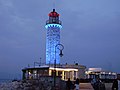
[edit]The city is divided into the upper and the lower section, connected with roads and broad stairs. The upper section (Ano Poli) is the older and the more picturesque; however, the lower section (Kato Poli) is laid out according to the 1858 city plan[citation needed], featuring a variety of squares. The most notable of these are the Psila Alonia and the Georgiou I Square. A number of notable neoclassical buildings are to be found, including the Apollon Theatre in Georgiou I Square, the City Hall, the headquarters of the Local Trade Association and the Court of Justice. A replica of Patras Lighthouse, the city's emblematic old lighthouse – which was at the dock of Ayios Nikolaos – rises at the end of Trion Navarchon street, near the temple of Saint Andreas.


In general, much of Patras's coastline is framed by roads and avenues running alongside; these include Dymaion Coast to the south and Iroon Polytechneiou Street to the north.
Main sights
[edit]


Patras and its region is home to various Ancient Greek, Roman and Byzantine Monuments, including the Roman Odeon of Patras, the Fortress of Rio and the Fortress (castle) of Patras.[13] More specifically, the main sights of the city are:
- The Patras Archaeological Museum focuses on the exhibition of various archaeological finds, from the Mycenaean to the Late Roman era, discovered in Patras and the wider Achaea region. The museum is housed in a modern and special architectural building designed by the architect Theophanis Bobotis.[14]
- The Mycenaean cemetery of Voudeni (Skioessa), 8 km (5.0 mi) from the center of Patras, is one of the most important sites of the Mycenaean world, showing active use for nearly five hundred years (1500–1000 BC). The site itself appears to have been inhabited from the Bronze Age until middle Roman times (1800 BC–AD 400).
- The Roman Odeon, the most significant ancient monument, is in the upper town and was built around 160 AD, in the reign of either Antoninus Pius or Marcus Aurelius. It has been restored and partially reconstructed, and is used as an open-air theatre for performances and concerts in the summer.
- The Roman Amphitheatre, near the Roman Odeon, in Ifestou street, dating from the 1st century AD, at a period of the biggest development of Roman Patras. Its area has been only partially excavated.[15]
- The Roman aqueduct[16] that led from the springs of Romanos to the acropolis. The aqueduct measured 6.5 km (4.04 mi) from the water cistern to the castle. For the greater part of this distance, the water passed through an underground channel, passing over valleys and gorges on carefully constructed archways, parts of which still stand, in the area of Aroi.[17]
Other Roman monuments include the ruins of the Roman stadium, remains of the Roman wall and a preserved bridge over the river Kallinaos.
- The medieval Patras Castle, in the ancient acropolis overlooking the city, was initially built in the 6th century AD by the Byzantine emperor Justinian, having many additions from the period of the Frankish and Venetian rule of the city, up to as far as the time of the Despotate of Morea and later the Ottoman Empire. Its current outline dates back to the second Venetian rule of the town (1687–1715). Today, is visiting and its interior is used as a public garden.
- The orthodox church of Saint Andrew of Patras was founded in 1908 by King George I and was inaugurated in 1974. It is dedicated to Saint Andrew, the patron of the city, and contains relics of the saint at the location of his crucifixion.[18] It is the second-largest temple of Byzantine style in the Balkans (after the Cathedral of Saint Sava in Belgrade). The central cupola is 46 m (151 ft) tall and is the base for a 5 m (16 ft) gold-plated cross and twelve smaller ones, symbolising Christ and the twelve apostles. A congregation of at least 5,000 can attend a sermon within the church.[19]
- The municipal Theatre Apollon, built in 1872 designed by architect Ernst Ziller. The building is characteristic of the 19th-century neoclassical style and is in the central square of the city.
- The Achaia Clauss wine industry and tasting center, which is on the outskirts in Petroto village. It was founded in 1861 by the Bavarian Gustav Clauss and is most famous for its Mavrodaphne.This place also houses the oldest wine of Greece, the old mavrodaphne of 1873.[citation needed]
- Residence of Kostis Palamas, a preserved neoclassical building on 241 Corinthou Street in the city center, where poet Kostis Palamas and the Italian painter Matilde Serao were born.[citation needed]
- Old Patras Hospital, a neoclassical building on Ano Poli, near Castle, designed by architect Christian Hansen.[citation needed]
- The Ottoman baths (16th century), still retain their initial use, and are one of the oldest Ottoman baths surviving in Europe.[20]
- The Patras Lighthouse, a reconstructed "Faros", a landmark of the city.
- The Agiou Nikolaou Stairs, Gerokostopoulou Stairs, Patreos Stairs and Trion Navarchon Stairs, outdoor grand staircases all over the centre of the city dividing the upper town from downtown.
- Rio-Antirrio Bridge, is a modern landmark of place and one of the world's longest multi-span cable-stayed bridges and longest of the fully suspended type.
Parks and squares
[edit]- Georgiou I Square, the central square and the heart of the city. It was named after King George I. The square's fountains were installed in 1875 at a cost of 70,000 drachmas each, a huge amount for the finances of Greece and Patra at the time. It was and continues to be the center of political and cultural life in the city, hosting all significant activities, political gatherings, rallies, cultural events and, most importantly for some, its carnival.
- Ethnikis Antistaseos ("National Resistance Square")

- Kapodistria Square in the district of Markato.
- Trion Symmachon Square bears the name of the three Allied Powers who fought in the Battle of Navarino; Britain, France and Russia. The square features a flower clock and links the Agiou Nikolaou pedestrian way with the seaside front and the dock of Agios Nikolaos.[citation needed]
- Psilalonia Square (Ψηλαλώνια or formally Πλατεία Υψηλών Αλωνίων) is one of Patras's most popular squares. It is 1.5 km (0.93 mi) from downtown Patras, next to the city's main north–south street, Gounari Street. It features a fountain, many sidewalks, palm trees and playgrounds. It is surrounded by several shops, restaurants and cafes and a number of modernist buildings. It was completed in the mid-to-late 19th century, when trees were added, along with neoclassical buildings. After World War II and the Greek Civil War, however, and through the 1960s and 1970s, most neoclassical buildings were replaced by eight-storey residential buildings. [citation needed] In the west end, a 15-metre-tall (49 ft) cliff overlooks the pedestrian Trion Navarchon Street, and offers a wide vista across the western Gulf of Patras, including the mountains of Aitoloakarnania.

The declaration of the revolutionaries of Patras (1821), engraved on a stele, Saint George Square - Saint George Square (Πλατεία Αγίου Γεωργίου). There is the monument to the fighters of 1821 on which is engraved the "declaration of the revolutionaries of Patras to the states of Europe" (22 March 1821).
- The Spinney of Patras (Δασύλλιο), is in a pine-tree-covered hill, which is dubbed "the Gulf of Patras's veranda" because of the panoramic view it offers. The spinney is ideal for recreational walks and jogging, with its specially formed paths and the shade offered by the tall trees.
- South Park of Patras

Waves Patras South Park


Architecture
[edit]

Patra is a relatively newly built city, as its medieval buildings were completely destroyed in the Greek War of Independence. The oldest surviving buildings (apart from ancient monuments and the castle) are the church of Pantocrator in Ano Poli and a residential building (Tzini's house) at the corner of Agiou Nikolaou and Maisonos street, built in 1832. The area on the south of the castle, around the Roman Odeon, the church of Pantokrator, in the Upper Town (Ano Poli), is the most appealing of the city, because of its status as the only area where construction height is limited to two-storey buildings.[21] Ιn Ano Poli is interesting the old school complex "Georgios Glarakis" work of the architect Georgios Petrιtsopoulos in 1931 which is built with stone and recently became a nice bioclimatic school.[citation needed] At the beginning of the 20th century, outside the school complex "Georgios Glarakis", line 2 of the tram ended, starting from Agios Dionysios, going up Dimitriou Gounari Street, passing behind the church of Pantanassa, entering Roman Odeon and finished outside the Glarakis school complex.[citation needed] Historical buildings and mansions of the city, apart Tzini's house, include also the Prapopoulos building, Golfinopoulos mansion (Alhambra), Perivolaropoulos mansion, Palamas house, while among the demolished after WWII were Tsiklitiras mansion, Kanellopoulos house, Chaidopoulos building, Frangopoulos house, Green mansion and Mineyko mansion.[22]
Districts and neighbourhoods
[edit]

Nowadays, the municipal units of Rio, Paralia, Messatida and Vrachnaiika have functionally become a part of the wider urban complex of Patras. Apart from the city center, the main districts of Patras are:
|
Patras municipal unit:
|
Rio municipal unit: |
Paralia: |
Messatida: |
Vrachneika: |
Geography
[edit]Patras is 215 km (134 mi) west of Athens by road, 94 km (58 mi) northeast of Pyrgos, 7 km (4.3 mi) south of Rio, 134 km (83 miles) west of Corinth, 77 km (48 miles) northwest of Kalavryta and 144 km (89 mi) northwest of Tripoli.
A central feature of the urban geography of Patras is its division into upper and lower sections. This is the result of an interplay between natural geography and human settlement patterns; the lower section of the city (Kato Poli), which includes the 19th-century urban core and the port, is adjacent to the sea and stretches between the estuaries of the rivers of Glafkos and Haradros. It is built on what was originally a bed of river soils and dried-up swamps. The older upper section (Ano Poli) covers the area of the pre-modern settlement, around the Fortress, on what is the last elevation of Mount Panachaikon (1,926 m (6,319 ft))[23] before the Gulf of Patras.
Hydrology
[edit]The largest river in the area is the Glafkos, flowing to the south of Patras. Glafkos springs in Mount Panachaikon and its water is, since 1925, collected in a small mountainous reservoir-dam near the village of Souli and subsequently pumped in order to provide energy for the country's first hydroelectric plant.[24] Other smaller streams are Charadros, Meilichos, Kallinaos, Panagitsa and the mountain torrent Diakoniaris.
Climate
[edit]Patras, like much of Western Greece, has a hot-summer Mediterranean climate (Köppen climate classification: Csa). It features the typical mild, wet winters and hot, dry summers, with spring and autumn being pleasant transitional seasons. Autumn in Patras, however, is wetter than spring. Humidity is high during the winter months and lower during the summer. Snowfall is extremely rare in coastal areas but is more common and abundant in the surrounding mountains. Patras falls in 10b hardiness zone.[25]
| Climate data for Patras Port (2008-2025) | |||||||||||||
|---|---|---|---|---|---|---|---|---|---|---|---|---|---|
| Month | Jan | Feb | Mar | Apr | May | Jun | Jul | Aug | Sep | Oct | Nov | Dec | Year |
| Record high °C (°F) | 24.9 (76.8) |
25.6 (78.1) |
25.1 (77.2) |
32.0 (89.6) |
37.2 (99.0) |
38.9 (102.0) |
40.8 (105.4) |
40.7 (105.3) |
35.7 (96.3) |
30.6 (87.1) |
28.1 (82.6) |
26.8 (80.2) |
40.8 (105.4) |
| Mean daily maximum °C (°F) | 14.2 (57.6) |
14.9 (58.8) |
16.2 (61.2) |
19.6 (67.3) |
23.1 (73.6) |
27.4 (81.3) |
30.4 (86.7) |
31.5 (88.7) |
27.4 (81.3) |
23.5 (74.3) |
19.8 (67.6) |
16.0 (60.8) |
22.0 (71.6) |
| Daily mean °C (°F) | 11.8 (53.2) |
12.4 (54.3) |
13.7 (56.7) |
16.9 (62.4) |
20.3 (68.5) |
24.6 (76.3) |
27.4 (81.3) |
28.4 (83.1) |
24.8 (76.6) |
20.8 (69.4) |
17.2 (63.0) |
13.6 (56.5) |
19.3 (66.8) |
| Mean daily minimum °C (°F) | 9.4 (48.9) |
9.9 (49.8) |
11.1 (52.0) |
14.1 (57.4) |
17.6 (63.7) |
21.7 (71.1) |
24.4 (75.9) |
25.2 (77.4) |
22.2 (72.0) |
18.0 (64.4) |
14.6 (58.3) |
11.2 (52.2) |
16.6 (61.9) |
| Record low °C (°F) | 1.2 (34.2) |
−0.9 (30.4) |
2.3 (36.1) |
8.2 (46.8) |
11.9 (53.4) |
15.0 (59.0) |
19.3 (66.7) |
20.1 (68.2) |
15.8 (60.4) |
9.2 (48.6) |
7.4 (45.3) |
3.0 (37.4) |
−0.9 (30.4) |
| Average rainfall mm (inches) | 108.1 (4.26) |
67.9 (2.67) |
71.2 (2.80) |
36.2 (1.43) |
22.4 (0.88) |
15.5 (0.61) |
5.0 (0.20) |
6.8 (0.27) |
41.5 (1.63) |
84.0 (3.31) |
111.1 (4.37) |
116.0 (4.57) |
685.7 (27) |
| Source 1: National Observatory of Athens Monthly Bulletins (Jan 2008 - Jan 2025) [25] | |||||||||||||
| Source 2: Patras N.O.A station [26] | |||||||||||||
Ecology
[edit]Of great importance for the biological diversity of the area and the preservation of its climate is the swamp of Agyia, a small and coastal aquatic ecosystem of only 30 ha (74 acres), north of the city centre. The main features of this wetland are its apparent survival difficulty, being at the heart of a densely populated urban centre that features a relatively arid climate and its admittedly high level of biodiversity, with over 90 species of birds being observed until the early 1990s, according to a study by the Patras Bureau of the Hellenic Ornithological Society.[27]
Government
[edit]
Patras is the regional capital of Western Greece and the capital of the Achaea regional unit. Since 2011, the city is also the capital of the administrative division, which includes (along with Western Greece) the regions of Peloponnese and the Ionian Islands.
Municipality
[edit]

The current municipality of Patras was formed at the 2011 local government reform by the merger of 5 municipalities that made up the Patras Urban Area. These former municipalities, which became municipal units, are:[28] (in parentheses their population, 2011)
- Messatida (13,852)
- Paralia (9,987)
- Patras (170,896)
- Rio (14,034)
- Vrachnaiika (4,627)
The municipality has an area of 334.858 km2 (129 sq mi), the municipal unit 125.420 km2 (48 sq mi).[29]
Demographics
[edit]
The following list presents demographic data on the municipality of Patras over the years 2012.
| Year | Pop. | ±% |
|---|---|---|
| 1853 | 15,854 | — |
| 1861 | 18,342 | +15.7% |
| 1870 | 16,641 | −9.3% |
| 1879 | 25,494 | +53.2% |
| 1889 | 33,529 | +31.5% |
| 1896 | 37,985 | +13.3% |
| 1907 | 37,728 | −0.7% |
| 1920 | 52,174 | +38.3% |
| 1928 | 61,278 | +17.4% |
| 1951 | 87,570 | +42.9% |
| 1961 | 96,100 | +9.7% |
| 1971 | 112,228 | +16.8% |
| 1981 | 142,163 | +26.7% |
| 1991 | 161,782 | +13.8% |
| 2001 | 171,616 | +6.1% |
| 2007 | 180,000 | +4.9% |
| 2011 | 213,984 | +18.9% |
| 2021 | 215,922 | +0.9% |
| Source: [30][31][32] | ||
From 2011 on, can data also reflect the city's urban area population, as all the municipalities that made up the Patras Urban Area were joined to create the new larger Patras municipality, formed at the 2011 local government reform.
Infrastructure
[edit]Heavy infrastructure works performed in the 2000s include the Peiros-Parapeiros dam (to provide water supply for Patras and surrounding towns)[33] and a "small industries" park that will be constructed next to the Glaykos river and provide an easy connection with the new port.
The city is one of the main Greek internet and GRNET hubs and is connected with high speed lines to Athens as part of the backbone. A metropolitan optical network will be deployed in the city, with a total length of 48 km (30 mi).[34]
Two major state hospitals operate in the city: the Agios Andreas Hospital is the oldest of the two; and General University Hospital of Patras. There also exists two smaller state hospitals, Karamandanio - a children's hospital, and the Center of Chest Diseases of Southwestern Greece. A large range of private hospitals and clinics operate in parallel.
Numerous art venues[35] and an ultra-modern archaeological museum[36] were constructed for the needs of European Culture Capital designation. The cultural and educational facilities include the Municipal Library, the university libraries, many theatres, the municipal art gallery,[37] the University of Patras's facilities, the Hellenic Open University and the Technical Institute of Patras. A number of research facilities are also established in the university campus area.
Economy
[edit]
.png)

The economy of the city largely depends on its service sector.
The area still retains some of its traditional winemaking and foodstuff industries as well as a small agricultural sector. [citation needed] Major businesses in Patras include:
Services sector
[edit]Most Greek banks have their regional headquarters for Western Greece in Patras.
In 2010, the new Infocenter of Patras was established, inside the neoclassical building of the former market "Agora Argyri", in Ayiou Andreou street. The building includes a conference hall, along with multi-purpose and exhibitional spaces.[38] The regional unit of Achaea has about 4,800 hotels rooms and in 2006, 286,000 tourists, mainly from Greece, stayed in the area for a total of 634,000 days.[39][40]
Manufacturing sector
[edit]Patras still has a large manufacturing base for a variety of industries.
The Titan Cement Company operates a large cement factory, with a private port, in Psathopyrgos, a suburb of Patras.
Patras hosts several timber manufacturing companies, and a wood distribution center of Shelman. The largest local company is Abex.[41] The paper sector is also active including a paper factory belonging to Georgia-Pacific (Delica) and two important Greek companies, Elite and El-pack, headquartered in the city.
Patras has several packing and industrial equipment companies. The most important of them are the local Antzoulatos and the multinational Frigoglass, a subsidiary of Coca-Cola, headquartered in the suburbs of Patras. Ideal Bikes is the leading bike producer in Greece, with large export activities.
The once omnipresent textile industry of the city is now almost defunct after the shut-down of the huge factory of Peiraiki-Patraiki (Πειραϊκή-Πατραϊκή), followed by numerous smaller textile industries. The remains of the facilities still cover hundreds of acres in the south side of the city.
Food
[edit]
Some of the largest industries in the city belong to the soft drinks and drinks sector. There are factories from Coca-Cola HBC and Athenian Brewery established in area, along with the facilities of the largest local company in soft-drinks production, Loux (ΛΟΥΞ). The city is also home to many leading Greek wineries and distilleries, among them the venerable Achaia Clauss and Parparoussi located in Rio. In the food sector, Friesland Foods, through the local subsidiary NoyNoy, operates a new yogurt factory in the city's industrial area. Patras is also home to important fish-farming companies (Andromeda, Nireus).[42][43] ECOFEED operates in the industrial zone of Patras, the largest fish-feeds factory in the Mediterranean.[44] The city hosts the second-largest flour-mills in Greece, Kepenou-Mills.[45]
Energy sector
[edit]
Acciona has completed the largest wind park in Greece, on the Panachaiko mountain, overlooking the city of Patras.[46] The Public Electric Company, operates a small hydroelectric plant on river Glafkos.[47]
IT sector
[edit]Intracom (Greece's largest multinational provider of telecommunications products) facilities in Patras house the offices of Telecommunications Software Development, Terminal Equipment Design, Development Programmes, and Support Services divisions. Expansion plans have recently been completed.[48] INTRASOFT, another core company of INTRACOM holdings group, has recently (2018) began operations in Patras and it is expected to expand its activities in 2019.[49] The Corallia Innovation Hub, Innohub hosts many companies focusing on Microelectronics.[50] Among them one of the largest is the multinational software company Citrix Systems which operates a R&D centre with more than 100 computer scientists and engineers. Another company that maintains an R&D center in Patras is Dialog Semiconductor, a UK-based manufacturer of semiconductor-based system solutions. Another large Greek IT company, Unisystems announced recently (October 2018) the signing of a cooperation agreement with the Patras-based IT company Knowledge SA, that lays the foundation for the establishment of a Remote Development Center in Patras.[51]
Research and technology
[edit]Patras Science Park is an incubator for many small but upcoming technology companies.[52][53] CBL Patras, a global manufacturer of specialty chemicals and active pharmaceutical ingredients, is a startup from a professor of the University of Patras.
Vianex, owned by Pavlos Giannakopoulos, has its largest production facilities in the industrial area of the city.[54]
Nobacco, a Greek electronic cigarette brand, works mainly with cooperation with the university of Patras.
There has been a significant development in the R&D sector, in the last few years, as a result of the many research institutes and the university impact in the area. The Computer Technology Institute and the Industrial Systems Institute[55] of Greece are headquartered in Patras. The city is also a host to the FORTH-ICE-HT (Institute of Chemical Engineering & High Temperature Chemical Processes)[56] and the Institute of Biomedical Technology.[57]
Media
[edit]|
Press
|
Television
|
Culture
[edit]


The cultural activity of Patras includes the Patras International Festival (with various artistic activities, mainly in the fields of theatre and music), the Patras Carnival and the Poetry Symposium.[58]
The city hosts many museums, including the Patras Archaeological Museum the History and Ethnology Museum, the Folk Art Museum, the Press Museum and the Technology Museum, the latter in the campus of Patras University.
Other cultural institutes are: the Visual Arts Workshop, the icon painting school, the Carnival Float Workshop, the Municipal Library, the Municipal Gallery, along with many private art galleries. The architectural heritage of the city is dominated by neo-classicism, but also includes structures from other periods. Patras is also a pilot city of the Council of Europe and EU Intercultural cities programme.
Theatrical tradition and music
[edit]The Patras Municipal and Regional Theatre was founded in June 1988, having as its main stage the city's landmark, the Apollon Theatre. Throughout its existence it has mounted critically acclaimed performances ranging from ancient dramaturgy and modern Greek, to international repertoire. The theatre cooperates with other theatrical groups, such as the Viomichaniki (Industrial) group and the Michani Technis (Art Machine).
The Roman Odeon hosts ancient dramas in the summer, while the Pantheon theater, the Art Factory, the Lithographeion and the Agora theatres provide additional venues. The International Festival of Patras takes place every summer, with a program consisting mostly of plays—both ancient drama and modern theatre—as well as various musical events.
Patras has also a very strong indie rock scene [citation needed] with critically acclaimed bands such as Raining Pleasure, Abbie Gale, Serpentine, Doch an Doris and others.
Carnival
[edit]The Patras Carnival (Patrino Karnavali) is the largest event of its kind in Greece and one of the biggest in Europe, with a heritage reaching back 160 years. The events begin on 17 January each year (St. Anthony's nameday), and last until Clean Monday. Hundreds of thousands of visitors from all over the world gather each year for its festivities, which include large events such as the mammoth sized parades of the last two weeks (up to 50.000 participants each), the Hidden Treasure Hunt (Krymmenos Thisavros), concerts, expositions, theatrical, musical, comedy and other artistic contests and events. Patras Carnival was originally introduced as ball-masquee' events in 1835 by the Italian origin merchant family of Moretti.
European Capital of Culture 2006
[edit]
Patras was chosen by the European Commission to be the European Capital of Culture for the year 2006. The concept of the event revolved around the main theme of "Bridges" and "Dialogues", drawing benefit from the city's rich history and its position as a "Gate to the West", to underline the essence of the productive interaction of culture and civilisations in Europe. The EU Commission found Patras's plans very ambitious and also commented that a successful hosting of the title by a medium-sized city would make it possible to redefine the meaning of the term Cultural Capital.
The Selection Panel for 2006 noted in its final report:
The current cultural activity of the city includes the Patras International Festival (various artistic activities, mainly in the field of music), the Patras Carnival and the Poetry Symposium (organised each year for the 25 years by an ad hoc committee at the University of Patras).[58] The Patras 2006 proposal focuses on two central ideas: "bridges" and "dialogues". Cultural managers from Patras and the general public will be involved in developing these ideas. Further, four poles/programmes of cultural attraction will be developed. The first, "A city for Europe", will relate to the architectural heritage, the industrial revolution and similar subjects. "The counterpart cities" programme will be developed in the fields of human and social sciences and in diverse artistic fields. "The three sea battles" will present a cultural programme focusing on peace and understanding. The last theme, "The many homelands", is directly linked to the etymology of the name of the city. This programme will among other things concentrate on art workshops, the transfer of know-how, way of life and entertainment.[59][60]
In 2006 various cultural events were held in the context of the European Capital of Culture. Among the artists presenting their work in Patras were: Gary Burton, Maxim Shostakovich, Ian Anderson - with the Patras Municipal Orchestra, Jean Louis Trintignant, Roberto Benigni, Eros Ramazzotti and José Carreras.[61] With the completion of the Capital of Culture programme, a part of the old Ladopoulos factory was renovated to host exhibitions, a small theatre (named the Art Factory), was built and a number of neoclassical buildings around the city were renovated as part of a plan to preserve the city's architectural heritage and link it to its cultural life. The new Archaeological museum was completed in 2009. Its globe-like roof and modern architectural design enhances the town's northern entrance, taking its place among the other city landmarks.
Sports
[edit]
.JPG)

.jpg)
Patras has several sports facilities and important teams in almost all the major Greek leagues. Panachaiki Gymnastiki Enosi, Apollon Patras, E.A. Patras and NO Patras are historically the major sports clubs based in the city, specialising in football, basketball, volleyball and water polo. The city's national stadium, Pampeloponnisiako Stadium, was renovated and expanded in 2004.[62] Since 2009, a new event, the Patras International Circuit Kart takes place every September, turning the city streets into a circuit.
The city has hosted several international sports events, such as the 1995 Basketball Under-19 World Cup (preliminaries), the 1995 Men's European Volleyball Championship (preliminaries), the 1997 Rhythmic Gymnastics European Championships, the 2001 World Wrestling Championships, the EuroBasket 2003 Women, the 2003 International Children's Games, a group stage of the football tournament in the 2004 Olympic Games, the 2007 World Rhythmic Gymnastics Championships, the 2008 World Deaf Football Championships and the 2019 Mediterranean Beach Games.
| Club | Sport | Current League | Venue | Location | Capacity | Established | Highest ranking |
|---|---|---|---|---|---|---|---|
| Panachaiki G.E. | Football | Super League 2 | Kostas Davourlis Stadium | Agyia | 11,321 | 1891 | 4th (1973) |
| Volleyball | Volleyball League | Panachaiki Indoor Arena | 500 | 1928 | 8th (2016) | ||
| Apollon Patras | Basketball | Basket League | Apollon Patras Indoor Hall | Perivola | 3,500 | 1926 | 6th (1986) |
| E.A. Patras | Volleyball | A2 Ethniki | EAP Indoor Hall | Agios Dionysios | 2,200 | 1927 | Champion (1938) |
| NO Patras | Water polo | A1 Ethniki | NOP Aquatic Centre | Akti Dymeon | 3,000 | 1929 | Champion (x 8) |
| Thyella | Football | Delta Ethniki | Fotis Aravantinos Stadium | Glafkos | 3,000 | 1930 | 5th (B Ethniki) |
| Olympiada Patras | Basketball Volleyball |
A2 League A2 Ethniki |
Olympiada Indoor Hall | Taraboura | 2,500 | 1961 | 8th (2002) 10th (2007) |
| Promitheas Patras | Basketball | Basket League | Dimitris Tofalos Arena | Bozaitika | 4,500 | 1985 | 2nd (2019) |
| Ormi Patras | Handball | A1 Women's | National Indoor Hall | Koukouli | 1,000 | 2003 | Champion (x 6) |
| NE Patras | Water polo | A2 Ethniki A1 Women's |
Antonis Pepanos Aquatic Centre | Koukouli | 4,000 | 2006 | 4th (2009) 4th (x 3) |
Religion
[edit]
The city is the seat of the Greek Orthodox Metropolis of Patras. As in the rest of the country, the largest denomination is the Orthodox Church, which represents the majority of the population. There is also a sizeable community of Roman Catholics and an Anglican church, part of the Church of England's Diocese in Europe.[63]

The most significant church in the city is the Orthodox Cathedral Church of Saint Andrew, in the south west of the city center. The construction of the church began in 1908 under the supervision of the architect Anastasios Metaxas, followed by Georgios Nomikos. It was inaugurated in 1974. It is the largest church in Greece and the third-largest Byzantine-style church in the Balkans, after the Cathedral of Saint Sava in Belgrade and Alexander Nevsky Cathedral in Sofia. It holds relics of Andrew the Apostle, which were returned to the city of Patras from St. Peter's Basilica, Rome in September, 1964, on the orders of Pope Paul VI. Other historical churches of the city are:
- The church of Pantokrator (1832), the old cathedral, in the upper town district
- The Metropolitan Church of Patras (1846) dedicated to Panayia Evangelistria, on Maisonos Street
- The church of Ayios Nikolaos (1885), next to the steps of Ayiou Nikolaou street
- The church of Pantanassa (1859), Ipsilanti street
- The church of Ayios Dimitrios, in the upper town district
- The Catholic Church of Saint Andrew (1937), on Maisonos Street
- The Anglican church of Saint Andrew (1878), on Odos Agiou Andreou [63]
- The old church of Ayios Andreas (1836–1843), next to the new temple. Situated in the site of Andrew the Apostle's martyrdom, it was built in basilica style by the architect Lysandros Kaftanzoglou.
- Girokomiou Monastery (Holy Monastery of Panagia Girokomitissa): This historic monastery was founded in the 10th century AD in the eastern part of Patras. It was built on the ruins of an ancient temple of the goddess Artemis and for this reason the monastery's cathedral is dedicated to Saint Artemiοs. It is obvious that the monastery maintained a nursing home during the Byzantine period.
- Monastery of Agios Nikolaos Bala (Paleomonastiro): Ιt is built at the foot of Panachaikos, at an altitude of 500 meters, near the village of Bala, 8 km northeast of Patras. This historic and picturesque monastery was founded at the end of the 17th century. A marble slab on the north outer side of the Cathedral tells of the restoration of the monastery in 1693. The monastery has also recently been renovated, numbering nineteen nuns and celebrating 6 December and 10 May.
The patron saint of Patras is Saint Andrew the Apostle. One of the modern saints is Saint Gervasios Paraskevopoulos of Patras (2023)
Jewish community
[edit]There is a district of the city named Evreomnimata, where the old Jewish cemetery was located.[citation needed]
Cuisine
[edit]
Local specialities include:
- Bourjeto (similar to the Corfiot Bourdeto)
- Tilichtária Patrina, pork meat dish
- Galatopita
- Tiganites (type of pancakes)
- Patrina loukoumia
- Rodozachari
- Mavrodafni wine
- Tentura drink
People
[edit]

The city has a significant political history in modern Greece; famous politicians from Patras include the prime ministers Dimitrios Gounaris, the main leader of the anti-venizelist party in the 1910s, Stylianos Gonatas, a high-ranking officer, politician and one of the leaders of the "1922 Revolution", Andreas Michalakopoulos, a prominent liberal party cadre, foreign minister and prime minister, and Dimitrios Maximos, a distinguished economist, minister and finally prime minister in the civil war era. More recent figures include the Papandreou family, arguably the most influential in post World War II Greece, Panagiotis Kanellopoulos, the last democratically elected head of government before the establishment of the 1967 junta, and Costis Stephanopoulos, the former president of the Hellenic Republic.
|
Politics
|
Sports
|
Culture/Arts
|
Economy/Other
|
Transport
[edit]


Seaport
[edit]The city has always been a sea-trade hub because of its strategic position. The port manages more than half of the foreign sea-passenger transportation in Greece,[67] and has excellent car-ferry links with the Ionian islands and the major Adriatic ports of Italy. Additionally, a new port was built in the southern section of the city to accommodate the increased traffic and relieve the city centre from port operations.[68] In 2011, this port went into operation. Ferries to Italy now dock there.[69]
The port is connected by a number of daily routes to the Ionian islands Kerkyra, Kefallonia, to the port of Igoumenitsa and to the Italian cities Ancona, Bari, Brindisi, Trieste and Venice.[70]
Roads
[edit]A newly constructed, 20-kilometre (12 mi) ring road (the Bypass of Patras) was first opened in 2002 in order to alleviate heavy traffic throughout the city.[71] A mini ring road (known as the "Mini bypass" of Patras) is now complete (2019), alleviating heavy traffic-related problems in the city centre.[72] The mini-bypass is a two lanes mototway bridging the northern city entrance at the Zavlani neighborhood to the eastern entrance at the Aroi, Synora and Upper town (Ano poli) neighborhoods reducing the city centre crossing time to less than 4 minutes drive.
Two large highways were also constructed, connecting the seacoast and the new port with the Bypass of Patras. The first is over the small Diakoniaris river (from Eleftheriou Venizelou street until the Bypass'es exit in Eglykada), while the second consists of two roads, 4 km (2 mi) each, that run in parallel with the Glafkos river entering at the city' s New Port.[73][74] Another project was completed recently, leading to an additional entrance to the downtown area after expanding and widening Kanakari street. This work led to a fast, direct connection of the city's mini bypass road with the city centre.
The highway connection with Athens was recently[when?] upgraded to a 220 km closed motorway (Olympia Odos), with a speed limit of 130 km/hour, reducing the transit time to 1 hour and 45 minutes. The motorway was connected to the Large bypass highway and was extended all the way to Pyrgos in July 2025.[75] Patras will eventually be a central hub of the A5 and A8 motorways, intended to bridge western Greece from Kalamata to Ioannina and the Kakavia border station. The Rio-Antirio bridge is north of the city and links the Peloponnese to mainland Greece. It was completed in August 2004.
Additional work was recently announced to begin in 2023 in order to connect via highway the Rion Antirrion bridge with Nafpaktos, Itea, Amfissa and Lamia. This project is expected to reduce the trip to Lamia to 90 minutes and its completion is expexted in 2025.
Patras is bypassed by the Olympia Odos (A8) motorway, which is also part of the E55 route that crosses the Rio-Antirio Bridge, dominating the sealine across the Gulf of Corinth.
- GR-5/E55
- GR-8/E55 and E65 (partly Panepistimiou Street)
- GR-8A
- GR-9/E55 (partly Akti Dymaion)
- GR-33 (partly Kalavryton, Georgiou Papandreou Street and Akrotiriou)
- Bypass of Patras
Rail
[edit]A rudimentary single, narrow-gauge railway track crosses the city and connects it to Rio. In the past regional rail links were provided by the Hellenic Railways Organisation, connecting Patras to Athens and Piraeus as well as to Pyrgos and Kalamata.[70] OSE announced the suspension of all the rail service in the Peloponnese in January 2011[76] so today the railway track is in use only by suburban trains that connect Patras with the adjacent villages of Rio and Agios Vasileios.
The central passenger train station of Patras which is a small building constructed in 1954, lies to the west of the downtown area, between Othonos-Amalias Avenue and the north port. The main freight station of Aghios Andreas lies further to the south, next to the homonymous church and it is not in use any more. Finally, the old depot of Aghios Dionysios, consisting of about ten tracks, offers basic turntable and roundhouse facilities; it is about 400 m (1,312.34 ft) long.
A new double standard gauge railway line, the Athens Airport–Patras railway, is under construction and will link Patras to Korinth and further to Athens. The construction works are currently in progress close to the suburbs of Patras, but the remaining few kilometres till the city centre and the new port are still under study because of various financial and technical problems.[77] As of 2020, the new railway reaches Aigio, 40 kilometres (25 mi) east of Patras.
Public transport
[edit]Patras is served by buses. There are two transport lines to and from the University of Patras and some nearby lines to city suburbs such as Saravali, Glafkos, and Paralia. All the urban bus lines are about 40, with three numbers.[clarification needed]
Commuter rail services have recently been established by Proastiakos, with one line currently connecting Patras, Rio, and Agios Vasileios.
Regional bus links are provided by the KTEL bus company and connect the city to most of Greece.
Air
[edit]Seasonal civilian air transport is provided by the military Patras Araxos Airport, about 40 km (25 mi) from the city's centre.
International relations
[edit]Patras is a pilot city of the Council of Europe and the European Commission Intercultural cities programme.[78]
Twin towns — sister cities
[edit]
|
|


Patras was selected as main motif for the €10 Greek Patras 2006 commemorative coin, minted in 2006. This coin was designed to commemorate an event signaling an enlightened course for Patras and serving as a reminder of the way in which culture can stimulate the economy and promote development, when Patras was appointed European Capital of Culture. On the obverse is the logo for Patras 2006 around the words "European Capital of Culture".
Consulates
[edit]The city hosts consulates from the following countries:[citation needed]


Gallery
[edit]-
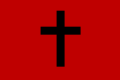 The flag raised by Andreas Londos in Patras at the outbreak of the Greek War of Independence.
 -
 Surrender of Patras to General Schneider by Hippolyte Lecomte.
 -
 Postcard with King George I Square in the late 19th century.
 -
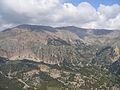 A view of Panachaiko mountain.
 -

-
 Pantanassa church
 -
 Ruins of the Roman and Medieval Aqueducts
 -
 Part of the Roman bridge over river Kallinaos
 -
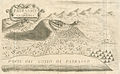 Illustration of Patrasso, 1687
 -

-
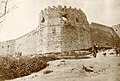 Patras Castle, 1890
 -
 Fountain in Georgiou I Square
 -
 Alhambra mansion, Trion Navarchon Street
 -
 Pantokrator church, uptown district
 -
 Catholic Church of Saint Andrew
 -
 The courthouse
 -
 The house where Kostis Palamas and Matilde Serao were born.
 -
 Tzini's house (1832), Maisonos & Agiou Nikolaou street
 -
 Prapopoulos building
 -
 Villa Crove at the old English (Egglezika) district of Patras
 -
-
 Entrance of Agios Nikolaos (Bala) Monastery (Paleomonastiro)
 -
 View to the Gulf of Patras
 -
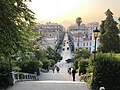 City view from Agiou Nikolaou steps
 -
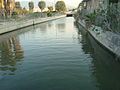 A view of Panagitsa (stream) in 2011.
 -
 The castle of Patras, photograph of the 19th century


_connecting_Patra_with_Aigio,_the_best_preserved_two-arched_bridge_in_Greece,_Patras,_Greece_(14331225575).jpg)


_(2).jpg)


.jpg)


See also
[edit]References
[edit]- ^ romanized: Pátrai, Ancient Greek: [pátrai̯], Katharevousa: [ˈpatre]
- ^ [ˈpatrae̯]
- ^ Municipality of Patras, Municipal elections – October 2023, Ministry of Interior
- ^ "Eurostat – Data Explorer". appsso.eurostat.ec.europa.eu. Archived from the original on 1 November 2016. Retrieved 10 February 2021.
- ^ "Patras". Dictionary.com Unabridged (Online). n.d.
- ^ S.L.U, Course Guru. "Όλα τα 3 Πανεπιστήμια σε Πάτρα | Κατατάξεις & Αξιολογήσεις 2023". UniversityGuru (in Greek). Archived from the original on 14 June 2023. Retrieved 14 June 2023.
- ^ Mansfield, Paul (29 January 2006). "Party town gets a culture kick". The Guardian. Archived from the original on 18 May 2017. Retrieved 6 September 2017.
- ^ Patras. From Antiquity to Today, ed. by Triantafyllos E. Sklavenitis and Konstantinos Sp. Staikos (Athens: Kotinos A.E. Editions, 2005)
- ^ Encyclopaedia of Islam s.v. Baliabadra
- ^ Constantine David (2011). In the Footsteps of the Gods: Travellers to Greece and the Quest for the Hellenic Ideal. Tauris Parke Paperbacks. p. 169. ISBN 9780857719478.
Readers were thus enabled to follow and visualize the campaign as it was reported, almost daily but after a time-lag of about four weeks, in despatches from Italy and Turkey. They read accounts — as confused, contradictory, exaggerated or downright false as such accounts generally are — of the Sieges of Coron and Modon, of the taking and Ioss of Mistra, the rout at Tripolis and the victory off Tchesmé. And it was repeatedly noted that both sides were conducting the war with great savagery: ' the ravages committed by both armies ... are dreadful ... horrid cruelties perpetrated in cold blood, shocking to human nature, 'the war is carried on with much Bloodshed and Horror'. When the Greeks got the upper hand they settled old scores; when the Turks and Albanians reasserted themselves they were merciless: recapturing Patras, they left scarcely anyone alive.
- ^ Strategus Makrygiannis. ""Memoirs", Book A, Chapter I, Athens, 1849". Archived from the original on 13 July 2006. Retrieved 2 October 2012.
- ^ Triantafyllou, Κ.Ν., Historic Lexicon of Patras
- ^ Kounenaki Pegy. "19th Century Patras: how the character of the city changed with the development of the port after 1828". News.kathimerini.gr. Archived from the original on 15 February 2012. Retrieved 2 October 2012.
- ^ Thomopoulos
- ^ "Contents". Archived from the original on 26 March 2012. Retrieved 10 February 2007., retrieved 9 February 2007
- ^ ΕΤ1 TV, broadcast "Mεταμουσείο", The New Archaeological Museum of Patras,18/03/2013| http://9dim-patras.ach.sch.gr/images/2018-19/2018_11_25/video/mouseio.mp4 Archived 29 January 2020 at the Wayback Machine
- ^ "RC - Patras, Restoration and preservation of the Roman amphitheatre of Patras". Iiinstitute.nl. Archived from the original on 27 March 2012. Retrieved 2 October 2012.
- ^ Mentzini, Marilena. "Patras' Roman Aqueduct -Restoration". Archived from the original on 1 September 2021. Retrieved 6 September 2017.
- ^ "Ρωμαϊκό Υδραγωγείο". e-patras.gr. Archived from the original on 30 July 2012. Retrieved 2 October 2012.
- ^ "Info about St.Andrew Church". InfoCenterpatras.gr. Archived from the original on 5 October 2011. Retrieved 2 October 2012.
- ^ "Άγιος Ανδρέας". e-patras.gr. Archived from the original on 2 August 2012. Retrieved 2 October 2012.
- ^ "Πάτρα: Το αρχαιότερο σε λειτουργία χαμάμ της Ελλάδας - Εκεί που εξαγνίζονται ψυχές και σώματα ανελλιπώς απο τον 17ο αιώνα!". THE BEST. 23 February 2015. Archived from the original on 23 September 2019. Retrieved 23 September 2019.
- ^ "WESTPOINT - Mια αρχιτεκτονική βόλτα στην Πάτρα". Westpoint.gr. Archived from the original on 26 March 2012. Retrieved 2 October 2012.
- ^ "Αρχιτεκτονικοί θησαυροί της Πάτρας που έγιναν πολυκατοικίες". 3 March 2019. Archived from the original on 6 August 2020. Retrieved 30 March 2020.
- ^ "Region of Western Greece: Geography". Ditikiellda-region.com. Archived from the original on 27 September 2007. Retrieved 9 February 2007.
- ^ Thomopoulos, St. N, History of the City of Patras from Antiquity to 1821, Patrai 1952, (ed. Triantafyllou, K.N.)
- ^ a b "Meteo.gr - Προγνώσεις καιρού για όλη την Ελλάδα". Archived from the original on 2 February 2023. Retrieved 13 January 2024.
- ^ "Latest Conditions in Patras". Archived from the original on 11 July 2024. Retrieved 13 January 2024.
- ^ Chris K. "Birds, birding and conservation in Greece". Hellenic Ornithological Society. Archived from the original on 25 December 2008. Retrieved 5 January 2009.
- ^ "ΦΕΚ A 87/2010, Kallikratis reform law text" (in Greek). Government Gazette. Archived from the original on 18 July 2010. Retrieved 7 September 2021.
- ^ "Population & housing census 2001 (incl. area and average elevation)" (PDF) (in Greek). National Statistical Service of Greece. Archived (PDF) from the original on 21 September 2015. Retrieved 15 November 2016.
- ^ 1928–1980 statistical data are from: "The population of Greece in the second half of the 20th century". Hellenic Republic. National Statistical Service of Greece. Athens 1980 & "Statistical Yearbook of Greece" Hellenic Republic. National Statistical Service of Greece. Athens 1980
- ^ Population data from 1853 to 1920 are cited from: Kosta N. Triantafyllou, "Istorikon Lexikon ton Patron: Istoria tis poleos ton Patron apo arxaiotaton xronon eos simeron kata alphavitikin eidologikin katataksin" 3rd edition, Patrai 1995
- ^ Data on municipal and urban population refer to permanent population and are taken from: the "2001 Census" of the National Statistical Service of Greece Archived 27 February 2011 at the Wayback Machine
- ^ Loizos Bailas, Mixalis Kaplanidis. "MHXANIKH AE". Michaniki.gr. Archived from the original on 28 September 2007. Retrieved 5 January 2009.
- ^ "Metropolitan Optical Network of Patras". Ru6.cti.gr. Archived from the original on 16 January 2009. Retrieved 2 October 2012.
- ^ "European Culture Capital, Patras Venues". Patras2006.gr. Archived from the original on 23 July 2007. Retrieved 2 October 2012.
- ^ "Ktizon, Presentation of the Archaeological museum of Patras". Ktizon.blogspot.com. 28 March 2007. Archived from the original on 10 January 2010. Retrieved 2 October 2012.
- ^ "Cultural Facilities in Patras". Infocenterpatras.gr. Archived from the original on 5 October 2011. Retrieved 2 October 2012.
- ^ "Παραδίδεται το έργο της ανάπλασης της Αγοράς Αργύρη - Οικονομία". Thebest.gr. 19 January 2010. Archived from the original on 23 March 2012. Retrieved 2 October 2012.
- ^ "Greek Statistics Organization, Tourism data - 2006" (PDF).[permanent dead link]
- ^ "Greek Statistics Organization, Tourism data - 2006" (PDF).[permanent dead link]
- ^ "Abex Timber Manufacturing". Abex.gr. Archived from the original on 3 September 2011. Retrieved 2 October 2012.
- ^ "Andromeda Aquaculture". Andromeda aquaculture.gr. Retrieved 2 October 2012.[permanent dead link]
- ^ "Nireus Aquaculture". Nireus.gr. Archived from the original on 16 March 2011. Retrieved 2 October 2012.
- ^ "λκμκ αρχιτέκτονες μηχανικοί - Βιομηχανικοί χώροι - Εργοστάσιο Παραγωγής Ιχθυοτροφών στην ΒΙ.ΠΕ. Πατρών". Lkmk.gr. Archived from the original on 22 December 2008. Retrieved 2 October 2012.
- ^ "Kepenou mills". Tovima.dolnet.gr. Archived from the original on 7 December 2008. Retrieved 2 October 2012.
- ^ "Acciona Wind Parks". Acciona-energia.com. Archived from the original on 14 January 2009. Retrieved 2 October 2012.
- ^ "Glafkos Hydroelectric Power Station". Dei.gr. Archived from the original on 5 December 2008. Retrieved 2 October 2012.
- ^ "Intracom Telecom: Infrastructure". Intracom-telecom.com. Archived from the original on 2 November 2007. Retrieved 2 October 2012.
- ^ "Intrasoft launched the new branch operation in the suburbs of Patras, an article in newspaper "GNOMI" (13 November 2018)". Archived from the original on 18 May 2019. Retrieved 18 May 2019.
- ^ "Corallia Innohub". Archived from the original on 29 March 2014.
- ^ "Uni Systems opens Remote Development Center in cooperation with Knowledge Broadband Services | Unisystems". www.unisystems.gr. Archived from the original on 18 May 2019. Retrieved 18 May 2019.
- ^ "Patras Science Park - Hosted Companies". Patras Science Park. Archived from the original on 5 December 2008. Retrieved 2 October 2012.
- ^ "Awards of the 7th International Venture Capital Forum" (in Greek). Archived from the original on 5 December 2008. Retrieved 2 October 2012.
- ^ "Vianex facilities in Patras". Vianex.gr. Archived from the original on 8 August 2007. Retrieved 2 October 2012.
- ^ "Industrial Systems Institute". Isi.gr. Archived from the original on 27 September 2007. Retrieved 2 October 2012.
- ^ "Institute of Chemical Engineering & High Temperature Chemical Processes". Iceht.forth.gr. Archived from the original on 8 March 2022. Retrieved 2 October 2012.
- ^ "Institute of Biomedical Technology". Inbit.gr. Archived from the original on 12 July 2006. Retrieved 2 October 2012.
- ^ a b "Συμπόσιο Ποίησης". Poetrysymposium.gr. 18 July 2012. Archived from the original on 30 September 2013. Retrieved 2 October 2012.
- ^ "Patras Final Report" (PDF). Europa.eu.int. Archived from the original (PDF) on 25 March 2006. Retrieved 2 October 2012.
- ^ "Patras Future Report". Europa.eu.int. Archived from the original on 4 May 2006. Retrieved 2 October 2012.
- ^ "Πολιτισμός". e-patras.gr. Archived from the original on 28 July 2012. Retrieved 2 October 2012.
- ^ George Xenides. "Παμπελοποννησιακό Εθνικό Στάδιο Πατρών". Stadia.gr. Archived from the original on 9 June 2011. Retrieved 2 October 2012.
- ^ a b Diocese in Europe, Greece: Patras Archived 1 November 2020 at the Wayback Machine, accessed 5 September 2020
- ^ "Fashion for the body all at the right price". 13 September 2022. Archived from the original on 15 November 2023.
- ^ "Nikos Apostolopoulos biography". Archived from the original on 15 November 2023.
- ^ Fallon, James (7 April 1995). "After Sculpture's success, Nikos to mold men's scent". Archived from the original on 15 December 2023.
- ^ ΟΛΠ - Στατιστικά στοιχεία (in Greek). Archived from the original on 4 April 2008.
- ^ http://www.patrasport.gr Archived 29 January 2021 at the Wayback Machine: The Port Archived 22 October 2019 at the Wayback Machine
- ^ "Southern Passenger Port | Οργανισμός Λιμένος Πατρών". www.patrasport.gr. Archived from the original on 10 November 2018. Retrieved 29 June 2019.
- ^ a b "Πως θα έρθετε". e-patras.gr. Archived from the original on 17 February 2013. Retrieved 2 October 2012.
- ^ "Ring Road map" (PDF). Dikitiellada.gov.gr. Archived from the original (PDF) on 11 October 2006. Retrieved 2 October 2012.
- ^ "Works under construction in the region of Western Greece". Ditikiellada.gov.gr. Archived from the original on 23 February 2009. Retrieved 2 October 2012.
- ^ Loizos Bailas, Mixalis Kaplanidis. "MHXANIKH AE". Michaniki.gr. Archived from the original on 28 September 2007. Retrieved 5 January 2009.
- ^ Loizos Bailas, Mixalis Kaplanidis. "MHXANIKH AE". Michaniki.gr. Archived from the original on 28 September 2007. Retrieved 5 January 2009.
- ^ "Road Axis Patra - Athens - Thessaloniki - Evzoni". Hellenic Ministry of Public Works. Archived from the original on 13 February 2012.
- ^ "ΤΡΑΙΝΟΣΕ: Διακοπή δρομολογίων και αύξηση κομίστρων | naftemporiki.gr". www.naftemporiki.gr. 23 December 2010. Archived from the original on 23 September 2019. Retrieved 23 September 2019.
- ^ "Rio – New Port of Patras". 21 March 2018. Archived from the original on 28 April 2018. Retrieved 27 April 2018.
- ^ Council of Europe (2011). "Intercultural city: Patras, Greece". coe.int. Archived from the original on 28 May 2011. Retrieved 22 May 2011.
- ^ "e-patras.gr - Αδελφοποιημένες Πόλεις". Archived from the original on 26 October 2009.
- ^ Градови партнери [City of Banja Luka - Partner cities]. Administrative Office of the City of Banja Luka (in Serbian). Archived from the original on 17 September 2011. Retrieved 9 August 2013.
- ^ a b c d e f "Patras Municipality - Fraternize Cities". Patras Municipality. Archived from the original on 30 July 2012. Retrieved 4 June 2011.
- ^ "Limassol Twinned Cities". Limassol (Lemesos) Municipality. Archived from the original on 1 April 2013. Retrieved 29 July 2013.
- ^ [1] Archived 23 January 2010 at the Wayback Machine
- ^ "Online site translation into English and other languages – Yandex.Translate". translate.yandex.com. Archived from the original on 2 May 2019. Retrieved 6 September 2017.
- ^ Makris, A. (April 2015). "Russian Sailing Ship Docks in Patras for Twinning with Kaliningrad - GreekReporter.com". Archived from the original on 13 July 2017. Retrieved 6 September 2017.
External links
[edit]

 The dictionary definition of Patras at Wiktionary
- The official website of the city Archived 13 August 2006 at the Wayback Machine
- official website of the Carnival of Patras Archived 15 March 2021 at the Wayback Machine
- Patras The Official website of the Greek National Tourism Organisation
- EΡΤ, ET1 TV,"Post-Museum" documentary - "The Patras New Archaeological Museum"
- [2] "The Glaraki's School Complex of Patras"

Places adjacent to Patras | ||||||||||||||||
|---|---|---|---|---|---|---|---|---|---|---|---|---|---|---|---|---|
| ||||||||||||||||


| Regional unit of Achaea | | |
|---|---|---|
| Regional unit of Aetolia-Acarnania | ||
| Regional unit of Elis | ||
| ||

Patras
View on GrokipediaGeography and Environment
Physical Setting and Topography
Patras occupies the northern edge of the Peloponnese peninsula in Greece, positioned at the eastern extremity of the Gulf of Patras, a gulf extending approximately 40 km westward from the Rio-Antirrio Strait.[5] This location places the city at coordinates 38°15′N 21°44′E, facing northward across the gulf toward the Aetolian mainland.[6] The gulf itself forms a branch of the Ionian Sea, characterized by its enclosed basin with depths reaching up to 900 meters in places, though shallower near the Patras shore.[5] The city's physical setting integrates coastal lowlands with rising terrain, extending from near-sea-level port areas to the northern foothills of the Panachaiko massif. Panachaiko, the northernmost mountain range of the Peloponnese, borders Patras to the south and east, with its highest peak, Pyrgos Palavou, at 1,926 meters elevation.[7] The urban area ascends amphitheatrically along these slopes, creating a tiered topography that divides the municipality into lower coastal zones at about 3 meters above sea level and upper districts averaging 283 meters in elevation across broader municipal extents.[8][9] This topographic gradient, resulting from tectonic uplift and erosion in the region, influences settlement patterns, with the historic core and modern expansions adapting to the natural contours of hills and valleys draining toward the gulf.[9] The surrounding landscape includes the Glafkos and Selinountas rivers, which originate in Panachaiko and flow northward, shaping alluvial plains at the city's base before emptying into the gulf.[10]Climate Patterns
Patras exhibits a hot-summer Mediterranean climate (Köppen Csa), marked by prolonged hot and arid summers contrasted with mild, rainy winters, influenced by its coastal position in the northern Peloponnese and proximity to the Gulf of Patras, which moderates extremes through maritime effects.[11][12] Annual average temperatures range from 15.5°C to 17.9°C across sources, with diurnal and seasonal variations driven by the region's subtropical high-pressure systems in summer and cyclonic depressions from the Mediterranean in winter.[13][14] Summer, spanning June to September, features consistently high temperatures, peaking in July with average highs of 33°C (92°F) and lows around 20°C (68°F); precipitation is minimal, often below 10 mm monthly, fostering drought conditions relieved only sporadically by brief thunderstorms.[11] Winters, from December to February, bring milder conditions with average highs of 13–15°C and lows near 5–7°C, though occasional cold snaps from northerly winds can dip minima to 0°C or below; rainfall dominates, accounting for over 70% of the annual total, typically 700–950 mm, concentrated in November–March due to frontal systems. Spring and autumn serve as transitional periods with moderate temperatures (15–25°C) and increasing variability in precipitation.[15]| Month | Avg. High (°C) | Avg. Low (°C) | Precipitation (mm) |
|---|---|---|---|
| January | 13 | 5 | 120–150 |
| February | 14 | 6 | 100–130 |
| March | 16 | 7 | 70–90 |
| April | 19 | 10 | 50–60 |
| May | 24 | 14 | 30–40 |
| June | 28 | 18 | <10 |
| July | 31 | 20 | <5 |
| August | 31 | 20 | <5 |
| September | 28 | 17 | 20–30 |
| October | 24 | 14 | 70–90 |
| November | 19 | 11 | 100–120 |
| December | 15 | 7 | 120–140 |
Hydrology and Natural Resources
The Glafkos River, a small waterway originating in the Panachaiko Mountains, flows through the southeastern outskirts of Patras and discharges into the Gulf of Patras south of the city center, forming the primary surface water feature in the local hydrology. Its basin, spanning approximately 65.62 km² in the upper catchment alone, supports hydroelectric power generation, urban water supply for Patras, and agricultural irrigation, with the river's alluvial plain hosting quaternary deposits that facilitate groundwater infiltration.[18] The Diakoniaris stream, another minor tributary, contributes to the network but is prone to pollution from untreated wastewater, impacting downstream water quality.[19] Groundwater in the Glafkos alluvial aquifer, covering about 25 km² southeast of Patras, serves as the city's principal subsurface reservoir, recharged primarily through river infiltration and precipitation in the surrounding karstic formations. Overexploitation for municipal, industrial, and agricultural demands has led to a steady decline in water levels, exacerbated by droughts, with salinization risks from seawater intrusion in the coastal zone; safe yield estimates for the broader coastal aquifer system range from 32 × 10⁶ m³/year in dry conditions to 37.1 × 10⁶ m³/year in normal years.[20][21] Management efforts include deep borehole recharge in the Patras Industrial Area to counteract drawdown and maintain hydraulic connectivity between the river and phreatic aquifer.[22] Natural resources in the Patras area are dominated by groundwater and surface water from the Glafkos system, essential for sustaining urban demands exceeding natural recharge rates in recent decades.[23] Limited mineral deposits include clayey raw materials suitable for ceramics, exploited historically in the Achaea region, though extraction remains modest compared to water utilization.[24] Broader regional assets, such as montane forests and rivers supporting limited timber and hydrological services, contribute indirectly but face pressures from overabstraction and land-use changes.Ecology and Recent Environmental Challenges
The ecology of Patras and the broader Achaea region features Mediterranean habitats transitioning from coastal dunes and wetlands to mountainous maquis and coniferous forests. Panachaiko Mountain, immediately north of the city, supports 757 native vascular plant taxa, among which 95 are Greek endemics and 79 are Balkan endemics, reflecting high botanical diversity adapted to calcareous soils and varying elevations up to 1,926 meters.[25] The Strofilia pine forest, Greece's largest contiguous stand of Aleppo pines (Pinus halepensis) approximately 45 km southwest of Patras, forms a key ecosystem with umbrella-shaped canopies that stabilize sandy soils and host understory shrubs typical of coastal Mediterranean scrub.[26] Endemic species such as Centaurea niederi, restricted to limestone outcrops in the nearby Kalogria dunes, underscore localized biodiversity hotspots vulnerable to habitat fragmentation.[27] Faunal diversity includes reptiles, birds, and arthropods characteristic of the Peloponnese, with observations documenting species like the Greek tortoise (Testudo graeca) and various passerine birds in peri-urban and forested areas; however, urban expansion and agricultural intensification have reduced habitat connectivity, limiting populations of larger mammals and amphibians within Patras proper.[28] Marine ecosystems in the Gulf of Patras adjacent to the city harbor benthic invertebrates and fish assemblages influenced by salinity gradients and seasonal upwelling, though eutrophication from river inflows poses risks to seagrass meadows.[29] Recent environmental challenges center on intensified wildfires and episodic air quality degradation. In August 2025, wildfires driven by temperatures of 38°C and gale-force winds ravaged hillsides near Patras, evacuating over 25 settlements, destroying homes, and releasing pollutants from both natural vegetation and industrial sites, which spiked particulate matter levels and prompted hospital admissions for respiratory issues.[30][31][32] Air pollution monitoring indicates that PM2.5 and NOx concentrations in Patras often approach or exceed EU thresholds during such events and winter inversions, exacerbated by port traffic and urban heating, though baseline levels remain moderate outside crises.[33][34] Coastal water quality faces pressures from stormwater runoff carrying urban pollutants into the gulf post-rainfall, prompting deployment of IoT sensors for real-time tracking of contaminants like heavy metals and nutrients since 2023.[35] These issues, compounded by drought-prone conditions, highlight vulnerabilities in fire management and wastewater infrastructure, with local authorities criticizing delayed national responses in 2025.[36]History
Ancient Foundations and Classical Era
The ancient city of Patrai originated from Mycenaean settlements active between approximately 1580 and 1100 BC, evidenced by habitation remains at the Pagona hill (serving as an early citadel) and a cemetery at Yermanou Street, with pottery indicating trade links to Cyprus, Crete, and the Middle East.[37] These early communities, lacking evidence of involvement in events like the Trojan War, represented peaceful Achaean presence in the region prior to Dorian migrations around 1100 BC.[37] Patrai's formal foundations involved the synoecism—or political unification—of three villages, Aroe, Antheia (near modern Thea), and Mesatis (near Voudeni), likely occurring in the mid-5th century BC rather than the legendary Mycenaean-era consolidation.[37] Tradition, as recorded by Pausanias, attributes the city's naming and unification to Patreus, son of the Achaean leader Preugenes, who led Spartan Achaeans to the area circa 1100 BC after displacement by Dorians; mythological accounts further link Aroe's founding to King Eumelos and its naming to the Greek word for "plough."[37] [38] Archaeological evidence from this formative phase includes Early Helladic II remains (circa 2500 BC) at Pagona and sparse Archaic pottery sherds (7th–6th centuries BC) east of Psila Alonia Square, alongside a sanctuary to Demeter at Thea from the late Geometric period.[37] During the Classical era (5th–4th centuries BC), Patrai emerged as an organized polis in Achaea, marked by urban expansion and infrastructure development; Thucydides notes its dockyard aiding Athenian forces in a 429 BC naval victory under Phormio during the Peloponnesian War, reflecting its alignment with Athens against Sparta.[37] [38] In 419 BC, Alcibiades recommended and oversaw the construction of long walls linking the acropolis to the harbor, enhancing defensive capabilities amid regional conflicts.[37] [38] The mid-5th-century establishment of the North Cemetery underscores this period's civic maturation, with the city surviving the 373 BC earthquake that devastated nearby Helice.[37] Patrai's growth positioned it among the twelve Achaean city-states, setting the stage for its prominence in the Hellenistic revival of the Achaean League around 280 BC, where it cooperated with Dyme to expel Macedonian garrisons and contributed troops against Gallic invaders in 279 BC.[38]Roman, Byzantine, and Medieval Periods
Patras, known anciently as Patrai, achieved prominence during the Roman period following its establishment as a colony by Emperor Augustus in 14 BCE.[39][38] This colony, named Colonia Augusta Aroe Patrensis, benefited from its strategic port location facilitating trade between Greece and Italy, leading to commercial prosperity that persisted until around the 3rd century CE.[38] The city minted coins from the reign of Augustus through to Caracalla, reflecting its administrative and economic integration into the Roman Empire.[40] Monumental constructions, such as the Roman Odeon built before 160 AD, underscore the urban development and cultural life during this era.[41] The Roman town experienced periodic seismic activity due to its proximity to active fault zones, including destructive earthquakes that influenced urban evolution and left destruction layers in archaeological strata.[42][43] Despite these challenges, Patras maintained significance as a regional center in Achaea, with evidence of mosaic floors and material culture indicating affluent residential and public spaces.[39] Transitioning into the Byzantine era, Patras retained its role as a key commercial hub in the Peloponnese, supported by fortifications including a castle constructed in the 6th century AD under Emperor Justinian I to defend against invasions.[44][45] By the early 10th century, the local bishopric of Patras held metropolitan authority over suffragan sees such as Sparta, Methone, Korone, and Bolaine, granting the bishop substantial political and economic influence.[44] During the medieval period, following the Fourth Crusade, Patras fell to Western forces in 1205 and became a barony within the Frankish Principality of Achaia, with a Latin archbishopric established around 1207.[45] This Latin rule integrated the city into the feudal structures of the Crusader states, though Byzantine forces under the Despotate of Morea later contested control, recapturing territories including Patras by the mid-13th century before its eventual transition to Ottoman dominance.[45] The castle served as a critical defensive stronghold throughout these shifts, adapting to successive rulers.[44]Ottoman Domination and Greek Independence
Following its reconquest by Ottoman forces in 1715 after a brief Venetian interlude, Patras served as a key administrative and commercial hub in the Morea province, benefiting from its strategic port position.[46] The local economy flourished through the export of currants, fostering a pattern of monoculture agriculture and attracting European merchants, particularly French traders who dominated external commerce for much of the 18th century.[47] Society comprised a majority Greek Orthodox population alongside Turkish administrators and Muslim residents, with Greeks subject to dhimmi status, entailing poll taxes and legal subordination, though prosperous merchant classes gained relative autonomy via capitulations with European powers.[46] Tensions escalated in the early 19th century amid Ottoman decline and Enlightenment influences, culminating in revolutionary fervor orchestrated by the Filiki Eteria society, to which Metropolitan Germanos of Patras belonged since 1819.[48] On March 25, 1821, Germanos proclaimed the uprising by raising the revolutionary flag at the Agia Lavra Monastery near Patras, symbolically igniting the Greek War of Independence and mobilizing Peloponnesian forces against Ottoman rule.[49] In Patras itself, local Greeks seized initiative, expelling Ottoman officials and besieging the citadel where the garrison had retreated; however, Ottoman reinforcements under Yusuf Pasha recaptured the lower town by April 3, 1821, perpetrating massacres against Christian inhabitants in reprisal.[50] Subsequent Greek efforts, including a renewed siege in February 1822 led by Theodoros Kolokotronis following the Battle of Girokomio, failed to dislodge the entrenched Ottoman defenders, who maintained control of the fortress amid broader Peloponnesian hostilities.[51] Patras's citadel endured as a Ottoman bastion through Egyptian intervention under Ibrahim Pasha in 1825, resisting Greek irregulars despite naval blockades and sporadic assaults.[52] Ultimate liberation came on October 7, 1828, when French expeditionary forces under General Nicolas-Joseph Maison, as part of the Morea Expedition, bombarded and captured the city, expelling the remaining Ottoman-Egyptian garrison and securing Greek control.[53] The event marked a decisive step toward formal independence via the 1830 London Protocol, though Patras lay in ruins, its population decimated by warfare and atrocities.[52]19th to 20th Century Developments
In the decades following Greek independence in 1821—proclaimed initially in Patras— the city emerged as a key commercial port, benefiting from European merchants who established trading networks and introduced capital for infrastructure.[54] By the mid-19th century, Patras had solidified its role as Greece's principal export outlet, particularly for currants produced in the surrounding Peloponnese vineyards, which accounted for a substantial portion of national agricultural revenue amid rising Western European demand for dried fruits.[55] This trade fueled population growth from approximately 12,000 residents in 1830 to over 30,000 by 1889, alongside urban transformations including neoclassical architecture and expanded harbor facilities to handle increasing cargo volumes peaking at around 100,000 tons annually by the 1880s.[56] The currant export surge, which represented up to 60% of Greece's total exports by the 1870s, attracted British, French, and Italian firms to Patras, diversifying the local economy with textile imports and shipbuilding while fostering a cosmopolitan merchant class.[57] However, vulnerability to international market fluctuations materialized in the 1893 currant crisis, triggered by French protectionist tariffs and oversupply, which halved export values and precipitated Greece's national bankruptcy, stalling Patras' expansion and leading to widespread unemployment among dockworkers and growers.[55] Early 20th-century recovery brought modernization, with Patras installing Greece's first public electric street lighting in 1892 and electrified tramways by 1906, enhancing connectivity across its growing urban grid of roughly 50,000 inhabitants by 1910.[52] The Balkan Wars (1912–1913) and World War I diverted resources to military efforts, limiting port throughput and industrial investments, though Patras served as a logistical hub for troop movements.[58] The interwar period saw influxes of over 20,000 Asia Minor Greek refugees after 1922, straining housing and accelerating unplanned suburban growth while bolstering the labor pool for emerging soap and tobacco processing industries.[52] World War II inflicted direct devastation, as Patras endured the first Italian air raid on Greek soil on October 28, 1940, followed by repeated bombings that destroyed key warehouses and caused hundreds of civilian casualties; subsequent Axis occupation from 1941 imposed a German military administration, exacerbating famine through resource requisitions.[59]Post-WWII and Contemporary History
Following the end of World War II, Patras, like much of Greece, grappled with the aftermath of Axis occupation and the ensuing Greek Civil War (1946–1949), during which communist-led Democratic Army of Greece forces clashed with government troops backed by British and later U.S. aid; in Patras, ELAS (Greek People's Liberation Army) positions were ceded to British forces in early 1945 as part of a ceasefire, though sporadic violence persisted amid national divisions that left the city economically strained and infrastructure damaged.[60] Postwar reconstruction accelerated in the 1950s, fueled by Greece's broader economic stabilization and Marshall Plan assistance, with Patras benefiting from its strategic port role; the port, which had declined immediately after the war due to wartime destruction and disrupted trade, revived through expanded ferry connections to Italy starting in the mid-20th century, handling increased passenger and cargo traffic that supported regional exports like agricultural goods.[58] [61] The establishment of the University of Patras on November 11, 1964, marked a pivotal development, as the institution—initially comprising schools of engineering, sciences, and humanities—began operations in the 1966–1967 academic year under state supervision, evolving into Greece's third-largest university with over 25,000 students by the 21st century and driving local innovation in fields like engineering and medicine.[62] This growth coincided with national political turbulence, including the military junta's rule from 1967 to 1974, which imposed authoritarian controls across Greece, suppressing dissent and altering civil liberties, though Patras-specific records indicate limited localized uprisings compared to Athens; the junta's fall in 1974 ushered in democratic restoration and EU accession in 1981, spurring infrastructure investments in Patras, such as port modernization and urban expansion.[63] In the contemporary era, Patras was designated European Capital of Culture in 2006, hosting over 500 events that drew 1.2 million visitors and funded projects like the restoration of historic sites and the Rio-Antirrio Bridge (completed 2004), though critics noted uneven urban regeneration outcomes amid budget overruns.[64] The Greek debt crisis (2009–2018) severely impacted the city, with unemployment peaking above 25% regionally and port activity fluctuating due to austerity measures, yet recovery post-2018 has emphasized digital innovation via the university and logistics expansion at the port, which now processes over 1.5 million passengers annually via Italy routes; as of 2025, Patras maintains its status as western Greece's economic hub, with ongoing challenges from depopulation trends offset by tourism and academic contributions.[58]Demographics
Population Trends and Statistics
The municipality of Patras encompasses 215,922 residents according to the 2021 Population-Housing Census by the Hellenic Statistical Authority (ELSTAT). This figure reflects a slight 0.9% increase from the 213,984 inhabitants recorded in the 2011 census.[65] The modest growth contrasts with Greece's national population decline of 3.1% over the same period, from 10,816,286 to 10,482,487, attributed primarily to low fertility rates, aging demographics, and net emigration following the 2008-2018 economic crisis.[65] Administrative boundaries expanded significantly under the 2010 Kallikratis reform, merging the former Patras municipality (population approximately 163,000 in 2001) with neighboring units such as Rio and Ovrya, which complicates direct historical comparisons but stabilized the area's overall figures amid broader regional depopulation trends in Western Greece. The urban core of Patras (Pátrai settlement) stood at 169,886 residents in 2021, with an average annual growth rate of 0.14% from 2011 to 2021, indicating relative stability compared to rural Greek municipalities that lost up to 20-30% of their populations in the same timeframe due to out-migration to urban centers or abroad.[66]| Census Year | Municipality Population | Urban Core Population (Pátrai) | National Context |
|---|---|---|---|
| 2011 | 213,984 | ~170,000 (est. based on growth rate) | 10,816,286 total |
| 2021 | 215,922 | 169,886 | 10,482,487 total |