


Community hub
Recent from talks
Contribute something
Nothing was collected or created yet.
County Cork
View on Wikipedia

Key Information

_coat_of_arms.svg)


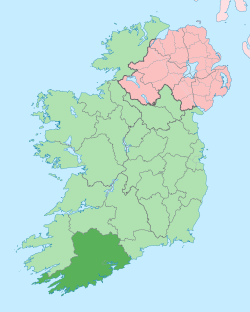
County Cork (Irish: Contae Chorcaí) is the largest and the southernmost county of Ireland, named after the city of Cork, the country's second-largest city. It is in the province of Munster and the Southern Region. Its largest market towns are Mallow, Macroom, Midleton, and Skibbereen. In 2022, the county had a population of 584,156, making it the third-most populous county in Ireland. Cork County Council is the local authority for the county, while Cork City Council governs the city of Cork and its environs. Notable Corkonians include Michael Collins, Jack Lynch, Mother Jones, Roy Keane, Sonia O'Sullivan, Fiona Shaw, Cillian Murphy and Graham Norton.
Cork borders four other counties: Kerry to the west, Limerick to the north, Tipperary to the north-east and Waterford to the east. The county contains the southern section of the Golden Vale pastureland that extends into the Blackwater valley. The south-west region, including West Cork, is one of Ireland's main tourist destinations,[5] known for its rugged coast and megalithic monuments and as the starting point for the Wild Atlantic Way. The largest third-level institution is University College Cork, founded in 1845, and has a total student population of around 22,000.[6] Local industry and employers include technology company Dell EMC, the European headquarters of Apple, and the farmer-owned dairy co-operative Dairygold.
The county is known as the "rebel county", a name given to it by King Henry VII of England for its support, in a futile attempt at a rebellion in 1491, of Perkin Warbeck, who claimed to be Richard of Shrewsbury, Duke of York.
Political and governance
[edit]The local government areas of county Cork and the city of Cork are administered by the local authorities of Cork County Council and Cork City Council respectively. The boundary between these two areas was altered by the 2019 Cork boundary change. It is part of the Southern Region and has five representatives on the Southern Regional Assembly.[7]
For elections to Dáil Éireann, the city and county are divided into five constituencies: Cork East, Cork North-Central, Cork North-West, Cork South-Central and Cork South-West. Together they return 20 deputies (TDs) to the Dáil.[8] It is part of the South constituency for European elections.[9]
Geography
[edit]
Cork is the largest county in Ireland by land area, and the largest of Munster's six counties by population and area. At the latest census in 2022, the population of the entire county stood at 584,156. Cork is the second-most populous county in the State, and the third-most populous county on the island of Ireland.
County Cork is located in the province of Munster, bordering Kerry to the west, Limerick to the north, Tipperary to the north-east and Waterford to the east. The county shares separate mountainous borders with Tipperary and Kerry. The terrain on the Kerry border was formed between 360 and 374 million years ago, as part of the rising of the MacGillycuddy's Reeks and Caha Mountains mountains ranges. This occurred during the Devonian period when Ireland was part of a larger continental landmass and located south of the equator.[10][11] The region's topography of peaks and valleys are characterised by steep ridges formed during the Hercynian period of folding and mountain formation some 300 million years ago.[10]
Twenty-four historic baronies are in the county—the most of any county in Ireland. While baronies continue to be officially defined units, they are no longer used for many administrative purposes. Their official status is illustrated by Placenames Orders made since 2003, where official Irish names of baronies are listed.[citation needed] The county has 253 civil parishes.[12] Townlands are the smallest officially defined geographical divisions in Ireland, with about 5447 townlands in the county.
Mountains and upland habitats
[edit]
The county's mountains rose during a period mountain formation some 374 to 360 million years ago and include the Slieve Miskish and Caha Mountains on the Beara Peninsula, the Ballyhoura Mountains on the border with Limerick and the Shehy Mountains which contain Knockboy (706 m), the highest point in Cork. The Shehy Mountains are on the border with Kerry and may be accessed from the area known as Priests Leap, near the village of Coomhola.
The upland areas of the Ballyhoura, Boggeragh, Derrynasaggart, and Mullaghareirk Mountain ranges add to the range of habitats found in the county. Important habitats in the uplands include blanket bog, heath, glacial lakes, and upland grasslands. Cork has the 13th-highest county peak in Ireland.
Rivers and lakes
[edit]_-_geograph.org.uk_-_263779.jpg)

Three rivers, the Bandon, Blackwater and Lee and their valleys dominate central Cork. Habitats of the valleys and floodplains include woodlands, marshes, fens, and species-rich limestone grasslands. The River Bandon flows through several towns, including Dunmanway to the west of the town of Bandon before draining into Kinsale Harbour on the south coast.
Cork's sea loughs include Lough Hyne and Lough Mahon, and the county also has many small lakes. An area has formed where the River Lee breaks into a network of channels weaving through a series of wooded islands, forming 85 hectares of swampland around Cork's wooded area. The Environmental Protection Agency carried out a survey of surface waters in County Cork between 1995 and 1997, which identified 125 rivers and 32 lakes covered by the regulations.
Land and forestry
[edit]Like many parts of Munster, Cork has fertile agricultural land and many bog and peatlands. Cork has around 74,000 hectares of peatlands, which amount to 9.8% of the county's total land area. Cork has the highest share of the national forest area, with around 90,020 ha (222,400 acres) of forest and woodland area, constituting 11.6% of the national total and approximately 12% of Cork's land area.[13] It is home to one of the last remaining pieces of native woodland in Ireland and Europe.[14]

Wildlife
[edit]The hooded crow, Corvus cornix is a common bird, particularly in areas nearer the coast. Due to this bird's ability to (rarely) prey upon small lambs, the gun clubs of County Cork have killed many of these birds in modern times.[15] A collection of the marine algae was housed in the herbarium of the botany department of the University College Cork.[16]
Parts of the South West coastline are hotspots for sightings of rare birds, with Cape Clear being a prime location for bird watching.[17][18] The island is also home to one of only a few gannet colonies around Ireland and the UK. The coastline of Cork is sometimes associated with whale watching, with some sightings of fin whales, basking sharks, pilot whales, minke whales, and other species.[19][20][21]
Coastline
[edit]Cork has a mountainous and flat landscape with many beaches and sea cliffs along its coast. The southwest of Ireland is known for its peninsulas and some in Cork include the Beara Peninsula, Sheep's Head, Mizen Head, and Brow Head. Brow Head is the most southerly point of mainland Ireland. There are many islands off the coast of the county, in particular, off West Cork. Carbery's Hundred Isles are the islands around Long Island Bay and Roaringwater Bay.
Fastnet Rock lies in the Atlantic Ocean 11.3 km south of mainland Ireland, making it the most southerly point of Ireland. Many notable islands lie off Cork, including Bere, Great Island, Sherkin, and Cape Clear. With an estimated 1,199 km (745 mi) of coastline, Cork is one of three counties which claims to have the longest coastline in Ireland, alongside Mayo and Donegal.[22][23][24] Cork is also one of just three counties to border two bodies of water – the Celtic Sea to the south and the Atlantic Ocean to the west. Cork marks the end of the Wild Atlantic Way, the tourism trail from County Donegal's Inishowen Peninsula to Kinsale
| Cork Harbour (Celtic Sea) | Jan | Feb | Mar | Apr | May | Jun | Jul | Aug | Sep | Oct | Nov | Dec | Year |
|---|---|---|---|---|---|---|---|---|---|---|---|---|---|
| Sea Temperature | 11.4 °C (52.5 °F) | 10.7 °C (51.3 °F) | 10.5 °C (50.9 °F) | 12.2 °C (54.0 °F) | 12.9 °C (55.2 °F) | 15.8 °C (60.4 °F) | 18.1 °C (64.6 °F) | 17.9 °C (64.2 °F) | 17.4 °C (63.3 °F) | 16.0 °C (60.8 °F) | 13.7 °C (56.7 °F) | 12.3 °C (54.1 °F) | 14.1 °C (57.4 °F) |
| Bantry (Atlantic Ocean) | Jan | Feb | Mar | Apr | May | Jun | Jul | Aug | Sep | Oct | Nov | Dec | Year |
| Sea Temperature | 11.6 °C (52.9 °F) | 11.2 °C (52.2 °F) | 11.0 °C (51.8 °F) | 12.1 °C (53.8 °F) | 12.8 °C (55.0 °F) | 15.6 °C (60.1 °F) | 17.6 °C (63.7 °F) | 17.5 °C (63.5 °F) | 17.3 °C (63.1 °F) | 15.8 °C (60.4 °F) | 13.8 °C (56.8 °F) | 12.2 °C (54.0 °F) | 14.0 °C (57.2 °F) |
History
[edit]| Year | Pop. | ±% |
|---|---|---|
| 1600 | 21,889 | — |
| 1610 | 34,250 | +56.5% |
| 1653 | 54,250 | +58.4% |
| 1659 | 63,031 | +16.2% |
| 1821 | 730,444 | +1058.9% |
| 1831 | 810,732 | +11.0% |
| 1841 | 854,118 | +5.4% |
| 1851 | 649,308 | −24.0% |
| 1861 | 544,818 | −16.1% |
| 1871 | 517,076 | −5.1% |
| 1881 | 495,607 | −4.2% |
| 1891 | 438,432 | −11.5% |
| 1901 | 404,611 | −7.7% |
| 1911 | 392,104 | −3.1% |
| 1926 | 365,747 | −6.7% |
| 1936 | 355,957 | −2.7% |
| 1946 | 343,668 | −3.5% |
| 1951 | 341,284 | −0.7% |
| 1956 | 336,663 | −1.4% |
| 1961 | 330,443 | −1.8% |
| 1966 | 339,703 | +2.8% |
| 1971 | 352,883 | +3.9% |
| 1979 | 396,118 | +12.3% |
| 1981 | 402,465 | +1.6% |
| 1986 | 412,735 | +2.6% |
| 1991 | 410,369 | −0.6% |
| 1996 | 420,510 | +2.5% |
| 2002 | 447,829 | +6.5% |
| 2006 | 481,295 | +7.5% |
| 2011 | 519,032 | +7.8% |
| 2016 | 542,868 | +4.6% |
| 2022 | 584,156 | +7.6% |
| [27] | ||
The county is colloquially referred to as "The Rebel County", although uniquely Cork does not have an official motto. This name has 15th-century origins, but from the 20th century, the name has been more commonly attributed to the prominent role Cork played in the Irish War of Independence (1919–1921) when it was the scene of considerable fighting. In addition, it was an anti-Treaty stronghold during the Irish Civil War (1922–23). Much of what is now county Cork was once part of the Kingdom of Deas Mumhan (South Munster), anglicised as the "Desmond", ruled by the MacCarthy Mór dynasty.
After the Norman invasion in the 12th century, the McCarthy clan were pushed westward into what is now West Cork and County Kerry. Dunlough Castle, standing just north of Mizen Head, is one of the oldest castles in Ireland (AD 1207). The north and east of Cork were taken by the Hiberno-Norman FitzGerald dynasty, who became the Earls of Desmond. Cork City was given an English Royal Charter in 1318 and for many centuries was an outpost for Old English culture. The Fitzgerald Desmond dynasty was destroyed in the Desmond Rebellions of 1569–1573 and 1579–1583. Much of county Cork was devastated in the fighting, particularly in the Second Desmond Rebellion. In the aftermath, much of Cork was colonised by English settlers in the Plantation of Munster. [citation needed]

In 1491, Cork played a part in the English Wars of the Roses when Perkin Warbeck, a pretender to the English throne spread the story that he was really Richard of Shrewsbury (one of the Princes in the Tower), landed in the city and tried to recruit support for a plot to overthrow King Henry VII of England. The Cork people supported Warbeck because he was Flemish and not English; Cork was the only county in Ireland to join the fight. The mayor of Cork and several important citizens went with Warbeck to England, but when the rebellion collapsed they were all captured and executed. Cork's nickname of the 'rebel county' (and Cork city's of the 'rebel city') originates in these events.[28][29]
In 1601, the decisive Battle of Kinsale took place in County Cork, which was to lead to English domination of Ireland for centuries. Kinsale had been the scene of the 4th Spanish Armada to help Irish rebels in the Nine Years' War (1594–1603). When this force was defeated, the rebel hopes for victory in the war were all but ended. County Cork was officially created by a division of the older County Desmond in 1606.
In the early 17th century, the townland of Leamcon (near Schull[30]: 41, 68 ) was a pirate stronghold, and pirates traded easily in Baltimore and Whiddy Island.[30]: 54–57

In the 19th century, Cork was a centre for the Fenians and for the constitutional nationalism of the Irish Parliamentary Party, from 1910 that of the All-for-Ireland Party. The county was a hotbed of guerrilla activity during the Irish War of Independence (1919–1921). Three Cork Brigades of the Irish Republican Army operated in the county and another in the city. Prominent actions included the Kilmichael Ambush in November 1920 and the Crossbarry Ambush in March 1921.[31]
The activity of IRA flying columns, such as the one under Tom Barry in west Cork, was popularised in the Ken Loach film The Wind That Shakes The Barley. On 11 December 1920, Cork City centre was gutted by fires started by the Black and Tans in reprisal for IRA attacks. Over 300 buildings were destroyed; many other towns and villages around the county, including Fermoy, suffered a similar fate.[32]
During the Irish Civil War (1922–23), most of the IRA units in Cork sided against the Anglo-Irish Treaty. From July to August 1922 they held the city and county as part of the so-called Munster Republic. However, Cork was taken by troops of the Irish Free State in August 1922 in the Irish Free State offensive, which included both overland and seaborne attacks. For the remainder of the war, the county saw sporadic guerrilla fighting until the Anti-Treaty side called a ceasefire and dumped their arms in May 1923. Michael Collins, a key figure in the War of Independence, was born near Clonakilty and assassinated during the civil war in Béal na Bláth, both in west Cork.
Irish language
[edit]County Cork has two Gaeltacht areas in which the Irish language is the primary medium of everyday speech. These are Múscraí (Muskerry) in the north of the county, especially the villages of Cill Na Martra (Kilnamartyra), Baile Bhúirne (Ballyvourney), Cúil Aodha (Coolea), Béal Átha an Ghaorthaidh (Ballingeary), and Oileán Chléire (Cape Clear Island).
There are 14,829 Irish language speakers in County Cork, with 3,660 native speakers in the Cork Gaeltacht. In 2011, there were 6,273 pupils attending the 21 Gaelscoileanna and six Gaelcholáistí all across the county.[33] In 2006, there were 4,896 people in the county who identified as daily Irish speakers outside of the education system. The village of Ballingeary is a centre for Irish language tuition, with a summer school, Coláiste na Mumhan, or the College of Munster.[34]
Anthem
[edit]The song "The Banks of My Own Lovely Lee" is traditionally associated with the county. It is sometimes heard at GAA and other sports fixtures involving the county.[35]
Media
[edit]Several media publications are printed and distributed in County Cork. These include the Irish Examiner (formerly the Cork Examiner) and its sister publication The Echo (formerly the Evening Echo). Local and regional newspapers include the Carrigdhoun, the Cork Independent, The Corkman, the Mallow Star, the Douglas Post, the East Cork Journal and The Southern Star.[36][37] Local radio stations include Cork's 96FM and dual-franchise C103, Red FM, and a number of community radio stations, such as CRY 104.0FM.[38]
Places of interest
[edit]Tourist sites include the Blarney Stone at Blarney Castle, Blarney.[39] The port of Cobh in County Cork was the point of embarkation for many Irish emigrants travelling to Australia, Canada, New Zealand, South Africa or the United States. Cobh (at the time named 'Queenstown') was the last stop of the RMS Titanic before it departed on its fated journey.
Fota Wildlife Park, on Fota Island, is also a tourist attraction.[39] Nearby is Fota House and Gardens and the Fota Golf Club and Resort; a European Tour standard golf course which hosted the Irish Open in 2001, 2002 and 2014.[40]
West Cork is known for its rugged natural environment, beaches and social atmosphere, and is a common destination for British, German, French and Dutch tourists.[41]
-
![St Finbar's church, located on Gougane Barra, a 6th century monastery site.[42]](//upload.wikimedia.org/wikipedia/commons/thumb/3/3c/Gougane_Barra.jpg/250px-Gougane_Barra.jpg)
-
![Saint Fin Barre's Cathedral, Cork city. Founded in 1879 on a 7th-century site.[43]](//upload.wikimedia.org/wikipedia/commons/thumb/3/30/CorkStFinbarrsCathedral.jpg/250px-CorkStFinbarrsCathedral.jpg) Saint Fin Barre's Cathedral, Cork city. Founded in 1879 on a 7th-century site.[43]
Saint Fin Barre's Cathedral, Cork city. Founded in 1879 on a 7th-century site.[43] -
![Timoleague Friary, West Cork. Founded 1240[44]](//upload.wikimedia.org/wikipedia/commons/thumb/b/bd/Timoleague_Friary.jpg/250px-Timoleague_Friary.jpg) Timoleague Friary, West Cork. Founded 1240[44]
Timoleague Friary, West Cork. Founded 1240[44] -
![Kilcrea Friary in mid-Cork. Founded in 1465[45]](//upload.wikimedia.org/wikipedia/commons/thumb/4/4f/KilcreaFriary.JPG/250px-KilcreaFriary.JPG) Kilcrea Friary in mid-Cork. Founded in 1465[45]
Kilcrea Friary in mid-Cork. Founded in 1465[45]
![St Finbar's church, located on Gougane Barra, a 6th century monastery site.[42]](https://en.wikipedia.org/wiki/File:Gougane_Barra.jpg)
![Saint Fin Barre's Cathedral, Cork city. Founded in 1879 on a 7th-century site.[43]](https://en.wikipedia.org/wiki/File:CorkStFinbarrsCathedral.jpg)
![Timoleague Friary, West Cork. Founded 1240[44]](https://en.wikipedia.org/wiki/File:Timoleague_Friary.jpg)
![Kilcrea Friary in mid-Cork. Founded in 1465[45]](https://en.wikipedia.org/wiki/File:KilcreaFriary.JPG)
Economy
[edit]The South-West Region, comprising counties Cork and Kerry, contributed €103.2 billion (approximately US$111.6 billion) towards the Irish GDP in 2020.[46]
The harbour area east of Cork city is home to many pharmaceutical and medical companies. Mahon Point Shopping Centre is Cork's largest, and Munster's second-largest, shopping centre; it contains over 75 stores including a retail park.[47] The Golden Vale is among the most productive farmland for dairy in Ireland. The chief milk processor is Dairygold, a farmer-owned co-operative based in Mitchelstown, which processes 1.4 billion litres a year, converting the milk into cheeses and powder dairy nutrition for infant formula.[48]
Demographics
[edit]| Rank | City or town | Population (2022)[49] |
|---|---|---|
| 1 | Cork | 224,004 |
| 2 | Carrigaline | 18,239 |
| 3 | Cobh | 14,148 |
| 4 | Midleton | 13,906 |
| 5 | Mallow | 13,456 |
| 6 | Youghal | 8,564 |
| 7 | Bandon | 8,196 |
| 8 | Fermoy | 6,720 |
| 9 | Passage West-Monkstown | 6,051 |
| 10 | Kinsale | 5,991 |
The city of Cork forms the largest urban area in the county, with a total population of 224,004 as of 2022. Cork is the second-most populous city in the Republic of Ireland, and the third-most populous city on the island of Ireland. In 2022, the county had 13 towns with a population of over 4,000. The county has a population density of 77.8 inhabitants per square kilometre (202/sq mi). A large percentage of the population lives in urban areas.
In the 1841 census, before the outbreak of the Great Famine, County Cork had a recorded population of 854,118.[50] By the 2022 census, Cork city and county had a combined population of 584,156 people.[51]
In the 2022 census, ethnically the population included 78.5% White Irish people, 9.9% other White background, 1.4% Asian and 1.1% Black. In 2022, the largest religious denominations in Cork were: Catholicism (71%), Church of Ireland (2.3%), Orthodox (1.2%), and Islam (1.2%). Those stating that they had no religion accounted for 15.7% of the population in 2022.[52]
Transport
[edit]Cork's main transport is serviced from:
- Air: Cork International Airport
- Rail: Iarnród Éireann's InterCity, Commuter and Freight rail services
- Sea: Port of Cork at Cork Harbour
People
[edit]Common surnames in the county include Barry, Buckley, Callaghan, Connell, Connor, Crowley, Lynch, McCarthy, Murphy, O'Leary, O'Sullivan, Sheehan, Walsh, and Fitzgerald (the latter with a Norman derivation).[53][54][55]
References
[edit]- ^ "What's your Irish County? County Cork". IrishCentral.com. 14 October 2016. Archived from the original on 14 August 2016. Retrieved 21 June 2019.
- ^ Local Government Arrangements in Cork – The Report of the Cork Local Government Committee (September 2015), section 2.1
- ^ "Report of the Expert Advisory Group on Local Government Arrangements in Cork". gov.ie. Department of Housing, Local Government and Heritage. 17 May 2017. Archived from the original on 28 October 2023. Retrieved 28 October 2023.
Area (Cork County: 7,467.91 km2 / Cork City: 39.61 km2
- ^ "Census 2022 - Summary Results - FY003A- Population". 30 May 2023. Archived from the original on 25 August 2021. Retrieved 3 June 2023.
- ^ "Ireland's most popular tourist counties and attractions have been revealed". TheJournal.ie. 23 July 2017. Archived from the original on 15 October 2017. Retrieved 15 October 2017.
the southwest, comprising Cork and Kerry, has the second-largest spend by tourists [after the Dublin region]
- ^ "International Office". Archived from the original on 13 August 2021. Retrieved 3 August 2021.
- ^ Local Government Act 1991 (Regional Assemblies) (Establishment) Order 2014 (S.I. No. 573 of 2014). Signed on 16 December 2014. Statutory Instrument of the Government of Ireland. Retrieved from Irish Statute Book on 14 March 2022.
- ^ Electoral (Amendment) (Dáil Constituencies) Act 2017, Schedule (No. 39 of 2017, Schedule). Enacted on 23 December 2017. Act of the Oireachtas. Retrieved from Irish Statute Book on 10 January 2022.
- ^ European Parliament Elections (Amendment) Act 2019, s. 7: Substitution of Third Schedule to Principal Act (No. 7 of 2019, s. 7). Enacted on 12 March 2019. Act of the Oireachtas. Retrieved from Irish Statute Book on 10 January 2022.
- ^ a b Bourke et al. 2011, p. 3.
- ^ Site Management Plan.
- ^ "Placenames Database of Ireland. Retrieved January 21, 2012". Logainm.ie. 13 December 2010. Archived from the original on 8 July 2013. Retrieved 23 May 2012.
- ^ "National Forestry Inventory, Third Cycle 2017". DAFM. 17 November 2020. Archived from the original on 20 June 2021. Retrieved 30 July 2021.
- ^ Baraniuk, Chris (12 February 2021). "What would a truly wild Ireland look like?". BBC. Archived from the original on 17 February 2021. Retrieved 18 February 2021.
- ^ C. Michael Hogan. 2009. Hooded Crow: Corvus cornix, GlobalTwitcher.com, ed, N. Stromberg Archived 26 November 2010 at the Wayback Machine
- ^ Cullinane, J.P., Phycology of the South Coast of Ireland. University College Cork, 1973
- ^ "Cape Clear Island: a birdwatching bonanza". Lonely Planet. 20 September 2019. Archived from the original on 1 December 2017. Retrieved 18 November 2017.
- ^ "Cape Clear Bird Observatory". BirdWatch Ireland. Archived from the original on 19 November 2017. Retrieved 18 November 2017.
- ^ Whooley, Pádraig. "Wild waters: the lesser-known life of whales and dolphins along the Irish coastline". The Irish Times. Archived from the original on 17 November 2017. Retrieved 18 November 2017.
- ^ Fáilte Ireland. "Whale Watching & Dolphin Watching in Ireland". Wild Atlantic Way. Archived from the original on 16 October 2017. Retrieved 18 November 2017.
- ^ Jones, Calvin (23 August 2016). "How to watch whales and dolphins – whalewatching tips and advice". Ireland's Wildlife. Archived from the original on 16 October 2017. Retrieved 18 November 2017.
- ^ "Irish Coastal Habitats: A Study of Impacts on Designated Conservation Areas" (PDF). heritagecouncil.ie. Heritage Council. Archived (PDF) from the original on 3 December 2020. Retrieved 6 May 2020.
- ^ "Mayo County Council Climate Adaptation Strategy" (PDF). mayococo.ie. Mayo County Council. Archived (PDF) from the original on 28 July 2020. Retrieved 9 May 2020.
- ^ "Managing the Donegal Coast in the Twenty-first Century" (PDF). research.thea.ie. Institute of Technology, Sligo. Archived (PDF) from the original on 13 July 2021. Retrieved 13 July 2021.
- ^ "Bantry Average Sea Temperature". seatemperature.org. Archived from the original on 12 August 2021. Retrieved 12 August 2021.
- ^ "Cork Average Sea Temperature". seatemperature.org. Archived from the original on 12 August 2021. Retrieved 12 August 2021.
- ^ for post 1821 figures 1653 and 1659 figures from Civil Survey Census of those years Paper of Mr Hardinge to Royal Irish Academy March 14, 1865 Archived 20 September 2010 at the Wayback Machine For a discussion on the accuracy of pre-famine census returns see J. J. Lee "On the accuracy of the pre-famine Irish censuses" in Irish Population Economy and Society edited by JM Goldstrom and LA Clarkson (1981) p54 in and also New Developments in Irish Population History 1700–1850 by Joel Mokyr and Cormac Ó Gráda in The Economic History Review New Series Vol. 37 No. 4 (November 1984) pp. 473–488.
- ^ "If not for collins, why is it called the rebel county?". Irish Independent. 4 August 2013. Archived from the original on 5 July 2018. Retrieved 28 June 2020.
- ^ O'Shea, Joe (21 May 2019). "Why is Cork called the Rebel County?". Cork Beo. Archived from the original on 28 June 2020. Retrieved 28 June 2020.
- ^ a b Senior, Clive M. (1976). A Nation of Pirates. Newton Abbot: David & Charles. ISBN 0-7153-7264-5.
- ^ "Rebelcork.com". Rebelcork.com. Archived from the original on 2 April 2012. Retrieved 23 May 2012.
- ^ "Rebelcork.com". Rebelcork.com. Archived from the original on 2 April 2012. Retrieved 23 May 2012.
- ^ "Oideachas Trí Mheán na Gaeilge in Éirinn sa Ghalltacht 2010–2011" (PDF) (in Irish). gaelscoileanna.ie. 2011. Archived (PDF) from the original on 19 April 2012. Retrieved 9 January 2012.
- ^ English, Eoin. "Fears that country’s oldest Irish summer college in Cork may not reopen this year". Irish Examiner, 25 Jan 2024. Retrieved 26 October 2024
- ^ "Lord Mayor to promote Cork songs at schools". Cork Independent. 27 August 2009. Archived from the original on 21 August 2010. Retrieved 23 May 2012.
- ^ "Regional Newspaper Circulation". ilevel.ie. 17 July 2012. Archived from the original on 8 August 2021. Retrieved 8 August 2021.
- ^ "Media Monitoring Analysis and Evaluation Brochure". Nimms Ltd. April 2011. Archived from the original on 8 August 2021. Retrieved 8 August 2021.
- ^ "List of TV and Radio Stations". bai.ie. Broadcasting Authority of Ireland. Archived from the original on 8 August 2021. Retrieved 8 August 2021.
- ^ a b "Fota and Blarney are Cork's top attractions". The Corkman. Independent News & Media. 8 August 2013. Archived from the original on 8 August 2021. Retrieved 8 August 2021.
- ^ "History". European Tour. Archived from the original on 25 October 2022. Retrieved 25 October 2022.
- ^ "West Cork Highlights". discoverireland.ie. Fáilte Ireland. Archived from the original on 20 June 2019.
- ^ Tempan, Paul. "The element sceilg in Irish place-names – a borrowing of Latin spelu(n)ca?". Proceedings of the 27th International Congress of Onomastic Sciences, 2023. DIO: 10.4467/K7501.45/22.23.18078
- ^ Bracken & Riain-Raedel 2006, p. 47.
- ^ "Proceedings of the Royal Irish Academy: Archaeology, Celtic studies, history, linguistics and literature". The Academy, 1970. p. 93
- ^ Keohane 2020, p. 451.
- ^ "County Incomes and Regional GDP 2020". Central Statistics Office. 2020. Archived from the original on 2 July 2023. Retrieved 5 December 2023.
- ^ "Visit Mahon Point Shopping Centre with Discover Ireland". Discover Ireland. Retrieved 6 March 2025.
- ^ "Dairygold opens €85m facility at Mallow headquarters". RTÉ. 22 September 2017. Archived from the original on 17 November 2017. Retrieved 16 November 2017.
- ^ "Census 2022 Profile 1 - Population Distribution and Movement F1015 - Population". Central Statistics Office. Archived from the original on 25 August 2021. Retrieved 28 October 2023.
- ^ "Brutality of Cork's Famine years: 'I saw hovels crowded with the sick and the dying in every doorway'". Irish Examiner. 8 May 2018. Archived from the original on 12 September 2022. Retrieved 12 September 2022.
- ^ "Census 2022: Cork population increases by 7.1%". echolive.ie. 23 June 2022. Archived from the original on 12 September 2022. Retrieved 12 September 2022.
- ^ "Profile 5 Diversity, Migration, Ethnicity, Irish Travellers & Religion Cork". Census 2022. Central Statistics Office. 26 October 2023. Archived from the original on 28 October 2023. Retrieved 28 October 2023.
- ^ "Popular Cork surnames and families". Roots Ireland. Archived from the original on 26 June 2018. Retrieved 26 June 2018.
- ^ "CORK". John Grenham. Archived from the original on 26 June 2018. Retrieved 26 June 2018.
- ^ "Cork". irishgenealogy.com. Archived from the original on 6 June 2018. Retrieved 26 June 2018.
Sources
[edit]- Bourke, Edward; Hayden, Alan; Lynch, Ann; O'Sullivan, Michael (2011). Skellig Michael, Co. Kerry: The Monastery and South Peak: Archaeological Stratigraphic Report: Excavations 1986–2010. Dublin: Department of Culture, Heritage and the Gaeltacht. OCLC 795846647.
- Bracken, Damian; Riain-Raedel, Dagmar Ó (2006). Ireland and Europe in the Twelfth Century: Reform and Renewal. Dublin: Four Courts Press. ISBN 978-1-85182-848-7.
- Keohane, Frank (2020). Cork: City and County. Buildings of Ireland. New Haven, CT / London: Yale University Press. ISBN 978-0-300-22487-0.
- "Skellig Michael World Heritage Site Management Plan : 2008–2018" (PDF). Department of the Environment, Heritage and Local Government. 2008. OCLC 916003677. Archived (PDF) from the original on 30 August 2017.
External links
[edit]


Places adjacent to County Cork | ||||||||||||||||
|---|---|---|---|---|---|---|---|---|---|---|---|---|---|---|---|---|
| ||||||||||||||||


The counties are listed per province | ||
 Connacht Connacht |  | |
 Leinster Leinster | ||
 Munster Munster | ||
 Ulster Ulster | ||
| ||
| International | |
|---|---|
| National | |
| Geographic | |
| Other | |

County Cork
View on GrokipediaGeography and Environment
Physical Geography
County Cork spans approximately 7,500 square kilometers in southwestern Ireland, constituting the largest county by land area in the state.[3] Its terrain varies from fertile lowlands and rolling hills in the east and north to rugged uplands and mountains in the west and southwest.[10] Prominent mountain ranges include the Shehy Mountains along the Kerry border, where Knockboy rises to 706 meters as the county's highest elevation, the Caha Mountains on the Beara Peninsula reaching up to 685 meters at Hungry Hill, and the inland Nagle and Boggeragh Mountains.[11][12] The county's hydrology features several major rivers: the River Lee (84 kilometers), which bisects Cork City and discharges into Cork Harbour; the River Bandon (70 kilometers) draining the southwest; and the Munster Blackwater (168 kilometers), originating near the Kerry border and forming the northern boundary before flowing eastward.[10][13] Cork's coastline exceeds 1,000 kilometers in length, characterized by deep inlets, cliffs, and peninsulas including Beara, Mizen, and Sheep's Head, with Mizen Head marking Ireland's southwestern extremity.[14] Geologically, Carboniferous limestone predominates, underlying much of the central lowlands, while Devonian sandstones and mudstones crop out in the west, shaped by Variscan folding and subsequent glaciation.[15][16]Climate and Weather Patterns
County Cork features a temperate oceanic climate classified as Cfb under the Köppen system, marked by mild temperatures year-round, high humidity, and frequent precipitation influenced by the North Atlantic Drift.[17][18] Mean annual temperatures hover around 10–11°C (50–52°F), with daily highs typically ranging from 8–10°C (46–50°F) in winter to 18–20°C (64–68°F) in summer, and lows rarely dipping below 0°C (32°F) or exceeding 25°C (77°F).[19] Winters (December–February) average 5–7°C (41–45°F), while summers (June–August) reach 15–17°C (59–63°F), with July as the warmest month at approximately 15.1°C (59.2°F).[17] Precipitation is abundant and evenly distributed, averaging 1,048 mm (41.3 inches) annually across the county, though western uplands receive up to 1,500–2,000 mm due to orographic effects from prevailing westerly winds.[20] December is the wettest month with about 150 mm (5.9 inches), while February is driest at around 80 mm (3.1 inches); the county sees roughly 146 days with measurable rain (>0.1 mm) per year.[21] Cloud cover dominates, limiting sunshine to 1,200–1,500 hours annually, and fog or mist is common near coasts.[19] Weather patterns exhibit high variability, with frequent Atlantic depressions bringing rain, gales, and occasional thunderstorms, particularly in autumn and winter; easterly winds can introduce drier, colder spells in spring.[17] Met Éireann data for 1991–2020 indicate a 7% rainfall increase compared to 1961–1990, alongside slight warming trends of 0.5–1°C in seasonal means, consistent with broader regional shifts but without altering the core oceanic regime.[22] Extremes include rare snow (1–2 days/year inland) and storms like ex-Hurricane Ophelia in 2017, which brought 100+ km/h winds to southern coasts.Biodiversity and Conservation
County Cork encompasses diverse habitats including a 1,200 km coastline, blanket bogs, ancient oak woodlands, wetlands, and freshwater lakes, fostering significant biodiversity. These environments support native flora such as sessile oak (Quercus petraea), downy birch (Betula pubescens), holly (Ilex aquifolium), bell heather (Erica cinerea), and bog species like wild clover (Trifolium repens). Fauna includes mammals such as otters (Lutra lutra), badgers (Meles meles), and red deer (Cervus elaphus), alongside birds like breeding waders, wood pigeons (Columba palumbus), and wintering wildfowl; coastal kelp forests (Laminaria spp.) provide nurseries for fish and invertebrates.[23][24][25] Protected areas safeguard key ecosystems, with Glengarriff Woods Nature Reserve spanning 300 hectares of old oak woodland and regenerating forests, Cuskinny Marsh featuring shoreline, lagoon, grassland, and woodland habitats, and Lough Hyne established as Europe's first marine nature reserve in 1981, hosting unique semi-enclosed marine biodiversity. The county includes multiple Special Areas of Conservation (SACs) and Special Protection Areas (SPAs) under EU directives, protecting habitats like coastal dunes, machair, and raised bogs. In September 2025, the Irish state acquired a significant site preserving wetlands, grasslands, and bird habitats.[26][27][28][29] Conservation initiatives include the County Cork Biodiversity Action Plan, which outlines strategies for habitat restoration and species protection, and EU-funded programs rewarding farmers for designating 10% of land as Biodiversity Managed Areas through regeneration measures. The National Parks and Wildlife Service allocated €2.9 million via the Local Biodiversity Action Fund in 2025 for local authority projects enhancing biodiversity. Efforts by organizations like Cork Nature Network focus on community-driven action plans to preserve habitats amid pressures from agriculture and climate change.[30][31][32][33]History
Prehistoric and Early Medieval Periods
Human occupation in County Cork dates back over 9,000 years, with evidence of Mesolithic hunter-gatherer activity including flint tools and temporary campsites along coastal and riverine areas.[34] The Neolithic period, approximately 4000–2500 BC, saw the introduction of agriculture and megalithic monument construction, exemplified by wedge tombs such as Labbacallee near Fermoy and portal tombs like Carraig á Mhaistin in Cork Harbour, which served as burial sites with ritual significance.[35][36] During the Bronze Age (c. 2500–500 BC), metalworking emerged prominently in Cork due to abundant copper deposits, with mines at Mount Gabriel and Derrycarhoon yielding artifacts dated to 1400–1000 BC, contributing to Ireland's early bronze production estimated at up to 370 tonnes of copper.[37][38] Stone circles like Drombeg, featuring 17 standing stones and central urn burials, indicate ceremonial practices.[39] Sites such as Ballybrowney reveal settlement patterns with roundhouses and artifacts supporting a mixed economy of farming and metallurgy.[40] The Iron Age (c. 500 BC–400 AD) shows continuity in settlement with hillforts and enclosures, though evidence remains sparser compared to earlier periods; ringfort precursors appear, reflecting fortified farmsteads amid emerging social hierarchies. Ogham stones, inscribed with an early Irish script from the 4th–6th centuries AD, are densely distributed in Cork, with over 100 examples recording names and lineages, primarily in the southwest.[41][42] The Early Medieval period (c. 400–1100 AD) brought Christianity, with monastic foundations like that of St. Finbarr in the 7th century at Cork city, fostering literacy and ecclesiastical enclosures alongside ringforts numbering over 1,000 in the county, used as defended homesteads from the 5th–10th centuries.[43] Viking raids commenced in 820 AD on Cork's monastery, leading to Norse settlements by the 9th–10th centuries, establishing a trading port that integrated with Gaelic society.[44][45]Norman Conquest and Late Medieval Era
The Anglo-Norman invasion of Ireland, commencing in 1169, extended to Munster by 1177 when forces under Raymond FitzGerald (le Gros) and others captured Cork city from its Ostman (Norse-Gaelic) inhabitants, establishing a foothold in the region.[46] This followed King Henry II's assertion of overlordship in 1171-1172, with the lordship of Cork granted to Milo de Cogan, who, alongside Robert FitzStephen, governed the area and initiated construction of stone fortifications and urban redevelopment.[47] The invaders faced resistance from Gaelic clans such as the MacCarthys, limiting territorial control primarily to coastal enclaves and towns like Cork, Youghal, and Kinsale, where motte-and-bailey castles were erected to secure trade routes and agricultural lands.[48] By the late 12th century, Anglo-Norman influence in County Cork fostered ecclesiastical reforms aligned with Roman practices, including the rebuilding of Christ Church in Cork as a stone cathedral around 1180 and the establishment of Augustinian and Cistercian houses, such as those at Kilcrea (founded circa 1190 by the Roches family).[49] Urban governance emerged under a patriciate of 12-15 merchant families engaged in continental trade, particularly wine and cloth, while feudal manors introduced manorial courts and demesne farming, though assimilation with Gaelic customs began early among settler elites.[50] Gaelic resurgence gained momentum in the 13th century, with the MacCarthy dynasty retaining sovereignty over much of west Cork, intermarrying with Norman barons like the Barrys and FitzGeralds, who controlled eastern territories and built over 50 stone castles by 1300 to counter raids.[51] The 14th century brought setbacks, including the Black Death (1348-1349), which depopulated rural areas and weakened Anglo-Norman holdings, compounded by the Bruce invasion's diversion of resources and subsequent Gaelic offensives that reduced English control to walled towns by 1366, as noted in the Kilkenny Statutes attempting to halt cultural assimilation.[52] In County Cork, the earldom of Desmond under the FitzGerald sept expanded, blending Norman feudalism with Gaelic Brehon law, fostering a hybrid lordship that dominated the county's politics and economy through cattle herding and tolls on the Blackwater River trade. The diocese of Cloyne, absorbing Cork's see in 1429, reflected ecclesiastical consolidation amid these shifts.[53] Late medieval Cork exhibited persistent Yorkist sympathies, evident in 1491 when Perkin Warbeck, a pretender to the English throne claiming to be Richard of York, landed in the city and received support from local merchants and the FitzGerald Earl of Desmond, who mistook or endorsed him as the lost prince due to trade ties with Burgundy. Warbeck's four-year sojourn in Cork until 1495 involved rallying Irish and Yorkist exiles, culminating in an abortive invasion of Waterford, highlighting the region's semi-autonomy and resistance to Tudor centralization before Desmond's dominance waned in the 16th century.[54]Early Modern Period and Plantations
The Desmond Rebellions, spanning 1569–1573 and 1579–1583, centered in Munster and profoundly disrupted County Cork, where Gaelic lords like the FitzGeralds held sway over vast territories. The first rebellion erupted when James FitzMaurice Fitzgerald, deprived of lands in County Cork such as Kerrycurrihy, allied with other disaffected lords to resist English encroachment, capturing castles and threatening settlements near Cork City.[55] The second, led by Gerald FitzGerald, the 14th Earl of Desmond, escalated into widespread conflict, drawing in native Irish forces against English troops under lords like Ormond and Grey de Wilton, resulting in the earl's attainder and execution in 1583. These uprisings caused extensive devastation in Cork, including crop destruction, cattle raids, and famine that halved populations in areas like Carbery, with economic losses from physical ruin and disrupted trade persisting for years.[56][57] Following the rebellions' suppression, the English Crown initiated the Munster Plantation in 1583–1586, confiscating over 500,000 acres of Desmond lands, with a significant portion—approximately 300,000 acres—in County Cork alone, redistributed to about 100 "undertakers" under strict conditions to promote Protestant settlement, English tenure, and self-sufficient walled towns.[58] Key grantees included Sir Walter Raleigh, allocated 12,000 acres around Youghal in east Cork for tobacco and pipe-making ventures, and Edmund Spenser, granted 3,000 acres at Kilcolman near Doneraile for agricultural experimentation described in his View of the Present State of Ireland.[59][60] The scheme mandated English settlers to build defenses, employ only Protestants, and convert natives to English customs, aiming to secure loyalty amid ongoing Gaelic resistance from clans like the MacCarthys, who retained some holdings through composition agreements but faced gradual erosion of autonomy.[61] Initial settlement progressed slowly due to native hostility and logistical challenges, with undertakers like those in Bandon establishing fortified outposts that introduced market-oriented farming and textile production, altering Cork's agrarian economy from pastoralism.[62] However, the plantation's fragility was exposed in 1598 during the Nine Years' War spillover, when Hugh O'Neill's confederates, aided by local Irish, overran Munster, sacking Kilcolman and forcing most settlers to evacuate, though English control was reasserted post-Kinsale in 1601.[60] By the early 17th century, surviving enclaves in Cork, bolstered by royal surveys like the 1620 fiants, had entrenched Protestant landownership, setting precedents for later confiscations under Cromwell, while native displacement fueled enduring resentments.[63] This era marked a causal shift from Gaelic lordship to colonial tenure, driven by military subjugation rather than voluntary integration, with empirical records showing settler numbers peaking at around 2,000 families before reversals.[64]19th Century and Famine Impacts
In the early decades of the 19th century, County Cork's economy thrived on agricultural exports, particularly butter produced by smallholders and shipped through the Cork Butter Market, established in 1770 and recognized as the world's largest by volume, handling standardized firkins of salted butter destined primarily for British markets.[65] Provisions such as salted beef and pork also fueled prosperity, supporting a population that reached 854,118 by the 1841 census, with dense rural settlements dependent on potato monoculture for subsistence amid subdivided holdings averaging under five acres per family.[66] This reliance on the potato crop, which provided caloric density for large families on marginal land, masked underlying vulnerabilities including soil exhaustion and limited crop diversity, though cash exports sustained urban centers like Cork City. The Great Famine began in 1845 with the arrival of Phytophthora infestans blight, devastating potato yields across southern Ireland; in County Cork, the 1846 harvest failed almost entirely, affecting over 90% of crops in affected areas and triggering widespread starvation compounded by typhus and dysentery epidemics. By 1847, known as "Black '47," mortality surged, with workhouses such as Skibbereen Union reporting 140 deaths in a single month and rates exceeding 20 daily at peak; the facility, designed for 800, housed over 1,800 amid overcrowding that accelerated disease transmission.[67] Similarly, Dunmanway Workhouse, built for 400, held 866 inmates by early 1847, with daily deaths reaching eight or more, reflecting systemic overload across Cork's 11 Poor Law Unions where fever hospitals were improvised from auxiliary sheds.[68] Relief efforts included the Soup Kitchen Act of March 1847, which temporarily fed up to 3 million nationwide, including thousands in Cork through local parish committees and Quaker initiatives that distributed 100-gallon batches in city markets; however, the program ended after six months, reverting reliance to rate-funded workhouses unable to cope.[69] Landlords, facing unpaid rents and rising poor rates, accelerated evictions—over 8% of holdings in Cork were cleared, exemplified by the September 1847 removal of 95 families from the Beamish estate in Clonakilty, often involving battering rams and leaving tenants to fever sheds or roadsides.[70] Food exports persisted, with grain and livestock shipped from Cork ports despite domestic shortages, as market incentives under laissez-faire policy prioritized creditors over immediate local needs. By the 1851 census, County Cork's population had plummeted to 649,308, a 24% decline from 1841, attributable to an estimated 100,000-150,000 deaths from famine-related causes alongside massive emigration.[71] Queenstown (now Cobh), Cork's principal departure point, saw tens of thousands sail annually on "coffin ships" to North America, contributing to Ireland's overall exodus of over 1.5 million during 1845-1851; post-1848, Cobh handled part of the 2.5 million departures through 1950, with Cork natives forming significant contingents in destinations like New York and Boston.[72] The famine entrenched land consolidation toward pasture grazing, reducing tillage and smallholdings, while social structures shifted with surviving tenants facing higher rents and persistent poverty, setting precedents for later agrarian unrest.[73]20th Century Conflicts and Independence
![Michael Collins.jpg][float-right] County Cork played a central role in the Irish War of Independence (1919–1921), with the county serving as a stronghold for the Irish Republican Army (IRA) due to its rural terrain and strong nationalist sentiment. The Third Tipperary Brigade's tactics influenced Cork units, leading to the formation of active service units and flying columns that conducted guerrilla warfare against British forces. By mid-1920, Cork No. 1 Brigade had over 4,000 members, engaging in ambushes and raids that disrupted British supply lines. British response intensified with the deployment of the Royal Irish Constabulary's Black and Tans and Auxiliaries, paramilitary units notorious for reprisals. On December 11, 1920, Auxiliaries burned much of Cork city's center in retaliation for an IRA attack on a lorry at Dagg's Lane, destroying 40 buildings including City Hall and the Carnegie Library, with damages estimated at £3.3 million (equivalent to over €200 million today). The fire, started with paraffin and petrol, was condemned by the British Labour Commission as a "wanton act of arson," though official inquiries attributed it to looters, a claim disputed by eyewitnesses and IRA veterans. Michael Collins, born in Clonakilty, County Cork in 1890, directed operations from Dublin but maintained close ties to Cork units, coordinating intelligence and arms smuggling through the county's ports. The Anglo-Irish Treaty of December 6, 1921, granted dominion status to the Irish Free State, partitioning Ireland and leaving Cork within the 26-county entity. However, opposition from anti-treaty republicans, strong in Cork, sparked the Irish Civil War (1922–1923). Provisional government forces shelled Cork city in August 1922 to dislodge IRA occupation, damaging Republican barracks and leading to the execution of 13 anti-treaty prisoners. Rural Cork saw prolonged guerrilla resistance, with atrocities like the April 1922 killing of 13 unarmed IRA prisoners at the Baile an Chláir farm by National Army troops. The war ended in May 1923 with IRA cessation, solidifying Free State control over Cork, though divisions persisted. Independence brought economic challenges to Cork, exacerbated by the Civil War's destruction, but the county's strategic ports like Cobh facilitated emigration and trade recovery. The execution of Collins on August 22, 1922, at Béal na Bláth in West Cork—ambushed by anti-treaty forces—symbolized the conflict's fratricidal nature, with his death attributed to a single shot from an anti-treaty rifleman, as confirmed by ballistic evidence and participant accounts. These events cemented Cork's reputation as a republican heartland, influencing its political alignment toward Sinn Féin and Fianna Fáil in subsequent decades.Post-1922 Developments and Recent Events
County Cork served as a major stronghold for anti-Treaty forces during the Irish Civil War (1922–1923), with significant engagements occurring throughout the region. Free State troops captured Cork city after intense fighting from August 8 to 10, 1922, involving artillery bombardment and urban combat that damaged infrastructure and resulted in casualties on both sides.[74] Anti-Treaty irregulars, who controlled rural areas in west Cork and adjacent Kerry, conducted guerrilla operations, leading to over 400 deaths in the two counties combined, including reprisal killings and executions that prolonged the conflict in Munster.[75] On August 22, 1922, Michael Collins, Commander-in-Chief of the National Army and a native of Clonakilty in County Cork, was fatally shot during an ambush at Béal na Bláth by anti-Treaty IRA members, marking a pivotal moment that shifted the war's momentum toward the provisional government.[76] The assassination, occurring amid ongoing hostilities, underscored the deep divisions in the county and contributed to the eventual suppression of irregular resistance by mid-1923. Post-war recovery was hampered by economic stagnation and emigration, with the county's population declining from 275,192 in 1926 to around 230,000 by the 1950s, reflecting national trends of rural depopulation.[77] Economic policy shifts in the late 1950s, including openness to foreign direct investment under Seán Lemass, spurred industrialization in Cork, leveraging its port and labor force. The Ford Motor Company's assembly plant, operational since 1917, supported manufacturing until its closure in 1984, while new sectors emerged; Apple established operations in Hollyhill in 1980, evolving into a major European support and engineering campus employing thousands by the 2020s.[78] The pharmaceutical industry became a cornerstone, with over 34 manufacturing sites in the county employing more than 14,100 people as of recent estimates, hosting facilities from global firms like Pfizer, Johnson & Johnson, and AbbVie that produce active pharmaceutical ingredients and biologics.[79][80] The Celtic Tiger boom (1990s–2008) accelerated growth, with Cork's population rebounding to 584,156 by 2022, driven by inward migration and suburban expansion around Cork city, the county's economic hub.[81] Post-2008 recovery emphasized high-tech sectors, including Apple's 2022 expansion adding engineering facilities for European product testing. Recent challenges include housing pressures from population influx, though the county maintains robust tourism and agriculture alongside its multinational-driven economy.[82]Governance and Administration
Local Government Framework
County Cork's local government operates through two distinct statutory authorities: Cork City Council, which administers the urban core and immediate suburbs, and Cork County Council, which governs the surrounding rural and suburban areas. This bifurcation stems from historical boundary demarcations formalized under the Local Government (Ireland) Act 1898 and subsequent reforms, including the Local Government Reform Act 2014, which abolished town councils and integrated their functions into higher-tier authorities while preserving the city-county split.[83] In 2019, boundary extensions transferred approximately 28 square kilometers and 80,000 residents from the county to the city, with compensatory financial arrangements requiring annual payments from the city council to the county council through 2029 to offset lost revenue bases.[84] Cork County Council, headquartered in Clogheenmilcon in County Cork, comprises 55 elected councillors serving five-year terms, organized into 10 municipal districts for localized decision-making on issues like planning and community grants.[85] The council's executive functions are led by a chief executive, currently Moira Murrell, who oversees a €516 million budget for 2025, funding services including roads maintenance (over 5,000 km managed), housing provision, environmental protection, and economic development initiatives.[86][87] A mayor, selected annually from among the councillors, holds a primarily ceremonial role, while plenary council meetings handle reserved functions such as adopting development plans and levying rates.[88] The council's organizational structure includes directorates for housing, roads, environment, planning, and corporate services, as outlined in its November 2024 chart.[89] Cork City Council, based at City Hall, elects 31 councillors across six local electoral areas, with executive authority vested in its chief executive, though specific 2025 details align with a €325 million budget emphasizing urban infrastructure, housing delivery, and tourism promotion.[90][87] Like its county counterpart, it performs core functions under the Local Government Acts, including spatial planning via the Cork City Development Plan 2022-2028, waste management, and public realm enhancements, but with a focus on dense urban demands such as traffic management and city-center regeneration.[91] Both councils derive funding from central government grants, commercial rates, and local property taxes, operating within Ireland's devolved framework where ultimate oversight rests with the Department of Housing, Local Government and Heritage. Joint strategies, such as the shared Housing Strategy 2022-2028, facilitate coordination on cross-boundary issues like affordable housing amid population pressures.[92]Electoral Representation and Politics
County Cork is represented in Dáil Éireann by portions of four constituencies: Cork North-Central (5 seats), Cork North-West (5 seats), Cork South-Central (5 seats), and Cork South-West (5 seats), totaling 20 Teachtaí Dála (TDs) elected in the November 2024 general election to form the 34th Dáil. These constituencies encompass both urban and rural areas of the county, with boundaries revised under the Electoral (Amendment) Act 2023 to reflect population changes, including the transfer of certain electoral divisions like Ballincollig from Cork North-West to Cork South-Central.[93] Fianna Fáil secured strong representation across these areas, including victories in Cork North-West where Aindrias Moynihan topped the poll, while Fine Gael, Sinn Féin, Labour, and independents also gained seats, reflecting a mix of centre-right dominance and competitive urban contests.[94] [95] At the local level, Cork County Council, governing the administrative county excluding Cork City, comprises 55 members elected across 10 local electoral areas (LEAs) in the June 2024 local elections, with a turnout of 52.32%.[96] [97] Party representation includes Fianna Fáil with 19 seats, Fine Gael with 18, non-party independents with 8, Independent Ireland with 4, Social Democrats with 3, Labour with 2, and Sinn Féin with 1, underscoring the council's centre-right orientation and the appeal of non-aligned candidates in rural LEAs such as Bantry-West Cork and Fermoy.[96] The council's structure supports sub-committees for regional development, with the cathaoirleach position rotating among parties to maintain balance.[98] Politically, County Cork exhibits patterns rooted in Ireland's historical civil war alignments, with Fianna Fáil and Fine Gael historically commanding rural and suburban support due to their focus on agricultural policy, infrastructure, and local patronage networks, as evidenced by their combined hold on over 60% of council seats in 2024.[99] Sinn Féin's representation remains marginal in the county proper, limited to one council seat and urban Dáil gains, attributable to weaker resonance of its urban-nationalist platform in predominantly conservative rural electorates.[96] Independent and Independent Ireland candidates have surged, capturing 12 seats collectively by emphasizing anti-centralization stances on issues like housing shortages and EU-driven regulations, which appeal amid perceptions of Dublin-centric governance.[96] Notable figures include Tánaiste Micheál Martin (Fianna Fáil, Cork South-Central), whose leadership bolsters the party's regional influence.[100]Administrative Divisions and Challenges
County Cork is administered by Cork County Council, which oversees the non-city areas of the county, while Cork City is governed separately by Cork City Council under distinct statutory boundaries established since 2019.[101][102] The county's administrative structure includes eight municipal districts, each managed by a subset of the council's 36 elected members and responsible for localized services such as parking control, cemetery management, and derelict sites enforcement.[101][88] These districts are: Bandon-Kinsale, Carrigaline-Cork Gateway, Cobh, East Cork, Fermoy, Kanturk-Mallow, Macroom, and West Cork.[101] Each municipal district aligns with local electoral areas (LEAs) for elections, totaling seven LEAs in the county excluding the city: Bantry-West Cork, Bandon-Kinsale, Carrigaline-Cork Gateway, Cobh, East Cork, Fermoy, and Kanturk-Mallow.[103] Underlying these are 1,090 small area electoral divisions used for census and statistical purposes, reflecting the county's rural and peri-urban character.[104] Historically, the county encompasses 24 baronies, vestiges of medieval land divisions that persist in legal and genealogical contexts but hold no modern administrative function.[105] Administrative challenges in County Cork stem primarily from rapid population growth straining housing delivery, with the council identifying it as Ireland's most pressing local issue amid national shortages.[106] Boundary demarcations between Cork City and County Councils have hindered integrated development, potentially jeopardizing the region's status as Ireland's second city without boundary adjustments to facilitate economic cohesion, as noted in a 2017 government report.[107] Infrastructure deficits in transport and flood management persist due to fragmented local governance, exacerbating urban-rural divides and delaying projects like the Midleton-Youghal Greenway.[108][109] Additionally, municipal district coordination faced disruptions during COVID-19 restrictions, requiring virtual adaptations for scrutiny and decision-making processes.[110] These issues underscore broader resilience concerns for large rural counties in delivering services amid EU-driven regulations and fiscal constraints.[111]Demographics
Population Trends and Statistics
The population of County Cork, incorporating both the city and county administrative areas, reached 584,156 according to the 2022 census conducted by Ireland's Central Statistics Office (CSO).[112] This figure reflects a growth of 41,288 persons, or 7.6%, from the 542,868 recorded in the 2016 census.[113] The increase outpaced the national intercensal growth rate of 8.1% over the same period, driven primarily by net inward migration (both internal and international) and a positive natural increase from births exceeding deaths.[114]| Census Year | Population (Cork City + County) | Intercensal Change (%) |
|---|---|---|
| 2011 | 519,032 | - |
| 2016 | 542,868 | +4.5 |
| 2022 | 584,156 | +7.6 |
Ethnic Composition and Cultural Shifts
According to the 2022 Irish Census, County Cork's population of 584,156 was ethnically dominated by those identifying as White Irish, numbering 456,500, or approximately 78% of the total.[121] This group reflects the county's longstanding Gaelic heritage, with historical records tracing continuous Irish settlement since prehistoric times, reinforced by limited external influx until the late 20th century. Other White backgrounds accounted for 57,672 residents, primarily from European origins such as Polish (8,590 nationals in Cork County) and UK (8,127), comprising about 10% of the population and linked to post-2004 EU enlargement migration.[121] [121] Non-White ethnic groups, though smaller, have grown due to economic migration tied to Cork's multinational sectors like pharmaceuticals and technology. Asian or Asian Irish residents numbered around 15,000 county-wide (extrapolated from national trends and local data), with Indian and Chinese communities prominent in urban areas, while Black or Black Irish stood at roughly 8,000, often from African nations.[121] Irish Travellers, a distinct indigenous ethnic minority, totaled about 2,500, maintaining nomadic traditions amid ongoing integration challenges. Non-Irish citizens overall reached 70,098 or 12% of the population, up from 10% in 2016, driven by job opportunities rather than asylum, with 75% of residents still born locally—the highest such proportion in Ireland.[2] [81] These shifts have introduced multicultural elements, such as increased Polish-language signage in suburbs and Asian festivals in Cork City, but the core cultural fabric remains Irish-centric, with GAA sports and traditional music festivals like those in West Cork preserving local identity. Immigration's scale, however, has strained housing and services, prompting debates on assimilation, as evidenced by rising dual citizenship (18,107 holders) without proportional erosion of native customs. Empirical data indicate no widespread dilution of Irish language use (under 2% daily speakers county-wide) or religious practices, where Catholicism holds at 69%, though secularization trends predate recent diversity.[121] [112]Migration, Urbanization, and Social Dynamics
County Cork has seen a reversal from historical emigration patterns, particularly following Ireland's economic recovery after the 2008 financial crisis, toward net inward migration driven by employment opportunities in technology, pharmaceuticals, and services sectors. Between April 2016 and April 2022, the county recorded a net migration gain of 20,892 persons, the second-highest among Irish counties after Dublin, contributing significantly to overall population growth from 542,309 in 2016 to 581,461 in 2022.[122] [123] Non-Irish nationals, comprising about 12% of the county's population in 2022, primarily originate from EU countries, with Polish citizens forming the largest group at 8,590 residents, followed by 8,127 from the United Kingdom and 1,602 Lithuanians; smaller but growing contingents include Brazilians and Indians, reflecting global labor mobility and family reunification.[121] This migration has diversified the workforce, particularly in Cork City's metropolitan area, though rural districts like West Cork experience lower inflows and occasional outward movement to urban centers.[124] Urbanization has accelerated, with over 40% of the county's population residing in Cork City and its immediate suburbs by 2022, up from 38% in 2016, fueled by infrastructural expansions such as the Docklands redevelopment and commuter rail improvements. Suburban towns including Ballincollig, Carrigaline, and Midleton have absorbed much of this growth, with populations increasing by 10-15% in the decade to 2022, while peripheral rural areas face stagnation or decline due to aging demographics and limited amenities.[4] [125] Social dynamics reflect this shift toward multiculturalism, with White Irish comprising approximately 85% of residents in 2022, down from 90% in 2011, alongside rising numbers of other White backgrounds (10%) and Asian/Other ethnicities (3%). Integration challenges persist, as migrants exhibit higher unemployment rates (around 8-10% versus 4% for Irish nationals) and overrepresentation in lower-skilled occupations, attributed to credential recognition barriers and language issues rather than overt discrimination.[124] Political engagement remains low, with ethnic minorities holding under 1% of local seats, though community initiatives like language classes and employer partnerships have facilitated gradual incorporation into civic life.[126]Economy
Primary Sectors: Agriculture and Fisheries
Agriculture in County Cork encompasses the largest agricultural land area in Ireland, with over 250,000 hectares utilized as per the Central Statistics Office (CSO) Census of Agriculture 2020, surpassing other counties like Galway and Tipperary.[127] This land supports intensive grassland-based livestock production, leveraging the region's temperate maritime climate for year-round grass growth and high stocking densities. Dairy farming dominates, with Cork hosting approximately 398,000 dairy cows in 2023, representing the highest concentration nationally and contributing to roughly 25% of Ireland's dairy herd.[128] Combined with Kerry, the southwest region accounted for 31% of national milk output in 2022, driven by around 4,000 specialist dairy farms that emphasize efficient, export-oriented production.[129] Beef rearing complements dairy through calf-to-finish systems, with total cattle numbers exceeding 1.1 million in 2023, including significant other cattle for meat production.[128] Sheep farming occurs on marginal uplands, while tillage is limited to feed crops like barley and silage, reflecting the county's focus on pastoral rather than arable systems.[130] Fisheries form a vital coastal sector, centered on ports such as Castletownbere, Ireland's largest whitefish landing hub, which handles demersal species including prawns, haddock, and monkfish.[131] In 2023, the Irish fishing fleet's overall profitability rose amid quota adjustments and fuel cost fluctuations, with Cork ports contributing to national landings of over 218,000 tonnes valued at €312 million the prior year, though specific county shares have marginally declined due to fleet consolidation and regulatory pressures.[132] Castletownbere alone sustains around 560 direct jobs from 111 vessels, emphasizing sustainable quotas under the Common Fisheries Policy, while smaller ports like Union Hall target shellfish such as crab and lobster.[131] Aquaculture, including salmon farming in inshore sites, adds value through controlled production, though it remains secondary to wild capture in employment terms, with historical data indicating over 1,000 combined fisheries and aquaculture roles county-wide.[133] Challenges include overcapacity in aging fleets and environmental limits on stocks, prompting investments in selective gear and stock enhancement by Bord Iascaigh Mhara (BIM).[134]Secondary and Tertiary Industries
In County Cork, secondary industries primarily encompass manufacturing, which employed 28,798 people in 2022, accounting for 17.9% of local jobs and reflecting a 25.9% increase since 2016.[135] Key subsectors include pharmaceuticals and biopharmaceuticals, with facilities such as Janssen's sites in Ringaskiddy and Little Island producing immunology and oncology medicines, alongside recent investments like Merck's €150 million climate-neutral filtration plant in Blarney opened in September 2025, creating over 200 jobs.[80][136] Food processing, leveraging local agriculture, and medical devices also contribute significantly, supported by the county's established industrial heritage in chemicals and engineering.[137][138] Tertiary industries dominate employment, with commerce and trade sectors employing 34,664 people (21.5% of local jobs, up 15.5% since 2016) and professional services at 37,711 (23.4%, up 17.7%).[135] Tourism plays a vital role, generating approximately €1 billion annually for the local economy as of 2025, driven by around two million visitors attracted to coastal landscapes, historical sites, and urban amenities in Cork City.[139] Retail and hospitality, integral to commerce, face pressures from rising costs but benefit from independent businesses comprising about 70% of outlets.[140] Financial and international services further bolster the sector, though concentrated more in urban areas.[141]| Sector | Employment (2022) | Share of Local Jobs | Change since 2016 |
|---|---|---|---|
| Manufacturing | 28,798 | 17.9% | +25.9% |
| Commerce and Trade | 34,664 | 21.5% | +15.5% |
| Professional Services | 37,711 | 23.4% | +17.7% |