Hubbry Logo
Roy KeaneRoy KeaneMain
Open search
Roy Keane
Community hub
Roy Keane
logo
28 pages, 0 posts
0 subscribers
Be the first to start a discussion here.
Roy Keane
Roy Keane
from Wikipedia

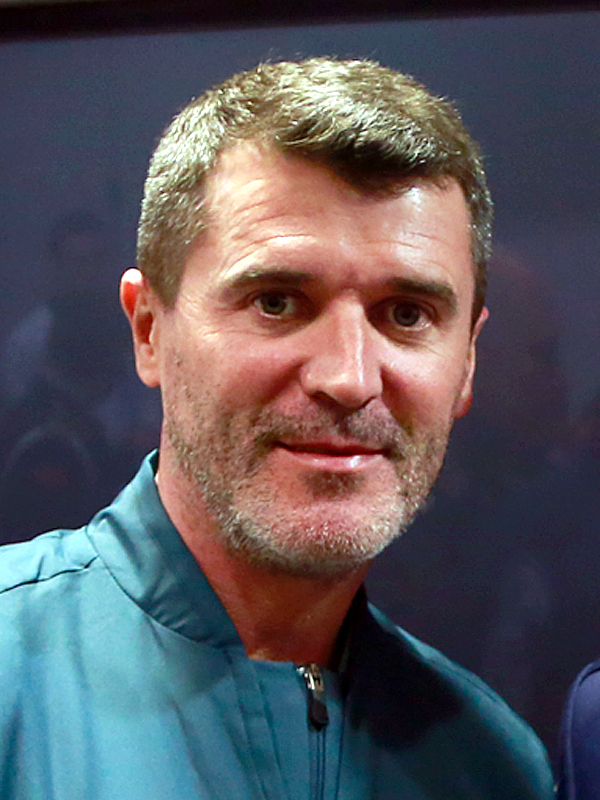
Roy Maurice Keane (born 10 August 1971) is an Irish football pundit, former coach, and former professional player. He is best known for his career in the Premier League, in particular his captaincy of Manchester United. He is the joint most decorated Irish footballer of all time alongside Denis Irwin and Ronnie Whelan, having won 19 major trophies in his club career, 17 during his time at Manchester United.[4] Widely regarded as one of the greatest defensive midfielders of all time, one of the best players of his generation, and one of the greatest players in Premier League history, he was named by Pelé in the FIFA 100 list of the world's greatest living players in 2004.[5][6][7][8][9]

Key Information

In his 18-year playing career, Keane played for Cobh Ramblers, Nottingham Forest, and Manchester United, before ending his career at Celtic. He was a dominating box-to-box midfielder noted for his aggressive and highly competitive style of play, an attitude that helped him excel as captain of Manchester United from 1997 until his departure in 2005. Keane helped United achieve sustained success during his 12 years at the club, winning seven Premier League titles, four FA Cups, and the UEFA Champions League. He then signed for Celtic, where he won the Scottish Premier League and Scottish League Cup before retiring as a player in 2006.

Keane played at the international level for the Republic of Ireland over 14 years, most of which he spent as captain. At the 1994 FIFA World Cup, he played in every Republic of Ireland game. He was sent home from the 2002 FIFA World Cup after a dispute with national coach Mick McCarthy over the team's training facilities.

Keane began his management career at Sunderland shortly after his retirement as a player and took the club from 23rd position in the Football League Championship, in late August, to winning the division title and gaining promotion to the Premier League.[10] He resigned in December 2008,[11] and from April 2009 to January 2011, he was manager of Championship club Ipswich Town.[12] In November 2013, he was appointed assistant manager of the Republic of Ireland national team by manager Martin O'Neill, a role he held until 2018.[13] He also had brief spells as assistant manager at Aston Villa in 2014 and Nottingham Forest in 2019. Following his departure as manager of Ipswich, Keane began a career in the media working for British channels ITV and Sky Sports as an in-studio football analyst.[14] He was inducted into the Premier League Hall of Fame in 2021.[15]

Early life

[edit]

Roy Maurice Keane was born into a working class family in the Ballinderry Park area of Cork's Mayfield suburb on 10 August 1971.[1] His father Maurice worked at a local knitwear company and at Murphy's Irish Stout brewery, among others. Keane's family was keen on sport, especially football, and many of his relatives had played for junior Cork clubs such as Rockmount. Keane took up boxing at age nine and trained for several years, winning all of his four bouts in a novice league. During this period, he was developing as a promising footballer at Rockmount, and his potential was highlighted when he was voted "Player of the Year" in his first season. Many of his teammates were offered trials abroad with English football teams, but Keane was not. He supported Celtic and Tottenham Hotspur as a child, citing Liam Brady and Glenn Hoddle as his favourite players, but Manchester United F.C. player Bryan Robson later became the footballer he most admired.[16]

Club career

[edit]

Cobh Ramblers

[edit]

Initially, Keane was turned down from the Ireland schoolboys squad after a trial in Dublin; one explanation from former Ireland coach and scout Ronan Scally was that the 14-year-old Keane was "just too small" to make it at the required level.[16] Undeterred, he began applying for trials with English clubs, but he was turned down by each one. As his childhood years passed, he took up temporary jobs involving manual work while waiting for a breakthrough in his football prospects. In 1989, he eventually signed for the semi-professional Irish club Cobh Ramblers after persuasion from Ramblers' youth team manager Eddie O'Rourke. Keane was one of two Ramblers representatives in the inaugural FAI/FAS scheme in the Dublin suburb of Palmerstown, and it was through this initiative that he got his first taste of full-time training, facilitated by living in nearby Leixlip, County Kildare from Monday-Friday.[17][18][19] His rapid progression into a promising footballer was reflected by the fact that he would regularly turn out for Ramblers' youth side as well as the actual first team, often playing twice in the same weekend as a result.

Keane's Cobh senior debut came on 13 August 1989 in Buckley Park as the Rams went down 2–0 to Kilkenny City in the Opel League Cup. First-team manager Liam McMahon gave Keane his League of Ireland debut on 5 November that year, in a 2–1 loss at Bray Wanderers. That season he would make 29 senior appearances as Cobh finished seventh. His two goals came against St Francis and Finn Harps.[20]

In an FAI Youth Cup match against Belvedere in February 1990, Keane's performance attracted the attention of watching Nottingham Forest scout Noel McCabe, who asked him to travel over to England for a trial. Keane impressed Forest manager Brian Clough, and eventually, a deal for Keane worth £47,000 was struck with Cobh Ramblers in the summer of 1990.[21]

Nottingham Forest

[edit]

Brian Clough's advice to me before most games were: 'You get it, you pass it to another player in a red shirt.' That's really all I've tried to do at Forest and United — pass and move — and I've made a career out of it.

Roy Keane[22]

Keane initially found life in Nottingham difficult due to the long periods away from his family, and he would often ask the club for a few days' home leave to return to Cork. Keane expressed his gratitude at Clough's generosity when considering his requests, as it helped him get through his early days at the club.[16] Keane's first games at Forest came in the Under-21s team during a pre-season tournament in the Netherlands. In the final against Haarlem, he scored the winning penalty in a shootout to decide the competition, and he was soon playing regularly for the reserve team. His professional league debut came against Liverpool at the start of the 1990–91 season, and the resulting performance encouraged Clough to use him more and more as the season progressed.

Keane eventually scored his first professional goal against Sheffield United, and by 1991 he was a regular starter in the side, displacing the England international Steve Hodge. Keane scored three goals during a run to the 1991 FA Cup Final, which Forest ultimately lost to Tottenham Hotspur. In the third round, however, he made a costly error against Crystal Palace, gifting a goal to the opposition and allowing them to draw the game. On returning to the dressing room after the game, Clough punched Keane in the chest in anger, knocking him to the floor.[23] Despite this incident, Keane bore no hard feelings against his manager, later claiming that he sympathized with Clough due to the pressures of management[24] and that he was too grateful to him for giving him his chance in English football. A year later, Keane returned to Wembley with Forest for the Football League Cup final but again finished on the losing side as Manchester United secured a 1–0 win.

Keane was beginning to attract attention from the top clubs in the Premier League, and in 1992, Blackburn Rovers manager Kenny Dalglish spoke to Keane about the possibility of a move to the Lancashire club at the end of the season. With Forest struggling in the league and looking increasingly likely to be relegated, Keane negotiated a new contract with a relegation escape clause. The lengthy negotiations had been much talked about in public, not least by Brian Clough, who described Keane as a "greedy child"[16] due to the high wages demanded by the Irishman. "Keane is the hottest prospect in football right now, but he is not going to bankrupt this club", Clough stated. Despite the extended contract negotiations, Forest fans voted him the club's Player of the Season.[25] Despite his best efforts, Keane could not save Forest from relegation, and the clause in his contract became activated. Blackburn agreed to a £4 million fee for Keane, who soon after agreed to a contract with the club.

A mistake, however, prevented the move to the club: when the contract had been agreed upon, Dalglish realized they did not have the correct paperwork needed to complete the transfer. This was on a Friday afternoon, and the office had been locked up for the weekend. With a verbal agreement in place, they agreed to meet on Monday morning to complete the transfer officially. Manchester United manager Alex Ferguson, hearing about the move, phoned Keane and asked whether he would like to join them instead of Blackburn. Ferguson ensured they had the paperwork ready and met up with Keane on Saturday and signed him for Manchester United for £3.75 million, a British transfer record at the time.[26]

Manchester United

[edit]

Early years: 1993–97

[edit]

Despite the then-record transfer fee, there was no guarantee that Keane would go straight into the first team. Paul Ince and Bryan Robson had established a formidable partnership in the center of midfield, having just inspired Manchester United to their first league title since 1967. Robson, however, was 36 years old and in the final stages of his playing career, and a series of injuries kept him out of action for most of the 1992–93 season and into the 1993–94 season. As a result Keane had an extended run in the team, scoring twice on his home debut in a 3–0 win against Sheffield United,[27] and grabbing the winner in the Manchester derby three months later when United overturned a 2–0 deficit at Maine Road to beat Manchester City 3–2.[28]

Keane had soon established himself as a first-choice selection, and by the end of the season, he had won his first trophy as a professional as United retained their Premier League title. Two weeks later, Keane broke his Wembley losing streak by helping United to a 4–0 victory over Chelsea in the FA Cup Final, sealing the club's first-ever "double".[29]

The following season was less successful, as United were beaten to the league title by Blackburn Rovers and beaten 1–0 in the FA Cup final by Everton.[30][31] Keane received his first red card as a Manchester United player in a 2–0 FA Cup semi-final replay win against Crystal Palace, after stamping on Gareth Southgate,[32] and was suspended for three matches and fined £5,000.[33][34] This incident was the first of 11 red cards Keane would accumulate in his United career, and one of the first signs of his indiscipline on the field.

The summer of 1995 saw a period of change at United, with Ince leaving for Internazionale,[35] Mark Hughes moving to Chelsea[36] and Andrei Kanchelskis being sold to Everton.[37] Younger players such as David Beckham, Nicky Butt and Paul Scholes were brought into the team, which left Keane as the most experienced player in midfield. Despite a slow start to the 1995–96 campaign, United pegged back title challengers Newcastle United, who had built a commanding 12-point championship lead by Christmas, to secure another Premier League title. Keane's second double in three years was confirmed with a 1–0 win over Liverpool to win the FA Cup for a record ninth time.[38]

The next season saw Keane in and out of the side due to a series of knee injuries and frequent suspensions. He picked up a costly yellow card in the first leg of the Champions League semi-final against Borussia Dortmund,[39] which ruled him out of the return leg at Old Trafford.[39] United lost both legs 1–0,[40] but this was compensated for by winning another league title a few days later.[41]

Captaincy: 1997–2001

[edit]

After Eric Cantona's unexpected retirement, Keane took over as club captain, although he missed most of the 1997–98 season because of a cruciate ligament injury caused by an attempt to tackle Leeds United player Alfie Haaland in the ninth Premier League game of the season. As Keane lay prone on the ground, Haaland stood over Keane, accusing the injured United captain of having tried to hurt him and of feigning injury to escape punishment, an allegation which would lead to an infamous incident between the two players four years later.

Keane did not return to competitive football that campaign, and could only watch from the sidelines as United squandered an 11-point lead over Arsenal to miss out on the Premier League title. Many pundits cited Keane's absence as a crucial factor in the team's surrender of the league trophy.[42]

"It was the most emphatic display of selflessness I have seen on a football field. Pounding over every blade of grass, competing as if he would rather die of exhaustion than lose, he inspired all around him. I felt it was an honor to be associated with such a player."

Sir Alex Ferguson on Keane's performance against Juventus in 1999[43]

Keane returned to captain the side the following season, and guided them to a treble of the FA Premier League, FA Cup, and UEFA Champions League. In an inspirational display against Juventus in the second leg of the Champions League semi-final, he helped haul his team back from two goals down to win 3–2, scoring the first United goal. His performance in this game has been described as his finest hour as a footballer.[44][45] Keane, however, received a yellow card after a trip on Zinedine Zidane that ruled him out of the final. United defeated Bayern Munich 2–1 in the final, but Keane had mixed emotions about the victory due to his suspension. Recalling his thoughts before the game, Keane said, "Although I was putting a brave face on it, this was just about the worst experience I'd had in football." Keane sustained an ankle injury during the 1999 FA Cup Final, four days before the Champions League Final, which ruled him out until the following season.[46] Later that year, Keane scored the only goal in the final of the Intercontinental Cup, as United defeated Palmeiras in Tokyo.

The following season saw prolonged contract negotiations between Keane and Manchester United, with Keane turning down an initial £2 million-a-year offer amid rumours of a move to Italy.[47] His higher demands were eventually met midway through the 1999–2000 season, committing him to United until 2004. Keane was angered when club officials explained an increase in season ticket prices was a result of his improved contract and asked for an apology from the club.[48] Days after the contract was signed, Keane celebrated by scoring the winning goal against Valencia in the Champions League, although United's defence of the Champions League was ended by Real Madrid in the quarter-finals, partly due to an unfortunate Keane own goal in the second leg. He was voted PFA Players' Player of the Year and FWA Footballer of the Year at the end of the season after leading United to their sixth Premier League title in eight years.

Keane caused controversy in November 2000, when he criticised sections of United supporters after the Champions League victory over Dynamo Kyiv at Old Trafford. He complained about the lack of vocal support given by some fans when Dynamo was dominating the game, stating, "Away from home our fans are fantastic, I'd call them the hardcore fans. But at home, they have a few drinks and probably the prawn sandwiches, and they don't realise what's going on out on the pitch. I don't think some of the people who come to Old Trafford can spell 'football', never mind understand it."[48] Keane's comments started a debate in England about the changing atmosphere in football grounds,[49] and the term "prawn sandwich brigade" is now part of the English football vocabulary, referring to people who attend football games or claim to be fans of football because it is fashionable rather than due to any genuine interest in the game.

Alfie Haaland incident

[edit]

Keane made headlines again in the 2001 Manchester derby, when five minutes from the final whistle, he was sent off for a knee-high foul on Alfie Haaland in what was seen by many as an act of revenge.[50] He initially received a three-match suspension and a £5,000 fine from The Football Association (FA), but further punishment was to follow after the release of Keane's autobiography in August 2002, in which he stated that he intended "to hurt" Haaland. Keane's account of the incident was as follows:

I'd waited long enough. I fucking hit him hard. The ball was there (I think). Take that you cunt. And don't ever stand over me sneering about fake injuries.[51]

His admission that the tackle was a premeditated assault led the FA to charge him with bringing the game into disrepute.[52] He was banned for a further five matches and fined £150,000 in the ensuing investigation. Despite widespread condemnation,[53] he later maintained in an interview that he had no regrets about the incident: "My attitude was, fuck him. What goes around comes around. He got his just rewards. He fucked me over and my attitude is an eye for an eye", and said he would probably do the same thing again.[54]

Haaland never played a full game afterwards. However, Haaland did complete the match and played 68 minutes of the following game.[55] He also played a friendly for Norway in between both matches.[citation needed] It was, in fact, a long-standing injury to his left knee rather than his right, that ended his career.[56]

Later career: 2001–2005

[edit]
Keane with Manchester United in 2005

United finished the 2001–02 season trophyless for the first time in four years. Domestically, they were eliminated from the FA Cup by Middlesbrough in the fourth round and finished third in the Premier League, their lowest final position in the league since 1991. Progress was made in Europe, however, as United reached the semi-finals of the Champions League, their furthest advance since their successful campaign of 1999. They were eventually knocked out on away goals after a 3–3 aggregate draw with Bayer Leverkusen, despite Keane putting United 3–2 up.

After the defeat, Keane blamed United's loss of form on some of his teammates' fixation with wealth, claiming that they had "forgot about the game, lost the hunger that got you the Rolex, the cars, the mansion".[16] Earlier in the season, Keane had publicly advocated the breakup of the treble-winning team[57] as he believed the team-mates who had played in United's victorious 1999 Champions League final no longer had the motivation to work as hard.[58]

In August 2002, Keane was fined £150,000 by Sir Alex Ferguson and suspended for three matches for elbowing Sunderland's Jason McAteer, and this was compounded by an added five-match suspension for the controversial comments about Haaland. Keane used the break to undergo an operation on his hip, which had caused him to take painkillers for a year beforehand. Despite early fears that the injury was career-threatening,[59] and suggestions of a future hip-replacement from his surgeon,[60] he was back in the United team by December.

I'd come to one firm conclusion, which was to stay on the pitch for ninety minutes in every game. In other words, to curb the reckless, intemperate streak in my nature that led to sendings-off and injuries.

Keane on his 'new' style of play[16]

During his period of rest after the operation, Keane reflected on the cause of his frequent injuries and suspensions. He decided that the cause of these problems was his reckless challenges and angry outbursts which had increasingly blighted his career.[16] As a result, he became more restrained on the field and tended to avoid disputes and confrontations with other players. Some observers felt that the "new" Keane had become less influential in midfield as a consequence of the change in his style of play, possibly brought about by decreased mobility after his hip operation. After his return, however, Keane displayed the tenacity of old,[59] leading the team to another league title in May 2003.

Throughout the 2000s, Keane maintained a fierce rivalry with Arsenal captain Patrick Vieira.[61] The most notable incident between the two took place at Highbury in 2005 at the height of an extreme period of bad blood between United and Arsenal. Vieira was seen confronting United defender Gary Neville in the tunnel before the game over his fouling of José Antonio Reyes in the previous encounter between the two sides,[62] prompting Keane to verbally confront the Arsenal captain.[57]

The incident was broadcast live on Sky Sports,[63] with Keane heard telling match referee Graham Poll to, "Tell him [Vieira] to shut his fucking mouth!" After the game, which United won 4–2, Keane controversially criticised Vieira's decision to play internationally for France instead of his country of birth, Senegal. Vieira, however, later suggested that having walked out on his national team in the FIFA World Cup finals, Keane was not in a good position to comment on such matters.[64] Referee Poll later revealed that he should have sent off both players before the match had begun, though was under pressure not to do so.[62]

Overall, Keane led United to nine major honours, making him the most successful captain in the club's history. Keane scored his 50th goal for Manchester United on 5 February 2005 in a league game against Birmingham City. His appearance in the 2005 FA Cup final, which United lost to Arsenal in a penalty shoot-out, was his seventh such game, a record in English football at the time.[65]

Keane also jointly holds the record for the most red cards received in English football, being dismissed a total of 13 times in his career. He was inducted into the English Football Hall of Fame in 2004 in recognition of his impact on the English game and became the only Irish player to be selected into the FIFA 100, a list of the greatest living footballers picked by Pelé.[5]

Departure

[edit]

Keane unexpectedly left Manchester United by mutual consent on 18 November 2005,[66] during a protracted absence from the team due to an injury sustained in his last competitive game for the club,[67] caused by a robust challenge from Luis García against Liverpool. His departure marked the climax of increasing tensions between Keane and the United management and players since the club's pre-season training camp in Portugal when he argued with Ferguson over the quality of the set-up at the resort.[68] Ferguson was angered further by Keane's admission during an MUTV phone-in that he would be "prepared to play elsewhere"[69] after the expiration of his current contract with United at the end of the season.

Another of Keane's appearances on MUTV provoked more controversy, when, after a 4–1 defeat at the hands of Middlesbrough in early November, he criticised the performances of John O'Shea, Alan Smith, Kieran Richardson and Darren Fletcher.[70] Of the club's record signing Rio Ferdinand, he said, "Just because you are paid £120,000-a-week and play well for 20 minutes against Tottenham, you think you are a superstar."[71] The outburst was deemed too damning by the United management and was subsequently pulled from transmission by the club's TV station. Keane's opinions were described by those present at the interview as "explosive even by his standards".[70]

Keane scored 33 league goals for Manchester United and a total of 51 in all competitions.[72] The first two of his goals for the club came in the 3–0 home win over Sheffield United in the Premier League on 18 August 1993,[73] the last on 12 March 2005 in a 4–0 away win over Southampton in the FA Cup.[74]

Two weeks later, after another row with Ferguson, Keane reached an agreement with Manchester United allowing him to leave the club immediately to sign a long-term deal with another club.[71] He was offered a testimonial in recognition of his 12+12 years at Old Trafford, with both Ferguson and United chief executive David Gill wishing him well for the future.[71]

Keane, in an interview with the Irish media company, Off the Ball, in September 2019, stated that Manchester United were pushing to get him out of the club because he was getting old and his strained relationship with then assistant manager Carlos Queiroz and later on with Sir Alex Ferguson, rather than the mere MUTV incident.[75]

Keane's testimonial took place at Old Trafford on 9 May 2006 between United and Celtic. The home side won the game 1–0, with Keane playing the first half for Celtic and the second half in his former role as Manchester United captain.[76] The capacity crowd of 69,591 remains the largest crowd ever for a testimonial match in England.[77] All of the revenue generated from the match was given to Keane's favourite charity, Irish Guide Dogs for the Blind.

Celtic

[edit]

On 15 December 2005, Keane was announced as a Celtic player, the team he had supported as a child.[78] Initial reports suggested Keane was offered a contract of around £40,000 per week; however, this was rejected by the player himself in his second autobiography, in which he claimed he was only paid £15,000 per week while a Celtic player.[79] Keane's Celtic career began in January 2006, when the Glasgow giants crashed to a 2–1 defeat to Scottish First Division side Clyde in the third round of the Scottish Cup. His abrasive style had not dwindled, as he was seen criticising some of his new team-mates during the match.[80] Keane scored what turned out to be his only Celtic goal a month later, a shot from 20 yards in a 2–1 Scottish Premier League victory over Falkirk.[81] He retained his place the following Sunday in his first Old Firm derby against Rangers, leading Celtic to victory. Celtic went on to complete a double of the Scottish Premier League title and Scottish League Cup, his last honour as a player.

On 12 June 2006, Keane announced his retirement from professional football on medical advice,[82] only six months after joining Celtic. His announcement prompted glowing praise from many of his former colleagues and managers, not least from Sir Alex Ferguson, who opined, "Over the years when they start picking the best teams of all time, he will be in there."[82]

International career

[edit]

Keane was part of the squad that participated in the 1988 UEFA European Under-16 Football Championship although he did not play.[83] He was man of the match for the Republic of Ireland national under-19 team when they beat hosts Hungary in the 1990 UEFA European Under-18 Football Championship to qualify for the 1991 FIFA World Youth Championship.[84]

When called up for his first game at the international level, an under-21s match against Turkey in 1991, Keane took an immediate dislike to the organisation and preparation surrounding the Irish team, later describing the set-up as "a bit of a joke".[16] He would continue to hold this view throughout the remainder of his time spent with the national team, which led to numerous confrontations with the Irish management. Keane declared his unavailability to travel with the Irish squad to Algeria, but was surprised when manager Jack Charlton told him that he would never play for Ireland again if he refused to join up with his compatriots.[16] Despite this threat, Keane chose to stay at home on the insistence of Nottingham Forest manager Brian Clough, and was pleased when a year later he was called up to the Irish squad for a friendly at Lansdowne Road. After more appearances, he grew to disapprove of Charlton's style of football, which relied less on the players' skill and more on continuous pressing and direct play. Tensions between the two men peaked during a pre-season tournament in the United States when Charlton berated Keane for returning home late after a drinking session with Steve Staunton.[16]

Keane was included in the Republic of Ireland senior squad for the 1994 FIFA World Cup in the U.S. and played in every game, including a famous 1–0 victory over tournament favourites and eventual runners-up Italy. Despite a second-round exit at the hands of the Netherlands, the tournament was considered a success for the Irish team, and Keane was named the best player of Ireland's campaign. Keane, however, was reluctant to join the post-tournament celebrations, later claiming that, as far as he was concerned, Ireland's World Cup was a disappointment: "There was nothing to celebrate. We achieved little."[16]

Keane missed crucial matches during the 1998 World Cup qualification matches due to a severe knee injury but came back to captain the team to within a whisker of qualification for UEFA Euro 2000, losing to Turkey in a play-off. Ireland secured qualification for the 2002 World Cup under new manager Mick McCarthy, greatly assisted by several match-winning performances from Keane. In the process of qualification, Ireland went undefeated, both home and away, against international football heavyweights Portugal and the Netherlands, famously beating the latter 1–0 at Lansdowne Road.

2002 FIFA World Cup incident

[edit]

The Football Association of Ireland (FAI) selected the training base intended for use during Ireland's World Cup campaign. During the first training session, Keane expressed serious misgivings about the adequacy of the training facilities and the standard of preparation for the Irish team. He was angered by the late arrival of the squad's training equipment, which had disrupted the first training session on a pitch that he described as "like a car park".[85] After a row with goalkeeping coach Packie Bonner and Alan Kelly Jr. on the second day of training, Keane announced that he was quitting the squad and that he wished to return home to Manchester due to his dissatisfaction with Ireland's preparation. The FAI was unable to get Keane an immediate flight home at such short notice, meaning that he remained in Saipan for another night, but they called up Colin Healy as a replacement for him. The following day, however, McCarthy approached Keane and asked him to return to the training camp, and Keane was eventually persuaded to stay.

Despite a temporary cooling of tensions in the Irish camp after Keane's change of heart, things soon took a turn for the worse. Keane immediately gave an interview to leading sports journalist Tom Humphries, of the Irish Times newspaper, where he expressed his unhappiness with the facilities in Saipan and listed the events and concerns which had led him to leave the team temporarily. McCarthy took offence at Keane's interview and decided to confront Keane over the article in front of the entire squad and coaching staff. Keane refused to relent, saying that he had told the newspaper what he considered to be the truth and that the Irish fans deserved to know what was going on inside the camp.[16] He then unleashed a stinging verbal tirade against McCarthy: "Mick, you're a liar... you're a fucking wanker. I didn't rate you as a player, I don't rate you as a manager, and I don't rate you as a person. You're a fucking wanker and you can stick your World Cup up your arse. The only reason I have any dealings with you is that somehow you are the manager of my country! You can stick it up your bollocks."[48][86] Niall Quinn observed in his autobiography that "Roy Keane's 10-minute oration [against Mick McCarthy, above] ... was clinical, fierce, earth-shattering to the person on the end of it and it ultimately caused a huge controversy in Irish society." But at the same time, he was also critical of Keane's stance, saying that, "[He] left us in Saipan, not the other way round. And he punished himself more than any of us by not coming back."[87]

None of Keane's teammates voiced support for him during the meeting, although some supported him in private afterwards. Veterans Niall Quinn and Steve Staunton backed McCarthy in a press conference after the event. It was here that McCarthy announced that he had dismissed Keane from the squad and sent him home.[88][89] By this time, the FIFA deadline for naming the World Cup squads had passed, meaning that Colin Healy was unable to be named as Keane's replacement and could not play in the tournament.

Recall

[edit]

Mick McCarthy resigned as Ireland manager in November 2002 after defeats to Russia and Switzerland in qualification for Euro 2004. The possibility of Keane returning to the squad for future qualifiers was raised, as Keane had not yet fully retired from international football, insisting that McCarthy's presence was the main incentive for staying away from the Irish squad.[90] McCarthy's replacement, Brian Kerr, discussed with Keane the possibility of a recall, and in April 2004 he was brought back into the Irish team to face Romania on 27 May. Keane was not reinstated as captain, however, as Kerr decided to keep the armband with Kenny Cunningham. After the team failed to qualify for the 2006 World Cup, he announced his retirement from international football to help prolong his club career.[91]

Post-retirement

[edit]

Keane has reiterated his displeasure with the attitude and selection policy of the FAI. In March 2007, Keane claimed that several Republic of Ireland players get picked solely based on their media exposure and that the organisation was biased towards players originating from Dublin or other regions of Leinster: "Once you keep playing them on the reputation they've built up through the media or because they do lots of interviews, then it's wrong. There's a fine line between loyalty and stupidity."[92] Keane claimed that Sunderland player Liam Miller was not picked because he was from Cork and that players with significant potential were failing to get picked for the national team. He also alleged that the FAI were incompetent in the running of their affairs.

Keane was involved in further controversy in the wake of Ireland's defeat by France in the qualification 2010 World Cup play-off. During an Ipswich Town press conference on 20 November 2009, Keane was critical of the Irish reaction to the Thierry Henry handball incident. His response included criticisms of the Irish team's defence and the FAI authorities.

Coaching career

[edit]

Keane's former manager Sir Alex Ferguson had previously said that he wanted Keane to succeed him as Manchester United coach when he retired. In the wake of Keane's acrimonious departure from the club, however, Ferguson became evasive regarding Keane's prospects as a manager: "Young managers come along and people say this one will be England manager or boss of this club, but two years later they're not there. It's not an easy environment to come into, I wouldn't forecast anything."[93]

Sunderland

[edit]

During his time at Celtic, Keane was suggested as a potential managerial successor to Gordon Strachan by former Celtic player Charlie Nicholas.[94] However, it was Championship club Sunderland where Keane chose to launch his managerial career, reuniting him with the club's chairman and outgoing manager, Niall Quinn. The two men, publicly at least, were on opposing sides during the fall-out from the Saipan incident, but they were on good terms at the time of the managerial appointment, with Quinn urging Sunderland fans to "support and enjoy one of football's true greats".[95]

Keane signed a three-year deal immediately after Sunderland's victory over West Bromwich Albion on 28 August, the Mackems' first win of the 2006–07 season after a dreadful run of four consecutive defeats under Quinn's temporary management. With his new club sitting in the relegation zone already, second bottom of the Championship table, Keane chose to enforce changes quickly. His first actions as manager were deciding to keep the existing assistant manager, Bobby Saxton, and to appoint his former Nottingham Forest colleague Tony Loughlan as head coach. He wasted no time in bringing in new additions to the squad, with a total of six players signing on the final day of the August transfer window. The most notable signings were Keane's former Manchester United teammates Dwight Yorke[96] and Liam Miller,[97] supported by former Celtic colleagues Ross Wallace and Stanislav Varga, [98] as well as Wigan Athletic pair Graham Kavanagh and David Connolly.[99]

Keane's first two games as manager could not have gone much better; first coming from behind to beat Derby County 2–1, followed by an easy 3–0 victory over Leeds United. Sunderland began to steadily creep up the league standings under Keane's management, and by the turn of the year, they had escaped the bottom half of the league. Five further players were signed during the January 2007 transfer window, three (Anthony Stokes, Carlos Edwards and Stern John) on permanent contracts and two (Jonny Evans and Danny Simpson) on loan from Manchester United, Keane's old club. Results continued to improve, and Keane was rewarded with the February and March Manager of the Month awards,[100] while his team began to challenge for the automatic promotion places. Meanwhile, Keane tackled his players' non-professional approach with a firm hand. When three players were late for the team coach on a trip to Barnsley, in March 2007, he simply left them behind.[101]

Sunderland secured promotion to the Premier League – along with Birmingham City – on 29 April when rivals Derby were beaten by Crystal Palace.[102] A week later, the Championship title was sealed, and Sunderland's revival under Keane was complete. His achievements also earned him the Championship Manager of the Year award.[103]

The lowest point of their next season came at Goodison Park, where they were beaten 7–1 by Everton, which Keane described as "one of the lowest points" of his career. In the second half of the season, however, the team's form was much improved (especially at home) and survival in the division was guaranteed with two games to go with a home win against Middlesbrough. Meanwhile, Keane carried on his trend of buying ex-Manchester United players with the addition of Kieran Richardson, Paul McShane, Danny Higginbotham and Phil Bardsley. He has also continued his strict disciplinary policy by putting Liam Miller (one of Sunderland's more consistent players) on the transfer list for being regularly late for training and other team meetings.

The beginning of the 2008–09 season would prove to be tumultuous. In September 2008 Keane became embroiled in a row with FIFA Vice-President Jack Warner over the withdrawal of Dwight Yorke from the Trinidad and Tobago national team. Warner accused Keane of being disrespectful towards small countries.[104] Keane responded by calling Warner "a clown" and insisted that Yorke was retired from international football.[105] That same month Keane experienced "one of the worst and longest nights" of his career when Sunderland had to come from 2–0 down at home in a League Cup tie against Northampton Town. The game ended 2–2, with Sunderland progressing narrowly on penalties.[106]

Despite some positive performances, including the historic 2–1 home victory against local rivals Newcastle United on 25 October (the first time the club had accomplished this in 28 years),[107] as well as good showings by recent signings like Djibril Cissé and Anton Ferdinand, the team's general form remained inconsistent. By the end of November, Sunderland was 18th in the Premier League, having lost five of their six previous games. Keane stood down as manager on 4 December after bringing doubt on his future with comments made in the wake of the 4–1 home defeat by Bolton Wanderers the previous weekend.[108] Keane's harsh management style was not appreciated by the Sunderland players, who were reported to have celebrated when they heard he had resigned.[109]

In an interview with The Irish Times on 21 February 2009, Keane cited differences with Sunderland's 30% shareholder Ellis Short and strains with club chairman Niall Quinn as the factors in his decision to resign as Sunderland manager.[110]

Keane was linked with a return to the club in 2022 following the sacking of Lee Johnson, but turned down the offer after over a week of negotiations.[111]

Ipswich Town

[edit]

On 23 April 2009, Keane was appointed as the new manager of Ipswich Town on a two-year contract,[112] the day after the club had dismissed Jim Magilton.[112] His first game in charge came the following Saturday with a 3–0 away win over Cardiff City, the final league match to be played at Ninian Park.[113] The following week, Ipswich rounded off the season with a 2–1 win over Coventry City.[114] In the 2009–10 season, Keane started to sign some players, some of them from his former club Sunderland. He signed goalkeeper Márton Fülöp, midfielders Carlos Edwards and Grant Leadbitter and brought in Jack Colback, David Healy and Daryl Murphy on loan to the club. Ipswich started without a win in their first 14 matches, making them the last team to record their first win in the whole league, finally winning on 31 October against Derby County and recording their first away win of the season on 29 November against Cardiff City. Their form gradually improved throughout the season, but Ipswich drew far too many games to come anywhere near the promotion race and they finished the season in 15th place.[115] Many inconsistencies in the 2009–10 and the 2010–11 season meant that Keane's Ipswich side never really challenged for promotions and as a result of a poor run of form, ending up with his side dropping to as low as 21st in the Championship. Keane was dismissed as Ipswich manager on 7 January 2011.[12]

National team

[edit]

On 5 November 2013, the FAI announced that Martin O'Neill had been made the Republic of Ireland manager and that Keane had been made the assistant manager.[116] Their first match was against Latvia at the Aviva Stadium in a 3–0 victory on 15 November 2013.[117] After Neil Lennon left Celtic at the end of the 2013–14 season, Keane looked set to become the new manager of the Hoops. Martin O'Neill admitted he wouldn't stand in his way of taking over the reins at Celtic Park.[118] Keane, however, remained as assistant manager of Ireland and asked not to be considered for the job.[119] Keane later stated that he was on the verge of taking the Celtic job and had met with the Celtic owner Dermot Desmond but felt "they didn't make him feel wanted enough" and rejected the offer.[120] Keane later became the new assistant manager of Aston Villa, combining his role with Villa and Ireland.[121]

In October 2014, Keane caused controversy after his book was released before crucial Euro 2016 qualifiers against Gibraltar and Germany. Martin O'Neill, however, rejected the claims that it was a distraction.[122]

A month later, before Ireland's crucial qualifier against Scotland, Keane was involved in an incident with a fan in the team hotel. An ambulance for the fan was called as well as the Garda Síochána, but no arrests or complaints were made.[123] The FAI and Martin O'Neill came out in support of Keane after the incident.[124] It later emerged that CCTV footage exonerated Keane of any wrongdoing. The man involved in the incident is Brendan Grace's son-in-law Frank Gillespie, who is believed to have asked Keane to sign a copy of Keane's autobiography The Second Half. Keane refused to do so, and Gillespie confronted Keane but then collapsed and an ambulance was called to the hotel. Grace stated that Gillespie and Keane were "old buddies".[125][126]

After the Scotland game, Keane claimed that Everton were putting pressure on the Irish players like Séamus Coleman and James McCarthy (who missed the Scotland match through injury) to pull out of international squads; Everton chairman Bill Kenwright refuted this claim, saying Keane says "stupid things". Then-Everton manager Roberto Martínez also dismissed Keane's comments.[127][128]

Again Keane was in the headlines after a heated press conference with journalists before the United States match. Keane got in a row with a journalist after he was questioned if he was becoming a distraction from the Republic of Ireland cause.[129] Eamon Dunphy called on the FAI and Martin O'Neill to stop Keane from giving interviews to end the circus of media attention around him.[130]

In November 2018, Keane and O'Neill left their jobs by "mutual agreement".[13]

Aston Villa

[edit]

On 1 July 2014, Keane was confirmed as Aston Villa's new assistant manager, working alongside manager Paul Lambert. He combined this role with his assistant manager's role with the Republic of Ireland.[131] On 28 November 2014, however, Keane quit his role as assistant manager at Aston Villa to concentrate on his assistant manager role with Ireland.[132]

Nottingham Forest

[edit]

In January 2019, Keane became assistant manager to Martin O'Neill at Nottingham Forest,[133] leaving the role in June 2019.[134]

Style of play

[edit]

Regarded as one of the greatest defensive midfielders of all time, Keane was a powerful, dominant, consistent, and highly competitive midfielder. In his prime, Keane was known for his work rate, mobility, energy, physicality, and hard-tackling style of play, which earned him a reputation as one of the best players in the world in his position. His playing style also earned him a degree of notoriety, due to his temper, tendency to pick up cards, confront opponents, and commit rash challenges. Usually operating in either a holding or box-to-box role in the centre of the pitch, his most prominent traits were his stamina, intelligence, positional sense, tenacity, aggression, physical strength, and ball-winning abilities, although he was a complete midfielder, who possessed a wide range of skills; indeed, he was also capable of carrying the ball forward effectively after obtaining possession, and either distributing it to other players, controlling the game and dictating the tempo in midfield, starting attacking plays, or even creating chances for his teammates, courtesy of his composure on the ball, first touch, and precise, efficient passing. He could even score goals himself, due to his attacking drive, eye for goal, a powerful shot from range, and his ability to make late runs into the penalty area, in particular in his early career.

In his later career, however, he modified his playing style and became more cautious in his play, occupying a deeper role, in order to compensate for his physical decline and loss of mobility following his hip operation, and attempted to avoid receiving so many bookings as a result of outbursts or reckless challenges. An influential presence on the pitch, in addition to his playing ability, Keane also stood out for his leadership and determination throughout his career, as well as his strong character. However, he also struggled out with injuries throughout his career.[nb 1] Despite his relatively small frame and short stature, he was also good in the air and an accurate header of the ball.[143][144][147][151][152] Although he was usually fielded as a defensive midfielder, Keane was also deployed as a defender on occasion, functioning as a centre-back or as a sweeper.[150][153][154]

Regarding his work rate, mentality, and influence, his former teammate Gary Neville said of him: "His greatest gift was to create a standard of performance which demanded the very best from the team. You would look at him busting a gut and feel that you'd be betraying him if you didn't give everything yourself."[142] Steve McClaren, who served as Alex Ferguson's assistant manager during Keane's time at Manchester United, between 1998 and 2001, instead said of the midfielder's competitive spirit: "He mirrors the manager on the pitch. They are winners."[143] Regarding Keane's complex character, despite his intensity on the pitch, Sean O'Hagan of The Guardian wrote in 2002 that he is "...a committed and confident warrior on the field, a shy, socially awkward, and often lonely introvert off it."[155]

Career statistics

[edit]

Club

[edit]
Appearances and goals by club, season, and competition[156]
Club Season League National Cup[a] League Cup[b] Europe Other Total
Division Apps Goals Apps Goals Apps Goals Apps Goals Apps Goals Apps Goals
Cobh Ramblers 1989–90[157] LOI First Division 23 1 3 1 3 0 29 2
Nottingham Forest 1990–91[158] First Division 35 8 10 2 4 1 0 0 49 11
1991–92[159] First Division 39 8 4 0 8 4 5[c] 2 56 14
1992–93[160] Premier League 40 6 4 1 5 1 49 8
Total 114 22 18 3 17 6 5 2 154 33
Manchester United 1993–94 Premier League 37 5 6 1 7 0 3[d] 2 1[e] 0 54 8
1994–95 Premier League 25 2 7 0 1 0 4[d] 1 0 0 37 3
1995–96 Premier League 29 6 7 0 1 0 2[f] 0 39 6
1996–97 Premier League 21 2 3 0 2 0 6[d] 0 1[e] 1 33 3
1997–98 Premier League 9 2 0 0 0 0 1[d] 0 1[e] 0 11 2
1998–99 Premier League 35 2 7 0 0 0 12[d] 3 1[e] 0 55 5
1999–2000 Premier League 29 5 0 0 12[d] 6 4[g] 1 45 12
2000–01 Premier League 28 2 2 0 0 0 13[d] 1 1[e] 0 44 3
2001–02 Premier League 28 3 2 0 0 0 12[d] 1 1[e] 0 43 4
2002–03 Premier League 21 0 3 0 2 0 6[d] 0 32 0
2003–04 Premier League 28 3 5 0 0 0 4[d] 0 1[h] 0 38 3
2004–05 Premier League 31 1 4 1 1 0 6[d] 0 1[h] 0 43 2
2005–06 Premier League 5 0 0 0 1[d] 0 6 0
Total 326 33 46 2 14 0 82 14 12 2 480 51
Celtic 2005–06 Scottish Premier League 10 1 1 0 2 0 13 1
Career total 473 57 68 6 36 6 82 14 17 4 676 87
  1. ^ Includes FAI Cup, FA Cup, Scottish Cup
  2. ^ Includes League of Ireland Cup, Football League Cup, Scottish League Cup
  3. ^ Appearances in Full Members' Cup
  4. ^ a b c d e f g h i j k l Appearance(s) in UEFA Champions League
  5. ^ a b c d e f Appearance in FA Charity Shield
  6. ^ Appearances in UEFA Cup
  7. ^ One appearance in UEFA Super Cup, one appearance and one goal in Intercontinental Cup, two appearances in FIFA Club World Championship
  8. ^ a b Appearance in FA Community Shield

International

[edit]
Appearances and goals by national team and year[161]
National team Year Apps Goals
Republic of Ireland 1991 3 0
1992 7 0
1993 9 0
1994 8 1
1995 2 0
1996 2 0
1997 7 2
1998 3 2
1999 4 0
2000 4 0
2001 7 4
2002 2 0
2004 5 0
2005 4 0
Total 67 9
Scores and results list Republic of Ireland's goal tally first, score column indicates score after each Keane goal[162]
List of international goals scored by Roy Keane
No. Date Venue Opponent Score Result Competition
1 16 November 1994 Windsor Park, Belfast, Northern Ireland  Northern Ireland 2–0 4–0 UEFA Euro 1996 qualification
2 6 September 1997 Laugardalsvöllur, Reykjavík, Iceland  Iceland 2–2 4–2 1998 World Cup qualification
3 3–2
4 5 September 1998 Lansdowne Road, Dublin, Ireland  Croatia 2–0 2–0 UEFA Euro 2000 qualification
5 14 October 1998 Lansdowne Road, Dublin, Ireland  Malta 3–0 5–0 UEFA Euro 2000 qualification
6 24 March 2001 GSP Stadium, Nicosia, Cyprus  Cyprus 1–0 4–0 2002 World Cup qualification
7 4–0
8 2 June 2001 Lansdowne Road, Dublin, Ireland  Portugal 1–0 1–1 2002 World Cup qualification
9 6 October 2001 Lansdowne Road, Dublin, Ireland  Cyprus 4–0 4–0 2002 World Cup qualification

Managerial statistics

[edit]
As of 7 January 2011
Managerial record by team and tenure
Team From To Record Ref
P W D L Win %
Sunderland 28 August 2006 4 December 2008 100 42 17 41 042.0 [163][164]
Ipswich Town 23 April 2009 7 January 2011 81 28 25 28 034.6 [164]
Total 181 70 42 69 038.7

Honours

[edit]

As a player

[edit]
Keane lifting the 1999 FA Cup as captain of Manchester United

Nottingham Forest

Manchester United

Celtic

Individual

As a manager

[edit]

Sunderland

Individual

Orders and special awards

[edit]

Outside football

[edit]

Media career

[edit]

Keane has done media work but expressed his lack of enthusiasm to do so again in the future when he said in 2008, "I was asked last week by ITV to do the Celtic game. A couple of weeks before that I was asked to do the United game against Celtic at Old Trafford. I think I've done it once for Sky. Never again. I'd rather go to the dentist. You're sitting there with people like Richard Keys and they're trying to sell something that's not there. Any time I watch a game on television I have to turn the commentators off."[175]

Keane later had a change of heart. Along with Harry Redknapp and Gareth Southgate (who had previously been stamped on by Keane during an FA Cup semi-final in 1995, leading to a red card), he was a pundit for ITV's coverage of the Champions League final between Manchester United and Barcelona.[176] In the 2011–12 season, he became ITV chief football analyst, appearing on nearly every Live ITV match alongside presenter Adrian Chiles and Gareth Southgate. He appeared on ITV in the Champions League including Chelsea's victory in the final against Bayern Munich, nearly all FA Cup matches including the final between Chelsea and Liverpool at Wembley, and England's competitive internationals and friendlies. He was also involved in the ITV team for Euro 2012 alongside long-time rival Patrick Vieira and they appeared together as pundits in Ireland–Spain match and Czech RepublicRussia match, also appearing with Roberto Martínez and Gordon Strachan. Keane worked for ITV during his time as Republic of Ireland Assistant on UEFA Champions League and UEFA Europa League highlights shows between 2015-2018 but didn't appear on International Football apart from on the Final of UEFA Euro 2016, he covered 2018 FIFA World Cup & UEFA Euro 2020 for ITV Sport and appeared again on England Qualifiers from 2018, in 2021-2022 he became ITV chief analyst for FA Cup appearing alongside Ian Wright.[177]

Keane joined Sky Sports to work on Super Sunday starting in September 2019.[178]

Personal life

[edit]

Keane married Theresa Doyle in 1997,[179] and they have five children.[180]

When Keane joined Manchester United, the family lived in a modern four-bedroom house in Bowdon, then moved to a mock Tudor mansion in Hale.[181][182] His family then had a 1930s-built home bulldozed so they could build a new £2.5 million house near Hale.[183]

On 6 June 2009, it was announced that Keane and his family would purchase a house in the Ipswich area, near the training ground of Keane's new club, Ipswich Town.[184] He eventually settled in the nearby market town of Woodbridge.[185] They moved out of the property and offered it for sale in 2015.[186]

In October 2014, Keane released the second part of his autobiography The Second Half, which was ghostwritten by Roddy Doyle.[187][188] It is the follow-up to his first autobiography, released in 2002, which was ghostwritten by Eamon Dunphy.[189][190]

In September 2023, he was allegedly headbutted by a man at Emirates Stadium whilst working as a pundit for Sky Sports.[191] In June 2024, the man was found guilty and given a three-year football banning order and ordered to complete 80 hours of unpaid work. He was also told to pay legal costs of £650 plus a victim surcharge of £114.[192]

Triggs

[edit]

Keane had a Labrador Retriever named Triggs, who died in 2012.[193] Speaking in Dublin at his annual visit to the Irish Guide Dogs for the Blind, he spoke on the loss affecting him, "Triggs was great and went through a lot with me... you will have me crying in a minute, so be careful. She had a good life."[193] Triggs came to international attention in 2002 during the Saipan incident ahead of that year's FIFA World Cup, which saw Keane engage in a public quarrel and leave the squad. He said of Triggs, "Unlike humans, dogs don't talk shit."[194]

The Daily Telegraph's Steve Wilson once described Triggs as "the most famous dog in football since Pickles, a mongrel who dug up the stolen Jules Rimet Trophy in 1966, or that dog that relieved itself on Jimmy Greaves at the 1962 World Cup".[195] Henry Winter, writing in the same paper and noting Keane's tendency to go for long walks with his dog in the wake of controversial incidents, called Triggs "the fittest dog in Cheshire" and opined that "if Cruft's (sic) held an endurance event, Keane and Triggs would scoop gold".[196]

Following her rise to fame, Triggs was mentioned by several sources on many occasions, with Keane followed by numerous canine references and dog puns for the remainder of his career.[197][198][199][200][201][202][203][204] In 2006 when Keane moved house to Sunderland, his reunion with Triggs, who joined him later, came to the notice of the press.[205] In 2007, Keane was reported to have heard of his team's promotion to the Premiership while walking Triggs.[206] The following year, Keane was said to have acquired a German Shepherd Dog named Izac to accompany Triggs.[207][208][209]

In later life, Triggs was involved in a police investigation when her behaviour caused an argument between Keane and a neighbour.[210] She appeared in an Irish Guide Dogs advertisement in 2009, whereupon the Irish Examiner referred to her as "football's biggest canine celebrity",[211] and also received her own profile on Facebook.[210] Triggs was described as a "celebrity" and a "household name" upon erroneous reports of her death from cancer in September 2010.[210] Keane was described as "inconsolable".[210] The Irish Examiner's obituary noted how "at critical moments when the nation's happiness seemed entwined with Roy's moods, he turned to his Labrador Triggs and took to the road".[212]

[edit]

The title refrain of Morrissey's 1997 single "Roy's Keen" is a pun on Keane's name, as Morrissey acknowledged during live performances of the song by changing the lyrics to "never seen a keener midfielder".[citation needed]

The character of Roy Kent, the irascible footballer featured in the TV series Ted Lasso, is based on Keane. Upon learning this, Keane insisted that he was "a lot nicer" than Kent.[213]

See also

[edit]

Notes

[edit]

References

[edit]
[edit]
Revisions and contributorsEdit on WikipediaRead on Wikipedia
from Grokipedia
Roy Maurice Keane (born 10 August 1971) is an Irish former professional footballer, manager, and media pundit, renowned for his tenacious midfield performances and as of Manchester United from 1997 to 2005. Born in Cork, , Keane began his career with local club Cobh Ramblers before moving to Nottingham Forest and then joining Manchester United in 1993 for a then-record fee for an Irish player. During his 12-year tenure at Manchester United, Keane was instrumental in the club's dominance, contributing to seven titles, four FA Cups, one (as part of the 1999 treble), and other honours including the Intercontinental Cup. His aggressive tackling, relentless work rate, and tactical acumen defined his playstyle, though it also led to numerous disciplinary issues, such as red cards and bans for incidents including a notorious challenge on in 2001. Internationally, Keane earned 67 caps for the , scoring 9 goals, but his career was overshadowed by the 2002 , where he publicly criticised manager over poor preparation for the , resulting in his departure from the squad before the tournament. Post-retirement in 2005 following a injury, Keane pursued management, achieving promotion with to the in 2007 before relegation led to his 2008 dismissal amid reported financial disputes with the club. He later managed Ipswich Town from 2009 to 2011, ending in relegation from the . Keane has since established himself as a forthright , offering unfiltered analysis on television, drawing from his experiences in high-stakes environments.

Early Life

Upbringing and Family Background

Roy Maurice Keane was born on 10 August 1971 into a working-class family in the Ballinderry Park area of Mayfield, a suburb of Cork in the Republic of Ireland. His father, Maurice "Mossie" Keane, supported the family through various manual jobs, including work at a bakery and as a milkman, while his mother, Marie Keane, managed the household. The Keanes resided in modest circumstances, with the family home at No. 88 in the area reflecting the economic realities of the time. Keane was the youngest of five children, with siblings Denis, Johnson, Hilary, and Pat. Raised in a tight-knit environment, the family emphasized resilience and community ties, which Keane later credited for shaping his competitive mindset. Maurice Keane, who passed away in 2019 at age 79 following a , was remembered for his charm and quick wit during his , attended by Roy and the extended family. From an early age, Keane immersed himself in sports amid these surroundings, favoring while also engaging in games and briefly exploring , though his path quickly centered on soccer development through local clubs. This upbringing in Cork's working-class suburbs fostered a no-nonsense approach that defined his later career.

Initial Football Development

Roy Keane joined Rockmount AFC, an amateur club based in Whitechurch, north of Cork, in 1981 at the age of ten, marking the start of his structured football involvement. The club, known for fostering talent through emphasis on discipline and basic skills development, provided Keane with his initial competitive exposure in youth leagues. Progressing through Rockmount's age groups, Keane played a central role in teams that achieved an unbeaten record across under-12 to under-17 levels, spanning six years of dominance in Cork's local youth competitions. This success highlighted his emerging energy and determination as a , traits that compensated for his physical disadvantages during . Keane encountered early obstacles, including multiple rejections from underage squads around age 14, where selectors deemed him too small and overly identified with Cork's regional style. He responded by writing to 92 English professional clubs seeking trials at 15, but faced near-total dismissal, fueling a persistent drive that shaped his combative approach. These experiences at Rockmount, absent formal scouting infrastructure, underscored self-reliant growth through repetitive local play rather than elite academy systems.

Club Career

Early Professional Steps at Cobh Ramblers

Keane signed with Cobh Ramblers of the League of Ireland First Division in 1989 at the age of 17, having transitioned from local club Rockmount AFC via the FAI FÁS Youth Scheme; a prior registration attempt with Cork City had fallen through due to administrative issues. Under manager Liam McMahon, he made his senior debut on 13 August 1989 in a 2–0 defeat to Kilkenny City in the Opel League Cup at Buckley Park. His league debut followed on 5 November 1989, contributing to a 2–1 victory over Bray Wanderers. During the 1989–90 season, Keane featured in 29 senior appearances for Cobh Ramblers, scoring two goals—against St Francis and Finn Harps—while the team finished seventh in the First Division. Primarily deployed on the right wing, he earned player-of-the-year honors at the club, impressing teammates with his fitness, tackling, and determination despite the side's mid-table position. Keane's performances drew attention from English scouts, notably during a 1990 FAI Youth Cup quarter-final replay against Belvedere, where Forest's Noel McCabe observed him amid a 4–0 loss. Following a successful trial, he departed in the summer of 1990, transferring to Forest on 12 June for an initial £30,000 fee, plus £17,000 in add-ons contingent on achieving 20 first-team appearances and five international caps. This move marked the end of his brief but formative professional stint in Ireland after approximately 14 months with the club.

Breakthrough at Nottingham Forest

Keane joined Nottingham Forest from Irish club Ramblers on 12 June 1990, initially on trial before securing a professional contract under manager . His league debut came on 28 August 1990 in a 2-0 defeat to in the First Division, where the 19-year-old midfielder showed early aggression by challenging 's , though he avoided a sending-off. Clough's hands-on approach, including personal meetings and ensuring Keane's adaptation to English football, helped curb his raw temperament; Keane later credited for providing structure without red cards across 154 appearances for the club. In the 1990–91 season, Keane established himself as a first-team regular, contributing to Forest's third-place finish in the First Division with 35 appearances and several goals, including a brace in a 7–0 league win over Chelsea on 20 October 1990. The team also reached the , though they lost 2–1 to Tottenham Hotspur; Keane's energetic midfield displays drew praise for his tackling and ball-winning ability, marking his transition from prospect to pivotal player. Clough instilled discipline through tough s, such as punching Keane in the chest after a poor pass in training, which Keane later described as a formative "harsh " in focus and responsibility. Over three seasons, Keane made 148 appearances for , scoring 31 goals, while the club transitioned to the inaugural in 1992–93 but suffered relegation that year. His consistent performances, on the pitch, and ability to drive attacks from deep positions attracted interest from top clubs; Forest rejected bids from Blackburn Rovers before accepting a British record £3.75 million transfer to Manchester United on 19 July 1993, just after Clough's retirement announcement. This move underscored Keane's breakthrough, transforming him from an unproven import into one of England's most sought-after midfielders.

Manchester United Tenure

Arrival and Integration: 1993–1997

Roy Keane transferred to Manchester United from Nottingham Forest on 22 July 1993 for a then-British record fee of £3.75 million. He made his debut on 7 August 1993 in a 2–0 away win over in the , starting as a . Keane quickly established himself as a key player under manager , contributing to United's first title in the 1993–94 season with 37 appearances and two goals. During this period, Keane formed a pivotal midfield partnership with players like and , helping United secure the double in 1993–94 by also winning the . However, his integration was marred by a serious sustained in September 1997 during a match against Leeds United, where Alf-Inge Håland accused him of feigning the injury. Keane underwent and rehabilitation, missing much of the 1997–98 season, but returned to aid United's victory that year.

Captaincy and Treble Era: 1997–2001

Keane was appointed Manchester United captain for the 1997–98 season following Eric Cantona's retirement. Under his leadership, United won the in 1998–99, 1999–2000, and 2000–01, with Keane making over 30 appearances in each title-winning campaign. His tenacious style and vocal presence were central to the team's success, though he received a red card in the 1999 semi-final replay against on 14 April 1999 after two bookable offences. Keane played a commanding role in United's 1998–99 treble, starting in the semi-final against Juventus and scoring in both legs, but accumulated yellow cards led to his suspension for the final victory over Bayern on 26 May 1999. He also captained the side to the and Intercontinental Cup triumphs that year, contributing to a total of 17 major trophies during his United tenure, including seven titles.

Mid-Career Challenges and Incidents: 2001–2003

In April 2001, during a against City, Keane executed a deliberate studs-up tackle on Alf-Inge Håland, resulting in a straight red card and a three-match suspension; he later admitted in his 2002 that the challenge was premeditated for Håland's earlier of faking . The incident exacerbated Håland's issues, contributing to his retirement in 2003, though Keane maintained it was a legitimate competitive action within the game's intensity. Keane faced ongoing injury setbacks, including and problems in 2001–02 that limited him to 21 league appearances, and hip issues in 2002–03 sidelining him for 110 days. Despite these, he led United to the 2002–03 title, his fourth as . His disciplinary record included multiple red cards, reflecting a combative style that drew both praise for leadership and criticism for aggression.

Final Years and Departure: 2003–2005

Keane continued as captain through United's win but suffered a broken metatarsal in a October 2005 match against , compounding prior foot injuries. During his recovery, he participated in a MUTV on 29 October 2005, criticizing manager , assistant , and several young players for lacking discipline and commitment. The club suspended Keane and stripped him of the captaincy, leading to his departure by mutual consent on 18 November 2005 after 12 years, 371 appearances, and 51 goals. Keane had won four FA Cups, one UEFA Champions League, and seven Premier League titles during his time at Old Trafford.

Arrival and Integration: 1993–1997

Keane joined Manchester United from Nottingham Forest on 22 July 1993 for a transfer fee of £3.75 million, a British record for a midfielder at the time. The signing, orchestrated by manager Sir Alex Ferguson, came after a prolonged negotiation saga involving interest from Blackburn Rovers, with Ferguson traveling to Ireland to finalize the deal personally on the eve of the 1993–94 Premier League opener. Keane's arrival addressed United's need for midfield reinforcement following the departure of Bryan Robson, positioning him behind established players like Paul Ince and Steve Bruce in the pecking order. Keane made his competitive debut as a substitute in United's 1–0 loss to on 14 August 1993. Opportunities arose due to injuries to Ince and , granting him an extended run; he scored his first goals for the club with a brace in a 3–0 win over Sheffield United on 18 August 1993. In the 1993–94 season, Keane featured in 37 matches, scoring 4 goals, and provided combative energy in midfield that contributed to United's first league title in 26 years, clinched on 10 May 1994. He also played in the victory over Chelsea on 14 May 1994, starting in the 4–0 win. During the 1994–95 and 1995–96 seasons, Keane solidified his role as a regular starter, appearing in 28 games with 1 goal in 1994–95 and 30 appearances with 6 goals in 1995–96, helping secure the in the latter year as part of a domestic double. His tenacious tackling and qualities emerged prominently, exemplified by a goal in a 3–2 comeback league win against Manchester City in October 1993 and a brace in a 3–2 Cup victory over Kispest Honvéd in September 1993. By 1996–97, with 24 league appearances and 4 goals, Keane had integrated fully, earning praise for driving United's midfield dominance amid Eric Cantona's return from suspension, setting the stage for his eventual captaincy.

Captaincy and Treble Era: 1997–2001

Keane was appointed captain of Manchester United at the start of the 1997–98 season, succeeding following the Frenchman's retirement. Under his leadership that season, United finished second in the behind and lost the 1–0 to the same opponents on 16 May 1998 at , with Keane playing the full match despite a prior knee issue. His emphasized and intensity, though the team managed only 77 league points, three behind . The 1998–99 season marked the pinnacle of Keane's early captaincy, as United achieved the Treble: the , , and . Keane featured in 35 league matches, scoring 4 goals and providing assists that underscored his midfield dominance, while United clinched the on 26 May 1999 with a 2–1 victory over Tottenham Hotspur, having trailed earlier in the season. In the FA Cup, he started the 2–0 final win against Newcastle United on 22 May 1999 at , lifting the trophy as captain. Keane's standout contribution came in the Champions League semi-final second leg against Juventus on 21 April 1999, where he scored the opener with a header from Ryan Giggs's corner in the 11th minute and assisted Sheringham's equalizer later, securing a 3–2 win (4–3 aggregate) despite his subsequent yellow card that ruled him out of the final. He earned man-of-the-match honors for his tireless performance, which neutralized Juventus's midfield including and , enabling United's comeback from a first-leg deficit. Absent from the 26 May 1999 final at —where United defeated Bayern 2–1 with stoppage-time goals—Keane still led the post-match trophy presentation, symbolizing his pivotal role in the campaign's success. Subsequent seasons under Keane's captaincy sustained United's domestic dominance, winning the in 1999–2000 (91 points, 97 goals scored) and 2000–01 (80 points, despite a late-season dip). He made 478 total appearances for United by 2005, with his leadership fostering a winning mentality amid occasional injuries, including a tear in April 1997 that he overcame to return for the Treble push. Keane's aggressive tackling and precise passing—evident in 31 assists career-wide—drove the team's transition play, though his disciplinary record drew 16 yellow cards across 1997–2001 league games.

Mid-Career Challenges and Incidents: 2001–2003

On 6 April 2001, during a Premier League match between Manchester United and Manchester City at Old Trafford, which United won 3–1, Keane committed a reckless challenge on Manchester City's Alf-Inge Haaland, lunging with his studs raised into Haaland's right knee four minutes from time. Keane was immediately sent off by referee David Elleray, receiving a three-match suspension and a £5,000 fine from the Football Association (FA). The incident stemmed from a grudge dating to September 1997, when Haaland, then at Leeds United, had tackled Keane, causing a cruciate ligament tear that sidelined the United captain for most of the 1997–98 season; Haaland had stood over the injured Keane, accusing him of feigning injury. In his 2002 autobiography, Keane admitted the tackle was deliberate revenge, stating he had targeted Haaland's previously injured knee and felt no remorse at the time. This confession prompted the FA to retrospectively charge Keane in September 2002 with misconduct for bringing the game into disrepute due to the "improperly motivated" nature of the challenge. On 16 October 2002, an FA disciplinary panel found him guilty, imposing an additional four-match ban (totaling five matches with the initial suspension's remainder) and a £150,000 fine, the largest ever for violent conduct at the time; Keane did not appeal. Haaland continued playing until retiring in 2003, citing knee issues, though medical evidence indicated Keane's challenge did not directly cause the career-ending injury, as Haaland had pre-existing problems and played matches shortly after. Keane's playing time was further hampered by recurring injuries during this period. In the 2001–02 season, he suffered a injury sidelining him for 21 days and a injury keeping him out for 56 days. The following 2002–03 season brought hip problems that limited him to just 25 appearances across all competitions, exacerbating United's struggles as they finished third in the behind and Chelsea. These setbacks, combined with the Haaland fallout, contributed to a perceived dip in team performance and internal tensions, with Keane publicly questioning some teammates' commitment post the 2001–02 title miss. Contract negotiations with Manchester United also strained relations in 2001–02, as Keane rejected an initial offer amid demands for higher wages and guarantees on playing time, though he ultimately extended his deal in November 2001. These challenges tested Keane's leadership amid United's failure to defend their 2000–01 title, marking a transitional phase before further decline.

Final Years and Departure: 2003–2005

Keane's later years at Manchester United were marked by recurring injuries, including calf and foot problems, which restricted his availability despite his continued role as captain. In the 2003–04 season, he made 25 appearances across all competitions as United finished third, seven points behind . The following 2004–05 campaign saw further limitations, with Keane featuring in 29 total matches but scoring only once, while the team again placed third, trailing Chelsea by eight points. Tensions escalated in the early 2005–06 season amid Keane's ongoing recovery from injury. On 26 October 2005, after a 4–1 loss to , Keane delivered a scathing unaired MUTV interview criticizing teammates including for poor distribution, for defensive lapses, for showboating, and for inadequate effort. The remarks, which also questioned the commitment of players like and , highlighted Keane's frustration with what he perceived as declining standards at the club. The interview fractured Keane's relationship with manager Sir Alex Ferguson, who viewed the public critique as undermining team unity. Ferguson later stated that Keane's attitude had become untenable, contributing to the decision for separation. On 18 November 2005, with Keane's contract set to expire in 2006 and during another injury absence, Manchester United announced his departure by mutual consent, concluding a 12-and-a-half-year spell that included seven titles. Keane later described the exit meeting as abrupt and disrespectful, lasting mere minutes without farewell to staff or players.

Brief Stint at Celtic

Keane signed with Celtic on a free transfer on 15 December 2005, agreeing to an 18-month contract following his controversial departure from Manchester United earlier that year. At age 34, he cited his boyhood support for the club as a factor in choosing Celtic over offers from larger European sides, including Real Madrid. His debut came on 8 January 2006 in a 2-1 Scottish Cup defeat to Clyde, after which he featured regularly in the Scottish Premier League and cup competitions. Over the remainder of the 2005–06 season, Keane made 13 appearances across all competitions, scoring one goal and providing one assist, primarily as a central midfielder. His physical presence and leadership contributed to Celtic's dominance, helping secure the Scottish Premier League title on 5 April 2006 with a 1-0 win over Hibernian, and the Scottish League Cup via a 3-0 final victory against Dunfermline Athletic on 19 March 2006. Despite the contract's length, Keane announced his retirement on 12 June 2006, just six months into his tenure, opting to end his playing career after 18 years professionally rather than extend his involvement. He cited a desire to retire while still performing at a high level and spend more time with family as key reasons, forgoing the remaining contract term. This brief period marked the conclusion of his playing days, during which he added two trophies to his extensive collection without any reported on-field disciplinary issues at Celtic.

International Career

Republic of Ireland Debut and Early Caps

Roy Keane made his debut for the national team on 22 May 1991, starting in a 1–1 friendly draw with at in . At 19 years old and playing club football for Nottingham Forest, Keane was selected by manager , who introduced several young players during that period. Keane rapidly became a fixture in the midfield, earning further caps in friendlies and qualifiers, including matches against , , , and in 1991 and 1992. His performances contributed to Ireland's successful qualification for the , where he featured in all four group stage games, starting in the 1–0 upset victory over on 18 June 1994. Keane scored his first international goal on 16 November 1994, netting in a 4–0 win away to at . By the mid-1990s, he had solidified his role as a key player under Charlton, known for his combative style and leadership qualities in the .

Qualification Campaigns and Key Matches

Keane featured prominently in the Republic of Ireland's campaign, making appearances in Group 4 matches against opponents including , , , and . Notable results included a 1–0 home win over on 9 September 1992 and a 2–1 home victory against on 14 October 1992, contributing to Ireland's group leadership with 10 points from 6 games and direct qualification. He also started in a goalless draw away to during an earlier phase, though Ireland advanced independently. In the qualifiers, failed to advance from Group 6, finishing third behind and despite Keane scoring his first international goal in a 4–0 away win over at on 6 September 1995. Other results included a 1–0 home loss to on 11 October 1995 and a 3–0 home win over on 6 October 1994, with Keane's midfield presence evident but insufficient to overcome defeats to and . The qualifiers saw exit in Group 4, second to after a decisive 1–0 home loss to them on 29 October 1997; Keane missed several crucial fixtures due to club commitments and injuries, limiting his impact as managed only 5 wins from 10 games. Similarly, Euro 2000 qualifiers ended without progression, with third in Group 8 behind and , though Keane contributed in matches like a 1–1 home draw with on 5 September 1998. Keane's most decisive involvement came in the qualifiers, where topped Group 2 with 21 points from 10 matches, ahead of the (17 points) and (17 points). He delivered match-winning performances, including a dominant display in the 1–0 home victory over the on 1 September 2001—Jason McAteer's 11th-minute goal securing a result that propelled toward qualification—and scored in a 4–0 home win against on 2 2001. A 2–2 away draw with the on 24 March 2001 further highlighted his tenacity, as overcame an early deficit. These efforts under manager marked Keane's peak influence in securing 's first World Cup appearance since 1994.

2002 FIFA World Cup Incident and Aftermath

During preparations for the , the national team held a training camp on the island of Saipan in the , arriving in mid-May. Roy Keane, the team captain, joined the squad late on May 21, 2002, after fulfilling Manchester United commitments, and immediately voiced dissatisfaction with the arrangements, including the poor quality of the training pitch, lack of proper equipment, inadequate acclimatization to heat, and the overall unprofessional setup following a lengthy flight. Keane argued that manager had prioritized a politically motivated choice of location—Saipan, a U.S. territory with ties to Irish-American interests—over football necessities, a view echoed in his subsequent criticisms of the (FAI) for substandard planning. Tensions escalated when Keane, in an interview with The Irish Times published on May 22, 2002, publicly lambasted McCarthy's leadership, accusing him of tactical naivety, poor preparation since qualification, and fostering a culture of mediocrity, while questioning the manager's competence in player selection and training. McCarthy, informed of the comments, convened a squad meeting that day where he confronted Keane, leading to a profane exchange in which Keane labeled McCarthy "a liar" and "a fucking wanker," defended his own professionalism, and reiterated grievances about facilities and strategy. McCarthy deemed Keane's behavior disruptive and undermining, formally dismissing him from the squad shortly after, stating it was in the team's best interest. Keane departed Saipan via a commercial flight to Manchester on May 23, 2002, without playing in the tournament. The FAI initially supported McCarthy's decision, with president Bernard O'Byrne confirming Keane's exclusion and emphasizing team unity, though internal divisions surfaced as some players privately sympathized with Keane's logistical complaints. in Ireland was polarized, with significant support for Keane—polls indicated up to 65% of fans backed him, viewing the episode as symptomatic of deeper FAI mismanagement—while others criticized his timing and abrasiveness as self-sabotaging. Ireland advanced to the World Cup knockout stage, defeating 3-0 and drawing 1-1 in the group phase before a loss to on June 16, 2002, but Keane's absence was widely cited as a factor in their limited attacking cohesion. In the incident's wake, Keane effectively ended his international career, having earned 67 caps and scored 7 goals for since his 1991 debut, with no return despite later FAI overtures under subsequent managers. He expressed no regrets in post-event statements, maintaining that irreconcilable differences with McCarthy and the federation precluded continuation, and later detailed in his 2002 how accumulated frustrations from qualification campaigns had eroded trust. McCarthy, who led until 2002, defended the preparations as pragmatic given budget constraints and denied Keane's portrayal of chaos, attributing the rift to the captain's ego. The episode strained Irish football governance, prompting FAI reviews and contributing to McCarthy's resignation after the tournament, while cementing Keane's reputation for uncompromising candor at the expense of national team legacy.

Later Involvement and Recall Attempts

Following the Saipan dispute in May 2002, Keane effectively retired from international duty with the , declining to participate in the remainder of the and stepping away amid ongoing tensions with manager . The appointment of Brian Kerr as national team manager in 2003 initiated persistent efforts to recall Keane, with Kerr conducting a year-long campaign involving direct meetings and negotiations to convince him of the benefits of a return. Keane agreed to make himself available in April 2004 after discussions with Kerr, committing to rejoin the squad without reclaiming the captaincy, which had been awarded to . He debuted in his comeback on 27 May 2004 during a 1-0 friendly defeat to in , marking his first appearance since October 2001. Over the subsequent 16 months, Keane featured in nine matches under Kerr, including World Cup qualifiers against teams such as , , and , contributing leadership in midfield despite the team's failure to advance to the . His final international outing came on 8 September 2005 in a 1-0 qualifying loss to France at , after which 's elimination from contention prompted Keane's abrupt retirement announcement on 14 October 2005. Kerr publicly criticized the decision as a reversal of Keane's prior commitment to see out the qualification campaign, highlighting frustrations over the timing amid Keane's ongoing club commitments at Manchester United. No further recall attempts materialized post-retirement, as Keane transitioned to management and appointed as successor manager.

Playing Style and Attributes

Technical and Tactical Qualities

Keane demonstrated elite passing range, particularly in delivering precise long balls that broke lines and launched counter-attacks during his Manchester United tenure, a often likened to that of contemporaries like in its vision and accuracy. His ability to execute forward passes under duress stemmed from superior scanning and body positioning, enabling him to receive the ball with a composed first touch even when pressed. As a box-to-box central , Keane's tactical acumen shone in his relentless ground coverage, averaging high distances per match while seamlessly shifting between defensive screening and offensive surges. He possessed exceptional positional awareness, anticipating opposition movements to intercept passes and disrupt build-up play, which allowed Manchester United to regain possession high up the pitch and transition rapidly. This intelligence extended to reading spatial dynamics, where he exploited gaps to support attacks without compromising defensive structure. Keane's technical proficiency included strong ball retention under pressure and a capacity for progressive carries, contributing to United's fluid midfield rotations in the late . His press-resistance, derived from anticipatory habits and quick , made him a pivot in possession-based phases, aligning with Ferguson's demands for midfield dominance.

Leadership and Mentality

Roy Keane assumed the captaincy of Manchester United in November 1997 following Eric Cantona's departure, a role he held until 2005, guiding the club to four consecutive titles from 1999 to 2003 and the 1999 treble including the . His emphasized unrelenting and high standards, demanding teammates match his intensity or face , as evidenced by his public rebukes of underperforming players and fans lacking commitment, such as the 2000 "prawn sandwich brigade" rant decrying superficial support at . Keane led by example, embodying passion and loyalty that aligned with the club's core values, often prioritizing team success over personal glory. A hallmark of Keane's mentality was his ferocious competitiveness, described by Sir Alex Ferguson as competing "as if he would rather die of exhaustion than lose," inspiring those around him through sheer willpower in high-stakes matches. This was exemplified in the 1999 Champions League semi-final against Juventus on April 21, where, despite facing a potential ban for the final, Keane delivered a man-of-the-match performance, scoring and assisting to secure a 3-2 aggregate victory through selfless play. Ferguson later hailed it as "the most emphatic display of selflessness I have ever seen," underscoring Keane's tactical intelligence and drive to elevate the squad. Keane's approach extended to rallying teammates post-errors, shouting corrections during games to enforce discipline and prevent lapses, fostering a culture of no-nonsense resilience. Keane's mindset, rooted in a gritty upbringing, projected an unyielding "" on the pitch—an acted of mental dominance and aggression that masked deeper strategic calculation, enabling him to dominate opponents psychologically. This elite mentality propelled United's dominance but occasionally manifested in volatile incidents, such as the April 2001 revenge tackle on , rupturing Keane's and sidelining him for six months, yet reflecting his refusal to forget or forgive on-field slights. Despite such risks, peers and Ferguson acknowledged his irreplaceable role in instilling a winning , with Keane's credited for transforming United into perennial champions through enforced excellence.

Criticisms of Physical Approach

Keane's aggressive tackling and physical confrontations on the pitch frequently attracted accusations of recklessness and excessive force, with critics arguing that his approach prioritized intimidation over fair play. In a on April 21, 2001, Keane executed a studs-up challenge on Manchester City's Alf-Inge Håland, earning a straight red card, a three-match ban, and a £5,000 fine from . Keane later confirmed in his 2002 that the tackle was premeditated revenge for Håland's taunting of his 1997 knee ligament injury during a Leeds United match, explicitly stating he targeted Håland's leg with intent to cause harm, which fueled debates over whether such admissions justified retrospective punishment. Throughout his Manchester United tenure from 1993 to 2005, Keane accumulated 11 red cards, contributing to a career total of 13 dismissals that underscored patterns of disciplinary lapses. His first United red came in the 1995 semi-final replay against , where he stamped on Gareth Southgate's chest, prompting immediate ejection and criticism for unnecessary violence in a high-stakes tie. Subsequent incidents included a 2000 elbow on Town's Ben Thorton, which drew a five-match suspension and £150,000 fine after video evidence surfaced, with pundits and opponents decrying the premeditated nature of the blow. Opponents and analysts often portrayed Keane's physicality as bordering on brutality, particularly in an era of evolving standards where such tactics risked long-term player welfare. Keane himself reflected in a that he "did go out to hurt because that was my job," a candid admission that amplified criticisms of his targeted aggression against rivals, even as it highlighted the win-at-all-costs mentality of 1990s and early 2000s football. Legal and sporting commentators, including in a 2003 analysis, faulted the FA for inconsistent leniency toward Keane's infractions, arguing it enabled a style that intimidated but occasionally crossed into foul play warranting stricter deterrence.

Career Statistics and Achievements

Club Appearances and Goals

Keane's professional club career began with Ramblers in Ireland, where he made 29 appearances and scored 2 goals in 1989 and 1990. He moved to Nottingham Forest in 1990, registering 148 appearances and 31 goals across all competitions before departing in 1993. At Manchester United from 1993 to 2005, he amassed 479 appearances and 51 goals in 480 total outings for the club. Keane ended his playing days at Celtic in 2005–06, contributing 13 appearances and 1 goal.
ClubYears ActiveAppearancesGoals
Cobh Ramblers1989–1990292
Nottingham Forest1990–199314831
Manchester United1993–200547951
Celtic2005–2006131
Career Total66985

International Record

Roy Keane earned 67 caps for the national football team between 1991 and 2005, during which he scored 9 goals. He debuted on 22 May 1991 in a 1–1 friendly draw against at , starting in midfield. Keane captained the side for the majority of his international tenure, including at the , where reached the Round of 16 and he started all four matches, accumulating 360 minutes without scoring. His goals came primarily in qualifiers and friendlies, with notable strikes including a penalty against the in 1995 and a header versus in 2000. Keane's final cap arrived on 7 September 2005 in a 0–1 home defeat to France during qualifying, where he started but was substituted in the 70th minute. Over his career, he featured in 66 starts and 1 substitute appearance, often as a central dictating tempo in qualifiers for 1992, 1994, 1996 (unqualified), 1998 (unqualified), 2000 (unqualified), and 2002 (before his mid-qualification withdrawal). Ireland qualified for major tournaments solely during his active period in 1994, underscoring his role in competitive fixtures despite the team's inconsistent qualification success.

Honours Won as Player

Keane won 17 major honours with Manchester United between 1993 and 2005, including seven titles in the 1993–94, 1995–96, 1996–97, 1998–99, 1999–2000, 2000–01, and 2002–03 seasons. He also lifted four FA Cups with the club in 1995–96, 1998–99, 1999–2000, and 2003–04, as well as the . Additionally, Keane secured four FA Community Shields in 1993, 1994, 1996, and 1997. During his brief stint at Celtic from 2005 to 2006, Keane contributed to the team's title win in the 2005–06 season. No major team honours were achieved with Nottingham Forest, where Keane played from 1990 to 1993, or with the national team across 67 caps from 1991 to 2005.
ClubCompetitionSeasons Won
Manchester United1993–94, 1995–96, 1996–97, 1998–99, 1999–2000, 2000–01, 2002–03
Manchester United1995–96, 1998–99, 1999–2000, 2003–04
Manchester United1998–99
Manchester United1993, 1994, 1996, 1997
Celtic2005–06

Managerial Career

Sunderland Promotion and Relegation

Roy Keane was appointed manager of on 28 August 2006, signing a three-year contract shortly after retiring as a player; at the time, the club languished in 23rd place in the following relegation from the the prior season with a record-low 15 points. Keane implemented a rigorous training regimen and targeted signings, including and , transforming the squad's mentality and leading a remarkable turnaround. secured promotion as champions on 29 April 2007 after County's loss to confirmed their automatic ascent, finishing the 2006–07 season with 88 points from 24 wins, 16 draws, and 18 losses. In their return to the for the 2007–08 season, Keane invested heavily, spending approximately £40 million on players such as and to bolster the defense and attack amid the top flight's increased competition. endured a challenging campaign marked by inconsistency, conceding 59 goals, but clinched survival with a 15th-place finish on 39 points (11 wins, 6 draws, 21 losses), three points above the relegation zone. Keane's approach emphasized physicality and resilience, though critics noted over-reliance on experience over youth development during this period. The 2008–09 season brought renewed struggles, with winless in their first seven league matches and slipping into the relegation zone after a poor run of six defeats in seven games by . Keane resigned by mutual consent on 4 December 2008, after 100 matches in charge (42 wins, 17 draws, 41 losses), citing the need for fresh direction despite believing in the squad's potential; the club sat 18th with 15 points from 15 games at his departure. His exit preceded caretaker Ricky Sbragia's efforts to stabilize the team, which ultimately avoided relegation by finishing 16th, but Keane's tenure highlighted the volatility of survival for newly promoted sides, with his demanding style credited for the initial ascent yet questioned for squad imbalances in later struggles.

Ipswich Town Struggles

Roy Keane assumed the role of Ipswich Town manager on 23 April 2009, inheriting a team in the relegation zone following a dismal run under predecessor . In his initial partial 2008–09 season, Keane secured survival with a late surge, including a 3–0 away victory in his debut match against Nottingham Forest, though the club ended the campaign just six points clear of the drop zone. The 2009–10 season marked Keane's first full year in charge, during which Ipswich finished 15th in the table, accumulating 59 points from 46 matches—a mid-table position that reflected stability but fell short of promotion aspirations despite investments in players such as Pablo Couñago and Tamas Priskin. Keane's recruitment strategy emphasized experienced additions, yet the squad's output remained inconsistent, hampered by defensive frailties and an inability to convert drawing form—25 draws across his 81-game tenure—into victories. His overall record at the club stood at 28 wins, 25 draws, and 28 losses, yielding a 34.6% win rate that underscored a balanced but uninspiring performance. Challenges intensified in the 2010–11 season, as plummeted to as low as 21st in the standings amid a protracted winless streak, including just one victory in nine league games and heavy defeats such as a 5–1 loss to rivals Norwich City and a home reverse to struggling Rovers. Keane later attributed the downturn to flawed recruitment decisions, admitting he "deserved" dismissal for failing to integrate high-profile signings effectively and for interpersonal management lapses, such as treating staff confrontationally. By 2011, with the team three points above relegation and seven losses in their last nine outings, the board acted decisively. Keane's exit on 7 January 2011, after 20 months, highlighted broader tactical and cultural mismatches; his demanding, disciplinarian approach—evident in measures like confiscating players' phones during training camps—alienated some squad members and failed to instill the winning mentality that defined his playing career. Reflecting years later, Keane described the stint as his managerial nadir, acknowledging poor handling of personnel and strategic errors that stalled the club's progress despite an initial promise of elevation. The episode contrasted sharply with his prior success at Sunderland, exposing limitations in adapting his intense leadership style to a mid-tier Championship environment lacking the resources for sustained contention.

National Team Assistant Role

In November 2013, Roy Keane was appointed assistant manager of the national football team by head coach , marking his return to international involvement despite past tensions with Irish football authorities stemming from the 2002 . The appointment, effective from 5 November 2013, leveraged Keane's extensive playing and managerial experience to bolster the team's competitiveness. During their five-year tenure, O'Neill and Keane guided Ireland through successful UEFA Euro 2016 qualification, securing the nation's third appearance in the tournament's finals. At the finals in France, Ireland advanced from the group stage after a 3-0 play-off victory over Bosnia and Herzegovina and a shock 1-0 win against hosts France in the round of 16, though they exited following a penalty shoot-out defeat to the latter. Keane's role emphasized tactical preparation and player motivation, drawing on his reputation for instilling discipline and mental resilience, which contributed to standout performances such as the 1-0 group-stage upset over Germany on 22 June 2016. The duo also oversaw Ireland's qualifying campaign, where the team topped their group before losing 5-1 on aggregate to in the play-offs. In parallel, Keane briefly served as assistant manager at Aston Villa from July to November 2014, relinquishing that position to prioritize his international duties. O'Neill and Keane resigned on 21 November 2018 following Ireland's relegation to League C after a poor run of results, including play-off losses for qualification. Reflecting on the period in a January 2025 interview, Keane described his time as Ireland's assistant as "the highlight of my career," citing the unique pressures and rewards of international management over his club successes.

Club Returns: Aston Villa and Nottingham Forest

In July 2014, Roy Keane was appointed assistant manager at Aston Villa, working under head coach . This role came shortly after Keane's tenure as assistant to with the national team, and he initially attempted to balance both positions. Villa, struggling in the with a winless run extending into the previous season, sought Keane's experience to bolster the coaching staff amid efforts to avoid relegation. Keane's stint at Villa lasted approximately five months, during which the team recorded three wins in 17 league matches under Lambert before the head coach's dismissal on November 11, 2014. Keane departed on November 28, 2014, relinquishing his role with immediate effect to prioritize his commitments with , citing the logistical challenges of juggling club and international duties. His time at the club was marked by limited on-field improvement, as Villa sat 18th in the table at the time of Lambert's sacking, though the team ultimately survived relegation under interim and subsequent management. Over four years later, in January 2019, Keane returned to club football at Nottingham Forest—his first professional club, where he began his playing career in 1990—as assistant manager to . The appointment reunited Keane with O'Neill, his former collaborator on the staff, and was framed as a homecoming to the , with Forest then mid-table in the . Keane emphasized his familiarity with the club's culture and expectations during training sessions, enforcing high standards on players. Keane's tenure at Forest ended abruptly after five months, with his departure announced on , 2019, by mutual consent as the club prepared for the next season. During this period, finished ninth in the , eight points shy of the play-offs, under O'Neill's leadership. Reflecting later, Keane described the move as a loyalty-driven decision to support O'Neill but one he regretted, citing dissatisfaction with certain players' attitudes and the overall environment. This brief return highlighted Keane's continued preference for short-term, high-intensity coaching roles over prolonged commitments.

Overall Managerial Record and Analysis

Roy Keane's head coaching record spans two primary spells: at Sunderland from 28 August 2006 to 4 December 2008, and at Ipswich Town from 23 April 2009 to 7 January 2011. Across 181 total competitive matches in these roles, he recorded 70 wins, 42 draws, and 69 losses, yielding a win percentage of approximately 38.7% and an average of 1.41 points per match. His sole major honour as manager was promotion to the with via the play-offs in May 2007.
ClubTenure DatesMatchesWinsDrawsLossesPoints per MatchKey Achievement
28 Aug 2006 – 4 Dec 20081004217411.45Promotion to (2007)
Ipswich Town23 Apr 2009 – 7 Jan 2011812825281.37Play-off semi-final (2010)
Total1817042691.411 honour
Keane's managerial tenure demonstrated strengths in squad rebuilding and motivational leadership, particularly evident in transforming Sunderland from relegation candidates to play-off winners in his debut season, achieved through aggressive recruitment of experienced players despite inheriting a squad burdened by prior mismanagement. However, sustainability proved elusive; Sunderland's heavy spending—exceeding £50 million on transfers—yielded immediate relegation from the in 2008, exposing vulnerabilities in tactical adaptability and squad depth against top-flight competition. At , Keane stabilized a mid-table side but faltered with an initial 14-game winless streak in 2009, reflecting challenges in integrating players under his demanding regimen, though a play-off appearance in 2010 underscored intermittent progress. Analytically, Keane's record reflects a high-risk approach rooted in his playing ethos of intensity and directness, which fostered short-term cohesion but often precipitated player burnout or disciplinary issues, contributing to inconsistent results. Empirical data indicates no overarching tactical innovation, with reliance on physicality over possession-based play correlating to poor performances against defensively organized teams. While promotion success validates his ability to instill winning habits in underperforming groups, the absence of sustained top-tier stability—coupled with departures amid internal conflicts—suggests limitations in long-term strategic planning and interpersonal dynamics beyond elite athletes. Later assistant roles, such as with the (2013–2018), where the team qualified for and reached the last 16, hint at complementary contributions in high-stakes environments, but his head coaching ledger remains modest relative to resource investment.

Major Controversies

Alfie Haaland Confrontation

During a match between Manchester United and United on 27 September 1997, tackled Roy Keane, causing a tear that sidelined Keane for the remainder of the 1997–98 season and most of the club's Treble-winning campaign. , then playing for Leeds, gestured towards Keane, accusing him of feigning injury, which Keane perceived as mockery and harbored as a personal grudge. In his 2000 autobiography, Keane: The Autobiography, Keane explicitly admitted planning revenge against for the 1997 incident, stating he had been waiting for an opportunity to retaliate. This admission drew criticism for endorsing premeditated violence, though Keane framed it as settling a score within the competitive norms of the era's physical football style. The confrontation culminated on 21 April 2001 in a at , with Manchester United leading Manchester City 3–1 and five minutes remaining. Keane lunged at Haaland with a knee-high stamp on his right leg, a challenge widely described as deliberate and reckless, leading to Keane's immediate red card. As he left the pitch, Keane verbally taunted Haaland, shouting, "Take that, you ," confirming the intent behind the foul. The Football Association fined Keane £5,000 initially but, upon reviewing video evidence, imposed an additional three-match ban, citing the tackle's dangerous nature. Haaland reported pain but completed the match and continued playing for City, appearing in 34 league games across the 2001–02 and 2002–03 seasons before retiring in July 2003 at age 30 due to chronic knee issues. Contrary to persistent claims, medical evidence and Haaland's own statements indicate pre-existing knee problems, including from the 1997 tackle on Keane, rather than the 2001 incident solely ending his career; Haaland later pursued legal action against Keane for assault but withdrew it. Keane expressed no remorse at the time, viewing the act as justified retribution, though in a 2014 interview he denied intending permanent injury, attributing it to the heat of the . The episode exemplified Keane's aggressive playing style, praised by some for intimidation value but condemned by others, including City manager , as a "cold-blooded" . Despite the controversy, Keane faced no long-term professional repercussions beyond the ban, continuing as United's captain and key player.

On-Field Altercations and Red Cards

Roy Keane's combative midfield presence contributed to a disciplinary record marked by 11 red cards during his Manchester United tenure from 1993 to 2005. In the specifically, he accumulated seven dismissals, reflecting frequent involvement in physical confrontations and referee decisions for reckless challenges or dissent. A notable early incident occurred on 12 April 1995 in the semi-final replay against , where Keane was sent off for stamping on Gareth Southgate's chest after the defender's lunging challenge. Keane later described Southgate's action as nasty and deserving of retaliation, emphasizing that the defender had attempted to injure him. This sparked a mass brawl between players from both sides, underscoring Keane's role in escalating on-pitch tensions. Subsequent sendings off often involved retaliatory or ill-tempered responses to opponents' actions. On 28 October 1995 against , Keane received a straight red for attempting to punch forward Jan Age Fjortoft after a shirt-grabbing incident, though he claimed not to have connected. Similarly, on 31 August 2002 versus , he elbowed , justifying it as a response to McAteer's verbal provocations and persistent fouling. Other dismissals included double yellows for persistent fouling, such as against on 14 April 1999 and Newcastle United on 12 February 2000, as well as a reckless early-season tackle on Chelsea's on 13 August 2000, which Keane admitted was deliberate to assert dominance. Keane's final club red card came on 25 February 2003 in a UEFA Cup match against , where he stamped on Vitor Baia's leg, an action he later expressed regret over for letting his team down amid a high-stakes European tie. These incidents, frequently rooted in perceived provocations, highlighted Keane's unyielding competitiveness but also drew for crossing into dangerous play, contributing to suspensions that tested Manchester United's squad depth.

Public Clashes with Media and Authorities

In May 2002, during preparations for the in Saipan, Keane publicly criticized the team's training facilities and logistical arrangements organized by the Football Association of Ireland (FAI), describing the pitch as "rock hard" and the preparation as inadequate in a pre-arranged interview. This escalated into a heated team meeting on 22 May, where Keane accused manager of poor leadership and dishonesty, leading McCarthy to dismiss him from the squad and send him home, effectively barring him from the tournament. Keane attributed the fallout to the FAI's incompetence and favoritism toward McCarthy, a view later echoed in analyses highlighting organizational failures by the association. The English (FA) imposed significant sanctions on Keane following revelations in his October 2002 autobiography, where he detailed deliberately aiming a tackle at Manchester City player Alfie Haaland's knee in 2001 revenge for a prior injury and admitted other aggressive on-field conduct. On 15 October 2002, an FA disciplinary commission found him guilty on two counts of bringing the game into disrepute, resulting in a five-match suspension starting 4 November and a record £150,000 fine. Keane appealed but ultimately served the penalty, which compounded an earlier three-match suspension in August 2002 for elbowing Sunderland's during a match. Keane has repeatedly confronted journalists in press conferences, often over perceived unprofessionalism or intrusive questioning. In 2002, while managing Ipswich Town, he halted a session to rebuke a reporter whose phone rang repeatedly, calling it disrespectful and underscoring his intolerance for lapses in decorum. During his tenure as assistant to manager in November 2014, Keane engaged in a tense exchange with media after an incident where he punched a fan at a team hotel; when asked if he was distracting from the national team effort, he accused reporters of and , refusing to yield and labeling their scrutiny as unfair. These episodes reflect Keane's consistent dismissal of media narratives he views as manufactured or overly adversarial.

Post-Playing Career

Transition to Management and Retirement

Following a short tenure at Celtic, where Keane appeared in 18 league matches during the 2005–06 season and contributed to victories in the and , he retired from professional football on 12 June 2006 at age 34. The decision stemmed from medical advice amid persistent injuries, including issues with his and that had plagued his later playing years. Keane had joined Celtic in December 2005 after departing Manchester United by mutual consent in November, seeking a less demanding environment to prolong his career, but physical limitations ultimately ended his playing days. Keane's entry into management came swiftly, with no intervening period of rest or lower-level roles. On 28 2006, just two months after retiring, he was appointed head manager of in the , signing a three-year contract under chairman . At the time, languished near the foot of the table following relegation from the in 2006, having won only one of their opening four fixtures that season. Keane, lacking formal qualifications or prior managerial experience, was installed for his leadership qualities and reputation as a winner, with Quinn citing Keane's hunger to succeed as a key factor. This direct shift reflected Keane's no-nonsense approach, as he later emphasized prioritizing practical results over bureaucratic prerequisites like badges, which he obtained retrospectively. Keane's managerial tenure did not culminate in full retirement; instead, after stints at (2006–2008), Ipswich Town (2009–2011), and Nottingham Forest (2018–2019), plus assistant roles with the (2013–2018) and Aston Villa (2019), he stepped away from active frontline positions following his dismissal from Forest on 28 January 2019. By 2024, Keane indicated plans to wind down his media commitments, hinting at broader retirement considerations, though he has not formally retired from potential management opportunities amid ongoing speculation. His transition underscored a seamless pivot from player to boss, driven by personal drive rather than gradual apprenticeship, yielding early successes like Sunderland's promotion but exposing challenges in sustaining elite-level consistency.

Media Punditry and Commentary

Keane transitioned to media punditry following his sacking from Ipswich Town on 22 January 2011, initially expressing reluctance but establishing himself as a regular analyst for ITV's coverage of international tournaments and ' programming. His appearances emphasized tactical , player accountability, and a no-excuses mentality rooted in his playing experience, often contrasting with more lenient analyses from contemporaries. Keane's style drew acclaim for its unfiltered candor, such as his 2019 critique of Manchester United's squad for lacking leadership—"They're not showing enough fight"—which resonated with fans seeking straightforward assessments amid perceived over-reliance on potential over performance. He contributed to ITV's Euro 2016, World Cup 2018, and Euro 2020 broadcasts, where his insistence on mental resilience, exemplified by the quote "Fail to prepare, prepare to fail," underscored causal links between preparation and outcomes in high-stakes matches. On ' Super Sunday, Keane frequently dissected defensive lapses and motivational deficits, as in his 2024/25 season commentary highlighting teams' failure to "go to war" in contests. In January 2026, following Ruben Amorim's sacking from Manchester United, Keane recommended Newcastle United manager Eddie Howe for the permanent head coach position at Old Trafford on Sky Sports, praising Howe's achievements at Newcastle United and Bournemouth—including a cup win and Champions League qualification—as well as his calm demeanor, while emphasizing the need for someone to instill discipline and make the team hard to beat. Also in early January 2026 on Sky Sports, during a discussion on club decision-making, Keane criticized the ongoing influence of Sir Alex Ferguson and David Gill at Manchester United, stating they were "hanging around like a bad smell" despite not being directly involved in operations; co-pundit Daniel Sturridge laughed at the remark. Keane suggested that key decisions such as manager hirings should be led by figures like Sir Jim Ratcliffe or Jason Wilcox instead, exemplifying his forthright punditry. In recognition of his impact, Keane received the Sports Journalists' Association Pundit of the Year award in March 2025, determined by public vote for his ITV and work, including England's qualifiers. Despite signaling intentions to retire from regular punditry in August 2024—citing fatigue with repetitive formats—he continued select engagements, debuting for on 21 May 2025 for the Europa League final between Manchester United and Tottenham Hotspur. Keane also featured on Gary Neville's The Overlap podcast series from 2021 onward, offering extended reflections on modern football's softening standards compared to his era. In a January 2026 episode of The Overlap, Keane criticized Michael Carrick's interim appointments of Jonny Evans, Darren Fletcher, and Jonathan Woodgate to Manchester United's coaching staff, describing them as "jobs for the boys" and questioning their qualifications, particularly highlighting Evans' prior role as loans manager. Critics and supporters alike note Keane's commentary privileges empirical observation of effort and execution over narrative-driven praise, though it occasionally sparked for its severity, as when he dismissed underperforming players as "not good enough" without qualifiers. His approach, informed by firsthand success in 13 major trophies at Manchester United, maintains appeal for prioritizing causal realism in team dynamics over superficial positivity.

Recent Developments and Management Speculation

In 2024, Keane engaged in discussions with the Football Association of (FAI) regarding the national team managerial position, describing the process as a "" due to its lack of transparency and efficiency. He ultimately withdrew, citing frustrations with the FAI's handling, though he expressed openness to an "emotional" return to management under the right circumstances. By October 2025, amid Manchester United's poor performance under manager Ruben Amorim, speculation intensified about Keane's potential return to club management, with pundits advocating for his appointment at . Former midfielder Jamie O'Hara publicly urged United to hire Keane, praising his leadership qualities and suggesting it could address the club's mentality issues more effectively than tactical changes. Keane's ex-Manchester United teammate also endorsed a comeback, arguing that Keane had matured from past perceptions of being "too intense" and could now balance discipline with modern coaching demands. Keane himself has not pursued active roles but has commented extensively on United's struggles in his punditry, emphasizing the need for a mentality shift over tactical tweaks and critiquing player selections like Kobbie Mainoo's positioning. He suggested Atlético Madrid's as a potential Amorim successor, highlighting Simeone's ability to instill "good havoc" through intense, confrontational management—qualities Keane admires but has not linked directly to his own candidacy. No firm offers for Keane have materialized as of October 2025, with his media commitments, including regular appearances on and ITV, appearing to take precedence.

Personal Life and Legacy

Family and Private Interests

Roy Keane married his wife, Theresa Doyle, in 1997 after meeting her during his time at Nottingham Forest. The couple has resided primarily in , , balancing Keane's professional commitments with family life. They share five children: daughters Shannon, Caragh, Leah, and Alanna, and son . Keane and Doyle are also grandparents to at least two grandchildren as of 2024, with Keane occasionally sharing family moments, such as celebrations of births and engagements. Keane's Leah became engaged to English footballer in 2024, a union highlighted in media reports due to both individuals' connections to . , Caragh, has pursued interests in fashion, operating her own swimwear line. Keane has described his family as central to his life post-retirement, noting in interviews that he values time with them despite occasional humorous admissions that they prefer limited proximity to his intense personality. He maintains close ties to his , including funding travel for his parents and siblings to attend matches during his playing career. Keane keeps his private interests largely shielded from public view, emphasizing a grounded routine over publicized pursuits. Reported activities include walking his dogs and watching sports, which he cited as simple enjoyments in later years. During his early playing days at Nottingham Forest and early Manchester United tenure, Keane acknowledged drinking as a primary , leading to conflicts with managers over lifestyle choices, though he has since distanced himself from such habits. No prominent involvement in hobbies like or has been consistently documented in reliable accounts of his personal life.

Autobiographies and Public Persona

Keane published his first autobiography, Keane: The Autobiography, in October 2000, co-authored with Irish journalist Eamonn Dunphy. The book provided a candid account of his upbringing in Cork, his breakthrough at Forest, his transfer to Manchester United in 1993 for a then-British record £3.75 million, and key incidents including his criticism of team-mates and reflections on disciplinary issues. It became a publishing success, topping sports book sales charts that year due to its unfiltered revelations, such as Keane's admission of limited remorse over his 1997 tackle on Alfie Haaland. In 2014, Keane released The Second Half, co-written with Booker Prize-winning author , focusing on the latter stages of his playing career, his managerial stints at and Town, and his transition to . The detailed personal challenges, including family strains from his Saipan fallout with in 2002, and offered introspective views on success, failure, and reinvention, blending anecdotes with philosophical reflections on football's demands. Critics noted its raw honesty, though some, like Guardian reviewer Tim Adams, characterized it as self-justifying amid Keane's disputes with former associates. The emphasized Keane's rejection of victimhood, attributing his career longevity to relentless self-discipline rather than external validation. Keane's public is defined by unyielding candor and a disdain for complacency, traits amplified in his post-retirement media role on ITV and , where he delivers terse critiques of underperforming players and managers. He has publicly labeled modern players as arrogant or lacking ambition, such as his September 2025 assessment of internationals amid their poor qualifying start, accusing them of ego-driven underachievement. Keane's commentary often invokes his own standards, dismissing overly humble facades in peers like , whom he praised as elite but edged with competitiveness beneath a "boy-next-door" image. While this hard-man reputation stems from on-pitch aggression and off-field clashes, associates like have contested exaggerated tales of intimidation, portraying Keane as principled yet fair in professional dealings. His occasional retractions, such as a 2025 apology to Manchester United's Ruben Amorim for overly harsh punditry, underscore a persona rooted in accountability over performative outrage.

Enduring Impact on Football


Roy Keane's captaincy of Manchester United from 1997 to 2005 established a model of leadership defined by relentless demands for excellence and tactical acumen, propelling the club to seven Premier League titles, four FA Cups, and the 1999 UEFA Champions League as part of the historic treble. His pivotal role in the 1999 Champions League semi-final comeback against Juventus, where he scored and orchestrated the 3-2 victory despite a booking that sidelined him for the final, exemplified selflessness praised by Sir Alex Ferguson as "the most emphatic display... on a football field." Keane's 366 Premier League appearances, yielding 39 goals, underscored his dominance as a central midfielder who combined aggressive tackling with intelligent positioning and precise distribution.
Keane's playing style—rugged, dynamic, and tactically astute—elevated the expectations for midfielders, emphasizing and work rate over mere technical flair, thereby influencing the archetype of the combative, all-action enforcer in modern football. His embodiment of Ferguson's philosophy of unyielding aggression and high standards shaped United's team culture during its most dominant , fostering a winning mentality that persisted beyond his playing days. Inducted into the Hall of Fame in 2004, Keane's legacy as Footballer of the Year and Players' Player of the Year in 2000 highlights his peer-recognized impact on elevating competitive standards across the sport. This enduring influence is evident in tributes from contemporaries, such as naming Keane among the best midfielders ever for his consistent game impact and . Keane's career, marked by 19 major trophies including 17 with United, reinforced the causal link between uncompromising resolve and sustained success at elite levels, a principle that continues to inform coaching and player development in professional football.

References

Add your contribution
Related Hubs
User Avatar
No comments yet.