


Community hub
Recent from talks
Contribute something
Nothing was collected or created yet.
Sandbox game
View on Wikipedia

 |
| Video games |
|---|
A sandbox game is a video game with a gameplay element that provides players a great degree of freedom to interact creatively, usually without any predetermined goal, or with a goal that the players set for themselves. Such games may mostly or totally lack any end goals, and are sometimes referred to as non-games or software toys. Very often, sandbox games result from these creative elements being incorporated into other genres and allowing for emergent gameplay. Sandbox games are often associated with an open world concept which gives the players freedom of movement and progression in the game's world. The game design term "sandbox" derives from the nature of a physical sandbox, which lets people create nearly anything they want within it.
Early sandbox games came out of space trading and combat games like Elite (1984) and city-building simulations and tycoon games like SimCity (1989). The releases of The Sims and Grand Theft Auto III in 2000 and 2001, respectively, demonstrated that games with highly detailed interacting systems that encouraged player experimentation could also be seen as sandbox games. Sandbox games also found ground with the ability to interact socially and share user-generated content across the Internet, as in Second Life (2003). Sandbox games Garry's Mod (2006) and Dreams (2020) allow players use the game's systems to create environments and modes to play with. Minecraft (2009) is the most successful example of a sandbox game, with players able to enjoy both creative modes and more goal-driven survival modes. Roblox (2006) allows users to create their own games using the Luau programming language.[1] Fortnite (2017) has game modes which allow players to interact competitively, or socialise.
Terminology
[edit]From a video game development standpoint, a sandbox game incorporates elements of sandbox design, a range of game systems that encourage free play.[2] Sandbox design can either describe a game or a game mode, with an emphasis on free-form gameplay, relaxed rules, and minimal goals. Sandbox design can also describe a type of game development where a designer slowly adds features to a minimal game experience, experimenting with each element one at a time.[3] There are "a lot of varieties" of sandbox design, based on "a wide range of dynamic interactive elements".[2] Thus, the term is used often, without a strict definition.[4] Game designers sometimes define a sandbox as what it is not, where a game can "subtract the missions, the main campaign, the narrative or whatever formatively binds the game's progression, and you have a sandbox."[2]
In game design, a sandbox is a metaphor for playing in a literal sandbox.[5][6] Game historian Steve Breslin describes "the metaphor [as] a child playing in a sandbox ... produc[ing] a world from sand", compared to games with more fully formed content.[2] This metaphor between the virtual and literal sandbox is noted by architectural scholar Alexandra Lange, with a sandbox describing any bounded environment that offers freedom to explore and construct.[7] This can distinguish it from conventional ideas of a game, where the metaphorical sandbox is a "play space in which people can try on different roles and imaginary quests ... rather than a 'game' to play."[8]

In describing video games, sandbox design is often associated with the open world gameplay mechanic and vice versa, but these are two disparate concepts. Open worlds are those where the player's movement in the virtual world is typically not limited by the game allowing the player to roam freely through it.[9] Adventure on the Atari 2600 is considered an open world game as the player can explore the entire game world save for through locked gates from the start, but it is not considered to have sandbox design as the player's actions are generally restricted.[2] Similarly, games like Microsoft Flight Simulator are also open world since the player can take their plane anywhere in the game's virtual world, but as there is no creative aspects to the game, would not be considered a sandbox.[2]
Characteristics
[edit]Sandbox design can incorporate several different game mechanics and structures, including open worlds, nonlinear storytelling, emergent behaviors, and automation of believable agents.[2][10] It represents a shift away from linear gameplay.[11][12] This freedom is always a question of degree, as a sandbox design "engenders a sense of player control, without actually handing over the reins entirely".[2]
Player creativity is often included in sandbox design. When a player is allowed to use a game as a sandbox, they gain the freedom to be creative with their gameplay.[13] A sandbox will have a combination of game mechanics and player freedom that can lead to emergent gameplay, where a player discovers solutions to challenges that may not be intended by the developers.[2] A sandbox sometimes gives the player "transformative" power over the game world, where "the free movement of play alters the more rigid structure in which it takes shape."[14] Will Wright describes this generative aspect of sandbox designs, leading to a measurable increase in player possibilities.[15] John Smedley describes this type of emergent gameplay more succinctly, having seen in EverQuest "how hungry people are for sandboxes -- for building stuff".[16] GameDeveloper.com notes the growth of player-generated content as a "particular brand of sandbox design: that game design is so fun in itself that, if properly packaged, it can well be reinterpreted as gameplay itself".[2]
Some games offer a separate sandbox mode, where the player can use a game's creative systems with fewer constraints.[17] "This mode has few restrictions on what he may do and offers no guidance on what he should do."[18] For example, a sandbox mode might unlock unlimited resources, or disable enemy threats.[19] A sandbox mode is separate from the campaign mode, without a main narrative progression.[2] In one sense, an approach to this design is to "enable the player to continue after the main storyline has been 'won'."[20]
Many games tutorials utilize this type of design, since "sandboxes are game play much like the real game, but where things cannot go too wrong too quickly or, perhaps, even at all. Good games offer players, either as tutorials or as their first level or two, sandboxes."[21] The game designers allows players to experiment in a safe environment, as "the point about open-ended/sandbox design and when they work best in teaching the player is through learning by doing".[22]
Cohesive narratives in sandbox design can be difficult since the player can progress through the game in a non-linear manner.[23] Some sandbox designs empower players to create their own stories, which is described as sandbox storytelling.[24] Sandbox stories can either replace or enhance a main plot.[25] Some games give players "pure agency by giving them tools and a sandbox",[26] sacrificing the story in favor of player creativity.[27] Where the game systems are reactive enough, this "does not remove the narrative, but rather transforms predetermined narrative into dynamic, responsive narrative".[2] According to Ernest Adams, "in sandbox storytelling, the idea is to give the player a big open world populated with opportunities for interesting interactions ... in any order".[24] Sandbox stories can also be told through shorter quests, conversations, collectables, and encounters, all of which reward players for engaging with the world.[25] This side-content becomes an "extremely common and an excellent format for sandbox gameplay: one central campaign (itself perhaps multi-threaded), plus a large number of side-missions".[2] In general, sandbox storytelling occurs when the player can move through the story independently of their movement through the game space.[24]
Designers also refer to sandbox worlds and sandbox game spaces, which create the feeling of a large open world.[28] The concept of an open world is much older than the term sandbox.[2] Overall, "a sandbox design usually means that the game space is not divided into discrete units", which emphasizes continuity and exploration.[29] This can sometimes overwhelm the player, which is why successful game designers draw on "urban design principles that can be used to build successful sandbox spaces".[28] As a best practice "when creating these sandbox worlds, [designers] should divide them up into distinct areas to aid the player's navigation and orientation."[30] Overall, a sandbox world should "provide the player with a large open set of spaces in which to play, and give him or her things to do".[28] "The more a game's design tends towards a sandbox style, the less a player will feel obliged to follow the main quest."[29]
Game designers often need to create more dynamic game systems to support sandbox-style gameplay. Physics systems are part of the sandbox experience of several games.[31] The popularity of voxels has also shown another system that can create "colourful sandboxes to dismantle and reconstruct."[32]
There is also the value of more robust artificial intelligence. GameDeveloper.com notes how "a sandbox means that the whole game becomes more of a simulation where AI plays an important role."[33] This means that "believable and self-motivated characters have become key to sandbox play, because they produce a rich space for interactivity and greatly help establish the open-world aesthetic."[2] Game designer John Krajewski observes for "a game that features sandbox-style play, the AI needs to provide enough different and interesting characters to interact within the world, and the size of the world doesn't have to get very big before it becomes unfeasible to hard code them all."[34]
An open-ended sandbox experience is sometimes contrasted with goal-oriented gameplay.[35] Sandbox design usually minimizes the importance of goals. Rather than 'winning' a game, a sandbox design allows players to 'complete' a game by exploring and actualizing all of its options.[29] This lack of victory condition may define sandbox as not a game at all. "For many, a game needs rules and a goal to be a game, which excludes sandbox/simulators."[36] In sandbox mode, "the game resembles a tool more than a conventional video game".[17]
History
[edit]
Multi-user dungeons (MUDs) are early[when?] examples of the principles of sandbox games; users of MUDs would generally be able to gain the ability to create their content within the MUD's framework, creating opportunities to collaborate with other users. However, MUDs never gained commercial release; while they inspired the first massively multiplayer online (MMO) games like EVE Online, the creation aspects of MUDs did not carry into commercial games.[37]
Before 2000, the bulk of what were considered sandbox games in commercial software came from two genres:
- Space trading and combat games: Elite (1984) is considered one of the first sandbox games: the player as a space pilot traveled across a randomly-generated galaxy, engaging in combat with enemies (one of the first games to use simulated 3D combat through wireframe graphics) and trading resources at various planets to improve their ship towards the best class possible, but otherwise the player has freedom towards completing this goal. Elite led to several similar trading and combat games, including The Seven Cities of Gold (1984), Sid Meier's Pirates! (1987), Star Control (1990), and Freelancer (2003).[2]
- City-building and tycoon games: Early city-building games like Utopia (1982) were more focused on arranging city features for achieving high scores, but with SimCity (1989), Will Wright wanted to give players more freedom to create a city and see how it operates while challenging the player to manage the growth of the city against its finances. SimCity's success led to many similar city-building and other tycoon games including Railroad Tycoon (1990), SimIsle (1995), and Capitalism (1995).[2]
Two games at the turn of the 21st century redefined the notion of what a sandbox game is.
- The Sims (2000) is a life simulation game where the player interactions with simulated humans in a house as they go about their daily lives. Life simulation games were not a new genre, but prior games such as Little Computer People (1985) had very limited artificial intelligence beyond the simulated humans, limiting the number of interactions that a player had with the simulation and making such games more curiosities. With The Sims, the simulated humans were given more detailed and believable behavior based on studies in artificial life, which led to players experimenting more with the simulated humans and exploring the simulations.[2][38] In terms of defining the sandbox, The Sims was considered a freeform game, but added sets of minimal goals through the game to guide the player and encourage progression.[39] The Sims became a best-selling title in the United States in 2000 and a long-running franchise for Electronic Arts. Further life simulation games would follow, such as Spore (2008).[2]
- Grand Theft Auto III (2001) is an action-adventure game in which the player takes the role of a small-time crook in a large city, completing various missions for bosses for the game. This was the first game in the open world Grand Theft Auto series to be set in a three-dimensional world, prior games having been played from a top-down perspective, and the first game to include a detailed physics engine for the various interaction of objects in the world. The combination of the game's open world and physics system allowed players to explore how they could cause havoc within the game, making the game a virtual sandbox with players to toy with.[40][41] In this manner, Grand Theft Auto III added the idea of emergent gameplay as a feature of sandbox games.[42] Grand Theft Auto III succeeded The Sims as the best-selling game in the United States in 2001; In addition to its highly-successful sequels, Grand Theft Auto III led to a genre of derivative Grand Theft Auto clones focused on criminal activities such as the Saints Row series, as well as a broad range of open world, action-adventure games such as the Assassin's Creed and Far Cry series.[2] This action game broadened expectations of a sandbox, a concept that was previously reserved for experiences like SimCity.[43]
These two games would become a major influence on many different games and genres to come. In 2007, game designer Warren Spector noted the influence of Will Wright on numerous designers, but was surprised that there weren't more who "mimic Wright's games or his sandbox-style, saying titles in the Grand Theft Auto look-alike genre are about the closest most developers have come to doing so."[44] This influence led to a trend, and by 2010 critics were noting that "almost every blockbuster game now contains a considerable 'sandbox' element."[12] This trend was linked to the rise of dynamic storytelling in sandbox worlds,[45] as well as AI that is dynamic enough to supplement scripted content.[33]
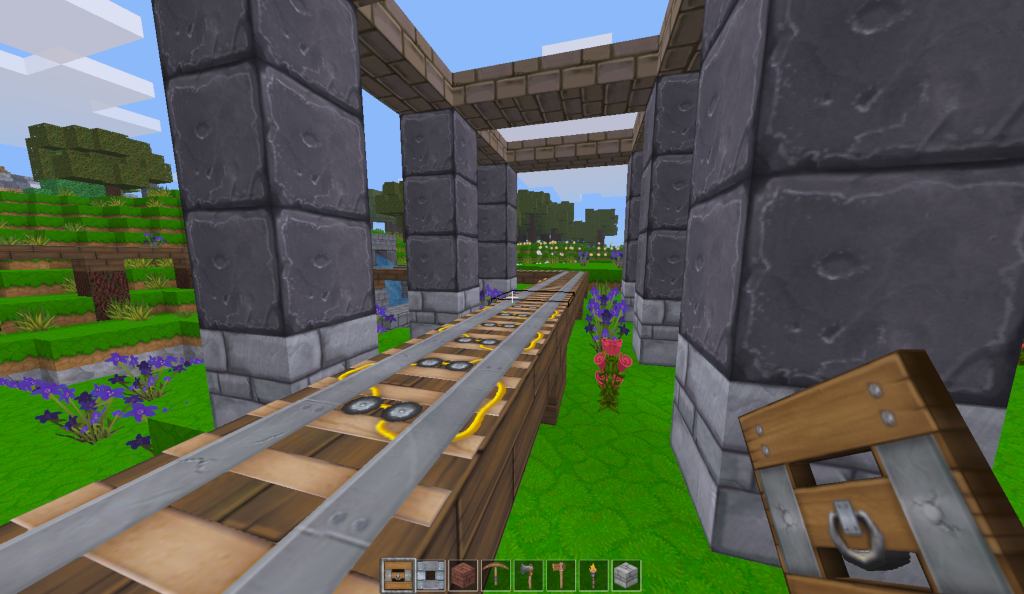
Another major shift in sandbox games came with the release of Minecraft, which was first introduced in 2009 in beta form and its first full release in 2011. At its core, Minecraft is a voxel-based survival game, where players collect resources to build tools that help them to collect better resources, and to construct shelters to protect them from hostile creatures. However, there are no limits on how players can build these structures, and using the vast array of resources available in the game, players can build nearly anything they could imagine; the game has been compared to digital Lego bricks.[27] Players' use of Minecraft in this way led to the developers to add a dedicated "Creative Mode" that stripped the survival elements from the game so that players could build without any hazards or other artificial limits.[46] Minecraft became a massive success, having sold more than 180 million copies by May 2019 and being the best selling personal computer game of all time.[47]
One pure sandbox game, aimed to offer no goals but allow players to create works to be shared with others, is Second Life (2003), a large massively multiplayer online game set in a virtual world where users could create various sections of the world as their own. The game was purposely developed as a community-driven world, so while the developers established some of the fundamentals of the in-game economies, much of how the workings and economics of the rest of Second Life's world was set by the players, which created several issues around pricing, gambling, and taxes, among other aspects. The game ultimately drew use by businesses as well, seeking to create space within it.[48]
More recent sandbox games have been aimed at providing interactive works that can be shared with others. Garry's Mod allows players to tinker with the Source engine from Valve to make animations and games[49] while games like LittleBigPlanet and Dreams (2019) from Media Molecule give users assets and primitive programming elements to craft games that can be shared with others.[50]
Influence on other genres
[edit]With time, sandbox design had become a mainstay in survival games,[22] as well as a popular subset of shooters,[36] and RPGs.[51][52] Long-time series such as Metal Gear had made the "shift to an open-world sandbox design," where the game dynamically "adds more missions as the story progresses and players complete the available side-ops".[53] Other long-running series such as Hitman were celebrated for their sandbox design.[54] The series became influential, creating a new template of games "that echo the same emphasis on sandbox design, open-ended mission structure, and sneaking".[55] In 2020, PC Gamer noted Mount & Blade as "a triumph of sandbox design". They observe that "because of its sandbox nature, Mount & Blade's quests are procedurally generated around many set templates," which leads to a game where "the simulation is the story".[56]
Starting in the late 2000s, superhero games have also begun to incorporate sandbox elements. Unlike common sandbox games during that time, where players control a semi-grounded normal human, superhero sandbox games have premises that involved controlling superpowered beings in a large open-world environment.[57] The first titles to utilize such premise were licensed superhero games such as Spider-Man 2 and Hulk: Ultimate Destruction.[58][59] The release of the 2007 game Crackdown, redefined these gameplay elements by adding the ability to level up and earn new weapons and powers. The game would go on to influence similar sandbox games like the 2009 titles Infamous and Prototype.[60][61] Infamous, in particular, added a morality system where the player can choose to be a superhero or a supervillain.[61] Other established sandbox games such as Saints Row and Just Cause, also began to incorporate these gameplay in their recent titles.[62]
Criticism
[edit]Sandbox design has been criticized for providing a lack of satisfying goals for players. According to Ernest Adams, "plunking the player down in a sandbox and saying, 'have fun' isn't good enough. Especially at the beginning of a game, the player should have a clear sense of what to do next and, in particular, why."[63] Christopher Totten observes that "sandbox elements can be mistakenly taken as fair replacements of narrative content; indeed, many games have missed their potential because they imagined that free-play would compensate for a lack of narrative. But even for our idealized child, playing around in a physical sandbox gets old pretty quick."[28] Critics point to repetitive in-game tasks, arguing that an "overabundance of mundane events can get in the way of enjoying the sandbox."[64] GameDeveloper.com notes that the quality of sandbox gameplay varies because "the great risk of the sandbox is that it can be boring." This is because "sand by itself is not much fun. Automated, complex, and perhaps most of all, directed responsiveness is essential to sandbox play, and the more complex and responsive the world, the more interesting the sandbox."[2]
Use in education
[edit]![[icon]](https://en.wikipedia.org/wiki/File:Wiki_letter_w_cropped.svg) | This section needs expansion. You can help by adding missing information. (January 2022) |
Some sandbox games have gained favorable use in education settings for inspiring studies to use creativity and critical thinking skills.[65]
Part of Microsoft's rationale for acquiring Mojang, the developers of Minecraft, for US$2.5 billion in 2014 was for its potential application in science, technology, engineering, and mathematics (STEM) education, according to CEO Satya Nadella on its acquisition in 2014, as the game already helps to pique children's curiosity.[66] Microsoft subsequently enhanced the MinecraftEDU version of the game into Minecraft: Education Edition (now known as Minecraft Education) that gives teachers and students numerous pre-made resources to work from, and the ability for teachers to monitor and assist students in their work, but otherwise allowing students to create and learn following several lesson plans developed by Microsoft.[67][68]
Educators and schools leverage Roblox for their computer and programming lessons. Students learning with Roblox can use their maintained game creation engine called Roblox Studio. The creation of these games can inspire students to work with creativity and concepts.[citation needed]
References
[edit]- ^ Brumbaugh, Zander (2021). Coding Roblox Games Made Easy (1st ed.). Packt Publishing, Limited. ISBN 9781800561991.
- ^ a b c d e f g h i j k l m n o p q r s t u Breslin, Steve (July 16, 2009). "The History and Theory of Sandbox Gameplay". GameDeveloper. Retrieved May 2, 2020.
- ^ Carreker, Dan (2012). The Game Developer's Dictionary: A Multidisciplinary Lexicon for Professionals and Students. Course Technology. ISBN 978-1-4354-6082-9.
- ^ Graft, Kris (29 October 2012). "EVE Online and the meaning of 'sandbox'". www.gamedeveloper.com. Retrieved 2020-05-14.
- ^ Oosterhuis, Kas; Feireiss, Lukas (2006). The Architecture Co-laboratory: GameSetandMatch II : on Computer Games, Advanced Geometries, and Digital Technologies. episode publishers. ISBN 978-90-5973-036-6.
- ^ Watkins, S. Craig; Cho, Alexander (2018-12-11). The Digital Edge: How Black and Latino Youth Navigate Digital Inequality. NYU Press. ISBN 978-1-4798-4985-7.
- ^ Lange, Alexandra (2018-06-15). "The Sandbox: an Intellectual History". Slate Magazine. Retrieved 2020-05-14.
- ^ "Information Behavior and the Formation and Maintenance of Peer Cultures in Massive Multiplayer Online Role-Playing Games" (PDF). Authors & Digital Games Research Association. Archived from the original (PDF) on 2017-08-12. Retrieved 2020-05-14.
- ^ Harris, John (September 26, 2007). "Game Design Essentials: 20 Open World Games". Gamasutra. Retrieved May 2, 2020.
- ^ "Good Game Stories - Backwards Compatible - History of Sandbox Games". www.abc.net.au. Retrieved 2020-05-14.
- ^ Stuart, Keith (2008-09-10). "Users are now the game developers". The Guardian. ISSN 0261-3077. Retrieved 2020-05-14.
- ^ a b "The Contradiction Of Linearity". www.gamedeveloper.com. 7 October 2010. Retrieved 2021-09-17.
- ^ "The Designer's Notebook: A Few Remarks on Creative Play". www.gamedeveloper.com. 29 April 2005. Retrieved 2021-09-17.
- ^ Warmelink, Harald (2014-02-03). Online Gaming and Playful Organization. Routledge. ISBN 978-1-135-04024-6.
- ^ Remo, James Huck, Chris (9 June 2008). "Exclusive: Will Wright - Video Games Close To 'Cambrian Explosion' Of Possibilities". www.gamedeveloper.com. Retrieved 2021-09-17.
{{cite web}}: CS1 maint: multiple names: authors list (link) - ^ Miller, Patrick (10 October 2012). "Emergent gameplay, F2P key for MMO user retention problems". www.gamedeveloper.com. Retrieved 2021-09-17.
- ^ a b Adams, Ernest (2010-04-07). Fundamentals of Game Design: Fundamentals of Game Design_2. New Riders. ISBN 978-0-13-210475-3.
- ^ Adams, Ernest; Rollings, Andrew (2007). Fundamentals of Game Design. Pearson Prentice Hall. ISBN 978-0-13-168747-9.
- ^ Jorge A. Blanco-Herrera; Christopher L. Groves; Ann M. Lewis; Douglas A. Gentile (2015). "Chapter 7 - Teaching Creativity: Theoretical Models and Applications". In James C. Kaufman; Garo Green (eds.). Video Games and Creativity. Elsevier. pp. 139–158. ISBN 978-0128017050.
- ^ Domsch, Sebastian (2013-08-28). Storyplaying: Agency and Narrative in Video Games. Walter de Gruyter. ISBN 978-3-11-027245-1.
- ^ "Learning by Design: Games as Learning Machines". www.gamedeveloper.com. 24 March 2004. Retrieved 2021-09-17.
- ^ a b Bycer, Josh (2015-02-17). "The Problems With Aimless Game Design". Game Wisdom. Retrieved 2020-06-07.
- ^ Domsch, Sebastian (2013). "3.2 Non-Unilinear Existents". Storyplaying: Agency and Narrative in Video Games. Walter de Gruyter. pp. 61–68. ISBN 978-3110272451.
- ^ a b c "The Designer's Notebook: Sandbox Storytelling". www.gamedeveloper.com. 25 August 2010. Retrieved 2020-05-14.
- ^ a b "The Four Basics of Open World Storytelling". www.gamedeveloper.com. April 2018. Retrieved 2021-09-17.
- ^ Sainsbury, Matt (2015). Game Art: Art from 40 Video Games and Interviews with Their Creators. No Starch Press. ISBN 978-1-59327-665-2.
- ^ a b Dawson, Christopher (May 25, 2012). "How 'Minecraft' became an Xbox blockbuster". CNN. Retrieved May 2, 2020.
- ^ a b c d Totten, Christopher W. (2018-09-03). An Architectural Approach to Level Design. CRC Press. ISBN 978-1-351-98292-4.
- ^ a b c Domsch, Sebastian (2013-08-28). Storyplaying: Agency and Narrative in Video Games. Walter de Gruyter. ISBN 978-3-11-027245-1.
- ^ Rogers, Scott (2014-04-16). Level Up! The Guide to Great Video Game Design. John Wiley & Sons. ISBN 978-1-118-87719-7.
- ^ Moss, Richard (21 April 2016). "7 examples of great game physics that every developer should study". www.gamedeveloper.com. Retrieved 2021-09-17.
- ^ Yarwood, Jack (21 February 2020). "How a new wave of developers are using voxels to create jaw-dropping worlds". www.gamedeveloper.com. Retrieved 2021-09-17.
- ^ a b Staff, Alex J. Champandard (February 2008). "Special: Top 5 Game AI Trends For 2008". www.gamedeveloper.com. Retrieved 2020-06-12.
- ^ "Creating All Humans: A Data-Driven AI Framework for Open Game Worlds". www.gamedeveloper.com. 4 February 2009. Retrieved 2021-09-17.
- ^ "Postmortem: Poptop Software's Tropico". www.gamedeveloper.com. 10 October 2001. Retrieved 2021-09-17.
- ^ a b Mitchell, Briar Lee (2012-03-05). Game Design Essentials. John Wiley & Sons. ISBN 978-1-118-23933-9.
- ^ Acharya, Devi; Wardrip-Fruin, Noah (2019). Building worlds together: understanding collaborative co-creation of game worlds. Proceedings of the 14th International Conference on the Foundations of Digital Games. pp. 1–5.
- ^ Edery, David1; Mollick, Ethan (2008). Changing the Game: How Video Games Are Transforming the Future of Business. FT Press. pp. 11–13. ISBN 978-0137151752.
{{cite book}}: CS1 maint: numeric names: authors list (link) - ^ Alex Fitzpatrick; John Patrick Pullen; Josh Raab; Lev Grossman; Lisa Eadicicco; Matt Peckham; Matt Vella (August 23, 2016). "The 50 Best Video Games of All Time". Time. Retrieved May 2, 2020.
- ^ Edery, David1; Mollick, Ethan (2008). Changing the Game: How Video Games Are Transforming the Future of Business. FT Press. pp. 9–11. ISBN 978-0137151752.
{{cite book}}: CS1 maint: numeric names: authors list (link) - ^ Taylor, Laurie N. (2006). "From Stompin' Mushrooms to Bustin' Heads: Grand Theft Auto III as Paradigm Shift". In Garrelts, Nate (ed.). The Meaning and Culture of Grand Theft Auto: Critical Essays. McFarland & Company. pp. 115–125. ISBN 0786428228.
- ^ Taylor, Laurie N. (2006). "Labyrinths, Mazes, Gardens, and Sandboxes: Game Space Metaphors". In Oosterhuis, Kas; Feireiss, Lukas (eds.). The Architecture Co-laboratory: GameSetandMatch II : on Computer Games, Advanced Geometries, and Digital Technologies. Episode Publishers. pp. 98–106. ISBN 9059730364.
- ^ Sheffield, Brandon (21 September 2009). "Opinion: Clone Vs. Genre - When Art Imitates Art". www.gamedeveloper.com. Retrieved 2021-09-17.
- ^ Duffy, Jill (8 March 2007). "GDC: Deus Ex Star Spector Questions Storytelling". www.gamedeveloper.com. Retrieved 2020-06-13.
- ^ "Gamasutra's Top 20 Trends of 2008". www.gamedeveloper.com. 17 December 2008. Retrieved 2021-09-17.
- ^ Matulef, Jeffrey (October 16, 2012). "Minecraft adds Creative Mode to the Xbox 360 version". Eurogamer. Retrieved May 2, 2020.
- ^ Bailey, Dustin. "Minecraft player count reaches 480 million". PCGamesN. Archived from the original on 19 November 2019. Retrieved 19 November 2019.
- ^ Hansen, Lauren (November 20, 2009). "What happened to Second Life?". BBC. Retrieved May 5, 2020.
- ^ Donnelly, Joe (August 27, 2015). "The making of: Garry's Mod". PCGamesN. Retrieved May 5, 2020.
- ^ Wen, Alan (July 17, 2019). "From LittleBigPlanet to Dreams: Media Molecule and the future of DIY gaming". TechRadar. Retrieved May 5, 2020.
- ^ Newman, Rich (2013-07-18). Cinematic Game Secrets for Creative Directors and Producers: Inspired Techniques From Industry Legends. Taylor & Francis. ISBN 978-1-136-13853-9.
- ^ "Focusing Creativity: RPG Genres". www.gamedeveloper.com. 24 January 2013. Retrieved 2021-09-17.
- ^ "Metal Gear Solid V: The Phantom Pain Has the Best Open World". GameRevolution. 2015-09-11. Retrieved 2020-06-13.
- ^ "Reviews round-up: Here's what critics think of Hitman 2". Critical Hit. 8 November 2018. Retrieved 2020-06-13.
- ^ "6 Games Like Hitman If You're Looking for Something Similar". Twinfinite. 2020-01-13. Retrieved 2020-06-13.
- ^ Savage, Phil (2017-04-06). "Mount and Blade 2 is on a mission to be 2017's best RPG". PC Gamer. Retrieved 2020-06-13.
- ^ Rodriguez, Jonathan. "10 Best Open-World Superhero Games, Ranked". GameRant. Archived from the original on February 10, 2024. February 8, 2024
- ^ Kane, Alex (2018-07-09). "The Oral History of Treyarch's Spider-Man 2: One of the Best Superhero Games Ever". USGamer.net. Archived from the original on February 10, 2019. Retrieved February 9, 2019.
- ^ Gilbert, Henry. "Prototype was inspired by Hulk: Ultimate Destruction". Games Radar. August 27, 2013
- ^ Cowen, Nick (12 July 2010). "Crackdown 2 video game review". The Telegraph. July 12, 2010
- ^ a b Kelly, Kevin (2009-03-25). "GDC09: An inFamous interview with Sucker Punch's Brian Fleming". Joystiq. Retrieved 2009-06-26.
- ^ Martin, Matt (14 August 2013). "Critical Consensus: Saints Row 4". gameindustry.biz. August 14, 2013
- ^ Adams, Ernest (26 August 2005). "The Designer's Notebook: The Bill of Players Rights". www.gamedeveloper.com. Retrieved 2021-09-17.
- ^ Doyle, Nick (2015-01-13). "Why More Open World Games is a Bad Thing". Gamemoir. Archived from the original on 2017-01-15. Retrieved 2020-06-08.
- ^ Chang, Dixie (December 2012). "Passion play: Will Wright and games for science learning". Cultural Studies of Science Education. 7 (4): 767–782. Bibcode:2012CSSE....7..767C. doi:10.1007/s11422-012-9456-5. S2CID 143547050.
- ^ Soper, Taylor (September 15, 2014). "Microsoft CEO Satya Nadella on Minecraft: 'It's the one game parents want their kids to play'". GeekWire. Retrieved May 12, 2020.
- ^ Kellon, Leo (January 19, 2016). "Minecraft to launch education edition". BBC. Retrieved May 12, 2020.
- ^ Kamenetz, Anya (August 9, 2017). "'Schoolifying' Minecraft Without Ruining It". NPR. Retrieved May 12, 2020.
| Action |
|  | |||||||||
|---|---|---|---|---|---|---|---|---|---|---|---|
| Action-adventure | |||||||||||
| Adventure | |||||||||||
| Digital tabletop | |||||||||||
| Puzzle | |||||||||||
| Role-playing | |||||||||||
| Simulation |
| ||||||||||
| Strategy | |||||||||||
| Other genres | |||||||||||
| Related concepts |
| ||||||||||