Hubbry Logo
Crow peopleCrow peopleMain
Open search
Crow people
Community hub
Crow people
logo
8 pages, 0 posts
0 subscribers
Be the first to start a discussion here.
Crow people
Crow people
from Wikipedia

Key Information

Apsáalooke
"children of the raven"
PeopleApsáalooke
LanguageApsáalooke aliláau
Apsáalooke iiéhkuua
CountryApsáalooke Issawua
Crow Indians, c. 1878–1883

The Crow, whose autonym is Apsáalooke ([ə̀ˈpsáːɾòːɡè]), are Native Americans living primarily in southern Montana. Today, the Crow people have a federally recognized tribe, the Crow Tribe of Montana,[1] with an Indian reservation, the Crow Indian Reservation, located in the south-central part of the state.[1]

Crow Native Americans are a Plains tribe, who speak the Crow language, part of the Missouri River Valley branch of Siouan languages. Of the 14,000 enrolled tribal citizens, an estimated 3,000 spoke the Crow language in 2007.[2]

In historical times, the Crow lived in the Yellowstone River valley, which extends from present-day Wyoming, through Montana, and into North Dakota, where it joins the Missouri River. During the United States' expansion into the West, the Crow allied with the Americans against their neighbors and rivals, the Dakota, Lakota, and Cheyenne.

Since the 19th century, Crow people have been concentrated on their reservation established south of Billings, Montana. Today, many also live in major Western cities. Their tribal headquarters are located at Crow Agency, Montana.[3] The tribe operates the Little Big Horn College.[2]

Name

[edit]

The autonym of the tribe, Apsáalooké or Absaroka,[5] means "children of the large-beaked bird"[6] and was given to them by the Hidatsa, a neighboring and related Siouan-speaking tribe. French interpreters translated the name as gens du corbeau ("people of the crow"), and they became known in English as the Crow. Other tribes also refer to the Apsáalooke as "crow" or "raven" in their own languages.[7] The identity of the bird this name was meant to refer to originally is lost to time, but many Apsáalooké people believe it references the mythical Thunderbird.[8]

History

[edit]

Into the Northern Plains

[edit]
Landscape on the Crow Indian Reservation, Montana

The Crow and related Hidatsa originated in the Ohio Country, south of Lake Erie.[9] They migrated west through Illinois, Minnesota, and settled south of Lake Winnipeg in the 12th or 13th centuries. They grew crops and hunted bison in settled villages, until the mid-16th century when the Ojibwe and Cree drove them further west to the Upper Missouri River.[9]

Later the Crow moved to the Devil's Lake region of North Dakota before the Crow split from the Hidatsa and moved westward in the late 17th century.[9] The Crow were largely pushed westward due to intrusion and influx of the Cheyenne and subsequently the Sioux, also known as the Lakota.

To acquire control of their new territory, the Crow fought against Shoshone bands, such as the Bikkaashe, or "People of the Grass Lodges",[10] and drove them westward. The Crow allied with local Kiowa and Plains Apache bands.[11][12][13] The Kiowa and Plains Apache bands later migrated southward, and the Crow remained dominant in their established area through the 18th and 19th centuries, the era of the fur trade.

Their historical territory stretched from what is now Yellowstone National Park and the headwaters of the Yellowstone River (E-chee-dick-karsh-ah-shay in Crow, translating to "Elk River") to the west, north to the Musselshell River, then northeast to the Yellowstone's mouth at the Missouri River, then southeast to the confluence of the Yellowstone and Powder rivers (Bilap Chashee, or "Powder River" or "Ash River"), south along the South Fork of the Powder River, confined in the SE by the Rattlesnake Mountains and westwards in the SW by the Wind River Range. Their tribal area included the river valleys of the Judith River (Buluhpa'ashe, or "Plum River"), Powder River, Tongue River, Big Horn River and Wind River as well as the Bighorn Mountains (Iisiaxpúatachee Isawaxaawúua), Pryor Mountains (Baahpuuo Isawaxaawúua), Wolf Mountains (Cheetiish, or "Wolf Teeth Mountains") and Absaroka Range (also called Absalaga Mountains).[14]

Once established in the Valley of the Yellowstone River[15] and its tributaries on the Northern Plains in Montana and Wyoming, the Crow divided into four groups: the Mountain Crow, River Crow, Kicked in the Bellies, and Beaver Dries its Fur. Formerly semi-nomad hunters and farmers in the northeastern woodland, they adapted to the nomadic lifestyle of the Plains Indians as hunters and gatherers, and hunted bison. Before 1700, they were using dog travois for carrying goods.[16][17]

Enemies and allies

[edit]
1880 Ledger drawing of a Cheyenne war chief and warriors (left) coming to a truce with a Crow war chief and warriors (right)

From about 1730, the Plains tribes rapidly adopted the horse, which allowed them to move out on to the Plains and hunt buffalo more effectively. However, the severe winters in the North kept their herds smaller than those of Plains tribes in the South. The Crow, Hidatsa, Eastern Shoshone, and Northern Shoshone soon became noted as horse breeders and dealers and developed relatively large horse herds. At the time, other eastern and northern tribes were also moving on to the Plains, in search of game for the fur trade, bison, and more horses. The Crow were subject to raids and horse thefts by horse-poor tribes, including the powerful Blackfoot, Gros Ventre, Assiniboine, Pawnee, and Ute.[18][19] Later they had to face the Lakota and their allies, the Arapaho and Cheyenne, who also stole horses from their enemies. Their greatest enemies became the tribes of the Blackfoot Confederacy and the Lakota-Cheyenne-Arapaho alliance.

In the 18th century, pressured by the Saulteaux and Cree peoples (the Iron Confederacy), who had earlier and better access to guns through the fur trade, the Crow had migrated to this area from the Ohio Eastern Woodland area of present-day Ohio, settling south of Lake Winnipeg. From there, they were pushed to the west by the Cheyenne. Both the Crow and the Cheyenne were pushed farther west by the Lakota, who took over the territory west of the Missouri River, reaching past the Black Hills of South Dakota to the Big Horn Mountains of Wyoming and Montana. The Cheyenne eventually became allies of the Lakota, as they sought to expel European Americans from the area. The Crow remained bitter enemies of both the Sioux and Cheyenne. They managed to retain a large reservation of more than 9300 km2 despite territorial losses, due in part to their cooperation with the federal government against their traditional enemies, the Sioux and Blackfoot. Many other tribes were forced onto much smaller reservations far from their traditional lands.

The Crow were generally friendly with the northern Plains tribes of the Flathead (although sometimes they had conflicts); Nez Perce, Kutenai, Shoshone, Kiowa, and Plains Apache. The powerful Iron Confederacy (Nehiyaw-Pwat), an alliance of northern plains Indian nations based around the fur trade, developed as enemies of the Crow. It was named after the dominating Plains Cree and Assiniboine peoples, and later included the Stoney, Saulteaux, and Métis.

Historical subgroups

[edit]

By the early 19th century, the Apsáalooke fell into three independent groupings, who came together only for common defense:[20]

  • Ashalaho ('Many Lodges', today called Mountain Crow), Awaxaawaxammilaxpáake ('Mountain People'), or Ashkúale ('The Center Camp'). The Ashalaho or Mountain Crow, the largest Crow group, split from the Awatixa Hidatsa and were the first to travel west. (McCleary 1997: 2–3)., (Bowers 1992: 21) Their leader No Intestines had received a vision and led his band on a long migratory search for sacred tobacco, finally settling in southeastern Montana. They lived in the Rocky Mountains and foothills along the Upper Yellowstone River, on the present-day Wyoming-Montana border, in the Big Horn and Absaroka Range (also Absalaga Mountains); the Black Hills comprised the eastern edge of their territory.
  • Binnéessiippeele ('Those Who Live Amongst the River Banks'), today called River Crow or Ashshipíte ('The Black Lodges') The Binnéessiippeele, or River Crow, split from the Hidatsa proper, according to tradition because of a dispute over a bison stomach. As a result, the Hidatsa called the Crow Gixáa-iccá—"Those Who Pout Over Tripe".[21][22] They lived along the Yellowstone and Musselshell rivers south of the Missouri River and in the river valleys of the Big Horn, Powder and Wind rivers. This area was historically known as the Powder River Country. They sometimes traveled north up to the Milk River.
  • Eelalapito (Kicked in the Bellies) or Ammitaalasshé (Home Away From The center, that is, away from the Ashkúale – "Mountain Crow").[23][24] They claimed the area known as the Bighorn Basin, from the Bighorn Mountains in the east to the Absaroka Range to the west, and south to the Wind River Range in northern Wyoming. Sometimes they settled in the Owl Creek Mountains, Bridger Mountains and along the Sweetwater River in the south.[25]

Apsaalooke oral history describes a fourth group, the Bilapiluutche ("Beaver Dries its Fur"), who may have merged with the Kiowa in the second half of the 17th century.

Gradual displacement from tribal lands

[edit]
Crow Indian territory (areas 517, 619 and 635) as described in Fort Laramie treaty (1851), present Montana and Wyoming

When European Americans arrived in numbers, the Crows were resisting pressure from enemies who greatly outnumbered them. In the 1850s, a vision by Plenty Coups, then a boy, but who later became their greatest chief, was interpreted by tribal elders as meaning that the whites would become dominant over the entire country, and that the Crow, if they were to retain any of their land, would need to remain on good terms with the whites.[26]

By 1851, the more numerous Lakota and Cheyenne were established just to the south and east of Crow territory in Montana.[27] These enemy tribes coveted the hunting lands of the Crow and warred against them. By right of conquest, they took over the eastern hunting lands of the Crow, including the Powder and Tongue River valleys, and pushed the less numerous Crow to the west and northwest upriver on the Yellowstone. After about 1860, the Lakota Sioux claimed all the former Crow lands from the Black Hills of South Dakota to the Big Horn Mountains of Montana. They demanded that the Americans deal with them regarding any intrusion into these areas.

The Treaty of Fort Laramie of 1851 with the United States confirmed as Crow lands a large area centered on the Big Horn Mountains: the area ran from the Big Horn Basin on the west, to the Musselshell River on the north, and east to the Powder River; it included the Tongue River basin.[28] But for two centuries the Cheyenne and many bands of Lakota Sioux had been steadily migrating westward across the plains, and were still pressing hard on the Crows.

Red Cloud's War (1866–1868) was a challenge by the Lakota Sioux to the United States military presence on the Bozeman Trail, a route along the eastern edge of the Big Horn Mountains to the Montana gold fields. Red Cloud's War ended with victory for the Lakota. The Treaty of Fort Laramie of 1868 with the United States confirmed the Lakota control over all the high plains from the Black Hills of the Dakotas westward across the Powder River Basin to the crest of the Big Horn Mountains.[29] Thereafter bands of Lakota Sioux led by Sitting Bull, Crazy Horse, Gall, and others, along with their Northern Cheyenne allies, hunted and raided throughout the length and breadth of eastern Montana and northeastern Wyoming, which had been for a time ancestral Crow territory.

On 25 June 1876, the Lakota Sioux and Cheyenne achieved a major victory over army forces under Lieutenant Colonel George Armstrong Custer at the Battle of the Little Big Horn in the Crow Indian Reservation,[30] but the Great Sioux War (1876–1877) ended in the defeat of the Sioux and their Cheyenne allies. Crow warriors enlisted with the U.S. Army for this war. The Sioux and allies were forced from eastern Montana and Wyoming: some bands fled to Canada, while others suffered forced removal to distant reservations, primarily in present-day Montana and Nebraska west of the Missouri River.

In 1918, the Crow organized a gathering to display their culture, and they invited members of other tribes. The Crow Fair is now celebrated yearly on the third weekend of August, with wide participation from other tribes.[31]

Crow Tribe history: a chronological record

[edit]

1600–1699

[edit]

A group of Crow went west after leaving the Hidatsa villages of earth lodges in the Knife River and Heart River area (present North Dakota) around 1675–1700. They selected a site for a single earth lodge on the lower Yellowstone River. Most families lived in tipis or other perishable kinds of homes at the new place. These Indians had left the Hidatsa villages and adjacent cornfields for good, but they had yet to become "real" buffalo hunting Crow following the herds on the open plains.[32] Archaeologists know this "proto-Crow" site in present Montana as the Hagen site.[33]

1700–1799

[edit]

Some time before 1765, the Crow held a Sun Dance, attended by a poor Arapaho. A Crow with power gave him a medicine doll, and he quickly earned status and owned horses as no one else. During the next Sun Dance, some Crow stole back the figure to keep it in the tribe. Eventually the Arapaho made a duplicate. Later in life, he married a Kiowa woman and brought the doll with him. The Kiowas use it during the Sun Dance and recognize it as one of the most powerful tribal medicines. They still credit the Crow tribe for the origin of their sacred Tai-may figure.[34]

1800–1824

[edit]
The trading posts built for trade with the Crows

The enmity between the Crow and the Lakota was reasserted from the start of the 19th century. The Crow killed a minimum of thirty Lakota in 1800–1801 according to two Lakota winter counts.[35] The next year, the Lakota and their Cheyenne allies killed all the men in a Crow camp with thirty tipis.[36]

In the summer of 1805, a Crow camp traded at the Hidatsa villages on Knife River in present North Dakota. Chiefs Red Calf and Spotted Crow allowed the fur trader Francois-Antoine Larocque to join it on its way across the plains to the Yellowstone area. He traveled with it to a point west of the place where Billings, Montana, is today. The camp crossed Little Missouri River and Bighorn River on the way.[37]

The next year, some Crow discovered a group of whites with horses on the Yellowstone River. By stealth, they captured the mounts before morning. The Lewis and Clark Expedition did not see the Crow.[38]

The first trading post in Crow country was constructed in 1807, known as both Fort Raymond and Fort Lisa (1807–ca. 1813). Like the succeeding forts, Fort Benton (ca. 1821–1824) and Fort Cass (1832–1838), it was built near the confluence of the Yellowstone and the Bighorn.[39]

The Blood Blackfoot Bad Head's winter count tells about the early and persistent hostility between the Crow and the Blackfoot. In 1813, a force of Blood warriors set off for a raid on the Crow in the Bighorn area. Next year, Crows near Little Bighorn River killed Blackfoot Top Knot.[40]: 6 

A Crow camp neutralized thirty Cheyenne bent on capturing horses in 1819.[41] The Cheyenne and warriors from a Lakota camp destroyed a whole Crow camp at Tongue River the following year.[42] This was likely the most severe attack on a Crow camp in historic time.[43][44]

1825–1849

[edit]

The Crows put up 300 tipis near a Mandan village on the Missouri in 1825.[45] The representatives of the US government waited for them. Mountain Crow chief Long Hair (Red Plume at Forehead) and fifteen other Crows signed the first treaty of friendship and trade between the Crows and the United States on 4 August.[46] With the signing of the document, the Crows also recognized the supremacy of the United States, if they actually understood the word. River Crow chief Arapooish had left the treaty area in disgust. By help of the thunderbird he had to send a farewell shower down on the whites and the Mountain Crows.[47]

In 1829, seven Crow warriors were neutralized by Blood Blackfoot Indians led by Spotted Bear, who captured a pipe-hatchet during the fight just west of Chinook, Montana.[40]: 8 

In the summer of 1834, the Crow (maybe led by chief Arapooish) tried to shut down Fort McKenzie at the Missouri in Blackfeet country. The apparent motive was to stop the trading post's sale to their Indian enemies. Although later described as a month long siege of the fort,[48] it lasted only two days.[49] The opponents exchanged a few shots and the men in the fort fired a cannon, but no real harm came to anyone. The Crows left four days before the arrival of a Blackfeet band. The episode seems to be the worst armed conflict between the Crows and a group of whites until the Sword Bearer uprising in 1887.

The death of chief Arapooish was recorded on 17 September 1834. The news reached Fort Clark at the Mandan village Mitutanka. Manager F.A. Chardon wrote he "was Killed by Black feet".[50]

The smallpox epidemic of 1837 spread along the Missouri and "had little impact" on the tribe according to one source.[51] The River Crows grew in number, when a group of Hidatsas joined them permanently to escape the scourge sweeping through the Hidatsa villages.[52]

Fort Van Buren was a short-lived trading post in existence from 1839 to 1842.[53]: 68  It was built on the bank of the Yellowstone near the mouth of Tongue River.[50]: 315, note 469 

In the summer of 1840, a Crow camp in the Bighorn valley greeted the Jesuit missionary Pierre-Jean De Smet.[54]: 35 

From 1842 to around 1852,[55]: 235  the Crow traded in Fort Alexander opposite the mouth of the Rosebud.[53]: 68 

The River Crows charged a moving Blackfeet camp near Judith Gap in 1845. Father Pierre-Jean De Smet mourned the destructive attack on the "petite Robe" band.[56] The Blackfeet chief Small Robe had been mortally wounded and many killed. De Smet worked out the number of women and children taken captive to 160. By and by and with a fur trader as an intermediary, the Crows agreed to let 50 women return to their tribe.[57]

1850–1874

[edit]
De Smet map of the 1851 Fort Laramie Indian territories (the light area). Jesuit missionary De Smet drew this map with the tribal borders agreed upon at Fort Laramie in 1851. Although the map itself is wrong in certain ways, it has the Crow territory west of the Sioux territory as written in the treaty, and the Bighorn area as the heart of the Crow country.
Crow Indian Chief Big Shadow (Big Robber), signer of the Fort Laramie treaty (1851). Painting by Jesuit missionary De Smet.
Lone Dog's Sioux winter count, 1870. Thirty Crows killed in battle.
1874 photograph of Crow Indians killed and scalped by Piegan Blackfeet in winter of 1873

Fort Sarpy (I) near Rosebud River carried out trade with the Crow after the closing of Fort Alexander.[53]: 67  River Crow went some times to the bigger Fort Union at the confluence of the Yellowstone and the Missouri. Both the "famous Absaroka amazon" Woman Chief[55]: 213  and River Crow chief Twines His Tail (Rotten Tail) visited the fort in 1851.[55]: 211 

In 1851, the Crow, the Sioux, and six other Indian nations signed the Fort Laramie treaty along with the U.S. It should ensure peace forever between all nine partakers. Further, the treaty described the different tribal territories. The U.S. was allowed to construct roads and forts.[58]: 594–595  A weak point in the treaty was the absence of rules to uphold the tribal borders.[53]: 87 

The Crow and various bands of Sioux attacked each other again from the mid-1850s.[59]: 226, 228 [60]: 9–12 [61]: 119–124 [62]: 362 [63]: 103  Soon, the Sioux took no notice of the 1851 borders[64]: 340  and expanded into Crow territory west of the Powder.[65]: 46 [66]: 407–408 [67]: 14  The Crows engaged in "… large-scale battles with invading Sioux …" near present-day Wyola, Montana.[67]: 84  Around 1860, the western Powder area was lost.[64]: 339 [68]

From 1857 to 1860, many Crow traded their surplus robes and skin at Fort Sarpy (II) near the mouth of the Bighorn River.[53]: 67–68 

During the mid-1860s, the Sioux resented the emigrant route Bozeman Trail through the Powder River bison habitat, although it mainly "crossed land guaranteed to the Crows".[53]: 89 [69]: 20 [70]: 170, note 13  When the Army built forts to protect the trail, the Crow cooperated with the garrisons.[53]: 89 and 91 [71]: 38–39  On 21 December 1866, the Sioux, Cheyenne, and Arapaho defeated Captain William J. Fetterman and his men from Fort Phil Kearny.[53]: 89  Evidently, the U.S. could not enforce respect for the treaty borders agreed upon 15 years before.[53]: 87 

The River Crow north of the Yellowstone developed a friendship with their former Gros Ventre enemies in the 1860s.[53]: 93 [63]: 105  A joint large-scale attack on a large Blackfoot camp at the Cypress Hills in 1866 resulted in a chaotic withdrawal of the Gros Ventres and Crow. The Blackfoot pursued the warriors for hours and killed allegedly more than 300.[63]: 106 [72]: 140 

In 1868, a new Fort Laramie treaty between the Sioux and the U.S. turned 1851 Crow Powder River area into "unceded Indian territory" of the Sioux.[58]: 1002  "The Government had in effect betrayed the Crows…".[71]: 40  On 7 May, the same year, the Crow ceded vast ranges to the US due to pressure from white settlements north of Upper Yellowstone River and loss of eastern territories to the Sioux. They accepted a smaller reservation south of the Yellowstone.[58]: 1008–1011 

The Sioux and their Indian allies, now formally at peace with the U.S., focused on intertribal wars at once.[73]: 175  Raids against the Crows were "frequent, both by the Northern Cheyennes and by the Arapahos, as well as the Sioux, and by parties made up from all three tribes".[74]: 347  Crow chief Plenty Coups recalled, "The three worst enemies our people had were combined against us …".[75]: 127 and 107, 135, 153 

In April 1870, the Sioux overpowered a barricaded war group of 30 Crow in the Big Dry area.[60]: 33  The Crow were killed to either last or last but one man. Later, mourning Crow with "their hair cut off, their fingers and faces cut" brought the dead bodies back to camp.[76]: 153  The drawing from the Sioux winter count of Lone Dog shows the Crow in the circle (the breastwork), while the Sioux close in on them. The many lines indicates flying bullets. The Sioux lost 14 warriors.[77]: 126  Sioux chief Sitting Bull took part in this battle.[60]: 33 [78]: 115–119 

In the summer of 1870, some Sioux attacked a Crow reservation camp in the Bighorn/Little Bighorn area.[79] The Crows reported Sioux Indians in the same area again in 1871.[80]: 43  During the next years, this eastern part of the Crow reservation was taken over by the Sioux in search of buffalo.[81]: 182  In August 1873, visiting Nez Percé and a Crow reservation camp at Pryor Creek further west faced a force of Sioux warriors in a long confrontation.[53]: 107  Crow chief Blackfoot objected to this incursion and called for resolute U.S. military actions against the Indian trespassers.[53]: 106  Due to Sioux attacks on both civilians and soldiers north of the Yellowstone in newly established U.S. territory (Battle of Pease Bottom, Battle of Honsinger Bluff), the Commissioner of Indian Affairs advocated the use of troops to force the Sioux back to South Dakota in his 1873 report.[82]: 145  Nothing happened.

1875–1899

[edit]
Crooks army before battle of the Rosebud. The Crow and Shoshone scouts and the Army are crossing Goose River on the way to the Rosebud in 1876. The equestrian woman may be either the Crow berdache Finds-them-and-kills-them or the Crow amazon The-other-magpie.[83]: 228 
"Eight Crow prisoners under guard at Crow agency, Montana, 1887"

Two years later, in early July 1875,[84]: 75  Crow chief Long Horse was killed in a suicidal attack on some Sioux,[75]: 277–284  who previously had killed three soldiers from Camp Lewis on the upper Judith River (near Lewistown).[85]: 114  George Bird Grinnell was a member of the exploring party in the Yellowstone National Park that year, and he saw the bringing in of the dead chief. A mule carried the body, which was wrapped in a green blanket. The chief was placed in a tipi "not far from the Crow camp, reclining on his bed covered with robes, his face handsomely painted".[85]: 116  Crow woman Pretty Shield remembered the sadness in camp. "We fasted, nearly starved in our sorrow for the loss of Long-Horse."[83]: 38 

Exposed to Sioux attacks, the Crows sided with the U.S. during the Great Sioux War in 1876–1877.[64]: 342  On 10 April 1876, 23 Crow enlisted as Army scouts.[81]: 163  They enlisted against a traditional Indian enemy, "... who were now in the old Crow country, menacing and often raiding the Crows in their reservation camps."[86]: X  Charles Varnum, leader of Custer's scouts, understood how valuable the enrolment of scouts from the local Indian tribe was. "These Crows were in their own country and knew it thoroughly."[87]: 60 

Notable Crows like Medicine Crow[88]: 48  and Plenty Coups participated in the Rosebud Battle along with more than 160 other Crows.[67]: 47 [75]: 154–172 [71]: 116 

The Battle of the Little Bighorn stood on the Crow reservation.[71]: 113  As most battles between the US and the Sioux in the 1860s and 1870s, "It was a clash of two expanding empires, with the most dramatic battles occurring on lands only recently taken by the Sioux from other tribes."[65]: 42 [66]: 408 [64]: 342  When the Crow camp with Pretty Shield learned about the defeat of George A. Custer, it cried for the assumed dead Crow scouts "… and for Son-of-the-morning-star [Custer] and his blue soldiers …".[83]: 243 

On 8 January 1877, three Crow participated in the last battle of the Great Sioux War in the Wolf Mountains.[89]: 60 

In the spring of 1878, 700 Crow tipis were pitched at the confluence of Bighorn River and Yellowstone River. Together with Colonel Nelson A. Miles, an Army leader in the Great Sioux War, the large camp celebrated the victory over the Sioux.[53][90]: 283–285 

In 1882, during the cattle boom, the US government responded to ranchers' demands for more land and pressured the Crow to cede the Western part of their reservation.[91]

Culture

[edit]

Subsistence

[edit]
Illustration of a buffalo jump
The Oath Apsaroke by Edward S. Curtis depicting Crow men giving a symbolic oath with a bison meat offering on an arrow

The main food source for the Crow was the American bison which was hunted in a variety of ways. Before the use of horses the bison were hunted on foot and required hunters to stalk close to the bison, often with a wolf-pelt disguise, then pursue the animals quickly on foot before killing them with arrows or lances. The horse allowed the Crow to hunt bison more easily as well as hunt more at one time. Riders would panic the herd into a stampede and shoot the targeted animals with arrows or bullets from horseback or lance them through the heart. In addition to bison the Crow also hunted bighorn sheep, mountain goats, deer, elk, bear, and other game. Buffalo meat was often roasted or boiled in a stew with prairie turnips. The rump, tongue, liver, heart, and kidneys all were considered delicacies. Dried bison meat was ground with fat and berries to make pemmican.[92] In addition to meat, wild edibles were gathered and eaten such as elderberries, wild turnip, and Saskatoon berries.

The Crow often hunted bison by utilizing buffalo jumps. "Where Buffaloes are Driven Over Cliffs at Long Ridge" was a favorite spot for meat procurement by the Crow Indians for over a century, from 1700 to around 1870 when modern weapons were introduced.[93] The Crow used this place annually in the autumn, a place of multiple cliffs along a ridge that eventually sloped to the creek. Early in the morning the day of the jump a medicine man would stand on the edge of the upper cliff, facing up the ridge. He would take a pair of bison hindquarters and pointing the feet along the lines of stones he would sing his sacred songs and call upon the Great Spirit to make the operation a success.[93] After this invocation the medicine man would give the two head drivers a pouch of incense.[93] As the two head drivers and their helpers headed up the ridge and the long line of stones they would stop and burn incense on the ground repeating this process four times.[93] The ritual was intended to make the animals come to the line where the incense was burned, then bolt back to the ridge area.[93]

Habitation and transportation

[edit]
Crow Lodge of Twenty-five Buffalo Skins, 1832–33 by George Catlin
Crow men trading on horseback
Three Crow men on their horses, Edward S. Curtis, 1908
A scout on a horse, 1908 by Edward S. Curtis

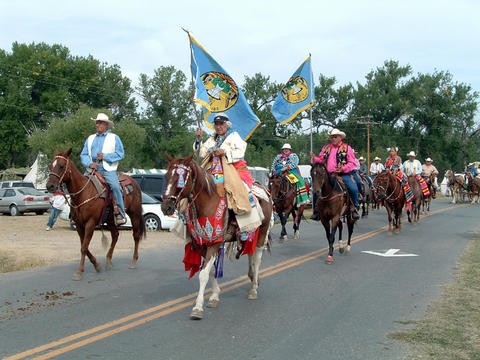
The traditional Crow shelter is the tipi or skin lodge made with bison hides stretched over wooden poles. The Crow are historically known to construct some of the largest tipis. Tipi poles were harvested from the lodgepole pine which acquired its name from its use as support for tipis.[94] Inside the tipi, mattresses and buffalo-hide seats were arranged around the edge, with a fireplace in the center. The smoke from the fire escaped through a hole or smoke-flap in the top of the tipi. At least one entrance hole with collapsible flap allowed entry into the tipi. Often hide paintings adorned the outside and inside of tipis with specific meanings attached to the images. Often specific tipi designs were unique to the individual owner, family, or society that resided in the tipi. Tipis are easily raised and collapsed and are lightweight, which is ideal for nomadic people like the Crow who move frequently and quickly. Once collapsed, the tipi poles are used to create a travois. Travois are a horse-pulled frame structure used by plains Indians to carry and pull belongings as well as small children. Many Crow families still own and use the tipi, especially when traveling. The annual Crow Fair has been described as the largest gathering of tipis in the world.

The most widely used form of transportation used by the Crow was the horse. Horses were acquired through raiding and trading with other Plains nations. People of the northern plains like the Crow mostly got their horses from people from the southern plains such as the Comanche and Kiowa who originally got their horses from the Spanish and southwestern Indians such as the various Pueblo people. The Crow had large horse herds which were among the largest owned by Plains Indians; in 1914 they had approximately thirty to forty thousand head. By 1921 the number of mounts had dwindled to just one thousand. Like other plains people the horse was central to the Crow economy and were a highly valuable trade item and were frequently stolen from other tribes to gain wealth and prestige as a warrior. The horse allowed the Crow to become powerful and skilled mounted warriors, being able to perform daring maneuvers during battle including hanging underneath a galloping horse and shooting arrows by holding onto its mane. They also had many dogs; one source counted five to six hundred. Dogs were used as guards and pack animals to carry belongings and pull travois. The introduction of horses into Crow society allowed them to pull heavier loads faster, greatly reducing the number of dogs used as pack animals.

Attire

[edit]

The Crow wore clothing distinguished by gender. Women wore dresses made of deer and buffalo hide, decorated with elk teeth or shells. They covered their legs with leggings during winter and their feet with moccasins. Crow women wore their hair in two braids. Male clothing usually consisted of a shirt, trimmed leggings with a belt, a long breechcloth, and moccasins. Robes made from the furred hide of a bison were often worn in winter. Leggings were either made of animal hide which the Crow made for themselves or made of wool which were highly valued trade items made specifically for Indians in Europe. Their hair was worn long, in some cases reaching the ground.[95] The Crow are famous for often wearing their hair in a pompadour which was often colored with white paint. Crow men were notable for wearing two hair pipes made from beads on both sides of their hair. Men often wore their hair in two braids wrapped in the fur of beavers or otters. Bear grease was used to give shine to hair. Stuffed birds were often worn in the hair of warriors and medicine men. Like other plains Indians the Crow wore feathers from eagles, crows, owls, and other birds in their hair for symbolic reasons. The Crow wore a variety of headdresses including the famous eagle feather headdress, bison scalp headdress with horns and beaded rim, and split horn headdress. The split horn headdress is made from a single bison horn split in half and polished into two nearly identical horns which were attached to a leather cap and decorated with feathers and beadwork. Traditional clothing worn by the Crow is still worn today with varying degrees of regularity.

The Crow are well known for their intercut beadwork. They adorned basically every aspect of their lives with these beads, giving special attention to ceremonial and ornamental items. Their clothing, horses, cradles, ornamental and ceremonial gear, in addition to leather cases of all shapes, sizes and uses were decorated in beadwork.[96] They gave reverence to the animals they ate by using as much of it as they could. The leather for their clothing, robes and pouches were created from the skin of buffalo, deer and elk. The work was done by the tribeswomen, with some being considered experts and were often sought by the younger, less experienced women for design and symbolic advice.[97] The Crow are an innovative people and are credited with developing their own style of stitch-work for adhering beads. This stitch, which is now called the overlay, is still also known as the "Crow Stitch".[96] In their beadwork, geometric shapes were primarily used with triangles, diamonds and hour-glass structures being the most prevalent. A wide range of colors were utilized by the Crow, but blues and various shades of pink were the most dominantly used. To intensify or to draw out a certain color or shape, they would surround that figure or color in a white outline.[96]

The colors chosen were not just merely used to be aesthetically pleasing, but rather had a deeper symbolic meaning. Pinks represented the various shades of the rising sun with yellow being the East the origin of the sun's arrival.[96] Blues are symbolic of the sky; red represented the setting sun or the West; green symbolizing mother earth, black the slaying of an enemy[97] and white representing clouds, rain or sleet.[96] Although most colors had a common symbolism, each piece's symbolic significance was fairly subjective to its creator, especially when in reference to the individual shapes. One person's triangle might symbolize a teepee, a spear head to a different individual or a range of mountains to yet another. Regardless of the individual significance of each piece, the Crow People give reverence to the land and sky with the symbolic references found in the various colors and shapes found on their ornamental gear and even clothing.[96]

Some of the clothing that the Crow decorated with beads included robes, vests, pants, shirts, moccasins and various forms of celebratory and ceremonial gear. In addition to creating a connection with the land, from which they are a part, the various shapes and colors reflected one's standing and achievements. For example, if a warrior were to slay, wound or disarm an enemy, he would return with a blackened face.[97] The black color would then be incorporated in the clothing of that man, most likely in his war attire. A beaded robe, which was often given to a bride to be, could take over a year to produce and was usually created by the bride's mother-in-law or another female relative-in-law. These robes were often characterized by a series of parallel horizontal lines, usually consisting of light blue. The lines represented the young women's new role as a wife and mother; also the new bride was encouraged to wear the robe at the next ceremonial gathering to symbolize her addition and welcoming to a new family.[96] In modern times, the Crow still often decorate their clothing with intricate bead designs for powwow and everyday clothing.

Gender and kinship system

[edit]

The Crow had a matrilineal system. After marriage, the couple was matrilocal (the husband moved to the wife's mother's house upon marriage). Women hold a significant role within the tribe.

Crow kinship is a system used to describe and define family members. Identified by Lewis Henry Morgan in his 1871 work Systems of Consanguinity and Affinity of the Human Family, the Crow system is one of the six major types which he described: Eskimo, Hawaiian, Iroquois, Crow, Omaha, and Sudanese.[98]

The Crow historically had a status for male-bodied two-spirits, termed baté/badé,[99] such as Osh-Tisch.[100][101]

21st Century

[edit]

Geography

[edit]

The Crow Indian Reservation in south-central Montana is a large reservation covering approximately 2,300,000 acres (3,600 sq mi; 9,300 km2) of land area, the fifth-largest Indian reservation in the United States. The reservation is primarily in Big Horn and Yellowstone counties with ceded lands in Rosebud, Carbon, and Treasure counties. The Crow Indian Reservation's eastern border is the 107th meridian line, except along the border line of the Northern Cheyenne Indian Reservation.

The southern border is from the 107th meridian line west to the east bank of the Big Horn River. The line travels downstream to Bighorn Canyon National Recreation Area and west to the Pryor Mountains and north-easterly to Billings. The northern border travels east and through Hardin, Montana, to the 107th meridian line. The 2000 census reported a total population of 6,894 on reservation lands. Its largest community is Crow Agency.

Government

[edit]
Crow flag seen from Interstate 90 at the Crow Indian Reservation, Big Horn County, Montana

Prior to the 2001 Constitution, the Crow Tribe of Montana was governed by its 1948 constitution. The former constitution organized the tribe as a general council (tribal council). The general council held the executive, legislative, and judicial powers of the government and included all enrolled, adult members of the Crow Tribe, provided that women were 18 years or older and men were 21 or older. The general council was a direct democracy, comparable to that the Haudenosaunee Confederacy.

The Crow Tribe of Montana established a three-branch government at a 2001 council meeting with its 2001 constitution. The general council remains the governing body of the tribe; however, the powers were distributed to three separate branches within the government. In theory, the general council is still the governing body of the Crow Tribe, yet in reality the general council has not convened since the establishment of the 2001 constitution.

The executive branch has four officials. These officials are known as the chairperson, Vice-chairperson, Secretary, and Vice-Secretary. The Executive Branch officials are also the officials within the Crow Tribal General Council, which has not met since 15 July 2001.

The current administration of the Crow Tribe Executive Branch is as follows:

  • Chairman: Frank White Clay
  • Vice-chairman: Lawrence DeCrane
  • Secretary: Levi Black Eagle
  • Vice-Secretary: Channis Whiteman[102]

The Legislative Branch consists of three members from each district on the Crow Indian Reservation. The Crow Indian Reservation is divided into six districts known as The Valley of the Chiefs, Reno, Black Lodge, Mighty Few, Big Horn, and Pryor Districts. The Valley of the Chiefs District is the largest district by population.

The Judicial Branch consists of all courts established by the Crow Law and Order Code and in accordance with the 2001 Constitution. The Judicial Branch has jurisdiction over all matters defined in the Crow Law and Order Code. The Judicial Branch attempts to be a separate and distinct branch of government from the Legislative and Executive Branches of Crow Tribal Government. The Judicial Branch consists of an elected Chief Judge and two Associate Judges. The Crow Court of Appeals, similar to State Court of Appeals, receives all appeals from the lower courts. The Chief Judge of the Crow Tribe is Julie Yarlott.

Constitution controversy

[edit]

According to the 1948 Constitution, Resolution 63-01 (Please note: in a letter of communication from Phileo Nash, then Commissioner of Indian Affairs, to the B.I.A. Area Director, as stated in the letter and confirmed that 63-01 is an Ordinance in said letter) all constitutional amendments must be voted on by secret ballot or referendum vote. In 2001, major actions were taken by the former Chairperson Birdinground without complying with those requirements. The quarterly council meeting on 15 July 2001 passed all resolutions by voice vote, including the measure to repeal the current constitution and approve a new constitution.

Critics contend the new constitution is contrary to the spirit of the Crow Tribe, as it provides authority for the US Bureau of Indian Affairs (BIA) to approve Crow legislation and decisions. The Crow people have guarded their sovereignty and Treaty Rights. The alleged New Constitution was not voted on to add it to the agenda of the Tribal Council. The former constitution mandated that constitutional changes be conducted by referendum vote, using the secret ballot election method and criteria. In addition, a constitutional change can only be conducted in a specially called election, which was never approved by council action for the 2001 Constitution. The agenda was not voted on or accepted at the council.

The only vote taken at the council was whether to conduct the voting by voice vote or walking through the line. Critics say the chairman ignored and suppressed attempts to discuss the Constitution. This council and constitutional change was never ratified by any subsequent council action. The Tribal Secretary, who was removed from office by the Birdinground Administration, was the leader of the opposition. All activity occurred without his signature.

When the opposition challenged, citing the violation of the Constitutional Process and the Right to Vote, the Birdinground Administration sought the approval of the United States Department of the Interior (USDOI), Bureau of Indian Affairs (BIA). The latter stated it could not interfere in an internal tribal affair The federal court also ruled that the constitutional change was an internal tribal matter.[citation needed]

Leadership

[edit]
Crow Tribal Chairperson Carl Venne and Barack Obama on the Crow Indian Reservation in Montana on 19 May 2008. Obama was the first presidential candidate to visit the Crow Tribe.

The seat of government and capital of the Crow Indian Reservation is Crow Agency, Montana.

The Crow Tribe historically elected a chairperson of tribal council biennially; however, in 2001, the term of office was extended to four years. The previous chairperson was Carl Venne. The chairperson serves as chief executive officer, speaker of the council, and majority leader of the Crow Tribal Council. The constitutional changes of 2001 created a three-branch government. The chairperson serves as the head of the executive branch, which includes the offices of vice-chairperson, secretary, vice-secretary, and the tribal offices and departments of the Crow Tribal Administration. Notable chairs include Clara Nomee, Edison Real Bird, and Robert "Robie" Yellowtail.

On 19 May 2008, Hartford and Mary Black Eagle of the Crow Tribe adopted U.S. Senator (later President) Barack Obama into the tribe on the date of the first visit of a U.S. presidential candidate to the nation.[103] Crow representatives also took part in President Obama's inaugural parade. In 2009, Dr. Joseph Medicine Crow was one of 16 people awarded the Presidential Medal of Freedom.

During the United States federal government shutdown of 2013, the Crow Tribe furloughed 316 employees and suspended programs providing health care, bus services and improvements to irrigation.[104]

In 2020, the Tribal Chairman AJ Not Afraid Jr. endorsed President Donald Trump's reelection, along with endorsing Republicans Steve Daines for the Senate, Greg Gianforte for Governor and Matt Rosendale for the U.S. House.[105]

Notable Crow people

[edit]
Delegation of important Crow chiefs, 1880. From left to right: Old Crow, Medicine Crow, Long Elk, Plenty Coups, and Pretty Eagle.
  • Eldena Bear Don't Walk (Crow/Salish/Kutenai, b. c. 1973), lawyer, judge, politician, first woman to serve as the Chief Justice of the Crow Tribe
  • Max Big Man, educator, artist, and honorary chief who created educational programming with CBS Radio
  • Earl Biss (1947–1998), painter
  • Bull Chief (c. 1825 – unknown), war chief (pipe carrier), who fought against Lakota, Nez Percé, Shoshone, and Piegan Blackfoot warriors, he also resisted white settlement of Crow territory
  • Curly (or Curley) (also known as Ashishishe/Shishi'esh, c. 1856 – 1923), Indian Scout and warrior
  • Goes Ahead or Ba'suck'osh (also Walks Among the Stars, 1851–1919), Indian Scout and warrior, husband of Pretty Shield
  • Hairy Moccasin or Esh-sup-pee-me-shish (c. 1854 – 1922), Crow Indian Scout and warrior
  • Half Yellow Face or Ischu Shi Dish (c. 1830 – c. 1879), Crow Indian Scout and warrior, war leader (pipe carrier) and leader of the six Crow Scouts who assisted General George A. Custer
  • Issaatxalúash, also Two Leggings (mid-1840s – 1923); bacheeítche (local group leader) of River Crow, war leader (pipe carrier), during the first years of the reservation era
  • Donald Laverdure, Principal Deputy Assistant Secretary of Indian Affairs at the U.S. Department of the Interior
  • Joe Medicine Crow, also PédhitšhÎ-wahpášh (1913–2016), the last war chief (pipe carrier) of the Crow Tribe, educator, historian, author, and official anthropologist
  • Elias Not Afraid; (born 1990) Apsáalooke (Crow/Absaroke)[2] artist known for his traditional and non-traditional beadwork
  • Janine Pease, an American Indian educator and advocate and the first woman of Crow lineage to earn a doctorate degree
  • Wendy Red Star, visual artist
  • Plenty Coups, Crow chief who cooperated with the government against other more hostile tribes, ensuring the Crow kept much of their traditional lands.
  • Pretty Eagle, fellow war chief of Plenty Coups, who worked with him to ensure the tribe's cooperation with the federal government.
  • Pretty Shield (c. 1856 – 1944), medicine woman, wife of Goes Ahead, a scout at the Battle of the Little Bighorn
  • Shows as He Goes, war chief
  • Pauline Small or Strikes Twice In One Summer (1924–2005), first woman to serve in Crow Tribal Council
  • Frank Shively (c. 1877 – unknown), football coach
  • Supaman, also Christian Parrish Takes the Gun, rapper and fancy dancer
  • Noah Watts, also Bulaagawish (Old Bull), actor and musician, best known for his role as Ratonhnhaké:ton, the main character of Assassin's Creed III
  • Bethany Yellowtail (Crow/Northern Cheyenne), fashion designer based in Los Angeles
  • Robert Yellowtail (1889–1988), leader of Crow Tribe, first Native American to hold position of Agency Superintendent
  • Thomas Yellowtail (1903–1993), a medicine man and Sun Dance Chief of the Crow Tribe
  • White Man Runs Him (c. 1858 – 1929); Crow Indian Scout and warrior, step-grandfather of Joe Medicine Crow
  • White Swan, also Mee-nah-tsee-us (White Goose, c. 1850 – 1904), Indian Scout and warrior, cousin of Curly.

See also

[edit]

Citations

[edit]
  1. ^ a b "Crow Tribe of Montana". National Indian Law Library. Retrieved 23 April 2016.
  2. ^ a b "Crow (Apsáalooke)". Omniglot. Retrieved 14 October 2019.
  3. ^ "Crow Tribe of Indians". Crow Tribe. Retrieved 14 October 2016.
  4. ^ Clark, Patricia Roberts (21 October 2009). Tribal Names of the Americas: Spelling Variants and Alternative Forms, Cross-Referenced. McFarland. p. 10. ISBN 978-0-7864-5169-2.
  5. ^ Or Absahrokee, Absaraka, Absarako, Ab-sar-o-ka, Absaroke, Absaroki, Absoroka.[4]
  6. ^ Johnson, Kirk (24 July 2008), "A State That Never Was in Wyoming", The New York Times
  7. ^ William C. Sturtevant, Handbook of North American Indians: Southwest (1979, ISBN 0160504007), page 714: "Among other tribes the Crow are most commonly designated as 'crow' or 'raven'."
  8. ^ "Crow Expressions". Western Heritage Center. Retrieved 19 October 2021.
  9. ^ a b c Pritzker, Barry (2000). A Native American Encyclopedia: History, Culture, and Peoples. Oxford: Oxford University Press. p. 313. ISBN 978-0-19-513897-9.
  10. ^ Phenocia Bauerle, The Way of the Warrior: Stories of the Crow People, Lincoln: University of Nebraska Press, ISBN 978-0-8032-6230-0
  11. ^ Peter Nabokof and Lawrence L. Lowendorf, Restoring a History, Norman: University of Oklahoma Press, 2004. ISBN 0-8061-3589-1, ISBN 978-0-8061-3589-2
  12. ^ John Doerner, "Timeline of historic events from 1400 to 2003", Little Bighorn Battlefield National Monument
  13. ^ Timeline and citations, Four Directions Institute
  14. ^ Rodney Frey: The World of the Crow Indians: As Driftwood Lodges, Norman: University of Oklahoma Press, 2009, ISBN 978-0-8061-2560-2
  15. ^ "The Crow Society". crow.bz. Archived from the original on 4 March 2016. Retrieved 13 January 2016.
  16. ^ Dog travois, Women of the Fur Trade
  17. ^ "Forest Prehistory", with pictures of dog travois, Helena National Forest Website
  18. ^ Osborn, Alan J. "Ecological Aspects of Equestrian Adaptation in Aboriginal North America", American Anthropologist 85, nos l. and 3 (Sept 1983), 566
  19. ^ Hamalainen, 10–15
  20. ^ Crow names, American Tribes
  21. ^ Bowers 1992: 23
  22. ^ Lowie 1993: 272–275
  23. ^ Timothy P. McCleary: The Stars We Know: Crow Indian Astronomy and Lifeways, Waveland Press Inclusive, 1996, ISBN 978-0-88133-924-6
  24. ^ Lowie 1912: 183–184
  25. ^ Barney Old Coyote, Turtle Island Storyteller
  26. ^ Plenty Coups and Linderman, Plenty-Coups, Chief of the Crows, 2002, p. 31-42.
  27. ^ Brown, Mark H (1959). The Plainsmen of the Yellowstone. University of Nebraska Press. pp. 128–129. ISBN 978-0-8032-5026-0. {{cite book}}: ISBN / Date incompatibility (help)
  28. ^ "Text of the Fort Laramie Treaty of 1851, see Article 5 relating to the Crow lands". Archived from the original on 12 August 2014. Retrieved 24 September 2014.
  29. ^ "Text of Fort Laramie Treaty of 1868, See Article 16, creating unceded Indian Territory east of the summit of the Big Horn Mountains and north of the North Platte River". Archived from the original on 26 November 2011. Retrieved 24 September 2014.
  30. ^ Kappler, Charles J.: Indian Affairs. Laws and Treaties. Vol. 2, Washington 1904, pp. 1008–1011.
  31. ^ 93rd Annual Crow Fair. Welcome from Cedric Black Eagle, Chairman of the Crow Tribe.
  32. ^ Wood, Raymond W. and A.S. Downer (1977): Notes on the Crow-Hidatsa Schism. Plains Anthropologist, Vol. 22, pp. 83–100, p. 86.
  33. ^ Wood, Raymond W. and A.S, Downer (1977): Notes on the Crow-Hidatsa Schism. Plains Anthropologist, Vol. 22, pp. 83–100, p. 84.
  34. ^ Boyd, Maurice (1981): Kiowa Voices. Ceremonial Dance, Ritual and Song. Vol. 1. Fort Worth.
  35. ^ Mallory, Gerrick (1886): The Dakota Winter Counts. Fourth Annual Report of the Bureau of Ethnology to the Secretary of the Smithsonian Institution, 1882–'83, Washington, pp. 89–127, p. 103.
  36. ^ Mallory, Gerrick (1893): Tenth Annual Report of the Bureau of Ethnology to the Secretary of the Smithsonian Institution, 1888–'89, Washington, p. 553.
  37. ^ Wood, Raymond W. and Thomas D. Thiessen (1987): Early Fur trade on the Northern Plains. Canadian Traders among the Mandan and Hidatsa Indians, 1738–1818. Norman and London, pp. 156–220.
  38. ^ Ewers, John C. (1988): Indian Life on the Upper Missouri. Norman and London, p. 54.
  39. ^ Hoxie, Parading Through History(1995), p. 68.
  40. ^ a b Dempsey, Hugh A (1965): A Blackfoot Winter Count. Occasional Paper No. 1. Calgary.
  41. ^ Hyde, George E. (1987): Life of George Bent. Written From His Letters. Norman, p. 23.
  42. ^ Hyde, George E. (1987): Life of George Bent. Written From His Letters. Norman, pp. 24–26.
  43. ^ Linderman, Frank B. (1962): Plenty Coups. Chief of the Crows. Lincoln/London, p. 190
  44. ^ Linderman, Frank B. (1974): Pretty Shield. Medicine Woman of the Crows. Lincoln and London, p. 168.
  45. ^ Jensen, Richard E. & James S. Hutchins (2001): Whell Boats on the Missouri. The Journals and Documents of the Atkinson-O'Fallon Expedition, 1824–26. Helena and Lincoln, p. 143.
  46. ^ Kappler, Charles J. (1904): Indian Affairs. Laws and Treaties. Vol. 2, pp. 244–246.
  47. ^ Curtis, Edward S. (1970): The North American Indian. Vol. 4. New York, p.48.
  48. ^ Denig, Edwin Thompson (1961): Five Indian Tribes of the Upper Missouri. Siouc, Arickaras, Assiniboines, Crees, Crows. Norman, p. 181
  49. ^ Audubon, Maria R. (Ed.) (1960): Audubon and his Journals. Vol. 2. New York, p. 179.
  50. ^ a b Chardon, F. A. (1997): F. A. Chardon's Journal at Fort Clark, 1834-139. Lincoln and London, pp. 4 and 275.
  51. ^ Hoxie, Parading Through History (1995), p. 132.
  52. ^ Bowers, Alfred W. (1965): Hidatsa Social and Ceremonial Organization. Smithsonian Institution. Bureau of American Ethnology. Bulletin 194. Washington, p. 24.
  53. ^ a b c d e f g h i j k l m Hoxie, Parading Through History (1995), p. 109.
  54. ^ De Smet, Pierre-Jean (1905): Life, Letters and Travels of Father Jean-Pierre De Smet, S.J., 1801–1873. Vol. 1. New York.
  55. ^ a b c Kurz, Rudolph F. (1937): Journal of Rudolph Friederich Kurz. Smithsonian Institution. Bureau of American Ethnology. Bulletin 115. Washington.
  56. ^ De Smet, Pierre-Jean (1847): Oregon Missions and Travels over the Rocky Mountains in 1845–46. New York, p.177.
  57. ^ Bedford, Denton R. (1975): The Fight at "Mountains on Both Sides". Indian Historian, Vol. 8, No. 2, pp. 13–23, p. 19.
  58. ^ a b c Kappler, Charles J. (1904): Indian Affairs. Laws and Treaties. Vol. II. Washington.
  59. ^ Greene, Candace: Verbal Meets Visual: Sitting Bull and the Representation of History. Ethnohistory. Vol. 62, No. 2 (April 2015), pp. 217–240.
  60. ^ a b c Stirling, M. W. (1938): Three Pictographic Autobiographies of Sitting Bull. Smithsonian Miscellaneous Collections. Vol. 97, No. 5. Washington.
  61. ^ Paul, Eli R. (1997): Autobiography of Red Cloud. War Leader of the Oglalas. Chelsea.
  62. ^ Beckwith, Martha Warren: Mythology of the Oglala Dakota. The Journal of American Folklore. Vol. 43, No. 170 (Oct.-Dec., 1930), pp. 339–442.
  63. ^ a b c McGinnis, Anthony (1990): Counting Coups and Cutting Horses. Intertribal Warfare on the Northern Plains, 1738–1889. Evergreen.
  64. ^ a b c d White, Richard: The Winning of the West: The Expansion of the Western Sioux in the Eighteenth and Nineteenth Centuries. The Journal of American History. Vol. 65, No. 2 (Sept. 1978), pp. 319–343.
  65. ^ a b Calloway, Colin G.: The Inter-tribal Balance of Power on the Great Plains, 1760–1850. The Journal of American Studies. Vol. 16, No. 1 (April 1982), pp. 25–47.
  66. ^ a b Ewers, John C.: Intertribal Warfare as a Precursor of Indian-White Warfare on the Northern Great Plains. Western Historical Quarterly. Vol. 6, No. 4 (Oct. 1975), pp. 397–410.
  67. ^ a b c Medicine Crow, Joseph (1992): From the Heart of the Crow Country. The Crow Indians' Own Stories. New York.
  68. ^ Serial 1308, 40th Congress, 1st Session, Vol. 1, Senate Executive Document No. 13, p. 127.
  69. ^ Utley, Robert M.: The Bozeman Trail before John Bozeman: A Busy Land. Montana, the Magazine of Western History. Vol. 53, No. 2 (Sommer 2003), pp. 20–31.
  70. ^ Stands in Timber, John and Margot Liberty (1972): Cheyenne Memories. Lincoln.
  71. ^ a b c d Dunlay, Thomas W. (1982): Wolves for the Blue Soldiers. Indian Scots and Auxiliaries with the United States Army, 1860–1890. Lincoln and London.
  72. ^ Grinnell, George Bird (1911): The Story of the Indian. New York and London.
  73. ^ Deloria, Vine Jr. and R. DeMallie (1975): Proceedings of the Great Peace Commission of 1867–1868. Washington.
  74. ^ Hyde, George E. (1987): Life of George Bent. Written From His Letters. Norman.
  75. ^ a b c Linderman, Frank B. (1962): Plenty Coups. Chief of the Crows. Lincoln/London.
  76. ^ Koch, Peter: Journal of Peter Koch – 1869 and 1870. The Frontier. A Magazine of the Northwest. Vol. IX, No. 2 (Jan. 1929), pp. 148–160.
  77. ^ Mallory, Gerrick (1896): The Dakota Winter Counts. Smithsonian Institution. 4th Annual Report of the Bureau of Ethnology, 1882–'83. Washington.
  78. ^ Vestal, Stanley (1932): Sitting Bull, Champion of the Sioux. A Biography. Boston and New York.
  79. ^ Serial 1449, 41st Congress, 3rd Session, Vol. 4, House Executive Document No. 1, p. 662.
  80. ^ Lubetkin, John M.: The Forgotten Yellowstone Surveying Expeditions of 1871. W. Milnor Roberts and the Northern Pacific Railroad in Montana. Montana, the Magazine of Western History. Vol. 52, No. 4 (Winter 2002), pp. 32–47.
  81. ^ a b Bradley, James H.: Journal of James H. Bradley. The Sioux Campaign of 1876 under the Command of General John Gibbon. Contributions to the Historical Society of Montana. Pp. 140–227.
  82. ^ Kvasnika, Robert M. and Herman J. Viola (1979): The Commissioners of Indian Affairs, 1824–1977. Lincoln and London.
  83. ^ a b c Linderman, Frank B. (1974): Pretty Shield. Medicine Woman of the Crows. Lincoln and London.
  84. ^ Webb, George W. (1939): Chronological List of Engagements Between The Regular Army of the United States And Various Tribes of Hostile Indians Which Occurred During The Years 1790 To 1898, Inclusive. St. Joseph.
  85. ^ a b Grinnell, George Bird (1985): The Passing of the Great West. Selected Papers of George Bird Grinnell. New York.
  86. ^ Medicine Crow, joseph (1939): The Effects of European Culture Contacts upon the Economic, Social, and Religious Life of the Crow Indians. A Thesis Presented to the Faculty of the Department of Anthropology, University of Southern California.
  87. ^ Varnum, Charles A. (1982): Custer's Chief of Scouts. The Reminiscences of Charles A. Varnum. Including his Testimony at the Reno Court of Inquiry. Lincoln.
  88. ^ Porter, Joseph C. (1986): Paper Medicine Man. John Gregory Bourke and His American West. Norman and London.
  89. ^ Pearson, Jeffrey V.: Nelson A. Miles, Crazy Horse, and the Battle of Wolf Mountains. Montana, the Magazine of Western History. Vol. 51, No. 4 (Winter 2001), pp. 52–67.
  90. ^ Miles, Nelson A. (1897): Personal Recollections and Observations of General Nelson A. Miles. Chicago and New York.
  91. ^ "Livestock and the Open range". Montana Historical Society. {{cite web}}: Missing or empty |url= (help)
  92. ^ "Crow Indian Recipes and Herbal Medicine". Scribd. Retrieved 13 January 2016.
  93. ^ a b c d e Keyser, James (1985). "The Plains Anthropologist". Plains Anthropologist. 30 (108). Anthropology News: 85–102. doi:10.1080/2052546.1985.11909269. JSTOR 25668522.
  94. ^ Wishart, David J. Encyclopedia of the Great Plains Indians. Lincoln: University of Nebraska Press, 2007. 89.
  95. ^ Letter No. 8 George Catlin "...most of them were over six feet high and very many of these have cultivated their natural hair to such an almost incredible length, that it sweeps the ground as they walk; there are frequent instances of this kind among them, and in some cases, a foot or more it will drag on the grass as they walk, giving exceeding grace and beauty their movements. They usually oil their Hair with a profusion of bear grease every morning"
  96. ^ a b c d e f g Powell, P (1988). To Honor the Crow People. Chicago: Foundation for the Preservation of American Indian Art and Culture, Inc.
  97. ^ a b c Lowie, R (1922). Crow Indian Art. New York: Anthropological Papers of the American Museum of Natural History.
  98. ^ Rácz, Péter; Passmore, Sam; Jordan, Fiona M. (April 2020). "Social Practice and Shared History, Not Social Scale, Structure Cross-Cultural Complexity in Kinship Systems". Topics in Cognitive Science. 12 (2): 744–765. doi:10.1111/tops.12430. ISSN 1756-8765. PMC 7318210. PMID 31165555.
  99. ^ Robert Harry Lowie, Social Life of the Crow Indians (1912), page 226
  100. ^ Will Roscoe (2000). Changing Ones: Third and Fourth Genders in Native North America. Palgrave Macmillan. ISBN 978-0-312-22479-0.
  101. ^ Scott Lauria Morgensen, Spaces Between Us: Queer Settler Colonialism and Indigenous Decolonization (ISBN 1452932727, 2011), pages 39-40, quotes Crow historian Joe Medicine Crow speaking about the treatment of badés and Osh-Tisch by a US government agent.
  102. ^ "Crow Tribe Executive Branch". Crow Tribe of Indians. Retrieved 14 October 2019.
  103. ^ "Obama Adopted into Crow Nation". The Washington Post. Archived from the original on 4 July 2008.
  104. ^ Brown, Matthew (2 October 2013). "Shutdown hits vulnerable Indian tribes as basics such as foster care, nutrition threatened". Minnesota Star-Tribune. AP. Archived from the original on 4 October 2013. Retrieved 3 October 2013.
  105. ^ "Crow Tribal Chairman endorses Trump campaign". Indian Country Today. 15 September 2020. Retrieved 29 September 2020.

General references

[edit]
[edit]
Revisions and contributorsEdit on WikipediaRead on Wikipedia
from Grokipedia
The Crow people, known to themselves as the Apsáalooke, meaning "children of the large-beaked bird," are a Native American tribe originating from the Northern whose historical territory centered on the Yellowstone and Bighorn river drainages in present-day southern and northern . Traditionally a nomadic people who subsisted primarily on bison hunting after acquiring horses in the , the Crow developed a horse-centered culture emphasizing warfare, raiding, and mobility across vast landscapes. Facing territorial encroachments and raids from neighboring tribes such as the Lakota and , the Crow formed strategic alliances with the government and military during the 19th-century Plains Wars, providing scouts and intelligence that aided campaigns against their rivals. This cooperation, including service under figures like Chief Plenty Coups, secured temporary promises of land protections but ultimately led to confinement on a diminished reservation following treaties like the 1868 Fort Laramie agreement. Today, the Crow Tribe of governs the Crow Indian Reservation, encompassing approximately 2.3 million acres in southeastern , where about 7,900 of the tribe's roughly 11,000 enrolled members reside; the tribe maintains cultural practices including a clan-based and the Crow , a member of the Siouan family, amid ongoing efforts to preserve traditions on resource-rich lands that include significant deposits.

Name and Identity

Etymology and Self-Designation

The self-designation of the Crow people is Apsáalooke, a term in their Siouan language meaning "children of the " or "descendants of the bird with a ." This autonym identifies the tribe with a prominent avian species, likely a raptor such as the () or , symbolizing attributes like keen vision and swift predation in their cultural narratives, rather than the corvid commonly known as a . The English exonym "Crow" originated from early European interpretations of the Apsáalooke name, filtered through terminology—since the Crow separated from the Hidatsa around the 16th or 17th century—and rendered in French as gens des corbeaux ("people of the ") by traders and explorers. This translation inaccurately conflated the "large-beaked " with the (Corvus brachyrhynchos), a misunderstanding perpetuated in English records from the 18th century onward, despite the tribe's own distinction of a more hawk-like in oral traditions. Alternative spellings like Absaroka or Absarokee reflect phonetic variations recorded by 19th-century ethnographers, but Apsáalooke remains the preferred in contemporary tribal usage.

Historical Subgroups and Clans

The Crow, or Apsáalooke, were historically divided into three primary political subgroups, known as the Mountain Crow (Bikkupe), the River Crow (Minátaree or Kiruštape), and the Kicked in the Bellies (Omahatshia). These divisions emerged after the tribe's settlement in the Yellowstone River valley and its tributaries in present-day Montana and Wyoming, operating semi-autonomously in daily affairs such as hunting and seasonal migrations while coalescing for mutual defense against external threats like the Lakota and Cheyenne. The Mountain Crow predominated in upland territories, the River Crow along waterways, and the Kicked in the Bellies as a distinct band possibly originating from a historical schism involving a leader's dispute over food distribution. Within these subgroups, Apsáalooke social organization centered on a matrilineal system comprising ten exogamous clans, corresponding to the traditional reckoning of ten lunar months in human . The clans were paired into five phratries, enforcing rules that prohibited unions within the same clan while fostering alliances across them; this structure underpinned , inheritance of names and property through the mother's line, and roles in rituals such as the Society ceremonies associated with certain phratries. Robert H. Lowie, drawing from early 20th-century fieldwork, documented variations including up to thirteen clans in some accounts, attributing differences to historical mergers or subdivisions, though tribal oral traditions consistently emphasize the core ten. Clans such as the Bad War Deeds, Heavy , and exemplified specialized functions, with leaders emerging based on merit in warfare or generosity rather than hereditary chiefly lines, reflecting a meritocratic ethos amid the clan's egalitarian framework. This system promoted social cohesion by distributing authority and resources, as clans collectively managed buffalo hunts and tipis during summer gatherings of up to several hundred lodges before dispersing in winter. Historical records from the indicate that clan affiliations influenced warrior societies and peace-making, with subgroups like the Kicked in the Bellies maintaining distinct identities into the reservation era.

Origins and Pre-Plains History

Linguistic and Cultural Roots

The Crow language, Apsáalooke, belongs to the branch of the Siouan language family, exhibiting with in its earlier forms before linguistic divergence. This classification reflects a shared spoken by Crow-Hidatsa ancestors, with retaining more conservative features such as phonological and morphological elements lost or innovated in Crow. Glottochronological analyses estimate the split occurred centuries prior to European contact, though exact remains debated due to limited pre-contact records. Culturally, Crow roots trace to the ancestral continuum along the upper in present-day , where semi-sedentary villages featured earth-lodge , maize-beans-squash , and riverine of and smaller . Oral traditions preserved by both Crow and describe a westward migration from eastern woodlands or Midwest regions east of the , driven by resource pressures, with settlements established by at least the late prehistoric period in Valley sites. Archaeological correlates include styles and village layouts akin to the Plains Village , indicating from foraging-horticultural economies to fortified communal living before the Crow-Hidatsa schism prompted nomadic divergence. These practices emphasized matrilineal clans, rituals, and seasonal migrations, forming the foundational social structures later adapted to Plains equestrian life.

Separation from Hidatsa Ancestors

The Crow people, known to themselves as Apsáalooke, share a common ancestry with the , both belonging to the Siouan linguistic family and exhibiting close cultural and linguistic affinities that indicate a relatively recent divergence. Their shared origins trace to woodland groups in the eastern regions, possibly near the or , from which ancestral bands migrated westward due to environmental pressures such as , eventually reaching the Devil's Lake area in present-day . Crow oral traditions describe the separation as a divinely guided event occurring at Devil's Lake, where two leaders—No Vitals (also called No Intestines) and Red Scout—fasted and received visions directing the division of their followers. No Vitals led approximately 400 followers westward in search of a land revealed in his vision, involving sacred seeds and a promised territory, while Red Scout's group remained behind, forming the basis of the . Some accounts specify a dispute, such as over a stomach or , precipitating the Binneessiippeele (River Crow) band's departure from the Hidatsa proper, though this may reflect a later internal Crow division rather than the primary schism. These narratives emphasize religious validation through and , underscoring a causal break driven by leadership visions and resource tensions rather than external . Estimates for the timing of the separation vary, with Crow oral accounts placing it around 1550 AD and subsequent migration intensifying between 1600 and 1625 AD, while scholarly analyses based on ethnohistorical and environmental data suggest a range of 1450 to 1550 AD for the initial split from the parent tribe. This divergence marked the Crow's transition to a nomadic, buffalo-hunting lifestyle on the Plains, contrasting with the Hidatsa's more sedentary village-based along rivers. Archaeological evidence for the exact remains limited and controversial, with linguistic supporting a split no earlier than the late medieval period, though some ethnohistoric interpretations propose a more gradual process extending into the late 1600s. The absence of precise dating reflects reliance on oral histories corroborated by indirect material traces, such as traditions and migration patterns, rather than definitive artifacts pinpointing the event.

Migration to the Northern Plains

Acquisition of Horses and Lifestyle Shift

The Apsáalooke (Crow) obtained horses in the early , with acquisition dated around 1725 to 1735 through or raids involving the , who had earlier received them via diffusion from Spanish-introduced stock in the Southwest. Prior to this, the Crow relied on pedestrian travel and dog for transporting goods, limiting their range and efficiency in the harsh Plains environment. The introduction of horses catalyzed a profound shift from semi-sedentary village life—shared with Hidatsa ancestors—to fully nomadic equestrian culture centered on communal buffalo hunts. enabled warriors and hunters to pursue herds at speed, dramatically increasing yields of , hides, and bones essential for , , , and tools; a single mounted hunter could fell multiple animals per chase, sustaining larger camps and reducing risks. This mobility facilitated seasonal migrations across expansive territories in present-day and , allowing exploitation of distant grazing lands and water sources previously inaccessible. Socially and economically, elevated status hierarchies, as ownership of —acquired via breeding, , or from enemies—signaled and prowess, with elite individuals commanding dozens or hundreds of animals for personal use, gifting, or exchange. Politically, mounted warfare intensified intertribal raids, particularly horse-stealing expeditions against foes like the Lakota and , fostering a where coup-counting and herd raids defined prestige. Religiously, integrated into ceremonies and visions, symbolizing power and spiritual favor, while tipis grew larger and more portable with horse-drawn , accommodating expanded family units. By the mid-18th century, these adaptations positioned the Crow as dominant Plains nomads, leveraging equine advantages for territorial defense and expansion until overhunting and European pressures later eroded buffalo-dependent sustainability.

Territorial Expansion and Adaptation

The people's acquisition of around 1700–1735 revolutionized their mode of existence, transitioning them from a semi-sedentary, agriculture-supplemented lifestyle shared with ancestors to a fully equestrian, nomadic bison-hunting culture. This adaptation, solidified by the 1730s, enabled rapid mobility across the Northern Plains, with used for dragging tipis, transporting goods, and pursuing buffalo herds that formed the basis of their economy. The shift enhanced social structures around horse ownership and raiding prowess, while religiously integrating into ceremonies honoring their transformative role. This equestrian prowess underpinned the Crow's territorial consolidation in the early 1700s, as they arrived in the Bighorn and drainages, establishing control over a vast domain in south-central and north-central . Their claimed lands extended north to the Musselshell River, east to the Powder River, south to the Wind River Range, and west to and the eastern , encompassing diverse ecosystems from river valleys to mountain ranges. The three primary bands adapted to sub-regions: the River Crow along the to the Milk River, the Mountain Crow in the Pryor and , and the Kicked-in-the-Bellies from the to the Wind River area, facilitating resource exploitation through seasonal movements—wintering in canyon shelters and summering in uplands. Mounted warfare tactics, emphasizing speed for hit-and-run raids rather than territorial conquest, allowed the Crow to defend this expanse against incursions from , Blackfeet, and others, capturing horses and achieving honor through . Conflicts focused on revenge, prestige, and equine wealth rather than expansion, yet the resulting mobility sustained their dominance over prime hunting grounds until mid-19th-century pressures from settler influxes and rival displacements eroded boundaries. By the 1851 Treaty of Fort Laramie, their territory was formally acknowledged, though subsequent cessions foreshadowed reservation confinement.

Intertribal Relations and Warfare

Primary Enemies and Rivalries

The (Apsáalooke) engaged in persistent warfare with several neighboring tribes on the Northern Plains, primarily driven by competition for buffalo hunting grounds, horse herds, and territorial control in the basin. Their chief rivals included the Lakota , , , and Blackfeet, with whom raids and battles were commonplace from the mid-18th century onward as equestrian warfare intensified following the widespread adoption of horses. These conflicts often involved small-scale skirmishes for or , escalating into larger engagements when opportunities arose to defend or expand influence. Relations with the Lakota Sioux proved the most antagonistic, as Lakota westward migration in the early 19th century directly encroached on Crow territory, leading to numerous clashes over prime river valleys and buffalo ranges. A notable example occurred in the late 1850s when a Crow war party killed a prominent Dakota warrior, prompting retaliatory Sioux incursions; this tension culminated in the Battle of Pryor Creek around 1859–1860, where Crow forces repelled a Dakota assault despite being outnumbered. By the 1870s, Sioux dominance forced the Crow into defensive postures, with Lakota winter counts recording victories such as the killing of thirty Crow in a single battle, underscoring the scale of losses Crow endured. Cheyenne and Arapaho alliances frequently opposed the Crow, particularly in joint raids targeting Crow horse herds and camps, as these tribes vied for similar southern extensions of the Plains. The 1861 Battle of Pryor Creek saw a coalition of , , and warriors attack a Crow encampment, but Crow mobility and terrain knowledge allowed them to inflict casualties and escape total defeat, preserving their presence in contested areas. Ledger art depicting Crow and warriors in negotiation highlights intermittent truces amid ongoing hostility, often brokered after exhaustive campaigns. Blackfeet raids posed a northern threat, with incursions into Crow lands for horses and captives dating to at least the early 1800s, including a major 1831 battle near the Colorado-Wyoming where both sides suffered heavy losses in a fortified engagement. These rivalries stemmed from overlapping claims to mountainous territories, exacerbating Crow vulnerabilities as Blackfeet coalitions occasionally allied with other foes against them. Despite numerical disadvantages, Crow warriors emphasized and prowess to mitigate enemy advances.

Alliances, Warrior Achievements, and Military Strategies

The Crow formed strategic alliances primarily with the during the mid-19th century to defend against incursions by the Lakota, , and other rivals encroaching on their territory in the Northern Plains. This partnership intensified during the , when Crow warriors served as scouts for U.S. Army columns, providing critical intelligence on enemy movements and participating in engagements such as the on June 17, 1876, where they clashed with Lakota and forces under . By aligning with American forces, the Crow aimed to preserve their lands, viewing the Lakota as an existential threat that had displaced them from prime hunting grounds along the Powder River. Crow warrior achievements emphasized personal valor through the tradition of , which involved feats like touching a live enemy in battle without killing them, disarming opponents, leading successful war parties, and stealing enemy horses—criteria required to attain the status of war chief. Historical examples include raids against bands, where Crow parties captured horses and inflicted casualties, as documented in intertribal conflicts like the Battle of Pryor Creek around 1859-1860, during which a Crow war party killed a prominent Dakota warrior who had previously amassed coups. Leaders such as , who rose to prominence as a before becoming chief in 1876, conducted multiple raids that bolstered Crow prestige and resources, often targeting Lakota villages for retaliation. These accomplishments were not merely martial but integral to social standing, with warriors earning respect and leadership roles based on verified deeds witnessed by peers. Militarily, the Crow employed mobile, horse-mounted tactics suited to the Plains environment, favoring small war parties of 10-50 warriors for hit-and-run raids rather than large-scale pitched battles, which allowed for surprise attacks, ambushes, and rapid retreats to minimize losses. Strategies focused on psychological intimidation, such as war cries and displays of agility on horseback, combined with practical objectives like horse theft to weaken enemies economically and symbolically. In alliance with U.S. forces, Crow scouts leveraged their intimate knowledge of terrain for reconnaissance, guiding troops through hostile areas and engaging in skirmishes, as seen in their support for General George Crook's campaign, which contributed to pressuring Sioux bands into surrender by late 1877. This adaptive approach, rooted in pre-contact raiding traditions, proved effective against numerically superior foes but relied on superior horsemanship and terrain familiarity for success.

European Contact and Early American Interactions

Fur Trade Involvement

The Crow engaged in the primarily as suppliers of pelts, robes, and to American traders starting in the early . In 1807, Manuel Lisa's Fur Company expedition ascended the and Yellowstone rivers, establishing Fort Raymond at their confluence with the Bighorn River as a base for and trading operations targeted at the Crow. Lisa's , including trappers like and , initiated direct contact, exchanging manufactured goods such as metal tools, firearms, and cloth for Crow-supplied pelts, buffalo robes, and ; the Crow also assisted as guides and occasional trappers in the surrounding territories. This early fostered relatively amicable relations, with the Crow proving more hospitable to American fur men compared to neighboring tribes like the Blackfeet. Throughout the 1820s and 1830s, trading activities expanded under companies like the Fur Company and later the , which sought to secure the Upper fur trade against competitors. Robert Meldrum emerged as a pivotal figure, serving as a trader and interpreter for the from around 1833; he lived among the Crow for decades, married a Crow woman, and facilitated the exchange of pelts and hides, earning the name "Round Iron" from the tribe. The Crow supplied significant quantities of pelts and buffalo robes, which were critical to the Rocky Mountain economy, while acquiring guns and ammunition that bolstered their military capabilities against rivals such as the and Blackfeet. Dedicated trading posts proliferated in Crow territory during the and to consolidate this commerce. The constructed Fort Sarpy I in 1849-1850 on the near the Rosebud confluence, followed by Fort Sarpy II in 1857 further upstream; these outposts focused on procuring furs and robes from the Crow but faced challenges including harsh weather, intertribal raids, and the post's remote vulnerability, leading to the abandonment of the second site after brief operation. By the mid-, the waned due to overhunting and shifting European fashions favoring hats over felt, transitioning Crow trade toward buffalo robes and other commodities until the near-extirpation of herds in the 1870s. This involvement provided the Crow with essential European but also integrated them into a that ultimately disadvantaged Plains tribes through and dependency on trade networks.

Alliances with United States Against Common Foes

![Crook's army before the Battle of the Rosebud][float-right] The Crow tribe formed strategic alliances with the military in the mid-19th century, driven by mutual interests against common adversaries, particularly the Lakota and , who had been encroaching on Crow hunting territories in violation of the 1851 Fort Laramie Treaty. This cooperation intensified during the construction of the in 1866, when the Crow permitted the U.S. Army to establish forts on their lands to facilitate emigrant travel and protect against raids, viewing the Sioux as the primary threat to their survival. Although not an unconditional partnership, the Crow's allowance of these forts positioned them as allies, as warriors, led by figures like , targeted the trail and its defenders, indirectly benefiting Crow territorial claims. The alliance reached its peak during the Great Sioux War of 1876, when approximately 40 Crow warriors enlisted as scouts for General George Crook's column, providing critical intelligence and combat support against larger Sioux and Cheyenne forces. On June 17, 1876, at the Battle of the Rosebud in southern Montana, Crow and Shoshone scouts played a decisive role in preventing Crook's command from suffering a catastrophic defeat, engaging aggressively despite being outnumbered by Lakota and Cheyenne warriors under Crazy Horse. These scouts, treated as official U.S. soldiers for the campaign, leveraged their knowledge of the terrain and enmity toward the Sioux to track enemy movements and disrupt their operations. Concurrent with Crook's efforts, six accompanied Lieutenant Colonel George Armstrong Custer's 7th Cavalry to the in late June 1876, ahead of the main force against the same Sioux-Cheyenne . One scout, Curley, survived the ensuing on June 25-26, 1876, evading encirclement to report the U.S. defeat, highlighting the risks borne by Crow allies in shared campaigns. This wartime service underscored the Crow's prioritization of eliminating Sioux expansionism, which had displaced them from prime buffalo grounds, over broader resistance to American settlement. By war's end in 1877, U.S. victories forced Sioux bands from and , securing temporary respite for Crow lands.

19th-Century Treaties, Conflicts, and Land Changes

Key Treaties and Cessions (1800s)

The Treaty of Fort Laramie, signed on September 17, 1851, represented the first major formal agreement involving the Crow Tribe with the , alongside other Plains tribes including the , , and . This treaty aimed to secure safe passage for emigrants along the , establish military posts, and define tribal territories to reduce intertribal conflicts. For the Crow, Article 5 delineated their acknowledged hunting grounds, extending from the mouth of River northward along the , westward to the headwaters of the Missouri's southern tributaries, and southward to the , encompassing approximately 35 million acres across present-day , , and parts of and . In exchange, the Crow received promises of U.S. protection against enemies, annual annuities totaling $50,000 shared among signatory tribes for ten years (with provisions for extension), and permission for the U.S. to build roads and forts within their territory. The treaty did not involve direct land cessions by the Crow but affirmed their territorial claims amid increasing settler incursions. The 1868 Treaty with the Crow, concluded on May 7 at Fort Laramie, marked a significant land cession, reducing Crow holdings to a designated reservation in response to pressures from mining rushes and railroad expansion. Under this agreement, the Crow ceded all lands outside specified boundaries to the United States, retaining a reservation of about 9.8 million acres in southern Montana, bounded by the Bighorn and Yellowstone Rivers to the east and north, the Wind River Mountains to the south, and the Pryor Mountains to the west. This cession relinquished vast areas previously recognized in 1851, including mineral-rich regions like the Black Hills (though primarily contested by Sioux). In return, the U.S. committed to providing agricultural implements, schools, mills, and annual goods valued at $20,000 for ten years, decreasing thereafter, along with protections and rights to hunt on ceded lands until game diminished. The treaty also reserved off-reservation hunting rights on unoccupied U.S.-owned lands, a provision later litigated. Ratified on July 25 and proclaimed August 12, 1868, it facilitated Crow relocation to the reservation by 1870. Subsequent agreements in the late 1800s further diminished Crow lands through acts and tribal consents. In 1882, enacted legislation authorizing the sale of 1.5 million acres of "surplus" reservation land, yielding $750,000 in compensation paid annually to the , driven by demands from cattle ranchers and settlers. An 1880 agreement preceded this, gaining tribal consent for the cession. By , another agreement ceded additional tracts, including coal-bearing areas, to the U.S., with proceeds funding tribal needs but reducing the reservation to roughly its modern 2.3 million acres by century's end. These cessions reflected U.S. policy prioritizing non-Indian settlement over treaty-guaranteed territories, often amid buffalo herd collapse and economic dependency.

Role in U.S. Military Campaigns

The Crow tribe allied with the United States during the mid-19th century Indian Wars primarily to counter territorial encroachments by their traditional enemies, the Lakota Sioux and Cheyenne, who had been expanding into Crow hunting grounds in the Powder River country. This strategic partnership involved Crow warriors serving as scouts and combatants for U.S. Army expeditions, providing critical intelligence on enemy movements and terrain due to their familiarity with the northern Plains. By the 1870s, hundreds of Crow men had enlisted or volunteered, motivated by both mutual interests against common foes and opportunities for revenge in intertribal conflicts. In the , played a pivotal role under General George Crook's column during the on June 17, 1876. Crook's force of approximately 1,300 troops included about 261 and scouts, who aggressively engaged a larger Lakota and warrior contingent led by , preventing a decisive defeat for the U.S. Army by disrupting enemy attacks and scouting positions. Around 170 participated without formal enlistment, demonstrating their initiative in supporting the campaign against dominance. Crow scouts also accompanied Lieutenant Colonel George Armstrong Custer's 7th Cavalry in the lead-up to the Battle of the Little Bighorn on June 25, 1876, where individuals such as Curley (Ashishishe), White Man Runs Him, and Goes Ahead provided reconnaissance on the massive Lakota-Cheyenne village along the Little Bighorn River. Curley, who stayed with Custer's immediate command during the battle, escaped through enemy lines and was later regarded as the sole survivor from that detachment, relaying vital details of the defeat. These scouts' efforts, though unable to avert Custer's annihilation, underscored the Crow's commitment to the alliance, as they risked their lives to aid U.S. forces against numerically superior adversaries. Beyond 1876, Crow warriors continued scouting duties in subsequent campaigns, including the of 1877, where they assisted U.S. troops under General Oliver O. Howard and Colonel John Gibbon against non-Plains tribes, further solidifying their reputation as reliable auxiliaries. This involvement earned some Medals of Honor and pensions, though their service was driven more by tribal survival than formal U.S. policy rewards. The alliance ultimately contributed to the subjugation of hostile bands but came at the cost of Crow , as U.S. successes facilitated broader federal control over Plains territories.

Displacement and Reservation Formation

The Tribe experienced significant territorial displacement in the as American expansion, including mining rushes, railroad development, and agricultural settlement, encroached on their lands, despite their alliances with U.S. forces against shared enemies like the Lakota Sioux. The Treaty of Fort Laramie, signed on September 17, 1851, formally recognized Crow aboriginal territory encompassing approximately 38 million acres across parts of modern-day , , , and , bounded by the Missouri and Yellowstone rivers to the north and east, the Wind River Mountains to the south, and the Big Horn Mountains to the west. This agreement aimed to secure peace among Plains tribes and facilitate U.S. westward migration but did not prevent subsequent pressures from non-Indian settlers and resource extractors. By the late , intensified settlement and the need to consolidate tribes on reservations led to the Second Treaty of Fort Laramie, ratified on May 7, 1868, which required to cede over 30 million acres of their 1851 territory in exchange for a reduced reservation of about 8 million acres, primarily along the Yellowstone and Big Horn rivers in southern . The treaty promised annuities, agricultural implements, schools, and protection from intruders, reflecting U.S. policy to confine tribes to fixed lands for easier administration and land acquisition. In practice, however, faced immediate challenges from declining buffalo herds—essential to their nomadic economy—and influxes of miners during the , which disrupted traditional lifeways and prompted early relocations to agency sites like Mission Creek in 1869. Reservation boundaries were further eroded through coerced agreements amid economic distress and federal allotment pressures. The 1880 agreement saw the Crow cede prime agricultural and timber lands south of the , receiving individual allotments of 160 acres per family head and annual payments of $30,000 for 25 years, ostensibly to promote farming but often resulting in land loss to non-Indian lessees. Subsequent congressional acts in diminished the reservation by additional tracts for white settlement and the , yielding $750,000 in compensation disbursed annually over decades, though corruption and mismanagement frequently diverted funds from tribal needs. By the 1890s, repeated cessions had shrunk the reservation to roughly 2.5 million acres, concentrating the Crow population in southeastern and marking a transition from sovereign territorial control to confined federal dependency, with lasting impacts on self-sufficiency and cultural practices.

20th-Century Reservation Life

Federal Policies and Assimilation Efforts

Federal policies in the early continued the assimilationist framework established during the reservation era, emphasizing the dissolution of communal and the imposition of Euro-American cultural norms on the Crow Tribe. The Crow Allotment Act of June 4, 1920, extended the principles of the Dawes Severalty Act by mandating the division of the tribe's remaining unallotted reservation lands into individual parcels of 40 to 320 acres per allottee, based on family size and age, while distributing approximately $4 million in tribal funds as payments to enrolled members. This legislation aimed to promote ownership, sedentary , and integration into the national economy, but it accelerated land alienation as allottees sold or leased holdings to non-Indians, resulting in significant of titles and economic dependency on federal oversight. Educational initiatives served as a primary vehicle for , with federal agents and missionaries establishing boarding schools to sever children from traditional influences. Institutions such as St. Xavier Mission School (founded 1887) and St. Charles Mission School (1891) on or near the Crow Reservation enforced English-only instruction, Western dress, and regimented discipline, embodying the policy of "kill the Indian, save the man" by prohibiting native languages, ceremonies, and family visits. By the 1920s, these efforts expanded under (BIA) control, with Crow children also attending off-reservation facilities; however, tribal members strategically leveraged acquired and skills to reinforce networks and challenge BIA authority, subverting full acculturation. Traditional practices faced direct suppression, including bans on the Sun Dance and other rites until their partial lifting in 1934, alongside mandates for square-frame housing over tipis to symbolize civilized progress. The (IRA) of 1934 marked a shift toward limited by halting further allotments and encouraging tribal constitutions, yet the Crow Tribe rejected it in a 1935 , citing provisions that retained BIA veto power over tribal decisions and fears of diminished autonomy. This opposition reflected broader skepticism of federal motives, as articulated by tribal leaders wary of exchanging one form of oversight for another. Concurrently, the Johnson-O'Malley Act of 1934 transferred some educational responsibilities to states, diffusing federal assimilation efforts but maintaining pressure for cultural conformity through public schools. Despite these policies, Crow resistance—manifest in events like the annual Crow Fair, initiated as an "industrial fair" in 1904—preserved core social structures and kinship systems, mitigating total erosion of tribal identity.

Economic Shifts to Ranching and Resource Extraction

Following the near-extinction of herds in the 1870s and confinement to the Crow Reservation established by the 1868 Treaty of Fort Laramie, the Crow transitioned from nomadic hunting to sedentary and raising, including ranching, as a primary economic adaptation. The of 1887 further incentivized this shift by allotting individual parcels of reservation land for farming and , though many allotments proved insufficient for viable operations due to arid conditions and limited irrigation. By 1885, a consortium of non-Indian ranchers secured a 10-year on approximately 3 million acres of unallotted reservation land for , marking early large-scale integration of ranching into the reservation economy. In the early , ranching expanded with federal support for and stock-raising, but Crow households often leased grazing lands to non-Indian operators for cash income rather than managing herds independently, reflecting challenges with capital, markets, and . A 1964 economic analysis of 50 Crow cattle operations on the reservation highlighted modest scales, with average herd sizes around 100-200 head and revenues dependent on seasonal sales amid fluctuating beef prices and high feed costs. By the mid-, the Crow managed only about 30% of their grazing lands directly, with the remainder leased, contributing to persistent underutilization of arable areas estimated at over 1.7 million acres of unallotted land. Parallel to ranching, resource extraction emerged as a key economic pillar through development, driven by the reservation's vast subbituminous reserves exceeding 9 billion tons. Federal mapping in 1918 identified significant deposits, prompting the tribe's 1919 vote to permit leases, formalized under the 1920 Crow Act which authorized extraction while retaining tribal . Commercial operations accelerated in the with the Absaloka Mine, generating millions in annual royalties and production taxes that funded tribal services, though revenues fluctuated with market declines, as seen in 2016 cuts amid low prices. This revenue supplemented ranching leases, forming a dual economy, but by the late , dependency overshadowed , with tribal budgets heavily reliant on severance taxes despite environmental and market risks.

Internal Governance and Social Adaptations

The Crow Tribe formalized its internal governance through the adoption of a constitution on June 24, 1948, which established the Crow Tribal Council as the primary decision-making body for reservation affairs. This framework, approved by the U.S. Secretary of the Interior on May 23, 1949, and later amended in 1966, drew from traditional consensus-based leadership while introducing elected representation and universal suffrage for adult tribal members, marking a shift from informal clan elders to a structured council handling legislation, budgets, and disputes under Bureau of Indian Affairs oversight. The council's Athenian-style democratic elements emphasized broad participation, though early operations focused on adapting federal policies like allotment under the 1920 Crow Act, which distributed remaining reservation lands to individuals, altering communal resource management. Socially, the Crow maintained their matrilineal kinship system, organized into 10 exogamous clans divided into two moieties (Ashalahó: and Buná:), which continued to underpin social organization, marriage rules, and mutual aid on the reservation despite pressures from sedentary life and federal assimilation efforts. Anthropological observations in the early 1900s by Robert Lowie documented the persistence of extended family and clan networks in political and daily reservation life, providing resilience against economic disruptions like the buffalo's decline and land loss. However, younger generations adapted traditional leadership criteria—historically tied to warfare prowess and visions—toward education and bureaucratic roles, as reservation confines eliminated opportunities for nomadic exploits, fostering hybrid authority blending clan influence with elected positions. Women retained significant influence in matriarchal traditions, managing households and resources amid boarding school separations and missionary impacts that disrupted family cohesion in the early 1900s. These adaptations reflected causal pressures from confinement to the 2.3 million-acre reservation established in 1868, where and resource scarcity compelled shifts from , kin-based to formalized institutions, yet loyalties often mediated disputes and economic cooperatives like ranching ventures. By mid-century, internal governance emphasized over resources, countering historical BIA paternalism, while social structures evolved to incorporate wage labor and federal welfare without fully eroding traditional .

Contemporary Crow Nation (Post-2000)

Geography, Demographics, and Reservation Layout

The Crow Indian Reservation occupies approximately 2.3 million acres in south-central , primarily within Big Horn County, with smaller portions in Yellowstone and Treasure counties, bordering to the south. This makes it the largest reservation in the state and the sixth-largest in the United States by land area. The terrain encompasses diverse ecosystems, ranging from the arid plains of the in the north to the foothills and higher elevations of the in the south, with elevations reaching up to 8,700 feet in southern ranges. Major waterways include the , Big Horn River, and Tongue River, which flow northward through the reservation, supporting historical and contemporary land use patterns. The Crow Tribe, or Apsáalooke, maintains enrollment of over 14,000 members, with roughly 7,900 residing on or near the reservation as of recent estimates. data indicate a total reservation population of 7,346, predominantly American Indian and Alaska Native, comprising over 96% in key communities like Crow Agency. About 75% of enrolled members live on or adjacent to the reservation, with high rates of retention—around 85% of the population speaks it as a . Demographic challenges include elevated rates, with 31% of residents below the poverty line, and around 18%, reflecting broader economic constraints in rural tribal areas. The reservation is administratively divided into six districts for tribal governance and cultural purposes: Reno (also known as Center Lodge), Lodge Grass, Upper Big Horn, Lower Big Horn, Pryor, and the sixth encompassing areas like Forty Mile Creek. Tribal headquarters are at Crow Agency, near the , serving as the central hub for services and administration. Other primary communities include Lodge Grass in the northwest, Wyola near the border, Pryor in the southwest, St. Xavier along the Big Horn River, and Dunmore; Hardin lies just off-reservation as a regional center. This district-based layout facilitates localized representation in the tribal , with three elected members per district, and aligns with geographic features like river valleys that historically guided settlement and resource distribution.

Tribal Government Structure and Leadership

The Crow Tribe, known as the Apsáalooke Nation, operates under the Crow Constitution and Bylaws ratified in 2001, which establishes a separation of powers into three independent branches—executive, legislative, and judicial—while vesting ultimate authority in the General Council, composed of all enrolled tribal members aged 18 years or older. This structure replaced earlier governance models influenced by the of 1934, aiming for greater and democratic representation akin to a town-meeting system, where the General Council convenes annually or as needed to approve budgets, treaties, and major policies. Executive officials and legislators are elected by popular vote among enrolled members, with terms typically lasting four years, though specific qualifications require candidates to be enrolled Crow citizens without convictions. The executive branch is headed by four elected officials: the Chairman, who serves as chief executive with powers to administer tribal programs, represent the nation externally, and veto legislation; the Vice-Chairman, who assumes duties in the Chairman's absence; the Secretary, responsible for records and administrative oversight; and the Vice-Secretary, who assists in these functions. As of 2024, Frank White Clay holds the position of Chairman, having testified before U.S. congressional committees on tribal resource issues during his tenure. The branch includes a cabinet, departments for areas like education and health, and various committees, enabling implementation of General Council directives on a reservation spanning over 2.3 million acres. The legislative branch, known as the Crow Tribal Legislature, consists of senators elected from six geographic across the reservation, providing representation for approximately 14,000 enrolled members. This body operates autonomously to enact laws on internal matters such as , infrastructure, and education, while maintaining oversight of the executive through of appointments and approvals; it responds to constituent needs via district-specific committees. The judicial branch comprises the Crow Tribal Courts, governed by the Crow Law and Order Code, which outlines a system including a with one Chief and two Associate Judges, as well as juvenile and appellate divisions to adjudicate civil and criminal matters within tribal . Judges are appointed by the executive and confirmed by the , serving to interpret the and independently, with appeals limited to ensure finality in disputes involving tribal members or reservation lands. This framework supports enforcement of over 100 tribal ordinances, emphasizing alongside statutory provisions.

Economic Development and Resource Utilization

The Crow Nation's centers on the extraction and leasing of resources, supplemented by limited agricultural operations and tribal enterprises. The reservation encompasses approximately 2.3 million acres, much of which supports resource-based activities, though high —estimated at around 47% in the early —persists despite these assets, partly due to leasing practices that favor non-tribal operators and regulatory hurdles to development. Efforts since the have emphasized tribal control over resource revenues to fund infrastructure and services, including through federal partnerships and export-oriented projects. Coal represents the reservation's most significant untapped resource, with an estimated 9 billion tons of recoverable subbituminous reserves, positioning the as advocates for expanded to generate jobs and royalties. The Sarpy Creek Mine, located on tribal lands, has been a key producer, contributing royalties and employment, though production details remain limited in public records; adjacent operations like the Absaloka Mine, which sourced from Crow leases, produced up to 7 million tons annually before ceasing operations in April 2024 amid market shifts toward renewables. Post-2000 initiatives include the tribe's pursuit of a coal-to-liquids (CTL) facility to convert into synthetic fuels, aiming for thousands of jobs but stalled by and environmental opposition; a related power plant proposal was abandoned after expending $700,000 in federal funds. The tribe continues to support exports to international markets, viewing it as essential for economic amid declining domestic demand. Agriculture and ranching utilize the majority of tribal lands, with dry farming, , and predominant on the semi-arid terrain, though the tribe directly manages only a small fraction—about 30% of grazing lands and minimal irrigated acreage—while leasing the rest predominantly to non-Native operators. This leasing generates revenue but limits tribal employment and equity, prompting post-2010 federal grants to build capacity for Crow members in farming and ranching, focusing on challenges like water access and soil degradation. and hay production dominate, supporting local markets, but output remains modest compared to resource extraction potential. Oil and gas fields on the reservation provide supplementary income through leasing and production, with multiple active sites yielding royalties since the mid-20th century, though specific post-2000 volumes are not publicly detailed. Tribal enterprises, including the Little Bighorn Casino opened in the , add diversification via gaming revenues, which contribute to broader tribal finances amid national indigenous gaming totals exceeding $40 billion annually in recent years, but Crow-specific figures indicate a smaller-scale operation. Recent economic strategies, such as the tribe's draft Comprehensive Economic Development Strategy, aim to integrate resource royalties into sustainable ventures like and , countering rates above 40% reported in data.

Social Challenges, Health Disparities, and Crime

The Crow Reservation grapples with entrenched social challenges rooted in and limited infrastructure. affects approximately 30% of the population, exceeding 's 13% rate, while among individuals aged 16 and older hovers at 9%, compared to the state's roughly 3%. Food insecurity impacts 48% of households—four times the average of 12%—often compounded by geographic isolation and inadequate transportation. shortages persist, with average waitlists for tribal homes spanning 10 years, leading to in 43.1% of units built between 1970 and 1989 and reports of substandard conditions like poor street lighting affecting 37% of residents. Health disparities reflect systemic barriers to care and behavioral risk factors, with American Indian and Alaska Native residents in Big Horn County facing a life expectancy about 20 years shorter than White Montanans. Cancer incidence stands at 579.2 cases per 100,000, higher than Montana's 465.7 rate, while adult smoking prevalence reaches 42%. Substance abuse exacerbates vulnerabilities, including 70% of middle school students initiating alcohol use before age 13 and 6.3% of adults reporting methamphetamine use in the past 30 days; these patterns correlate with elevated mental health strains and suicide rates, frequently tied to alcohol dependence and trauma. Diabetes affects 11% of clinic patients, though access gaps hinder broader prevalence data, and COVID-19 mortality among Montana's AI/AN population was 3.8 times higher than for Whites overall, rising to 12.5 times for those under 65. Crime on the reservation is influenced by under-resourced policing and jurisdictional overlaps between tribal, state, and federal authorities. In 2019, the Crow Tribe declared a citing chronic shortages in personnel, which strained responses to and property offenses. Big Horn County, encompassing most of the reservation, reports a rate of 7.194 per 1,000 residents, though broader data indicate U.S. reservations average over 2.5 times the national rate, with Crow Agency experiencing rates around 23.2 violent incidents per 100,000—marginally above the U.S. average of 22.7. Issues like and substance-related offenses predominate, often linked to and limited prosecution follow-through.

Cultural Revitalization and Education Initiatives

The Crow Tribe has prioritized as a core component of cultural preservation, establishing the Crow Language Consortium (CLC) as a collaborative entity comprising tribal schools, Little Big Horn College, and educators dedicated to sustaining the Apsáalooke language. The CLC has developed immersion programs for children, created language-learning tools such as apps and curricula, and secured funding including a $10,000 grant in 2021 to support documentation and teaching materials. Partnerships with organizations like Our Mother Tongues have facilitated funding and strategic planning for community-based conservation, emphasizing oral transmission and elder-youth interactions to counter historical suppression. Little Big Horn College, chartered by the Crow Tribe in 1980 and operational since, integrates cultural revitalization into its academic framework through associate degrees in Crow Studies, which cover Apsáalooke , history, and . The institution offers programs blending vocational training with cultural education, such as six-week youth initiatives teaching traditional skills like archery and horsemanship to foster leadership and cultural continuity among teens. Under leaders like Janine Pease, who served as president from 1982 to 2000 and commissioned a 2000 study on Native [language immersion](/page/language immersion) models, the college has expanded efforts drawing from Hawaiian and other indigenous examples. Recent initiatives extend language instruction beyond the reservation, with launching a mobile immersion van program in 2025 to engage in conversational Apsáalooke, addressing declining fluent speakers through hands-on, community-embedded learning. Broader cultural programs link revitalization to social outcomes, incorporating traditional teachings in curricula that emphasize spiritual and historical knowledge to mitigate high-risk behaviors. These efforts reflect a tribal strategy prioritizing empirical transmission of knowledge over assimilationist models, with measurable outputs like preserved audio archives and increased participation in ceremonies.

Notable Crow Individuals

Historical Figures

Plenty Coups (Apsáalooke: Alaxchíia Ahú, meaning "many achievements"; c. 1848–1932) served as the principal chief of the Crow Tribe from 1876 until his death, becoming chief at age 28 during the year of the Battle of the Little Bighorn. Born near present-day Billings, Montana, he undertook a vision quest at age 11 in the Crazy Mountains, which guided his leadership toward alliance with the United States against common enemies like the Lakota and Northern Cheyenne. As a warrior in his youth, Plenty Coups participated in raids and counted coups, but later advocated for peace, negotiating treaties that preserved Crow lands amid encroachment by settlers and railroads; he represented the Crow at the signing of the Constitution on October 3, 1889, and traveled repeatedly to Washington, D.C., to protect tribal interests. His home in Pryor, Montana, became a National Historic Landmark after his death at age 84, as he was the last traditional Crow chief, with no successor named. Curly (Apsáalooke: Ashishishe, also known as Bull Half White; c. 1856–1923) was a who accompanied George Armstrong Custer's 7th Cavalry during the , serving among six recruited for their enmity toward the . Born into the Grease Grass clan, Curly participated in reconnaissance ahead of the on June 25, 1876, warning Custer of the large Lakota, Northern , and encampment estimated at 7,000–10,000 warriors, though his advice to avoid direct assault was disregarded. Detached from Custer's immediate command during the engagement, Curly evaded encirclement by disguising himself with regalia and signaling the regiment's defeat with dust plumes and gestures, emerging as one of the few survivors from the contingent; his post-battle accounts, given through interpreters, described heavy firing and the overwhelming odds faced by the 7th Cavalry's 262 soldiers. Arapooish (also rendered as Arpá-ish or Big Belly; d. 1834) was a prominent Crow chief in the early who engaged with American fur traders and expeditions, articulating a strategic view of Crow territory encompassing the , Powder River, and Yellowstone Valley as ideally suited for hunting buffalo, , and bears while lacking burdensome neighbors. During interactions with the Rocky Mountain Fur Company's Robert Campbell around 1833, Arapooish emphasized the Crows' preference for trade over conflict with whites, contrasting their lands favorably against those of the Blackfeet and ; he reportedly led efforts to disrupt Fort McKenzie in 1834 amid competition for pelts. Arapooish died on September 17, 1834, amid ongoing tribal migrations and rivalries that shaped Crow alliances. Pretty Shield (1856–1944) was a Crow medicine woman whose oral history, recorded in 1931–1932 by ethnographer Frank Bird Linderman through interpreters and , provides one of the earliest documented accounts of Crow female life spanning pre-reservation nomadic existence to forced settlement. Born into a traditional band reliant on buffalo hunts and tipis, she described healing practices, child-rearing, and the devastation of the 1870s buffalo extermination, which numbered herds from tens of millions to near extinction by 1889, compelling dietary shifts to government rations. Pretty Shield lamented the loss of autonomy on the reservation, where diseases like claimed many, yet preserved knowledge of herbal remedies and ceremonies; her narrative underscores gender roles, including women's roles in tanning hides and , amid cultural erosion.

Modern Leaders and Contributors

Frank White Clay has served as Chairman of the Crow Tribe since December 2020, leading efforts on economic legislation such as the Crow Revenue Act introduced in 2024 to enhance tribal sovereignty over coal resources. He secured a $2.3 million Food Sovereignty grant in 2024 to support tribal agriculture and nutrition programs. White Clay's administration was re-elected unanimously in November 2024, reflecting continuity in executive leadership including Vice-Chairman Lawrence DeCrane and Secretary Levi Black Eagle. Alvin "AJ" Not Afraid Jr. chaired the Crow Tribe from approximately 2016 to 2020, advocating for infrastructure improvements and meeting with President in 2019 to discuss tribal priorities. His tenure addressed water rights and reservation , including proposals to modify alcohol policies on tribal lands. Carl Venne led as Chairman from 2002 until his death in February 2009, focusing on community development and combating issues during a period of heightened tribal health challenges. A , Venne emphasized education and reservation welfare over three decades of service. Pauline Small became the first woman elected to Crow tribal office as Vice-Secretary in 1966, serving until 1972 and advancing women's roles in governance. She carried the tribal flag at events like the Crow Fair, symbolizing official status. In cultural contributions, Joseph Medicine Crow (1913–2016) earned distinction as the last Crow war chief, fulfilling traditional coup feats during as a Plains Scout, and later as an anthropologist preserving oral histories through lectures and writings. Artist Kevin Red Star, born in 1943, has depicted Crow traditions in paintings blending historical scenes with modern perspectives, exhibiting widely and studying at the Institute of American Indian Arts. Wendy Red Star, a multimedia artist, critiques colonial representations of Native identity through and installations, receiving a MacArthur Fellowship in 2024 for works rooted in Crow heritage.

References

Add your contribution
Related Hubs
User Avatar
No comments yet.