
.jpg/250px-Decatur,_Alabama_(2023).jpg)


.jpg/2000px-Decatur,_Alabama_(2023).jpg)
Community hub
Recent from talks
Contribute something
Nothing was collected or created yet.
Decatur, Alabama
View on Wikipedia
Decatur (/dɪˈkeɪtər/[6]) is the largest city in and the county seat of Morgan County (with a portion also in Limestone County) in the U.S. state of Alabama.[7] Nicknamed "The River City," it is located in northern Alabama on the banks of Wheeler Lake along the Tennessee River. The population was 57,938 at the 2020 census.[4]
Key Information

.jpg)


Decatur is the core city of the two-county large Decatur metropolitan area, with an estimated population of 157,425 in 2022. Combined with the Huntsville Metropolitan Area, the two create the Huntsville-Decatur Combined Statistical Area, of which Decatur is the second-largest city.
Like many southern cities in the early 19th century, Decatur's early success was based upon its location along a river. Railroad routes and boating traffic pushed the city to the front of North Alabama's economic atmosphere. The city rapidly grew into a large economic center within the Tennessee Valley and was a hub for travelers and cargo between Nashville and Mobile, as well as Chattanooga and New Orleans. Throughout the 20th century, the city experienced steady growth but was eclipsed as the regional economic center by the fast-growing Huntsville during the space race. Decatur now finds its economy heavily based on manufacturing, mining, cargo transit, chemical, and high-tech companies such as Vulcan Materials,[8] Daikin,[9] Toray,[10] and United Launch Alliance.[11]
History
[edit]
Initially, the area was known as "Rhodes Ferry Landing", named for Dr. Henry W. Rhodes, an early landowner who operated a ferry that crossed the Tennessee River in the 1810s at the present-day location of Rhodes Ferry Park. The city was incorporated as Decatur in 1821. It was named in honor of Stephen Decatur; after he was killed in a duel in 1820, President Monroe directed that the Alabama town be named for him.[12]
In the early 1830s, Decatur was the eastern terminus of the Tuscumbia, Courtland and Decatur Railroad, the first railway built west of the Appalachian Mountains. In 1850, the Tuscumbia, Courtland and Decatur was incorporated into the Memphis & Charleston Railroad.[13]
Because of its location on the Tennessee River at the strategically important crossing of two major railroads, Decatur was the site of several encounters during the American Civil War. When the Union Army occupied the city early in the war, the commanding general ordered all but four buildings in the town to be destroyed. Bricks from some of the churches in town were used to build stoves and chimneys for the buildings that housed soldiers. Three of the buildings that remained are still standing - the Old State Bank, the Dancy-Polk House, and the Burleson-Hinds-McEntire House. After the Union victory in the Battle of Atlanta, a Confederate army under the command of General John Bell Hood briefly sparred with a vastly outmanned garrison during the 1864 Battle of Decatur, when the city was referred to as "A Tough Nut to Crack."[citation needed]
While the city was under Confederate control, plans for the Battle of Shiloh were mapped out within the Burleson-Hinds-McEntire House. These activities make the house one of the most historic buildings in Decatur.[14]
New Decatur was a city that rose out of the ashes of former Decatur west of the railroad tracks. New Decatur was founded in 1887 and incorporated in 1889. However, residents of the older Decatur resented the new town, founded and occupied by people who moved down from northern states. Animosity was built until New Decatur renamed their town "Albany" after Albany, New York, in September 1916. The impetus to meld the two towns came from the need for a bridge, instead of a ferry, across the Tennessee River. The Decatur Kiwanis Club was formed with an equal number of members from each town to organize efforts to get the state to build the bridge. In 1925, the two cities merged to form one City of Decatur. There is a noticeable difference between the two sides of town. The cities developed differently at different times and still to this day have somewhat different cultures. Eastern portions of Decatur tend to act more suburban and traditional, while western portions tend to look more metropolitan and contemporary.[citation needed]
The Old State Bank, on the edge of downtown, is the oldest bank building in the State of Alabama, being 190 years old. The first wave pool in the United States was built in Decatur and is still in operation at the Point Mallard Aquatic Center.[15] The city has the largest Victorian-era home district in the state of Alabama.
In the past, its industries included repair shops of the Louisville and Nashville Railroad, car works, engine works, bottling plants, and manufacturers of lumber, sashes and blinds, tannic acid, fertilizers, cigars, flour, cottonseed oil, and various other products.[citation needed][16]
Geography
[edit]The Tennessee River has traditionally been the northern border of the city and Morgan County, but a small portion of the city extends across the river into Limestone County between U.S. 31 and I-65. Major bodies of water in the city include Wheeler Lake on the Tennessee River itself, plus Flint Creek, and Dry Branch,[17] tributaries of the Tennessee River. The city extends to the other side of Flint Creek and the Refuge in the Indian Hills and Burningtree subdivision areas.
The northern portion of Decatur sits on top of a short hill that overlooks the Tennessee River; this creates a very steep drop-off to the river shore at Rhodes Ferry Park. This hill allows the "Steamboat Bill" Memorial Bridge to leave the mainland at grade without any major sloping required to cross the river while not interfering with Decatur's heavy barge traffic. This hill extends from the banks of the river about 1.5 miles (2.4 km) south to the 14th St./Magnolia St. intersection with 6th Avenue (US 31).[citation needed]
South past the 14th St. and 6th Ave. intersection, land remains flat. South, and also west, past S.R. 67 there are a few minor ridges that sit within the city limits.[citation needed]
According to the United States Census Bureau, the city has a total area of 61.020 square miles (158.04 km2), of which 54.594 square miles (141.40 km2) is land and 6.426 square miles (16.64 km2), is water.[2] Decatur is 25 miles (40 km) southwest of Huntsville, 86 miles (138 km) north of Birmingham, and 44 miles (71 km) east of Muscle Shoals.
Climate
[edit]Decatur has a humid subtropical climate (Köppen Cfa) with four distinct seasons.
Winters are generally mild, with a January daily average temperature of 40.6 °F (4.8 °C). On average, the low temperature falls to the freezing mark or below on 59 days a year, and to or below 20 °F (−7 °C) on 9.2 days.[18] Winters usually do not produce much snow; a large amount of snow is rare within the city limits. A small, measurable amount of snow can be experienced a few times each year. In 2011, Decatur received up to 8 inches (20 cm) of snow in a single storm. It tied for the most since 1963. [citation needed]Summers are hot and humid with a July daily average temperature of 79.6 °F (26.4 °C). There are 51–52 days of 90 °F (32 °C)+ highs annually and 1.7 days of 100 °F (38 °C)+ highs.[18] Thunderstorms are common during the summer months. The latter part of summer tends to be drier. Autumn, which spans from mid-September to early December, tends to be similar to spring in terms of temperature and precipitation, although it begins relatively dry.
Precipitation averages about 53.4 inches per year and on average, is relatively (and uniformly) heavy from November to July, with December the single wettest month on average; August through October are slightly drier months on average. Occasionally, severe thunderstorms occur. These storms can produce damaging winds and large hail in addition to the usual hazards of lightning and very heavy rain. There is also the risk of tornadoes. Severe thunderstorms can occur at any time of the year, but are most common during the spring months. A secondary severe weather season peaks in November. Occasionally from July to October, the Decatur area experiences strong winds and/or heavy to excessive rain from tropical disturbances. These commonly make landfall along the Gulf Coast as hurricanes but lose intensity as they move inland.
The highest recorded temperature was 108 °F (42 °C) on July 28, 1952, and August 16, 1954, while the lowest recorded temperature was −19 °F (−28 °C) on January 30, 1966.[18]
| Climate data for Decatur, Alabama (1991–2020 normals) | |||||||||||||
|---|---|---|---|---|---|---|---|---|---|---|---|---|---|
| Month | Jan | Feb | Mar | Apr | May | Jun | Jul | Aug | Sep | Oct | Nov | Dec | Year |
| Record high °F (°C) | 78 (26) |
82 (28) |
87 (31) |
94 (34) |
99 (37) |
105 (41) |
108 (42) |
108 (42) |
105 (41) |
97 (36) |
86 (30) |
80 (27) |
108 (42) |
| Mean daily maximum °F (°C) | 50.7 (10.4) |
55.4 (13.0) |
63.7 (17.6) |
73.0 (22.8) |
80.8 (27.1) |
87.6 (30.9) |
89.8 (32.1) |
89.8 (32.1) |
85.1 (29.5) |
74.5 (23.6) |
62.3 (16.8) |
53.6 (12.0) |
72.2 (22.3) |
| Daily mean °F (°C) | 41.4 (5.2) |
45.3 (7.4) |
52.7 (11.5) |
61.6 (16.4) |
69.9 (21.1) |
77.1 (25.1) |
79.7 (26.5) |
78.8 (26.0) |
73.1 (22.8) |
62.0 (16.7) |
50.8 (10.4) |
44.1 (6.7) |
61.4 (16.3) |
| Mean daily minimum °F (°C) | 32.0 (0.0) |
35.2 (1.8) |
41.7 (5.4) |
50.1 (10.1) |
59.1 (15.1) |
66.6 (19.2) |
69.7 (20.9) |
67.9 (19.9) |
61.2 (16.2) |
49.5 (9.7) |
39.2 (4.0) |
34.6 (1.4) |
50.6 (10.3) |
| Record low °F (°C) | −19 (−28) |
−4 (−20) |
7 (−14) |
20 (−7) |
35 (2) |
42 (6) |
51 (11) |
50 (10) |
36 (2) |
24 (−4) |
0 (−18) |
−5 (−21) |
−19 (−28) |
| Average precipitation inches (mm) | 4.64 (118) |
4.96 (126) |
4.96 (126) |
4.50 (114) |
4.15 (105) |
3.66 (93) |
3.95 (100) |
3.05 (77) |
3.21 (82) |
3.23 (82) |
3.96 (101) |
5.20 (132) |
49.47 (1,257) |
| Average precipitation days (≥ 0.01 in) | 9.3 | 12.1 | 11.0 | 11.0 | 10.8 | 11.4 | 12.4 | 10.6 | 8.3 | 8.6 | 9.7 | 10.8 | 126.0 |
| Source 1: NOAA[18] | |||||||||||||
| Source 2: The Weather Channel (extremes)[19] | |||||||||||||
Neighboring cities/towns
[edit]- Athens (north) - Limestone County
- Hartselle (south) - Morgan County
- Hillsboro (west) - Lawrence County
- Huntsville (northeast) - Madison/Limestone counties
- Madison (northeast) - Madison/Limestone counties (however Huntsville completely separates the two)[20]
- Mooresville (northeast) - Limestone County
- Moulton (southwest) - Lawrence County
- Priceville (east) - Morgan County
- Trinity (west) - Morgan County
Neighborhoods
[edit]Decatur is divided into four different regions of town (Northeast, Southeast, Northwest, Southwest). Southeast and Northeast Decatur lie east of the CSX Railroad's mainline. North of Lee Street, the dividing line is Bank Street which runs a block east of and parallel to the railroad. Northeast and Southeast and are divided by Moulton Street. Southwest consists of the area west of the CSX Railroad and south of Moulton Street. Northwest is bordered by Moulton Street, the CSX Railroad from Moulton Street to Lee Street and then by Bank Street from Lee Street to the Tennessee River. While there are few major cultural differences between the East and the West, minute differences such as street grid patterns, zoning patterns, and architectural styles are noticeable.[citation needed]
Northwest
[edit]- West Decatur (the portion north of Moulton Street)
Northeast
[edit]- Albany (New Decatur)
- Downtown Decatur
- East Acres
- Old Decatur
- Bank Street and Second Avenue (Downtown Shopping District)
- Harborview (Riverfront)
- Irvington (Limestone County)
- Whiteside (Limestone County)
Southeast
[edit]- Bayside
- Brookmeade
- Burleson Mountain
- Burningtree Mountain
- Cedar Lake
- Fairview
- Flint
- Hickory Hills
- Indian Hills
- Point Mallard Estates
Southwest
[edit]- Autumn Ridge
- Austinville
- Basham
- Braswell
- Cedar Ridge
- Chapel Hill
- Chula Vista
- City View Estates
- Deerfoot Estates
- Dogwood Estates
- Dunbarton
- Flint
- Graystone
- Griffin Addition
- Longleaf Estates
- Moulton Heights
- Oak Lea
- Oakworth
- Timberlake
- Russell Village
- Vestavia
- West Decatur (the portion south of Moulton Street)
- Westmeade
- Woodtrail
Demographics
[edit]| Census | Pop. | Note | %± |
|---|---|---|---|
| 1850 | 606 | — | |
| 1870 | 671 | — | |
| 1880 | 1,063 | 58.4% | |
| 1890 | 2,765 | 160.1% | |
| 1900 | 3,114 | 12.6% | |
| 1910 | 4,228 | 35.8% | |
| 1920 | 4,752 | 12.4% | |
| 1930 | 15,593 | 228.1% | |
| 1940 | 16,604 | 6.5% | |
| 1950 | 19,974 | 20.3% | |
| 1960 | 29,217 | 46.3% | |
| 1970 | 38,044 | 30.2% | |
| 1980 | 42,002 | 10.4% | |
| 1990 | 48,761 | 16.1% | |
| 2000 | 53,929 | 10.6% | |
| 2010 | 55,683 | 3.3% | |
| 2020 | 57,938 | 4.0% | |
| 2024 (est.) | 57,974 | [5] | 0.1% |
| U.S. Decennial Census[21] 2020 Census[4] | |||
2020 census
[edit]| Race | Number | Percent |
|---|---|---|
| White (non-Hispanic) | 32,079 | 55.37% |
| Black or African American (non-Hispanic) | 13,314 | 22.98% |
| Native American | 207 | 0.36% |
| Asian | 518 | 0.89% |
| Pacific Islander | 54 | 0.09% |
| Other/Mixed | 2,696 | 4.65% |
| Hispanic or Latino | 9,070 | 15.65% |
As of the 2020 census, there were 57,938 people, 23,570 households, and 14,864 families residing in the city.[23] There were 25,351 housing units.
2010 census
[edit]As of the 2010 census, there were 55,683 people, 22,576 households, and 14,918 families residing in the city. The population density was 953.5 inhabitants per square mile (368.1/km2). There were 24,538 housing units at an average density of 420.2 per square mile (162.2/km2). The racial makeup of the city was 66.5% White, 21.7% Black or African American, 0.7% Native American, 0.9% Asian, 0.1% Pacific Islander, 7.9% from other races, and 2.2% from two or more races. 12.4% of the population were Hispanic or Latino of any race.
There were 22,576 households, out of which 28.7% had children under the age of 18 living with them, 46.0% were married couples living together, 15.6% had a female householder with no husband present, and 33.9% were non-families. 29.9% of all households were made up of individuals, and 11.4% had someone living alone who was 65 years of age or older. The average household size was 2.42 and the average family size was 2.99.
In the city, the population was spread out, with 24.1% under the age of 18, 9.0% from 18 to 24, 26.1% from 25 to 44, 26.3% from 45 to 64, and 14.5% who were 65 years of age or older. The median age was 37.9 years. For every 100 females, there were 92.7 males. For every 100 females age 18 and over, there were 96.2 males.
The median income for a household in the city was $43,090, and the median income for a family was $55,158. Males had a median income of $42,146 versus $27,477 for females. The per capita income for the city was $23,615. About 12.8% of families and 17.5% of the population were below the poverty line, including 28.3% of those under age 18 and 11.1% of those age 65 or over.
2000 census
[edit]As of the 2000 census, there were 53,929 people, 21,824 households, and 14,753 families residing in the city. The population density was 1,009.7 inhabitants per square mile (389.8/km2). There were 23,950 housing units at an average density of 448.4 per square mile (173.1/km2). The racial makeup of the city was 75.50% White, 19.56% Black or African American, 0.58% Native American, 0.70% Asian, 0.13% Pacific Islander, 2.22% from other races, and 1.33% from two or more races. 5.64% of the population were Hispanic or Latino of any race.
There were 21,824 households, out of which 31.8% had children under the age of 18 living with them, 50.7% were married couples living together, 13.4% had a female householder with no husband present, and 32.4% were non-families. 28.9% of all households were made up of individuals, and 10.7% had someone living alone who was 65 years of age or older. The average household size was 2.43 and the average family size was 2.99.
In the city, the population was spread out, with 25.4% under the age of 18, 8.8% from 18 to 24, 29.6% from 25 to 44, 23.1% from 45 to 64, and 13.1% who were 65 years of age or older. The median age was 36 years. For every 100 females, there were 92.4 males. For every 100 females age 18 and over, there were 89.5 males.
The median income for a household in the city was $37,192, and the median income for a family was $47,574. Males had a median income of $37,108 versus $22,471 for females. The per capita income for the city was $20,431. About 11.9% of families and 14.9% of the population were below the poverty line, including 21.2% of those under age 18 and 11.1% of those age 65 or over.
Economy
[edit]Decatur has grown to be the busiest river port on the Tennessee River. The Port of Decatur sees large amounts of barge traffic from up and down the Tennessee River, which has led to twelve Fortune 500 companies opening plants in the city. Major employers include General Electric, 3M, Wayne Farms, United Launch Alliance, Nucor, Bunge Limited, Daikin, Hyosung, Ascend Performance Materials, and the Tennessee Valley Authority.[24]
Decatur is also known as the "Home of Meow Mix", after the company bought a 200,000-square-foot (19,000 m2) facility in town, and now utilizes its riverfront property to ship the finished product up and down the Tennessee River.[citation needed]
Being part of the Huntsville-Decatur CSA, the city lies within the region having the most engineers per capita in the nation.[citation needed]

Approval of the United Launch Alliance combined Lockheed-Martin and Boeing's rocket manufacturing contracts to a central location at the plant in Decatur. All satellite launching rockets used by the U.S. government will be built in Decatur. This approval brought over 230 new jobs to the Decatur area. The ULA plant utilizes the Tennessee River to ship the rockets to Cape Canaveral.[25]
In March 2008, a $1.3 billion development, including a Bass Pro Shops was announced for the Interstate 65/Interstate 565 interchange inside the city limits. The development, named Sweetwater, would have included more than 1,000,000 square feet (93,000 m2) of retail space, 825,000 square feet (76,600 m2) of medical and office space, 2,700 residences, and an entertainment venue with seating for up to 8,000 people. A school, fire department, parks and lakes were expected to support the future development.[26] As of Spring 2010, this project still seems to be on the horizon, but there is no set date for the project to start.[27] As of 2012, Bass Pro Shop has removed Decatur from its list of stores "Coming Soon" on its webpage. In 2013, Mayor Don Kyle announced that the "Sweet Water" complex was back on track, but has not announced whether Bass Pro Shops will be involved or not. Research from the Franklin Center for Government and Public Integrity suggests that the economic impact of Bass Pro Shops is typically limited despite the large subsidies the company often receives.[28]
Tourism
[edit]
Tourism is a major part of Decatur's economy. Hundreds of thousands of people from in and out of town and from many other countries and territories attend some of the premier festivals in the South.[29]
The Alabama Jubilee, begun in 1978, is the oldest hot air balloon race south of the Kentucky Derby's Great Balloon Race (from 1973). With visiting populations rising to 100,000, people crowd around more than 60 seven-story-tall balloons as they inflate. Because of the Alabama Jubilee, Decatur has been named "The Ballooning Capital of Alabama" by the Alabama State Legislature.[30]
The Spirit of America Festival is one of the largest free Fourth of July festivals in the South. More than 65,000 people arrive in Decatur to watch annual celebrations and the Miss Spirit of America beauty pageant. The contest was known as "Miss Point Mallard" from 1976 through 2013. It moved to the Princess Theatre in 2014.[31]
Another large event in Decatur and North Alabama, the Racking Horse World Celebration attracts horses from around the world to compete in the largest Racking Horse competition. Held in the Celebration Arena near Priceville, the celebration draws up to 75,000 fans and competitors each year.[citation needed]
The Riverfest barbeque cook-off at Ingalls Harbor is sanctioned by the Kansas City Barbeque Society and attracts competitors from across the country. Beginning in 1995, the festival has previously been selected as a top ten tourist event in the State of Alabama, festival goers can expect live, nationally known musical acts, children's activities, and award-winning barbeque. Proceeds benefit the local community including several charitable organizations.
2018 saw the opening of the Cook Museum of Natural Science located at 133 Fourth Avenue NE Decatur, Alabama 35601 and showcases a wide variety of native animal and plant species within a state of the art facility. Cook Museum of Natural Science has been nominated by USA Today in their 2020 10 Best Readers' Choice travel awards as one of the best new museums to open in the past two years. Cook Museum of Natural Science is the newspaper's only Alabama-based nominee.
Parks and recreation
[edit]
Delano Park - Founded in 1887, the 28 acre Delano Park (pronounced DELL-uh-no) is Morgan County's oldest city park in continuous operation and an oasis in the heart of historic Decatur. At 125 years old, the park is recognized as a designed historic landscape and is listed on the National Historic Register.[32]
Government
[edit]
The current mayor of Decatur is Kent Lawrence, who was elected in 2025.[33] The city has a five-member/district City Council.[34]
Education
[edit]Austin High and Decatur High are the two main high schools of the city. With the addition of the International Baccalaureate Program to Austin and Decatur High Schools, Decatur has become the first Alabama school system north of Birmingham and one of five in the state to offer the honors program for juniors and seniors (as of July 2006).[citation needed]
Public schools
[edit]High schools
[edit]Middle schools
[edit]- Decatur Middle School
- Austin Middle School
- Austin Junior High
Private schools
[edit]- Decatur Heritage Christian Academy
- Cornerstone Christian School (K-12)
- St. Ann's Catholic School (K-8)
Higher education
[edit]- Alabama Center for the Arts[35]
- Calhoun Community College System[36]
- Strayer University[37]
Media
[edit]Newspapers
[edit]The Decatur Daily has been the only major newspaper based in the Decatur Metropolitan Area since 1912, and one of the few family owned newspapers in Alabama. It has an average daily circulation of 20,824 and a Sunday circulation of 23,840. The paper circulates in the morning to an area that includes Morgan County, Lawrence County, and Limestone County, and parts of Cullman County, and Winston County.[citation needed]
The Huntsville Times is the only other newspaper with a larger circulation in the Huntsville-Decatur Combined Statistical Area, and has been in circulation since 1996 to most area counties, when the Huntsville News closed. Before then, the News was the morning paper, and the Times was the afternoon paper. After the News closed, the Times remained an afternoon paper until 2004.[citation needed]
Cable/Phone
[edit]Spectrum, AT&T and WOW! offer cable TV to Decatur. AT&T, Spectrum and WOW! offer phone service to Decatur. With AT&T, Huntsville and Madison are local calls (Madison County only), but Athens is long distance. Decatur comes within 3 miles (5 km) of Athens and touches Huntsville. AT&T has begun rolling out their fiber network as of 2018.
Infrastructure
[edit]Transportation
[edit]Air
[edit]Decatur is served by two major airports. The Huntsville International Airport, in suburban Huntsville is the second busiest airport in Alabama, behind Birmingham International Airport. The city is also served by the busiest regional airport in Alabama, the Pryor Field Regional Airport.[38]
Roads
[edit]
Decatur's main thoroughfares are U.S. Route 31 (6th Avenue), U.S. Route 72 Alternate (S.R. 20), State Route 24, and State Route 67. 6th Avenue begins as both U.S. 72 Alternate and U.S. 31, and the two routes split after being carried by the twin-span "Steamboat Bill" Hudson Memorial Bridge that crosses the Tennessee River at the north central part of town. SR 20/Alternate U.S. 72 continues west towards The Shoals and Florence. U.S. 31 connects the city to Athens in the north, and Cullman in the south. A portion of S.R. 67 is known as Beltline Road, and serves as a partial beltway around the city. Interstate 65 runs east of the city, and connects the area to Nashville in the north and Birmingham in the south. Interstate 565 begins in Limestone County northeast of the city, and connects to Huntsville.[citation needed] Transforming U.S. 72 Alternate into an extension of Interstate 565 into the city has been discussed in the past.[39]
Major highways
[edit]


Water (River)
[edit]Large shipments can move from Decatur to the Atlantic Ocean via the Tennessee River to the Mississippi River and the Gulf of Mexico. The United States builds some of its space launch vehicles in Decatur (United Launch Alliance vehicles only), and ships them to both Cape Canaveral and Vandenberg Air Force Base via this water route.[40]
Rail
[edit]Decatur has two railroads, the Norfolk Southern Railway, and CSX Transportation (CSX) main line, the S&NA North Subdivision (Nashville to Birmingham). CSX operates a yard downtown. Norfolk Southern main line is the Memphis District East End. The line runs from Sheffield, Alabama, to Chattanooga, Tennessee. The rest of the line, west of Sheffield to Memphis, Tennessee, is the Memphis District West End. The line receives trackage rights in Stevenson, Alabama, from CSX on their Chattanooga Subdivision to Chattanooga.
Until 1971 the Decatur Union Depot was served by several Louisville and Nashville trains (Humming Bird, Pan-American and South Wind) originating in Chicago or Cincinnati and terminating at New Orleans or Miami, Florida, to the south. Amtrak from 1971 until 1979 operated the Floridian that made a station stop in Decatur. The Southern Railway's Tennessean served points to the east and west. The station is now a municipal museum.
Transit
[edit]The North Central Alabama Regional Council of Governments operates NARCOG Transit, which provides demand-response service in the city. There is no fixed-route transit.
Public safety
[edit] | This section needs to be updated. (November 2017) |
| Decatur | |
|---|---|
| Crime rates* (2022) | |
| Violent crimes | |
| Homicide | 12 |
| Rape | 21 |
| Robbery | 35 |
| Aggravated assault | 175 |
| Total violent crime | 243 |
| Property crimes | |
| Burglary | 181 |
| Larceny-theft | 1,176 |
| Motor vehicle theft | 157 |
| Arson | 162 |
| Total property crime | 1,676 |
Notes *Number of reported crimes per 100,000 population. 2022 population: 57,922 Source: 2022 FBI UCR Data | |
The Public Safety Department consists of the Decatur Police Department and Decatur Fire & Rescue. The Public Safety annex is located at 4119 Old Highway 31 in the Flint Community at the south end of the city and houses the Fire Department's administrative offices. This is also the site of the fire and police training facilities. The Police and Fire Departments currently cover approx. 130 square miles (340 km2) in and around the city. Both the Decatur Police and Decatur Fire & Rescue are dispatched by the Morgan County E-911 Center.[citation needed]
The Decatur Police Department consists of approx. 140 officers, assigned to 4 divisions (Operations, Management Services, Criminal Investigations, & Administration). The current interim Chief of Police is Nadis Carlisle Jr.[41]
Decatur Fire & Rescue is an Advanced Life Support, full service department consisting of approx. 115 firefighters. The department currently runs 6 Engine Companies (with 3 in reserve), 2 Ladder Companies, 1 Heavy Rescue (which also responds as part of AL-TF3), 1 Brush Truck, 1 HazMat Unit, 1 Battalion Chief Vehicle, and several other staff and support vehicles out of 8 Fire Stations. The current Fire Chief is Tracy Thornton.
Decatur is also home to the Morgan County Rescue Squad, an all volunteer organization, who responds to water, cave and high angle rope rescues all throughout Morgan County. They operate multiple land vehicles, 4 response boats and several smaller vessels out of 1 station (also located in Flint) and 2 boat houses on the Tennessee River, with approximately 30–40 members.
Emergency medical services and healthcare
[edit]Decatur is currently served by Decatur-Morgan EMS, the ambulance service for Decatur Morgan Hospital.[42] Air Evac Lifeteam provides aeromedical services for the city of Decatur and North Alabama.[citation needed]
Decatur is served by two hospitals, Decatur General Hospital and Parkway Medical Center. Decatur General Hospital is a 273-bed, general acute care hospital and a 64-bed behavioral medicine hospital making it the third largest employer in Morgan County. Decatur General is accredited by the Joint Commission and its medical staff consists of more than 200 physicians representing 20 specialties. Decatur General Hospital is designated as a level two trauma center by the Alabama Department of Public Health. Parkway Medical Center is a 120-bed hospital that is designated as a level three trauma center by the Alabama Department of Public Health. As of January 1, 2012, Huntsville Hospital is the full owner of Parkway Medical Center. Parkway was formally a private not-for-profit hospital until their purchase from the public Huntsville Hospital System. Huntsville Hospital is the region's referral center and also serves as North Alabama's level one trauma center. As of November 2010, Decatur General Hospital and Huntsville Hospital are affiliate hospitals, ensuring the continued tradition and excellence of public, not-for-profit health care in North Alabama.[citation needed]
Notable people
[edit]- Joseph Abbott, U.S. congressman from 1887 to 1897
- Richard W. Austin, U.S. congressman from 1909 to 1919
- Cynthia Bailey, model (Real Housewives of Atlanta)
- Loren C. Ball, amateur astronomer, discoverer of asteroid 34351 Decatur
- Taye Biddle, professional football player
- Lucas Black, actor
- Alonzo Boone, Negro League baseball pitcher and manager
- Marv Breeding, Major League baseball second baseman
- Cedrick Bridgeforth, Methodist bishop
- Deonte Brown, former University of Alabama lineman and national champion
- Anna Laura Bryan, Miss Alabama 2012
- Rufus Columbus Burleson, Baptist preacher and two-time Baylor University president
- Charlie Burse, blues musician
- Kendrick Burton, professional football player
- Jason Carthen, professional football player and public speaker
- David Charles, neurologist
- Grace Curzon, Marchioness Curzon of Kedleston, second wife of Lord Curzon, Viceroy of India
- Pop Gates, professional basketball player and Harlem Globetrotter
- Chad Girodo, Major League baseball pitcher
- Eugene C. Gordon, founder of Decatur Land Improvement and Furnace Company
- Micky Hammon, convicted felon and former member of the Alabama House of Representatives
- Christopher Columbus Harris, U.S. congressman from 1914 to 1915
- Robin Henderson, associate director, Management, of the NASA Marshall Space Flight Center
- Richard Hendrix, professional basketball player
- Mae Jemison, first African American woman in space
- Dean Jones, actor
- Leslie Kelley, former New Orleans Saints linebacker
- Seth Kimbrough, professional BMX rider, former front man of Mortal Treason
- Gary Knotts, Major League baseball pitcher
- Alan Koch, Major League baseball pitcher
- Cricket Lee, entrepreneur and inventor
- Donald Lourie, College Football Hall of Fame quarterback and former president of the Quaker Oats Company
- Seybourn Harris Lynne, federal judge from 1946 to 1973
- Rolando McClain, National Football League linebacker
- Chuck Murphy, American Anglican bishop
- Arthur Orr, member of the Alabama Senate since 2006
- John O'Sullivan, conservative columnist and pundit
- Luther Patrick, U.S. congressman 1937 to 1943
- Josh Pearson, wide receiver and Super Bowl (LV) champion with the Tampa Bay Buccaneers
- Ray Pepper, Major League Baseball outfielder
- Benny Perrin, former St. Louis Cardinals safety
- Charles Redding Pitt, U.S. Attorney for the U.S. District Court for the Middle District of Alabama; Democratic politician
- Jerraud Powers, National Football League cornerback
- Andy Price, comic artist, known for illustrating My Little Pony: Friendship Is Magic
- Gary Redus, Major League baseball outfielder
- Kristopher Reisz, novelist
- Philip Rivers, National Football League quarterback
- Johnny Sandlin, musician, recording engineer, record producer
- Rip Sewell, Major League baseball pitcher
- Charles Christopher Sheats, U.S. congressman from 1873 to 1875
- Perry Stephens, actor and singer
- Mandisa Stevenson, professional basketball player
- David Stewart, former Tennessee Titans offensive tackle
- Skip Stewart, aerobatic pilot
- Travis S. Taylor, aerospace engineer and subject of Rocket City Rednecks
- Gordon Terry, bluegrass and country music fiddler and guitarist
- Randy Thornhill, entomologist and evolutionary biologist
- Carson Tinker, long snapper for the Los Angeles Rams
- Judith Toups, birder and columnist for the Sun Herald of Biloxi
- Phil Waldrep, Southern Baptist preacher and minister
- Don Whitmire, College Football Hall of Fame offensive tackle
- Mildred Wolfe, artist
- Reddy Steward, National Football League Corner back for the Dallas Cowboys.[43]
References
[edit]- ^ Act 93. "AN ACT to incorporate the town of Decatur, in Morgan county." Acts Passed at the Eighth Annual Session of the General Assembly of the State of Alabama. 1826. Printed by Grantland & Robinson, State Printers. Pages 88-89.
- ^ a b "2023 U.S. Gazetteer Files". United States Census Bureau. Retrieved March 6, 2024.
- ^ a b U.S. Geological Survey Geographic Names Information System: Decatur, Alabama
- ^ a b c "Explore Census Data". United States Census Bureau. Retrieved March 6, 2024.
- ^ a b "City and Town Population Totals: 2020–2022". United States Census Bureau. March 6, 2024. Retrieved March 6, 2024.
- ^ "How to pronounce Decatur in English - Definition of Decatur in English". Forvo. Retrieved August 17, 2021.
- ^ "Find a County". National Association of Counties. Archived from the original on May 31, 2011. Retrieved June 7, 2011.
- ^ "Vulcan: Construction Materials". Vulcan Materials. Retrieved March 8, 2019.
- ^ "Daikin America". Daikin. Retrieved March 8, 2019.
- ^ "Toray Composite Materials America, INC". Toray. Retrieved March 8, 2019.
- ^ "ULA selects Blue Origin engines for Vulcan rocket in boost for Alabama". United Launch Alliance. September 27, 2018. Retrieved March 8, 2019.
- ^ "USS Decatur". US Navy. Archived from the original on February 14, 2019. Retrieved February 13, 2019.
- ^ Sherrod, Phillip. "The Tuscumbia, Courtland & Decatur Railway". Wheeler Plantation: Preserving our Past. Friends of the Joe Wheeler Foundation. Archived from the original on March 23, 2010.
- ^ "Rhea-McIntire House". The Clio. Retrieved February 14, 2019.
- ^ "Water Park". Point Mallard Park.
- ^ "Historic Depot & Railroad Museum". The City of Decatur, Alabama. Retrieved August 10, 2023.
- ^ "Dry Branch Embayment Wheeler Reservoir Intensive Basin Survey 2015" (PDF). Alabama Department of Environmental Management (ADEM).
- ^ a b c d "Station: Decatur Pryor FLD, AL". U.S. Climate Normals 2020: U.S. Monthly Climate Normals (1991-2020). National Oceanic and Atmospheric Administration. Retrieved June 7, 2021.
- ^ "Monthly Averages for Decatur, AL". The Weather Channel. June 2011. Archived from the original on October 23, 2012.
- ^ "TIGERweb: Decatur, Alabama". U.S. Census Bureau. Retrieved April 26, 2022.
- ^ "Census of Population and Housing". United States Census Bureau. Retrieved June 4, 2015.
- ^ "Explore Census Data". data.census.gov. Retrieved December 16, 2021.
- ^ "US Census Bureau, Table P16: Household Type". United States Census Bureau. Retrieved March 6, 2024.
- ^ "City of Decatur CAFR, 2011" (PDF). Archived from the original (PDF) on April 18, 2013.
- ^ "FTC Gives Approval". Decatur Daily Newspaper. October 3, 2006. Archived from the original on September 30, 2007. Retrieved November 9, 2006.
- ^ "Bass Pro, convention center planned for major Decatur development". Birmingham Business Journal. March 17, 2008. Archived from the original on February 11, 2009. Retrieved March 17, 2008.
- ^ "Decatur Mayor: Sweetwater Deal Still Good". WHNT 19 News. March 15, 2010. Archived from the original on September 28, 2011.
- ^ "Why Have So Many Cities and Towns Given Away So Much Money to Bass Pro Shops and Cabela's?". The Atlantic. August 13, 2012. Archived from the original on April 26, 2014. Retrieved May 5, 2014.
- ^ "Festivals and celebrations". Decatur-Morgan County Convention and Visitors Bureau. 2006. Archived from the original on July 28, 2007.
- ^ "The Early Years". Alabama Jubilee Hot Air Balloon Classic. Archived from the original on March 2, 2019. Retrieved March 8, 2019.
- ^ Godbey, Catherine (June 22, 2014). "Beauty & Grace: Contestants to vie for Miss Spirit of America title". The Decatur Daily. Decatur, Alabama. Retrieved July 17, 2014.
- ^ Delano Park website
- ^ "Office of the Mayor". City of Decatur, Alabama. Retrieved November 11, 2025.
- ^ "Council Members". City of Decatur, Alabama. Retrieved November 11, 2025.
- ^ "Home". Alabama Center for the Arts. Retrieved September 30, 2019.
- ^ "About Calhoun – Calhoun Community College". March 13, 2018. Retrieved September 30, 2019.
- ^ "College in Decatur, AL Campus". Strayer University. August 9, 2019. Retrieved September 30, 2019.
- ^ "Rivers, rails, roads, and air". Decatur Daily Newspaper. October 1, 2006. Archived from the original on May 25, 2011. Retrieved January 31, 2010.
- ^ "3-year transit plan". Decatur Daily Newspaper. June 5, 2005. Archived from the original on September 30, 2007. Retrieved November 9, 2006.
- ^ Weaver, Amber (March 2, 2025). "From Sea to Space". The Tennessee Magazine. Retrieved May 23, 2025.
- ^ "Nadis Carlisle Jr. named interim Decatur Police chief". WAFF. February 26, 2025. Retrieved May 23, 2025.
- ^ Klapp, Caroline (March 16, 2022). "First Response Ambulance done taking ambulance calls in Decatur". www.waff.com. Retrieved April 7, 2023.
- ^ https://www.dallascowboys.com/news/cowboys-add-two-defensive-backs-via-nfl-waivers
External links
[edit]
Municipalities and communities of Limestone County, Alabama, United States | ||
|---|---|---|
| Cities |  | |
| Towns | ||
| Unincorporated communities | ||
| Footnotes | ‡This populated place also has portions in an adjacent county or counties | |
Municipalities and communities of Morgan County, Alabama, United States | ||
|---|---|---|
| Cities | 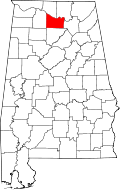 | |
| Towns | ||
| Unincorporated communities | ||
| Ghost town | ||
| Former city | ||
| Former town | ||
| Footnotes | ‡This populated place also has portions in an adjacent county or counties | |
| International | |
|---|---|
| National | |
| Geographic | |
| Other | |

Decatur, Alabama
View on GrokipediaHistory
Founding and Early Development
Decatur originated as a settlement known as Rhodes Ferry Landing in 1817, established around a ferry service operated by Dr. Henry W. Rhodes across the Tennessee River, which served as a key crossing for settlers moving westward from the Appalachian Mountains.[1][2] The area's appeal stemmed from its fertile soil suitable for agriculture and the strategic river access facilitating trade and transportation.[3] On June 16, 1820, the community was renamed Decatur in honor of U.S. Navy Commodore Stephen Decatur, reflecting the era's admiration for naval heroes following the War of 1812.[3] The Alabama Legislature formally incorporated the town in 1826, solidifying its status as a burgeoning riverside hub.[3] Early infrastructure included the construction of the Old State Bank in 1833, which housed the Decatur branch of the Alabama State Bank and represented one of the state's earliest financial institutions, though it ceased operations in 1842.[1] Economic momentum accelerated in 1836 when Decatur was selected as the eastern terminus of the Tuscumbia, Courtland and Decatur Railroad, the first railroad constructed west of the Appalachian Mountains, enhancing connectivity for cotton exports and industrial goods via the Tennessee River.[3] This rail linkage, combined with river boating, positioned Decatur as a vital transportation node, drawing settlers and commerce despite the absence of major urban centers nearby.[3] By the mid-19th century, the town's development centered on agriculture, rudimentary manufacturing, and trade, laying the groundwork for later expansion prior to the disruptions of the Civil War.[3]Civil War and Reconstruction
![Old State Bank, one of the few structures to survive the Civil War destruction in Decatur][float-right] Decatur's strategic location at the confluence of railroads and the Tennessee River made it a key target during the American Civil War, leading to multiple occupations by both Confederate and Union forces, with the town changing hands at least eight times.[4] Union troops burned the railroad bridge spanning the Tennessee River in August 1862 before abandoning the area.[5] By spring 1864, Union commanders ordered the systematic destruction of much of the town to deny resources to Confederate forces, leaving only a handful of buildings intact, including the Old State Bank.[6] [7] The Battle of Decatur, occurring from October 26 to 29, 1864, as part of the Franklin-Nashville Campaign, exemplified the town's military significance. Confederate General John Bell Hood sought to cross the Tennessee River with approximately 39,000 troops to sever Union supply lines to Nashville, but a Union garrison of about 3,000 men under Brigadier General Robert S. Granger, fortified in earthworks, repelled the assault after four days of skirmishing and artillery exchanges.[8] [9] This engagement delayed Hood's advance and preserved Union control over vital transportation routes. Enslaved individuals in the area often fled to Union lines upon occupation, seeking emancipation amid the shifting control.[10] During the Reconstruction era, Decatur underwent gradual rebuilding, with surviving structures and new construction reflecting the period's economic recovery efforts.[11] The Old Town area, initially devastated, attracted former slaves drawn by emerging industrial opportunities, leading to its resettlement as a working-class community.[12] Political participation among freedmen emerged, including Burrell Lemons serving as Decatur's first Black alderman during Reconstruction and later as the city's first Black mayor.[13] As white residents increasingly moved eastward across the railroad tracks, Old Town solidified as a hub for Black residents and laborers.[14]Industrial Expansion and Railroad Era
The Tuscumbia, Courtland and Decatur Railroad, initially chartered as the Tuscumbia Railway Company on January 16, 1830, and expanded under its new name in January 1832, initiated rail connectivity to Decatur with construction beginning in June 1831.[15] The line's first segment from Tuscumbia to the Tennessee River opened in 1832, followed by extension to Decatur by the end of 1834, spanning 43 miles and bypassing the navigational challenges of Muscle Shoals on the river.[15] As the first railroad west of the Appalachian Mountains, it provided reliable year-round transport, elevating Decatur's role in regional commerce and marking it as an early southern rail hub.[16] In 1836, Decatur was selected as the eastern terminus of this pioneering line, further integrating it with the Tennessee River for combined water-rail shipping and spurring initial economic activity.[3] Pre-Civil War intersections of the Memphis & Charleston Railroad (predecessor to Norfolk Southern) and Louisville & Nashville (L&N, now CSX) at Decatur amplified its strategic transport position, though wartime destruction left the city in ruins by 1865.[17] Post-Reconstruction recovery accelerated in the late 1880s, when northern industrialists invested in rebuilding, establishing Decatur as a manufacturing center through rail-enabled logistics.[18] The L&N Railroad opened extensive repair facilities in 1889, including 13 shops that employed 2,500 workers and drove significant population influx by the early 1900s.[17][16] By 1900, these operations supported 1,400 employees with a monthly payroll of $60,000, rising to $150,000 by 1915, forming the backbone of local industry and attracting ancillary businesses.[18] This rail-centric expansion, complemented by the 1905 construction of the Southern Railway's Union Depot, solidified Decatur's identity as a key industrial node in the Tennessee Valley.[17]20th-Century Growth and Challenges
The consolidation of Decatur with the adjacent city of Albany (formerly New Decatur) in 1927 created a unified municipality spanning both banks of the Tennessee River, enhancing administrative efficiency and spurring residential and commercial expansion amid ongoing railroad activity from the Louisville and Nashville line. [19] This merger capitalized on the city's dual access to river transport and rail, positioning Decatur as a regional logistics node for agricultural exports and emerging manufactures like lumber and cotton processing. Population figures reflected this momentum, with the city recording approximately 16,604 residents by the 1930 census, up from smaller pre-consolidation counts driven by fertile Tennessee Valley soils and proximity to northern markets. [20] Industrial momentum accelerated in the 1930s with the Tennessee Valley Authority's completion of Wheeler Dam in 1936, which generated hydroelectric power, controlled seasonal flooding, and deepened the river channel for barge traffic, enabling heavier shipments of raw materials and finished goods. [21] The dam's infrastructure supported shoreline factories, including hosiery mills that employed hundreds in the early Depression era, contributing to a wartime manufacturing surge in the 1940s as federal contracts for tubing and metal products—such as those from Wolverine Tube—bolstered local payrolls. [22] By 1950, Decatur's population had reached 19,974, underscoring steady workforce influx tied to these utilities and defense-related output. [23] Challenges persisted amid national downturns, including the Great Depression's unemployment spikes, which strained textile and mill operations despite New Deal infusions via TVA electrification. Labor unrest peaked during the 1934 General Textile Strike, which rippled through Alabama's mills—including Decatur's hosiery facilities—demanding wage hikes and an end to production speedups, though union efforts largely faltered against employer resistance and state intervention. [24] Recurrent Tennessee River floods, such as the 1927 deluge submerging low-lying districts and the 1951 event damaging infrastructure across northern Alabama, highlighted vulnerabilities unmitigated until post-dam improvements, costing millions in crop losses and repairs. [25] Post-World War II, Decatur grappled with relative stagnation as Huntsville's rocket and aerospace boom—fueled by Redstone Arsenal—drew investment and talent, eclipsing Decatur's riverine industries and contributing to slower per-capita growth through the late century. [18] Emerging chemical manufacturing along the waterfront also sowed seeds of environmental strain, with unregulated effluents foreshadowing later contamination issues from wartime expansions.Post-2000 Developments
In the early 2000s, Decatur experienced modest population growth, with the city proper increasing from 53,929 residents in 2000 to approximately 57,760 by 2023, reflecting a cumulative rise of about 7.8% amid slower expansion compared to regional peers.[26] The broader Decatur metropolitan statistical area, encompassing Morgan and Limestone counties, saw its population grow from roughly 150,000 in 2000 to 156,924 in 2023, driven by steady but limited influxes tied to manufacturing and logistics sectors.[27] Median household income in the city climbed to $59,831 by 2023, up from prior years, supported by employment in durable goods manufacturing, which remains a cornerstone of the local economy.[28] Downtown revitalization emerged as a key focus post-2010, with investments in cultural and recreational infrastructure attracting visitors and fostering economic activity. Notable projects include the 2018 opening of the Cook Museum of Natural Science and expansions at the Alabama Center for the Arts, which have drawn thousands annually and contributed to streetscape enhancements along 2nd Avenue and Bank Street.[29] The Decatur Downtown Redevelopment Authority's 2021-2025 strategic plan prioritizes mixed-use developments, including a proposed trolley system, visitors center relocation, and farmers market upgrades, aiming to integrate riverfront assets with urban renewal.[30] These efforts align with the city's 2018 Comprehensive Plan, which emphasizes leveraging trails, arts venues, and the Tennessee River for sustainable growth while addressing stagnant household income and population targets.[31] Recent infrastructure initiatives underscore ongoing commitments to expansion, including the approval in October 2025 of the $400 million South Brook mixed-use project on the former Decatur Country Club site, projected to generate $1 billion in construction impacts through residential, commercial, and recreational components.[32] Concurrently, construction of an 80-room Fairfield by Marriott hotel and a 230-space parking deck with retail in downtown proceeded, enhancing hospitality and accessibility.[33] Transportation updates via the Decatur Area Metropolitan Planning Organization have incorporated federal funds into the Transportation Improvement Program, supporting road and utility enhancements amid the region's high exposure to flooding and tornado risks, though no city-specific catastrophic events dominated the period.[34] These developments reflect a deliberate pivot toward diversified, river-oriented economic resilience.[35]Geography
Location and Physical Features
Decatur occupies a position in northern Alabama, centered at approximately 34.606°N latitude and 86.983°W longitude. The city lies within the Tennessee River Valley, primarily in Morgan County, with a smaller portion extending into adjacent Limestone County to the north. As the county seat of Morgan County, Decatur's location facilitates its role as a regional hub, situated about 25 miles (40 km) southwest of Huntsville and roughly 20 miles east of the Mississippi state line.[36][37] The physical landscape of Decatur is characterized by its proximity to the Tennessee River, where the city borders Wheeler Lake, a 67,100-acre reservoir extending 60 miles along the river and formed by the Wheeler Dam completed in 1936 by the Tennessee Valley Authority. This reservoir influences local hydrology and provides a navigable waterway that supports industrial and recreational activities. The terrain is predominantly flat to gently rolling, typical of the river valley, with elevations ranging from about 167 meters at the lowest points near the water to higher ground reaching up to 190 meters on average across the city area.[38][39] Decatur covers a total land area of 54.16 square miles, with the urban layout shaped by the river's meanders and the impoundment of Wheeler Lake, which defines much of the southern boundary. The surrounding region features fertile alluvial soils conducive to agriculture, interspersed with forested areas and developed industrial zones along the waterfront. Minimal topographic relief contributes to occasional flooding risks from the Tennessee River, mitigated by federal dam management.[40][41]Climate and Environmental Factors
Decatur experiences a humid subtropical climate characterized by hot, humid summers and mild winters, with annual average temperatures ranging from lows of about 31°F in January to highs near 90°F in July.[42] The city receives approximately 54 inches of precipitation annually, distributed relatively evenly but peaking in winter months like December at around 5 inches, while summers see the least at about 3.5 inches; snowfall averages 2 inches per year, primarily in January and February.[43] These patterns align with Köppen classification Cfa, influenced by the city's location in the Tennessee Valley, where the Tennessee River moderates temperatures but contributes to high humidity levels often exceeding 70% year-round.[42] The Tennessee River, bordering Decatur to the south, shapes local environmental dynamics, supporting biodiversity in areas like the nearby Wheeler National Wildlife Refuge while enabling industrial activities that have led to contamination issues. Per- and polyfluoroalkyl substances (PFAS), known as "forever chemicals" due to their persistence, have been detected at elevated levels in groundwater and the river near Decatur, stemming from historical discharges by companies including 3M, which admitted to unlawful releases of related compounds like FBSA into the waterway.[44] Tests in 2020 near a Decatur landfill revealed PFAS concentrations up to 51,000 parts per trillion in groundwater flowing toward the river, far exceeding EPA health advisory levels of 70 parts per trillion for certain PFAS, prompting lawsuits and settlements totaling $35 million from emitters to affected water districts.[45] [46] These pollutants pose potential health risks including cancer and immune system effects, as documented in peer-reviewed studies on PFAS exposure, though long-term local impacts require ongoing monitoring given the chemicals' environmental persistence.[47] Flooding and tornadoes represent key environmental hazards, exacerbated by the river's floodplain location and regional severe weather patterns. The Tennessee River has historically flooded Decatur, with major events tied to heavy rainfall; the area faces above-average tornado risk, with the city experiencing impacts from outbreaks like the 1974 Super Outbreak and more recent storms in 2023 that damaged structures including a marina.[48] Alabama's tornado frequency, driven by Gulf moisture and jet stream dynamics, places Decatur in a high-risk corridor, with an earthquake index ranking it relatively low but still noting minor seismic activity from the nearby New Madrid fault system.[48] Mitigation efforts, including levees and wildlife refuge management, aim to balance flood control with habitat preservation, though industrial legacies continue to challenge water quality restoration.[49]Neighborhoods and Urban Layout
Decatur's urban layout is defined by its position along the Tennessee River, with primary development concentrated south of the river across Morgan and Limestone counties, encompassing approximately 55 square miles of land area. The historic downtown core, centered on Bank Street and 2nd Avenue, features a grid-pattern street network and serves as a mixed-use hub undergoing revitalization through initiatives like the Decatur Downtown Redevelopment Authority, established in 2004. Surrounding this core are residential neighborhoods, commercial strips along corridors such as 6th Avenue SE and the Beltline Road, and industrial zones clustered along the riverfront and rail lines, which together facilitate bulk shipping via port terminals like the Port of Decatur.[31][50][31] Key historic neighborhoods include Old Decatur, platted in 1821 and rebuilt with Victorian-style homes after Civil War destruction, Albany (originally New Decatur, founded as a planned suburb in 1887 and merged with Decatur in 1927), and Old Town, representing the city's earliest settlement boundaries. These districts, designated on the National Register of Historic Places, emphasize pedestrian-friendly layouts near river access, museums, and parks like Delano Park, contrasting with outer areas featuring curvilinear streets and newer single-family subdivisions. Residential land use dominates, accounting for over 50% of developed acreage primarily in single-family structures, though aging housing stock and low recent construction—averaging 32 units annually from 2012 to 2016—have prompted programs for maintenance and infill development.[51][52][31][11] Transportation infrastructure, including 604 miles of roads with 11 miles of interstates like I-65 and I-565 bisecting the city, both connects neighborhoods and creates barriers alongside the river and railroads. The five council districts, redrawn for electoral equity as of recent adjustments ensuring populations near 11,137 per district, overlay this layout to guide local governance and planning. Industrial riverfront dominance limits public recreation but supports economic hubs, while ongoing efforts target mixed-use riverfront redevelopment, including a $400 million project approved on October 20, 2025, to convert an 80-acre former country club site into a new residential neighborhood.[31][53][54][55]
Demographics
Population Dynamics
The population of Decatur, Alabama, has grown modestly over the past several decades, reflecting patterns of industrial stability and regional migration rather than rapid expansion. U.S. Census Bureau data record 53,929 residents in the city as of April 1, 2000, increasing to 55,683 by April 1, 2010—a decennial gain of 3.3%—and further to 57,938 by April 1, 2020, for a 4.0% rise in the subsequent decade. This equates to an average annual growth rate of about 0.35% from 2000 to 2020, below the national average and indicative of constrained natural increase amid economic reliance on manufacturing and proximity to larger Huntsville metro influences.[26]| Census Year | Population | Decennial Change |
|---|---|---|
| 2000 | 53,929 | - |
| 2010 | 55,683 | +3.3% |
| 2020 | 57,938 | +4.0% |
Racial, Ethnic, and Cultural Composition
According to the U.S. Census Bureau's American Community Survey (ACS) estimates for 2019-2023, Decatur's population of approximately 57,760 residents is racially composed as follows: 60.9% White alone, 23.4% Black or African American alone, 1.1% American Indian and Alaska Native alone, 0.5% Asian alone, 0.1% Native Hawaiian and Other Pacific Islander alone, with the remainder including two or more races or other categories.[60] [61] Non-Hispanic Whites constitute 56.7% of the total, reflecting a distinction from Hispanic or Latino residents who may identify with any race.[28] Hispanic or Latino residents of any race make up 16.4% of the population, predominantly of Mexican origin (63.8% of the Hispanic subgroup), with smaller shares from Puerto Rican (6.5%), Cuban (3.2%), and other Hispanic origins.[62] [63]| Race/Ethnicity | Percentage | Approximate Number (2023 est.) |
|---|---|---|
| White (Non-Hispanic) | 56.7% | 32,764 |
| Black or African American (Non-Hispanic) | 22.1% | 12,769 |
| Hispanic or Latino (any race) | 16.4% | 9,477 |
| Two or More Races | 7.2% | 4,163 |
| Other Race | 6.9% | 3,983 |
| American Indian/Alaska Native | 1.1% | 635 |
| Asian | 0.5% | 289 |
Socioeconomic Indicators
The median household income in Decatur was $59,831 for the period 2019-2023, below the Alabama state median of approximately $62,000 and the national median of $79,466.[60][28] Per capita income stood at $34,835 over the same period, reflecting lower individual earnings compared to state and national averages.[65] The poverty rate in Decatur was 12.8% in 2023, lower than the Alabama rate of 15.6% but indicative of persistent economic challenges in a region with heavy reliance on manufacturing.[28][66] This rate represents a slight decline from prior years, with approximately 7,209 residents below the poverty line.[65] Educational attainment levels in Decatur lag behind state and national figures, with about 82% of adults aged 25 and older having completed high school or equivalent in recent estimates, compared to 87% statewide.[65] Roughly 14.5% hold a bachelor's degree or higher, while 7.4% have an associate degree; these metrics correlate with limited access to higher-wage professional sectors.[61] Unemployment in the Decatur metropolitan area averaged 2.6% in 2024, significantly below the national rate of around 4%, driven by stable employment in industry and logistics.[67] Labor force participation remains tied to blue-collar occupations, with manufacturing accounting for a disproportionate share of jobs.[68]| Indicator | Decatur Value (Recent) | Alabama Comparison | National Comparison |
|---|---|---|---|
| Median Household Income | $59,831 (2019-2023) | $62,000 | $79,466 |
| Poverty Rate | 12.8% (2023) | 15.6% | 11.5% |
| High School or Higher | ~82% (25+ years) | 87% | 89% |
| Bachelor's or Higher | 14.5% (25+ years) | 26% | 34% |
| Unemployment Rate | 2.6% (2024 MSA) | 3.0% | 4.0% |
Economy
Key Industries and Employment
Decatur's economy centers on manufacturing, which dominates local employment with production occupations comprising 16.8 percent of the workforce in the metropolitan area as of May 2024, far exceeding the national figure of 5.7 percent.[69] This sector's strength stems from the area's industrial heritage, access to the Tennessee River for logistics, and proximity to raw materials, fostering clusters in advanced manufacturing, aerospace, metals, chemicals, and food processing.[70] The manufacturing industry directly employs over 14,000 workers in the Decatur MSA.[59] Aerospace stands out as a high-growth subsector, anchored by United Launch Alliance's 1.6-million-square-foot rocket assembly facility, which supports national defense and commercial space launches.[71] In July 2024, ULA announced a $300 million expansion of its Decatur operations to boost Vulcan rocket production, projected to create 200 additional jobs.[72] Other aerospace firms, including Hexcel and the newly opened Karman Space & Defense facility, contribute to this cluster, leveraging skilled labor in composites and propulsion systems.[73][74] Primary metals and chemicals further bolster the industrial base, with Nucor Steel employing 767 workers in steel production and 3M operating a facility focused on industrial chemicals and plastics with 788 employees.[75] Food processing, exemplified by Wayne-Sanderson Farms' poultry operations (820 employees), adds diversity to manufacturing.[75] GE Appliances, a Haier subsidiary, leads private-sector employment with 1,400 workers producing refrigerators.[75]| Major Employer | Industry | Employees (approx.) |
|---|---|---|
| GE Appliances | Appliances | 1,400[75] |
| Wayne-Sanderson Farms | Food Processing | 820[75] |
| 3M Company | Chemicals/Plastics | 788[75] |
| Nucor Steel Decatur | Primary Metals | 767[75] |
Major Employers and Trade
Major employers in Decatur, Alabama, are predominantly in manufacturing, healthcare, education, and aerospace, reflecting the city's industrial heritage along the Tennessee River. Manufacturing accounts for the largest share of employment, with over 5,000 workers in 2023, followed by retail trade (3,266) and construction (2,560).[28] Key sectors include steel production, appliances, chemicals, and poultry processing, supported by proximity to rail, highway, and river transport. Aerospace facilities, such as those operated by United Launch Alliance, contribute specialized high-wage jobs in rocket assembly and testing.[78] Healthcare and public education also rank highly, with Decatur Morgan Hospital and local school systems employing thousands.[75] The following table lists select top employers in the Decatur-Morgan County area, based on recent employment figures from economic development reports:| Employer | Industry/Sector | Approximate Employees |
|---|---|---|
| Decatur Morgan Hospital | Healthcare | 1,900 |
| Decatur City Schools | Education | 1,445 |
| GE Appliances | Manufacturing (Appliances) | 1,400 |
| Wayne Farms | Poultry Processing | ~1,000+ |
| 3M Company | Chemicals/Manufacturing | 788 |
| Nucor Steel Decatur | Steel Production | 767 |
| United Launch Alliance | Aerospace | ~700+ |
Recent Economic Initiatives and Challenges
In October 2025, the Decatur City Council unanimously approved the $400 million South Brook redevelopment project, transforming the 80-acre former Decatur Country Club site in south Decatur into a walkable mixed-use neighborhood featuring residential, commercial, and recreational elements.[32] [84] The initiative, developed by Land Innovations, is projected to generate $1 billion in construction-related economic activity and stimulate long-term local investment through infrastructure improvements and job creation in development and services sectors.[32] The Alabama Robotics Technology Park in Decatur advanced workforce training with the $30 million EV Technology Center, a 40,000-square-foot facility focused on electric vehicle assembly, battery technology, robotics, and automation skills, with construction commencing in October 2024 and operations targeted for 2026.[85] [86] This public-private partnership, involving the Alabama Department of Commerce and AIDT, aims to equip 1,000 workers annually for high-tech manufacturing roles amid regional auto industry expansion, building on the park's existing robotics programs.[85] In September 2025, the Frazier-White industrial site on Alabama Highway 20 received an $87,922 state grant for a comprehensive assessment to prepare it for redevelopment and attract new manufacturing tenants.[87] Decatur's fiscal year 2025 general fund revenues increased 5.58% year-over-year through mid-year, supporting modest employee cost-of-living adjustments amid stable manufacturing employment.[88] However, the city council approved a flat overall budget for 2025, incorporating a 3% raise for employees but reducing capital projects and cutting nonprofit allocations by 10% to manage fiscal constraints.[89] The nine-month closure of Wilson Lock on the Tennessee River until June 2025 created barge backlogs, delaying cargo transit for Decatur's chemical, manufacturing, and export-dependent firms reliant on the inland waterway system.[90] Rising construction costs have introduced uncertainty for ongoing infrastructure initiatives, including potential federal grant reductions that threatened $16 million for Bill Sims Bicycle Trail expansions earlier in 2025.[91] [92] Despite these pressures, Morgan County's labor force participation rate ranked among Alabama's highest in mid-2025, with statewide employment gains of 92,000 jobs from June 2024 to June 2025 bolstering regional resilience.[93]Government and Politics
Municipal Structure and Leadership
Decatur, Alabama, operates under a mayor-council form of government, established in October 1968, in which the mayor functions as the chief executive officer with authority to enforce municipal laws, veto ordinances, and oversee city departments, while the city council exercises legislative powers over budgets, zoning, and policy-making.[94][95][96] The legislative body consists of five council members, each elected from a single-member district to staggered four-year terms, with responsibilities including approving appropriations and appointing certain boards.[97][96] District boundaries were redrawn in prior years to address population disparities, with District 1 designated as the minority-majority district.[54] Kent Lawrence, a retired businessman, assumed office as mayor on October 7, 2025, following his election on August 26, 2025, with 54% of the vote against three challengers, succeeding Tab Bowling who had served since 2016.[98][99][100] The current city council, seated after the 2025 municipal elections, includes:| District | Member | Notes |
|---|---|---|
| 1 | Terrance Adkins | Elected August 26, 2025, with 56% of the vote.[101][100] |
| 2 | Kyle Dukes Pike | Incumbent; council president pro tempore.[97] |
| 3 | Carlton McMasters | Re-elected August 26, 2025.[100][97] |
| 4 | Pam Werstler | Elected September 23, 2025, in runoff.[102][103] |
| 5 | Jacob Ladner | Incumbent; council president.[97][104] |
Elections and Political Dynamics
Decatur's municipal elections are nonpartisan and occur every four years in late August, with a mayor elected at-large and a seven-member city council representing five districts and two at-large seats.[107] Qualifying for candidates takes place through the city clerk's office, and runoffs are held six weeks later if no candidate secures a majority in the initial vote.[108] Voter turnout in the 2025 election was approximately 15-20% of registered voters, consistent with historical municipal election patterns in Alabama cities of similar size, where participation remains low due to the absence of party primaries and focus on local issues like infrastructure and economic development.[109] In the August 26, 2025, election, retired businessman and former city council member Kent Lawrence won the mayoralty outright with 52.3% of the vote, defeating council member Billy Jackson (42.8%) and two other candidates who received under 3% combined.[110] [98] Lawrence succeeded Tab Bowling, who had served since 2016 after defeating incumbent Bill Johnson in a runoff and was term-limited or chose not to seek re-election.[98] City council results included Terrance Adkins securing District 1 with 48.7%, avoiding a runoff, while District 4 advanced to a September 23 runoff where Pam Werstler defeated Sarah French by 53.2% to 46.8%, amid reports of heated campaigning focused on district-specific concerns like zoning and public safety.[101] [103] The council canvassed results on September 2, 2025, with no formal challenges raised.[111] Politically, Decatur reflects the conservative lean of Morgan and Limestone counties, where registered Republicans outnumber Democrats by roughly 2:1, mirroring statewide trends of 55% Republican and 36% Democratic affiliation as of 2025.[112] [113] Municipal races emphasize pragmatic issues such as industrial recruitment, flood control along the Tennessee River, and partnerships with NASA-related facilities, rather than national partisan divides, though candidates often align with Republican-leaning priorities like fiscal conservatism and limited government intervention. Historical mayoral contests, including Bowling's 2016 victory, have featured incumbents or business-oriented challengers prevailing over progressive-leaning opponents, with voter preferences driven by economic stability in a region dependent on manufacturing and aerospace.[114] Local media coverage, primarily from outlets like the Decatur Daily, highlights minimal partisan acrimony in city hall, attributing dynamics to cross-aisle collaboration on budget approvals and infrastructure bonds.Law Enforcement and Public Safety
Police Department Operations
The Decatur Police Department maintains responsibility for enforcing municipal ordinances and state laws, conducting investigations, and responding to service calls across the city's neighborhood zones.[115] Operations are divided into specialized units to address patrol, traffic safety, criminal investigations, and administrative functions, with patrol organized into four shifts (A, B, C, and D) under the Operations Division led by Captain Jeff Clem.[116] The department employs approximately 130 sworn officers, supporting over 10 specialty areas including canine units and school resource officers.[117] Key operational components include the Criminal Investigation Division (CID), commanded by Captain George Silvestri, which handles property crimes, financial crimes, violent crimes, family services, vice and narcotics, and crime scene processing.[116] Traffic enforcement falls under a dedicated unit supervised by Lieutenant Chris Moffett, focusing on accident investigations and patrol.[116] Management Services oversees school resource officers, while Professional Standards, led by Lieutenant Selby De León, manages community complaints and officer accountability.[116] The department emphasizes core values of loyalty, accountability, trust, and transparency, with policies outlined in a written directives manual covering ethics, use of force, arrests, and community policing practices.[115][118] Under Chief Torry Mack, appointed following Todd Pinion's resignation in February 2025, the department continues initiatives to build community trust, including a tip line at (256) 341-INFO and weekly crime statistics reports detailing calls for service and arrests.[115][119] In fiscal year 2026, proposed budget adjustments include temporary cuts to officer positions to accommodate department-wide raises averaging 6% in the prior year, with plans to potentially restore them based on revenue.[120] A third-party review released in January 2025, involving interviews with over 50 residents and 53 employees, examined operational performance amid prior leadership transitions.[121] The department pursues accreditation standards through the CALEA portal, prioritizing procedural compliance in community-oriented policing.[115]Notable Incidents and Reviews
In October 2023, Decatur police officer Mac Bailey Marquette fatally shot 39-year-old Steven Perkins during a confrontation at Perkins' home over a vehicle repossession attempt.[122] [123] Police stated Perkins brandished a gun toward officers and a tow truck driver, while body camera and Ring footage showed Perkins retrieving a firearm after warnings; Marquette was charged with murder in 2024, claiming self-defense, with his trial pending as of May 2025.[124] [125] The incident sparked protests, policy reforms including enhanced use-of-force training, and an independent audit of the department.[122] In April 2025, 37-year-old John Scott Jr., experiencing a mental health crisis, was arrested after Decatur officers used a Taser and physical force; he was hospitalized for a week before dying on April 22.[126] [127] Video footage circulated showing the altercation, prompting the department to request investigations by the Alabama Law Enforcement Agency and FBI; Scott's family filed a $100 million lawsuit in September 2025 against Decatur, alleging excessive force by officers from multiple agencies.[128] [129] A third-party audit by Green Research and Technology, released January 23, 2025, examined over 300 hours of body camera footage and department records following the Perkins shooting.[130] [121] It identified patterns of improper arrests, including charging residents with disorderly conduct for profanity alone and obstruction for non-compliance without clear probable cause, violating Alabama statutes.[131] [132] The review criticized a lack of empathy in interactions, inadequate complaint processing with poor communication to complainants, and recommended de-escalation training, body camera policy updates, and better internal affairs transparency.[133] [124] City officials acknowledged the findings, with Police Chief Todd Pinion issuing a statement committing to reforms, though some council members expressed concern over systemic issues.[134] [135]Education
K-12 Public Education
Decatur City Schools serves as the primary public K-12 education provider for the city, operating 20 schools including elementary, middle, and high schools for approximately 8,700 students from pre-kindergarten through grade 12.[136] [137] The district maintains a student-teacher ratio of 16:1, with 70% of students identifying as minority (predominantly Hispanic) and 57% classified as economically disadvantaged.[136] Governance falls under a city-elected board of education, which oversees operations focused on academic excellence amid a diverse student body influenced by local manufacturing and immigration patterns.[138] Performance metrics from the Alabama State Department of Education indicate steady but mixed results. The district earned a B grade (score of 86) on the 2022-2023 state report card, exceeding the statewide average, with an academic achievement indicator score of 61.51; this dipped slightly to 85 for the 2023-2024 cycle.[139] [140] [141] Graduation rates average 93%, reflecting effective retention efforts, while elementary proficiency stands at 47% in reading and 37% in math based on state assessments.[142] [136] High school outcomes include an average ACT score of 24 at Decatur High School, ranked 33rd in Alabama, though post-pandemic math recovery lags, with 2023 grade-level equivalents 0.64 below 2019 baselines.[142] [143] [144]| Metric | Value (Recent Data) | Source |
|---|---|---|
| Enrollment | ~8,700 students | US News Education[136] |
| Graduation Rate | 93% average | Niche[142] |
| State Report Card Grade (2022-23) | B (86) | AL Dept. of Education[139] |
| Elementary Reading Proficiency | 47% | US News Education[136] |
| Elementary Math Proficiency | 37% | US News Education[136] |