Hubbry Logo
search
logo
2236420

Declaration of war

logo
Community Hub0 Subscribers
Read side by side
from Wikipedia

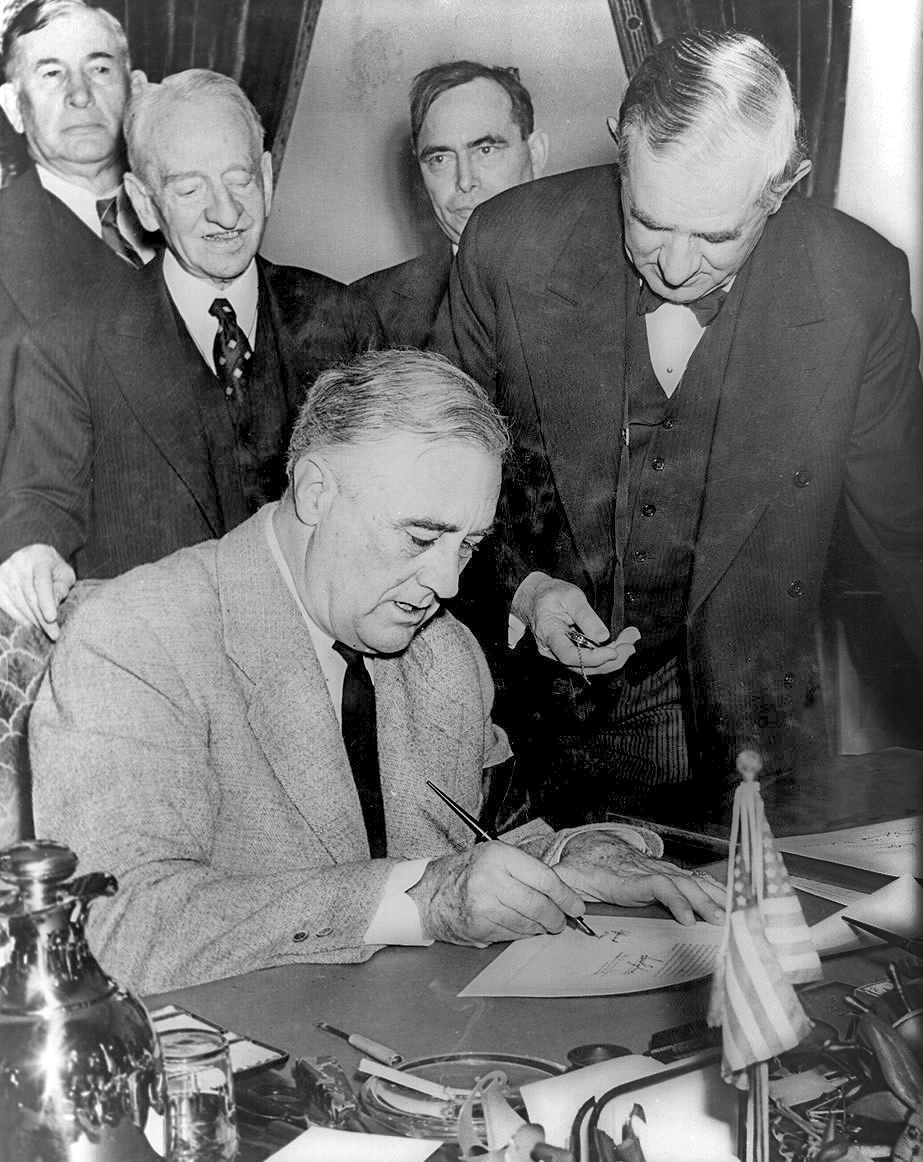
US President Franklin D. Roosevelt signs a declaration of war against Nazi Germany on 11 December 1941.

A declaration of war is a formal act by which one state announces existing or impending war activity against another. The declaration is a performative speech act (or the public signing of a document) by an authorized party of a national government, in order to create a state of war between two or more states.

The legality of who is competent to declare war varies between nations and forms of government. In many nations, that power is given to the head of state or sovereign. In other cases, something short of a full declaration of war, such as a letter of marque or a covert operation, may authorise war-like acts by privateers or mercenaries. The official international protocol for declaring war was defined in the Hague Convention (III) of 1907 on the Opening of Hostilities.

Since 1945, developments in international law such as the United Nations Charter, which prohibits both the threat and the use of force in international conflicts, have made declarations of war largely obsolete in international relations,[1] though such declarations may have relevance within the domestic law of the belligerents or of neutral nations. The UN Security Council, under powers granted in articles 24 and 25, and Chapter VII of the Charter, may authorize collective action to maintain or enforce international peace and security. Article 51 of the United Nations Charter also states that: "Nothing in the present Charter shall impair the inherent right to individual or collective self-defence if an armed attack occurs against a state."[2]

Declarations of war have been exceedingly rare since the end of World War II.[3][4] Scholars have debated the causes of the decline, with some arguing that states are trying to evade the restrictions of international humanitarian law (which governs conduct in war)[4] while others argue that war declarations have come to be perceived as markers of aggression and maximalist aims.[3]

History

[edit]
Adolf Hitler announcing the German declaration of war against the United States on 11 December 1941.

The practice of declaring war has a long history. The ancient Sumerian Epic of Gilgamesh gives an account of it,[5] as does the Old Testament.[6][7] The Roman Republic formalized the declaration of war by a special ceremony, the ritual of the Fetials, though the practice started to decline into the Imperial era.

However, the practice of declaring war was not always strictly followed. In his study Hostilities without Declaration of War (1883), the British scholar John Frederick Maurice showed that between 1700 and 1870 war was declared in only 10 cases, e.g. the 1812 French declaration of war on Russia or the Declarations of war by Great Britain and the United Kingdom, while in another 107 cases war was waged without such declaration (these figures include only wars waged in Europe and between European states and the United States, not including colonial wars in Africa and Asia).

In modern public international law, a declaration of war entails the recognition between countries of a state of hostilities between these countries, and such declaration has acted to regulate the conduct between the military engagements between the forces of the respective countries. The primary multilateral treaties governing such declarations are the Hague Conventions.

The League of Nations, formed in 1919 in the wake of the First World War, and the General Treaty for the Renunciation of War of 1928 signed in Paris, France, demonstrated that world powers were seriously seeking a means to prevent the carnage of another world war. Nevertheless, these powers were unable to stop the outbreak of the Second World War, so the United Nations was established following that war in a renewed attempt to prevent international aggression through declarations of war.

Denigration of formal declarations of war before WWI

[edit]

In classical times, Thucydides condemned the Thebans, allies of Sparta, for launching a surprise attack without a declaration of war against Plataea, Athens' ally – an event that began the Peloponnesian War.[8]

The utility of formal declarations of war has always been questioned, either as sentimental remnants of a long-gone age of chivalry or as imprudent warnings to the enemy. For example, writing in 1737, Cornelius van Bynkershoek judged that "nations and princes endowed with some pride are not generally willing to wage war without a previous declaration, for they wish by an open attack to render victory more honourable and glorious."[9] Writing in 1880, William Edward Hall judged that "any sort of previous declaration therefore is an empty formality unless the enemy must be given time and opportunity to put himself in a state of defence, and it is needless to say that no one asserts such a quixotism to be obligatory."[10]

Formal declarations of war during World War I

[edit]

Formal declarations of war during World War II

[edit]

Declared wars since 1945

[edit]

Declarations of war, while uncommon in the traditional sense, have mainly been limited to the conflict areas of the Western Asia and East Africa since 1945. Additionally, some small states have unilaterally declared war on major world powers such as the United States or Russia when faced with a hostile invasion and/or occupation. The following is a list of declarations of war (or the existence of war) by one sovereign state against another since the end of World War II in 1945. Only declarations that occurred in the context of a direct military conflict are included.

War(s) Date Titled Belligerents Ended References
Declaring party Opponent
15 May 1948 Declaration of war Kingdom of Egypt Egypt Israel 26 March 1979 [11]
Jordan 26 October 1994
Syria Syria, Kingdom of Iraq Iraq, Lebanon Still technically at war
Six-Day War (1967) June 1967 MauritaniaMauritania 1991 [12][better source needed]
Ogaden War 13 July 1977 Somalia Ethiopia Ethiopia 15 March 1978
Uganda–Tanzania War 2 November 1978 Tanzania Uganda 3 June 1979 [13]
Iran–Iraq War 22 September 1980 Iraq Iraq Iran 20 July 1988 [14]
United States invasion of Panama 15 December 1989 Existence of a state of war Panama United States 31 January 1990 [15]
Eritrean–Ethiopian War 14 May 1998 Ethiopia Eritrea 12 December 2000 [16]
Chadian Civil War 23 December 2005 Chad Sudan 15 January 2010 [17]
Djiboutian–Eritrean border conflict 13 June 2008 Djibouti Eritrea 6 June 2010 [18]
Russo-Georgian War 9 August 2008 Georgia Russia 16 August 2008 [19]
Heglig Crisis 11 April 2012 Sudan South Sudan 26 May 2012 [20]
Anglophone Crisis 4 December 2017 Declaration of war Cameroon Ambazonia Still at war [21]
Second Nagorno-Karabakh War 27 September 2020 Existence of a state of war Azerbaijan Armenia 10 November 2020 [22]
Second Western Sahara War 14 November 2020 Declaration of war SADR Morocco Still at war [23]
Gaza war 7 October 2023 [disputeddiscuss] Existence of a state of war Israel Hamas Still at war [24]

Other unique cases

[edit]

Russo-Ukrainian War

[edit]

No formal declaration of war has been issued in the ongoing Russo-Ukrainian War. At the beginning of the Russian invasion of Ukraine, Putin gave a televised broadcast announcing the start of the invasion with the term "special military operation", side-stepping a formal declaration of war.[25] The statement was, however, regarded as a declaration of war by the Ukrainian government[26] and reported as such by many international news sources.[27][28] While the Ukrainian parliament refers to Russia as a "terrorist state" in regards to its military actions in Ukraine,[29] it has not issued a formal declaration of war on its behalf.

Procedures

[edit]

In Title II, Article 2 of the first Hague Convention of 1899, the signatory states agreed that at least one other nation be used to mediate disputes between states before engaging in hostilities:

In case of serious disagreement or conflict, before an appeal to arms, the signatory Powers agree to have recourse, as far as circumstances allow, to the good offices or mediation of one or more friendly Powers.[30]

The Hague Convention (III) of 1907 called "Convention Relative to the Opening of Hostilities"[31] gives the international actions a country should perform when opening hostilities. The first two Articles say:

Article 1

The Contracting Powers recognize that hostilities between themselves must not commence without previous and explicit warning, in the form either of a reasoned declaration of war or of an ultimatum with conditional declaration of war.[32]

Article 2

The existence of a state of war must be notified to the neutral Powers without delay, and shall not take effect in regard to them until after the receipt of a notification, which may, however, be given by telegraph. Neutral Powers, nevertheless, cannot rely on the absence of notification if it is clearly established that they were in fact aware of the existence of a state of war.[33]

The United Nations and war

[edit]

In an effort to force nations to resolve issues without warfare, framers of the United Nations Charter attempted to commit member nations to using warfare only under limited circumstances, particularly for defensive purposes.

The UN became a combatant itself after North Korea invaded South Korea on 25 June 1950, which began the Korean War. The UN Security Council condemned the North Korean action by a 9–0 resolution (with the Soviet Union absent) and called upon its member nations to come to the aid of South Korea. The United States and 15 other nations formed a "UN force" to pursue this action. In a press conference on 29 June 1950, US President Harry S. Truman characterized these hostilities as not being a "war" but a "police action".[34]

The United Nations has issued Security Council Resolutions that declared some wars to be legal actions under international law, most notably Resolution 678, authorizing the 1991 Gulf War which was triggered by Iraq's invasion of Kuwait. UN Resolutions authorise the use of "force" or "all necessary means".[35][36]

Legality

[edit]

The legality of who is competent to declare war varies between nations and forms of government. In many nations, that power is given to the head of state or sovereign. The official international protocol for declaring war was defined in the Hague Convention (III) of 1907 on the Opening of Hostilities.

Since 1945, developments in international law such as the United Nations Charter, which prohibits both the threat and the use of force in international conflicts, have made declarations of war largely obsolete in international relations,[1] though such declarations may have relevance within the domestic law of the belligerents or of neutral nations. The UN Security Council, under powers granted in articles 24 and 25, and Chapter VII of the Charter, may authorize collective action to maintain or enforce international peace and security. Article 51 of the United Nations Charter also states that: "Nothing in the present Charter shall impair the inherent right to individual or collective self-defence if an armed attack occurs against a state."[2]

Requirements by country

[edit]

Declaring war is usually done through a process that involves prior approval before a formal announcement is made. This differs by country as some do not have a formal or codified pre-approval process, and in such a case, a given head of government can declare war with no pre-conditions.

Country War declarer Legal cause Authorized by Additional information
Australia Governor-General Section 61 and 68 of the Australian constitution[37] Governor-General[a]

(de jure)

Government (de facto)

Per the Australian Constitution executive powers relating to defence are vested in the Governor General as the representative of the Monarch of Australia, including the power to formally proclaim a state of war, which has only been used during World War 2, in contemporary day to day practice the deployment of forces and military action against hostile powers is the responsibility of the Prime Minister and Ministers under the Defence Act 1903 and other related acts.[38][39]
Austria[40] Parliament Article 38 and 40 of B-VG Parliament The President has to announce a declaration of war.
Brazil President Article 84 of the Brazilian constitution Congress The President of Brazil has the power to declare war, in the event of foreign aggression, when authorized by the National Congress or, upon its ratification if the aggression occurs between legislative sessions, and decree full or partial national mobilization under the same conditions.
Canada Monarch None Monarch
(de jure)[b]
See: Declaration of war by Canada.
China President Article 62(15), 67(19) and 80 Congress
(de jure)[c]
The National People's Congress is vested with the power to decide "on issues concerning war and peace" while the President "in pursuance of the decisions of the National People's Congress...proclaims a state of war." The Standing Committee of the National People's Congress may "decide, when the National People's Congress is not in session, on the proclamation of a state of war in the event of an armed attack on the country or in fulfillment of international treaty obligations concerning common defense against aggression".
Finland[41] President Article 93 of the Finnish constitution Parliament The President of Finland may declare war or peace, with permission from the Parliament of Finland
France Government Article 35 of the French constitution Parliament The Parliament "authorize" the declaration of war.[42]
Germany[43] Parliament Article 115a GG Parliament A necessary requirement is a determination by a two-thirds majority in the lower house and a majority of the upper house that the territory of Germany is under armed attack or that such an attack is imminent. Exceptions apply if the bodies are unable to meet. If such a determination is made, declarations of international law can be made by the president in accordance with the lower house.
Hungary[44] National Assembly Article 1 of the Fundamental Law of Hungary National Assembly The National Assembly "shall decide to declare a state of war and to conclude peace".
India President Article 53(2) of the Constitution of India Parliament The president of India can declare war or conclude peace, subject to the approval of parliament and advice from select government officials.[45]
Israel Prime Minister The Knesset: Article 40(a)[46] and The Government: Article 3(a)[47] of the Basic Laws of Israel Prime Minister Per article 40(a) of the Basic Law The Knesset, the state will declare war "pursuant to a government decision" with the prime minister to give notice to the Knesset "as soon as possible." Per article 3(a) of the Basic Law The Government, "the Government is comprised of the Prime Minister and Ministers."
Italy President Articles 78 and 87 of the Constitution of Italy Parliament The President shall make declarations of war as have been agreed by Parliament. Parliament has the authority to declare a state of war and vest the necessary powers into the Government.
Kuwait Monarch Article 68 of the Constitution of Kuwait Monarch The Emir declares defensive war by decree. Offensive war is prohibited.
Mexico[48] President Article 89 § VIII of the Mexican Constitution Congress The President may declare war in the name of the United Mexican States after the correspondent law is enacted by the Congress of the Union.
Netherlands[49] States General Article 96 of the Constitution of the Netherlands States General Majority vote in the state general is required, unless an act of war prevents the states general to convene.
Philippines[50] Congress Article 6, Section 23 of the Constitution of the Philippines President Requires a two-thirds vote in a joint session of Congress, with each chamber voting separately.
Qatar Monarch Article 71 of the Constitution of Qatar Monarch Defensive war shall be declared by an Emiri decree and aggressive war is prohibited.
Russia President Article 71 and 86 of the Constitution of Russia[51][52] President Per Article 71: "The jurisdiction of the Russian Federation includes [...] foreign policy and international relations of the Russian Federation, international treaties and agreements of the Russian Federation, issues of war and peace;" Per Article 86:a "The President of the Russian Federation shall: [...] govern the foreign policy of the Russian Federation;"
Saudi Arabia Monarch Article 61 of the Basic Law of Saudi Arabia Monarch
Spain Monarch Article 63 of the Spanish constitution of 1978 Parliament The King, with prior authorization by the Parliament, has the power to declare war and make peace.
Sweden[53] Cabinet Section 15 § 14 entitled "Krigsförklaring" (2010:1408) of the Instrument of Government Parliament The Swedish cabinet (regeringen) may not declare Sweden to be at war without the parliament's (riksdagen) consent unless Sweden is attacked first.
Turkey Parliament Article 87 and 92 of the Constitution of Turkey Parliament The President may declare Turkey to be at war without the parliament's consent if the parliament is adjourned or in recess and Turkey is attacked first.
United Kingdom Monarch[54][55] None Monarch[56] See: Declarations of war by Great Britain and the United Kingdom.
United States[57][58][59] Congress Article 1, Section 8 of the Constitution of the United States President See: Declaration of war by the United States.

See also

[edit]

Notes

[edit]

References

[edit]
[edit]
Revisions and contributorsEdit on WikipediaRead on Wikipedia
from Grokipedia
A declaration of war is a unilateral formal announcement issued by the competent authority of a state, establishing the precise commencement of hostilities and creating a legal state of war under international law.[1][2] This act distinguishes war from mere armed conflict by invoking reciprocal rights and duties governed by treaties such as the Hague and Geneva Conventions, legitimizing measures like the internment of enemy nationals and the application of rules concerning captures.[3] In nations with written constitutions allocating war powers, such as the United States, the authority to declare war resides exclusively with the legislature; Article I, Section 8, Clause 11 of the U.S. Constitution empowers Congress "to declare War," separating this from the executive's role in conducting military operations.[4][5] Formal declarations trigger domestic statutes, including trading-with-the-enemy acts and selective service mobilizations, while avoiding them allows circumvention of certain legal constraints.[6] Declarations of war were routine in interstate conflicts through the 19th century but declined sharply after World War II, with no major power issuing one since 1945, owing to the United Nations Charter's prohibition on the use of force except in self-defense or Security Council authorization, alongside incentives to evade neutrality obligations and insurance clauses tied to formal war status.[7][8] The U.S. Congress has formally declared war only eleven times, across five conflicts, the last being against Romania, Bulgaria, and Hungary in 1942.[9] This shift has fueled debates over the constitutionality of undeclared wars and authorizations for use of military force, which lack the full legal effects of declarations, such as automatic enemy combatant status.[6][3]

Conceptual Foundations

Definition and Historical Purpose

A declaration of war constitutes a formal, unilateral pronouncement by the competent authority of a sovereign state—typically a legislative body or head of state—announcing the initiation or existence of armed hostilities against another state, thereby establishing a precise legal commencement of the state of war.[10] [11] This act invokes the full spectrum of international and domestic legal consequences associated with belligerency, including the legitimization of lethal force against enemy combatants, the suspension of normal diplomatic relations, and the activation of rules governing neutral rights and commerce.[11] Unlike mere ultimatums or authorizations for limited military action, a declaration traditionally signals total commitment to conflict resolution through decisive victory, distinguishing it from policing operations or interventions short of war.[6] Historically, declarations served multiple interrelated purposes rooted in the need for clarity amid the chaos of interstate violence. Prior to the 20th century, they provided explicit notice to adversaries, allowing opportunities for last-minute negotiations or surrender, while informing neutral powers to adjust trade, travel, and alliances accordingly—thereby mitigating inadvertent escalations.[10] Domestically, such proclamations authorized the reallocation of resources, conscription, and economic controls, as seen in the U.S. Constitution's vesting of this power in Congress to prevent monarchical whims, a reaction to European precedents where executives like Britain's monarchs held unchecked war-making authority.[9] [12] Internationally, declarations triggered the application of customary laws of war, such as protections for prisoners and prohibitions on perfidy, fostering a framework where states could pursue territorial or political aims through organized force without descending into unregulated anarchy.[13] This ritualistic formality, evident from Roman fetial procedures demanding justification before Jupiter for just cause to medieval European heraldic announcements, underscored war's status as a regulated public act rather than private vendetta.[10] The practice's persistence into the modern era, such as the 11 U.S. congressional declarations from 1812 to 1942, reflected a causal logic: formal announcement reduced ambiguity in treaty obligations and prize captures at sea, where undeclared aggression risked alienating allies or inviting reprisals.[9] Yet, even then, declarations often followed initial hostilities, as with Japan's 1941 attack on Pearl Harbor preceding Germany's formal notice to the U.S., highlighting their role more as ratification than precondition for violence.[11] In essence, these instruments embodied a commitment to sovereignty's logical endpoint—resolving disputes by force when diplomacy failed—while imposing reciprocal restraints that preserved the interstate system's stability.[6]

Relation to Sovereignty and Just War Principles

A declaration of war constitutes a formal exercise of state sovereignty, affirming the declaring entity's exclusive competence to authorize organized violence as a matter of public policy rather than private aggression. This act distinguishes lawful interstate conflict from brigandage or irregular warfare, rooted in the principle that sovereigns hold imperium over war and peace within their domains. Hugo Grotius, in De Jure Belli ac Pacis (1625), emphasized that declarations render wars "public" under the law of nations, binding the sovereign's subjects and legitimizing reprisals against the enemy, thereby upholding the territorial and political independence codified later in the Peace of Westphalia (1648).[14] Without such sovereign assertion, hostilities risk devolving into unlicensed predation, undermining the reciprocal restraints that stabilize relations among polities. In just war theory's jus ad bellum criteria, the requirement of legitimate authority directly intersects with declarations, mandating that war be initiated only by a recognized sovereign or its delegated institutions, excluding private persons or usurpers. Thomas Aquinas, in Summa Theologica (II-II, q. 40, a. 1), argued that "it belongs to the sovereign's authority to declare war" because public welfare demands centralized command, preventing anarchy from diffused decision-making; the sovereign alone bears responsibility for the polity's defense and retribution.[15] This criterion ensures proportionality and accountability, as unauthorized wars lack the moral warrant to override individual rights or international norms, echoing Augustine's earlier insistence on episcopal or princely sanction to avert civil strife masquerading as justice. The linkage persists in realist critiques of just war doctrine, where sovereignty's causal primacy—states' monopoly on legitimate coercion—renders declarations signaling mechanisms rather than moral absolutes, yet essential for invoking reciprocal legal protections like prisoner treatment under customary law. Empirical patterns, such as the U.S. Congress's declarations in 1812, 1846, and 1941-1942, illustrate how legislative sovereignty operationalizes this authority, constraining executive overreach while invoking just cause against aggression.[11] Post-1945 shifts toward implicit authorizations (e.g., UN Security Council resolutions) have diluted formal declarations, but the underlying principle critiques non-sovereign actors—like non-state militants—as inherently illegitimate, prone to escalatory spirals absent sovereign restraint.[16]

Historical Development

Ancient and Medieval Declarations

In ancient Rome, formal declarations of war were conducted by the fetiales, a college of priests responsible for ensuring conflicts adhered to religious and customary protocols aimed at justifying hostilities as defensive or reparative. The process began with the rerum repetitio, a ritual demand for restitution delivered by a pater patratus (chief fetial) to the enemy, specifying grievances such as violated treaties or territorial incursions; if unmet within 33 days, the Senate could authorize war.[17] This culminated in the indictio belli, involving a spear (hasta) hurled into enemy soil—symbolizing the gods' sanction—or, if inaccessible, into the Temple of Bellona within Rome, accompanied by incantations invoking divine approval.[18] These rites, documented from the early Republic (c. 509 BCE) and persisting into the Empire, underscored a causal link between ritual legitimacy and military success, though emperors later bypassed them for expediency in civil or frontier wars.[10] Greek city-states employed less codified but analogous practices, often via heralds (kerykes) who issued ultimatums or proclamations before hostilities, rooted in customary norms rather than binding law. Declarations were not universally required but served to invoke shared Hellenic conventions, as seen in Thucydides' accounts of interstate conflicts where poleis like Athens or Sparta notified opponents to frame aggression as retaliation for prior offenses.[10] In cases such as the Peloponnesian War (431–404 BCE), formal heraldic announcements preceded invasions, aligning with oracular consultations to affirm divine favor, though violations occurred amid escalating rivalries.[19] Earlier Near Eastern precedents, including Mesopotamian or Egyptian campaigns from the third millennium BCE, lacked evidence of comparable rituals, with wars typically initiated through surprise or tributary demands without ceremonial notice.[20] Medieval Europe inherited and adapted Roman and canon law traditions, emphasizing formal acts to distinguish licit from illicit warfare under just war doctrine articulated by Augustine (c. 426 CE) and Thomas Aquinas (c. 1270 CE), which required legitimate authority, cause, and intent. Declarations often took the form of letters of defiance (cartels or defiances) sent by heralds to enemy courts, detailing casus belli like feudal disputes or dynastic claims, as in Edward III's 1340 challenge to Philip VI of France initiating the Hundred Years' War.[21] These rituals, ritualistic and public to deter treachery, involved heraldic processions and sometimes symbolic gestures like breaking spears, but adherence waned with feudal fragmentation; private wars by nobles frequently bypassed sovereign approval, reflecting decentralized power structures over centralized ritual.[22] Papal interventions, such as Urban II's 1095 call for the First Crusade, blended spiritual authorization with declarative elements, yet empirical records show many conflicts—e.g., Viking raids or Mongol incursions—commenced without prior notice, prioritizing strategic surprise over formality.[23]

Early Modern Period to 19th Century

In the early modern period, declarations of war transitioned from medieval rituals involving heralds and symbolic acts of defiance to formalized diplomatic notifications and manifestos that articulated legal and moral rationales for conflict, aligning with evolving doctrines of international law and just war theory. Hugo Grotius's De Iure Belli ac Pacis (1625) formalized the requirement for public intent to wage war, enabling the adversary to seek redress and distinguishing lawful aggression from brigandage under natural law principles.[24] [25] This practice emphasized casus belli, such as treaty violations or dynastic claims, to legitimize sovereign actions amid the religious and territorial strife of the era.[26] During the Thirty Years' War (1618–1648), belligerents issued manifestos justifying interventions on grounds of imperial authority, religious persecution, and alliance obligations, with records documenting over a dozen such declarations invoking Protestant rights or Catholic restoration.[27] The Peace of Westphalia (1648) reinforced this custom by embedding expectations of prior notice in treaty stipulations, standardizing declarations as precursors to hostilities in subsequent European conflicts.[10] In the 18th century, amid "wars of cabinets" characterized by calculated balance-of-power maneuvers, formal declarations coexisted with de facto initiations via proxy or colonial clashes; Britain, for instance, declared war on France on May 17, 1756, codifying the Seven Years' War after initial fighting in North America.[28] France's declaration against Britain on February 1, 1793—prompted by expulsion of its ambassador and fears of coalition encirclement—drew Britain's immediate reciprocation, escalating the French Revolutionary Wars across Europe.[29] [30] The 19th century saw declarations retain ceremonial and justificatory functions despite accelerating disregard in total warfare, as states invoked national honor or border incidents. The U.S. Congress enacted its first formal declaration on June 18, 1812, against Britain for violations of neutral shipping and sailor impressment, mobilizing 458,000 troops over two years.[9] In 1846, Congress declared war on Mexico on May 13 following the Thornton Affair skirmish, framing it as retaliation for invasion claims in disputed Texas territory.[12] Europe's Franco-Prussian War commenced with France's declaration on Prussia dated July 19, 1870, after Bismarck's edited Ems Dispatch inflamed Parisian assembly debates, leading to rapid Prussian mobilization and French defeat within months.[31] These declarations, often published in gazettes and diplomatic exchanges, served causal purposes beyond ritual—deterring neutral powers, rallying domestic support, and attempting to constrain war's scope—yet empirical patterns reveal frequent circumvention, as strategic surprise trumped formality in an age of professional armies and colonial expansion.[28] [32]

World War I and Formal Protocols

The formal protocols governing declarations of war entered international custom through the 1907 Hague Convention (III) Relative to the Opening of Hostilities, which stipulated that hostilities among contracting powers must not commence without a previous and explicit warning, either as a reasoned declaration of war or an ultimatum containing a conditional declaration.[33] [34] This measure, ratified by major European powers including Germany, Austria-Hungary, Russia, France, and Britain, aimed to mitigate surprise attacks and provide diplomatic space for resolution, reflecting a pre-war emphasis on regulated interstate conflict amid rising tensions from alliances and militarization. The convention's requirements were not absolute barriers to war but procedural norms, enforceable through diplomatic channels rather than binding adjudication, and they presupposed sovereign states' autonomy in deciding hostilities while curbing unannounced aggression. In the outbreak of World War I, these protocols were invoked amid the July Crisis following the assassination of Archduke Franz Ferdinand on June 28, 1914. Austria-Hungary, backed by a German "blank cheque" of support issued on July 6, delivered a ten-point ultimatum to Serbia on July 23, which Serbia partially rejected; Austria-Hungary then declared war on Serbia on July 28, 1914, citing the ultimatum's conditions as unmet and framing the action as defensive against Serbian irredentism.[35] This triggered alliance mechanisms: Russia ordered general mobilization on July 30, prompting Germany to declare war on Russia on August 1, 1914, after a demand for demobilization went unheeded, explicitly notifying Russia of hostilities per Hague stipulations.[36] Germany followed with a declaration against France on August 3, 1914, invoking its alliance obligations, while invading Belgium en route; Britain, honoring its 1839 treaty guarantee of Belgian neutrality, issued an ultimatum to Germany on August 4 demanding withdrawal, and declared war upon its expiration at 11:00 p.m. that day.[35] Austria-Hungary declared on Russia August 6, France reciprocated against Austria-Hungary on August 11, and further declarations rippled outward, such as Japan's on Germany August 23 under its Anglo-Japanese alliance. These actions adhered to the convention's form—explicit notifications via diplomatic notes or telegrams—though mobilizations often preceded final declarations by hours or days, underscoring the protocols' limits against preemptive military preparations enabled by industrialized railroads and telegraphs. As the war expanded, formal declarations continued, totaling over 20 by major and minor powers by 1917, including Bulgaria's on Serbia October 14, 1915, and Ottoman entry via alliance rather than direct declaration until November 1914.[35] The United States, initially neutral, issued declarations against Germany on April 6, 1917, following submarine warfare escalation, and against Austria-Hungary December 7, 1917, via congressional joint resolutions after presidential request.[37] While deviations occurred—such as informal Ottoman-German coordination without immediate public notice—the prevailing practice upheld explicit warnings, preserving diplomatic records over covert onset. This adherence contrasted with later conflicts, highlighting World War I as a transitional era where protocols formalized escalation amid total war's demands, yet failed to avert catastrophe due to rigid alliances and miscalculations of limited liability.[34]

World War II and Mass Declarations

World War II commenced with Germany's invasion of Poland on September 1, 1939, without a formal declaration of war, prompting the United Kingdom and France to declare war on Germany two days later on September 3, 1939.[38] These declarations adhered to pre-war norms under the Kellogg-Briand Pact, which had outlawed aggressive war but preserved the tradition of formal notice. Commonwealth dominions followed suit, with Australia and New Zealand declaring on September 3, 1939, and Canada on September 10, 1939, reflecting their autonomous foreign policy status within the British Empire.[39] The Soviet Union invaded eastern Poland on September 17, 1939, under the Molotov-Ribbentrop Pact, without declaration, illustrating the Axis powers' frequent disregard for formalities in favor of surprise attacks. Germany's Operation Barbarossa against the Soviet Union on June 22, 1941, similarly lacked a declaration, as did Japan's assault on Pearl Harbor on December 7, 1941. In response, the United States Congress declared war on Japan on December 8, 1941, and reciprocated Germany's declaration on the U.S. on December 11, 1941, after Hitler invoked the Tripartite Pact.[9] This U.S. entry triggered a cascade of declarations from Latin American states aligned with hemispheric security pacts; for instance, Brazil declared war on the Axis on August 22, 1942, Mexico on May 22, 1942, and by 1943, most republics including Bolivia, Colombia, and Chile had followed, often after breaking diplomatic relations.[39] A distinctive feature of World War II declarations was the "mass" phenomenon of late entries by neutral states in 1944–1945, motivated less by immediate security imperatives than by geopolitical opportunism amid the Axis collapse. Countries such as Turkey, which declared war on Germany and Japan on February 23, 1945, after maintaining strict neutrality, and Argentina, which did so on March 27, 1945, despite domestic pro-Axis sentiments, sought to meet eligibility criteria for the United Nations founding conference in San Francisco.[39][40] Similarly, Saudi Arabia declared war on Germany on March 28, 1945, enabling participation in the post-war order without substantive military contributions. These actions aligned with Allied stipulations at Yalta and Dumbarton Oaks, requiring signatories to have been at war with Axis powers to join the UN Charter signatories, thus prioritizing diplomatic positioning over causal military necessity.[41] Such declarations underscored the ritualistic erosion of formal war notices, as they imposed no real risk given Germany's imminent defeat by April 1945.[42]

Post-1945 Decline and Exceptions

Following the conclusion of World War II in 1945, formal declarations of war experienced a near-total decline among sovereign states, driven primarily by the United Nations Charter's prohibition on the threat or use of force against the territorial integrity or political independence of any state, as stipulated in Article 2(4).[8] This norm, coupled with allowances for self-defense under Article 51 or collective actions authorized by the Security Council, rendered traditional declarations incompatible with international legal frameworks, as they historically connoted aggressive intent and could invoke outdated neutrality laws or economic obligations under treaties like the Hague Conventions.[7] States increasingly opted for alternative mechanisms, such as executive authorizations, multilateral resolutions, or unilateral claims of self-defense, to legitimize military engagements without the legal and diplomatic encumbrances of formal war declarations.[43] In the United States, the last congressional declarations occurred on June 5, 1942, against Bulgaria, Hungary, and Romania as Axis allies.[44] Post-1945 conflicts, including the Korean War (initiated June 25, 1950, via UN Security Council Resolution 83), the Vietnam War (escalated after the August 1964 Gulf of Tonkin incident under a congressional resolution), and the 1991 Gulf War (authorized by UN Resolution 678 on November 29, 1990), relied on Authorizations for Use of Military Force (AUMFs) or presidential directives rather than declarations, reflecting a shift toward executive discretion amid domestic political divisions and international constraints.[9] This pattern extended to other democracies; for example, the United Kingdom engaged in the 1956 Suez Crisis without declaring war on Egypt, framing it as enforcement of international agreements.[7] Globally, the decline reflects causal factors beyond law, including nuclear deterrence's emphasis on ambiguity to avoid escalation and the strategic advantages of "limited" or "asymmetric" warfare, where declarations could unify opponents or trigger broader alliances.[8] Armed conflicts proliferated—over 250 interstate and intrastate wars since 1945, per Correlates of War data—but without ritualized announcements, often reclassified as peacekeeping, counterinsurgencies, or humanitarian operations to mitigate reputational costs.[7] Exceptions remain sparse and typically involve peripheral actors or disputes where international norms held less sway. In the 1948 Arab-Israeli War, Arab states including Egypt, Jordan, Syria, Iraq, and Lebanon invaded following Israel's declaration of independence on May 14, 1948, with actions tantamount to declarations through coordinated Arab League resolutions rejecting the state's legitimacy and authorizing military intervention on May 15, 1948.[45] Similarly, in the 1977 Ogaden War, Somalia initiated hostilities against Ethiopia on July 13, 1977, over the disputed Ogaden region, with Somali leadership publicly framing the incursion as a war of liberation, though it proceeded primarily as an unannounced invasion exploiting Ethiopia's internal instability.[46] These cases highlight how declarations, when occurring, often serve rhetorical purposes in asymmetric or irredentist contexts rather than adhering to pre-1945 formalities, underscoring the broader obsolescence of the practice amid realist adaptations to global order.[8]

Pre-UN Customary and Treaty Law

Prior to the United Nations Charter, customary international law recognized the declaration of war as a conventional practice to demarcate the shift from peace to belligerency, thereby triggering obligations under the laws of war, such as the protection of neutral rights and the lawful prize of enemy property at sea.[10] This norm, evolving from state practice in Europe and the Americas since the 17th century, aimed to provide notice to adversaries and third parties, reducing ambiguity in diplomatic and commercial relations during hostilities.[10] [47] Formal declarations were common in major conflicts, such as the United States' declarations against Great Britain in 1812 and Mexico in 1846, often accompanied by justifications invoking casus belli like territorial violations or trade interference.[11] However, adherence was inconsistent; undeclared wars, including the Anglo-Boer War (1899) and aspects of the Crimean War (1853–1856), proceeded without prior notice, prompting disputes over retroactive belligerency status but rarely invalidating military actions under prevailing custom.[10] [13] Absence of a strict customary prohibition on unannounced hostilities meant no automatic legal penalties for violations, though it could complicate recognition of war status for purposes like insurance claims or neutral trade exemptions.[10] State practice reflected a balance between strategic surprise and legal clarity, with declarations serving evidentiary roles in arbitral tribunals, as in the 1872 Alabama Claims arbitration where Britain's delayed recognition of Confederate belligerency was scrutinized.[2] By the late 19th century, growing calls for regularization, influenced by humanitarian advocates like the Institute of International Law (founded 1873), underscored the custom's role in mitigating abrupt escalations, though it imposed no universal obligation on non-European powers.[33] The foremost treaty codifying these norms was the Hague Convention (III) of 1907 relative to the Opening of Hostilities, signed on October 18, 1907, by 13 states including the major European powers, the United States, and Japan.[34] Ratified by 33 states by 1914, it entered into force on January 26, 1910, binding contracting parties to refrain from initiating hostilities without "previous and explicit warning, in the form either of a declaration of war, giving reasons, or of an ultimatum with conditional declaration of war."[34] [33] Article 2 required such declarations or ultimatums to clearly establish the state of war and be notified without delay to neutral powers, ensuring transparency for international obligations like the suspension of treaties and activation of contraband rules.[34] Article 3 extended notification duties to neutrals regarding the exact date of war's outbreak.[34] This convention represented the first multilateral treaty mandate for pre-hostility notice among signatories, aiming to prevent fait accompli attacks and align with emerging pacifist sentiments, though it preserved the attacker's right to tactical surprise post-notification.[2] It applied solely between contracting states and did not retroactively penalize prior undeclared conflicts, but its provisions influenced customary expectations, as evidenced by World War I declarations—Germany's on Russia (August 1, 1914) and France (August 3, 1914)—which cited treaty compliance despite invasion of neutral Belgium.[33] [10] No equivalent pre-UN treaties imposed broader requirements; the 1928 Kellogg-Briand Pact renounced aggressive war but omitted procedural mandates like declarations, focusing instead on prohibiting resort to force.[10] Thus, pre-UN law emphasized notification as a procedural courtesy rather than a substantive barrier to war initiation.[13]

United Nations Charter and Article 51

The United Nations Charter, adopted on June 26, 1945, and entering into force on October 24, 1945, fundamentally reshaped international norms on the use of force by prohibiting aggressive war as an instrument of national policy. Article 2(4) mandates that "All Members shall refrain in their international relations from the threat or use of force against the territorial integrity or political independence of any state, or in any other manner inconsistent with the Purposes of the United Nations."[48] This provision codified a post-World War II consensus against unilateral resort to war, rendering formal declarations of war—historically a prerequisite for lawful belligerency under customary international law—largely incompatible with the Charter's framework, as such declarations typically signal intent to initiate or escalate hostilities in violation of the prohibition.[6] Article 51 preserves an exception for self-defense, stating: "Nothing in the present Charter shall impair the inherent right of individual or collective self-defence if an armed attack occurs against a Member of the United Nations, until the Security Council has taken measures necessary to maintain international peace and security."[48] Measures under this article must be reported immediately to the Security Council and remain subordinate to its authority, emphasizing proportionality and temporality tied to the armed attack's cessation.[49] While Article 51 does not explicitly authorize or require formal declarations of war, it permits defensive force without implying aggression, allowing states to respond to attacks through military action framed as self-preservation rather than belligerent declaration. This has contributed to the post-1945 obsolescence of declarations, as states invoke self-defense to justify operations without the legal and diplomatic baggage of declaring war, which could undermine claims of Charter compliance.[8] In practice, the interplay of Articles 2(4) and 51 has shifted focus from declarations to Security Council resolutions under Chapter VII for collective enforcement or to unilateral self-defense notifications. No state has formally declared war under Article 51 auspices since 1945, reflecting the Charter's causal impact in decoupling legal force from ritualistic war announcements; instead, conflicts are often described as "defensive actions" or "operations" to align with the self-defense carve-out.[8][50] This evolution underscores the Charter's role in promoting restraint, though enforcement gaps—due to veto powers and geopolitical divisions—have led to interpretive disputes over what constitutes an "armed attack" triggering Article 51.[49]

Enforcement Challenges and Realist Critiques

The United Nations Charter's prohibition on the threat or use of force under Article 2(4) has proven difficult to enforce due to the structure of the Security Council, where permanent members possess veto power that prioritizes national interests over collective action. Since the Charter's adoption in 1945, the veto has been exercised over 280 times, often blocking resolutions addressing acts of aggression, such as the Soviet Union's 1956 invasion of Hungary or Russia's 2022 invasion of Ukraine, where Moscow vetoed condemnatory measures despite widespread recognition of the action as a breach of the Charter. This mechanism, intended to ensure great-power consensus, has resulted in selective enforcement, with the Council authorizing force in only a handful of cases, including the 1950 Korean intervention and the 1991 Gulf War against Iraq, while failing to act on numerous others like the U.S. involvement in Vietnam (1965–1973) or the 1979 Soviet invasion of Afghanistan.[51][52][53] Enforcement gaps extend to the rarity of formal war declarations post-1945, as states increasingly bypass both declarations and Security Council authorization to pursue military objectives unilaterally, rendering the legal framework aspirational rather than binding. For instance, the 2003 U.S.-led invasion of Iraq lacked explicit Council approval, justified instead by claims of preemptive self-defense against weapons of mass destruction that were later disproven, highlighting how powerful states interpret Article 51's self-defense exception expansively without effective recourse. Similarly, NATO's 1999 intervention in Kosovo proceeded without Council endorsement due to anticipated Russian and Chinese vetoes, underscoring the challenge of verifying and punishing aggression when enforcement relies on the aggressor's cooperation or the willingness of other powers to override vetoes through alternative mechanisms like General Assembly "Uniting for Peace" resolutions, which lack coercive authority. These instances demonstrate that while the International Criminal Court can prosecute individuals for aggression since its 2010 Kampala amendments, state-level enforcement remains stymied by sovereignty and power asymmetries.[54][55] Realist scholars critique these frameworks as fundamentally ineffective in constraining state behavior, arguing that international law, including norms around war declarations, operates epiphenomenally to underlying power distributions rather than independently shaping outcomes. Hans Morgenthau, a foundational realist, contended in his 1948 work Politics Among Nations that legal prohibitions like Article 2(4) fail without a global enforcer akin to domestic sovereignty, as states prioritize survival and interest in an anarchic system, evidenced by persistent violations despite treaty commitments. Contemporary realists like John Mearsheimer echo this, asserting that declarations of war serve diplomatic signaling but do not deter aggression when vital interests clash, as seen in the post-Cold War era where U.S. interventions and Chinese territorial assertions in the South China Sea proceeded irrespective of legal formalities. This perspective attributes the decline in formal declarations not to normative evolution but to strategic circumvention, where states avoid legal stigma to maintain flexibility, revealing law's dependence on power balances rather than intrinsic authority.[56][57][58]

Domestic Authorization Processes

United States Constitutional Requirements

![Franklin D. Roosevelt signing the declaration of war against Germany][float-right] The United States Constitution vests the power to declare war exclusively in Congress under Article I, Section 8, Clause 11, which states: "The Congress shall have Power... To declare War, grant Letters of Marque and Reprisal, and make Rules concerning Captures on Land and Water."[59] This provision reflects the Framers' intent to prevent unilateral executive warmaking, assigning to the legislative branch the decision to commit the nation to formal hostilities while designating the President as Commander in Chief under Article II, Section 2, responsible for directing military operations once authorized.[60] The clause distinguishes a full declaration of war, which invokes the laws of war and triggers comprehensive domestic and international legal consequences, from lesser congressional authorizations or presidential actions short of war.[4] To enact a declaration, both chambers of Congress must pass a joint resolution by simple majority, after which it is presented to the President for approval; historically, presidents have signed such resolutions without veto.[9] The House may suspend its rules to expedite consideration, as occurred in all World War II declarations.[12] Congress has issued formal declarations on 11 occasions, targeting five adversaries in the War of 1812, Mexico in 1846, Spain in 1898, Germany and Austria-Hungary in 1917, and six Axis powers between 1941 and 1942.[9] These actions followed presidential requests, often after attacks or provocations, such as the Japanese assault on Pearl Harbor on December 7, 1941, prompting Congress to declare war on Japan the next day by a vote of 82-0 in the Senate and 388-1 in the House.[61] The constitutional framework implies that without a declaration, presidential military engagements constitute limited operations rather than total war, though interpretations vary; some legal scholars argue that statutory authorizations for use of military force (AUMFs) suffice for modern conflicts, bypassing formal declarations while nominally fulfilling Congress's role.[6] No formal declaration has occurred since World War II, amid debates over executive overreach, culminating in the 1973 War Powers Resolution, which mandates congressional notification within 48 hours of troop commitments and limits unauthorized hostilities to 60 days but does not alter the core constitutional requirement for declarations in cases of full-scale war.[62] This resolution, passed over President Nixon's veto, underscores congressional efforts to reclaim oversight without supplanting the Declare War Clause.[63]

Procedures in Parliamentary Democracies

In parliamentary democracies, the executive typically holds the primary authority to declare war, often through the head of government advising the ceremonial head of state, due to the constitutional fusion of legislative and executive branches. Formal declarations, however, are rare since 1945, with procedures more commonly addressing the authorization of armed deployments as a proxy for entering hostilities. Parliamentary involvement varies: some systems mandate prior legislative consent for military commitments, rooted in post-World War II aversion to unchecked executive war-making, while others rely on conventions or ex post facto accountability via funding votes or no-confidence motions. This reflects a trend toward "parliamentarization" of war powers, where legislatures constrain executives through approval requirements, though enforcement depends on political dynamics rather than uniform legal mandates.[64][65] In the United Kingdom, declarations of war fall under the royal prerogative, exercisable by the government without parliamentary consent or statutory process. The procedure involves the Prime Minister and Cabinet deciding on military action, with the monarch formally notified but not actively involved; historical examples, such as the 1939 declaration against Germany, followed diplomatic ultimatums delivered via ambassadors. A non-binding convention, codified in the 2011 Cabinet Manual, requires informing Parliament and seeking a substantive Commons motion for significant deployments unless operational secrecy or urgency intervenes, as seen in approvals for Iraq (2003), Libya (2011), and Syria (2015), but bypassed for Yemen strikes (2016) and Syria (2018). This convention enhances democratic legitimacy but lacks legal force, allowing governments to act unilaterally if Parliament is not recalled.[66][67][68] Germany's Basic Law (Grundgesetz) prohibits aggressive war under Article 26 and omits explicit provisions for formal declarations, emphasizing defense under Article 87a, which establishes armed forces solely for national protection unless otherwise constitutionally permitted. The Federal Constitutional Court, in its 1994 ruling on Bundeswehr deployments to Bosnia, established that Bundestag approval—via a simple majority vote on a government-drafted mandate—is constitutionally required for any out-of-area armed forces commitment involving combat risks, excluding immediate self-defense. This "parliamentary participation right" applies prospectively, with mandates specifying mission scope, duration, and rules of engagement; extensions require renewed votes, as in Afghanistan (2001–2021) and Mali (2013–present). The Defence Committee provides ongoing oversight, but the procedure underscores judicial enforcement of legislative primacy over executive initiative in non-defensive actions.[69][70][71] In Canada, war declarations occur via Order-in-Council under royal prerogative, issued by the Governor General on Cabinet advice, without constitutional requirement for prior parliamentary approval. The process mirrors pre-1939 practices, as in the 1939 declaration against Germany, involving executive diplomatic notification followed by parliamentary debate but no binding vote; modern engagements like Libya (2011) relied on similar unilateralism, prompting calls for a statutory War Powers Act to mandate consent. Parliament retains indirect control through appropriations and confidence votes, yet the absence of veto power has enabled rapid commitments, such as Korea (1950).[72][73] Australia's Constitution vests war powers in the executive, with the Governor-General acting on ministerial advice to commit forces, lacking any provision for mandatory parliamentary pre-approval. Declarations or deployments, as in World War I (1914) and Iraq (2003), proceed via Cabinet decisions, followed by optional parliamentary statements and debates under standing orders, but funding bills provide the primary legislative check. Recent inquiries, including the 2023 parliamentary review, have highlighted this executive dominance, recommending conventions for post-deployment reporting but rejecting statutory curbs to preserve flexibility in alliances like AUKUS.[74]

Practices in Non-Democratic Regimes

![Adolf Hitler addressing the Reichstag during a session]float-right In non-democratic regimes, declarations of war, when they occur, emanate from centralized authority vested in a single leader, ruling party apparatus, or nominal legislative body lacking independent power, enabling unilateral decisions unencumbered by debate or opposition. This contrasts with democratic processes by emphasizing executive fiat over collective deliberation, often utilizing formal announcements for propagandistic mobilization or to invoke treaty obligations rather than as a constraint on aggression. Historical instances reveal such declarations as extensions of personal or oligarchic will, frequently timed to align with strategic imperatives without prior public scrutiny. Under Adolf Hitler's totalitarian rule in Nazi Germany, war declarations were personal proclamations ratified by the subservient Reichstag. On December 11, 1941, Hitler delivered a speech to the Reichstag announcing Germany's state of war with the United States, four days after Japan's attack on Pearl Harbor, with the assembly providing automatic endorsement absent any dissenting mechanism.[75] [76] This procedure exemplified the Führer's absolute control, where legislative forms masked dictatorial initiative. In the Soviet Union, formal declarations issued by the Presidium of the Supreme Soviet or government statements masked decisions originating from Joseph Stalin and the Politburo, with legislative approval serving as pro forma validation. The August 8, 1945, declaration of war on Japan—stating that the Soviet government would consider itself at war from August 9—preceded the immediate invasion of Japanese-held Manchuria, fulfilling Yalta Conference commitments while advancing Soviet territorial aims without broader consultation.[77] [78] Such mechanisms persisted in communist states, where party elites predetermined outcomes, rendering declarations symbolic endorsements of preordained policy. Post-1945, non-democratic regimes have largely eschewed formal declarations, favoring ambiguous terminology to evade domestic legal triggers like full mobilization, economic controls, or international censure under the UN Charter's prohibition on aggressive war. The People's Republic of China, since its 1949 founding, has engaged in major conflicts—such as the Korean War intervention from October 1950—without formal declarations, deploying "People's Volunteer Army" units to maintain deniability and avoid escalation thresholds.[79] Similarly, Russia's 2022 incursion into Ukraine proceeded under the rubric of a "special military operation" authorized by President Vladimir Putin via Federal Security Council decree on February 24, deliberately avoiding a war declaration to sidestep constitutional requirements for nationwide conscription and to frame actions as limited intervention rather than total war.[80] [81] This approach underscores causal incentives in autocracies: opacity preserves regime flexibility, minimizes internal resistance, and circumvents global norms privileging defensive self-determination over offensive conquest.

Case Studies and Examples

Pivotal Historical Declarations

Austria-Hungary's declaration of war on Serbia on July 28, 1914, served as the immediate catalyst for World War I, following the assassination of Archduke Franz Ferdinand by a Bosnian Serb nationalist on June 28.[82] This action, backed by Germany's "blank cheque" assurance, activated alliance chains: Russia mobilized in defense of Serbia, prompting Germany to declare war on Russia on August 1 and on France on August 3, while invading neutral Belgium, which led Britain to declare war on Germany on August 4.[36] These rapid, formal declarations underscored the fragility of pre-war diplomacy and the role of rigid alliances in escalating a regional crisis into a global conflict involving over 30 nations and resulting in approximately 20 million deaths.[83] The United States' formal declarations during World War I marked a shift toward interventionist policy. On April 6, 1917, Congress declared war on Germany after President Woodrow Wilson's address citing unrestricted submarine warfare and the Zimmermann Telegram, which proposed a German-Mexican alliance against the U.S.[37] A subsequent declaration against Austria-Hungary followed on December 7, 1917. These decisions mobilized over 4 million American troops, tipping the balance toward Allied victory by November 1918 and influencing the post-war order through the Treaty of Versailles.[84] In World War II, pivotal declarations accelerated the conflict's global scope. After Japan's attack on Pearl Harbor on December 7, 1941, which killed 2,403 Americans and damaged the Pacific Fleet, the U.S. Congress declared war on Japan the next day, with only one dissenting vote.[44] Germany and Italy then declared war on the U.S. on December 11, prompting reciprocal U.S. declarations signed by President Franklin D. Roosevelt, as depicted in historical records of the event. These exchanges integrated the European and Pacific theaters, committing the U.S. to total war mobilization that produced 300,000 aircraft and 100,000 tanks, ultimately contributing to Axis defeat in 1945.[9] Earlier U.S. declarations, such as against Great Britain on June 18, 1812, amid impressment of sailors and trade restrictions, established constitutional precedents for congressional war powers under Article I, Section 8. Similarly, the 1846 declaration against Mexico followed border disputes after the annexation of Texas, leading to territorial gains comprising over 500,000 square miles. The 1898 Spanish-American War declaration, enacted April 25 after the USS Maine explosion (later attributed to internal causes rather than sabotage), resulted in U.S. acquisition of Puerto Rico, Guam, and the Philippines. These instances demonstrated how formal declarations facilitated rapid military mobilization and shaped territorial expansion, though causal analyses reveal underlying economic and strategic motives beyond stated pretexts.[9][85]

Post-WWII Formal Instances

Following the establishment of the United Nations in 1945, formal declarations of war became exceptionally rare, as Article 2(4) of the UN Charter prohibits the threat or use of force against the territorial integrity or political independence of any state, rendering explicit declarations incompatible with claims of defensive action or collective security authorization under Chapter VII. Major powers, bound by treaty obligations and domestic legal constraints, opted instead for authorizations for use of military force, UN resolutions, or de facto engagements without ceremonial or legislative pronouncements of war. This shift reflects a broader post-WWII norm favoring ambiguity to avoid legal admissions of aggression, facilitate escalation control, and align with realist assessments of power dynamics over ritualistic formalism.[7] One verified instance of a formal declaration occurred during the Eritrean-Ethiopian War (1998-2000), when Ethiopia's government explicitly declared war on Eritrea on May 13, 1998. The announcement followed Eritrean occupation of the disputed border village of Badme on May 6, 1998, which Ethiopia viewed as an unprovoked incursion into sovereign territory, prompting widespread mobilization and artillery exchanges. Ethiopian Prime Minister Meles Zenawi justified the declaration as necessary to repel aggression and restore the status quo ante, framing it within self-defense under Article 51 of the UN Charter despite the absence of prior Security Council endorsement. The conflict, rooted in unresolved border demarcations from Eritrea's 1993 independence referendum, escalated into a full-scale conventional war involving trench warfare, air strikes, and over 70,000-100,000 fatalities, primarily from ground offensives in the Badme and Tsorona fronts.[86][87] No other unambiguous formal declarations by UN member states have been documented in major conflicts since 1945, such as the Arab-Israeli wars, Iran-Iraq War, or Indo-Pakistani wars, where initiators typically relied on surprise attacks, abrogations of treaties, or multilateral interventions without explicit war proclamations. In the Iran-Iraq War, for instance, Iraq's September 22, 1980, invasion of Iran was preceded by Saddam Hussein's public severance of diplomatic ties and border closure but lacked a legislative or ceremonial declaration, instead justified as pre-emptive response to alleged Iranian subversion. This pattern underscores enforcement challenges in international law, where declarations invite scrutiny under the UN framework while undeclared wars evade formal prohibitions, enabling deniability amid hybrid threats like proxy support and insurgencies.[88]

Contemporary Conflicts and Absences

In the 21st century, formal declarations of war have remained exceptionally rare, with most major armed conflicts initiated without such pronouncements, reflecting a shift toward alternative legal and political rationales such as self-defense claims under Article 51 of the UN Charter or domestic authorizations for military force.[7] This absence avoids triggering full wartime legal obligations, including conscription laws, insurance escalations, and treaty activations, while allowing flexibility in hybrid warfare involving non-state actors and proxy forces.[80] For instance, the United States has not issued a formal declaration since World War II, relying instead on Authorizations for Use of Military Force (AUMFs), as seen in the 2001 response to the September 11 attacks and the 2002 Iraq resolution, which enabled operations in Afghanistan and Iraq without invoking constitutional war powers.[9][11] Russia's full-scale invasion of Ukraine on February 24, 2022, exemplifies this pattern, as President Vladimir Putin announced a "special military operation" rather than a declaration of war, citing denazification and demilitarization goals without formal parliamentary approval for total war.[89] This framing circumvented Russian domestic laws requiring declarations for prolonged mobilization and avoided international escalations tied to recognized belligerency.[80] Similarly, conflicts like the 2008 Russia-Georgia war and the 2020 Nagorno-Karabakh clashes between Armenia and Azerbaijan proceeded without declarations, framed as defensive or enforcement actions amid territorial disputes.[7] One notable exception occurred on October 8, 2023, when Israel's security cabinet invoked Article 40(a) of its Basic Laws to formally declare war on Hamas following the group's October 7 attacks that killed over 1,200 Israelis and took more than 250 hostages.[90][91] This marked Israel's first such declaration since the 1973 Yom Kippur War, enabling expanded military measures against the Gaza-based militant group, though Hamas's non-state status complicates traditional belligerency recognition.[1] In contrast, ongoing U.S. and allied strikes against Houthi targets in Yemen since 2024, in response to Red Sea shipping attacks, have operated under executive authority without congressional declarations or UN mandates, highlighting persistent enforcement gaps.[11] The prevalence of these absences underscores realist critiques of international law's constraints, as states prioritize operational ambiguity over ritualistic declarations, often leading to prolonged engagements without clear jus ad bellum resolution.[7] Ethiopia's 2020 Tigray conflict and Sudan's 2023 civil war further illustrate intra-state and regional violence escalating without formal interstate declarations, blurring lines between civil unrest and internationalized warfare.[7]

Contemporary Debates and Implications

Merits of Formal Declarations for Clarity and Legitimacy

Formal declarations of war establish a precise legal status under both domestic constitutions and international law, distinguishing full-scale armed conflict from limited military operations or peacekeeping actions. In the United States, such declarations trigger specific statutory authorities, including the Alien Enemy Act (50 U.S.C. §§ 21-24), which permits apprehension and regulation of citizens from enemy states, and extensions to statutes of limitations for war-related crimes (18 U.S.C. § 3287).[92] This clarity activates wartime protocols, such as enhanced presidential powers over the Coast Guard (14 U.S.C. § 3) and temporary suspensions of certain Uniform Code of Military Justice provisions, enabling structured mobilization without reliance on ambiguous executive orders.[92] Internationally, a declaration invokes the full law of war regime under frameworks like the Geneva Conventions, applying protections and obligations distinct from human rights law applicable in non-war scenarios.[93] By requiring explicit legislative approval, formal declarations enhance domestic legitimacy, ensuring that war-making aligns with representative processes rather than unilateral executive decisions. The U.S. Constitution's Declare War Clause (Article I, Section 8, Clause 11) vests this power exclusively in Congress, promoting deliberation and accountability to prevent impulsive or unchecked aggression, as emphasized by James Madison's concerns over monarchical war tendencies.[94] This process holds both branches responsible, fostering public and institutional buy-in; for instance, World War II declarations (e.g., Public Law 77-331 against Japan on December 8, 1941) unified national effort and garnered judicial deference to executive actions.[93] In contrast, authorizations for use of military force, while flexible, often lack this formal endorsement, leading to debates over their scope and constitutionality, as seen in challenges to post-9/11 operations.[92] On the international stage, declarations signal unambiguous intent and commitment, providing notice to adversaries and neutrals while legitimizing combatant status and prize captures under customary law, as codified in Hague Convention III (1907).[92] This reduces ambiguity in rules of engagement and diplomatic relations, potentially averting escalations from misperceived limited strikes; historically, pre-World War I declarations served as ultimatums, clarifying casus belli and invoking treaty obligations.[93] Moreover, they reinforce state sovereignty in just war theory, restricting valid warfare to actions authorized by legitimate governments, thereby undermining non-state actors' claims to belligerent rights.[93] Empirically, nations adhering to declarations have demonstrated lower incidences of unprovoked surprise attacks, as the ritual underscores restraint and mutual recognition of hostilities.[92]

Risks and Criticisms in Modern Warfare

Formal declarations of war in the modern era carry significant legal risks due to the extensive framework of international humanitarian law (IHL) that activates upon such pronouncements. Unlike limited military actions, a declaration invokes the full spectrum of treaties like the Geneva Conventions, imposing obligations on combatants, protections for civilians, and prohibitions on certain tactics, which can constrain operational flexibility for states engaging in asymmetric or counterinsurgency conflicts.[95] Scholars such as Tanisha Fazal argue that this proliferation of war laws since the 19th century has deterred formal declarations, as states prefer the ambiguity of "armed conflicts" to avoid scrutiny and potential war crimes prosecutions under bodies like the International Criminal Court.[8] In the nuclear age, declarations heighten escalation risks by signaling intent for total war, potentially triggering mutual assured destruction doctrines among nuclear-armed states. Post-World War II restraint in declarations correlates with the advent of atomic weapons in 1945, where formal acts could interpret as existential threats, prompting preemptive responses rather than calibrated deterrence.[7] For instance, a hypothetical U.S. declaration against a peer like Russia or China might compel adherence to Cold War-era strategies, where ambiguity in undeclared actions allows for off-ramps, whereas explicit war status removes diplomatic maneuvering and invites alliance activations under treaties like NATO's Article 5.[96] Critics further contend that declarations undermine strategic surprise and adaptability in hybrid warfare environments involving cyber operations, proxies, and non-state actors, where formalities do not align with fluid threats. By publicizing aims, declarations enable adversaries to mobilize resources, fortify positions, or garner international sympathy, as seen in historical precedents where advance notice diluted initial advantages.[93] Economically, they disrupt neutral trade rights and trigger domestic insurance escalations or asset freezes, complicating sustained efforts without broad consensus. Constitutionally, in democracies like the U.S., the rarity since 1942 reflects congressional aversion to binding commitments that constrain executive discretion, fostering criticisms that declarations politicize conflicts unduly and hinder rapid responses to provocations.[92] These factors collectively render formal declarations a liability in an era prioritizing de-escalation and multilateral sanctions over binary war-peace dichotomies.

Prospects for Revival Amid Hybrid Threats

Hybrid threats, encompassing cyberattacks, disinformation campaigns, economic coercion, and irregular military actions, often operate below the threshold of traditional armed conflict, enabling aggressors to achieve strategic objectives without triggering formal responses under international law. These tactics, as exemplified by Russia's operations in Ukraine since 2014, blend overt and covert elements to exploit vulnerabilities while maintaining plausible deniability and avoiding the legal and political consequences of declared war.[97][98] Such approaches render conventional declarations of war ill-suited, as they presuppose clear state-on-state hostilities rather than the ambiguous, multi-domain aggression characteristic of hybrid warfare.[99] Proponents of reviving formal declarations argue that they could provide legal clarity, mobilize domestic support, and signal unambiguous resolve against escalating hybrid campaigns, potentially deterring further aggression by invoking full-spectrum countermeasures including economic sanctions and military mobilization. For instance, in the U.S., debates surrounding the War Powers Resolution have highlighted the need for congressional authorization akin to declarations for cyber operations that mimic kinetic attacks, emphasizing that ambiguous responses to gray-zone activities undermine deterrence.[100] However, empirical evidence from recent conflicts shows limited adoption; NATO's 2024 Washington Summit Declaration addressed Russian hybrid threats through enhanced resilience measures and collective defense commitments without resorting to war declarations, reflecting a preference for flexible, non-escalatory tools.[101] Similarly, EU statements in 2025 condemned persistent Russian hybrid campaigns but relied on diplomatic and sanctions-based reprisals rather than formal belligerency.[102] The prospects for revival remain constrained by the inherent mismatch between declarations' binary framework and hybrid warfare's continuum of coercion, where escalation to formal war risks broader conflict without proportionate gains. International legal analyses indicate that expanding self-defense rights under Article 51 of the UN Charter to encompass severe hybrid acts could enable robust responses without declarations, but political inertia—evident in the absence of such invocations amid China's gray-zone activities in the South China Sea or Russia's interference in European elections—suggests persistence of ad hoc measures over revival.[103][104] Only a paradigm shift, such as hybrid threats crossing into sustained kinetic operations, might catalyze declarations, as seen in historical transitions from undeclared to formal wars, though current trends favor institutional adaptations like NATO's hybrid response centers over obsolete rituals.[105][106]

References

User Avatar
No comments yet.