Hubbry Logo
French hornFrench hornMain
Open search
French horn
Community hub
French horn
logo
8 pages, 0 posts
0 subscribers
Be the first to start a discussion here.
French horn
French horn
from Wikipedia
Horn
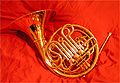
A modern double horn
Brass instrument
Other names
Classification
Hornbostel–Sachs classification423.232
(Valved aerophone sounded by lip vibration)
Playing range
Staff with bass clef showing a range from C two octaves below middle C to E above middle C
In F the horn sounds a perfect fifth lower than written. In older music, bass-clef notes are written one octave lower and thus sound a perfect fourth higher than written.[1]
Related instruments
Musicians
Builders
More articles or information

The horn (the term French horn refers to horns with pistons, not with rotary valves) is a brass instrument made of tubing wrapped into a coil with a flared bell. The double horn in F/B (technically a variety of German horn) is the horn most often used by players in professional orchestras and bands, although the descant and triple horn have become increasingly popular. A musician who plays a horn is known as a horn player or hornist.

Pitch is controlled through the combination of the following factors: speed of air through the instrument (controlled by the player's lungs and thoracic diaphragm); diameter and tension of lip aperture (by the player's lip muscles—the embouchure) in the mouthpiece; plus, in a modern horn, the operation of valves by the left hand, which route the air into extra sections of tubing. Most horns have lever-operated rotary valves, but some, especially older horns, use piston valves (similar to a trumpet's) and the Vienna horn uses double-piston valves, or pumpenvalves. The backward-facing orientation of the bell relates to the perceived desirability to create a subdued sound in concert situations, in contrast to the more piercing quality of the trumpet. A horn without valves is known as a natural horn, changing pitch along the natural harmonics of the instrument (similar to a bugle). Pitch may also be controlled by the position of the hand in the bell, in effect reducing the bell's diameter. The pitch of any note can easily be raised or lowered by adjusting the hand position in the bell.[2] The key of a natural horn can be changed by adding different crooks of different lengths.

Three valves control the flow of air in the single horn, which is tuned to F or less commonly B. The more common double horn has a fourth, trigger valve, usually operated by the thumb, which routes the air to one set of tubing tuned to F or another tuned to B which expands the horn range to over four octaves and blends with flutes or clarinets in a woodwind ensemble. Triple horns with five valves are also made, usually tuned in F, B, and a descant E or F. There are also double horns with five valves tuned in B, descant E or F, and a stopping valve, which greatly simplifies the complicated and difficult hand-stopping technique,[3] though these are rarer. Also common are descant doubles, which typically provide B and alto F branches.

A crucial element in playing the French horn deals with the mouthpiece. The mouthpiece is usually placed about 23 on the lips with more on the upper. Because of differences in the formation of the lips and teeth of different players, some tend to play with the mouthpiece slightly off center.[4] Although the exact side-to-side placement of the mouthpiece varies for most horn players, the up-and-down placement of the mouthpiece is generally two-thirds on the upper lip and one-third on the lower lip.[4] When playing higher notes, the majority of players exert a small degree of additional pressure on the lips using the mouthpiece. However, this is undesirable from the perspective of both endurance and tone: excessive mouthpiece pressure makes the horn sound forced and harsh and decreases the player's stamina due to the resulting constricted flow of blood to the lips and lip muscles. Added pressure from the lips to the mouthpiece can also result in tension in the face resulting in what brass players often call "pushing". As mentioned before, this results in an undesirable sound, and loss of stamina.[4]

Name

[edit]

The name "French horn" first came into use in the late 17th century. At that time, French makers were preeminent in the manufacture of hunting horns and were credited with creating the now-familiar, circular "hoop" shape of the instrument. As a result, these instruments were often called, even in English, by their French names: trompe de chasse or cor de chasse (lit.'trumpet of hunt' or 'horn of hunt'—the clear modern distinction between trompes [trumpets] and cors [horns] did not exist at that time).[5]

German makers first devised crooks to make such horns playable in different keys—so musicians came to use "French" and "German" to distinguish the simple hunting horn from the newer horn with crooks, which in England was also called the Italian name corno cromatico (chromatic horn).[5]

More recently, "French horn" is often used colloquially, though the adjective has normally been avoided when referring to the European orchestral horn, ever since the German horn began replacing the French-style instrument in British orchestras around 1930.[6] The International Horn Society has recommended since 1971 that the instrument be simply called the horn.[7][8]

There is also a more specific use of "French horn" to describe a particular horn type, differentiated from the German horn and Vienna horn. In this sense, "French horn" refers to a narrow-bore instrument (10.8–11.0 mm [0.43–0.43 in]) with three Périnet (piston) valves. It retains the narrow bell-throat and mouthpipe crooks of the orchestral hand horn of the late 18th century, and most often has an "ascending" third valve. This is a whole-tone valve arranged so that with the valve in the "up" position the valve loop is engaged, but when the valve is pressed the loop is cut out, raising the pitch by a whole tone.[9]

History

[edit]
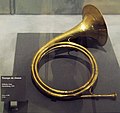
Horn with three Perinet valves
"How to shout and blow horns."—Facsimile of a miniature in a manuscript of the hunting manual of Gaston Phoebus (15th century)

As the name indicates, humans originally used to blow on the actual horns of animals before starting to emulate naturally occurring horns with metal ones. The use of animal horns survives with the shofar, a ram's horn, which plays an important role in Jewish religious rituals.

Early metal horns were less complex than modern horns, consisting of valveless brass tubes, wound around a few times, with a slightly flared opening (the bell). These early "hunting" horns (French: cors de chasse) were originally played on a hunt, often while mounted, and the sound they produced was called a recheat. Change of pitch on these hunting horns was controlled entirely by the lips, as the use of valves and insertion of a hand in the bell to change pitch were later innovations. Without valves, only the notes within the harmonic series are available. By combining a long length with a narrow bore, the French horn's design allows the player to easily reach the higher overtones which differ by whole tones or less, thus making it capable of playing melodies before valves were invented.[4]

Early horns were commonly pitched in B alto, A, A, G, F, E, E, D, C, and B basso. Since the only notes available were those on the harmonic series of one of those pitches, horn-players had no ability to play in different keys. The remedy for this limitation was the use of crooks, i.e., sections of tubing of differing length that, when inserted, altered the length of the instrument, and thus its pitch.[10]

In the mid-18th century, horn players began to insert the right hand into the bell to change the length of the instrument, adjusting the tuning up to the distance between two adjacent harmonics depending on how much of the opening was covered.

In 1818 the German makers Heinrich Stölzel and Friedrich Blümel patented the first valved horn, using rotary valves. François Périnet introduced piston valves in France about 1839.[11] The use of valves initially aimed to overcome problems associated with changing crooks during a performance. Valves' unreliability, musical taste, and players' distrust, among other reasons, slowed their adoption into the mainstream. Many traditional conservatories and players refused to use them at first, claiming that the valveless horn, or natural horn, was a better instrument. Some musicians who specialize in period instruments use a natural horn to play in original performance styles, to try to recapture the sound of an older piece's original performances.[12]

There were many different versions of early valves, most being variants of the piston and rotary systems used in modern horns. Early valves by Blühmel are cited as possibly the first rotary valve, but the first confirmed rotary valve design was in 1832 by Joseph Riedl in Vienna. [clarification needed][13]

Types

[edit]

Horns may be classified into single horn, double horn, compensating double horn, and triple horn as well as having the option of detachable bells.

Single horn in F, student model.

Single horn

[edit]

Single horns use a single set of tubes connected to the valves. This allows for simplicity of use and a much lighter weight. They are usually in the keys of F or B, although many F horns have longer slides to tune them to E, and almost all B horns have a valve to put them in the key of A. The problem with single horns is the inevitable choice between accuracy or tone – while the F horn has the "typical" horn sound, above third-space C accuracy is a concern for the majority of players because, by its nature, one plays high in the horn's harmonic series where the overtones are closer together. This led to the development of the B horn, which, although easier to play accurately, has a less desirable sound in the mid and especially the low register where it is not able to play all of the notes. The solution has been the development of the double horn, which combines the two into one horn with a single lead pipe and bell. Both main types of single horns are still used today as student models because they are cheaper and lighter than double horns. In addition, the single B horns are sometimes used in solo and chamber performances and the single F survives orchestrally as the Vienna horn. Additionally, single F alto and B alto descants are used in the performance of some baroque horn concertos and F, B and F alto singles are occasionally used by jazz performers.

Dennis Brain's benchmark recordings of the Mozart Horn Concerti were made on a single B instrument by Gebr. Alexander, now on display at the Royal Academy of Music in London.

Double horn

[edit]
The valves of a Conn 6D double horn. The three lever keys (above the large valves) can be depressed toward the large outer tube. The thumb key (near the left-most valve) moves inward toward the three finger keys.
Scheme of a double horn (view from underneath)
  1. Mouthpiece
  2. Leadpipe, where the mouthpiece is placed
  3. Adjustable handrest
  4. Water key (also called a spit valve)
  5. Fourth valve to change between F and B pitches
  6. Valve levers, operated with the left hand
  7. Rotary valves
  8. Slides, for tuning each valve
  9. Long tubing for F pitch with slide
  10. General slide
  11. Short tubing for B pitch with slide
  12. Bellpipe
  13. Bell; the right hand is cupped inside this

Despite the introduction of valves, the single F horn proved difficult for use in the highest range, where the partials grew closer and closer, making accuracy a great challenge. An early solution was simply to use a horn of higher pitch—usually B. The use of the F versus the B horn was extensively debated among horn players of the late 19th century, until the German horn maker Eduard Kruspe (namesake of his family's brass instrument firm) produced a prototype of the "double horn" in 1897.

The double horn also combines two instruments into a single frame: the original horn in F, and a second, higher horn keyed in B. By using a fourth valve (usually operated by the thumb), the horn player can quickly switch from the deep, warm tones of the F horn to the higher, brighter tones of the B horn, or vice versa, as the horn player may choose to have the horn set into B by default by making a simple adjustment to the valves. The two sets of tones are commonly called "sides" of the horn. Using the fourth valve not only changes the basic length (and thus the harmonic series and pitch) of the instrument, it also causes the three main valves to use proportionate slide lengths.[14]

Compensating double horn

[edit]

A full double horn has two full-length sets of slides (one set for the B side and a longer set for the F side); a compensating double horn only has full-length slides for the B side and a shorter set of slides whose length can be added to the B slides to give the necessary tubing length for playing in F. As for the full double horn, the air is routed through the appropriate slide(s) by use of the fourth valve. Compensating double horns are lighter than full double horns because of this design.[15]

Triple horn

[edit]

A triple horn has more tubing, adding a descant horn to the double horn and hence giving more assistance for the high range. The descant horn is most commonly in F, sounding an octave higher than the normal F horn.[16]

Detachable bell

[edit]

The horn, although not large, is awkward in its shape and does not lend itself well to transport where space is shared or limited, especially on planes. To compensate, horn makers can make the bell detachable; this allows for smaller and more manageable horn cases.

[edit]

The variety in horn history necessitates consideration of the natural horn, Vienna horn, mellophone, marching horn, and Wagner tuba.

Natural horn

[edit]
A natural horn has no valves, but can be tuned to a different key by inserting different tubing, as during a rest period.

The natural horn is the ancestor of the modern horn. It is essentially descended from hunting horns, with its pitch controlled by air speed, aperture (opening of the lips through which air passes) and the use of the right hand moving around, as well as in and out of the bell. Although a few recent composers have written specifically for the natural horn (e.g., György Ligeti's Hamburg Concerto and sections of Paul Dukas' Villanelle for Horn and Piano), today it is played primarily as a period instrument. The natural horn can only play from a single harmonic series at a time because there is only one length of tubing available to the horn player. A proficient player can indeed alter the pitch by partially or fully muting the bell with the right hand, thus enabling the player to reach some notes that are not part of the instrument's natural harmonic series – of course this technique also affects the quality of the tone. The player has a choice of key by using crooks to change the length of tubing.[17][verification needed]

Vienna horn

[edit]
Vienna horn

The Vienna horn is a special horn used primarily in Vienna, Austria. Instead of using rotary valves or piston valves, it uses the pumpenvalve (or Vienna valve), which is a double-piston operating inside the valve slides, and usually situated on the opposite side of the corpus from the player's left hand, and operated by a long pushrod. Unlike the modern horn, which has grown considerably larger internally (for a bigger, broader, and louder tone) and considerably heavier (with the addition of valves and tubing in the case of the double horn), the Vienna horn very closely mimics the size and weight of the natural horn (although the valves do add some weight, they are lighter than rotary valves), even using crooks in the front of the horn between the mouthpiece and the instrument. Instead of the full range of keys, Vienna horn players usually use an F crook; it is looked down upon to use others, though switching to an A or B crook for higher pitched music does happen on occasion. Vienna horns are often used with funnel shaped mouthpieces similar to those used on the natural horn, with very little (if any) backbore and a very thin rim. The Viennese horn requires very specialized technique and can be quite challenging to play, even for accomplished players of modern horns. The Vienna horn has a warmer, softer sound than the modern horn. Its pumpenvalves facilitate a continuous transition between notes (glissando); conversely, a more precise operating of the valves is required to avoid notes that sound out of tune.

Mellophone

[edit]

Two instruments are called a mellophone. The first is an instrument shaped somewhat like a horn, in that it is formed in a circle and is often referred to as a "classic" or "concert" mellophone. It has piston valves and is played with the right hand on the valves. Most are pitched in the key of F, with facility to switch to Eeither by changing crooks/leadpipes, or by a valve dedicated to this purpose. Older examples often included the ability to be played in the keys of D and/or C as well. Manufacturing of this instrument sharply decreased in the middle of the 20th century, and this mellophone (or mellophonium) rarely appears today.

The second instrument is used in modern brass bands and marching bands, and is more accurately called a "marching mellophone". A derivative of the F alto horn, it is keyed in F. It is shaped like a flugelhorn, with piston valves played with the right hand and a forward-pointing bell. These horns are generally considered better marching instruments than regular horns because their position is more stable on the mouth, they project better, and they weigh less. It is primarily used as the middle voice of drum and bugle corps. Though they are usually played with a V-cup cornet-like mouthpiece, their range overlaps the common playing range of the horn. This mouthpiece switch makes the mellophone louder, less mellow, and more brassy and brilliant, making it more appropriate for marching bands. Often now with the use of converters, traditional conical horn mouthpieces are used to achieve the more mellow sound of a horn to make the marching band sound more like a concert band.

As they are pitched in F or G and their range overlaps that of the horn, mellophones can be used in place of the horn in brass and marching band settings. Mellophones are, however, sometimes unpopular with horn players because the mouthpiece change can be difficult and requires a different embouchure. Mouthpiece adapters are available so that a horn mouthpiece can fit into the mellophone lead pipe (some of them are designed to where the end is bent at a 45-degree angle so that they can use the same embouchure), but this does not compensate for the many differences that a horn player must adapt to. The "feel" of the mellophone can be foreign to a horn player. Another unfamiliar aspect of the mellophone is that it is designed to be played with the right hand instead of the left (though it can be played with the left). Intonation can also be an issue with the mellophone.[why?]

While horn players may be asked to play the mellophone, it is unlikely that the instrument was ever intended as a substitute for the horn, mainly because of the fundamental differences described.[18] As an instrument it compromises between the ability to sound like a horn, while being used like a trumpet or flugelhorn, a tradeoff that sacrifices acoustic properties for ergonomics.

Marching horn

[edit]

The marching horn is quite similar to the mellophone in shape and appearance, but it is pitched in the key of B, the same as the B side of a double horn or valve trombone (which is also the same as a bass trumpet, an octave below a normal trumpet). It is also available in F alto, one octave above the F side of a double horn (or the high F side of a triple horn). The marching horn is also played with a horn mouthpiece (unlike the mellophone, which needs an adapter to fit the horn mouthpiece). These instruments are primarily used in marching bands so that the sound comes from a forward-facing bell, as dissipation of the sound from the backward-facing bell becomes a concern in open-air environments. Many college marching bands and drum corps, however, use mellophones instead, which, with many marching bands, better balance the tone of the other brass instruments; additionally, mellophones require less special training of trumpeters, who considerably outnumber horn players.[19] Some college marching bands use marching French horns when accompanying choirs as to not overpower their singing.

Wagner tuba

[edit]

The Wagner tuba is a rare brass instrument that is essentially a horn modified to have a larger bell throat and a vertical bell. Despite its name and its somewhat tuba-shaped appearance, it is generally not considered part of the tuba family, because the instrument's relatively narrow bore causes it to play more like a horn. Invented for Richard Wagner specifically for his work Der Ring des Nibelungen, it has since been written for by various other composers, including Bruckner, Stravinsky and Richard Strauss. It uses a horn mouthpiece and is available as a single tuba in B or F, or, more recently, as a double tuba similar to the double horn. It is usually played in a range similar to that of the euphonium, but its possible range is the same as that of the horn, extending from low F, below the bass clef staff to high C above the treble staff when read in F. The low pedal tones are substantially easier to play on the Wagner tuba than on the horn. Wagner viewed the regular horn as a woodwind rather than a brass instrument, evidenced by his placing of the horn parts in his orchestral scores in the woodwind group and not in their usual place above the trumpets in the brass section.

Repertoire

[edit]
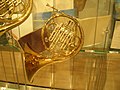
Paxman horns

Discussion of the repertoire of horns must recognize the different needs of orchestras and concert bands in contrast to marching bands, as above, but also the use of horns in a wide variety of music, including chamber music and jazz.

Orchestra and concert band

[edit]

The horn is most often used as an orchestral and concert band instrument, with its singular tone being employed by composers to achieve specific effects. Leopold Mozart, for example, used horns to signify the hunt, as in his Jagdsinfonie (hunting symphony). Telemann wrote much for the horn, and it features prominently in the work of Handel and in Bach's Brandenburg Concerto no. 1. Once the technique of hand-stopping had been developed, allowing fully chromatic playing, composers began to write seriously for the horn. Gustav Mahler made great use of the horn's uniquely haunting and distant sound in his symphonies, notably the famous Nachtmusik (serenade) section of his Symphony No. 7.

Many composers have written works that have become favorites in the horn repertoire. These include Poulenc (Elegie) and Saint-Saëns (Morceau de Concert for horn and orchestra, op. 94 and Romance, op. 36). Others, particularly Wolfgang Amadeus Mozart, whose friend Joseph Leutgeb was a noted horn player, wrote extensively for the instrument, including concerti and other solo works. Mozart's A Musical Joke satirizes the limitations of contemporary horn playing, including the risk of selecting the wrong crook by mistake.

The development of the valve horn was exploited by romantic composers such as Bruckner, Mahler, and Richard Strauss, whose father was a well-known professional horn player. Strauss's Till Eulenspiegel's Merry Pranks contains one of the best known horn solos from this period, relying on the chromatic facility of the valved horn. Schumann's Konzertstück for four horns and orchestra is a notable three-movement work. Brahms had a lifelong love-affair with the instrument, with many prominently featured parts throughout his four symphonies. Despite his use of natural horns in his work (e.g., Horns in B♮ in the second movement of his Symphony No. 2), players today typically play Brahms's music on modern valved instruments.

Chamber music

[edit]

There is an abundance of chamber music repertoire for horn. It is a standard member of the wind quintet and brass quintet, and often appears in other configurations, such as Brahms' Horn Trio for violin, horn and piano (for which, however, Brahms specified the natural horn). Also, the horn can be used by itself in a horn ensemble or "horn choir". The horn choir is especially practical because the extended range of the horn provides the composer or arranger with more possibilities, registerally, sonically, and contrapuntally.

Orchestral and concert band horns

[edit]
A horn section in a military concert band
The horn section in I Solisti Veneti, a chamber Baroque orchestra

A classical orchestra usually has at least two French horn players. Typically, the first horn played a high part and the second horn played a low part. Composers from Beethoven (early 1800s) onwards commonly used four horns. Here, the first and second horns played as a pair (first horn being high, second horn being low), and the third and fourth horns played as another pair (third horn being high, fourth horn being low).

Music written for the modern horn follows a similar pattern with the first and third horns being high and the second and fourth horns being low. This configuration serves multiple purposes. It is easier to play high when the adjacent player is playing low and vice versa. Pairing makes it easier to write for horns, as the third and fourth horns can take over from the first and second horns or play contrasting material. For example, if the piece is in C minor, the first and second horns might be in C, the tonic major key, which could get most of the notes, and the third and fourth horns might be in E, the relative major key, to fill in the gaps.

Many orchestral horn sections in the 2010s also have an assistant[20] who doubles the first horn part for selected passages, joining in loud parts, playing instead of the principal if there is a first horn solo approaching, or alternating with the principal if the part is tiring to play.[21] Often the assistant is asked to play a passage after resting a long time. Also, he or she may be asked to enter in the middle of a passage, exactly matching the sound, articulation, and overall interpretation of the principal, thus enabling the principal horn to rest a bit.

In jazz

[edit]

The French horn was at first rarely used in jazz music. (Note that colloquially in jazz, the word "horn" refers to any wind instrument.) Notable exponents, however, began including French horn in jazz pieces and ensembles. These include composer/arranger Gil Evans who included the French horn as an ensemble instrument from the 1940s, first in Claude Thornhill's groups, and later with the pioneering cool jazz nonet (nine-piece group) led by trumpeter Miles Davis, and in many other projects that sometimes also featured Davis, as well as Don Ellis, a trumpet player from Stan Kenton's jazz band. Notable works of Ellis' jazz French horn include "Strawberry Soup" and other songs on the album Tears of Joy. Notable improvising horn players in jazz include Julius Watkins, Willie Ruff, John Graas, David Amram, John Clark, Vincent Chancey, Giovanni Hoffer, Arkady Shilkloper, Adam Unsworth, and Tom Varner.

Bass clef old notation vs. new notation

[edit]

Notation in the bass clef for the horn has undergone a convention shift. Prior to approximately 1920, horn parts employing the bass clef often used what is now referred to as old notation. In this system, notes in the bass clef were written in octaves below concert pitch rather than above. By the early 20th century, as the valve horn became standard, the new notation gradually replaced the old system.[22] In new notation, transposition in the bass clef follows the same rule as the treble clef, that is, to write notes in the octave above concert pitch.

Usually there is no indication on the score for whether the horn parts are written in old or new notation. However, horn players have developed a general rule-of-thumb to determine which notation is being used.[23]

Notable horn players

[edit]

People who are more notable for their other achievements, but also play the horn, include actors Ewan McGregor and David Ogden Stiers, comedian and television host Jon Stewart, journalist Chuck Todd, The Who bassist and singer John Entwistle, and rapper and record producer B.o.B.[24]

[edit]

See also

[edit]

References

[edit]
[edit]
Revisions and contributorsEdit on WikipediaRead on Wikipedia
from Grokipedia
The French horn, also known simply as the horn, is a characterized by its coiled tubing—typically measuring 12 to 13 feet (3.7 to 4 meters) in length when uncoiled for a single F horn—ending in a wide flared bell, and played by vibrating the lips against a funnel-shaped mouthpiece to produce sound through a predominantly conical bore. Constructed primarily from yellow or alloys for durability and tonal warmth, it features rotary valves operated by the left hand to redirect airflow through additional tubing lengths, enabling a full across its standard written range of approximately three and a half octaves, from the low F below the bass staff to the F above the treble staff. The player inserts the right hand into the bell to adjust intonation and via hand-stopping techniques, resulting in the instrument's distinctive mellow, resonant tone that blends seamlessly between and woodwind sections. Originating from 16th-century hunting horns used for signaling in and , the French horn evolved into a instrument by the late , with early orchestral uses in the 1680s. Key developments included the introduction of crooks for pitch changes in the early by makers such as the Leichnamschneider brothers, and the invention of the in 1832 by Joseph Riedl, which facilitated the modern double horn in F/B♭ for greater versatility and ease of playing across registers. Today, the double horn remains the standard in professional orchestras, valued for its wide dynamic range and expressive capabilities, though it is notorious for its technical demands, including precise control and resistance from its long tubing. In orchestral and ensemble settings, the French horn serves multiple roles, from providing harmonic support and lyrical melodies to delivering bold fanfares, with its soft yet projecting sound making it indispensable in symphonic repertoire from Beethoven to contemporary works. Variations such as the natural horn (valveless, using crooks for tuning) and (with narrower bore and piston valves) persist in period performances and specific traditions, highlighting the instrument's adaptability and historical depth.

Etymology and Nomenclature

Origins of the Name

The term "" derives from the French "cor de chasse," meaning " horn," which referred to the large, coiled developed in during the 17th century for aristocratic signaling and later adapted for musical purposes. This instrument, characterized by its wide conical bore and looped tubing, originated from earlier animal horns but was refined in the French , where it gained popularity among for its resonant calls across distances. By the late 17th century, the cor de chasse had spread to , where it was explicitly termed the "French horn" to denote its continental origin and distinguish it from indigenous or other brass instruments simply called "horns," such as the older English hunting horns or the angelic horn (later known as the ). The name's adoption in English musical contexts solidified around 1720, coinciding with its integration into orchestral works; for instance, George Frideric Handel's (premiered circa 1717) and subsequent scores employed "corno" parts that ambiguously indicated these French-style horns, marking their early orchestral prominence without yet specifying valves, which were invented later. This nomenclature persisted in English-speaking countries to specify the particular orchestral descendant of the cor de chasse, differentiating it from broader "horn" categories that included trumpets, trombones, or unrelated folk instruments, even as German developments refined its design.

Modern Terminology and Distinctions

In contemporary usage, the instrument known as the French horn in English-speaking contexts is referred to simply as the "horn" by professional musicians and organizations to promote clarity and universality. This preference avoids the potentially confusing qualifier "French," which is a historical misnomer, and aligns with international standards that emphasize the instrument's distinct identity within the brass family. Regional naming conventions vary significantly, reflecting linguistic and cultural traditions. In German-speaking areas, it is commonly called the Waldhorn (forest horn) or simply Horn, emphasizing its origins in hunting instruments. In French, the term cor d'harmonie (harmony horn) is standard, while cor serves as a generic designation. These names distinguish the orchestral horn from other instruments like trumpets or trombones, whereas the English "French horn" emerged to differentiate it from simpler hunting horns or other coiled . The designation "French horn" is a misnomer because the modern valved form, developed in the early , derives primarily from German innovations rather than French designs. Following the invention of valves around by German makers Heinrich Stölzel and Friedrich Blühmel, the instrument evolved into its current configuration in during the and beyond, replacing earlier French-style natural horns in professional use. This German lineage is why professionals often reject "French" in favor of "horn" or "" for the rotary-valved model prevalent today. To prevent confusion with the English horn (), a double-reed in the family that produces a reedy, melancholic tone unrelated to , the term "French horn" persists in non-professional English contexts. The International Horn Society endorses "horn" in its publications and guidelines, advocating for its use in educational and orchestral settings to streamline communication and honor the instrument's global heritage.

History

Early Development and Hunting Horns

The precursors to the modern French horn date back to prehistoric and ancient times, when animal horns—such as those from oxen, rams, or other beasts—served as simple signaling instruments across for communication during , rituals, and warfare. These natural horns produced a limited range of tones based on their length and shape, relying on the natural series for sounds that carried over long distances in open landscapes. Archaeological evidence, including artifacts like the Danish (S-shaped bronze horns dating to around 1400–500 BCE), demonstrates early advancements in that allowed for louder, more resonant signals while maintaining the instrument's role as a practical tool rather than a melodic one. By the medieval and Renaissance periods, these signaling horns had evolved into more standardized forms used primarily in , where they directed hounds and communicated positions among hunters. In 17th-century , the instrument underwent significant transformation with the development of the cor de chasse, a coiled metal hunting horn crafted from or silver tubing wound into a circular shape for easier handling on horseback. This design, popularized under the patronage of at Versailles, emphasized a bright, projecting tone suitable for outdoor fanfares and was documented in treatises like Marin Mersenne's Harmonie universelle (1636), which described its fingering and harmonic capabilities. The cor de chasse remained a non-transposing instrument limited to its natural harmonics, typically the 5th through 12th partials, making it ideal for bold, ceremonial calls but challenging for complex music. The cor de chasse's transition to the concert hall began in the late 17th century, marking the horn's entry into orchestral settings for dramatic effect. In , incorporated hunting horns into his 1664 comédie-ballet La Princesse d'Élide to evoke and scenes through fanfare-like passages played on harmonics. By the 1690s, this practice spread across Europe, with English composer employing horns in semi-operas such as (1691) and (1692) to underscore ceremonial and naturalistic episodes, again relying solely on the instrument's inherent overtones for short, signaling motifs. These early orchestral uses were confined to pairs of horns in or octaves, emphasizing their role as coloristic elements rather than solo voices, and required players skilled in lip control to navigate the wide intervals of the harmonic series. Further refinements in the pre-valve era came in the mid-18th century through experimentation in , where horn players at the court sought ways to expand the instrument's tonal range without altering its core design. Anton Joseph Hampel (c. 1710–1771), a Bohemian-born and , pioneered the systematic use of crooks—removable segments of tubing inserted to lengthen the horn and it to different keys—around the 1740s. Hampel's students, including Johann Joseph Roderich and Friedrich Gabriel Beck, built on this by developing standardized crook sets for common orchestral keys like F, E, and D, allowing greater flexibility in ensemble music while preserving the natural horn's purity of tone. This innovation, detailed in period method books and court records, enabled composers like Haydn and to write more demanding horn parts, though players still contended with the instrument's inherent limitations in intonation and chromatic access.

Invention of Valves and Orchestral Adoption

The invention of marked a pivotal advancement for the French horn, transforming it from a primarily diatonic instrument reliant on crooks and hand-stopping into one capable of full chromatic execution. In , German musician and inventor Heinrich Stölzel developed the first practical system specifically for the horn, using box valves that allowed players to lower the pitch by semitones and facilitate rapid key changes without manual adjustments. This innovation addressed the limitations of the natural horn, enabling access to notes outside the series while maintaining the instrument's characteristic tone. Building on Stölzel's work, Joseph Riedl in patented the in 1832, a rotating mechanism that provided smoother airflow and more reliable intonation compared to earlier designs. This valve type quickly gained prominence in Central European horn making, as it integrated seamlessly with the horn's and supported extended playing ranges. Concurrently, in the French tradition, for horns were introduced around 1839 by François Périnet, with makers like Marcel-Auguste Raoux producing piston horns in the mid-19th century for orchestral use. These developments collectively enabled hornists to play complex chromatic passages with greater agility and consistency. The adoption of valved horns in orchestras accelerated during the early 19th century, evolving from the hand-horn techniques employed by Haydn and , where players inserted their hand into the bell to produce stopped notes and alter . Beethoven's symphonies after 1800, such as the Fifth and , expanded the horn's role with demands for broader chromaticism and dynamic expression that strained the natural horn's capabilities, indirectly spurring integration by the 1820s. By the mid-19th century, valved horns became standard in European orchestras; composers like embraced them in works such as the 1849 Adagio and Allegro, Op. 70, exploiting the s for virtuosic, fully chromatic lines. Similarly, Johannes incorporated valved horn writing in his symphonies and concertos, such as the First Symphony (1876), where the instrument's expanded range enriched harmonic textures and solo passages. Standardization progressed through the , with makers refining systems for reliability and intonation. A key milestone was Fritz Kruspe's 1897 invention of the double horn in F/B♭, combining two horn lengths in one instrument via a fourth , which resolved tuning issues between high and low registers and solidified the modern orchestral horn's form. This design, alongside ongoing improvements in rotary and piston , ensured the French horn's central role in Romantic , influencing ensemble balance and compositional possibilities.

20th-Century Innovations and Standardization

In the early , French horn construction saw a shift toward yellow and alloys, enhancing durability and resistance to corrosion while influencing tonal characteristics. , composed of , , and , provided a harder material than traditional , allowing for brighter projection and structural integrity in professional models. This material choice became prevalent in American and European instruments by the mid-century, as seen in designs like the King 1160 model introduced in 1963 with a solid body. The double horn in F/B♭ solidified as the orchestral standard during the , building on its invention in 1897 by German maker Fritz Kruspe, which combined F and B♭ sides into a single instrument for greater range and versatility. By the early 1900s, this design addressed intonation challenges of single horns and gained widespread adoption in symphony orchestras, supplanting earlier single F models. The International Horn Society, established in 1970, further promoted this configuration through educational resources and symposia, reinforcing its role as the norm for professional performance. Advancements in valve systems included the development of compensating mechanisms by British firm Paxman in collaboration with hornist Richard Merewether starting in 1959, with production models emerging in the 1970s to improve pitch accuracy across the full range of double and triple horns. These systems used additional tubing to compensate for sharpening tendencies in the B♭ side, offering lighter weight and better response compared to traditional full-double designs. Up to 2025, innovations have focused on lightweight materials and hybrid technologies, such as carbon fiber bells introduced by Wiseman, which reduce instrument weight for marching ensembles while preserving projection and dynamic control. In experimental music, electronic augmentations have expanded the horn's palette, incorporating live electronics for real-time processing and electric variants that blend acoustic tones with synthesized effects, as explored in contemporary compositions.

Design and Acoustics

Basic Components and Materials

The French horn is constructed from a long, coiled tube of thin-walled , typically measuring approximately 12 to 18 feet in length when uncoiled, which allows for the production of its characteristic range of pitches. This tubing features a consistent bore size, often around 0.472 inches, and tapers gradually toward the end. At the distal end sits a flared bell, usually 12 to 13 inches in diameter, which shapes and projects the sound while providing . Central to the instrument's mechanism are the rotary valves, typically three or four in number, housed in a valve section that enables the player to redirect through additional loops of tubing to alter pitch. These valves, often made of yellow brass, connect to finger levers and thumb valves for operation. The proximal end includes a mouthpiece receiver, or leadpipe, which accepts the detachable mouthpiece and directs into the instrument, along with multiple tuning slides—such as the main slide and valve slides—for precise pitch adjustment. The primary material for the horn's body is yellow brass, an alloy of about 70% copper and 30% zinc, valued for its malleability, corrosion resistance, and balanced tonal projection. Finishes commonly include lacquer to protect against tarnish or silver plating for enhanced durability and a brighter appearance. Some professional models incorporate gold brass, with higher copper content (around 85%), to produce a warmer, richer tone, while student instruments may use lightweight alloys like nickel silver for easier handling and reduced cost. Manufacturing involves specialized techniques to ensure acoustic quality and playability. Bells are frequently hand-hammered from sheet sheets, stretched and shaped over mandrels to form the flare, which contributes to superior compared to bells. Tubing is machine-drawn from billets, annealed for flexibility, and coiled into the instrument's circular form, with valves and slides assembled precisely for smooth action. Reputable manufacturers like Holton and Yamaha emphasize these processes, using high-grade materials and tapered designs for consistent performance across models.

Acoustic Principles and Pitch

The French horn generates sound through the vibration of the player's lips within the mouthpiece cup, a process known as lip buzzing, which initiates standing waves in the air column of the instrument. These vibrations create pressure oscillations that propagate through the tubing, where they are amplified and resonated. The predominantly conical bore, which gradually expands from the narrow mouthpiece shank to the wider bell, shapes the to emphasize lower-order harmonics, resulting in the instrument's signature mellow and rounded tone quality. The bell's exponential flare further aids in efficient sound radiation while preserving the warm by directing higher frequencies less aggressively than in cylindrical-bore brass instruments. As a pitched in F, the French horn sounds a lower than the written notation, with its corresponding approximately to B♭1 (around 58 Hz) on the B♭ side of a double horn. The playable pitches derive from the harmonic series of this fundamental, enabling a continuous range from low pedal tones—such as the sub-pedal B♭1 or pedal F2 on the F side—to the register extending beyond written C6 (sounding above F5). This series provides the natural structure, with partials becoming closer in pitch as the register ascends, allowing for melodic flexibility but requiring precise control over lip tension and air speed. In double horn designs, the B♭ side incorporates additional tubing , effectively lowering the overall pitch by a compared to the F side and extending the low range to access pedal tones like B♭1 that are challenging or inaudible on the F side alone. Intonation on the French horn is inherently challenging due to the harmonic series' tendency for upper partials to sound sharp relative to , particularly in the mid-to-high register where partials are closely spaced. These discrepancies arise from the instrument's acoustic design, including the conical bore's influence on impedance peaks, which can elevate certain overtones. Players correct these tendencies primarily through hand stopping, inserting the right hand into the bell to partially close it, which lowers the pitch by approximately a , dampens higher , and alters for better blending; this technique also facilitates chromatic notes outside the open harmonic series. Some historical or specialized horns incorporate vent holes—small openings near the bell or —to facilitate rapid pitch adjustments or stabilize stopped notes, though modern valved French horns rely more on hand technique and valve combinations for precise tuning.

Types of French Horns

Single Horn

The single horn, commonly pitched in F, features a basic configuration with three rotary valves that enable chromatic playing across its range without additional pitch-altering mechanisms. This design emphasizes simplicity, resulting in a lighter instrument weighing approximately 3.3 to 3.75 pounds, which contrasts with the heavier construction of more versatile models. Its advantages include enhanced ease of handling for novice players, as the streamlined build and reduced weight facilitate better control and focus on core skills like articulation and tone production. The single F horn also offers superior intonation in the high register, where its tubing length is optimized for the demands of typical orchestral writing, promoting a traditional, resonant . These qualities make it particularly suitable for and are commonly employed in youth orchestras and select solo repertoire. A key drawback is the limited low range, as the instrument cannot easily access notes below its fundamental F without alternative techniques, restricting its utility in modern ensemble settings. Prior to , single horns represented the primary professional standard before the rise of multi-pitch designs, and contemporary usage centers on educational models such as the Holton H602.

Double Horn

The double horn consists of two independent sets of tubing in parallel: a primary F branch approximately 370 cm (12.1 feet) long for the lower register and a secondary B♭ branch about 275 cm (9 feet) long for the upper register, resulting in a total tubing length of roughly 645 cm (21.2 feet). This configuration allows the instrument to produce a full from pedal C upward, addressing the limitations of single horns by providing access to both keys without swapping instruments. The mechanics rely on a fourth rotary valve, typically operated by a thumb trigger, which diverts airflow between the F and B♭ sides while the first three valves handle standard pitch adjustments. Invented in the late by German makers such as Fritz Kruspe and Edmund Gumpert, the double horn gained prominence around 1900 as a versatile solution for orchestral demands. The 8D model, introduced in the late as an evolution of Kruspe designs, exemplifies this setup with its responsive construction and has remained a benchmark for professional instruments. This design offers key advantages in orchestral settings by combining the B♭ side's and security for high with the F side's fuller tone and power for low passages, making it the preferred choice for most professional players. Full-double variants, where both sides use independent tubing paths, provide smoother airflow and richer compared to semi-doubles, though they are slightly heavier. Today, the double horn constitutes the standard for the majority of orchestral positions, prized for its balance and reliability in ensemble performance.

Compensating and Triple Horns

Compensating double horns represent an advanced variant of the double horn designed to address intonation challenges inherent in standard doubles, particularly the tendency for notes to play sharp when multiple valves are engaged on the B♭ side for low-register playing. This system incorporates additional tubing loops integrated into the valve mechanism, which lengthen the air column and lower the pitch of those combinations, resulting in more accurate intonation without requiring the player to switch to the F side. The design, pioneered in the early with the Gumpert model introduced by Kruspe in , uses a single set of primary tubing extended by the compensating loops rather than duplicating full-length F tubing, making the instrument lighter—typically 1.8 to 2.2 kg—and producing a more direct, open tone due to the shorter overall air path. These horns maintain the versatility of the double configuration while offering improved stability in the pedal range, allowing players to remain on the B♭ side for extended low passages that might otherwise demand frequent side changes and disrupt phrasing. Examples include the Gebr. Alexander Model 102 and Paxman Model 33, both favored by professionals for their balance of weight and responsive intonation in orchestral settings. Triple horns build on the double horn framework by incorporating a third tuning configuration, often a descending low F side achieved through a compensating system that extends the B♭ tubing with additional loops and a fifth for further pitch adjustment, enabling access to an extended low register down to pedal C or below without side-switching. This setup corrects the sharp tendencies of valve combinations in the sub-low range, providing seamless transitions and enhanced security for demanding passages. The added complexity increases the instrument's weight to approximately 6-7 lbs (2.7-3.2 kg), yet the design yields a fuller, more stable low-end response compared to standard doubles. Preferred by virtuosos for solo repertoire requiring agile low-register demands—such as extended pedal tones in concertos by or Dukas—triple horns like the Paxman Model 81 or customized variants (e.g., Model 303) allow performers to maintain consistent and airflow across the full range. Their adoption has grown among professional soloists and principal orchestral players since the early , valued for eliminating the intonation compromises of frequent thumb-valve shifts in complex modern works.

Detachable Bell Variants

Detachable bell variants of the French horn incorporate a screw-thread mechanism at the junction of the bell and the first branch, enabling the bell to be easily removed and reattached without tools. This design facilitates the use of interchangeable bells of varying sizes, materials, or shapes to suit different acoustic needs or performance environments, such as swapping a standard large bell for a smaller one to alter projection or response. The primary advantages of this configuration include significantly reduced instrument size and weight when the bell is detached, making transportation more convenient—particularly for , where the separated components fit into compact cases or overhead bins without affecting tonal quality. Additionally, it simplifies maintenance tasks like cleaning the bell interior or polishing, as the component can be handled independently, though players must ensure the connection is securely tightened to prevent loosening during play. In contemporary practice, detachable bell horns are widely adopted in professional and educational settings, especially in the UK, where they support versatile ensemble work by allowing quick adaptations for varied repertoire or venue acoustics. Reputable manufacturers like Yamaha and Conn-Selmer produce models with this feature, such as the Yamaha YHR-668 series and Conn 11DNS, emphasizing enhanced portability alongside preserved resonance and intonation.

Natural Horn

The natural horn, the valveless predecessor to the modern French horn, features a long coiled tube of typically around 12 to 16 feet in length, wound into a circular shape with a wide conical bore and a flared bell. To adjust the pitch for different keys, players insert interchangeable crooks—additional segments of tubing that lengthen or shorten the instrument's total tube length, allowing transpositions such as G alto, F, , or . For chromatic notes beyond the natural harmonic series, the technique of hand stopping is employed, where the player inserts their right hand into the bell to partially close it, lowering the pitch by approximately a and altering the to produce stopped tones. In the , the natural horn served as the primary orchestral horn, integral to the sound of classical ensembles and particularly prominent in the works of composers like , who composed four horn concertos exploiting its capabilities. Mozart's concertos, such as Nos. 2 in and 4 in , incorporate hand-stopping techniques to achieve chromatic passages and dynamic contrasts, reflecting the instrument's role in signals evolved into . By the late 18th century, specialized horn players in orchestras mastered these methods to meet the growing demands for expressiveness in symphonic and operatic repertoire. Unlike the modern valved French horn, the natural horn lacks mechanical s, restricting its playable notes primarily to the harmonics of its fundamental pitch determined by the crook in use, which demands advanced control and precise lip adjustments for intonation across the partials. Chromaticism is thus limited and achieved through hand stopping or vent holes in some variants, rather than valve combinations, resulting in a brighter, more variable tone that varies by crook and stopping technique. Following the invention of valves in the early , the natural horn fell out of common use but experienced a revival in the with the rise of period instrument performances, where replicas are employed by ensembles like the to authentically recreate 18th-century music.

Vienna Horn

The Vienna horn is a specialized variant of the French horn characterized by its narrow-bore design and use of double valves, primarily employed in Viennese orchestral traditions. This instrument maintains a single F tuning with a detachable crook, allowing for pitch adjustments while preserving a compact, agile form suited to classical . Its emphasizes a conical bore diameter of approximately 11 mm, paired with a smaller bell that facilitates precise, rapid articulation and smooth passages. The double valves, known as Vienna valves, operate in tandem and were patented in by Leopold Uhlmann, enabling chromatic playability on an otherwise horn-inspired frame. Introduced in the , the became the standard for the Orchestra, where it has been used continuously to achieve the ensemble's signature warm, blended . This adoption reflects its roots in early 19th-century Viennese instrument-making, evolving from designs to incorporate valves for greater versatility in orchestral settings. Players of the Vienna horn employ a lighter compared to that required for wider-bore German double horns, relying on subtler lip tension to produce its characteristic soft, veiled tone. Distinctive elements of the Vienna horn include its funnel-shaped mouthpiece, which resembles those of the natural horn and promotes a focused, non-cupped for nuanced expression. Hand-stopping remains a core technique, with the player's right hand inserted into the bell to fine-tune intonation and enhance the instrument's harmonic richness, a practice integral to its idiomatic performance. Contemporary replicas, crafted by makers such as Denk, faithfully reproduce these historical specifications using modern materials for improved durability and consistency, ensuring the tradition endures in professional use.

Mellophone and Marching Horns

The serves as a primary substitute for the French horn in marching bands and drum corps, characterized by its compact, horizontal bell oriented forward for optimal sound projection during movement. Pitched in F, it utilizes three valves operated with trumpet-style fingerings, a straight leadpipe, and a trumpet-sized mouthpiece receiver, enabling performers to approximate the French horn's melodic role while adapting to the physical demands of marching. This design facilitates a brighter, more penetrating tone suited to outdoor environments, with a typical bore of around 0.460 inches and a 10- to 11-inch bell flare made from yellow for enhanced volume and . Modern trace their development to the , when manufacturers like Conn introduced refined models to address the limitations of earlier horns in drum corps, prioritizing ease of play and projection over the concert French horn's nuanced . Zig Kanstul further advanced the instrument in the through his work at Olds & Son and later Kanstul Musical Instruments, creating lightweight designs with improved valve action and bowl-shaped mouthpieces for greater efficiency and intonation stability in high-mobility settings. Marching horns represent direct adaptations of the for upright, bell-forward use, typically configured as single instruments in F or B♭ to maintain the traditional conical bore and rotary valve system while enhancing portability and acoustic throw. These models feature a narrower bore—often 0.466 inches—compared to mellophones, paired with a 10-inch bell and an angled mouthpipe to accommodate the horn's during marches, resulting in a warmer, more orchestral tone with reduced weight for sustained performance. Employed extensively in military bands for ceremonial and parade functions, marching horns provide harmonic support and projection in formations where standard concert horns would be impractical due to their backward-facing bells. Manufacturers like King emphasize durable construction, such as heavy-gauge brass and reinforced bracing, to withstand rigorous outdoor use while preserving the instrument's mellow character. Key differences between mellophones and marching horns include the former's piston valves and trumpet-oriented ergonomics, which yield a sharper attack and easier upper-register access for volume, versus the latter's rotary valves and horn-specific setup for subtler articulation and blend. Both incorporate wider bores than concert French horns to amplify sound over distance and lighter materials—often under 4 pounds—to minimize fatigue, though mellophones prioritize trumpet-like responsiveness while marching horns retain closer fidelity to the parent instrument's design. Some models offer detachable bells for versatility in storage or conversion.

Wagner Tuba

The Wagner tuba is a valved brass instrument developed specifically for Richard Wagner's operatic cycle Der Ring des Nibelungen. Conceived by Wagner in the summer of 1853 while in exile in Zurich, Switzerland, it was intended to bridge the tonal gap between the French horn and the tuba in the orchestral brass section. The first prototypes were constructed in 1874 by Munich instrument maker Georg Ottensteiner, and the instrument made its public debut as a quartet on March 1, 1875, in Vienna, performed by tuba players Alois Schantl, Michael Pichler, Franz Nittmann, and Wilhelm Kleinecke. It premiered in the full Ring cycle during the 1876 Bayreuth Festival, marking its integration into Wagner's innovative orchestration. In design, the Wagner tuba exists in two primary models: a tenor version pitched in B♭ with a tubing length of approximately 290 cm, and a bass version in F with about 380 cm of tubing. Both feature an upright bell—typically around 25 cm in diameter for the tenor—and a conical bore comparable to that of the French horn, with a narrow diameter of 10.8–11 mm to maintain a horn-like timbre. Equipped with four rotary valves operated by the left hand, similar to those on a horn, the instrument uses a funnel-shaped mouthpiece akin to the French horn's, though some modern versions accommodate slightly deeper cups for enhanced tonal depth. This hybrid construction allows for a tenor-range sound that is mellower and more blended than a standard tuba, with fingerings identical to the French horn. The Wagner tuba's primary role is to provide a middle voice in the section, filling the sonic space between the horns and lower like trombones and , thereby creating a more cohesive choral effect in Wagner's scores. It is typically played by hornists rather than tuba players, due to the shared demands, valve mechanism, and hand position, which enables seamless integration within horn sections during performances. In orchestral scores, its notation appears between the horn and tuba staves, underscoring its intermediary function. Today, the Wagner tuba remains rare outside performances of Wagner's Ring cycle, as well as works by Anton Bruckner and Richard Strauss that adopted it, such as Bruckner's Symphony No. 7. Modern replicas are produced by specialist makers, including Gebr. Alexander in Germany, which crafts both Bb tenor and F bass models with traditional rotary valves and upright bells to faithful historical specifications. These instruments are valued for their unique, veiled tone but are not commonly used in general orchestral or band settings due to their specialized nature.

Playing Technique

Embouchure, Breathing, and Intonation

The for the French horn involves a relaxed positioning of the lips against the mouthpiece, with approximately two-thirds of the upper and one-third of the lower inside the to optimize and tone production. This placement allows the upper to provide primary control over pitch and while maintaining flexibility. To form the through which air passes, players often employ an "ee" shape in the mouth, which narrows the oral cavity and directs the airstream efficiently without excessive tension. Common issues arise from overly tight corners of the mouth, which can lead to fatigue, reduced endurance, and inconsistent tone, emphasizing the need for minimal muscular effort beyond what's required for . Breathing technique on the French horn relies on diaphragmatic support to sustain long phrases and achieve tonal stability, drawing air deeply into the lower lungs rather than shallow chest breathing. This method engages the diaphragm and abdominal muscles to provide steady air pressure, essential for the instrument's lyrical demands. , while possible on some wind instruments, is rare on the French horn due to the precise control required, with players instead focusing on efficient during rests. The dynamic range typically extends from forte (f) to pianississimo (ppp), supported by controlled that maintains consistent airflow across volumes. Intonation on the French horn is managed through subtle adjustments to counteract the instrument's tendencies toward sharpness in certain partials, allowing players to fine-tune pitch within the harmonic series. The primary tuning slide sets the overall pitch, but microtonal corrections often involve varying tension or speed of air column . Additionally, the right hand positioned in the bell serves as a key tool for intonation, where partial obstruction lowers pitch slightly and refines tone color, enabling adjustments of up to a quarter-tone without altering fingerings. These techniques ensure precise tuning in ensemble settings, where the horn's acoustics can amplify discrepancies.

Hand Techniques and Articulation

Hand stopping is a fundamental technique on the French horn that involves inserting the right hand into the bell to modify pitch and , originally developed to enable chromatic notes on the natural horn by raising the pitch approximately a when the bell is fully covered. To perform full hand stopping, the player fingers the desired note a half step lower than written while pressing the palm firmly against the bell to seal it, resulting in a muted, nasal tone that contrasts with the open sound. This method remains essential for achieving specific coloristic effects in modern playing, even on valved instruments, and requires precise hand conformation to the bell's shape for consistent intonation and projection. Half-stopping extends this technique by partially inserting the hand into the bell, creating a veiled or hazy without fully muting the sound, often used for expressive subtlety in lyrical passages. In contrast, echo effects, or "echo horn," involve a looser hand position that muffles the tone while transposing the written pitch up a half step, producing a distant, resonant quality distinct from the sharper stopped sound. These partial manipulations allow hornists to blend open and stopped timbres seamlessly, enhancing dynamic expression and texture in performance. Articulation on the French horn relies primarily on , where the interrupts the at the lips to define note attacks, with common syllables including "ta" for bright , "da" for softer detached notes, and "la" for smooth connections. Single provides clear separation for basic phrases, while multiple techniques—double (alternating "ta-ka") and triple (ta-ka-ta")—enable rapid articulation, such as executing 16th notes at a of = 120, essential for virtuosic passages. , achieved by rolling the as in a prolonged "r" sound, adds a trembling, percussive effect for dramatic or imitative purposes in .

Repertoire and Usage

Orchestral and Band Repertoire

The French horn plays a prominent role in orchestral repertoire from the Classical period onward, often serving as a melodic voice and harmonic support within standard four-horn sections. In Ludwig van Beethoven's Symphony No. 3 ("Eroica"), the horns feature iconic calls in the third movement , where the first and second horns execute rapid fanfare-like figures in hunting horn style, evoking pastoral themes and demanding precise intonation across the ensemble. These parts exemplify the era's reliance on techniques, with the four horns typically paired as high (1 and 3) and low (2 and 4) for balanced voicing. Pyotr Ilyich Tchaikovsky's Symphony No. 5 further highlights the horn's lyrical capabilities, particularly in the second movement's extended solo for the principal horn, which unfolds a poignant, melody over sustained string harmonies. This passage, marked by expressive phrasing and dynamic control, underscores the instrument's soloistic potential within the orchestral texture while the remaining horns provide supportive chords. In the Romantic era, composers expanded the horn's technical demands, as seen in Richard Strauss's tone poem , where the delivers virtuosic passages, including a soaring solo for the first horn in the "Hero's Companion" section that portrays the hero's beloved with sweeping melodies and rapid scalar runs. The work's eight horns (including offstage) require exceptional stamina and blend, pushing the section's role from accompaniment to dramatic protagonist. In wind band literature, the French horn contributes to tonal warmth and contrast, notably in Gustav Holst's Second Suite in F for Military Band, where the horns open the second movement with a somber chord progression, supporting the folk-song variations and enabling smooth transitions between brass and woodwind colors. This piece, a staple of band programming, utilizes four horns in F to reinforce the ensemble's harmonic foundation without overpowering the lighter textures. Twentieth-century works continued to integrate the horn for both blend and timbral contrast, as in Benjamin Britten's , where the solo horn weaves through the with obbligato lines that echo and interpret the vocal poetry, creating intimate dialogues within the . Here, the horn's natural harmonics and muted effects enhance the nocturnal mood, demonstrating its versatility in smaller orchestral settings while maintaining sectional cohesion.

Chamber, Solo, and Concert Works

The French horn occupies a prominent place in solo repertoire through concertos that exploit its singing tone and technical range. Joseph Haydn's Concerto for Two Horns in (Hob. VIId:6), composed in the early , exemplifies early classical writing for the instrument, featuring antiphonal dialogues between the soloists and a light orchestral in three movements: Allegro maestoso, Romanza (Adagio), and Rondo (Allegretto). Although attribution is debated—some scholars credit (Franz Anton) or —it remains a foundational work showcasing the horn's hunting-call heritage and lyrical potential. Richard Strauss's Horn Concerto No. 1 in , Op. 11 (1882–1883), marks a Romantic milestone, originally scored for but widely performed on the modern valved instrument. Dedicated to his father, , principal horn of the Munich Court Orchestra, the three-movement structure—Allegro, Andante, and Allegro molto—emphasizes melodic warmth in the slow movement and in the finale, blending Wagnerian influences with classical form. Published by , it endures as a for hornists due to its demanding yet idiomatic writing. Contemporary solo works continue this tradition, as seen in Eric Ewazen's Concerto for Horn and (2002), commissioned by and premiered by Greg Hustis with the chamber ensemble Voices of Change. Structured in three movements, it draws on American tonal , with the horn weaving expansive melodies against string textures that highlight its resonant mid-range and agile upper register. Theodore Presser Company publishes the score, underscoring its integration into modern recital and orchestral programs. In chamber settings, the French horn contributes its blending to intimate ensembles, often providing harmonic foundation and melodic . Johannes Brahms's Trio in E-flat major, Op. 40 (1865), for , , and —adaptable to or viola—evokes the landscapes of the composer's summer retreat in the Austrian countryside, with four movements that alternate introspective Andante and vigorous , Finale. The horn's role is integral, mirroring vocal lines in a post-horn style. Edition Peters issues the standard edition. Horn quartets further explore the instrument's ensemble potential, as in Eugène Bozza's Suite pour Quatre Cors en Fa (1952), a five-movement work published by Alphonse Leduc that ranges from playful Cortège to introspective Nocturne, demanding precise intonation and dynamic control among the four horns. The French horn also serves a pivotal function in wind quintets (flute, oboe, clarinet, horn, bassoon), acting as a timbral bridge between higher woodwinds and the bassoon; representative repertoire includes Anton Reicha's Quintets, Op. 88 (c. 1815), where the horn supplies foundational harmonies and occasional solos, enhancing the group's blended sonority in classical divertimentos. Concert band solos spotlight the horn's expressive qualities in larger wind ensembles. Vincent Persichetti's Parable VIII for Solo Horn, Op. 120 (1975), part of his series of 25 meditative works, pairs the unaccompanied horn—later orchestrated—with band for a contemplative exploration of the instrument's and phrasing, emphasizing sustained lyrical lines over virtuosic display. Theodore Presser publishes the solo version, which highlights the horn's introspective voice in mid-20th-century band literature. These pieces collectively underscore the French horn's adaptability in chamber, solo, and concert contexts, prioritizing melodic intimacy and technical finesse.

Jazz and Contemporary Applications

The French horn's integration into jazz began in the mid-20th century, with Julius Watkins emerging as a pioneering figure during the 1950s bebop era. Regarded as the father of the jazz French horn, Watkins demonstrated the instrument's viability in improvisational contexts through recordings with Quincy Jones's big band and his own quintet, the Jazz Modes, where he explored its lyrical and harmonic potential alongside tenor saxophonist Charlie Rouse. David Amram, collaborating alongside Watkins, further advanced the horn's role by performing with Miles Davis, Charlie Parker, and Thelonious Monk, adapting its classical timbre to jazz ensembles and emphasizing its expressive range in live settings. Jazz hornists have employed mute techniques, including hand-stopping and straight mutes, to enhance improvisational color, allowing for timbral shifts that mimic vocal inflections and add textural variety to bebop and modal solos. The instrument's conical bore poses adaptation challenges in , where its inherently mellow, blended tone differs from the brighter, more direct projection of cylindrical-bore like the , complicating fast scalar runs and agile phrasing essential to . Nevertheless, the horn has thrived in and avant-garde ensembles, as evidenced by Vincent Chancey's contributions to the and Lester Bowie's Brass Fantasy, where it supports experimental, multimedia-driven improvisations incorporating unconventional sounds and group dynamics. In , the French horn appears in film scores, notably those of , who leverages its warm, versatile to bridge orchestral sections and convey narrative emotion, as in works like Star Wars and . Post-2000 electronic fusions have expanded its scope, with projects such as the French Horn Rebellion merging acoustic horn lines with synthesized beats and loops in dance-oriented compositions. Artists like Romain Thorel have pioneered electric French horn setups, blending amplified horn tones with grooves and digital effects to create hybrid textures. By the mid-2020s, trends toward integration include horn-synth hybrids in experimental works, where players like Brian KM combine live horn performance with real-time electronic processing for immersive, genre-blurring soundscapes.

Notable Horn Players

Classical and Orchestral Performers

Giovanni Punto, born Jan Václav Stich in 1746, was a pioneering Czech horn virtuoso renowned for his mastery of the hand-stopping technique, which allowed for chromatic playing on the natural horn during the late . He toured extensively across , performing his own concertos and chamber works, and was celebrated as one of the finest horn players of his era, captivating audiences and composers alike with his technical prowess and expressive range. In the 1790s, Punto's performances influenced the development of horn repertoire, including interactions with , whose admiration for his skill highlighted Punto's status as a leading figure in classical horn playing. Oscar Franz (1843–1886) emerged as a prominent horn performer and pedagogue in the late , serving as principal horn in major orchestras such as the Dresden Court Orchestra during the era of . His contributions extended beyond performance to , with his Complete Method for Horn providing essential etudes that emphasized stopped-horn techniques and endurance, shaping generations of orchestral players. Franz's work in the Brahms period underscored the transition to horns in orchestral settings, where his precise execution in symphonic helped define the instrument's role in Romantic ensembles. In the 20th century, (1921–1957) revolutionized horn playing through his tenure as principal horn with the and his solo recordings, particularly his definitive interpretations of Benjamin Britten's Serenade for Tenor, Horn and Strings in 1944 and 1955, which showcased his exceptionally clean articulation and lyrical phrasing. Brain's technical innovations, including refined control for seamless tone production, influenced modern orchestral standards and inspired composers like Britten to expand the horn's soloistic possibilities. Similarly, (1931–2020), principal horn of the London Symphony Orchestra from 1955 to 1968, became a preeminent soloist specializing in Richard Strauss's horn concertos, with his 1967 recordings under István Kertész establishing benchmarks for interpretive depth and virtuosity in that repertoire. Tuckwell's career as a pedagogue further amplified his impact, authoring instructional materials and conducting masterclasses that promoted the horn's centrality in classical orchestras. Among contemporary orchestral horn players, Sarah Willis has been a member of the since 2001, marking her as the orchestra's first female brass player and contributing to its renowned through performances in a vast symphonic repertoire. As a pedagogue and media presenter, Willis has advanced horn education globally via initiatives like her "Horn Hangouts" series and collaborations bridging classical traditions with diverse genres. Radek Baborák, born in 1976, serves as principal horn and chief conductor with the Orchestre de la Suisse Romande, having previously held positions with the and , where his solo engagements and recordings highlight his exceptional control and musicality in both orchestral and chamber contexts. Baborák's dual role as performer and conductor exemplifies modern horn principals' influence on ensemble interpretation and repertoire development.

Jazz and Modern Innovators

In the realm of , the French horn found a pioneering voice through Julius Watkins, a innovator who elevated the instrument from orchestral obscurity to a central improvisational force during the 1950s and 1960s. Watkins, often collaborating with luminaries like , , and , demonstrated the horn's agility in contexts, employing rapid articulations and melodic lines that bridged classical with jazz phrasing. His recordings, such as those on Monk's (1957), showcased the horn's ability to cut through ensemble textures while adding lyrical depth to small-group settings. Arkady Shilkloper emerged as a trailblazer in extending the horn's technical boundaries within , particularly through his mastery of multiphonics and , techniques that produce simultaneous tones and sustained phrases unattainable on traditional . A Russian-born based in , Shilkloper integrated these methods into improvisational frameworks, as heard in his solo works and collaborations like Man with Horn (1990s recordings), where the horn evokes ethereal, layered soundscapes blending with contemporary experimentation. His innovations have influenced fusion ensembles by expanding the instrument's palette beyond conventional valved playing. The French horn's integration into jazz ensembles gained further traction through composers like (1936–2023), whose big bands in the 1970s and 1980s featured hornists such as John Clark, who contributed warm, contrapuntal lines to works like European Tour 1977 and Night-Glo (1985). Clark's role highlighted the horn's harmonic richness in , providing subtle color and rhythmic interplay within Bley's eclectic orchestrations. Among modern innovators, Tom Varner stands out as a composer-performer who has redefined the horn's rhythmic and improvisational potential in contemporary jazz since the 1980s. Based in after early years in New York, Varner founded the Julius Watkins Jazz French Horn Festival and released albums like Current Climate (2008), where his septet arrangements fuse swing with angular melodies, emphasizing the horn's percussive attacks and extended range for driving fusion grooves. His work underscores the instrument's adaptability to polyrhythmic structures in small ensembles. Mark Taylor, another avant-garde figure, has pushed the horn into experimental jazz territories through collaborations with artists like and , integrating microtonal shifts and noise elements into improvisations. Taylor's quartet recordings, such as At What Age (2009), explore the horn's timbral extremes in settings, using hand-stopping and to enhance textural density in fusion and contexts. His contributions have broadened the horn's role from melodic support to a lead voice capable of abstract expression. These innovators collectively advanced the French horn's rhythmic versatility and extended techniques in fusion genres, transforming it from a background orchestral tool into a dynamic solo instrument. Multiphonics, glissandi, and breath-controlled effects, as pioneered by Shilkloper and adapted by Varner and Taylor, have enabled the horn to navigate complex and timbral shifts, influencing its application in jazz-rock hybrids and experimental ensembles. This evolution emphasizes conceptual expansion over traditional intonation, fostering greater integration in modern improvisational music.

References

Add your contribution
Related Hubs
User Avatar
No comments yet.