Hubbry Logo
Vinyl alcoholVinyl alcoholMain
Open search
Vinyl alcohol
Community hub
Vinyl alcohol
logo
8 pages, 0 posts
0 subscribers
Be the first to start a discussion here.
Vinyl alcohol
Vinyl alcohol
from Wikipedia
Vinyl alcohol
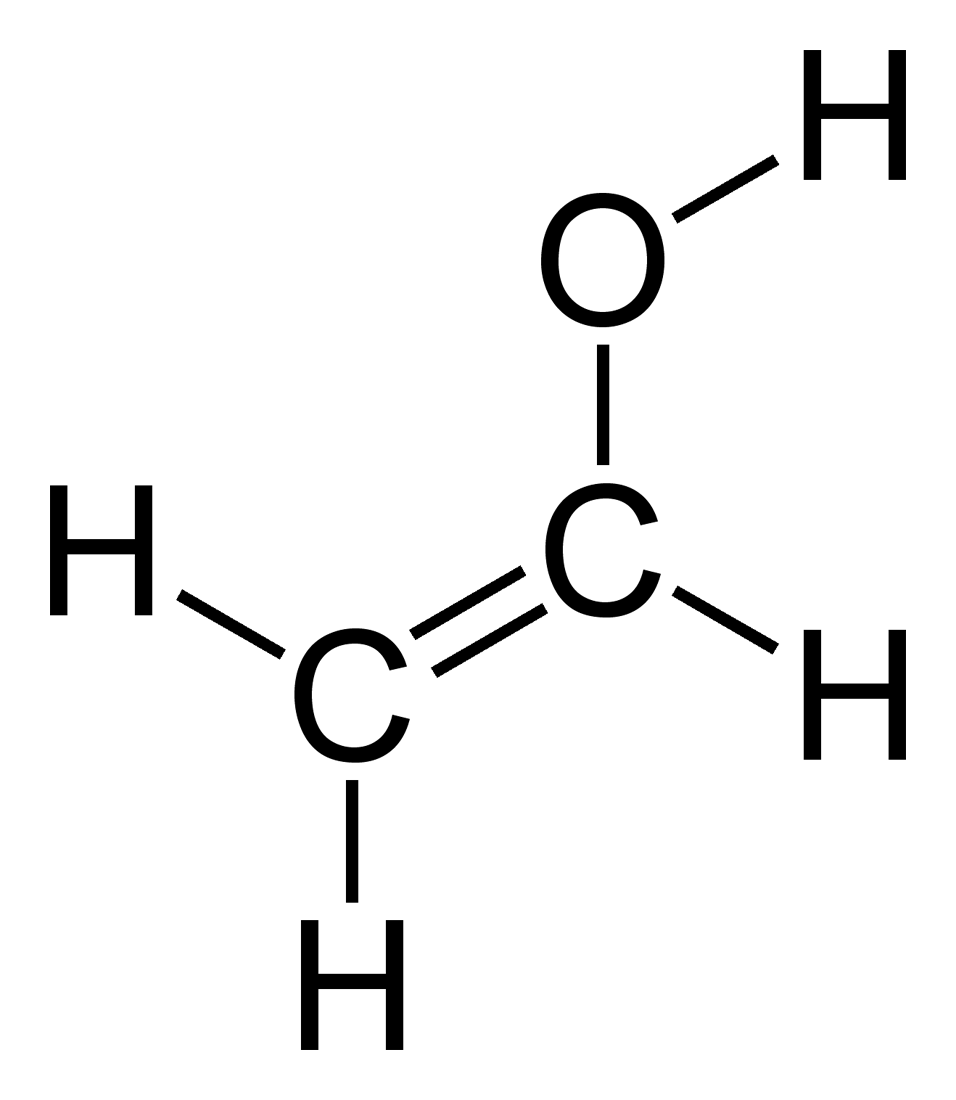
Structural formula of ethenol
Ball-and-stick model of ethenol
Names
Preferred IUPAC name
Ethenol
Other names
Hydroxyethene
Hydroxyethylene
Ethylenol
Identifiers
3D model (JSmol)
ChEMBL
ChemSpider
ECHA InfoCard 100.008.350 Edit this at Wikidata
UNII
  • InChI=1S/C2H4O/c1-2-3/h2-3H,1H2 checkY
    Key: IMROMDMJAWUWLK-UHFFFAOYSA-N checkY
  • InChI=1S/C2H4O/c1-2-3/h2-3H,1H2
  • InChI=1S/C2H4O/c1-2-3/h2-3H,1H2
    Key: IMROMDMJAWUWLK-UHFFFAOYSA-N
  • OC=C
Properties
C2H4O
Molar mass 44.053 g/mol
Related compounds
Related compounds
Allyl alcohol
Except where otherwise noted, data are given for materials in their standard state (at 25 °C [77 °F], 100 kPa).
checkY verify (what is checkY☒N ?)

Vinyl alcohol, also called ethenol (IUPAC name; not ethanol) or ethylenol, is the simplest enol. With the formula CH2CHOH, it is a labile compound that converts to acetaldehyde immediately upon isolation near room temperature.[1] It is not a practical precursor to any compound.

Synthesis

[edit]

Vinyl alcohol can be formed by the pyrolytic elimination of water from ethylene glycol at a temperature of 900 °C and low pressure. Such processes are of no practical importance.[2]

Tautomerization of vinyl alcohol to acetaldehyde

[edit]

Under normal conditions, vinyl alcohol converts (tautomerizes) to acetaldehyde:

At room temperature, acetaldehyde (H3CC(O)H) is more stable than vinyl alcohol (H2C=CHOH) by 42.7 kJ/mol.[3] Vinyl alcohol gas isomerizes to the aldehyde with a half-life of 30 min at room temperature.[1]

H2C=CHOH → H3CC(O)H
The industrial synthesis of acetaldehyde (Wacker process) proceeds via the intermediacy of a vinyl alcohol complex.[4]

The uncatalyzed keto–enol tautomerism by a 1,3-hydrogen migration is forbidden by the Woodward–Hoffmann rules and therefore has a high activation barrier and is not a significant pathway at or near room temperature. However, even trace amounts of acids or bases (including water) can catalyze the reaction. Even with rigorous precautions to minimize adventitious moisture or proton sources, vinyl alcohol can only be stored for minutes to hours before it isomerizes to acetaldehyde. (Carbonic acid is another example of a substance that is stable when rigorously pure, but decomposes rapidly due to catalysis by trace moisture.)

The tautomerization can also be catalyzed via photochemical process. These findings suggest that the keto–enol tautomerization is a viable route under atmospheric and stratospheric conditions, relevant to a role for vinyl alcohol in the production of organic acids in the atmosphere.[5][6]

Vinyl alcohol can be stabilized by controlling the water concentration in the system and utilizing the kinetic favorability of the deuterium-produced kinetic isotope effect (kH+/kD+ = 4.75, kH2O/kD2O = 12). Deuterium stabilization can be accomplished through hydrolysis of a ketene precursor in the presence of a slight stoichiometric excess of heavy water (D2O). Studies show that the tautomerization process is significantly inhibited at ambient temperatures ( kt ≈ 10−6 M/s), and the half-life of the enol form can easily be increased to t1/2 = 42 minutes for first-order hydrolysis kinetics.[7]

Relationship to poly(vinyl alcohol)

[edit]

Because of the instability of vinyl alcohol, the thermoplastic polyvinyl alcohol (PVA or PVOH) is made indirectly by polymerization of vinyl acetate followed by hydrolysis of the ester bonds (Ac = acetyl; HOAc = acetic acid):[8]

n CH2=CHOAc → (CH2−CHOAc)n
(CH2−CHOAc)n + n H2O → (CH2−CHOH)n + n HOAc

As a ligand

[edit]

Several metal complexes are known that contain vinyl alcohol as a ligand. One example is Pt(acac)(η2-C2H3OH)Cl.[9]

Occurrence in interstellar medium

[edit]

Vinyl alcohol was detected in the molecular cloud Sagittarius B in 2001, the last of the three stable isomers of C
2
H
4
O
(after acetaldehyde and ethylene oxide) to be detected in space.[10][11] Its stability in the (dilute) interstellar medium shows that its tautomerization does not happen unimolecularly,[11] a fact attributed to the size of the activation energy barrier to the rearrangement being insurmountable at temperatures present in interstellar space.[12] The vinyl alcohol to acetaldehyde rearrangement is the only keto-enol tautomerisation to have been detected in deep space, induced by the provision of secondary electrons from galactic cosmic rays.[12]

References

[edit]
Revisions and contributorsEdit on WikipediaRead on Wikipedia
from Grokipedia
Vinyl alcohol, also known as ethenol or hydroxyethene, is an with the molecular formula C₂H₄O and the H₂C=CHOH, featuring a carbon-carbon adjacent to a hydroxyl group. It serves as the of (CH₃CHO), a more stable keto form, and is characterized by its high reactivity and thermodynamic instability, with the tautomerization reaction being exothermic by approximately 40.5 kJ/mol. Due to this rapid keto-enol tautomerism, which proceeds with a barrier of about 51.9 kcal/mol in the gas phase, vinyl alcohol exists only fleetingly in solution or gas phase unless stabilized under specific conditions, such as low temperatures or isotopic substitution. In terms of physical properties, vinyl alcohol has a molecular weight of 44.05 g/mol, a calculated logP of 0.5 indicating moderate hydrophobicity, and a topological of 20.2 Ų, consistent with its ability to form bonds as both a donor and acceptor. Chemically, it exhibits exact mass of 44.026214747 Da and is classified as a with vinyl functionality, though its instability limits direct measurement of properties like or in standard conditions. In atmospheric contexts, vinyl alcohol arises from the of and contributes to the formation of species like , with an estimated global production rate of 23 Tg yr⁻¹, primarily lost through heterogeneous uptake into aqueous aerosols where tautomerization occurs rapidly. Vinyl alcohol can be generated in laboratory settings through methods such as the of or ketene methyl vinyl acetal in deuterated solvents with catalytic acid, yielding persistent solutions for spectroscopic study at where tautomerization rates are on the order of 10⁻⁶ M/s. Notably, it has been detected in toward Sagittarius B2N via millimeter-wave rotational transitions, marking it as one of the simplest enols observed in astrophysical environments and highlighting its role in prebiotic chemistry and organic formation in molecular clouds. Although not isolable in pure form for practical applications, vinyl alcohol's copolymerization with monomers like under free radical conditions has been demonstrated, offering insights into the synthesis of analogs without relying on . Its study underscores fundamental aspects of tautomerism and reactivity in organic and .

Molecular structure and properties

Chemical formula and bonding

Vinyl alcohol, with the IUPAC name ethenol, has the molecular formula and structural formula CH₂=CHOH. This distinguishes it from (CH₃CH₂OH), a saturated alcohol lacking the carbon-carbon characteristic of vinyl alcohol as the simplest . In its enol structure, vinyl alcohol features two sp²-hybridized carbon atoms connected by a C=C , with the hydroxyl (-OH) group directly attached to one of the sp²-hybridized vinyl carbons, enabling partial conjugation between the and the oxygen lone pairs. Microwave spectroscopic measurements on the syn conformer yield bond lengths of approximately 1.336 Å for the C=C bond and 1.364 Å for the C-O bond, reflecting the influence of sp² hybridization and enolic . The molecule exhibits rotational isomerism with syn and anti conformers differing by rotation about the C-O single bond; the syn rotamer, where the OH hydrogen points toward the C=C bond, is lower in energy by about 1.1 kcal/mol, stabilized by favorable electrostatic interactions between the hydroxyl hydrogen and the π-electron density of the double bond. Vinyl alcohol is polar due to the electronegative oxygen atom bearing a partial negative charge (δ⁻) and the attached hydrogen carrying a partial positive charge (δ⁺), with additional contributions from the vinyl hydrogens; this results in a dipole moment of 1.04 D for the syn conformer, as determined by microwave spectroscopy.

Physical properties

Vinyl alcohol (CH₂=CHOH) exists primarily in the gas phase or low-temperature matrix isolation due to its rapid tautomerization to , preventing observation of bulk liquid or solid states under standard conditions. Its physical properties are thus derived from spectroscopic and computational methods, with thermodynamic data focused on the gas phase for both and anti conformers. The (ΔH_f°) for the gas-phase anti conformer at 298.15 K is -118.67 ± 0.90 kJ/mol (-28.35 ± 0.22 kcal/mol). The heat of has not been directly measured owing to the molecule's instability but is estimated at 36.05 kJ/mol from thermochemical models. Infrared spectroscopy reveals key vibrational modes in the gas phase for the syn conformer, with ten fundamental absorption bands observed between 3600 and 600 cm⁻¹; the O-H stretching vibration occurs near 3650 cm⁻¹, indicative of a free hydroxyl group, while the C=C stretching appears around 1640 cm⁻¹. provides rotational constants for structural insight: for the syn conformer, A = 59.661 GHz, B = 10.562 GHz, and C = 8.966 GHz; the anti conformer exhibits A = 62.868 GHz, B = 10.456 GHz, and C = 8.963 GHz, reflecting differences in due to OH orientation. Energetic properties include an adiabatic ionization potential of 9.18 eV and a vertical ionization potential of 9.52 eV, determined via . The is approximately 172 kcal/mol, supporting its potential reactivity in proton-transfer processes. Hypothetical liquid-state properties, extrapolated from molecular simulations assuming stability, suggest a of 334 (61°C) and melting point of 171 (-102°C). The dipole moment, relevant to intermolecular interactions, measures 1.79 D for the anti conformer.

Stability and tautomerism

Keto-enol tautomerism

Keto-enol tautomerism refers to the reversible 1,3-hydrogen shift that interconverts vinyl alcohol (CH₂=CHOH, the form) with (CH₃CHO, the keto form). This process is a classic example of tautomerism in simple carbonyl compounds, where the enol structure features a carbon-carbon and a hydroxyl group, while the keto form has a carbon-oxygen double bond and an adjacent . The equilibrium strongly favors the keto tautomer due to the greater stability of the C=O bond over the C=C and O-H bonds in the enol. In the gas phase at 298 K, the Kenol/keto3×107K_{\text{enol/keto}} \approx 3 \times 10^{-7}, meaning the enol form constitutes only a tiny fraction of the mixture. The intramolecular 1,3-proton transfer required for this tautomerization faces a high barrier of approximately 56 kcal/mol in the gas phase for the enol-to-keto direction. This barrier arises from the need to break the O-H bond and form the C-H bond while rearranging the π-system, making the uncatalyzed process kinetically slow at . In solution or under catalytic conditions, the barrier can be substantially lowered—for instance, by molecules or acids facilitating proton relay—allowing faster interconversion. The overall reaction is exothermic by about 9.8 kcal/mol, favoring thermodynamically. Several factors influence the position of the equilibrium. play a key role, with polar protic solvents like stabilizing the form through bonding to the OH group, leading to a slightly higher enol fraction compared to the gas phase; in at 25°C, Kenol/keto=6.0×108K_{\text{enol/keto}} = 6.0 \times 10^{-8}. dependence follows for this endothermic shift toward the enol: elevating the increases the enol population, as the change supports greater disorder in the higher-energy form. These dynamics explain why vinyl alcohol is transient under standard conditions, rapidly converting to unless stabilized by low temperatures or isolation techniques. The concept of keto-enol tautomerism was first systematically explored by Christopher K. Ingold in the 1920s and 1930s, who proposed mechanisms involving proton transfers for such isomerizations in organic compounds. For vinyl alcohol specifically, the tautomerism was confirmed spectroscopically in the 1950s through studies of the generated via , establishing its distinct vibrational signatures before rapid conversion to .

Mechanism of tautomerization

The tautomerization of vinyl alcohol (CH₂=CHOH) to (CH₃CHO) in the gas phase proceeds via a concerted intramolecular 1,3-proton transfer from the hydroxyl group to the terminal carbon, passing through a single with an energy barrier of approximately 56 kcal/mol (236 kJ/mol). This high barrier renders the uncatalyzed process negligible at , with the unimolecular rate constant estimated to be far below 1 s^{-1} (on the order of 10^{-25} s^{-1} or smaller based on ), corresponding to an effectively infinite lifetime for practical purposes in the absence of or high temperatures. Quantum mechanical effects, particularly quantum tunneling, play a crucial role in facilitating the tautomerization, especially at low temperatures where classical over-barrier crossing is negligible. Computational studies employing high-level methods such as CCSD(T) with complete basis set extrapolation have demonstrated that tunneling significantly reduces the effective barrier, with correction factors reaching up to 10³ in analogous systems and contributing factors of ~18 in detailed Eckart barrier approximations for related pathways. Catalysis substantially accelerates the process by lowering the activation barriers. and base catalysts, such as (H₂SO₄) or (HClO₄), reduce the forward barrier to near zero (e.g., 0.5–1.6 kJ/mol), while -assisted mechanisms lower it to approximately 20–25 kcal/mol (e.g., 104 kJ/mol for single- catalysis) through proton relay in six-membered ring transition states. These catalytic effects are particularly relevant in prebiotic environments, where clusters or trace acids could mimic enzymatic proton transfer processes to enable interconversion under mild conditions. In the gas phase, the uncatalyzed tautomerization is kinetically prohibited at 300 K, allowing vinyl alcohol to persist unless other sinks (e.g., reaction with OH radicals) or intervene, as observed in atmospheric or interstellar contexts.

Synthesis and detection

Laboratory synthesis

Vinyl alcohol is typically generated in the laboratory as a transient species due to its rapid tautomerization to , requiring techniques that produce and isolate it on short timescales for study. One common method is gas-phase , where of (HOCH₂CH₂OH) at a temperature of 900 °C under low yields vinyl alcohol (CH₂=CHOH) in small quantities. This process involves unimolecular elimination of , with the product stream containing vinyl alcohol alongside and other byproducts. An alternative pyrolytic route is the elimination from (CH₃CH₂OH → CH₂=CHOH + H₂), which occurs at similar high temperatures and produces vinyl alcohol as a minor product in the decomposition pathway. These gas-phase methods allow for spectroscopic detection but require rapid quenching to prevent tautomerization. Photolysis routes provide another approach for generating vinyl alcohol, particularly through UV irradiation of (CH₃CHO) in the actinic region (295-330 nm), leading to photo-tautomerization via a 1,2-hydrogen shift to form the form. Yields can reach up to 21% under tropospheric conditions, with the process confirmed by kinetic modeling and direct detection. These photolytic methods are useful for studying analogs, as they mimic natural . Another method for generating stabilized vinyl alcohol involves the acid-catalyzed of (CH₂=C=O) or its derivatives, such as ketene methyl vinyl acetal, in deuterated solvents, yielding persistent solutions suitable for spectroscopic study at . For stabilization, matrix isolation techniques are employed to trap vinyl alcohol at low temperatures. In this approach, flash vacuum of suitable precursors, such as or related compounds, is performed at high temperatures (around 600-900 °C) , and the products are co-deposited with inert gases like or onto a cryogenic surface at 10 . This allows vinyl alcohol to be stabilized for hours, enabling detailed spectroscopic characterization without significant tautomerization. The method has been pivotal in confirming the structure and vibrations of the syn conformer.

Spectroscopic characterization

Vinyl alcohol's molecular structure was first confirmed in 1976 through microwave spectroscopy, which detected rotational transitions of the syn conformer in the 8–12 GHz range during thermal dehydration of ethylene glycol. The spectrum exhibited both a-type and b-type transitions, yielding rotational constants of A = 59 660.2 MHz, B = 10 561.55 MHz, and C = 8 965.82 MHz, consistent with a planar syn configuration. In 1985, the anti conformer was identified via similar microwave measurements, with its vibrational ground state lying 4.5 ± 0.6 kJ mol⁻¹ above the syn form, determined from relative transition intensities. Assignment of both conformers relied on Stark effect analysis, which provided dipole moment components (for syn: μ_a = 0.616 D, μ_b = 0.807 D; for anti: μ_a = 0.547 D, μ_b = 1.702 D), confirming the structural parameters. Infrared and provide detailed vibrational characterization, highlighting the functionality. Key bands include the asymmetric =C-H stretch at approximately 3080 cm⁻¹ and the C=C stretch at 1630 cm⁻¹, observed in gas-phase and matrix-isolated samples to prevent tautomerization to . Additional prominent features encompass the O-H stretch near 3630 cm⁻¹ and the C-O stretch around 1050 cm⁻¹, with ten fundamental modes identified between 3600 and 600 cm⁻¹ in high-resolution spectra. Matrix isolation techniques isolate the molecule in inert environments like , enabling clear observation of these bands without interference from decomposition products. The UV-visible of vinyl alcohol features an absorption maximum near 200 nm, corresponding to the π→π* transition of the conjugated system, which facilitates monitoring of its transient presence during photolysis experiments. Recent advances in submillimeter have extended the rotational of both conformers to higher frequencies, with measurements up to 310 GHz recorded in using frequency-modulation techniques on a pyrolysis-generated sample. These studies analyzed over 240 transitions for the syn conformer and refined centrifugal distortion constants to sextic order, improving predictive accuracy. Quantum-chemical calculations complement these efforts, assigning vibronic levels and supporting spectroscopic predictions for complex environments.

Chemical applications

Relation to polyvinyl alcohol

Polyvinyl alcohol (PVA) is a water-soluble synthetic characterized by the repeating unit [CH2CH(OH)]n\left[ -\mathrm{CH_2CH(OH)-} \right]_n, which structurally mimics the product of vinyl alcohol . This configuration features a carbon backbone with pendant hydroxyl groups, enabling strong hydrogen bonding that contributes to its in water and other polar solvents. Direct polymerization of vinyl alcohol to form PVA is not possible because the monomer is highly unstable and undergoes rapid keto-enol tautomerism to , a more stable keto form, preventing its isolation and handling for synthetic routes. In , if vinyl alcohol were stable, it could undergo analogous to other vinyl s, with occurring at the carbon-carbon and involving the of further units that retain the hydroxyl functionality. However, this remains hypothetical, as the tautomerization barrier renders the process impractical. PVA is instead synthesized industrially via the alkaline or acid-catalyzed of , a stable precursor obtained by of . Although direct homopolymerization is not feasible, copolymerization of vinyl alcohol with monomers like under free radical conditions has been demonstrated using stabilized forms of the monomer generated , providing insights into the reactivity of enols and synthesis of PVA analogs. The discovery of PVA dates to , when German chemists W. O. Herrmann and W. Haehnel first prepared it by hydrolyzing in with , marking a pivotal advancement in . This acetate hydrolysis route has remained the standard method, allowing control over the degree of hydrolysis (typically 80–99%) to tailor properties such as solubility and crystallinity. The hydroxyl groups in PVA, derived indirectly from the enol-like structure of vinyl alcohol, are responsible for its key attributes, including film-forming ability and adhesiveness in applications like textiles and adhesives. Modern variants of PVA include copolymers such as ethylene-vinyl alcohol (EVOH), which incorporates 27–48 mol% ethylene units alongside vinyl alcohol segments to enhance gas barrier properties, particularly against oxygen, making it ideal for multilayers. EVOH is produced similarly through of ethylene-vinyl acetate copolymers, without direct use of vinyl alcohol. Industrial production of PVA and its derivatives relies entirely on the polyvinyl acetate pathway, as vinyl alcohol's instability precludes its use in any commercial process.

Use as a ligand

Vinyl alcohol acts as a bidentate in complexes, primarily coordinating through its oxygen atom and the terminal carbon of the in an η²-(O,C) fashion. This mode allows for that stabilizes the otherwise fleeting form against tautomerization to . A seminal example is the (II) complex Pt(acac)(η²-CH₂=CHOH)Cl, where the bridges the metal via the oxygen and the =CH₂ carbon, as confirmed by revealing Pt-O and Pt-C bond lengths of approximately 2.10 and 2.05 , respectively. NMR further supports this structure, showing downfield shifts in the vinyl protons (δ ≈ 5.5-6.5 ppm) indicative of coordination-induced deshielding. Rhodium(I) complexes also feature vinyl alcohol ligands, often generated as π-complexes during enolizable reactions. For instance, treatment of [Rh(CO)₂Cl]₂ with 8-quinolinyl benzyl yields a stable Rh(I)-η²-vinyl alcohol . complexes, particularly those with Cp* ligands, have been isolated containing tautomers akin to vinyl alcohol, such as [CpIr(bpy)(CH₃C(OH)=CHC(O)OC₂H₅)]⁺, where the coordinates bidentate to (III), enhancing thermal stability up to 100 °C as evidenced by variable-temperature NMR. These CpIr systems are synthesized via hydration, trapping the intermediate before keto tautomerization. The synthesis of vinyl alcohol metal complexes typically proceeds through in situ enolization of under basic conditions or by trapping transient from carbonyl insertion reactions with metal hydrides. significantly boosts stability, suppressing tautomerism compared to the free . This suppression of tautomerism is briefly noted in coordination contexts, where metal binding alters the enol-keto equilibrium. As ligands, vinyl alcohol derivatives exhibit hemilabile behavior, with the oxygen arm readily dissociating to create open coordination sites, facilitating substrate binding in catalytic processes like hydrogenation. For example, Rh and Ir enol complexes promote selective hydrogenation of alkenes by temporarily opening the chelate. Spectroscopic characterization, including ¹H and ¹³C NMR, reveals coordination effects such as α-carbon shifts to δ 80-90 ppm, confirming η² binding and distinguishing it from monodentate modes. Key studies from the , including Milstein's overview of organometallics, detail Rh and Ir vinyl alcohol complexes as models for reactivity in catalytic cycles, with applications emerging in asymmetric synthesis. These findings underscore vinyl alcohol's utility in stabilizing otherwise unstable enols for synthetic advancements.

Occurrence and significance

In interstellar medium

Vinyl alcohol (CH₂=CHOH) was first detected in the toward the high-mass star-forming region Sagittarius B2(N) in 2001, using the National Radio Astronomy Observatory (NRAO) 12 m at Kitt Peak. The identification relied on seven millimeter-wave rotational transitions observed between 72 and 154 GHz, including five lines from the anti conformer and two from the syn conformer. The total column density was determined to be 2.2×10142.2 \times 10^{14} cm⁻², corresponding to a fractional abundance relative to H₂ of approximately a few × 10⁻¹⁰. The detection revealed a higher abundance of the syn conformer compared to the anti, with column densities of 2.0×10142.0 \times 10^{14} cm⁻² and 2.4×10132.4 \times 10^{13} cm⁻², respectively, yielding a syn:anti ratio of about 8:1. This ratio aligns with the relative stabilities of the conformers, where the syn form is lower in . Vinyl alcohol has since been observed primarily in hot core environments like Sagittarius B2(N), where its abundance relative to (CH₃CHO) is roughly 1:800, highlighting its minor role compared to the keto tautomer. Recent ALMA observations in 2025 confirmed the detection of vinyl alcohol toward the eruptive young star V883 Orionis, expanding its known occurrences beyond traditional hot cores to warmer, outbursting protostellar environments. Laboratory spectroscopic data, including rotational transitions, have enabled these identifications by matching observed line profiles. No isotopic variants, such as ¹³CH₂CHOH, have been securely detected to date. Proposed formation mechanisms include gas-phase reactions, such as the addition of OH to the vinyl radical (C₂H₃), which is efficient under warm interstellar conditions. However, recent laboratory simulations in 2025 demonstrate that ice-phase photolysis of (CH₃CH₂OH)-containing analogs under irradiation also produces vinyl alcohol, suggesting contributions from in cold molecular clouds prior to its release into the gas phase.

Astrophysical implications

Vinyl alcohol plays a pivotal role as an intermediate in interstellar chemical networks leading to the formation of complex organic molecules (COMs). A 2025 laboratory study simulating irradiation of methane-ethylene glycol at 5 K demonstrated the production of vinyl alcohol alongside 1,2-propanediol (CH₃CH(OH)CH₂OH), highlighting its involvement in abiotic pathways for biorelevant diols through radical recombination processes in ice mantles. In gas-phase reactions relevant to the (ISM), vinyl alcohol interacts with radicals such as OH and ; for OH, abstraction is the dominant channel (branching ratio ≈1:0), forming CH₂CHO, while minor addition yields enediols; for CN, addition yields cyanoacetaldehyde. The prebiotic significance of vinyl alcohol stems from its enol structure, positioning it as a precursor to sugars and components. Quantum chemical simulations in 2024 revealed that the barrierless reaction of syn-vinyl alcohol with the CCH radical in dense molecular clouds produces isomers of 1-butenol-3-yne, unsaturated alcohols that could contribute to sugar-like backbones under ISM conditions. Furthermore, the reaction of vinyl alcohol with CN radicals yields cyanoacetaldehyde, a key intermediate for bases such as and uracil, linking ISM chemistry to the abiotic synthesis of genetic material precursors. Recent updates to astrochemical models have integrated vinyl alcohol into comprehensive simulations of evolution. The 2025 PEGASIS three-phase model incorporates diffusive and non-diffusive grain-surface processes, including quantum tunneling and thermal diffusion on ice mantles, to better capture COM formation; it models gas-phase abundances of vinyl alcohol enhanced by nondiffusive chemistry in cold cores (~10 K). Advanced telescopes such as the (JWST) and Atacama Large Millimeter/submillimeter Array (ALMA) may enable the detection of conformer-specific rotational lines of vinyl alcohol (syn and anti), refining models of COM distribution in star-forming regions. These findings may extend to exoplanet atmospheres, where vinyl alcohol could indicate active analogous to ISM processes, influencing assessments.

References

Add your contribution
Related Hubs
User Avatar
No comments yet.