


Community hub
Recent from talks
Contribute something
Nothing was collected or created yet.
Eurocopter AS332 Super Puma
View on Wikipedia
The Airbus Helicopters H215 (formerly Eurocopter AS332 Super Puma) is a four-bladed, twin-engined, medium-sized, utility helicopter developed and initially produced by French aerospace company Aérospatiale. It has been subsequently manufactured by the successor companies Eurocopter and Airbus Helicopters. The Super Puma is a re-engined and larger version of the original Aérospatiale SA 330 Puma.
Key Information


The Super Puma was developed during the 1970s, based on the successful SA 330 Puma. While retaining a similar layout, the fuselage was redesigned to increase its damage tolerance and crashworthiness, and composite materials were more extensively used. A pair of more powerful Turbomeca Makila turboshaft engines was used, the nose was more streamlined, and there were other changes. Two alternative fuselage lengths, a shortened and stretched form, were developed from the onset. On 5 September 1977, the SA 331 preproduction prototype performed its maiden flight; the first true Super Puma made its first flight roughly one year later. By 1980, the Super Puma had succeeded the SA 330 Puma as Aérospatiale's principal utility helicopter. The Super Puma quickly proved itself to be a commercial success for both military and civilian customers. The French Army was a keen early customer, using the type in its new rapid-response task force, and routinely dispatching Super Pumas to support France's overseas engagements in Africa and the Middle East.
The Indonesian state-owned aircraft manufacturer PT Dirgantara Indonesia manufactured the model under license. In the civilian sector, it has been heavily used to support offshore oil rigs and aerial firefighting. Since 1990, Super Pumas in military service have been marketed under the AS532 Cougar name. In civilian service, a next-generation successor to the AS 332 was introduced in 2004, the further-enlarged Eurocopter EC225 Super Puma.
Development
[edit]Origins
[edit]During 1974, Aérospatiale commenced development of a new medium transport helicopter based on its successful SA 330 Puma. The project's existence was publicly announced at the 1975 Paris Air Show. While the new design retained a similar general layout to the preceding AS 330, it was powered by a pair of Turbomeca Makila turboshaft engines, which had recently been developed and were more powerful than the preceding Turbomeca Turmo. The rotorcraft's four-bladed main rotor was redesigned to make use of composite materials. The design team paid substantial attention to increasing the new model's damage resistance; a more robust fuselage structure and a new crashworthy undercarriage were adopted, the rotor blades are able to withstand some battle damage, and various other key mechanical systems were modified.[2]
External features that distinguish the new helicopter from the SA 330 include a ventral fin underneath the tail boom and a more streamlined nose.[3] From the project's onset, it had been planned for the new rotorcraft to be available in two fuselage lengths: a short-fuselage version with similar capacity to the SA 330 while providing superior performance under "hot and high" conditions, and a stretched version which allowed more internal cargo or passengers to be carried in circumstances where overall weight was deemed to be less critical.[4]
On 5 September 1977, a preproduction prototype, the SA 331, modified from a SA 330 airframe by the addition of Makila engines and a new gearbox, performed its maiden flight.[5] The first prototype of the full Super Puma made its first flight on 13 September 1978, and was quickly followed by a further five prototypes.[6] Flight testing found that the AS 332 Super Puma had a higher cruise speed and more range than the SA 330 Puma,, in part due to the Makila engine providing greater power output, and also a 17% reduction in fuel consumption. The Super Puma was also far more stable in flight, and was less reliant on automated corrective systems.[7] The development of military and civilian variants was carried out in parallel, including at the certification stage.[8] During 1981, the first civil Super Puma was delivered.[9]
Production and improvements
[edit]By 1980, the AS 332 Super Puma had replaced the preceding SA 330 Puma as Aérospatiale's principal utility helicopter.[10] It quickly proved to be highly popular amongst its customers; between July 1981 and April 1987, on average, three helicopters per month were being built for operators from both the military and civilian sectors.[11] The success of the AS 332 Super Puma led to the pursuit of additional development programs that produced further advanced models. These included the introduction of features including lengthened rotor blades, more powerful engines and gearboxes, increases in takeoff weight, and modernised avionics.[11] Overseas manufacturing was established; Indonesian Aerospace (IPTN) produced both the SA 330 and AS 332 under license from Aerospatiale; IPTN-build rotorcraft were produced for both domestic and some overseas customers.[12]
A wide variety of specialised Super Puma variants followed the basic utility transport model into operation, including dedicated search-and-rescue (SAR) and antisubmarine warfare (ASW) versions. Since 1990, military-orientated Super Pumas have been marketed under the AS532 Cougar name. As a fallback option to the NHIndustries NH90 programme, a Mark III Super Puma was considered for development at one stage.[11] By 2005, various models of Super Puma had been operated by numerous customers across 38 nations for a wide variety of purposes.[12] 565 Super Pumas (including military-orientated Cougars) had been delivered or were on order at this time.[13]
During February 2012, Eurocopter announced that it was offering a lower-cost basic Super Puma configuration that would be more competitive with rivals such as the Russian-built Mil Mi-17.[14] Starlite Aviation became the launch customer for this new variant, designated AS 332 C1e.[15] In November 2015, Airbus Helicopters announced that manufacturing activity of the AS 332 Super Puma, which was redesignated H215, would be transferred to a new purpose-built final-assembly facility in Brasov, Romania[16] to cut production time and cost by simplifying production to a single baseline configuration that would then be customised to meet the needs of civilian and military customers.[17]
Design
[edit]
.jpg)
The Eurocopter AS332 Super Puma is a medium-sized utility helicopter, powered by a pair of Turbomeca Makila 1A1 turboshaft engines, which drive the rotorcraft's four-bladed main rotor and five-bladed tail rotor along with a pair of independent hydraulic systems and a pair of electrical alternators. Fuel is housed across six internal fuel tanks, while additional auxiliary and external tanks can be equipped for extended flight endurance. For safety, the fuel tanks use a crashworthy plumbing design and fire-detection and suppression systems are installed in the engine bay. The monocoque tail boom is fitted with tail rotor strike protection; the forward portion of the boom also accommodates a luggage compartment. The retractable tricycle landing gear has been designed to provide high energy-absorption qualities.[18]
The main cabin of the Super Puma, which is accessed via a pair of sliding plug doors, features a reconfigurable floor arrangement that enables various passenger seating or cargo configurations to be adopted, which includes specialised configurations for medical operators. According to Airbus Helicopters, in addition to the two pilots, the short-fuselage AS332 can accommodate up to 15 passengers, while the stretched-fuselage AS332 increases this to 20 passengers in a comfortable configuration.[19] Soundproof upholstery is installed, as is separately-adjustable heating and ventilation systems. In addition to the doors, 12 windows line the sides of main cabin area, these are jettisonable to become emergency exits if required. The lower fuselage can also be fitted with flotation gear to give the rotorcraft additional buoyancy. A hatch is set into the cabin floor which facilitates access to the cargo sling pole, in addition to individual stowage space for airborne equipment.[18]
The flight control system of the Super Puma uses four dual-body servo units for pitch control of the cyclic, collective, and tail rotor. A duplex digital autopilot is also incorporated. The cockpit is equipped with dual flight controls. Principle instrumentation consists of four multifunction liquid crystal displays along with two display and autopilot control panels; for redundancy, a single integrated standby instrument system and vehicle monitoring system are also fitted.[18] According to Airbus Helicopters, the avionics installed on later variants has ensured a high level of operational safety.[20] Third-party firms have offered various upgrades for the Super Puma, including integrated flight management systems, global positioning systems receivers, a digital map display, flight data recorders, a collision warning system, night-vision goggles-compatibility, and multiple radios.[21][22][23]
A marine variant of the Super Puma has been manufactured for anti-submarine and anti-surface warfare. In this configuration the Super Puma is modified with additional corrosion protection, a folding tail rotor boom, a deck-landing guidance system, sonar equipment, and the nose-mounted Omera search radar. For the anti-surface role, as of 1987 it could be armed with a pair of Exocet anti-ship missiles.[24]
Operational history
[edit]
In August 1983, the French government created a new rapid-response task force, the Force d'Action Rapide, to support France's allies and to contribute to France's overseas engagements in Africa and the Middle East; up to 30 Super Pumas were assigned to it.[25] In June 1994, France staged a military intervention in the ongoing Rwandan genocide, dispatching a military task force to neighboring Zaire; Super Pumas provided the bulk of the task force's rotary-lift capability, transporting French troops and equipment during their advance into Rwanda.[26]
During the 1980s, the French Army were interested in mounting an airborne battlefield surveillance radar upon the Super Puma. The first prototype Orchidée was assembled at Aérospatiale's Marignane factory and began testing in late 1988; the French Army intended to procure 20 aircraft to equip two squadrons. Orchidée was described as having a pulse-Doppler radar mounted on the fuselage's underside, capable of 360° scanning to detect low-flying helicopters and ground vehicles at ranges of up to 150 km; gathered data were to be relayed in real time to mobile ground stations by a single-channel data link for processing and analysis before being transmitted to battlefield commanders. The system was said to be capable of all-weather operation, and would counteract hostile electronic countermeasures.[27] However, development was aborted in mid-1990 during post-Cold War defence spending reductions.[28]
Indonesia has been a key customer for the Super Puma; state-owned aircraft manufacturer PT Dirgantara Indonesia (PT DI) secured a license to produce the type.[29] While the company was initially involved in the assembly and finishing of Super Pumas delivered from Europe, PT DI has expanded the range of its manufacturing involvement in the type over time, while also expanding its collaboration with Eurocopter.[30] In 1989, the Indonesian Air Force placed an order for 16 Super Pumas as a replacement for its ageing Sikorsky S-58T fleet, but amid continued funding shortfalls, only seven units had been delivered by 2008, the operations of which were reportedly hampered by a lack of spare parts. The Indonesian government had also ordered 16 Super Pumas for purposes such as VIP transport, seven of which had been delivered by 2008.[31] These helicopters were manufactured locally by PT DI.[32][33]

A key export customer was Switzerland, which had originally purchased fifteen AS 332M1 Super Pumas, locally designated TH89, for the Swiss Air Force. These were subsequently joined by 11 AS 532UL Cougars, designated TH98, while the TH06 programme was launched in 2006 to retrofit the earlier Super Puma fleet with new a
avionics that equalled or exceeded the capabilities of the newer Cougar fleet by RUAG. The Swiss Air Force has typically deployed the type for intelligence, surveillance, target acquisition, and reconnaissance and search-and-rescue (SAR) missions.[34] Swiss Super Pumas have occasionally been deployed outside the country, usually to provide humanitarian aid, such as a deployment to Greece for aerial firefighting in August 2021.[35] During 1988, Sweden arranged to procure a fleet of 12 Super Pumas; they were primarily operated domestically, although some were deployed overseas occasionally, such as to provide medical evacuation services to coalition forces engaged in the war in Afghanistan.[36] In October 2015, the Swedish Air Force retired its last Super Puma, replacing it with newer rotorcraft such as the NHIndustries NH90 and Sikorsky UH-60M Black Hawk.[37] Six of the retired Super Pumas were sold and refurbished for further service with other operators.[38]
During 1990, Nigeria made a deal with Aerospatiale to exchange several of their Pumas for larger Super Pumas.[39] In November 2009, an additional five used Super Pumas were acquired from France for peacekeeping and surveillance operations in the Niger Delta.[40] In 2015, it was reported that a number of weaponised Super Pumas had been procured by the Nigerian Air Force for anti-insurgency operations against Boko Haram.[41] During 2000, a pair of Nigerian Super Pumas were deployed to in Cross River State to improve area surveillance and increase available firepower in response to insecurity in the vicinity of the Bakassi axis.[42]
In late 1990s, the Hellenic Air Force issued a request to acquire more modern and capable SAR helicopters,[43] to replace its ageing fleet of Agusta Bell AB-205 SAR helicopters, which were in use since 1975. The need for an all-weather, day and night, long range SAR helicopter for operations throughout the Athens FIR came up after the Imia/Kardak incident of 1996, and the growing tension between Greece and Turkey over territorial water disputes on the Aegean Sea. The Greek government signed a deal with Eurocopter for the purchase of an initial four AS-332 C1 Super Pumas in 1998.[44][45] HAF acquired two more Super Pumas for air support operations of the Athens 2004 Olympic Games, and six more followed from 2007 to 2011 for the new CSAR role of the 384 SAR/CSAR Sq. All HAF Super Pumas are of the C1 version, which includes features such as a four-axis auto pilot, a NADIR type1000 navigation and mission management computer, FLIR turrets, an RBR1500B search radar, an engine anti-icing system, hydraulic and electrical hoists, a SPECTROLAB SX-16 searchlight, engine exhaust-gas deflectors, a Bertin loudspeaker, and six-stretcher interior configuration for MEDEVAC missions.[46]

The Spanish Air Force operated Super Pumas for various purposes. The fleet participated in the war in Afghanistan between 2005 and 2011, at one point being the sole rotorcraft providing combat SAR and MEDEVAC cover in Afghanistan's western regions, the last of these were withdrawn in November 2013.[47][48] The type has also been used domestically for firefighting.[49] During the 2010s, Spain decided to replace its Super Puma with the newer NH90, the first of which was delivered in 2020.
VH-34 is the Brazilian Air Force's designation for the helicopter used to transport the President of Brazil. A pair of modified Super Pumas, configured to carry up to 15 passengers and three crew members, were used as the main presidential helicopters. The VH-34 model was progressively supplemented and later replaced by the VH-36, the later EC725.[50][51] Several French presidents, including François Mitterrand, have used military Super Pumas for official transport during diplomatic missions.[52] During 2008, British Prime Minister Gordon Brown was flown in a Super Puma during a tour of Iraq.[53]
The Super Puma has reportedly proven to be well-suited to offshore operations for the North Sea oil industry, where the type has been used to ferry personnel and equipment to and from oil platforms. One of the biggest civilian operators of the Super Puma is Bristow Helicopters, which had a fleet of at least 30 Super Pumas in 2005;[12] CHC Helicopters is another large civil operator, having possessed a fleet of 56 Super Pumas in 2014.[54] During the 1990s, Iran procured at least seven Indonesian-built Super Pumas for civil offshore oil exploration missions.[55][56] Super Pumas are also operated by Petrobras, the largest energy company in Brazil, to support its long-distance oil rigs.[57] The largest civilian helicopter operator in China, CITIC Offshore Helicopter, operates a sizeable Super Puma fleet.[58] At least 19 Super Pumas were operated by Germany's Federal Police service as of 2018.[59]
The Finnish Border Guard has operated numerous AS332 L1 Super Pumas equipped for maritime reconnaissance and SAR operations throughout the country. To better suit the challenging prevailing conditions, they are typically fitted with forward-looking infrared, a four-axis autopilot, and de-icing apparatus.[60] During the late 2010s, older members of Finland's Super Puma fleet were transported to Romania to be modernised and equipped to the newer H215 standard.[61]
In 2014, Airbus Helicopters, the manufacturer of the type, stated that the Super Puma/Cougar family had delivered 890 to customers across 56 nations.[20] By 2015, 187 Super Pumas had reportedly been ordered by military customers; amongst others, the orders included 29 for Argentina, 30 for Spain, 33 for Indonesia, 22 for Singapore and 12 for Greece.[62]
In November 2017, Romania announced its intention to buy up to 16 helicopters, and planned to make a 30% down payment towards the first four aircraft that year.[63]
Variants
[edit].jpg)
- SA 331 – Initial prototype, based on SA 330 airframe, first flew on 5 September 1977[6]
- AS 332A – Commercial preproduction version
- AS 332B – Military version
- AS 332B1 – First military version
- AS 332C – Production civilian version[9]
- AS 332C1 – SAR version, equipped with a search radar and six stretchers[9]
- AS 332F – Military antisubmarine and antiship version
- AS 332F1 – Naval version
- AS 332L – Civilian version with more powerful engines, a lengthened fuselage, a larger cabin space, and a larger fuel tank[9]
- AS 332L1 – Stretched civilian version, with a long fuselage and an airline interior[9]
- AS 332L2 Super Puma Mk 2 – Civilian transport version, fitted with Spheriflex rotor head and EFIS[9]
- AS 332M – Military version of the AS 332L
- AS 332M1 – Stretched military version
- NAS 332 – Licensed version built by IPTN, now Indonesian Aerospace PT DI
- UH-14 – Brazilian Navy designation of the AS 332F.[64]
- CH-34 – Brazilian Air Force designation of the AS 332M.[64]
- VH-34 – Brazilian Air Force designation of the VIP-configured AS 332M1.[64]
- H.9 – (Thai: ฮ.๙) Royal Thai Armed Forces designation for the AS 332L2.[65]
Operators
[edit]Civilian
[edit]| Country | Airlines |
|---|---|
| Azerbaijan | Azerbaijan Airlines[66][67] |
| Brazil | Petrobras[57] |
| Canada | CHC Helicopter[68] |
| China | CITIC Offshore Helicopter[58] |
| Germany | German Federal Police[59] |
| Greece | Hellenic Fire Service - Operates two AS332L.1s.[69] |
| Hong Kong | Government Flying Service[70] |
| Iceland | Icelandic Coast Guard[71] |
| Japan | |
| Norway | Lufttransport |
| Serbia | Serbian Police[74][75] |
| Ukraine | State Emergency Service of Ukraine |
| United Kingdom | |
| United States | Los Angeles County Sheriff's Department[79] |
| Vietnam | Southern Vietnam Helicopter Company[80] |
-
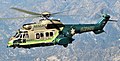 An L.A. County Sheriff's Department Super Puma flying a SAR mission
 -
 A CHC AS332L2 Super Puma
 -
 AS 332, named Líf, of the Icelandic Coast Guard

.jpg)
.jpg)
Military
[edit]| Country | Airlines |
|---|---|
| Albania | Albanian air force[citation needed] |
| Argentina | Argentine Army Aviation[81] |
| Bolivia | Bolivian Air Force[81] |
| Brazil | Brazilian Army Aviation[81] |
| Chile | Chilean Navy[81] |
| Ecuador | Ecuadorian Army[81] |
| Finland | Finnish Border Guard[82] |
| France | French Air and Space Force[81] |
| Gabon | Gabonese Air Force[81] |
| Georgia | Ministry of Defense[83] |
| Greece | Hellenic Air Force[81] |
| Indonesia | Indonesian Air Force[81] |
| Jordan | Royal Jordanian Air Force[81] |
| Kuwait | Kuwait Air Force[81] |
| Lebanon | Lebanese Air Force[81] |
| Mali | Mali Air Force[81] |
| Morocco | Royal Moroccan Gendarmerie[84] |
| Nigeria | Nigerian Air Force[81] |
| Oman | Royal Air Force of Oman[81] |
| Saudi Arabia | Royal Saudi Navy[81] |
| South Korea | Republic of Korea Air Force[81] |
| Spain | Spanish Air and Space Force[81] |
| Switzerland | Swiss Air Force[81] |
| United Kingdom | Royal Air Force |
| Ukraine | National Guard of Ukraine |
| Uzbekistan | Uzbekistan Air Force |
| Venezuela | Venezuelan Air Force[81] |
-
 AS 332 of the Hellenic Air Force
 -
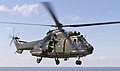 A Singapore Air Force Super Puma approaching USS Inchon
 -
 AS 332 of the Spanish Air Force
.jpg)
.jpg)

Former operators
[edit]
| Country | Airlines |
|---|---|
| Brazil | Brazilian Air Force[85][86] |
| Cameroon | Cameroon Air Force[87][88] |
| China | People's Liberation Army Ground Force[89] |
| Democratic Republic of the Congo | Congolese Democratic Air Force[90][91] |
| Indonesia | Indonesian Navy[92] |
| Japan | Japan Ground Self-Defense Force[93] |
| Sweden | Swedish Air Force[37] |
| Thailand | Royal Thai Air Force[94][95] |
| Singapore | Republic of Singapore Air Force[81] |
| Togo | Togolese Air Force[96][97] |
Notable accidents and incidents
[edit]- 16 July 1988 – an AS332 L operated by Helikopter Service AS ditched in the North Sea due to heavy vibrations caused by the loss of a metal strip from one of the main rotor blades. All passengers and crew survived.[98]
- 14 March 1992 – G-TIGH lost control and crashed into the North Sea near East Shetland Basin; 11 of the 17 passengers and crew died.[99]
- 19 January 1995 – G-TIGK, operating Bristow Helicopters Flight 56C, ditched in the North Sea, after being hit by an abnormally large lightning strike; there were no fatalities, but the aircraft was written off.[100]
- 18 January 1996 – LN-OBP, an AS332 L1 operated by Helikopter Service AS, ditched in the North Sea some 200 km south-west of Egersund. All passengers and crew survived and the helicopter was still floating 3 days later.[98]
- 18 March 1996 – LN-OMC, an AS332 operated by Airlift from Svalbard Airport crashed at Wijdefjorden. There were no fatalities
- 8 September 1997 – LN-OPG, an AS332 L1 operated by Helikopter Service AS, suffered a catastrophic main gearbox failure and crashed en route from Brønnøysund to the Norne oil field, killing all 12 aboard.[101] Eurocopter accepted some but not all of the AAIB/N recommendations.[102]
- 11 August 2000 - Kaskasapakte, Sweden. A Swedish Air Force AS332M1 (10404 / H94) crash into the mountainside during initial approach to perform hoisting operations during a mountain rescue mission. All 3 crewmembers are killed. The cause of the accident was not fully determined, but difficult visual conditions is believed to have caused the crew to lose judgement of distance to the mountain side.[103]
- 18 November 2003 - Rörö, Sweden. A Swedish Air Force AS332M1 (10409 / H99) crash into the sea during a night-time hoist exercise near Rörö in Gothenburg's archipelago. The task was to conduct a number of hoist cycles to the rescue ship Märta Collin. On approach the aircraft suddenly hit the water at high velocity, killing six crew members. Only one crew member, a conscript rescue swimmer, survived with minor injuries. The cause of the accident was not fully determined, but was believed to have been the result of incorrect flight attitude awareness in bad weather.[104]
- 21 November 2006 – A Eurocopter AS332 L2 SAR helicopter ditched in the North Sea. The aircraft was equipped with two automatic inflatable life rafts, but both failed to inflate. The Dutch Safety Board afterwards issued a warning.[105]
- 1 April 2009 – A Bond Offshore Helicopters AS332L2 with 16 people on board crashed into the North Sea 13 miles (21 km) off Crimond on the Aberdeenshire coast; there were no survivors.[106] The AAIB's initial report found that the crash was caused by a "catastrophic failure" in the aircraft's main rotor gearbox epicyclic module.[107]
- 11 November 2011 – XC-UHP AS332-L Super Puma of Mexico's General Coordination of the Presidential Air Transport Unit crashed in the Amecameca region south of Mexico City. Mexico's Secretary of the Interior Francisco Blake Mora died in this accident along with seven other crew and passengers.[108]
- 21 March 2013 – During a readiness exercise, a German Federal Police (Bundespolizei) Eurocopter EC155 collided with a Super Puma on the ground while landing in whiteout conditions next to the Olympic Stadium in Berlin, Germany, destroying both aircraft, killing one of the pilots, and injuring numerous bystanders. The whiteout was caused by snow on the ground being stirred up by the helicopter downdraft.[109]
- 23 August 2013 – A Super Puma L2 helicopter G-WNSB experienced a (so far unexplained) loss of air speed on a low approach and ditched into the North Sea 2 miles (3.2 km) west of Sumburgh Airport around 18:20 BST. The aircraft experienced a hard impact and overturned shortly after hitting the water. However, its armed flotation system deployed and the aircraft stayed afloat. Four passengers were killed, while both crew and a further 12 passengers were rescued, most with injuries. To date, the AAIB stated it was not caused by mechanical failure. A court has ordered the CV/FDR be released to the UK CAA for analysis on behalf of the Crown Office.[110][111][112][113]
- 28 September 2016 - Saint Gothard Pass region, Switzerland, A Swiss Air Force Super Puma struck a landline 50 metres (160 ft) after taking off, both pilots were killed and the loadmaster sustained undisclosed injuries but survived. The helicopter was a total loss as it burned out completely. After a lengthy investigation the pilots were found to not have been at fault.[114]
Specifications (AS332 L1)
[edit]
Data from Jane's All The World's Aircraft 1993–94[115]
General characteristics
- Crew: 2
- Capacity: 24 passengers plus attendant / 4,490 kg (9,899 lb)
- Length: 16.79 m (55 ft 1 in) fuselage
- 18.7 m (61 ft) rotor turning
- Height: 4.97 m (16 ft 4 in)
- Empty weight: 4,660 kg (10,274 lb)
- Max takeoff weight: 9,150 kg (20,172 lb)
- Powerplant: 2 × Turbomeca Makila 1A2 turboshaft, 1,376 kW (1,845 hp) each
- Main rotor diameter: 16.2 m (53 ft 2 in)
- Main rotor area: 206.12 m2 (2,218.7 sq ft)
- Blade section: root: NACA 13112; tip: NACA 13106[116]
Performance
- Cruise speed: 277 km/h (172 mph, 150 kn) max,
- 247 km/h (153 mph; 133 kn) econ.
- Never exceed speed: 327 km/h (203 mph, 177 kn)
- Range: 851 km (529 mi, 460 nmi)
- Service ceiling: 5,180 m (17,000 ft)
- Rate of climb: 7.4 m/s (1,460 ft/min)
See also
[edit]
Related development
Aircraft of comparable role, configuration, and era
Related lists
References
[edit]Citations
[edit]- ^ Dominic Perry (7 September 2019). "Airbus delivers 1,000th Super Puma helicopter". Flightglobal.
- ^ Jackson 1984, pp. 7–10.
- ^ Lake 2002, p. 82.
- ^ Jackson 1984, p. 11.
- ^ Jackson 1984, p.10.
- ^ a b Lake 2002, p. 85.
- ^ Lambert 1979, pp. 437, 439.
- ^ Lambert 1979, p. 437.
- ^ a b c d e f Endres and Gething 2005, p. 272.
- ^ McGowen 2005, p. 194.
- ^ a b c Sedbon, Gary. "Aerospatiale develops Super Puma II." Flight International, 18 April 1987. p. 12.
- ^ a b c McGowen 2005, p. 195.
- ^ Endres and Gething 2005, p. 487.
- ^ Pyadushkin, Maxim and Robert Wall. "Mil Mi-171, Super Puma To Do Battle." Aviation Week, 13 February 2012.
- ^ Noyé, Régis. "Starlite: Launch Customer for the New AS 332 C1e Super Puma." Airbus Helicopters, May 2013.
- ^ "Romania to host production of new, robust, and cost-effective H215 heavy helicopter." Airbus Helicopters, 17 November 2015.
- ^ Perry, Dominic. "Airbus Helicopters to revive Romanian aircraft manufacturing." Flight International, 17 November 2015.
- ^ a b c "AS332 L1e Technical Data – 2015." Archived 12 September 2015 at the Wayback Machine Airbus Helicopters, 2015.
- ^ "Civil Range." Archived 11 September 2015 at the Wayback Machine Airbus Helicopters, 2015.
- ^ a b "AS332 C1e." Archived 11 September 2015 at the Wayback Machine Airbus Helicopters, 2014.
- ^ Morris, John. "RUAG Aviation Shows Super Puma Upgrade." Aviation Week, 11 September 2012.
- ^ Osborne, Tony. "Adding On Capabilities For Combat Helicopters In Europe." Aviation Week, 25 March 2013.
- ^ "CHC's Heli-One Group Awarded Swedish Military Super Puma Upgrade Contract." CHC Helicopters, 30 March 2006.
- ^ "Military Aircraft of the World - A S . 3 3 2 Super Puma" (PDF). Flight International. 1 August 1987. p. 24. Archived from the original (PDF) on 8 December 2015.
- ^ Chipman 1985, pp. 19–20.
- ^ Charbonneau 2008, pp. 140–141.
- ^ Sedbon, Gilbert. "France develops Battlefield Radar." Flight International, 18 June 1988. p. 17.
- ^ "French end development of Orchidee radar." Aviation Week & Space Technology, 133(13), 24 September 1990. p. 22.
- ^ "Airbus Military launches Pacific drive from Indonesia". ainonline.com. 10 February 2012.
- ^ Pocock, Chris (8 June 2012). "Eurocopter Boosts Asian Prospects via Indonesia, Kazakhstan". ainonline.com.
- ^ Grevatt, J (January 2008). "Indonesia reduces Super Puma order".
- ^ Grevatt, J (May 2007). "PT Dirgantara nears aircraft deal for Indonesian forces".
- ^ "PT DI delivers Super Puma chopper to Air Force". en.antaranews.com. 29 January 2021.
- ^ Mathews, Neelam; Donald, David (18 June 2013). "Ruag Shows Off Super Puma Upgrade, Delivers Do 228s". ainonline.com.
- ^ "Swiss helicopters return from Greece wildfires". airmedandrescue.com. 19 August 2021.
- ^ "Swedish Helicopter Wing prepares for operations in Afghanistan ." Shephard Media, 12 June 2010.
- ^ a b Åkerberg, Gunnar (20 October 2015). "Swedish military retires last Super Puma". flightglobal.com.
- ^ "Ex-Change Parts acquires Super Puma AS332M1 helicopters from the Swedish Armed Forces" (PDF). ex-changeparts.com. 9 October 2018.
- ^ African Defence Journal, Issues 113–124, 1990. p. 12.
- ^ "Nigeria buys oil security, peacekeeping ’copters." Reuters, 26 November 2009.
- ^ Ejiofor, Clement. "NAF Use Weaponised Helicopters Against Boko Haram." Naija, May 2015.
- ^ Olanrewaju, Rasheed (2020). "Airforce deploys 2 Puma Helicopter to Bakassi in Cross River State". ait.live.
- ^ [1] airforce-technology.com
- ^ [2] Defence-aerospace.com, 21 December 2000.
- ^ [3] helis.com.
- ^ Force, Hellenic Air. "AS 332C1 Super Puma - Hellenic Air Force".
- ^ Cherisey, Erwan de. "HELISAF: Spanish SAR in Afghanistan." Archived 8 December 2015 at the Wayback Machine Air Forces Monthly, February 2014. No. 311. pp. 36–40.
- ^ "Spanish helicopters attacked by Afghan insurgents during rescue mission." ABC News, 12 July 2008.
- ^ MÉndez, Isabel; Caberazas, Eugenio (19 July 2022). "Cómpeta fire is declared 'extinguished'".
- ^ "VH-34 Super Puma." Archived 28 September 2011 at the Wayback Machine Brazilian Air Force. Retrieved 26 January 2009.
- ^ "Helicóptero de Dilma apresenta problema no motor." EPC, 2 November 2013.
- ^ Ripley 2010, p. 11.
- ^ Watt, Nicholas. "Brown sets out plan for UK pull-out from Iraq." The Guardian, 20 July 2008.
- ^ "CHC Helicopter Fiscal 2014 Fourth Quarter." Archived 6 July 2022 at the Wayback Machine CHC Helicopter, 10 July 2014. p. 28.
- ^ Hunter 2010, p. 138.
- ^ "IPTN pushes Super Puma sales to Iran." Flight International, 16 November 1993.
- ^ a b "A Satisfied Eurocopter Customer". eurocopter.com. Archived from the original on 5 October 2013. Retrieved 12 March 2013.
- ^ a b "Eurocopter and COHC Sign Contract for Two AS 332 L1 Super Pumas". eurocopter.com. Archived from the original on 4 October 2013. Retrieved 12 March 2013.
- ^ a b "German Federal Police strengthens Super Puma fleet with delivery of three H215s". helicopters.airbus.com. 14 December 2018. Archived from the original on 19 January 2023. Retrieved 14 August 2022.
- ^ "Eurocopter will supply two more AS332 L1 Super Puma helicopters to the Finnish Border Guard for maritime search and rescue missions". helicopters.airbus.com. 20 December 2012.
- ^ "Finlanda își va moderniza elicopterele în România". digi24.ro. 15 May 2017.
- ^ ARG. "Eurocopter Puma / Cougar Medium transport helicopter". Archived from the original on 18 May 2007.
- ^ Adamowski, Jarosław (3 November 2017). "Romania to buy H215 helos from Airbus-IAR consortium". Defense News. Warsaw, Poland. Archived from the original on 4 November 2017. Retrieved 4 November 2017.
- ^ a b c "Brazilian Military Aircraft Designations". designation-systems.net. Retrieved 16 March 2025.
- ^ "Thai Military Aircraft Designations". designation-systems.net. Retrieved 20 March 2025.
- ^ Eurocopter Press Release – Azerbaijan Airlines Orders 6 Helicopters From Eurocopter Archived 26 September 2007 at the Wayback Machine
- ^ "Azerbaijan Airlines AS332". Retrieved 12 March 2013.
- ^ "CHC Helicopters fleet". chc.ca. Archived from the original on 13 February 2013. Retrieved 12 March 2013.
- ^ Scharenborg 2022, p. 70
- ^ "GFS fleet". Government of Hong Kong. Archived from the original on 5 October 2013. Retrieved 12 March 2013.
- ^ "World's Air Forces 2004 pg. 63". Retrieved 12 March 2013.
- ^ "Japan Coast Guard to boost its fleet". aviationnews.eu. 18 August 2011. Retrieved 12 March 2013.
- ^ Thompson, Paul Fire/Disaster Prevention J-HangarSpace Retrieved February 27, 2017
- ^ Bozinovski, Igor (18 March 2019). "Serbia to acquire H215 helicopters". FlightGlobal. Belgrade. Archived from the original on 18 March 2019. Retrieved 18 March 2019.
- ^ "Serbia and Airbus Helicopters expand partnership". Airbus (Press release). 26 June 2019. Retrieved 12 October 2019.
- ^ "Bond fleet". bondaviationgroup.com. Archived from the original on 5 October 2013. Retrieved 12 March 2013.
- ^ "Bristow Helicopter Fleet". bristowgroup.com. Archived from the original on 10 June 2013. Retrieved 12 March 2013.
- ^ "CHC Scotia". chc.ca. Retrieved 24 August 2013.
- ^ "Sheriff's New Super Puma Rescue Helicopters". lacounty.gov. Archived from the original on 5 October 2013. Retrieved 12 March 2013.
- ^ "VNH South - Super Puma AS332 L2". www.vnhs.com.vn. Retrieved 24 October 2021.
- ^ a b c d e f g h i j k l m n o p q r s t u "World Air Forces 2019". Flightglobal Insight. 2019. Retrieved 5 January 2019.
- ^ "Eurocopter will supply two more AS332 L1 Super Puma helicopters to the Finnish Border Guard". aviationnews.eu. Archived from the original on 11 March 2013. Retrieved 12 March 2013.
- ^ Kirtzkhalia, N. (7 September 2015). "Georgian President strongly against sale of Super Puma helicopters by Defence Ministry". Trend. Retrieved 22 June 2015.
- ^ "Moroccan Royal Gendarmerie recognized". helihub.com. 9 April 2012. Retrieved 12 March 2013.
- ^ Plavetz, Ivan (1 December 2015). "FAB desativa helicópteros H-34". Tecnologia & Defesa. Retrieved 2 September 2025.
- ^ a b Wiltgen, Guilherme (6 October 2022). "Batalhão de Manutenção da AvEx atinge 75% de disponibilidade do HM-3 Cougar". Defesa Aérea & Naval. Retrieved 2 September 2025.
- ^ "World's Air Forces 2004", Flight International, vol. 166, no. 4960, p. 49, 16–22 November 2004, retrieved 12 March 2013 – via Flightglobal Archive
- ^ "TJ-AAR aerospatiale AS332L Super Puma C/N 2119". Helis.com. 13 June 2014. Retrieved 2 August 2016.
- ^ World's Air Forces 2004, vol. 166, 16–22 November 2004, p. 51, retrieved 12 March 2013 – via Flightglobal Archive
- ^ World's Air Forces 2004, vol. 166, 16–22 November 2004, p. 52, retrieved 12 March 2013 – via Flightglobal Archive
- ^ "aerospatiale AS332L Super Puma C/N 2108". Helis.com. Retrieved 2 August 2016.
- ^ Willis, David, ed. (1999). Aerospace Encyclopedia of World Air Forces. London, UK: Aerospace Publishing Ltd. p. 293. ISBN 1-86184-045-4.
- ^ "World's Air Forces 2004", Flight International, vol. 166, no. 4960, p. 68, 16–22 November 2004, retrieved 12 March 2013 – via Flightglobal Archive
- ^ "World's Air Forces 2004", Flight International, vol. 166, no. 4960, p. 89, 16–22 November 2004, retrieved 12 March 2013 – via Flightglobal Archive
- ^ "AS332L2 Super Puma in Royal Thai Air Force". Helis.com. Retrieved 2 August 2016.
- ^ "World's Air Forces 2004", Flight International, vol. 166, no. 4960, p. 90, retrieved 12 March 2013 – via Flightglobal Archive
- ^ "5V-TAH G-BWZX LN-OLE aerospatiale AS332L Super Puma C/N 2120". Helis.com. Retrieved 2 August 2016.
- ^ a b "Helikotertragedien: Tidligere helikopterulykker i Nordsjøen" [The helicopter tragedy: Previous helicopter accidents in the North Sea] (in Norwegian). Dagbladet. 8 September 1997. Archived from the original on 10 October 2016. Retrieved 5 May 2016.
- ^ "Report on the accident to AS 332L Super Puma, G-Tigh near in Comorant 'A' Platform, East Shetland Basin, on 14 March 1992" (PDF). Air Accidents Investigation Branch. 26 April 1993. Retrieved 13 July 2018.
- ^ Aircraft Accident Report 2/97. Air Accidents Investigation Branch. 15 August 1997.
- ^ "Report on the air accident 8 September 1997 in the Norwegian Sea approx. 100 nm west north west of Brønnøysund, involving Eurocopter AS 332L1 Super Puma, LN-OPG, operated by Helikopter Service AS" (PDF). Air Accident Investigation Board, Norway. November 2001. Archived from the original (PDF) on 8 October 2006. Retrieved 16 April 2009.
- ^ "Comments on the conclusion & recommendations on the draft of the final report." Archived 8 October 2006 at the Wayback Machine May 2001.
- ^ "All you need to know about helicopters in Sweden - Nordic Rotors". www.nordicrotors.com. Archived from the original on 13 February 2021. Retrieved 5 February 2021.
- ^ "Aviation Safety Network".
- ^ "Emergency landing in sea, AS322L2 Search and rescue helicopter, North…". 22 February 2013. Archived from the original on 22 February 2013.
- ^ "Call for grounding of helicopters." BBC News, 11 April 2009.
- ^ "Initial Report – Super Puma accident" Archived 13 April 2009 at the Wayback Machine London: Air Accidents Investigation Branch, 10 April 2009.
- ^ "Muere Blake Mora en desplome de helicóptero". Noticieros Televisa. 11 November 2011.
- ^ "Wie es zu dem tödlichen Hubschrauber-Absturz kam." Berliner Morgenpost, 21 March 2013.
- ^ "Shetland helicopter crash: four people confirmed dead by police". The Guardian. 23 August 2013.
- ^ "Super Puma stuck on platform overnight amid safety fears" Archived 4 March 2016 at the Wayback Machine STV news, 13 September 2013.
- ^ "Scottish Court Orders Release of Sumburgh Helicopter CVFDR". 21 June 2015.
- ^ "Pilots 'failed to spot reduced air speed'". BBC News, 18 October 2013. Retrieved 19 October 2013.
- ^ "Swiss air force grounds Super Puma copters after fatal crash". Reuters. 28 September 2016.
- ^ Lambert 1993, pp. 148–149.
- ^ Lednicer, David. "The Incomplete Guide to Airfoil Usage". m-selig.ae.illinois.edu. Retrieved 16 April 2019.
Bibliography
[edit]- Charbonneau, Bruno. France and the New Imperialism: Security Policy in Sub-Saharan Africa. Ashgate Publishing, 2008. ISBN 0-75469-078-4.
- Chipman, John. French Military Policy and African Security, Routledge, 1985. ISBN 1-13470-553-0.
- Endres, Günter G. and Michael J. Gething. Jane's Aircraft Recognition Guide. HarperCollins UK, 2005. ISBN 0-00718-332-1.
- Hoyle, Craig. "World Air Forces Directory". Flight International, Vol. 182, No. 5370, 11–17 December 2012. pp. 40–64. ISSN 0015-3710.
- Hunter, Shireen. Iran's Foreign Policy in the Post-soviet Era: Resisting the New International Order. ABC-CLIO, 2010. ISBN 0-31338-194-1.
- Jackson, Paul. "Super Puma". Air International, January 1984, Vol. 26 No. 1. ISSN 0306-5634. pp. 7–12, 33–35.
- Lake, Jon. "Variant File: Super Puma and Cougar: AS 332, AS 532 and EC 725". International Air Power Journal, Volume 3, Winter 2001/2002. Norwalk, Ct, USA:AIRtime Publishing, 2002. ISSN 1473-9917, ISBN 1-880588-36-6. pp. 80–93.
- Lambert, Mark. "Super Puma: Cat with More Muscle." Flight International, 11 August 1979. pp. 437–439.
- Lambert, Mark (editor). Janes's All The World's Aircraft 1993–94. Coulsdon, UK:Jane's Data Division, 1993. ISBN 0-7106-1066-1.
- McGowen, Stanley S. Helicopters: An Illustrated History Of Their Impact. ABC-CLIO, 2005. ISBN 1-85109-468-7.
- Ripley, Tim. Conflict in the Balkans 1991–2000. Osprey Publishing, 2010. ISBN 1-84176-290-3.
- Scharenborg, Martin. "Fighting the fires". Air International, Vol. 103 No. 2, September 2022. pp. 68–72. ISSN 0306-5634.
External links
[edit]
| |||||||||||||||||


Eurocopter AS332 Super Puma
View on GrokipediaDevelopment
Origins
The Aérospatiale SA 330 Puma, developed as a medium transport helicopter, conducted its first flight on 15 April 1965 and entered service with the French Army Aviation in 1969.[10][11] This twin-engine design proved versatile for military utility roles but faced limitations as operational demands evolved. In the 1970s, surging requirements for enhanced medium-lift capabilities emerged, driven by the expansion of offshore oil exploration—particularly in the North Sea—and military needs for greater payload and range in transport missions.[12][13] These factors prompted Aérospatiale to develop a successor to the Puma, launching the AS332 Super Puma project in 1974 to provide superior performance for such applications.[13] The AS332 prototype achieved its maiden flight on 13 September 1978, incorporating key advancements over the Puma.[4][14] Design objectives focused on boosting power with new Turbomeca Makila engines, expanding the cabin volume for increased passenger accommodation, and extending range to facilitate efficient offshore personnel and supply transport.[13] Following extensive testing, the AS332 received certification in 1981, enabling initial deliveries to customers in 1981.[15][13][16]Production history
The production of the Eurocopter AS332 Super Puma began under Aérospatiale following the type's certification in 1981, with initial assembly at the company's primary facility in Marignane, France.[3] In 1992, Aérospatiale's helicopter division merged with that of Germany's Messerschmitt-Bölkow-Blohm (MBB) to form Eurocopter, transferring ongoing AS332 manufacturing to the new entity.[17] Eurocopter continued production at Marignane, where the line supported both civil and military variants, and the company was rebranded as Airbus Helicopters in 2014, maintaining the same facility for subsequent Super Puma family models.[18] By 2020, Airbus Helicopters had delivered over 1,000 units of the Super Puma family from Marignane, marking a significant milestone with the 1,000th aircraft—an H215—handed over in 2019 to the German Federal Police.[19] Production rates peaked during the 1980s and 1990s, averaging around three helicopters per month in the mid-1980s to meet growing demand for offshore and military applications.[20] International collaborations expanded AS332 manufacturing beyond France, including licensed assembly agreements with subsidiaries and partners. In Brazil, Airbus subsidiary Helibras established production capabilities for Super Puma variants at its Itajubá facility, supporting local military needs and technology transfer.[21] Similarly, a 2008 agreement with Indonesian Aerospace (PTDI) enabled final assembly of AS332 units in Bandung, Indonesia, for regional operators.[22] The AS332's production played a key role in bolstering the European aerospace industry through Eurocopter's integration of French and German expertise, while exports to more than 30 countries—spanning Europe, Asia, Latin America, and the Middle East—drove economic benefits via jobs, supply chain development, and sustained revenue from aftermarket services.[13] As of 2025, production of the Super Puma family continues at a rate of 20 to 25 units per year, with recent orders including additional H215 helicopters for Greece in April 2025.[23][24]Upgrades and improvements
The AS332 L1 variant, introduced in 1986, incorporated the Spheriflex rotor head design, which provided enhanced performance through improved vibration damping and load distribution compared to earlier models, along with longer main rotor blades featuring parabolic tips for better aerodynamic efficiency.[6][25] This upgrade, paired with the more powerful Turbomeca Makila 1A1 engines, extended the helicopter's operational envelope for medium-lift missions.[6] In the 1990s, avionics enhancements focused on modernizing the cockpit for improved situational awareness, including the integration of electronic flight instrument systems (EFIS) and early glass cockpit displays to replace analog instruments.[26] These updates facilitated better navigation and reduced pilot workload during complex operations. The AS332 L2 variant, certified in 1989, further advanced powerplant capabilities with the uprated Turbomeca Makila 1A2 engines, delivering approximately 10% more power for single-engine operations and enhancing overall reliability.[13][2][27] Post-2010 enhancements emphasized civilian applications, with noise reduction kits introduced to lower external acoustic footprints, incorporating advanced composite rotor blades and optimized airflow designs that achieved significant decibel reductions without compromising lift capacity.[28] For military users, survivability packages were developed, including missile approach warning systems (MAWS) and countermeasures such as infrared jammers and flare dispensers to detect and defeat heat-seeking threats.[26][29] Following the 2016 North Sea crash of a related EC225 variant, which highlighted vulnerabilities in the main rotor gearbox, Airbus implemented safety improvements applicable to the AS332 L2, including redesigned gearbox components with enhanced fatigue resistance and improved monitoring systems to detect early degradation.[30][31] These modifications, informed by accident investigations, involved material upgrades and redundant lubrication paths to prevent catastrophic failures.[32] The transition to Airbus Helicopters branding in 2014 integrated the AS332 into the modern lineup, with the civilian model redesignated as the H215 to align with successor developments like the H225, facilitating shared maintenance and upgrade pathways across the Super Puma family.[33][34] This rebranding supported ongoing mid-life modernizations, extending service life into the 2020s through standardized avionics and rotor systems.[13]Design
Configuration and structure
The Eurocopter AS332 Super Puma employs a four-bladed main rotor system equipped with a Spheriflex hub, which utilizes elastomeric bearings for articulation and eliminates the need for lubrication or maintenance-intensive components like flapping hinges. This rotor configuration, with a diameter of 16.20 m, enhances durability and reduces operational costs while providing smooth flight characteristics. The tail rotor is a five-bladed Fenestron design with a diameter of 3.15 m, integrated into the vertical stabilizer to counter torque effectively.[6][15] The fuselage forms the core of the airframe, constructed primarily from riveted aluminum alloy for structural integrity and lightweight strength, measuring 16.79 m in length and 4.97 m in height overall. Access to the cabin is facilitated by two large jettisonable sliding plug doors on each side, along with a rear step door for loading elongated cargo items. Later production models incorporate composite materials in the rotor blades, improving resistance to fatigue and environmental degradation compared to earlier all-metal designs.[35][36][37] The cabin layout features a spacious, rectangular configuration with a flat floor, designed for modularity to support diverse missions such as search and rescue (SAR) or personnel transport. It accommodates up to 24 passengers in standard seating or equivalent cargo volume, with provisions for quick reconfiguration including foldable seats and tie-down points. Aerodynamic features emphasize versatility, including a reinforced undercarriage for slung load operations up to 4,500 kg and optimized airflow for stable hover in demanding hot and high environments.[38][25]Powerplant and systems
The Eurocopter AS332 Super Puma is powered by two Safran Helicopter Engines (formerly Turboméca) Makila 1A1 turboshaft engines, each delivering a maximum takeoff power of 1,357 kW (1,819 shp).[38] These engines incorporate full authority digital engine control (FADEC) systems for automated operation, optimizing performance, fuel efficiency, and surge margins through features like a FADEC-controlled bleed valve. The modular engine design facilitates rapid swaps, typically completed in under two hours during maintenance intervals, contributing to the aircraft's operational reliability in demanding environments.[39][26] The fuel system includes internal tanks with a total capacity of 1,565 liters (413 US gallons), housed in crash-resistant cells to enhance safety.[15] This configuration supports a standard range of 781 km (422 nautical miles) at cruise speed, which can be extended to over 1,000 km using auxiliary internal or external tanks without compromising payload capacity.[40] Fuel management is integrated with the engines' FADEC for precise consumption monitoring, achieving rates around 500 kg/h in typical operations.[36] Flight controls rely on dual redundant hydraulic systems, each powered independently by engine-driven pumps operating at 207 bar (3,000 psi), ensuring continued operation in the event of a single system failure. The electrical system provides 28 V DC power via two 200 A starter-generators, supplemented by a 43 Ah nickel-cadmium battery and 115/200 V AC alternators for essential loads, with automatic load-shedding to maintain critical functions during generator outages.[36] Early AS332 variants feature analog avionics suites with basic instrumentation, including gyroscopic attitude indicators and radio altimeters, while later models support upgrades to digital glass cockpits with weather radar, four-axis autopilot, and terrain awareness systems for enhanced situational awareness and reduced pilot workload.[41] The overall systems architecture emphasizes redundancy and modularity, achieving mean time between failures (MTBF) rates exceeding 1,000 hours for major subsystems, which supports extended on-condition maintenance programs.[42]Operational history
Military service
The Eurocopter AS532 Cougar, the military designation for the AS332 Super Puma since 1990, was first adopted by the French Army in 1982 for troop transport and utility roles, with initial deliveries enabling medium-lift capabilities in diverse terrains.[13] This adoption marked the transition from the earlier SA 330 Puma, enhancing payload and range for tactical insertions and logistics support in army aviation units. By the mid-1980s, the Cougar had become a staple for French ground forces, supporting rapid deployment exercises and border security operations across Europe and former colonies.[7] The helicopter also contributed to UN peacekeeping missions in Africa throughout the 1990s and 2000s, including operations in Somalia and the Central African Republic, where it facilitated troop movements and humanitarian aid delivery amid unstable environments. More recently, Cougars supported French forces in Operation Serval in Mali from 2013, conducting low-altitude insertions and extractions against insurgent groups, accumulating extensive operational hours in counterterrorism scenarios until the mission's transition to Operation Barkhane in 2014.[43][44] In 2025, the French Army withdrew its remaining AS532 Cougars from service, ending decades of operation with the type.[13] Naval variants, such as the AS532SC, have been integral to the French Navy for anti-submarine warfare (ASW) and search-and-rescue (SAR) missions, often embarked on Mistral-class amphibious assault ships equipped with dipping sonar and Exocet missiles for maritime interdiction.[45] These capabilities were demonstrated in Operation Harmattan during the 2011 Libyan intervention, where Cougars conducted ASW patrols and SAR recoveries from naval platforms in the Mediterranean. Export successes include the Brazilian Navy's adoption of the AS532 for offshore patrol and maritime surveillance, enhancing coastal defense with its robust all-weather performance.[46] Similarly, the Indonesian Air Force has utilized Cougar-derived platforms for disaster relief, deploying them in earthquake response efforts to transport aid and evacuate personnel in remote archipelago regions.[47] The AS532 Cougars and related variants have demonstrated reliability in combat and support roles across more than 20 nations.[48]Civilian and offshore operations
The Eurocopter AS332 Super Puma has served as a primary transport helicopter for offshore oil and gas operations since its certification in 1983, enabling the shuttling of personnel and equipment to remote platforms in harsh marine environments.[6] Bristow Helicopters, one of the largest civilian operators, placed a record order for 35 customized AS332 variants in 1982, dubbing them "Bristow Tigers" for dedicated North Sea oil rig support, where they achieved high reliability with a 95% planned flight departure rate.[49] These helicopters facilitated safe worker transfers over distances exceeding 150 miles from bases like Aberdeen, contributing to the expansion of North Sea extraction activities.[50] In search and rescue (SAR) roles, the AS332 is configured with rescue hoists capable of handling loads up to 275 kg, forward-looking infrared (FLIR) systems for thermal detection, and night vision-compatible cockpits to support coast guard duties in low-visibility conditions.[51] The Norwegian Coast Guard operates AS332 variants for SAR missions in Arctic waters, including hoist operations from hovering positions as low as 30 meters above the sea surface.[52] Similar setups, including dual hoists and FLIR consoles, have been integrated into Icelandic Coast Guard AS332s leased from Norwegian operators, enhancing all-weather response capabilities.[53] The AS332's spacious, reconfigurable cabin supports conversions for VIP executive transport and medical evacuation (medevac), accommodating up to 15-20 passengers in luxury layouts or four stretchers with medical attendants in emergency setups.[51] Modular medevac kits, installable in approximately 15 minutes, include life-support systems tailored for the Super Puma family, enabling rapid deployment for patient transport in remote areas.[54] VIP configurations feature enhanced interiors for high-profile users, such as heads of state, while maintaining the helicopter's utility for mixed missions.[54] AS332 helicopters have been deployed in major disaster responses, including the 2004 Indian Ocean tsunami, where Republic of Singapore Air Force Super Pumas conducted over 690 missions to deliver aid and evacuate survivors across affected regions in Indonesia and Thailand.[55] In the 2010 Haiti earthquake relief, a Dutch AS332 (N-7070) supported humanitarian efforts by transporting personnel and supplies from aboard the HNLMS Johan de Witt amphibious ship.[56] By 2025, more than half of the over 1,000 produced AS332 Super Pumas operate in civilian hands, underscoring their economic impact on industries like North Sea oil extraction through improved safety and operational efficiency.[19][13] This civilian dominance reflects the type's versatility in non-combat roles, with ongoing upgrades ensuring continued service in demanding offshore environments.[51]Variants
Core variants
The AS332L served as the initial civilian production model of the Super Puma family, featuring a lengthened fuselage for expanded cabin space to accommodate up to 20 passengers and powered by two Turboméca Makila 1A1 turboshaft engines, each delivering 1,376 kW (1,845 shp).[57] The Super Puma prototype first flew on 13 September 1978, with early deliveries of the AS332L commencing in 1981 for offshore and utility roles.[58] The AS332L1 represented an upgraded civilian variant introduced in 1986, incorporating composite-material main rotor blades for improved durability and efficiency, along with an increased maximum takeoff weight of 9,150 kg to enhance payload capacity for missions such as firefighting and passenger transport.[51] It retained the Makila 1A1 engines but benefited from refined aerodynamics and a shorter airframe option optimized for aerial work. Certification was achieved in 1987, enabling widespread adoption in civil operations. Over 200 units of the AS332L1 were produced, though production of early models tapered off in the 2020s in favor of later enhancements.[13] The AS332L2 is an advanced civilian variant introduced in 1992, featuring a further stretched fuselage for up to 24 passengers, upgraded Turboméca Makila 1A2 engines each delivering 1,376 kW (1,845 shp), and enhanced avionics including a four-axis autopilot.[13] It supports extended range and improved performance for offshore and transport roles, with production continuing into the 2010s. The AS332F1 was developed as a navalized variant specifically for the French Navy, incorporating folding main rotor blades, enhanced corrosion protection, and maritime avionics for shipboard operations including search and rescue and anti-submarine warfare support.[57] Powered by the same Makila 1A1 engines as the baseline models, it achieved initial operational capability with first deliveries in 1989.[58] The AS532 Cougar designation applied to military export versions of the Super Puma, adapted for troop transport, utility, and combat roles with provisions for arming including UB 12 rocket pods, 20 mm cannon pods, and machine guns.[7] It utilized Turboméca Makila 1A2 engines rated at 1,376 kW (1,845 shp) each for greater power, with the redesignation formalized in 1990 to distinguish military configurations.[59] Approximately 408 AS532 units were produced across various subvariants for international operators.[60]Export and specialized variants
The AS332M represents a military variant tailored for the Brazilian armed forces, featuring integrated local avionics systems developed in collaboration with Helibras, which has handled production and assembly in Brazil to meet national defense requirements.[13] Helibras initiated manufacturing of the AS332 series for military applications in the early 1990s as part of technology transfer agreements, enabling customization for Brazilian operational needs such as troop transport and maritime support.[61] The AS532A2 serves as an upgraded military Cougar variant specifically for the French Army, incorporating enhanced armament capabilities including anti-tank guided missiles like the HOT system for ground attack roles, with deliveries commencing around 1990 following the redesignation of Super Puma military models to the AS532 series.[62] This configuration improved the helicopter's versatility in armored threat environments while retaining core utility functions.[63] For offshore search and rescue (SAR) missions, the AS332C1 Super Puma Mk I variant was adapted for the United Kingdom's maritime operations, including compatibility with night vision imaging systems (NVIS) to enable low-light rescues over water.[64] Equipped with forward-looking infrared (FLIR) sensors and specialized lighting filters, this setup supports extended SAR coverage in challenging coastal conditions.[41] Desert-adapted versions of the Super Puma incorporate sand filter kits on engine intakes to mitigate abrasive particle ingestion during operations in arid regions, a modification commonly applied to fleets operated by Middle Eastern customers such as Saudi Arabia's air force and navy.[13] These kits, often in a box-style configuration, enhance engine longevity and reliability in high-dust environments like the Arabian Peninsula.[65] Limited-edition VIP conversions, such as the AS332 Prestige, transform the Super Puma into a luxury transport with customized interiors including leather seating, executive cabins, and advanced communication suites, serving heads of state across more than 25 nations.[66] Over 50 such specialized units have been produced, emphasizing comfort and security for high-profile passengers.[20]Operators
Current military operators
The Eurocopter AS332 Super Puma and its military variant, the AS532 Cougar, continue to serve in several armed forces worldwide as of 2025, primarily in transport, search and rescue (SAR), and maritime patrol roles. These helicopters are valued for their medium-lift capabilities and versatility in diverse operational environments, with ongoing mid-life upgrades extending their service life in select fleets.[13] France operates 30-40 AS532 Cougars across the French Army Aviation (ALAT) and French Navy, employed for troop transport, anti-submarine warfare (ASW), and utility missions. The fleet supports operations in metropolitan France and overseas territories, with recent field trials and participation in events like Bastille Day 2025 confirming their active status despite partial transitions to newer platforms like the NH90 and H225M.[13][67][45] The Brazilian Navy maintains approximately 18 AS332M1 Super Pumas for maritime patrol, SAR, and logistics support from its helicopter carrier and shore bases, forming a key component of its naval aviation assets amid fleet modernization efforts. These aircraft, delivered primarily in the 1990s and upgraded for extended endurance, operate in the South Atlantic and Amazon regions.[68][21] Indonesia's Air Force fields 12-15 AS332 Super Pumas (locally designated NAS332), utilized for SAR, utility transport, and disaster relief in the archipelago's challenging terrain. A mid-life upgrade program initiated in 2024 with Airbus and local partner GMF AeroAsia ensures the fleet's continued reliability through 2030, addressing airframe fatigue from intensive use.[69][70] Saudi Arabia's National Guard operates approximately 12 AS332L1 Super Pumas for VIP transport, training, and light utility tasks, integrated into its rotorcraft fleet for internal security and royal duties. The aircraft, based at key facilities like King Khalid Air Base, benefit from regional sustainment support and have seen no reported reductions since 2020.[71][72] The Royal Netherlands Air Force operates 12 AS532U2 Cougar helicopters for special forces transport, SAR, and utility roles as of 2025. The fleet, in service since the 1990s, underwent life-extension upgrades and is planned to be replaced by 12 H225M Caracals starting in 2028.[73][74] Spain's Air Force operates around 10 AS532 Cougars and AS332 Super Pumas for transport and VIP missions as of 2025, with a replacement program using H175 helicopters announced in September 2025.[75] No major retirements of AS332/AS532 fleets have occurred among these operators post-2020; sustainment contracts emphasize upgrades for ongoing viability. In April 2025, Greece ordered additional AS332 Super Pumas to expand its military fleet.[24]| Country | Branch | Variant | Fleet Size (2025) | Primary Roles |
|---|---|---|---|---|
| France | Army/Navy | AS532 Cougar | 30-40 | Transport, ASW, utility |
| Brazil | Navy | AS332M1 | ~18 | Maritime patrol, SAR, logistics |
| Indonesia | Air Force | AS332 (NAS332) | 12-15 | SAR, utility, disaster relief |
| Saudi Arabia | National Guard | AS332L1 | ~12 | VIP transport, training, utility |
| Netherlands | Air Force | AS532U2 | 12 | Special forces transport, SAR |
| Spain | Air Force | AS532/AS332 | ~10 | Transport, VIP |
Current civilian operators
The Eurocopter AS332 Super Puma remains in service with various civilian operators worldwide as of 2025, primarily supporting offshore energy transport, search and rescue (SAR), medical evacuation, and aerial firefighting in demanding environments. These operations leverage the helicopter's robust design for medium-lift utility roles, with fleets often configured for specific regional needs such as harsh weather resilience or water-dropping capabilities. CHC Helicopter, a leading global provider of helicopter services, operates a fleet of AS332 variants for offshore oil and gas support, as well as SAR missions across multiple continents.[76] The company recently upgraded several AS332 helicopters to meet all-weather SAR requirements, including enhanced avionics for operations in challenging conditions like those in the North Sea.[77] In North America, firefighting has emerged as a key application for the AS332. Precision Helicopters, based in Oregon, USA, maintains five AS332 L1 units outfitted with advanced wireless intercom systems and water-dropping equipment to support United States Forest Service contracts and initial attack missions.[78] Complementing this, Coldstream Helicopters in British Columbia, Canada, operates ten AS332 L and L1 helicopters, focusing on large-scale wildfire suppression through partnerships that enable cross-border deployments.[79][80] European civilian users include Heli Austria, which deploys six AS332 helicopters for firefighting and general utility tasks, with ongoing investments in refurbishments to extend service life and improve performance in mountainous terrain.[79] In southern Europe and beyond, Avincis Group utilizes AS332 L2 models for intensive firefighting campaigns, such as deploying two units from Spain to Chile for over 3,300 water drops in a single season in 2025.[81][82] Australia's government-contracted civilian fleets highlight the AS332's role in emergency response. Kestrel Aviation operates at least one AS332 L1 equipped with night-vision capabilities and a Helitak fire tank for Victoria's firefighting programs, addressing urban-interface wildfires.[83] Similarly, Custom Helicopters employs Super Puma variants for rapid-response water bombing and personnel transport in remote bushfire scenarios, contributing to national aerial firefighting resources.[84] In April 2025, Greece ordered additional AS332 Super Pumas for government and civilian multi-role operations. The Japanese Coast Guard continues to operate AS332 variants with recent upgrades for SAR and patrol missions.[24] Although some operators are phasing out older AS332 units in favor of advanced models like the H225 for higher efficiency, the type persists in remote and high-risk areas where its established safety record and parts availability provide ongoing value.[23]Former operators
The Eurocopter AS332 Super Puma and its military counterpart, the AS532 Cougar, have been retired by several nations and organizations primarily due to aging airframes exceeding 30-40 years of service, escalating maintenance costs, and safety concerns stemming from incidents in the Super Puma family, including gear box failures that led to temporary flight bans in offshore operations from 2016 onward. Sweden's Armed Forces retired their last six AS332 Super Puma (HKP10) helicopters in October 2015, after nearly 30 years of service in transport and SAR roles. The retirement was attributed to the airframes' age and the adoption of newer platforms like the NH90 and UH-60M Black Hawk for improved performance and lower operating costs. Six of the retired helicopters were sold and refurbished for use by other operators.[85][86] In France, the Army retired its four AS532 Cougar Horizon battlefield surveillance helicopters in May 2008, after short operational use, due to prohibitively high maintenance costs and the increasing reliance on unmanned aerial vehicles for reconnaissance tasks, which offered better cost-effectiveness and reduced risk to personnel.[45][87] For civilian operators, Bristow Group in Australia retired its last two AS332 Super Puma helicopters in December 2015, after more than 30 years of service in offshore oil and gas support. The decision was part of fleet modernization efforts to address aging structures and incorporate newer technology for safety and efficiency.[88]Incidents and accidents
Early incidents
The Eurocopter AS332 Super Puma encountered a series of incidents during its initial operational years from the mid-1980s through the 1990s, often linked to environmental conditions, power loss, and emerging mechanical concerns in the transmission system. These events highlighted vulnerabilities in offshore and military operations, prompting early safety reviews by aviation authorities. While most early incidents resulted in ditchings or controlled landings with limited casualties, they underscored the need for improved weather tolerance and component monitoring. One of the first notable accidents occurred on 27 April 1985, when an AS332L operated by Universal Helicopters in Canada (registration C-GQLS) crashed during a training takeoff at St. John's Airport, Newfoundland. The helicopter rolled over to the right shortly after liftoff, resulting in substantial damage but no fatalities among the crew. The investigation attributed the incident to a loss of control during the initial climb phase, with no specific mechanical failure identified beyond possible pilot input factors.[89] In the North Sea offshore environment, harsh weather frequently contributed to incidents. On 14 March 1992, a Bristow Helicopters AS332L (G-TIGH) ditched approximately 500 meters east of the Shell Cormorant 'A' platform during a short repositioning flight in gale-force winds and rough seas. The helicopter rolled inverted upon water impact and sank rapidly, leading to 11 fatalities out of 17 occupants. The UK Air Accidents Investigation Branch (AAIB) determined that the primary cause was dynamic rollover exacerbated by wave action during low-altitude hover and takeoff, with secondary factors including inadequate platform deck design for such conditions. Recommendations included enhanced crew training for marginal weather and improved personal flotation devices.[90] A similar ditching event took place on 19 January 1995, involving another Bristow AS332L (G-TIGK) en route to the Brae Alpha platform. The helicopter was struck by lightning, causing failure of a tail rotor blade and subsequent gearbox detachment, resulting in loss of tail rotor control. The crew executed a successful autorotation and ditching in the North Sea, with all 18 occupants (16 passengers and 2 crew) surviving uninjured after rescue by nearby vessels. The AAIB report identified the lightning strike exceeding the tail rotor's protection provisions as the initiating event, leading to recommendations for upgraded lightning strike criteria in composite rotor components.[91] Common causes in these early incidents included weather-related factors such as high winds, rough seas, and lightning, which tested the AS332's stability and electrical systems during low-level offshore operations. Gearbox and transmission issues also began to surface in the 1990s, with initial signs of fatigue in epicyclic modules noted in operational data, though catastrophic failures were rare until later examples like the 1997 Helikopter Service AS332L1 (LN-OPG) crash off Norway, where a main rotor gearbox fracture caused disintegration and 12 fatalities. These patterns prompted regulatory scrutiny on vibration monitoring and component life limits.[92] In response, aviation authorities issued initial airworthiness directives targeting rotor and transmission safety. The FAA's 2000-14-51 directive, effective July 2000 but building on 1999 proposals, required repetitive inspections and modifications to main rotor blades on AS332C, L, and L1 variants to address delamination risks from manufacturing defects.[93] Similarly, the JAA (predecessor to EASA) introduced Additional Airworthiness Directives in 1999 mandating Health and Usage Monitoring Systems (HUMS) for early detection of gearbox anomalies in offshore fleets. These measures aimed to mitigate recurring issues without grounding the fleet, focusing on preventive maintenance.[93]Major crashes and investigations
One of the most significant accidents involving the Eurocopter AS332 Super Puma since 2010 occurred on 23 August 2013, when AS332 L2 helicopter G-WNSB, operated by CHC Scotia on behalf of Total, crashed into the North Sea approximately 2 nautical miles west of Sumburgh Airport in the Shetland Islands, UK.[94] The helicopter was transporting 16 passengers and 2 crew members from the Brent Alpha platform to Sumburgh when, during the final approach at low altitude, the main rotor rpm decayed rapidly due to unmonitored engine power reduction, leading to a loss of control, a left roll, and ditching in the sea.[94] Four passengers suffered fatal injuries, while the pilots and 12 others survived with various injuries; the accident prompted an immediate suspension of Super Puma operations in the North Sea by the UK Civil Aviation Authority.[94] In April 2021, an AS332M1 Super Puma (TR-KCX) operated by the Gabonese Air Force crashed in Minkébé National Park, Ogooué-Ivindo Province, Gabon, during a medical evacuation mission.[95] The helicopter, carrying six people including medical personnel and patients, experienced an in-flight engine failure, prompting an attempted emergency landing that resulted in a hard impact and post-crash fire; all six occupants were killed.[95] This incident highlighted ongoing challenges with engine reliability in older AS332 variants under demanding operational conditions, though a formal investigation report has not been publicly released.[96] On 22 November 2024, an AS332L1 Super Puma (N368EV), operated by Nomad Aviation, crashed near Hay in New South Wales, Australia, during a ferry flight from Broken Hill Airport to Albury Airport. The helicopter departed at approximately 07:59 local time and collided with terrain about 30 minutes later, resulting in the death of the pilot and serious injuries to the passenger. The Australian Transport Safety Bureau's preliminary report identified a fractured tail rotor pitch change control sleeve as a contributing factor to the loss of control. The full investigation remains ongoing as of November 2025.[97] Investigations into AS332 accidents have frequently centered on the main rotor gearbox, particularly metallurgical flaws in the epicyclic module's planet gears, as detailed in UK Air Accidents Investigation Branch (AAIB) reports. The 2009 crash of AS332 L2 G-REDL, which killed all 16 on board due to a fatigue fracture in a second-stage planet gear leading to catastrophic gearbox failure, revealed manufacturing inconsistencies in gear material and heat treatment that allowed subsurface defects to propagate under cyclic loading.[98] Although predating 2010, its findings influenced subsequent probes, including the 2013 Sumburgh incident, where while pilot monitoring was primary, underlying gearbox health monitoring was scrutinized; the French Bureau d'Enquêtes et d'Analyses (BEA) contributed to related family-wide reviews, confirming similar vulnerabilities in shared components across AS332 and successor models.[94] These reports emphasized the need for enhanced non-destructive testing to detect microscopic flaws in high-stress gears.[98] The cumulative impact of these events, exacerbated by a 2016 EC225 Super Puma crash in Norway that shared the AS332's gearbox design and resulted in 13 fatalities from a similar planet gear fatigue fracture, led to widespread regulatory actions.[32] In May 2016, the European Aviation Safety Agency (EASA) expanded its grounding order to include all AS332 L2 variants globally, affecting offshore operations and requiring mandatory inspections of main gearboxes for wear and material integrity.[99] Fleets remained grounded through much of 2016 and into 2017, with operators implementing accelerated upgrades such as improved gear metallurgy, enhanced lubrication systems, and real-time health monitoring via chip detectors and vibration analysis.[32] Post-2020, AS332 operations resumed in select regions after compliance with these airworthiness directives, though with reduced utilization in high-risk environments like the North Sea until full certification of modifications.[100]Specifications
AS332 L1 variant
The AS332 L1 variant, a key model in the Super Puma series, is configured for a crew of two pilots and offers flexible passenger capacity ranging from 1 to 24, depending on mission requirements and interior layout.[15] Key dimensions include a main rotor diameter of 16.2 m and an overall length of 19.4 m, providing a compact footprint for medium-lift operations while maintaining stability in diverse environments.[41] The variant's weight specifications feature an empty weight of 4,660 kg and a maximum takeoff weight of 8,600 kg (internal load) or 9,350 kg (external load), enabling efficient payload handling for transport and utility roles.[15] It is powered by two Turbomeca Makila 1A1 turboshaft engines, each delivering 1,376 kW (1,845 shp). Performance capabilities encompass a maximum speed of 309 km/h, a standard range of 611 km (ferry range up to 1,000 km with auxiliary tanks), and a service ceiling of 7,620 m, supporting extended offshore and search-and-rescue missions.[15] In military configurations, the AS332 L1 supports optional armament including door-mounted machine guns or rocket pods for self-defense and light attack duties.[101]Comparative performance
The Eurocopter AS332 Super Puma exhibits a lower maximum takeoff weight (MTOW) of 9,300 kg compared to the Sikorsky S-92's 12,020 kg, limiting its payload capacity in standard configurations but providing advantages in operational flexibility for medium-lift roles.[36] Despite this, the AS332 demonstrates superior hot-and-high performance, enabling effective operations in challenging environments such as high-altitude or elevated-temperature conditions.[79][102] Relative to its predecessor, the SA 330 Puma, the AS332 incorporates Turbomeca Makila engines delivering approximately 30% more power per unit, enhancing overall thrust and climb rates. This upgrade also contributes to a roughly 47% increase in operational range, extending mission endurance from the SA 330's baseline of about 579 km to the AS332's 851 km under similar load conditions.[13][41] In comparison to its successor, the Airbus Helicopters H225, the AS332 offers similar lift capabilities with an MTOW up to 9,300 kg versus the H225's 11,200 kg, but benefits from lower maintenance costs due to its simpler four-bladed rotor system and less advanced avionics. However, the AS332 is noisier, with external noise levels around 96 dB EPNL during landing, exceeding the H225's compliance with ICAO Stage 3 standards for reduced community impact.[103][104] Efficiency metrics for the AS332 include a cruise fuel burn rate of approximately 500 kg/h, supporting economical operations over extended ranges. Data on environmental impacts, such as CO2 emissions per flight hour, remains limited, though estimates based on fuel consumption suggest around 1,500 kg CO2 per hour, primarily from engine exhaust, underscoring the need for further sustainability assessments in rotorcraft operations.[36][105][106]References
- https://commons.wikimedia.org/wiki/File:Norwegian_Coast_Guard_%28SAR%29_Eurocopter_AS332_SuperPuma_%28Svalbard%2C_2003%29.jpg