Hubbry Logo
FirozpurFirozpurMain
Open search
Firozpur
Community hub
Firozpur
logo
8 pages, 0 posts
0 subscribers
Be the first to start a discussion here.
Contribute something
Firozpur
Firozpur
from Wikipedia

Firozpur, (pronunciation: [fɪroːzpʊr]) also known as Ferozepur,[note 1][4] is a city on the banks of the Sutlej River in the Firozpur District of Punjab, India. After the Partition of India in 1947, it became a border town on the India–Pakistan border with memorials to soldiers who died fighting for India.[5]

Key Information

It is located on the banks of the Sutlej River on the India–Pakistan border. The nearby Firozpur Cantonment is a major cantonment of the country.

Etymology

[edit]

The name of Ferozepore is said to derive either from Feroz Shah Tughlaq, sultan of Delhi, or from a Bhatti chief, named Feroze Khan, who was a mid-16th century Manj Rajput chief.[6] A popular name for the locality is Shaheedon-ki-dharti ("the land of martyrs").[7]

History

[edit]

Early history

[edit]
Painting of Sultan Firuz Shah Tughlaq. Kept in the collection of the Raza Library Rampur.

The city of Firozpur was founded by Firoz Shah Tughlaq, a ruler of the Tughluq dynasty, who reigned over the Sultanate of Delhi from 1351 to 1388.[8] The Ferozepur Fortress is said to have been constructed in the 14th century during the reign of Firoz Shah of the Delhi Sultanate.[9] The Manj Rajput chief, Feroze Khan, was a prominent figure in the region in the mid-16th century.[6] The locality's trade was dominated by the Bhabra Jain community.[6] However, due to an epidemic in 1543, much of these traders shifted to Kot Ise Khan.[6]

Sikh period

[edit]

The period of Sikh influence in the region was affirmed in 1758, when Adina Beg was defeated by the Sikhs.[6] In 1761, the Sikh chief Hari Singh of the Bhangi Misl captured Kasur and nearby areas of Ferozepore.[6] One of the Bhangi sardars of Hari Singh, named Gurja (Gujar) Singh, along with his brother Nushaha Singh, and two nephews, Gurbakhsh Singh and Mastan Singh, took hold of Ferozepore for the Sikhs.[6] Later, Gurja (Gujar) Singh gave Ferozepore to his nephew, Gurbakhsh Singh.[6] The Ferozepore territory as it existed then contained 37 villages.[6] In 1792, Gurbaksh Singh decided to divy up his territorial possessions among his four sons, with his second-son, Dhanna Singh, being bestowed control over the Ferozepore territory.[6]

In ca.1818–19, Dhanna Singh died and therefore was succeeded by his widow, Lachhman Kaur.[7][10] In 1820, Lachhman Kaur went on a pilgrimage to shrines of Haridwar, Gaya, and Jagannath after having placed her father-in-law, Gurbakhsh Singh, in charge of Ferozepore in her temporary absence.[7] However, it was during this absence that Baghel Singh, nephew of the deceased Dhanna Singh, occupied the Ferozepore Fort under the guise of visiting his grandfather Gurbaksh Singh.[7] After three years of travels, Lachhman Kaur returned to Ferozepore in 1823 to find that Baghel Singh has holed himself in the fortress and was unable to expel him.[7] Therefore, she enlisted the help of the British East India Company to reclaim her possession of Ferozepore.[7] Through the efforts of Captain Ross, the Deputy Superintendent of Sikh Affairs, whom represented her case to the Lahore agent representing the Sikh Empire, Maharaja Ranjit Singh gave orders to Baghel Singh to relinquish his antics, allowing Lachhman Kaur to return to her rule of Ferozepore.[7] Baghel Singh died in 1826.[7]

Lachhman Kaur died issueless on 28 September 1835 (another source gives her date of death as being December 1835).[10][7] In July 1838, Jhanda Singh and Chanda Singh, the brothers of Baghel Singh and nephews of Dhanna Singh, both claimed the chiefship of Ferozepore.[10][7] However, these attempts were unsuccessful and the Ferozepore territory lapsed into direct British-control.[10][7] Henry Lawrence took full charge of the absorbed territory in 1839.[11]

British control

[edit]

British rule was first established in 1835, when, on the failure of heirs to the Sikh family who possessed it, a small escheat to the British government was formed, and the district was gradually formed around this nucleus. The British inherited Ferozepore at a time when its local economy was in-decline.[7] In 1838, the population of the settlement of Ferozepore stood-at 2,732, however by 1841, the local population rose to 4,841.[7] The increase in the population of Ferozepore in the period immediately following British annexation has been attributed to reforms by Henry Lawrence, who constructed a main market place and also built another market place towards the east of the old fortress.[7]

The strategic importance of Ferozepur (as it was spelled under the British) was at this time very great, and in 1839 it was the outpost of British India in the direction of the Sikh power. It accordingly became the scene of operations during the First Anglo-Sikh War, in which the Sikhs crossed the Sutlej in December 1845, but were defeated and withdrew into their own territory, and peace was concluded with the Treaty of Lahore. Later, throughout the Indian Mutiny Ferozepur remained in the hands of the English.[12]

Photograph of a street-scene in Ferozepore, Punjab, 1856


The Arya Orphanage, providing shelter for orphans and the destitute spread over 21 acres, was established in Ferozepur on 26 October 1877 by Dayananda Saraswati, the founder of the Arya Samaj, after being invited by Rai Sahib Mathra Das.[7] The orphanage would later be praised by Lala Lajput Rai and Lord C. R. Attlee.[7]

Battle of Ferozeshah - charge of the Bengal Light Cavalry, The Pictorial Times, 1846
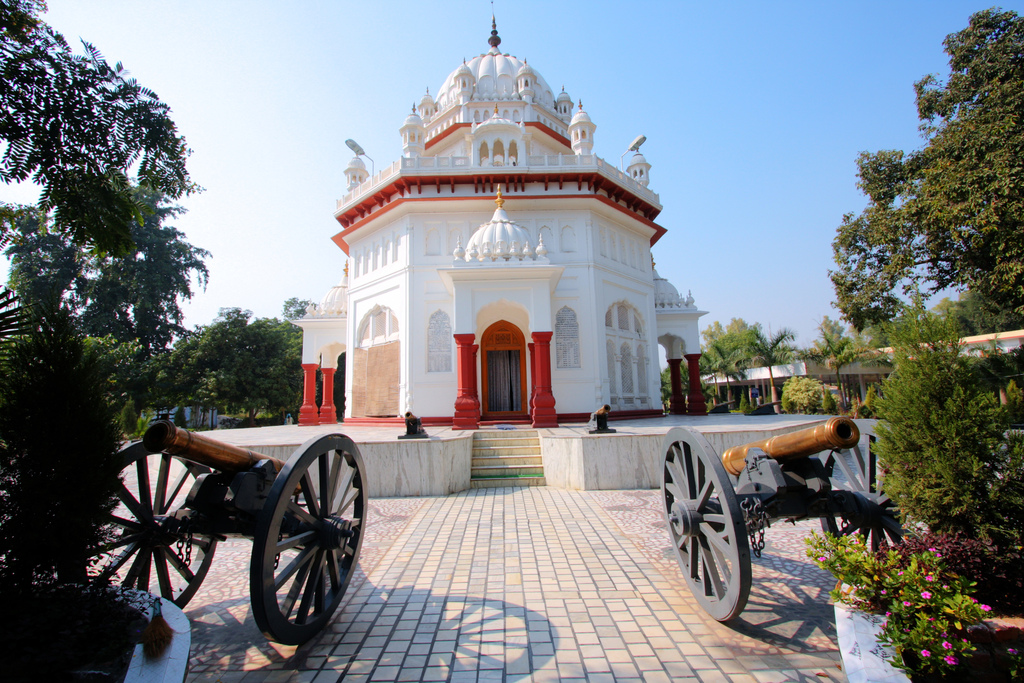
Postcard photograph of the Saragarhi Memorial Gurdwara in Firozpur, ca.1920's

The Saragarhi Memorial Gurdwara commemorates 21 Sikh soldiers of the 36th Sikh Regiment who died in the Battle of Saragarhi, defending the Saragarhi Fort against an overwhelming enemy force of 10,000 Pathan tribesmen on 12 September 1897.[13][14][15][7] All of the 21 soldiers were awarded the Indian Order of Merit posthumously.[13][14][7] The Saragarhi Memorial Gurdwara of Ferozepur was opened in 1904 by Sir Charles Montgomery Rivaz, the Lieutenant-Governor of Punjab.[7]

On 23 March 1931, at 7.30 p.m., the remains of Bhagat Singh, Rajguru, and Sukhdev were cremated about 10 km north of Ferozepur on the bank of the Sutlej River at Hussainiwala.[7] The location of the cremation went to Pakistan in 1947 but was given to India on 17 January 1961 when India and Pakistan exchanged their exclaves.[7]

Moti Bazar and Hira Mandi in Ferozepore were once prominent markets for the pearl and diamond trade.[7] Prior to partition in 1947, Hira Mandi was home to many singing girls.[7]

Post-independence

[edit]

The Home for the Blind institute was established in Ferozepur in 1956.[7] The establishment assists the blind.[7]

A construction of a memorial at Hussainiwala dedicated to the three Indian freedom-fighters began and its foundation stone was laid on 23 March 1965, by the Union Defence Minister Y. B. Chavan.[7] However, the Indo-Pakistani war of 1965 soon broke-out the same year and work on the memorial stalled.[7] In 1968, Chief Minister of Punjab, Lachman Singh Gill, completed the monument within 37 days at a cost of Rs 1.84 lakh.[7] However, the monument was later vandalised by Pakistani troops betwee 1971–72.[7] The monument was again restored in 1973 by Giani Zail Singh.[7]

The Barki Memorial, built in 1969, is a memorial to the soldiers of the 7 Infantry Division who died in a battle in 1965 which led to India taking the town of Barki, 15 miles south-east of Lahore.[16][7]

The historical Firozpur Fort has recently been re-opened to the public after 200-years.[17][18]

Geography

[edit]

Ferozepur is located on the bank of the Sutlej River.[19]

Climate

[edit]
Climate data for Firozpur
Month Jan Feb Mar Apr May Jun Jul Aug Sep Oct Nov Dec Year
Mean daily maximum °C (°F) 19
(66)
21
(69)
26
(78)
34
(94)
38
(101)
39
(103)
34
(94)
33
(91)
33
(92)
32
(89)
26
(79)
21
(69)
30
(85)
Mean daily minimum °C (°F) 7
(44)
8
(47)
13
(55)
18
(65)
23
(73)
26
(79)
26
(79)
24
(76)
23
(74)
17
(63)
11
(52)
7
(45)
17
(63)
Average precipitation mm (inches) 20
(0.80)
38
(1.50)
30
(1.20)
20
(0.80)
20
(0.80)
61
(2.40)
229
(9.00)
188
(7.40)
86
(3.40)
5.1
(0.20)
13
(0.50)
20
(0.80)
730.1
(28.8)
Source: [20]

Demographics

[edit]
Religion in Firozpur City[21]
Religion Percent
Hinduism
70.47%
Sikhism
26.25%
Christianity
2.35%
Islam
0.31%
Others
0.61%

As of the 2011 Indian Census, Firozpur had a total population of 110,313, of which 58,451 (53%) were male and 51,862 (47%) were female. 10.6% of the population was six years old or younger. The total number of literate people in Firozpur was 78,040, which constituted 70.7% of the population, with male literacy of 73.3% and female literacy of 67.9%. The effective literacy rate (population of 7 years and above) was 79.1%, of which the male literacy rate was 82.3% and female literacy rate was 75.6%. The Scheduled Caste population was 27,395. Firozpur had 22,263 households in 2011.[2]

Religion

[edit]

According to the 2011 census, out of a total population of 110,313 in Firozpur city, Hinduism is followed by 77,743 (70.5%) people and Sikhism by 28,961 (26.3%). Minority religions include Christianity, Islam, Jainism, and Buddhism.[21]

Religious groups in Firozpur City (1881−2011)[a]
Religious
group
1881[23][24]: 520  1891[25]: 68  1901[26]: 44  1911[27]: 20  1921[28]: 23  1931[29]: 26  1941[22]: 32  2011
Pop. % Pop. % Pop. % Pop. % Pop. % Pop. % Pop. % Pop. %
Hinduism 19,004 48.03% 23,047 45.69% 21,304 43.18% 21,542 42.38% 24,525 45.12% 28,253[b] 43.71% 34,543[b] 41.87% 77,743 70.47%
Islam 17,609 44.5% 22,018 43.65% 24,314 49.28% 23,409 46.05% 24,456 45% 28,464 44.04% 38,390 46.53% 342 0.31%
Sikhism 1,207 3.05% 3,387 6.72% 1,635 3.31% 2,951 5.8% 3,025 5.57% 4,439 6.87% 6,457 7.83% 28,961 26.25%
Jainism 72 0.18% 407 0.81% 301 0.61% 479 0.94% 476 0.88% 511 0.79% 630 0.76% 148 0.13%
Christianity 1,561 3.09% 1,753 3.55% 2,439 4.8% 1,855 3.41% 2,942 4.55% 1,533 1.86% 2,591 2.35%
Zoroastrianism 15 0.03% 4 0.01% 16 0.03% 14 0.03% 24 0.04%
Buddhism 0 0% 0 0% 0 0% 0 0% 1 0% 43 0.04%
Others 1,678 4.24% 2 0% 0 0% 0 0% 0 0% 0 0% 949 1.15% 485 0.44%
Total population 39,570 100% 50,437 100% 49,341 100% 50,836 100% 54,351 100% 64,634 100% 82,502 100% 110,313 100%

Media

[edit]

Firozpur has an All India Radio Relay station known as Akashvani Firozpur. It broadcasts on 100.1 MHz frequency.

Economy

[edit]

There are many markets in the town that are named after local figures and philanthropists.[7] Some of these markets are Gali Dugglan, Mohalla Sodhian, Mohalla Baurianwala, Basti Shekhan, Basti Balochan, Hata Khuda Bakhsh, Kuchha Harnam Das, and Gali Kumrianwali.[7]

Education

[edit]

There are a number of educational institutions within the town, such as:[7]

  • DAV College for Women[7]
  • Dev Samaj College for Women[7]
  • Dev Samaj College of Education for Women[7]
  • RSD College[7]
  • Guru Nanak College[7]
  • Shaheed Bhagat Singh College of Engineering and Technology

Some libraries are:[7]

  • Firozpur municipal library[7]
  • Firozpur district library[7]
  • Dronacharya library (located in the cantonment area, with a large book collection)[7]

Aside from the above, there are two government schools, one dedicated toward a particular gender.[7] There are two industrial training institutes, also dedicated to a particular gender.[7] There is also a government polytechnic.[7]

Nature

[edit]

The town was once home to many gardens, such as Tulsi Ram Bagh, Gole Bagh, Nishat Bagh, Ram Sukh Das Bagh, and Kanshi Ram Bagh.[7] However, only Gole Bagh was under the control of the municipal government, with the majority of the gardens being held privately by residents or trusts.[7] In around 1960, these trusts and individuals began getting rid of their garden-land as it became difficult to maintain them.[7] Many fruit trees used to be found at Gole Bagh but now it is used as a garbage-dump.[7]

Places of worship

[edit]

Gurdwaras

[edit]

Churches

[edit]
  • Saint Andrew’s Church, Jhoke Road[7]
  • Roman Catholic Church, Church Road[7]
  • Methodist Church, NBI Road, established by Missionaries of Methodist Denomination during 1925–30[7]

Notable people

[edit]

Notes

[edit]

References

[edit]
[edit]
Revisions and contributorsEdit on WikipediaRead on Wikipedia
from Grokipedia
Firozpur (also spelled Ferozepur) is a serving as the administrative headquarters of in the state of northwestern , positioned in the fertile Plains approximately 8 kilometers east of the international border with . The district covers an area of about 4,110 square kilometers and features a predominantly agrarian economy reliant on crops such as , , , and emerging diversifications into oilseeds and , supported by canal irrigation systems. Historically, Firozpur traces its origins to the 14th century, attributed either to Sultan Firoz Shah Tughlaq of the or a local chief named , evolving into a strategic outpost under British colonial rule from 1835 onward. It gained prominence during the , particularly as the site of the in December 1845, where British forces under Sir Hugh Gough clashed intensely with Sikh armies, resulting in heavy casualties on both sides and marking a pivotal, hard-fought British . The city's military significance persists today through its large , which includes memorials honoring Sikh soldiers, such as the Saragarhi Memorial commemorating the 21 defenders who held out against overwhelming Afghan tribal forces in 1897. As of the 2011 Indian census, Firozpur district recorded a population of 1,001,931, with the urban agglomeration reflecting a mix of Punjabi-speaking communities engaged in farming, military service, and small-scale industries like rice milling and textile processing. Post-independence, its border location has underscored its role in national security and Indo-Pak relations, while agricultural productivity remains central despite challenges like groundwater depletion prompting crop diversification efforts.

Name and Origins

Etymology

The name Firozpur originates from the Persianate term denoting a settlement associated with Firoz, specifically attributed to Firoz Shah Tughlaq of the , who reigned from 1351 to 1388 and is credited with founding the city as a strategic outpost on the route between and . Historical accounts, including those from regional gazetteers and administrative records, describe Firozpur—meaning "town of Firoz"—as established by Tughlaq to bolster control over Punjab's frontier regions, with the fortress constructed during his era serving as early evidence of settlement. An alternative tradition posits derivation from a 16th-century chief named Feroze Khan, though primary attributions favor the Tughlaq foundation based on the site's positional importance and naming conventions of the period. During British colonial administration from 1835 onward, the name was transliterated as Ferozepore to reflect anglicized phonetics, reverting to Firozpur post-independence in line with standardized Indian toponymy.

Founding and Early Settlement

Firozpur was founded during the reign of Firoz Shah Tughlaq, who ruled the from 1351 to 1388 CE, as a strategic outpost on the banks of the River. The site's selection leveraged its position along vital communication lines connecting to , enabling oversight of Punjab's northwestern approaches and facilitating rapid troop movements. This establishment reflected Tughlaq priorities in consolidating frontier defenses amid regional instability. As a frontier town under the , Firozpur featured early fortifications, including a fortress attributed to Firoz Shah's initiatives, designed to deter incursions and secure riverine crossings. These defenses were integral to maintaining imperial authority in a semi-arid zone prone to tribal raids, with the providing a and transport artery. The also promoted through canals drawn from the , supporting sustenance and nascent in the surrounding alluvial plains. The settlement integrated into pre-existing Punjab trade networks, with the facilitating commerce in grains, textiles, and livestock linking local markets to imperial centers. Historical accounts of Tughlaq-era underscore how such outposts spurred economic activity by enhancing water management and route security, though archaeological evidence remains limited to surface finds of medieval and structures. This foundational phase laid the groundwork for Firozpur's role as a logistical hub, distinct from prior nomadic or village patterns in the region.

History

Ancient and Medieval Periods

The region encompassing modern Firozpur, situated along the River in , formed part of ancient settlements in the , where riverine geography provided fertile alluvial soils conducive to early agriculture and sustained human habitation. The , known as Shutudri in Vedic texts such as the , highlights the area's integration into the Indo-Aryan cultural sphere during the (c. 1500–500 BCE), though specific archaeological evidence linking continuous occupation directly to the Firozpur site remains limited. Broader excavations in the Firozpur and adjacent areas have uncovered historical mounds indicative of settlements dating 1,500 to 2,000 years ago, suggesting activity from the late ancient to early medieval eras, potentially associated with post-Vedic or Kushan influences, but without definitive artifacts tying them to named polities. During the medieval period, the area experienced incursions from Central Asian invaders, including the under (r. 998–1030 CE), whose raids into disrupted local Hindu kingdoms and facilitated the gradual extension of Muslim influence westward from the Indus. By the establishment of the in 1206 CE, the , including territories near the , served as a strategic zone against further invasions, with river crossings offering both defensive advantages and vulnerabilities. Firozpur itself emerged as a notable settlement under the , founded around 1356 CE by Sultan Firoz Shah Tughlaq (r. 1351–1388 CE) as a fortified outpost, evidenced by the construction of a fortress to bolster control over the western periphery amid ongoing threats from Mongol incursions and internal rebellions. This positioning leveraged the 's role as a natural barrier, enabling agricultural surplus from irrigated lands to support military garrisons while positioning it as a key node in the sultanate's northwestern defenses.

Sikh Empire Era

Firozpur operated as a within the under Ranjit Singh's consolidation of territories from 1801 onward, with local administrators from the clan holding hereditary rights in exchange for and revenue contributions to the Lahore Durbar. This structure integrated the region administratively into the empire's feudal system, where jagirdars like Dhanna Singh Mal maintained control while aligning with central directives, including troop levies for broader campaigns. The estate's governance exemplified Ranjit Singh's approach to unifying disparate Sikh misls and principalities through loyal intermediaries, ensuring stability without direct annexation until the jagir's lapse in 1835 following the death of its issueless ruler. Positioned along the River, Firozpur functioned as a strategic military outpost on the empire's southwestern periphery, bolstering defenses against regional rivals and potential disruptions from adjacent states like , amid the Sikh Empire's broader containment of Afghan pressures to the northwest. No major battles occurred in the area under , but the site's proximity to the 1809 Treaty of Amritsar boundary heightened its role in monitoring eastern threats from British expansions, with garrisons ready to reinforce imperial lines. Administrative oversight included kardars for local management, reflecting the empire's decentralized yet centralized command. Maharaja Ranjit Singh enhanced Firozpur's fortifications by commissioning the construction of the Ferozepur Fort, a hexagonal stronghold featuring six gates built with durable Nanakshahi bricks, which symbolized Sikh military architecture's emphasis on robust, practical defense. This upgrade transformed the fort into a critical depot for troops, , and supplies, underscoring the region's integration into the empire's army logistics prior to the post-Ranjit instability. Sikh influences extended to local infrastructure, with the fort serving as a hub for regional security until British occupation in 1835. Land revenue collection in Firozpur adhered to the Sikh Empire's dari model, where assessments on agricultural output—primarily , , and —were levied at rates yielding a share for the jagirdar and to the state, often one-third of converted to cash via imperial treasuries. Kardars enforced these collections efficiently under Ranjit Singh's reforms, minimizing intermediaries and corruption to sustain military funding without documented peasant uprisings in the jagir, though exact annual yields remain sparsely recorded outside general empire estimates of over 1.8 million rupees from farms empire-wide by the . This system prioritized fiscal realism, balancing extraction with agricultural incentives to maintain productivity on the fertile lands.

British Colonial Period

British control over Firozpur was established in 1835 through escheat, following the extinction of the local Sikh ruling family's male line, integrating the territory as a frontier outpost of the East India Company adjacent to the Sikh Empire. A military cantonment was founded in 1839 under Captain H.M. Lawrence, serving as a strategic base for troop concentrations during the Anglo-Afghan War of 1839–1842, from which forces advanced toward Kabul. This militarization underscored Firozpur's role in Britain's forward policy, positioning it to counter Sikh expansion and potential Russian influence via Afghanistan. The (1845–1846) elevated Firozpur's significance as a besieged garrison when Sikh forces under crossed the River on 11 December 1845, aiming to relieve their army and sever British supply lines. British reinforcements under Sir Hugh Gough clashed with the at Mudki on 18 December, suffering 215 killed and 657 wounded, followed by the intense night battle at Ferozeshah on 21–22 December, where British artillery and infantry charges overcame fortified Sikh positions despite 2,415 casualties against Sikh losses exceeding 3,000. These engagements, culminating in Sikh defeats at Aliwal and Sobraon, led to the in March 1846, ceding territories east of the and establishing British oversight in . The Second Anglo-Sikh War (1848–1849) ended with 's annexation on 29 March 1849 under Governor-General Dalhousie, incorporating Firozpur into the Punjab province as a key district for administrative and military control. Post-annexation, the British intensified military buildup at Firozpur Cantonment, deploying regiments and later recruiting loyal Punjabi troops, including , to secure the northwest frontier amid ongoing Afghan tensions. Infrastructure development included canal extensions from the River, enhancing for and cultivation, which expanded and output but prioritized revenue through cash crop exports and land revenue assessments, reflecting colonial extraction strategies that funded imperial administration while altering local agrarian structures. By the late , these systems supported commercial agriculture, with feeding British textile industries and bolstering food supplies, though at the cost of traditional subsistence patterns and increasing peasant indebtedness under fixed revenue demands.

Partition and Immediate Aftermath

The Radcliffe Award, published on August 17, 1947, assigned to despite its Muslim population of approximately 45.1% as per the 1941 census, overriding demographic considerations in favor of strategic imperatives. The decision centered on retaining Indian control over the Ferozepur headworks, which regulated irrigation via the Sirhind and canals supplying water to arid regions in Rajasthan princely states like and ; allocating these to risked weaponizing water supply against Indian agriculture. Last-minute revisions, reportedly influenced by Mountbatten after initial drafts favored , ensured the headworks and surrounding left-bank territories remained Indian, averting potential downstream flooding or cutoff risks. This allocation precipitated intense in Firozpur, where uncertainty over the delayed boundary announcement fueled rumors of the district's transfer, igniting retaliatory attacks amid broader Punjab-wide riots. Triggers included economic rivalries over and , amplified by political mobilizations from the Muslim League's partition demands, Congress's territorial claims, and Akali Dal's Sikh , which eroded intercommunal trust without justifying the ensuing atrocities. Killings, abductions, and property destruction displaced residents en masse, contributing to Punjab's estimated 2.3–3.2 million excess deaths and migrations from violence and unrecorded outflows between 1941 and 1951. Demographic upheaval was stark: Firozpur's Muslim share dropped to 0.4% by the 1951 census, implying near-total exodus of around 400,000–500,000 (based on district totals near 1 million in ), replaced by Hindu and refugees fleeing Pakistan-side . This mirrored Punjab's overall flux, with over 8 million crossing borders between August and December 1947, including roughly 5 million westward and 4–5 million / eastward, straining immediate relief as abandoned Muslim properties were seized and redistributed to arrivals via government allotments. camps proliferated in Firozpur, housing tens of thousands temporarily, with recovery metrics showing provisional land grants to 20–30% of arrivals by , though disputes over evacuee assets persisted amid economic disruption from disrupted harvests and depopulated villages.

Post-Independence Era

After India's independence in 1947, Firozpur district prioritized the rehabilitation of Hindu and Sikh refugees displaced from West Punjab and Bahawalpur State, allotting them evacuee lands previously held by Muslims who migrated to Pakistan. Eligible claimants—those who owned, purchased, or cultivated land in Pakistan—received allotments based on verified pre-partition holdings, standardized by "standard acres" to approximate original soil productivity and irrigation access, with temporary plough units of 10 acres per family supplemented by loans for seeds and equipment. This state-led process, managed by the Punjab government's Rehabilitation Department, resettled over 349,000 such refugees in the district by the early 1950s, displacing residual Muslim populations and establishing Hindu-Sikh dominance, as reflected in the 1951 census where non-Muslims comprised nearly the entire populace. Key infrastructural interventions supported economic recovery, notably the 1953 completion of the Harike Barrage at the Sutlej-Beas confluence, which expanded canal irrigation across arid tracts and enabled year-round cropping. These efforts laid groundwork for agricultural intensification, with state provisioning of tubewells and further enhancing productivity by the 1960s. under Punjab's 1953-1970 reforms amalgamated fragmented holdings, reducing disputes and optimizing farm , though critics noted uneven benefits favoring larger refugee allottees over locals. The amplified these gains, as 's adoption of (HYV) and rice seeds, alongside chemical s and assured minimum support prices, transformed Firozpur into a cotton-centric hub within the state's -rice belt. District farmers shifted to HYV cotton hybrids post-1960s, boosting yields from traditional lows to over 400 kg lint per by the 1980s, supported by state extension services and subsidies that increased use from negligible pre-1965 levels to 150 kg/ha by 1990. This yield surge— production in rising from 1.9 million tonnes in 1960-61 to 11.1 million tonnes by 1990—drove economic rebuilding, though over-reliance on water-intensive crops strained , with Firozpur's irrigated area expanding 50% via canals and tubewells. Tied to these booms, Firozpur 's population grew from 1,011,123 in the to 2,029,074 by , reflecting rural prosperity and natural increase amid agricultural surpluses that reduced out-migration. State interventions, including credit access via cooperatives, sustained this trajectory through the 1990s, with per capita income in Punjab's canal colonies like Firozpur outpacing national averages by 20-30% during peak decades.

Contemporary Developments

Punjab's GDP ranking among Indian states declined from first in 1981 to fourth by 2001, reflecting slower agricultural growth amid national , with the state falling to 17th by recent estimates due to stagnant productivity in water-intensive cropping patterns. In , agriculture remains dominant, but extraction for and —subsidized through free and minimum support prices—has led to over-exploitation, with all blocks classified as over-exploited by the Central Ground Water Board as of 2022, resulting in annual declines exceeding sustainable recharge rates. This depletion, driven by policy incentives distorting crop choices toward high-water-use staples rather than market signals for diversification, has reduced depths by over 8 meters statewide since 2000, exacerbating farm viability in Firozpur's canal-irrigated but tubewell-dependent zones. Urbanization in Firozpur has progressed modestly post-2000, with the district's urban population share rising from 23.6% in 2001 to 26.9% in 2011 per data, concentrated around the city but trailing 's overall 6% annual urban growth rate, amid limited industrial inflows. infrastructure expansions, including the four-laning of the Talwandi Bhai-Firozpur section on NH-5 completed in recent years and ongoing pushes for Firozpur-Fazilka upgrades, aim to enhance connectivity to markets, yet face delays from land acquisition issues stalling broader Rs 12,700 national projects in . Rural distress persists, evidenced by migration rates exceeding 30% of households in Firozpur as per a 2024 study, primarily overseas to , funded by household borrowings totaling billions, signaling underlying economic pressures from subsidy-induced inefficiencies rather than external shocks alone. Policy responses have included sporadic crop diversification mandates and metering pilots to curb free power subsidies, which empirical analyses link to distorted and fiscal burdens exceeding Rs 10,000 annually statewide, but implementation lags due to political resistance, perpetuating a cycle of and low-value farm output. These measures highlight causal linkages between input subsidies and overuse, as unsubsidized alternatives like pulses or fruits offer higher returns per unit but face adoption barriers from guaranteed procurement of staples.

Geography

Physical Features and Location

Firozpur district occupies a position in the southwestern of , within the region, featuring predominantly flat terrain formed by Pleistocene and sub-recent alluvial deposits. The area's even topography and fertile alluvial soils, deposited by rivers such as the , facilitate intensive agricultural activity, though the low-lying landscape contributes to vulnerability from riverine flooding. The district is traversed by the Sutlej River, the easternmost and longest tributary of the Indus River system, which originates in Tibet and demarcates approximately 105 kilometers of the India-Pakistan border in the vicinity. Under the 1960 Indus Waters Treaty, the Sutlej—along with the Ravi and Beas—was allocated exclusively to India for irrigation, hydropower, and other uses, granting the country control over its waters despite the shared basin dynamics with Pakistan. Firozpur's strategic location, situated in close proximity to the international border with , underscores its defensive significance, particularly in managing headworks that regulate Sutlej flows critical for regional water security. The terrain's flood-prone nature has been repeatedly demonstrated, with major overflows in September 2025 inundating agricultural lands and isolating border villages through breached embankments and eroded riverbanks.

Climate and Weather Patterns

Firozpur experiences a under the hot sub-tropical category, marked by pronounced seasonal extremes in temperature and limited, variable . Summers, spanning to , are intensely hot with average maximum temperatures around 40°C and peaks occasionally surpassing 45°C, driven by continental heating and low . Winters from to contrast sharply, featuring cold spells with average minima near 5°C and lows dipping to 2°C or below, accompanied by occasional and that can persist for days. Transition periods in spring and autumn moderate these extremes but remain dry overall. Annual rainfall averages 389 mm, distributed across roughly 23 rainy days, with approximately 79% concentrated in the southwest from to , when depressions from the bring intense but unreliable downpours. Pre-monsoon showers in contribute minimally, while post-monsoon and winter rains are negligible, reinforcing the region's outside the humid summer months. Empirical records from local stations indicate increasing variability in monsoon onset and intensity, with decadal analyses showing erratic patterns that have intensified since the , correlating with delayed arrivals and uneven spatial distribution across Punjab's southwestern districts. These weather patterns exhibit causal ties to the 's , as -driven flows dictate seasonal water levels critical for systems serving Firozpur's ; deficient or excess rains directly alter river discharge, amplifying drought risks in low-precipitation years when lags. Historical data from observatories highlight wind patterns—predominantly westerly in winter and easterly during —that further modulate local microclimates, with dust storms common in summer exacerbating heat stress.
MonthAvg. Max Temp (°C)Avg. Min Temp (°C)Avg. Rainfall (mm)
January20520
February23825
March291320
361910
May392315
392550
3525150
3424130
342240
32155
November2795
December22510
This table summarizes monthly climatological normals derived from long-term observations, illustrating the skewed rainfall profile and thermal range.

Demographics

Population Dynamics

According to the , Firozpur district had a total of 2,029,074, reflecting a decadal growth rate of 16.08% from the 2001 figure of 1,745,930. This growth equates to an average annual rate of approximately 1.5%, driven primarily by natural increase and residual migration effects, though Punjab's overall fertility rates have since declined below replacement levels. The district's stood at 380 persons per square kilometer, concentrated in fertile canal-irrigated plains conducive to agrarian settlement. Urbanization remained limited, with 27.23% of the (552,556 individuals) residing in urban areas and 72.77% (1,476,518) in rural settings, a split indicative of the district's agrarian and dispersed village networks. The was 893 females per 1,000 s, marginally better than Punjab's state average but still reflecting historical preferences for male offspring in rural households. improved to 69.8%, with at 76.2% and at 62.5%, showing gains from prior decades but persistent gaps in access to education, particularly in rural zones. Following the 1947 Partition, Firozpur—previously a Muslim-majority district awarded to despite demographic arguments for —experienced a rapid exodus of its Muslim population alongside an influx of Hindu and Sikh refugees from western , resulting in net growth and heightened density in border-adjacent areas. This forced migration reversed pre-partition stagnation, elevating the district's pressure and laying the foundation for subsequent expansions in housing and infrastructure. Projections based on post-2011 trends estimate the district's population at approximately 2,230,764 by 2025, assuming continued moderation in growth rates amid declining and out-migration to urban centers beyond the district.
Census YearTotal PopulationDecadal Growth (%)Urban (%)Rural (%)Sex Ratio (F/1000M)Literacy (%)
20011,745,930-----
20112,029,07416.0827.2372.7789369.8

Religious Composition

The religious composition of Firozpur district underwent a profound transformation following the 1947 . In the 1941 census, Muslims constituted 45.1% of the population, forming the plurality amid a diverse mix of , , and smaller groups; this reflected the district's location in the canal-colonized Muslim-majority tracts of , where agricultural settlements had bolstered Muslim demographics since the late . Partition-induced communal violence and mass migrations resulted in the near-total departure of Muslims to , with their share plummeting to 0.4% by the 1951 census; this exodus was mirrored by an influx of approximately 200,000 Hindu and Sikh refugees from western districts, who were rehabilitated through government allocation of evacuee properties and land grants in abandoned Muslim villages. The demographic causality stemmed directly from Radcliffe's border demarcation, which preserved Firozpur for despite its Muslim plurality—prioritizing strategic canal headworks and cantonments over strict religious majorities—coupled with reciprocal population transfers enforced by and state policies favoring religious homogenization. By the 2011 census, had become the majority at 53.76% (1,090,815 persons), followed by at 44.67% (906,408 persons), at 0.95% (19,358 persons), and at a residual 0.34% (6,844 persons); Jains, Buddhists, and others comprised less than 0.3% combined. These figures underscore the enduring impact of partition-era displacements, with Sikh dominance in rural canal areas and higher Hindu concentrations in urban centers like Firozpur city, while the minimal Muslim presence reflects sustained low return migration and assimilation of remaining communities into the Sikh-Hindu fabric.

Linguistic and Social Structure

The predominant language in is Punjabi, spoken as the mother tongue by the overwhelming majority of residents and written in the script, reflecting the broader linguistic profile of rural where it accounts for over 90% of primary usage in daily communication and education. serves as a secondary in administrative and urban contexts, while English is employed in official government proceedings, higher education, and military institutions due to the district's heritage. is limited, with smaller proportions reporting or English proficiency, often tied to urban rates exceeding 70% in the district . Social structure in Firozpur is characterized by caste dynamics, with Jats—predominantly Sikhs—forming the dominant agrarian landowning group that exerts significant influence over local politics, economy, and rural norms, a pattern rooted in historical land reforms and agricultural productivity favoring this community. Scheduled Castes constitute approximately 43% of the population, primarily engaged in agricultural labor and marginalized from land ownership, highlighting persistent hierarchical divisions despite formal egalitarian ideals in the region. Family structures remain predominantly joint in rural areas, emphasizing patriarchal authority where elder males hold decision-making power over resources, marriages, and inheritance, though urbanization and male out-migration to urban centers or abroad have induced shifts toward nuclear units in about 20-30% of households. Gender roles reinforce patriarchal norms, with workforce participation lagging at around 14% as per 2011 data, concentrated in informal agricultural tasks rather than formal , attributable to cultural expectations prioritizing domestic responsibilities and limited access to beyond secondary levels. Male migration for overseas opportunities, particularly to and Gulf countries, has increased female involvement in farm management but often without ownership rights or economic autonomy, exacerbating dependency and contributing to skewed sex ratios from historical preferences for male heirs. These dynamics underscore causal links between land-based privileges and social rigidity, with empirical surveys indicating lower inter-caste mobility compared to urban averages.

Administration and Security

Local Governance

Firozpur district is administered by a , who serves as the responsible for coordination between state government directives and local implementation, including revenue collection, law and order, and development schemes. The district comprises three —Firozpur, Zira, and Guru Har Sahai—each headed by a managing land records, judicial functions, and sub-divisional administration. Additionally, there are six blocks and four sub-tehsils, including Makhu (under Zira), Talwandi Bhai and Mamdot (under Firozpur), facilitating decentralized governance at the rural level. Urban local governance in Firozpur city falls under the Municipal Council Ferozepur, an elected civic body tasked with such as , street lighting, and . The council operates through ward-based representatives and a president, conducting regular elections under state oversight to ensure in local decision-making. Rural areas are governed by elected gram panchayats, with district-level elections for these bodies last conducted in 2024, emphasizing participatory local self-government as per Punjab's framework. The administrative structure of Firozpur was affected by the Punjab Reorganisation Act of 1966, which bifurcated the erstwhile into linguistically distinct states of and , resulting in marginal boundary realignments for districts like Firozpur while retaining it within the Punjabi-speaking state. This reorganization streamlined district functions by aligning them with the new state boundaries, without major territorial losses at the time, though subsequent subdivisions occurred later, such as the creation of from Firozpur in 2008.

Military Cantonment and Defense Role

Firozpur , established in the early during British rule, serves as a key military installation in , strategically positioned near the border. It houses units under the operational control of the Indian Army's Western Command, headquartered in Chandimandir, contributing to regional defense operations. The cantonment played a significant role in the 1965 Indo-Pakistani War, particularly in operations leading to the capture of Barki village in , commemorated by the Barki erected in 1969 to honor soldiers of the 7th Division who sacrificed their lives. During the 1971 Indo-Pakistani War, Firozpur emerged as an important theater, with Indian forces and personnel engaging in defensive and offensive actions against Pakistani incursions. In contemporary defense strategy, the supports border vigilance along the International Border with , where threats including armed infiltration and drone incursions necessitate ongoing troop deployments and readiness exercises. Recent activities, such as a 30-minute blackout drill conducted on May 5, 2025, underscore preparations for potential escalation, reflecting empirical patterns of Pakistani proxy activities that deterrence alone has not fully neutralized, as cross-border incidents persist despite bilateral agreements. These measures highlight the cantonment's integral function in maintaining causal chains of through proactive monitoring and rapid response capabilities.

Economy

Agricultural Sector

The agricultural sector in Firozpur district, , centers on , paddy (rice), and as primary staple crops, reflecting the broader cropping pattern dominated by the rice-wheat rotation. holds particular significance in the southwestern districts, including Firozpur, which ranks among the top producers alongside and Muktsar, contributing to 's overall output that accounts for about 5.53% of India's production. In recent years, such as 2023-24, the district's crop estimates align with 's trends, where paddy area exceeded historical highs despite diversification efforts, underscoring persistent reliance on water-intensive staples. Irrigation coverage in Firozpur is extensive, with nearly all cultivable under assured supply, primarily through a combination of systems and tubewells, though tubewells now irrigate a larger effective area—exceeding -irrigated by 137% due to supplemental and replacement usage. This stems from the Green Revolution's expansion since the 1960s, when high-yield varieties, chemical inputs, and mechanized via tubewells proliferated, boosting productivity but shifting dependence from to extraction. 's tubewell count surged from around 50,000 in the early 1960s to over 1.4 million by the 2020s, enabling intensive cropping but causing average annual declines of approximately 70 cm in affected zones. The Minimum Support Price (MSP) mechanism, guaranteeing procurement for and paddy, has causally reinforced by providing economic security for these crops over alternatives, limiting diversification into pulses, oilseeds, or despite pushes. This incentive structure, coupled with free electricity for tubewells, has intensified over-extraction, as farmers prioritize high-MSP staples that demand 3-5 times more water than or , leading to stage of depletion in 78% of Punjab's blocks. In Firozpur, where rice- covers over 90% of cropped area, such distortions hinder improvements and sustainable yields, with experts noting that MSP's focus on two crops perpetuates resource strain without addressing underlying productivity limits from over-reliance on subsidized inputs.

Industrial and Commercial Activities

The industrial sector in is dominated by micro, small, and medium enterprises (MSMEs), with 4,356 registered micro and small enterprises (MSEs) recorded as of 2010-11, providing to 19,884 workers. Updated assessments place the total number of MSME units at approximately 17,535, underscoring a reliance on small-scale operations rather than large-scale industrialization. Key manufacturing activities center on agro-processing and engineering, including 11 large-scale units such as Punjab Agro Juices Ltd. and Fazilka Cooperative Sugar Mills Ltd., which facilitate rice milling and sugar production for export. A specialized cluster in agricultural implements manufacturing comprises 75 units, generating a turnover of Rs. 65 crore annually. Other small-scale sectors encompass textiles, weaving, foundries, and light engineering goods, bolstered by support from the Punjab Small Industries & Export Corporation (PSIEC) for land allocation and sheds. Commercial activities emphasize domestic trade in processed goods and consumer items, with serving as a primary . The unregistered MSME segment is predominantly service-oriented, including repairs, cold storage facilities, and presses, indicating a pivot toward tertiary . Persistent challenges such as inadequate , support, skilled labor shortages, and infrastructural deficits have contributed to post-1990s stagnation in growth, limiting the sector's expansion despite efforts.

Infrastructure and Connectivity

Firozpur is connected to major cities via National Highway 5 (NH-5), which spans approximately 660 km from Firozpur westward toward the border and eastward linking to networks toward and other regions. The four-laning of the 23.6 km Talwandi Bhai to Firozpur section of NH-5, incorporating paved shoulders, enhances seamless connectivity from and Moga districts, supporting logistics in this border-adjacent area. Punjab's inclusion of regional road projects under initiatives like Pariyojana aims to improve border logistics, though specific Firozpur allocations emphasize upgrades to existing arterial routes rather than new expressways. The city's rail infrastructure centers on Firozpur Junction and Firozpur Cantonment stations, serving as key junctions in the Northern Railway network with multiple lines radiating to , , and beyond. In July 2025, introduced new train services in the Firozpur division to bolster regional connectivity, addressing demands for enhanced passenger and freight movement. Ongoing projects include the 26 km Firozpur-Patti new rail line, fully within and near the international border, designed to link border districts directly to ports for economic corridors; land acquisition is in progress with completion targeted post-2025. 's rail network achieved 100% by 2025, including lines through Firozpur, enabling higher speeds and capacity. Bridges over the River are critical for cross-regional links, with the Barrage Bridge facilitating rail and road traffic near ; it underwent restructuring and reopening in 2013. A 720-meter road bridge at Gidderpindi village, connecting , , and regions, neared completion in 2011, though seasonal flooding occasionally disrupts operations, as seen in September 2025 when swelling halted rail services. Power infrastructure in Firozpur benefits from Punjab's statewide upgrades, with a ₹139.79 scheme launched in October 2025 to install 31 new 11 kV feeders, 279 transformers, and augment 355 existing units by March 2027, aiming for reliable supply amid growing demand. The Punjab State Power Corporation Limited's reforms, including a ₹50 billion initiative for substations and lines, support near-universal , though rural feeders face occasional overloads during peak agricultural seasons. No dedicated serves Firozpur; air connectivity relies on regional hubs like , approximately 120 km away.

Education and Institutions

Primary and Secondary Education

Primary and secondary education in Firozpur is facilitated through government-managed schools under the and a growing number of private institutions, with the latter gaining popularity for perceived quality advantages. The district's rate rose from 60.70% in the 2001 to 68.92% in 2011, reflecting gradual improvements in school access amid rural-urban disparities, where rural lagged at 65.14% compared to 78.89% in urban areas. Enrollment patterns mirror state trends, with private schools attracting higher numbers at the primary level (Classes I-V), where recorded 11.22 students in private institutions versus 10.40 in government schools as of recent UDISE+ data. Government schools remain foundational, numbering in the hundreds across blocks, but face competition from private options emphasizing English-medium instruction. The mid-day meal program, implemented universally, has boosted attendance by addressing nutritional barriers, particularly in rural government schools. Dropout rates in government schools stand at 2.5% for primary and 2.7% for upper primary levels, though sees higher attrition, exceeding 12% for boys in Firozpur among other districts. Rural deficiencies, such as inadequate facilities and shortages, contribute to quality gaps, despite initiatives like aiming for universal enrollment and retention.

Higher Education and Research

Shaheed Bhagat Singh State University, established in 1995 by the Government of as Shaheed Bhagat Singh College of and , serves as the primary higher education institution in Firozpur, offering undergraduate and postgraduate programs in , , and fields. The university emphasizes technical education aligned with regional needs, including civil, mechanical, and , with a focus on practical training to support 's industrial and agricultural sectors. Government Polytechnic College, Ferozepur, provides diploma-level vocational training in engineering disciplines such as electronics and communication, , electrical, and , with an annual intake of 159 students across these streams and a faculty strength of 21. Established to deliver industry-oriented technical , the institution prioritizes hands-on learning to address skill requirements in border-area and infrastructure projects. DAV College for Women, founded in 1969 and accredited with NAAC B++ grade, offers undergraduate courses in arts, commerce, and sciences, contributing to women's higher education in the region with a focus on academic and co-curricular development in a pollution-free environment. Similarly, R.S.D. College, established in 1921, has evolved into a major center for , providing diverse programs that have supported local in and public services. In agricultural research, Punjab Agricultural University's Farm Advisory Service Centre (FASC) in Ferozepur conducts extension activities, including on improved crop varieties, non-chemical pest , value addition, and sustainable farming practices tailored to the district's cotton-wheat . These efforts aim to enhance farmer entrepreneurship and , leveraging Firozpur's border location for in water-scarce conditions, though broader challenges in 's higher education include transitioning from rote-based curricula to skill-focused amid agricultural mechanization demands.

Culture and Media

Cultural Traditions and Heritage

Firozpur's cultural traditions are deeply rooted in Punjab's agrarian heritage, with festivals like Baisakhi and serving as central expressions of community and seasonal cycles. Baisakhi, observed annually in April, celebrates the wheat harvest and Punjabi New Year through communal gatherings, traditional feasts, and performances of folk dances such as bhangra, which originated among farmers in the 14th or 15th century to mark agricultural success. , held in January, signifies the end of winter with bonfires, folk songs, and dances like performed by women, emphasizing themes of and renewal tied to the region's rural economy. These events foster social cohesion in Firozpur, where over 80% of the population engages in , directly linking cultural practices to harvest rhythms. Folk arts in Firozpur, including bhangra and , embody Punjab's vibrant performative traditions, often accompanied by traditional instruments like the drum and string instrument during festivals. These dances, performed in colorful attire with energetic movements, historically celebrated community labor and joy, evolving from rural origins to widespread cultural symbols. Preservation efforts focus on maintaining these arts amid modernization, with local initiatives promoting performances at harvest-time events to sustain empirical ties to Punjab's pre-industrial past. The 1947 Partition profoundly shaped Firozpur's cultural evolution, as the near-total exodus of its Muslim population—replaced by influxes of Hindu and Sikh refugees—shifted the demographic from mixed to predominantly Hindu-Sikh, reducing pre-Partition syncretic that blended Muslim, Hindu, and Sikh elements in festivals and . Post-Partition, this led to a consolidation of Hindu-Sikh shared practices, such as joint participation in Baisakhi processions and rituals, while diminishing Sufi-influenced folk traditions once common in the region. Heritage from the Sikh era, including secular structures like the Ferozepur Fort (a key outpost during the in the early 19th century), has seen renewed preservation, with the site opening to the public in June 2025 after two centuries, highlighting empirical efforts to document and restore artifacts tied to Punjab's martial and administrative history.

Media Landscape

Local print media in Firozpur primarily consists of Punjabi-language dailies and weeklies distributed through regional networks, with major titles like Ajit and maintaining strong presence alongside smaller outlets such as Ferozepur Di Awaz, Punjab Varta, and Sarhad Kesari. These publications focus on local agricultural news, district administration updates, and community events, often reflecting the agrarian economy's priorities. Circulation of such regional papers has faced declines, mirroring broader Indian trends where print readership dropped by up to 28% during the before partial recovery, driven by competition from national Hindi and English dailies. Broadcasting remains anchored by public service outlets, including All India Radio's Firozpur station on 100.1 FM, which airs news, talk programs, and music in , English, and Punjabi since its establishment as a relay service. Private FM stations are absent locally, with residents tuning into regional signals from nearby cities like Jalandhar's on 98.3 FM. Television access relies on cable operators like Fastway and DTH providers such as , delivering state-run Punjab alongside national channels, though no dedicated local TV production facilities exist. Post-2010, digital platforms have reshaped consumption, with enabling farmers to share real-time information on prices, , and policy impacts, bypassing traditional media's limitations in an agriculture-dependent . Sites like Ferozpur Online provide hyper-local updates in Punjabi, supplementing print amid national media's growing dominance and print's ongoing circulation erosion. This shift has amplified rural voices but intensified challenges for local outlets sustaining ad revenue and readership.

Religious and Cultural Sites

Sikh Gurdwaras

, with its longstanding military and Sikh martial heritage, features several serving as centers for worship, community service, and historical remembrance. These sites embody Sikh tenets of equality through communal langar kitchens, where free meals are prepared and served daily to devotees regardless of background, fostering sewa (voluntary service) and vand chakna (sharing). The Saragarhi Memorial Gurudwara in Ferozepur Cantonment stands as the most renowned, constructed in 1904 to honor the 21 Sikh soldiers of the who perished defending the Saragarhi signaling post against 10,000 Afghan tribesmen on September 12, 1897, during British India's . Built with salvaged stones from the ruined fort, its walls bear inscriptions of the martyrs' names, and the structure includes a central prayer hall with traditional Sikh architectural motifs like onion domes and the Khanda symbol. Annual observances on Saragarhi Day draw military personnel and civilians for recitations and , reinforcing the event's legacy as a symbol of Sikh valor and sacrifice. Other notable gurdwaras include Sri Patsahi Chevin Sahib at Thatha village, 12 kilometers northwest of Zira, linked to the sixth Guru Hargobind's travels in the early 17th century, where local traditions hold he rested and preached. Similarly, Sri Jamani Sahib in Bazidpur and Sri Cheeni Sahib in Mehar Singh Wala preserve relics from Sikh historical periods, offering langar facilities and hosting smaller-scale festivals tied to Gurpurabs. These institutions maintain active sangat participation, with daily diwan and path services underscoring Firozpur's role in sustaining Sikh religious continuity amid its agrarian and border-region context.

Hindu Temples and Other Sites

Firozpur, situated in Punjab's border region, maintains a modest array of Hindu temples serving its Hindu minority population, which constitutes approximately 38% of the district as per the 2011 census, amid a Sikh-majority demographic shaped by the 1947 Partition. These temples, often dedicated to deities like , , and , have endured demographic shifts and communal realignments post-Partition, with many undergoing renovations to preserve rituals amid reduced Hindu influx from . Local Hindu worship emphasizes festivals such as Navratri and , integrated into the broader Punjabi cultural fabric without distinct syncretic deviations verifiable in Firozpur-specific beyond regional shared agrarian rites. Prominent temples include Bala Ji Dhaam, a Hanuman shrine attracting devotees for strength and protection invocations, located centrally and noted for its active community gatherings. Mata Shitla Devi Mandir honors the smallpox goddess Shitala, with rituals focused on healing and seasonal epidemics, reflecting pre-modern folk traditions persisting in rural outskirts. Nav Durga Vashino Mandir and Mata Basanti Devi Mandir serve as focal points for Devi worship, hosting annual processions that draw inter-community participation during spring Basant Panchami, underscoring localized Hindu resilience. Additional sites like Hanuman Mandir, Sat Narayan Temple, and Raghunath Mandir provide Vishnu and Rama-centric devotion, with the latter on Rose Avenue featuring community bhajans. Beyond , maintain temples in Firozpur district's tehsils, such as Zira and Lehra, exemplifying minority faith continuity. In Zira, a 1923-constructed temple enshrines an unadorned marble idol, emphasizing without ancillary demi-gods, serving a dwindling Svetambara following amid post-Partition migrations. Lehra's sites similarly preserve principles through sparse , with no major reconstructions documented, highlighting Jainism's marginal yet stable presence in Punjab's agrarian belt. No dedicated Partition-era memorials exclusively for Hindu victims appear in district records, with broader national sites like subsuming diverse martyrdom narratives.

Mosques and Churches

Firozpur hosts a limited number of mosques serving its small Muslim population, which numbered 6,844 individuals or 0.34% of the district's total as of the 2011 census. The 1947 Partition led to a sharp decline in the local Muslim community through migrations to , resulting in the abandonment or repurposing of many pre-existing mosques and a reduction in active Islamic worship sites. Surviving structures, such as Jama Masjid in Basti Tankan and remnants associated with dargahs like Peer Baba Sher , primarily accommodate the residual minority, often facing maintenance issues due to low attendance and funding constraints tied to demographic shifts. Christian places of worship in Firozpur trace their origins to the British colonial period, with congregations comprising 19,358 adherents or 0.95% of the district in 2011. Key establishments include the in Ferozepur city, which marked 120 years of operation by around 2023, and St. Andrew's Church, noted for its historical significance as one of Punjab's earliest Protestant sites dating to the . Catholic churches such as St. Thomas and St. Joseph, located in the city and areas, continue to hold services for small, stable communities, though overall participation remains modest amid broader regional secular trends. These sites reflect enduring but diminished colonial-era infrastructure, with upkeep reliant on limited local donations and occasional diocesan support.

Environment

Natural Resources and Biodiversity

The soils of Firozpur district predominantly consist of loamy sand and sandy loam, derived from alluvial deposits, which support intensive despite localized and in areas marked by salt crusts. Surface water resources are anchored by the Sutlej River, which delineates the district's eastern boundary and feeds canal irrigation systems covering much of the . forms a critical resource, with unconfined aquifers exhibiting pre-monsoon water levels ranging from 0.73 to 11.35 meters below ground level, though Central Ground Water Board data indicate overexploitation at 147% stage of development as of recent assessments. Biodiversity in Firozpur is largely tied to Sutlej-dependent wetlands and riparian zones, which sustain migratory bird populations including the (Anas acuta), (Tadorna ferruginea), and (Ephippiorhynchus asiaticus). The , spanning areas adjacent to the district at the Sutlej-Beas confluence, hosts over 150 bird species alongside aquatic fauna such as fish and turtles, reflecting seasonal migrations as indicators of habitat viability. The Abohar Wildlife Sanctuary, encompassing 186.5 km² within the district, preserves arid and semi-arid flora like and acacia species, alongside fauna including (Antilope cervicapra), (Boselaphus tragocamelus), and (Sus scrofa). These protected areas highlight the district's transition from fertile floodplains to drier southwestern tracts, where faunal diversity includes reptiles, small mammals, and resident avifauna amid agricultural matrices.

Environmental Issues and Conservation

Groundwater depletion poses a critical challenge in , driven by intensive paddy-wheat and subsidized . As of 2023, Firozepur recorded water table declines of up to 41.13 cm per year in certain blocks, contributing to Punjab's statewide rate of 79%, where annual draft exceeds recharge by 14.58 billion cubic meters. Free subsidies for tube wells, intended to support farmers, have instead promoted unchecked pumping, with rice procurement policies alone accounting for over 50% of Punjab's loss since the by incentivizing water-intensive crops over sustainable alternatives. Stubble burning exacerbates air quality degradation, releasing particulate matter that affects local and downwind regions. In October 2025, Firozpur reported the highest daily incidents in , with 14 farm fires in a single 24-hour span amid a statewide total exceeding 400 cases since mid-September, despite enforcement efforts. This practice, tied to tight harvest windows for paddy residue, underscores how distortions—such as procurement incentives for water-guzzling —prioritize short-term yields over long-term environmental costs, with market-based pricing potentially curbing such waste by aligning extraction with scarcity signals. Conservation initiatives include a working plan managing 11,387 hectares of linear forests along roads, canals, and bunds, alongside awareness campaigns like those organized in May 2025 at local universities. Firozpur also cleared 7,911 metric tons of legacy waste by December 2022, becoming Punjab's first to eliminate such dumpsites, aiding and . However, evaluations of in reveal modest vegetation recovery amid agricultural encroachment, questioning the net efficacy of tree-planting drives without addressing root causes like subsidy-induced overuse.

Notable People

Military and Defense Figures

Firozpur's military legacy is tied to its role as a British-era and recruiting center for Sikh regiments, producing personnel noted for service in major conflicts. The Saragarhi Memorial in Firozpur honors the 21 soldiers of the who defended the Saragarhi post against overwhelming Afghan tribal forces on September 12, 1897, delaying an advance and enabling relief of adjacent forts; the regiment, raised in 1887, drew many recruits from districts including areas around Firozpur. Major Deepender S. Bhuchar, VrC, from Firozpur district, exemplified post-independence valor after commissioning into 10 Para (Special Forces) on November 24, 1984. During counter-insurgency operations in Sri Lanka as part of the IPKF, he led an assault on July 8, 1987, at Jaffna University, neutralizing multiple LTTE cadres in close combat despite sustaining injuries, for which he received the Vir Chakra. Sepoy Jiwan Singh, hailing from Mahi Mashiwala village in Firozpur, served with the 8th Battalion, Sikh Regiment, and laid down his life during the Kargil conflict in 1999, contributing to operations against Pakistani intruders in the high-altitude sector. The district's proximity to the has also seen local units engaged in the and 1971 wars, with the Barki War Memorial commemorating captures like Barki village on September 10, , though specific local honorees from these engagements remain less documented beyond unit citations.

Political and Social Leaders

Ghubaya, born on 10 June 1962 in Ghubaya village, , emerged as a key political representative for the region, securing election to the from Firozpur constituency in 2009, 2014, 2019, and 2024 as an candidate. His tenure has emphasized advocacy for farmers' welfare, rural infrastructure, and border area development amid Punjab's agricultural challenges. Ghubaya's repeated victories reflect persistent voter support in a constituency marked by agrarian dependencies and proximity to the international . In social leadership, Firozpur's contributions to agricultural cooperatives trace back to the early , with the district's inaugural registered on 4 October 1911 in Khalchi Kadim village of Firozpur , enabling small farmers to access collective credit and mitigate indebtedness under British-era land revenue pressures. This initiative, part of broader cooperative experiments, supported local reformers in fostering self-reliant farming communities, though specific founding figures remain undocumented in primary records; subsequent expansions aided post-independence inputs despite ongoing disputes over and tenancy rights.

Cultural and Other Notables

, born on September 8, 1999, in the of , is a leading Indian cricketer who has captained the national team in and the in the , amassing over 2,000 international runs by 2023. In , Ronjan Sodhi, born October 23, 1979, in Firozpur, rose to world No. 1 in , securing gold at the in and multiple medals, earning the in 2010. , born August 20, 1948, in Firozpur, made history as the first Indian woman to win an individual gold in the 400m at the 1970 edition, clocking 57.3 seconds and setting a national record that stood for years. Field hockey forward Gagan Ajit Singh, born December 9, 1980, in Firozpur, competed for India at the 2000 and 2004 Olympics, captained the junior national team to the 2001 Junior World Cup title, and scored key goals in senior international tournaments. In Punjabi music, lyricist Navi Kamboz (also known as Navi Ferozpurwala), born January 2 in Firozpur, has written chart-topping tracks including "Mitran De Boot" (performed by Jazzy B) and "Wakhra Swag" (Navv Inder), contributing to over a dozen hit singles since his 2010s debut. Ravi Deep, born December 30, 1954, in Firozpur, is a director, writer, and actor recognized for helming television serials such as Buniyad (1986–1987), which depicted Partition-era narratives, and other Punjabi-language productions blending drama and cultural themes.

Challenges and Controversies

Border Tensions with

The India- in the Firozpur sector has witnessed recurrent tensions since the 1947 partition, including skirmishes and attempted infiltrations by Pakistani forces or irregulars. During the 1965 Indo-Pakistani War, Pakistani troops launched offensives in the adjacent sector, prompting Indian defenses to engage in battles such as the one at Barki village, where Indian forces repelled advances and captured territory up to the Ichhogil Canal. These actions highlighted vulnerabilities along the Sutlej River frontier, with Pakistani infiltrations aimed at disrupting Indian positions but ultimately failing to achieve strategic gains. To counter ongoing cross-border threats, initiated comprehensive border in the sector, including Firozpur, starting in the early 2000s, which has substantially curtailed traditional infiltration and via foot or vehicle. By 2025, fencing repairs following flood damage reached 95% completion in , contributing to a noted decline in infiltration attempts, as flooded underground tunnels and enhanced patrolling deterred crossings. Despite this, Pakistani networks have adapted by employing drones for narcotics and arms, with incidents nearly doubling in by 2022 to 266 recorded sightings, often linked to consignments valued in millions. Drug seizures in Firozpur underscore the persistence of these threats, with operations recovering kilograms of from drone drops and cross-border attempts, frequently traced to Pakistani operatives. In 2024, drone-driven smuggling cases along the India-Pakistan border surged to 179 from just three in 2021, predominantly involving opiates funneled through districts like Firozpur to fund insurgent activities. Recent escalations in 2025 have included direct attacks, such as Pakistani drone strikes on Firozpur civilians in May, injuring families and prompting blackouts for security, amid broader border skirmishes. The neutralized an intruding Pakistani national in the Firozpur sector on May 8, 2025, exemplifying proactive measures against infiltration bids often supported by Pakistani elements. These incidents reflect Pakistan's role in fomenting instability through state-tolerated and proxy actions, contrasting with India's defensive fortifications and interdictions, without equivalent reverse flows documented at scale.

Water Management Disputes

The of 1960 grants India unrestricted rights to the waters of the eastern rivers, including the , for domestic, agricultural, and hydropower uses, with no mandatory minimum flows required to downstream . In , the 's flows are regulated at the Ferozepur Headworks, which diverts water into key irrigation canals such as the Sirhind Feeder and Eastern Canal, supporting over 1.5 million hectares of farmland across but prioritizing upstream regions. Interstate allocation disputes under the 1981 tribunal award assign Punjab 4.22 million acre-feet (MAF) annually from the Ravi-Beas-Sutlej basin, yet Firozpur farmers frequently experience tail-end shortages due to upstream over-drawals and sedimentation reducing canal capacity. In June 2024, supplies in Firozpur's Fazilka sub-division dropped below scheduled levels, forcing reliance on depleting and prompting claims of inequitable distribution where head-end users receive 20-30% more than tails. These inequities arise from Punjab's fixed share, strained by agricultural intensification; paddy cultivation alone consumes 70% of canal despite the crop's high evapotranspiration rates in the region's . The Shahpurkandi Dam, completed in 2019 on the , redirects approximately 1,150 cusecs of previously unused water into Punjab's canal network, including links to systems, to bolster without altering obligations. However, this utilization has intensified scrutiny over basin-wide flows, with local scarcities in Firozpur persisting amid claims of over-allocation; Punjab's per capita water availability fell to 1,544 cubic meters by 2023 from 5,000 in 1951, driven by to 30 million and expanded acreage exceeding sustainable yields. Such dynamics highlight causal tensions between static allocations—rooted in mid-20th-century —and escalating demands from demographic pressures and inelastic crop choices, rather than transboundary restrictions under the .

Political Protests and Security Incidents

On January 5, 2022, Narendra Modi's was stranded for approximately 15-20 minutes on the Piareana flyover in after farmers protesting the 's farm laws blocked the route with tractors and crowds, preventing access to a scheduled rally at the . The incident, occurring amid heightened tensions from the ongoing agitation against the three farm acts enacted in 2020, prompted Modi to cancel the event and return by helicopter, with the labeling it a "major security lapse" that violated protocols requiring advance route clearance and drone surveillance. Farmers' unions, including the Samyukta Kisan Morcha, maintained the blockade was peaceful and not intended to endanger the , framing it as a demonstration against perceived threats to agricultural livelihoods from the laws' provisions for and market deregulation. The responded by appointing a led by former to investigate, which in August 2022 indicted Punjab's then-Ferozepur Senior Superintendent of Police Harmandeep Hans for failing to ensure route security despite inputs on potential disruptions, leading to his suspension along with eight other officers facing disciplinary action. A was filed against protesters under charges including attempt to murder and , though farmers' groups contested these as politically motivated; by January 2025, a issued warrants for 25 members of the Bharti Kisan Union (Krantikari) and allied unions involved in the . This event underscored vulnerabilities in protecting national leaders during mass mobilizations, where legitimate policy dissent intersected with operational failures, potentially exposing routes to unforeseen risks without evidence of coordinated malice but with tangible stranding of the . The 2022 formed part of the broader 2020-2021 farmers' protests in , where blockades around Firozpur and other disrupted freight movement, contributing to reported economic strain on local traders through delayed supplies and reduced commerce. In overall, such actions during the agitation led to claims of substantial losses for industries reliant on uninterrupted road access, though district-specific quantifications for Firozpur remain limited in ; the protests, centered on repealing the farm laws (achieved in November 2021), involved over 750 farmer deaths nationwide from hardships like exposure and clashes, highlighting the trade-offs between reform advocacy and sustained disruptions to regional mobility and trade.

References

Add your contribution
Related Hubs
Contribute something
User Avatar
No comments yet.