


Community hub
Recent from talks
Contribute something
Nothing was collected or created yet.
American Airlines Flight 77
View on Wikipedia
American Airlines Flight 77 was a scheduled domestic transcontinental passenger flight from Dulles International Airport in Northern Virginia to Los Angeles International Airport in Los Angeles. The Boeing 757-200 aircraft serving the flight was hijacked by five al-Qaeda terrorists on the morning of September 11, 2001, as part of the September 11 attacks. The hijacked airliner was deliberately crashed into the Pentagon in Arlington County, Virginia, killing all 64 aboard and another 125 in the building.
Key Information


Flight 77 became airborne at 08:20 ET. Thirty-one minutes after takeoff, the attackers stormed the cockpit and forced the passengers and crew to the rear of the cabin, threatening the hostages but initially sparing all of them. Lead hijacker Hani Hanjour assumed control of the aircraft after having undergone extensive flight training as part of his preparation for the attack. In the meantime, two people aboard discreetly made phone calls to family members and relayed information on the situation without the knowledge of their assailants.
Hanjour flew the airplane into the west side of the Pentagon at 09:37. Many people witnessed the impact, and news sources began reporting on the incident within minutes, and footage of the crash was recorded by a Pentagon parking gate security camera. The 757 severely damaged an area of the Pentagon and caused a large fire that took several days to extinguish. By 10:10, the damage inflicted by the aircraft and ignited jet fuel led to a localized collapse of the Pentagon's western flank, followed forty minutes later by another five stories of the structure. Flight 77 was the third of four passenger jets to be commandeered by terrorists that morning, and the last to reach a target intended by al-Qaeda. The hijacking was to be coordinated with that of United Airlines Flight 93, which was flown in the direction of Washington, D.C., the US capital. The terrorists on Flight 93 had their sights set on a federal government building not far from the Pentagon, but were forced to crash the plane in a Pennsylvania field when the passengers fought for control after being alerted to the previous suicide attacks, including Flight 77's.
The damaged sections of the Pentagon were rebuilt in 2002, with occupants moving back into the completed areas that August. The 184 victims of the attack are memorialized in the Pentagon Memorial adjacent to the crash site. The 1.93-acre (7,800 m2) park contains a bench for each of the victims, arranged according to their year of birth.
Background
[edit]The flight was commandeered as part of the September 11 attacks. The attacks themselves cost somewhere in the region of $400,000 and $500,000 to execute, but the source of this financial support remains unknown.[1] Led by Khalid Sheikh Mohammed, who was described as being the "principal architect" of the attacks in the 9/11 Commission Report,[2] al-Qaeda was motivated by several factors, not least of which was anti-Western sentiment.[3] Because al-Qaeda only had the resources to commandeer four passenger jets, there was disagreement between Mohammed and Osama bin Laden over which targets should be prioritized. Mohammed favored striking the Twin Towers of the World Trade Center complex in New York City, while bin Laden was bent on toppling the United States federal government, a goal he believed could be accomplished by destroying the Pentagon, the White House, and the United States Capitol.[4] Though bin Laden himself expressed a preference for the destruction of the White House over the Capitol, his subordinates disagreed, citing its difficulty in striking from the air. Hani Hanjour―likely while in the presence of fellow Flight 77 accomplice Nawaf al-Hazmi―scoped out the Washington metropolitan area on July 20, 2001, by renting a plane and taking a practice flight from Fairfield, New Jersey to Gaithersburg, Maryland in order to determine the feasibility of each of the possible candidates.[5]
In the end, 19 terrorists participated in the attacks against the United States, consisting of three groups of five men each and one group of four. The nine hijackers on Flight 77 and United Airlines Flight 93 were assigned the task of striking governmental structures in or near the national capital of Washington, D.C., and as such, the objective was for the two hijackings to be coordinated insofar as both planes being aimed towards targets in the Washington metropolitan area.[6] Significant complications faced by the four terrorists on Flight 93 ensured that Flight 77 was the only one to successfully attack a target intended by al-Qaeda when it struck the Pentagon in Arlington County, Virginia at 09:37, while a passenger uprising forced the hijackers aboard Flight 93 to crash the plane in rural Pennsylvania.
Regardless, the degree of coordination between Flight 77 and Flight 93 was evidently less than that of American Airlines Flight 11 and United Airlines Flight 175, the two airliners that were flown into the Twin Towers of the World Trade Center 17 minutes apart in a joint attack on New York City. Flights 11 and 175 both departed from Logan International Airport in Boston for Los Angeles International Airport, and crashed into targets that stood next to each other, in contrast to the Pentagon and the federal government building Flight 93 was set to crash into, which were simply located in the same general area.
One noteworthy difference between the attacks in the National Capital Region and those in New York is that the teams on Flights 77 and 93 did not follow suit with their counterparts on Flights 11 and 175 by booking planes from the same airport with the same California destination in mind. Flight 77's group hijacked a plane out of Dulles International Airport in Virginia, conveniently situated near the Pentagon and consequently the capital, on a flight path destined for LAX. Conversely, Flight 93 departed from Newark International Airport in New Jersey, nearly 200 miles northeast of D.C., bound for San Francisco International Airport. There was also no contact between Hanjour and Flight 93 hijacker pilot Ziad Jarrah on the day of the attacks, whereas Mohamed Atta and Marwan al-Shehhi spoke over the phone while preparing to board their respective flights, apparently to confirm the attacks were ready to begin.[7]
Hijackers
[edit]


The hijackers on American Airlines Flight 77 were five Saudi men between the ages of 20 and 29. They were led by Hanjour, who piloted the aircraft into the Pentagon.[8] Hanjour first arrived in the United States in 1990.[9]
Hanjour trained at the CRM Airline Training Center in Scottsdale, Arizona, earning his FAA commercial pilot's certificate in April 1999.[10] He had wanted to be a commercial pilot for Saudia but was rejected when he applied to the civil aviation school in Jeddah in 1999. Hanjour's brother later explained that, frustrated at not finding a job, Hanjour "increasingly turned his attention toward religious texts and cassette tapes of militant Islamic preachers."[11] Hanjour returned to Saudi Arabia after being certified as a pilot, but left again in late 1999, telling his family he was going to the United Arab Emirates to work for an airline.[12] Hanjour likely went to Afghanistan, where al-Qaeda recruits were screened for special skills they might have. Already having selected the Hamburg cell members, al-Qaeda leaders selected Hanjour to lead the fourth team of hijackers.[13]
'I guess I was the more senior agent. So I went up to the individual that had the ticket on the Yemeni cell, the Yemeni operatives. And I said to her, I said, "What's going on? You know, we've got to tell the Bureau about this. These guys clearly are bad. One of them, at least, has a multiple-entry visa to the U.S. We've got to tell the FBI."
And then [the CIA officer] said to me, "No, it's not the FBI's case, not the FBI's jurisdiction."
So I go tell Doug. And I'm like, "Doug, what can we do?" If we had picked up the phone and called the Bureau, I would have been violating the law. I would have broken the law. I would have been removed from the building that day. I would have had my clearances suspended, and I would be gone.'
In December 2000, Hanjour arrived in San Diego, joining "muscle" hijackers Nawaf al-Hazmi and Khalid al-Mihdhar, who had been there since January of that year.[12][15] Alec Station, the CIA's unit dedicated to tracking Osama bin Laden, had discovered that al-Hazmi and al-Mihdhar had multiple-entry visas to the United States. An FBI agent inside the unit and his supervisor Mark Rossini (Former Federal Bureau of Investigation Supervisory Agent) sought to alert FBI headquarters, but the CIA officer supervising Rossini at Alec Station rebuffed him on the grounds that the FBI lacked jurisdiction.[16]
Soon after arriving in San Diego, Hanjour and Hazmi left for Mesa, Arizona, where Hanjour began refresher training at Arizona Aviation.[12] In April 2001, they relocated to Falls Church, Virginia, where they awaited the arrival of the remaining "muscle" hijackers.[12] One of these men, Majed Moqed, arrived on May 2, 2001, with Flight 175 hijacker Ahmed al-Ghamdi from Dubai at Dulles International Airport. They moved into an apartment with al-Hazmi and Hanjour.[17]
On May 21, 2001, Hanjour rented a room in Paterson, New Jersey, where he stayed with other hijackers through the end of August.[18] The last Flight 77 "muscle" hijacker, Salem al-Hazmi, arrived on June 29, 2001, with Abdulaziz al-Omari (a hijacker of Flight 11) at John F. Kennedy International Airport from the United Arab Emirates. They stayed with Hanjour.[17]
Hanjour received ground instruction and did practice flights at Air Fleet Training Systems in Teterboro, New Jersey, and at Caldwell Flight Academy in Fairfield, New Jersey.[12] Hanjour moved out of the room in Paterson and arrived at the Valencia Motel in Laurel, Maryland, on September 2, 2001.[18] While in Maryland, Hanjour and fellow hijackers trained at Gold's Gym in Greenbelt.[19] On September 10, he completed a certification flight, using a terrain recognition system for navigation, at Congressional Air Charters in Gaithersburg, Maryland.[20][21]
On September 10 Nawaf al-Hazmi, accompanied by other hijackers, checked into the Marriott in Herndon, Virginia, near Dulles Airport.[22]
Suspected accomplices
[edit]According to a US State Department cable leaked in the WikiLeaks dump in February 2010, the FBI has investigated another suspect, Mohammed al-Mansoori. He had associated with three Qatari citizens who flew from Los Angeles to London (via Washington) and Qatar on the eve of the attacks, after allegedly surveying the World Trade Center and the White House. US law enforcement officials said the data about the four men was "just one of many leads that were thoroughly investigated at the time and never led to terrorism charges."[23] An official added that the three Qatari citizens had never been questioned by the FBI. Eleanor Hill, the former staff director for the congressional joint inquiry on the September 11 attacks, said the cable reinforces questions about the thoroughness of the FBI's investigation. She also said that the inquiry concluded the hijackers had a support network that helped them in different ways.[23]
The three Qatari men were booked to fly from Los Angeles to Washington on September 10, 2001, on the same plane that was hijacked and piloted into the Pentagon on the following day. Instead, they flew from Los Angeles to Qatar, via Washington and London. While the cable said Mansoori was currently under investigation, US law enforcement officials said there was no active investigation of him or of the Qatari citizens mentioned in the cable.[23]
Flight
[edit]The aircraft involved in the hijacking was a Boeing 757-223 registered as N644AA built and delivered to American Airlines in 1991.[24][25] The crew included Captain Charles Burlingame (51) (a Naval Academy graduate and former fighter pilot), First Officer David Charlebois (39), purser Renee May and flight attendants Michele Heidenberger, Jennifer Lewis and Kenneth Lewis.[26] The capacity of the aircraft was 188 passengers, but with 58 passengers on September 11, the load factor was 33 percent. American Airlines said Tuesdays were the least-traveled day of the week, with the same load factor seen on Tuesdays in the previous three months for Flight 77.[27] Passenger Barbara Olson, whose husband Theodore Olson served as the 42nd Solicitor General of the United States, was en route to a recording of the TV show Politically Incorrect.[28] A group of three 11-year-old children, their chaperones, and two National Geographic Society staff members were also on board, embarking on an educational trip west to the Channel Islands National Marine Sanctuary near Santa Barbara, California.[29] Former Georgetown University basketball coach John Thompson had originally booked a ticket on Flight 77. As he would tell the story many times in the following years, including a September 12, 2011 interview on Jim Rome's radio show, he had been scheduled to appear on that show on September 12, 2001. Thompson was planning to be in Las Vegas for a friend's birthday on September 13, and initially insisted on traveling to Rome's Los Angeles studio on the 11th. However, this did not work for the show, which wanted him to travel on the day of the show. After a Rome staffer personally assured Thompson he would be able to travel from Los Angeles to Las Vegas immediately after the show, Thompson changed his travel plans. He would later feel the impact from the crash at his home near the Pentagon.[30]
Boarding and departure
[edit]
On the morning of September 11, 2001, the five hijackers arrived at Washington Dulles International Airport. At 07:15 AM ET, Khalid al-Mihdhar and Majed Moqed checked in at the American Airlines ticket counter for Flight 77,[31] arriving at the passenger security checkpoint a few minutes later at 07:18.[32] Both men set off the metal detector and were put through secondary screening. Moqed continued to set off the alarm, so he was searched with a hand wand.[33] The al-Hazmi brothers checked in together at the ticket counter at 07:29. Hani Hanjour checked in separately and arrived at the passenger security checkpoint at 07:35.[21] Hanjour was followed minutes later at the checkpoint by Salem and Nawaf al-Hazmi, who also set off the metal detector's alarm. The screener at the checkpoint never resolved what set off the alarm. As seen in security footage later released, Nawaf al-Hazmi appeared to have an unidentified item in his back pocket. Utility knives up to four inches were permitted at the time by the Federal Aviation Administration (FAA) as carry-on items.[31][33] The passenger security checkpoint at Dulles International Airport was operated by Argenbright Security, under contract with United Airlines.[34]
The hijackers were all selected for extra screening of their checked bags. Hanjour, al-Mihdhar, and Moqed were chosen by the Computer Assisted Passenger Prescreening System (CAPPS) criteria, while the brothers Nawaf and Salem al-Hazmi were selected because they did not provide adequate identification and were deemed suspicious by the airline check-in agent. Hanjour, al-Mihdhar, and Nawaf al-Hazmi did not check any bags for the flight. Checked bags belonging to Moqed and Salem al-Hazmi were held until they boarded the aircraft.[27]
During the boarding process a National Geographic employee took a group photograph of the teachers and students going on the Channel Islands trip and the two employees accompanying them, as well as a picture of the airplane, inadvertently capturing the last images of both the victims and N644AA. Visible in the background of the group photograph is a man whose haircut and dress shirt match that of Nawaf al-Hazmi from Dulles security footage, indicating it may also be the last photograph of any of the Flight 77 hijackers while alive, but this has not been definitely confirmed.[35]
Flight 77 was scheduled to depart for Los Angeles at 08:10; 58 passengers boarded through Gate D26, including the 5 hijackers. The 53 other passengers on board excluding the hijackers were 26 men, 22 women, and 5 children ranging in age from three to eleven. On the flight, Hani Hanjour was seated up front in 1B, while Salem and Nawaf al-Hazmi were likewise seated in first class, in seats 5E and 5F. Majed Moqed and Khalid al-Mihdhar were seated farther back in 12A and 12B, in economy class.[36] Flight 77 left the gate on time and took off from Runway 30 at Dulles at 08:20.[27] The attacks were already underway by this point, as American Airlines Flight 11 had been hijacked six minutes earlier.[37] Shortly after Flight 77 became airborne, FAA flight controller Danielle O'Brien made a routine handoff of the flight to a colleague at the FAA's Indianapolis Center. For reasons she could not explain and would never fully understand, O'Brien did not use one of her normal sendoffs to the pilots: "Good day," or "Have a nice flight." Instead, she wished them, "Good luck."[38][39]
Flight 77 reached its assigned cruising altitude of 35,000 feet (10,668 m) at 8:46 a.m., four minutes after the hijacking of United Airlines Flight 175 commenced and the very same minute Flight 11 crashed into the North Tower of the World Trade Center.[40] The final communication between Flight 77 and controllers on the ground occurred four minutes later at 08:50:51, as Hanjour and his team prepared to strike.[41]
Hijacking
[edit]
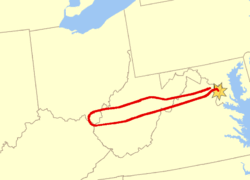
At approximately 8:51 - 8:54, the hijackers launched their assault.[42] The modus operandi of Hanjour's group was in stark contrast to the other three teams, in that while the victims were threatened with knives and box cutters, there were no reports of any injuries or deaths prior to the crash; both pilots were spared when the cockpit was breached, and the use of chemical weapons or bomb threats was not reported by either of the two people who made phone calls from the rear of the cabin.[b] At 08:54, as the plane flew in the vicinity over Pike County, Ohio, it began deviating from its normal assigned flight path and turned south.[44] Two minutes later, the plane's transponder was switched off.[31] The flight's autopilot was promptly engaged and set on a course heading eastbound towards Washington, D.C.[45]
The FAA was aware at this point there was an emergency on board the airplane. After learning of a second hijacking involving an American Airlines aircraft and the hijacking of a United Airlines jet, American Airlines' executive vice president Gerard Arpey ordered a nationwide ground stop for the airline.[31] For several minutes, Indianapolis Air Route Traffic Control Center and dispatchers for American Airlines made several failed attempts to contact the hijacked airliner, giving up just as Flight 175 flew into the World Trade Center's South Tower at 09:03.[46] The plane had been flying over an area of limited radar coverage at the time of its hijacking.[47] With air controllers unable to contact the flight by radio, an Indianapolis official declared that it had possibly crashed at 09:09, twenty-eight minutes before it actually did.[47] Sometime between 09:17 and 09:22, Hanjour broadcast a deceptive announcement via the cabin's public address system, advising those aboard that the plane was being hijacked and that their best chance of survival was by not resisting.[48] This tactic was used on Flight 11 and on Flight 93 with the aim of deceiving the passengers and crew into believing the plan was to land the plane after securing a ransom; in both cases, however, the terrorists’ understanding of the internal communication systems used aboard aircraft was evidently not as good as Hanjour's,[49] as they keyed the wrong microphone and broadcast their message to the ground instead. No passengers aboard Flight 11 reported hearing any intercom messages.[50]
Calls
[edit]Two people on board the aircraft made a total of three phone calls to contacts on the ground. At 09:12, flight attendant Renee May made a phone call lasting just under two minutes to her mother, Nancy May, in Las Vegas.[36] During the phone call, she made the erroneous claim that "six persons" had forced "us" to the rear of the airplane, but did not explain whether the people crowded together were crew members, passengers, or both.[51][31][36] May asked her mother to contact American Airlines, which she and her husband promptly did,[31] although the company was well aware of the hijacking by this point.
At 09:16, Barbara Olson made a call to her husband Ted, quietly explaining that the plane had been hijacked and that those responsible were armed with knives and box cutters.[31][52] She revealed that everyone, including the pilots, had been moved to the back of the cabin and that the call was being made without the knowledge of the hostage takers. The connection dropped a minute into the conversation.[53] Theodore Olson contacted the command center at the Department of Justice, and tried unsuccessfully to contact Attorney General John Ashcroft.[31] Barbara Olson called again five minutes later, informing her husband of the announcement Hanjour―"the pilot"―made over the loudspeaker,[54] and asked him, "What do I tell the pilot to do?"[55] Inquired of her whereabouts, Barbara replied saying that they were flying low over a residential area.[56] In the background, Ted overheard another passenger mentioning that the plane was flying northeast.[57] He then made his wife aware of the suicide attacks on the World Trade Center, causing her to go quiet; Ted wondered if this meant she had been shocked into silence. After expressing their feelings and reassuring one another, the call cut off for the last time, at 9:26 a.m.[58]
Crash
[edit]"The speed, the maneuverability, the way that he turned, we all thought in the radar room, all of us experienced air traffic controllers, that that was a military plane. You don't fly a 757 in that manner. It's unsafe."
At 9:29 a.m., one minute after Flight 93 was hijacked, the terrorists aboard Flight 77 disengaged the autopilot and took manual control of the plane.[45] Turning and descending rapidly as it made its final approach toward Washington, the airplane was detected again on radar screens by controllers at Dulles, who mistook it for a military fighter at first glance due to its high speed and maneuvering.[61]
While Flight 77 was 5 miles (8.0 km) west-southwest of the Pentagon in Arlington County, Virginia, it made a 330-degree spiral turn clockwise. By the end of the revolution, the 757 was descending 2,200 feet (670 m), pointed toward the Pentagon and downtown Washington. Advancing the throttles to full power, Hanjour rapidly began diving toward his target.[62] The wings clipped five street lights as the plane flew level above the ground, while the right wing in particular struck a portable generator, creating a smoke trail seconds before smashing into the Pentagon.[63][64]
Flying at a speed of 530 miles per hour (850 km/h; 240 m/s; 460 kn) over the Navy Annex Building adjacent to Arlington National Cemetery,[65] Flight 77 crashed into the Pentagon's western flank at 09:37:46.[66] The plane struck the establishment at the first-floor level[67] and was rolled slightly to the left, with the right wing elevated as it crashed.[68] The front part of the fuselage immediately disintegrated upon impact, while the mid and tail sections continued moving for another fraction of a second, with tail section debris penetrating farthest into the building.[67] In total, the aircraft took 0.8 seconds to pass 310 feet (94 m) through the three outermost of the structure's five rings[69] and unleashed a fireball that rose 200 feet (61 m) above the building.[67] The 64 people aboard the flight were killed instantly, while a further 125 people in the Pentagon were either killed outright or fatally injured.
In the minutes leading up to the crash, Reagan Airport controllers had asked a passing Air National Guard Lockheed C-130 Hercules to identify and follow the aircraft. The pilot, Lieutenant Colonel Steven O'Brien, told them he believed it was either a Boeing 757 or 767, observing that its silver fuselage meant it was most likely an American Airlines jet. O'Brien mentioned having difficulty picking out the airplane in the "East Coast haze", but moments later reported seeing a "huge" fireball. His initial assumption as he approached the crash site was that the plane had simply hit the ground, but upon closer inspection he saw the damage done to the Pentagon's west side and relayed to Reagan control, "Looks like that aircraft crashed into the Pentagon, sir."[31][70]

At the time of the attacks, approximately 18,000 people worked in the Pentagon, 4,000 fewer than before renovations began in 1998.[71] The section of the Pentagon that was struck, which had recently been renovated at a cost of $250 million (~$448 million in 2024),[72] housed the Naval Command Center.[73]

The fatalities in the Pentagon included 55 military personnel and 70 civilians.[74] Of those 125 killed, 92 were on the first floor, 31 were on the second floor, and two were on the third.[75] Seven Defense Intelligence Agency civilian employees were killed while the Office of the Secretary of Defense lost one contractor. The US Army suffered 75 fatalities – 53 civilians (47 employees and six contractors) and 22 soldiers – while the US Navy suffered 42 fatalities – nine civilians (six employees and three contractors) and 33 sailors.[76] Lieutenant General Timothy Maude, an Army deputy chief of staff, was the highest-ranking military officer killed at the Pentagon; also killed was retired Rear Admiral Wilson Flagg, a passenger on the plane.[77] LT Mari-Rae Sopper, JAGC, USNR, was also on board the flight, and was the first Navy Judge Advocate ever to be killed in action.[78] Another 106 were injured on the ground and were treated at area hospitals.[75]
"I don't want to alarm anybody right now, but apparently – it felt just a few moments ago like there was an explosion of some kind here at the Pentagon."
On the side where the plane hit, the Pentagon is bordered by Interstate 395 and Washington Boulevard. Motorist Mary Lyman, who was on I-395, saw the airplane pass over at a "steep angle toward the ground and going fast" and then saw the cloud of smoke from the Pentagon.[80] Omar Campo, another witness, was on the other side of the road:
I was cutting the grass and it came in screaming over my head. I felt the impact. The whole ground shook and the whole area was full of fire. I could never imagine I would see anything like that here.[81]
Afework Hagos, a computer programmer, was on his way to work and stuck in a traffic jam near the Pentagon when the airplane flew over. "There was a huge screaming noise and I got out of the car as the plane came over. Everybody was running away in different directions. It was tilting its wings up and down like it was trying to balance. It hit some lampposts on the way in."[81] Daryl Donley witnessed the crash and took some of the first photographs of the site.[82]

USA Today reporter Mike Walter was driving on Washington Boulevard when he witnessed the crash:
I looked out my window and I saw this plane, this jet, an American Airlines jet, coming. And I thought, 'This doesn't add up, it's really low.' And I saw it. I mean it was like a cruise missile with wings. It went right there and slammed right into the Pentagon.[83]
Terrance Kean, who lived in a nearby apartment building, heard the noise of loud jet engines, glanced out his window, and saw a "very, very large passenger jet". While he watched, "it just plowed right into the side of the Pentagon. The nose penetrated into the portico. And then it sort of disappeared, and there was fire and smoke everywhere."[84] Tim Timmerman, who is a pilot himself, noticed American Airlines markings on the aircraft as he saw it hit the Pentagon.[85] Other drivers on Washington Boulevard, Interstate 395, and Columbia Pike witnessed the crash, as did people in Pentagon City, Crystal City, and other nearby locations.[80]
Rescue and recovery
[edit]"In this area ... it's so hot that the debris is melting and dripping off the ceiling onto your skin and it would sear your skin and melt your uniform. We went a little farther, turned a corner and came into this bombed out office space that was a roaring inferno of destruction and smoke and flames and intense heat you could feel searing your face."
Rescue efforts began immediately after the crash. Almost all the successful rescues of survivors occurred within half an hour of the impact.[87] Initially, rescue efforts were led by the military and civilian employees within the building. Within minutes, the first fire companies arrived and found these volunteers searching near the impact site. The firefighters ordered them to leave as they were not properly equipped or trained to deal with the hazards.[87]
The Arlington County Fire Department (ACFD) assumed command of the immediate rescue operation within ten minutes of the crash. ACFD Assistant Chief James Schwartz implemented an incident command system (ICS) to coordinate response efforts among multiple agencies.[88] It took about an hour for the ICS structure to become fully operational.[89] Firefighters from Fort Myer and Reagan National Airport arrived within minutes.[90][91] Rescue and firefighting efforts were impeded by rumors of additional incoming planes. Chief Schwartz ordered two evacuations during the day in response to these rumors.[92]

As firefighters attempted to extinguish the fires, they watched the building in fear of a structural collapse. One firefighter remarked that they "pretty much knew the building was going to collapse because it started making weird sounds and creaking."[92] Officials saw a cornice of the building move and ordered an evacuation. Minutes later, at 10:10, the upper floors of the damaged area of the Pentagon collapsed.[92] The collapsed area was about 95 feet (29 m) at its widest point and 50 feet (15 m) at its deepest.[92] The amount of time between impact and collapse allowed everyone on the fourth and fifth levels to evacuate safely before the structure collapsed.[93][94] After 11:00, firefighters mounted a two-pronged attack against the fires. Officials estimated temperatures of up to 2,000 °F (1,090 °C).[94] While progress was made against the interior fires by late afternoon, firefighters realized a flammable layer of wood under the Pentagon's slate roof had caught fire and begun to spread.[95] Typical firefighting tactics were rendered useless by the reinforced structure as firefighters were unable to reach the fire to extinguish it.[95] Firefighters instead made firebreaks in the roof on September 12 to prevent further spreading. At 18:00 on the 12th, Arlington County issued a press release stating the fire was "controlled" but not fully "extinguished". Firefighters continued to put out smaller fires that ignited in the succeeding days.[95]
Various pieces of aircraft debris were found within the wreckage at the Pentagon. While on fire and escaping from the Navy Command Center, Lt. Kevin Shaeffer observed a chunk of the aircraft's nose cone and the nose landing gear in the service road between rings B and C.[96] Early in the morning on Friday, September 14, Fairfax County Urban Search and Rescue Team members Carlton Burkhammer and Brian Moravitz came across an "intact seat from the plane's cockpit",[97] while paramedics and firefighters located the two black boxes near the punch out hole in the A–E drive,[98] nearly 300 feet (91 m) into the building.[68] The cockpit voice recorder was too badly damaged and charred to retrieve any information,[99] though the flight data recorder yielded useful information.[66] Investigators also found a part of Nawaf al-Hazmi's driver's license in the North Parking Lot rubble pile.[100] Personal effects belonging to victims were found and taken to Fort Myer.[101]
Remains
[edit]
Army engineers determined by 17:30 on the first day that no survivors remained in the damaged section of the building.[102] In the days after the crash, news reports emerged that up to 800 people had died.[103] Army soldiers from Fort Belvoir were the first teams to survey the interior of the crash site and noted the presence of human remains.[104] Federal Emergency Management Agency (FEMA) Urban Search and Rescue teams, including Fairfax County Urban Search and Rescue assisted the search for remains, working through the National Interagency Incident Management System (NIIMS).[104][105] Kevin Rimrodt, a Navy photographer surveying the Navy Command Center after the attacks, remarked that "there were so many bodies, I'd almost step on them. So I'd have to really take care to look backwards as I'm backing up in the dark, looking with a flashlight, making sure I'm not stepping on somebody."[106] Debris from the Pentagon was taken to the Pentagon's north parking lot for more detailed search for remains and evidence.[107]
Remains recovered from the Pentagon were photographed, and turned over to the Armed Forces Medical Examiner office, located at Dover Air Force Base in Delaware. The medical examiner's office was able to identify remains belonging to 179 of the victims.[108] Investigators eventually identified 184 of the 189 people who died in the attack.[109] The remains of the five hijackers were identified through a process of elimination, and were turned over as evidence to the Federal Bureau of Investigation (FBI).[110] On September 21, the ACFD relinquished control of the crime scene to the FBI. The Washington Field Office, National Capital Response Squad (NCRS), and the Joint Terrorism Task Force (JTTF) led the crime scene investigation at the Pentagon.[91]
By October 2, 2001, the search for evidence and remains was complete and the site was turned over to Pentagon officials.[107] In 2002, the remains of 25 victims were buried collectively at Arlington National Cemetery, with a five-sided granite marker inscribed with the names of all the victims in the Pentagon.[111] The ceremony also honored the five victims whose remains were never found.[111]
Flight recorders
[edit]
About 03:40 on September 14, a paramedic and a firefighter who were searching through the debris of the impact site found two dark boxes, about 1.5 by 2 feet (46 by 61 cm) long. They called for an FBI agent, who in turn called for someone from the National Transportation Safety Board (NTSB). The NTSB employee confirmed that these were the flight recorders ("black boxes") from American Airlines Flight 77.[112] Dick Bridges, deputy manager for Arlington County, Virginia, said the cockpit voice recorder was damaged on the outside and the flight data recorder was charred. Bridges said the recorders were found "right where the plane came into the building".[113]
The cockpit voice recorder was transported to the NTSB lab in Washington, D.C., to see what data was salvageable. In its report, the NTSB identified the unit as an L-3 Communications, Fairchild Aviation Recorders model A-100A cockpit voice recorder – a device which records on magnetic tape. There were several loose pieces of magnetic tape that were found lying inside of the tape enclosure. No usable segments of tape were found inside the recorder; according to the NTSB's report, "[t]he majority of the recording tape was fused into a solid block of charred plastic".[114] On the other hand, all the data from the flight data recorder, which used a solid-state drive, was recovered.[115]
Continuity of operations
[edit]At the moment of impact, Secretary of Defense Donald Rumsfeld was in his office on the other side of the Pentagon, away from the crash site. He ran to the site and assisted the injured.[116] Rumsfeld returned to his office, and went to a conference room in the Executive Support Center where he joined a secure videoteleconference with Vice President Dick Cheney and other officials.[117] On the day of the attacks, DoD officials considered moving their command operations to Site R, a backup facility in Pennsylvania. Secretary of Defense Rumsfeld insisted he remain at the Pentagon, and sent Deputy Secretary Paul Wolfowitz to Site R. The National Military Command Center (NMCC) continued to operate at the Pentagon, even as smoke entered the facility.[118] Engineers and building managers manipulated the ventilation and other building systems that still functioned to draw smoke out of the NMCC and bring in fresh air.[119]
During a press conference held inside the Pentagon at 18:42, Rumsfeld announced, "The Pentagon's functioning. It will be in business tomorrow."[120] Pentagon employees returned the next day to offices in mostly unaffected areas of the building. By the end of September, more workers returned to the lightly damaged areas of the Pentagon.[107]
Aftermath
[edit]
Early estimates on rebuilding the damaged section of the Pentagon were that it would take three years to complete.[107] However, the project moved forward at an accelerated pace and was completed by the first anniversary of the attack.[121] The rebuilt section of the Pentagon includes a small indoor memorial and chapel at the point of impact.[122] An outdoor memorial, commissioned by the Pentagon and designed by Julie Beckman and Keith Kaseman, was completed on schedule for its dedication on September 11, 2008.[123]
Security camera videos
[edit]The US Department of Defense released filmed footage on May 16, 2006, that was recorded by a security camera of American Airlines Flight 77 crashing into the Pentagon, with a plane visible in one frame, as a "thin white blur" and an explosion following.[124] The images were made public in response to a December 2004 Freedom of Information Act request by Judicial Watch.[125] Some still images from the video had previously been released and publicly circulated, but this was the first official release of the edited video of the crash.[126]
A nearby Citgo service station also had security cameras, but a video released on September 15, 2006, did not show the crash because the camera was pointed away from the crash site.[127][128]
The Doubletree Hotel in the nearby neighborhood of Crystal City also had a security camera video. The FBI released the video on December 4, 2006, in response to a FOIA lawsuit filed by Scott Bingham. The footage is "grainy and the focus is soft, but a rapidly growing tower of smoke is visible in the distance on the upper edge of the frame as the plane crashes into the building."[129]
Memorials
[edit]


On September 12, 2002, Defense Secretary Donald Rumsfeld and General Richard Myers, Chairman of the Joint Chiefs of Staff, dedicated the Victims of Terrorist Attack on the Pentagon Memorial at Arlington National Cemetery.[131] The memorial specifically honors the five individuals for whom no identifiable remains were found.[132] This included Dana Falkenberg, age three, who was aboard American Airlines Flight 77 with her parents and older sister.[132] A portion of the remains of 25 other victims are also buried at the site.[133] The memorial is a pentagonal[134] granite marker 4.5 feet (1.4 m) high.[132] On five sides of the memorial along the top are inscribed the words "Victims of Terrorist Attack on the Pentagon September 11, 2001". Aluminum plaques, painted black, are inscribed with the names of the 184 victims of the terrorist attack.[132] The site is located in Section 64,[135] on a slight rise, which gives it a view of the Pentagon.[132]
At the National September 11 Memorial, the names of the Pentagon victims are inscribed on six panels at the South Pool.[136]
The Pentagon Memorial, located just southwest of The Pentagon in Arlington County, Virginia, is a permanent outdoor memorial to the 184 people who died as victims in the building and on American Airlines Flight 77 during the September 11 attacks.[137] Designed by Julie Beckman and Keith Kaseman of the architectural firm of Kaseman Beckman Advanced Strategies[138] with engineers Buro Happold,[139] the memorial opened on September 11, 2008, seven years after the attack.
Nationalities of victims on the aircraft
[edit]The 53 passengers (excluding the hijackers) and six crew were from:
| Nationality | Passengers | Crew | Total |
|---|---|---|---|
 United States United States |
47 | 6 | 53 |
 China China |
2 | 0 | 2[140] |
 Australia Australia |
1 | 0 | 1 |
 Ethiopia Ethiopia |
1 | 0 | 1 |
 South Korea South Korea |
1 | 0 | 1 |
 United Kingdom United Kingdom |
1 | 0 | 1 |
| Total | 53 | 6 | 59 |
See also
[edit]References
[edit]- ^ "9/11 Commission Staff Report" (PDF). September 2005. pp. 202–203. Retrieved May 6, 2023.
- ^ 9/11 Commission 2004a, p. 372.
- ^ Bergen, Peter (September 23, 2006). "What were the causes of 9/11?". Prospect. Retrieved August 11, 2025.
Three of the four 9/11 pilots and two key planners, Ramzi bin al Shibh and Khalid Sheikh Mohammed, became more militant while living in the west. Perceived discrimination, alienation and homesickness seem to have turned them all in a more radical direction. This is true for other anti-western terrorists.
- ^ "9/11 Commission Staff Report" (PDF). September 2005. p. 18. Retrieved May 6, 2023.
- ^ "9/11 Commission Staff Report" (PDF). September 2005. p. 19. Retrieved May 6, 2023.
- ^ 9/11 Commission 2004a, p. 50.
- ^ 9/11 Commission 2004a, p. 20.
- ^ David W. Chen (September 19, 2001). "A Nation Challenged: The Suspect – Man Traveled Across U.S. In His Quest to Be a Pilot". The New York Times. Archived from the original on November 12, 2014. Retrieved February 8, 2015.
- ^ Yardley, Jim; Thomas, Jo (June 19, 2002). "Traces of Terror: The F.B.I.; For Agent in Phoenix, the Cause of Many Frustrations Extended to His Own Office". The New York Times. Archived from the original on March 17, 2009. Retrieved June 4, 2008.
- ^ "Four Planes, Four Coordinated Teams". The Washington Post. 2001. Archived from the original on February 24, 2011. Retrieved June 17, 2001.
- ^ Sennott, Charles M. (March 3, 2002). "Why bin Laden plot relied on Saudi hijackers". The Boston Globe. Archived from the original on May 13, 2008. Retrieved May 29, 2008.
- ^ a b c d e "The Attack Looms". 9/11 Commission Report. National Commission on Terrorist Attacks Upon the United States. 2004. Archived from the original on October 23, 2013. Retrieved May 29, 2008.
- ^ Wright, Lawrence (2006). "Chapter 18, "Boom"". Looming Tower. Alfred P. Knopf. ISBN 978-0375414862. Archived from the original on January 10, 2020. Retrieved November 14, 2019.
- ^ Bamford, James; Willis, Scott (February 3, 2009). "The Spy Factory". PBS. Archived from the original on April 11, 2014. Retrieved July 2, 2013.
- ^ Goldstein, Amy (September 30, 2001). "Hijackers Led Core Group". The Washington Post. Archived from the original on May 5, 2008. Retrieved May 29, 2008.
- ^ The Spy Factory, PBS Frontline episode based on James Bamford's book, Shadow Factory Archived April 11, 2014, at the Wayback Machine
- ^ a b "Chronology". Monograph on 9/11 and Terrorist Travel (PDF). National Commission on Terrorist Attacks Upon the United States. p. 22. Archived (PDF) from the original on May 29, 2008. Retrieved May 25, 2008.
- ^ a b Martin, John P. (September 27, 2001). "Landlord Identifies Terrorists as Renters". The Star-Ledger.
- ^ Masters, Brooke A.; Smith, Leef; Shear, Michael D. (September 19, 2001). "Dulles Hijackers Made Maryland Their Base; Residents Recall Men as Standoffish". The Washington Post.
The men who hijacked Flight 77 also made a concerted effort to stay in shape. All five visited the Gold's Gym on Greenbelt Road during the first week of September
- ^ Olson, Bradley (September 9, 2006). "MD. Was Among Last Stops For Hijackers; Those Who Recall Encounters Are Haunted By Proximity To Agents Of Tragic Event". The Baltimore Sun. Archived from the original on October 22, 2012. Retrieved May 30, 2008.
- ^ a b 9/11 Commission (2004). "Notes". 9/11 Commission Report. National Commission on Terrorist Attacks Upon the United States. Archived from the original on May 30, 2008. Retrieved May 30, 2008.
{{cite book}}: CS1 maint: numeric names: authors list (link) - ^ Federal Bureau of Investigation (February 4, 2008). "Hijackers' Timeline" (PDF). 9/11 Myths. Archived from the original (PDF) on August 3, 2008. Retrieved August 1, 2008.
- ^ a b c Isikoff, Michael (February 2, 2011). "WikiLeaks cable revives talk of 9/11 support network". MSNBC. Archived from the original on February 11, 2011. Retrieved February 18, 2011.
- ^ "FAA Registry (N644AA)". Federal Aviation Administration.
- ^ "Flight Path Study – American Airlines Flight 77" (PDF). National Transportation Safety Board. February 19, 2002. Archived from the original (PDF) on August 24, 2006. Retrieved May 30, 2008.
- ^ "American Airlines Flight 77". CNN. 2001. Archived from the original on May 12, 2008. Retrieved May 29, 2008.
- ^ a b c "Staff Monograph on the "Four Flights and Civil Aviation Security"" (PDF). National Commission on Terrorist Attacks Upon the United States. September 2005. Archived from the original (PDF) on March 6, 2008. Retrieved August 14, 2008.
- ^ Moraes, Lisa (September 17, 2001). "Letterman's Back Tonight, but Don't Expect a Biting Monologue". The Washington Post.
- ^ "Team from National Geographic Killed in Pentagon Crash". National Geographic Society. September 12, 2001. Archived from the original on May 18, 2008. Retrieved June 10, 2008.
- ^ Brennan, Eamonn (September 12, 2011). "John Thompson's surreal 9/11 story". College Basketball Nation Blog. ESPN.com. Archived from the original on April 8, 2014. Retrieved September 16, 2011.
- ^ a b c d e f g h i "'We Have Some Planes'". 9/11 Commission Report. National Commission on Terrorist Attacks Upon the United States. 2004. Archived from the original on May 14, 2008. Retrieved May 30, 2008.
- ^ "The Aviation Security System and the 9/11 Attacks – Staff Statement No. 3" (PDF). National Commission on Terrorist Attacks Upon the United States. Archived (PDF) from the original on May 28, 2008. Retrieved May 30, 2008.
- ^ a b "New Video of 9/11 hijackers at Dulles Airport before attacks". Anderson Cooper 360. July 21, 2004. CNN. Archived from the original on June 1, 2013.
- ^ Orecklin, Michele; Land, Greg (November 19, 2001). "Why Argenbright Sets Off Alarms". Time. Archived from the original on August 23, 2013. Retrieved May 30, 2008.
- ^ "Out of the Ashes: How the Tragedy of September 11 Left Its Mark on the National Marine Sanctuary System".
- ^ a b c "Summary of Flight 77". United States District Court for the Eastern District of Virginia. Archived from the original on February 1, 2014. Retrieved February 4, 2007.
- ^ National Commission on Terrorist Attacks Upon the United States (2004). "Chapter 1". 9/11 Commission Report. Government Printing Office. p. 21.
- ^ "Dulles air traffic controller recalls 'chilling' day - October 24, 2001". CNN. Archived from the original on May 18, 2021.
- ^ "Air Traffic Controllers Recall 9/11". ABC News. Archived from the original on March 24, 2009. Retrieved June 27, 2020.
- ^ (9/11 Commission 2004a, p. 25, chpt. 1)
- ^ Gregor, Joseph A. (December 21, 2001). "ATC Report American Airlines Flight 77" (PDF). National Transportation Safety Board. Archived from the original (PDF) on October 29, 2012. Retrieved September 25, 2011.
- ^ (9/11 Commission 2004a, p. 27, chpt. 1)
- ^ "Final Report of the 9/11 Commission" (PDF). National Commission on Terrorist Attacks Upon the United States. 2004. p. 26.
- ^ Sciolino, Elaine; Cushman, John H. Jr. (September 13, 2001). "After the Attacks: American Flight 77; A Route Out of Washington, Horribly Changed". The New York Times. ISSN 0362-4331. Retrieved April 27, 2021.
- ^ a b O'Callaghan, John; Bower, Daniel (February 13, 2002). "Study of Autopilot, Navigation Equipment, and Fuel Consumption Activity Based on United Airlines Flight 93 and American Airlines Flight 77 Digital Flight Data Recorder Information" (PDF). National Transportation Safety Board. Archived from the original (PDF) on June 4, 2011. Retrieved June 1, 2008.
- ^ "Flight Path Study - American Airlines Flight 77" (PDF). February 19, 2002. Retrieved May 27, 2023.
- ^ a b Phillips, Don (November 3, 2001). "Pentagon Crash Highlights a Radar Gap". The Washington Post.
- ^ (9/11 Commission 2004a, p. 29, chpt. 1)
- ^ "The First 109 Minutes: 9/11 and the U.S. Air Force" (PDF). 2011. p. 37.
- ^ "Final Report of the 9/11 Commission" (PDF). National Commission on Terrorist Attacks Upon the United States. 2004. pp. 36 and 46.
- ^ "Home | National Security Archive". nsarchive.gwu.edu.
- ^ Johnson, Glen (November 23, 2001). "Probe reconstructs horror, calculated attacks on planes". The Boston Globe. Archived from the original on June 8, 2008. Retrieved June 1, 2008.
- ^ O'Brien, Tim (September 11, 2001). "Wife of Solicitor General alerted him of hijacking from plane". CNN. Archived from the original on March 10, 2013. Retrieved September 25, 2011.
- ^ (9/11 Commission 2004a, p. 26, chpt. 1)
- ^ Laura Parker (September 13, 2001). "Four flights, four tales of terror". USA Today. Archived from the original on March 8, 2016. Retrieved February 8, 2015.
- ^ Producers: Colette Beaudry and Michael Cascio (September 23, 2005). "Zero Hour". Inside 9/11. National Geographic Channel.
- ^ National Commission on Terrorist Attacks Upon the United States (2004). "Chapter 1". 9/11 Commission Report. Government Printing Office. p. 9.
- ^ Harnden, Toby (March 5, 2002). "'She Asked Me How to Stop the Plane'". The Telegraph. United Kingdom: Telegraph Group Limited. Archived from the original on September 5, 2008.
- ^ "Flight 77, Video 2". Judicial Watch. Archived from the original on February 12, 2009.
- ^ "Air Traffic Controllers Recall 9/11". 20/20. ABC News. October 24, 2001. Archived from the original on September 29, 2013. Retrieved June 5, 2008.
- ^ Fisher, Marc; Phillips, Don (September 12, 2001). "On Flight 77: 'Our Plane Is Being Hijacked'". The Washington Post. Archived from the original on January 11, 2016. Retrieved June 1, 2008.
- ^ National Commission on Terrorist Attacks Upon the United States (2004). "Chapter 1". 9/11 Commission Report. Government Printing Office. p. 27.
- ^ "9/11 Survivor Wants Life For Moussaoui". WRC-TV. April 25, 2006. Archived from the original on October 9, 2008. Retrieved June 2, 2008.
- ^ Curiel, Jonathan (September 3, 2006). "The Conspiracy to Rewrite 9/11". San Francisco Chronicle. Archived from the original on May 19, 2008. Retrieved June 2, 2008.
- ^ Goldberg et al., p. 14.
- ^ a b "American Airlines Flight 77 FDR Report" (PDF). National Transportation Safety Board. January 31, 2002. Archived (PDF) from the original on September 26, 2007. Retrieved June 2, 2008.
- ^ a b c Goldberg, Alfred; et al. (2007). Pentagon 9/11. Washington, D.C.: United States Government Printing Office. p. 17. ISBN 978-0160783289.
- ^ a b Mlakar, Paul F.; Dusenberry, Donald O.; Harris, James R.; Haynes, Gerald; Phan, Long T.; Sozen, Mete A. (January 2003). The Pentagon Building Performance Report (PDF). American Society of Civil Engineers. Archived (PDF) from the original on June 24, 2008. Retrieved June 19, 2008.
- ^ John N. Maclean (August 1, 2008). "America Under Attack". The Washington Post. Archived from the original on December 18, 2014. Retrieved February 8, 2015.
- ^ Schmitt, Eric; Lichtblau, Eric (June 18, 2004). "To the Minute, Panel Paints a Grim Portrait of Day's Terror". The New York Times. Archived from the original on April 9, 2014. Retrieved June 1, 2008.
- ^ Goldberg et al., p. 3.
- ^ "Phoenix Rising: The Rebuilding of the Pentagon" (Flash). The Washington Post. Archived from the original on April 9, 2008. Retrieved June 2, 2008.
- ^ Zablotsky, Sarah (June 11, 2003). "Survivor of Pentagon attack has a positive attitude". Pittsburgh Post-Gazette. Archived from the original on December 5, 2011. Retrieved June 2, 2008.
- ^ Andrea Stone (August 20, 2002). "Military's aid and comfort ease 9/11 survivors' burden". USA Today. Archived from the original on March 11, 2015. Retrieved February 8, 2015.
- ^ a b Goldberg et al., pp. 23–24.
- ^ Goldberg, Alfred, Pentagon 9/11, pp. 208–212.
- ^ "Sept. 11 fallen warrior memorialized in building dedication" (Press release). United States Army. April 30, 2002. Archived from the original on January 3, 2010. Retrieved June 10, 2008.
- ^ "Mari-Rae Sopper: 9112001". Mari-rae.net. Archived from the original on August 5, 2013. Retrieved April 8, 2014.
- ^ "'Hardball with Chris Matthews' for May 16". Hardball with Chris Matthews. NBC News. May 16, 2006. Archived from the original on May 30, 2014. Retrieved May 30, 2008.
- ^ a b "Terrible Tuesday". The Washington Post. September 16, 2001.
- ^ a b Borger, Julian (September 12, 2001). "'Everyone was screaming, crying, running. It's like a war zone'". The Guardian. London. Archived from the original on May 16, 2008. Retrieved June 19, 2008.
- ^ "Documentary Photographs". Library of Congress, Prints and Photographs Division. Archived from the original on November 11, 2006. Retrieved November 12, 2006.
- ^ Anderson, Porter (September 11, 2001). "Witnesses to the moment: Workers' voices". CNN. Archived from the original on June 30, 2009. Retrieved June 10, 2008.
- ^ Sheridan, Mary B (September 12, 2001). "Loud Boom, Then Flames In Hallways; Pentagon Employees Flee Fire, Help Rescue Injured Co-Workers". The Washington Post. Archived from the original on October 12, 2018. Retrieved October 12, 2018.
- ^ "Transcripts – America Under Attack: Eyewitness Discusses Pentagon Plane Crash". CNN. September 11, 2001. Archived from the original on March 19, 2013. Retrieved June 10, 2008.
- ^ Goldberg et al., pp. 55–56.
- ^ a b Goldberg et al., p. 51.
- ^ Goldberg et al., p. 72.
- ^ Goldberg et al., p. 77.
- ^ Goldberg et al., p. 78.
- ^ a b "Arlington, Virginia After-Action Report" (PDF). Arlington County Fire Department. Archived from the original (PDF) on September 27, 2007. Retrieved June 10, 2008.
- ^ a b c d Goldberg et al., pp. 80–82.
- ^ Goldberg et al., p. 20.
- ^ a b Goldberg et al., pp. 86–90.
- ^ a b c Goldberg et al., pp. 91–95.
- ^ Swift, Earl (September 9, 2002). "Inside the Pentagon on 9/11: The Call of Duty". The Virginian-Pilot (Hampton Roads). Archived from the original on July 30, 2004.
- ^ "Web Exclusive: Washington's Heroes – On the ground at the Pentagon on Sept. 11". MSNBC. September 28, 2001. Archived from the original on September 10, 2010.
- ^ Creed, Patrick; Rick Newman (2008). "Chapter 41: A Great Find". Firefight: Inside the Battle to Save the Pentagon on 9/11. Random House.
- ^ Murray, Frank J. (September 15, 2001). "Pentagon plane voice recorder is too 'cooked' to aid in probe". The Washington Times.
- ^ "Prosecution Trial Exhibits – Exhibit Number PE00102". United States District Court for the Eastern District of Virginia. Archived from the original on February 9, 2014. Retrieved June 19, 2008.
- ^ Wilkinson, Marian (September 9, 2002). "Capital punishment". Melbourne: The Age (Australia). Archived from the original on November 14, 2013. Retrieved June 24, 2008.
- ^ Goldberg et al., p. 97.
- ^ "Twin Towers Demolished, Pentagon Hit in Terrorist Attacks". Foxnews.com. September 12, 2001. Archived from the original on May 1, 2013. Retrieved June 10, 2008.
- ^ a b Goldberg et al., p. 119.
- ^ Eversburg, Rudy (November 1, 2002). "The Pentagon Attack on 9-11: Arlington County (VA) Fire Department Response". Fire Engineering. Archived from the original on January 4, 2014. Retrieved June 10, 2008.
- ^ Goldberg et al., pp. 121–122.
- ^ a b c d Vogel, Steve (October 3, 2001). "Search for Remains Ends at Pentagon". The Washington Post.
- ^ "Mass Fatality Management for Incidents Involving Weapons of Mass Destruction" (PDF). U.S. Army Research Development and Engineering Command and the Office for Domestic Preparedness. August 2005. Archived from the original (PDF) on August 2, 2008. Retrieved June 24, 2008.
- ^ Kelly, Christopher (November 29, 2001). "Forensic feat IDs nearly all Pentagon victims". Stripe. Archived from the original on May 13, 2011. Retrieved June 27, 2008.
- ^ Vogel, Steve (November 21, 2001). "Remains Unidentified For 5 Pentagon Victims; Bodies Were Too Badly Burned, Officials Say". The Washington Post.
- ^ a b Steve Vogel (September 13, 2002). "Lost and, Sometimes, Never Found". The Washington Post. Archived from the original on October 17, 2014. Retrieved February 8, 2015.
- ^ Rosenberg, Debra (September 28, 2001). "Washington's Heroes: On the ground at the Pentagon on Sept. 11". MSNBC. Archived from the original on May 26, 2004. Retrieved November 2, 2009.
- ^ "Searchers find Pentagon black boxes". USA Today. Associated Press. September 14, 2001. Archived from the original on November 8, 2014. Retrieved February 8, 2015.
- ^ "Specialist's Factual Report of Investigation: Cockpit Voice Recorder". National Transportation Safety Board. April 30, 2002. Archived from the original on April 11, 2014. Retrieved November 2, 2009.
- ^ "Specialist's Factual Report of Investigation: Digital Flight Data Recorder" (PDF). NTSB. January 31, 2002. Archived from the original (PDF) on October 10, 2012. Retrieved February 28, 2014.
- ^ Vobejda, Barbara (September 11, 2001). "'Extensive Casualties' in Wake of Pentagon Attack". The Washington Post. Archived from the original on April 25, 2011. Retrieved June 20, 2008.
- ^ Creed, Patrick; Rick Newman (2008). Firefight: Inside the Battle to Save the Pentagon on 9/11. Presidio Press. pp. 276–277. ISBN 978-0891419051.
- ^ "Battling the Pentagon Blaze After 9/11". NPR/WHYY – Fresh Air. May 22, 2008. Archived from the original on February 27, 2014. Retrieved June 24, 2008.
- ^ Creed and Newman, p. 278
- ^ "DoD News Briefing on Pentagon Attack". United States Department of Defense. September 11, 2001. Archived from the original on June 7, 2008. Retrieved June 24, 2008.
- ^ "Project Phoenix: Pentagon offices rise from rubble". CNN. September 4, 2002. Archived from the original on June 10, 2009. Retrieved June 24, 2008.
- ^ Kevin Freking (September 9, 2006). "Public Honors 9/11 Fallen at Pentagon". The Washington Post. Archived from the original on February 8, 2015. Retrieved February 8, 2015.
- ^ Shaughnessy, Larry (May 24, 2008). "Nearly complete Pentagon memorial tells story of 9/11". CNN. Archived from the original on October 25, 2012. Retrieved September 12, 2011.
- ^ "Video of 9/11 plane hitting Pentagon is released". NBC News. Associated Press. May 16, 2006. Archived from the original on May 30, 2014. Retrieved June 10, 2008.
- ^ "Judicial Watch Obtains September 11 Pentagon Video" (Press release). Judicial Watch. May 16, 2006. Archived from the original on May 11, 2008. Retrieved June 11, 2008.
- ^ "Images show September 11 Pentagon crash". CNN. March 8, 2002. Archived from the original on May 31, 2008. Retrieved June 11, 2008.
- ^ "CITGO Gas Station Cameras Near Pentagon Evidently Did Not Capture Attack" (Press release). Judicial Watch. September 15, 2006. Archived from the original on May 1, 2008. Retrieved June 11, 2008.
- ^ "Videotapes dispel conspiracy; Plane, not missile seen hitting Pentagon on 9/11". The Washington Times. May 17, 2006.
- ^ "FBI Releases New Footage of 9/11 Pentagon Attack". KWTX-TV. December 4, 2006. Archived from the original on December 8, 2006. Retrieved June 11, 2008.
- ^ "South Pool: Panel S-74 – Timothy J. Maude". National September 11 Memorial & Museum. Archived from the original on July 27, 2013. Retrieved October 29, 2011.
- ^ Garamone, Jim. "Remains of Pentagon Attack Victims Buried at Arlington". American Forces Press Service. September 12, 2002. Accessed September 7, 2011.
- ^ a b c d e Cass, Connie. "Cremated Remains of Pentagon Victims Are Laid to Rest at National Cemetery". Associated Press. September 13, 2002.
- ^ "Arlington Funeral Honors Unidentified Victims". CNN.com. September 12, 2002. Accessed September 7, 2011. [1]
- ^ Pusey, Allen. "Final Service Honors Victims of Pentagon Attack". Dallas Morning News. September 13, 2002.
- ^ Vogel, Steve. "Lost and, Sometimes, Never Found". Washington Post. September 13, 2002.
- ^ About: The Memorial Names Layout. Memorial Guide: National 9/11 Memorial. Retrieved December 11, 2011. Archived July 27, 2013, at the Wayback Machine
- ^ "Pentagon Memorial Project Schedule". Pentagon Renovation Program. Archived from the original on March 13, 2003. Retrieved October 12, 2006.
- ^ Miroff, Nick (September 11, 2008). "Creating a Place Like No Other". The Washington Post. Archived from the original on August 20, 2011. Retrieved July 26, 2011.
- ^ "Pentagon Memorial". Archived from the original on September 10, 2010. Retrieved September 12, 2010.
- ^ "Spokesman on the terrorist attacks on New York and Washington". Consulate General of China, New York. September 13, 2001. Archived from the original on June 3, 2002. Retrieved June 3, 2002.
- ^ The aircraft was a Boeing 757-200 model; Boeing assigns a unique code for each company that buys one of its aircraft, which is applied as an infix to the model number at the time the aircraft is built, hence "757-223" designates a 757-200 built for American Airlines (customer code 23).
- ^ Although the two people who made phone calls did not mention the use of chemical weapons or bomb threats, the 9/11 Commission noted that both of them were originally from the first-class cabin and had been moved to the rear, implying the first class area may have been uninhabitable.[43]
Works cited
[edit]- Final Report of the 9/11 Commission on Terrorist Attacks Upon the United States (PDF) (Report). National Commission on Terrorist Attacks Upon the United States. July 22, 2004. Archived (PDF) from the original on August 16, 2021. Retrieved August 15, 2021.
External links
[edit]
- Picture of Aircraft Pre 9-11
- Arlington County After-Action Report, July 23, 2002
- "American Airlines site with condolences for deceased". Archived from the original on September 11, 2001. Retrieved October 18, 2006. (September 11, 2001)
- "American Airlines site with condolences for deceased". Archived from the original on September 12, 2001. Retrieved October 18, 2006. (September 12, 2001)

| National | |
|---|---|
| Other | |

American Airlines Flight 77
View on GrokipediaAircraft and Route
Aircraft Specifications
![Boeing 757-223 N644AA, American Airlines, Phoenix Sky Harbor International Airport, December 2000][float-right]The aircraft was a Boeing 757-223 narrow-body jet airliner, registered as N644AA, manufactured by Boeing Commercial Airplanes with manufacturer's serial number 24602.[6][7] It completed its first flight on April 25, 1991, and was delivered to American Airlines on May 8, 1991.[6][7] At the time of the incident on September 11, 2001, the airframe had accumulated 33,432 flight hours over 11,789 cycles.[8] The Boeing 757-200 variant, to which the -223 belongs, measures 155 feet 3 inches (47.32 meters) in length with a wingspan of 124 feet 10 inches (38.05 meters) and a height of 44 feet 6 inches (13.56 meters).[9] Its maximum takeoff weight is 255,000 pounds (115,680 kilograms), supported by a fuel capacity of approximately 11,489 U.S. gallons (43,490 liters).[10][9] Powered by two Rolls-Royce RB211-535E4 high-bypass turbofan engines mounted under the wings, each providing up to 40,100 pounds-force (178 kN) of thrust, the aircraft had a maximum cruising speed of Mach 0.80 (approximately 530 miles per hour or 850 kilometers per hour at altitude) and a range of about 3,900 nautical miles (7,222 kilometers) with typical passenger loads.[11][9] The standard configuration accommodated 178 to 239 passengers across two classes, though American Airlines typically fitted their 757-223s for 188 seats.[10][9]
Scheduled Route and Context
American Airlines Flight 77 (AA77) was a scheduled domestic transcontinental passenger flight from Washington Dulles International Airport (IAD) near Chantilly, Virginia, to Los Angeles International Airport (LAX).[12] The route spanned approximately 2,100 nautical miles westward across the United States, operating as a routine morning service typical of American Airlines' daily transcontinental offerings between East Coast hubs and West Coast destinations.[3] The flight was timetable for departure at 8:10 a.m. Eastern Daylight Time on September 11, 2001, with an estimated flight duration of about five hours under normal conditions.[12] That morning featured temperate weather with nearly cloudless skies over the eastern U.S., facilitating standard pre-flight preparations at Dulles, a major hub handling high volumes of cross-country traffic.[1] No unusual security alerts or operational anomalies were reported for the flight's scheduling prior to boarding.[13]Crew, Passengers, and Hijackers
Flight Crew
The flight crew of American Airlines Flight 77 consisted of two pilots: Captain Charles F. "Chic" Burlingame III and First Officer David S. Charlebois.[12][14] The aircraft was a Boeing 757-223 operating the scheduled domestic flight from Washington Dulles International Airport to Los Angeles International Airport on September 11, 2001.[12] Captain Burlingame, 51 years old and residing in Herndon, Virginia, had graduated from the United States Naval Academy in 1971 and served as a fighter pilot in the Navy, accumulating experience on the F-4 Phantom II.[15] He joined American Airlines in 1979, logging over 20 years of service and more than 10,000 flight hours, including on Boeing 757 aircraft.[15] Burlingame was survived by his wife, daughter, and grandson.[15] First Officer Charlebois, aged 39, was born in Kenitra, Morocco, and raised partly in Paris, France, before moving to the United States, where he lived in the Dupont Circle neighborhood of Washington, D.C.[5] He began his commercial aviation career in 1988 with USAir, later transitioning to American Airlines, and had served as a corporate pilot prior to that.[16] Charlebois contributed to the flight's operation from the right seat, handling standard pre-departure and takeoff duties alongside Burlingame.[12]Cabin Crew and Passengers
The cabin consisted of four American Airlines flight attendants: Renee A. May, aged 39 from Baltimore, Maryland; Michele L. Heidenberger, aged 57 from Chevy Chase, Maryland; Jennifer J. Lewis, aged 38 from Culpeper, Virginia; and Kenneth E. Lewis, aged 49 from Leesburg, Virginia, the latter two being a married couple based at Washington Dulles International Airport.[17][15][18] May, a former operations agent for the airline, had returned to flight duties after maternity leave earlier that year, while Heidenberger was a veteran attendant with over three decades of service.[15][19] Excluding the five hijackers, the flight carried 53 passengers, comprising 26 men, 22 women, and five children ranging in age from 3 to 11 years old.[17][15] Among them were government employees, such as Barbara K. Olson, a 45-year-old conservative commentator and wife of U.S. Solicitor General Theodore Olson, who was en route to Los Angeles for professional engagements; and several children, including Asia Cottom, an 11-year-old sixth-grader from Washington, D.C., traveling with her mother and stepfather.[15][20] The passengers hailed primarily from the Washington, D.C., area and included professionals from sectors like healthcare, finance, and defense contracting, reflecting the flight's origin at Dulles Airport serving business travelers bound for the West Coast.[15][21]Hijackers and Their Preparation
The hijackers of American Airlines Flight 77 were five Saudi nationals affiliated with al-Qaeda: Hani Hanjour, who served as the pilot; Khalid al-Mihdhar; Nawaf al-Hazmi; Salem al-Hazmi, Nawaf's younger brother; and Majed Moqed.[22] All had undergone training in al-Qaeda camps in Afghanistan, focusing on physical fitness, weapons handling, and basic hijacking tactics during late 2000 to early 2001, though none except Hanjour received specialized aviation instruction there.[22] Nawaf al-Hazmi and Khalid al-Mihdhar, both veteran al-Qaeda operatives, were the first to arrive in the United States on January 15, 2000, at Los Angeles International Airport.[22] They relocated to San Diego by February 4, 2000, where they attempted flight lessons at a local school in May 2000 but abandoned the effort due to limited English proficiency and disinterest in non-pilot roles.[22] Al-Mihdhar departed the U.S. on June 9, 2000, while Nawaf al-Hazmi remained, later receiving logistical support from local contacts including Mohdar Abdullah for housing and finances.[22] Both reconnected with al-Qaeda networks, including imam Anwar al-Awlaki in San Diego.[22] Hani Hanjour, designated as the muscle hijacker-turned-pilot, had prior U.S. flight training starting in 1991, earning a commercial pilot certificate by 1999.[23] He re-entered the U.S. on December 8, 2000, at Cincinnati/Northern Kentucky International Airport on a student visa and pursued refresher courses in Arizona, including multi-engine certification and simulator practice at schools like Arizona Aviation and Pan Am International Flight Academy through March 2001.[22] Hanjour joined Nawaf al-Hazmi in Virginia by April 2001, where they shared an apartment and obtained fraudulent identification documents, including Virginia IDs in August 2001 via contacts with Salvadoran forgers.[23] Salem al-Hazmi and Majed Moqed, recruited as muscle hijackers, arrived together at Dulles International Airport on May 2, 2001.[22] Salem, who had basic English skills from prior U.S. visits, briefly attended a community college in Saudi Arabia but focused on al-Qaeda training; Moqed worked as a civil engineer in Saudi Arabia before radicalization.[22] Both secured U.S. identification, including Virginia IDs in August 2001, and joined the group in the Washington, D.C., area.[23] Khalid al-Mihdhar returned to the U.S. on July 4, 2001, at New York, completing the team.[23] In the final weeks, the hijackers consolidated in the Laurel, Maryland, area by early September 2001, about 20 miles from Washington, D.C., staying in motels, frequenting gyms for physical conditioning, and coordinating via Mohamed Atta, who visited on September 7.[22] They purchased one-way tickets for Flight 77 between August 25 and September 5, 2001, using cash and credit cards, and moved to a Herndon, Virginia, hotel on September 10.[22] This preparation emphasized operational security, minimal communication, and reliance on Hanjour's piloting skills for the suicide mission.[22]Pre-Hijacking Events
Boarding Process
The boarding process for American Airlines Flight 77 occurred at Washington Dulles International Airport's Gate D26, where passengers and the five hijackers checked in and passed through security screening in the Main Terminal's west checkpoint between approximately 7:15 a.m. and 7:50 a.m. on September 11, 2001.[1] The flight carried 58 passengers, including the hijackers, along with six crew members, for a total of 64 people aboard; this load was slightly above average for the route.[1] The hijackers—Hani Hanjour, Khalid al-Mihdhar, Majed Moqed, Nawaf al-Hazmi, and Salem al-Hazmi—arrived in two groups, used tickets purchased in June or July 2001 with U.S. identification (some fraudulent), and were assigned seats in first class (Hanjour in 1B) and coach (the others in rows 5 and 12).[1] Check-in began at 7:15 a.m. for al-Mihdhar and Moqed, followed by the al-Hazmi brothers at 7:29 a.m. and Hanjour by 7:35 a.m..[1] Four of the hijackers (Hanjour, al-Mihdhar, Moqed, and Nawaf al-Hazmi) were flagged by the Computer-Assisted Passenger Prescreening System (CAPPS) for additional baggage scrutiny, resulting in their checked bags being held until boarding confirmation; the al-Hazmi brothers also drew attention due to Nawaf's lack of photo ID and language difficulties, though no further personal searches occurred.[1] During security screening, al-Mihdhar and Moqed triggered metal detectors at 7:18 a.m. and were hand-wanded without detection of prohibited items; Hanjour set off alarms twice around 7:35 a.m. but cleared after supplemental checks; and Nawaf al-Hazmi triggered alarms twice, underwent hand-wanding, and had his bag tested with an explosive trace detector, passing without issue.[1] [24] Salem al-Hazmi cleared screening shortly after his brother. Airport surveillance video captured the hijackers passing through checkpoints, revealing no overt suspicious behavior despite these alerts, and screeners failed to detect the knives and box cutters later used in the hijacking.[24] The remaining passengers boarded routinely through Gate D26 without reported anomalies, completing the process by around 7:50 a.m. when the hijackers also entered the aircraft.[1] The flight pushed back from the gate at 8:09 a.m. and departed at 8:20 a.m., 10 minutes behind schedule.[1] Pre-9/11 aviation security protocols, including metal detector calibration and prescreening limitations, allowed the hijackers to board undetected despite the CAPPS flags and screening triggers, as documented in official investigations.[1]Departure from Dulles
American Airlines Flight 77, operated by a Boeing 757-223 registered as N644AA, pushed back from Gate D26 at Washington Dulles International Airport at 8:09 a.m. EDT on September 11, 2001.[25] The aircraft taxied to Runway 30 amid typical morning congestion and became airborne at 8:20 a.m., following a delay of approximately 10 to 20 minutes from its scheduled departure time due to ground traffic.[25][26][1]
After takeoff, Flight 77 followed its initial assigned departure procedures, climbing northwest toward its cruising altitude of 35,000 feet while maintaining radar and radio contact with air traffic control.[2] The weather at Dulles was clear with good visibility, posing no operational issues for the departure.[25] The flight carried 58 passengers, 4 flight attendants, and 2 pilots, with a total of 64 people on board.[1]
Hijacking Sequence
Initial Takeover
The hijackers seized control of the cockpit on American Airlines Flight 77 between 8:51 a.m. and 8:54 a.m. EDT on September 11, 2001, approximately 31 minutes after the Boeing 757-223 departed from Washington Dulles International Airport.[1] The five hijackers—Hani Hanjour, Khalid al-Mihdhar, Nawaf al-Hazmi, Salem al-Hazmi, and Majed Moqed—used box cutters and knives smuggled past security checkpoints to storm the flight deck, exploiting the open cockpit door policy during the aircraft's climb.[1] [27] The last routine radio transmission from Captain Charles Burlingame III to air traffic control occurred at 8:51 a.m., after which the cockpit fell silent to ground communications.[1] The hijackers stabbed multiple flight attendants, including Michelle Heidenberger and Renee May, and slit the throat of at least one passenger to subdue resistance and herd the remaining 58 passengers and crew to the rear of the cabin.[1] They claimed to possess a bomb, though none was found post-crash, and issued commands in accented English, such as demands for the aircraft to land or face consequences.[1] The cockpit voice recorder, recovered from the Pentagon crash site, captured audio of the struggle, including shouts, thuds indicating violence, and hijacker utterances asserting control, confirming the rapid and violent nature of the takeover.[1] Hani Hanjour, seated in first class (1B), assumed the pilot controls, while the other hijackers, positioned in rows 7 and 12, provided support in restraining the crew and passengers.[1] This phase marked the end of normal flight operations, with the transponder disabled by 8:56 a.m., initiating the aircraft's deviation from its assigned westbound route.[1]Communications from the Aircraft
The hijacking of American Airlines Flight 77 occurred between 8:51 a.m. and 8:54 a.m. Eastern Daylight Time on September 11, 2001, after which no radio transmissions were made from the cockpit to air traffic control.[1] The last routine contact with Indianapolis Air Route Traffic Control Center had occurred at 8:51 a.m., when the controller cleared the flight to climb to 35,000 feet.[1] At 8:56 a.m., the aircraft's transponder was disabled, eliminating secondary radar data such as altitude and identification, though primary radar continued to track the plane's position intermittently.[1] No ACARS messages or emergency radio calls were transmitted by the crew or hijackers, distinguishing Flight 77 from other hijacked aircraft that day that issued distress signals or announcements.[1] The only confirmed outgoing communications from the aircraft were three brief airphone calls placed by individuals aboard, providing direct evidence of the hijacking to ground contacts.[1] At 9:12 a.m., flight attendant Renee May dialed an American Airlines reservations office in Las Vegas, reporting that the plane had been hijacked, that passengers and crew were being stabbed with knives, and that the hijackers appeared to number five.[1] The call lasted approximately two minutes before disconnecting.[28] Passenger Barbara Olson, a commentator and wife of then-Deputy U.S. Solicitor General Theodore Olson, made two separate calls to her husband at the Department of Justice between 9:18 a.m. and 9:20 a.m.[1] In the first call, she stated that the flight had been hijacked without weapons visible to her initially, and that passengers had been herded to the rear of the aircraft.[1] Theodore Olson advised her to ask the pilot for the flight's status, to which she replied that the pilot was no longer in control and had likely been incapacitated.[1] The second call reiterated the hijacking, specifying that the assailants wielded knives and box cutters, and confirmed a stabbing of a crew member.[1] Both calls ended abruptly, with no further details on resistance or the hijackers' demands.[1] These calls represented the sole real-time reports from Flight 77 reaching authorities or family members, informing early ground awareness of the onboard violence involving edged weapons but lacking specifics on the hijackers' identities or intentions.[1] No additional calls were documented, and the aircraft proceeded silently toward its impact with the Pentagon at 9:37 a.m.[1] The details emerged primarily from Theodore Olson's recollections and airline records, as corroborated in official investigations.[1]Flight Path Deviation and Crash
Radar and Transponder Data
The transponder on American Airlines Flight 77, which provided secondary radar returns including the aircraft's identity and altitude, operated normally from its departure at 8:20 a.m. EDT until 8:56 a.m. EDT, when it was deactivated by the hijackers shortly after the initial deviation from its assigned flight path over eastern Kentucky.[3] Primary radar, relying on reflected signals from the aircraft's skin without transponder assistance, continued to detect the Boeing 757 following transponder deactivation, though initial contacts were intermittent due to gaps in coverage and the aircraft's maneuvers away from primary radar beams.[29][30] By approximately 9:05 a.m., continuous primary radar tracking was reestablished as the aircraft executed a westward then southward course before initiating its return eastward toward Washington, D.C., with data from FAA facilities including the Indianapolis Air Route Traffic Control Center and later the Washington Air Route Traffic Control Center.[25] Radar returns indicated the aircraft descending from its cruising altitude of 35,000 feet by 9:00 a.m., leveling near 7,000 feet around 9:29 a.m. approximately 35 miles west of the Pentagon after autopilot disengagement.[3] At 9:34 a.m., primary radar positioned the aircraft 3.5 miles west-southwest of the Pentagon, from which it began a right 330-degree descending spiral turn, reaching about 2,000 feet altitude by its completion, maintaining track until impact at 9:37:45 a.m.[3] Post-event analysis by the National Transportation Safety Board and the U.S. Air Force's 84th Radar Evaluation Squadron integrated FAA primary radar data with flight data recorder parameters to reconstruct the full trajectory, confirming the hijackers' control and the absence of any distress signals in the radar record.[2] This reconstruction highlighted limitations in real-time primary radar utility, such as lack of altitude information and reduced precision compared to secondary returns, which complicated immediate air traffic control responses but enabled precise forensic verification.[31] Military radar systems, including those monitored by NORAD, did not provide independent primary tracking of Flight 77 until after the hijacking was inferred from civilian data, with notifications occurring too late for interception.[32]Approach and Impact on the Pentagon
Following the hijacking, American Airlines Flight 77 disengaged its autopilot around 9:29 a.m. EDT and executed a 330-degree descending spiral turn over southern Ohio, eastern West Virginia, and northern Virginia, rapidly losing altitude from approximately 7,000 feet to 2,200 feet by 9:34 a.m.[1] [3] The Boeing 757 then initiated its final approach to the Pentagon from the southwest, descending further to an altitude of 50 to 1,000 feet while accelerating to a ground speed of about 530 miles per hour (460 knots).[2] [1] In the final descent, the aircraft flew low over Arlington County, Virginia, skimming treetops, clipping five light poles along Interstate 395, and passing just above the Navy Annex building, as corroborated by radar data, flight data recorder parameters, and multiple eyewitness accounts from motorists and Pentagon personnel.[1] [3] The hijacker-pilot, Hani Hanjour, maintained control through a shallow bank and leveled the plane at roughly 50 feet above ground level seconds before impact, approaching the Pentagon's western facade at a 42-degree angle to the building face.[2] [3] At 9:37:45 a.m. EDT on September 11, 2001, Flight 77 struck the Pentagon's Wedge 1 section between Corridors 4 and 5 on the first floor (E Ring), penetrating diagonally through the E, D, and C rings over 310 feet into the structure.[1] [3] The high-speed impact caused the aircraft to largely disintegrate, scattering debris across the site and igniting a fireball from its remaining 7,256 gallons of jet fuel, which fueled intense fires across multiple floors.[2] [3] This event resulted in the immediate deaths of all 64 people aboard the aircraft, with structural effects including an initial entry hole about 75 feet wide matching the fuselage and engines, as the wings sheared off and folded or penetrated separately; denser parts such as engines and landing gear produced a smaller punch-out hole in the inner C ring.[1]Immediate Consequences
Structural Damage and Fire
American Airlines Flight 77, a Boeing 757-223, struck the west facade of the Pentagon at approximately 9:37 a.m. on September 11, 2001, traveling at an estimated speed of 530 miles per hour and penetrating the building to a depth of about 310 feet through the E, D, and C rings.[33] The impact created a swath of destruction approximately 75 feet wide by 230 feet long on the first floor, matching the width of the fuselage and engine nacelles, as the wings sheared off, folded, or penetrated separately; denser components such as the engines and landing gear produced a smaller punch-out hole in the inner C ring.[33] This destroyed or severely impaired around 50 structural columns, including about 30 first-floor columns that lost load-bearing capacity and 20 others significantly damaged.[33] The west exterior wall sustained damage spanning roughly 120 feet across column lines 8 to 20, with the facade breach tapering into a triangular damaged area.[33] The Pentagon's design features, such as spirally reinforced concrete columns, short-span floor systems, and redundant load paths, allowed the structure to redistribute loads and avoid immediate progressive collapse despite the extensive initial damage.[33] The crash released approximately 4,000 gallons of jet fuel, igniting intense fires that spread rapidly across the first and second floors, particularly in areas bounded by column lines 4-7 and 11-13.[33] Fire temperatures reached up to 1,740°F (950°C) in some locations, fully developing within 30 minutes and weakening the already compromised structural elements, including steel floor supports and damaged concrete frames.[33] This thermal degradation, combined with impact-induced losses, led to the partial collapse of a 50-foot by 60-foot section of the E Ring (column lines 11-18) at around 9:57 a.m., about 20 minutes after impact, as the fire-compromised members could no longer support redistributed loads.[33] Firefighting efforts involved over 300 personnel from Arlington County Fire Department and other agencies, who faced challenges from structural instability, water supply issues, and the fire's persistence fueled by aircraft debris and building contents contributing an estimated 33,325 Btu per square foot of energy release.[34] [35] The fire continued into the night, with aerial photographs and footage capturing the burning building from elevated perspectives during rescue and firefighting efforts. The blaze was not fully extinguished until three days later, on September 14, 2001, after continuous suppression operations prevented wider spread beyond the renovated wedge due to blast-resistant features like Kevlar mesh and insulated windows implemented in the prior year.[35] Overall damage affected more than 1.5 million square feet, but the building's compartmentalized design and rapid response contained the incident to one-fifth of the structure.[36]Casualties and Victim Identification
The crash resulted in 184 fatalities, comprising 59 individuals aboard American Airlines Flight 77—excluding the five hijackers—and 125 personnel within the Pentagon.[37] The aircraft's occupants included 53 passengers and six crew members, all of whom perished upon impact.[37] Among the Pentagon victims were Department of Defense civilian employees and military members working in the impacted wedge of the building.[38] Recovery efforts at the crash site involved sifting through debris for human remains, with over 100 sets initially transported to Dover Air Force Base for processing.[39] The Armed Forces Institute of Pathology, through its Armed Forces DNA Identification Laboratory, performed DNA profiling using reference samples from victims' families, such as those obtained from personal items like toothbrushes or combs.[40] This analysis, conducted over approximately two months following initial remains processing, yielded identifications for 183 of the 184 victims.40681-1/pdf) The five hijackers' remains were distinguished via a process of exclusion, as their DNA did not match family-submitted references from known victims.[41] As of late 2001, remains from five Pentagon victims remained unidentified, and no recoverable remains were found for an additional subset of victims due to the extreme conditions of the fire and impact.[41][42]Recovery and Forensic Analysis
Human Remains and Debris Recovery
Recovery operations at the Pentagon crash site following the impact of American Airlines Flight 77 on September 11, 2001, involved coordinated efforts by the FBI, Arlington County officials, and other agencies to sift through tons of debris for human remains and aircraft fragments. The high-speed collision and ensuing fire fragmented much of the Boeing 757 and its contents, necessitating systematic processing of rubble from the impacted E Ring. The FBI concluded sifting for evidence in late 2001, shifting focus to victim identification.[39] Human remains were recovered in highly fragmented form due to the extreme forces of the crash and temperatures exceeding 1,000 degrees Fahrenheit in the fire. The Armed Forces DNA Identification Laboratory and FBI forensic teams conducted DNA analysis on samples, identifying remains of 184 individuals, including the 59 passengers, 5 crew members, 5 hijackers, and 115 of the 125 Pentagon occupants killed. Five victims' remains—likely Pentagon employees—remained unidentified owing to severe damage from the explosion and fire, as determined by the Arlington County medical examiner's office after exhaustive efforts.[41][4] Aircraft debris recovery confirmed the presence of substantial components from the Boeing 757, including fuselage sections, with FBI-documented photographs showing scattered wreckage both inside the building and on the lawn. These recoveries, amid the structural collapse and firefighting, refuted claims of no plane debris and supported forensic linkage to Flight 77 via serial numbers and material analysis. The process prioritized evidence preservation for the criminal investigation while aiding structural stabilization efforts.[43][44]Cockpit Voice and Flight Data Recorders
The cockpit voice recorder (CVR) and flight data recorder (FDR) from American Airlines Flight 77 were recovered from the Pentagon crash site on September 14, 2001.[45] The devices, commonly known as black boxes, withstood the high-impact crash sufficiently for partial data extraction despite severe damage from the collision and ensuing fire.[46] The FBI assumed custody of both recorders immediately after recovery and transported them to its Audio Document Laboratory in Quantico, Virginia, for analysis in coordination with the National Transportation Safety Board (NTSB).[46] The CVR, which records audio from the cockpit including pilot communications, ambient sounds, and radio transmissions, sustained heavy damage that rendered much of its content unusable.[47] Official investigations, including those by the FBI and NTSB, reported that no clear recordings of hijacker voices or distress signals from the flight crew were recoverable from the device, and no public transcript has been released.[48] This contrasts with the CVR from United Airlines Flight 93, where a detailed transcript was produced. The limited utility of the AA77 CVR data stemmed from physical degradation of the tape, exacerbated by the intense heat and impact forces exceeding design survivability thresholds in some respects. In contrast, the FDR yielded comprehensive data essential for reconstructing the flight's final trajectory.[49] The device, a digital flight data acquisition unit, captured 88 parameters including altitude, airspeed, heading, control surface positions, and engine performance at one-second intervals.[49] Analysis confirmed the aircraft reached a maximum speed of approximately 460 knots (530 miles per hour) during its descent and impacted the Pentagon at 9:37:45 a.m. EDT on September 11, 2001, with parameters aligning with radar tracks and eyewitness accounts.[2] This data supported the NTSB's flight path study, verifying the deliberate maneuvers executed post-hijacking without evidence of mechanical failure.[2] The FDR's robustness in this scenario highlighted its value in high-energy crash investigations, though full parameter sets were not publicly detailed beyond summary reports due to the criminal nature of the event handled primarily by the FBI.[49]Physical Evidence from the Site
The impact of American Airlines Flight 77 on September 11, 2001, produced a damage zone approximately 120 feet wide on the Pentagon's west facade, encompassing column lines 8 through 20, with the aircraft striking at column line 14 below the second-story slab level.[50] This breach facilitated the penetration of aircraft debris and fuel into the building, resulting in heaviest structural damage along a triangular swath 90 feet wide and 230 feet long.[50] Approximately 20 minutes after impact, progressive collapse occurred in Ring E between column lines 11 and 18, limited primarily to the upper stories due to the building's reinforced concrete frame absorbing kinetic energy.[50] Aircraft debris, including wing fragments, fuselage sections, and the front landing gear assembly, was recovered throughout the site, with larger components found up to 310 feet inside near column 1K.[50] Fuselage remnants disintegrated within roughly 65 feet of the facade, while lighter debris such as engine shroud pieces scattered to the adjacent heliport.[50] Photographs from the scene document Boeing 757-specific parts, including portions of the landing gear and fuselage bearing American Airlines livery.[43] Federal Bureau of Investigation teams cataloged these artifacts, confirming their consistency with the registered tail number N644AA.[44] The distribution and condition of the wreckage—marked by fragmentation from high-velocity collision with reinforced columns—aligned with engineering analyses of a large commercial jet's kinetic energy dissipation upon impact with a hardened structure.[50] Exposed reinforcing bars in damaged columns exhibited necking and spalling, indicative of substantial shear and flexural forces beyond typical explosive or low-mass impacts.[50] No evidence of alternative projectiles, such as missiles, was observed in the debris field or structural failure patterns.[43]Official Investigation
NTSB and FBI Findings
The National Transportation Safety Board (NTSB), at the request of the Federal Bureau of Investigation (FBI), conducted a technical analysis of radar data, air traffic control recordings, and the recovered flight data recorder (FDR) from American Airlines Flight 77 to reconstruct the aircraft's trajectory on September 11, 2001.[49] The FDR, serial number 747000303289, was recovered from the crash site on September 14, 2001, and yielded validated data parameters including altitude, airspeed, heading, and control inputs up to the moment of impact.[49] Radar tracks from Federal Aviation Administration (FAA) and Department of Defense (DoD) sources showed the Boeing 757-223 (N644AA) departing Washington Dulles International Airport at 8:20 a.m. EDT on a normal westerly course until approximately 8:54 a.m., when it began an initial deviation south of its assigned route.[2] The transponder signal ceased at 8:56 a.m., after which primary radar continued tracking the aircraft through a 330-degree descending right turn, placing it on a southwesterly heading toward Washington, D.C., by 9:04 a.m.[2] [51] FBI-led analysis, as part of the PENTTBOM investigation—the largest in bureau history—involved forensic examination of debris field artifacts, including aircraft structural components bearing the tail number N644AA and engine parts matching the Rolls-Royce RB211 series installed on the aircraft.[4] The cockpit voice recorder (CVR) was also recovered but provided no usable audio data due to severe impact damage and fire exposure.[4] Integration of NTSB flight path data with FBI evidence confirmed the aircraft accelerated to approximately 460 knots (530 miles per hour) during a final low-altitude descent over Arlington, Virginia, striking the Pentagon's west facade at 9:37:45 a.m. EDT at a shallow angle, with the fuselage disintegrating upon penetration through the building's E-ring.[2] Passenger and crew manifests, corroborated by DNA identification of remains from the site, aligned with pre-flight records, while hijacker identities—Hani Hanjour as pilot, alongside Khalid al-Mihdhar, Nawaf al-Hazmi, Salem al-Hazmi, and Majed Moqed—were established through surveillance footage from Dulles Airport, rental car records, and fingerprint matches from recovered effects.[4] NTSB and FBI findings emphasized the hijackers' manual control of the aircraft post-takeover, evidenced by erratic maneuvers inconsistent with autopilot operation and FDR parameters indicating full-throttle engine settings without flaps or landing gear extension during the terminal phase.[49] No mechanical anomalies were identified in pre-impact systems; fuel exhaustion was ruled out, as approximately 36,000 pounds of jet fuel remained at impact, contributing to the post-crash fire.[2] The investigations deferred a traditional NTSB accident report due to the criminal nature of the event, with technical data released primarily to support FBI prosecutorial efforts against al-Qaeda operatives.[49]Eyewitness Accounts and Security Footage
Numerous eyewitnesses in the vicinity of the Pentagon on September 11, 2001, reported observing a large commercial airliner, identified by some as bearing American Airlines markings, flying at low altitude toward the building. Sean Boger, a Pentagon helicopter mechanic on duty in the north parking lot, described seeing the aircraft approach so low that it clipped light poles before impacting the west wall at approximately 9:37 a.m., producing a massive fireball.[52] Similarly, U.S. Marshal Jimmy Grady, positioned nearby, recounted witnessing the plane descend rapidly and strike the Pentagon, noting its silver fuselage and the ensuing explosion that shattered windows in his vehicle.[53] Other accounts, including those from USA Today reporter Mike Walter and naval officer Albert Hemphill, corroborated the sight of a Boeing 757-sized jet maneuvering erratically at high speed, severing light poles along the flight path and disintegrating upon collision with the reinforced facade.[54] These testimonies align with physical evidence such as recovered light pole debris matching the reported trajectory, though variations existed in precise details like the aircraft's banking angle or engine noise, attributable to individual vantage points and the event's chaos. Retired Army Lt. Col. Mike Hogan, observing from a nearby location, emphasized the plane's deliberate low-level approach, consistent with hijacker control overriding autopilot.[55] VCU professor Mary Ann Owens, watching from a highway overpass, similarly detailed the airliner's proximity to the ground, clipping obstacles before the impact that generated a shockwave felt miles away.[56] Empirical analysis of these accounts, cross-referenced with radar data from the National Transportation Safety Board (NTSB), supports a unified causal sequence: the aircraft, traveling at over 500 mph, followed a descending path from Dulles airspace directly into the Pentagon's outer E-ring.[54] Security footage from Pentagon checkpoints, released by the Department of Defense and FBI, captured the final seconds of the approach but was limited by low frame rates (one frame per second) and resolution typical of 2001-era surveillance systems. One camera at a north parking lot gate recorded a fast-moving, wing-shaped blur—estimated at 100-200 feet in span—entering the frame from the right, followed immediately by a massive explosion and debris plume at 9:37:46 a.m.[57] A second viewpoint from a south-side guard booth showed similar vapor trail and impact flash, with the object's velocity and dimensions correlating to a Boeing 757's profile when modeled against known aerodynamics.[58] Initial FBI seizure of nearby private videos (e.g., from a Citgo station and Doubletree Hotel) delayed public access, but released frames from official sources depict no missile or smaller craft, instead evidencing a large, low-flying object's kinetic energy transfer consistent with eyewitness-reported mass and momentum.[59] These recordings, while not yielding high-definition clarity due to technological constraints, provide causal corroboration when integrated with flight data recorder parameters indicating descent to 20 feet altitude at impact.[57]Controversies and Skepticism
Alternative Theories on the Crash
Alternative theories regarding the crash of American Airlines Flight 77 into the Pentagon on September 11, 2001, primarily assert that the aircraft did not strike the building, instead positing scenarios involving missiles, drones, or internal explosives orchestrated by elements within the U.S. government or military. Proponents, including French author Thierry Meyssan in his 2002 book 9/11: The Big Lie, claimed that no Boeing 757 impacted the Pentagon, arguing the damage was inconsistent with a large airliner and suggesting a staged event using a smaller projectile or bomb to justify subsequent wars.[60] These views gained traction through films like Loose Change (2005 onward), which questioned the official account by highlighting the relatively small entry hole—approximately 75 feet wide—and sparse visible wreckage, implying a missile or unmanned drone rather than a 125-foot-wingspan passenger jet.[61] [62] Another variant alleges that Flight 77 was shot down by U.S. military aircraft before reaching the Pentagon, with debris scattered en route, though no radar or eyewitness data from official investigations supports interception. Advocates point to limited security footage released by the Department of Defense—five frames from a nearby camera showing an indistinct object—and the absence of clear commercial video from surrounding areas as evidence of suppression.[63] Some theories incorporate claims of fabricated passenger manifests or remote hijacking technology, attributing these to government complicity, often citing the rapid cleanup of the site by the U.S. Army Corps of Engineers as preventing independent verification.[64] These narratives, disseminated via online forums and documentaries, frequently reference the Pentagon's role in auditing trillions in unaccounted Defense Department funds announced the day prior, positing a motive for self-inflicted damage to obscure financial discrepancies.[65] Skeptics of the official narrative also scrutinize eyewitness reports, arguing that some descriptions of a "missile-like" object or American Airlines jet contradict each other, while emphasizing the lack of released high-resolution impact videos despite the building's surveillance infrastructure.[63] Proponents like filmmaker Dylan Avery have echoed Meyssan's assertions, claiming seismic data and light poles downed along the flight path indicate a smaller, guided weapon rather than a struggling airliner flown by novice pilots.[62] These theories persist in fringe communities, often linking the event to broader 9/11 "inside job" frameworks, though they rely heavily on interpretive analysis of photos and selective testimonies rather than forensic or radar corroboration from aviation authorities.[66]Empirical Evidence Refuting Claims
Numerous aircraft debris items identifiable as components of a Boeing 757, including landing gear assemblies, engine rotors, and fuselage sections bearing American Airlines markings, were recovered from the Pentagon impact site and surrounding areas.[43] [67] These findings directly contradict assertions that no airplane wreckage was present, as documented in photographs released by federal investigators showing twisted metal and structural elements consistent with a commercial airliner.[62] The structural damage inflicted on the Pentagon, including a 75-foot-wide entry hole expanding to 90 feet internally, downed light poles along the approach path, and penetration through three reinforced concrete rings over 310 feet, aligns with the kinetic energy and mass of a Boeing 757-200 traveling at approximately 530 mph with nearly full fuel load.[62] Engineering analyses confirm that the aircraft's aluminum fuselage fragmented upon impact with the facade's load-bearing columns, while denser components like engines and landing gear continued inward, producing the observed debris trail and fire damage from 5,000 gallons of jet fuel.[54] Claims of an insufficiently large hole or missile-like strike fail to account for the variable fragmentation of high-speed airliners, as evidenced by comparable crashes such as the 1994 USAir Flight 427 incident.[62] Flight data recorder information recovered from the site, analyzed by the National Transportation Safety Board, records the aircraft's descent from 7,000 feet, a 330-degree spiraling turn, and acceleration to 530 mph before impact at 9:37:45 a.m. on September 11, 2001, matching radar tracks and the Pentagon's west wall strike coordinates.[2] This empirical trajectory data refutes notions of an impossible flight path, as the maneuvers, while aggressive, fall within the Boeing 757's performance envelope for a pilot with commercial training, corroborated by simulator recreations.[62] Over 100 eyewitnesses, including Pentagon personnel and motorists on adjacent highways, reported observing a large commercial airliner—described as an American Airlines jet—flying low and striking the building, with accounts consistent on the aircraft's silver fuselage, blue tail, and path clipping light poles.[52] [68] Security camera footage from the Pentagon's north parking lot captures the impact flash and explosion at the precise timestamp, further aligning with radar and eyewitness timings despite low frame rates obscuring fine details.[43] Forensic DNA analysis by the Armed Forces Institute of Pathology identified remains of all 58 passengers and crew from Flight 77, as well as the five hijackers, from tissue samples collected amid the debris, using mitochondrial and nuclear DNA comparisons against family references and pre-attack profiles.[69] [41] This identification process, which matched 184 total victims including 125 Pentagon employees, precludes alternative scenarios like a drone or missile, as no such devices carry human occupants yielding comparable genetic evidence.[4]Broader Implications
Impact on U.S. Security and Military Operations
The crash of American Airlines Flight 77 into the Pentagon's E Ring at 9:37 a.m. on September 11, 2001, caused immediate and severe disruption to military operations, destroying over 400,000 square feet across Wedges 1 and 2, penetrating three rings, and igniting fires that burned for days.[3] The impact killed 125 Department of Defense personnel, primarily from the Army's personnel offices and the Navy Command Center, while heavy smoke, power outages, and a partial collapse of the E Ring at 10:15 a.m. forced the evacuation of approximately 20,000 to 26,000 occupants and halted operations in the affected sectors.[3] [70] Despite these challenges, the National Military Command Center (NMCC) maintained functionality through redundant systems and the Secretary of Defense's decision to remain on site, preserving the chain of command amid national crisis coordination.[3] Recovery efforts enabled partial resumption of operations by September 12, 2001, with 66% of the building reoccupied by September 24 and full occupancy achieved by February 2003 via the Phoenix Project reconstruction.[3] Approximately 3,000 displaced workers relocated to temporary sites in Crystal City within five days, minimizing long-term downtime, though the loss of records and facilities necessitated rapid data recovery and alternate command activations.[3] The Pentagon's recent renovation of the impacted wedge, featuring blast-resistant windows and reinforced columns, contained damage and facilitated quicker stabilization, underscoring pre-existing design elements that mitigated broader operational paralysis.[3] The attack exposed critical vulnerabilities in continental air defense, prompting procedural overhauls including revised NORAD-FAA notification protocols to expedite military intercepts and the establishment of U.S. Northern Command (NORTHCOM) in 2002 for homeland defense missions previously handled externally.[71] Pentagon-specific security enhancements followed, such as elevating force protection to Condition Delta, forming the Pentagon Force Protection Agency in 2002 for integrated security management, closing perimeter routes to heavy vehicles, and accelerating building-wide upgrades like reinforced perimeters and access controls.[3] These measures, informed by the incident's causal chain—from hijacker exploitation of aviation gaps to unchecked approach—shifted military operations toward persistent counterterrorism focus, enabling rapid deployment of forces for Operation Enduring Freedom by October 2001 while embedding domestic threat response into doctrinal planning.[3]Memorials and Remembrance
The National 9/11 Pentagon Memorial, located on the southwest side of the Pentagon in Arlington, Virginia, commemorates the 184 victims of the September 11, 2001, attack, including the 59 passengers and crew aboard American Airlines Flight 77 excluding the hijackers.[31] Dedicated on September 11, 2008, by President George W. Bush, the $22 million memorial features 184 cantilevered benches arranged chronologically by the victims' ages at death, ranging from 3 to 71 years old.[72] [5] Each bench, constructed from stainless steel with inlaid polished granite, is positioned over a shallow reflective pool illuminated by underwater LED lights that activate at dusk, symbolizing the passage from darkness to light.[5] Benches dedicated to Flight 77 victims face toward the Pentagon building, while those for Pentagon victims face the sky, with the victims' names engraved on the granite ends.[73] The design, by architects Julie Beckman and Keith Kaseman, incorporates age walls and paperbark maple trees planted to mature over time, providing a living element to the remembrance.[74] Annual remembrance activities include a sunrise flag unfurling ceremony on September 11, where a large American flag is draped over the Pentagon's west facade at the impact site, a tradition begun in 2002.[75] An observance ceremony follows, featuring the reading of victims' names and a moment of silence at 9:37 a.m., the exact time of Flight 77's impact.[76] These events honor the victims and first responders, observed as part of Patriot Day, a national day of service and remembrance established by Congress.[77]References
- https://commons.wikimedia.org/wiki/File:Pentagon_Security_Camera_1.ogv