


Ford Edge
View on Wikipedia
| Ford Edge | |
|---|---|
 2019 Ford Edge SEL EcoBoost AWD (US) | |
| Overview | |
| Manufacturer | Ford |
| Production | 2006–present |
| Model years | 2007–2024 (CAN/US) 2016–2021 (Europe) 2015–2019 (UK) |
| Body and chassis | |
| Class | Mid-size crossover SUV[1][2] |
| Body style | 5-door SUV |
| Layout | Front-engine, front-wheel drive / all-wheel drive |
The Ford Edge is a crossover SUV manufactured and marketed by the Ford Motor Company introduced for the 2007 model year as the first mid-size CUV marketed by Ford in North America. Deriving its name from a trim package of the Ford Ranger, the Ford Edge is positioned between the Ford Escape and the Ford Explorer within the Ford product line.
Production of the North American Edge ended in April 2024,[3] with the third generation Edge (dubbed the Edge L), launched in 2023, being produced and sold exclusively in China.
Sharing its underpinnings with the Ford Fusion sedan, Ford also marketed a rebadged variant as the Lincoln MKX (since 2019, the Lincoln Nautilus). The second generation is also marketed by Ford of Europe, positioned between the Kuga (Escape) and the Explorer PHEV.
Manufacturing of the first two generations took place at Oakville Assembly (Oakville, Ontario) alongside the Nautilus.
First generation (U387; 2007)
[edit]| First generation | |
|---|---|
 | |
| Overview | |
| Model code | U387 |
| Production | January 2006–2014 |
| Model years | 2007–2014 |
| Assembly | Canada: Oakville, Ontario (Oakville Ford Assembly Plant) |
| Designer | Sid Ramnarace |
| Body and chassis | |
| Platform | Ford CD3 platform |
| Related | Lincoln MKX |
| Powertrain | |
| Engine | |
| Transmission | 6-speed 6F50 automatic |
| Dimensions | |
| Wheelbase | 111.2 in (2,824 mm) |
| Length |
|
| Width |
|
| Height | 67.0 in (1,702 mm) |
| Curb weight | 4,291 lb (1,946 kg) (FWD) 4,234 lb (1,921 kg) (AWD) |
The first-generation Edge debuted at the 2006 North American International Auto Show in Detroit, with production starting in January 2006 as a 2007 model year.
Trim levels
[edit]

The SE includes cloth seats, single-zone manual air conditioning, AM/FM stereo with single-disc CD/MP3 player, and 17-inch painted aluminum wheels.
The SEL includes unique cloth seats, six-way power driver's seat, premium AM/FM stereo with six-disc in-dash CD/MP3 player, leather-wrapped steering wheel with secondary audio controls, and 18-inch painted aluminum wheels.
The SEL Plus, later known as the Limited includes leather-trimmed seats, and optionally, six-way power front passenger fold-flat seat, EasyFold second-row seat back release, dual-zone electronic automatic temperature control, SYNC in-car connectivity system, and 18-inch premium chrome-clad aluminum wheels. The Limited trim level replaced the SEL Plus in 2008.
The Sport trim level debuted at the 2008 Chicago Auto Show, with sales beginning as a 2009 model.[4] The trim level includes leather-trimmed with grey faux-suede inserts, reclining 60/40 fold-flat seats with center fold-down armrest, second-row seat back release (marketed as EasyFold), premium AM/FM stereo with six-disc in-dash CD/MP3 player, SYNC in-car connectivity system, large-diameter chrome exhaust tips, 20-inch premium chrome-clad aluminum wheels, all body-colored trim and optional 22-inch wheels.
Specifications
[edit]Engines
[edit]| Type[5] | Model years | Power at rpm | Torque at rpm |
|---|---|---|---|
| 3,496 cc (213.3 cu in) 3.5 Duratec V6 | 2007–2010 | 265 bhp (198 kW) at 6,250 | 250 lb⋅ft (339 N⋅m) at 4,500 |
| 2011–2014 | 285 bhp (213 kW) at 6,500 | 253 lb⋅ft (343 N⋅m) at 4,000 | |
| 3,721 cc (227.1 cu in) 3.7 Duratec V6 | 2011–2014 | 305 bhp (227 kW) at 6,250 | 280 lb⋅ft (380 N⋅m) at 4,500 |
| 1,999 cc (122.0 cu in) EcoBoost I4 | 2011–2014 | 240 bhp (179 kW) at 5,500 | 270 lb⋅ft (366 N⋅m) at 1,750–4,500 |
Transmission
[edit]Standard transmission is a 6F50 6-speed automatic transmission.
Safety
[edit]
Safety equipment includes standard dual front airbags, front side-impact airbags, side-curtain airbags, antilock brakes, traction control, electronic stability control, and a tire-pressure monitoring system.
National Highway Traffic Safety Administration (NHTSA) crash test ratings:[6]
- Frontal driver:

- Frontal passenger:

- Side impact:
- Rollover:


NHTSA 2011 Edge FWD crash ratings:[7]
- Frontal driver:

- Frontal passenger:
- Side driver:
- Side passenger:
- Side pole:

Awards
[edit]- Ford Edge was recognized as one of the "Best Cars for Families" in 2007 by AAA and Parents Magazine.
- Edge earned the IIHS "Top Safety Pick" rating for models built after January 2007
- The 3.5-L Duratec 35 V6 was named one of the world's "10 Best Engines" by Ward.
- Ford Edge was named "2007 Urban Truck of the Year" by On Wheels, Inc.
- Edge won the J.D. Power and Associates' 2007 "APEAL Award"
HySeries concept
[edit]
A concept version of the Ford Edge with HySeries Drive was shown at the 2007 Washington Auto Show.[8] This was a hybrid electric vehicle that used hydrogen fuel along with plug-in charging of its lithium-ion battery pack, for a combined range over 320 kilometres (200 mi).[citation needed] The HySeries system was introduced in the Ford Airstream concept from the 2007 Detroit Auto Show.
Ford also planned to produce a gasoline-electric hybrid version of the Edge, to debut for the 2010 model year. The model was expected to use a new hybrid system from Ford, pairing an electric motor with a V6 engine.[9] This hybrid version was later canceled.
Facelift
[edit]The updated Ford Edge was revealed at the 2010 Chicago Auto Show, with production starting on February 12, 2010, as a 2011 model. Exterior changes include a new front fascia, wheels, and a revised bumper, while the revamped interior features upgraded materials and capacitive touch controls in place of some conventional buttons and switches, which can also be seen on the second-generation Lincoln MKX.[10][11]
The 2011 Edge was the first vehicle to feature Ford Sync 2, or MyFord Touch, as an option (standard on Limited models).
Engines offered for the updated first generation: a 2.0 L EcoBoost I4 engine, a 3.5 L Duratec with Ti-VCT making 285 hp (213 kW) and 253 lb⋅ft (343 N⋅m) of torque, and the Sport model had the same 3.7 L Duratec engine as the 2011 Lincoln MKX[12] with 305 hp (227 kW) and 280 lb⋅ft (380 N⋅m) of torque. The turbocharger in the new 2.0-L engine is designed for 150,000 miles or 10 years.[13]
-
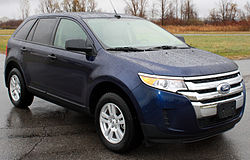 2011 refresh (US)
 -
 Rear view (China)


Trim levels
[edit]
In the American Range: The SE includes cloth-trimmed seats, single-zone manual air-conditioning, steering wheel controls, and 17-inch painted aluminum wheels.
The SEL includes everything in the SE plus unique cloth-trimmed seats, six-way power driver's seat, dual-zone electronic automatic temperature controls, leather-wrapped steering wheel with cruise control, five-way switch pads and secondary audio controls, 18-inch painted aluminum wheels, reverse sensing system, and supplemental parking lamps.
The Limited includes everything in the SEL plus leather-trimmed seats, 10-way heated power driver's seat, Sony audio system with HD radio with 12 speakers in 10 locations, MyFord Touch with two driver-configurable 4.2 in (110 mm) color LCD screens in cluster and 8 in (200 mm) color LCD screen in center stack, Ford Sync including media hub with two USB ports, SD card reader and video input jacks, 18-inch chrome-clad aluminum wheels with optional 20-inch chrome-clad aluminum wheels, rear view camera, and six-way heated power, fold-flat front passenger seat. In Israel, this trim is called SEL Plus.
Limited options include HID headlamps, a blind-spot information system, and adaptive cruise control.
The Sport includes the 3.7 L Twin-independent Variable Cam Timing V6 engine from the Mustang, six-speed SelectShift automatic transmission with paddle activation, unique charcoal black leather-trimmed seats with Silver Smoke Metallic inserts, 22-inch polished aluminum wheel with Tuxedo Black spoke accents, body-color front and rear lower fascia, 4-inch chrome oval dual exhaust tips, and body-color side lower cladding and rocker molding.
Second generation (CD539; 2015)
[edit]| Second generation | |
|---|---|
.jpg) 2017 Ford Edge (Europe) | |
| Overview | |
| Model code | CD539 |
| Also called | Ford Endura (Australia & New Zealand) Ford Edge Plus (China) |
| Production | 2014–2024 |
| Model years | 2015–2024 (North America) |
| Assembly | Canada: Oakville, Ontario (Oakville Ford Assembly Plant) China: Hangzhou, Zhejiang (Changan Ford) |
| Designer | Kevin George[14] |
| Body and chassis | |
| Platform | Ford CD4 platform |
| Related | |
| Powertrain | |
| Engine | |
| Transmission | 6-speed 6F automatic 6-speed manual (Europe only, diesel) 6-speed PowerShift dual-clutch transmission 7-speed automatic 8-speed automatic |
| Dimensions | |
| Wheelbase | 112.2 in (2,850 mm) |
| Length | 188.1 in (4,779 mm) 192.0 in (4,878 mm) (three-row version) |
| Width | 75.9 in (1,928 mm) |
| Height | 68.6 in (1,742 mm) |
| Curb weight | 3,912 lb (1,774 kg) (FWD) 4,060 lb (1,840 kg) (AWD) |
| Chronology | |
| Predecessor | Ford Territory (Australasia) |
For 2015, the Ford Edge was redesigned with a new Taurus and Explorer-like grille, new headlights, LED combination taillights, increased interior room, and a rear-view camera. This generation of the Edge comes with a standard EcoBoost engine, the all-new 2.0 L (only the displacement and bore-center spacing carry over), which has a new twin-scroll turbo to boost low-end torque figures. Unlike the previous 2.0 L EcoBoost, the 2015 generation has a towing capacity of 3500 lb and is available with all-wheel drive. The mid specification engine is a 3.5 L V6, with slightly reduced power output. The highest engine in the range, powering Sport models, is the new 2.7 L twin-turbo EcoBoost V6.
For the first time, Ford marketed the Edge in European markets (as part of the company's "One Ford" strategy); it sits above the Ford Kuga. Gasoline engines are not sold in Europe; instead, this market receives either of two turbo-charged Duratorq diesel engines as used in other Ford Europe products such as the Ford Mondeo. Both engines are mated to an all-wheel drive system as standard; no option for two-wheel drive is available. The two engines are rated at 180 hp and 210 hp. Which output the customer receives is entirely dependent on the transmission choice, with a six-speed manual as standard mated to the 180-hp unit. A six-speed PowerShift automatic dual-clutch transmission option was available, mated to the 210-hp unit.
Ford marketed the Edge in Europe as a premium large crossover with only high-end trims and diesel engines at prices 50% higher than in North America. Due to low sales, the model was limited in 2019 to only a few countries, with the last stock sold in early 2021.[15] Production of the North American-market second generation Ford Edge ended on April 26, 2024, without a direct successor.[16]
-
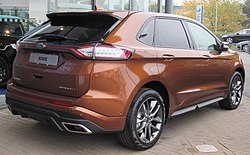 Rear view
 -
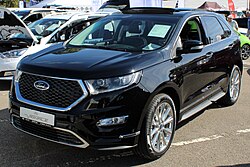 Edge Vignale
 -
 The longer three-row Edge is available exclusively in China.
 -
 The three-row Edge, rear


.jpg)
.jpg)
2019 facelift
[edit]The Edge (alongside the Lincoln MKX) received a mid-cycle facelift for the 2019 model year, with a revised front grille, aluminum-alloy wheel options, exterior and interior color combinations, as well as a 12-speaker B&O Play surround-sound system replacing the Sony system. All models received a new Ford 8F35 eight-speed automatic transmission (featuring automatic stop-start technology), which also allowed the base 2.0 L EcoBoost turbocharged four-cylinder engine to gain a 5-horsepower (3.7 kW) boost, and improved EPA fuel economy.
With the launch of the 2018 model in Australia (February 2019 in New Zealand),[17] the Edge is sold as the Ford Endura, and is the successor to the Ford Territory.[18][19] In Australia, the Endura was made available in Trend, ST-Line, and Titanium trim levels.[20] The Endura was discontinued in Australia by the end of 2020.[21] It had been discontinued in New Zealand prior to this.
The 2019 Ford Edge was offered in nine exterior colors, some of which were new for 2019.[22]
In addition, the 2019 Edge offered three new safety technologies:
- Post-collision braking automatically applies brake pressure when a collision event is detected.
- Evasive steering assist helps drivers in steering around stopped or slower vehicles to avoid a possible collision.
- Adaptive cruise control with stop-and-go lane centering allows the vehicle to maintain a comfortable driving distance and helps reduce stress during longer drives.
The 2019 Edge made its debut at the 2018 North American International Auto Show in Detroit, and went on sale in the second quarter of 2018 as an early 2019 model year vehicle.[23]
For the 2020 model year, dual-zone automatic climate control was included on all trims. However, the CD player was removed.[24]
-
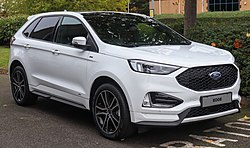 2019 Ford Edge ST-Line (UK; facelift)
 -
 2019 Ford Edge ST-Line (UK; facelift)
 -
 2020 Ford Edge Titanium (US; facelift)
 -
 Interior (facelift)


Edge Plus (China, 2021 facelift)
[edit]The Edge in China was facelifted with the rest of the world in 2019 while receiving another facelift for the 2021 model year exclusively for the Chinese three-row Edge called the Ford Edge Plus. The Edge Plus features a slightly redesigned exterior and a different interior design. The interior features two new displays measuring 8 and 13.2 inches across and a new squared-off multi-function steering wheel. The updated center console houses both the climate controls and the air vents, while a cover below conceals a power socket, a single USB port and a wireless charger. The Edge Plus is powered by the previous 2.0-liter turbo-inline-4 engine producing 245 PS (242 hp; 180 kW) and 390 N⋅m (39.8 kg⋅m; 288 lb⋅ft), which links to an eight-speed automatic transmission. Both FWD and AWD are offered.[25]
-
 Ford Edge Plus (China; 2021 facelift)
 -
 Ford Edge Plus (China; 2021 facelift)
.jpg)
.jpg)
2021 model year changes
[edit]For the 2021 model year, the Ford Edge gained a standard 12 in (300 mm), tablet-style touchscreen infotainment system screen (Ford Sync 4), with wireless Apple CarPlay and Android Auto smartphone integration, as well as standard SiriusXM satellite radio with 360L. A new "ST-Line" trim, based on the mid-level Edge SEL, added ST-inspired exterior and interior styling, a unique ActiveX (leatherette)-trimmed interior, and unique black-finished aluminum-alloy wheels, but is powered by the base 2.0L EcoBoost four-cylinder engine mated to an eight-speed automatic transmission. The Edge Titanium gained a new Titanium Elite Package, which added a unique interior color scheme, model-specific exterior styling cues, and larger tires with unique aluminum-alloy wheels.
Edge ST
[edit]
Ford also offered a new model of the Edge, the ST, instead of the Sport as the top trim level for the line. It features a 2.7 L EcoBoost twin-turbocharged V6 engine producing 335 horsepower (250 kW), a modest 20 horsepower (15 kW) increase over the 2018 Sport, which used the same engine. ST styling includes a dark-finished mesh front grille, aluminum-alloy wheels, and unique interior.
Powertrain
[edit]| Type | Model years | Power at rpm | Torque at rpm | Notes |
|---|---|---|---|---|
| 1,999 cc (122.0 cu in) Ecoboost I4 | 2015–2024 | 245 bhp (183 kW) at 5,500 rpm | 275 lb⋅ft (373 N⋅m) at 3,000 rpm | |
| 3,496 cc (213.3 cu in) Duratec 35 V6 | 2015–2018 | 280 bhp (209 kW) at 6,500 rpm | 250 lb⋅ft (339 N⋅m) at 4,000 rpm | |
| 2,720 cc (166 cu in) 2.7 Ecoboost V6 | 2015–2018 | 315 bhp (235 kW) at 4,750 rpm | 350 lb⋅ft (475 N⋅m) at 2,750 rpm | |
| 2019–2024 | 335 bhp (250 kW) at 5,550 rpm | 380 lb⋅ft (515 N⋅m) at 3,250 rpm | ||
| 2.0 L (120 cu in) TDCI I4 (Europe) | 2016–2018 | 180 bhp (134 kW) at 3,500 rpm | 295 lb⋅ft (400 N⋅m) at 2,000-2,750 rpm | Available only with a 6-speed manual transmission |
| 2.0 L (120 cu in) TDCI I4 (Europe) | 2016–2018 | 210 bhp (157 kW) at 3,000-4,500 rpm | 332 lb⋅ft (450 N⋅m) at 2,000 rpm | Available only with a 6-speed PowerShift dual-clutch transmission |
| 2.0 L (120 cu in) EcoBlue I4 (Europe) | 2018–2024 | 190 bhp (142 kW) at 3,500 rpm | 295 lb⋅ft (400 N⋅m) at 2,000 rpm | Available only with a 6-speed manual transmission |
| 2.0 L (120 cu in) EcoBlue I4 (Australia) | 2018–2024 | 190 bhp (142 kW) at 3,500 rpm | 295 lb⋅ft (400 N⋅m) at 2,000 rpm | Available only with an 8-speed automatic transmission |
| 2.0 L (120 cu in) EcoBlue I4 (Europe) | 2018–2024 | 238 bhp (177 kW) at 3,750 rpm | 369 lb⋅ft (500 N⋅m) at 2,000 rpm | Available only with an 8-speed automatic transmission |
Safety
[edit]| Test | Points | % |
|---|---|---|
| Overall: | 
| |
| Adult occupant: | 32.4 | 85% |
| Child occupant: | 37.6 | 76% |
| Pedestrian: | 28.2 | 67% |
| Safety assist: | 10.7 | 89% |
| Test | Points | % |
|---|---|---|
| Overall: |
| |
| Adult occupant: | 32.4 | 85% |
| Child occupant: | 37.6 | 76% |
| Pedestrian: | 28.2 | 67% |
| Safety assist: | 10.7 | 89% |
| Overall: |
|
| Frontal driver: |
|
| Frontal passenger: |
|
| Side driver: |
|
| Side passenger: |
|
| Side pole driver: |
|
| Rollover AWD: |  15.4% 15.4%
|
| Category | Rating |
|---|---|
| Moderate overlap frontal offset | Good |
| Small overlap frontal offset (2015–present) | Acceptable1 |
| Side impact | Good |
| Roof strength | Good2 |
- 1 vehicle structure rated "Good"
- 2 strength-to-weight ratio: 5.11
Third generation (CDX706; 2023)
[edit]| Third generation | |
|---|---|
 2023 Ford Edge L (China) | |
| Overview | |
| Model code | CDX706 |
| Production | 2023–present |
| Assembly | China: Hangzhou, Zhejiang (Changan Ford) |
| Designer | Siddartha Kazami |
| Body and chassis | |
| Layout |
|
| Platform | Ford C2 |
| Related | |
| Powertrain | |
| Engine | |
| Transmission | |
| Range | 1,188 km (738 mi) (hybrid, WLTC) |
| Dimensions | |
| Wheelbase | 2,950 mm (116.1 in) |
| Length | 5,000 mm (196.9 in) |
| Width | 1,961 mm (77.2 in) |
| Height | 1,773 mm (69.8 in) |
| Curb weight | 1,990–2,152 kg (4,387–4,744 lb) |
The third-generation Edge was revealed on February 23, 2023 for the Chinese market as the Ford Edge L (Chinese: 锐界; pinyin: ruì jiè) as a replacement for the China exclusive Ford Edge Plus, and is built by Ford's Chinese joint venture partner Changan Ford. It is a mid-size SUV with three rows of seats, available with gasoline and hybrid powertrains.[30][31]
The body grows in length and is 22.1 centimeters (8.7 in) longer than the previous generation Edge, and 12.2 centimeters (4.8 in) longer than the Edge Plus. The updated exterior styling elements including LED headlights, optional two-tone black roof, C-pillar 'fin' design, and a triple horizontal light stripe motif in both the DRLs and taillights.[32]
The interior is notable for its expansive screens. A 12.3-inch (310 mm) screen placed behind a slightly squared off steering wheel serves as the digital gauge cluster. A 13.2-inch (340 mm) touchscreen is used as the standard infotainment system. An optional 27-inch (690 mm) 4K touchscreen sits atop the center and passenger side of the dashboard, where the left half serves as the vehicle's infotainment system, while the right half is the passenger entertainment screen. Underneath the screens, a narrow air vent with copper accents spans the dashboard. The center console contains a large cubby with a sliding cover at the front, with the gear selector next to an optional wireless charging pad sitting behind it.
Seating is either in a 2-3-2 or 2-2-3 arrangement; the 2-3-2 arrangement is standard, with flat folding second row seats. The optional 2-2-3 arrangement features captain's chairs in the second row, which have optional power adjustment, heating and ventilating, and can recline to become nearly flat with an extending leg rest. Seating surfaces are either a combination of fabric and leather, or full leather and features two-toned colors on all trims.
Other features include standard three-zone independent climate control, optional Level 2 sem-autonomous driving features, interior ambient lighting, active noise cancellation, 4G network connectivity and OTA updates, optional head-up display, optional panoramic sunroof, and optional Bang & Olufsen audio system.[33]
-
 Rear View
 -
 Interior
 -
 2023 Edge L ST-Line (front)
 -
 2023 Edge L ST-Line (rear)


.jpg)
.jpg)
Non-Chinese markets
The third-gen Ford Edge was launched in Panama in November 2025 exclusively with the hybrid setup introduced in the Chinese market. Panama is the first country to receive the Edge in the Latin America-Caribbean region.[34][35]
Powertrain
[edit]The Edge L is offered with two powertrain options, a gasoline engine with an optional hybrid version. The standard engine is a 2.0 L turbocharged 4-cylinder making 248 hp (185 kW; 251 PS) and 279 lb⋅ft (378 N⋅m; 38.6 kg⋅m) of torque which is mounted to an eight-speed automatic transmission. The hybrid version combines the same engine with a 140 kW (188 hp; 190 PS), 236 lb⋅ft (320 N⋅m; 32.6 kg⋅m) electric motor through a planetary gearset eCVT to achieve a total system output of 271 hp (202 kW; 275 PS) and 299 lb⋅ft (405 N⋅m; 41.3 kg⋅m) of torque. Both powertrains are offered with optional mechanical all-wheel drive and have transverse mounted engines.[36]
Fuel consumption ranges from 6.31 L/100 km (37.3 mpg‑US) with the front-wheel drive hybrid model, 8.91 L/100 km (26.4 mpg‑US) with the all-wheel drive gasoline model on the WLTP cycle.
| Engine | Power | Torque | Transmission |
|---|---|---|---|
| 1,999 cc (122.0 cu in) Ecoboost I4 (CAF484WQH0) | 248 hp (185 kW; 251 PS) @5500 rpm | 279 lb⋅ft (378 N⋅m; 38.6 kg⋅m) @2000-4500 rpm | 8-speed automatic |
| 1,999 cc (122.0 cu in) Ecoboost I4 E Hybrid (CAF484WQH0) | 271 hp (202 kW; 275 PS) @5500 rpm | 299 lb⋅ft (405 N⋅m; 41.3 kg⋅m) @3000-4000 rpm | planetary eCVT |
Sales
[edit]| Calendar year | U.S.[37] | China[38] | Europe[39] | Mexico[40] | Brazil[41] |
|---|---|---|---|---|---|
| 2006 | 2,202 | 38 | |||
| 2007 | 130,125 | 2,710 | |||
| 2008 | 110,798 | 3,103 | 75 | ||
| 2009 | 88,548 | 2,405 | 1,201 | ||
| 2010 | 118,637 | 2,817 | 920 | ||
| 2011 | 121,702 | 3,379 | 1,989 | ||
| 2012 | 127,969 | 3,586 | 3,828 | ||
| 2013 | 129,109 | 2,155 | 3,243 | ||
| 2014 | 108,864 | 1,148 | 2,358 | ||
| 2015 | 124,120 | 65,152 | 1,631 | 1,031 | |
| 2016 | 134,588 | 123,690 | 9,300 | 1,844 | 255 |
| 2017 | 142,603 | 108,525 | 16,000 | 1,327 | 309 |
| 2018 | 134,122 | 59,892 | 9,500 | 898 | 233 |
| 2019 | 138,515 | 32,815 | 8,644 | 850 | 134 |
| 2020 | 108,886 | 25,709 | 3,722 | 325 | 90 |
| 2021 | 85,225 | 31,091 | 261 | 41 | |
| 2022 | 85,465 | 26,266 | 2 | ||
| 2023 | 106,098 | 25,502[42] | |||
| 2024 | 66,436[43] | 29,878[44] | |||
| 2025 | 32,592[45] |
References
[edit]- ^ "2018 Edge | Ford Media Center".
- ^ "Trucks. Ford Edge". US News. Retrieved March 4, 2023.
- ^ Foote, Brett (May 7, 2024). "This Is The Last North American Ford Edge Ever Produced". Ford Authority. Retrieved November 18, 2024.
- ^ "2009 Ford Edge Sport". Inside Line. Archived from the original on December 8, 2012.
- ^ "2012 Ford Edge | View Full Engine Specifications". Ford.com. Archived from the original on January 12, 2013. Retrieved January 6, 2012.
- ^ "Ford Edge Crash Test Ratings". NHTSA. Archived from the original on October 12, 2008. Retrieved August 12, 2008.
- ^ Lynberg, Matthew (June 10, 2016). "Ratings". NHTSA. Archived from the original on March 4, 2016. Retrieved April 30, 2018.
- ^ "Future Vehicles Preview". Inside Line. Archived from the original on December 8, 2012.
- ^ Van Alphen, Tony (June 22, 2007). "Ford hybrid plans unclear after 2008". The Star. Toronto. Archived from the original on October 7, 2012. Retrieved March 23, 2018.
- ^ "2011 Ford Edge and Edge Sport". Car and Driver. Archived from the original on September 4, 2012. Retrieved April 4, 2010.
- ^ "2011 Lincoln MKX and 2011 Ford Edge interiors revealed". egmCarTech. January 7, 2010. Archived from the original on August 7, 2012. Retrieved April 4, 2010.
- ^ Paukert, Chris (February 15, 2010). "2011 Ford Edge gets three engine choices, more ambitious Sport model — Autoblog". Autoblog.com. Archived from the original on October 20, 2012. Retrieved April 4, 2010.
- ^ "MY2011 Ford Edge Features First North American Application of 2.0LEcoBoost, Two Ti-VCT Engines". GreenCarCongress. February 10, 2010. Archived from the original on October 8, 2012.
- ^ "Meet the Designers: Ford Edge Concept". Formtrends. December 17, 2013.
- ^ "Ford limits sales of Edge in Europe". autonews.com. June 5, 2019.
- ^ "Ford Edge has an expiration date". guideautoweb.com. January 29, 2024.
- ^ "New Ford Endura to arrive in New Zealand in February 2019". www.ford.co.nz.
- ^ "Ford Endura 2018 confirmed as Territory successor". www.aa.co.nz.
- ^ "Ford Endura 2018 pricing and specs confirmed".
- ^ "Ford Endura Price, Specs and Release Date". October 3, 2018.
- ^ "Ford Endura Axed In Australia | Drive Car News".
- ^ "All-New 2019 Ford Edge SUV Coming Soon". www.ford.com. Archived from the original on January 12, 2018.
- ^ "Revving Up: Ford Drives New Edge ST into Showrooms, Accelerating its SUV Sales Momentum". media.ford.com (Press release). January 11, 2018. Archived from the original on January 14, 2018. Retrieved March 23, 2018.
- ^ "Ford Edge Prices, Reviews, and Pictures | Edmunds". Edmunds.com. June 8, 2020.
- ^ "Ford Edge Plus gets giant displays in China". media.ford.com (Press release). December 23, 2021. Retrieved March 27, 2021.
- ^ "ANCAP results for Ford Endura ST-Line (New Zealand only)". Ancap.com.au. 2016.
- ^ "ANCAP results for Ford Endura all variants". Ancap.com.au. 2016.
- ^ "2016 Ford Edge SUV AWD". National Highway Traffic Safety Administration. Archived from the original on October 1, 2015. Retrieved September 30, 2015.
- ^ "2015 Ford Edge Midsize SUV". IIHS. Archived from the original on September 30, 2015. Retrieved September 30, 2015.
- ^ "2024 Ford Edge L With Three-Rows Bows In China Looking Pretty Edgy". Carscoops. February 23, 2023.
- ^ "2024 Ford Edge L Officially Debuts In China With, Oh, Edgy Styling". Motor1.com. February 24, 2023.
- ^ Miller, Caleb (February 24, 2023). "The Ford Edge Lives On in China as a Hybrid with a Handsome New Design". Car and Driver. Retrieved September 25, 2024.
- ^ Ramsey, Jonathon (February 27, 2023). "China's 2024 Ford Edge L is a nice sight". Autoblog: Car News, Reviews and Buying Guides. Retrieved September 26, 2024.
- ^ Bonilla, Darwin (October 1, 2025). "Ford Edge 2026 en Panamá: Precio y detalles de la nueva generación". Deagencia (in Spanish). Retrieved October 20, 2025.
- ^ Muñoz, Mario Andrés (November 21, 2025). "Ford presenta oficialmente en Panamá la Edge híbrida con diseño de tres filas". Octanos Media (in Spanish). Retrieved February 1, 2026.
- ^ Chen, Dong Yi (March 18, 2023). "Changan Ford Edge L with BYD batteries starts pre-sale in China at 33,000 USD". CarNewsChina.com. Retrieved September 26, 2024.
- ^ "Ford Edge US car sales figures". carsalesbase.com. November 2, 2015. Retrieved March 27, 2021.
- ^ "Ford Edge China auto sales figures". carsalesbase.com. June 22, 2015. Retrieved March 27, 2021.
- ^ "Ford Europe FY 2020 Sales Release" (PDF). ford.com. June 22, 2015. Archived from the original (PDF) on June 2, 2021. Retrieved May 30, 2021.
- ^ "Venta al público y producción de vehículos ligeros por marca, modelo, segmento y país origen". Instituto Nacional de Estadística, Geografía e Informática (INEGI) (in Mexican Spanish). Retrieved October 26, 2021.
- ^ "Veiculos mais vendidos no Brasil em cada ano". autoo. Retrieved April 13, 2025.
- ^ "【易车销量榜】全国2023年福特零售量销量榜-易车榜-易车". car.yiche.com. Retrieved April 13, 2025.
- ^ "Ford U.S. Q4 2024 Sales Release". January 3, 2025. Archived from the original on January 20, 2025. Retrieved January 10, 2024.
- ^ "【易车销量榜】全国2024年福特零售量销量榜-易车榜-易车". car.yiche.com. Retrieved April 13, 2025.
- ^ "【易车销量榜】全国2025年福特终端量销量榜-易车榜-易车". car.yiche.com. Retrieved January 31, 2026.
External links
[edit]

| Current models |
|  | |||||||||||||||||||||||
|---|---|---|---|---|---|---|---|---|---|---|---|---|---|---|---|---|---|---|---|---|---|---|---|---|---|
| Former models (by date of introduction) |
| ||||||||||||||||||||||||
| Military | |||||||||||||||||||||||||
| Related topics | |||||||||||||||||||||||||


| Subsidiaries and brands |
| | |||||||||||
|---|---|---|---|---|---|---|---|---|---|---|---|---|---|
| Facilities |
| ||||||||||||
| Passenger cars | |||||||||||||
| Commercial vehicles |
| ||||||||||||
Ford Edge
View on GrokipediaDevelopment and background
Origins and concept
The Ford Edge was introduced as the company's first mid-size crossover utility vehicle (CUV) for the 2007 model year, originating from the Ford Edge concept vehicle that debuted at the 2006 North American International Auto Show in Detroit.[19] This concept showcased a bold, athletic design intended to blend the versatility of an SUV with car-like responsiveness, positioning the Edge as a fresh entry in the rapidly expanding CUV segment.[20] Development of the Edge drew from the Ford CD3 platform, a midsize architecture co-developed with Mazda and derived from the Mazda6, which allowed for efficient engineering while providing ample interior space for five passengers.[21] The platform enabled the Edge to fill a strategic gap in Ford's SUV portfolio, situated between the smaller, more urban-oriented Escape and the larger, truck-based Explorer, catering to buyers seeking a balance of practicality and maneuverability.[22] This positioning reflected Ford's early 2000s shift toward more agile, front-wheel-drive-based crossovers amid declining demand for traditional body-on-frame SUVs.[23] The Edge's creation aligned with Ford's broader turnaround efforts under incoming CEO Alan Mulally, who joined in September 2006 and later formalized the "One Ford" plan in 2008 to streamline global operations and prioritize high-volume segments like crossovers.[24] Mulally's emphasis on unified product strategies amplified the Edge's role in revitalizing the brand, as crossovers became central to Ford's recovery from financial challenges by appealing to diverse global markets.[25] Early market research for the Edge focused on family-oriented consumers who prioritized vehicles combining spacious accommodations with engaging driving dynamics and upscale amenities, such as responsive steering and refined ride quality.[19] Ford aimed to capture buyers transitioning from sedans or minivans, offering a premium yet accessible alternative that emphasized safety, comfort, and subtle performance cues. The first-generation Lincoln MKX luxury crossover shared the CD3 platform, providing a higher-end counterpart to broaden the lineup's appeal.[26]Platforms and engineering
The first-generation Ford Edge (2007–2014) utilized the CD3 platform, a front-wheel-drive architecture derived from Ford's midsize sedan lineup and shared with models such as the Fusion and Milan. This monocoque structure featured an independent MacPherson strut front suspension with an isolated subframe for improved ride quality and a multi-link rear suspension, supporting optional all-wheel drive through an intelligent AWD system that distributed torque as needed.[20][21] For the second generation (2015–2024), Ford transitioned to the CD4 platform, an evolution designed for enhanced structural integrity and dynamic performance in midsize crossovers. This welded steel unibody incorporated extensive high-strength steel, comprising over two-thirds of the body structure, which resulted in a 26% increase in bending stiffness and 16% in torsional rigidity compared to the prior platform, contributing to superior handling and crash energy management. Key features included independent suspension with MacPherson struts up front and a multi-link setup at the rear, paired with electric power-assisted steering (EPAS) for variable effort based on speed. Engineers also implemented a multi-phase NVH strategy, utilizing acoustic laminated glass, refined aerodynamics, and isolated powertrain mounts to reduce cabin noise by up to 10% over the first generation.[27][28][29][30] The third-generation Edge L, introduced in 2023 exclusively for the Chinese market under the model code CDX706, employs a stretched variant of Ford's C2 platform to accommodate three-row seating for up to seven passengers. This extended architecture integrates hybrid powertrain compatibility, featuring a front transverse engine layout with front- or all-wheel drive, while maintaining independent suspension systems for balanced ride and handling. NVH refinements continue with advanced materials and sound insulation, ensuring a quiet interior suited to family-oriented use.[31][32]First generation (2007–2014)
Design and features
The first-generation Ford Edge is a mid-size crossover SUV built on the CD3 platform, shared with the Ford Fusion and Lincoln MKX. It debuted at the 2006 North American International Auto Show as a 2007 model year vehicle, with production starting in January 2007 at Ford's Oakville Assembly in Canada. The Edge measures 185.7 inches (4,720 mm) in length for 2007–2010 models (184.2 inches or 4,678 mm post-facelift), with a wheelbase of 111.2 inches (2,824 mm), width of 75.8–76.0 inches (1,930 mm), and height of 67.0 inches (1,700 mm). Curb weight ranges from 4,234–4,291 pounds (1,920–1,948 kg), depending on drivetrain.[5][3] The design emphasized a bold, athletic stance with a prominent three-bar grille, sculpted hood, and flared wheel arches. The interior offered seating for five passengers across two rows, with 39.2 cubic feet (1,110 L) of cargo space behind the rear seats, expanding to 68.9 cubic feet (1,951 L) with seats folded. Standard features included air conditioning, a CD audio system, power windows, and 17-inch alloy wheels. Higher trims added leather upholstery, dual-zone climate control, and optional navigation. The cabin focused on comfort and utility, with a quiet ride aided by acoustic-laminated glass on select models. All-wheel drive was optional across the lineup.[2][33]Trim levels and variants
The first-generation Edge was offered in four trim levels: SE, SEL, Limited, and Sport (introduced for 2009). All trims seated five passengers and were available in front-wheel drive or all-wheel drive configurations.[34][33] The base SE trim featured cloth seats, manual air conditioning, a four-speaker AM/FM/CD audio system, cruise control, and 17-inch steel wheels with covers. It provided essential utility for entry-level buyers. The SEL trim upgraded to an eight-speaker audio system, power-adjustable driver's seat, leather-wrapped steering wheel, fog lamps, and 18-inch alloy wheels, appealing to those seeking added comfort. The Limited trim included leather-trimmed seats, dual-zone automatic climate control, the SYNC infotainment system, heated front seats, and 18-inch chrome-clad wheels, positioning it as a premium option. The Sport variant, available from 2009, featured unique exterior styling with a black grille, 20-inch (standard) or optional 22-inch wheels, sport-tuned suspension, and suede/leather seats with red stitching for a performance-oriented appeal.[3]Powertrain
The first-generation Edge utilized a front-engine, front-wheel-drive layout with optional all-wheel drive, paired with a six-speed 6F50 automatic transmission featuring SelectShift manual control on higher trims. Fuel economy varied by engine and drivetrain, with front-wheel-drive models achieving up to 18 mpg city/25 mpg highway (EPA). Towing capacity was rated at 3,500 pounds (1,588 kg) when equipped.[5][33] From 2007 to 2010, the standard powertrain was a 3.5-liter Duratec V6 engine producing 265 horsepower (198 kW) at 6,250 rpm and 250 lb⋅ft (339 N⋅m) at 4,000 rpm. The 2011 facelift introduced a retuned 3.5-liter V6 with 285 horsepower (213 kW) and 253 lb⋅ft (343 N⋅m). An optional 2.0-liter EcoBoost turbocharged inline-four engine, rated at 240 horsepower (179 kW) and 270 lb⋅ft (366 N⋅m), was added for better efficiency. The Sport trim exclusively used a 3.7-liter Duratec V6 producing 305 horsepower (227 kW) and 280 lb⋅ft (380 N⋅m).[3][35]Safety and testing
The first-generation Ford Edge received strong safety ratings from major agencies. The Insurance Institute for Highway Safety (IIHS) awarded it a Top Safety Pick for models built after January 2007, with "Good" ratings in moderate overlap frontal, side, and roof strength tests, and "Acceptable" for head restraints and seats. Small overlap frontal testing was not conducted during this period.[36][37] The National Highway Traffic Safety Administration (NHTSA) gave the 2007 Edge five stars for side crash protection and four stars for rollover resistance; frontal ratings were four stars for the driver and three stars for the passenger. Later models (2011–2014) improved to five stars overall in most categories, including frontal and side impacts.[38][39] Standard safety features included dual-stage front airbags, front side-impact airbags, side curtain airbags for all rows, antilock brakes (ABS), traction control, and AdvanceTrac stability control with rollover mitigation. Optional equipment encompassed a reverse sensing system and tire pressure monitoring. Recalls during this period addressed issues like accelerator pedal corrosion (2007–2008 models) and wheel separation risks, remedied by Ford at no cost.[40] In the 2023 model year (third generation), the Ford Edge, including the ST trim, has relatively few common problems compared to earlier model years, with only 14 complaints reported to the NHTSA and 15 problems on CarComplaints.com. Recalls include those addressing improperly aimed or overly bright front right headlights and insufficient welds on child seat tether anchors. Owners have reported minor concerns such as infotainment glitches, occasional sensor issues (e.g., EGR), or pre-collision warning malfunctions, but no major widespread complaints specific to the ST's 2.7L V6 engine or performance features are prominent. Overall reliability is rated above average by sources like Consumer Reports.[41][16][15]Facelift changes
The 2011 model year introduced a mid-cycle facelift for the first-generation Ford Edge, encompassing notable revisions to its exterior design, interior amenities, and mechanical specifications to enhance appeal and efficiency. These updates built upon the original 2007 design while addressing consumer feedback on styling and technology integration.[42] Exterior modifications focused on a more aggressive front fascia, including a larger chrome grille with a three-bar pattern, revised headlights that incorporated slim vertical daytime running lights, and a resculpted hood for a bolder, more athletic profile. The taillights were restyled to eliminate the previous clear and red sections, opting for a cleaner smoked appearance, while new wheel designs—up to 20 inches on higher trims—added visual dynamism. Additionally, the lower bumper gained a sculpted chin spoiler and optional blacked-out accents for a sportier stance, with nearly all sheet metal refreshed except the side doors and roof.[43][44][45] Interior enhancements centered on an updated dashboard layout with a redesigned instrument cluster featuring a digital-like display reminiscent of the Ford Fusion Hybrid, improving readability and modern aesthetics. The center console adopted an available 8-inch touchscreen interface for MyFord Touch navigation and climate controls, streamlining user interaction. An optional 12-speaker Sony premium audio system with amplifier became available on SEL and higher trims, delivering enhanced sound quality through improved materials and craftsmanship throughout the cabin.[43][42][42] Mechanically, the six-speed automatic transmission was standardized across the lineup with refinements for smoother shifts and reduced noise, paired with aerodynamic tweaks like underbody shields for better wind resistance. The powertrain options expanded with the debut of a turbocharged 2.0-liter EcoBoost inline-four engine rated at 240 horsepower and 270 lb-ft of torque, achieving up to 21 mpg city and 30 mpg highway in front-wheel-drive configuration—a roughly 15% improvement over the prior base V6. The existing 3.5-liter V6 was retuned to 285 horsepower with dual exhaust standard, also benefiting from the efficiency gains to reach 19 mpg city and 27 mpg highway. These changes collectively boosted overall fuel economy while maintaining performance.[46][47][48] The facelift also introduced the Sport trim as a performance-oriented variant, distinguished by a lowered suspension for sharper handling, unique 22-inch aluminum wheels, sport-tuned steering, and paddle shifters on the transmission, available exclusively with the 3.5-liter V6 and all-wheel drive. This trim targeted enthusiasts seeking a more dynamic driving experience without venturing into full performance models.[49]Second generation (2015–2024)
Design and features
The second-generation Ford Edge was introduced for the 2015 model year, featuring a redesigned exterior with a larger, more prominent grille inspired by the Ford Taurus and Explorer, slim projector-beam headlights, and LED taillights for a modern appearance. The vehicle measures 188.1 inches (4,780 mm) in length, 75.9 inches (1,928 mm) in width, 68.3 inches (1,735 mm) in height, and has a wheelbase of 112.2 inches (2,850 mm), providing a two-row configuration for five passengers with enhanced rear legroom compared to the first generation.[50][51] The interior emphasizes comfort and technology, with available leather-trimmed heated and cooled front seats, a panoramic vista roof, and up to 73.4 cubic feet (2,080 liters) of cargo space with the rear seats folded, or 39.2 cubic feet (1,110 liters) behind the second row. Early models included the MyFord Touch system, later upgraded to SYNC 3 with an 8-inch touchscreen supporting Apple CarPlay and Android Auto. Additional features comprised active noise cancellation, tri-zone climate control, and optional 12-speaker Sony audio system, contributing to a quiet cabin suitable for family use. Front-wheel drive was standard, with intelligent all-wheel drive available for better traction.[52][53] In the Chinese market, a localized facelifted version known as the Edge Plus was introduced for the 2021 model year, featuring minor exterior updates including a bolder grille and extended overall length to 192.0 inches (4,878 mm) for improved presence, while retaining the standard wheelbase and interior layout.[54][55]Trim levels and variants
The second-generation Ford Edge was offered in several trim levels, starting with the base SE, which included cloth seats, an 8-inch SYNC infotainment system, and rearview camera. The SEL added features like enhanced active park assist and satellite radio. Higher trims included the Titanium with leather upholstery, heated rear seats, and premium audio, while the Sport (2015–2018) and later ST variant focused on performance styling with unique 20-inch wheels and sport-tuned suspension. All trims were available in front-wheel or all-wheel drive configurations, with no three-row option globally. Special editions, such as the 2019 Edge ST-Line, offered sporty aesthetics on non-ST models. Production for North America ended after the 2024 model year.[56][57]Powertrain
The second-generation Edge featured efficient powertrains centered on turbocharged engines paired with automatic transmissions that varied by model year: a 6-speed automatic for 2015–2018 models and an 8-speed automatic from 2019 onward. For 2015–2018 models, the 6-speed transmission was generally smooth, responsive, and well-matched to the engines, though some reviews noted occasional lumpy shifts. The available intelligent all-wheel drive was an on-demand system that intelligently sent power to the rear wheels for improved traction, stability, and handling, especially in slippery conditions; it was praised as competent and reliable in professional reviews. Overall, the drivetrain contributed to a composed and capable driving experience, with no major widespread issues reported in expert sources.[58][7][59] For the 2016 model year, engine options included:- 2.0L EcoBoost turbocharged I4: 245 hp, 275 lb-ft torque, EPA 21/30 mpg city/highway (FWD), 20/28 mpg (AWD).
- 3.5L V6: 280 hp, 250 lb-ft torque, EPA 18/26 mpg (FWD), 17/24 mpg (AWD).
- 2.7L twin-turbo EcoBoost V6 (Sport trim): 315 hp, 350 lb-ft torque, 17/24 mpg (AWD only). All paired with a six-speed automatic transmission (upgraded to eight-speed in later facelifts). The base engine for most trims, including the Titanium, was a 2.0-liter EcoBoost turbocharged inline-four producing 250 horsepower at 5,500 rpm and 280 lb-ft of torque at 3,000 rpm (with premium fuel recommended for optimal performance; output may be slightly lower on regular unleaded). This engine paired with an 8-speed automatic transmission from 2019 onward.
Facelifts and updates
The second-generation Ford Edge underwent its mid-cycle refresh for the 2019 model year, introducing a redesigned front fascia with a new honeycomb-pattern grille and updated LED headlight housings that integrated more seamlessly with the bumper.[60] The interior received an upgraded SYNC 3 infotainment system, which became standard across all trims and included compatibility with Apple CarPlay and Android Auto for enhanced smartphone integration.[61] Additionally, the Ford Co-Pilot360 suite of driver-assistance features—encompassing pre-collision assist with automatic emergency braking, blind-spot monitoring, lane-keeping assist, and rearview camera—was made standard equipment, marking the Edge as the first Ford SUV to offer this comprehensive package.[62] Further refinements arrived for the 2021 model year, highlighted by the adoption of a larger 12-inch vertical touchscreen running the new SYNC 4A interface, which supported wireless Apple CarPlay and Android Auto connectivity along with over-the-air software updates for improved usability.[63] The ST trim saw minor styling revisions, including a more prominent "Edge" badge on the rear liftgate and subtle adjustments to the blacked-out accents for a sharper appearance.[64] Subsequent annual updates from 2022 to 2024 were more incremental, focusing on enhanced connectivity options such as standard wireless charging pads in higher trims and refined voice recognition in the infotainment system.[65] The 2.7-liter EcoBoost V6 engine remained exclusive to the ST performance variant throughout this period, with no availability in base trims that continued to rely on the 2.0-liter EcoBoost inline-four.[66] In the Chinese market, a localized version known as the Edge Plus debuted for the 2021 model year, featuring updated interior technology including a larger touchscreen and adjusted exterior styling with a bolder grille, while maintaining the core second-generation platform.[55]Performance variants
The Ford Edge ST debuted in the 2019 model year as the second-generation Edge's flagship performance variant, becoming the first Ford SUV calibrated by the Ford Performance engineering team for sharper dynamics and power delivery. Powered by a twin-turbocharged 2.7-liter V6 engine generating 335 horsepower and 380 lb-ft of torque—building on the powertrain options detailed elsewhere—this setup pairs with an eight-speed automatic transmission and standard all-wheel drive to deliver brisk acceleration, reaching 0-60 mph in 5.7 seconds according to independent testing. Reviews praise the ST for its powerful acceleration, engaging driving dynamics, and planted handling with a nimble feel even in wet conditions, complemented by a stiff but composed ride.[67][68][69] Distinguishing the ST are its sport-tuned suspension with revised springs and dampers for reduced body roll, 20-inch machined aluminum wheels (with 21-inch optional for added grip), and a quad-tip dual exhaust system that amplifies engine resonance without excessive drone. Braking performance is elevated via an available package featuring 13.6-inch front rotors, performance pads, and red-painted calipers for improved fade resistance during spirited driving, complemented by steering-wheel-mounted paddle shifters that enable manual gear selection for more engaging control.[67][70][71] The ST's cabin emphasizes driver focus with bolstered sport seats upholstered in leather and suede inserts for better lateral support, aluminum pedals for a purposeful feel, and a premium 12-speaker Bang & Olufsen sound system tuned for clarity across genres. It offers a spacious and comfortable interior with good technology features including a large touchscreen. However, reviewers have noted mediocre fuel economy, an interior design that feels dated compared to rivals, and less refined ride and handling than competitors such as the Mazda CX-90, along with a higher price for the ST trim. For those desiring the ST's aggressive aesthetics on a milder powertrain, the 2020 ST-Line edition emerged as an accessible alternative, borrowing blacked-out grille surrounds, 20-inch gloss-black wheels, and sport seating cues while retaining the standard 2.0-liter turbo four-cylinder.[72][71][73][6][69]Reliability and common issues
First generation (2007–2014)
The first-generation Ford Edge offered an optional panoramic "Vista" roof, a dual-panel sunroof with sliding glass and power shade. This feature, while popular for its open-air feel, became a notable reliability concern. Owners frequently reported issues with the sunroof mechanism, particularly warping or breakage of the plastic guides (sliders) attached to the drive cables and tracks. This led to binding in the rails, making closure difficult from fully open positions (often failing past halfway), intermittent operation, and sudden complete refusal to move despite the motor functioning (e.g., tilt and partial operations working). Heat exacerbated friction due to plastic expansion, sometimes causing abrupt failures after periods of normal use. Minor cases were often resolved via recalibration/initialization procedures from the Ford workshop manual:- Start the engine.
- Close the glass if open by holding the close switch.
- Hold the close switch for 10–21 seconds to allow the system to stall at hard stops, cycle the shade, and relearn positions.
- Repeat a full open/close cycle while holding the switch.
- The process forces motors to recognize end limits; interruption can desync the shade or glass.