



Community hub
Recent from talks
Contribute something
Nothing was collected or created yet.
North American International Auto Show
View on Wikipedia
| Detroit Auto Show | |
|---|---|
 | |
| Genre | Auto show |
| Venue | Huntington Place |
| Location | Detroit, Michigan |
| Country | United States |
| Inaugurated | 1907 |
| Previous event | January 10–20, 2025 |
| Next event | January 14–25, 2026 |
| Organised by | Detroit Auto Dealers Association |
| Website | detroitautoshow |
The Detroit Auto Show, formerly known as the North American International Auto Show (NAIAS),[1] is an annual auto show held in Detroit, Michigan. Hosted at Huntington Place (formerly Cobo Center) since 1965,[2] it is among the largest auto shows in North America, and is widely regarded as one of the automotive industry's most important events.[3][4]
The show is organized by the Detroit Auto Dealers Association (DADA), and has been held annually in January for much of its recent history. It is usually open to the general public for 1–2 weeks, preceded by previews for industry employees and media, and a black-tie "charity preview" fundraiser for local children's charities.
History
[edit]In 1899, William E. Metzger helped organize the Detroit Auto Show, only the second of its kind, after the 1898 Paris Auto Show.[5] An auto show was held in Detroit in 1907 at Beller's Beer Garden at Riverside Park and since then annually except 1941–1953. During the show's first decades of existence it portrayed only a regional focus. In 1957 international carmakers exhibited for the first time.[6]
In 1987, the DADA proposed that the show become international.[7] The members of the DADA went to places such as Europe and Japan in the attempt to convince those unveiling their new brands or vehicles in those countries to bring those unveilings to the North American Auto Show.[7] That attempt proved to be successful; the North American Auto Show was then renamed the North American International Auto Show in 1989.[7] The NAIAS was the first (and, until 2006, only) auto show in the United States sanctioned by the OICA.[8]
Since 1965, the show has been held at Huntington Place (formerly Cobo Center),[7] where it occupies nearly 1 million square feet (93,000 m2) of floor space. Prior to being held at Huntington Place, the show was held at other well-known places in the Metro Detroit area, including the Light Guard Armory, Wayne Gardens pavilion, and Michigan State Fairgrounds.[9]
Record attendance was in 2003, with 838,066 attendees.[10] In 2009, attendance was 650,517.[10] In 2016, there were 815,575 in ticketed attendance, after reaching 803,451 in 2015.[10] In 2004 and 2005, the charity preview attracted 17,500 people at $400 a ticket and raised $7 million in total. Over 800,000 attended during the days the show was open to the general public in 2018; it is estimated that the show generates a revenue of over $500 million to the local economy.[11]
Audi, BMW and Mercedes-Benz were not present at the 2019 edition, following recent absences of other luxury manufacturers like Porsche, Jaguar, Land Rover and Volvo.[11]
In 2018, plans were made to move the show from January to June beginning in 2020, in hopes of attracting more visitors and adding outdoor events,[11] with plans for an "auto plaza" around Woodward and Jefferson avenues, in addition to the indoor exhibition at TCF Center.[12] An outdoor festival known as "Motor Bella" was to precede the show, which would showcase European supercars.[13] The 2020 edition was cancelled due to the COVID-19 pandemic, during which TCF Center was used as a field hospital by FEMA.[14]
In 2020, plans were made to move the 2021 show from June to late September due to the continued pandemic.[15] However, the 2021 edition was also canceled. The NAIAS organizers held Motor Bella at the M1 Concourse in Pontiac, Michigan as a partial replacement, which was an outdoor enthusiast event running from September 21–26. Executive director Rod Alberts stated that "we cannot ignore the major disruptions caused by the pandemic and the impact it has had on budgets. As such, we will be providing an amazing experience to the media, the auto industry and the public in a cost-effective way."[16]
For the 2022 and 2023 editions, the show returned to downtown Detroit and was held in September.[17] With the 2025 edition, the show returned to January, and was rebranded again as the Detroit Auto Show.[1][18]
-
 2007 North American International Auto Show
 -
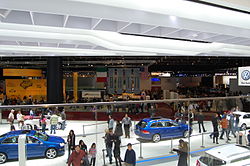 NAIAS 2009 overlooking the Volkswagen exhibit


Editions
[edit]2025
[edit]In 2025, the show was moved back to its previous January timeframe;[1] as a result, no show was held in 2024.[19] The 2025 public show ran from January 11–20, with the media and charity previews held on the 10th,[20] the latter featuring a performance by Flo Rida.[21]
Like in 2023, the 2025 show was held entirely indoors at Huntington Place. Ford, General Motors, Kia, Stellantis, Toyota, and Volkswagen returned as full exhibitors;[22] and BMW, Honda, Hyundai, Ineos, Mazda, and Mercedes-Benz were represented by exhibits organized by local dealerships,[23] with Ineos making their first Detroit Auto Show appearance.[24] High-end and exotic vehicles were exhibited in The Gallery, a separate section also programmed by local dealers.[25]
The 2025 show included four test tracks on the show floor: the returning Powering Michigan EV Experience, featuring electric vehicles from BMW, Cadillac, Chevrolet, GMC, and Rivian (in the latter's Detroit Auto Show debut);[24] the new Detroit Grand Prix Track, with electric and gasoline-powered electric vehicles from Buick, Ford, Honda, Mazda, and Volkswagen; and the returning Ford Bronco Built Wild Experience and Camp Jeep off-road courses in their manufacturers' respective exhibits.[22]
The 2025 show featured few vehicle introductions, in part due to the decline in popularity of auto shows in North America, and in part due to conflicting with the Consumer Electronics Show, where several concept and production vehicles were introduced along with vehicle interior technology and concepts were showcased.[26] The only new vehicles shown were from Ford, who revealed the Mustang RTR prototype and Mustang GTD Spirit of America edition in a separate press conference before the event on January 9.[27]
Production car introductions
[edit]- Ford Mustang GTD Spirit of America (special edition)
Concept car introductions
[edit]- Ford Mustang RTR (prototype)
2023
[edit]The 2023 public show ran from September 16–24, with the media preview on the 13th and charity preview (featuring a performance by Jennifer Hudson) on the 15th.[28] Notably, its run coincided with the beginning of the 2023 United Auto Workers strike, which targeted Ford, General Motors, and Stellantis, the show's three largest exhibitors. The UAW held a rally outside Huntington Place on the evening of the charity preview, but did not picket the event or call for a consumer boycott of the show.[28]
For 2023, the show returned to its previous all-indoor format. All three Detroit-based automakers exhibited, joined by Kia, Toyota, and Volkswagen.[29] Subaru declined to return for the 2023 show,[30] while Honda and Hyundai were represented in exhibits organized by their Detroit-area dealerships.[31][32] Like in 2022, non-participating automakers were represented by smaller displays of their automobiles in a separate section of the show floor.[29][33]
The 2023 show introduced the Powering Michigan EV Experience, a large indoor test track at the rear of the show floor, on which attendees rode in new electric vehicles from GM, Ford, Volkswagen, BMW, and Tesla.[29] The track included a 300-foot acceleration strip, and a serpentine course to demonstrate the vehicles' handling.[34][35] The separate Ford and Jeep off-road demonstration courses, as well as the Ram truck course, returned from the 2022 show.[36] Tesla's participation in the EV Experience marked the company's first NAIAS appearance since 2015.[37]
Production car introductions
[edit]- 2025 Cadillac CT5 (refresh)
- 2024 Ford F-150 (refresh)
- 2024 Ford Mustang Mach-E Rally (auto show debut)
- 2024 GMC Acadia
- 2024 Jeep Gladiator (refresh)
2022
[edit]In 2022, the full NAIAS returned to Huntington Place, with the public show running from September 17–25, preceded by the media preview on the 14th and the charity preview on the 16th. The media preview was visited by then-U.S. President Joe Biden,[38] and the charity preview featured a performance by Nile Rodgers & Chic.[39]
The 2022 edition featured a redesigned layout, with the main exhibits indoors on the show floor at Huntington Place, and other supporting events outdoors in nearby Hart Plaza.[40] Stellantis, Ford, General Motors, Toyota, and Subaru were the only automakers with major exhibits on the convention floor, while Volkswagen had a smaller display in the lobby of Huntington Place.[41] In recognition of Jeep ducking, Stellantis rented the World's Largest Rubber Duck for the show, which stood in the plaza outside Huntington Place.[42] Many non-participating automakers, such as Nissan, Hyundai, and Mercedes-Benz, were represented by new vehicles on display on the convention floor, but without a branded exhibit.[43]
Returning from Motor Bella were interactive test tracks on the show floor, offering rides in Ford and Stellantis vehicles, included with show admission. Ford's track featured an acceleration strip, used to demonstrate the F-150 Lightning, and a large hill, showcasing the Bronco's off-road capabilities. Stellantis operated two tracks: Camp Jeep, an off-road course featuring the Jeep Wrangler, Gladiator, and Grand Cherokee; and a second demonstration course featuring Ram pickup trucks.
Production car introductions
[edit]- 2023 Chevrolet Tahoe RST Performance Edition [44]
- 2023 Chrysler 300C[45]
- 2024 Ford Mustang[46]
- 2023 Jeep Grand Cherokee 4xe 30th Anniversary Edition [47]
- 2023 Jeep Wrangler Willys 4xe [48]
- 2023 Lincoln Corsair (refresh) [46]
- 2023 Toyota Crown (auto show debut) [49]
Concept car introductions
[edit]The 2023 North American Car, Truck, and Utility of the Year semi-finalists were announced and displayed at the show, with the winners to be announced in January 2023.[50]
2021: Motor Bella
[edit]Plans for the full NAIAS to return in September 2021 were cancelled due to the COVID-19 pandemic. In lieu, the show's organizers hosted an outdoor event, Motor Bella, at the M-1 Concourse in nearby Pontiac from September 21–26.[51][52]
Production car introductions
[edit]- 2022 Toyota Tundra[53]
2020 (cancelled)
[edit]The 2020 show was scheduled to be held from June 13–20; it was canceled in March 2020 due to the worldwide COVID-19 pandemic.[14]
2019
[edit]The 2019 show ran from January 19–27 at Cobo Center[54] and opened with the lowering of a 2020 Shelby GT500 from the Cobo Center ceiling.[3] 30 cars launched in the previews, down from 69 in 2018.[55] Among various cars, it displayed new versions of the Kia Soul. Other major attractions included the 2020 Shelby GT500.[56] USA Today noted that Chevrolet, Ford, Honda, Jeep and Toyota were all re-introducing discontinued models at the show with the media previews, for example the Toyota Supra and midsize Ford Ranger.[57][58] Virtual reality displays were utilized by several carmakers.[59] A number of protests took place outside the event regarding Ford's environmental record and GM layoffs.[60]
- January 12 – Gallery
- January 14–15 – Press preview
- January 14–17 – Automobili-D (mobility and autonomy exposition)
- January 16–17 – Industry preview
- January 18 – Charity preview
- January 19–27 – Open to public
Production car introductions
[edit]- 2020 Cadillac XT6[61]
- 2020 Ford Explorer[62]
- 2020 Ford Mustang Shelby GT500[63]
- 2019 Hyundai Elantra GT N-Line[64]
- 2020 Kia Telluride[65]
- 2020 Lexus RC F Track Edition[66]
- 2019 Ram 2500/3500 HD[67]
- 2020 Subaru WRX STI S209[68]
- 2020 Toyota Supra[69]
- 2020 Volkswagen Passat[70]
Concept car introductions
[edit]Race car introductions
[edit]- Hyundai Veloster N TCR[77]
- Subaru WRX STI VT19x (with new livery)[78]
At the show, Ford Motor Company and Volkswagen Group announced a global alliance to collaborate on commercial vans and mid-size pickup trucks, and potentially share EV and autonomous vehicle technology in the future.[79]
2018
[edit]The 2018 show took place January 20 to 28 at the Cobo Center.[80] It ran from January 14 to 28. The press preview was extended by one day and the second edition of Automobili-D was extended by three days.
The Washington Post reported that the fastest cars at the 2018 auto show included the 2019 Acura NSX, the 2019 Dodge Challenger SRT Hellcat Widebody, the 2019 Nissan GT-R, the 2019 Alfa Romeo Giulia, and the 2019 Corvette ZR1.[81]
- January 14–16 – Press preview
- January 14–21 – Automobili-D (mobility and autonomy exposition)
- January 17–18 – Industry preview
- January 19 – Charity preview
- January 20–28 – Open to the public
Production car introductions
[edit]- 2019 Acura RDX (prototype)[82]
- 2019 Audi A7 (US debut)[83]
- 2019 BMW i8 Coupe (refresh)[84]
- 2018 BMW X2[85]
- 2019 Chevrolet Silverado[86]
- 2019 Ford Edge (refresh), Edge ST[87]
- 2019 Ford Mustang Bullitt[88]
- 2019 Ford Ranger
- 2019 Honda Insight (prototype)[89]
- 2019 Hyundai Veloster (second generation)[90]
- 2019 Jeep Cherokee (refresh)[91]
- 2019 Kia Forte sedan[92]
- 2019 Lamborghini Urus (US debut)[93]
- 2019 Mercedes-AMG CLS53, E53 Coupe/Cabriolet[94]
- 2019 Mercedes-Benz G-Class[95]
- 2018 Mercedes-Benz GLS-Class (X166) Grand Edition[96]
- 2019 Mini Hatch (refresh)[97]
- 2019 Ram 1500[98]
- 2018 Rolls-Royce Phantom (US debut)[99]
- 2018 Smart Fortwo ED 10th Anniversary Edition (US debut)[100]
- 2019 Toyota Avalon[101]
- 2019 Volkswagen Jetta[102]
- 2018 Volkswagen Passat GT[103]
Concept car introductions
[edit]2017
[edit]The 2017 show ran from January 9 to 22. Automobili-D, an exposition dedicated to automotive autonomy and mobility, ran in conjunction with the show on January 8–12.[108] Sam Slaughter served as chairman.[10]
- January 9–10 – Press preview[10]
- January 11–12 – Industry preview[10]
- January 13 – Charity preview[10]
- January 14–22 – Open to the public[10]
Production car introductions
[edit]- 2018 Audi A5/S5 Cabriolet[109]
- 2018 Audi SQ5[110]
- 2017 BMW 5 Series[111]
- 2018 Chevrolet Traverse[112]
- 2018 Ford F-150 (refresh)[113]
- 2018 Ford Mustang (refresh – shown during public days)[114]
- 2018 GMC Terrain[115]
- 2018 Honda Odyssey[116]
- 2018 Kia Stinger[117]
- 2018 Lexus LS (XF50)[118]
- 2018 Mercedes-AMG GT (refresh), GT C Coupe[119]
- 2018 Mercedes-Benz E-Class Coupe[120]
- 2018 Mercedes-Benz GLA-Class (refresh)[121]
- 2017 Mercedes-Benz S-Class Coupe Night Edition[122]
- 2017 Nissan Rogue Sport[123]
- 2017 Ram 1500 Rebel Black[124]
- 2018 Subaru WRX (refresh)[125]
- 2018 Toyota Camry[126]
- 2018 Volkswagen Atlas R-Line[127]
- 2018 Volkswagen Tiguan (long-wheelbase version)[128]
- 2018 Volvo V90 (North American debut)[129]
Concept car introductions
[edit]- Audi Q8 concept[130]
- BMW Concept X2 (North American debut)[111]
- Ford Transit Connect Hybrid Taxi Prototype[131]
- Infiniti QX50 Concept[132]
- Nissan Vmotion 2.0[133]
- Volkswagen I.D. Buzz[134]
Race car introductions
[edit]- BMW M6 GT3 (North American debut)[111]
- 2018 Toyota Camry Cup Car[135]
2016
[edit]The 2016 show ran from January 11 to 24. The show drew 5,068 credentialed members of the media from 60 countries during the media preview, with the industry preview afterwards drawing 39,788 visitors from 25 countries and 2,000 companies.[10] Among celebrity visitors was Barack Obama.[10][136] The first day saw the debut of models like the Lexus LC 500, the new Pacifica minivan, and an Audi hydrogen concept car.[137]
- January 11–12 – Press preview[10][138]
- January 13–14 – Industry preview[10]
- January 15 – Charity preview[10]
- January 16–24 – Open to the public[10]
Production car introductions
[edit]- 2017 Audi A4 (North American debut)[139]
- 2017 Audi A4 allroad quattro[139]
- 2016 BMW M2[140]
- 2016 BMW X4 M40i[140]
- 2016 Buick Envision (North American debut)[141]
- 2017 Chevrolet Cruze Hatchback[142]
- 2017 Chrysler Pacifica[143]
- Fisker Force 1[144]
- 2017 Ford F-150 Raptor SuperCrew[145]
- 2017 Ford Fusion (refresh)[146]
- 2017 Genesis G90[147]
- 2017 Genesis G80 (refresh)[148]
- 2017 GMC Acadia[149]
- 2017 Honda Ridgeline[150]
- 2016 Infiniti Q50 (refresh)[151]
- 2017 Infiniti Q60[151]
- 2016 Infiniti QX60 (refresh)[151]
- 2017 Kia Forte/Forte5 (refresh)[152]
- 2018 Lexus LC 500[153]
- 2017 Lincoln Continental[154]
- 2017 Mercedes-AMG S65 Cabriolet[155]
- 2017 Mercedes-Benz E-Class (sedan)
- 2017 Mercedes-Benz SLC-Class (refresh)[156]
- 2017 Porsche 911 Turbo, Turbo S (991.2)[157]
- 2017 Smart Fortwo Cabrio (North American debut)[158]
- 2017 Volvo S90[159]
Concept car introductions
[edit]- Acura Precision Concept[160]
- Audi h-tron quattro concept[139]
- Buick Avista[161]
- Kia Telluride[162]
- Nissan IDS (US debut)[163]
- Nissan Titan Warrior Concept[164]
- Volkswagen Tiguan GTE Active Concept[165]
2015
[edit]The 2015 show ran from January 12 to 25.
- January 12–13 – Press preview
- January 14–15 – Industry preview
- January 16 – Charity preview
- January 17–25 – Open to the public[166]
Production car introductions
[edit]- 2017 Acura NSX[167]
- 2015 Alfa Romeo 4C Spider[168]
- 2017 Audi Q7[169]
- 2016 BMW 6 Series, M6 (refresh)[170]
- 2016 Buick Cascada[171]
- 2016 Cadillac CTS-V[172]
- 2016 Chevrolet Volt (second generation)[173]
- 2017 Ford F-150 Raptor[174]
- 2017 Ford GT[175]
- 2016 Ford Shelby GT350R Mustang[176]
- 2016 Hyundai Sonata Hybrid (North American debut)[177]
- 2016 Hyundai Sonata Plug-in Hybrid[178]
- 2017 Jaguar XE (North American debut)[179]
- 2016 Lexus GS F[180]
- 2016 Lincoln MKX[181]
- 2016 Mercedes-Benz C350 Plug-in Hybrid[182]
- 2015 Mercedes-Benz C450 AMG[183]
- 2016 Mercedes-Benz GLE-Class Coupé[184]
- 2015 Mini John Cooper Works Hardtop[185]
- 2016 Nissan Titan XD[186]
- 2015 Porsche 911 Targa 4 GTS[187]
- 2015 Porsche Cayenne Turbo S (refresh)[187]
- 2015 Ram 1500 Rebel[188]
- 2016 Range Rover Td6, Range Rover Sport Td6 (North American debut)[189]
- 2016 Toyota Tacoma[190]
- 2016 Volvo S60 Cross Country[191]
- 2016 Volvo S60 Inscription (LWB)[192]
Concept car introductions
[edit]- Buick Avenir[193]
- Chevrolet Bolt EV[194]
- Honda FCV Concept (North American debut)[195]
- Hyundai Santa Cruz Crossover Truck Concept[196]
- Infiniti Q60 Concept[197]
- Volkswagen Cross Coupe GTE Concept[198]
2014
[edit]The 2014 show ran from January 13 to 26.
- January 13–14 – Press preview
- January 15–16 – Industry preview
- January 17 – Charity preview
- January 18–26 – Open to the public[199]
Production car introductions
[edit]- 2015 Audi A8/S8 (facelift) (North American debut)[200]
- 2015 Audi Q3 (North American debut)[201]
- 2014 BMW 2 Series[202]
- 2015 BMW M3[202]
- 2015 BMW M4[202]
- 2015 Cadillac ATS Coupe[203]
- 2015 Chevrolet Corvette Z06[204]
- 2015 Chrysler 200[205]
- 2015 Ford F-150[206]
- 2015 Ford Mustang (auto show debut)
- 2015 GMC Canyon[207]
- 2015 Honda Fit[208]
- 2015 Hyundai Genesis[209]
- 2015 Lexus RC (North American debut)[210]
- 2015 Lexus RC F[211]
- 2015 Mercedes-Benz C-Class[212]
- 2015 Mercedes-Benz GLA45 AMG[213]
- 2015 Mercedes-Benz S600[214]
- 2015 Porsche 911 Targa[215]
- 2015 Subaru WRX STI[216]
- 2015 Volkswagen Golf R (North American debut)[217]
Concept car introductions
[edit]- Acura TLX Prototype[218]
- Audi allroad shooting brake[219]
- Infiniti Q50 Eau Rouge[220]
- Kia GT4 Stinger[221]
- Mercedes-Benz Concept S-Class Coupé (North American debut)
- Mini John Cooper Works concept[222]
- Nissan IDx Freeflow and IDx NISMO (U.S. debut)[223]
- Nissan Sport Sedan concept[224]
- Toyota FT-1[225]
- Volkswagen Beetle Dune[226]
- Volkswagen Passat BlueMotion Concept[227]
- Volvo Concept XC Coupe[228]
Race car introductions
[edit]- Acura TLX GT Race Car[229]
- Chevrolet Corvette C7.R[230]
2013
[edit]The 2013 show ran from January 14 to 27.
- January 14–15 – Press preview
- January 16–17 – Industry preview
- January 18 – Charity preview
- January 19–27 – Open to the public
Production car introductions
[edit]- 2014 Audi R8 (facelift)
- 2013 Audi RS5 Cabriolet (North American debut)
- 2014 Audi RS7
- 2014 Audi SQ5 (gasoline version)
- Bentley Continental GT Speed Convertible
- 2013 BMW 320i (U.S. market debut)
- 2014 BMW M6 Gran Coupe
- 2014 BMW Z4 (E89)
- 2014 Cadillac ELR
- 2014 Chevrolet Corvette Stingray
- 2014 Chevrolet Silverado
- 2013 Chrysler 300 Motown Edition
- 2013 Dodge Dart GT
- 2015 Ford Transit (North American debut)
- 2014 GMC Sierra
- 2014 Infiniti Q50
- 2014 Jeep Compass
- 2014 Jeep Grand Cherokee (facelift)
- 2014 Kia Cadenza (North American debut)
- 2014 Lexus IS
- 2014 Maserati Quattroporte
- 2014 Mercedes-Benz CLA-Class
- 2014 Mercedes-Benz E-Class (facelift)
- 2014 Mini John Cooper Works Paceman
- 2014 Nissan Versa Note (North American debut)
- 2014 Porsche Cayenne Turbo S
- 2013 Shelby Focus ST
- 2014 Volkswagen Tiguan R-Line
- 2014 Volkswagen Touareg R-Line
Concept car introductions
[edit]- Acura MDX pre-production concept[231]
- Acura NSX Concept (updated 2013 version with interior)[232]
- BMW Concept 4 Series Coupe[233]
- Fiat 500 Abarth "Tenebra" and "Cattiva" design concepts[234]
- Ford Atlas[235]
- Honda Urban SUV Concept[236]
- Hyundai HCD-14 Genesis[237]
- Lincoln MKC concept[238]
- Nissan Resonance[239]
- Toyota Corolla Furia[240]
- Volkswagen Crossblue[241]
- Volkswagen Passat Performance Concept[242]
Chevrolet also displayed five models sold outside the United States: the Onix, Orlando, Sail, Spin, and Trax.[243]
2012
[edit]
The 2012 show ran from January 9 to 22.
- January 9–10 – Press preview
- January 11–12 – Industry preview
- January 13 – Charity preview
- January 14–22 – Open to the public
Nissan returned to the show after a three-year absence.[244]
Bryan Herta was presented with the Baby Borg trophy for the 2011 Indianapolis 500 during the show, which coincided with the promotion of the return of the IZOD IndyCar Series to Detroit later in June. A replica Baby Borg was also presented to Suzie Wheldon, the widow of the winning driver of the race.
Production car introductions
[edit]- 2013 Acura RDX
- 2013 Audi A4
- 2013 Audi S4
- 2013 Audi allroad
- 2012 Bentley Continental GT V8
- 2012 BMW 3 Series (North American debut)
- 2012 BMW ActiveHybrid 3
- 2012 BMW ActiveHybrid 5
- 2013 Buick Encore
- 2013 Cadillac ATS
- 2013 Chevrolet Sonic RS
- 2012 Chrysler 200 Super S
- 2012 Dodge Charger Redline
- 2013 Dodge Dart
- 2013 Ford Fusion
- 2013 Hyundai Genesis Coupe (North American debut)
- 2013 Hyundai Veloster Turbo
- 2013 Lexus LX
- 2013 Mercedes-Benz SL-Class
- 2012 Mini Roadster
- 2012 Porsche 911 Carrera/Carrera S Cabriolet
- 2013 Scion FR-S (North American debut)
- 2013 Subaru BRZ (U.S. debut)
- 2012 Toyota Prius c (North American debut)
- 2013 Volkswagen Jetta Hybrid
Concept car introductions
[edit]- Acura ILX concept
- Acura NSX concept
- Audi Q3 Vail
- Chevrolet Code 130R
- Chevrolet Tru 140S
- Chrysler 700C
- Ford Evos (North American debut)
- Honda Accord Coupe concept
- Lexus LF-LC
- Lincoln MKZ concept
- Maserati Kubang (North American debut)
- Nissan e-NV200 Concept
- Nissan Pathfinder concept
- Smart For-Us
- Toyota NS4[245]
- Volkswagen E-Bugster
- Volvo XC60 Plug-in Hybrid
2011
[edit]The 2011 show ran from January 10 to 23.
- January 10–11 – Press preview
- January 12–13 – Industry preview
- January 14 – Charity preview
- January 15–23 – Open to the public
Porsche returned to the show for the first time since 2007.[246] A new "Smarter Living in Michigan" section showcased alternative energy technologies outside of the automotive sector, in addition to an electric vehicle track condensed from its 2010 size.
Production car introductions
[edit]- 2012 Audi A6
- 2012 BMW 1 Series M Coupe
- 2012 BMW 6 Series (F12) Convertible
- 2012 Buick Verano
- 2012 Chevrolet Sonic
- 2011 Chrysler 300
- 2012 Ford C-Max (North American debut – production plans canceled)
- 2013 Ford C-Max Energi
- 2013 Ford C-Max Hybrid
- 2012 Hyundai Veloster
- 2011 Jeep Compass
- 2012 Mercedes-Benz C-Class
- 2012 Mercedes-Benz S350 Bluetec
- 2013 Toyota Prius Plug-in
- 2012 Toyota Prius V
- 2012 Volkswagen Passat (North American version)
Concept car introductions
[edit]- Ford Vertrek[247]
- GMC Sierra All Terrain HD[248]
- Honda Civic & Civic Si concept
- Hyundai Curb
- Kia KV7[249]
- Mini Paceman[250]
- Porsche 918 RSR
- Toyota Prius C Concept
2010
[edit]The 2010 show ran from January 11 to 24.
- January 11–12 – Press preview
- January 13–14 – Industry preview
- January 15 – Charity preview
- January 16–24 – Open to the public
A new "Electric Avenue" section showcased electric vehicles from around the world, including some entrants for the Automotive X-Prize. Saab, Hummer, Infiniti, Suzuki, and Porsche did not attend the 2010 show.[251] Nissan and Mitsubishi did not have regular floor space, but the Nissan Leaf and Mitsubishi i MiEV appeared in the Electric Avenue section.[252] A small electrical fire at the Audi exhibit caused an evacuation on January 21. Nobody was hurt.[253]
Production car introductions
[edit]- 2011 BMW 740i/Li (North American debut)
- 2011 BMW Z4 (E89) sDrive35is
- 2011 Cadillac CTS-V Coupe
- 2011 Ford Focus
- 2011 Ford Mustang GT
- 2011 Ford Mustang Boss 302R
- 2011 GMC Acadia Denali
- 2011 Honda CR-Z
- 2010 Hyundai Santa Fe
- 2010 Jeep Liberty Renegade
- 2010 Jeep Wrangler Islander / Mountain editions
- 2011 Lincoln MKX
- 2011 Mercedes-Benz E-Class Cabriolet
- Revenge Verde supercar[254]
Concept car introductions
[edit]- Audi e-tron Detroit showcar
- BMW Concept ActiveE
- Buick Regal GS
- Cadillac XTS Platinum
- Chevrolet Aveo RS
- Chrysler/Lancia Delta
- Fiat 500 Elettra
- GMC Granite
- Hyundai Blue-Will plug-in hybrid
- Mini Beachcomber
- Toyota FT-CH dedicated hybrid
- Volkswagen NCC
- Volvo C30 electric
2009
[edit]The 2009 show ran from January 11 to 25.[255]
- January 11–13 – Press days
- January 14–15 – Industry days
- January 16 – Charity preview
- January 17–25 – Open to the public
Nissan, Infiniti, Mitsubishi, Suzuki, Rolls-Royce, Land Rover, Ferrari, and Porsche did not attend the 2009 auto show, the largest number of non-returning automakers in the show's history. As a result, the show became the first with Chinese automakers (BYD and Brilliance) exhibited on the main floor.[256]
Production car introductions
[edit]- 2010 Audi A3 2.0 TDI (North American debut)
- 2009 BMW Z4 (E89)
- 2010 Buick LaCrosse
- 2010 Cadillac SRX
- 2011 Chevrolet Cruze (North American debut)
- 2010 Chevrolet Equinox
- Fisker Karma
- 2010 Ford Mustang Shelby GT500
- 2010 Ford Taurus
- 2010 Honda Insight
- 2010 Jaguar XFR
- 2010 Jaguar XKR
- 2010 Lexus HS 250h
- 2010 Lincoln MKT
- 2009 Mini Cooper Convertible
- 2009 Saab 9-5 Griffin
- 2010 Toyota Camry
- 2010 Toyota Prius
The 2010 Mercedes-Benz E-Class was announced and shown to invited members of the press, but was not put on public display until the March 2010 Geneva Motor Show.[257]
GM also announced the production of the Chevrolet Spark mini-car (previously shown as the Chevrolet Beat concept), for sale in Europe in 2010 and North America in 2011, as well as the Chevrolet Orlando compact MPV, for sale in North America in 2011. The Spark will be shown at the 2009 Geneva Motor Show.[258]
Concept car introductions
[edit]- Audi Sportback concept
- Cadillac Converj
- Chevrolet Orlando concept (North American debut)
- Chrysler 200C EV
- Dodge Circuit EV
- Fisker Karma S Concept
- Jeep Patriot EV
- Kia Soul'ster
- Lincoln C
- Mercedes-Benz BlueZero concepts
- E-Cell (electric)
- E-Plus (plug-in hybrid), 100 km electric-only range
- F-Cell (fuel cell)
- Subaru Legacy concept
- Toyota FT-EV
- Volkswagen Concept BlueSport[259]
- Volvo S60 concept
2008
[edit]The 2008 show ran from January 13 to 27.
- January 13–15 – Press days
- January 16–17 – Industry days
- January 18 – Charity preview
- January 19–27 – Open to the public
Production car introductions
[edit]- 2009 Audi TTS
- 2008 BMW 1 Series Convertible (North American debut)
- 2009 BMW 335d (North American debut)
- 2009 BMW X5 (E70) xDrive35d
- 2009 BMW X6
- 2009 Cadillac CTS-V
- 2009 Chevrolet Corvette ZR-1
- 2009 Dodge Ram
- 2009 Ford F-150
- 2009 Hyundai Genesis
- 2012 Land Rover Range Rover Evoque
- 2009 Kia Borrego
- 2009 Mazda RX-8
- 2009 Mercedes-Benz SLK-Class (North American debut)
- 2009 Mitsubishi Lancer Ralliart
- 2008 Scion xB RS 5.0 ("Mica Gold")
- 2009 Saturn Vue Green Line 2-Mode Hybrid
- 2009 Subaru Forester
- 2009 Toyota Venza
- 2009 Volkswagen Passat CC
Concept car introductions
[edit]- Audi R8 TDI
- Buick Riviera (North American debut)
- BYD F6DM
- Cadillac CTS Coupe concept
- Cadillac Provoq (also appearing at the 2008 Consumer Electronics Show)
- Chrysler ecoVoyager
- Dodge ZEO
- Fisker Karma
- Ford Explorer America
- Ford Verve
- Hummer HX
- Honda Pilot Prototype
- Jeep Renegade
- Land Rover LRX
- Lincoln MKT concept
- Lexus LF-A Roadster
- Mazda Furai
- Mercedes-Benz Vision GLK Freeside
- Mitsubishi Concept-RA
- Nissan Forum
- Saab 9-4X BioPower
- Saturn Flextreme
- Toyota A-BAT
2007
[edit]The 2007 show was held from January 7 to 21.
- January 7–9 – Press days
- January 10–11 – Industry days
- January 12 – Charity preview
- January 13–21 – Open to the public
Production car introductions
[edit]- 2008 Audi Q7 3.0 TDi
- 2007 BMW 3 Series convertible
- 2008 Cadillac CTS
- 2008 Chevrolet Equinox Sport
- Chevrolet HHR Premium Edition
- 2008 Chevrolet Malibu
- 2008 Chrysler Town and Country
- 2008 Dodge Avenger
- 2008 Dodge Grand Caravan
- 2008 Dodge Magnum
- 2008 Dodge Viper SRT-10
- 2008 Ford Five Hundred (renamed to Ford Taurus for the 2007 Chicago Auto Show)
- 2008 Ford Focus
- 2007 Hyundai Veracruz (North American introduction)
- 2008 Infiniti QX56
- 2008 Lexus IS-F
- 2007 Maserati Quattroporte Automatica
- 2008 Mazda Tribute HEV
- 2007 MINI Cooper (North American introduction)
- 2007 MINI Sidewalk
- 2008 Mitsubishi Lancer
- 2008 Nissan Rogue
- 2008 Pontiac G6 GXP
- 2008 Pontiac Torrent GXP
- 2008 Porsche Cayenne
- 2008 Rolls-Royce Phantom Drophead Coupé
- 2007 Scion tC RS 3.0 ("Blizzard Pearl")
- 2008 Smart Fortwo (North American introduction)
- 2008 Subaru Legacy (North American introduction)
- 2008 Subaru Outback (North American introduction)
- 2007 Toyota Tundra CrewMax
Concept car introductions
[edit]- Acura Advanced Sports Car concept
- Audi Q7 V12 TDI concept (North American introduction)
- Changfeng Liebao CS7 concept
- Changfeng Liebao CS6 concept
- Changfeng Feibao CT5 concept
- Changfeng UU-CT3 concept
- Changfeng rhombus concept car
- Chevrolet Camaro Convertible concept
- Chevrolet Volt
- Chrysler Nassau
- Dodge Viper SRT-10 Mopar concept
- Ford Airstream
- Ford Interceptor
- Honda Accord Coupe concept
- Hummer H3 Open-Top concept
- Jaguar C-XF (Concept XF)
- Jeep Trailhawk
- Kia Kue
- Lexus LF-A (updated concept)
- Lincoln MKR concept
- Mazda Ryuga
- Mercedes-Benz Vision GL420 Bluetec
- Mercedes-Benz Ocean Drive
- Mitsubishi Prototype-X (Lancer Evolution Prototype)
- Nissan Bevel
- Saab 9-3 BioPower Hybrid concept
- Suzuki Flix
- Toyota FT-HS Hybrid Sports concept
- Volvo XC60 concept
- Volvo BeeVan
GM also displayed five "global" concept cars for the first time in North America: Chevrolet T2X, Chevrolet WTCC, Holden Efijy, Opel Antara GTC, and Saab Aero-X.
2006
[edit]The 2006 show was held from January 8 to 22.
- January 8–10 – Press days
- January 11–12 – Industry days
- January 13 – Charity preview
- January 14–22 – Open to the public
Production car introductions
[edit]- 2006 Audi RS4
- 2007 Audi S6
- 2007 Audi S8
- 2006 BMW 325xi Sports Wagon
- 2007 BMW M Roadster
- 2006 BMW M6
- 2006 BMW Z4 (E85) Coupe
- 2007 Cadillac Escalade
- 2007 Cadillac Escalade ESV
- 2007 Cadillac Escalade EXT
- 2007 Chevrolet Aveo
- 2007 Chevrolet Suburban LTZ
- 2007 Chevrolet Tahoe LTZ
- 2007 Chevrolet Tahoe Two-Mode Hybrid
- 2007 Chrysler Aspen
- 2007 Dodge Caliber
- 2007 Ford Edge
- 2007 Ford Shelby GT500
- 2007 Ford Explorer Sport Trac Adrenalin
- 2007 GMC Yukon
- 2007 GMC Yukon XL
- 2007 Honda Fit
- 2007 Hummer H3x
- 2007 Hyundai Santa Fe
- 2007 Jaguar XK convertible
- 2007 Jeep Compass
- 2007 Jeep Wrangler
- 2007 Kia Optima
- 2007 Lexus LS
- 2007 Lincoln MKX
- 2006 Maserati GranSport Spyder
- 2006 Maserati Quattroporte Sport GT and Executive GT
- 2007 Mercedes-Benz E320 Bluetec
- 2007 Mercedes-Benz GL320 Bluetec
- 2007 Mercedes-Benz GL450
- 2007 Mercedes-Benz ML63 AMG
- 2007 Mercedes-Benz R63 AMG
- 2007 Mercedes-Benz S550
- 2007 Mercedes-Benz S65 AMG
- 2007 Mitsubishi Eclipse Spyder
- 2007 Nissan Versa
- 2007 Nissan Sentra
- 2007 Pontiac Solstice GXP
- 2007 Saturn Sky
- 2007 Saturn Vue Green Line
- 2007 Toyota Camry (AutoWeek "Most Significant")
- 2007 Toyota Camry Hybrid
- 2007 Toyota FJ Cruiser
- 2007 Toyota Yaris
- 2006 Volvo C70 Convertible
- Geely 7151CK (the first Chinese automobile ever shown in the United States, only shown to press)
Concept car introductions
[edit]- Aston Martin Rapide concept
- Acura RDX prototype
- Audi Roadjet
- BMW X3 Hybrid Efficient Dynamics concept
- Buick Enclave concept
- Chevrolet Camaro concept (AutoWeek "Best In Show")
- Chrysler Imperial concept
- Dodge Challenger concept (AutoWeek "Best Concept")
- Ford F-250 Super Chief
- Ford Iosis (North American introduction)
- Ford Reflex
- Hyundai HCD9 Talus
- Infiniti G35 Coupe concept
- Jeep Patriot concept
- Kia Soul
- Lamborghini Miura concept[260]
- Lincoln MKS concept
- Maybach Exelero
- Mazda Kabura concept
- Mazda Mazda5 hydrogen rotary concept
- Mini Concept Detroit
- Mitsubishi Concept-CT MIEV
- Nissan Urge (AutoWeek "Most Fun"), with built in Xbox 360
- Saab 9-5 Aero BioPower concept
- Subaru B5-TPH
- Toyota F3R
- Volvo C30 concept
2005
[edit]Production car introductions
[edit]- 2006 Acura RL
- 2006 Cadillac STS-V
- 2006 Chevrolet Corvette Z06
- 2006 Chrysler 300C SRT-8
- 2006 Dodge Charger
- 2006 Dodge Viper SRT-10 Coupe
- 2006 Ford Fusion
- 2006 Honda Ridgeline
- 2006 Hyundai Sonata
- 2006 Infiniti M
- 2006 Kia Rio
- 2006 Land Rover Range Rover
- 2006 Land Rover Range Rover Sport
- 2006 Lincoln Zephyr/MKZ
- 2006 Mercedes-Benz M-Class
- 2006 Mercury Milan
- 2006 Mitsubishi Eclipse
- 2006 Mitsubishi Raider
- 2006 Porsche 911 Cabrio
- 2005 Saab 9-7X
- 2006 Subaru B9 Tribeca
- 2005 Toyota Avalon
Concept car introductions
[edit]- Chrysler Firepower
- Ford Explorer Sport Trac Concept
- Ford Fairlane Concept
- Ford Shelby GR-1
- Ford SYNUS
- General Motors Sequel
- GMC Graphyte
- Infiniti Kuraza
- Jaguar Advanced Lightweight Coupe Concept
- Jeep Gladiator (2005 concept)
- Jeep Hurricane
- Kia KCD-II Mesa
- Lexus LF-A concept
- Mazda MX-Crossport
- Mercury Meta One
- Nissan AZEAL
- Opel Astra hybrid concept
- Saturn Aura concept
- Saturn Sky concept
- Suzuki Concept X
- Toyota FT-SX
- Volkswagen New Beetle Ragster
- Volvo 3CC
2004
[edit]The 2004 show was held from January 10 to 19.
Production car introductions
[edit]- 2005 Chevrolet Corvette (C6)
- 2004 Ferrari 612 Scaglietti
- 2005 Ford Five Hundred
- 2005 Ford Freestyle
- 2005 Ford Mustang
- 2005 Infiniti QX56
- 2005 Kia Spectra
- 2006 Lexus GS
- 2005 Nissan Frontier
- 2005 Nissan Pathfinder
- 2005 Pontiac G6
- 2005 Pontiac Solstice
- 2005 Scion tC
- 2005 Volvo S40
- 2005 Volvo V50
Concept car introductions
[edit]- Chevrolet Nomad (2004 concept)
- Chrysler ME Four-Twelve
- Dodge Slingshot
- Ford Bronco (2004 concept)
- Honda SUT
- Jeep Rescue
- Land Rover Range Stormer
- Lincoln Aviator (2004 concept)
- Lincoln Mark X
- Mazda MX-Micro Sport
- Mercedes-Benz Vision GST (2004 concept)
- Mitsubishi Eclipse Concept-E
- Mitsubishi Sport Truck Concept
- Nissan Actic
- Saturn Curve
- Toyota FTX
- Toyota Rugged Youth Utility
- Volkswagen Concept T
2003
[edit]The 2003 show was held from January 11 to 20.
Production car introductions
[edit]- 2004 Acura TSX
- 2004 Cadillac SRX
- 2004 Chevrolet Colorado
- 2005 Chevrolet Equinox
- 2004 Chevrolet Malibu
- 2004 Ford F-150
- 2003 Infiniti FX45
- 2004 Lexus RX 330
- 2004 Mitsubishi Endeavor
- 2004 Nissan Maxima
- 2004 Nissan Quest
- 2004 Nissan Titan
- 2004 Pontiac Grand Prix
- 2003 Rolls-Royce Phantom VII
- 2004 Toyota Sienna
Concept car introductions
[edit]- Aston Martin AMV8 Vantage
- Audi Pikes Peak
- BMW xActivity
- Buick Centieme
- Cadillac Sixteen
- Chevrolet Cheyenne
- Chevrolet SS (2003 concept)
- Dodge Avenger (2003 concept)
- Dodge Durango (concept)
- Dodge Kahuna
- Dodge Tomahawk V10 'motorcycle'
- Ford 427
- Ford Freestyle FX
- Ford Model U
- Ford Mustang GT (2003 concept)
- Infiniti Triant
- Kia KCD-1 Slice
- Lincoln Navicross
- Matra P75
- Mazda Washu
- Mercury Messenger
- Mitsubishi Tarmac Spyder
- Pontiac G6 (concept)
- Toyota Fine-S
2002
[edit]Production car introductions
[edit]- 2003 Audi A4 Cabriolet
- 2002 Bentley Arnage T
- 2004 Cadillac XLR
- 2003 Ford Expedition
- 2003 Honda Pilot
- 2003 Infiniti G35
- 2003 Lexus GX 470
- 2002 Maserati Coupé
- 2003 Mazda6
- 2003 Mazda RX-8 (North American debut)
- 2003 Range Rover
- 2003 Subaru Baja
- 2002 Suzuki Aerio
- 2003 Volvo XC90
Concept car introductions
[edit]- Acura RD-X concept
- Cadillac Cien
- Chevrolet Bel Air concept
- Chrysler Pacifica concept
- Dodge M80
- Dodge Ram SRT-10 concept
- Dodge Razor
- Ford GT40
- Ford Mighty F-350 Tonka
- Infiniti FX45 concept
- Isuzu Axiom SXR, SXT
- Jeep Compass concept
- Lincoln Continental concept
- Mercedes-Benz Vision GST
- Mitsubishi SUP (Sports Utility Pack)
- Nissan Quest concept
- Pontiac Solstice concept
- Saab 9-3X concept
- Toyota ccX
- Volkswagen Magellan
2001
[edit]Production car introductions
[edit]- Acura RSX
- BMW M3 Convertible
- Daewoo Leganza
- Dodge Viper SRT-10
- Ford Thunderbird
- Infiniti Q45
- Jeep Liberty
- Lexus SC430
- Mercedes-Benz C-Class Wagon
- Nissan Sentra SE-R
- Subaru Impreza WRX
- Toyota Matrix
Concept car introductions
[edit]- BMW X-Coupe
- Chrysler Crossfire
- Cunningham C7
- Dodge Super 8 Hemi
- Honda Model X
- Infiniti FX45
- Jeep Willys
- Mitsubishi RPM 7000
- Nissan alpha-T
- Oldsmobile Alero, Aurora, Intrigue Zebra Show Vehicle
- Volkswagen Microbus
- Volvo ACC[261][262]
- Volvo SCC[261][263]
2000
[edit]Concept car introductions
[edit]- Dodge Viper GTS-R Concept
- Ford Equator[264]
- Ford Think
- Ford 021C
- GMC Terradyne
- Honda Spocket
- Infiniti XVL Concept
- Isuzu VX-4
- Lexus Sport Coupe
- Mazda RX-8 Concept 1
- Mercedes-Benz Vision SLA
- Opel Zafira Snowtrekker
Production car introductions
[edit]- 2001 BMW M3
- 2001 Chevrolet Avalanche
- 2003 Chevrolet SSR
- 2001 Chrysler PT Cruiser
- 2001 Ford Escape
- 2001 Hummer H2
- 2001 Hyundai Santa Fe
- 2001 Lexus LS 430
- 2001 Mitsubishi Eclipse
- 2000 Nissan Sentra
- 2001 Pontiac Aztek
- 2001 Porsche 996 Turbo
- 2001 Toyota Prius
- 2001 Toyota Sequoia
- 2001 Volvo V70 XC
1999
[edit]Concept car introductions
[edit]- Cadillac Evoq
- Chevrolet Nomad concept
- Dodge Charger concept
- Ford Thunderbird
- Jeep Commander concept
- Lincoln Blackwood
- Mercedes-Benz Vision SLR concept
- Mercury My concept
- Nissan 240Z concept
- Oldsmobile Recon
- Pontiac Aztek concept
- Pontiac GTO concept
1998
[edit]Production car introductions
[edit]- Aston Martin DB7 "Alfred Dunhill"
- Chrysler 300M
- Chrysler LHS
- Dodge Dakota R/T Club Cab
- Dodge Dakota R/T Regular Cab
- Ford Ranger
- Ford NASCAR Taurus
- GMC Jimmy 5-door
- GMC Yukon Denali
- Isuzu Amigo
- Isuzu Rodeo
- Isuzu Trooper
- Lexus RX300
- Mercedes-Benz ML430
- Mercedes-Benz CLK430
- Jeep Grand Cherokee
- Oldsmobile Alero
- Pontiac Grand Am
- Saab 9-3
- Subaru Legacy SUS
- Toyota Camry Solara Coupe
- Volkswagen New Beetle[265]
Concept car introductions
[edit]- Aston Martin Project Vantage
- Dodge TekQua
- Dodge Big Red Truck
- Dodge Intrepid ESX2
- Buick Signia
- Chevrolet Monte Carlo Intimidator
- Chevrolet Guts Truck
- Chevrolet Silverado Show Truck
- Chrysler Chronos
- Jeep Jeepster
- Mitsubishi SST
- Oldsmobile Bravada X-Scape
- Plymouth Pronto Spyder
- Pontiac Montana Thunder
- Ford P2000 DIATA
- Ford Alpe Limited
- Ford Courier F1
- General Motors EV1 parallel hybrid
- General Motors EV1 CNG
- General Motors EV1 fuel cell
- General Motors EV1 Electric
- Mobility Outfitters Gear Box Concept
- GMC Sierra ACE Show Truck
- Acura TL-X Concept
- Audi Allroad Quattro Concept
- Honda MV-99
- BMW R1200C Sidecar Concept
- Suzuki SUP-1
- Karmann AFB Concept
1997
[edit]Production car introductions
[edit]- 1997 Chevrolet Corvette C5
- 1998 Chrysler Concorde
- 1998 Dodge Durango
- 1998 Dodge Intrepid
- 1998 Ford Escort ZX2
- 1998 Mercedes-Benz CLK
- 1998 Subaru Forester
- 1998 Toyota Sienna
- 1998 Volvo C70 convertible
Concept car introductions
[edit]- CCS Solstice
- Chrysler Phaeton
- Dodge Copperhead
- Ford Tremor
- Hyundai Tiburon Convertible Concept
- Jeep Dakar
- Jeep Icon
- Karmann Open View
- Lexus HPS
- Mercury MC4
- Oldsmobile Alero Alpha Concept
- Plymouth Pronto
- Pontiac Rageous
- Volkswagen Coupe Study CJ
1996
[edit]Concept car introductions
[edit]- Ford Indigo[266]
- Ford Synergy 2010[267]
- Lincoln Sentinel[268]
1995
[edit]This edition featured 52 new vehicles, including 39 worldwide introductions.
Production car introductions
[edit]- AM General Hummer H1
- Acura NSX-T
- BMW 740iL
- Dodge Viper RT/10
- Dodge Caravan
- Cadillac Eldorado
- Chrysler Town & Country
- Chrysler Voyager
- Chrysler Grand Voyager
- Eagle Vision TSi "Autostick"
- GMC Yukon
- Gillet Vertigo
- Jeep Grand Cherokee Orvis
- Land Rover Defender 90
- Lincoln Mark VIII LSC
- Ford Taurus
- Ford Explorer
- Mercury Sable
- Mercury Mystique "Young America" Edition
- Hyundai Accent
- Lamborghini Diablo VT Roadster
- Oldsmobile Bravada
- Plymouth Voyager
- Suzuki Esteem GL
- Suzuki Esteem GLX
- Suzuki Sidekick Sport
- Toyota T100 XtraCab
Concept car introductions
[edit]- Acura CL-X
- Buick XP2000[269]
- Chrysler Atlantic Concept
- Dodge Avenger RT Concept
- Eagle Jazz Concept
- Ford GT90
- Ford Triton Concept
- Ford Windstar SHO-Star Concept
- Hyundai HCD-III
- Lincoln L2K Concept
- Oldsmobile Antares Concept
- Plymouth Backpack
- Pontiac Grand Prix 300GPX Concept
1994
[edit]Production car introductions
[edit]- Acura Integra[270]
- Acura Legend GS[270]
- Audi Cabriolet (facelift)[271]
- BMW 325i Cabrio[270]
- Buick Riviera[272]
- Cadillac DeVille[270]
- Chevrolet Camaro Convertible[270]
- Chevrolet Lumina[272]
- Chevrolet Monte Carlo[272]
- Chrysler Cirrus[272]
- Chrysler New Yorker[270]
- Chrysler LHS[270]
- Dodge Stealth[270]
- Dodge Stratus[272]
- Dodge Viper GTS[272]
- Ford Aspire[272]
- Ford Mustang (facelift)[270]
- Ford Thunderbird (facelift)[270]
- Ford Cougar (facelift)[270]
- Ford Windstar[272]
- GMC Jimmy[272]
- Honda Accord[270]
- Hyundai Elantra (facelift)[270]
- Hyundai Sonata[272]
- Infiniti G20t[271]
- Isuzu Trooper SE[271]
- Isuzu Rodeo (facelift)[271]
- Lincoln Continental[270]
- Mazda Millenia[270]
- Mercedes-Benz C220[270]
- Mercedes-Benz C280[270]
- Oldsmobile Aurora[272]
- Pontiac TransSport (facelift)[270]
- Porsche 911 Carrera[272]
- Saab 900[272]
- Toyota Celica[270]
Concept car introductions
[edit]- ASC GMC Sunoma[271]
- ASC Chrysler 300[271]
- ASC Crown Victoria LSS[271]
- Cadillac LSE[272]
- Chrysler Aviat[272]
- Dodge Venom[272]
- Eagle Vision Aerie
- Ford Ranger Sea Splash[271]
- Ford Powerstroke (Power Stroke)[273]
- Lincoln Contempra[272]
- Mercury Premys[272]
- Plymouth Expresso[272]
- Pontiac Sunfire Speedster[272]
- Volkswagen Concept 1[272]
1993
[edit]Production car introductions
[edit]- BMW 325is
- BMW 5 Series
- Chevrolet Camaro Z28 Coupe
- Chevrolet Camaro Z28 Indy 500 Pace Car
- Chevrolet Impala SS
- Chrysler LHS
- Chrysler New Yorker
- Dodge Ram 1500
- Ford Explorer Limited
- Lincoln Mark VIII
- Mitsubishi Galant
- Subaru Impreza
- Toyota T100
- Volkswagen Jetta GLX
Concept car introductions
[edit]- Cadillac Seville Coupe Concept by ASC
- Chevrolet Highlander Concept[274]
- Chevrolet Corvette LT-1 Spyder by ASC
- Chevrolet Bass Sport Concept
- Chrysler Thunderbolt Concept
- Chrysler Patriot Concept
- Dodge Ram Sport V10 Concept
- Ford Ranger Open-Air Flare Concept by ASC
- GMC Santa Fe Concept
- Hyundai HCD-II Epoch Concept
- Jeep ECCO
- Mazda Cubist
- Mercedes-Benz "Panorama Roof" SL Concept
- Mercury Villager Nautica Concept
- Plymouth Prowler Concept
- Porsche Boxster Concept
- Pontiac Grand Prix GTP Concept
- Saturn Coupe + Roadster Concept by ASC
1992
[edit]Production car introductions
[edit]- Audi 100CS Quattro
- Audi Cabriolet
- BMW E36 3 Series coupes
- Chrysler Concorde
- Chrysler New Yorker
- Dodge Intrepid
- Eagle Vision
- Cadillac Allanté
- Cadillac Allanté Pace Car
- Jeep Grand Cherokee
- Mercedes-Benz S600 Coupe
- Honda Civic CRX
- Mazda MX-6
- Toyota Camry SE
- Porsche 911 Carrera RS America
- Saturn SW
- Lamborghini LM American
Concept car introductions
[edit]- Buick Sceptre
- Chevrolet Lumina Sizigi Concept
- Chevrolet Corvette Sting Ray III Concept
- Chrysler Cirrus Concept
- Dodge EPIC
- Ford Connecta (Ghia)
- Ford F-150 SuperFlare Concept
- General Motors Ultralite
- Hyundai HCD-1
- Lincoln Marque X
- Oldsmobile Anthem
- Pontiac Salsa
- Pontiac Salsa Sport
1991
[edit]- Chevrolet Corvette ZR-1 Spyder Concept
- Mercedes-Benz F100
1990
[edit]The 1990 Detroit Auto Show was held on January 6–14.[275]
Concept car introductions
[edit]- Acura NSX
- ASC Vision II
- Buick Bolero
- Buick Park Avenue
- Cadillac Aurora
- Chevrolet Corvette CERV III
- C&C LSV
- C&C Tresaire
- Dodge Daytona R/T
- Dodge LRT
- Eagle Optima
- Ford Surf
- Geo Tracker Hugger
- GM Micro Concept
- GMC Mahalo
- Jeep Freedom
- Jeep Rubicon Wrangler
- Mercury Cyclone
- Nissan Gobi
- Oldsmobile Expression
- Plymouth Voyager 3
- Pontiac Sunfire
1989
[edit]The Detroit Auto Show was renamed the North American International Auto Show for 1989, as Lexus and Infiniti debuted. The show opened on January 11, with press previews and introductions for the first two days.
Production car introductions
[edit]- Audi V8
- Chevrolet Lumina
- Chevrolet Lumina APV
- Chevrolet Corvette ZR-1
- Chrysler LeBaron GT
- Chrysler Town & Country
- Dodge Dakota convertible
- Geo Prizm
- Geo Storm
- Infiniti Q45
- Lexus LS400
- Lotus Esprit Turbo
- Mazda MPV
- Mitsubishi Eclipse
- Plymouth Laser
- Porsche 911 Carrera 4 and Speedster
- Porsche 944 S2 Cabriolet
- Shelby Dakota
- Shelby CSX-VNT
- Volkswagen Corrado
Concept car introductions
[edit]- Chevrolet PPG XT-2 Concept
- Chrysler Millenium Concept
- Chrysler PPG Le Baron Pace Car Concept
- Dodge Viper VM-01 Concept
- Mercury Concept 50
- Oldsmobile Aerotech II
- Oldsmobile Aerotech III
- Plymouth Speedster Concept
- Pontiac Stinger Concept
1987
[edit]The 1987 show ran from January 10 to 18.
Production models introductions
[edit]Concept cars introductions
[edit]- Dodge Daytona 199x
- Pontiac Pursuit
- Chevrolet Express Concept
- Oldsmobile Aerotech I Long Tail
- Oldsmobile Aerotech I Short Tail
Awards
[edit]Two major awards are presented at the auto show: the EyesOn Design Awards for Design Excellence,[276] and the Car, Truck, and Utility of the Year Award, which was founded in 1994. At the North American Car, Truck and Utility Vehicle of the Year awards, awarded in the preview period of the auto show, around 55 automotive journalists serve as judges. They evaluate "value, innovation, design, performance, safety, technology and driver satisfaction."[58]
EyesOn Design Award winners
- 2004: Winners were the Mazda Kabura concept for "Aesthetics & Innovation", the Ferrari FXX prototype for "Functionality", and the Chevrolet Camaro (fifth generation) model for "Concept Implementation".[276]
- 2007: Winners were the 2007 Chrysler Nassau concept for "Aesthetics & Innovation", the Kia Kue concept for "Functionality", the 2008 Cadillac CTS (second generation) production model for "Concept Implementation", and the Jeep Trailhawk concept for "Spirit of Industrial Design".[276]
- 2008: The Cadillac CTS concept and the Chrysler ecoVoyager won the awards for concept car and truck. The 2009 Cadillac CTS-V and the BMW X6 received the Design Excellence awards for best production car and truck.[276]
- 2009: The Audi Sportback and the Cadillac Converj (ELR) won the "Excellence in Design Award" for concept vehicles debuted at the Detroit. The Audi R8 V10 and the BMW Z4 (E89) received the Design Excellence award for production vehicles.[276]
- 2010: The GMC Granite won the Excellence in Design Award for concept vehicles debuted at the Detroit show and the Audi A8 received the top honor for production vehicles.[276]
- 2011: The Porsche 918 RSR won for concept vehicles debuted at the Detroit show and the 2011 Audi A6 received the award for production vehicles.[277]
- 2012: The Lexus LF-LC won the "Excellence in Design Award" for concept vehicles debuted at the Detroit show and the 2013 Ford Fusion received the top honor for production vehicles.[278]
- 2013: The 2014 Cadillac ELR won the "Production Category" at the Detroit show while the Nissan Resonance concept and the Ford Atlas concept tied for the "Concept Category" award.[279]
- 2014: The 2015 Ford Mustang won "Best Production Vehicle" while the Volvo Concept XC Coupé took awards for both "Best Concept Vehicle" and "Best Use of Color, Graphics, and Materials".[280]
- 2015: The Ford GT won "Best Designed Production Vehicle" award while the Buick Avenir was selected as both "Best Concept Vehicle" and "Best Use of Color, Graphics, and Materials" and the Audi Q7 received Best Designed Interior.[281]
References
[edit]- ^ a b c Martin, Kylie (July 30, 2024). "Detroit Auto Show announces 2025 show dates in January: What to know". Detroit Free Press. Retrieved August 2, 2024.
- ^ Smith, Mike (October 11, 2023). "The Vintage Detroit Auto Show: A Journey Back to the 1920s and 1930s". The Detroit Jewish News.
- ^ a b "New Shelby Mustang steals the show at Detroit Auto Show". UPI. Retrieved January 28, 2019.
- ^ "NAIAS Hosts Chinese Automakers Again in 2009 - Nov 11, 2008". Naias.mediaroom.com. Archived from the original on March 23, 2009. Retrieved February 12, 2010.
- ^ Yanik, Anthony J. (2001). The E-M-F Company: The Story of Automotive Pioneers Barney Everitt, William Metzger, and Walter Flanders. Society of Automotive Engineers, SAE. ISBN 9780768007169.
- ^ "Wheels Up". AAA Living. 97 (1). January 2015.
- ^ a b c d "Show History". naias.com. Retrieved January 28, 2019.
- ^ "Automotive Excitement Brings Over 100,000 to 2017 NAIAS as the Show Kicks into High Gear". naias.com. Retrieved January 28, 2019.
- ^ "North American International Auto Show | Detroit Historical Society". detroithistorical.org. Retrieved September 7, 2023.
- ^ a b c d e f g h i j k l m n "Dates set for 2017 North American International Auto Show". Crain's Detroit Business. January 27, 2016. Retrieved January 28, 2019.
- ^ a b c "It's official: Detroit auto show moves to June for 2020". Autoweek. July 23, 2018. Retrieved January 28, 2019.
- ^ Neil, Dan (January 17, 2019). "Big Questions—and a Few Answers—Coming Out of the Detroit Auto Show". Wall Street Journal. Retrieved January 28, 2019 – via www.wsj.com.
- ^ "2020 Detroit auto show adds European supercar festival Motor Bella". Crain's Detroit Business. January 15, 2020. Retrieved March 5, 2021.
- ^ a b Wayland, Michael (March 29, 2020). "2020 Detroit auto show canceled after venue chosen for coronavirus field hospital". CNBC. Retrieved March 29, 2020.
- ^ Clarke, K. (September 21, 2020). "North American International Auto Show moves reimagined show to Sept. 28 through Oct. 9, 2021". WDIV Local 4. Retrieved November 4, 2020.
- ^ Ewing, Steven. "2021 Detroit Auto Show canceled, replaced by outdoor Motor Bella event". Roadshow. Retrieved January 13, 2021.
- ^ Jordyn Grzelewski (September 28, 2022). "Detroit auto show organizers set 2023 dates". The Detroit News.
- ^ Hall, Kalea (July 30, 2024). "Detroit Auto Show rebrands, releases schedule for January 2025 return". The Detroit News. Retrieved August 2, 2024.
- ^ Durr, Matt (January 12, 2024). "Detroit auto show won't happen in 2024 as event moves back to January timeframe". MLive. Retrieved May 4, 2024.
- ^ Pevos, Edward (December 17, 2024). "2025 Detroit Auto Show to feature 22 brands, 4 immersive track experiences". mlive. Retrieved January 21, 2025.
- ^ "Flo Rida to perform at Detroit Auto Show Charity Preview in January". The Detroit News. Retrieved November 27, 2024.
- ^ a b "2025 Detroit Auto Show Track Floor Plan" (PDF). Detroit Auto Show. Detroit Auto Dealers Association. January 6, 2025.
- ^ "2025 Detroit Auto Show: Everything you need to know if you're planning to attend!". WXYZ-TV. January 6, 2025. Retrieved January 21, 2025.
- ^ a b "What's new — and what's missing — at 2025 Detroit Auto Show". www.autonews.com. Retrieved January 21, 2025.
- ^ Hall, Kalea (December 20, 2024). "Detroit Auto Show to feature 34 brands, including 12 ultra-luxury and exotic makes". The Detroit News. Retrieved January 21, 2025.
- ^ Gauthier, Michael (January 11, 2025). "Is The Detroit Auto Show Dead? | Carscoops". Carscoops. Archived from the original on January 11, 2025. Retrieved April 10, 2025.
- ^ Gauthier, Michael (February 6, 2025). "Detroit Auto Show Attendance Plummets As Glory Days Fade | Carscoops". Carscoops. Archived from the original on February 7, 2025. Retrieved April 10, 2025.
- ^ a b "UAW isn't planning to picket Detroit Auto Show's charity preview event - CBS Detroit". www.cbsnews.com. September 13, 2023. Retrieved October 29, 2023.
- ^ a b c "2023 Public Show Floor Plan" (PDF). North American International Auto Show. September 12, 2023.
- ^ Payne, Henry (September 13, 2023). "Payne: The best things to see at the 2023 Detroit auto show". The Detroit News.
- ^ Gauthier, Michael. "2023 Detroit Auto Show: Hits, Misses And Mega Gallery | Carscoops". www.carscoops.com. Archived from the original on January 18, 2024. Retrieved January 21, 2025.
- ^ "Detroit auto show vows to make a comeback in 2023. But which automakers can the show lure back?". Automotive News. June 3, 2023.
- ^ Anderson, Brad (September 7, 2023). "2023 Detroit Auto Show To Feature 35 Car Brands And EV Test Drives". Carscoops.
- ^ "Everything you need to know about Detroit's auto show: Rides, reveals and electrics". The Detroit News. Retrieved October 29, 2023.
- ^ "2023 Detroit Auto Show: Everything you need to know". WXYZ-TV. September 11, 2023. Retrieved October 29, 2023.
- ^ "Detroit auto show 2023 will be made for shopping: Here's what to see and do". Detroit Free Press. Retrieved October 29, 2023.
- ^ "Tesla To Attend 2023 Detroit Auto Show: Will Offer On-Street Ride And Drives". InsideEVs. Retrieved October 29, 2023.
- ^ Shepardson, David; Mason, Jeff (September 15, 2022). "Biden hops into Corvette, declares Detroit 'back' at EV-focused auto show". Reuters. Retrieved September 20, 2022.
- ^ Hightower, Brendel (August 3, 2022). "Nile Rodgers and CHIC to perform at Detroit auto show Charity Preview". Detroit Free Press. Retrieved September 20, 2022.
- ^ "Detroit Auto Show Announces Media Registration Is Open, All Tickets On Sale Now" (Press release). Retrieved August 22, 2022.
- ^ "Floor Plan & Map". North American International Auto Show. Archived from the original on September 20, 2022. Retrieved September 20, 2022.
- ^ Noble, Breana (September 13, 2022). "'World's largest rubber duck' at Detroit auto show celebrates Jeep 'ducking' movement". The Detroit News.
- ^ Chemello, Lalita (September 16, 2022). "The 2022 North American International Auto Show Was a Depressing Ghost Town". Jalopnik. Retrieved September 20, 2022.
- ^ "2023 Chevy Tahoe RST Performance Edition adds power, handling".
- ^ "Stellantis Media - Last of a Legend: 6.4L HEMI®-powered 2023 Chrysler 300C Celebrates Iconic Chrysler 300 Model".
- ^ a b c "Follow The Stampede: Detroit Auto Show Returns With All-New Mustang Reveal And Must-Have Ford, Lincoln Showcases".
- ^ "Stellantis Media - Jeep® Brand Celebrates 30 Years of Legendary Grand Cherokee 4x4 Capability and Premium Design with Debut of 2023 Jeep Grand Cherokee 4xe 30th Anniversary Edition at 2022 Detroit Auto Show".
- ^ "Stellantis Media - Jeep® Wrangler 4xe – the best-selling PHEV in America – expands lineup with new Willys 4xe".
- ^ "North American International Auto Show Highlights All-New 2023 Toyota Crown and Latest American-Made Lineup". September 13, 2022.
- ^ Migliore, Greg (September 14, 2022). "2023 North American Car, Truck and Utility of the Year Awards semifinalists revealed". AutoBlog.
- ^ Laitner, Bill. "Moved to Pontiac, new outdoor auto show features 'ride-alongs' and test drives of new cars". Detroit Free Press. Retrieved October 29, 2023.
- ^ Pair, Jordyn (September 21, 2021). "Your guide to the 2021 Motor Bella auto show in Pontiac". MLive.
- ^ "The All-New 2022 Toyota Tundra is Heading to Motor Bella" (Press release). US: Toyota. September 14, 2021. Retrieved September 16, 2021.
- ^ Vega, Karel (January 24, 2019). "At Detroit Auto Show, VR Gives Consumers A Deeper Look Into New Vehicles". www.wkar.org. Retrieved January 28, 2019.
- ^ Coren, Michael J. (January 19, 2019). "Detroit's auto show has reached the end of the road". Quartz. Retrieved January 28, 2019.
- ^ "Detroit auto show in high gear on first public day". Detroit News. Retrieved January 28, 2019.
- ^ NathanBomey. "Detroit auto show 2019: Why GM, Ford, Toyota are bringing dead cars back to life". USA TODAY. Retrieved January 28, 2019.
- ^ a b "Hyundai wins top 2 awards at Detroit Auto Show". wgntv.com. January 15, 2019. Retrieved January 28, 2019.
- ^ "Jeep's Gladiator a big draw at Detroit auto show". Toledo Blade. Retrieved January 28, 2019.
- ^ "Automakers face a series of protests at the Detroit Auto Show". Detroit Free Press. Retrieved January 28, 2019.
- ^ Vijayenthiran, Viknesh (December 13, 2018). "2020 Cadillac XT6 3-row crossover debuting in Detroit". Motor Authority. Retrieved January 28, 2019.
- ^ "New Ford Explorer Will Reportedly Premiere On January 9 In Detroit". carscoops.com. December 21, 2018. Retrieved January 28, 2019.
- ^ "Looks like the 2020 GT500 will arrive at the Detroit auto show". Autoweek. November 30, 2018. Retrieved January 28, 2019.
- ^ "Hyundai Elantra GT N Line expands N performance lineup with mild upgrades". Autoblog. Retrieved January 28, 2019.
- ^ Capparella, Joey (October 30, 2018). "The Kia Telluride Gets Tarted Up for Off-Road Duty at SEMA". Car and Driver. Retrieved January 28, 2019.
- ^ "2020 Lexus RC F Track Edition will be the most powerful Lexus since the LFA". Autoblog. Retrieved January 28, 2019.
- ^ Adlen, Nathan (December 4, 2018). "Undisguised New 2019 Ram Heavy Duty Trucks Are Driving Around In Public: What's Going On? - The Fast Lane Truck". www.tfltruck.com. Retrieved December 22, 2018.
- ^ Palmer, Zac (December 27, 2018). "Subaru WRX STI S209 confirmed for Detroit Auto Show". Autoblog. Retrieved December 28, 2018.
- ^ "Toyota finally, finally revealing 2020 Supra at Detroit Auto Show". Autoblog. Retrieved January 28, 2019.
- ^ "2020 VW Passat sneak peek - Redesigned for whoever's still buying sedans". Autoblog. Retrieved January 28, 2019.
- ^ "GAC Motor to show Entranze 7-seat EV concept in Detroit". Autoblog. Retrieved January 28, 2019.
- ^ Joel Stocksdale (January 4, 2019). "Infiniti QX Inspiration crossover EV is another step toward a grille-less future". Autoblog. Retrieved January 28, 2019.
- ^ Zac Palmer (January 14, 2019). "Infiniti QX Inspiration fails to drive onstage at Detroit Auto Show reveal". Autoblog.
- ^ "Lexus LC Convertible Concept is likely headed for production". Autoblog. Retrieved January 28, 2019.
- ^ "Nissan IMs EV Sports Sedan concept makes world debut at 2019 North American International Auto Show". Nissan Online Newsroom. January 14, 2019. Retrieved January 28, 2019.
- ^ PRNewswire (December 18, 2018). "Workhorse Group to Exhibit SureFly Electric Octocopter at 2019 Detroit Auto Show". AviationPros. Retrieved December 18, 2018.
- ^ "Hyundai Veloster N Race Car Makes World Debut at North American International Auto Show - Hyundai Newsroom". www.hyundainews.com. Retrieved March 30, 2020.
- ^ "Scott Speed Joins Subaru Motorsports For 2019 Rallycross Season". conceptcarz.com. Retrieved January 28, 2019.
- ^ "Ranger pickup is part of the deal as Ford, VW announce alliance in Detroit". Autoblog. Retrieved January 28, 2019.
- ^ Raven, Benjamin (January 24, 2018). "Detroit auto show: All the vehicle unveilings and announcements". MLive.com. Retrieved January 28, 2019.
- ^ Holley, Peter (January 17, 2018). "Behold: The fastest cars at this year's Detroit Auto Show". Washington Post. Retrieved March 30, 2020.
- ^ "Acura RDX Prototype to debut at 2018 Detroit Auto Show". Autoblog. Retrieved January 28, 2019.
- ^ "Audi picks Detroit for A7's show debut". Automotive News. November 1, 2017. Retrieved January 28, 2019.
- ^ "BMW To Stage World Debuts Of The X2 And i8 Coupe In Detroit". carscoops.com. December 18, 2017. Retrieved January 28, 2019.
- ^ "BMW aims X2 at younger buyers". Automotive News. October 26, 2017. Retrieved January 28, 2019.
- ^ "2019 Chevy Silverado debuts in new Trail Boss trim". Autoblog. Retrieved January 28, 2019.
- ^ Cole, Aaron (January 15, 2018). "Meet the 2019 Ford Edge ST, for when the soccer team is running late". Motor Authority. Retrieved January 28, 2019.
- ^ Zenlea, David (January 15, 2018). "The 2019 Ford Mustang Bullitt Is a Ripping 475-HP Tribute to the Original". Road & Track. Retrieved January 15, 2018.
- ^ "Honda Takes New Approach with Insight Prototype Debuting at 2018 North American International Auto Show". Honda Newsroom. December 19, 2017. Retrieved January 28, 2019.
- ^ Vijayenthiran, Viknesh (January 7, 2018). "2019 Hyundai Veloster teased ahead of Detroit debut". Motor Authority. Retrieved January 28, 2019.
- ^ "FCA US Media - Introducing the New 2019 Jeep® Cherokee". Fiat Chrysler Automobiles. Retrieved January 28, 2019.
- ^ "KIA MOTORS RELEASES RENDERINGS OF ALL-NEW 2019 FORTE SEDAN AHEAD OF NORTH AMERICAN INTERNATIONAL AUTO SHOW WORLD DEBUT". www.kiamedia.com. Retrieved January 28, 2019.
- ^ "2018 Detroit Auto Show (NAIAS) A-To-Z Debuts - Updated". carscoops.com. January 17, 2018. Retrieved January 28, 2019.
- ^ "Mercedes-AMG 53 - Inline-six turbo hybrid and a bounty of tech". Autoblog. Retrieved January 28, 2019.
- ^ "2019 Mercedes G-Class Interior Revealed, All-New SUV Debuts In Detroit". carscoops.com. December 12, 2017. Retrieved January 28, 2019.
- ^ "The Mercedes-Benz GLS Grand Edition". Mercedes-Benz USA - Online Newsroom. January 9, 2018. Retrieved January 28, 2019.
- ^ Hardtop, Mini Cooper Convertible Mini Cooper. "Mini Hardtop And Convertible Facelift Coming Next Week To Detroit". Motor1.com. Retrieved January 28, 2019.
- ^ "2018 Jeep Wrangler Goes Into Production Later This Year, Facelifted Cherokee Coming In Early 2018". carscoops.com. October 24, 2017. Retrieved January 28, 2019.
- ^ "2018 Rolls-Royce Set to Make U.S. Debut at Detroit's The Gallery - Motor Trend". December 17, 2017. Retrieved March 30, 2020.
- ^ "smart celebrates 10th Anniversary with Special Edition". Mercedes-Benz USA - Online Newsroom. January 10, 2018. Retrieved January 28, 2019.
- ^ "2019 Toyota Avalon to debut at the 2018 Detroit Auto Show". Autoblog. Retrieved January 28, 2019.
- ^ "We drive the 2019 VW Jetta before we've actually seen it". Autoweek. December 11, 2017. Retrieved January 28, 2019.
- ^ "2018 Volkswagen Passat GT will show off a sportier look in Detroit". Autoblog. Retrieved January 28, 2019.
- ^ "GAC's audacious goal: Sell Chinese cars in the U.S. by late 2019". Autoblog. Retrieved January 28, 2019.
- ^ "INFINITI hints at future design with Q Inspiration Concept". Nissan Online Newsroom. January 3, 2018. Retrieved January 28, 2019.
- ^ "Lexus LF-1 Limitless looks like a curvy crossover concept". Autoblog. Retrieved January 28, 2019.
- ^ "Nissan Xmotion SUV concept - Like a Japanese landscape, complete with koi". Autoblog. Retrieved January 28, 2019.
- ^ "About AutoMobili-D - NAIAS". naias.com. Retrieved January 20, 2017.
- ^ "Audi of America will debut the all-new A5 and S5 Cabriolet at the 2017 North American International Auto Show - Audi USA". audiusa.com. Retrieved January 20, 2017.
- ^ "The perfect balance of performance and functionality, all-new 2018 Audi SQ5 makes world debut at NAIAS - Audi USA". audiusa.com. Retrieved January 20, 2017.
- ^ a b c AG, BMW. "NAIAS Detroit 2017". bmw.com. Retrieved January 20, 2017.
- ^ "All-New 2018 Chevrolet Traverse to Debut Jan. 9". chevrolet.com. December 19, 2016. Retrieved January 20, 2017.
- ^ "Ford Raises the Bar Again: New F-150 Pickup Is Even Tougher, Smarter, More Capable - Ford Media Center". ford.com. Retrieved January 20, 2017.
- ^ George, Patrick (January 18, 2017). "Why We Didn't Get The 2018 Ford Mustang At The Detroit Auto Show Press Days". Jalopnik. Retrieved January 28, 2019.
- ^ "Detroit auto show reveal: New 2018 GMC Terrain SUV". freep.com. Retrieved January 20, 2017.
- ^ "Honda to Debut All-New 2018 Odyssey Minivan at 2017 North American International Auto Show". hondanews.com. December 19, 2016. Retrieved January 20, 2017.
- ^ "2018 KIA STINGER MAKES WORLD DEBUT AT NORTH AMERICAN INTERNATIONAL AUTO SHOW". kiamedia.com. Retrieved January 20, 2017.
- ^ "New Lexus LS Flagship Sedan to Make Global Debut at the 2017 NAIAS - Lexus". lexus.com. Retrieved January 20, 2017.
- ^ Stocksdale, Joel. "Mercedes refreshes the AMG GT for 2018 and adds a GT C coupe". autoblog.com. Retrieved January 20, 2017.
- ^ "The 2018 Mercedes-Benz E-Class Coupe: Stunning from every angle". autoweek.com. December 13, 2016. Retrieved January 20, 2017.
- ^ Gluckman, David. "2018 Mercedes GLA gets styling and feature updates in regular and AMG strengths". autoblog.com. Retrieved January 20, 2017.
- ^ "Mercedes-Benz S-Class Coupe Night Edition Heading To 2017 NAIAS". carscoops.com. December 16, 2016. Retrieved January 20, 2017.
- ^ "2017 Nissan Rogue Sport takes the stage at NAIAS today – joins record-breaking Rogue lineup this spring". nissannews.com. January 9, 2017. Retrieved January 20, 2017.
- ^ "FCA US Media - New Ram 1500 Rebel "Black" Shown for the First Time at 2017 North American International Auto Show". fcanorthamerica.com. Retrieved January 20, 2017.
- ^ Vijayenthiran, Viknesh (January 10, 2017). "2018 Subaru WRX and WRX STI debut at 2017 Detroit auto show". Motor Authority. Retrieved January 28, 2019.
- ^ "Prepare to Stare. - Toyota". toyota.com. December 2016. Retrieved January 20, 2017.
- ^ Ltd, Newspress. "VOLKSWAGEN INTRODUCES PERFORMANCE INSPIRED R-LINE® APPEARANCE PACKAGE ON ALL-NEW 2018 ATLAS : Volkswagen Media Centre". vw.com. Archived from the original on January 7, 2017. Retrieved January 20, 2017.
- ^ Ltd, Newspress. "VOLKSWAGEN REVEALS THE ALL-NEW 2018 LONG-WHEELBASE TIGUAN AT THE NORTH AMERICAN INTERNATIONAL AUTO SHOW : Volkswagen Media Centre". vw.com. Archived from the original on January 11, 2017. Retrieved January 20, 2017.
- ^ "The Volvo V90 Arrives in America". volvocars.com. Retrieved January 20, 2017.
- ^ "Audi Q8 concept car to be revealed at the 2017 North American International Auto Show - Featuring the next generation of Audi SUV design language - Audi USA". audiusa.com. Retrieved January 20, 2017.
- ^ Edelstein, Stephen (January 4, 2017). "Ford Transit Connect Hybrid taxi prototype to appear in Detroit". Green Car Reports. Retrieved January 28, 2019.
- ^ "INFINITI to reveal QX50 Concept in Detroit". infinitinews.com. December 30, 2016. Retrieved January 20, 2017.
- ^ "Nissan unveils Vmotion 2.0 at 2017 North American International Auto Show". nissannews.com. January 9, 2017. Retrieved January 20, 2017.
- ^ Ltd, Newspress. "I.D. BUZZ CONCEPT MAKES ITS WORLD DEBUT AT THE NORTH AMERICAN INTERNATIONAL AUTO SHOW IN DETROIT : Volkswagen Media Centre". vw.com. Archived from the original on January 12, 2017. Retrieved January 20, 2017.
- ^ Kierstein, Alex. "Toyota unveiled its 2018 NASCAR Camry alongside the completely unrelated real Camry". autoblog.com. Retrieved January 20, 2017.
- ^ AlHajal, Khalil (January 20, 2016). "President Barack Obama tours Detroit auto show". MLive.com. Retrieved January 28, 2019.
- ^ "Detroit auto show: Crossovers, concepts and snafus unveiled". USA TODAY. Retrieved January 28, 2019.
- ^ "In Detroit, An Auto Show With a Split Personality". Time. Retrieved January 28, 2019.
- ^ a b c "Sporty, efficient and thoroughly connected – Audi at the NAIAS 2016 - Audi USA". audiusa.com. Retrieved January 20, 2017.
- ^ a b "BMW USA News - BMW M2 AND BMW X4 M40i TO MAKE WORLD DEBUTS AT THE 2016 NORTH AMERICAN INTERNATIONAL AUTO SHOW IN DETROIT". bmwusanews.com. Retrieved January 20, 2017.
- ^ Lienert, Anita (December 7, 2015). "2016 Buick Envision Arrives in Showrooms Next Summer: 2016 Detroit Auto Show". Edmunds.com. Retrieved December 16, 2015.
- ^ "Chevrolet Introduces 2017 Cruze Hatch". chevrolet.com. January 7, 2016. Retrieved January 20, 2017.
- ^ "2017 Chrysler Pacifica: All-new 'modern family' minivan". The Detroit News. Retrieved January 11, 2016.
- ^ Ramsey, Jonathon (December 12, 2015). "The Force will be strong with Fisker in Detroit". Autoblog. Retrieved December 27, 2015.
- ^ "Still Unmatched: All-New Ford F-150 Raptor SuperCrew Is America's Favorite High Performance Off-Road Pickup Truck - Ford Media Center". ford.com. Retrieved January 20, 2017.
- ^ Blanco, Sebastian (December 10, 2015). "2017 Ford Fusion will debut at Detroit Auto Show". Autoblog. Retrieved December 16, 2015.
- ^ "Hyundai to run separate booth for Genesis cars at Detroit Motor Show". GlobalPost. January 2, 2016. Archived from the original on January 26, 2016. Retrieved January 6, 2016.
- ^ The Hyundai Genesis is dead! Long live the Genesis G80!
- ^ "2017 GMC Acadia coming to Detroit Auto Show". GlobalPost. January 7, 2016. Retrieved January 7, 2016.
- ^ "Honda Accelerates Sweeping Light Truck Makeover with New Ridgeline Pickup Set for Global Debut at the 2016 North American International Auto Show". hondanews.com. December 18, 2015. Retrieved January 20, 2017.
- ^ a b c "2016 Infiniti QX60 and Q50 previewed prior to North American International Auto Show". infinitinews.com. Archived from the original on January 14, 2016. Retrieved January 20, 2017.
- ^ Noah, Joseph (January 11, 2016). "Kia rolls out updated Forte, Forte5 for 2017". Autoblog. Retrieved January 11, 2016.
- ^ "Global Debut of All-New Lexus LC 500 at the 2016 NAIAS Signals Dawn of a New Era for Lexus - Toyota USA Newsroom". toyota.com. Retrieved January 20, 2017.
- ^ Vijayenthiran, Viknesh (October 10, 2015). "New Lincoln Continental Debuting At 2016 Detroit Auto Show: Report". Motor Authority. Retrieved December 21, 2015.
- ^ "Mercedes-AMG S65 Cabriolet Unveiled at 2016 Detroit Auto Show - Edmunds". edmunds.com. Retrieved January 20, 2017.
- ^ "Meet the 2016 Mercedes SLC". autoweek.com. Retrieved January 20, 2017.
- ^ "Redefining fast: the new 2017 Porsche 911 Turbo and 911 Turbo S" (Press release). US: Porsche. Archived from the original on December 23, 2016. Retrieved January 20, 2017.
- ^ Noordeloos, Marc (January 11, 2016). "2017 Smart Fortwo Cabrio Drops its Top in Detroit". automobilemag.com. Retrieved January 28, 2019.
- ^ "2017 Volvo S90 Revealed Ahead Of Detroit Auto Show: Video". motorauthority.com. December 2, 2015. Retrieved January 20, 2017.
- ^ "Acura Precision Concept to Debut at 2016 North American International Auto Show". hondanews.com. December 18, 2015. Retrieved January 20, 2017.
- ^ "Buick Introduces Avista Concept". buick.com. Retrieved January 20, 2017.
- ^ Ewing, Steven J. (January 8, 2016). "Kia's Detroit concept is called Telluride". Autoblog. Retrieved January 10, 2016.
- ^ "Nissan IDS Concept makes its U.S. debut at the 2016 North American International Auto Show". nissannews.com. January 11, 2016. Retrieved January 20, 2017.
- ^ "Nissan TITAN Warrior Concept makes world debut at the 2016 North American International Auto Show". nissannews.com. January 11, 2016. Retrieved January 20, 2017.
- ^ "VW Tiguan GTE Active Concept wants to crush your Beetle". autoweek.com. Retrieved January 20, 2017.
- ^ "NAIAS Announces Updates for 2015". June 17, 2014. Archived from the original on November 30, 2014. Retrieved December 5, 2014.
- ^ "Acura NSX Production Model to Make World Debut at 2015 North American International Auto Show" (Press release). Honda Newsroom. Retrieved January 19, 2015.
- ^ "Alfa Romeo 4C Spider rolls into Detroit auto show". Autoweek. Retrieved January 19, 2015.
- ^ "Slimmer, Fuel-Efficient 2016 Audi Q7 To Bow at 2015 Detroit Auto Show". Edmunds. Retrieved January 19, 2015.
- ^ "2015 BMW 6 Series Arrives at Dealerships in Early 2015: 2015 Detroit Auto Show". Edmunds. Retrieved January 19, 2015.
- ^ "Buick Cascada convertible news ahead of the Detroit Auto Show". Autoweek. Retrieved January 19, 2015.
- ^ "2016 Cadillac CTS-V To Arrive at Dealerships Next Summer: 2015 Detroit Auto Show". Edmunds. Retrieved January 19, 2015.
- ^ "2016 Chevrolet Volt Design Teased Ahead of 2015 Detroit Auto Show". Edmunds. Retrieved January 19, 2015.
- ^ "New Ford F-150 SVT Raptor, Focus RS Set for 2015 Detroit Auto Show". Edmunds. Retrieved January 19, 2015.
- ^ "Ford Redefines Innovation in Aerodynamics, EcoBoost and Light-Weighting with All-New Ford GT Carbon Fiber Supercar" (Press release). ford.com. Retrieved January 19, 2015.
- ^ "Shelby GT350R Mustang: Most Track-Capable Production Mustang Ever Built Coming to U.S., Canada Later This Year" (Press release). ford.com. Retrieved January 19, 2015.
- ^ "2016 Hyundai Sonata hybrid delivers increased fuel economy sophisticated design" (Press release). hyundainews.com. Archived from the original on January 16, 2015. Retrieved January 19, 2015.
- ^ "2016 Hyundai Sonata plug-in hybrid expected to deliver class-leading 22-mile all-electric-range" (Press release). hyundainews.com. Archived from the original on January 16, 2015. Retrieved January 19, 2015.
- ^ "North American Debut of Jaguar XE at 2015 North American International Auto Show" (Press release). jaguarlandrover.com. Retrieved January 19, 2015.
- ^ "Lexus Announces the Latest Addition to the Daunting 'F' Performance Line: the GS F Sedan" (Press release). toyota.com. Archived from the original on January 7, 2015. Retrieved January 19, 2015.
- ^ "All-New Lincoln MKX Delivers Personal Luxury to Attract New Global Customers" (Press release). lincoln.com. Retrieved January 19, 2015.
- ^ "Mercedes C350 Plug-in Hybrid news from the 2015 Detroit Auto Show". Autoweek. Retrieved January 19, 2015.
- ^ "Mercedes-AMG Sport Line To Bow at 2015 Detroit Auto Show". Edmunds. Retrieved January 19, 2015.
- ^ "Mercedes AMG GLE63 news and photos from the 2015 Detroit auto show". Autoweek. Retrieved January 19, 2015.
- ^ "MINI USA News". miniusanews.com (Press release). Retrieved January 19, 2015.
- ^ "Nissan Targets 2015 Detroit Auto Show for 2016 Nissan Titan Debut". Edmunds. Retrieved January 19, 2015.
- ^ a b "Porsche 911 Targa 4 GTS and Cayenne Turbo S preen at Detroit auto show". Autoweek. Retrieved January 19, 2015.
- ^ "Off-road Ram Rebel unveiled at Detroit auto show". Autoweek. Retrieved January 19, 2015.
- ^ "Land Rover Brings Two Luxury Diesel SUV Models to North America Market" (Press release). jaguarlandrover.com. Retrieved January 19, 2015.
- ^ "2016 Toyota Tacoma To Debut at Detroit Auto Show". Edmunds. Retrieved January 19, 2015.
- ^ "2015 Volvo S60 Cross Country To Bow at 2015 Detroit Auto Show". Edmunds. Retrieved January 19, 2015.
- ^ "Volvo Cars' S60 Inscription: tailored to the U.S." volvocars.com. Retrieved January 20, 2017.
- ^ "Buick Explores Future with Avenir Concept" (Press release). media.gm.com. Retrieved January 19, 2015.
- ^ "Chevrolet Bolt EV Concept Signals Brand's EV Strategy". media.gm.com (Press release). Retrieved January 19, 2015.
- ^ "Honda FCV Concept to Make North American Debut at 2015 North American International Auto Show" (Press release). Honda Newsroom. Retrieved January 19, 2015.
- ^ "HYUNDAI INTRODUCES CONVENTION-SHATTERING SANTA CRUZ CROSSOVER TRUCK CONCEPT AT DETROIT INTERNATIONAL AUTO SHOW". hyundainews.com. Archived from the original on November 7, 2016. Retrieved January 20, 2017.
- ^ "Infiniti Q60 Concept Previews Future Coupe: 2015 Detroit Auto Show". Edmunds. Retrieved January 19, 2015.
- ^ "VW Cross Coupe GTE concept to debut at Detroit auto show". Autoweek. January 11, 2015. Retrieved January 19, 2015.
- ^ "Detroit steps it up for the NAIAS 2014 and beyond". Archived from the original on December 8, 2013. Retrieved October 15, 2013.
- ^ "The newly redesigned 2015 Audi A8 makes North American debut at NAIAS". Audiusanews.com. January 10, 2014. Retrieved February 4, 2014.[permanent dead link]
- ^ "2015 Audi Q3 To Arrive in U.S. Showrooms This Fall". Edmunds.com. January 10, 2014. Retrieved February 4, 2014.
- ^ a b c "BMW USA News". BMW USA News. January 13, 2014. Retrieved February 4, 2014.
- ^ "2015 Cadillac ATS Coupe To Debut at 2014 Detroit Auto Show". Edmunds.com. November 20, 2013. Retrieved February 4, 2014.
- ^ "2015 Chevrolet Corvette Stingray Z06 to debut at 2014 Detroit auto show". Autoweek. Archived from the original on February 16, 2014. Retrieved February 4, 2014.
- ^ "2015 Chrysler 200 Revealed Before Official 2014 Detroit Auto Show Debut". Edmunds.com. December 13, 2013. Retrieved February 4, 2014.
- ^ "All-New Ford F-150 Redefines Full-Size Trucks as the Toughest, Smartest, Most Capable F-150 Ever" (Press release). Media.ford.com. January 13, 2014. Retrieved February 4, 2014.
- ^ "2015 GMC Canyon Teased Ahead of 2014 Detroit Auto Show". Edmunds.com. Retrieved February 4, 2014.
- ^ "2015 Honda Fit Bound for 2014 Detroit Auto Show". Edmunds.com. December 19, 2013. Retrieved February 4, 2014.
- ^ "New 2015 Hyundai Genesis Sedan Caught Undisguised". Edmunds.com. November 11, 2013. Retrieved February 4, 2014.
- ^ "The All-New Lexus RC Set to Launch 'In the Red'" (Press release). Pressroom.toyota.com. December 23, 2013. Archived from the original on January 6, 2014. Retrieved February 4, 2014.
- ^ "Lexus F Highlights Performance: 2014 Detroit Auto Show". Edmunds.com. December 9, 2013. Retrieved February 4, 2014.
- ^ "New Mercedes C-class technology and interior design details, photos, specs". Autoweek. October 21, 2013. Archived from the original on February 18, 2014. Retrieved February 4, 2014.
- ^ "2015 Mercedes-Benz GLA45 AMG Targets Young Buyers: 2014 Detroit Auto Show". Edmunds.com. Retrieved February 4, 2014.
- ^ "Mercedes S600 at the Detroit auto show news, photos, horsepower and price". Autoweek. January 13, 2014. Archived from the original on February 17, 2014. Retrieved February 4, 2014.
- ^ "Porsche 911 Targa to Debut at the North American International Auto Show" (Press release). US: Porsche. Archived from the original on January 16, 2014. Retrieved February 4, 2014.
- ^ "2015 Subaru WRX STI Bound for 2014 Detroit Auto Show". Edmunds.com. January 6, 2014. Retrieved February 4, 2014.
- ^ "2014 Detroit Auto Show: 2015 Volkswagen Golf R FAQ". Edmunds.com. Retrieved February 4, 2014.
- ^ "2015 Acura TLX Prototype Set for 2014 Detroit Auto Show". Edmunds.com. December 19, 2013. Retrieved February 4, 2014.
- ^ "Crossover in a compact package: The Audi allroad shooting brake show car" (Press release). Audiusanews.com. January 11, 2014. Archived from the original on February 18, 2014. Retrieved February 4, 2014.
- ^ "Formula One-inspired Infiniti to debut at Detroit auto show". Autoweek. Archived from the original on February 7, 2014. Retrieved February 4, 2014.
- ^ "Kia shows off rear-drive Stinger again before Detroit auto show". Autoweek. Archived from the original on January 13, 2014. Retrieved February 4, 2014.
- ^ "Mini John Cooper Works Hardtop concept for Detroit". Autoweek. December 17, 2013. Archived from the original on December 24, 2013. Retrieved February 4, 2014.
- ^ "Nissan IDx Freeflow and IDx NISMO Concepts - From Ideas to Reality - Nissan Online Newsroom" (Press release). Nissannews.com. January 13, 2014. Retrieved February 4, 2014.
- ^ Joseph, Noah. "Nissan previews new Sport Sedan Concept ahead of Detroit debut". Autoblog. Retrieved February 4, 2014.
- ^ "Toyota FT-1 concept revealed at the Detroit auto show with Gran Turismo 6 downloadable content". Autoweek. January 13, 2014. Archived from the original on January 18, 2014. Retrieved February 4, 2014.
- ^ "VW to unveil Beetle Dune concept at Detroit auto show". Autoweek. Archived from the original on January 22, 2014. Retrieved February 4, 2014.
- ^ "Volkswagen Passat goes green with the BlueMotion Concept". Autoblog.com.
- ^ "Volvo previews Concept XC Coupé before Detroit Auto Show debut". Autoweek. Archived from the original on February 14, 2014. Retrieved February 4, 2014.
- ^ "Honda Media Newsroom - Headlines - Acura TLX GT Race Car Unveiled At North American International Auto Show" (Press release). Hondanews.com. January 14, 2014. Archived from the original on February 18, 2014. Retrieved February 4, 2014.
- ^ Ross, Jeffrey N. (December 12, 2013). "Corvette C7.R will debut in Detroit, race at Rolex 24". Autoblog.com. AOL Autos. Retrieved December 18, 2013.
- ^ Jewett, Dale (December 12, 2013). "Next-gen Acura MDX previewed in Detroit show concept". Autoweek. Archived from the original on February 1, 2014. Retrieved December 13, 2012.
- ^ "Acura Unveils Next Evolution of NSX Concept at 2013 North American International Auto Show" (Press release). Honda Media Newsroom. January 15, 2013. Archived from the original on January 18, 2013. Retrieved January 15, 2013.
- ^ Kable, Greg (December 5, 2012). "BMW confirms new 4-series coupe". Autoweek. Archived from the original on February 1, 2014. Retrieved December 13, 2012.
- ^ "FIAT Brand to Debut Fiat 500 Design Concepts at the 2013 North American International Auto Show" (Press release). Chrysler Group LLC. January 11, 2013. Retrieved January 11, 2013.
- ^ "Ford Atlas Concept: The Future of Pickups" (Press release). Ford. January 15, 2013. Archived from the original on January 18, 2013. Retrieved January 15, 2013.
- ^ "Honda Compact "Urban SUV Concept" to Make World Debut at the 2013 North American International Auto Show" (Press release). Hondanews.com. December 11, 2012. Archived from the original on December 14, 2012. Retrieved December 13, 2012.
- ^ "HYUNDAI to debut HCD-14 concept vehicle at the 2013 North American International Auto Show in Detroit" (Press release). Hyundai. January 7, 2013. Archived from the original on February 1, 2014. Retrieved January 7, 2013.
- ^ "Honda, Lincoln to Unveil Downsized Crossovers at Detroit Auto Show". The Detroit Bureau. December 11, 2012. Retrieved December 31, 2012.
- ^ Jewett, Dale (January 10, 2013). "Nissan Resonance concept due in Detroit". AutoWeek. Archived from the original on January 13, 2013. Retrieved January 10, 2013.
- ^ "Toyota Furia Concept Makes Global Debut at 2013 North American International Auto Show" (Press release). Toyota. January 14, 2013. Archived from the original on January 16, 2013. Retrieved January 14, 2013.
- ^ Kable, Greg (January 14, 2013). "VW CrossBlue SUV concept revealed at Detroit". AutoWeek. Archived from the original on January 15, 2014. Retrieved January 14, 2013.
- ^ "Global debut of Volkswagen Passat performance concept at 2013 North American International Auto Show" (Press release). Volkswagen USA. January 11, 2013. Archived from the original on February 17, 2013. Retrieved January 11, 2013.
- ^ "Chevrolet Puts the International in NAIAS 2013" (Press release). GM News. January 9, 2013. Retrieved January 9, 2013.
- ^ Chappell, Lindsay (May 5, 2001). "Detroit auto show: Nissan set to return in 2012". Autoweek. Archived from the original on February 1, 2014. Retrieved January 5, 2012.
- ^ "Toyota to Debut Advanced Plug-In Hybrid Concept and Prius c at 2012 North American International Auto Show" (Press release). Pressroom.toyota.com. December 20, 2011. Archived from the original on January 7, 2012. Retrieved January 5, 2012.
- ^ Williams, Vanessa (September 16, 2010). "Porsche will return to Detroit auto show in 2011". Autoweek. Archived from the original on December 22, 2010. Retrieved January 6, 2012.
- ^ "Ford Vertrek Concept Defines Modern Capability For Next Generation Of Compact Suv Customers" (Press release). Media.ford.com. January 10, 2011. Archived from the original on January 12, 2012. Retrieved January 6, 2012.
- ^ Jewett, Dale (December 16, 2010). "Detroit auto show: GMC Sierra All Terrain concept is a heavy-duty off-roader". Autoweek. Archived from the original on January 15, 2012. Retrieved January 6, 2012.
- ^ Jewett, Dale (December 24, 2010). "Detroit auto show: Kia KV7 explores ways to haul people". Autoweek. Archived from the original on December 27, 2010. Retrieved January 6, 2012.
- ^ Magrath, Mike (December 18, 2010). "Detroit 2011: Mini Paceman Concept Coupe". Blogs.insideline.com. Archived from the original on October 9, 2011. Retrieved January 6, 2012.
- ^ "125 all events.ai" (PDF). Archived from the original (PDF) on December 29, 2009. Retrieved February 12, 2010.
- ^ "NAIAS NewsFlash". Naias.com. December 18, 2009. Archived from the original on January 26, 2010. Retrieved February 12, 2010.
- ^ Tom Greenwood and Oralandar Brand-Williams (January 21, 2010). "Fire at Audi exhibit forces auto show evacuation". The Detroit News.[dead link]
- ^ "Revenge Designs Verde Supercar Teased Ahead of Detroit Premiere". Worldcarfans.com. Retrieved February 12, 2010.
- ^ "North American International Auto Show Reveals 2009 Dates and Reviews NAIAS 2008" (Press release). NAIAS. February 8, 2008. Archived from the original on September 2, 2008.
- ^ Beene, Ryan (November 26, 2008). "BYD and Brilliance move up to main floor at Detroit show". AutoWeek. Retrieved January 6, 2012.
- ^ "AutoWeek: 2010 Mercedes-Benz E-Class: Now you see it, now you don't". Archived from the original on January 18, 2009. Retrieved March 30, 2020.
- ^ "GM Media Online: Chevrolet Spark and Orlando Headed to the United States in 2011" (Press release). General Motors. January 11, 2009. Archived from the original on February 11, 2009.
- ^ "VW shifts roadster debut to Detroit". Autoweek.com. November 10, 2008. Archived from the original on January 15, 2012. Retrieved January 6, 2012.
- ^ Lago, Alessandro (January 8, 2006). "Lamborghini Miura Concept". Omni Auto (in Italian). Retrieved August 2, 2014.
- ^ a b "North American Auto Show 2001". Archived from the original on December 19, 2010. Retrieved January 3, 2016.
- ^ "Volvo: The Adventure Concept Car". Retrieved January 3, 2016.
- ^ "Volvo: The Safety Concept Car". Retrieved January 3, 2016.
- ^ "Ford Equator Concept". Car and Driver. January 21, 2000. Retrieved January 28, 2019.
- ^ Nagy, Bob (March 2, 1998). "1998 Volkswagen Beetle - First Look". /www.motortrend.com.
- ^ "Concept Car of the Week: Ford Indigo (1996) - Car Design News". Retrieved June 16, 2018.
- ^ Wojdyla, Ben (April 8, 2008). "Ford Synergy 2010: The 2010 Ford Taurus That Never Was Or Ever Will Be". Jalopnik. Retrieved January 28, 2019.
- ^ "LINCOLN SENTINEL CONCEPT". www.christies.com. Retrieved January 28, 2019.
- ^ "1995 Buick XP2000 Concept". Autos of Interest. Archived from the original on March 19, 2013. Retrieved January 19, 2015.
- ^ a b c d e f g h i j k l m n o p q r s "Detroit Free Press from Detroit, Michigan on January 9, 1994 · Page 124". newspapers.com. January 9, 1994. Retrieved January 20, 2017.
- ^ a b c d e f g h "Detroit Free Press from Detroit, Michigan on January 6, 1994 · Page 38". newspapers.com. January 6, 1994. Retrieved January 20, 2017.
- ^ a b c d e f g h i j k l m n o p q r s t u Mrchevy baja (December 8, 2012). "1994 AUTO SHOW NAIAS". Archived from the original on December 12, 2021. Retrieved January 20, 2017 – via YouTube.
- ^ "Ford - Powerstroke (Power Stroke)". allcarindex.com. Retrieved January 20, 2017.
- ^ "Chevrolet - Highlander". allcarindex.com. Retrieved January 20, 2017.
- ^ Program, Show. 1990 North American International Auto Show. NAIAS.
- ^ a b c d e f "Past Winners". Detroit Institute of Ophthalmology. Archived from the original on April 14, 2013. Retrieved February 11, 2013.
- ^ "Past Design Awards2011 Winners". Detroit Institute of Ophthalmology. January 11, 2011. Archived from the original on June 4, 2012. Retrieved January 23, 2012.
- ^ "2012 EyesOn Design Awards at NAIAS Winners". Detroit Institute of Ophthalmology. January 10, 2012. Archived from the original on February 1, 2012. Retrieved January 23, 2012.
- ^ "2013 Winners". EyesOn Design Awards at NAIAS. January 18, 2012. Retrieved February 5, 2013.
- ^ Brophy, Drew (January 14, 2014). "Volvo, Ford Win EyesOn Design Awards at NAIAS". EyesOn Design. Archived from the original on November 23, 2016. Retrieved January 15, 2014.
- ^ Bruce, Chris (January 15, 2015). "Ford GT, Buick Avenir and Audi Q7 take 2015 EyesOn Design awards". Auto Blog. Retrieved January 19, 2015.
External links
[edit]
Auto & motor show circuit | |||||
|---|---|---|---|---|---|
| Annual |
| ||||
| Biennial |
| ||||


North American International Auto Show
View on GrokipediaOverview
Event Description and Purpose
The North American International Auto Show (NAIAS), commonly known as the Detroit Auto Show, is an annual automotive exhibition hosted in Detroit, Michigan, where global manufacturers unveil new passenger vehicles, trucks, commercial models, and emerging technologies such as electric propulsion systems and autonomous driving features.[1] Held at Huntington Place convention center, the event spans approximately ten days, beginning with invitation-only media and industry preview sessions that attract thousands of journalists and executives for exclusive first looks at prototypes and production models.[9] Public access follows, enabling hundreds of thousands of attendees to explore exhibits, participate in ride-and-drive demonstrations, and interact with brand representatives.[10] For 2025, the show occurred from January 10 to 20, reverting to its traditional winter timing after experimental summer editions in 2022 and 2023.[11] The core purpose of NAIAS is to serve as a launchpad for product announcements that shape consumer demand and industry benchmarks, leveraging Detroit's legacy as the birthplace of mass-produced automobiles to amplify visibility for domestic and international exhibitors.[12] Automakers utilize the platform to generate pre-launch buzz through staged reveals, media briefings, and experiential zones, directly influencing vehicle sales cycles and competitive positioning in the North American market.[13] Beyond commercial promotion, the event fosters professional networking among suppliers, engineers, and policymakers, often incorporating forums like the Mobility Global Forum to discuss regulatory, infrastructural, and technological shifts in transportation.[14] This dual focus on innovation display and stakeholder engagement underscores NAIAS's role in sustaining Detroit's economic vitality, with ancillary benefits including charitable contributions from ticket proceeds and heightened local tourism during the show period.[15] At its historical peak, the event drew over 5,000 international journalists, cementing its status as a bellwether for annual automotive trends and consumer preferences.[10]Role in the Automotive Industry
The North American International Auto Show, commonly referred to as the Detroit Auto Show, functions as a primary venue for automakers to debut new vehicle models, prototypes, and technological advancements, thereby influencing industry directions and consumer expectations in the North American market. Historically, it has hosted unveilings of pivotal products, including the Jeep Grand Cherokee in 1992 and the Dodge Ram pickup in 1993, which capitalized on theatrical presentations to maximize media buzz and position vehicles as market leaders.[4] These reveals underscore its role in accelerating product cycles, as manufacturers leverage the event's visibility to test market reactions and refine strategies ahead of production.[4] The show amplifies automotive innovation by aggregating global exhibitors, enabling cross-industry networking among original equipment manufacturers (OEMs), suppliers, and engineers to discuss trends in electrification, autonomous driving, and supply chain dynamics. At its zenith in the 1990s and early 2000s, it drew over 4,000 journalists annually, fostering widespread coverage that shaped public discourse on automotive progress and drove measurable upticks in vehicle sales through heightened awareness.[4] [16] Empirical studies affirm that such events prompt attendee engagement leading to purchase intent, with participants often citing direct exposure to innovations as a catalyst for buying decisions.[16] Despite its foundational contributions, the show's industry dominance has eroded since the 2010s due to escalating booth costs exceeding $1 million per major exhibit, the rise of digital media previews, and rival platforms like CES prioritizing tech-centric announcements over traditional hardware reveals.[17] [4] Automakers increasingly opt for bespoke events to control narratives, diminishing NAIAS's gatekeeping function, though its persistence as a hub for Detroit's Big Three—Ford, General Motors, and Stellantis—along with commitments from Toyota for 2026, sustains its niche as a regional trend indicator and economic generator valued at $370 million in direct impact during the 2025 edition.[18] [19]History
Origins and Early Development (1907–1964)
The North American International Auto Show traces its roots to early automobile exhibitions in Detroit, with a precursor event in 1899 organized by William E. Metzger and the Tri-State Automobile and Sporting Goods Association at the Light Guard Armory, featuring two electric vehicles and two steam-powered cars amid a broader sporting goods display.[2] The show's formal origins began in 1907, when the Detroit Automobile Dealers Association (DADA) hosted the inaugural Detroit Auto Show in December at a beer garden near the Belle Isle Bridge, known variously as Riverview Park or Beller's Beer Garden, marking the start of an annual tradition focused on showcasing vehicles to dealers and the public.[2] [20] As attendance and exhibitor participation increased with the burgeoning automotive industry, the event relocated frequently to accommodate growth, including to the Wayne Hotel in 1910, Convention Hall, the Detroit Artillery Armory, and the Michigan State Fairgrounds; from 1924 to 1940, it was held at Grindley's Convention Hall.[2] [21] By 1919, the show had reached its eighteenth iteration, delayed from January to March due to World War I's impact on production, reflecting the industry's pivot from military to civilian output.[5] The event faced significant interruptions during global conflicts, with a prolonged hiatus from 1941 to 1953 attributed to World War II, as U.S. automakers ceased civilian vehicle production on February 9, 1942, to prioritize munitions and military hardware, resuming only after postwar reconversion.[20] [22] Postwar resumption saw continued evolution, incorporating innovative displays such as concept vehicles like the Chrysler Thunderbolt in 1940–1941 and, in the 1950s, General Motors' Motorama exhibitions from 1949 to 1961, which highlighted futuristic designs and boosted public interest ahead of the 1965 transition to Cobo Hall.[5] Through these decades, the DADA-managed show solidified Detroit's status as a hub for automotive commerce and innovation, adapting to economic shifts while emphasizing practical vehicle demonstrations over mere trade displays.[2]Expansion and Consumer Focus (1965–1999)
In 1965, the Detroit Auto Show established Cobo Hall as its permanent venue, enabling significant physical expansion and a more structured format with dedicated public exhibition days that emphasized consumer engagement over purely trade-oriented displays.[2][23] This shift allowed for larger exhibits and broader accessibility, building on the 1960 debut at Cobo which had already drawn over 1.4 million visitors without foreign participation.[24] The event's nine-day run increasingly featured over 700 vehicles, including new model introductions aimed at generating public interest and sales momentum for manufacturers.[2] The introduction of the Charity Preview in 1969 marked an early consumer-facing innovation, raising $25,000 at $25 per couple and blending philanthropy with public spectacle to boost attendance and goodwill.[24] By the late 20th century, annual attendance exceeded 800,000, reflecting the show's evolution into a major consumer event that showcased domestic and emerging import models to everyday buyers rather than solely industry insiders.[2] This growth was driven by causal factors such as Detroit's entrenched automotive ecosystem and the venue's capacity to host elaborate displays, which drew families and enthusiasts for hands-on interaction with vehicles. A pivotal expansion occurred in 1989 with the rebranding to the North American International Auto Show (NAIAS), timed to coincide with Cobo Center's expansion and a move to January scheduling to capture global media attention while maintaining consumer days.[24][2] The change facilitated increased international exhibitor participation, highlighted by debuts like Toyota's Lexus and Nissan's Infiniti luxury brands, broadening appeal to North American consumers amid rising import competition.[24] Throughout the 1990s, exhibits grew more immersive, exemplified by Ford's 1999 two-story, 10,000-square-foot display, underscoring the show's focus on captivating public imagination to influence purchasing decisions.[24] These developments solidified NAIAS as a consumer-driven platform, prioritizing experiential marketing and vehicle accessibility over exclusive trade dealings.Peak Influence and Globalization (2000–2019)
During the early 2000s, the North American International Auto Show (NAIAS) achieved peak attendance levels, with a record of over 838,000 visitors in 2003, reflecting its status as a premier venue for automotive unveilings amid a recovering U.S. economy and strong consumer interest in new models.[25] This period marked the show's height of influence, as it consistently drew over 800,000 attendees in subsequent years, such as 803,000 in 2014 and 815,575 in 2016, underscoring its role as a bellwether for North American market trends.[26] [25] The show's global reach expanded significantly, with increasing participation from international automakers seeking North American debuts to capitalize on the world's largest vehicle market. European brands like Volkswagen and Porsche maintained prominent exhibits, as seen in comprehensive displays throughout the 2000s and 2010s, while Asian manufacturers, including Korean firms Hyundai and Kia, ramped up world premieres tailored for U.S. consumers.[27] By the mid-2010s, Chinese automakers such as Geely began exhibiting vehicles like the Hifun model in 2008, signaling early globalization efforts despite limited initial market penetration.[28] This influx contributed to dozens of annual vehicle introductions, including high-profile reveals like the aluminum-bodied Ford F-150 in 2014 and the revived Toyota Supra in 2019, which generated widespread media coverage from over 5,000 global journalists.[27] [29] [10] NAIAS's economic footprint grew in tandem with its international profile, generating an estimated $430 million for the regional economy in 2019 alone through visitor spending, media presence, and supplier activity.[30] The event's press previews featured up to 40 new-vehicle launches by the early 2010s, fostering innovation announcements that influenced global supply chains and sales strategies.[31] Innovations like the Cadillac ATS Coupe and Nissan autonomous drive prototypes highlighted the show's pivot toward advanced technologies, attracting exhibitors from diverse regions and solidifying Detroit's position as a nexus for automotive globalization until competitive shifts in the late 2010s.[27]Disruptions and Rebranding Attempts (2020–Present)
The North American International Auto Show (NAIAS) faced significant disruptions starting in 2020 due to the COVID-19 pandemic, which led to the cancellation of its planned June event on March 28, 2020, after the venue, TCF Center (now Huntington Place), was designated by the Federal Emergency Management Agency as a temporary field hospital to handle overflow cases.[32][33] This marked the first full cancellation in the show's history, following an earlier shift from its traditional January timing to June, intended to incorporate outdoor mobility demonstrations and align with warmer weather for expanded experiential elements.[34] No physical show occurred in 2021, as organizers focused on virtual programming amid ongoing restrictions and venue constraints.[35] In response, NAIAS organizers pursued rebranding to position the event as a broader "mobility" platform beyond traditional vehicle displays, emphasizing electric vehicles, autonomous tech, startups, and urban transport innovations to adapt to industry shifts toward digital announcements and non-automotive OEM participation.[35] The show resumed in September 2022 (September 15–25) at Huntington Place, featuring indoor exhibits, outdoor test tracks, and a "citywide mobility celebration" with food trucks and rides, but on a reduced scale with fewer major automaker unveilings as manufacturers increasingly opted for online reveals to control costs and timing.[36] Attendance estimates ranged from 300,000 to 500,000, lower than pre-pandemic peaks exceeding 800,000, reflecting challenges in drawing crowds during fall competition with other events and a pivot toward experiential tech demos over mass vehicle spectacles.[37] A similar September format returned in 2023, continuing the mobility emphasis with EV test drives and 35 brands, though official attendance figures were not disclosed, underscoring persistent draw issues amid evolving consumer and industry preferences for virtual engagement.[38] These efforts encountered headwinds, including reduced automaker commitments—exacerbated by supply chain disruptions and a strategic industry move to digital launches—and criticism that the summer timing diluted the event's legacy as a winter product-launch hub aligned with model-year cycles.[39] In September 2023, organizers announced skipping a 2024 edition to retool, opting instead for a January 2025 return (January 10–20) under the simplified "Detroit Auto Show" branding to reconnect with its Motor City heritage and January roots, which facilitate indoor-focused reveals during harsh weather when competitors are less active.[40][41] The 2025 event drew 275,000 attendees over 11 days, generating a reported $370 million economic impact but still 65% below pre-2020 levels, signaling ongoing adaptation to a landscape where physical auto shows compete with efficient online alternatives.[42][43]Organization and Operations
Governing Body and Management
The North American International Auto Show, rebranded as the Detroit Auto Show in recent years, is organized and governed by the Detroit Auto Dealers Association (DADA), a trade association founded in 1907 by five Detroit-area automobile dealers following the inaugural Detroit Auto Show.[44] DADA represents over 200 domestic and import new car and truck dealerships in Southeast Michigan, advocating for their interests through legislative representation, educational programs, and community initiatives, with the auto show serving as its flagship event that draws global media and hundreds of thousands of visitors annually.[45] DADA's management structure includes elected officers who oversee operations: President Lincoln Phillip, Vice President Katie Coleman, and Treasurer/Secretary Ed Jolliffe, who handle financial oversight, strategic direction, and administrative duties.[45] The association's executive leadership for the auto show is provided by a dedicated director role; Sam Klemet serves as the current Executive Director of both DADA and the Detroit Auto Show, having transitioned from Co-Executive Director in May 2024 to sole director effective January 2025.[45] [46] Klemet, a Michigan State University alumnus with prior experience as CEO of the Michigan Association of Broadcasters, has focused on campaigns like "My Drive. My City. My Show." to enhance attendee engagement and industry relevance.[45] Preceding Klemet, Rod Alberts held the Executive Director position for approximately 30 years, during which he managed the event's expansion into a major international platform, coordinated with over 5,000 media representatives, and directed the Charity Preview gala that has raised more than $41 million for local children's hospitals and nonprofits since 1976.[45] Under DADA's governance, the show emphasizes dealer participation, with member dealerships contributing to exhibit coordination, promotional efforts, and economic impact assessments for the region.[44] This dealer-centric model has sustained the event's operations amid industry shifts, including the 2020 postponement due to the COVID-19 pandemic and subsequent format adjustments.[47]Venue and Infrastructure
The North American International Auto Show is hosted at Huntington Place, located at 1 Washington Boulevard in downtown Detroit, Michigan, serving as its venue since 1965.[1] This facility provides over 723,000 square feet of exhibit space, enabling the display of nearly 500 vehicles across multiple halls during the event.[48] Originally constructed in 1960 as Cobo Hall and renamed Huntington Place in 2021 following a sponsorship, the center has undergone significant expansions to support large-scale exhibitions like the auto show, including a 1989 project that nearly doubled its total size to 2.4 million square feet and a 2011 addition of 166,000 square feet to the exhibition hall.[49][50] Infrastructure includes four on-site parking structures offering 2,585 spaces, facilitating access for attendees and exhibitors.[51] The venue integrates with Detroit's public transportation via the Detroit People Mover, an elevated monorail system with a station directly adjacent to the center, providing free rides during show periods to reduce congestion.[52] Additional facilities encompass indoor test tracks, atriums for activations, and modernized loading docks to handle heavy vehicle shipments, ensuring efficient setup for the event's immersive displays and demonstrations.[53] In August 2025, a $125 million expansion was approved, adding approximately 20,000 square feet of event space to the southwest corner, enhancing capacity for future iterations amid ongoing demands for advanced automotive showcases.[54]Event Format and Activities
The North American International Auto Show, rebranded as the Detroit Auto Show, follows a structured multi-phase format spanning approximately 12 days in mid-January at Huntington Place in Detroit.[55] The event begins with exclusive previews and progresses to broad public access, facilitating vehicle unveilings, industry networking, and consumer engagement. For 2026, the schedule includes The Gallery on January 13, Media and Industry Days on January 14-15, Charity Preview on January 16, and Public Show Days from January 17-25.[56] Media and Industry Days provide restricted access for journalists, automakers, suppliers, and professionals, emphasizing announcements and technical discussions. Activities include press conferences for new model debuts, exhibits of nearly 500 vehicles from over 30 brands, and the Mobility Global Forum featuring keynotes, panels, and fireside chats on topics such as mobility innovation and electrification impacts.[14] The AutoMobili-D zone showcases emerging technologies like autonomous systems and connectivity solutions.[1] The Charity Preview operates as a black-tie gala on the evening before public opening, granting attendees full access to indoor and outdoor exhibits alongside a VIP ribbon-cutting ceremony. This event supports children's charities in southeastern Michigan, having raised over $125 million since 1976, with more than $100 million in the last 25 years benefiting organizations like Boys & Girls Clubs and C.S. Mott Children's Hospital.[57] Tickets cost $400 individually, with entertainment such as live performances enhancing the fundraising atmosphere.[58] Public Show Days offer ticketed general admission for interactive exploration of manufacturer booths displaying production models, concepts, and prototypes. Key activities encompass four immersive indoor activation tracks enabling hands-on demonstrations, including electric vehicle ride-and-drives, off-road simulations like Camp Jeep with climbing walls and professional-driven courses, and brand-specific experiences such as Bronco Mountain.[1] [59] Outdoor elements may include street course ride-and-drives when weather permits, alongside family-oriented activations to broaden appeal beyond traditional auto enthusiasts.[60]Economic and Cultural Impact
Contributions to Local and Regional Economy
The North American International Auto Show, held annually in Detroit, Michigan, generates significant economic activity through direct and indirect spending by attendees, exhibitors, and media. In its 2025 iteration, the event drew 275,000 visitors over 11 days, yielding a projected economic impact of up to $370 million for the region, encompassing expenditures on hotels, restaurants, transportation, and event-related services.[61][62] This figure includes multiplier effects from supply chain activities, such as vehicle shipping and booth construction by automakers. Over the preceding two decades, cumulative contributions exceeded $5 billion, bolstering Detroit's tourism sector during the winter off-season when occupancy rates typically lag.[63] Exhibitor investments amplify local benefits, with major automakers allocating millions for displays, staffing, and logistics at the Huntington Place convention center. For instance, the 2025 Charity Preview gala alone raised $1.7 million for regional nonprofits, indirectly supporting community programs while drawing high-profile attendees who spend on premium hospitality.[61] Annual impacts often surpass $100 million in baseline visitor-driven revenue, sustaining jobs in hospitality and event management amid seasonal fluctuations.[64] These effects extend to southeastern Michigan, where ancillary tourism—such as visits to nearby cultural sites—enhances regional GDP contributions from the auto industry's historical hub.[43] While attendance has declined from pre-pandemic peaks (e.g., over 800,000 in 2019), the show's repositioning to January has stabilized its role as a counter-cyclical economic driver, offsetting slower periods in Detroit's convention calendar.[42] State incentives, including grants, underscore recognition of these benefits, with Michigan allocating funds to promote the event's visibility and infrastructure.[65] Economic analyses typically derive impacts via input-output models accounting for direct spending (e.g., $50–$100 per attendee on average) and induced effects, though organizer estimates may incorporate optimistic assumptions on leakage and retention.Attendance and Participation Trends
The North American International Auto Show, commonly known as the Detroit Auto Show since its 2022 rebranding, historically drew peak public attendance of 838,066 visitors in 2003 during its traditional January slot at Cobo Center (now Huntington Place).[67] Pre-pandemic figures consistently exceeded 650,000 annually, with 809,161 ticketed attendees in 2018 and 774,179 in 2019, reflecting its status as a major consumer event amid strong industry participation.[67][68][69]| Year | Attendance |
|---|---|
| 2003 | 838,066 |
| 2018 | 809,161 |
| 2019 | 774,179 |
| 2025 | 275,000 |
Influence on Vehicle Sales and Innovation
The North American International Auto Show (NAIAS), held annually in Detroit, significantly influences vehicle sales by attracting high-intent consumers and generating widespread media exposure for new models. Recent research on major North American auto shows, including Detroit's, indicates that 40% of attendees plan to purchase or lease a new vehicle within the following 12 months, with these visitors being 2.9 times more likely to buy than the general population.[16] Additionally, 80% of visitors attend specifically to view new models and brands, while 58% seek information on emerging technologies, fostering direct engagement that correlates with heightened purchase consideration.[73] Earlier studies, such as a 2015 analysis, similarly found that 57% of attendees were actively shopping for vehicles up to a year post-event, underscoring the show's role in accelerating buying decisions through hands-on experiences and exclusive previews unavailable via digital channels alone.[74] NAIAS debuts have directly propelled sales for specific models by creating pre-launch hype and positioning them as market leaders. For instance, Toyota's all-new Supra sports car premiered at the 2019 NAIAS, reviving a dormant nameplate and capitalizing on enthusiast anticipation, which contributed to strong initial demand in a segment dominated by competitors like Porsche and BMW.[75] Similarly, high-profile unveilings like the 2012 Acura NSX concept at NAIAS influenced subsequent production decisions, leading to the 2016 hybrid supercar's release, which blended advanced powertrain tech with performance heritage to differentiate Acura in the luxury market.[76] These launches generate billions in earned media value, translating into measurable upticks in dealer inquiries and reservations, as manufacturers leverage the event's global visibility—reaching millions via broadcasts and online coverage—to drive competitive positioning and consumer loyalty. In terms of innovation, NAIAS functions as a critical testing ground for prototypes and concepts that shape industry trajectories, compelling manufacturers to showcase cutting-edge advancements amid peer scrutiny. The 1998 Audi Allroad Quattro concept, debuted at NAIAS, directly informed the production Allroad wagon's rugged yet refined design, introducing soft-roader versatility that influenced the premium crossover segment's expansion.[77] Likewise, the 2003 Audi Le Mans Quattro prototype at the show previewed technologies integrated into the production R8 supercar, advancing high-performance V8 engineering and lightweight construction standards that competitors later emulated.[76] By facilitating real-time feedback from industry insiders, media, and early adopters, the event accelerates R&D validation and trendsetting, such as early EV and autonomy demonstrations in the 2010s, though causal links to widespread adoption remain tied to broader market forces rather than the show in isolation. This competitive forum has historically pressured automakers to prioritize empirical advancements in efficiency, safety, and connectivity over incremental updates.Awards and Honors
Key Award Categories
The primary award categories associated with the North American International Auto Show, now known as the Detroit Auto Show, are the North American Car, Truck, and Utility Vehicle of the Year (NACTOY) awards, which have been presented annually since 1994 to recognize vehicles excelling in innovation, design, safety, performance, technology, driver satisfaction, and value.[78] These awards are determined by a jury of approximately 50 automotive journalists from the United States and Canada, who evaluate vehicles first eligible for the current or upcoming model year based on criteria such as segment leadership, handling, and overall value relative to price.[78][79] NACTOY encompasses three distinct categories: North American Car of the Year, focusing on sedans, coupes, and convertibles; North American Truck of the Year, targeting pickup trucks and similar heavy-duty models; and North American Utility Vehicle of the Year, covering SUVs, crossovers, minivans, and vans.[78] Winners are announced during the show's media preview, influencing industry perceptions and sales; for instance, the 2025 recipients were the Honda Civic Hybrid in the car category, Ford Ranger in the truck category, and Volkswagen ID. Buzz in the utility category.[80][81] Another key category is the EyesOn Design Awards, which honor the most noteworthy production and concept vehicles unveiled in the preceding 12 months for their contributions to transportation design, judged by a panel of prominent automotive designers and educators.[82] These awards emphasize aesthetic and functional innovation in vehicle styling, with recipients selected from debuts at major auto shows including Detroit, and serve to highlight evolving design trends amid shifting consumer and regulatory demands.[82]Notable Past Recipients
The North American Car, Truck, and Utility Vehicle of the Year (NACTOY) awards, voted on by automotive journalists and announced at the NAIAS, have recognized vehicles for excellence in innovation, design, safety, performance, technology, driver satisfaction, and value since 1999.[78] Notable past recipients demonstrate shifts toward electrification and efficiency, with multiple wins for models like the Honda Civic and Ford F-Series highlighting enduring market leadership.[83] Key examples include the 2020 Chevrolet Corvette Stingray (Car), praised for its mid-engine layout transforming sports car dynamics; the Kia Telluride (Utility), which exceeded 100,000 U.S. sales in its debut year post-award; and the Jeep Gladiator (Truck), reviving a pickup segment with off-road capability.[83][84]| Year | Category | Recipient |
|---|---|---|
| 2024 | Car | Toyota Prius / Prius Prime |
| 2024 | Truck | Ford Super Duty |
| 2024 | Utility | Kia EV9 |
| 2023 | Car | Acura Integra |
| 2023 | Truck | Ford F-150 Lightning |
| 2023 | Utility | Kia EV6 |
| 2022 | Car | Honda Civic |
| 2022 | Truck | Ford Maverick |
| 2022 | Utility | Ford Bronco |
| 2021 | Car | Hyundai Elantra |
| 2021 | Truck | Ford F-150 |
| 2021 | Utility | Ford Mustang Mach-E |
| 2020 | Car | Chevrolet Corvette Stingray |
| 2020 | Truck | Jeep Gladiator |
| 2020 | Utility | Kia Telluride |
Notable Vehicle Introductions
Significant Production Models
The 1989 North American International Auto Show marked the debut of several influential production models, including the Lexus LS 400, Toyota's first entry into the U.S. luxury sedan segment, which featured a 4.0-liter V8 engine producing 250 horsepower and emphasized quietness and reliability to challenge established German rivals.[86][87] Priced at approximately $35,000, the LS 400 achieved strong initial sales, exceeding 16,000 units in its first year and contributing to Lexus becoming the top-selling luxury brand in the U.S. by 1991 through superior build quality and customer service.[88] Concurrently, Nissan's Infiniti Q45 debuted as the flagship for its new luxury division, equipped with a 4.5-liter V8 and offering advanced features like a bird's-eye view analog instrument cluster, though it struggled against perceptions of unfamiliarity and achieved modest sales of around 5,000 units annually in its early years.[88] In 1992, the Jeep Grand Cherokee premiered at the show with a dramatic entrance, as a prototype crashed through a plate-glass window at Cobo Hall, highlighting its unibody construction, 4.0-liter inline-six engine, and optional four-wheel-drive system that combined on-road refinement with off-road capability.[89][90] This midsize SUV sold over 250,000 units in its first full year, pioneering the premium SUV category and influencing competitors to develop similar vehicles, with cumulative global sales surpassing 7 million by 2022.[91] Later editions featured redesigns of high-volume trucks, such as the 2019 Chevrolet Silverado 1500, which introduced a new platform with options for a 2.7-liter turbocharged inline-four and advanced towing capacity up to 12,200 pounds, debuting amid a booming U.S. pickup market.[92] The model contributed to Chevrolet's segment leadership, with over 500,000 units sold in the U.S. in 2019 alone, underscoring the show's role in showcasing evolutionary updates to enduring best-sellers.[93]Influential Concept and Prototype Vehicles
The North American International Auto Show has served as a key venue for unveiling concept and prototype vehicles that have shaped automotive design, performance standards, and powertrain innovations, often previewing technologies that transition to production models.[4] The Dodge Viper RT/10 concept, revealed at the 1989 Detroit Auto Show—marking the inaugural edition rebranded as NAIAS—featured a Lamborghini-sourced 8.0-liter V10 engine producing approximately 400 horsepower, exposed aluminum bodywork, and side-exit exhausts, embodying raw American performance ethos.[94][95] Conceived under Chrysler executive Bob Lutz, it directly influenced the production Viper's 1992 launch, which sold over 30,000 units across five generations and revived interest in high-output, minimalist supercars amid a market dominated by refined imports.[96] In 1998, Audi debuted the Allroad Quattro concept at NAIAS, a modified A6 Avant wagon with adjustable air suspension raising ground clearance by 8.3 inches for enhanced versatility, combining luxury sedan dynamics with light off-road capability via permanent quattro all-wheel drive.[77] This prototype foreshadowed the 1999 production A6 Allroad, which sold over 200,000 units globally by 2010 and helped define the "crossover wagon" segment, bridging traditional estates and SUVs.[97] General Motors introduced the Chevrolet Volt concept at the 2007 NAIAS, showcasing an extended-range electric vehicle (E-REV) architecture with a 1.0-liter range-extender gasoline engine supporting a 40-mile electric-only range from lithium-ion batteries, achieving up to 150 mpg-equivalent efficiency.[98][99] Championed by GM vice chairman Bob Lutz as a response to hybrid competition, it entered production in 2010 with initial sales exceeding 10,000 units annually, accelerating industry adoption of plug-in hybrids and influencing subsequent models like the BMW i3 REx.[100]Challenges and Criticisms
Declining Relevance and Competition
The North American International Auto Show has experienced a marked decline in attendance, with the 2025 edition drawing 275,000 visitors, a 65% drop from pre-pandemic levels of approximately 774,000 in 2019.[42][70][101] This represents a loss of nearly 500,000 attendees compared to peaks in the late 2010s, exacerbated by the COVID-19 disruptions from 2020 onward, though figures have not recovered even after returning to the traditional January timing.[70] Automaker participation has similarly waned, with the 2025 show featuring only one domestic manufacturer and limited foreign exhibitors, resulting in a downsized floor plan and thinner crowds relative to historical norms.[102] Manufacturers have cited high costs, shifting marketing budgets toward digital channels, and a lack of compelling announcements as reasons for reduced involvement, enabling vehicle reveals via online platforms that reach global audiences more efficiently and at lower expense.[103][104][72] Intensifying competition from events like the Consumer Electronics Show (CES), which prioritizes automotive technology integrations, and the Los Angeles Auto Show, with its focus on production models and milder weather, has fragmented media and buyer attention.[105][106] CES, in particular, has drawn automakers for preemptive tech unveilings, diminishing the Detroit show's role as a premiere launch venue, while broader industry trends toward virtual experiences accelerated by the pandemic have further eroded its centrality.[107][108]Failed Format Changes and Mismanagement
In 2018, organizers of the North American International Auto Show (NAIAS) announced a shift from its traditional January dates to June in even-numbered years starting in 2020, aiming to avoid winter weather challenges, provide more preparation time for vehicle reveals, and better align with global industry calendars for increased international participation.[109] This format change sought to reposition the event as a warmer-weather showcase amid rising competition from digital launches and other auto shows.[110] However, the COVID-19 pandemic forced cancellation of the planned 2020 summer edition, exposing vulnerabilities in the new timing as global travel restrictions and health concerns disrupted logistics.[111] The 2021 edition was scrapped as a traditional indoor show and replaced with Motor Bella, an all-outdoor, enthusiast-focused event held September 21-26 at the M1 Concourse in Pontiac, Michigan, emphasizing test drives and rides over static displays and major unveilings.[112] This pivot, intended to mitigate pandemic risks through open-air access, suffered from severe mismanagement, including disorganized parking, insufficient media facilities, and a lack of compelling content, resulting in a subdued atmosphere and minimal industry buzz.[113] Heavy rainfall canceled all activities on the second day, further undermining the outdoor format's viability and highlighting inadequate contingency planning for Michigan's unpredictable late-summer weather.[114] Attendance and media engagement fell short of expectations, with the event criticized as a "wet blanket" over the show's legacy, failing to replicate the draw of prior indoor iterations.[115] Subsequent editions in September 2022 and 2023, returning indoors to Huntington Place but retaining the fall slot, compounded the damage through persistently low participation, with fewer exhibitors and vehicles as automakers prioritized costlier digital reveals or rival events.[116] Attendance plummeted to around 275,000 for the 2025 January return—down nearly 500,000 from peaks under 1 million in the 2010s—reflecting eroded prestige from the disrupted schedule and failure to innovate beyond superficial changes like rebranding to "Detroit Auto Show."[117][70] Critics, including Automotive News executive editor Jamie Butters, attributed these outcomes to organizational inertia, such as reluctance to overhaul content for emerging technologies like electric vehicles or address shifting consumer behaviors, rather than clinging to outdated traditions without effective adaptation.[116] The decision to skip 2024 entirely and revert to January 2025 underscored the summer experiment's collapse, as the off-season timing alienated North American media and buyers accustomed to winter launches while failing to gain traction elsewhere.[41]Environmental and Industry Debates
The North American International Auto Show (NAIAS) has served as a platform for showcasing advancements in electric vehicles (EVs) and hybrid technologies aimed at curbing transportation-related greenhouse gas emissions, which overtook power sector emissions as the largest U.S. source by 2023.[118] Exhibitors at recent editions, including the 2025 event, emphasized EV innovations, with major automakers unveiling models to align with regulatory mandates for zero-emission vehicles by 2035 in states like California.[119][120] However, environmental critiques highlight the incomplete picture of EV sustainability, as battery production involves energy-intensive processes often powered by fossil fuels, contributing up to 70% of an EV's lifecycle emissions before road use.[121] A core debate centers on the ecological footprint of scaling EV production, with projections indicating the U.S. shift could demand three times the current global lithium supply by 2030, exacerbating mining-related habitat loss, water depletion, and toxic waste in regions like South America's "lithium triangle."[122] Activists, including those disrupting comparable events like the 2023 Los Angeles Auto Show, argue that NAIAS-promoted EVs enable greenwashing by overlooking supply chain harms, such as child labor in cobalt mines and deforestation for raw materials, while grid dependency on coal in manufacturing hubs like Detroit offsets tailpipe gains.[123] Empirical lifecycle analyses show EVs reduce emissions by 50-70% versus gasoline vehicles in clean-grid scenarios but yield marginal benefits where fossil fuels dominate electricity, as in much of the Midwest.[124] Industry discussions at NAIAS reflect tensions between rapid electrification and persistent consumer demand for internal combustion engine (ICE) vehicles, particularly fuel-thirsty trucks and SUVs that comprised 80% of U.S. light-vehicle sales in 2022 despite efficiency regulations.[125] Detroit's "Big Three" automakers have faced accusations of lagging EV commitments, prioritizing profitable ICE segments amid slowing demand—U.S. EV market share dipped to 7.6% in Q1 2024—while alternatives like synthetic e-fuels gain traction as bridges for existing fleets without full infrastructure overhauls.[126][127] Federal pushes, such as President Biden's 2023 NAIAS appearance advocating full electrification of road trips, underscore policy-industry friction, with skeptics citing inadequate charging networks and higher upfront costs as barriers to causal emission reductions.[128] These debates reveal NAIAS as a microcosm of broader causal realities: technological shifts alone insufficient without addressing energy sourcing and material extraction externalities.[129]Recent Editions
2025 Edition
The 2025 Detroit Auto Show, returning to its traditional January timing after experimental summer editions, occurred from January 10 to 20 at Huntington Place in downtown Detroit.[130] The event featured media day on January 10, followed by public access from January 11 to 20, with an emphasis on emerging technologies and new vehicle products.[131] Organizers highlighted an indoor electric vehicle experience and participation from 34 brands, including luxury vehicles in "The Gallery" section curated from local dealerships and collections.[1][61] Attendance totaled 275,000 visitors, a figure organizers described as positioning the show among the largest in the United States, with website traffic surging 87% during the event compared to the prior year.[61] However, this represented a approximately 65% decline from pre-pandemic levels, which exceeded 800,000, amid broader industry challenges and competition from digital reveals.[42] The show's reduced scale reflected a "back to basics" approach, with fewer global automaker unveilings and a focus on domestic players like Ford, which debuted minor variants of existing models rather than major North American launches.[102] Notable vehicle introductions included the Jeep Wagoneer S, Stellantis's first all-electric midsize SUV, emphasizing rapid charging and performance capabilities.[132] Ford unveiled the limited-edition Mustang GTD Spirit of America, a high-performance variant building on the track-focused GTD model.[133] The Volkswagen ID. Buzz electric minivan made its production debut, earning the show's 2025 Midsize SUV award for its retro-inspired design and family-oriented electric mobility.[134] An updated hybrid version of the Ford F-150 pickup was also showcased, highlighting improved efficiency in a segment dominated by internal combustion engines.[12] These reveals underscored a mix of electrification pushes and hybrid solutions, though critics noted the event's diminished role in major debuts compared to virtual announcements by automakers.[135]2023 Edition
The 2023 edition of the North American International Auto Show, held at Huntington Place in Detroit, Michigan, featured a media preview from September 13 to 15 and was open to the public from September 16 to 24.[136][137] This marked the second consecutive year of the event's summer timing, a shift from its traditional January schedule, aimed at accommodating experiential elements like outdoor displays, though primarily indoors due to weather considerations.[138] The show hosted 35 vehicle brands, including domestic marques like Buick, Cadillac, Chevrolet, Ford, GMC, Jeep, and Ram, alongside imports such as BMW, Kia, Lexus, Tesla, Toyota, and Volkswagen, emphasizing a mix of mainstream, luxury, and electric vehicles.[139][140] Key attractions included the debut of an indoor electric vehicle test track, the Power Michigan EV Experience, featuring models from BMW, Cadillac, Chevrolet, GMC, Ford, Tesla, and Volkswagen to demonstrate real-world performance.[141][142] Additional entertainment comprised five amusement rides, such as Jeep and Ford-themed rollercoasters and EV-specific tracks, alongside a premium vehicle display highlighting exotic and luxury models.[143] Vehicle introductions were limited, with notable updates including the refreshed 2024 Ford F-150 full-size pickup and the mid-cycle 2024 Jeep Gladiator, both debuting mid-size and full-size segment revisions focused on enhanced towing, technology, and off-road capability.[136] Other reveals encompassed the track-oriented Ford Mustang GTD prototype, boasting over 800 horsepower for circuit performance, and mid-cycle refreshes for the Cadillac CT5 sedan and GMC Acadia SUV, prioritizing interior tech upgrades like larger displays and driver aids.[144][145] The event drew praise for its family-oriented public programming and EV focus, reflecting industry trends toward electrification amid regulatory pressures and consumer shifts, though media previews received criticism for subdued excitement and fewer global debuts compared to historical January iterations.[138][146] Observers noted a pivot toward experiential marketing over product launches, with fewer new models on display as automakers prioritized digital reveals and competing shows like Los Angeles, signaling broader challenges in auto show relevance amid supply chain disruptions and direct-to-consumer sales strategies.[138][146] Despite these, the show positioned itself as a mobility hub, incorporating micromobility exhibits and forums on autonomous tech, though detractors argued the emphasis on rides and tracks diluted its core automotive showcase function.[147][138]2022 Edition
The 2022 edition of the North American International Auto Show took place from September 14 to 25 at Huntington Place in Detroit, Michigan, representing the event's return after cancellations in 2020 and 2021 due to the COVID-19 pandemic.[148] This marked the first show under a shifted fall schedule, originally adopted in 2020 to avoid winter weather and align with warmer family outings, though it faced criticism for competing with end-of-summer vacations.[149] The format emphasized experiential attractions over lavish vehicle displays, incorporating four indoor tracks for off-road demonstrations, eVTOL air mobility exhibits, dinosaur-themed installations, and citywide mobility events to broaden appeal beyond traditional auto enthusiasts.[150][36] Organizers projected attendance of 300,000 to 500,000 visitors, later expressing confidence in exceeding these targets amid a 12-day public run from September 17 to 25, with media previews on September 14 and industry days on September 15–16.[117] The event featured around 500 vehicles from participating brands, though fewer major automakers mounted full-scale exhibits compared to pre-pandemic iterations, reflecting industry shifts toward digital reveals and events like CES.[148] Key themes highlighted electric vehicle advancements and urban mobility solutions, with interactive elements like thrill rides drawing crowds despite reports of sparse foot traffic in exhibit halls.[151] Notable vehicle introductions included the Chevrolet Equinox EV compact SUV, previewing General Motors' affordable electric lineup with up to 319 miles of range; the Dodge Charger Daytona SRT Concept, an all-electric muscle car signaling Stellantis' electrification of iconic models; and the 2024 Chevrolet Blazer EV midsize SUV, emphasizing performance variants.[148][152] Other debuts comprised the Jeep Grand Cherokee 4xe plug-in hybrid, the 2023 Chevrolet Tahoe RST Performance Edition with upgraded suspension, and concepts like the Lincoln Star and L100, showcasing luxury electrification visions.[152] The 2024 Ford Mustang's reveal occurred post-closing on September 14 via livestream, underscoring a trend of decoupling major announcements from the physical show.[153] Reception was divided, with organizers hailing it as a successful reinvention focused on community engagement and generating buzz for mobility innovations, while automotive journalists noted a "ghost town" atmosphere, diminished glitz, and reduced international participation that eroded the event's prestige.[150][153] General Motors notably skipped media day unveilings, prioritizing separate announcements, which symbolized broader skepticism toward the show's evolving relevance amid pandemic-accelerated changes in marketing and supply chain disruptions.[7] This edition's experimental approach ultimately influenced a return to the traditional January slot starting in 2025, acknowledging challenges in sustaining winter-era draw during off-season timing.[154]2021 Cancellation and Motor Bella
The 2021 North American International Auto Show was canceled on January 11, 2021, owing to persistent uncertainties and health risks posed by the COVID-19 pandemic, which had already disrupted global automotive events.[155][112][156] Organizers, the Detroit Auto Dealers Association, cited challenges in securing indoor venues like Huntington Place (formerly Cobo Hall) under prevailing restrictions and low manufacturer participation as key factors.[157][158] To bridge the gap, the association launched Motor Bella, a novel all-outdoor automotive showcase positioned as a "bridge to the future" for next-generation mobility displays.[159][160] Held from September 21 to 26, 2021, at the M1 Concourse—a 1.4-mile private racetrack and garage facility in Pontiac, Michigan—the event emphasized enthusiast appeal with vehicle exhibits, test-track demonstrations, and technology unveilings in an open-air format to minimize pandemic transmission risks.[112][161][162] Motor Bella's schedule included media and industry previews on September 21–23, followed by public access from September 23–26, with features like static displays from select automakers and suppliers, though participation was limited compared to traditional NAIAS editions.[161][163] Operations faced interruption on September 22, when all activities were suspended for safety reasons amid inclement weather, enabling site preparations for the remainder of the event.[114][115] Participants, including suppliers like AISIN, reported positive outcomes from the scaled-down format, which prioritized controlled, outdoor interactions.[164][165]2020 Cancellation
The North American International Auto Show's 2020 edition, rescheduled to June 7–20 following a format shift from its traditional January timing, was canceled on March 28, 2020.[33][32] The decision stemmed directly from the Federal Emergency Management Agency's (FEMA) designation of the TCF Center—the show's venue in downtown Detroit—as a temporary field hospital to handle overflow COVID-19 patients amid the escalating pandemic.[166][167] Organizers cited the venue's repurposing as the primary causal factor, noting that Michigan's first confirmed COVID-19 cases had emerged weeks earlier in late March, prompting widespread restrictions on large gatherings to mitigate viral spread.[168][169] All purchased tickets, including those for the industry preview, charity preview, and public show, were fully refunded, with the charity event's projected $4–6 million in proceeds redirected to support affected nonprofits through alternative means.[170] The cancellation marked a significant disruption, as the summer format had been introduced in 2019 to incorporate outdoor vehicle demonstrations and align with warmer weather, aiming to boost attendance beyond the 2019 January show's 810,000 visitors.[171] In response, NAIAS organizers pursued insurance claims for losses estimated in the millions, filing a lawsuit in March 2021 against their provider for denying a $2.4 million payout under pandemic-related exclusions.[169] This event underscored the auto industry's vulnerability to public health crises, with the TCF Center ultimately serving as a field hospital until mid-2020, treating over 1,000 patients.[172]References
- https://www.freep.com/story/money/[business](/page/Business)/columnists/carol-cain/2023/09/14/detroit-auto-show-economy-tourism/70840107007/