
Golden plates
View on Wikipedia |
| Part of a series on the |
| Book of Mormon |
|---|
 |
According to Latter Day Saint belief, the golden plates (also called the gold plates or in some 19th-century literature, the golden bible)[1] are the source from which Joseph Smith translated the Book of Mormon, a sacred text of the faith.[2] Some accounts from people who reported handling the plates describe the plates as weighing from 30 to 60 pounds (14 to 27 kg),[3] gold in color, and composed of thin metallic pages engraved with hieroglyphics on both sides and bound with three D-shaped rings.[4]
Smith said that he found the plates on September 22, 1823, on a hill near his home in Manchester, New York, after the angel Moroni directed him to a buried stone box. He said that the angel prevented him from taking the plates but instructed him to return to the same location in a year. He returned to that site every year, but it was not until September 22, 1827, that he recovered the plates on his fourth annual attempt to retrieve them. He returned home with a heavy object wrapped in a frock, which he then put in a box. He allowed others to heft the box but said that the angel had forbidden him to show the plates to anyone until they had been translated from their original "reformed Egyptian" language.
Smith dictated the text of the plates while a scribe wrote down the words which would later become the Book of Mormon. Eyewitnesses to the process said Smith translated the plates, not by looking directly at them, but by looking through a transparent seer stone in the bottom of his hat.[5] Smith published the first edition of the translation in March 1830 as the Book of Mormon, with a print run of 5,000 copies at a production cost of $3,000 (or 60 cents per book).
Smith obtained testimonies from 11 men who said that they had seen the plates, known as the Book of Mormon witnesses.[6][7] After the translation was complete, Smith said that he returned the plates to the angel Moroni; thus, they could not be re-examined. Latter Day Saints believe the account of the golden plates as a matter of faith, while critics often assert that Smith manufactured them himself.[8]
Origin and historicity
[edit]In the words of Mormon historian Richard Bushman, "For most modern readers, the plates are beyond belief, a phantasm, yet the Mormon sources accept them as fact."[9] Smith said that he returned the plates to the angel Moroni after he finished translating them, and their authenticity cannot be determined by physical examination. They were reportedly shown to several close associates of Smith.[10] Mormon scholars have formed collaborations such as Foundation for Ancient Research and Mormon Studies to provide apologetic answers to critical research about the golden plates and topics in the field of Mormon studies. The credibility of the plates has been a "troublesome item", according to Bushman.[11]
The Book of Mormon itself portrays the golden plates as a historical record, engraved by two pre-Columbian prophet-historians from around the year AD 400: Mormon and his son Moroni.[12] Mormon and Moroni, the book says, had abridged earlier historical records from other sets of metal plates. Their script, according to the book, was described as "reformed Egyptian", a language unknown to linguists or Egyptologists.[13] Scholarly reference works on languages do not acknowledge the existence of either a "reformed Egyptian" language or "reformed Egyptian" script as it has been described in Mormon belief, and there is no archaeological, linguistic, or other evidence of the use of Egyptian writing in ancient America. Historically, Latter Day Saint movement denominations have taught that the Book of Mormon's description of the plates' origin is accurate, and that the Book of Mormon is a translation of the plates.[14] The Community of Christ, however, accepts the Book of Mormon as scripture but no longer takes an official position on the historicity of the golden plates.[15] Some adherents accept the Book of Mormon as inspired scripture but do not believe that it is a literal translation of a physical historical record, even in the more theologically conservative Church of Jesus Christ of Latter-day Saints (LDS Church).[16]
Non-Mormons and some liberal Mormons have advanced naturalistic explanations for the story of the plates. For example, it has been theorized that the plates were fashioned by Smith or one of his associates,[17] that Smith had the ability to convince others of their existence through illusions or hypnosis,[18] or that witnesses were having ecstatic visions.
Story
[edit]
The story of the golden plates consists of how, according to Joseph Smith and his contemporaries, the plates were found, received from the angel Moroni, translated, and returned to the angel before the publication of the Book of Mormon. Smith is the only source for a great deal of the story because much of it occurred while he was the only human witness. Nevertheless, Smith told the story to his family, friends, and acquaintances, and many of them provided second-hand accounts. Other parts of the story are derived from the statements of those who knew Smith, including several witnesses who said that they saw the golden plates.
The best-known elements of the golden plates story are found in an account told by Smith in 1838 and incorporated into the official church histories of some Latter Day Saint movement denominations.[19] The LDS Church has canonized part of this 1838 account as part of its scripture, the Pearl of Great Price.
Background
[edit]During the Second Great Awakening, Joseph Smith lived on his parents' farm near Palmyra, New York. At the time, churches in the region contended so vigorously for souls that western New York later became known as the "burned-over district" because the fires of religious revivals had burned over it so often.[20] Western New York was also noted for its participation in a "craze for treasure hunting".[21] Beginning as a youth in the early 1820s, Smith was periodically hired, for about $14 per month, as a scryer, using what were termed "seer stones" in attempts to locate lost items and buried treasure.[22] Smith's contemporaries described his method for seeking treasure as putting the stone in a white stovepipe hat, putting his face over the hat to block the light, and then "seeing" the information in the reflections of the stone.[23]
According to Richard Bushman, Smith did not consider himself to be a "peeper" or "glass-looker", a practice he is said to have called "nonsense", despite his use of seer stones.[24] Rather, Smith and his family viewed their folk magical practices as spiritual gifts.[25] Although Smith later rejected his youthful treasure-hunting activities as frivolous and immaterial, he never repudiated the stones themselves, denied their presumed power to find treasure, or ever relinquish the magic culture in which he was raised.[26] He came to view seeing with a stone in religious terms as the work of a "seer".[27] Smith's first stone, apparently the same one that he used at least part of the time to translate the golden plates, was chocolate-colored and about the size of a chicken egg,[28] found in a deep well he helped dig for one of his neighbors.[29] The LDS Church released photographs of the stone on August 4, 2015.[30][31]
Finding the plates
[edit]According to Smith, he found the plates after he was directed to them by a heavenly messenger[32] whom he later identified as the angel Moroni.[33] According to the story, the angel first visited Smith's bedroom late at night, on September 22[34] in 1822 or 1823.[35] Moroni told Smith that the plates could be found buried in a prominent hill near his home, later called Cumorah, a name found in the Book of Mormon.[36] Before dawn, Moroni reappeared two more times and repeated the information.[37] However, the angel would not allow Smith to take the plates until he obeyed certain "commandments".[38] Smith recorded some of these commandments but made it clear the main thrust of Moroni's message was that he had to keep God's commandments in general. Some contemporaries who later claimed he told them the story said there were others, some of which are relevant to the modern debate about whether or how closely events of early Mormonism were related to the practice of contemporary folk magic.[39] Smith's writings say that the angel required at least the following: (1) that he have no thought of using the plates for monetary gain,[40] (2) that he tell his father about the vision,[41] and (3) that he never show the plates to any unauthorized person.[42] Smith's contemporaries who claimed to have heard the story, both sympathetic and unsympathetic, generally agreed that Smith mentioned the following additional commandments: (4) that Smith take the plates and leave the site in which they had been buried without looking back,[43] and (5) that the plates never directly touch the ground until they were safe at home in a locked chest.[44] Some unsympathetic listeners who allegedly heard the story from Smith or his father recalled that Smith had said the angel required him (6) to wear "black clothes" to the place where the plates were buried,[45] (7) to ride a "black horse with a switchtail",[46] (8) to call for the plates by a certain name,[47] and (9) to "give thanks to God."[48]
.gif)
In the morning, Smith began work as usual and did not mention the visions to his father[49] because, he said, he did not think his father would believe him.[50] Smith said he then fainted because he had been awake all night, and while unconscious, the angel appeared a fourth time and chastised him for failing to tell the visions to his father.[51] When Smith then told all to his father, he believed his son and encouraged him to obey the angel's commands.[52] Smith then set off to visit the hill, later stating that he used his seer stone to locate the place that the plates were buried[53] but that he "knew the place the instant that [he] arrived there."[54]
Smith said he saw a large stone covering a box made of stone (or possibly iron).[55] Using a stick to remove dirt from the edges of the stone cover and prying it up with a lever,[56] Smith saw the plates inside the box, together with other artifacts.[57]
Unsuccessful retrieval attempts
[edit]According to Smith's followers, Smith said he took the plates from the box, put them on the ground, and covered the box with the stone to protect the other treasures that it contained.[58] Nevertheless, the accounts say that when Smith looked back at the ground after closing the box, the plates had once again disappeared into it.[59] When Smith once again raised the stone and attempted to retrieve the plates, he said that he was stricken by a supernatural force that hurled him to the ground as many as three times.[60]
Disconcerted by his inability to obtain the plates, Smith said he briefly wondered whether his experience had been a "dreem of Vision" [sic].[61] Concluding that it was not, he said he prayed to ask why he had been barred from taking the plates.[62]
In response to his question, Smith said the angel appeared and told him he could not receive the plates because he "had been tempted of the advisary and saught the Plates to obtain riches and kept not the commandments that I should have an eye single to the Glory of God" [sic].[63] According to Smith's followers, Smith had also broken the angel's commandment "not to lay the plates down, or put them for a moment out of his hands,"[64] and according to a nonbeliever, Smith said, "I had forgotten to give thanks to God," as required by the angel.[65]
Smith said the angel instructed him to return the next year, on September 22, 1824, with the "right person": his older brother Alvin.[66] Alvin had died in November 1823, and Smith returned to the hill in 1824 to ask what he should do.[67] Smith said he was told to return the following year (1825) with the "right person" but the angel did not tell Smith who that person might be.[68] However, Smith determined after looking into his seer stone that the "right person" was Emma Hale, his future wife.[69] For the visit on September 22, 1825, Smith may have attempted to bring his treasure-hunting associate Samuel T. Lawrence.[70]
Smith said that he visited the hill "at the end of each year" for four years after the first visit in 1823,[71] but there is no record of him being in the vicinity of Palmyra between January 1826 and January 1827, when he returned to New York from Pennsylvania with his new wife.[72] In January 1827, Smith visited the hill and then told his parents that the angel had severely chastised him for not being "engaged enough in the work of the Lord,"[73] which may have meant that he had missed his annual visit to the hill in 1826.[74]
Receiving the plates
[edit]The next annual visit on September 22, 1827, would be, Smith told associates, his last chance to receive the plates.[75] According to Brigham Young, as the scheduled final date to obtain the plates approached, several Palmyra residents expressed concern "that they were going to lose that treasure" and sent for a skilled necromancer from 60 miles (96 km) away, encouraging him to make three separate trips to Palmyra to find the plates.[76] During one of the trips, the unnamed necromancer is said to have discovered the location but was unable to determine the value of the plates.[77] A few days prior to the September 22, 1827, visit to the hill, Smith's loyal treasure-hunting friends Josiah Stowell and Joseph Knight Sr. traveled to Palmyra, in part, to be there during Smith's scheduled visit to the hill.[78]
Another of Smith's former treasure-hunting associates, Samuel T. Lawrence, was also apparently aware of the approaching date to obtain the plates, and Smith was concerned that he might cause trouble.[79] Therefore, on the eve of September 22, 1827, the scheduled date for retrieving the plates, Smith dispatched his father to spy on Lawrence's house until dark. If Lawrence attempted to leave, the elder Smith was to tell him that his son would "thrash the stumps with him" if he found him at the hill.[75] Late at night, Smith took a horse and carriage to the hill Cumorah with Emma.[80] While Emma stayed behind kneeling in prayer,[81] Smith walked to the site of the buried plates. Sometime in the early morning hours, he said that he retrieved the plates and hid them in a hollow log on or near Cumorah.[82] At the same time, Smith said he received a pair of large spectacles he called the Urim and Thummim or "Interpreters," with lenses consisting of two seer stones, which he showed his mother when he returned in the morning.[83]
Over the next few days, Smith took a well-digging job in nearby Macedon to earn enough money to buy a solid lockable chest in which to put the plates.[84] By then, however, some of Smith's treasure-seeking company had heard that Smith had said that he had been successful in obtaining the plates, and they wanted what they believed was their share of the profits from what they viewed as part of a joint venture in treasure hunting.[85] Spying once again on the house of Samuel Lawrence, Smith Sr., determined that a group of ten to twelve of these men, including Lawrence and Willard Chase, had enlisted the talents of a renowned and supposedly talented seer from 60 miles (96 km) away, in an effort to locate where the plates were hidden by means of divination.[86] When Emma heard of that, she rode a stray horse to Macedon and informed Smith,[87] who reportedly determined through his Urim and Thummim that the plates were safe. He nevertheless hurriedly rode home with Emma.[88]
Once home in Manchester, he said he walked to Cumorah, removed the plates from their hiding place, and walked home through the woods and away from the road with the plates wrapped in a linen frock under his arm.[89] On the way, he said a man had sprung up from behind a log and struck him a "heavy blow with a gun.... Knocking the man down with a single punch, Joseph ran as fast as he could for about a half mile before he was attacked by a second man trying to get the plates. After similarly overpowering the man, Joseph continued to run, but before he reached the house, a third man hit him with a gun. In striking the last man, Joseph said, he injured his thumb."[90] He returned home with a dislocated thumb and other minor injuries.[91] Smith sent his father, Joseph Knight, and Josiah Stowell to search for the pursuers, but they found no one.[92]
Smith is said to have put the plates in a locked chest and hid them in his parents' home in Manchester.[93] He refused to allow anyone, including his family, to view the plates or the other artifacts that he said he had in his possession, but some people were allowed to heft them or feel what were said to be the artifacts through a cloth.[94] A few days after retrieving the plates, Smith brought home what he said was an ancient breastplate, which he said had been hidden in the box at Cumorah with the plates. After letting his mother feel through a thin cloth what she said was the breastplate, he placed it in the locked chest.[95]
The Smith home was approached "nearly every night" by villagers hoping to find the chest, where Smith said the plates were kept.[96] After hearing that a group of them would attempt to enter the house by force, Smith buried the chest under the hearth,[97] and the family was able to scare away the intended intruders.[98] Fearing the chest might still be discovered, Smith hid it under the floor boards of his parents' old log home nearby that was then being used as a cooper shop.[85] Later, Smith told his mother he had taken the plates out of the chest, left the empty chest under the floorboards of the cooper shop, and hid the plates in a barrel of flax. Shortly thereafter the empty box was discovered, and the place ransacked by Smith's former treasure-seeking associates,[99] who had enlisted one of the men's sisters to find the hiding place by looking in her seer stone.[100]
Translating the plates
[edit]Smith said that the plates were engraved in an unknown language, and he told associates that he was capable of reading and translating them.[101] The translation took place mainly in Harmony, Pennsylvania (now Oakland Township), Emma's hometown, where Smith and his wife had moved in October 1827 with financial assistance from a prominent, though superstitious, Palmyra landowner Martin Harris.[102] The translation occurred in two phases: the first, from December 1827 to June 1828, during which Smith transcribed some of the characters and then dictated 116 manuscript pages to Harris, which were lost. The second phase began sporadically in early 1829 and then in earnest in April 1829 with the arrival of Oliver Cowdery, a schoolteacher who volunteered to serve as Smith's full-time scribe. In June 1829, Smith and Cowdery moved to Fayette, New York, completing the translation early the following month.

Smith used scribes to write the words he said were a translation of the golden plates, dictating the words while peering into seer stones, which he said allowed him to see the translation. Smith's translation process evolved from his previous use of seer stones in treasure-seeking.[103] During the earliest phase of translation, Smith said he used what he called Urim and Thummim, two stones set in a frame like a set of large spectacles.[104] Witnesses said Smith placed the Urim and Thummim in his hat while he was translating.[105]
After the loss of the first 116 manuscript pages, Smith translated with a single seer stone, which some sources say he had previously used in treasure-seeking.[106] Smith placed the stone in a hat, buried his face in it to eliminate all outside light, and peered into the stone to see the words of the translation.[107] A few times during the translation, a curtain or blanket was raised between Smith and his scribe or between the living area and the area where Smith and his scribe worked.[108] Sometimes, Smith dictated to Harris from upstairs or from a different room.[109]
Smith's translation did not require the use of the plates themselves.[110] Though Smith himself said very little about the translation process, his friends and family said that as he looked into the stone, the written translation of the ancient script appeared to him in English.[111] There are several proposed explanations for how Smith composed his translation. In the 19th century, the most common explanation among anti-Mormons was that he copied the work from a manuscript written by Solomon Spaulding.[112] That theory is repudiated by Smith's preeminent modern biographers.[113] The most prominent modern theory among many ex-Mormons is that Smith composed the translation in response to the provincial opinions of his time,[114] perhaps while in a magical trance-like state.[115] As a matter of faith, Latter Day Saints generally view the translation process as either an automatic process of transcribing text written within the stone[116] or an intuitive translation by Smith, assisted by a mystical connection with God, through the stone.[117] Some Latter Day Saint apologists argue that because of the length of the Book of Mormon (roughly 270,000 words) and the timeframe in which the Book was dictated, it is unlikely that he wrote it or memorized the words from elsewhere. It is also argued that Smith was unfamiliar with the text, often pausing to attempt to pronounce names of people and places that were unfamiliar to him, and therefore it is unlikely that he had read the text before or written it previously.[118]
Smith's dictations were written down by a number of assistants, including Emma Smith, Martin Harris, and Oliver Cowdery.[119] In May 1829, after Smith had lent 116 unduplicated manuscript pages to Harris, and Harris had lost them, Smith dictated a revelation explaining that Smith could not simply retranslate the lost pages because his opponents would attempt to see if he could "bring forth the same words again."[120] According to Grant Palmer, Smith believed "a second transcription would be identical to the first. This confirms the view that the English text existed in some kind of unalterable, spiritual form rather than that someone had to think through difficult conceptual issues and idioms, always resulting in variants in any translation."[121]
Location of the plates during translation
[edit]When Smith and Emma moved to Pennsylvania in October 1827, they transported a wooden box, which Smith said contained the plates, hidden in a barrel of beans.[122] For a time, the couple stayed in the home of Emma's father, Isaac Hale, but when Smith refused to show Hale the plates, Hale banished the concealed objects from his house.[123] Afterward, Smith told several of his associates that the plates were hidden in the nearby woods.[124] Emma said that she remembered the plates being on a table in the house, wrapped in a linen tablecloth, which she moved from time to time when it got in the way of her chores.[125] According to Smith's mother, the plates were also stored in a trunk on Emma's bureau.[126] However, Smith did not require the physical presence of the plates to translate them.[127]
In April 1828, Martin Harris's wife, Lucy, visited Harmony with her husband and demanded to see the plates. When Smith refused to show them to her, she searched the house, grounds, and woods. According to Smith's mother, during the search Lucy was frightened by a large, black snake and so was prevented from digging up the plates.[128] As a result of Martin Harris's loss of the 116 pages of manuscript, Smith said that between July and September 1828, the angel Moroni took back both the plates and the Urim and Thummim as a penalty for his having delivered "the manuscript into the hands of a wicked man."[129] According to Smith's mother, the angel returned the objects to Smith on September 22, 1828, the anniversary of the day that he first received them.[130]
In March 1829, Martin Harris visited Harmony and asked to see the plates. Smith told him that he "would go into the woods where the Book of Plates was, and that after he came back, Harris should follow his tracks in the snow, and find the Book, and examine it for himself." Harris followed the directions but could not find the plates.[131]
In early June 1829, the unwanted attentions of locals around Harmony necessitated Smith's move to the home of David Whitmer and his parents in Fayette, New York. Smith said that during this move the plates were transported by the angel Moroni, who put them in the garden of the Whitmer house, where Smith could recover them. The translation was completed at the Whitmer home.[132]
Returning the plates
[edit]
After translation was complete, Smith said he returned the plates to the angel, but he did not elaborate about this experience.[133] According to accounts by several early Mormons, a group of Mormon leaders, including Oliver Cowdery, David Whitmer, and possibly others[134] accompanied Smith and returned the plates to a cave inside the Hill Cumorah.[135] There, Smith is said to have placed the plates on a table near "many wagon loads" of other ancient records, and the Sword of Laban hanging on the cave wall.[136]
Smith taught that part of the golden plates were "sealed."[137] The "sealed" portion is said to contain "a revelation from God, from the beginning of the world to the ending thereof."[138] Many Latter Day Saints believe that the plates will be kept hidden until a future time, when the sealed part will be translated[139] and, according to one early Mormon leader, transferred from the hill to one of the Mormon temples.[140]
David Whitmer is quoted as stating that he saw just the untranslated portion of the plates sitting on the table with the sword (and also a breastplate).[141] Apparently, Whitmer was aware of expeditions at Cumorah to locate the sealed portion of the plates through "science and mineral rods."[142]
Descriptions of the plates
[edit]Smith said the angel Moroni had commanded him not to show the plates to any unauthorized person.[42] However, Smith eventually obtained the written statement of several witnesses who saw the plates. It is unclear whether the witnesses believed they had seen the plates with their physical eyes or had seen them in a vision. For instance, although Martin Harris continued to testify to the truth of the Book of Mormon even when he was estranged from the church, at least during the early years of the movement, he "seems to have repeatedly admitted the internal, subjective nature of his visionary experience."[143]
According to some sources, Smith initially intended that the first authorized witness be his firstborn son;[144] but this child was stillborn in 1828.[145] In March 1829, Martin Harris came to Harmony to see the plates, but was unable to find them in the woods where Smith said they could be found.[146] The next day,[147] Smith dictated a revelation stating that Harris could eventually qualify himself[148] to be one of three witnesses with the exclusive right to "view [the plates] as they are".[149]
By June 1829, Smith determined that there would be eight additional witnesses, a total of twelve including Smith.[150] During the second half of June 1829,[151] Smith took Harris, Oliver Cowdery and David Whitmer (known collectively as the Three Witnesses)[152] into woods in Fayette, New York, where they said they saw an angel holding the golden plates and turning the leaves.[153] The four also said they heard "the voice of the Lord" telling them that the translation of the plates was correct, and commanding them to testify of what they saw and heard.[154] A few days later, Smith took a different group of Eight Witnesses[155] to a location near Smith's parents' home in Palmyra[156] where they said Smith showed them the golden plates.[157] Statements over the names of these men, apparently drafted by Smith,[158] were published in 1830 as an appendix to the Book of Mormon.[159] According to later statements ascribed to Martin Harris, he viewed the plates in a vision and not with his "natural eyes."[160]
In addition to Smith and the other eleven who claimed to be witnesses, a few other early Mormons said they saw the plates. For instance, Smith's mother Lucy Mack Smith said she had "seen and handled" the plates.[161] Smith's wife Emma and his younger brother William and younger sister Katharine also said they had examined and lifted the plates while they were wrapped in fabric.[162] Others said they had visions of the plates or had been shown the plates by an angel, in some cases years after Smith said he had returned the plates.[163]
Described format, binding, and dimensions
[edit]
The plates were said to be bound at one edge by a set of rings. In 1828, Martin Harris, is reported to have said that the plates were "fastened together in the shape of a book by wires".[164] In 1859 Harris said that the plates "were seven inches [18 cm] wide by eight inches [20 cm] in length, and were of the thickness of plates of tin; and when piled one above the other, they were altogether about four inches [10 cm] thick; and they were put together on the back by three silver rings, so that they would open like a book".[165] David Whitmer, another of the Three Witnesses, was quoted by an 1831 Palmyra newspaper as having said the plates were "the thickness of tin plate; the back was secured with three small rings ... passing through each leaf in succession".[166] Anomalously, Smith's father is quoted as saying that the plates were only half an inch (1.27 centimeter) thick.[167] Smith's mother, who said she had "seen and handled" the plates, is quoted as saying they were "eight inches [20 cm] long, and six [15 cm] wide ... all connected by a ring which passes through a hole at the end of each plate".[161]
Hyrum Smith and John Whitmer, also witnesses in 1829, are reported to have stated that the rings holding the plates together were, in Hyrum's words, "in the shape of the letter D, which facilitated the opening and shutting of the book".[168] Smith's wife Emma and his younger brother William said they had examined the plates while wrapped in fabric. Emma said she "felt of the plates, as they thus lay on the table, tracing their outline and shape. They seemed to be pliable like thick paper, and would rustle with a metallic sound when the edges were moved by the thumb, as one does sometimes thumb the edges of a book".[169] William agreed that the plates could be rustled with one's thumb like the pages of a book.[170]
Smith did not provide his own published description of the plates until 1842, when he said in a letter that "each plate was six inches [15 cm] wide and eight inches [20 cm] long, and not quite so thick as common tin. They were ... bound together in a volume, as the leaves of a book, with three rings running through the whole. The volume was something near six inches [15 cm] in thickness".[171]
Described composition and weight
[edit]The plates were first described as "gold", and beginning about 1827, the plates were widely called the "gold bible".[172] When the Book of Mormon was published in 1830, the Eight Witnesses described the plates as having "the appearance of gold".[173] The Book of Mormon describes the plates as being made of "ore".[174] In a June 1830 court hearing, Josiah Stowell testified that he inadvertently caught a glimpse of a corner of the plates (making him "the only witness to see the plates 'by accident,'") and said it "resembled a stone of a greenish caste."[175] In 1831, a Palmyra newspaper quoted David Whitmer, one of the Three Witnesses, as having said that the plates were a "whitish yellow color", with "three small rings of the same metal".[166]
Smith's first published description of the plates said that the plates "had the appearance of gold",[171] and Smith said that Moroni had referred to the plates as "gold."[176] Late in life, Martin Harris stated that the rings holding the plates together were made of silver,[165] and he said the plates themselves, based on their heft of "forty or fifty pounds" (18–23 kg),[177] "were lead or gold".[178] Joseph's brother William, who said he felt the plates inside a pillow case in 1827, said in 1884 that he understood the plates to be "a mixture of gold and copper ... much heavier than stone, and very much heavier than wood".[179]
Different people estimated the weight of the plates differently. According to Smith's one-time-friend Willard Chase, Smith told him in 1827 that the plates weighed between 40 and 60 pounds (18–27 kg), most likely the latter.[180] Smith's father Joseph Smith Sr., who was one of the Eight Witnesses, reportedly weighed them and said in 1830 that they "weighed thirty pounds" (14 kg).[181] Smith's brother William, who had lifted the plates, thought they "weighed about sixty pounds [27 kg] according to the best of my judgment".[182] Others who lifted the plates while they were wrapped in cloth or enclosed in a box thought that they weighed about 60 pounds [27 kg]. Martin Harris said that he had "hefted the plates many times, and should think they weighed forty or fifty pounds [18–23 kg]".[183] Smith's wife Emma never estimated the weight of the plates but said they were light enough for her to "move them from place to place on the table, as it was necessary in doing my work".[125]
From descriptions of the plates' dimensions, had the plates been made of 24-karat gold (which Smith never claimed), they would have weighed about 140 pounds (64 kg).[184] Based on the plates' lighter weight and Stowell's description of its corner's "greenish cast", one scholar has hypothesized Smith made the plates from copper, which weighs less than gold and rusts green.[185] LDS writers have speculated the plates could also exhibit those qualities if it were made of a copper-gold alloy like Mesoamerican tumbaga.[175][186][187]
"Sealed" portion
[edit]According to Smith and others, the golden plates contained a "sealed" portion[137] containing "a revelation from God, from the beginning of the world to the ending thereof."[188] Smith never described the nature of the seal, and the language of the Book of Mormon may be interpreted to describe a sealing that was spiritual, metaphorical,[189] physical, or a combination of these elements.
The Book of Mormon refers to other documents and plates as being "sealed" to be revealed at some future time. For example, the Book of Mormon says the entire set of plates was "sealed up, and hid up unto the Lord"[190] and that separate records of John the Apostle were "sealed up to come forth in their purity" in the end times.[191] One set of plates to which the Book of Mormon refers was "sealed up" in the sense that they were written in a language that could not be read.[192]
Smith may have understood the sealing to be a supernatural or spiritual sealing "by the power of God" (2 Nephi 27:10),[193] an idea supported by a reference in the Book of Mormon to the "interpreters" with which Smith said they were buried or "sealed."[194] Oliver Cowdery also stated that when Smith visited the hill, he was stricken by a supernatural force because the plates were "sealed by the prayer of faith."[195]
Several witnesses described a physical sealing placed on part of the plates by Mormon or Moroni. David Whitmer said that when an angel showed him the plates in 1829, "a large portion of the leaves were so securely bound together that it was impossible to separate them,"[196] that the "sealed" part of the plates were held together as a solid mass "stationary and immovable,"[197] "as solid to my view as wood,"[198] and that there were "perceptible marks where the plates appeared to be sealed"[199] with leaves "so securely bound that it was impossible to separate them."[200] In 1842, Lucy Mack Smith said that some of the plates were "sealed together" while others were "loose."[161] The account of the Eight Witnesses says they saw the plates in 1829 and handled "as many of the leaves as Smith has translated," implying that they did not examine untranslated parts, such as the sealed portion.[173] In one interview, David Whitmer said that "about half" the book was unsealed;[201] in 1881, he said "about one-third" was unsealed.[199] Whitmer's 1881 statement is consistent with an 1856 statement by Orson Pratt, an associate of Smith's who never saw the plates himself but who had spoken with witnesses,[202] that "about two-thirds" of the plates were "sealed up".[203]
Engravings
[edit]
Significance in the Latter Day Saint tradition
[edit]The golden plates are the reputed source for the Book of Mormon, which Smith called the "most correct of any book on earth, and the keystone of our religion."[204] However, the golden plates are just one of many known and reputed metal plates with significance in the Latter Day Saint movement. The Book of Mormon itself refers to a long tradition of writing historical records on plates, of which the golden plates are a culmination (see List of plates (Latter Day Saint movement)).
Some Latter Day Saints, especially those within the Community of Christ, have doubted the historicity of the golden plates and downplayed their significance.[15][205] For most adherents of the Latter Day Saint faith, however, the physical existence and authenticity of the golden plates are essential elements of their faith. For them, the message of the Book of Mormon is inseparable from the story of its origins.[206]
Hugh Nibley, a Latter-day Saint scholar, said in 1957 that he believed even proof of the actual existence of the golden plates would not settle disputes about the Book of Mormon and the story of its origin.[207][208]
Kinderhook plates hoax
[edit]
A few other sets of plates have arisen to prominence in various denominations of the Latter Day Saint movement.
In 1843, after reading a missionary tract written by Orson Pratt, three men in Kinderhook, Pike County, Illinois – Robert Wiley, Wilburn Fugate, and Bridge Whitton – decided to collaborate to counterfeit a set of metal plates and "startle the natives," as one of Fugate's sons recalled.[209][210] The trio forged plates from copper, etched them with acid, and buried them in a mound, digging them up on April 23, 1843, in a pretended discovery.[210] The Quincy Whig published a story on the discovery, and the Times and Seasons and Nauvoo Neighbor, a publication of the church and of the city respectively, reprinted the story. The Mormon community soon expressed much interest in the plates.[210]
By May 1, the plates had been brought to Nauvoo, and Smith, apparently believing they were authentic, attempted to translate them.[211] Smith's private secretary William Clayton recorded that upon receiving the plates, Smith sent for his "Hebrew Bible & Lexicon",[212] suggesting that rather than translate the plates by direct revelation, Smith attempted to translate the plates by more conventional means.[210][213] That day, Clayton wrote in his journal:[214]
I have seen 6 brass plates ... covered with ancient characters of language containing from 30 to 40 on each side of the plates. Prest J. [Joseph Smith] has translated a portion and says they contain the history of the person with whom they were found and he was a descendant of Ham through the loins of Pharaoh king of Egypt, and that he received his kingdom from the ruler of heaven and earth.
Scholars examining the Kinderhook plates in retrospect have found that one character coincidentally resembles a character in Smith's Egyptian Alphabet Book, the alleged meaning of which matches Smith's attempted translation of the Kinderhook plates, further suggesting Smith tried to translate the plates as an amateur linguist.[210]
Apostles John Taylor and Wilford Woodruff, editors of the Nauvoo Neighbor, anticipated Smith would translate the plates in their entirety and promised in a June 1843 article that "The contents of the plates, together with a Fac-simile of the same, will be published in the 'Times and Seasons,' as soon as the translation is completed."[215] However, the plates were returned untranslated to Wiley and Fugate in Kinderhook. Smith did not express reservations about the plates to any of his compatriots,[216] but whether or not he recognized the Kinderhook plates as fraudulent, "he did not swing into a full-fledged translation" as he had with his earlier encounter with Egyptian scrolls.[210][217]
In 1886, a signed letter from Fugate was published in the book Joseph Smith the Prophet, His Family and His Friends: A Study Based on Facts and Documents, and in the letter Fugate revealed the hoax and the fabrication of the plates.[210] Nevertheless, many members of the Church of Jesus Christ of Latter-day Saints (a denomination of Mormons who followed Brigham Young after Smith's death) refused to accept Fugate's confession and defended the Kinderhook plates as authentic and Smith's translation as legitimate until 1980, when Northwestern University materials science professor D. Lynn Johnson examined a plate still held by the Chicago Historical Society and conclusively proved it was a nineteenth-century creation.[210]
Strangite plates
[edit]Two other sets of alleged plates, the Voree plates and the Book of the Law of the Lord, were translated by James Strang – one of three major contenders to succeed Smith – who went on to lead the Church of Jesus Christ of Latter Day Saints (Strangite). The Voree plates were alleged to have been written by an ancient inhabitant of what is now Burlington, Wisconsin, while the Book of the Law of the Lord was alleged by Strang to be a translation of the Plates of Laban mentioned in the Book of Mormon. Neither of these alleged discoveries by Strang is accepted as authentic outside of the Strangite community.[218]
Mainstream views
[edit]Mainstream scholarship regards the Book of Mormon as an ahistorical 19th-century creation and rejects Smith's claim to have possessed golden plates.
Visionary witnesses
[edit]Smith and his peers were practitioners of folk magic, including scrying, second sight, and divination.[219] Joseph Smith reportedly guided local seer Samuel T. Lawrence to the hill, where the two used a seer stone to view the golden plates; Lawrence reportedly was the first to see a pair of spectacles in addition to the plates.[220]
Oliver Cowdrey, one of the Three Witnesses, was a distant relative of Joseph Smith who also engaged in divination.[221] Cowdery reported that his first witness of the golden plates was in a vision before he and Smith had ever met.[222] In 1838, Cowdrey broke with Smith, accusing him of a "dirty, nasty, filthy affair" with Fanny Alger.[223] David Whitmer, a friend of Cowdery, similarly reported visions and owned a seer stone.[224]
Martin Harris, one of the Three Witnesses to the golden plates, described his witness as a visionary experience. John Gilbert, printer of the first edition of the Book of Mormon, recalled asking Harris if he saw the plates with his naked eyes, to which Harries replied "No, I saw them with a spiritual eye".[225][226]
In 1837, Harris and others accused the Kirtland Safety Society bank of fraud. In December 1837, Smith and the Kirtland High Council excommunicated 28 individuals, Harris among them.[227] In 1838, Smith called the Three Witnesses (Cowdery, Harris, and Whitmer) "too mean to mention; and we had liked to have forgotten them."[228] Parrish's church in Kirtland took control of the temple and became known as The Church of Christ. In 1838, Harris publicly admitted that "he never saw the plates with his natural eyes, only in vision or imagination."[229][230] Harris publicly denied that any of the Witnesses to the Book of Mormon had ever seen or handled the golden plates. Harris's statement reportedly induced five influential members, including three apostles, to leave the church.[231] In the 1870s, Harris again gave an interview where he admitted "I never saw the golden plates, only in a visionary or entranced state."[232]
Sham plates hypothesis
[edit]Multiple witnesses reported touching a set of plates covered in cloth. Scholar Dan Vogel has argued that Smith may have constructed a set of plates, out of tin or similar metal, that could be hefted but could not pass visual inspection.[233] In 2021, John Dehlin's Mormon Stories Podcast documented the creation of a set of tin plates using 19th-century tools in two hours.[234]
Notes
[edit]- ^ Use of the terms golden bible and gold bible by both believers and non-believers dates from the late 1820s. See Harris (1859, p. 167) (use of the term gold bible by Martin Harris in 1827); Smith (1853, pp. 102, 109, 113, 145) (use of the term gold Bible in 1827–29 by believing Palmyra neighbors); Grandin (1829) (stating that by 1829 the plates were "generally known and spoken of as the 'Golden Bible'"). Use of those terms has been rare since the 1830s.
- ^ "History & Culture – Mormon Pioneer National Historic Trail (U.S. National Park Service)". www.nps.gov.
- ^ Vogel (2004, pp. 600n65, 601n96). Vogel estimates that solid gold plates of the same dimensions would weigh about 140 pounds (64 kg).
- ^ Vogel (2004, p. 98)
- ^ Bushman (2005, pp. 71–72); Marquardt & Walters (1994, pp. 103–104); Van Wagoner & Walker (1982, pp. 52–53) (citing numerous witnesses of the translation process); Quinn (1998, pp. 169–170, 173) (describing similar methods for both the two-stone Urim and Thummim and the chocolate-colored seer stone). Smith's use of a single stone is well documented (Van Wagoner & Walker 1982, pp. 59–62), although Smith said that his earliest translation used a set of stone spectacles called the Urim and Thummim which he found with the plates (Smith et al. 1839–1843, p. 5). Smith's mother, Lucy Mack Smith, was the only known witness of the Urim and Thummim, which she said she had observed when covered by a thin cloth (Smith 1853, p. 101).
- ^ Critics question whether Martin Harris physically saw the plates. Harris continued to testify to the truth of the Book of Mormon even when he was estranged from the church, at least during the early years of the movement. He "seems to have repeatedly admitted the internal, subjective nature of his visionary experience." Vogel, Early Mormon Documents, 2: 255. The foreman in the Palmyra printing office that produced the first Book of Mormon said that Harris "used to practice a good deal of his characteristic jargon and 'seeing with the spiritual eye,' and the like." Pomeroy Tucker, Origin, Rise, and Progress of Mormonism (New York: D. Appleton and Co., 1867) p. 71 in EMD, 3: 122. John H. Gilbert was the typesetter for most of the book, and he said that he had asked Harris, "Martin, did you see those plates with your naked eyes?" Harris "looked down for an instant, raised his eyes up, and said, 'No, I saw them with a spiritual eye.'" John H. Gilbert, "Memorandum," 8 September 1892, in EMD, 2: 548. Two other Palmyra residents said that Harris told them that he had seen the plates with "the eye of faith" or "spiritual eyes." Martin Harris interviews with John A. Clark, 1827 & 1828 in EMD, 2: 270; Jesse Townsend to Phineas Stiles, 24 December 1833, in EMD, 3: 22. In 1838, Harris told an Ohio congregation that "he never saw the plates with his natural eyes, only in vision or imagination." Stephen Burnett to Lyman E. Johnson, 15 April 1838 in EMD, 2: 291. A neighbor of Harris in Kirtland, Ohio, said that Harris "never claimed to have seen [the plates] with his natural eyes, only spiritual vision." Reuben P. Harmon statement, c. 1885, in EMD, 2: 385.
- ^ "Book of Mormon/Witnesses/"Eye of Faith" and "Spiritual Eye" statements by Martin Harris – FAIR". www.fairlatterdaysaints.org.
- ^ Vogel (2004, p. 98) "His remark that a plate was not quite as thick as common tin may have been meant to divert attention from the possibility that they were actually made from some material otherwise readily available to him. Indeed, his prohibition against visual inspection seems contrived to the skeptic who might explain that the would-be prophet constructed a set of plates to be felt through a cloth."
- ^ Bushman (2005, p. 58).
- ^ Only close associates of Smith were allowed to become official witnesses to the plates; he invited no strangers to view them. The first witnesses were a group of three: Martin Harris, Oliver Cowdery, and David Whitmer; then a group of eight: five members of the Whitmer family, Smith's father Joseph Smith Sr., and of his brothers Hyrum and Samuel. They all said that they "saw and hefted" the plates. See Jan Shipps, "Mormonism: The Story of a New Religious Tradition," University of Illinois Press, p. 23.
- ^ "The Mormon sources constantly refer to the single most troublesome item in Joseph Smith's history, the gold plates on which the Book of Mormon was said to be written." Bushman (2005, p. 58). Ostling & Ostling (1999) begin a chapter called "The Gold Bible" (pp. 259–277) with a question posed by liberal Mormon Brigham D. Madsen: "'Were there really gold plates and ministering angels, or was there just Joseph Smith seated at a table with his face in a hat dictating to a scribe a fictional account of the ancient inhabitants of the Americas?' Resolving that problem haunts loyal Mormons." (at p. 259).
- ^ See Metcalfe (1993), which outlines the main arguments for and against Book of Mormon authenticity.
- ^ Smith (1830, p. 538). Standard language treatises contain no reference to "reformed Egyptian", including Daniels & Bright (1996); Crystal (1997); and Woodard (2004). "Reformed Egyptian" is also not discussed in Robinson (2002), although it is mentioned in Williams (1991).
- ^ Book of Mormon (LDS edition), Introduction expressing the LDS view that the Book of Mormon "is a record of God's dealings with the ancient inhabitants of the Americas", and that the book is a translation of the golden plates "into the English language".
- ^ a b W. Grant McMurray|McMurray, W. Grant, "They 'Shall Blossom as the Rose': Native Americans and the Dream of Zion," an address delivered February 17, 2001, accessed September 1, 2006
- ^ Ostling & Ostling 1999, p. 264.
- ^ Vogel (2004, pp. 98, 600 note 65)
- ^ Riley (1902, p. 211)
- ^ Smith (1838a); Roberts (1902, ch.1–6) (official history of the LDS Church); History of the Reorganized Church of Jesus Christ of Latter Day Saints, vol. 1, ch. 1–2 (official history of the Community of Christ).
- ^ Jan Shipps, "Mormonism: The Story of a New Religious Tradition," University of Illinois Press, p. 7.
- ^ Bennett (1893). The treasure-seeking culture in early-19th-century New England is described in Quinn (1998, pp. 25–26).
- ^ Smith (1838b, pp. 42–43) (stating that he was what he called a "money digger" but that it "was never a very profitable job to him, as he only got fourteen dollars a month for it").
- ^ Harris, A. (1833, pp. 253–254); Hale (1834, p. 265); Clark (1842, p. 225); Turner (1851, p. 216); Harris (1859, p. 164); Tucker (1867, pp. 20–21); Lapham (1870, p. 305); Lewis & Lewis (1879, p. 1); Mather (1880, p. 199); Bushman (2005, pp. 50–51, 54–55).
- ^ Bushman (2005, pp. 50–51).
- ^ Bushman (2005, pp. 50–51). Lucy Mack Smith later remembered that the family did not abandon its labor "to win the faculty of Abrac, drawing magic circles, or sooth saying to the neglect of all kinds of business. We never during our lives suffered one important interest to swallow up every other obligation but whilst we worked with our hands we endeavored to remember the service of & the welfare of our souls."
- ^ Bushman (2005, pp. 50–51) Smith "never repudiated the stones or denied their power to find treasure. Remnants of the magical culture stayed with him to the end;" Jan Shipps, Mormonism: The Story of a New Religious Tradition, University of Illinois Press, p. 11.
- ^ Bushman (2005, p. 51).
- ^ Roberts (1903, p. 108). Roberts was at the time the official historian of the LDS Church.
- ^ Harris (1859, p. 163); Lapham (1870, pp. 305–306). The stone was found in either 1819 (Tucker 1867, pp. 19–20 Bennett 1893) or 1822 (Chase 1833, p. 240).
- ^ "Religion". www.huffingtonpost.com. Archived from the original on 2015-08-07.
- ^ Joseph Fielding Smith (an apostle of the LDS Church): "The statement has been made that the Urim and Thummim was on the altar in the Manti Temple when that building was dedicated. The Urim and Thummim so spoken of, however, was the seer stone which was in the possession of the Prophet Joseph Smith in early days. This seer stone is currently in the possession of the Church." (Doctrines of Salvation 3: 225).
- ^ Smith referred to the visitor as an "angel of the Lord" at least as early as 1832 (Smith 1832, p. 4), and possibly as early as 1829 (Early Mormon Documents 1:151–152). Some early accounts related by non-Mormons described this angel as a "spirit" (Hadley 1829; Harris, A. 1833, p. 253; Chase 1833, p. 242) or a "ghost" (Burnett 1831); see also Lewis & Lewis (1879, p. 1) (a later-published account using the "ghost" terminology). In 1838, however, Smith later said that the "angel" was a man who had been "dead, and raised again therefrom" (Smith 1838b, pp. 42–43).
- ^ Smith et al. 1835, p. 180; Smith 1838b, pp. 42–43. In distinction from his other accounts, Smith's 1838 autobiography said that the angel's name was Nephi (Smith 1838a, p. 4); nevertheless, modern historians and Latter Day Saints generally refer to the angel as Moroni.
- ^ September 22 was listed in a local almanac as the autumnal equinox, which has led D. Michael Quinn to argue that the date had astrological significance in Smith's worldview Quinn 1998, p. 144; however, that astrological significance was never mentioned by Smith or his contemporaries.
- ^ Smith's first mention of the angel in later histories is an appearance on the eve of September 22, 1823 (Smith 1838a, p. 4); however, other accounts say or imply that the angel may have appeared a year earlier in 1822. Smith's first history in 1832 said that the angel's first visit was on September 22, 1822, although he also said he was "seventeen years of age" (Smith 1832, p. 3), which would have made the year 1823 (he turned 17 in December 1822). In 1835, after Oliver Cowdery initially dated the angel's visit to the "15th year of our brother J. Smith Jr.'s, age", Cowdery changed the statement to read the 17th year of his age (16 years old, or 1822) – but he said this visit in Smith's "17th year" occurred in 1823 (Cowdery 1835a, p. 78). Smith's father is quoted by an inquirer, who visited his house in 1830, as saying that the first visit by the angel took place in 1822 but that he did not learn about it until 1823 (Lapham 1870, p. 305). A neighbor who said Smith told him the story in 1823 said the angel appeared "a year or two before" the death of Joseph's brother Alvin in November 1823.
- ^ Smith (1838a, p. 4) (identifying the hill but not referring to it by a name); Cowdery (1835b, p. 196) (referring to the hill as Cumorah).
- ^ Smith (1832, p. 7); Smith (1842, p. 707).
- ^ Smith (1838a, p. 6) (saying the angel told him to obey his charge concerning the plates; "otherwise I could not get them"); Clark (1842, pp. 225–226) (the angel "told him that he must follow implicitly the divine direction, or he would draw down upon him the wrath of heaven"); Smith (1853, p. 83) (characterizing the angel's requirements as "commandments of God" and saying Smith could receive the plates "not only until he was willing, but able" to keep those commandments).
- ^ See, e.g., Quinn (1998).
- ^ Smith (1832, p. 5) (saying he was commanded to "have an eye single to the glory of God"); Smith (1838a, p. 6) (saying the angel commanded him to "have no other object in view in getting the plates but to glorify God.")
- ^ Smith's mother Lucy Mack Smith said he was commanded to tell his father during the third vision (Smith 1853, p. 81), but he disobeyed because he thought that his father would not believe him, and the angel appeared a fourth time to rebuke him and reiterate the commandment (p. 82). Joseph Smith and his sister Katharine said the angel gave him the commandment in his fourth visit, but they did not say whether he had received the commandment earlier that night (Smith 1838a, p. 7; Salisbury 1895, p. 12). Smith's father is quoted by a skeptical interviewer to say that in 1830, Smith delayed telling his father about the vision for about a year (Lapham 1870, p. 305). Smith's brother William, who was 11 at the time, said the angel commanded him to tell his entire family (Smith 1883, p. 9), but he may have been remembering Smith tell the story that night after he visited the hill, according to their mother's recollection (Smith 1853, p. 83).
- ^ a b Hadley (1829); Smith (1838a, p. 6).
- ^ This commandment is described in the account of Joseph Knight Sr., a loyal Latter Day Saint friend of Smith (Knight 1833, p. 2), and Willard Chase, an associate of Smith's in Palmyra during the 1820s (Chase 1833, p. 242). Both Knight and Chase were treasure seekers, but while Knight remained a loyal follower until his death, Chase was a critic of Smith by the early 1830s.
- ^ There is agreement on this commandment by Smith's mother (Smith 1853, pp. 85–86) and sister (Salisbury 1895, p. 14) and by two non-Mormons (Chase 1833, p. 242; Lapham 1870, p. 305).
- ^ Chase (1833, p. 242) (an affidavit of Willard Chase, a non-Mormon treasure seeker who believed Smith wrongly appropriated his seer stone). Chase said he heard the story from Smith's father in 1827. Fayette Lapham, who traveled to Palmyra in 1830 to inquire about the Latter Day Saint movement and heard the story from Joseph Smith Sr., said Smith was told to wear an "old-fashioned suit of clothes, of the same color as those worn by the angel", but Lapham did not specify what color of clothing the angel was wearing (Lapham 1870, p. 305).
- ^ Chase (1833, p. 242) (affidavit of Willard Chase, relating story heard from Smith's father in 1827). A friendly but non-believing Palmyra neighbor, Lorenzo Saunders, heard the story in 1823 from Joseph Smith and also said that Smith was to required to ride a black horse to the hill (Saunders 1884b).
- ^ Chase (1833, p. 242) (affidavit of the skeptical Willard Chase).
- ^ Saunders (1893) (statement of Orson Saunders of Palmyra, who heard the story from Benjamin Saunders, who heard the story from Joseph Smith).
- ^ Smith (1838a, p. 7)
- ^ Smith (1853, p. 82); Salisbury (1895, p. 12) (stating that Smith told the angel during the fourth visit that he was afraid his Father would not believe him).
- ^ Smith (1853, p. 82); Smith (1838a, p. 6).
- ^ Smith (1853, p. 82); Smith (1838a, p. 7). Smith's brother William, who was 11 at the time, said he also told the rest of his family that day prior to visiting the hill (Smith 1883, pp. 9–10), but he may have been remembering Smith tell the story the night after he visited the hill, according to their mother's recollection (Smith 1853, p. 83). Smith's sister Katharine said that Joseph told his father and the two oldest brothers Alvin and Hyrum the morning before visiting the hill, but Katharine was too young (10 years old) to understand what they were talking about (Salisbury 1895, p. 13).
- ^ Harris, H. (1833, p. 252) (statement by Henry Harris, a non-Mormon Palmyra resident); Harris (1859, p. 163) (statement by Martin Harris, a Latter Day Saint who became one of the Three Witnesses of the golden plates). According to one hearer of the account, Smith used the seer stone to follow a sequence of landmarks by horse and on foot until he arrived at the place that the plates were buried.Lapham (1870, p. 305).
- ^ Smith (1838a, pp. 6–7).
- ^ Most accounts, including those written by Smith, say the plates were found in a stone box (Cowdery 1835b, p. 196; Smith 1838a, pp. 15–16; Whitmer 1875, calling it a "stone casket," and stating that Smith had to dig down for the box "two and a half or three feet"); according to two non-believing witnesses, however, Smith said they were buried in an iron box (Bennett 1831, p. 7; Lewis & Lewis 1879, p. 1).
- ^ Salisbury (1895, p. 13)
- ^ Smith (1838a, pp. 15–16). According to various accounts, the artifacts may have included a breastplate (Cowdery 1835b, p. 196; Smith 1838a, p. 16; Salisbury 1895, p. 13, saying it was the "breast-plate of Laban"), a set of large spectacles made of seer stones (Chase 1833, p. 243; Smith 1838a, p. 16; Salisbury 1895, p. 13), the Liahona, the sword of Laban (Lapham 1870, pp. 306, 308; Salisbury 1895, p. 13), the brass plates of Laban (Salisbury 1895, p. 13), the vessel in which the gold was melted, a rolling machine for gold plates, and three balls of gold as large as a fist (Harris, A. 1833, p. 253).
- ^ Knight (1833, p. 2) (account by Joseph Knight Sr., a loyal lifelong follower who had worked with Smith in treasure expeditions); Smith (1853, p. 85) (account by Smith's mother, saying this occurred on Smith's second visit to the hill); Salisbury (1895, p. 14) (account of Smith's sister, saying this occurred on Smith's third visit to the hill but that it happened prior to their brother Alvin's death, which was in November 1823); Cowdery (1835b, p. 197) (account by Smith's second-in-command Oliver Cowdery, stating that when Smith was looking in the box for other artifacts, he had not yet removed the plates).
- ^ Smith (1853, p. 85) (account by Smith's mother); Knight (1833, p. 2) (account by Smith's lifelong friend Joseph Knight Sr.); Salisbury (1895, p. 14) (account of Smith's sister).
- ^ Writing with Smith's assistance for a church periodical, Oliver Cowdery said that Smith was stricken three times with an ever-increasing force, persisting after the second blow because he thought that the plates were held by the power of an "enchantment" (like hidden-treasure stories he had heard) that could be overcome by physical exertion (Cowdery 1835b, pp. 197–198). Smith's mother said that he was stricken by a force but did not say how many times (Smith 1853, p. 86). Willard Chase, who heard the story from Smith's father in 1827, said that Smith was stricken at least twice by a toad-like creature (Chase 1833, p. 242). Account of Benjamin Saunders, a sympathetic nonbeliever who heard the story from Smith in 1827 Saunders (1884a). Fayette Lapham, who said he heard the story in about 1830 from Smith's father, said Smith was stricken three times with ever-increasing force (Lapham 1870, p. 306). Two neighbors who heard the story from Smith in Harmony in the late 1820s said Smith was knocked down three times (Lewis & Lewis 1879, p. 1). Smith himself said he made three unsuccessful attempts to take the plates that day but he did not mention his being stricken (Smith 1832, p. 3). Smith's sister Katharine stated that three times, "he felt a pressure pushing hom [him] away" (Salisbury 1895, p. 14). David Whitmer said that the angel struck Smith three times with such force that he was knocked off the hill onto the surrounding plain and had to reascend it (Whitmer 1875).
- ^ Smith (1832, p. 3).
- ^ Smith (1832, p. 3); Knight (1833, p. 2) (saying Smith exclaimed, "why Cant I stur this Book?"); Cowdery (1835b, p. 198) (saying that Smith exclaimed, without premeditation, "Why can I not obtain this book?"); Salisbury (1895, p. 14) (saying Smith asked, "Lord, what have I done, that I can not get these records?")
- ^ Smith (1832, p. 5); Knight (1833, p. 2) (saying the angel said "you cant have it now," to which Smith responded, "when can I have it?" and the angel said "the 22nt Day of September next if you Bring the right person with you".); Cowdery (1835b, pp. 197–198) (stating that although Smith "supposed his success certain," his failure to keep the "commandments" led to his inability to obtain them). In Smith's 1838 account he said the angel had already told him that he would not receive the plates for another four years (Smith 1838a, p. 7). Smith's brother, who was 11 at the time, said "upon his return [he] told us that in consequence of his not obeying strictly the commandments which the angel had given him, he could not obtain the record until four years from that time" (Smith 1883, p. 10). Smith's sister Katharine (who was 10 at the time) said that Moroni told Smith, "You have not obeyed the commandments as you were commanded to; you must obey His commandments in every particular. You were not to lay them out of your hands until you had them in safe keeping" (Salisbury 1895, p. 14).
- ^ Smith (1853, p. 85); Knight (1833, p. 2).
- ^ Saunders (1893) (statement of Orson Saunders, who heard the account from his uncle Benjamin Saunders, who heard it from Smith in 1827).
- ^ Knight (1833, p. 2) (account of Joseph Knight Sr., a lifelong follower of Smith); Lapham (1870, p. 307) (account of Fayette Lapham, who became a skeptic after hearing the story from Smith's father in 1830); Salisbury (1895, p. 14) (account of Smith's sister Katharine).
- ^ Salisbury (1895, p. 14). Smith (1853, p. 85) (account of Smith's mother). About the time of the scheduled September 22, 1824, meeting with the angel that Alvin was to attend, there were rumors in Palmyra that Alvin's body had been dug up and dissected. To quell such rumors, Smith's father brought witnesses to exhume the body three days after Smith's reported meeting with the angel (September 25) and then ran a notice in a local newspaper, stating that the body remained undisturbed, except, of course, by Smith Sr., and the witnesses. (Smith 1824).
- ^ Knight (1833, p. 2); Salisbury (1895, p. 14) (saying the angel said, "You will know her when you see her.").
- ^ Knight (1833, p. 2); Salisbury (1895, p. 15) (saying that Smith "knew when he saw her that she was the one to go with him to get the records").
- ^ Chase (1833, p. 243); Knight (1833, p. 3) (saying Lawrence was a seer and had been to the hill and knew what was there); Harris (1859, p. 164) (identifying Samuel T. Lawrence as a practitioner of crystal gazing).
- ^ Smith (1838a, p. 7).
- ^ Smith (1853, pp. 99–100).
- ^ Smith (1853, p. 99).
- ^ Smith's father is cited as stating Smith was late one year and missed the date for visiting the hill and therefore was chastised by the angel (Lapham 1870, p. 307).
- ^ a b Knight (1833, p. 3).
- ^ Young (1855, p. 180).
- ^ Young (1855, pp. 180–181).
- ^ Knight (1833, p. 3) (Saying Knight went to Rochester on business and then passed back through Palmyra so that he could be there on September 22); Smith (1853, p. 99) (Smith's mother, stating Knight and Stowell arrived there September 20, 1827, to inquire on business matters but stayed at the Smith home until September 22).
- ^ Knight (1833, p. 3) (saying Lawrence was a seer, had been to the hill, and knew what was there).
- ^ Smith (1853, p. 100); Salisbury (1895, p. 15) (Emma "didn't see the records, but she went with him").
- ^ Harris (1859, p. 164).
- ^ Chase (1833, p. 246); Smith (1853, p. 104) (Smith had cut away the bark of a decaying log, placed the plates inside and then covered the log with debris); Harris (1859, p. 165); Salisbury (1895, p. 15) (saying Smith "brought them part way home and hid them in a hollow log").
- ^ Smith (1853, p. 101). Smith's friend Joseph Knight Sr., said that Smith was even more fascinated by the Interpreters than the plates (Knight 1833, p. 3).
- ^ Smith (1853, p. 101).
- ^ a b Harris (1859, p. 167).
- ^ Smith (1853, p. 102); Salisbury (1895, p. 15) (saying that Smith's father "heard that they had got a conjurer, who they said would come and find the plates."
- ^ Smith (1853, p. 103); Salisbury (1895, p. 15).
- ^ Smith (1853, pp. 103–104).
- ^ Smith (1853, pp. 104–106).
- ^ Vogel (2004, p. 99)Salisbury (1895, p. 15); Howe (1834, p. 246); Smith (1853, pp. 104–106); Harris (1859, p. 166).
- ^ Smith (1853, pp. 104–106) (mentioning the dislocated thumb); Harris (1859, p. 166) (mentioning an injury to his side); Salisbury (1895, p. 15) (mentioning the dislocated thumb and an injury to his arm).
- ^ Smith (1853, pp. 105–106); Salisbury (1895, p. 15).
- ^ Smith (1853, p. 106); Salisbury (1895, p. 15).
- ^ Howe (1834, p. 264); Harris (1859, pp. 169–170); Smith (1884).
- ^ Smith (1853, p. 107) (saying she saw the glistening metal, and estimating the breastplate's value at over 500 dollars).
- ^ Salisbury (1895, p. 15).
- ^ Smith (1853, p. 108); Harris (1859, pp. 166–167).
- ^ Smith (1853, p. 108).
- ^ Smith (1853, pp. 107–109); Harris (1859, p. 167).
- ^ Smith (1853, p. 109) The seer was the sister of Willard Chase, who said that she had "found a green glass, through which she could see many very wonderful things."
- ^ "Book of Mormon Translation", Gospel Topics, LDS Church
- ^ The local Presbyterian minister, Jesse Townsend, described Harris as a "visionary fanatic." An acquaintance, Lorenzo Saunders, said, "There can't anybody say word against Martin Harris... a man that would do just as he agreed with you. But he was a great man for seeing spooks." (Walker 1986, p. 35).
- ^ Bushman (2005, p. 73); Quinn (1998, p. 173).
- ^ Smith et al. (1839–1843, p. 5). Early followers of Smith used the term Urim and Thummim to refer to both the large spectacles and Smith's other seer stones, most notably one that was commonly called the "Chase stone" and found by Smith in a Palmyra well in the early 1820s(Van Wagoner & Walker 1982, pp. 59–62); Quinn (1998, p. 171). Tucker (1867, p. 35) (referring to the Urim and Thummim as "mammoth spectacles").
- ^ Quinn (1998, pp. 169–170). Martin Harris, one of Smith's scribes, is reported to have said that the spectacles were made for a giant and could not have been worn by Smith (Anthon 1834). David Whitmer, another scribe, also said that the spectacles were larger than normal spectacles and indicated that Smith placed them in his hat while translating, rather than wearing them (Whitmer 1875). However, a man who interviewed Smith's father in 1830 said that Smith did at least some of the translation while he wore the spectacles (Lapham 1870).
- ^ Hale (1834, p. 265); Smith (1879, pp. 536–540); (Van Wagoner & Walker 1982, pp. 59–62) (containing an overview of witnesses to the translation process); Quinn (1998, p. 171) (Whitmer said that the angel had taken the Urim and Thummim after Smith lost the first 116 pages of manuscript but allowed Smith to continue translating with the brown stone); Van Wagoner & Walker (1982, p. 53);Givens (2003, p. 34); Quinn (1998, p. 172): "Most of Smith's disciples did not emphasize the fact that he was now using for religious purposes the brown seer stone he had previously used for the treasure-quest." Smith's father-in-law, Isaac Hale, said that the "manner in which he pretended to read and interpret was the same as when he looked for the money-diggers, with the stone in his hat, and his hat over his face, while the Book of Plates were at the same time hid in the woods!" (Hale 1834, p. 265).
- ^ Whitmer (1875) ("Having placed the Urim and Thummim in his hat, Joseph placed the hat over his face, and with prophetic eyes read the invisible symbols syllable by syllable and word by word."). Michael Morse, Smith's brother-in-law, stating that he watched Smith on several occasions: "The mode of procedure consisted in Joseph's placing the Seer Stone in the crown of a hat, then putting his face into the hat, so as to entirely cover his face." (Van Wagoner & Walker 1982, pp. 52–53, quoting W. W. Blair, Latter Day Saints' Herald 26 (15 November 1879): 341, who was quoting Michael Morse). Smith's wife, Emma, stated that she took dictation from her husband as she sat next to him and that he would put his face into a hat with the stone in it, dictating for hours at a time. (Smith 1879, pp. 536–540).
- ^ Cook (1991, p. 173). However, Elizabeth Ann Whitmer, later to be the wife of scribe Oliver Cowdery, said that she had never seen a curtain raised between Smith and Cowdery or her brothers while translation was taking place in the Whitmer home (Van Wagoner & Walker 1982, p. 51).
- ^ Howe (1834, p. 14).
- ^ Marquardt (2005, p. 97); (Van Wagoner & Walker 1982, pp. 53).
- ^ Bushman (2005, p. 72) (Joseph said almost nothing about his method); Quinn (1998, p. 170).
- ^ Quinn (1998, p. 455 n.273) (most common 19th-century theory); Brodie (1971, p. 68).
- ^ Brodie (1971, pp. 143–144); Bushman (2005, pp. 90–91); Quinn (1998, p. 455 n.273) (arguing that the theory has been repudiated).
- ^ Brodie (1971, p. 69); Bushman (2005, p. 72)).
- ^ Bloom (1992, p. 86); Riley (1902, pp. 84, 195).
- ^ Bushman (2005, p. 72) (arguing that this transcription method is the only one consistent with the historical record).
- ^ Quinn (1998, pp. 479 n.302, 482 n.335) (expressing his personal view shared by several other Mormon apologists and noting that while that view might pose problems because of the historical record, it helps to explain the origin of the Book of Mormon's grammatical mistakes).
- ^ Peterson, Daniel (27 March 2015). "Joseph, the stone and the hat: Why it all matters". Deseret News. Retrieved 27 March 2021.
- ^ Clark (1842) ("Although in the same room, a thick curtain or blanket was suspended between them, and Smith concealed behind the blanket, pretended to look through his spectacles, or transparent stones, and would then write down or repeat what he saw, which when repeated aloud, was written down by Harris."); Benton (1831) ("Oliver Cowdery, one of the three witnesses to the book, testified under oath, that said Smith... translated his book [with] two transparent stones, resembling glass, set in silver bows. That by looking through these, he was able to read in English, the reformed Egyptian characters, which were engraved on the plates.").
- ^ Phelps (1833, p. 24).
- ^ Palmer (2002, p. 7).
- ^ Smith (1853, p. 113); Harris (1859, p. 170).
- ^ Hale (1834, p. 264); Knight (1833, p. 3).
- ^ Hale (1834, p. 264); Knight (1833, p. 3); Smith (1853, p. 115).
- ^ a b Smith (1879).
- ^ Smith (1853, p. 124).
- ^ Stevenson (1882); Hale (1834, pp. 264–265); Van Horn (1881); Whitmer (1875) ("The plates were not before Joseph while he translated, but seem to have been removed by the custodian angel."). Isaac Hale said that while Joseph was translating, the plates were "hid in the woods" (Hale 1834, p. 264). Joseph Smith Sr. said they were "hid in the mountains" Palmer (2002, pp. 2–5).
- ^ Smith (1853, pp. 115–116). Lucy may have caused the "loss" of the 116 manuscript pages, which Smith had lent her husband.
- ^ Smith (1853, p. 125) (stating that the angel took back the Urim and Thummim but referring to the revelation, which stated the plates were taken too); Smith (1832, p. 5) (referring only to the plates); Phelps (1833, 9:1, p. 22) (a revelation referring only to the plates and to Smith's "gift" to translate).
- ^ Smith (1853, p. 126).
- ^ Hale (1834, pp. 264–265).
- ^ Smith (1853, p. 137); Salisbury (1895, p. 16).
- ^ Van Horn (1881); Smith (1853, p. 141).
- ^ Young (1877, p. 38) (mentioning only Smith and Cowdery); Packer (2004, pp. 52, 55) (including David Whitmer in the list and describing Whitmer's account of the event and citing William Horne Dame Diary, 14 January 1855, stating that Hyrum Smith was also in the group).
- ^ Packer (2004, p. 52).
- ^ Young (1877, p. 38) (Young said he heard this from Oliver Cowdery).
- ^ a b Smith (1842, p. 707).
- ^ Book of Mormon, 2 Nephi 27:7.
- ^ Packer (2004, p. 55).
- ^ Packer (2004, p. 55) (quoting a statement by Orson Pratt).
- ^ Packer (2004, p. 55) (citing reporter Edward Stevenson's 1877 interview with Whitmer).
- ^ Packer (2004, p. 55). At least one Mormon scholar doubts the existence of a Cumorah cave and instead argues that early Mormons saw a vision of a cave in another location.Tvedtnes (1990)
- ^ Vogel, Early Mormon Documents, 2: 255. The foreman in the Palmyra printing office that produced the first Book of Mormon said that Harris "used to practice a good deal of his characteristic jargon and 'seeing with the spiritual eye,' and the like." Pomeroy Tucker, Origin, Rise, and Progress of Mormonism (New York: D. Appleton and Co., 1867), 71 in EMD, 3: 122. John H. Gilbert, the typesetter for most of the book, said that he had asked Harris, "Martin, did you see those plates with your naked eyes?" According to Gilbert, Harris "looked down for an instant, raised his eyes up, and said, 'No, I saw them with a spiritual eye.'" John H. Gilbert, "Memorandum," 8 September 1892, in EMD, 2: 548. Two other Palmyra residents said that Harris told them that he had seen the plates with "the eye of faith" or "spiritual eyes." Martin Harris interviews with John A. Clark, 1827 & 1828 in EMD, 2: 270; Jesse Townsend to Phineas Stiles, 24 December 1833, in EMD, 3: 22. In 1838, Harris is said to have told an Ohio congregation that "he never saw the plates with his natural eyes, only in vision or imagination." Stephen Burnett to Lyman E. Johnson, 15 April 1838 in EMD, 2: 291. A neighbor of Harris in Kirtland, Ohio, said that Harris "never claimed to have seen [the plates] with his natural eyes, only spiritual vision." Reuben P. Harmon statement, c. 1885, in EMD, 2: 385.
- ^ Chase (1833, p. 246) (citing Martin Harris as stating in 1829 that Smith's unborn son would translate the plates at the age of two (this son was stillborn), and thereafter, "you will see Joseph Smith Jr. walking through the streets of Palmyra, with the Gold Bible under his arm, and having a gold breast-plate on, and a gold sword hanging by his side."); Hale (1834, p. 264) (stating that the first witness would be "a young child").
- ^ Howe (1834, p. 269); Smith (1853, p. 118).
- ^ In March 1829, Martin Harris returned to Harmony and wanted to see the plates firsthand. Smith reportedly told Harris that Smith "would go into the woods where the Book of Plates was, and that after he came back, Harris should follow his tracks in the snow, and find the Book, and examine it for himself"; after following these directions, however, Harris could not find the plates (Hale 1834, pp. 264–265).
- ^ (Hale 1834, p. 265).
- ^ To qualify as a witness, Harris had to "humble himself in mighty prayer and faith" (Phelps 1833, pp. 10–12).
- ^ (Phelps 1833, pp. 11–12). Smith's dictated text of the Book of Ether (chapter 2) also made reference to three witnesses, stating that the plates would be shown to them "by the power of God" (Smith 1830, p. 548).
- ^ In June 1829, around the time these eleven additional witnesses were selected, Smith dictated a revelation commanding Oliver Cowdery and David Whitmer (two of the eventual Three Witnesses) to seek out twelve "disciples", who desired to serve, and who would "go into all the world to preach my gospel unto every creature", and who would be ordained to baptize and to ordain priests and teachers (Phelps 1833, p. 37). According to D. Michael Quinn, this was a reference to selecting the witnesses of the Book of Mormon, who would be a leading body of Smith's Church of Christ.[citation needed]. Mormon religious and apologetic commentators understand this revelation as referring to the eventual (in 1835, six years later) formation of the first Quorum of the Twelve.[citation needed]
- ^ Van Horn (1881).
- ^ According to Smith's mother, upon hearing news in June 1929 that Smith had completed the translation of the plates (Smith 1853, p. 138), Martin Harris accompanied the Smith parents to the Whitmer home in Fayette, New York, where Smith was staying (Smith 1853, p. 138), to inquire about the translation (Roberts 1902, p. 51). When Harris arrived, he joined with Oliver Cowdery and David Whitmer to request that the three be named as the Three Witnesses, and Smith's dictated revelation designating the three of them as the witnesses (Smith et al. 1835, p. 171).
- ^ Roberts (1902, pp. 54–55); Smith (1830, appendix).
- ^ Roberts (1902, pp. 54–55); Smith (1830, appendix). David Whitmer later stated that the angel showed them "the breast plates, the Ball or Directors, the Sword of Laban and other plates". Van Horn (1881); Braden (1884, p. 187); see also Smith et al. (1835, p. 171).
- ^ The Eight Witnesses consisted of two groups: (1) the males of the Whitmer home, including David Whitmer's brothers Peter, Christian, Jacob, and John, and his brother-in-law Hiram Page; and (2) the older males of the Smith family, including is father Joseph Smith Sr. and his brothers Hyrum and Samuel.
- ^ Smith (1853). Because of a foreclosure on their Manchester property, the Smith family was then living in a log cabin technically in Palmyra (Smith 1883, p. 14; Berge 1985)
- ^ Roberts (1902, p. 57). Though the Eight Witnesses did not refer, like the Three, to an angel or the voice of God, they said that they had hefted the plates and seen the engravings on them: "The translator of this work, has shown unto us the plates of which hath been spoken, which have the appearance of gold; and as many of the leaves as the said Smith has translated we did handle with our hands; and we also saw the engravings thereon, all of which has the appearance of ancient work, and of curious workmanship" (Smith 1830, appendix).
- ^ This is the conclusion of Palmer (2002, pp. 195–196), who compared "The Testimony of Three Witnesses" to part of the Doctrine and Covenants written in 1829 (first published at Smith et al. (1835, p. 171)), and concluding that they show "the marks of common authorship". Palmer also compares a letter from Oliver Cowdery to Hyrum Smith dated June 14, 1829, quoting the language of this revelation (Joseph Smith letterbook (22 November 1835 to 4 August 1835), 5–6). Commentators generally agree that this letter refers to the revelation. See Larry C. Porter, "Dating the Restoration of the Melchizedek Priesthood", Ensign, June 1979, 5.
- ^ Smith (1830, appendix).
- ^ Gilbert (1892) (during the printing of the Book of Mormon, when asked whether Harris had seen the plates with his bodily eyes, he replied, "No, I saw them with a spiritual eye."); Burnett (1838) (Burnett "came to hear Martin Harris state in public that he never saw the plates with his natural eyes only in vision or imagination, neither Oliver nor David & also that the eight witnesses never saw them & hesitated to sign that instrument for that reason, but were persuaded to do it, the last pedestal gave away"); Parrish (1838) ("Martin Harris, one of the subscribing witnesses, has come out at last, and says he never saw the plates, from which the book purports to have been translated, except in vision, and he further says that any man who says he has seen them in any other way is a liar, Joseph not excepted."; Metcalf in EMD, 2: 347 (quoting Harris, near the end of his long life, as saying he had seen the plates in "a state of entrancement"). Harris was resolute, however, as to his position that he had seen the plates in a vision. See Letter of Martin Harris Sr., to Hanna B. Emerson, January 1871, Smithfield, Utah Territory, Saints' Herald 22 (15 October 1875):630, in EMD 2: 338 ("No man heard me in any way deny the truth of the Book of Mormon, the administration of the angel that showed me the plates; nor the organization of the Church of Jesus Christ of Latter-day Saints under the administration of Joseph Smith Jr."). See also Richard Lloyd Anderson, Investigating the Book of Mormon Witnesses (Salt Lake City: Deseret Book Company, 1981), 118.
- ^ a b c Smith (1842b, p. 27).
- ^ Smith (1879); Smith (1884).
- ^ For instances of people testifying to having seen the golden plates after Smith returned them to the angel, see the affirmations of John Young and Harrison Burgess in Palmer (2002, p. 201). In 1859, Brigham Young referred to one of these "post-return" testimonies: "Some of the witnesses of the Book of Mormon, who handled the plates and conversed with the angels of God, were afterwards left to doubt and to disbelieve that they had ever seen an angel. One of the Quorum of the Twelve, a young man full of faith and good works, prayed, and the vision of his mind was opened, and the angel of God came and laid the plates before him, and he saw and handled them, and saw the angel." Journal of Discourses, June 5, 1859, 7:164.
- ^ Anthon (1834, p. 270).
- ^ a b Harris (1859, p. 165).
- ^ a b Cole (1831).
- ^ Lapham (1870, p. 307).
- ^ Statement by Hyrum Smith as reported by William E. McLellin in the Huron Reflector, October 31, 1831. See also Poulson (1878).
- ^ Smith III, Joseph (October 1, 1879). "last Testimony of Sister Emma". The Saints' Herald. 26 (19): 289.
- ^ Smith (1884).
- ^ a b Smith (1842).
- ^ Harris (1859, p. 167); Smith (1853, pp. 102, 109, 113, 145); Grandin (1829).
- ^ a b Smith (1830, appx.)
- ^ Smith (1830, Mormon 8:5).
- ^ a b Morris, Larry E. (Summer 2019). "Empirical Witnesses of the Gold Plates". Dialogue: A Journal of Mormon Thought. 52 (2): 59–84. doi:10.5406/dialjmormthou.52.2.0059. S2CID 246615290.
- ^ Joseph Smith–History 1:34.
- ^ Harris (1859, p. 166)
- ^ Harris (1859, p. 169).
- ^ Smith (1884)
- ^ Chase (1833, p. 246).
- ^ Lapham (1870).
- ^ Smith (1883).
- ^ Harris (1859, pp. 166, 169).
- ^ Vogel (2004, p. 600, n. 65).
- ^ Taves, Ann (2014). "History and the Claims of Revelation: Joseph Smith and the Materialization of the Golden Plates". Numen. 61 (2–3): 182–207. doi:10.1163/15685276-12341315. S2CID 170900524 – via eScholarship.
- ^ Putnam (1966)
- ^ Smith, Robert F. (1992). "The 'Golden' Plates". In Welch, John W. (ed.). Reexploring the Book of Mormon: A Decade of New Research. Deseret Book Company. pp. 174–176. ISBN 978-0-87579-600-0 – via BYU ScholarsArchive.
- ^ Book of Mormon, 2 Nephi 27:7. The "sealing" of apocalyptic revelations in a book has precedents in the Bible. See, for example, Isaiah 29:11, Daniel 12:4, and Revelation 5:1–5. The Book of Mormon states that this vision was originally given to the Brother of Jared, recorded by Ether on a set of 24 plates later found by Limhi, and then "sealed up". Book of Mormon, Ether 1:2. According to this account, Moroni copied the plates of Limhi onto the sealed portion of the golden plates.
- ^ i.e. that the book was "sealed" in the sense that its contents were hidden or kept from public knowledge
- ^ (Smith 1830, title page)
- ^ Book of Mormon, 1 Nephi 14:26.
- ^ Book of Mormon, Ether 3:22.
- ^ Quinn (1998, pp. 195–196).
- ^ Book of Mormon, Ether 4:5. According to Martin Harris, anyone who looked into the "interpreters", "except by the command of God", would "perish" (Harris 1859, p. 166).
- ^ Cowdery (1835b, p. 198).
- ^ David Whitmer interview, Chicago Tribune, 24 January 1888, in David Whitmer Interviews, ed. Cook, 221. Near the end of his life, Whitmer said that one section of the book was "loose, in plates, the other solid". Storey (1881).
- ^ Cole (1831)
- ^ Poulson (1878).
- ^ a b Storey (1881)
- ^ Whitmer (1888). Orson Pratt, who said he had spoken with many witnesses of the plates,(Pratt 1859, p. 30), assumed that Smith could "break the seal" if only he had been "permitted" (Pratt 1877, pp. 211–212).
- ^ Cole (1831); Poulson (1878).
- ^ Pratt (1859, p. 30).
- ^ Pratt (1856, p. 347).
- ^ Roberts (1908, p. 461).
- ^ Ostling & Ostling (1999, p. 259): "'Were there really gold plates and ministering angels, or was there just Joseph Smith Seated at a table with his face in a hat dictating to a scribe a fictional account of the ancient inhabitants of the Americas?' Resolving that problem haunts loyal Mormons. The blunt questioner quoted is Brigham D. Madsen, a liberal Mormon and onetime history teacher at Brigham Young University."
- ^ Givens (2003, p. 37).
- ^ England, Eugene (1990). "Hugh Nibley as Cassandra". BYU Studies Quarterly. 30 (4): 104–116 – via BYU ScholarsArchive.
- ^ Hugh Nibley, An Approach to the Book of Mormon Archived 2013-12-20 at the Wayback Machine: "Critics of the Book of Mormon often remark sarcastically that it is a great pity that the golden plates have disappeared, since they would very conveniently prove Joseph Smith's story. They would do nothing of the sort. The presence of the plates would only prove that there were plates, no more: it would not prove that Nephites wrote them, or that an angel brought them, or that they had been translated by the gift and power of God; and we can be sure that scholars would quarrel about the writing on them for generations without coming to any agreement, exactly as they did about the writings of Homer and parts of the Bible. The possession of the plates would have a very disruptive effect, and it would prove virtually nothing. On the other hand, a far more impressive claim is put forth when the whole work is given to the world in what is claimed to be a divinely inspired translation – in such a text any cause or pretext for disagreement and speculation about the text is reduced to an absolute minimum: it is a text which all the world can read and understand, and is a far more miraculous object than any gold plates would be."
- ^ Bushman 2005, p. 489–490.
- ^ a b c d e f g h Bradley, Don; Ashurst-McGee, Mark (2020). "'President Joseph Has Translated a Portion': Joseph Smith and the Mistranslation of the Kinderhook Plates". Producing Ancient Scripture: Joseph Smith's Translation Projects in the Development of Mormon Christianity. Salt Lake City: University of Utah Press. pp. 452–524. ISBN 978-1-60781-738-3.
- ^ Bushman (2005, p. 490);Brodie (1971, p. 291): "The whole of Nauvoo soon buzzed with the discovery. The Times and Seasons published full reproductions as further proof of the authenticity of the Book of Mormon, and the printing office sold facsimiles at one dollar a dozen." The original source is William Clayton's Journal, May 1, 1843 (See also, Trials of Discipleship – The Story of William Clayton, a Mormon, 117): "I have seen 6 brass plates ... covered with ancient characters of language containing from 30 to 40 on each side of the plates. Prest J. has translated a portion and says they contain the history of the person with whom they were found and he was a descendant of Ham through the loins of Pharaoh king of Egypt, and that he received his kingdom from the ruler of heaven and earth." Clayon's journal entry was republished in the first person (as if Smith had said it) in the History of the Church: "I insert facsimiles of the six brass plates found near Kinderhook ... I have translated a portion of them, and find they contain the history of the person with whom they were found. He was a descendant of Ham, through the loins of Pharaoh, king of Egypt, and that he received his kingdom from the Ruler of heaven and earth." More than six pages of History of the Church, 5:372–379 discuss the Kinderhook plates, and Smith directed Reuben Hedlock to make woodcuts of the plates. Palmer (2002, p. 31) "Church historians continued to insist on the authenticity of the Kinderhook plates until 1980 when an examination conducted by the Chicago Historical Society, possessor of one plate, proved it was a nineteenth-century creation." Bushman (2005, p. 490)
- ^ Smith, Joseph (1843), Diary, LDS Church Archives
- ^ Ashurst-McGee, Mark (2003), "A One-sided View of Mormon Origins", The FARMS Review, 15 (2): 309–364, doi:10.5406/farmsreview.15.2.0309, S2CID 164502393, archived from the original on January 20, 2015, retrieved January 19, 2015
- ^ Tanner, Jerald; Tanner, Sandra. "The Kinderhook Plates: Excerpt from Answering Mormon Scholars Vol 2". Retrieved 2008-11-29.
- ^ The Nauvoo Neighbor, Special Broadside June 24th, 1843. http://www.sidneyrigdon.com/dbroadhu/IL/kndrfac2.jpg
- ^ Bradley & Ashurst-McGee 2020. "If Smith ever came to suspect the authenticity of the Kinderhook plates, he apparently never voiced any concern to his inner circle of friends."
- ^ Bushman 2005, p. 90. "Joseph may not have detected the fraud, but he did not swing into a full-fledged translation as he had with the Egyptian scrolls."
- ^ Ostling, Richard N.; Ostling, Joan K. (1999). Mormon America: The Power and the Promise. New York: HarperSanFrancisco. pp. 338–339. ISBN 0-06-066371-5.
- ^ Early Mormonism and the Magical Worldview
- ^ Willard Chase, per D. Michael Quinn
- ^ Palmer, 179: "Oliver Cowdery came from a similar background. He was a treasure hunter and 'rodsman' before he met Joseph Smith in 1829. William Cowdery, his father, was associated with a treasure-seeking group in Vermont, and it is from them, one assumes that Oliver learned the art of working with a divining rod. Joseph told Oliver that he knew the 'rod of nature' Oliver used 'has told you many things.'" See Vogel EMD, 1: 599-621.
- ^ Palmer, 179; Dean C. Jessee, ed., The Papers of Joseph Smith: Autobiographical and Historical Writings (Salt Lake City: Deseret Book Co., 1989), I: 10.
- ^ Brodie, 182. The Cowdery quotation is from a letter to his brother. B. H. Roberts, New Witnesses for God, 2: 308–09; Encyclopedia of Mormonism "Book of Mormon Witnesses"; Oliver Cowdery and History of the Church, 3: 14–17.
- ^ Palmer, 180–81, 193–94, 197–99.
- ^ "Martin, did you see those plates with your naked eyes?" Martin looked down for an instant, raised his eyes up, and said, "No, I saw them with a spiritual eye" John H. Gilbert, "Memorandum," 8 September 1892, Early Mormon Documents, 2: 548.
- ^ "A gentleman in Palmyra, bred to the law, a professor of religion, and of undoubted veracity told me that on one occasion, he appealed to Harris and asked him directly,-"Did you see those plates?" Harris replied, he did. "Did you see the plates, and the engraving on them with your bodily eyes?" Harris replied, "Yes, I saw them with my eyes,-they were shown unto me by the power of God and not of man." "But did you see them with your natural,-your bodily eyes, just as you see this pencil-case in my hand? Now say no or yes to this." Harris replied,-"Why I did not see them as I do that pencil-case, yet I saw them with the eye of faith; I saw them just as distinctly as I see any thing around me,-though at the time they were covered over with a cloth"
- ^ H. Michael Marquardt. "Martin Harris : The Kirtland Years, 1831 - 1870" (PDF). Dialoguejournal.com. Retrieved March 11, 2014.
- ^ B.H. Roberts, ed. History of the Church (Salt Lake City: Deseret News, 1905), 3: 232.
- ^ Stephen Burnett to Lyman E. Johnson, April 15, 1838, in Vogel 1996–2003, 2: 291
- ^ Reuben P. Harmon statement, c. 1885, in Vogel 1996–2003, 2: 385
- ^ Stephen Burnett to Luke S. Johnson, April 15, 1838, in Joseph Smith's Letterbook, Vogel 1996–2003, 2: 290-92
- ^ "I never saw the golden plates, only in a visionary or entranced state. I wrote a great deal of the Book of Mormon myself, as Joseph Smith translated or spelled the words out in English. Sometimes the plates would be on a table in the room in which Smith did the translating, covered over with cloth. I was told by Joseph Smith that God would strike him dead if he attempted to look at them, and I believed it. When the time came for the three witnesses to see the plates, Joseph Smith, myself, David Whitmer and Oliver Cowdery, went into the woods to pray. When they had all engaged in prayer, they failed at that time to see the plates or the angel who should have been on hand to exhibit them. They all believed it was because I was not good enough, or, in other words, not sufficiently sanctified. I withdrew. As soon as I had gone away, the three others saw the angel and the plates. In about three days I went into the woods to pray that I might see the plates. While praying I passed into a state of entrancement, and in that state I saw the angel and the plates." "Martin Harris Interview with Anthony Metcalf, Circa 1873-1874," in Vogel (ed.) Early Mormon Documents 2:346-347.
- ^ "Joseph Smith Brings the Plates Home - Dan Vogel". YouTube. 19 September 2013.
- ^ "1388: Recreating the Book of Mormon Plates with Trent Told – Mormon Stories". 27 January 2021.
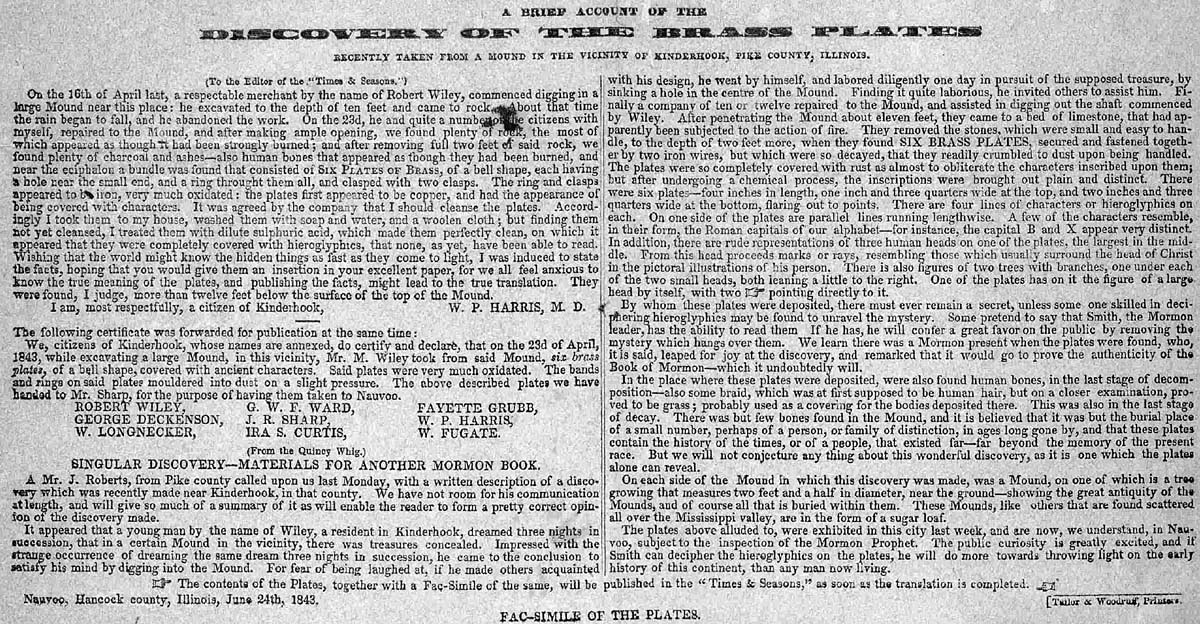
References
[edit]- Anthon, Charles (February 17, 1834), "Letter to Eber Dudley Howe", in Howe, Eber Dudley (ed.), Mormonism Unvailed: or, A Faithful Account of That Singular Imposition and Delusion, from Its Rise to the Present Time, Painesville, Ohio: Telegraph Press, pp. 270–272.
- Bennett, James Gordon Jr. (June 25, 1893), "Mormon Leaders at Their Mecca", The New York Herald.
- Bennett, James Gordon Sr. (1831), Arrington, Leonard J. (ed.), "James Gordon Bennett's 1831 Report on 'The Mormonites'", BYU Studies, 10 (3): 353–364 (1–10 in reprint).
- Benton, Abram W. (March 1831), "Reminiscence", in Vogel, Dan (ed.), Early Mormon Documents, vol. 4, Salt Lake City: Signature Books (published 2002), p. 97, ISBN 978-1-56085-159-2
{{citation}}: ISBN / Date incompatibility (help). - Berge, Dale L. (August 1985), "Archaeological Work at the Smith Log House", Ensign, 15 (8): 24.
- Bidamon, Emma Smith (1996). "Letter to Emma S. Pilgrim (March 27, 1876)". In Vogel, Dan (ed.). Early Mormon Documents. Vol. 1. Signature Books. ISBN 1-56085-072-8.
- Bloom, Harold (1992), The American Religion, Simon & Schuster, ISBN 0-671-67997-X.
- Braden, Clark (1884), Braden-Kelley Debate, St. Louis
{{citation}}: CS1 maint: location missing publisher (link). - Brodie, Fawn M. (1971), No Man Knows My History (Second edition, revised and enlarged ed.), New York: Knopf, ISBN 0-394-46967-4, OCLC 130292.
- Burnett, David S. (March 7, 1831), "Something New – Golden Bible", Evangelical Inquirer, vol. 1, no. 10.
- Burnett, Stephen (15 April 1838), "Letter to Luke S. Johnson", in Vogel, Dan (ed.), Early Mormon Documents, vol. 2, Salt Lake City: Signature Books (published 1999), pp. 290–292, ISBN 978-1-56085-093-9
{{citation}}: ISBN / Date incompatibility (help). - Bushman, Richard Lyman (2005), Joseph Smith: Rough Stone Rolling, New York: Knopf, ISBN 1-4000-4270-4.
- Chandler, Clay L. (2003). "Scrying for the Lord: Magic, Mysticism, and the Origins of the Book of Mormon". Dialogue: A Journal of Mormon Thought. 36 (4): 43–78. doi:10.2307/45227185. JSTOR 45227185. S2CID 254397755..
- Chase, Willard (1833), "Testimony of Willard Chase", in Howe, Eber Dudley (ed.), Mormonism Unvailed, Painesville, Ohio: Telegraph Press, pp. 240–248.
- Clark, John A. (1842), Gleanings by the Way, Philadelphia: W.J. & J.K. Simmon.
- Cobb, James T. (June 1, 1881). "The Hill Cumorah, And The Book Of Mormon. The Smith Family, Cowdery, Harris, and Other Old Neighbors – What They Know". The Saints' Herald. 28 (11): 167..
- Cole, Abner (March 19, 1831), "Gold Bible, No. 6", The [Palmyra] Reflector, II (16).
- Cook, Lyndon W. (1991), David Whitmer Interviews: A Restoration Witness, Orem, Utah: Grandin.
- Cowdery, Oliver (1834). "Letter [I]". Latter Day Saints' Messenger and Advocate. 1 (1): 13–16..
- Cowdery, Oliver (1834b). "Letter III". Latter Day Saints' Messenger and Advocate. 1 (3): 41–43..
- Cowdery, Oliver (1835a), "Letter IV", Latter Day Saints' Messenger and Advocate, 1 (5): 77–80.
- Cowdery, Oliver (1835b), "Letter VIII", Latter Day Saints' Messenger and Advocate, 2 (1): 195–202.
- Crystal, David (1997), The Cambridge Encyclopedia of Language, Cambridge University Press.
- Daniels, Peter T.; Bright, William, eds. (1996), The World's Writing Systems, New York: Oxford University Press.
- Gilbert, John H. (September 8, 1892), Recollections of John H. Gilbert, Palmyra, New York: typescript located in Harold B. Lee Library, Brigham Young University, archived from the original on February 18, 2009, retrieved March 25, 2009.
- Givens, Terry (2003), By the Hand of Mormon: The American Scripture that Launched a New World Religion, Oxford University Press.
- Grandin, E.B. (June 26, 1829), "Editor's note", The Wayne Sentinel.
- Hadley, Jonathan A. (August 11, 1829), "Golden Bible", The Palmyra Freeman.
- Hale, Isaac (1834), "Affidavit of Isaac Hale", in Howe, Eber Dudley (ed.), Mormonism Unvailed, Painesville, Ohio: Telegraph Press, pp. 262–266.
- Hamblin, William J. (2007). "Sacred Writing on Metal Plates in the Ancient Mediterranean". The FARMS Review. 19 (1): 37–54. doi:10.5406/farmsreview.19.1.0037. S2CID 193702940. Archived from the original on 2012-05-15..
- Harris, Abigail (1833), "Affidavit of Abigail Harris", in Howe, Eber Dudley (ed.), Mormonism Unvailed, Painesville, Ohio: Telegraph Press, pp. 253–254.
- Harris, Henry (1833), "Affidavit of Henry Harris", in Howe, Eber Dudley (ed.), Mormonism Unvailed, Painesville, Ohio: Telegraph Press, pp. 251–252.
- Harris, Martin (1859), "Mormonism, No. II", Tiffany's Monthly, 5: 163–170.
- Howe, Eber Dudley, ed. (1834), Mormonism Unvailed, Painesville, Ohio: Telegraph Press. See also: Mormonism Unvailed
- Knight, Joseph Sr. (1833), Jessee, Dean (ed.), "Joseph Knight's Recollection of Early Mormon History", BYU Studies, 17 (1) (published 1976): 35.
- Lapham, [La]Fayette (1870), "Interview with the Father of Joseph Smith, the Mormon Prophet, Forty years Ago. His Account of the Finding of the Sacred Plates", Historical Magazine, Second series, 7: 305–309
{{citation}}: CS1 maint: numeric names: authors list (link). - Lewis, Joseph; Lewis, Hiel (April 30, 1879), "Mormon History", Amboy Journal, 24 (5).
- Marquardt, H. Michael; Walters, Wesley P. (1994), Inventing Mormonism: Tradition and the Historical Record, San Francisco: Signature Books, ISBN 1-56085-039-6, OCLC 28067219.
- Marquardt, H. Michael (2005), The Rise of Mormonism: 1816–1844, Grand Rapids, MI: Xulon Press, p. 632, ISBN 1-59781-470-9.
- Mather, Frederic G. (1880), "Early Days of Mormonism", Lippincott's Magazine, 26 (152): 198–211.
- Metcalfe, Brent Lee (1993), "Apologetic and Critical Assumptions about Book of Mormon Historicity", Dialogue: A Journal of Mormon Thought, 26 (3): 153–184, doi:10.2307/45228673, JSTOR 45228673, S2CID 259876987.
- Ostling, Richard N.; Ostling, Joan K. (1999), Mormon America: The Power and the Promise, HarperSanFrancisco.
- Packer, J. Cameron (2004), "Cumorah's Cave", Journal of Book of Mormon Studies, 13 (1), Provo, Utah: Maxwell Institute: 50–57, JSTOR 10.5406/jbookmormstud.13.1-2.0050, S2CID 193606120, archived from the original on 2006-12-07.
- Palmer, Grant H. (2002), An Insider's View of Mormon Origins, Salt Lake City: Signature Books.
- Parrish, Warren (August 11, 1838), Letter from W. Parrish, Kirtland, The Evangelist (published October 1, 1838), republished in Vogel, Dan, ed. (1999). Early Mormon Documents. Vol. 2. Salt Lake City: Signature Books. p. 289. ISBN 978-1-56085-093-9.
- Phelps, W. W., ed. (1833), A Book of Commandments, for the Government of the Church of Christ, Zion: William Wines Phelps & Co..
- Poulson, P. Wilhelm (August 16, 1878), "Letter to the editor", Deseret Evening News.
- Pratt, Orson (1856), "The Faith and Visions of the Ancient Saints – The Same Great Blessing to be Enjoyed by the Latter-day Saints", Journal of Discourses, III: 344–353.
- Pratt, Orson (1859), "Evidences of the Bible and Book of Mormon Compared", Journal of Discourses, VII: 22–38.
- Pratt, Orson (1877), "King Limhi's Enquiry, from the Book of Mormon", Journal of Discourses, XIX: 204–219.
- Putnam, Read H. (September 1966), "Were the Golden Plates Made of Tumbaga?", Improvement Era, 69 (9): 788–789, 828–831.
- Quinn, D. Michael (1998), Early Mormonism and the Magic World View (2nd ed.), Salt Lake City: Signature Books, ISBN 1-56085-089-2.
- Riley, I. Woodbridge (1902), The Founder of Mormonism: A Psychological Study of Joseph Smith Jr., New York: Dodd, Mead & Co.
- Roberts, B. H., ed. (1902), History of the Church of Jesus Christ of Latter-day Saints, vol. 1, Salt Lake City: Deseret News.
- Roberts, B. H. (1903), New Witnesses for God. Volume II. The Book of Mormon (PDF), Salt Lake City: Deseret News.
- Roberts, B. H., ed. (1905), History of the Church of Jesus Christ of Latter-day Saints, vol. 3, Salt Lake City: Deseret News.
- Roberts, B. H., ed. (1908), History of the Church of Jesus Christ of Latter-day Saints, vol. 4, Salt Lake City: Deseret News.
- Robinson, Andrew (2002), Lost Languages: The Enigma of the World's Undeciphered Scripts, New York: McGraw Hill.
- Salisbury, Katharine Smith (April 10, 1895), Walker, Kyle R. (ed.), "Katharine Smith Salisbury's Recollections of Joseph's Meetings with Moroni" (PDF), BYU Studies, 41 (3) (published 2002): 4–17.
- Saunders, Benjamin (September 1884a), "Interview by William H. Kelley", in Vogel, Dan (ed.), Early Mormon Documents, vol. 2, Salt Lake City: Signature Books (published 1998).
- Saunders, Lorenzo (1884b), "Interview by William H. Kelley", in Vogel, Dan (ed.), Early Mormon Documents, vol. 2, Salt Lake City: Signature Books (published 1998), pp. 159–160.
- Saunders, Orson (June 25, 1893), Bennett, James Gordon Jr. (ed.), "Mormon Leaders at Their Mecca", The New York Herald: 12.
- Smith, Joseph III (October 1, 1879), "last Testimony of Sister Emma", The Saints' Herald, 26 (19): 289.
- Smith, Joseph (1830), The Book of Mormon: An Account Written by the Hand of Mormon, Upon Plates Taken from the Plates of Nephi, Palmyra, New York: E. B. Grandin, archived from the original on 2021-04-13, retrieved 2006-12-04.
- Smith, Joseph (1832), "History of the Life of Joseph Smith", in Jessee, Dean C (ed.), Personal Writings of Joseph Smith, Salt Lake City: Deseret Book (published 2002), ISBN 1-57345-787-6, archived from the original on 2008-11-20
{{citation}}: ISBN / Date incompatibility (help). - Smith, Joseph; Cowdery, Oliver; Rigdon, Sidney; Williams, Frederick G. (1835), Doctrine and Covenants of the Church of the Latter Day Saints: Carefully Selected from the Revelations of God, Kirtland, Ohio: F. G. Williams & Co.
- Smith, Joseph (April 1838a), History of the Church, copied to Smith, Joseph; Mulholland, James; Thompson, Robert B.; Phelps, William W.; Richards, Willard (1839–1843), "History of the Church, Ms. A–1", in Jessee, Dean C (ed.), Personal Writings of Joseph Smith, Salt Lake City: Deseret Book (published 2002), ISBN 1-57345-787-6
{{citation}}: ISBN / Date incompatibility (help). - Smith, Joseph (July 1838b), "Editor's note", Elders' Journal of the Church of Jesus Christ of Latter Day Saints, 1 (3).
- Smith, Joseph (March 1, 1842), "Church History [Wentworth Letter]", Times and Seasons, 3 (9), Nauvoo, Illinois: 906–936.
- Smith, Joseph Sr. (September 29, 1824), "To the Public", Wayne Sentinel, 1.
- Smith, Lucy Mack (1842b), Casawall, Henry (ed.), The City of the Mormons; or, Three Days at Nauvoo, in 1842, London: J.G.F. & J. Rivington (published 1842), ISBN 978-0-598-28557-7
{{citation}}: ISBN / Date incompatibility (help). - Smith, Lucy Mack (1853), Biographical Sketches of Joseph Smith the Prophet, and His Progenitors for Many Generations, Liverpool: S.W. Richards. See also: Biographical Sketches of Joseph Smith the Prophet, and His Progenitors for Many Generations
- Smith, William (1883), William Smith on Mormonism: A True Account of the Origin of the Book of Mormon, Lamoni, Iowa: RLDS Church.
- Smith, William (1884), "The Old Soldier's Testimony", The Saints' Herald, 34 (39): 643–6644.
- Stevenson, Edward (1882), "One of the Three Witnesses: Incidents in the Life of Martin Harris", The Latter Day Saints' Millennial Star, 44: 78–79, 86–87, archived from the original on 2011-06-11.
- Storey, Wilbur F. (October 17, 1881), "Interview with David Whitmer", Chicago Times.
- Tvedtnes, John A (1990), "Review of Little Known Evidences of the Book of Mormon by Brenton G. Yorgason", FARMS Review of Books, 2 (1), Provo, Utah: Maxwell Institute: 258–259, archived from the original on 2006-09-05.
- Tucker, Pomeroy (1867), Origin, Rise and Progress of Mormonism, New York: D. Appleton.
- Turner, Orasmus (1851), History of the Pioneer Settlement of Phelps and Gorham's Purchase, and Morris' Reserve, Rochester, New York: William Alling.
- Van Horn, Robert T. (June 5, 1881), "Mormonism: Authentic Account of the Origin of The Sect from One of the Patriarchs", Kansas City Daily Journal, archived from the original on April 27, 2011.
- Van Wagoner, Richard S.; Walker, Steven C. (Summer 1982), "Joseph Smith: The Gift of Seeing", Dialogue: A Journal of Mormon Thought, 15 (2): 48–68, doi:10.2307/45225078, JSTOR 45225078, S2CID 254395171
- Vogel, Dan, ed. (1996–2003). Early Mormon Documents. (Vols. 1-5). Salt Lake City: Signature Books. ISBN 1-56085-072-8.
- Vogel, Dan (2004), Joseph Smith: The Making of a Prophet, Salt Lake City: Signature Books.
- Wade, B. (April 23, 1880). An Interesting Document. The Salt Lake Daily Tribune. Vol. 19.
- Walker, Ronald W. (1986), "Martin Harris: Mormonism's Early Convert", Dialogue: A Journal of Mormon Thought, 19 (4): 29–43, doi:10.2307/45225502, JSTOR 45225502, S2CID 254310097.
- Whitmer, John C. (August 7, 1875), "The Golden Tables", Chicago Times.
- Whitmer, David (1887). "An Address to All Believers in Christ By A Witness to the Divine Authenticity of the Book of Mormon". Richmond, Missouri: David Whitmer..
- Whitmer, David (January 24, 1888), "An Old Mormon's Closing Hours: David Whitmer, One of the Pioneers of That Faith, Passing Away", Chicago Daily Tribune: 5, archived from the original on October 1, 2007.
- Williams, Stephen (1991), Fantastic Archaeology: The Wild Side of North American Prehistory, Philadelphia: University of Pennsylvania Press.
- Woodard, Roger D., ed. (2004), The Cambridge Encyclopedia of the World's Ancient Languages, Cambridge University Press.
- Young, Brigham (February 18, 1855), "The Priesthood and Satan – the Constitution and Government of the United States –Rights and Policy of the Latter-day Saints", in Watt, G.D. (ed.), Journal of Discourses by Brigham Young, President of the Church of Jesus Christ of Latter-Day Saints, His Two Counsellors, the Twelve Apostles, and Others, vol. 2, Liverpool: F.D. & S.W. Richards (published 1855), pp. 179–190. See also: Journal of Discourses
- Young, Brigham (June 17, 1877), "Trying to Be Saints – Treasures of the Everlasting Hills – The Hill Cumorah – Obedience to True Principle the Key to Knowledge – All Enjoyment Comes from God – Organization – Duties of Officers – Final Results", in Evans, D.W.; Gibbs, Geo. F. (eds.), Journal of Discourses by Brigham Young, His Two Counselors, and the Twelve Apostles, vol. 19, Liverpool: William Budge (published 1878), pp. 36–45.