


Community hub
Recent from talks
Contribute something
Nothing was collected or created yet.
Hafsid dynasty
View on WikipediaThe Hafsid dynasty (Arabic: الحفصيون al-Ḥafṣiyūn) was a Sunni Muslim dynasty of Berber descent[2] that ruled Ifriqiya (modern day Tunisia, western Libya, and eastern Algeria) from 1229 to 1574. The dynasty was founded by Abu Zakariya Yahya, who was initially appointed governor of the region by the Almohad caliph before declaring his independence.
Key Information


Under the reigns of Abu Zakariya and his successor, al-Mustansir (r. 1249–1277), the Hafsids consolidated and expanded their power, with Tunis as their capital. After al-Mustansir's death, internal conflicts resulted in a division between an eastern branch of the dynasty ruling from Tunis and a western branch ruling from Béjaïa and Consantine.[3] A reunification took place under Abu Yahya Abu Bakr II (r. 1318–1346), but his death was followed by another crisis during which the Marinids, based in present-day Morocco, invaded briefly. Eventually, unity was re-established by Abu al-Abbas Ahmad II (r. 1370–1394), who inaugurated the apogee of Hafsid power and influence across the region, which continued under Abu Faris Abd al-Aziz II (r. 1394–1434) and Abu 'Amr 'Uthman (r. 1435–1488). After this, their power gradually declined. During the 16th century, as the Ottoman Empire encroached on the region, the Hafsids were propped up by Spain until the final Ottoman conquest of Tunis in 1574 put an end to their reign.[3]
The Hafsid period in Ifriqiya was also marked by important cultural and intellectual activity, encouraged in part by Abu Zakariya Yahya's decision to welcome Andalusi migrants and refugees. The medieval historian, Ibn Khaldun, was born in Tunis during this time. Hafsid architectural patronage included, among other things, the first madrasas in the Maghreb.[3]
History
[edit]Almohad Ifriqiya
[edit]The Hafsids were of Berber descent,[2] although to further legitimize their rule, they claimed Arab ancestry from the second Rashidun caliph Omar.[4] The ancestor of the dynasty (from whom their name is derived), was Abu Hafs Umar ibn Yahya al-Hintati, a Berber from the Hintata tribal confederation,[5] which belonged to the greater Masmuda confederation in present-day Morocco.[6] He was a member of the Council of Ten, one of the highest Almohad political bodies, and a close companion of Ibn Tumart, the Almohad movement's founder.[5]
The son of Abu Hafs, Abu Muhammad Abd al-Wahid ibn Abi Hafs, was appointed by the Almohad caliph Muhammad al-Nasir as governor of Ifriqiya (generally present-day Tunisia, eastern Algeria, and western Libya) where he ruled from 1207 to 1221.[7] He was established in Tunis, which the Almohads had chosen as the province's administrative capital.[8]: 133 His appointment came in the wake of the defeat of Yahya Ibn Ghaniya, who had launched a serious attack against Almohad authority in the region. Abu Muhammad Abd al-Wahid was ultimately quite effective in keeping order. The caliph had granted him a significant degree of autonomy in governing, partly to help persuade him to accept this difficult position in the first place. This laid the groundwork for a future Hafsid state.[9]: 101, 119
When Abu Muhammad Abd al-Wahid died in 1221, the Almohad chiefs in Ifriqiya initially elected his son, Abu Zayd Abd al-Rahman, as the next governor. However, the Almohad caliph in Marrakesh, Yusuf II al-Mustansir, had not consented to this and was able to overrule this and appoint his own relative to the position.[9]: 119 As Almohad authority weakened over the following years, local opposition to the Almohad governor compelled the Almohad caliph Abdallah al-Adil to appoint another Hafsid family member to the post in 1226. He chose Abu Muhammad Abdallah, a grandson of Abu Hafs. Abu Muhammad Abdallah's brother, Abu Zakariya Yahya, arrived in Tunis before him and began to reestablish order.[9]: 119 When al-Ma'mun, the brother of Abdallah al-Adil, rebelled against the latter's authority from al-Andalus, Abu Zakariya sided with him, whereas Abu Muhammad Abdallah remained loyal to the caliph in Marrakesh. Al-Ma'mun's eventual victory resulted in Abu Zakariya being placed in charge of Ifriqiya in 1228.[9]: 119
Rise to power
[edit]A year later, in 1229, al-Ma'mun officially renounced Almohad doctrine. Abu Zakariya used this as a pretext to repudiate his authority and to declare himself independent. By this point, Al-Ma'mun did not have the means to stop him or to reassert control over Ifriqiya.[9]: 119 Initially, Abu Zakariya had his name mentioned in the khutba (the sermon during Friday prayer) with the title of amir, but in 1236 or 1237 he began to adopt the caliphal title of Amir al-Mu'minin, in direct challenge to the Almohad caliph in Marrakesh.[9]: 119
Abu Zakariya annexed Constantine (Qusantina) and Béjaïa (Bijaya) in 1230.[7] In 1234, he chased Yahya Ibn Ghaniya out of the countryside south of Constantine in 1234, ending this lingering threat.[7] In 1235 he captured Algiers and then established his authority as far as the Chelif River to the west.[7] In the following years he subdued various rural tribes, such as the Hawwara, but allowed some of the Banu Tujin tribes in the central Maghreb to govern themselves as small vassal states that secured his western borders.[7] He welcomed many refugees and immigrants from al-Andalus who were fleeing the advance of the Reconquista. He appointed some of them to important political positions and recruited Andalusi military regiments as a way of counteracting the power and influence of traditional Almohad elites.[3]
For a time, the Nasrid ruler of Granada in al-Andalus, Ibn al-Ahmar, briefly acknowledged Abu Zakariya's suzerainty in an attempt to enlist his help against Christian forces. Ultimately, Hafsid intervention on the Iberian Peninsula was limited to sending a fleet to Muslim Valencia's aid in 1238.[9]: 119–120 Abu Zakariya showed more interest in trying to recreate some of the former authority of the Almohads over the Maghreb and he made attempts to extend his control further west. In 1242, he captured Tlemcen from the Zayyanids, but the Zayyanid leader Yaghmurasan evaded him. The two leaders eventually came to an agreement, with Yaghmurasan continuing to rule in Tlemcen but agreeing to formally recognize Abu Zakariya's authority.[9]: 120 That same year, Sijilmasa and Ceuta (Sabta) also recognized his authority,[9]: 120 though these would later fall under Marinid control.[9]: 107, 136 This policy of western expansion ended with Abu Zakariya's death (1249).[9]: 120
Consolidation and division
[edit]
His successor, Muhammad I al-Mustansir (r. 1249–1277), focused on consolidating the Hafsid state in Ifriqiya. The state benefited from expanding trade with both Europe and the Sudan region (south of the Sahara).[9]: 120–121 In the western Maghreb (present-day Morocco), the Marinids, who had not yet fully established their rule in the region, formally recognized his authority in 1258.[9]: 120 With the fall of Baghdad, the home of the Abbasid caliphs, that same year, the Hafsids were briefly seen as the most important rulers of the Muslim world. The Sharif of Mecca, Abu Numayy, temporarily recognized him as caliph in 1259.[9]: 120 [10]: 97
It was during his reign that the failed Eighth Crusade took place, led by Louis IX of France. After landing at Carthage, Louis died of dysentery in the middle of his army decimated by disease in 1270.
After al-Mustansir's death in 1277, the Hafsids were riven by internal conflict, aggravated by interference from Aragon.[9]: 123 This resulted in a split in the dynasty: one branch ruled from Tunis in the east and another branch ruled from Béjaïa (Bijaya) and Constantine (Qusantina) in the west. This division continued to characterize Hafsid politics for much of its history, with the balance of power sometimes shifting from one side to another and with intermittent successes at unifying both branches under one rule.[3] After the initial split, the first successful reunification took place under Abu Yahya Abu Bakr II (r. 1318–1346), the ruler of the western branch who managed to take control of Tunis.[3]
Marinid invasions and internal crisis
[edit]Abu Yahya Abu Bakr's rule remained unstable and he resorted to making alliances with the Zayyanids and Marinids to the west.[3] His agreement with the Marinid ruler, Abu al-Hasan (r. 1331–1348), included a marriage to his sister, who subsequently died during a failed Marinid expedition in Spain, followed by another marriage to his daughter.[9]: 110 When Abu Yahya Abu Bakr died in 1346, his intended heir, Abu'l Abbas, was killed in Tunis by his brother, Umar, who seized power. Abu'l Abbas's chamberlain, Abu Muhammad Abdallah ibn Tafrajin, sent a letter to Abu al-Hasan urging him to intervene and invade Ifriqiya. Abu al-Hasan, having already conquered Tlemcen in 1337, seized the opportunity to further expand. He conquered Tunis in 1347 and the Hafsid governors in the region accepted his authority.[9]: 110
The invasion, however, disturbed the balance of power in favour of the Bedouin Arab tribes, whom the Marinids were unable to sway.[9]: 111, 128 Ibn Tafrajin, who had hoped to be placed in power by the Marinids, fled to Egypt. The situation in Ifriqiya devolved into further disorder and internal rivalries, and Abu al-Hasan was forced to return west in 1349, partly to deal with a coup d'état by his son, Abu Inan. Ibn Tafrajin returned to Ifriqiya and, with Bedouin support, installed another young son of Abu Yahya Abu Bakr, Abu Ishaq, as ruler.[9]: 111, 128 Abu Inan, having successfully taken the throne from his father, invaded Ifriqiya again and captured Tunis in August 1357, but he was soon forced by his own troops to abandon the region. He returned west, retaining control only of Constantine and the cities of the central Maghreb for a time.[9]: 111
During the mid-14th century, plague epidemics brought to Ifriqiya from Sicily caused a considerable fall in population, further weakening the Hafsid realm. To stop raids from southern tribes during plague epidemics, the Hafsids turned to the Banu Hilal to protect their rural population.[11]: 37
Apogee
[edit]
After the Marinid threat ended, attempts to reunify the Hafsids failed until Abu al-Abbas Ahmad II (r. 1370–1394), the emir of Béjaïa and Constantine, conquered Tunis in 1370.[3] A capable ruler and military leader, he reestablished Hafsid authority on stronger terms, centralizing power to a greater extent than ever before. Meanwhile, the Zayyanids and Marinids were occupied by internal matters.[3]
Abu Faris Abd al-Aziz II's reign (r. 1394–1434) was considered the apogee of Hafsid power and prosperity by contemporary writers. He further consolidated his dynasty's power in Ifriqiya and extended his influence over the Zayyanids and Marinids (and the Wattasids who succeeded the latter).[3]
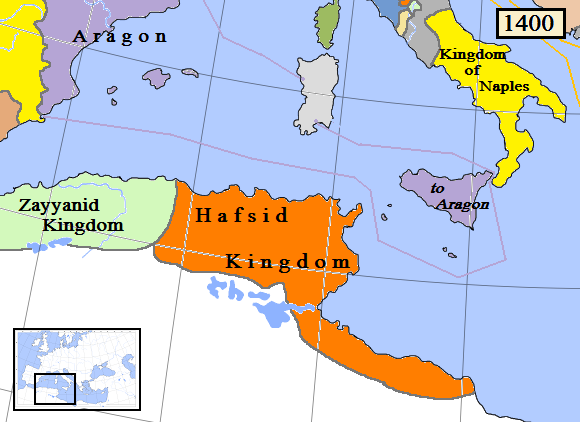
The beginning of his reign was not easy since the cities of the south revolted against him. However, the new sultan quickly regained control: he reoccupied Tozeur (1404), Gafsa (1401), and Biskra (1402), subdued tribal power in the regions of Constantine and Béjaïa (1397–1402), and appointed governors of these regions to be elected officers.[clarification needed] He also intervened against his western and eastern neighbors. He annexed Tripoli (1401) and Algiers (1410–1411).[13] In 1424, he defeated the Zayyanid sultan, Abu Malik Abd al-Wahid, and placed another Zayyanid, Abu Abdallah Muhammad IV, on the throne of Tlemcen as his vassal.[14][15] In 1428, the latter became embroiled in another war with Abu Malik Abd al-Wahid – who had now won his own support from the Hafsids – and was eventually replaced by yet another Zayyanid relative with Abu Faris Abd al-Aziz's help in 1431.[15] Around the same time (probably in 1426), Abu Faris Abd al-Aziz also helped to install Abd al-Haqq II on the Marinid throne in Fez – under the regency of Abu Zakariya Yahya al-Wattasi – and thus obtained from him a recognition of Hafsid suzerainty.[16]
In 1429, the Hafsids attacked the island of Malta and took 3000 slaves, although they did not conquer the island.[17] Kaid Ridavan was the military leader during the attack.[18] The profits were used for a great building programme and to support art and culture. However, piracy also provoked retaliation from the Christians, which several times launched attacks and crusades against Hafsid coastal cities such as the Barbary crusade (1390), the Bona crusade (1399) and the capture of Djerba in 1423.[citation needed]
Abu Faris Abd al-Aziz II died in 1434 during another expedition against Tlemcen.[3] His successor, Abu 'Amr 'Uthman, had the longest reign of any Hafsid (r. 1435–1488). He largely continued the strong rule of his predecessors but he had to contend with greater challenges, including internal politics, restive Bedouin tribes in the south, and the Wattasids in the west.[3]
Uthman conquered Tripolitania in 1458 and appointed a governor in Ouargla in 1463.[19] He led two expeditions to Tlemcen in 1462 and 1466 and made the Zayyanids his vassals, while the Wattasid state in Morocco also formally accepted his authority. The entire Maghreb was thus briefly under Hafsid suzerainty.[20][9]: 132
Fall
[edit]In the 16th century the Hafsids became increasingly caught up in the power struggle between Spain and the Ottoman Empire-supported Corsairs. The Ottomans conquered Tunis in 1534 and held it for one year, driving out the Hafsid ruler Moulay Hassan. A year later the King of Spain and Holy Roman Emperor Charles V seized Tunis, drove the Ottomans out and restored Muley Hassan as a Habsburg tributary.[21] Due to the Ottoman threat, the Hafsids were vassals of Spain after 1535. The Ottomans again conquered Tunis in 1569 and held it for four years. Don Juan of Austria recaptured it in 1573. The Ottomans reconquered Tunis in 1574, and Muhammad VI, the last Caliph of the Hafsids, was brought to Constantinople and was subsequently executed due to his collaboration with Spain and the desire of the Ottoman Sultan to take the title of Caliph as he now controlled Mecca and Medina.[citation needed]
Economy
[edit]The Hafsids, with their location in Ifriqiya, was rich in agriculture and trade. Instead of placing the capital at inland cities such as Kairouan, Tunis was chosen as the capital due to its position on the coast as a port linking the Western and Eastern Mediterranean. Christian merchants from Europe were given their own enclaves in various cities on the Mediterranean coast, promoting trans-Mediterranean trade. Under the Hafsids, commerce and diplomatic relations with Christian Europe grew significantly,[22] however piracy against Christian shipping grew as well, particularly during the rule of Abd al-Aziz II (1394–1434). By the mid-14th century, the population of Tunis had grown to 100,000. The Hafsids also had a large stake in trans-Saharan trade through the caravan routes from Tunis to Timbuktu and from Tripoli to sub-Saharan Africa.[11]: 34–36
Culture
[edit]Intellectual activity
[edit]The Hafsids were effective patrons of culture and education.[3] They were the first to introduce madrasas to the Maghreb.[23]: 209 [3] Arabic literacy and religious education thus increased, with Kairouan, Tunis and Bijaya hosting famous university-mosques. Kairouan continued to serve as a center of the Maliki school of religious doctrine.[11]: 37 As the political center of the country shifted to Tunis, the Great Mosque of al-Zaytuna, the city's main mosque, became the country's leading center of learning.[24] Of great impact on culture were immigrants from al-Andalus, whom Abu Zakariya encouraged to come to his realm in the 13th century. Among the most important figures was the historian and intellectual, Ibn Khaldun, born in Tunis and of Andalusi descent.[3]
Architecture
[edit].jpg)
The Hafsids were significant builders, particularly under the reigns of successful leaders like Abu Zakariya (r. 1229–1249) and Abu Faris (r. 1394–1434), though not many of their monuments have survived intact to the present-day.[23]: 208 While Kairouan remained an important religious center, Tunis was the capital and progressively replaced it as the main city of the region and the main center of architectural patronage. Unlike the architecture further west, Hafsid architecture was built primarily in stone (rather than brick or mudbrick) and appears to have featured much less decoration.[23]: 208 In reviewing the history of architecture in the western Islamic world, scholar Jonathan Bloom remarks that Hafsid architecture seems to have "largely charted a course independent of the developments elsewhere in the Maghrib."[23]: 213
The Kasbah Mosque of Tunis was one of the first works of this period, built by Abu Zakariya (the first independent Hafsid ruler) at the beginning of his reign. Its floor plan had noticeable differences from previous Almohad-period mosques but the minaret, completed in 1233, bears very strong resemblance to the minaret of the earlier Almohad Kasbah Mosque in Marrakesh.[23] Other foundations from the Hafsid period in Tunis include the Haliq Mosque (13th century) and the al-Hawa Mosque (1375). The Bardo Palace (today a national museum) was also begun by the Hafsids in the 15th century,[25] and is mentioned in historical records for the first time during the reign of Abu Faris.[23]: 208 The Hafsids also made significant renovations to the much older Great Mosque of Kairouan – renovating its ceiling, reinforcing its walls, and building or rebuilding two of its entrance gates in 1293 – as well as to the Great Mosque of al-Zaytuna in Tunis.[23]: 209
The Hafsids also introduced the first madrasas to the region, beginning with the Madrasa al-Shamma῾iyya built in Tunis in 1238[26][23]: 209 (or in 1249 according to some sources[27]: 296 [28]). This was followed by many others (almost all of them in Tunis) such as the Madrasa al-Hawa founded in the 1250s, the Madrasa al-Ma'ridiya (1282), and the Madrasa al-Unqiya (1341).[23] Many of these early madrasas, however, have been poorly preserved or have been considerably modified in the centuries since their foundation.[23][29] The Madrasa al-Muntasiriya, completed in 1437, is among the best preserved madrasas of the Hafsid period.[23]: 211
Flags
[edit]According to French historian Robert Brunschvig, the Hafsid dynasty and its founding tribe, Hintata, were represented specifically with a white flag;[30] he states : "Among the Hafsid standards carried in the parades stood out, apart, closer to the sultan and held by a man on horseback, a white standard, the "victorious standard" (al-alam al-mansûr). It is with good reason that some wanted to find in this white standard that of the Almohads, of the same color, reproducing in turn that which the Fatimids had adopted."[30] Egyptian historiographer Al-Qalqashandi (d. 1418) mentioned white flags when he spoke about the Almohad flag in Tunisia, where he stated that: "It was a white flag called the victorious flag, and it was raised before their sultan when riding for Eid prayers or for the movement of the makhzen slaves (which were the ordinary people of the country and the people of the markets)."[31] Historian Charles-André Julien also speaks of Hafsid sovereigns doing parades with their court while hoisting their own white standard, overshadowing multicolored flags of embroidered silk.[32]
The Book of Knowledge of All Kingdoms, written by a Franciscan friar in the 14th century, describes the flag of Tunis as being white with a black moon at its center. Other cities within modern Tunisia and eastern Algeria were also reported having white flags with a moon.[33]
- Flags of Hafsids on portolans and from other sources
-
![Early red flag with white or yellow crescent of the 14th century, reported by Marino Sanudo (ca. 1321), Pietro Vesconte (1325), Angelino Dulcerta (1339) and the Catalan Atlas (1385)[34]](//upload.wikimedia.org/wikipedia/commons/thumb/d/d1/Flag_of_Tunis_during_14th_century.svg/120px-Flag_of_Tunis_during_14th_century.svg.png) Early red flag with white or yellow crescent of the 14th century, reported by Marino Sanudo (ca. 1321), Pietro Vesconte (1325), Angelino Dulcerta (1339) and the Catalan Atlas (1385)[34]
Early red flag with white or yellow crescent of the 14th century, reported by Marino Sanudo (ca. 1321), Pietro Vesconte (1325), Angelino Dulcerta (1339) and the Catalan Atlas (1385)[34] -
![White with blue crescent according to Jacobo Russo, 1550 (last period of the kingdom)[34]](//upload.wikimedia.org/wikipedia/commons/thumb/0/02/Flag_of_Hafsid_Tunisia_%281550%29.svg/120px-Flag_of_Hafsid_Tunisia_%281550%29.svg.png) White with blue crescent according to Jacobo Russo, 1550 (last period of the kingdom)[34]
White with blue crescent according to Jacobo Russo, 1550 (last period of the kingdom)[34]
![Early red flag with white or yellow crescent of the 14th century, reported by Marino Sanudo (ca. 1321), Pietro Vesconte (1325), Angelino Dulcerta (1339) and the Catalan Atlas (1385)[34]](https://en.wikipedia.org/wiki/File:Flag_of_Tunis_during_14th_century.svg)
![White with blue crescent according to Jacobo Russo, 1550 (last period of the kingdom)[34]](https://en.wikipedia.org/wiki/File:Flag_of_Hafsid_Tunisia_(1550).svg)
Hafsid rulers
[edit]| History of Tunisia |
|---|
 |
.svg) Africa portal • Africa portal •  History portal History portal |
| History of Algeria |
|---|
_et_du_Royaume_de_F%C3%A8s.jpg) |
| History of Libya | ||||||||||||||||||||||||||||||||||||||
|---|---|---|---|---|---|---|---|---|---|---|---|---|---|---|---|---|---|---|---|---|---|---|---|---|---|---|---|---|---|---|---|---|---|---|---|---|---|---|
 | ||||||||||||||||||||||||||||||||||||||
|
||||||||||||||||||||||||||||||||||||||
 Libya portal Libya portal | ||||||||||||||||||||||||||||||||||||||
| S. n. | Name | Birth date | Death date | Reign | Notes |
|---|---|---|---|---|---|
| – | Abu Muhammad Abd al-Wahid ibn Abi Hafs | unknown | 1222 | 1207–1222 | Not yet a sultan, just a local minor leader. |
| – | Abu Muhammad Abd Allah ibn Abd al-Wahid | unknown | 1229 | 1222–1229 | Not yet a sultan, just a local minor leader. |
| 1st | Abu Zakariya Yahya | 1203 | 5 October 1249 | 1229–1249 | |
| 2nd | Muhammad I al-Mustansir | 1228 | 1277 | 1249–1277 | |
| 3rd | Yahya II al-Wathiq | 1249 | 1279 | 1277–1279 | |
| 4th | Ibrahim I | 1234 | 1283 | 1279–1283 | |
| 5th | Abd al-Aziz I | unknown | 1283 | 1283 | |
| 6th | Ibn Abi Umara | unknown | 1284 | 1283–1284 | |
| 7th | Abu Hafs Umar bin Yahya | 1245 | 1295 | 1284–1295 | |
| 8th | Abu Asida Muhammad II | 1279 | September 1309 | 1295–1309 | |
| 9th | Abu Yahya Abu Bakr ash-Shahid | unknown | September 1309 | 1309 | |
| 10th | Abu-l-Baqa Khalid An-Nasr | c.1283 | 1311 | 1309–1311 | |
| 11th | Abd al-Wahid Zakariya ibn al-Lihyani | 1253 | 1326 | 1311–1317 | |
| 12th | Abu Darba Muhammad Al-Mustansir | 1274 | 1323 | 1317–1318 | |
| 13th | Abu Yahya Abu Bakr II | 1293 | 19 October 1346 | 1318–1346 | |
| 14th | Abu-l Abbas Ahmad | unknown | 1346 | 1346 | |
| 15th | Abu Hafs Umar II | unknown | 1347 | 1346–1347 | |
| 16th | Abu al-Abbas Ahmad al-Fadl al-Mutawakkil | unknown | 1350 | 1347–1350 | |
| 17th | Abu Ishaq Ibrahim II | October or November 1336 | 19 February 1369 | 1350–1369 | |
| 18th | Abu-l-Baqa Khalid II | unknown | November 1370 | 1369–1370 | |
| 19th | Ahmad II | 1329 | 3 June 1394 | 1370–1394 | |
| 20th | Abd al-Aziz II | 1361 | July 1434 | 1394–1434 | |
| 21st | Abu Abd-Allah Muhammad al-Muntasir | unknown | 16 September 1435 | 1434–1435 | |
| 22nd | Abu 'Amr 'Uthman | February 1419 | September 1488 | 1435–1488 | |
| 23rd | Abu Zakariya Yahya II | unknown | 1489 | 1488–1489 | |
| 24th | Abd al-Mu'min | unknown | 1490 | 1489–1490 | |
| 25th | Abu Yahya Zakariya III | unknown | 1494 | 1490–1494 | |
| 26th | Abu Abdallah Muhammad IV al-Mutawakkil | unknown | 1526 | 1494–1526 | |
| 27th | Muhammad V (“Moulay Hasan”) | unknown | 1543 | 1526–1543 | |
| 28th | Ahmad III | c. 1500 | August 1575 | 1543–1569 | |
| Ottoman conquest (1569–1573) | |||||
| 29th | Muhammad VI | unknown | 1594 | 1573–1574 | |
See also
[edit]References
[edit]- ^ Baskins, Cristelle L. (2022). Hafsids and Habsburgs in the Early Modern Mediterranean: Facing Tunis. Springer Nature. p. 311. ISBN 978-3-031-05079-4.
- ^ a b C. Magbaily Fyle, Introduction to the History of African Civilization: Precolonial Africa, (University Press of America, 1999), 84.
- ^ a b c d e f g h i j k l m n o Rouighi, Ramzi (2020). "Ḥafṣids". In Fleet, Kate; Krämer, Gudrun; Matringe, Denis; Nawas, John; Rowson, Everett (eds.). Encyclopaedia of Islam, Three. Brill. ISBN 9789004161658.
- ^ Fromherz, Allen James (2016). Near West: Medieval North Africa, Latin Europe and the Mediterranean in the Second Axial Age. Edinburgh University Press. p. 113. ISBN 978-1-4744-1007-6.
- ^ a b Fromherz, Allen J. (2009). "Abū Ḥafṣ ʿUmar al-Hintātī". In Fleet, Kate; Krämer, Gudrun; Matringe, Denis; Nawas, John; Rowson, Everett (eds.). Encyclopaedia of Islam, Three. Brill. ISBN 9789004161658.
- ^ Deverdun, G. (1986) [1971]. "Hintāta". In Lewis, B.; Ménage, V. L.; Pellat, C.; Schacht, J. (eds.). Encyclopaedia of Islam. Vol. III (2nd ed.). Leiden, Netherlands: E. J. Brill. ISBN 9004081186.
- ^ a b c d e Idris, H. R. (1986) [1971]. "Ḥafṣids". In Lewis, B.; Ménage, V. L.; Pellat, C.; Schacht, J. (eds.). Encyclopaedia of Islam. Vol. III (2nd ed.). Leiden, Netherlands: E. J. Brill. p. 66. ISBN 9004081186.
- ^ Abadi, Jacob (2013). Tunisia Since the Arab Conquest: The Saga of a Westernized Muslim State. Apollo Books. ISBN 978-0-86372-435-0.
- ^ a b c d e f g h i j k l m n o p q r s t u Abun-Nasr, Jamil (1987). A history of the Maghrib in the Islamic period. Cambridge: Cambridge University Press. ISBN 0521337674.
- ^ Naylor, Phillip (2015). North Africa, Revised Edition: A History from Antiquity to the Present. University of Texas Press. ISBN 978-0-292-76192-6.
- ^ a b c Roland Anthony Oliver; Roland Oliver; Anthony Atmore (2001). Medieval Africa, 1250–1800. Cambridge University Press. ISBN 978-0-521-79372-8.
- ^ "Papier pourpre et encre d'argent". BnF Essentiels (in French). Retrieved 2023-11-27.
- ^ نوري, عبد المجيد (March 2017). "العملة وتأثيراتها السياسية في تاريخ الغرب الإسلامي من مطلع القرن الخامس إلى أواخر القرن السابع الهجري 407 هـ - 674 هـ /1017 - 1275 م". Historical Kan Periodical (in Arabic). 10 (35): 172–175. doi:10.12816/0041490. ISSN 2090-0449.
- ^ نوري, عبد المجيد (March 2017). "العملة وتأثيراتها السياسية في تاريخ الغرب الإسلامي من مطلع القرن الخامس إلى أواخر القرن السابع الهجري 407 هـ - 674 هـ / 1017 - 1275 م". Historical Kan Periodical (in Arabic). 10 (35): 172–175. doi:10.12816/0041490. ISSN 2090-0449.
- ^ a b Garrot, Henri (1910). Histoire générale de l'Algérie (in French). Alger, Impr. P. Crescenzo. pp. 287–288.
- ^ Cour, Auguste (1920). La dynastie marocaine des Beni Wattas (1420-1554). Recueil des notices et mémoires de la Société archéologique de la province de Constantine (in French). Imprimerie D. Braham. p. 50.
- ^ Castillo, Dennis Angelo (2006). The Maltese Cross: A Strategic History of Malta. Greenwood Publishing Group. pp. 36–37. ISBN 0313323291.
- ^ Cauchi, Fr Mark (12 September 2004). "575th anniversary of the 1429 Siege of Malta". Times of Malta. Retrieved 4 August 2022.
- ^ Braunschvig 1940, p. 260
- ^ Julien, Charles André (1970). History of North Africa: Tunisia, Algeria, Morocco, from the Arab Conquest to 1830. Routledge & K. Paul. ISBN 978-0-7100-6614-5.
- ^ Roger Crowley, Empires of the Sea, faber and faber 2008 p. 61
- ^ Berry, LaVerle. "Hafsids". Libya: A Country Study. Library of Congress. Retrieved 5 March 2011.
- ^ a b c d e f g h i j k Bloom, Jonathan M. (2020). Architecture of the Islamic West: North Africa and the Iberian Peninsula, 700–1800. Yale University Press. ISBN 9780300218701.
- ^ Chater, Khalifa (2002). "Zaytūna". In Bearman, P.; Bianquis, Th.; Bosworth, C.E.; van Donzel, E.; Heinrichs, W.P. (eds.). Encyclopaedia of Islam, Second Edition. Vol. XI. Brill. pp. 488–490. ISBN 9789004161214.
- ^ M. Bloom, Jonathan; S. Blair, Sheila, eds. (2009). "Tunis". The Grove Encyclopedia of Islamic Art and Architecture. Oxford University Press. ISBN 9780195309911.
- ^ Binous, Jamila; Baklouti, Naceur; Ben Tanfous, Aziza; Bouteraa, Kadri; Rammah, Mourad; Zouari, Ali (2002). Ifriqiya: Thirteen Centuries of Art and Architecture in Tunisia (2nd ed.). Museum With No Frontiers, MWNF. ISBN 9783902782199.
- ^ Marçais, Georges (1954). L'architecture musulmane d'Occident. Paris: Arts et métiers graphiques.
- ^ M. Bloom, Jonathan; S. Blair, Sheila, eds. (2009). "Hafsid". The Grove Encyclopedia of Islamic Art and Architecture. Oxford University Press. ISBN 9780195309911.
- ^ Bloom, Jonathan M.; Blair, Sheila S., eds. (2009). "Madrasa". The Grove Encyclopedia of Islamic Art and Architecture. Oxford University Press.
- ^ a b Brunschvig, Robert (1982). La Berberie orientale sous les Hafsides des origines à la fin du XVe siècle [Eastern Berberia under the Hafsids from the origins to the end of the 15th century] (PDF) (in French). Vol. 2. A. Maisonneuve. p. 30.
- ^ عاصم, محمد رزق (2006). رايات الإسلام من اللواء النبوي الأبيض إلى العلم العثماني الأحمر [Banners of Islam from the white Prophet's banner to the red Ottoman flag] (in Arabic). Cairo: مكتبة مدبولي. p. 151.
- ^ Julien 1970, p. 155.
- ^ Markham, Clements R. (Clements Robert); Jiménez de la Espada, Marcos (1912). Book of knowledge of all the kingdoms, lands, and lordships that are in the world, and the arms and devices of each land and lordship, or of the kings and lords who possess them. Kelly - University of Toronto. London, The Hakluyt society. p. 24.
- ^ a b "TunisiaArms". www.hubert-herald.nl.
Timeline of the Maghreb dynasties | |
|---|---|
 |
| International | |
|---|---|
| National | |
| People | |
| Other | |

Hafsid dynasty
View on GrokipediaOrigins and Foundation
Almohad Context in Ifriqiya
The Almohads established control over Ifriqiya following their conquest of the region between 1159 and 1160, when Caliph Abd al-Mu'min captured Tunis and integrated the area—encompassing modern Tunisia and eastern Algeria—into their centralized empire spanning the Maghreb, al-Andalus, and the Balearic Islands.[5] This followed the subjugation of Arab tribes at Setif in 1153, whose presence stemmed from earlier migrations such as the Banu Hilal in the 11th century that reshaped Ifriqiya’s countryside, political sociology, rural power structures through tribal federations, and fiscal challenges in converting nomadic mobility into predictable revenue, while advancing Arabization in language and society,[6] and addressed prior Norman incursions, such as the 1149 capture of al-Mahdiyya, by reorganizing Ifriqiya as a province under direct caliphal oversight.[5] Initial stability relied on economic measures, including a 1160 treaty with Genoa imposing an 8% customs duty on their merchants—lower than the 10% for others—to secure maritime trade routes vital for revenue.[5] However, by the late 12th century, this centralized authority began to erode amid persistent revolts, notably from the Banu Ghaniya, who challenged Almohad dominance in 1187 and again after 1199, requiring reconquests of key cities like Bijaya in 1184 and Tunis in 1188.[5] [7] To counter local instability, Caliph Muhammad al-Nasir (r. 1199–1213) appointed Umar al-Hintati, son of the Almohad loyalist Abu Hafs Umar ibn Yahya al-Hintati from the Hintata tribe of the Masmuda confederation, as governor of Ifriqiya in 1207, a position he held until his death in 1221.[8] This appointment introduced the Hafsid lineage to the region, leveraging the governor's tribal ties and military experience—his father had been a key companion of Ibn Tumart—to forge alliances with local Zenata Berber groups amid ongoing tribal frictions between Masmuda settlers and indigenous Zenata populations.[5] Umar al-Hintati's tenure focused on suppressing the Banu Ghaniya revolt by 1206 through decisive campaigns, temporarily restoring order but highlighting reliance on provincial governors who often prioritized local consolidation over distant caliphal directives.[5] Religious and doctrinal tensions exacerbated political fragility, as the Almohads' strict unitarian tauhid—rejecting anthropomorphic interpretations of scripture and suppressing traditional Maliki Sunni jurisprudence prevalent in Ifriqiya since the Aghlabid era, with deep scholarly roots—provoked dissent among local ulema and Arab tribes.[9] This rigidity, enforced through bans on Maliki scholars and forced doctrinal adherence, clashed with Ifriqiya's entrenched Sunni preferences and foreshadowed the post-Almohad transition's gradual re-anchoring of religious authority in Maliki judges, teachers, and endowments, fueling revolts alongside economic strains like post-1212 territorial losses after the Battle of Las Navas de Tolosa, which slashed gold production by up to 90% and prompted Zenata and Arab uprisings demanding tribute.[5] [9] Famines from 1215 to 1217 under al-Mustansir (r. 1213–1224) further intensified these disorders, with unpaid troops and supply failures eroding central loyalty and enabling provincial figures to accrue autonomous power.[5]Rise of Abu Zakariya Yahya
Abu Zakariya Yahya, a member of the Banu Hafs clan of Zenata Berber origin, initially served the Almohad Caliphate as governor of Gabès in Ifriqiya before being elevated to governor of Tunis around 1226.[8] His appointment reflected the Almohads' reliance on trusted tribal leaders to administer distant provinces amid growing internal instability.[10] The Almohad Caliphate's decline accelerated after its decisive defeat at the Battle of Las Navas de Tolosa in 1212, which shattered its military prestige in al-Andalus and exposed vulnerabilities in its overextended empire, including Ifriqiya.[11] This loss fragmented Almohad authority, fostering provincial autonomy as caliphal control weakened and local governors exploited the power vacuum.[12] In 1229, amid these disturbances, Abu Zakariya capitalized on the chaos by conquering key eastern Algerian cities, including Constantine and Béjaïa, before returning to Tunis and declaring independence from the Almohads, thereby founding the Hafsid emirate.[8][12] To consolidate his rule, Abu Zakariya forged alliances with Arab tribes, such as the Banu Hilal, whose migratory pressures had already disrupted Almohad governance; these alliances involved recurring political contracts with Arab groups concerning grazing access, tax collection, military service, and protection of roads, which could empower tribal leaders, constrain central authority, and occasionally destabilize governance, but also enabled the extension of Hafsid influence beyond coastal cities, while suppressing rival Banu Ghaniya claimants and other local potentates.[13] These maneuvers extended Hafsid influence eastward toward Tripoli by securing tribute and nominal suzerainty over peripheral regions, transitioning Ifriqiya from Almohad vassalage to a nascent independent polity centered on Tunis.[14] Initial economic measures focused on stabilizing trade routes with Italian merchants, leveraging Béjaïa's port to foster commerce in textiles and grains, which underpinned the regime's fiscal independence.[10]Expansion and Consolidation
Proclamation of Caliphate
Muhammad I al-Mustansir, who succeeded his father Abu Zakariya Yahya as ruler of Ifriqiya in 1249, proclaimed himself caliph in 1259, shortly after the Mongol sack of Baghdad in 1258 ended the Abbasid Caliphate's political authority.[15][16] This declaration positioned the Hafsids as claimants to universal Muslim leadership amid the resulting spiritual and political vacuum, drawing on their descent from the Almohad tribal confederation while asserting independence from its doctrines.[13] The proclamation invoked Abbasid-style legitimacy, with al-Mustansir adopting the regnal name to evoke continuity with prior caliphs, though the Hafsids lacked direct Abbasid lineage and relied instead on regional dominance and ideological adaptation.[17] Diplomatic outreach followed, including appeals to neighboring Maghreb dynasties; the Marinids dispatched a delegation to Tunis acknowledging al-Mustansir's suzerainty, while efforts extended to the rival Zayyanids of Tlemcen, though full recognition remained contested amid ongoing power struggles.[13][16] Religiously, the claim emphasized a return to Sunni Maliki orthodoxy, which al-Mustansir promoted through scholarly patronage and the reinstitution of traditional fiqh practices, explicitly distancing the dynasty from the Almohad emphasis on unitary tawhid doctrine that had incorporated Berber customary elements and faced criticism for deviation from established Sunni norms.[13] This shift bolstered internal legitimacy by aligning with Ifriqiya's urban ulama, who favored Maliki jurisprudence. The Hafsid caliphal presentation interacted with Arab political culture by invoking Quraysh-centered ideals, genealogical prestige, and caliphal symbolism to broaden appeal among Arabic-speaking scholarly and mercantile circles, while legitimacy was strengthened through investments in Maliki institutions, jurists, teaching circles, and endowments that were culturally and linguistically Arabized despite mixed local lineages.[18] However, the caliphal pretensions were short-lived in scope, as the Mamluks in Egypt revived a nominal Abbasid line in Cairo, limiting Hafsid claims to symbolic rather than ecumenical acceptance.[17]Territorial Control and Administration
The Hafsid administration was centralized in Tunis, which served as the capital and primary hub of governance from the dynasty's establishment in 1229. Following the Almohad model, the structure emphasized strict centralization, with the sultan exercising absolute authority over political, administrative, and judicial affairs.[13][8] Early rulers retained elements of Almohad bureaucracy, including the influential position of Shaykh of the Almohads, initially a powerful council that advised on state matters but later reduced to a ceremonial role.[13] Provincial control relied on appointed governors, known as amīrs or local officials, who oversaw major cities such as Bijāya, Constantine, and Tripoli, handling tax collection, justice, and local security. These governors often enjoyed significant autonomy, occasionally withholding revenues from Tunis or leveraging tribal alliances to assert independence, as seen in Bijāya under rulers like Abu Ishaq (r. 1280-1283).[13] Central oversight was maintained through periodic appointments from Tunis, with efforts to curb provincial defiance intensifying in the 14th century under sultans like Abū al-ʿAbbās (r. 1370-1394), who reincorporated semi-autonomous regions into direct Hafsid authority.[13] At its peak in the 14th century, Hafsid territory encompassed Ifriqiya, extending from Tripoli in the east to Bijāya in the west, including key urban centers like Tunis, Kairouan, Sfax, Gabes, and Constantine. This control included nominal suzerainty over eastern Algerian and western Libyan regions, though southern frontiers and islands like Djerba fluctuated due to tribal unrest and external pressures.[13] Expansion under Abū Zakariyā Yaḥyā (r. 1229-1249) incorporated Bijāya and Constantine by 1230 and Tripoli by 1234, establishing the core domain that later rulers sought to consolidate.[13] To ensure loyalty, the Hafsids pursued managed incorporation of Berber and Arab tribal groups into the state apparatus, particularly through military roles, iqṭāʿ land grants, and revenue assignments to tribal chiefs, rewarding service in suppressing rebellions, maintaining order, and mobilizing cavalry forces for stabilization. Under al-Mustanṣir (r. 1249-1277), Bedouin tribes were strategically divided to prevent unified opposition, while successive rulers granted iqṭāʿ and related tax farming arrangements to Arab nomads as part of negotiated control involving selective coercion across Ifriqiya.[13][19] This approach, however, risked entrenching semi-autonomous power among grant recipients, and heavy taxation often sparked resistance, necessitating ongoing balancing of tribal autonomy and central oversight.[13]Military Affairs and Conflicts
Armed Forces and Organization
The Hafsid military drew on multiple reservoirs, including urban garrisons, palace and household troops, provincial contingents, and tribal cavalry drawn from Berber confederations suited to mobile warfare in steppe and semi-arid zones, forming the core of its field armies with light horsemen adept at the North African landscape. These forces included Arab Bedouin, who played a central role in cavalry and scouting for operations outside city walls, particularly during crises such as the Eighth Crusade in 1270 when reinforcements from Barqa bolstered defenses around Tunis. Urban militia from cities like Tunis provided infantry support for garrisons and local defense, though they were less prominent in open-field engagements. During crises such as plague, famine, or succession disputes, the balance of power could shift toward Bedouin confederations, influencing control over roads, tax collection, and promises of protection.[20] Key cities were fortified to counter invasions, with the Hafsids enhancing defenses in Tunis through the construction of the Kasbah—a citadel incorporating a mosque and administrative structures—under rulers like Abu Zakariya Yahya around 1236. In Kairouan, existing ramparts dating to the 8th century were maintained and reinforced during the Hafsid period to safeguard the religious and economic center against nomadic incursions and rival dynasties. These fortifications emphasized static defense, integrating walls, gates, and towers to deter sieges.[21] Over time, the Hafsid forces transitioned from primarily defensive orientations, inherited from Almohad governance amid threats from eastern invaders like the Banu Ghaniya in the early 13th century, to more expeditionary capabilities by the mid-14th century. This shift involved organizing larger tribal contingents for campaigns into neighboring regions, supported by administrative grants of land to tribal leaders to ensure loyalty and sustained mobilization.[22]Major Invasions and Wars
The Eighth Crusade of 1270, led by King Louis IX of France, targeted the Hafsid capital of Tunis under caliph Muhammad I al-Mustansir (r. 1249–1277), with an army estimated at 15,000 men arriving in July.[20] The Hafsids avoided direct confrontation, leveraging scorched-earth tactics and disease outbreaks—primarily dysentery—that decimated the crusaders, resulting in Louis's death on August 25.[23] Negotiations ensued, culminating in the Treaty of Tunis, which secured commercial privileges for Christians and a heavy ransom (reportedly 210,000 ounces of gold) without ceding territory, demonstrating Hafsid diplomatic resilience amid the failed invasion.[24] Marinid sultan Abu al-Hasan (r. 1331–1348) launched a major invasion of Ifriqiya in 1347, capturing Tunis after crossing with a force bolstered by a fleet of hundreds of vessels and exploiting Hafsid internal divisions.[25] His occupation proved short-lived; by 1348, revolts from Arab tribes, including a decisive defeat near Kairouan where Marinid forces numbering around 30,000 suffered heavy losses, compelled withdrawal amid logistical strains and plague.[13] Subsequent Marinid incursions under Abu Inan Faris (r. 1348–1358) further disrupted Hafsid control, but Abu al-Abbas Ahmad II (r. 1370–1394) reasserted authority by 1370, defeating fragmented Marinid remnants and unifying Ifriqiya through targeted campaigns from Béjaïa.[13] Succession crises intensified vulnerabilities, particularly after al-Mustansir's death in 1277, sparking civil wars that fragmented the dynasty into rival branches, such as those centered in Tunis and Béjaïa, with intermittent clashes over thrones and resources.[26] These conflicts, often involving Arab tribal alliances shifting loyalties, eroded military cohesion and invited external interventions, yet Hafsids periodically reconciled through kin-based pacts, enabling recoveries like Abu al-Abbas's consolidation.[26] Such internal strife, while exacerbating invasion risks, underscored the dynasty's adaptive endurance via localized defenses and opportunistic reconquests.Naval Capabilities and Mediterranean Engagements
The Hafsid dynasty cultivated naval resources centered on the strategic ports of Tunis and Mahdia to safeguard commercial shipping lanes and conduct limited maritime operations amid persistent Christian threats in the Mediterranean. These efforts included maintaining armed vessels capable of coastal patrols and raids, though the fleet's scale remained modest compared to contemporaneous European or later Ottoman forces. In 1238, during the early consolidation under Abu Zakariya Yahya, the Hafsids dispatched a squadron of eighteen ships commanded by Ibn ash-Shahid to support the taifa of Valencia against the Aragonese conquest led by James I, marking one of the dynasty's few documented trans-Mediterranean deployments. The Eighth Crusade of 1270, launched by Louis IX of France against Tunis under Hafsid sultan Muhammad I al-Mustansir, underscored vulnerabilities in Hafsid maritime defenses, as the crusader fleet blockaded the city without decisive naval opposition from Hafsid forces. The campaign collapsed due to plague and Louis's death on August 25, 1270, prompting al-Mustansir to conclude a treaty that imposed an annual tribute of 210,000 gold ounces payable over ten years, alongside guarantees for free Christian trade access and protection for clergy in Hafsid territories. This agreement facilitated renewed commercial pacts with Genoa, Pisa, Venice, and Catalan entities, temporarily curbing hostilities while bolstering Tunis's role as a trade nexus.[27][28] Hafsid maritime engagements increasingly incorporated privateering and piracy as countermeasures to Christian naval incursions, with organized pirate fleets administered by state officials targeting enemy vessels for captives and ransom. From the 1360s onward, Hafsid warships and armed craft from bases in Bugia and Tunis intensified raids on Catalan-Aragonese shipping, particularly around the Balearic Islands and Iberian coasts circa 1370, escalating tensions that elicited European reprisals like the 1390 Mahdia Crusade, where a Genoese-led coalition of twenty-eight galleys and eighteen transports assaulted the port.[29] In a notable offensive action, Hafsid caliph Abd al-Aziz II in 1429 mounted a naval expedition to Malta—then under Sicilian rule—landing troops to besiege Mdina, plunder livestock, and enslave approximately 3,000 inhabitants before retreating after several weeks of skirmishes.[30] Unlike the expansive corsair networks of post-Hafsid Barbary regencies, Hafsid naval projections emphasized defensive trade escorting and sporadic coastal predation over sustained blue-water campaigns, reflecting resource constraints and a primary orientation toward inland stability and diplomacy with European powers.[13]Economy
Trade Networks and Prosperity
Tunis emerged as a pivotal commercial entrepôt under Hafsid rule, strategically positioned to integrate Mediterranean maritime networks with trans-Saharan caravan routes, thereby linking European imports of wool and metals to exports of grain and textiles, while facilitating the influx of gold and slaves from sub-Saharan Africa and spices from the Levant.[2] This connectivity transformed the city into one of the Islamic world's most prosperous ports, where diverse merchants converged to exploit Ifriqiya's role as a crossroads between the Christian Mediterranean and Muslim hinterlands.[27] Customs revenues from bustling harbors and souks, derived from duties on incoming vessels and caravan goods, constituted a primary fiscal pillar sustaining Hafsid military and administrative apparatus.[31] This trade relied on a contractual infrastructure managed by Arabic-speaking merchants, jurists, notaries, and brokers, who handled partnerships, credit instruments, dispute resolution, and port city governance.[32] Hafsid rulers actively cultivated diplomatic and commercial ties with external powers to amplify these networks, beginning with treaties negotiated in the 1230s under Abu Zakariya Yahya, which granted Venetian, Pisan, and Genoese merchants preferential access to Tunisian markets in exchange for naval protection and technology transfers.[33] Subsequent agreements extended to Iberian kingdoms such as Aragon and Castile, as well as Provençal traders, enabling the export of surplus grain—often exceeding 100,000 quintals annually during favorable harvests—and woolen textiles to famine-prone European regions, while importing timber, iron, and coral.[34] These pacts, renewed periodically amid naval skirmishes, underscored the Hafsids' pragmatic balancing of ideological rivalry with economic imperatives, yielding tariffs that reportedly doubled state income during peak trading seasons.[13] Economic zenith arrived in the 14th and 15th centuries, coinciding with expanded Saharan commerce and intensified European demand, under rulers like Abu Faris Abd al-Aziz II (r. 1394–1434), whose reign contemporaries described as the apogee of Hafsid affluence through fortified trade monopolies and urban market expansions.[2] Annual trans-Saharan convoys from Tunis to Timbuktu and Tripoli funneled commodities like ivory and ostrich feathers northward, complementing Levantine silk and Eastern spices rerouted via Hafsid galleys, fostering a merchant class whose wealth rivaled princely treasuries.[35] Inland caravan movement and rural surplus extraction depended on negotiated safe conduct and protection services provided by local Arab tribal groups, intertwining state revenue with tribal power. This prosperity, however, remained vulnerable to disruptions like Marinid incursions, yet resilient diplomatic overtures ensured sustained inflows, cementing Ifriqiya's status as a linchpin in pre-modern global exchange.[13]Agriculture, Resources, and Fiscal Policies
The agriculture of Ifriqiya under Hafsid rule centered on the fertile coastal plains and river valleys, which sustained a mixed economy emphasizing the Mediterranean triad of cereals (primarily wheat and barley), olives, and grapes, supplemented by pulses like lentils, chickpeas, and beans.[36] Olive cultivation was especially prominent, with oil extraction serving as a key exportable commodity that supported inland production and state revenues through tithes and levies. Date palms thrived in oases and irrigated lowlands, providing staple fruits resilient to the region's semi-arid conditions and contributing to food security for urban centers like Tunis.[37] Land management relied on the iqta' system, inherited from prior Islamic administrations, whereby rulers granted revenue rights from agricultural estates to military officers, tribal chiefs, and Arab nomad allies in exchange for loyalty, troops, and administrative oversight.[19] These allocations, often revocable, incentivized efficient collection of zakat (tithe on produce) and kharaj (land tax), channeling funds to sustain the Hafsid army and bureaucracy while minimizing direct state intervention in farming. Periodic disruptions from nomadic incursions or droughts could reduce yields, but Hafsid policies favored sedentary cultivation by rewarding compliant tribes with iqta' expansions.[37] Inland resources bolstered fiscal stability through oversight of southern caravan routes linking to the Sahara, where Hafsids exacted duties on trans-Saharan commodities including salt slabs from Saharan mines, ivory tusks, and enslaved captives transported northward.[37] These inflows, taxed at border depots and urban markets, diversified revenue beyond agriculture and funded infrastructural maintenance like irrigation qanats. To counter inflationary pressures from fluctuating trade volumes, Hafsid sovereigns, starting with Abu Zakariya Yahya (r. 1229–1249), established minting operations in Tunis for gold dinars and fractional pieces, standardizing weights and inscriptions to affirm caliphal authority and facilitate internal transactions.[38] [39] This coining practice persisted, with later rulers like Abu Faris Abd al-Aziz (r. 1393–1434) issuing currency that integrated Qur'anic motifs, helping stabilize fiscal flows amid regional power struggles.[38]Religion and Society
Sunni Revival and Religious Policies
The Hafsids positioned themselves as restorers of Sunni orthodoxy in Ifriqiya following the Almohad era, during which traditional Maliki jurisprudence had been suppressed in favor of the Almohads' emphasis on a purified tawhid that diverged from established Sunni schools.[13] This revival involved a gradual ideological shift, initiated under Abu Bakr II ibn al-Lihyani (r. 1311–1318), who ordered the removal of Ibn Tumart's name—the Almohad founder—from the Friday khutba, marking an explicit break from Almohad doctrinal exclusivity.[13] By the late 14th century, under Abu al-Abbas Ahmad II (r. 1370–1394) and his successor Abu Faris Abd al-Aziz (r. 1394–1434), the dynasty deepened its commitment to Maliki Sunni Islam by sponsoring ulema and appointing Maliki qadis to key judicial and advisory roles, thereby securing legitimacy among urban scholarly elites and integrating religious authority into state governance.[13] This patronage extended to educational institutions, including the establishment of madrasas and libraries in Tunis's mosques, where selected manuscripts reinforced Maliki teachings and sidelined Almohad remnants.[40] Kairouan retained its status as a longstanding hub for Maliki scholarship, with Hafsid rulers channeling resources to sustain its doctrinal preeminence.[13] Hafsid caliphal ideology explicitly invoked sharia adherence to underpin their claims to universal Muslim leadership, as exemplified by al-Mustansir's adoption of the title amir al-mu'minin al-Mustansir Bi'llah in 1253, reinforced by a formal pledge of allegiance (bay'a) from Meccan authorities in 1258.[13] These policies enforced religious uniformity by prioritizing Maliki jurists over Almohad loyalists, aligning the dynasty with the Maghrib's emerging Sunni consensus and marginalizing heterodox influences without documented campaigns against distant sects like Ismailism.[13] Hafsid rulers increasingly supported Maliki Sunni institutions through appointments, teaching venues, and endowments, reinforcing the authority of scholars in Tunis and older centers of learning.[18] Arab contribution is especially visible here because religious authority was largely articulated through Arabic language scholarship. Even when lineages were mixed, the public culture of jurisprudence, preaching, chancery writing, and education was Arabic in form, and Hafsid legitimacy depended on participation in that Arabic scholarly ecosystem.Social Structure and Tribal Dynamics
The Hafsid ruling class centered on the dynasty's kinship network, augmented by loyal Zenata Berber tribes that furnished military contingents and administrative personnel. Founded by Abu Zakariya Yahya, a governor of Almohad descent from the Banu Hafs Zenata lineage, the regime consolidated power through tribal confederations that emphasized collective solidarity over purely familial ties.[41] This structure reflected broader Berber organizational patterns, where tribal shaykhs held sway in provincial governance, often mediating between central decrees and local customs.[13] Mamluk slaves played a supplementary role in administration and the military elite, imported or recruited to counterbalance tribal factions and ensure ruler loyalty, akin to practices in contemporaneous Islamic states.[42] Berber-Arab tensions persisted, with Hafsids subduing nomadic Arab groups like the Hawwara through campaigns while forging pacts with sedentary tribes, thereby mitigating revolts and securing tribute flows.[43] These dynamics underscored a patronage system where elite formation hinged on co-opting tribal leaders via land grants and marriage alliances, fostering a hybrid nobility that tempered dynastic absolutism. Urban society in Tunis and other centers featured guilds of craftsmen and merchants, organized by trade suqs under professional heads who bargained for fiscal privileges against the sultan's demands.[44] Rural tribes, conversely, preserved semi-autonomy via alliances that exchanged military service for exemption from direct taxation, creating a federal equilibrium vulnerable to succession upheavals. Gender roles adhered to Islamic prescriptions, confining women to domestic spheres with minimal public agency, though maternal kin occasionally maneuvered in palace intrigues during contested thronings, as seen in broader Maghrebi precedents.[45]Population Composition
The population of Ifriqiya under the Hafsid dynasty (1229–1574) consisted primarily of Berber and Arab groups, united by Islam despite ethnic diversity shaped by earlier Arab tribal influxes and ongoing Arabization processes.[38] Berbers, the indigenous base including tribes affiliated with Sanhaja and Kutama confederations, predominated in both urban and rural settings, while Arab elements from Bedouin groups like Banu Hilal integrated into the social fabric.[38] Urban areas, particularly Tunis as the political and economic hub, concentrated much of the sedentary population, estimated at around 100,000 inhabitants during the dynasty's peak in the 13th–14th centuries, in contrast to sparser, often nomadic communities in the interior steppes and highlands.[46] This demographic pattern reflected a divide between coastal and central city dwellers, reliant on agriculture and trade, and pastoralist tribes maintaining traditional mobility. Minority dhimmis, including Jews and Christians, formed small but notable communities, afforded tolerance that permitted professional activities such as medicine and commerce.[38] Jewish populations, reinforced by refugees from al-Andalus amid the Reconquista, participated actively in Mediterranean exchanges under Hafsid patronage.[47] Christian presence remained limited, tied largely to mercantile contacts with European powers.[48] Migrations from Iberia during the 13th–15th centuries introduced Andalusian Muslims and Jews, altering urban demographics and bolstering skilled labor pools in cities like Tunis.[49] Plagues, including a severe outbreak in 1270 during the French siege of Tunis that killed King Louis IX and local forces, periodically disrupted population stability and exacerbated vulnerabilities in densely settled areas.[14] Trans-Saharan trade routes further incorporated sub-Saharan African individuals, mainly as traders or captives, into coastal societies.[50]Culture and Intellectual Life
Architecture and Urban Development
The Hafsid dynasty patronized architecture that emphasized mosques, palaces, and infrastructure in Tunis, reflecting the dynasty's consolidation of power and economic prosperity from the 13th to 16th centuries. Key examples include the Kasbah Mosque, constructed by founder Abu Zakariya Yahya around 1231–1233 following independence from Almohad rule, serving as the first Friday mosque in Tunis after the Zaytuna Mosque.[51] This structure features a rectangular prayer hall divided into seven naves and nine bays, covered by groined vaults supported on horseshoe arches and columns with distinctive Hafsid capitals.[52] Expansions and renovations to the Zaytuna Mosque under Hafsid rule enhanced its role as a central religious and educational hub in the capital, with the mosque gaining prominence as Tunis superseded Kairouan during the 13th–15th centuries.[53] Palaces such as Dar al-Haddad, built in the 15th century, exemplify residential architecture with a central courtyard, first-floor gallery, a unique sunken hall, and elements like Turkish-influenced fireplaces, blending functionality with ornamental details.[54] The Bardo Palace, developed by Hafsid rulers post-Almohad collapse, included reception halls, throne rooms, and courtyards, underscoring administrative and residential grandeur.[55] Urban infrastructure improvements included the restoration of the ancient Zaghouan Aqueduct by Sultan al-Mustansir between 1250 and 1267, utilizing rubble-stone conduits with freestone facing and brick arches to supply water to Tunis, supporting population growth and the medina's expansion.[56] [57] The Kasbah area functioned as an administrative citadel, integrating mosque, fortifications, and palaces to centralize governance amid the dynasty's territorial peak. Hafsids also fortified coastal cities like Sfax and repaired urban walls, enhancing defense and urban resilience.[52] Later Hafsid constructions, such as the Abdelliya Palace in the 16th century under Abu 'Abdallah al-Hafsi, featured sumptuous gardens and layouts amid dynastic decline, illustrating persistent architectural patronage despite political fragmentation.[58] These projects collectively transformed Tunis into a major Islamic urban center, with styles incorporating horseshoe arches, vaults, and local motifs derived from prior Fatimid and Almohad influences.[54]Scholarship, Literature, and Sciences
The Hafsids supported intellectual pursuits by funding madrasas and appointing scholars to official roles, thereby embedding Maliki jurisprudence and related disciplines within state administration.[1] In 1249, under Abu Zakariya Yahya, the dynasty established the Madrasa al-Shamiyya in Tunis, one of the earliest such institutions in the region, which served as a center for legal studies, textual preservation, and transmission of knowledge from earlier Islamic traditions.[59] These madrasas preserved and commented upon classical works in fiqh, hadith, and adab, though specific innovations in astronomy or medicine under Hafsid patronage remain sparsely documented compared to earlier Abbasid or Andalusian eras.[1] Prominent Maliki scholars benefited from court favor, including Ibn Khaldun (1332–1406), born in Tunis to a family with ties to Hafsid administration, who held minor positions under rulers like Abu Ishaq II around 1352. During his time in Ifriqiyya, Ibn Khaldun developed foundational ideas on historiography and sociology in works like the Muqaddimah (completed circa 1377), analyzing cycles of dynastic rise and decline (asabiyya and umran), which drew implicitly from observations of Hafsid political fragmentation.[26] His Kitab al-Ibar further chronicled North African history, serving as a model for later regional historiography that emphasized causal patterns over mere narrative. Hafsid courts cultivated literature through princely patronage, including poetry composed by rulers themselves; Abu Zakariya Yahya authored a lengthy panegyric of 66 verses responding to contemporaries, blending praise with political messaging.[38] Dynastic chronicles, emerging from the 1340s onward, employed rhetorical strategies to affirm Hafsid legitimacy as successors to Almohad universalism, often portraying rulers as restorers of order amid civil strife.[13] This historiographical tradition, reliant on court scribes, prioritized accounts of prosperity and justice under figures like Abu Yahya Abu Bakr to counter narratives of instability.[26]Foreign Relations and Diplomacy
Interactions with Neighboring Muslim Powers
The Hafsids maintained a precarious balance of power with the Marinid dynasty of Morocco and the Zayyanid dynasty of Tlemcen through cycles of border conflicts, invasions, and pragmatic alliances over disputed territories in western and central Algeria. These interactions often centered on strategic cities like Béjaïa, Constantine, and Algiers, where shifting loyalties and military campaigns prevented any single power from achieving lasting dominance in the central Maghreb. For instance, Hafsid ruler Abu Yahya Abu Bakr II (r. 1318–1346) forged temporary alliances with both Marinids and Zayyanids to stabilize his rule amid internal instability, illustrating the diplomatic maneuvering required to counterbalance threats from the west.[13] Such truces were short-lived, as underlying rivalries over trade routes and agricultural lands fueled recurrent hostilities. A pivotal episode occurred in 1347 when Marinid sultan Abu al-Hasan Ali (r. 1331–1348) exploited Hafsid-Zayyanid tensions to invade Ifriqiya, capturing Tunis and briefly imposing overlordship. Hafsid forces, bolstered by local resistance, repelled the invaders the following year near Kairouan, where the Marinid army suffered heavy losses, compelling Abu al-Hasan's retreat and preserving Hafsid autonomy. This reversal underscored the limits of Marinid expansion eastward and prompted subsequent truces, though border skirmishes persisted into the 15th century. Similarly, relations with the Zayyanids involved intermittent warfare over eastern Algerian territories, with Hafsids occasionally allying with Zayyanids against Marinid incursions to maintain the tripartite equilibrium.[60] The Hafsids asserted temporary overlordship in Algeria during periods of Zayyanid weakness, notably under Abu Faris Abd al-Aziz I (r. 1393–1434), who conquered Algiers in 1410 and installed a puppet ruler, extending Hafsid influence westward for a brief span before Zayyanid reconquest. In Libya, early Hafsid expansion under founder Abu Zakariya Yahya (r. 1229–1249) secured Tripolitania by 1234, establishing nominal suzerainty over eastern provinces that fluctuated with internal revolts but reinforced Hafsid claims to broader Maghreb leadership. These extensions were pragmatic responses to power vacuums rather than sustained empires, often reversed by local uprisings or rival interventions.[8] Ideological competition amplified these geopolitical rivalries, as the Hafsids' proclamation of the caliphate by al-Mustansir Billah (r. 1249–1277) in the wake of the Abbasid collapse positioned them as Sunni champions vying for religious legitimacy against Marinid assertions of amir al-mu'minin authority and Zayyanid scholarly patronage. This claim, rooted in alleged descent from Caliph Umar ibn al-Khattab, sought to rally support across the Maghreb but met resistance from neighbors who viewed it as overreach, contributing to diplomatic isolation during periods of caliphal pomp in Tunis.[61]Relations with Christian Europe
The Hafsid dynasty maintained pragmatic diplomatic and economic ties with Christian powers in Iberia and Italy, balancing trade concessions against periodic naval conflicts and piracy. Following the Eighth Crusade in 1270, which targeted Tunis under ruler al-Mustansir (r. 1249–1277), a treaty was negotiated with the French Crusaders led by Louis IX, granting commercial privileges and political recognition to the Hafsids without territorial losses, while facilitating prisoner exchanges and renewed maritime access for European merchants. Similar peace agreements were concluded with the Crown of Aragon and Genoese authorities, often exchanging Hafsid protection of Christian traders in North African ports for safe passage and reduced tariffs on goods like grain, textiles, and olive oil exported to Europe.[34] These relations were marked by economic interdependence, as Hafsid ports such as Tunis and Bijayah became hubs for Italian city-states, with treaties delineating merchant rights and navigation freedoms despite underlying religious tensions. A notable example is the 1323 treaty (723 AH) between the Hafsids of Bijayah and Aragon, which emphasized peaceful coexistence and mutual trade guarantees, reflecting a pattern where Hafsids leveraged their control over Mediterranean shipping lanes to secure tribute or exemptions from Iberian raids.[62] Diplomatic overtures extended to Venice and Sicily, fostering alliances that prioritized commerce over conquest, though Hafsids occasionally intervened in Iberian affairs, such as dispatching a fleet to aid Muslim Valencia against Christian forces in 1238.[8] Naval skirmishes persisted alongside diplomacy, with Hafsid corsairs conducting raids on Christian vessels that prompted retaliatory expeditions, including Genoese and Aragonese sackings of Djerba in 1388 and 1432, respectively. Prisoner exchanges were a recurring feature of these encounters, as seen in post-conflict negotiations that exchanged captives for ransoms or trade concessions, underscoring the Hafsids' strategy of deterrence through piracy while preserving vital economic links to Europe.[13] This duality—treaties enabling prosperity amid sporadic warfare—highlighted the Hafsids' realist approach, where religious crusading rhetoric yielded to mutual benefits in a interconnected Mediterranean economy.[63]Prelude to Ottoman Influence
In the early 16th century, escalating Habsburg Spanish pressures on North African ports prompted Hafsid rulers to seek alliances with Ottoman-aligned corsairs as a counterweight. Following Spanish conquests of Tripoli in 1510 and Algiers in 1516, Hafsid Sultan Abu Abdallah Muhammad al-Malik (r. 1503–1526) permitted the Barbarossa brothers—corsair leaders Khizr (Hayreddin) and Oruç Reis, who had pledged nominal allegiance to the Ottoman sultan Selim I—to establish a naval base in Tunis around 1504, aiming to leverage their raids against Spanish shipping for mutual defense.[64] This arrangement facilitated initial military exchanges, including the introduction of Ottoman galley designs and irregular infantry tactics to Hafsid forces, which foreshadowed the hybridized Ottoman-Barbary naval operations that would dominate the region.[65] Such overtures reflected broader appeals from Tunisian religious scholars and Arab Muslim elites to the Ottoman Empire for aid against Christian incursions, viewing Istanbul as a bulwark of Sunni orthodoxy amid Hafsid vulnerability.[66] However, these ties exposed the dynasty's deepening fragmentation, with dynastic infighting and regional revolts—exemplified by the contested succession after Sultan Uthman’s death in 1488—eroding authority beyond Tunis and Constantine by the 1520s.[67] This internal disarray, compounded by reliance on transient corsair pacts, created opportunities for Ottoman intervention, as local governors and pretenders increasingly invoked eastern suzerainty to bolster claims, paving the way for the regency's integration into the Ottoman framework.[3]Decline and Fall
Internal Crises and Fragmentation
During the reign of ʿUthmān (1435–1488), the Hafsid dynasty faced significant internal challenges, including a prolonged rebellion from 1435 to 1452 that tested central authority but ultimately failed to unseat him.[18] Despite suppressing this uprising, which involved tribal and possibly rival Hafsid factions, ʿUthmān's rule marked the last period of relative vigor for the dynasty, as underlying divisions persisted amid succession uncertainties.[18] Following ʿUthmān's death in 1488, dynastic struggles intensified, with competing Hafsid princes launching frequent coups and vying for control, eroding the unified caliphal authority that the rulers had claimed since the 13th century.[18] [2] These conflicts often resulted in temporary partitions, where rival branches asserted autonomy in key regions such as Tunis in the east, Béjaïa (Bougie) along the coast, and Constantine in the interior, fragmenting administrative and military cohesion. By the early 16th century, such strife had substantially weakened the dynasty's prestige and capacity to govern effectively, rendering the caliphal title more symbolic than substantive.[18] Economic pressures exacerbated these divisions, as rulers resorted to heavy taxation to fund defenses and court factions, sparking localized revolts among urban merchants and rural tribes strained by fiscal demands.[68] The resulting instability facilitated further coups, with power shifting rapidly among short-reigning sultans, further diminishing central oversight over Ifriqiya's territories.[18]External Pressures and Conquest
The Hafsid dynasty experienced mounting external pressures in the 16th century from Spanish Habsburg expeditions aimed at countering Ottoman expansion in the western Mediterranean. Spanish forces captured the port of Mahdia in an amphibious operation from June to September 1550, targeting a fortress held by Ottoman-aligned defenders amid Hafsid territorial fragmentation; Spain retained control until 1554, when Ottoman admiral Turgut Reis recaptured it, further eroding Hafsid coastal authority.[69] Similarly, Spanish possession of Tripoli since its conquest in 1510 exerted ongoing pressure on Hafsid eastern flanks, as the enclave served as a base for Christian raids into Ifriqiya until its loss to Ottoman forces in 1551.[70] These incursions, part of broader Habsburg-Ottoman rivalry, compelled Hafsid rulers to oscillate between nominal alliances with Spain for protection and overtures to the Ottomans, though such diplomacy yielded limited autonomy.[67] The decisive Ottoman conquest unfolded in 1574, following Spain's brief recapture of Tunis in 1573 under Don John of Austria, who installed the Hafsid puppet Muhammad VI as a vassal ruler.[65] In response, Ottoman Grand Vizier Koca Sinan Pasha coordinated a massive expedition from Istanbul, converging with forces under Uluj Ali from Algiers; comprising approximately 250–300 warships and up to 100,000 troops, the armada landed near La Goulette on July 12, 1574.[71] After a prolonged siege involving artillery bombardment and mining operations, Ottoman forces overran the fortified Goletta harbor on August 24 and entered Tunis by September 13, deposing Muhammad VI and annexing the Hafsid realm as an Ottoman regency.[1] This campaign effectively terminated Hafsid independence, integrating Ifriqiya into the Ottoman administrative structure under governors like Uluj Ali.[65] Subsequent Hafsid exile attempts, such as those backed by intermittent Spanish support, proved futile against consolidated Ottoman control, marking the dynasty's irreversible collapse without restoring sovereignty.[61] The conquest reflected the Hafsids' inability to mobilize sufficient internal resources or stable alliances amid rival imperial ambitions, culminating in their absorption into the Ottoman orbit.[67]Rulers and Succession
Chronological List of Hafsid Leaders
The Hafsid dynasty's rulers, beginning with the founder Abu Zakariya Yahya's declaration of independence from the Almohads in 1229, maintained authority over Ifriqiyya until the Ottoman conquest in 1574.[14][2] Following Muhammad I al-Mustansir's assumption of the caliphal title after the Mongol sack of Baghdad in 1258, subsequent leaders generally adopted caliphal styling, though internal strife and short reigns often marked successions with disputes, co-rulerships, or usurpers.[72][14]| Ruler | Reign Dates | Notes |
|---|---|---|
| Abu Zakariya Yahya | 1229–1249 | Founder; former Almohad governor who declared independence and expanded territory.[2] |
| Muhammad I al-Mustansir | 1249–1277 | Son of Abu Zakariya; first to claim caliphal title in 1258.[2][72] |
| Yahya II al-Wathiq | 1277–1279 | Son of al-Mustansir; brief reign amid emerging factionalism.[14] |
| Ibrahim I | 1279–1283 | Successor; overthrown in dynastic conflict.[14] |
| Ibn Abi Umara (usurper) | 1283–1284 | Non-dynastic challenger who briefly seized power.[14] |
| Abu Hafs Umar I | 1284–1295 | Restored Hafsid control after usurper; caliph.[2][14] |
| Abu Yahya Abu Bakr I | 1295–1311 | Consolidated rule; faced external pressures.[14] |
| Abu al-Baqa Khalid an-Nasr | 1311–1317 | Brief tenure; succession instability.[14] |
| Abu Yahya Zakariya al-Lihyani | 1317–1318? | Short rule; disputed transition.[14] |
| Abu Bakr II | 1318–1346 | Long reign; navigated Marinid threats and Black Death.[2][14] |
| Abu Hafs Umar II | 1346–1349 | Disputed succession after Abu Bakr II's death.[14] |
| Ahmad I | 1349 | Very brief; overthrown.[14] |
| Ishaq II | 1350–1369 | Stabilized amid civil wars.[14] |
| Abu al-Baqa Khalid (again) | 1369–1371 | Returned briefly; factional rule.[14] |
| Abu al-Abbas Ahmad II | 1371–1394 | Revived prosperity; caliph.[2][14] |
| Abd al-Aziz II | 1394–1434 | Long rule; co-rulership periods noted in some records.[14] |
| Muhammad III | 1434–1436 | Short; internal challenges.[14] |
| Uthman | 1436–1488 | Lengthy reign; quelled rebellions but faced dynastic fragmentation.[2][18] (noted for vigor despite strife) |
| Abu Zakariya Yahya | 1488–1489 | Brief post-Uthman successor.[14] |
| Abd al-Mu'min | 1489–1490 | Transitional; disputed.[14] |
| Abu Yahya Zakariya | 1490–1494 | Continued instability.[14] |
| Muhammad IV | 1494–1526 | Faced Spanish incursions; caliph.[14] |
| Muhammad V (Muley Hassan) | 1526–1543 | Became Spanish vassal temporarily.[14] |
| Ahmad III | 1543–1569 | Deposed by Ottomans; intermittent control.[14] |
| Muhammad VI | 1573–1574 | Last Hafsid caliph; executed by Ottomans post-conquest.[2][14] |