Hubbry Logo
Hamlet (place)Hamlet (place)Main
Open search
Hamlet (place)
Community hub
Hamlet (place)
logo
8 pages, 0 posts
0 subscribers
Be the first to start a discussion here.
Contribute something
Hamlet (place)
Hamlet (place)
from Wikipedia
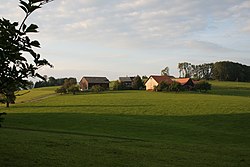
The hamlet Weiler Oberwil in Waldkirch, Switzerland

A hamlet is a human settlement that is smaller than a town or village.[1][2] This is often simply an informal description of a smaller settlement or possibly a subdivision or satellite entity to a larger settlement.[citation needed] Sometimes a hamlet is defined for official or administrative purposes.[citation needed]

The word and concept of a hamlet can be traced back to Norman England, where the Old French hamelet came to apply to small human settlements.

Etymology

[edit]

The word comes from Anglo-Norman hamelet, corresponding to Old French hamelet, the diminutive of Old French hamel meaning a little village. This, in turn, is a diminutive of Old French ham, possibly borrowed from (West Germanic) Franconian languages. It is related to the modern French hameau, Dutch heem, Frisian hiem, German Heim, Old English hām, and Modern English home.[3]

By country

[edit]

Afghanistan

[edit]

In Afghanistan, the word "hamlet" may be used to translate the term "qala" (Dari: قلعه, Pashto: کلي).[4] The Afghan qala is a fortified group of houses, generally with a community building such as a mosque but without a marketplace. The qala is the smallest type of settlement in Afghan society, outsized by the village (Dari/Pashto: ده), which is larger and includes a commercial area.

Canada

[edit]

In Canada's three territories, hamlets are officially designated municipalities.[5]

In Canada's provinces, hamlets are usually small unincorporated communities within a larger municipality (similar to civil townships in the United States), such as many communities within the single-tier municipalities of Ontario,[citation needed] Alberta's specialized and rural municipalities,[9] and Saskatchewan's rural municipalities.[10]

Canada's two largest hamlets—Fort McMurray (formerly incorporated as a city)[11] and Sherwood Park—are located in Alberta. They each have populations, within their main urban area, over 60,000—well over the 10,000-person threshold that can choose to incorporate as a city in Alberta.[12][13] As such, these two hamlets have been further designated by the Province of Alberta as urban service areas.[14] An urban service area is recognized as equivalent to a city for provincial and federal program delivery and grant eligibility.[15][16]

France

[edit]
A cottage in the Hameau de Chantilly

A hamlet (French: hameau) is a group of rural dwellings, usually too small to be considered a village. The term Lieu-dit is also applied to hamlets but it can also refer to uninhabited localities.

During the 18th century it was fashionable for rich or noble people to create their hameau in their gardens. This was a group of houses or farms with a rustic appearance but very comfortable. The best known are the Hameau de la Reine, built by Queen Marie-Antoinette in the park of the Palace of Versailles, and the Hameau de Chantilly, built by Louis Joseph, Prince of Condé in Chantilly, Oise.

Germany

[edit]

The word "hamlet" may be used to translate the term Weiler (German: [ˈva͡ɪlɐ]).[citation needed] Compared to a Dorf (village), a Weiler [de] has no infrastructure (i.e. no inn, no school, no store, no church). The houses and farms of a Weiler can be grouped (in the hills and the mountains) or scattered (more often in the plains). In North West Germany, a group of scattered farms is called Bauerschaft. In a Weiler, there are no street names, the houses are just numbered.

There is no legal definition of a Weiler in Germany. In Bavaria, like in Austria, a Weiler is defined as a settlement with 3 to 9 dwellings, from 10 houses it is called a village.[citation needed]

Italy

[edit]

In Italy, the term ‘frazione’ refers to a portion of inhabited territory within a municipality (the lowest level of subdivision, the "Comune"), generally located some distance from the centre of the town or village but still within the municipality's territory. In practice, if a village or town can be divided into neighbourhoods, i.e. portions of the same inhabited centre, the hamlets are located at a certain distance, creating a detached urban group. In many cases, some hamlets may have once been municipalities. Hamlets are always indicated by a sign, but they have no administrative function (at most, they may be polling stations). Small groups of houses that do not form a town and are further detached are called "località" (localites). We mention two examples in the Liguria Region: the coastal municipality of Camogli consists of the town centre and the hamlets of Ruta (a former Napoleonic municipality) and San Rocco. In turn, there are localities such as Boschetto, Case Rosse, Mortola, Porto Pidocchio and San Fruttuoso di Capodimonte, which are well separated but fall within the three main localities for all aspects of daily life. The municipality of Lumarzo, on the other hand, is known as a “scattered municipality” because it is made up of numerous separate centres without a main one, such as Lagomarsino, Pannesi, Boasi and Tasso, with numerous localities. For example, there are Tassorello, Tasso Alto, Sotto Tasso...

India

[edit]

In different states of India, there are different words for hamlet. In Haryana and Rajasthan, it is called "dhani" (Hindi: ढाणी ḍhāṇī) or "Thok".[17][18][19][20] In Gujarat, a hamlet is called a "nesada", which are more prevalent in the Gir forest. In Maharashtra, it is called a "pada". In southern Bihar, especially in the Magadh division, a hamlet is called a "bigha". In the state of Karnataka, a hamlet is known by different names like Palya, Hadi (Haadi), Keri, and Padi (Paadi). In the olden days, the human population of hamlet was less than Halli (Village) or Ooru (Uru). But in the 20th century with the tremendous increase in population, some of these hamlets became villages, towns and cities or merged with them.

Indonesia

[edit]
The hamlet Kampung Naga in West Java Province, Indonesia

All over Indonesia, hamlets are translated as "small village", desa or kampung. They are known as dusun in Central Java and East Java, banjar in Bali, jorong or kampuang in West Sumatra.[citation needed]

Netherlands

[edit]

The Dutch words for hamlet are gehucht or buurtschap. A gehucht or buurtschap has, compared to a dorp (village), no infrastructure (i.e. no inn, no school, no store) and contains often only one street, bearing the same name. The houses and farms of a gehucht or a buurtschap can be scattered. Though there are strong similarities between a gehucht and buurtschap, the words are not interchangeable. A gehucht officially counts as an independent place of residence (e.g. Wateren), while a buurtschap officially is a part of another place (e.g. Bartlehiem, part of Wyns).

Pakistan

[edit]

In Pakistan, a hamlet is called a gaaon گاؤں or mauza موضع in Urdu, giraaan گراں or pind پنڈ in Punjabi, and kalay کلې in Pashto. It is almost synonymous with 'village'.

Poland

[edit]

In Poland, the law recognises several different kinds of rural settlements. Przysiółek (which can be translated as "hamlet") refers to a cluster of farms. Osada (which is typically translated as "settlement" but also can be translated as "hamlet") includes smaller settlements especially differing by type of buildings or inhabited by population connected with some place or workplace (like mill settlements, forest settlements, fishing settlements, railway settlements, former State Agricultural Farm settlements). They can be an independent settlement, or a part of another settlement, like a village.[21]

Romania

[edit]

In Romania, hamlets are called cătune (singular: cătun), and they represent villages that contain several houses at most. They are legally considered villages, and statistically, they are placed in the same category. Like villages, they do not have a separate administration, and thus are not an administrative division, but are part of a parent commune.

Spain

[edit]

In Spain, a hamlet is called lugar, aldea or cortijada (Spanish: [koɾtiˈxaða]). The word comes from the Spanish term cortijo («estate»). In the South of Spain, the term caserío (Spanish: [kaseˈɾi.o]) is also used for designating small groups of rural dwellings or farmhouses.

A hamlet in Spain is a human settlement, usually located in rural areas, and typically smaller in size and population than a village (called in Spain, pueblo Spanish: [ˈpweβlo]). The hamlet is a common territorial organisation in the North West of Spain (Asturias, Cantabria and Galicia) dependent on a larger entity (e.g. parish or municipality).

In Spain, the hamlet is one of the categories in the official gazetteer of population entities. In the Royal Order and Instruction of the 8 of March 1930,[22] issued for the elaboration of the Annual gazetteer, the hamlet (aldea) is defined as the population entity with the smallest population and neighbourhood, usually more disseminated than the lugar, though its buildings can be also organised in streets and plazas.

Switzerland

[edit]

In the four national languages, hamlets are known as Weiler (German), hameaux (French), frazioni (Italian) and fracziun (Romansh). A hamlet is always part of a larger municipality or may be shared between two municipalities. The difference between a hamlet and a village is that typically a hamlet lacks a compact core settlement and lacks a central building such as a church or inn. However, some hamlets (Kirchwiler) may have grown up as an unplanned settlement around a church.[23] No population limit defines a hamlet and some hamlets have a larger population than some of the smallest municipalities. Generally, there are no street names in a hamlet; rather, addresses are given by hamlet name and a number. House numbers might start at one side of the hamlet and continue to the other side or may have no clear organization.

A hamlet may form or have formed a Bürgergemeinde (legal place of citizenship regardless of where a person was born or currently lives) and may own common property for the Bürgergemeinde.

United Kingdom

[edit]

England

[edit]
Haynes Church End in Bedfordshire

In England, the word hamlet (having the French origin given at the top of this article) means (in current usage) simply a small settlement, maybe of a few houses or farms, smaller than a village. However, traditionally and legally, it means a village or a town without a church,[24] although hamlets are recognised as part of land use planning policies and administration. Historically, it may refer to a secondary settlement in a civil parish, after the main settlement (if any); such an example is the hamlet of Chipping which is the secondary settlement within the civil parish of Buckland. Hamlets may have been formed around a single source of economic activity such as a farm, mill, mine or harbour that employed its working population. Some hamlets may be the result of the depopulation of a village; examples of such a hamlet are Graby and Shapwick. Because of the hilly topography of the parish, the village of Clent, situated on the Clent Hills, consists of five distinct hamlets.

Northern Ireland

[edit]

In Northern Ireland, the common Irish place name element baile is sometimes considered equivalent to the term hamlet in English, baile would actually have referred to what is known in English today as a townland: that is to say, a geographical locality rather than a small village.

Scotland

[edit]

In the Scottish Highlands, the term clachan, of Gaelic derivation, may be preferred to the term hamlet.[25] Also found in Scotland more generally is ferm toun, used in the specific case of a farm settlement, including outbuildings and agricultural workers' homes.[26][27]

Wales

[edit]

The term hamlet was used in Wales to denote a geographical subdivision of a parish (which might or might not contain a settlement). Elsewhere, mostly in England, these subdivisions were called "townships" or "tithings".[28][29] The Welsh word for "hamlet" is pentrefan[30] (also pentrefyn). Both these words are diminutives of pentref ("village") with the loose meaning of "small village".

United States

[edit]

Mississippi

[edit]

In Mississippi, a 2009 state law (§ 17-27-5) set aside the term "municipal historical hamlet" to designate any former city, town, or village with a current population of less than 600 inhabitants that lost its charter before 1945. The first such designation was applied to Bogue Chitto, Lincoln County.

New York

[edit]

In New York, hamlets are unincorporated settlements within towns. Hamlets are not legal entities and have no local government or official boundaries. Their approximate locations will often be noted on road signs, however, a specific service, such as water, sewer, or lighting provides only that hamlet with services. A hamlet could be described as the rural or suburban equivalent of a neighborhood in a city or village. The area of a hamlet may not be exactly defined; it may be designated by the Census Bureau, or it may rely on some other form of border (such as a ZIP Code, school district or fire district for more urbanized areas; rural hamlets are typically only demarcated by speed zones on the roads serving them). Others, such as Forestville, New York, will be the remnants of former villages, with borders coextant with the previously defined borders of the defunct or dissolved village. Some hamlets proximate to urban areas are sometimes continuous with their cities and appear to be neighborhoods, but they still are under the jurisdiction of the town. Some localities designated as hamlets, such as Levittown in the Town of Hempstead, with a population of over 50,000, are more populous than some incorporated cities in the state.

Oregon

[edit]

In Oregon, specifically in Clackamas County, a hamlet is a form of local government for small communities that allows the citizens therein to organize and coordinate community activities. Hamlets do not provide services, such as utilities or fire protection, and do not have the authority to levy taxes or fees. There are four hamlets in Oregon: Beavercreek, Mulino, Molalla Prairie, and Stafford.

See also

[edit]

References

[edit]
[edit]
Revisions and contributorsEdit on WikipediaRead on Wikipedia
from Grokipedia
A hamlet is a small , typically rural and smaller than a village, consisting of a few scattered houses or farms without a central church, meeting hall, or other key institutions. Etymologically, "hamlet" entered English in the from hamelet, a of hamel (small village), derived from ham meaning an enclosed homestead or home-related . Definitions of hamlets vary by region and legal context, reflecting local administrative traditions. These variations highlight hamlets' role as foundational units in settlement hierarchies worldwide.

Linguistic origins

The word "hamlet," denoting a small , entered the in the early as a borrowing from hamelet, a form of hamel or ham, meaning "" or "small cluster of houses." This term itself derives from Frankish haim or a similar Germanic source, ultimately tracing back to Proto-Germanic \haimaz, signifying "," "homestead," or "settled ." The root \haimaz is with hām, which referred to an enclosed homestead, village, or home , reflecting shared Indo-European origins in concepts of settlement and , linked to Proto-Indo-European \tkei- ("to settle, dwell"). Although the "hamlet" as a specific term arose in French, its introduction into English occurred via Anglo-Norman influences following the of 1066, which facilitated the integration of French vocabulary into for describing rural locales. The earliest recorded use of "hamlet" in English appears around 1330 in the chronicle Handlyng Synne by Robert Mannyng of Brunne, a Lincolnshire priest and poet, where it describes a small settlement: "He died at a hamelette, men calle it Burgh bisandaes." In this context, the word denoted a modest cluster of dwellings in a rural area, distinct from larger villages or towns. Mannyng's work, a verse translation of Anglo-Norman texts into Middle English, exemplifies how such terms were adapted to capture everyday topographical features in medieval Britain. Subsequent 14th-century texts, such as legal and administrative records, employed the term to refer to unincorporated rural groups of homes lacking formal institutions. Medieval manuscripts show variations in spelling and pronunciation, reflecting the transitional phonology of and regional dialects. Common forms included hamelet, hamlet, hamlett, and hamelette, with the initial "h" sometimes softened or elided in pronunciation, akin to contemporary French hameau. These orthographic differences arose from scribal practices in hand-copied texts, where influences from Latin, French, and native Germanic elements blended; for instance, the suffix -et from paralleled English formations like "booklet." By the late , the spelling stabilized toward "hamlet" in southern English dialects, as seen in Chaucer's contemporaries, though northern variants retained longer vowel sounds.

Evolution in English

In the 14th to 16th centuries, "" primarily carried a literal meaning, referring to modest rural groupings of homes and agricultural buildings without implying formal administrative status. From the 17th to 19th centuries, the word's usage shifted to emphasize unincorporated rural settlements, often those outside established parochial boundaries and lacking a dedicated church, as administrative needs under the Poor Laws highlighted such divisions for relief and governance. The Enclosure Acts of the reinforced this connotation, with the term appearing in some legal descriptions of small, non-parished clusters of holdings during the of common lands. The 19th and 20th centuries saw further standardization of "hamlet" in British legal frameworks, notably through the Local Government Act 1894, which provided for meetings in small rural es—often encompassing hamlets—as basic units of rural administration below the level of full councils. Today, the defines a hamlet as a small , usually rural and without a church, underscoring its informal distinction from the more structured "village."

Definition and characteristics

Core definition

A hamlet is defined as a very small rural , typically comprising fewer than 100-200 inhabitants and lacking a church or other central and amenities. Exact characteristics, including size and administrative status, vary by country and legal system, with specifics detailed in regional sections. Central to the concept are the absence of formal local governance structures and the informal nature of the community, often manifesting as a simple cluster of houses aligned along a or centered on a farmstead. The term "" is widely employed globally as an informal descriptor for such diminutive settlements, separate from any official administrative designations that may vary by jurisdiction. Archetypal examples include scattered groups of dwellings in rural landscapes, evoking quiet, self-contained clusters without institutional hubs.

Typical features and size

Hamlets are characterized by small populations, typically ranging from 5 to 100 residents, though in some contexts they may extend up to 500 inhabitants without transitioning to a larger settlement type. This limited scale reflects their role as the smallest organized human settlements, often emerging organically in rural areas. remains low, with dwellings spaced out to accommodate use. The physical layout of hamlets features scattered residential dwellings, lacking any defined commercial or civic core such as a or central square. These settlements are commonly positioned adjacent to larger villages or along transport routes, sometimes organized around a simple crossroads or a single unpaved or minimally maintained lane that connects to broader road networks. Buildings are predominantly single-family homes or farmsteads, with open spaces between them emphasizing rural integration over urban clustering. Infrastructure within hamlets is rudimentary, generally confined to basic access roads that facilitate local movement but offer no advanced utilities or facilities. Essential services like schools, shops, healthcare, or public transportation are absent, compelling residents to depend on proximate towns or villages for daily needs and opportunities. Demographically, hamlets support economies centered on , where inhabitants engage in farming or related activities, or serve as commuter bases for those traveling to urban centers for work. This structure fosters tight-knit communities but limits self-sufficiency.

Distinctions from other settlements

Hamlets are distinguished from villages primarily by their lack of central communal institutions and smaller scale. In the and similar European traditions, villages typically feature a , a pub, and often a local shop or serving as focal points for life, while hamlets generally consist of scattered dwellings without these amenities, emphasizing their more dispersed and informal character. Villages, by contrast, are generally larger than hamlets and provide basic services that foster social cohesion. In historical contexts, the term "" often referred to subordinate settlements within a feudal manorial , where inhabitants were bound by obligations to a estate, including labor and . Modern hamlets, however, operate independently of such manorial dependencies, functioning as standalone rural clusters without ties to overarching feudal hierarchies. Hamlets differ from temporary clusters, such as seasonal farmsteads or outposts, by implying a degree of permanence and residential stability, rather than transient occupancy. The term "," an archaic synonym for derived from , similarly denotes a small, enduring but has largely fallen out of contemporary use, surviving mainly in place names. Regarding , many hamlets remain informal designations without official recognition or structures, relying on broader municipal oversight for services. This contrasts with incorporated hamlets in certain jurisdictions, which possess defined boundaries and limited , though such formalizations are exceptions rather than the norm.

European usage

In France

In France, the term hameau refers to a small cluster of dwellings that constitutes a subdivision within a commune, the basic unit of local administration. Unlike villages or towns, a hameau typically lacks its own church, commercial services, or separate municipal , falling under the authority of the parent commune's and . This structure emphasizes the hameau's role as an integral, non-autonomous part of larger rural or semi-rural administrative units. Historically, during the feudal era in the , hameaux represented dense rural occupations, often comprising isolated farms or small groups of buildings dependent on nearby larger villages or manorial estates. These settlements functioned primarily as agricultural extensions, where peasants worked lands under the oversight of local lords, contributing to the feudal economy through labor and tribute without independent status. The marked a pivotal shift, as the decrees of 14 and 22 December 1789 reorganized the territory into approximately 44,000 communes based on former parishes, integrating hameaux into these new entities to centralize administration and abolish feudal dependencies. Today, hameaux maintain their subordinate position within communes, with no separate governance or mayoral authority, and they often house fewer than 50 residents, preserving a rural, community-oriented character. Notable examples appear in scenic regions like , where scattered hameaux dot the hillsides amid lavender fields and olive groves, and the , particularly in the Chartreuse Regional Natural Park, where the commune of Saint-Laurent-du-Pont encompasses nearly 50 such hamlets amid forested plateaus and limestone cliffs. These settings highlight the cultural significance of hameaux in fostering traditional and Alpine lifestyles, including seasonal farming and .

In Germany

In Germany, the concept of a hamlet corresponds most closely to the term "Weiler," which denotes a small rural cluster settlement typically comprising 3 to 15 farmsteads or houses, lacking independent administrative structures, a church, or centralized facilities like inns or schools, and integrated as a subordinate part of a larger (Gemeinde). These settlements often feature dispersed or loosely grouped buildings adapted to the local , such as in hilly or forested areas, distinguishing them from more compact villages (Dörfer) that serve as communal centers. Unlike isolated farmsteads (Einzelhöfe), Weiler represent minimal group formations, emphasizing agricultural self-sufficiency over urban-like organization. Historically, Weiler emerged in the early medieval period as components of the Villikation system, the Carolingian-era structure of large estates where a central manor (curtis) oversaw peripheral tenant farms organized into small hamlets for labor and production efficiency. This system, prevalent from the 8th to 12th centuries, facilitated of and serf obligations, with Weiler functioning as outlying production units rather than autonomous communities; by the , as feudal ties loosened, many evolved into stable rural enclaves amid broader settlement expansions in regions like and . The term "Weiler" itself traces to roots denoting a "small village" or "homestead group," reflecting their role in Slavic-influenced early German frontier settlements. Municipal reforms in the profoundly altered the status of Weiler by consolidating over 24,000 small administrative units into approximately 8,500 larger Gemeinden, eliminating the independent viability of many tiny settlements to improve efficiency in services and governance. In states like and , aggressive amalgamation strategies fully absorbed Weiler into unitary municipalities averaging 14,000 to 45,000 residents, reducing local councils by nearly half and prioritizing over fragmented . This wave of territorial , driven by federal and state laws, marked the end of any residual semi-independent status for Weiler, embedding them firmly as non-sovereign districts within parent communes. Under contemporary state-specific Gemeindeordnungen (municipal codes), Weiler hold no formal legal standing as separate entities, defined instead as unincorporated localities (Ortschaften) within a Gemeinde's boundaries, subject to the overarching municipality's , taxation, and decisions. This framework underscores their unincorporated nature, prohibiting standalone elections or budgets while allowing cultural recognition in regional . Representative examples include Weiler in the , such as the hamlet of Weiler near with around 20-30 households focused on , or dispersed Weiler in the Black Forest region of , where 10-50 farmsteads dot forested slopes, often totaling under 100 residents and relying on nearby villages for amenities. These cases illustrate the typical scale of 10-50 houses, aligning with broader patterns of small, agriculturally oriented clusters in Germany's varied terrains.

In the Netherlands

In the , hamlets are referred to as gehucht or buurtschap, denoting small, informal clusters of houses or farms that form part of a larger or without their own dedicated postcode, church, , or local . These settlements typically lack formal administrative status and serve primarily as geographic or social identifiers for local residents. Historically, many Dutch hamlets emerged in connection with the country's extensive systems, where reclaimed lowland areas from the 12th century onward fostered scattered agricultural communities rather than centralized villages. The establishment of the national in played a key role in formalizing their boundaries, as surveyors divided the landscape into sections and parcels, thereby mapping and distinguishing these modest clusters from larger entities during the 19th-century land reforms. Examples of such rural gehuchten and buurtschappen abound in provinces like and Limburg, where they function as neighborhood anchors amid farmland and waterways; for instance, small clusters near historic polders in identify local farmsteads, while those in Limburg's hilly terrains mark informal rural hamlets without independent governance. Today, these hamlets continue to play a practical role in postal addressing and community identity but hold no political authority, remaining integrated within broader municipal structures; the Netherlands encompasses thousands of such informal settlements as part of its over 6,000 recorded place names.

In Poland

In Poland, hamlets are referred to as osada (settlement) or kolonia (colony), denoting small rural clusters of buildings that form integral parts of a gmina (municipality) without independent administrative structures. These units typically consist of scattered farmsteads or a few dozen households engaged in agriculture, falling under the direct jurisdiction of the gmina council, which handles local governance, infrastructure, and services. The formation of many osady and kolonie dates to the 19th-century partitions of Poland, especially in Prussian-controlled territories, where state-sponsored colonization under the Prussian Settlement Commission (Hakkertkommission) established German-speaking agricultural outposts to alter demographic balances in regions like and . Following , massive population displacements due to border changes prompted the Polish government's resettlement programs, which repopulated former German lands in the west and north, leading to the organic growth of numerous small osady from dispersed farmsteads and temporary housing clusters. Examples abound in regions like and , where osady often house 20-100 residents focused on forestry or . In Masuria's Warmian-Masurian , Osada Bobry exemplifies this, with approximately 324 inhabitants in a dispersed rural setting integrated into the local . Similar small osady in , such as those near Białystok, emerged from historical woodland clearances and post-war influxes, supporting low-density communities under oversight. Legally, osady and kolonie lack autonomous status under the Ustawa o samorządzie gminnym (Act on Municipal Self-Government), which empowers to administer all rural subunits without mandating separate elections or councils for such minor settlements; instead, residents participate through the broader gmina assembly or designated village representatives if the area qualifies as a sołectwo.

In Romania

In Romania, the equivalent of a hamlet is known as a cătun, which denotes a small rural settlement comprising a cluster of houses that forms a subdivision or fraction of a larger village, without independent administrative autonomy or separate governance structures. These units are typically dispersed in layout, reflecting traditional patterns of in hilly or mountainous areas, and are legally subsumed under the administrative of the parent village within a commune. Unlike full villages (sate), cătune do not possess their own local councils or mayors, relying instead on the commune's centralized services for , , and . The development of cătune as distinct settlement types traces back to historical influences from the , which imposed fragmented land tenure systems in and , and the , which enforced similar dispersed rural patterns in through feudal obligations and ethnic diversity in land management. These imperial legacies fostered small, isolated clusters suited to and , rather than compact urban-like villages. The 1968 administrative-territorial reform, enacted under communist rule, formalized this hierarchy by reorganizing into 39 counties and approximately 2,800 communes, explicitly integrating cătune as non-autonomous components of villages to streamline socialist planning and collectivization efforts. This reform reduced the number of independent units while preserving cătune for statistical and cadastral purposes. Examples of cătune are prevalent in regions like and , where they support pastoral economies centered on sheep and rearing in the Carpathian highlands. In , scattered cătune such as those near the facilitate seasonal , with households maintaining traditional wooden homes and communal grazing lands amid forested terrain. Similarly, in 's , cătune like those in the Târnava Mare area underscore the adaptation of small settlements to rugged landscapes, contributing to biodiversity conservation through low-density pastoral practices. Currently, cătune remain embedded in commune frameworks, though exact figures fluctuate due to rural depopulation and migration.

In Spain

In Spain, a hamlet is commonly known as an aldea or pueblo pequeño, referring to a small that lacks independent status and operates as a subdivision within a larger , without its own ayuntamiento (). These entities are integrated into the administrative structure of the parent , handling local matters through delegated representatives or the . This setup ensures coordinated governance while preserving the hamlet's distinct community identity in rural contexts. The origins of many Spanish aldeas date back to the medieval period, particularly during the (8th–15th centuries), when they were established as fortified or semi-autonomous repopulation settlements in territories reclaimed from Muslim rule. These hamlets facilitated agricultural expansion and frontier defense, often documented in royal charters granting land to settlers. The modern administrative definition solidified with the Real Decreto of November 30, 1833, which reorganized into provinces and delineated municipal boundaries, classifying aldeas as dependent entities within this framework to streamline provincial governance. Examples of aldeas abound in regions like Castile and , such as the historic settlements around or the rural clusters in Jaén province, where they embody traditional agrarian life with scattered farmhouses and communal lands. However, post-1950s rural exodus—driven by industrialization and urban migration—led to significant depopulation, with many aldeas losing over half their inhabitants between 1960 and 1980, transforming vibrant communities into near-ghost villages. Under the Ley 7/1985, de 2 de abril, Reguladora de las Bases del Régimen Local (LBRL), aldeas are formally recognized as entidades locales menores or entities of territorial scope inferior to the , allowing them limited autonomy in cultural, recreational, and infrastructural affairs while remaining fiscally tied to the parent entity. In the 2020s, revitalization efforts have intensified through national initiatives like the Plan de Recuperación, Transformación y Resiliencia, which includes over 130 measures to combat demographic decline in rural areas, such as subsidies for housing rehabilitation and digital connectivity to attract young residents and reverse depopulation trends. These programs emphasize , integrating aldeas into broader rural economies focused on , , and .

In Switzerland

In , hamlets are referred to as Weiler in German-speaking regions and hameau in French-speaking areas, serving as small, informal clusters of dwellings that function as statistical subunits within larger municipalities. These settlements are defined by the Swiss Federal Statistical Office (BFS) as named localities used primarily for addressing and demographic recording, without independent administrative status. They typically consist of a handful of farmhouses or homes dispersed in rural or alpine settings, distinguishing them from villages (Dorf or village) which may have central amenities like churches or schools. Historically, Swiss hamlets emerged from medieval alpine communities, particularly during the 12th to 15th centuries when Germanic-speaking Walser migrants from the region settled remote high-altitude valleys to cultivate pastures and establish self-sufficient outposts. These early hamlets adapted to the rugged terrain, fostering dispersed patterns suited to and seasonal herding in cantons like and . The 1848 Federal Constitution reinforced municipal autonomy under cantonal oversight, solidifying hamlets' role as integral but subordinate parts of communes without granting them separate governance. Examples abound in mountainous cantons, such as the Weiler scattered throughout the Lötschental valley in , where small clusters like those near Wiler support traditional alpine livelihoods amid steep slopes. In , the Walser hameau of Obermutten exemplifies preservation of medieval wooden architecture and isolation, perched at over 1,500 meters with its historic church. These hamlets highlight Switzerland's adaptation to , often featuring stone or timber buildings clustered for protection against harsh winters. Today, hamlets hold no political authority, remaining embedded within Switzerland's approximately 2,100 municipalities for administrative purposes. The BFS employs them in federal to track distribution, , and urban-rural dynamics for precise . This statistical framework aids in monitoring alpine depopulation trends and without altering their non-entity status.

In the United Kingdom

In the , a refers to a small, rural that is typically smaller than a village and lacks a central , such as a church, or other communal facilities like a village hall. These settlements often consist of a loose cluster of houses, farms, or cottages, sometimes as few as a handful, and serve primarily agricultural or residential purposes without independent administrative governance. In , hamlets are generally considered secondary or subsidiary parts of larger civil es, meaning they fall under the jurisdiction of a rather than having their own; unparished areas exist but are uncommon for hamlets, which are integrated into parished territories for local services and decision-making. Historically, the concept of hamlets traces back to the of 1086, commissioned by , which recorded landholdings and settlements across much of as "vills"—administrative units that could include nucleated villages, dispersed hamlets, or isolated farmsteads, providing an early snapshot of rural organization with over 13,000 such places noted. By the , under the Poor Laws—particularly the Elizabethan statutes codified in –98 and reformed in 1834—hamlets were explicitly distinguished as smaller units within es, often required to contribute to through rates levied on property, with multiple hamlets sometimes banding together for support if too small to manage independently. This framework highlighted hamlets' role in localized welfare, administered by parish overseers to aid the indigent without compelling them to beg. Regional variations reflect the UK's diverse geography and land use. In , hamlets often manifest as scattered groups of farmsteads amid agricultural landscapes, such as those in the , where small clusters like the hamlets around Great Hucklow and Foolow contribute to the area's pastoral character without forming distinct villages. Scotland's hamlets are frequently tied to , the traditional small-scale tenant farming system in the , forming tight-knit clusters of crofts—typically 2 to 15 acres each—for mixed livestock and crop production; examples include Duirinish in , a modest fishing and crofting hamlet, and townships like Lonemore near , protected under crofting legislation since the to sustain community resilience. In and , the term is used more informally for analogous small rural outposts, with seeing historical hamlets as parish subdivisions that largely consolidated or vanished during late medieval enclosure, though remnants persist in remote areas; similarly, employs it for tiny settlements like Aghalee in , integrated into broader districts without unique status. Today, hamlets hold no formal administrative or legal status under key legislation like the Local Government Act 1972, which restructured England's and Wales's local authorities into counties, districts, and parishes but left hamlets as informal entities governed by encompassing parishes or higher tiers, emphasizing their role in rural preservation rather than autonomy. This lack of recognition underscores hamlets' integration into larger community frameworks, preserving their character in protected landscapes like the while adapting to modern needs such as tourism and environmental management.

Asian usage

In Afghanistan

In Afghanistan, small rural settlements referred to as hamlets are known in Pashto and Dari as qaryah or deh, functioning as the fundamental units of rural organization beneath the district level in the country's administrative . These terms denote autonomous social and spatial entities, often comprising clusters of households engaged in and , with deh particularly used to identify localized places within broader regions. Historically, Afghan hamlets have evolved from tribal affiliations, where groups established self-governing communities for mutual and , a structure deeply rooted in and other customary codes. The Soviet invasion (1979–1989) and subsequent disrupted many traditional formations, leading to the displacement of populations and the emergence of new or reconstituted deh amid returns and factional conflicts in the post-Soviet era. The 2004 Constitution formalized local governance by establishing provinces as primary administrative units while enabling laws to define subordinate structures, thereby recognizing rural hamlets through district-level integration and programs like the National Programme. Illustrative examples include the deh scattered across the Hindu Kush valleys, such as those in Panjshir or Andarab districts, where isolated settlements rely on terraced farming and herding in rugged terrain. These hamlets typically consist of 50–200 residents, forming tight-knit groups vulnerable to environmental hardships and isolation from urban centers. As of 2025, Afghanistan's rural hamlets continue to face acute vulnerabilities from protracted conflict, economic pressures, and climate variability, with many serving as focal points for amid Taliban governance shifts. Recent assessments estimate around 45,000 such rural clusters nationwide, underscoring their role as the backbone of the country's predominantly agrarian population.

In India

In India, hamlets are recognized as smaller sub-units or habitations within larger villages, often referred to locally as "tola" in regions like or "patti" and "dhani" in parts of and , respectively. According to the , these sub-village clusters form integral parts of the rural administrative structure, where the village remains the primary census unit, but hamlets represent dispersed or secondary inhabited areas within it. For instance, a "tola" typically denotes a clustered settlement of households, often along or community lines, serving as a basic social and residential subunit without independent administrative status. Historically, many such hamlets originated as small agrarian settlements during the Mughal era (16th–19th centuries), functioning as dispersed outposts for cultivation and pastoral activities under local zamindari systems, which organized land revenue around village clusters including these subunits. Following India's independence in 1947, these hamlets were integrated into the formal framework through the Community Development Programme (1952) and subsequent reforms, such as the Balwant Rai Mehta Committee recommendations (1957), which established gram panchayats to oversee multiple hamlets or villages for local , resource allocation, and development. This integration emphasized decentralized administration, subsuming hamlets under gram sabhas—defined as assemblies of one or more hamlets—to ensure participatory decision-making at the grassroots level. Examples of hamlets within gram panchayats include "Pakistan Tola" in , , a small tribal habitation of about 250 residents focused on basic agriculture and lacking separate infrastructure, fully administered by the local panchayat. In , "dhani" hamlets like those in , such as Raika Ki Dhani, represent isolated pastoral clusters attached to parent villages, supporting semi-nomadic herding communities under the broader panchayat system. Similarly, in Uttar Pradesh's , "patti" subunits like function as community-specific habitations within larger villages, contributing to rural social cohesion without autonomous . In modern , hamlets lack separate governance and are governed collectively through gram panchayats, which handle services like , , and welfare schemes across multiple subunits. The 2011 Census recorded over 640,000 villages, many comprising several hamlets, with rural sub-village units estimated to number in the millions based on household clustering patterns; updated projections from the National Sample Survey (2019) indicate continued prevalence, with hamlets housing a significant portion of the rural amid trends. By 2025, government reports highlight that these units remain vital for targeted interventions under schemes like MGNREGA, though challenges like gaps persist in remote hamlets.

In Indonesia

In Indonesia, the term dusun refers to a hamlet or neighborhood that functions as an administrative sub-unit within a desa (village), forming the foundational level of rural . Under Law No. 6 of 2014 on Villages (UU No. 6 Tahun 2014 tentang Desa), dusun are established within the territorial boundaries of a desa, with their formation and adapted to align with local origins, , traditions, and sociocultural values of the community. This law emphasizes dusun as integral to village governance, enabling localized decision-making on matters such as community development and resource management while remaining subordinate to the desa head (kepala desa). The administrative framework of dusun originated during the Dutch colonial era, when small rural settlements were commonly referred to as kampung, denoting indigenous neighborhoods or wards integrated into colonial administrative hierarchies for control and taxation purposes. After Indonesia's independence in 1945, the structure persisted amid initial centralization under the new republic but evolved through progressive , particularly following the 1998 political reformation (reformasi), which shifted power to local levels and recognized traditional units like dusun in national policy. The 2014 Village Law marked a pivotal post-independence advancement in this , granting villages—and by extension their dusun—greater fiscal and administrative autonomy to address rural disparities. Dusun in regions like Java and Sumatra typically encompass 100 to 300 households, serving as cohesive units for social services, mutual aid, and local dispute resolution within larger desa. For example, in rural Central Java, a dusun might organize around shared agricultural lands or irrigation systems, while in Sumatra's Aceh province, dusun often align with ethnic gampong traditions, accommodating 150–250 households in community-focused clusters. These sizes vary by geography and population density, but they consistently represent the smallest formal rural division, fostering grassroots participation. Currently, each dusun is led by an elected head (kepala dusun), selected through democratic community voting or consensus to ensure representation and accountability at the neighborhood level. Reforms enacted in 2025, building on the 2014 Village Law, further enhance rural autonomy by promoting participatory models that empower dusun leaders in budgeting, infrastructure planning, and inclusive , aiming to reduce and amplify community voices in national efforts.

In Pakistan

In Pakistan, hamlets are small, nucleated rural settlements, often comprising a handful of households and lacking independent administrative status, that integrate into broader village clusters or union councils. These represent the smallest units of rural habitation, typically centered on agriculture or pastoral activities. Under the Punjab Local Government Act 2013, such settlements fall within union councils, the lowest tier of rural local governance, which group multiple villages and hamlets for service delivery and elections. Similar structures apply in other provinces like Sindh, where small rural clusters contribute to taluka-level administration. Historically, the British Raj's revenue settlement policies in the late 19th and early 20th centuries shaped Pakistan's rural landscape, particularly in and , by mapping and taxing compact groups of dwellings as part of the and systems. These policies formalized small hamlets as extensions of larger revenue villages, facilitating irrigation projects like the that spurred settlement in arid areas. Following the 1947 Partition, Pakistan's rural focus shifted toward agricultural reform and community integration, preserving many such hamlets amid post-independence land redistribution efforts. Examples of hamlets include small settlements in Punjab's , such as those associated with tribal groups like the Kassar in the Dhani plain region. In , small pastoral hamlets in the , influenced by semi-nomadic herding communities like the Kolhi, emphasize over fixed cultivation and often cluster around water sources. These settlements highlight regional variations, with Punjab's hamlets more tied to sedentary farming and Sindh's reflecting mobile traditions. In contemporary , hamlets are administratively embedded within tehsils (sub-districts), enabling coordinated resource allocation under provincial governments. The 2023 Population and Housing Census identifies 46,697 rural localities nationwide, encompassing hamlets and small clusters that house over 61% of the population in dispersed or nucleated forms, underscoring their role in rural demographics. This integration supports national development programs, though challenges like persist in remote areas.

North American usage

In Canada

In Canada, hamlets are unincorporated communities situated within the boundaries of larger rural municipalities, such as municipal districts, counties, or improvement districts. This status is governed by provincial legislation, with Alberta's Municipal Government Act providing a formal framework for designation: a community qualifies as a hamlet if it has 5 or more buildings used as dwellings, with a majority on parcels smaller than 1850 m², and contains parcels used for non-residential purposes, allowing the parent municipality to establish boundaries and provide enhanced urban services. In other provinces, such as , hamlets are recognized as small, established settlement areas in official municipal plans, lacking independent incorporation but integrated into township or county governance. Unlike incorporated villages or towns, hamlets do not have separate taxing authority or councils but may form local advisory boards to address needs. The historical roots of Canadian hamlets lie in the 19th-century expansion of settlement across the prairies and other regions, driven by the Dominion Lands Act of 1872, which surveyed vast tracts of land into quarter-sections and offered 160-acre homesteads to settlers for a nominal fee after three years of cultivation. This policy, administered by the federal government, attracted immigrants from Europe and , fostering clusters of small farms and service centers that evolved into hamlets amid the 's decline and the rise of agriculture. Earlier, some hamlets originated near fur trade posts established by the and in the late 18th and early 19th centuries, where temporary trading outposts transitioned into permanent rural nuclei during the boom. Examples of hamlets abound in Alberta's prairie landscapes, such as the Hamlet of Cayley in , with around 300 residents supporting local , or the Hamlet of Standard in Wheatland County, home to about 300 people and featuring community halls and basic amenities. In Ontario's townships, hamlets like Fraserville in Otonabee–South Monaghan Township exemplify small clusters of 100-300 residents, often centered around historic mills or crossroads, preserving rural character within larger administrative units. These communities typically range from 50 to 500 inhabitants, emphasizing self-reliant living with ties to farming or resource extraction. In modern , hamlets rely on their parent municipalities for , including road maintenance, , , and , funded through county-wide taxes rather than local levies. 's hamlets, for instance, benefit from dedicated urban service agreements that prioritize in populated areas. Incorporation options exist for growth: in , a hamlet can petition to become a village upon reaching 300 residents, though few have done so since 1980 due to the advantages of remaining unincorporated. As of 2025, alone recognizes 437 hamlets, contributing to an estimated 1,200 such communities nationwide when including informal designations in other provinces, reflecting ongoing rural vitality amid pressures. In the northern territories, hamlets are incorporated municipalities serving small communities. As of the 2021 Census, the has 11 hamlets with populations under 1,000, while has 24 hamlets ranging from a few hundred to over 5,000 residents, functioning as local governments with councils and bylaws.

In the United States

In the United States, the term "" lacks a uniform federal definition and is generally used informally to describe small, unincorporated communities or clusters of residences, often within larger townships or counties. These settlements typically consist of a few dozen to several hundred homes, without independent municipal governance, and are recognized locally for historical, cultural, or administrative reasons. The U.S. Census Bureau does not officially classify hamlets but incorporates many such areas into Census-Designated Places (CDPs), statistical entities that delineate populated, unincorporated locales for purposes. Historically, hamlets emerged in colonial as dispersed clusters of farmsteads and homes within broader town boundaries, serving as centers for local agriculture, milling, and community gatherings around crossroads or waterways. By the , westward expansion fostered similar small settlements across the Midwest and West, often forming organically along migration routes, rivers, and railroads to support farming, , or , though the term "hamlet" was more commonly applied in eastern states. State-level usage varies significantly, reflecting local traditions rather than standardized law. In New York, hamlets are unincorporated subdivisions of towns, lacking separate incorporation but often featuring distinct identities through schools, post offices, or fire districts; for instance, Montauk in County functions as a coastal hamlet within the Town of East Hampton, known for its beaches and fishing heritage. In , the term applies to unincorporated communities, particularly in rural counties like Clackamas, where hamlets such as Mulino and Beavercreek organize around agricultural needs without formal city status. uniquely codifies "municipal historical hamlets" under state law as former municipalities with populations under 600 that retain limited services; Bogue Chitto in Lincoln County exemplifies this, a small riverside community that dissolved its charter in 1944 but preserves its historical designation. As of the 2020 Census, the Bureau recognized nearly 12,500 CDPs nationwide, encompassing a wide array of s and similar rural clusters that highlight the decentralized nature of American settlement patterns. These modern hamlets, such as Oregon's coastal enclaves like Nehalem or New York's inland communities, continue to play vital roles in preserving rural economies and cultural landscapes amid suburban growth.

Other global usage

In

In , the term "hamlet" is used informally to describe small rural localities or clusters of dwellings that lack formal administrative status and are typically governed by local councils within larger shires or districts. These settlements are smaller than villages, often consisting of scattered homesteads or a handful of houses engaged in or activities, without defined boundaries or dedicated services like churches or schools. Unlike formal classifications in the Australian Statistical Geography Standard (ASGS), which categorizes areas as urban centres (over 1,000 people) or localities (200–999 people), hamlets fall under the broader "rural balance" category and are not officially delineated. Historically, many Australian hamlets emerged in the as outposts during the gold rushes and pastoral expansion, particularly in Victoria and following discoveries in 1851. These small clusters of miners' huts and farming homesteads supported transient populations drawn to goldfields or sheep stations, often housing 15 to 50 people in rudimentary setups amid harsh conditions. After in 1901, the establishment of councils formalized rural governance, incorporating these hamlets into larger administrative units without altering their informal character, allowing them to persist as agricultural support nodes. Notable examples include Wail in Victoria's , a with approximately 37 residents focused on farming, and Willow Banks near Murray Bridge in , a semi-rural locality of scattered homes along the . In , places like Fentonbury serve as similar tiny rural s, often with populations under 50, supporting local and bushwalking. These settlements highlight the typical scale, emphasizing self-sufficient, low-density living in remote areas. In modern contexts, the term "" is frequently employed in to evoke quaint, historic rural charm, attracting visitors to sites like the Otway Coast hamlets or gold-rush-era spots in Victoria. According to the Australian Bureau of Statistics' 2021 Census data, rural localities and balances—encompassing s—account for thousands of small clusters nationwide, with over 1,000 settlements under 1,000 residents, though exact counts remain informal due to the lack of precise classification.

In China

In China, hamlets are commonly referred to as "natural villages" (自然村, zìrán cūn) or smaller settlements known as "zhuang" (庄), which function as informal, community-based subunits beneath the formal administrative villages (行政村, xíngzhèng cūn) in the rural administrative hierarchy. These natural villages represent organic clusters of households sharing historical, , or geographic ties, often lacking independent administrative status but playing key roles in local , land allocation, and social organization. Administrative villages, the lowest official rural units under townships (乡 or 镇), typically encompass multiple such hamlets, enabling centralized management while preserving local identities. Historically, the concept of hamlets traces back to imperial systems like the baojia (保甲), a mutual surveillance and defense mechanism implemented from the Song dynasty (960–1279) and refined under the Qing (1644–1911), where households were grouped into jia (10 families) and bao (100 families) to maintain order, collect taxes, and organize labor, often aligning with or overriding natural village boundaries. Following the founding of the People's Republic in 1949, rural collectivization transformed these structures: initial land reforms redistributed property to individual households, but by the mid-1950s, mutual aid teams and cooperatives merged hamlets into larger production units, culminating in the 1958 Great Leap Forward's people's communes that subsumed natural villages into brigades and teams for centralized farming and resource control. This era disrupted traditional hamlet autonomy, prioritizing state-driven output over local cohesion. Examples of such hamlets abound in rural regions; in province, Zhoujiazhuang serves as a preserved example of a zhuang-type settlement, historically functioning as a self-sustaining under collective systems. In , Zhuang ethnic hamlets, often terraced and integrated with minority customs, typically comprise 20 to 100 households, emphasizing clan-based governance and agricultural heritage amid diverse terrains. These units, averaging around 50 households in some areas, highlight the scale of hamlets as intimate social entities within broader administrative frameworks. In the modern context, hamlets remain integral to townships (xiang) and are addressed in ongoing rural reforms, including the Central Document No. 1, which promoted village consolidation and land rights adjustments to integrate natural villages more effectively into administrative structures for improved and alleviation. 's rural revitalization policies, as outlined in the No. 1 Central Document and building on the 2018 strategy, recognize approximately 600,000 such small rural units—primarily administrative villages incorporating hamlets—as focal points for modernization, with initiatives targeting , ecological protection, economic diversification, , and bridging urban-rural gaps by 2035.

References

Add your contribution
Related Hubs
Contribute something
User Avatar
No comments yet.