Hubbry Logo
High Alemannic GermanHigh Alemannic GermanMain
Open search
High Alemannic German
Community hub
High Alemannic German
logo
8 pages, 0 posts
0 subscribers
Be the first to start a discussion here.
High Alemannic German
from Wikipedia

High Alemannic
Hochalemannisch
Native toSwitzerland
Germany: Baden-Württemberg
Austria: Vorarlberg
Liechtenstein
France: Haut-Rhin
Latin (German alphabet)
Language codes
ISO 639-3
Glottologhigh1290
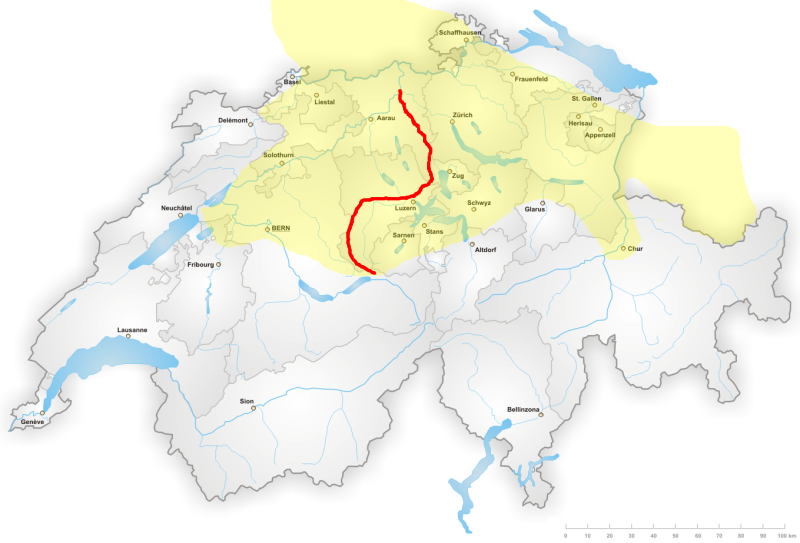
Geographical spread of High Alemannic dialects; marked in red is the Brünig-Napf-Reuss line

High Alemannic is a branch of Alemannic German spoken in the westernmost Austrian state of Vorarlberg and in Switzerland and Liechtenstein.[1] Intelligibility of these dialects to non-Alemannic speakers tends to be limited.

Language area

[edit]

The High Alemannic dialects are spoken in Liechtenstein and in most of German-speaking Switzerland (Swiss Plateau), except for the Highest Alemannic dialects in the Swiss Alps and for the Low Alemannic (Basel German) dialect in the North West.

Therefore, High Alemannic must not be confused with the term "Swiss German", which refers to all Alemannic dialects of Switzerland as opposed to Swiss variant of Standard German, the literary language of diglossic German-speaking Switzerland.

In Germany, High Alemannic dialects are spoken in Southern Baden-Württemberg, i.e. the Markgräflerland and in the adjacent area south of Freiburg im Breisgau up to the Black Forest (Schönau). It is also spoken in the southern Sundgau region beyond the Upper Rhine, which is part of Alsace, France. In Vorarlberg in Western Austria, a form of High Alemannic is spoken around the Rheintal as well.

Subdivisions

[edit]

High Alemannic is traditionally subdivided in an Eastern and Western language area (Sprachraum), marked by the Brünig-Napf-Reuss line across the cantons of Aargau and Lucerne (Luzern).

Eastern High Alemannic includes Zurich German, Lucerne German, and the dialects of Eastern Switzerland.

Western High Alemannic includes Bernese German, the German dialects of Solothurn and Fribourg, as well as most dialects of Aargau and the northern parts of the canton of Lucerne.

Features

[edit]

The distinctive feature of the High Alemannic dialects is the completion of the High German consonant shift, for instance chalt [xalt] 'cold' vs. Low Alemannic and standard German 'kalt' [kʰalt].

References

[edit]
Revisions and contributorsEdit on WikipediaRead on Wikipedia
from Grokipedia
High Alemannic German is a major subgroup of the , which belong to the branch of the High German language continuum, and is distinguished by its full participation in the , including affrication and processes such as /k/ to /kx/ or /x/ in initial positions. These dialects form a continuum of spoken vernaculars primarily used in informal contexts, alongside as the prestige variety for writing and formal communication. Geographically, High Alemannic dialects are spoken across the Alpine region, including northern (such as the cantons of , , and ), the entirety of , the Austrian state of , and southern parts of Germany's . Together with other Alemannic varieties, they are used by approximately 10 million native speakers, with High Alemannic accounting for the majority in , where it functions as the dominant everyday among German-speaking communities. The dialects exhibit significant local variation, influenced by the rugged that has historically limited with northern German varieties. Linguistically, High Alemannic features include a retention of front vowels for certain sounds (e.g., /ɛː/ from MHG æ), frequent use of suffixes, a preference for perfect tenses over other past forms, and avoidance of the in favor of prepositional constructions. Vocabulary often diverges from , with regional terms like Grundbirne or for "," and remains non-standardized, leading to diverse written representations in media and . Subgroups encompass Western High Alemannic (e.g., ), Eastern High Alemannic (e.g., German), and transitional zones to Highest Alemannic in southern , reflecting a geolinguistic gradient shaped by migration and trade routes.

Introduction and Classification

Definition and Overview

High Alemannic German is a major branch of the Alemannic dialect group within the Upper German (High German) languages, encompassing a continuum of varieties spoken primarily in the non-alpine regions of German-speaking Switzerland, the Austrian state of Vorarlberg, Liechtenstein, and southern Baden-Württemberg in Germany. These dialects form part of the broader Alemannic continuum, which extends across southwestern Germany, eastern France, Switzerland, Liechtenstein, and western Austria. The term "Alemannic" originates from the Latin Alemanni, referring to an ancient of Germanic tribes related to the , who inhabited areas near the upper and rivers during late Roman times and eventually settled in the regions where these dialects developed. High Alemannic varieties are estimated to have approximately 5 million speakers, with the majority concentrated in . A defining characteristic of High Alemannic German is its limited mutual intelligibility with Standard German (Hochdeutsch) and other non-Alemannic dialects, especially in spoken form, due to distinct phonological, grammatical, and lexical features that set it apart from the standard language. This contrasts with the more conservative Highest Alemannic subgroup, which is confined to higher alpine areas and retains additional archaic traits.

Position in the Germanic Language Family

High Alemannic German forms a central subgroup within the Alemannic dialect continuum, which itself belongs to the Upper German branch of the High German languages in the West Germanic family. The Upper German dialects, including Alemannic, are defined by their participation in the High German consonant shift, a series of sound changes affecting stops (such as Proto-Germanic *p, *t, *k shifting to affricates or fricatives in initial and medial positions), which separates them from Central German and Low German varieties to the north. This shift, occurring roughly between the 6th and 8th centuries, established the foundational phonological distinctions that position Upper German as the southernmost and most conservative branch of continental West Germanic. Within the Alemannic group, High Alemannic occupies an intermediate position, spoken primarily in the central and surrounding highlands, distinguishing it from Low Alemannic to the north in flatter regions like the area and Highest Alemannic to the south in isolated alpine valleys. Low Alemannic varieties exhibit partial retention of pre-shift and closer ties to neighboring Franconian influences, while Highest Alemannic shows more extreme innovations, such as further shifts and morphological simplifications, often in relative isolation due to mountainous terrain. These internal divisions arise from gradual phonetic divergences rather than abrupt breaks, forming a shaped by altitude and geography. High Alemannic borders Swabian dialects to the north, which represent another variety often grouped closely with or as an eastern extension of Alemannic, sharing features like suffixes but differing in systems. To the east, it adjoins Bavarian dialects, a parallel branch that diverges through distinct lexical and syntactic traits, such as periphrastic verb constructions not found in Alemannic. The boundaries between these adjacent varieties are marked by bundles of isoglosses, including the Sundgau-Bodensee-Schranke (separating Low from High Alemannic via contrasts like Standard German Kind pronounced as [kɪnd] versus [χɪnd]) and transitional lines around the Walser settlements that isolate Highest Alemannic forms.

Geographic Distribution

Primary Regions and Countries

High Alemannic German is predominantly spoken in , particularly across the and the northern foothills of the in the German-speaking regions, encompassing about 62% of the country's population and excluding the Low Alemannic areas around and the Highest Alemannic dialects in the higher Alpine zones. Key urban centers in Switzerland include Zurich, where the local variety is spoken by roughly 1.5 million people in the canton (as of 2023); ; and St. Gallen, where the dialect serves as the everyday alongside in formal contexts. In these areas, usage patterns show strong retention in both urban and rural settings, though rural communities often exhibit higher dialect proficiency among older generations. In , High is confined to the western state of , bordering , where it forms the primary spoken dialect for the region's approximately 410,000 residents (as of 2024). The main urban hub is , the state capital, where the dialect is integral to daily communication despite the prevalence of in education and media. Liechtenstein represents a complete linguistic territory for High Alemannic German, with the dialect serving as the main vernacular for over 91% of the population, who are Alemannic speakers in this microstate of about 40,000 inhabitants (as of 2025) wedged between and . Dialect use is robust across the country, including in the capital , reflecting a high degree of continuity in rural and urban alike. Smaller pockets exist in , specifically in the southern regions of , where High Alemannic varieties are spoken amid a broader Alemannic continuum, though speaker numbers are limited and concentrated in rural villages rather than major cities. In , the dialect appears in the district of southern , near the Swiss border, with around 43% of the local population demonstrating high proficiency, predominantly in smaller towns and villages where it coexists with French influences due to regional . The geographic spread highlights influences from neighboring languages, such as French in western border areas of Switzerland and Alsace, and Italian in southern regions like Graubünden, fostering bilingualism and occasional loanwords in everyday usage.

Dialect Boundaries and Continuum

High Alemannic German occupies a central position within the broader Alemannic dialect continuum, which extends from the relatively uniform Low Alemannic varieties in the northern lowlands—such as those spoken in Alsace and northern Baden-Württemberg—to the more divergent Highest Alemannic forms in the southern Alpine highlands. This continuum reflects gradual linguistic transitions driven by historical settlement patterns and geographic isolation, with High Alemannic serving as an intermediate zone characterized by increasing phonetic and morphological complexity toward the south. A key internal boundary within High Alemannic is the Brünig-Napf-Reuss line, which divides the western and eastern subgroups. Running from the Brünig Pass in the , across the Napf mountain ridge, and along the Reuss River valley, this bundle separates dialects like to the west from to the east, influencing features such as vowel shifts and lexical choices. The line not only marks linguistic divergence but also aligns with broader cultural divides in . To the south, High Alemannic transitions into Highest Alemannic along the Walser line, associated with the medieval migrations of Walser communities into isolated Alpine valleys, where extreme vowel reductions and preserved archaic traits emerge. These southern boundaries are sharply defined by the rugged of the , limiting diffusion and preserving distinctiveness. In the north, High Alemannic fades gradually into non-Alemannic varieties, particularly Swabian dialects in northern , through a zone of mixed features like shared suffixes but differing lenitions. Geographic features, including rivers like the and mountain barriers such as the , reinforce these transitions by historically constraining speaker mobility and innovation spread.

Historical Development

Origins in Alemannic Settlement

The High Alemannic German dialects originated from the migrations and settlements of the Alemanni, a confederation of Germanic tribes that coalesced around 200–250 AD along the upper Main River in present-day central Germany. First documented in Roman records in 213 AD by the historian Cassius Dio, the Alemanni launched repeated incursions into the Roman Empire starting in 233 AD, crossing the Rhine and expanding southward during the 3rd to 5th centuries. By the mid-4th century, they had established permanent settlements across the Upper Rhine region, encompassing southwestern Germany, northern Switzerland, and Alsace, where they occupied abandoned Roman villas and displaced indigenous Celtic groups like the Helvetii. These movements positioned the Alemanni as a key player in the transition from Roman to early medieval Europe, laying the foundational demographic base for the High Alemannic linguistic varieties in the Alpine highlands. Settlement in these Romanized territories introduced significant substrate influences on the proto-Alemannic language, particularly from Celtic and Latin sources. The pre-existing Celtic populations contributed lexical elements, especially in toponyms and terms related to local flora, fauna, and landscape features, while Latin loanwords entered via administrative, military, and trade contacts during the Roman era. Representative examples include early borrowings like Pflanze (from Latin planta, denoting a plant or shoot) and other agricultural vocabulary, which integrated into the Germanic lexicon as the Alemanni adopted Roman-style farming and settlement practices. These substrates enriched the emerging dialect with hybrid forms, distinguishing it within the broader Upper German branch of West Germanic. The Alemanni's linguistic consolidation advanced during their incorporation into the Frankish Empire in the 6th to 8th centuries, following defeat by at the in 496 AD, which established the Duchy of Alemannia as a Frankish province. , progressing gradually from the early under Merovingian and Carolingian rule, further shaped dialect formation by promoting vernacular use in religious contexts. Monasteries served as hubs for and manuscript production, fostering the development of distinct Alemannic speech patterns amid Frankish administrative integration. This era marked the transition from tribal oral traditions to more structured linguistic communities, with High Alemannic emerging in the southern, more isolated settlements. Early written evidence of High Alemannic traits survives in 8th-century glosses from Swiss monastic centers, reflecting the dialect's initial documentation. Institutions like St. Gall and Reichenau produced interlinear and marginal annotations in Latin texts, such as the late-8th-century Abrogans glossary (St. Gall Codex 911), which translates over 3,200 Latin terms into Alemannic vernacular, and glosses in ' Consolation of Philosophy (St. Gall Codex 844). These artifacts, featuring phonetic and lexical markers of the High Alemannic branch—like aspirated forms and regional —demonstrate the dialect's vitality in scholarly and liturgical settings by the late 8th century.

Evolution and Influences

Following the initial Alemannic settlements in the 6th to 8th centuries, High Alemannic German began to diverge from other dialects during the medieval period, particularly between the 10th and 15th centuries, as geographic isolation in the Alpine highlands and Rhine valley preserved archaic features while limiting broader interactions. This seclusion fostered conservative linguistic traits, such as retained systems and morphological elements, distinguishing High Alemannic from more innovative Bavarian or Swabian varieties within the group. External influences from neighboring shaped High Alemannic through lexical borrowing and structural contact, especially in border regions. In western areas like the cantons of and , French contributed administrative and cultural loanwords, such as terms for governance and cuisine, evident in records from 1550 to 1650 that document over 500 French integrations into dialects, including High Alemannic forms. Italian impacts were prominent in eastern Switzerland, introducing vocabulary related to and arts in regions like Ticino's vicinity, with similar borrowing patterns during the same period reflecting migration and . Along the Graubünden borders, contact with Romansh introduced limited but notable Rhaeto-Romance elements, such as place names and terms, enhancing lexical diversity in Highest Alemannic varieties through prolonged . The 16th-century Reformation and the advent of printing significantly reinforced the use of High Alemannic dialects in Switzerland, countering the dominance of Latin and emerging Standard German. Reformers like Huldrych Zwingli advocated vernacular preaching in Swiss German dialects to reach the laity, while printers such as Pamphilus Gengenbach in Basel produced pamphlets and translations—such as Luther's works rendered into local German—in the 1520s, prioritizing dialectal accessibility over Latin's clerical monopoly and Standard German's nascent uniformity. This vernacular push empowered Protestant dissemination in Alemannic-speaking areas, embedding dialect in religious and public discourse. In the 19th and 20th centuries, standardization pressures from emerging nation-states, particularly Germany's promotion of High German as a unified norm, intensified in , where High Alemannic served informal domains while dominated and administration. Swiss identity movements resisted full assimilation, allowing dialects to retain vitality in media and daily life, though formal contexts reinforced the High German overlay by the mid-20th century.

Internal Subdivisions

Eastern Varieties

The eastern varieties of High Alemannic German encompass the dialects spoken in central and eastern Switzerland, including Zurich German (Züridütsch), (Lozärnerdütsch), the dialects of St. Gallen, (both Innerrhoden and Ausserrhoden), and eastern , as well as the Alemannic dialects in the Austrian state of . These areas lie east of the Brünig-Napf-Reuss line, a linguistic and cultural boundary that distinguishes them from the more conservative western High Alemannic varieties. The dialects in this region form a relatively uniform continuum, with strong among speakers in urban centers like Zurich and rural enclaves like , reflecting shared historical settlement patterns from the Alemannic migrations. Linguistically, the eastern varieties are characterized by innovative vowel systems, particularly in urban settings. In Zurich German, for example, long vowels exhibit centralized qualities under normative influence from Standard German, such as the dialectal [ɒː] shifting toward [ɑː]. Lucerne and St. Gallen dialects similarly feature centralized or fronted long vowels (e.g., /ɒː/ for in St. Gallen). Urban Zurich, as Switzerland's largest city, exhibits stronger lexical and phonological borrowing from Standard German (Hochdeutsch), evident in the Swiss Standard German (Schweizer Hochdeutsch) spoken there. This urban-standard convergence is less pronounced in rural Appenzell, where variants retain more isolated archaic syntactic features, such as distinct copredicative markings (e.g., "warm e" for adjectival agreement). These dialects are vital in everyday communication and cultural expression, with High Alemannic varieties in spoken by approximately 4-5 million people as of recent estimates, predominantly in the (population 1.62 million as of 2024, nearly all German-speaking). Bilingualism rates are high, as speakers routinely code-switch with in formal or inter-regional contexts. Swiss German dialects are used extensively in Swiss media, with about 60% of national television broadcasts occurring in dialect, which helps standardize and propagate eastern features nationwide. In , the dialects align closely with Swiss eastern varieties, reinforcing cross-border cultural ties through shared media consumption and migration. Preservation efforts in emphasize rural traditions, maintaining archaic elements amid pressures elsewhere.

Western Varieties

The Western varieties of High Alemannic German encompass dialects spoken in the central and northwestern regions of , including the cantons of , , , the German-speaking portions of , and the northern parts of below the Highest Alemannic zone. The Brünig-Napf-Reuss line serves as a key linguistic divider, separating these western dialects from the eastern High Alemannic forms to the east. These varieties are noted for their relatively conservative consonant systems compared to eastern counterparts, retaining features such as /l/-vocalization (where coda /l/ becomes a or , e.g., [vaʊt] for "Wald") and /nd/-velarization (where coda /nd/ simplifies to [ŋ], e.g., [huŋ] for "Hund") in many lexical items. Rural communities in these regions often preserve archaic forms longer than urban centers, maintaining older grammatical and phonological traits amid modernization pressures. The Bernese dialect (Bärndytsch), prominent in the , exemplifies these western traits and holds a central role in Swiss regional identity, serving as a cultural marker in , media, and daily communication across both rural and urban settings. Collectively, these western varieties contribute to the broader High Alemannic speaker base of around 4-5 million in . Usage is sustained in Swiss contexts but varies regionally.

Linguistic Characteristics

Phonological Features

High Alemannic German exhibits a complete implementation of the High German consonant shift, distinguishing it from Low German varieties and marking its Upper German affiliation. This shift involves the affrication and fricativization of voiceless stops: /p/ becomes /pf/ (as in Apfel [ˈɑpfəl] 'apple'), /t/ to /ts/ (as in Zeit [tsait] 'time'), and /k/ to /χ/ or /x/ (as in machen [ˈmɑχə] 'to make'). These changes occurred earliest in Alemannic dialects around the 4th to 6th centuries, progressing from geminates to single consonants and influencing all positions in words. The vowel system in High Alemannic German is characterized by a rich inventory of monophthongs and diphthongs, with regional variations in quality and length. Long monophthongs include /iː yː eː øː ɛː œː æː ɑː ɔː oː uː/, often realized with lowering in northern varieties (e.g., /iː/ as [ɪː] in Bernese). Diphthongs such as /ei/ derive from /ī/ (e.g., Schnee [ʃnei] 'snow') and /ou/ from /ū/ (e.g., Haus [hɑus] 'house'), though monophthongization occurs in some southern areas, particularly Highest Alemannic, where hiatus forms like [ˈbuː.ə] 'to build' simplify to monophthongs. Vowel qualities show dialect-specific formant distributions, with fronting or centralization influencing pronunciations in regions like and Bern. A hallmark of High Alemannic is the dominance of the Ach-Laut, the or [χ], used for "ch" in all positions, unlike northern and dialects where the palatal [ç] (Ich-Laut) predominates after front s. In High Alemannic, even post-front contexts yield , as in ich [ɪx] 'I' or ich [ɪχ], with fronting to [ç] limited or absent compared to ; this velar realization extends word-initially and postsonorantly in many varieties. Alveolopalatalization to [ɕ] may occur among younger speakers in some areas, but the velar form remains prevalent. Prosodically, High Alemannic German displays a syllable-timed , contrasting with the stress-timed pattern of , as evidenced by higher vocalic intervals (%V around 51-56%) and normalized pairwise variability (nPVI-V 40-50 ms) across dialects like Bernese and . Swiss varieties feature regional pitch accent systems, with late rises and sustained high F₀ in (accent command durations up to 200 ms) versus more uniform melodies in ; Alpine dialects like show complex, "singing" F₀ contours sensitive to focus, while Midland ones exhibit phrase-final lengthening.

Grammatical Structures

High Alemannic German exhibits distinctive morphological features in verb conjugation that diverge from . In the , plural forms often reflect simplification, with endings varying regionally such as -e or -en in some varieties. The perfect tense employs periphrastic constructions with auxiliaries ha ("have") or ("be"), where sii is used for motion verbs and changes of state, yielding forms like i bi gange ("I went" or "I have gone"). This usage parallels 's sein for unaccusative verbs but extends more broadly to dynamic motion in High Alemannic varieties. Noun morphology features a simplified case system in many High Alemannic dialects, with nominative distinguished from an oblique case (encompassing accusative and dative) for articles, though the dative is preserved more robustly in pronouns and indirect objects than in many spoken varieties of Standard German. For instance, indirect objects appear in the dative, as in er git dr Öpfel em mir ("he gives the apple to me"), and relative clauses may require resumptive dative pronouns for case matching. Gender assignment follows the three-way masculine-feminine-neuter distinction, but western High Alemannic varieties maintain conservative feminine forms in predicative adjective agreement, resisting the inflectional decline seen in eastern dialects and Standard German. The diminutive suffix -li is ubiquitous across nouns, forming affectionate or small-scale variants like Hüsli ("little house"), a productive feature more consistently applied than the Standard German -chen or -lein. Syntactically, High Alemannic adheres to in main clauses, similar to , where the occupies the second position regardless of the initial constituent, as in adverb-fronted sentences. Subordinate clauses allow greater flexibility, with verb raising or projection raising inverting the order of verbal elements compared to Standard German's stricter verb-final structure, such as dass er ist gange ("that he has gone"). Phonological reductions occasionally influence these structures, facilitating contractions in prepositional phrases like bi em to bime.

Lexical Particularities

High Alemannic German, spoken primarily in , , and , features a that diverges notably from through retained archaic terms, regional innovations, and borrowings shaped by Switzerland's multilingual environment. Core often preserves older Germanic roots or develops unique compounds, such as chuchichäschtli for 'kitchen cupboard', a playful formation not found in , which uses Küchenschrank. Similarly, wegli denotes a small roll, contrasting with Standard German Brötchen, and highlights everyday regionalisms in and food culture. Regional loanwords reflect geographic and cultural contacts, particularly French influences due to Switzerland's federal structure. In High Alemannic varieties, French merci integrates as mèrssi for '', a common polite expression blending Romance and Germanic elements. Swiss-specific terms like biberli, referring to a traditional honey-almond , draw from local traditions without direct equivalents beyond the generic . These loans and adaptations underscore the dialect's responsiveness to neighboring languages while maintaining foundations. A hallmark of High Alemannic is the prolific use of the -li, applied to nouns for endearment, smallness, or affection, exceeding its frequency in where -chen or -lein prevail. Examples include gläsli for 'small glass' (as in a ) and pröschtli for '' (diminutive of proscht, akin to Prost), infusing speech with warmth and informality; this suffix integrates grammatically to form affectionate or precise descriptors, such as bütterweggli for 'buttered roll'. Modern innovations adapt technology terms dialectally, often retaining Standard German roots but with phonetic or morphological tweaks for local use. In Zurich High Alemannic, 'computer' appears as komputer, reflecting informal pronunciation shifts while aligning with broader Upper German patterns. Such adaptations ensure accessibility in contemporary contexts like work and education, without introducing entirely new coinages.

Sociolinguistic Status

Usage in Daily Life and Education

In German-speaking Switzerland, High Alemannic German functions within a classic diglossic framework, where the dialect serves as the low variety (L) for informal spoken interactions, while Standard German (Hochdeutsch) acts as the high variety (H) for formal writing, official documents, and institutional communication. This division is particularly pronounced in regions like the Swiss Plateau, where High Alemannic prevails, with speakers switching seamlessly between the two based on context to maintain social cohesion and identity. Similar patterns exist in Liechtenstein and Austria's Vorarlberg, where High Alemannic dialects dominate casual speech but yield to Standard German in bureaucratic and cross-border settings, though the intensity of diglossia varies slightly across eastern and western subdivisions due to differing levels of standardization exposure. High Alemannic remains central to everyday interactions in family settings, local markets, and community politics, fostering a sense of regional among over 90% of households and nearly 98% of workplaces in Swiss German-speaking areas. However, its vitality is waning among urban , particularly in cities like Zurich and , where traditional morphological features such as inflected predicative adjectives have undergone significant decline over the past seven decades, partly due to the influence of English-language media and increased mobility that exposes younger speakers to non-dialectal norms. This shift is more evident in urbanized central regions, where dialect retention drops to near zero in certain grammatical forms, contrasting with stronger preservation in rural alpine communities. In education, High Alemannic is acquired naturally through home and environments, providing an informal foundation for young learners, but it lacks a formal in primary or secondary schools across , , and . Standard German takes precedence as the from early primary levels, with about 85% of students beginning its systematic study there, though recent surveys indicate growing support for integrating elements to bridge comprehension gaps and reduce language insecurity. This informal recognition helps maintain cultural continuity without disrupting the standardized educational framework. Media outlets amplify High Alemannic's presence in informal spheres, with Swiss broadcaster SRF featuring dialect-heavy radio programs like "ABC SRF 3" and television segments that capture everyday speech, often subtitled in to ensure accessibility. This approach has bolstered dialect use in since the mid-20th century, allowing High Alemannic to permeate and while adhering to diglossic norms in written and formal content.

Cultural Significance and Preservation Efforts

High Alemannic German holds profound cultural significance in the identity of , , and , where it serves as the primary vehicle for expressing regional heritage and community bonds. Traditions such as , a vocal technique rooted in Alpine communication and now evolving into modern performances, exemplify this role; in 2025, the Swiss government nominated Swiss yodeling for UNESCO's List of , highlighting its acoustic uniqueness and ties to Alemannic-speaking regions. Similarly, carnival customs like the (Fasnat in ) integrate the dialect through satirical songs, masked parades, and local , fostering social cohesion in Alemannic communities across borders. In literature and performing arts, High Alemannic varieties contribute to a vibrant dialect-based tradition. Since the 19th century, Swiss scholars have collected and promoted Alemannic poetry, songs, and prose to affirm national distinctiveness from standard German influences, viewing dialects as egalitarian symbols of republican values. Modern theater in Zurich and surrounding areas frequently employs Zurich German, a High Alemannic variant, to authentically depict everyday narratives, enhancing accessibility and cultural resonance in live performances. Preservation efforts underscore the dialect's enduring value amid . The Schweizerisches Idiotikon, launched in 1881 by the Antiquarische Gesellschaft in , systematically documents Alemannic vernaculars—including High Alemannic—from the 13th to the across 16 published volumes, with ongoing digital expansions to ensure and scholarly use. The Phonogram Archives at the further supports this by recording oral dialects, such as early 20th-century samples, to safeguard phonetic and lexical diversity. benefits from Austria's implementation of the European Charter for Regional or Minority Languages, funding cultural events and media to maintain dialect vitality. Despite these initiatives, High Alemannic faces challenges from and migration, which erode rural variants through in mixed communities; however, as of 2023, Alemannic dialects in remain highly vital, dominating daily interactions across social strata and requiring ongoing monitoring for stability.

References

Add your contribution
Related Hubs
User Avatar
No comments yet.