Recent from talks
Nothing was collected or created yet.
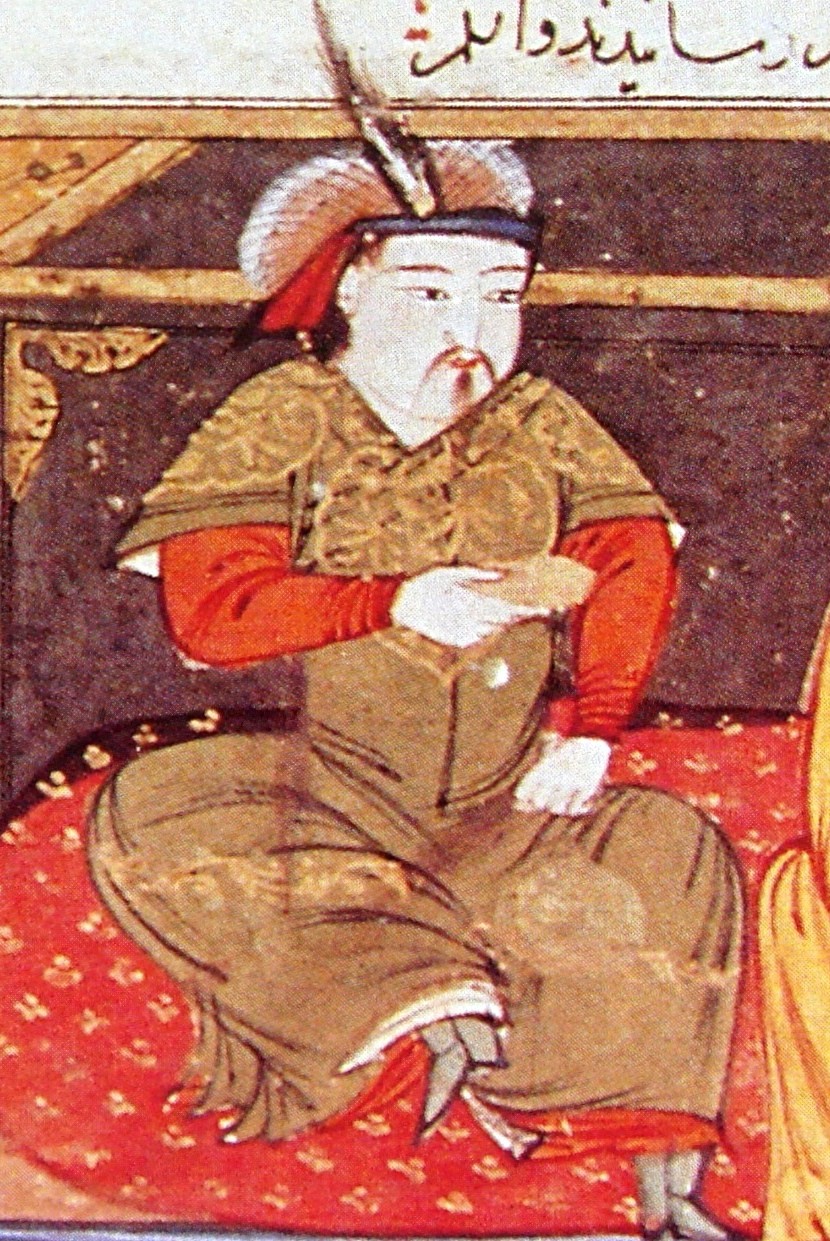
Hulegu Khan
View on Wikipedia
Hulegu Khan, also known as Hülegü or Hulagu[n 1] (c. 1217 – 8 February 1265), was a Mongol ruler who conquered much of Western Asia. As a son of Tolui and the Keraite princess Sorghaghtani Beki, he was a grandson of Genghis Khan and brother of Ariq Böke, Möngke Khan, and Kublai Khan.
Key Information
Hulegu's army greatly expanded the southwestern portion of the Mongol Empire, founding the Ilkhanate in Persia. Under Hulegu's leadership, the Mongols sacked and destroyed Baghdad, ending the Islamic Golden Age and the Abbasid dynasty. They also weakened Damascus, causing a shift of Islamic influence to the Mamluk Sultanate in Cairo.
Background
[edit]Hulegu was born to Tolui, one of Genghis Khan's sons, and Sorghaghtani Beki, an influential Keraite princess and a niece of Toghrul in 1217.[3] Not much is known of Hulegu's childhood except of an anecdote given in Jami' al-Tawarikh and he once met his grandfather Genghis Khan with Kublai in 1224.
Military campaigns
[edit]

Hulegu's brother Möngke Khan had been installed as Great Khan in 1251. Möngke charged Hulegu with leading a massive Mongol army to conquer or destroy the remaining Muslim states in southwestern Asia. Hulegu's campaign sought the subjugation of the Lurs of southern Iran,[3] the destruction of the Nizari Ismaili state (the Assassins), the submission or destruction of the Abbasid Caliphate in Baghdad, the submission or destruction of the Ayyubid states in Syria based in Damascus, and finally, the submission or destruction of the Bahri Mamluke Sultanate of Egypt.[4] Möngke ordered Hulegu to treat kindly those who submitted and utterly destroy those who did not. Hulegu vigorously carried out the latter part of these instructions.
Hulegu marched out with perhaps the largest Mongol army ever assembled – by order of Möngke, two-tenths of the empire's fighting men were gathered for Hulegu's army[5] in 1253. He arrived at Transoxiana in 1255. He easily destroyed the Lurs, and the Assassins surrendered their impregnable fortress of Alamut without a fight, accepting a deal that spared the lives of their people in early 1256. He chose Azerbaijan as his power base, while ordering Baiju to retreat to Anatolia. From at least 1257 onwards, Muslims and Christians of every major religious variety in Europe, the Middle East, and mainland Asia were a part of Hulegu's army.[6]
Siege of Baghdad
[edit]Hulegu's Mongol army set out for Baghdad in November 1257. Once near the city he divided his forces to threaten the city on both the east and west banks of the Tigris. Hulegu demanded surrender, but the caliph, Al-Musta'sim, refused. Due to the treason of Abu Alquma, an advisor to Al-Musta'sim, an uprising in the Baghdad army took place and Siege of Baghdad began. The attacking Mongols broke dikes and flooded the ground behind the caliph's army, trapping them. Much of the army was slaughtered or drowned.
The Mongols under Chinese general Guo Kan laid siege to the city on 29 January 1258,[7] constructing a palisade and a ditch and wheeling up siege engines and catapults. The battle was short by siege standards. By 5 February the Mongols controlled a stretch of the wall. The caliph tried to negotiate but was refused. On 10 February Baghdad surrendered. The Mongols swept into the city on 13 February and began a week of destruction. The Grand Library of Baghdad (also called 'Bayt al-Hikmah), containing countless precious historical documents and books on subjects ranging from medicine to astronomy, was destroyed. Citizens attempted to flee but were intercepted by Mongol soldiers.
Death counts vary widely and cannot be easily substantiated: A low estimate is about 90,000 dead;[8] higher estimates range from 200,000 to a million.[9] The Mongols looted and then destroyed buildings. Mosques, palaces, libraries, hospitals—grand buildings that had been the work of generations—were burned to the ground. The caliph was captured and forced to watch as his citizens were murdered and his treasury plundered. Il Milione, a book on the travels of Venetian merchant Marco Polo, states that Hulegu starved the caliph to death, but there is no corroborating evidence for that. Most historians believe the Mongol and Muslim accounts that the caliph was rolled up in a rug and the Mongols rode their horses over him, as they believed that the earth would be offended if touched by royal blood. All but one of his sons were killed. Baghdad underwent a severe decline in importance after the siege, although according to historian Michal Biran, Hulegu ordered the city rebuilt and the libraries were reopened within two years.[10][11] Smaller states in the region hastened to reassure Hulegu of their loyalty, and the Mongols turned to Syria in 1259, conquering the Ayyubid dynasty and sending advance patrols as far ahead as Gaza.
A thousand squads of northern Chinese sappers accompanied Hulegu during his conquest of the Middle East.[12]
Conquest of Syria (1260)
[edit]
In 1260 Mongol forces combined with those of their Christian vassals in the region, including the army of the Armenian Kingdom of Cilicia under Hethum I, King of Armenia and the Franks of Bohemond VI of Antioch. This force conquered Muslim Syria, a domain of the Ayyubid dynasty. They captured Aleppo by siege and, under the Christian general Kitbuqa, seized Damascus on 1 March 1260.[a] A Christian Mass was celebrated in the Umayyad Mosque and numerous mosques were profaned. Many historical accounts describe the three Christian rulers Hethum, Bohemond, and Kitbuqa entering the city of Damascus together in triumph,[15][16] though some modern historians such as David Morgan have questioned this story as apocryphal.[17]
The invasion effectively destroyed the Ayyubids, which was until then a powerful dynasty that had ruled large parts of the Levant, Egypt, and the Arabian Peninsula. The last Ayyubid king, An-Nasir Yusuf, had been killed by Hulegu this same year.[18] With Baghdad ravaged and Damascus weakened, the center of Islamic power shifted to the Mamluk sultan's capital of Cairo.
Hulegu intended to send forces southward through Palestine toward Cairo. So he had a threatening letter delivered by an envoy to the Mamluk Sultan Qutuz in Cairo demanding that Qutuz open his city or it would be destroyed like Baghdad. Then, because food and fodder in Syria had become insufficient to supply his full force, and because it was a regular Mongol practice to move troops to the cooler highlands for the summer,[19] Hulegu withdrew his main force to Iran near Azerbaijan, leaving behind one tumen (10,000 men or less) under Kitbuqa, accompanied by Armenian, Georgian, and Frankish volunteers, which Hulegu considered sufficient. Hulegu then personally departed for Mongolia to play his role in the imperial succession conflict occasioned by the death some eight months earlier of Great Khan Möngke. But upon receiving news of how few Mongols now remained in the region, Qutuz quickly assembled his well-trained and equipped 20,000-strong army at Cairo and invaded Palestine.[20][unreliable source?] He then allied himself with a fellow Mamluk leader, Baybars in Syria, who not only needed to protect his own future from the Mongols but was eager to avenge for Islam the Mongol capture of Damascus, looting of Baghdad, and conquest of Syria.
The Mongols, for their part, attempted to form a Frankish-Mongol alliance with (or at least, demand the submission of) the remnant of the Crusader Kingdom of Jerusalem, now centered on Acre, but Pope Alexander IV had forbidden such an alliance. Tensions between Franks and Mongols also increased when Julian of Sidon caused an incident resulting in the death of one of Kitbuqa's grandsons. Angered, Kitbuqa had sacked Sidon. The Barons of Acre, contacted by the Mongols, had also been approached by the Mamluks, seeking military assistance against the Mongols. Although the Mamluks were traditional enemies of the Franks, the Barons of Acre recognized the Mongols as the more immediate menace. Instead of taking sides, the Crusaders opted for a position of cautious neutrality between the two forces. In an unusual move, however, they allowed the Egyptian Mamluks to march northward without hindrance through Crusader territory and even let them camp near Acre to resupply.
Battle of Ain Jalut
[edit]
When news arrived that the Mongols had crossed the Jordan River in 1260, Sultan Qutuz and his forces proceeded southeast toward the 'Spring of Goliath' (Known in Arabic as 'Ain Jalut') in the Jezreel Valley. They met the Mongol army of about 12,000 in the Battle of Ain Jalut and fought relentlessly for many hours. The Mamluk leader Baybars mostly implemented hit-and-run tactics in an attempt to lure the Mongol forces into chasing him. Baybars and Qutuz had hidden the bulk of their forces in the hills to wait in ambush for the Mongols to come into range. The Mongol leader Kitbuqa, already provoked by the constant fleeing of Baybars and his troops, decided to march forwards with all his troops on the trail of the fleeing Egyptians. When the Mongols reached the highlands, Egyptians appeared from hiding, and the Mongols found themselves surrounded by enemy forces as the hidden troops hit them from the sides and Qutuz attacked the Mongol rear. Estimates of the size of the Egyptian army range from 24,000 to 120,000. The Mongols broke free of the trap and even mounted a temporarily successful counterattack, but their numbers had been depleted to the point that the outcome was inevitable. Refusing to surrender, the whole Mongol army that had remained in the region, including Kitbuqa, were cut down and killed that day. The battle of Ain Jalut established a high-water mark for the Mongol conquest.
Civil War
[edit]
After the succession was settled and his brother Kublai Khan was established as Great Khan, Hulegu returned to his lands by 1262. When he massed his armies to attack the Mamluks and avenge the defeat at Ain Jalut, however, he was instead drawn into civil war with Batu Khan's brother Berke. Berke Khan, a Muslim convert and the grandson of Genghis Khan, had promised retribution in his rage after Hulegu's sack of Baghdad and allied himself with the Mamluks. He initiated a large series of raids on Hulegu's territories, led by Nogai Khan. Hulegu suffered a severe defeat in an attempted invasion north of the Caucasus in 1263. This was the first open war between Mongols and signaled the end of the unified empire. In retaliation for his failure, Hulegu killed Berke's ortogh, and Berke did the same in return.[21]
Even while Berke was Muslim, out of Mongol brotherhood he at first resisted the idea of fighting Hulegu. He said, "Mongols are killed by Mongol swords. If we were united, then we would have conquered all of the world." But the economic situation of the Golden Horde due to the actions of the Ilkhanate led him to declare jihad because the Ilkhanids were hogging the wealth of North Iran and because of the Ilkhanate's demands for the Golden Horde not to sell slaves to the Mamluks.[22]
Communications with Europe
[edit]Hulegu's mother Sorghaghtani successfully navigated Mongol politics, arranging for all of her sons to become Mongol leaders. She was a Christian of the Church of the East (often referred to as "Nestorianism") and Hulegu was friendly to Christianity. Hulegu's favorite wife, Doquz Khatun, was also a Christian, as was his closest friend and general, Kitbuqa. Hulegu sent multiple communications to Europe in an attempt to establish a Franco-Mongol alliance against the Muslims. In 1262, he sent his secretary Rychaldus and an embassy to "all kings and princes overseas". The embassy was apparently intercepted in Sicily by Manfred, King of Sicily, who was allied with the Mamluk Sultanate and in conflict with Pope Urban IV, and Rychaldus was returned by ship.[23]
On 10 April 1262, Hulegu sent a letter, through John the Hungarian, to Louis IX of France, offering an alliance.[24] It is unclear whether the letter ever reached Louis IX in Paris – the only manuscript known to have survived was in Vienna, Austria.[25] The letter stated Hulegu's intention to capture Jerusalem for the benefit of the Pope and asked for Louis to send a fleet against Egypt:
From the head of the Mongol army, anxious to devastate the perfidious nation of the Saracens, with the good-will support of the Christian faith (...) so that you, who are the rulers of the coasts on the other side of the sea, endeavor to deny a refuge for the Infidels, your enemies and ours, by having your subjects diligently patrol the seas.
— Letter from Hulegu to Saint Louis.[26]
Despite many attempts, neither Hulegu nor his successors were able to form an alliance with Europe, although Mongol culture in the West was in vogue in the 13th century. Many new-born children in Italy were named after Mongol rulers, including Hulegu: names such as Can Grande ("Great Khan"), Alaone (Hulegu), Argone (Arghun), and Cassano (Ghazan) are recorded.[27]
Family
[edit]Hulegu had fourteen wives and concubines with at least 21 issues with them:
Principal wives:
- Guyuk Khatun (died in Mongolia before reaching Iran) – daughter of Toralchi Güregen of the Oirat tribe and Checheikhen Khatun
- Qutui Khatun – daughter of Chigu Noyan of Khongirad tribe and Tümelün behi (daughter of Genghis khan and Börte)
- Takshin (d. 12 September 1270 of urinary incontinence)
- Tekuder (1246–1284)
- Todogaj Khatun[28] – married to Tengiz Güregen, married secondly to Sulamish his son, married thirdly to Chichak, son of Sulamish
- Yesunchin Khatun (d. January/February 1272) – a lady from the Suldus tribe
- Abaqa (1234–1282)
- Dokuz Khatun, daughter of Uyku (son of Toghrul) and widow of Tolui
- Öljei Khatun – half-sister of Guyuk, daughter of Toralchi Güregen of the Oirat tribe
- Möngke Temür (b. 23 October 1256, d. 26 April 1282)
- Jamai Khatun – married Jorma Güregen after her sister Bulughan's death
- Manggugan Khatun – married firstly to her cousin Chakar Güregen (son of Buqa Timur and niece of Öljei Khatun), married secondly to his son Taraghai
- Baba Khatun – married to Lagzi Güregen, son of Arghun Aqa
Concubines:
- Nogachin Aghchi, a lady from Cathay; from camp of Qutui Khatun
- Tuqtani (or Toqiyatai) Egechi (d. 20 February 1292) – sister of Irinjin, niece of Dokuz Khatun
- Boraqchin Agachi, from camp of Qutui Khatun
- Taraghai (died by lightning strike on his way to Iran in 1260s)
- Arighan Agachi (d. 8 February 1265) – daughter of Tengiz Güregen; from camp of Qutui Khatun
- Ajuja Agachi, a lady from China or Khitans, from camp of Dokuz Khatun
- Yeshichin Agachi, a lady from the Kür'lüüt tribe; from camp of Qutui Khatun
- Yesüder – Viceroy of Khorasan during Abaqa's reign
- A daughter (married to Esen Buqa Güregen, son of Noqai Yarghuchi)
- Khabash – posthumous son
- Yesüder – Viceroy of Khorasan during Abaqa's reign
- El Agachi – a lady from the Khongirad tribe; from camp of Dokuz Khatun
- Irqan Agachi (Tribe unknown)
- Taraghai Khatun – married to Taghai Timur (renamed Musa) of Khongirad (son of Shigu Güregen) and Temülun Khatun (daughter of Genghis Khan)
- Mangligach Agachi (Tribe unknown)
- Qutluqqan Khatun – married firstly to Yesu Buqa Güregen, son of Urughtu Noyan of the Dörben tribe, married secondly Tukel, son of Yesu Buqa
- A concubine from Qutui Khatun's camp:
- Toqai Timur (d. 1289)[29]
- Qurumushi
- Hajji
- Toqai Timur (d. 1289)[29]

Death
[edit]Hulegu Khan fell seriously ill in January 1265 and died the following month on the banks of Zarrineh River (then called Jaghatu) and was buried on Shahi Island in Lake Urmia. His funeral was the only Ilkhanate funeral to feature human sacrifice.[30] His tomb has never been found.[31]
Legacy
[edit]Hulegu Khan laid the foundations of the Ilkhanate and thus paved the way for the later Safavid dynastic state, and ultimately the modern country of Iran. Hulegu's conquests also opened Iran to both European influence from the west and Buddhist influence from the east. Thus, combined with patronage from his successors, would develop Iran's distinctive excellence in architecture. Under Hulegu's dynasty, Iranian historians began writing in Persian rather than Arabic.[32] It is recorded however that he converted to Buddhism as he neared death,[33] against the will of Doquz Khatun.[34] The erection of a Buddhist temple at Ḵoy testifies his interest in that religion.[3] Recent translations of various Tibetan monks' letters and epistles to Hulegu confirms that he was a lifelong Buddhist, following the Kagyu school.[35]
Hulegu also patronized Nasir al-Din Tusi and his researches in Maragheh observatory. Another of his proteges were Juvayni brothers Ata Malik and Shams al-Din Juvayni. His reign as the ruler of Ilkhanate was peaceful and tolerant to diversity.[36]
In popular media
[edit]- Portrayed by Kurt Katch in Ali Baba and the Forty Thieves (1944)
- Portrayed by Pran in the 1956 Indian film Halaku.
- Portrayed by Öztürk Serengil in Cengiz Han'ın Hazineleri (1962)[37]
- Portrayed by Zhang Jingda and Zhang Bolun in The Legend of Kublai Khan (2013)
Notes
[edit]Language notes
General notes
References
[edit]- ^ Grousset, René (1970). The Empire of the Steppes: A History of Central Asia. Rutgers University Press. p. 358. ISBN 9780813513041.
- ^ Vaziri, Mostafa (2012). "Buddhism during the Mongol Period in Iran". Buddhism in Iran: An Anthropological Approach to Traces and Influences. Palgrave Macmillan US. pp. 111–131. doi:10.1057/9781137022943_7. ISBN 9781137022943.
- ^ a b c "Hulāgu Khan" at Encyclopædia Iranica
- ^ Amitai-Preiss, Reuven. The Mamluk-Ilkhanid War
- ^ John Joseph Saunders, The History of the Mongol Conquests, 1971.
- ^ Chua, Amy (2007). Day of Empire: How Hyperpowers Rise to Global Dominance–and Why They Fall (1st ed.). New York: Doubleday. p. 111. ISBN 978-0-385-51284-8. OCLC 123079516.
- ^ "Six Essays from the Book of Commentaries on Euclid". World Digital Library. Retrieved 21 March 2013.
- ^ Sicker 2000, p. 111.
- ^ New Yorker, April 25, 2005, Ian Frazier, "Invaders - Destroying Baghdad"
- ^ Hodous, Florence (2020). "Guo Kan: Military Exchanges between China and the Middle East". In Biran, Michal; Brack, Jonathan; Fiaschetti, Francesca (eds.). Along the Silk Roads in Mongol Eurasia: Generals, Merchants, and Intellectuals (1st ed.). Oakland: University of California Press. pp. 27–43. doi:10.2307/j.ctv125jrx5.7. ISBN 978-0-520-29875-0. JSTOR j.ctv125jrx5.7.
- ^ Boyle, John Andrew (1968). "Dynastic and Political History of the Il-khans". In Boyle, J. A. (ed.). The Cambridge History of Iran. Vol. 5: The Saljuq and Mongol Periods. Cambridge: Cambridge University Press. pp. 303–421. ISBN 978-1-139-05497-3.
- ^ Josef W. Meri (2005). Josef W. Meri (ed.). Medieval Islamic Civilization: An Encyclopedia. Psychology Press. p. 510. ISBN 0-415-96690-6. Retrieved 28 November 2011.
This called for the employment of engineers to engage in mining operations, to build siege engines and artillery, and to concoct and use incendiary and explosive devices. For instance, Hulegu, who led Mongol forces into the Middle East during the second wave of the invasions in 1250, had with him a thousand squads of engineers, evidently of north Chinese (or perhaps Khitan) provenance.
- ^ "In May 1260, a Syrian painter gave a new twist to the iconography of the Exaltation of the Cross by showing Constantine and Helena with the features of Hulegu and his Christian wife Doquz Khatun" in Cambridge History of Christianity Vol. 5 Michael Angold p. 387 Cambridge University Press ISBN 0-521-81113-9
- ^ Le Monde de la Bible N. 184 July–August 2008, p. 43
- ^ a b Runciman 1987, p. 307.
- ^ Grousset, p. 588
- ^ Jackson 2014.
- ^ Atlas des Croisades, p. 108
- ^ Pow, Lindsey Stephen (2012). Deep Ditches and Well-Built Walls: a Reappraisal of the Mongol Withdrawal from Europe in 1242 (Master's thesis). University of Calgary. p. 32. OCLC 879481083.
- ^ Corbyn, James (2015). In What Sense Can Ayn Jalut be Viewed as a Decisive Engagement? (Master's thesis). Royal Holloway University of London. pp. 7–9.
- ^ Enkhbold, Enerelt (2019). "The role of the ortoq in the Mongol Empire in forming business partnerships". Central Asian Survey. 38 (4): 531–547. doi:10.1080/02634937.2019.1652799. S2CID 203044817.
- ^ Johan Elverskog (2011). Buddhism and Islam on the Silk Road. University of Pennsylvania Press. pp. 186–. ISBN 978-0-8122-0531-2.
- ^ Jackson 2014, p. 173.
- ^ Jackson 2014, p. 178.
- ^ Jackson 2014, p. 166.
- ^ Letter from Hulegu to Saint Louis, quoted in Les Croisades, Thierry Delcourt, p. 151
- ^ Jackson 2014, p. 315.
- ^ Landa, Ishayahu (2018). "Oirats in the Ilkhanate and the Mamluk Sultanate in the Thirteenth to the Early Fifteenth Centuries: Two Cases of Assimilation into the Muslim Environment (MSR XIX, 2016)" (PDF). Mamlūk Studies Review. doi:10.6082/M1B27SG2.
- ^ a b c Brack, Jonathan Z. (2016). Mediating Sacred Kingship: Conversion and Sovereignty in Mongol Iran (Thesis). hdl:2027.42/133445.
- ^ Morgan, p. 139
- ^ Henry Filmer (1937). The Pageant Of Persia. p. 224.
- ^ Francis Robinson, The Mughal Emperors And The Islamic Dynasties of India, Iran and Central Asia, pp. 19 & 36
- ^ Hildinger 1997, p. 148.
- ^ Jackson 2014, p. 176.
- ^ Martin, Dan; Samten, Jampa (2014). "Letters for the Khans: Six Tibetan Epistles for the Mongol Rulers Hulegu and Khubilai, and the Tibetan Lama Pagpa. Co-authored with Jampa Samten". In Roberto Vitali (ed.). Trails of The Tibetan Tradition: Papers for Elliot Sperling. Amnye Machen Institute. ISBN 9788186227725.
- ^ Nehru, Jawaharlal. Glimpses of World History. Penguin Random House.[ISBN missing][page needed]
- ^ Yilmaz, Atif (10 October 1962), Cengiz Han'in hazineleri (Adventure, Comedy), Orhan Günsiray, Fatma Girik, Tülay Akatlar, Öztürk Serengil, Yerli Film, retrieved 1 February 2021
Works cited
[edit]- Atwood, Christopher P. (2004). The Encyclopedia of Mongolia and the Mongol Empire. Facts on File, Inc. ISBN 0-8160-4671-9.
- Boyle, J.A., (Editor). The Cambridge History of Iran: Volume 5, The Saljuq and Mongol Periods. Cambridge University Press; Reissue ed., (1968). ISBN 0-521-06936-X.
- Hildinger, Erik (1997). Warriors of the Steppe: A Military History of Central Asia, 500 B.C. to 1700 A.D. Da Capo Press. ISBN 0-306-81065-4.
- Morgan, David. The Mongols. Blackwell Publishers; Reprint ed., 1990. ISBN 0-631-17563-6. Best for an overview of the wider context of medieval Mongol history and culture.
- Runciman, Steven (1987). A History of the Crusades: Volume 3, The Kingdom of Acre and the Later Crusades. Cambridge University Press. ISBN 9780521347723.
- Jackson, Peter (2014). The Mongols and the West: 1221–1410. Taylor & Francis. ISBN 978-1-317-87898-8.
- Robinson, Francis. The Mughal Emperors And the Islamic Dynasties of India, Iran and Central Asia. Thames and Hudson Limited; 2007. ISBN 0-500-25134-7
External links
[edit]- A long article about Hulegu's conquest of Baghdad, written by Ian Frazier, appeared in the 25 April 2005 issue of The New Yorker.
- An Osama bin Laden tape in which Osama bin Laden compares Vice President Dick Cheney and Secretary of State Colin Powell to Hulegu and his attack on Baghdad. Dated 12 November 2002.
- Hulegu the Mongol, by Nicolas Kinloch, published in History Today, Volume 67 Issue 6 June 2017.
Hulegu Khan
View on GrokipediaEarly Life and Rise
Birth and Family Background
Hülegü Khan was born around 1217 as the son of Tolui, the youngest and fourth son of Genghis Khan, and Sorghaghtani Beki, a Keraite princess renowned for her political acumen and Nestorian Christian faith.[5][6] Tolui, who commanded the keshig (imperial guard) during Genghis Khan's campaigns and inherited the Mongol homeland after his father's death in 1227, provided Hülegü with direct ties to the empire's founding lineage.[6] Sorghaghtani, daughter of a Kerait noble and widow after Tolui's death in 1232, actively promoted her sons' interests within the Mongol aristocracy, converting her influence toward ensuring their prominence amid succession struggles.[6] As the third or fourth surviving son of Tolui and Sorghaghtani—following Möngke (born 1209) and Kublai (born 1215), and preceding Ariq Böke—Hülegü belonged to the Borjigin clan's Toluid branch, which produced three Great Khans and vied for supremacy after Ögedei's line waned.[6][7] This fraternal network positioned him within the empire's core power structure, where familial alliances and maternal advocacy shaped early Mongol imperial dynamics.[6] Hülegü's upbringing amid the nomadic elite emphasized martial training and administrative oversight, reflecting the Toluid emphasis on loyalty to the khanate's expansive conquests.[5]Education and Early Military Experience
Hulagu was born circa 1217 as the fifth son of Tolui, Genghis Khan's youngest son, and Sorghaghtani Beki, a Kerait princess raised in the Nestorian Christian tradition but who adhered to Mongol customs.[8] His early upbringing occurred in the nomadic environment of the Mongol heartland, where noble sons were groomed for leadership through immersion in steppe life, including herding, falconry, and communal rituals that fostered loyalty and resilience. In 1224, at about age nine, Hulagu accompanied his brother Kublai to meet Genghis Khan returning from campaigns in Transoxania and Iran; Genghis ritually anointed their bowstring fingers with fat from slain game, symbolizing their initiation into warrior status.[8] As with other Mongol princes, Hulagu's education lacked formal institutions but centered on practical mastery of warfare essentials: archery from horseback, endurance riding across vast distances, wrestling, and strategic coordination via organized hunts that replicated army maneuvers on a smaller scale.[9] These skills were honed from childhood under familial oversight, preparing him for command without recorded scholarly pursuits beyond basic literacy in the Uighur-Mongol script used for administrative tallies. Prior to 1251, Hulagu's military experience remained domestic, focused on securing Toluid appanages against local threats and rebellions in eastern Mongolia rather than distant conquests led by his uncles Ögedei and Güyük; this period built his logistical acumen in managing tumens (units of 10,000 warriors) and vast herds essential for sustaining campaigns.[8][10]Appointment by Mongke Khan
Möngke Khan, elected Great Khan in July 1251 following a kurultai in the Mongol homeland, initiated comprehensive plans for imperial expansion, including directives for campaigns in the western Islamic lands. He appointed his younger brother Hulagu, a seasoned Mongol prince and fifth son of Tolui, to command the expedition aimed at eliminating the Nizari Ismaili strongholds in Persia and compelling submission from the Abbasid Caliphate centered in Baghdad. This commission, formalized around 1252–1253, granted Hulagu extensive authority over military operations, civil administration, and resource allocation in the targeted regions, with explicit instructions to raze resistant fortresses and enforce Mongol suzerainty through conquest or negotiated vassalage.[11][12] The appointed force under Hulagu comprised approximately 100,000 to 150,000 personnel, including core Mongol tumens, allied contingents from Chagatai and Jochid uluses, and specialized units of Chinese engineers for siege machinery alongside Persian and Arab artillery experts. Departing from Mongolia in 1253, the army traversed Central Asia over three years, reaching Persia by late 1255 or early 1256, with Hulagu accompanied by his Nestorian Christian consort Dokuz Khatun and select royal kin to underscore the dynastic stakes. Möngke's orders emphasized total eradication of the Ismailis unless they surrendered unconditionally, while demanding the Caliph Al-Musta'sim personally attend a Mongol assembly or risk obliteration, reflecting the empire's strategy of psychological intimidation fused with overwhelming force.[12][13]Campaigns in Western Asia
Destruction of the Nizari Ismailis
In early 1256, Hülegü Khan, leading an army estimated at over 100,000 troops, initiated his campaign against the Nizari Ismaili strongholds in Persia as part of the broader Mongol objectives assigned by his brother, Great Khan Möngke.[14][6] The Nizaris, a Shi'i Ismaili sect centered in mountainous fortresses like Alamut and Maymun-Diz, had maintained a network of approximately 100 castles and were notorious for targeted assassinations against political and religious figures, prompting Mongol demands for their submission.[15] Hülegü's forces first subdued minor resistances in regions such as Quhistan and Qumis before converging on the core Alamut territories.[16] The Nizari imam Rukn al-Din Khurshah, who had assumed leadership in December 1255 following his father Ala ad-Din Muhammad III's death, faced immediate pressure as Mongol envoys demanded unconditional surrender.[17] Besieged at his stronghold of Maymun-Diz in autumn 1256, Khurshah capitulated after negotiations failed, pledging the submission of all Nizari fortresses to avert total annihilation.[15] He dispatched orders for castles including Alamut to yield, leading to the rapid capitulation of most defenses without prolonged combat; Mongol engineers deployed trebuchets and other siege engines only against isolated holdouts like Girdkuh, which resisted until 1257.[15] Alamut, the symbolic heart of Nizari power since Hassan-i Sabbah's capture in 1090, fell to Mongol forces on December 15, 1256, marking the effective end of the Ismaili state.[18] Hülegü initially treated Khurshah with deference to ensure compliance, but once surrenders were secured, he ordered the imam's execution along with much of his family—reportedly by trampling under horses or precipitous execution—eliminating the leadership cadre.[15] The Mongols systematically razed fortresses, demolished towers, and incinerated vast libraries, including Alamut's collection of scientific and philosophical manuscripts, resulting in irrecoverable cultural losses.[6] Surviving Nizaris were dispersed or absorbed into Mongol administration, with some communities persisting covertly in Persia and Syria, though the centralized Alamut polity ceased to exist.[19] Hülegü's contemporary chronicler Ata-Malik Juvayni, who accompanied the campaign, documented the events in his Tarikh-i Jahangushay, emphasizing the Mongols' strategic use of psychological intimidation and overwhelming logistics to dismantle the Nizari network efficiently.[20] This operation, completed with minimal Mongol casualties due to preemptive surrenders, cleared the path for subsequent advances against the Abbasid Caliphate.[6]Siege and Destruction of Baghdad
Following the subjugation of the Nizari Ismaili state in 1256, Hulagu Khan redirected his expeditionary force toward Baghdad, the political and cultural center of the Abbasid Caliphate, as mandated by Great Khan Möngke to extend Mongol dominion over the Islamic realms.[21] In late 1257, Hulagu dispatched an envoy to Caliph al-Mustaʿṣim billah, demanding submission, annual tribute of 2,000 dinars, the provision of military intelligence against other Muslim rulers, and the dispatch of royal heirs as hostages; the caliph's dismissive response, reportedly enclosing the envoy's letter in a insulting reply, precipitated the invasion.[4] The Mongol army, numbering around 200,000 troops including auxiliary forces from Armenian, Georgian, and Chinese engineers, encircled Baghdad on January 29, 1258, initiating a siege that exploited the city's outdated fortifications and internal divisions.[21][22] Hulagu's forces deployed massive trebuchets and catapults to bombard the walls, while sappers undermined defenses and engineers diverted the Tigris River's canals to flood the surrounding moats and agricultural lands, severely hampering resupply and morale within the city.[4] Despite a garrison of approximately 50,000 under the command of the vizier Ibn al-Alqami, who allegedly undermined defenses due to Shi'a sympathies, the eastern walls were breached after six days of intense combat from February 4 onward.[23] Al-Mustaʿṣim, facing collapse, surrendered unconditionally on February 10, 1258, leading his entourage to the Mongol camp.[23] Upon surrender, Hulagu initially issued decrees sparing the lives of judges (qadis), scholars, nobles, Shi'a descendants of Ali, and Nestorian Christians, reflecting selective Mongol policies toward useful administrators and religious minorities; however, these protections proved limited as the sack unfolded.[4] The caliph and his sons were executed shortly thereafter, with al-Mustaʿṣim reportedly confined without food until death or trampled to death while enclosed in a carpet to avoid spilling royal blood directly on the earth, per accounts drawing from Persian historians like Juvayni and later European observers.[23] The ensuing plunder and destruction lasted approximately one week, transforming the once-prosperous metropolis into ruins, with Hulagu himself estimating over 200,000 deaths among the population, though contemporary figures vary widely up to 800,000 due to massacres, drownings, and famine.[23] Mongol troops systematically looted palaces, mosques, and markets, setting fires that razed much of the urban fabric, while the Tigris River reportedly ran black with ink from the millions of volumes destroyed in libraries such as the House of Wisdom, where texts accumulated over five centuries were cast into the waters in such quantities that they allegedly formed a temporary bridge capable of supporting a horseman.[24] This devastation not only eradicated the Abbasid Caliphate's temporal authority after 524 years but also inflicted profound cultural losses, severing Baghdad's role as a hub of Islamic scholarship and engineering.[24][21]Advance into Syria and Defeat at Ain Jalut
Following the destruction of Baghdad in February 1258, Hulagu Khan directed his forces westward into Syria in late 1259, crossing the Euphrates River after securing the submissions of Harran and Edessa.[25] His army sacked Manbij en route and laid siege to Aleppo on January 18, 1260 (2 Safar 658 AH).[8] The city walls fell after a six-day bombardment with siege engines, surrendering on January 24, 1260, though the citadel held out for several more weeks until mid-February; a week-long massacre ensued, with widespread looting and slaughter of the populace.[25][8] Hulagu's vanguard, commanded by Ket Buqa Noyan, then advanced on Damascus, which surrendered without a fight in early March 1260—reportedly on March 1—amid offers of amnesty and tribute from the city's leaders, who greeted the Mongols with gifts and the keys to the gates.[25][26] This peaceful capitulation spared Damascus the fate of Aleppo, though Mongol garrisons were imposed to enforce submission across Syria. Hulagu, learning of his brother Möngke Khan's death in August 1259, withdrew the majority of his army—estimated at over 100,000 troops initially for the western campaign—eastward in spring 1260 to secure his claim in the ensuing Mongol succession struggle, leaving Ket Buqa with a reduced force of approximately 20,000 to consolidate control in the Levant.[8][25] The lingering Mongol presence prompted demands for submission from the Mamluk Sultanate of Egypt; Sultan Saif ad-Din Qutuz executed the envoys in defiance, mobilizing an army under his command and that of his deputy Baybars.[27] In July 1260, the Mamluks—numbering around 20,000, primarily elite slave cavalry—advanced northward into Palestine, where they encountered Ket Buqa's forces encamped near Ain Jalut (Goliath's Spring) southeast of Nazareth.[27] On September 3, 1260 (25 Ramadan 658 AH), the Mamluks initiated battle with a feigned retreat to lure the Mongol heavy cavalry into pursuit, then unleashed hidden reserves in an ambush that shattered the Mongol lines; Ket Buqa was captured in the rout and executed shortly after.[27] This victory represented the first open-field defeat of a Mongol army since the empire's inception, stemming from the Mongols' numerical disadvantage, overextension without Hulagu's main force, and the Mamluks' tactical adaptation of Mongol feigned-retreat maneuvers against them.[27] It preserved Egypt as an independent power and precluded further Mongol incursions southward, though Hulagu later sought revenge without recapturing Syria.[27]Founding and Rule of the Ilkhanate
Territorial Consolidation and Administration
Following the Mamluk victory at the Battle of Ain Jalut on 3 September 1260, Hulagu withdrew his forces from Syria to prioritize consolidation of the conquered territories in Persia, Mesopotamia (Iraq), and adjacent regions, thereby establishing the Ilkhanate as a distinct Mongol polity centered on these areas.[8] He selected Maragheh in Azerbaijan as his primary residence and administrative hub by late 1260, leveraging its strategic position for governance and defense against rivals such as the Golden Horde.[5] This shift marked a transition from conquest to stabilization, including the suppression of local revolts and the integration of fragmented Persian principalities under centralized Mongol oversight.[8] Hulagu's administrative structure combined Mongol military hierarchies with Persian bureaucratic expertise, appointing experienced officials to manage civil affairs while subordinating them to noyans (tribal commanders). In 1259, he designated ʿAlāʾ-al-Din ʿAṭāʾ Malek Juvayni, a Persian administrator, as governor (shihna) of Baghdad to oversee reconstruction and revenue extraction in the Abbasid ruins.[8] Arghun Aqa, a pre-existing Mongol governor of western Asian finances since the 1240s, retained authority over taxation and the diwan (financial bureau) under Hulagu, ensuring continuity in fiscal operations across Persia and Khorasan.[28] By 1262, Hulagu elevated Šams-al-Din Muhammad Juvayni to sahb-e divan (chief financial minister), who implemented revenue reforms to stabilize the post-conquest economy.[8] This hybrid system privileged Mongol oversight to prevent autonomy among local elites, though it required collegial consultation with aristocratic commanders to mitigate internal dissent.[7] Fiscal administration emphasized systematic taxation to fund the standing army and campaigns, building on empire-wide censuses initiated under Möngke Khan in the 1250s; Hulagu enforced property assessments and qubchur (household levies) on sedentary populations, yielding revenues estimated at millions of dinars annually from Iraqi farmlands alone.[1] Military governance involved dividing forces into tumens (units of 10,000), with detachments garrisoned in key cities like Tabriz and Baghdad to enforce order and deter incursions.[8] Border security was bolstered through conflicts, such as the 1262-1263 war against Berke Khan's Golden Horde forces in the Caucasus, which secured Azerbaijan's flanks and affirmed Ilkhanid sovereignty over contested pastoral lands.[8] Hulagu also initiated infrastructural policies indicative of administrative foresight, commissioning the Maragheh Observatory in 1259 under Nasir al-Din Tusi's direction to advance astronomical and calendrical sciences, which aided in standardizing measurements for taxation and military logistics.[8] Selective tolerance toward Christian communities—sparing them during the 1258 Baghdad sack—facilitated alliances and administrative cooperation in diverse territories, though Islamic institutions faced heavier impositions to offset war damages.[8] These measures laid the groundwork for the Ilkhanate's endurance, blending coercive Mongol extraction with adaptive Persian mechanisms until Hulagu's death in 1265.[5]Patronage of Scholars and Infrastructure
Hulagu Khan demonstrated notable patronage toward Persian scholars, particularly in the fields of astronomy and mathematics, as part of his efforts to legitimize Ilkhanid rule through cultural and intellectual integration. Following the 1256 conquest of the Nizari Ismaili stronghold at Alamut, he spared and recruited key figures such as Nasir al-Din al-Tusi, a prominent Shi'ite scholar and polymath previously affiliated with the Ismailis, appointing him to administrative roles including oversight of religious endowments (waqfs).[29] Al-Tusi, in turn, advised Hulagu on scientific matters, leveraging his influence to secure resources for intellectual pursuits amid the Mongol ruler's campaigns.[30] This support extended to other astronomers like Mu'ayyid al-Din al-'Urdi, fostering a collaborative environment that drew scholars from across the Islamic world and beyond, including a Chinese astronomer named Fao Munji.[31] A cornerstone of Hulagu's infrastructural initiatives was the establishment of the Maragheh Observatory in northwestern Iran, construction of which began in 1259 on a hilltop site selected for its suitability, with al-Tusi as director.[29] Funded directly by Hulagu, the facility represented one of the earliest purpose-built astronomical observatories in the Islamic world, equipped with large-scale instruments such as a mural quadrant over 4 meters in diameter and a solstitial armillary sphere, enabling precise observations that contributed to the compilation of the Zij-i Ilkhani astronomical tables completed posthumously under his successors.[30] [32] The observatory's operations, sustained until around 1316, advanced geocentric models with innovations like al-Tusi's "couple" mechanism for planetary motion, influencing later European astronomy, though its remote location and political disruptions limited long-term impact.[29] Beyond astronomy, Hulagu's patronage included support for libraries and scriptoria, where scholars produced works in Persian and Arabic under Ilkhanid auspices, reflecting a pragmatic policy of harnessing local expertise for administrative and cultural stability.[33] Infrastructural efforts, however, were more selectively focused; while broader Mongol policies under Hulagu emphasized military logistics over widespread civilian projects, the Maragheh initiative exemplified targeted investments in scientific infrastructure to enhance the Ilkhanate's prestige and utility in calendrical and astrological computations essential for rulership.[30] No extensive records detail large-scale canal restorations or urban rebuilding directly attributable to Hulagu, as his reign prioritized conquest and consolidation over such endeavors.Religious Policies and Tolerance
![Hulagu Khan and his wife Doquz Khatun in a Syriac Bible][float-right]Hulagu Khan followed traditional Mongol Tengrism, the shamanistic faith centered on the sky god Tengri, though he exhibited sympathies toward Nestorian Christianity due to the influence of his mother Sorghaghtani Beki and principal wife Doquz Khatun, both adherents of that denomination.[6][4] No verified conversion to Christianity occurred, despite papal overtures from Urban IV in 1263 suggesting possible inclinations.[6] Accounts indicate late-life interest in Buddhism, with a temple constructed near his burial site at Khoy following his death in 1265.[6] His policies reflected broader Mongol pragmatism: religious tolerance granted to compliant subjects who paid tribute, irrespective of faith, while resistance—regardless of creed—invited severe reprisal.[6] This manifested in favoritism toward Christians; during the 1258 sack of Baghdad, Hulagu exempted Nestorian communities from the general massacre, directing them to seek refuge in churches declared off-limits to Mongol forces, an intervention attributed to Doquz Khatun's advocacy.[12][4] Similar protections extended to Jews and Shi'i Muslims in Baghdad, sparing them from the estimated hundreds of thousands slain, primarily Sunni partisans of the Abbasid Caliph al-Musta'sim, whom Hulagu executed after the city's fall on February 10, 1258.[6][34] In Aleppo's 1260 conquest, Christians and Jews again received leniency amid the devastation.[6] Toward Islam, Hulagu displayed no systematic animus beyond enforcing submission; the annihilation of the Nizari Ismaili state in 1256–60 targeted a militant sect viewed as a strategic threat by both Mongols and regional powers, not merely a religious purge.[6] Post-conquest, Muslim populations under Ilkhanate rule faced standard Mongol taxation without coerced conversion, aligning with the empire's multi-confessional administration.[6] He patronized Muslim astronomers like Nasir al-Din Tusi, commissioning the Maragheh Observatory in 1259 for scientific pursuits transcending faith.[6] Conflicts arose with Muslim Khan Berke of the Golden Horde over the Caliph's death, underscoring political rather than doctrinal divides.[6] This approach sustained diverse religious practices in the Ilkhanate until later rulers like Ghazan adopted Islam in 1295.[6]
