Recent from talks
Contribute something
Nothing was collected or created yet.
Hypermarket
View on Wikipedia
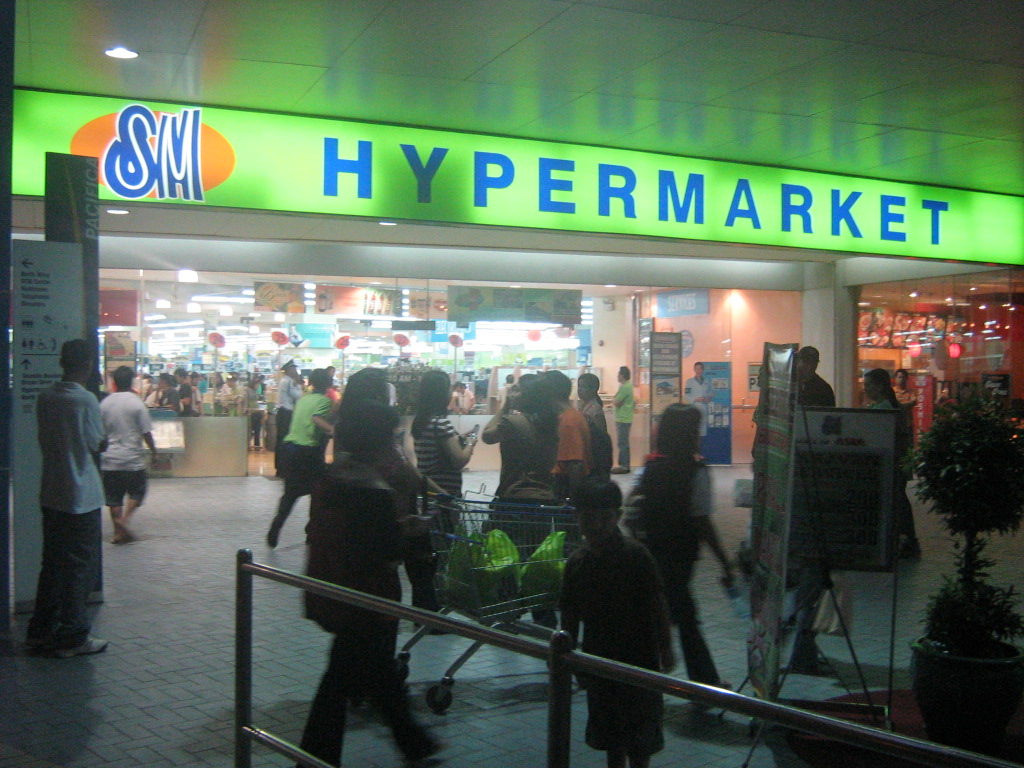
A hypermarket or superstore is a big-box store combining a supermarket and a department store.[1] The result is an expansive retail facility carrying a wide range of products under one roof, including full grocery lines and general merchandise. In theory, hypermarkets allow customers to satisfy all their routine shopping needs in one trip. The term hypermarket (French: hypermarché) was coined in 1968 by the French trade expert Jacques Pictet.[2]
Hypermarkets, like other big-box stores, typically have business models focusing on high-volume, low-margin sales. Typically covering an area of 5,000 to 15,000 square metres (54,000 to 161,000 sq ft), they generally have more than 200,000 different brands of merchandise available at any one time.[citation needed] Because of their large footprints, many hypermarkets choose suburban or out-of-town locations that are easily accessible by automobile.
History
[edit]Canada
[edit]Loblaws established its Real Canadian Superstore chain in 1979. It sells mainly groceries, while also retailing clothing, electronics and housewares. Its largest competitor in Canada is Walmart. These are the two major Canadian hypermarkets.
Europe
[edit]In 1961, following the repeal of Belgian laws that restricted department store sizes, the Belgian retailer Grand Bazar opened three hypermarkets under the name SuperBazar. The first, opened in Bruges on 9 September, covered 3,300 square meters (36,000 sq ft), while the second in Auderghem, Brussels, spanned 9,100 square meters (98,000 sq ft), marking it as a significant early example of the hypermarket concept.[3]
It was Belgian market development engineer Maurice Cauwe, who adopted the concept from his frequent trips to the United States, particularly inspired from the Grand Union's "Grand Way" center in Paramus, New Jersey.[4]
Carrefour opened its first hypermarket in 1963, at Sainte-Geneviève-des-Bois, France,[5] The co-founders were influenced by the teachings of Colombian-born American marketing executive Bernardo Trujillo, who taught executive education as part of the NCR Corporation's marketing campaign.[6]
In France, hypermarkets are generally situated in shopping centers (French: centre commercial or centre d'achats) outside cities, though some are present in the city center. They are surrounded by extensive car parking facilities, and generally by other specialized superstores that sell clothing, sports gear, automotive items, etc.
After the successes of super- and hyper-markets and amid fears that smaller stores would be forced out of business, France enacted laws that made it more difficult to build hypermarkets and also restricted the amount of economic leverage that hypermarket chains can impose upon their suppliers (the Loi Galland).
Japan
[edit]The predecessor to Ito-Yokado was founded in 1920 selling western goods, went public in 1957, and switched to that name in 1965. Seibu Department Stores was founded in 1956, and opened up its grocery chain Seiyu Group in 1963. Isao Nakauchi founded the first Daiei in Kobe in 1957, selling clothing, electronics, furniture and groceries all in one store. Jusco was created in 1970, and eventually became known as Aeon.
In Japanese, hypermarkets are known as General Merchandise Stores (総合スーパー, Sōgō Sūpā). There is a distinction in Japanese between Supers (スーパー) and Departs (デパート) with the former being discounters, but the latter selling luxury brand clothing and quite often high-end groceries as well.
Hypermarkets are found in both urban and less populated areas in Japan. Their development is often supported by collaborative investment from financial institutions. Japanese hypermarkets may contain restaurants, manga (Japanese comic) stands, Internet cafés, typical department store merchandise, a full range of groceries, beauty salons and other services all in the same store. A recent[when?] trend has been to combine the dollar store concept with the hypermarket blueprint, giving rise to the "hyakkin plaza"—hyakkin (百均) or hyaku en (百円) means 100 yen (roughly 1 U.S. dollar).
United States
[edit]
Until the 1980s, large stores combining food and non-food items were unusual in the United States, although early predecessors existed since the first half of the 20th century.[7] The term "hypermarket" itself is still rarely used in the US.
The Pacific Northwest chain Fred Meyer, now a division of the Kroger supermarket company, opened the first suburban one-stop shopping center in 1931 in the Hollywood District of Portland, Oregon. The store's innovations included a grocery store alongside a drugstore plus off-street parking and an automobile lubrication and oil service. In 1933, men's and women's wear was added, and automotive department, housewares, and other non-food products followed in succeeding years. In the mid-1930s, Fred Meyer opened a central bakery, a candy kitchen, an ice cream plant, and a photo-finishing plant, which supplied the company's stores in Portland and neighbouring cities with house brands such as Vita Bee bread, Hocus Pocus desserts, and Fifth Avenue candies. By the 1950s, Fred Meyer began opening stores that were 4,200 to 6,500 m2 (45,000 to 70,000 sq ft), and the 1960s saw the first modern-sized Fred Meyer hypermarkets.[8]
The Midwest (then grocery) chain Meijer, which today operates about 235 stores in six U.S. states, coined the term "super center",[9] and opened the first of its hypermarket format store in Grand Rapids, Michigan, in June 1961, under the brand name "Thrifty Acres".[10][11]
In the late 1980s and early 1990s, the three major U.S. discount store chains – Walmart, Kmart and Target – started developing similar format chains. Wal-Mart (as it was known before its late-2000s rebranding as Walmart) introduced Hypermart USA in 1987, followed by Wal-Mart Supercenter in 1988;[12] The same year, French chains Carrefour and Auchan opened hypermarkets in Philadelphia and Greater Houston, respectively.[13] Kmart opened its first Super Kmart Center in 1991;[14] and Target came with the first Target Greatland stores in 1990, followed by the larger SuperTarget stores in 1995.[15] Most Greatland stores have since been converted to SuperTarget stores, while some have been converted into regular Target stores with the exception of 2 entrances (one example of this is the Antioch, California location which opened in 2004).
In the early 1990s, U.S. hypermarkets also began selling fuel. The idea was first introduced in the 1960s, when a number of supermarket chains and retailers like Sears tried to sell fuel, but it didn't generate sufficient consumer interest at the time. Today, there are approximately 4,500 hypermarket stores in the U.S. selling fuel, representing an estimated 14 billion US gallons (53 billion litres) sold each year.[16]
Australia
[edit]In Australia, hypermarkets were at their peak during the 1980s. This was especially prevalent during the era of South African owned Pick n Pay Stores and a now discontinued format of Kmart Australia stores known as Super Kmart. This trend in the Australian market soon lost its appeal into the 1990s. Super Kmart stores were discontinued and Coles Supermarkets and Kmart Stores opened in the former location. Pick n Pay continued to operate in Australia until the 2000s when their locations at Aspley and Sunnybank Hills were converted into Coles Supermarkets and Kmart Department Stores.
As of 2022, the only hypermarket or Big-Box Store operational in Australia are Costco Wholesale Warehouses with currently sixteen stores in Australia – five stores in Melbourne, three stores in Sydney, two stores in Brisbane, two stores in Perth and one store each in Newcastle, Canberra, Adelaide and Queensland's Gold Coast. There were plans for German hypermarket company Kaufland to open stores in Australia announced in 2019; these plans were cancelled in 2020.
Iran
[edit]Before 2009 (1388 ه.ش.), there were some local hypermarkets, but international branches were nonexistent. Despite their late arrival, hypermarkets in Iran have achieved a significant degree of growth. The first branch was opened in Tehran under the name of Iran Hyperstar through a collaboration between Carrefour and Majid Al Futtaim Group based in the United Arab Emirates. The Emirati holding is the main shareholder with about 75% of the company's shares. New branches were established after Iran Hyperstar’s first store found relative success. Now, other branches have been established in Tehran, Isfahan, Shiraz, Mashhad, Ahvaz, etc.[17]
Size
[edit]
The average Walmart Supercenter covers around 16,500 m2 (178,000 sq ft), with the largest ones covering 24,000 m2 (260,000 sq ft).[18] A typical Carrefour hypermarket still covers 10,000 m2 (110,000 sq ft), while the European trend in the 2000s has rather turned towards smaller hypermarkets of 3,000 to 5,000 m2 (32,000 to 54,000 sq ft).[19] In France, INSEE defines hypermarkets (French: hypermarché/s) as non-specialized markets with a minimum size of 2,500 m2 (27,000 sq ft).[20]
Future
[edit]Despite its historical success, analysts such as Sanjeev Sanyal, former Deutsche Bank Global Strategist until 2015, have suggested that the hypermarket model may face challenges from online shopping and increasing demand for customized retail experiences.[21] Sanyal has argued that some developing countries such as India may omit the hypermarket stage and directly go online.[22]
Warehouse club
[edit]Another category of stores sometimes included in the hypermarket category are the membership-based wholesale warehouse clubs that are popular in North America, pioneered by Fedco and today including Sam's Club, a division of Walmart; Costco, in which Carrefour owned some shares[23] from 1985 to 1996; BJ's Wholesale Club on the East Coast; and Clubes City Club in Mexico. In Europe, Makro (owned by Metro AG) leads the market.
However, warehouse clubs differ from hypermarkets in that they have sparse interior decor and require paid membership. In addition, warehouse clubs usually sell bigger packages and have fewer choices in each category of items.
See also
[edit]- List of hypermarkets
- Mass consumption – Acquisition of goods beyond essential needs
- Types of retail outlets – Sale of goods and services
- Shelf-ready packaging – Form of product packaging
References
[edit]- ^ "Hypermarket". Investopedia. 24 June 2007. Retrieved 26 September 2018.
- ^ Grimmeau 2013, p. 3.
- ^ Grimmeau 2013, pp. 1–3.
- ^ Grimmeau 2013, pp. 2, 7.
- ^ Jean-Mark Villermet, Naissance de l'hypermarche, 1991, ISBN 2-200-37263-9, Colin (publisher).
- ^ "Bernardo Trujillo, l'accoucheur des grandes surfaces". Les Echos. 8 December 1999. Retrieved 10 February 2018.
- ^ Grimmeau 2013, p. 8.
- ^ FundingUniverse: Fred Meyer Stores, Inc. History Linked 9 January 2014
- ^ Meijer website: Our Company Archived 7 February 2014 at the Wayback Machine Linked 9 January 2014
- ^ Meijer website: Our History Linked 9 January 2014 Archived 25 January 2014 at the Wayback Machine
- ^ "Column: Meijer's first Super center past its prime but full of good memories". MLive.com. 12 October 2008. Retrieved 30 July 2015.
- ^ "Walmart Corporate - We save people money so they can live better". Archived from the original on 8 January 2007. Retrieved 30 July 2015.
- ^ Wollam, Allison. "Food Town to occupy portion of shuttered Auchan hypermarket." Houston Business Journal. Sunday 8 June 2003. Modified on Thursday 5 June 2003. Retrieved on 13 January 2011.
- ^ "Sears Holdings Corporation - Corporate Website". Archived from the original on 20 October 2008. Retrieved 30 July 2015.
- ^ Target website: Target through the years Archived 2019-09-16 at the Wayback Machine Linked 9 January 2014
- ^ The History of Gasoline Retailing Archived 24 March 2011 at the Wayback Machine
- ^ "تاریخچه هایپراستار؛ همه چیز درباره بزرگترین فروشگاه زنجیره ای – فرصت امروز". forsatnet.ir (in Persian). Retrieved 16 April 2023.
- ^ Paul Ausick (22 March 2014). "Walmart Now Has Six Types of Stores". 24/7 Wall Street. Retrieved 17 June 2016.
- ^ David Jolly (27 January 2012). "Carrefour Rethinks Its 'Bigger Is Better' Strategy". New York Times. Retrieved 17 June 2016.
- ^ La situation du commerce en 2014 [The situation of commerce in 2014] (PDF) (Report) (in French). INSEE. 18 December 2015. Retrieved 17 June 2016.
- ^ "Sanjeev Sanyal on The Customization Revolution - Project Syndicate". Project Syndicate. 22 March 2012. Retrieved 30 July 2015.
- ^ "Sanjeev Sanyal on Clicks over Bricks in India - Project Syndicate". Project Syndicate. 5 October 2012. Retrieved 30 July 2015.
- ^ Robert Spector, "Carrefour enters U.S. via share in Costco", Supermarket News, January 1985.
Bibliography
[edit]- Grimmeau, Jean-Pierre (10 June 2013). "A forgotten anniversary: the first European hypermarkets open in Brussels in 1961". Brussels Studies (67). doi:10.4000/brussels.1155. ISSN 2031-0293. Retrieved 28 March 2020.
External links
[edit]
Media related to Supermarkets at Wikimedia Commons
Hypermarket
View on GrokipediaDefinition and Characteristics
Core Definition and Features
A hypermarket is a expansive retail format that combines supermarket operations with department store offerings, enabling customers to purchase groceries, fresh produce, and perishable goods alongside non-food merchandise such as apparel, consumer electronics, furniture, and household appliances in one comprehensive venue designed for one-stop shopping. These stores typically span over 80,000 square feet, with many exceeding 100,000 square feet to accommodate vast inventory and high foot traffic.[6][7] Key operational features include a self-service model with grid-based layouts featuring wide aisles for cart navigation, promoting independent customer browsing and efficient throughput. Hypermarkets emphasize high-volume sales through bulk procurement from suppliers, which leverages purchasing power to negotiate lower wholesale costs, and maintain broad assortments of 30,000 to 80,000 stock-keeping units (SKUs)—far exceeding the 20,000 to 50,000 SKUs typical of conventional supermarkets.[8][9][10] From a first-principles perspective, the scale of hypermarkets generates economies in logistics, inventory management, and overhead distribution, reducing per-unit costs and facilitating aggressive pricing strategies that intensify retail competition. Empirical evidence indicates this structure correlates with lower staple food prices compared to smaller formats, as larger operations achieve cost efficiencies that smaller stores cannot match, ultimately delivering measurable savings to consumers, including lower-income households reliant on affordable basics.[11][12][13]Variations in Size and Layout
Hypermarkets exhibit significant variations in physical size, typically ranging from 80,000 to 200,000 square feet, enabling them to stock a vast array of groceries and general merchandise under one roof, which distinguishes them from smaller supermarkets averaging 40,000 square feet or less.[14][15] This scale supports operational efficiency by spreading fixed costs like utilities and staffing over larger sales volumes, though it requires substantial upfront investment in real estate and infrastructure. In regions with expansive suburban developments, such as the United States, hypermarkets often approach or exceed 180,000 square feet to accommodate diverse product categories, while European models may skew smaller—around 50,000 to 150,000 square feet—due to denser urban planning and zoning restrictions that limit land availability.[16] Layout designs prioritize customer navigation and sales optimization, commonly featuring wide aisles—typically 4 to 6 feet—to facilitate cart movement and reduce congestion amid high daily foot traffic.[17] Perishable groceries like produce, meat, and dairy are often positioned along the perimeter walls to leverage natural browsing patterns and maintain product freshness through proximity to loading areas, while central zones house non-perishable staples and non-food items such as apparel or household goods, fostering cross-shopping and impulse buys.[18] Internal zoning further enhances efficiency with dedicated departments for bakery, deli, and electronics, separated by clear signage and flooring cues to guide traffic flow from high-margin fresh foods at entry points to deeper store areas. Many incorporate attached amenities like in-store pharmacies for prescription services and, in select locations, fueling stations to extend convenience and capture additional revenue streams.[19] Extensive integrated parking lots, often accommodating 500 to 2,000 vehicles based on store footprint, are standard to handle peak-hour volumes, minimizing external traffic disruptions and supporting the one-stop-shopping model that drives higher per-visit basket sizes compared to fragmented retail formats.[20] These structural elements collectively lower per-square-foot operational costs through scale economies, such as centralized inventory management and reduced staffing density relative to sales area, though they demand precise logistics to avoid bottlenecks in high-traffic scenarios.Historical Development
Origins and Early Innovations in Europe
The hypermarket format emerged in France amid post-World War II economic reconstruction, where rapid urbanization and persistent inflation strained traditional small-scale retailing, prompting innovators to adapt larger American supermarket models for greater efficiency and affordability.[3] On June 15, 1963, Carrefour opened the first hypermarket in Sainte-Geneviève-des-Bois, south of Paris, spanning 2,500 square meters and combining extensive food and non-food merchandise under one roof to leverage economies of scale against food price pressures.[4] [22] This pioneering store drew from U.S. self-service concepts observed by founders Marcel Fournier and Louis Defforey but scaled up to include automotive and household goods, enabling bulk purchasing that reduced per-unit costs for consumers facing shortages and rising living expenses in the 1950s and early 1960s.[3] Early proliferation extended to neighboring countries in the mid-1960s, with Belgium seeing proto-hypermarkets as early as 1961 in Brussels, though these were smaller precursors to the standardized French model.[23] By the 1970s, chains like Continent in Germany and expansions by Carrefour into Belgium and Spain adopted the format, with stores exceeding 5,000 square meters to capitalize on suburban land availability and integrate diverse product categories.[24] In Spain, regulatory shifts post-Franco era facilitated entry, while Germany's post-war Wirtschaftswunder supported similar large-format developments amid industrial recovery.[25] Key enablers included regulatory liberalization in France prior to 1973 restrictions, which permitted large retail establishments in peripheral zones, and surging private car ownership—rising from under 10% of households in the early 1950s to over 50% by 1970—allowing customers to access out-of-town sites impractical for pedestrian traffic.[26] These factors aligned with causal demands for volume-driven pricing in reconstruction economies, where hypermarkets bypassed fragmented supply chains of wartime-era markets. By the 1980s, hypermarkets and supermarkets had eroded traditional retailers' dominance, capturing over 40% of French food sales from a 16% base in 1969, with large formats driving competitive price discipline through high turnover rather than monopoly power, as evidenced by sustained entry of rivals spurring format innovations like extended hours and private labels.[27] [28] This shift empirically lowered real food costs via scale efficiencies, countering inflationary legacies without evidence of uniform price hikes until later consolidations.[29]Global Expansion to the Americas and Asia
In the United States, the hypermarket model entered during the 1980s primarily through adaptations by domestic retailers facing regulatory hurdles such as zoning laws that restricted massive single-store developments exceeding certain square footage thresholds. Kmart, which had pioneered discount stores in 1962, experimented with larger hybrid formats combining general merchandise and groceries, but these did not fully replicate European hypermarket scales due to antitrust scrutiny and local opposition from smaller competitors. Walmart, starting from its discount store origins in 1962, launched its first supercenters in 1988, integrating full-line supermarkets with discount departments to achieve operational efficiencies akin to hypermarkets, reaching over 100,000 square feet per store and enabling one-stop shopping that boosted sales volumes through economies of scale.[30][31] These hybrids adapted to American suburban sprawl and car-centric consumer habits, prioritizing parking and broad assortments over the dense urban footprints common in Europe, while zoning variances allowed gradual expansion without pure hypermarket dominance. In Asia, hypermarket diffusion accelerated from the 1970s amid rapid urbanization and rising middle-class incomes, which correlated with increased demand for centralized access to diverse, affordable goods including locally sourced produce and imported durables. Japan saw early adoption through chains like Ito-Yokado, which expanded multilevel superstores stocking groceries, appliances, and furniture starting in the 1970s, tailoring layouts to high-density populations and integrating Japanese staples such as fresh seafood sections to align with dietary preferences.[32] By the 1990s, liberalization in South Korea enabled entrants like Lotte Mart, which opened its inaugural hypermarket in Seoul in 1998 following regulatory easing that permitted foreign-inspired large formats, modernizing supply chains and contributing to retail sector productivity gains amid post-Asian Financial Crisis recovery. In China, Carrefour established its first hypermarket in Beijing in 1995 via joint ventures, navigating initial foreign investment caps by partnering locally and stocking region-specific items like bulk rice and regional vegetables, which facilitated market penetration as urban migration swelled consumer bases.[3][33] Protectionist measures, such as Japan's Large-Scale Retail Stores Law until its 1990s reforms and Korea's pre-liberalization caps on store sizes, initially slowed foreign hypermarket chains but spurred domestic adaptations that preserved local vendor integrations and mitigated claims of cultural erosion by emphasizing hybrid assortments blending global efficiencies with vernacular products. This expansion empirically linked to verifiable improvements in consumer welfare, including lower prices and greater variety, driven by urbanization rates exceeding 2-3% annually in key markets and middle-class household growth that outpaced traditional wet markets without evidence of net homogenization when local sourcing comprised over 80% of perishables in adapted stores.[33] Overall, these 1970s-1990s shifts prioritized causal efficiencies in logistics and scale over rigid format imports, fostering retail modernization that supported GDP contributions from trade and consumption sectors.Regional Adaptations and Case Studies
In Iran, the Refah Chain Stores, established in 1995, exemplifies adaptation of the hypermarket format to local economic and cultural contexts by operating large-scale outlets alongside smaller express formats, with all products compliant with halal standards mandated under Iranian law.[34] [35] By the mid-2010s, the chain had grown to hundreds of branches, prioritizing expansion in underserved areas while navigating state-driven retail policies that favor domestic chains over foreign entrants.[36] This model succeeds amid sanctions and import restrictions by emphasizing locally sourced goods, achieving scale efficiencies without full reliance on Western supply chains. In the broader Middle East, Carrefour's entry into the UAE in 1995 marked an early hypermarket adaptation, involving modifications such as segregated family sections, halal-certified inventory, and extended operating hours aligned with regional prayer times and shopping patterns.[37] These adjustments addressed conservative social norms and high expatriate populations, enabling the format's growth in urban centers like Dubai, where hypermarkets now capture significant market share through integrated non-food departments tailored to affluent consumers. Australian implementations, such as Woolworths' mega-stores, adapt the hypermarket by amplifying fresh produce assortments—sourcing 100% domestic beef, lamb, pork, chicken, eggs, and dairy—to capitalize on consumer preferences for quality perishables in a geography-dependent market.[38] This emphasis, rooted in strategies dating to the 1980s, differentiates from compact European models by allocating expansive floor space to in-store butchery and greengrocery, supporting local agriculture amid vast distances that challenge centralized logistics.[39] Canada's Loblaw Companies introduced the Real Canadian Superstore in the late 1970s as a hypermarket experiment, featuring stores larger than American football fields that merge supermarket staples with apparel, electronics, and pharmacy services to serve suburban families in expansive territories.[40] This format thrives in low-density regions by offering one-stop shopping, with adaptations like bilingual signage in Quebec reflecting linguistic diversity, though it faces competition from discount chains prompting periodic pricing recalibrations. Japan's hypermarket development was constrained until 2000 by the Large-Scale Retail Stores Law of 1974, which required extensive community consultations and zoning approvals for outlets over 1,500 square meters, effectively protecting small retailers and limiting foreign entrants like Aeon until deregulation.[41] Post-repeal, approvals accelerated, enabling formats like Ito-Yokado to expand with integrated department store elements suited to dense urban layouts and high land costs, though proliferation remained slower than in less regulated Asian markets due to entrenched keiretsu supplier networks.[42]Operational and Economic Model
Merchandising, Pricing, and Supply Chain
Hypermarkets primarily rely on an everyday low pricing (EDLP) model, which commits to consistently low base prices across assortments rather than relying on periodic promotions, enabling high-volume sales to offset razor-thin gross margins typically ranging from 1% to 3%.[43][44] This approach stems from direct, large-scale negotiations with suppliers, which secure favorable terms due to the hypermarket's purchasing power, often passing savings to consumers while prioritizing operational efficiency over promotional variability.[45][46] Merchandising strategies emphasize broad assortments, with private-label products accounting for 20-25% of sales in many chains, allowing hypermarkets to undercut national brands by 10-20% on comparable items through lower production costs and exclusive control over formulation and packaging.[47][48] These store brands not only boost margins by reducing reliance on manufacturer pricing but also facilitate targeted merchandising in high-traffic aisles, where empirical data shows they drive impulse purchases and loyalty among price-sensitive shoppers.[49] Supply chains in hypermarkets center on centralized distribution facilities that consolidate inbound goods from suppliers, enabling just-in-time replenishment to minimize holding costs and waste, particularly for perishables where spoilage can exceed 5% without precise timing.[50][51] These hubs, often spanning millions of square feet, reduce stockout rates to 2-5% through automated sorting and rapid store delivery, outperforming decentralized models by streamlining logistics across hundreds of outlets.[52] Advanced data analytics further enhance demand forecasting by integrating point-of-sale data, weather patterns, and seasonal trends, achieving forecast accuracy improvements of up to 30% and supporting dynamic assortment adjustments.[53][54] The scale of hypermarket operations yields 15-25% lower prices on groceries compared to independent stores, as evidenced by econometric analyses of supercenter expansions, directly contributing to consumer surplus estimated in billions annually through reduced expenditure on essentials.[55][56] This pricing edge arises causally from procurement leverage and inventory turnover rates exceeding 10 times per year, though it demands rigorous supply chain discipline to sustain without eroding service levels.[57]Employment and Labor Practices
Hypermarkets generate substantial employment, with individual stores typically employing 300 to 500 workers, encompassing roles in inventory management, customer service, and operations.[58] These positions often start as entry-level opportunities, characterized by relatively high turnover rates due to the sector's demands, but operators like Walmart provide structured internal training programs that facilitate upward mobility, with thousands of associates advancing to supervisory or managerial roles annually.[58] Part-time scheduling predominates to accommodate flexible workforce needs, including students and secondary earners, enabling operators to match demand fluctuations while offering employees variable hours.[59] Unionization varies significantly by region, remaining low in the United States at approximately 4% for retail workers, as major non-union operators like Walmart prioritize direct employee relations over collective bargaining.[60] In Europe, rates are higher, such as around 10% in the UK retail sector, with French hypermarket chains like Carrefour engaging works councils and unions under national labor frameworks that mandate collective agreements.[61] Wages in hypermarkets generally exceed local minimums, averaging $18 per hour in U.S. operations as of 2024, though critics argue these fail to reflect living costs amid part-time prevalence.[58] Large-scale retailers pay comparably higher hourly rates than smaller service-oriented firms, with non-managerial retail positions at $16.28 for men and $12.79 for women.[62] Economic analyses indicate that hypermarket expansion displaces some jobs at incumbent small retailers but yields net neutral or modestly positive effects on overall local employment, as efficiency gains lower prices and boost consumer spending multipliers.[63] For instance, Walmart store openings correlate with slight retail employment declines of 100-150 jobs per county but stable or increased total payrolls when accounting for spillover hiring in supporting sectors.[64] This contrasts with narratives favoring small-shop preservation, as consolidated formats sustain more positions through scale than fragmented alternatives, per labor market data showing large employers' role in absolute job volume despite per-firm rates favoring smaller entities.[65]Impacts and Controversies
Economic Benefits and Consumer Advantages
Hypermarkets deliver substantial consumer advantages through economies of scale that enable lower prices on a wide array of goods, including groceries, household items, and non-food products. Empirical analyses of big-box retailers, which encompass hypermarket formats like supercenters, indicate that food prices are typically 8-27% lower compared to traditional supermarkets, driven by high-volume purchasing from suppliers and efficient logistics that reduce per-unit costs.[66][67] This pricing structure allows households to achieve meaningful cost savings, particularly in competitive markets where hypermarkets pressure rivals to match or undercut prices.[68] The one-stop shopping model further enhances consumer welfare by consolidating purchases across categories, minimizing the need for multiple store visits and thereby saving time and transportation expenses. Shoppers at hypermarkets report prioritizing this convenience, which aligns with broader retail trends showing reduced shopping frequency—such as fewer weekly trips—as consumers opt for larger, less frequent baskets to cover diverse needs efficiently.[69][70] These efficiencies are especially pronounced for busy households, where the ability to access extensive product ranges under one roof streamlines routines without compromising variety or quality.[71] On a macroeconomic level, hypermarkets stimulate supplier economies by placing large, predictable orders that allow producers to optimize production scales, lower marginal costs, and expand operations.[72] The global hypermarket sector, valued at approximately $786 billion in 2025, underscores this scale's role in driving retail GDP contributions and broader economic growth through efficient distribution networks.[73] Moreover, price deflation from hypermarket competition disproportionately aids low-income households, who devote a higher budget share to essentials; such reductions enhance affordability, boost real purchasing power, and support poverty mitigation by making basic goods more accessible without relying on subsidies.[63][74]Criticisms Regarding Competition and Urban Effects
Critics argue that hypermarket entry distorts local competition by displacing small independent grocers, with empirical analyses indicating that such expansions account for 40-50% of the net decline in small discount and grocery stores during periods of rapid growth, as observed in the U.S. discount retailing sector from the late 1980s to 1990s.[75] This displacement arises from hypermarkets' scale advantages in procurement and operations, which enable lower prices that undercut smaller competitors lacking similar efficiencies.[76] However, evidence suggests many exiting stores were marginally productive, with survival hinging on competitive viability rather than inherent predation; post-entry, remaining small retailers often adapt by specializing in niches like fresh produce or convenience, reflecting market-driven selection of efficient operators over protection of inefficient ones.[77] Regarding urban effects, hypermarkets' typical suburban or peripheral locations necessitate large parking facilities and automobile access, fostering car dependency and contributing to increased traffic congestion and vehicle emissions in sprawling areas.[78] Studies link such out-of-town retail formats to higher per-capita vehicle miles traveled for shopping, exacerbating emissions compared to compact urban small-store clusters that support walking or public transit.[79] Counterarguments emphasize causal efficiency: hypermarkets consolidate diverse purchases into single trips, potentially reducing total shopping-related vehicle kilometers versus dispersed visits to multiple small outlets, while consumer preference for one-stop variety and savings—often 8-27% lower food prices—drives voluntary suburban travel patterns.[57] Mainstream media and advocacy sources frequently highlight "community erosion" from these shifts, prioritizing sentimental attachments to traditional retail over quantifiable gains.[80] In contrast, peer-reviewed economic research underscores net welfare improvements, as hypermarkets' lower staple food prices in small stores—typically higher by margins exceeding 20%—translate to substantial household savings that outweigh localized business losses, aligning with principles of competitive resource allocation.[12] This perspective accounts for potential biases in institutional narratives favoring small-scale inefficiency under the guise of social preservation.[81]Regulatory Challenges and Policy Debates
In France, the Loi Royer of December 1973 imposed strict authorization requirements for retail establishments exceeding 1,000 square meters, effectively capping hypermarket expansion to protect smaller independent shops from competition.[82] These measures, advocated by traditional retailers and local interests, delayed new hypermarket openings and contributed to reduced retail concentration, with empirical analysis indicating a subsequent increase in consumer prices due to diminished competitive pressure.[83] Similar zoning restrictions persist in parts of Europe and the United States, where local ordinances limit big-box store footprints or require extensive permitting, often influenced by lobbying from incumbent businesses; for instance, U.S. municipalities have enacted size caps under 80,000 square feet to curb perceived urban impacts, correlating with higher local grocery costs as entry barriers preserve market power among existing operators.[84][85] Antitrust scrutiny has targeted hypermarket consolidations, exemplified by the European Commission's in-depth investigation into the 1999 Carrefour-Promodes merger, which raised concerns over potential dominance in French and broader EU markets despite the scale efficiencies enabling lower pricing through expanded supply chains.[86] While regulators debated monopoly risks, post-merger data from similar entries reveal pro-competitive outcomes, with hypermarket introductions typically boosting overall retail rivalry and reducing local prices by 7-11% via intensified price and variety competition.[87] In Japan, the Large-Scale Retail Stores Law of 1973, which mandated lengthy approval processes for stores over 1,500 square meters, exemplified protectionist policies until its deregulation in 2000; subsequent liberalization accelerated large-store entries, empirically linking a 10% rise in their relative floor space to price reductions of 0.3-1.3% as competition eroded incumbents' pricing power.[88] Policy debates center on balancing local preservation against consumer welfare, with proponents of restrictions arguing they safeguard "urban charm" and small enterprises, yet causal evidence from deregulation episodes demonstrates that such barriers elevate affordability hurdles by stifling scale-driven efficiencies.[89] For example, pre-2000 Japanese restrictions correlated with stagnant retail prices amid limited entry, while liberalization yielded measurable declines, underscoring how anti-competitive zoning and licensing, frequently lobbied by protected interests, impose verifiable costs on households through sustained higher markups rather than fostering genuine economic vitality.[88] These interventions, while framed in mainstream policy discourse as equitable, often overlook empirical patterns where hypermarket scale enhances rivalry without monopoly outcomes, prioritizing sectoral incumbency over broader price discipline.Comparisons to Related Retail Formats
Differences from Supermarkets
Hypermarkets are distinguished from supermarkets by their substantially larger physical footprint and broader merchandise assortment, which extends well beyond food and grocery staples. Supermarkets typically range from 20,000 to 60,000 square feet in size, with an average of 42,453 square feet in the United States as of 2024, and derive over 70% of sales from grocery items including perishables, dairy, and center-store dry goods.[90][91] In contrast, hypermarkets often exceed 100,000 square feet—reaching up to 180,000 square feet in formats like supercenters—and allocate 40–50% of sales to non-food categories such as apparel, electronics, home goods, and general merchandise, functioning as one-stop shopping destinations.[92][93] This scale enables hypermarkets to achieve economies of bulk procurement and distribution, often resulting in deeper price discounts across both food and non-food items compared to supermarkets, which prioritize niche product freshness, localized sourcing, and higher-margin perishables to maintain customer loyalty for routine grocery needs.[14] Unlike membership-based warehouse clubs, hypermarkets operate without entry fees, appealing to a wider demographic seeking convenience in combined shopping trips. Empirical data from major operators indicate hypermarkets generate 2–3 times the foot traffic of traditional supermarkets due to their diversified appeal, though this comes at the cost of longer dwell times and more complex store navigation.[7]Distinctions from Warehouse Clubs
Hypermarkets provide unrestricted access to all customers, enabling immediate entry and shopping without any financial prerequisite, in contrast to warehouse clubs, which mandate an annual membership fee—typically $50 for basic access at Sam's Club or $65 at Costco as of 2025—to participate in their model.[94][95] This fee-based structure in warehouse clubs, such as those operated by Costco Wholesale and Sam's Club, supports their emphasis on bulk purchasing for high-volume consumers, often yielding unit prices 20 to 35 percent lower than in traditional grocery formats when adjusted for comparable product mixes.[96] Hypermarkets, by eliminating such barriers, accommodate a wider array of household sizes and shopping habits, prioritizing everyday variety over volume-driven discounts.[97] In terms of product presentation and assortment, warehouse clubs feature a limited selection of 3,000 to 4,000 stock-keeping units (SKUs), focused on pallet-stacked bulk items with minimal packaging and irregular availability of national brands alongside private labels, designed for efficiency rather than breadth.[98][99] Hypermarkets counter this with expansive assortments exceeding 30,000 SKUs, including standard-sized packages of fresh perishables, household goods, and general merchandise arranged in curated displays to facilitate one-stop convenience shopping.[100] Store layouts further underscore these divergences: warehouse clubs adopt sparse, industrial configurations with exposed ceilings, concrete floors, and end-of-aisle bulk stacks to minimize operational costs and maximize throughput.[101] Hypermarkets utilize structured grid layouts with organized aisles, climate-controlled sections for produce, and enhanced merchandising to create an inviting, full-service atmosphere, complemented by diverse checkout options—including self-service and assisted lanes—and robust return policies absent in the streamlined club format.[100] This approach allows hypermarkets to capture loyalty across broader demographics, promoting inclusivity by avoiding the commitment of membership while still competing on price for non-bulk needs.[102]Relations to Supercenters and Discount Chains
Supercenters, exemplified by Walmart Supercenters which first opened in 1988, parallel hypermarkets through their large-scale integration of grocery and general merchandise offerings, typically spanning over 180,000 square feet and serving as one-stop shopping destinations. Unlike traditional European hypermarkets that often incorporate department-store-like polish with varied non-food assortments, supercenters emphasize discount-driven models centered on everyday low pricing (EDLP) to attract price-sensitive consumers across broader demographics.[103][1] In the post-1980s era, several U.S. hypermarket experiments transitioned into supercenter formats; Walmart's Hypermart USA pilot projects, launched in 1987 as joint ventures combining groceries and merchandise under one roof, directly informed the supercenter blueprint by refining supply chain efficiencies and layout designs for high-volume sales. These evolutions retained hypermarket-scale ambitions but adapted EDLP strategies more aggressively, while varying in private-label emphasis—supercenters balancing national brands with own-labels, distinct from the heavier reliance on private labels in pure discount operations.[104] Discount chains such as Aldi diverge from both by prioritizing extreme value in groceries through compact stores, limited SKUs (often under 2,000 items), and minimal non-food sections, forgoing the expansive size and merchandise diversity of supercenters or hypermarkets to minimize overhead and pass savings to shoppers.[105] While hypermarkets and supercenters alike accelerated retail consolidation by capturing market share from smaller independents—evidenced by Walmart's grocery sales surging to dominate U.S. volumes by the 1990s—supercenters expanded more rapidly in America due to antitrust frameworks that permitted aggressive scaling, unlike Europe's tighter zoning and competition restrictions curbing similar dominance.[106][107]Contemporary Adaptations
Integration with Digital and E-commerce
Hypermarkets have increasingly adopted omnichannel strategies in the 2020s to integrate digital ordering with physical store operations, leveraging mobile applications for click-and-collect and in-store pickup services to mitigate competition from pure-play online grocers. For instance, Carrefour expanded its multichannel offerings, including dedicated apps and platforms for Drive (click-and-collect) services, which by 2024 saw 60% of its French customers utilizing these options for their convenience in combining online selection with rapid physical retrieval.[108][109] These hybrid approaches allow hypermarkets to maintain dominant physical sales volumes, typically comprising 80-90% of total revenue in grocery-heavy models, as consumers continue preferring in-store purchases for tactile evaluation of perishables despite digital encroachment.[110][111] Grocery e-commerce sales have grown at a compound annual growth rate (CAGR) of around 9% projected through 2029, driven by post-pandemic habits and urban demand for convenience, compelling hypermarkets to evolve store networks into integrated digital-physical ecosystems.[110] This shift, evident in 2024-2025 data, has prompted investments in app-based ordering systems that facilitate same-day fulfillment without fully supplanting brick-and-mortar dominance.[112] Hypermarkets' large-scale physical footprints enable efficient adaptation, with stores serving as micro-fulfillment centers to handle order aggregation and reduce last-mile delivery dependencies on external logistics.[113] The inherent scale of hypermarket locations provides causal advantages in last-mile efficiency for perishable goods, where proximity to dense populations and on-site inventory minimize spoilage risks and delivery windows compared to centralized pure-online warehouses.[114] By repurposing existing stores as fulfillment hubs, operators achieve cost savings through tighter turnaround times and lower outsourcing needs, preserving competitive edges in fresh food categories that constitute a core hypermarket strength.[115] This model underscores how physical infrastructure bolsters digital scalability, with same-day services enhancing customer retention amid rising expectations for speed.[116]Responses to Sustainability and Market Shifts
Hypermarket operators have implemented targeted measures to address environmental concerns, including commitments to reduce plastic packaging and emissions. For instance, Carrefour established a low-carbon strategy in 2015 aiming for a 40% reduction in overall emissions by 2025, incorporating local sourcing to minimize transport-related greenhouse gases.[117] Tesco similarly pledged a 60% cut in scope 1 and 2 emissions by 2025 from a 2015 baseline, leveraging supply chain optimizations like AI-driven forecasting to lower emissions by 835 tonnes of CO2 in specific initiatives.[118][119] However, progress has been uneven; Walmart indicated in February 2025 that it would miss its 2025 targets for reducing virgin plastic in owned-brand packaging by 20% and achieving full recyclability, highlighting challenges in scaling reductions amid high-volume operations.[120] Critiques persist regarding hypermarkets' energy-intensive scale, including unreported methane emissions from supply chains, as noted in a 2025 report on chains like Walmart, Tesco, and Carrefour, which often prioritize operational efficiencies over comprehensive scope 3 tracking.[121] Despite this, empirical evidence suggests inherent efficiencies: larger formats enable advanced planning for perishables, reducing spoilage rates through optimized replenishment and assortment, outperforming smaller stores where limited scale exacerbates waste from inconsistent demand forecasting.[122][123] U.S. grocery retailers, including hypermarket operators, reported a 30% decline in unsold food's carbon footprint from 2020 to 2024 via such operational tweaks, demonstrating market-driven waste minimization per unit sold that counters narratives of inherent inefficiency.[124] In response to e-commerce pressures from platforms like Amazon, hypermarkets have bolstered loyalty programs integrating physical and digital elements to retain hybrid shoppers. Walmart's Walmart+ membership, launched in 2020 and expanded by 2025, offers perks like free delivery from stores alongside in-store benefits, enhancing retention against Amazon's Prime dominance.[125][126] These strategies emphasize omnichannel loyalty over standalone online pivots, capitalizing on hypermarkets' physical infrastructure for rapid fulfillment.[127] Geographically, hypermarkets counter Western market saturation—evident in mature European and North American segments—through expansion in Asia, where rising urbanization drives demand. The global hypermarket sector, valued at $774.27 billion in 2025, projects a 2.5% CAGR through 2033, with Asia-Pacific grocery retail growing 2.8% in Q1 2025 alone, fueled by formats adapting to local preferences over declining per-store openings in saturated regions.[128][129] This shift underscores causal adaptation to demographic growth, offsetting stagnation without relying on regulatory mandates.[130]References
- https://www.[researchgate](/page/ResearchGate).net/publication/235282192_Efficiency_measurement_among_hypermarkets_and_supermarkets_and_the_identification_of_the_efficiency_drivers_A_case_study
