Hubbry Logo
Yellow badgeYellow badgeMain
Open search
Yellow badge
Community hub
Yellow badge
logo
8 pages, 0 posts
0 subscribers
Be the first to start a discussion here.
Yellow badge
Yellow badge
from Wikipedia

Yellow star labeled Juif, the French term for Jew, that was worn during the Nazi occupation of France.

The yellow badge, also known as the yellow patch, the Jewish badge, or the yellow star (German: Judenstern, lit.'Jew's star'), was an accessory that Jews were required to wear in certain non-Jewish societies throughout history. A Jew's ethno-religious identity, which would be denoted by the badge, would help to mark them as an outsider.[1] Legislation that mandated Jewish subjects to wear such items has been documented in some Middle Eastern caliphates and in some European kingdoms during the medieval period and the early modern period. The most recent usage of yellow badges was during World War II, when Jews living in Nazi Germany and German-occupied Europe were ordered to wear a yellow Star of David to keep their Jewish identity disclosed to the public in the years leading up to the Holocaust.

History

[edit]

Muslim world

[edit]

The practice of wearing special clothing or markings to distinguish Jews and other non-Muslims (dhimmis) in Muslim-dominated countries seems to have been introduced in the Umayyad Caliphate by Caliph Umar II in the early 8th century.[2][3] In the 9th century, Islamic authorities began to harden their attitude on ghiyār (غيار, differentiating non-Muslims from Muslims.[4] The Abbasid caliph al-Mutawakkil issued a decree in 850 that ordered Jews and Christians to wear the zunnar (زنار), honey-coloured outer garments and badge-like patches on their clothing and their servants' clothing. This began the long tradition of differentiation by colour, though the colour and badges would change over time and place.[5][4]

The clothing was also enforced outside of the Islamic heartlands. In Aghlabid Northern Africa and Sicily dhimmis were required to wear a patch (Arabic: رقعة, ruq'a) of white fabric on the shoulder of their outer garment, with the patch for Jews being in the image of an ape and for Christians - in the image of a pig.[4][6] It is not clear how long this humiliating decree remained in force, but it is clear that in the Maghrebi case, the purpose of the patch was not merely ghiyār 'differentiation' but also dhull (ذل, 'humiliation'), in keeping with the qoranic injunction (Sura 9:29) that non-Muslims should be humbled.[4] A genizah document from 1121 gives the following description of decrees issued in Baghdad:

Two yellow badges [are to be displayed], one on the headgear and one on the neck. Furthermore, each Jew must hang round his neck a piece of lead weighing [3 grams] with the word dhimmi on it. He also has to wear a belt around his waist. The women have to wear one red and one black shoe and have a small bell on their necks or shoes.[7]

The Jews of Egypt were forced in 1005 to wear the zunnar on their garments and a wooden calf to remind them of the golden one.[3] In the late 12th century, the Almohads forced the Jews of North Africa to wear yellow cloaks and turbans,[8][9] a practice the subsequent Hafsid dynasty continued to follow.[10] In 1250, under Hafsid caliph al-Mustansir, Jews had to wear some sort of distinguishing badge (Arabic: شكيلة, shikla), though it is not exactly known how it looked like and it may have referred to both a special patch and an overall attire unique to Jews.[11] At the same time, the Ayyubid Sultan decreed that the life and property of any Jew or Christian found in the street without a distinguishing badge (Arabic: علامة, 'alāma) or zunnar would be forfeit.[10] In the following century, in 1301, Jews were required to wear a yellow turban.[3]

Mid-15th century reports describe the shikla as a piece of yellow cloth worn on the outer clothing that Tunisian Jews were obliged to wear.[12][11] The shikla ceased to be used in Morocco from the 16th century, but it continued to be such a regular defining mark of Tunisian Jews up to the 19th century, that they were commonly referred to as shikliyyūn ('those who wear the sign').[10]

Medieval and early modern Europe

[edit]
A 16th century depiction of a Jewish couple from Worms, Germany, wearing the obligatory yellow badge; the man holds a moneybag and bulbs of garlic (often used in artistic portrayals of Jews in medieval Europe).

From the thirteenth century onwards, secular authorities in Medieval Europe started to distinguish different people, affecting both Christians and non-Christians, and occupations by distinguishing clothing. With the Fourth Council of the Lateran in 1215 headed by Pope Innocent III it was for the first time specifically declared that Jews and Muslims must wear distinguishing garbs (Latin habitus).[13] These measures were not seen as being inconsistent with the papal bulls Sicut Judaeis. While some historians argue that the reason was to keep Jews out of Christian society, many clothing restrictions also applied to Christians and the stated and likely reason was to prevent intermarriage and thus proselytisation.[13] This wording of the council decree may have been influenced indirectly by the Muslim requirements for Jews.[3][8] Canon 68 reads, in part:

In some provinces a difference in dress distinguishes the Jews or Saracens from the Christians, but in certain others such a confusion has grown up that they cannot be distinguished by any difference. Thus it happens at times that through error Christians have relations with the women of Jews or Saracens, and Jews and Saracens with Christian women. Therefore, that they may not, under pretext of error of this sort, excuse themselves in the future for the excesses of such prohibited intercourse, we decree that such Jews and Saracens of both sexes in every Christian province and at all times shall be marked off in the eyes of the public from other peoples through the character of their dress. Particularly, since it may be read in the writings of Moses [Numbers 15:37–41], that this very law has been enjoined upon them.[14]

Innocent III had in 1199 confirmed Sicut Judaeis, which was also confirmed by Pope Honorius III in 1216. In 1219, Honorius III issued a dispensation to the Jews of Castile,[3] the largest Jewish population in Europe. Spanish Jews normally wore turbans, which presumably met the requirement to be distinctive.[5] Elsewhere, local laws were introduced to bring the canon into effect.[15] The identifying mark varied from one country to another, and from period to period.

In 1227, the Synod of Narbonne, in canon 3, ruled:

That Jews may be distinguished from others, we decree and emphatically command that in the center of the breast (of their garments) they shall wear an oval badge, the measure of one finger in width and one half a palm in height.[14]

However, these ecclesiastic pronouncements required legal sanctions of a temporal authority. In 1228, James I of Aragon ordered Jews of Aragon to wear the badge;[3] and in 1265, the Siete Partidas, a legal code enacted in Castile by Alfonso X but not implemented until many years later, included a requirement for Jews to wear distinguishing marks.[16] On 19 June 1269, Louis IX of France imposed a fine of ten livres (one livre was equivalent to a pound of silver) on Jews found in public without a badge (Latin: rota, lit.'wheel', French: rouelle or roue).[3][17] The enforcement of wearing the badge is repeated by local councils, with varying degrees of fines, at Arles 1234 and 1260, Béziers 1246, Albi 1254, Nîmes 1284 and 1365, Avignon 1326 and 1337, Rodez 1336, and Vanves 1368.[3] The "rota" looked like a ring of white or yellow.[18] The shape and colour of the patch also varied, although the colour was usually white or yellow. Married women were often required to wear two bands of blue on their veil or head-scarf.[19]

In 1274, Edward I of England enacted the Statute of Jewry, which also included a requirement:

Each Jew, after he is seven years old, shall wear a distinguishing mark on his outer garment, that is to say, in the form of two Tables joined, of yellow felt of the length of six inches [150 mm] and of the breadth of three inches [75 mm].[20][21]

In Europe, Jews were required to wear the Judenhut or pileum cornutum, a cone-shaped hat, in most cases yellow.[22] In 1267, the Vienna city council ordered Jews to wear this type of hat rather than a badge.[3] There is a reference to a dispensation from the badge in Erfurt on 16 October 1294, the earliest reference to the badge in Germany.[3] There were also attempts to enforce the wearing of full-length robes, which in late 14th-century Rome were supposed to be red. In Portugal, a red Star of David was used.[19]

Enforcement of the rules was variable; in Marseille the magistrates ignored accusations of breaches, and in some places individuals or communities could buy exemption. Cathars who were considered "first time offenders" by the Catholic Church and the Inquisition were also forced to wear yellow badges, albeit in the form of crosses, about their person.

The yellow badge remained the key distinguishing mark of Jewish dress in the Middle Ages.[23] From the 16th century, the use of the Judenhut declined, but the badge tended to outlast it, surviving into the 18th century in places.[24]

Axis powers

[edit]
A Jewish boy in Radom with a Star of David armband

After Nazi Germany's invasion of Poland in 1939, there were different local decrees requiring Jews to wear a distinctive sign under the General Government. The sign was a white armband with a blue Star of David on it; in the Warthegau a yellow badge in the form of a Star of David on the left side of the breast and on the back.[25] The requirement to wear the Star of David with the word Jude (German for "Jew") – inscribed in Faux Hebrew letters meant to resemble Hebrew writing – was then extended to all Jews over the age of six in the Reich and the Protectorate of Bohemia and Moravia (by a decree issued on 1 September 1941, signed by Reinhard Heydrich)[26][27] and was gradually introduced in other German-occupied areas, where local words were used (e.g. Juif in French, Jood in Dutch).

One observer reported that the star increased German non-Nazi sympathy for Jews as the impoverished citizens who wore them were, contrary to Nazi propaganda, obviously not the cause of German failure on the Eastern Front. In the Protectorate of Bohemia and Moravia, government had to ban hat tipping towards Jews and other courtesies that became popular as protests against the German occupation. A whispering campaign that claimed that the action was in response to the United States government requiring German Americans to wear swastikas was unsuccessful.[28]

Post–World War II

[edit]

In May 2001, the Taliban government in Afghanistan ruled that Hindus in the country must wear a yellow badge, causing international outcry.[29][30]

In May 2021, in response to the anti-vaccine movement in the United States, hatWRKS, a hat store in Nashville, Tennessee, sold badges that resembled the yellow stars with the words "Not vaccinated" on them. In response, the Stetson company announced they would no longer sell any hats to the store. This also sparked protests outside the store.[31] The practice of wearing yellow stars in protests against responses to the COVID-19 pandemic spread to Montreal, London, Amsterdam and Paris. The practice sparked condemnation by various Jewish advocacy groups and Holocaust survivors.[32][33][34][35]

On 31 October 2023, Permanent Representative of Israel to the United Nations Gilad Erdan, as well as other Israeli delegates, began wearing yellow star badges with the words "Never Again" written on them, in protest to criticism of Israel's conduct during the Gaza war. Erdan claimed that the UN Security Council was "silent" about the October 7 attacks, and said that he would wear the star "as a symbol of pride".[36] However, this decision was immediately condemned by Yad Vashem chairman Dani Dayan, calling it a "[disgrace to] the victims of the Holocaust as well as the state of Israel", pointing out that the slaughter of Jews by Hamas differs from the Holocaust in that "Jews have today a state and an army. We are not defenseless and at the mercy of others."[37][38] According to Ynet, unnamed officials from Israel's Ministry of Foreign Affairs were also highly critical of the decision, with one calling it a "cheap gimmick that doesn’t serve our goal", and others describing it as an attempt to appeal to Likud party members.[39]

Timeline

[edit]

Caliphates

[edit]
717–720
Caliph Umar II orders non-Muslims (dhimmi) to wear vestimentary distinctions (called giyār, غيار, 'distinguishing marks').[40]
847–861
Caliph al-Mutawakkil reinforces and reissues the edict. Christians are required to wear patches. One of the patches was to be worn in front of the breast and the other on the back. They were required to be honey-coloured.[2]
888
Ibrahim ibn Ahmad, the Aghlabid ruler of North Africa and Sicily, proclaims an order according to which Jews have to wear a patch depicting a monkey and Christians one depicting a pig.[6]
1005
The Fatimid caliph al-Hakim forces Jews to wear black robes and a wooden image of a calf in public and a bell around their neck when in public baths (the same applies for Christians who have to wear a wooden cross around their neck in the baths).[5][41]
1184–1199
The Almohad Yaqub al-Mansur orders that Jews must dress in Muslim fashion of mourning (dark blue or black). His successor requires Jews to wear yellow cloaks and turbans.[8]
1249
The Ayyubid Sultan issues an order according to which the property and life of Jews or Christians which are found on the streets without a distinguishing badge is forfeit.[10]
1450
The Algerian qadi Muhammad al-Uqbani and the Flemish traveller Anselm Adornes report that Tunisian Jews are obliged to wear a distinctive piece of yellow cloth on their clothing.[12][11]

Medieval and early modern Europe

[edit]
1215
The Fourth Council of the Lateran headed by Pope Innocent III declares: "Jews and Saracens of both sexes in every Christian province and at all times shall be marked off in the eyes of the public from other peoples through the character of their dress."[42]
1219
Pope Honorius III issues a dispensation to the Jews of Castile.[3] Spanish Jews normally wore turbans in any case, which presumably met the requirement to be distinctive.[5]
1222
Archbishop of Canterbury Stephen Langton orders English Jews to wear a white band two fingers broad and four fingers long.[3]
1227
The Synod of Narbonne rules: "That Jews may be distinguished from others, we decree and emphatically command that in the center of the breast (of their garments) they shall wear an oval badge, the measure of one finger in width and one half a palm in height."[42]
1228
James I orders Jews of Aragon to wear the badge.[3]
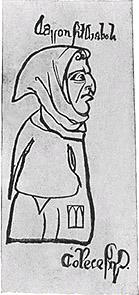
In the 1277 caricature Aaron, Son of the Devil, Aaron wears a badge with the Tablets of the Law
1265
The Siete Partidas, a legal code enacted in Castile by Alfonso X but not implemented until many years later, includes a requirement for Jews to wear distinguishing marks.[16]
1267
In a special session, the Vienna city council forces Jews to wear pileum cornutum (a cone-shaped head dress, common in medieval illustrations of Jews); a badge does not seem to have been worn in Austria.[3]
1269
France. (Saint) Louis IX of France orders all Jews found in public without a badge (French: rouelle or roue, Latin: rota) to be fined ten livres of silver.[17] The enforcement of wearing the badge is repeated by local councils, with varying degrees of fines, at Arles 1234 and 1260, Béziers 1246, Albi 1254, Nîmes 1284 and 1365, Avignon 1326 and 1337, Rodez 1336, and Vanves 1368.[3]
1274
The Statute of Jewry in England, enacted by King Edward I, enforces the regulations. "Each Jew, after he is seven years old, shall wear a distinguishing mark on his outer garment, that is to say, in the form of two Tables joined, of yellow felt of the length of six inches [150 mm] and of the breadth of three inches [75 mm]."[21]
1294
Erfurt. The earliest mention of the badge in Germany.[3]
1315–1326
Emir Ismail Abu-I-Walid forces the Jews of Granada to wear the yellow badge.[3]
1321
Henry II of Castile forces the Jews to wear the yellow badge.[3]
16th-century watercolour of a Jew from Worms, Germany. The rota or Jewish ring on the cloak, moneybag, and garlic bulb are symbols of antisemitic ethnic stereotypes
1415
A bull of the Antipope Benedict XIII orders the Jews to wear a yellow and red badge; the men on their breast, the women on their forehead.[3]
1434
Emperor Sigismund reintroduces the badge at Augsburg.[3]
1528
The Council of Ten of Venice allows the newly arrived famous physician and professor Jacob Mantino ben Samuel to wear the regular black doctors' cap instead of Jewish yellow hat for several months (subsequently made permanent), upon the recommendation of the French and English ambassadors, the papal legate, and other dignitaries numbered among his patients.[43]
1555
Pope Paul IV decrees, in his Cum nimis absurdum, that the Jews should wear yellow hats.
1566
King Sigismund II Augustus passes a law that required Lithuanian Jews to wear yellow hats and head coverings. The law was abolished twenty years later.[3]
1710
Frederick William I abolished the mandatory Jewish yellow patch in Prussia in return for a payment of 8,000 thaler (about $75,000 worth of silver at 2007 prices) each.[44]

Axis powers

[edit]

1939

[edit]
Local German occupation commanders ordered Jewish Poles to wear an identifying mark under the threat of death. There were no consistent requirements as to its colour and shape: it varies from a white armband, a yellow hat to a yellow Star of David badge. Hans Frank ordered all Jewish Poles over the age of 11 years in German-occupied Poland to wear white armbands with a blue Star of David.

1940

[edit]
A popular legend portrays king Christian X of Denmark wearing the yellow badge on his daily morning horseback ride through the streets of Copenhagen, followed by non-Jewish Danes responding to their king's example, thus preventing the Germans from identifying Jewish citizens. Queen Margrethe II of Denmark has explained that the story was not true.[45][46] No order requiring Jews to wear identifying marks was ever introduced in Denmark.[47]

1941

[edit]
Jews in the Independent State of Croatia, a puppet state of Nazi Germany, were ordered to wear "Jewish insignia".[48] Jewish Poles in German-occupied Soviet-annexed Poland, Jewish Lithuanians, Latvians and Estonians as well as Soviet Jews in German-occupied areas were obliged to wear white armbands or yellow badges. All Romanian Jews were ordered to wear the yellow badge.[49] The yellow badge was the only standardised identifying mark in the German-occupied East; other signs were forbidden. Jewish Germans and Jews with citizenship of annexed states (Austrians, Czechs, Danzigers) from the age of six years were ordered to wear the yellow badge from 19 September when in public.[26] In Luxembourg, the German occupation authorities introduce the Nuremberg Laws, followed by several other anti-Jewish ordinances including an order for all Jews to wear a yellow star with the word Jude.[50] The Slovak Republic ordered its Jews to wear yellow badges.

1941/1942

[edit]

Romania started to force Jews in newly annexed territories, denied Romanian citizenship, to wear the yellow badge.

"Whoever wears this sign is an enemy of our people" – Parole der Woche, 1 July 1942

1942

[edit]
The Gestapo ordered Jewish Germans and Jews with citizenship of annexed states to mark their apartments or houses at the front door with a white badge.[51] Jewish Dutch people were ordered to wear the yellow badge. Jewish Belgians were ordered to wear the yellow badge. Jews in occupied France, covering the northern and western half of the country, were ordered to wear a yellow star by the German authorities. Bulgaria ordered its Jewish citizens to wear small yellow buttons. German forces invaded and occupied the zone libre, i.e. the south-eastern half of France, but did not enforce the yellow star directive there.

1944

[edit]
After the occupation of Hungary, the Nazi occupiers ordered Jewish Hungarians and Jews with defunct other citizenships (Czechoslovak, Romanian, Yugoslav) in Hungarian-annexed areas to wear the yellow badge.[52]

See also

[edit]

References

[edit]
[edit]
Revisions and contributorsEdit on WikipediaRead on Wikipedia
from Grokipedia
The yellow badge, also known as the Jewish badge, consisted of a distinctive patch, circle, band, or sewn onto outer garments to compel public identification of , enforcing segregation, , and vulnerability to across various regimes from the medieval era to the . Originating under 8th-century caliphs—such as Harun al-Rashid's 807 CE decree for badges or fringes on in , and al-Mutawakkil's donkey-shaped patches in 847–861 CE—the practice marked non-' inferior status while granting limited protections. In Christian Europe, the Fourth of under mandated distinguishing markers for and to avert illicit relations and affirm separation from Christians (Canon 68), leading to implementations like 's 1217 royal order for badges on male ' garments and France's "rota" ( or red felt circles) from 1217. Variations included taffeta shaped as the Tablets of the Law in 1275 under I, or the Judenhut () in German regions, with enforcement sporadic but aimed at social degradation and control, persisting until diminished the custom by the 18th century. Revived systematically by Nazi authorities—first in occupied Poland in September 1939 via white armbands, then as Stars of David labeled "Jude" across the from September 1941 under Reinhard Heydrich's decree—the badge stigmatized for isolation, harassment, and streamlined to extermination sites, with adaptations like rectangles in or plastic badges in .

Origins and Religious Foundations

Early Conceptual Precursors

The concept of visually distinguishing religious minorities, particularly Jews as dhimmis under Islamic rule, emerged from early caliphal policies enforcing social separation and subordination. The foundational text, the —attributed to Caliph ibn al-Khattab (r. 634–644 CE) but likely codified in the 7th–9th centuries—stipulated that non-Muslims, including and , must wear specific garments or accessories to mark their status, such as a yellow belt known as the zunnar or distinctive turbans, to prevent intermingling and uphold the ummah's supremacy. This requirement stemmed from sharia-derived dhimma obligations, where protected status in exchange for tax necessitated clear identification to enforce restrictions on public roles, dress, and interactions. These precursors reflected a causal logic of maintaining religious purity and in conquered territories with diverse populations, predating specific badge shapes but establishing the principle of compelled visibility for outgroups. Implementation began under Abbasid caliphs; for instance, in 807 CE, Caliph decreed that in wear belts or fringes on their clothing to differentiate them from . By 847–861 CE, Caliph escalated this with mandates for to affix a , donkey-shaped patch to outer garments, symbolizing degradation, while wore pig-shaped ones—measures aimed at humiliation and compliance amid rising sectarian tensions. No verifiable evidence exists for analogous imposed visual markers on Jews in pre-Islamic empires like Sassanid Persia or antiquity, where distinctions relied more on legal or rather than badges. The Islamic framework thus provided the primary conceptual template, influencing later regional variations by embedding identification within religious governance to deter assimilation and facilitate enforcement of discriminatory laws.

Islamic Mandates

In Islamic jurisprudence, non-Muslims classified as dhimmis—primarily Jews and Christians—were obligated under the dhimma covenant to adopt distinguishing attire that set them apart from Muslims, symbolizing their protected yet subordinate status in exchange for payment of the jizya poll tax and adherence to restrictive codes of conduct. This requirement stemmed from interpretations of Quranic verses enjoining separation of believers from unbelievers (e.g., Quran 5:51) and early conquest-era pacts like the attributed Pact of Umar, which mandated visible differentiation to prevent social assimilation and uphold Islamic supremacy, though the pact's origins as a later compilation render its direct attribution debated among historians. The zunnar, a wide girdle or sash worn around the waist, served as a primary marker for dhimmis, with colors often specified: yellow for Jews and blue or black for Christians, reflecting both practical identification and symbolic degradation. The practice of color-coded badges emerged explicitly in the Abbasid Caliphate. Caliph Umar II (r. 717–720 CE) initially revived Sassanid-influenced ordinances requiring dhimmis to wear the zunnar and avoid Muslim-style garments, aiming to enforce social hierarchy amid growing conversions and intermingling in conquered territories. These were systematized and harshly imposed by Caliph (r. 847–861 CE), who decreed in 850 CE that Jews must wear yellow badges on their outer clothing—often in the form of patches or sashes—along with honey-colored garments, while Christians donned blue equivalents; violators faced flogging, property confiscation, or . Al-Mutawakkil's edict, motivated by orthodox backlash against perceived laxity under prior caliphs, extended to prohibitions on dhimmis riding saddled horses or building new synagogues, embedding the badge within broader discriminatory rulings. Subsequent caliphs and jurists, drawing from Hanbali and Shafi'i schools, reaffirmed these mandates in legal compendia, though application varied by ruler and region; for instance, a 1121 CE document specified two yellow badges for —one on and one on the neck—to ensure visibility. Enforcement waned under tolerant regimes like the Fatimids (10th–12th centuries) but resurged during periods of religious revivalism, such as under the Almohads (), where non-compliance led to massacres or exile rather than mere fines. These provisions persisted in Ottoman and Persian codes into the , underscoring the badge's role in perpetuating dhimmi visibility as a perpetual reminder of theological inferiority, distinct from sporadic anti-Jewish pogroms driven by economic or political factors.

Christian Canonical Directives

The Fourth Lateran Council, convened in 1215 under , issued Canon 68, which mandated that and Saracens () in every Christian province distinguish themselves from Christians through a difference in attire to prevent deception and illicit intermingling. The canon addressed concerns that and Saracens sometimes altered their clothing and hairstyles to pass as Christians, facilitating prohibited carnal relations with Christian women or other forms of undue association. It specified that this distinction should involve publicly noticeable clothing modifications, such as a prominent identifying mark on the breast or head coverings styled in a manner unlike Christian norms, though it left the exact form to local customs rather than prescribing a uniform badge. This directive built on sporadic provincial practices but established the first ecumenical mandate across , framing the requirement as a safeguard against ritual and social contamination rather than mere segregation. Subsequent papal interventions reinforced and clarified the Lateran decree within the framework of . In a 1221 letter, reiterated the need for general distinctions in dress to avoid confusion between Christians and non-Christians. By 1229, under , a further specified the use of badges (signa) as the identifying mechanism, directing enforcement to ensure could not evade recognition through disguise. These pronouncements integrated into broader collections, such as Gratian's Decretum adaptations, which emphasized perpetual Jewish subordination as a theological marker of divine disfavor, linking visible distinction to biblical precedents like Cain's mark. Later councils, including Vienne in 1311–1312, reaffirmed the obligation amid ongoing complaints of non-compliance, tying it to prohibitions on holding public office or employing Christian servants to maintain hierarchical separation. The directives' rationale rested on causal concerns over assimilation's risks, including spiritual pollution and violations of usury bans, with enforcement left to secular rulers who often adapted the vague language into specific badges like circles or wheels in regions such as and by the mid-13th century. While aimed at clarity in social boundaries, the mandates reflected an institutional bias toward ritual purity over individual rights, as evidenced by exemptions granted only for conversions or papal dispensations, underscoring the directives' role in perpetuating ' visible otherness under Christian .

Historical Implementations by Region and Era

In the Muslim World

In the Islamic world, the imposition of distinguishing marks on originated as part of the system, which required non-Muslims to wear specific garments or badges to visibly separate them from Muslims and enforce social hierarchy. The Abbasid Caliph formalized these regulations in 850 CE, decreeing that must wear a zunnar—a honey-colored belt or sash—around their waists, while Christians wore a or equivalent; were also required to affix patches to their outer , sometimes shaped like a to symbolize degradation. This edict built on earlier precedents from the , a 7th- or 8th-century document outlining restrictions, including distinctive attire to prevent Muslims from unwittingly associating with infidels or violating purity laws. Enforcement under was rigorous in and extended across Abbasid territories, with penalties for non-compliance including fines, imprisonment, or execution; historical records indicate sporadic violence against dhimmis who evaded the badges, as they facilitated identification during inspections by muhtasibs (market overseers). Subsequent caliphs occasionally reinforced or relaxed these rules, but the yellow badge persisted as a marker of Jewish inferiority into the , influencing later practices in regions like Persia and under Fatimid and Almohad rule, where faced similar sartorial mandates alongside taxation. While not universally applied with the same intensity as in medieval Europe, these badges underscored the institutionalized second-class status of , limiting and exposing them to targeted ; Ottoman sultans from the onward moderated such visible humiliations in favor of subtler taxes and ghettoization, though echoes of dress codes lingered in some provinces until the 19th-century reforms. Compliance varied by locale and ruler tolerance, with wealthier sometimes bribing officials for exemptions, but the practice reinforced a causal link between visibility and vulnerability, as unmarked risked accusations of or .

In Medieval and Early Modern Europe

The requirement for Jews to wear distinguishing badges in Europe stemmed from the Fourth Lateran Council convened by Pope Innocent III in 1215, which mandated that Jews and Saracens of both sexes in every Christian province wear a difference in dress to distinguish them from Christians and prevent inadvertent social intercourse through error. This canon did not specify the form but aimed to enforce visible separation, building on earlier sporadic local practices. Implementation varied by region: in England, King Henry III decreed in 1217–1218 that Jewish males over the age of puberty sew a badge resembling the Tablets of the Law onto their outer garments, with enforcement tied to royal oversight of Jewish communities. In France, similar edicts followed under Louis IX around 1254, requiring a yellow circle or wheel on clothing, though compliance was inconsistent and often negotiated through payments to authorities. In the , the badge frequently took the form of a yellow , known as the Judenhut, mandated from the 13th century in cities like Worms and , where Jews were depicted wearing yellow ring-shaped badges on their garments by the late medieval period to ensure recognition in public spaces. Enforcement intensified during periods of economic pressure or anti-Jewish agitation, such as the pogroms of 1348–1351, when badges facilitated identification for violence, yet exemptions were sometimes granted for bribes or privileges. In , including the , men wore yellow hats and women yellow kerchiefs, as ordered soon after 1215, with the yellow circle becoming standardized in places like by the 15th century. During the , badge requirements persisted in fragmented forms amid ongoing expulsions and ghettoization, such as in German principalities and Italian states into the 17th and 18th centuries, where non-compliance could result in fines or expulsion. However, with the Enlightenment and revolutionary changes, mandates waned: the abolished such distinctions in 1791 as part of , influencing , though some eastern and central European territories retained them until the 19th-century waves. The largely faded by 1500 in favor of badges, but overall, the practice symbolized institutionalized segregation rather than uniform enforcement across .

Under the Axis Powers in the 20th Century

The Nazi regime in mandated the wearing of a yellow by as a compulsory identifier to facilitate segregation, , and persecution. On September 1, 1941, SS-Obergruppenführer issued a decree requiring all aged six and older residing in the —including annexed areas such as , Alsace-Lorraine, and the Protectorate of Bohemia-Moravia—to affix the badge to their outer garments at all times when in public. The badge consisted of a six-pointed yellow star outlined in black, approximately 10 centimeters in diameter, with the word "Jude" inscribed in black Gothic script in the center; it had to be sewn onto , not pinned, to prevent removal. Implementation commenced on September 19, 1941, in and other major cities, with police enforcing visibility by prohibiting overcoats that concealed it during winter. Exemptions were narrowly granted, such as to in privileged mixed marriages or those with special work permits, but these were temporary and often revoked; for instance, veterans initially received waivers that were later withdrawn. The policy aimed to visually distinguish from non-Jews, enabling spontaneous violence, denial of services, and systematic roundups for to ghettos and camps; non-compliance carried penalties including fines, , or execution. By marking approximately 80% of Germany's remaining Jewish population—around 163,000 individuals at the time—the badge accelerated the transition from exclusion to extermination, as it simplified identification amid the regime's escalating . Under Axis occupation across Europe, the badge requirement proliferated with adaptations to local conditions. In occupied Poland's , had worn white armbands inscribed with "Jude" or a blue since November 1939, evolving to the yellow star in some districts by 1941 to align with standards. Western occupied territories saw staggered enforcement: the mandated the yellow star from May 3, 1942; and occupied from June 1942, with implementation on June 7; and from November 1942. In Axis satellite states, such as the Independent State of under the Ustaša regime, German authorities ordered to wear a yellow badge or armband featuring the from April 30, 1941, onward, affecting an estimated 40,000 . In , prior to the 1943 German occupation of the north following Mussolini's ouster, the Fascist government under the 1938 racial laws had imposed economic and social restrictions on but stopped short of mandatory badges, reflecting Mussolini's initial reluctance to fully adopt Nazi-style antisemitic markers despite alliance pressures. However, in the German puppet (Salò Republic), badges were enforced from late 1943 in collaborationist zones, mirroring policies to aid deportations that claimed over 7,500 by war's end. , as an Axis power, did not implement comparable Jewish identification measures in its territories, focusing instead on interning select Jewish refugees without systematic badging. Across these implementations, the badge's uniformity in design—predominantly with "Jude" or local equivalents—served as a precursor to mass killings, with over 5 million European ultimately murdered under Axis control.

Design, Enforcement, and Practical Aspects

Variations in Form and Color

In the Islamic world, the earliest mandates under Caliph Umar II around 717 CE required Jews to wear a yellow zunnar, a distinctive girdle or sash, often in yellow fabric to differentiate them from Muslims. Later, under Caliph al-Mutawakkil in 847 CE, enforcement intensified with Jews required to wear yellow badges or patches on their clothing, sometimes shaped symbolically like a donkey, while maintaining the yellow color as a marker of distinction. Medieval European implementations showed greater diversity in form following the Fourth Lateran Council's directive for distinguishing signs. In from 1217, the rouelle consisted of yellow or circular patches of felt, approximately 4 inches in diameter, affixed to both front and back of outer garments. English edicts in 1218 specified a yellow badge resembling the Tablets of the Law, about 4 by 3 inches, made of yellow or , worn over the heart by over age seven. In Italian regions during the , a simple yellow round O badge was common in northern and central areas, symbolizing exclusion. Some locales combined colors, such as yellow with borders, or required yellow pointed hats (Judenhut) instead of badges. Under the Nazi regime from September 1941, the badge standardized as a yellow with black-outlined points and the word "Jude" in mock-Hebrew script, measuring about 4 inches across, sewn onto ; however, in occupied from 1939, white armbands with a blue preceded this, and camp prisoners wore two overlapping yellow triangles forming the star. Local variations persisted, such as fabric armbands in some areas or different orientations of the star, reflecting enforcement adaptations across occupied territories.

Methods of Compulsion and Compliance

In medieval Europe, compulsion to wear the Jewish badge stemmed from ecclesiastical mandates like the Fourth Lateran Council's Canon 68 in 1215, which required and Muslims to adopt distinguishing attire to prevent social mingling with Christians; secular rulers translated this into enforceable laws, such as King Henry III of England's 1217 order for male Jews to affix a badge to outer garments. Enforcement relied on royal officials and local authorities conducting visual inspections in public spaces and markets, with compliance verified through periodic decrees reasserting the requirement, as seen in King Edward I's 1275 statute specifying a yellow badge measuring six by three fingers over the left chest. Penalties for non-compliance typically included fines, seizure of goods, or short-term imprisonment, though enforcement varied by region and was often inconsistent due to ' economic utility in moneylending and trade. In the Islamic world, caliphs imposed distinguishing marks as part of dhimmi regulations, with Caliph enforcing the zunnar—a yellow or black belt for non-Muslims—between 847 and 861 CE, alongside donkey-shaped patches or special hats in places like by 887–888 CE. Compulsion was achieved through repeated caliphal ordinances and oversight by market inspectors or muhtasibs (public order officials), who checked compliance during daily activities; adherence was linked to dhimmi protections and tax obligations, fostering partial voluntary compliance to avoid loss of legal status. Violations incurred fines, , or temporary revocation of residence rights, but enforcement fluctuated with rulers' priorities and local customs. Under the Axis powers, particularly Nazi Germany, the yellow Star of David was mandated by Reinhard Heydrich's decree on September 1, 1941, requiring Jews aged six and older to sew it visibly onto outer clothing in public, with earlier impositions in occupied Poland via Hans Frank's November 23, 1939, order for white armbands on those over ten. Enforcement involved Gestapo and local police patrols conducting spot checks, random stops, and denunciations by civilians encouraged through propaganda; badges had to be worn at all times outdoors, replaced if damaged, and displayed on dwellings in some areas. Non-compliance carried severe penalties, including immediate arrest, fines, forced labor, imprisonment in camps, or execution, as in Poland where defiance escalated risks of summary shooting. In occupied territories like France (June 7, 1942) and the Netherlands (spring 1942), similar mechanisms applied, with variations in design but uniform harsh reprisals to ensure isolation and facilitate deportations.

Evasion Tactics and Penalties

In medieval , Jews evaded mandatory badges by covering them with outer garments, removing them in transit through unfamiliar territories, or negotiating communal exemptions via payments to authorities, as seen in Renaissance Italy where communities in the Duchy of paid annual taxes for waivers in the 15th and 16th centuries. Such tactics often served as pretexts for , with non-compliance leading to arrests, fines, or of pledges for unpaid badge fees, as documented in contemporary records from . Under Nazi rule, evasion included outright refusal to wear the yellow —mandatory from September 1, 1941, for aged six and older in the and annexed areas—or hiding it during movement, though familial or communal pressure often enforced compliance to avoid collective reprisals. In , widespread non-compliance occurred after the badge's introduction on August 26, 1942, with only about one-fifth of Sofia's adhering, aided by local opposition that hindered enforcement. Penalties were severe: in occupied from November 23, 1939, and elsewhere, caught without the badge faced fines, immediate , , to camps, or execution, as in cases where non-wearers were shot on sight or sent to transit camps leading to death. For instance, in from May 1942, refusal resulted in transit camp internment and high mortality rates. In the Bialystok , members enforcing compliance noted risks of death for refusers.

Societal Rationales and Consequences

Stated Purposes and Justifications

The Fourth Lateran Council of 1215, under , decreed that and Saracens must wear identifying badges or distinctive clothing to render them "readily distinguishable" from , with the explicit justification of averting inadvertent interactions, particularly sexual relations between and non-Christians that could lead to confusion over lineage or religious boundaries. This canon, formalized in Canon 68, framed the measure as a protective expedient for Christian society, building on prior local customs while institutionalizing visibility to enforce social separation without relying solely on ghettoization or expulsion. In the Islamic world, the practice originated earlier under Caliph Umar II (r. 717–720 CE), who mandated yellow badges for (and blue or other colors for ) as part of dhimmi policies, justified as a means to visibly differentiate non-Muslims from the Muslim , thereby upholding Islamic supremacy and preventing ritual or social assimilation that might undermine the faith of believers. Subsequent rulers, such as those in the , reiterated this for administrative ease in applying taxes and sumptuary laws, positing the badge as a pragmatic tool for maintaining hierarchical order rather than mere humiliation. Nazi authorities, via a September 19, 1941, decree from , required Jews over age six to wear a yellow labeled "Jude," officially rationalized as essential for public identification to segregate from Aryans, monitor compliance with , and prevent "racial defilement" through incidental contact. German officials, including , portrayed the star as a non-violent administrative necessity for orderly enforcement of anti-Jewish regulations, though internal documents reveal its role in stigmatization to psychologically isolate prior to mass and . This echoed medieval precedents but was scaled for total control, with exemptions for mixed marriages initially granted to feign legality before broader application across occupied .

Effects on Targeted Populations

The yellow badge marked Jewish individuals as perpetual outsiders, intensifying and exposing them to routine harassment and violence across historical contexts. In medieval , following the Fourth Lateran Council's 1215 decree under , the badges provoked mockery by children and assaults by adults, with the pope himself recognizing that such visibility placed Jews in "danger of loss of life." This stigmatization curtailed public interactions, fostering communal withdrawal and vulnerability to pogroms. Economically, the badges enabled targeted exclusions, confining Jews to demeaning trades like moneylending while barring them from guilds and prime markets. In Renaissance during the 1560s–1590s, communities paid exorbitant annual taxes for badge exemptions, leading to widespread impoverishment, , and forced emigration from regions like . Under Nazi occupation, from November 23, 1939, in parts of , and September 1, 1941, in , the yellow restricted Jews to specific shopping hours and segregated transport, accelerating job losses, property confiscations, and ghetto confinement. Psychologically, the badges instilled chronic humiliation and fear, eroding personal dignity and communal morale. Nazi-era accounts describe Jews, including children over age six, enduring public shaming that preceded deportations to killing centers, such as those in in 1943. In the Muslim world, 7th-century stipulations for yellow distinguishing attire reinforced inferiority, perpetuating segregation and mental subordination over centuries. Enforcement through penalties like fines, arrests, or execution—evident in Nazi threats of death for non-compliance—compelled adherence but amplified terror, transforming the badge into a harbinger of broader and demographic decline via conversions, migrations, and mass killings.

Long-Term Social and Economic Ramifications

The mandatory wearing of identifying badges institutionalized social segregation for Jewish communities across medieval and the Muslim world, limiting interpersonal interactions and reinforcing perceptions of inherent inferiority. In Christian , following the Fourth Lateran Council's decree in 1215, badges such as yellow wheels or tablets facilitated public mockery and targeted violence, as seen in assaults on badge-wearing Jews in Italian cities like and in 1572. This visibility heightened vulnerability during economic downturns or crises, contributing to pogroms and expulsions, such as those in after 1275 badge enforcements. In Muslim societies under caliphs like in 807 CE, yellow belts marked status, curtailing social integration and perpetuating a that endured for centuries, fostering insularity within Jewish communities as a survival mechanism. Economically, badges exacerbated exclusion from dominant trades, as their conspicuousness deterred participation in guild-controlled crafts, steering Jews toward moneylending, peddling, and international commerce—professions Christians often shunned due to usury prohibitions. Medieval guild monopolies in Europe barred Jewish entry, confining them to these niches and enabling rulers to extract taxes or exemptions via fines for non-compliance, which frequently bankrupted communities and prompted migrations, as in the Duchy of Piedmont where multiple annual levies were imposed. This specialization built resilient trade networks across the diaspora but entrenched stereotypes of Jewish economic exploitation, fueling resentment during debt crises and reinforcing cycles of prosperity followed by persecution. Over centuries, these practices contributed to lasting patterns of Jewish economic adaptability, with portable skills in and aiding post-emancipation integration in the , yet the associated stigma perpetuated antisemitic tropes that influenced 20th-century policies, including Nazi Germany's 1939 badge mandates as precursors to ghettoization and . Socially, the badges' legacy included diminished trust in host societies, strengthening communal self-reliance and cultural preservation amid repeated displacements, though they hindered broader assimilation until legal abolitions in during the and subsequent emancipations.

Modern Appropriations and Debates

Post-World War II Instances

In May 2001, the Taliban regime in Afghanistan decreed that the country's Hindu and Sikh minorities—numbering around 50,000 individuals—must wear distinctive yellow cloth patches or badges on their clothing to identify themselves as non-Muslims. The measure, announced by Taliban leader Mullah Mohammed Omar, was justified by officials as a protective step to exempt these groups from penalties imposed by the religious police for non-compliance with strict Islamic dress codes, such as failure to grow beards or observe prayer times. Taliban spokesmen emphasized that the badges would prevent mistaken enforcement against minorities unfamiliar with Sharia requirements, drawing explicit parallels in intent to historical practices of marking outsiders for differential treatment. The policy evoked widespread international condemnation, with comparisons to the Nazi-era yellow stars forced on Jews; the United Nations Secretary-General Kofi Annan urged its rejection, and the U.S. House of Representatives passed a resolution (H.Con.Res.145) denouncing it as discriminatory. Enforcement was limited due to the impending U.S.-led invasion later that year, which ousted the Taliban, but the decree accelerated the exodus of these communities, reducing their numbers to a few hundred by 2007. In 2006, reports emerged alleging that Iran's parliament had approved a sumptuary law requiring non-Muslims—including approximately 25,000 Jews—to wear colored identifying badges: yellow strips for Jews, white for Zoroastrians, and red for Christians. The claim, initially published by the National Post citing exiled Iranian sources and analyst Amir Taheri, suggested the measure aimed to enforce Islamic dress distinctions and facilitate segregation in public spaces. Iranian lawmakers and officials swiftly denied the legislation's existence, labeling it disinformation, and the National Post retracted the story amid accusations of fabrication by neoconservative-linked reporting. No evidence of implementation surfaced, and the episode highlighted tensions over minority rights in Iran but was not substantiated as policy.

Contemporary Protest Symbolism

In the early 2020s, particularly during protests against COVID-19 vaccine mandates and lockdowns, some demonstrators in Europe and North America adopted modified yellow stars resembling the Nazi-era Judenstern as symbols of perceived persecution. In Germany, starting around 2021, anti-lockdown protesters wore yellow stars labeled "Ungeimpft" (unvaccinated), appearing at rallies in cities like Berlin and Munich to equate vaccination requirements with historical Jewish segregation. This usage prompted condemnation from Jewish organizations, including the Anti-Defamation League (ADL), which described it as Holocaust trivialization that falsely equates public health measures with genocidal policies targeting Jews on the basis of ethnicity and religion. By January 2022, German authorities responded by authorizing police in to detain individuals wearing such badges, classifying the act as "" for minimizing Nazi crimes. Similar incidents occurred in the United States; for instance, on August 17, 2021, a woman wore a yellow star to a City Council meeting to protest mask mandates, drawing accusations of from local experts who argued it desecrated memory. In September 2021, protesters at a [Staten Island](/page/Staten Island) rally against vaccine mandates displayed yellow stars, which organizers and critics distinguished from Nazi-era enforcement due to the absence of lethal state violence but still deemed inappropriate for invoking imagery over policy disputes. These appropriations faced broad backlash from and institutions; a 100-year-old survivor publicly rebuked anti-vaccine activists in 2022 for equating stars with mandate non-compliance, emphasizing the original's role in facilitating rather than temporary restrictions. In , anti-vaccine leader François Amalega Bitondo initially endorsed yellow stars in 2021 but abandoned them after with Jewish community heads, while upholding the underlying comparison. Critics, including rabbis and historians, argued such symbolism dilutes the unique scale of the Shoah—six million Jewish deaths driven by racial —by applying it to universal health policies affecting all demographics, potentially fueling real amid rising incidents. Earlier, in December 2015, a professor and about 100 students wore yellow stars to perceived Islamophobia, framing as modern equivalents to Holocaust victims, an action decried by watchdogs as inverting historical victimhood and minimizing Jewish suffering. These cases highlight ongoing debates over the symbol's invocation, where proponents claim rhetorical power against state overreach, but opponents substantiate objections with the irreconcilable disparity in intent, scale, and outcome between Nazi enforcement and contemporary mandates.

Controversies Over Comparisons and Usage

In the context of opposition to COVID-19 vaccine mandates and related measures, protesters in multiple countries adopted replicas of the yellow —historically used to mark for —as symbols of alleged government overreach. For instance, in September 2021, attendees at a rally in , New York, against requirements wore yellow stars on their clothing, prompting local Jewish leaders to denounce the action as an "absolute disgrace" for evoking imagery without equivalence to Nazi policies of extermination. Similarly, in August 2020, a protester in appeared at an anti-lockdown demonstration wearing a yellow star labeled "unvaccinated," leading to widespread condemnation from historians and Jewish organizations for trivializing the symbol's role in facilitating mass deportations and . These acts were part of a broader pattern documented by the (ADL), which tracked over a dozen U.S. instances in 2020-2022 where passports or exemptions were equated to yellow badges, often framing unvaccinated individuals as modern equivalents of targeted minorities. Critics, including rabbis and ' groups, argued that such comparisons minimized the yellow badge's function as a precursor to industrialized , where over 6 million were killed after identification enabled roundups, as opposed to temporary health-based restrictions aimed at disease control. In May , U.S. Representative drew rebuke from Republican leaders like after likening a grocery chain's maskless employee tags to yellow stars, with McCarthy stating the remarks were "wrong and offensive" for equating routine compliance markers to tools of ethnic annihilation. advocacy bodies such as the ADL classified these analogies as forms of distortion, potentially fueling by diluting the unique scale of Nazi crimes, where badges were mandated under the 1935 and expanded in 1941 to occupied Europe, affecting millions before death camps. In , a by historians noted similar uses by anti-vaccine activists, including displays at protests, as offensive trivializations that ignored the badges' enforcement through violence and their link to ghettos and gas chambers. Proponents of the comparisons, often from libertarian or anti-mandate circles, contended they served as hyperbolic warnings against "slippery slopes" toward , citing instances like a British school's 2021 directive for mask-exempt students to wear star-like identifiers, which was rescinded amid parental outcry over evoking Nazi-era segregation. A Nashville hat shop in May 2021 sold "not vaccinated" star badges, framing them as protest against perceived akin to historical precedents, though the business faced calls from civil rights groups. Political figures, such as Republican Party officials in July 2021, amplified the via posts equating mandates to Nazi persecution, only to retract after internal and external pressure deemed it "beyond abhorrent." These debates highlighted tensions between invoking historical symbols for contemporary and accusations of insensitivity, with no peer-reviewed studies endorsing the analogies' factual parity but some commentators noting their rhetorical utility in mobilizing resistance to policies affecting 20-30% unvaccinated populations in various jurisdictions. Beyond , isolated comparisons have arisen in other identification debates, such as equating digital IDs or bans to badges of , but these lack the volume of pandemic-era instances and rarely involve physical replicas. In all cases, Jewish communal leaders consistently rejected equivalences, emphasizing empirical disparities: yellow badges preceded the murder of two-thirds of Europe's , whereas modern policies, even if coercive, operated without genocidal machinery or state-sanctioned pogroms. The ADL and similar groups advocate against such usages to preserve the symbol's gravity, arguing they erode public understanding of antisemitism's mechanisms, as evidenced by rising incidents post-2020 where inversion correlated with spikes in anti-Jewish harassment.

References

Add your contribution
Related Hubs
User Avatar
No comments yet.