


Community hub
Recent from talks
Contribute something
Nothing was collected or created yet.
Joseph Larmor
View on Wikipedia
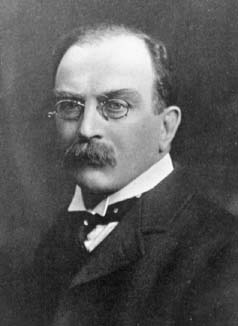
Sir Joseph Larmor (11 July 1857 – 19 May 1942) was an Irish[4] mathematician, theoretical physicist, and British politician who made breakthroughs in the understanding of electricity, dynamics, thermodynamics, and the electron theory of matter. His most influential work was Aether and Matter, a theoretical physics book published in 1900.
Key Information


Biography
[edit]He was born in Magheragall in County Antrim, the son of Hugh Larmor, a Belfast shopkeeper and his wife, Anna Wright.[5] The family moved to Belfast circa 1860, and he was educated at the Royal Belfast Academical Institution, and then studied mathematics and experimental science at Queen's College, Belfast (BA 1874, MA 1875),[6] where one of his teachers was John Purser. He subsequently studied at St John's College, Cambridge, where in 1880 he was Senior Wrangler (J. J. Thomson was second wrangler that year) and Smith's Prizeman, getting his MA in 1883.[7] After teaching physics for a few years at Queen's College, Galway, he accepted a lectureship in mathematics at Cambridge in 1885. In 1892 he was elected a fellow of the Royal Society of London, and he served as one of the Secretaries of the society.[8] . He was elected to honorary membership of the Manchester Literary and Philosophical Society on May 13th, 1902;[9]
He was made an honorary fellow of the Royal Society of Edinburgh in 1910.[10]
In 1903 he was appointed Lucasian Professor of Mathematics at Cambridge, a post he retained until his retirement in 1932. He never married.[11] He was knighted by King Edward VII in 1909.
Motivated by his strong opposition to Home Rule for Ireland, in February 1911 Larmor ran for and was elected as Member of Parliament for Cambridge University with the Conservative party. He remained in parliament until the 1922 general election, at which point the Irish question had been settled. Upon his retirement from Cambridge in 1932, Larmor moved back to County Down in Northern Ireland.
He received an honorary Doctor of Laws (LLD) from the University of Glasgow in June 1901.[12][13] He received an honorary Doctor in Science from Trinity College Dublin in 1903.[14] He was elected an International Honorary Member of the American Academy of Arts and Sciences in 1903, an International Member of the United States National Academy of Sciences in 1908, and an International Member of the American Philosophical Society in 1913.[15][16][17] He was awarded the Poncelet Prize for 1918 by the French Academy of Sciences.[18] Larmor was a Plenary Speaker in 1920 at the ICM at Strasbourg[19][20] and an Invited Speaker at the ICM in 1924 in Toronto and at the ICM in 1928 in Bologna.
He died in Holywood, County Down on 19 May 1942.[21]
Work
[edit]Larmor proposed that the aether could be represented as a homogeneous fluid medium which was perfectly incompressible and elastic. Larmor believed the aether was separate from matter. He united Lord Kelvin's model of spinning gyrostats (see Vortex theory of the atom) with this theory. Larmor held that matter consisted of particles moving in the aether. Larmor believed the source of electric charge was a "particle" (which as early as 1894 he was referring to as the electron). Larmor held that the flow of charged particles constitutes the current of conduction (but was not part of the atom). Larmor calculated the rate of energy radiation from an accelerating electron. Larmor explained the splitting of the spectral lines in a magnetic field by the oscillation of electrons.[22]

Larmor also created the first solar system model of the atom in 1897.[23] He also postulated the proton, calling it a "positive electron". He said the destruction of this type of atom making up matter "is an occurrence of infinitely small probability".
In 1919, Larmor proposed sunspots are self-regenerative dynamo action on the Sun's surface.
Quotes from one of Larmor's voluminous work include:
- "while atoms of matter are in whole or in part aggregations of electrons in stable orbital motion. In particular, this scheme provides a consistent foundation for the electrodynamic laws, and agrees with the actual relations between radiation and moving matter".
- "A formula for optical dispersion was obtained in § 11 of the second part of this memoir, on the simple hypothesis that the electric polarization of the molecules vibrated as a whole in unison with the electric field of the radiation".
- “…that of the transmission of radiation across a medium permeated by molecules, each consisting of a system of electrons in steady orbital motion, and each capable of free oscillations about the steady state of motion with definite free periods analogous to those of the planetary inequalities of the Solar System;”
- “'A' will be a positive electron in the medium, and 'B' will be the complementary negative one...We shall thus have created two permanent conjugate electrons A and B; each of them can be moved about through the medium, but they will both persist until they are destroyed by an extraneous process the reverse of that by which they are formed".[24]
Discovery of Lorentz transformation
[edit]
Parallel to the development of Lorentz ether theory, Larmor published an approximation to the Lorentz transformations in the Philosophical Transactions of the Royal Society in 1897,[25] namely for the spatial part and for the temporal part, where and the local time He obtained the full Lorentz transformation in 1900 by inserting into his expression of local time such that and, as before, and .[26] This was done around the same time as Hendrik Lorentz (1899, 1904) and five years before Albert Einstein (1905).




Larmor, however, did not possess the correct velocity transformations, which include the addition of velocities law, which were later discovered by Henri Poincaré. Larmor predicted the phenomenon of time dilation, at least for orbiting electrons, by writing (Larmor 1897): "individual electrons describe corresponding parts of their orbits in times shorter for the [rest] system in the ratio (1 – v2/c2)1/2". He also verified that the FitzGerald–Lorentz contraction (length contraction) should occur for bodies whose atoms were held together by electromagnetic forces. In his book Aether and Matter (1900), he again presented the Lorentz transformations, time dilation and length contraction (treating these as dynamic rather than kinematic effects). Larmor was opposed to the spacetime interpretation of the Lorentz transformation in special relativity because he continued to believe in an absolute aether. He was also critical of the curvature of space of general relativity, to the extent that he claimed that an absolute time was essential to astronomy (Larmor 1924, 1927).
Publications
[edit]- 1884, "Least action as the fundamental formulation in dynamics and physics", Proceedings of the London Mathematical Society.
- 1887, "On the direct applications of first principles in the theory of partial differential equations", Proceedings of the Royal Society.
- 1891, "On the theory of electrodynamics", Proceedings of the Royal Society.
- 1892, "On the theory of electrodynamics, as affected by the nature of the mechanical stresses in excited dielectrics", Proceedings of the Royal Society.
- 1893–97, "Dynamical Theory of the Electric and Luminiferous Medium", Proceedings of the Royal Society; Philosophical Transactions of the Royal Society. Series of 3 papers containing Larmor's physical theory of the universe.
- 1896, "The influence of a magnetic field on radiation frequency", Proceedings of the Royal Society.
- 1896, "On the absolute minimum of optical deviation by a prism", Proceedings of the Cambridge Philosophical Society.
- Larmor, J. (1897). "A Dynamical Theory of the Electric and Luminiferous Medium. Part III. Relations with Material Media". Philosophical Transactions of the Royal Society A: Mathematical, Physical and Engineering Sciences. 190: 205–493. Bibcode:1897RSPTA.190..205L. doi:10.1098/rsta.1897.0020.
- 1898, "Note on the complete scheme of electrodynamic equations of a moving material medium, and electrostriction", Proceedings of the Royal Society.
- 1898, "On the origin of magneto-optic rotation", Proceedings of the Cambridge Philosophical Society.
- Larmor, J. (1900), , Cambridge University Press; Containing the Lorentz transformations on p. 174.
- 1903, "On the electrodynamic and thermal relations of energy of magnetisation", Proceedings of the Royal Society.
- 1904, "On the mathematical expression of the principle of Huygens" (read 8 Jan. 1903), Proceedings of the London Mathematical Society, Ser. 2, vol. 1 (1904), pp. 1–13.
- 1907, "Aether" in Encyclopædia Britannica, 11th ed. London.
- 1908, "William Thomson, Baron Kelvin of Largs. 1824–1907" (Obituary). Proceedings of the Royal Society.
- 1921, "On the mathematical expression of the principle of Huygens – II" (read 13 Nov. 1919), Proceedings of the London Mathematical Society, Ser. 2, vol. 19 (1921), pp. 169–80.
- 1924, "On Editing Newton", Nature.
- 1927, "Newtonian time essential to astronomy", Nature.
- 1929, Mathematical and Physical Papers. Cambridge Univ. Press.[27]
- 1937, (as editor), Origins of Clerk Maxwell's Electric Ideas as Described in Familiar Letters to William Thomson. Cambridge University Press.[28]
Larmor edited the collected works of George Stokes, James Thomson and William Thomson.
-
 Title page to a 1900 copy of "Aether and Matter"
 -
 First page of the preface to "Aether and Matter"
 -
 First page of "Aether and Matter"


See also
[edit]
 Quotations related to Joseph Larmor at Wikiquote
- History of Lorentz transformations
- Dynamo theory
- Larmor precession
- Larmor (crater)

References
[edit]- ^ O'Connor, John J.; Robertson, Edmund F., "Joseph Larmor", MacTutor History of Mathematics Archive, University of St Andrews
- ^ a b c d "Joseph Larmor - The Mathematics Genealogy Project". genealogy.math.ndsu.nodak.edu. Retrieved 14 July 2025.
- ^ a b "Joseph Larmor - Physics Tree". academictree.org. Retrieved 14 July 2025.
- ^ "Sir Joseph Larmor | Irish physicist | Britannica".
- ^ Biographical Index of Former Fellows of the Royal Society of Edinburgh 1783–2002 (PDF). The Royal Society of Edinburgh. July 2006. ISBN 0-902-198-84-X. Archived from the original (PDF) on 4 March 2016. Retrieved 12 March 2017.
- ^ From Ballycarrickmaddy to the moon Lisburn.com, 6 May 2011
- ^ "Larmor, Joseph (LRMR876J)". A Cambridge Alumni Database. University of Cambridge.
- ^ "Court Circular". The Times. No. 36919. London. 7 November 1902. p. 8.
- ^ Memoirs And Proceedings Of The Manchester Literary And Philosophical Society Vol-46-47 (1947)
- ^ Biographical Index of Former Fellows of the Royal Society of Edinburgh 1783–2002 (PDF). The Royal Society of Edinburgh. July 2006. ISBN 0-902-198-84-X. Archived from the original (PDF) on 4 March 2016. Retrieved 12 March 2017.
- ^ "Joseph Larmor – Biography". Maths History. Retrieved 5 April 2024.
- ^ Eddington, A. S. (1942). "Joseph Larmor. 1857–1942". Obituary Notices of Fellows of the Royal Society. 4 (11): 197–207. doi:10.1098/rsbm.1942.0016.
- ^ "Glasgow University Jubilee". The Times. No. 36481. London. 14 June 1901. p. 10. Retrieved 5 January 2024 – via Newspapers.com.
- ^ Dublin University Calendar, A Special Supplemental Volume for the year 1906-7. Vol. III. Dublin: Hodges, Figgis, and Co. Ltd. 1907.
- ^ "Joseph Larmor". American Academy of Arts & Sciences. 9 February 2023. Retrieved 15 November 2023.
- ^ "Joseph Larmor". National Academy of Sciences. Retrieved 15 November 2023.
- ^ "APS Member History". search.amphilsoc.org. Retrieved 15 November 2023.
- ^ "Prize Awards of the Paris Academy of Sciences for 1918". Nature. 102 (2565): 334–335. 26 December 1918. Bibcode:1918Natur.102R.334.. doi:10.1038/102334b0.
- ^ "Questions in physical indetermination by Joseph Larmor" (PDF). Compte rendu du Congrès international des mathématiciens tenu à Strasbourg du 22 au 30 Septembre 1920. 1921. pp. 3–40. Archived from the original (PDF) on 27 December 2013.
- ^ H, H. B. (7 October 1920). "The International Congress of Mathematicians". Nature. 106 (2658): 196–197. Bibcode:1920Natur.106..196H. doi:10.1038/106196a0. In his plenary address, Larmor advocated the aether theory as opposed to Einstein's general theory of relativity.
- ^ Biographical Index of Former Fellows of the Royal Society of Edinburgh 1783–2002 (PDF). The Royal Society of Edinburgh. July 2006. ISBN 0-902-198-84-X. Archived from the original (PDF) on 4 March 2016. Retrieved 12 March 2017.
- ^ Histories of the Electron: The Birth of Microphysics edited by Jed Z. Buchwald, Andrew Warwick
- ^ The Zeeman Effect and the Discovery of the Electron, Theodore Arabatzis, 2001.
- ^ ”A Dynamical Theory of the Electric and Luminiferous Medium.— Part III". Joseph Larmor, Phil. Trans., A, vol. 190, 1897, pp. 205–300.
- ^ Larmor, Joseph (1897), , Philosophical Transactions of the Royal Society, 190: 205–300, Bibcode:1897RSPTA.190..205L, doi:10.1098/rsta.1897.0020
- ^ Larmor, Joseph (1900), , Cambridge University Press
- ^ Gronwall, T. H. (1930). "Review: Mathematical and Physical Papers, by Sir Joseph Larmor" (PDF). Bull. Amer. Math. Soc. 36 (7): 470–471. doi:10.1090/s0002-9904-1930-04975-7.
- ^ Page, Leigh (1938). "Review: Origins of Clerk Maxwell's Electric Ideas as Described in Familiar Letters to William Thomson, by Sir Joseph Larmor" (PDF). Bull. Amer. Math. Soc. 44 (5): 320. doi:10.1090/s0002-9904-1938-06738-9.
Further reading
[edit]- Bruce J. Hunt (1991), The Maxwellians, Cornell University Press.
- Macrossan, M. N. "A note on relativity before Einstein", British Journal for the Philosophy of Science, 37 (1986): 232–234.
- Warwick, Andrew, "On the Role of the FitzGerald–Lorentz Contraction Hypothesis in the Development of Joseph Larmor's Electronic Theory of Matter". Archive for History of Exact Sciences 43 (1991): 29–91.
- Darrigol, O. (1994), "The Electron Theories of Larmor and Lorentz: A Comparative Study", Historical Studies in the Physical and Biological Sciences, 24 (2): 265–336, doi:10.2307/27757725, JSTOR 27757725
- "A very short biography of Joseph Larmor"
- "Ether and field theories in the late 19th century" At VictorianWeb: History of science in the Victorian era
- "Papers of Sir Joseph Larmor". Janus, University of Cambridge.
- . . Dublin: Alexander Thom and Son Ltd. 1923. p. – via Wikisource.
External links
[edit] Media related to Joseph Larmor at Wikimedia Commons


Joseph Larmor
View on GrokipediaSir Joseph Larmor (11 July 1857 – 19 May 1942) was an Irish theoretical physicist and mathematician renowned for his foundational contributions to electromagnetism and the electron theory of matter.[1] Born in Magheragall, County Antrim, he excelled academically, earning a B.A. and M.A. from Queen's University Belfast before achieving Senior Wrangler status in the Cambridge Mathematical Tripos of 1880.[1] After serving as Professor of Natural Philosophy at Queen's College, Galway (1880–1885), he returned to Cambridge as a lecturer at St John's College and later held the Lucasian Professorship of Mathematics from 1903 to 1932.[1] Larmor's key achievements include deriving the formula for the power radiated by an accelerating electron—known as Larmor's formula—and formulating the concept of Larmor precession, which describes the precessional motion of electron orbits in a magnetic field.[1][2] He also advanced understanding of the luminiferous aether through his dynamical theory and the seminal book Aether and Matter (1900), bridging classical physics toward emerging relativistic ideas.[1] Knighted in 1909 and elected a Fellow of the Royal Society in 1892, Larmor extended his influence into politics as a Unionist Member of Parliament for Cambridge University from 1911 to 1922.[1]
Early Life and Education
Family Background and Childhood
Joseph Larmor was born on 11 July 1857 at Ballycarrickmaddy near Magheragall, County Antrim, Ireland, into a family of modest means.[1][3] He was the eldest child among five sons and two daughters of Hugh Larmor, who worked as a farmer at the time of Joseph's birth before transitioning to shopkeeping in Belfast, and Anna Wright, daughter of Joseph Wright—a connection reflected in the naming of her firstborn son after her father.[1][3] The Larmors relocated to Belfast when Joseph was of school age, around 1860, enabling access to urban educational opportunities in the industrializing city.[1]Academic Training in Ireland and England
Larmor received his secondary education at the Royal Belfast Academical Institution in Belfast, Ireland, where he was noted as a shy, delicate, and precocious student.[1][4] He pursued higher education at Queen's College, Belfast (part of Queen's University), earning a B.A. in 1877 and subsequently an M.A. with the highest honors.[1][5] In 1877, Larmor entered St John's College, Cambridge, England, to study for the Mathematical Tripos, the rigorous honors examination in mathematics.[1] Despite a year interrupted by ill health, he completed the Tripos in 1880, achieving the position of Senior Wrangler—the top first-class honors candidate—and also securing first place in the Smith's Prize competition for advanced mathematical proficiency.[1] That same year, he was elected a Fellow of St John's College, securing his position within the Cambridge academic community.[1]Professional Career
Initial Academic Positions
Upon graduating from St John's College, Cambridge in 1880 as Senior Wrangler and recipient of the first Smith's Prize, Larmor was immediately elected a Fellow of the college.[1][6] This fellowship recognized his exceptional mathematical prowess and provided a foundation for his early academic pursuits in theoretical physics and applied mathematics.[1] Concurrently in 1880, Larmor was appointed Professor of Natural Philosophy at Queen's College, Galway (now University of Galway), marking his return to Ireland shortly after completing his Cambridge degree.[1][7] In this role, he lectured on physics and mathematics to undergraduates, contributing to the institution's curriculum during a period of expansion in Irish higher education under the Queen's Colleges system established in 1845.[1] He retained his St John's fellowship while based in Galway, allowing him to maintain ties to Cambridge scholarly networks.[8] Larmor held the Galway professorship until 1885, a five-year tenure during which he began developing his interests in electrodynamics and ether theory through independent research alongside teaching duties.[1][7] In 1885, he resigned to return to Cambridge, accepting a lectureship in mathematics at St John's College, where he delivered advanced courses on mathematical physics and mentored students in preparation for the Tripos examinations.[1][9] This position solidified his integration into the Cambridge academic establishment, facilitating collaborations with figures like J. J. Thomson and enabling his progression toward more senior roles.[1]Lucasian Professorship and Institutional Roles
Larmor succeeded George Gabriel Stokes as Lucasian Professor of Mathematics at the University of Cambridge upon Stokes's death on 1 February 1903, a position he held until his retirement in 1932.[1] The Lucasian chair, established in 1663, had previously been occupied by figures such as Isaac Newton and Stokes, focusing on advancing mathematical and physical sciences through lectures and research oversight.[1] During his tenure, Larmor emphasized geometrical and physical interpretations in electromagnetic theory, influencing Cambridge's mathematical physics tradition amid emerging challenges from relativity and quantum ideas.[1] Beyond the professorship, Larmor maintained significant institutional roles in scientific societies. Elected a Fellow of the Royal Society in 1892, he served as its Secretary from 1901 to 1912, managing publications and administrative affairs during a period of rapid theoretical advancements.[1] The Society recognized his work with the Royal Medal in 1915 for contributions to dynamics and the Copley Medal in 1921 for electromagnetic theory developments.[1] In the London Mathematical Society, where he joined as a member in 1884, Larmor held positions including Vice-President (1890–1891), Treasurer (1892–1914), and President in 1914, shaping policy on mathematical research dissemination.[1]Political Engagement as MP
Larmor was elected as the Unionist Member of Parliament for the University of Cambridge on 15 February 1911, defeating Liberal candidate Thomas Cox with 2,308 votes to Cox's 1,954 in a contest triggered by the resignation of the previous incumbent.[10] His candidacy was driven primarily by staunch opposition to the proposed Home Rule for Ireland, reflecting his Ulster Protestant heritage and concerns over the potential destabilization of the United Kingdom.[1] He retained the seat through subsequent elections, serving until 26 October 1922, when the university constituencies were abolished under the Representation of the People Act 1918 reforms, which he had critiqued for undermining academic representation.[10][11] In Parliament, Larmor's interventions centered on Irish affairs, education policy, and university interests. His maiden speech on 8 May 1912 defended the Unionist stance against the Third Irish Home Rule Bill, arguing that devolution would exacerbate sectarian divisions and economic disparities in Ireland, drawing on his firsthand knowledge of Ulster conditions.[1][12] He contributed to debates on the Government of Ireland Bill, including clauses on legislative powers and safeguards for Ulster, consistently advocating for partition or exclusion mechanisms to protect Protestant-majority areas from a Dublin-based parliament.[12] Larmor also opposed electoral reforms like the alternative vote, delivering a prolonged address in 1918 that he later credited with swaying the House against it, viewing such changes as diluting informed voter judgment in university seats.[13][14] Throughout his tenure, Larmor prioritized defending Oxford and Cambridge's parliamentary representation against dilution, warning in 1918 that minority voting systems could fragment academic influence without enhancing democratic equity.[11] His advocacy extended to broader educational matters, including resistance to state overreach in university governance and support for maintaining academic autonomy amid post-war reforms.[15] Though not a frequent speaker—totaling fewer than 50 recorded contributions—his expertise on technical and constitutional issues lent weight to Unionist positions, particularly on Ireland, where his interventions underscored a commitment to empirical assessment of regional stability over ideological concessions to nationalism.[12] Larmor retired from politics in 1922, focusing thereafter on scientific correspondence and legacy.[1]Core Scientific Contributions
Advances in Electrodynamics and Ether Dynamics
Joseph Larmor advanced electrodynamics by developing a dynamical theory of the electric and luminiferous medium, articulated in a series of papers published between 1894 and 1897 in the Proceedings of the Royal Society. These works posited the luminiferous ether as a continuous, elastic medium permeating space, within which electromagnetic phenomena arise from the motion and stresses of discrete charged particles, later identified as electrons.[1] Larmor introduced the concept of electrons as permanent singularities in the ether, carrying negative charge and constituting the atomic structure of matter, thereby unifying electromagnetic theory with emerging atomic models.[16] In these papers, Larmor derived the Larmor formula for the power radiated by an accelerated electron, given by , where is the charge, the acceleration, the speed of light, and the permeability of free space, providing a foundational calculation for classical electron radiation that remains valid in non-relativistic limits.[1] He also predicted Larmor precession, the phenomenon wherein the magnetic moment of a charged particle precesses around an external magnetic field at a frequency , with the field strength and the particle mass, marking the first theoretical anticipation of this effect in 1897.[17] Larmor's ether dynamics emphasized the ether's role as an absolute frame for electromagnetic propagation, contrasting with later relativistic interpretations. To reconcile the null result of the Michelson-Morley experiment with ether theory, he proposed length contraction in the direction of motion through the ether, derived via a transformation that approximates the Lorentz transformation to second order: incorporating factors like for spatial coordinates. This appeared in his 1897 paper "A Dynamical Theory of the Electric and Luminiferous Medium, Part III."[18] [19] In his 1900 monograph Aether and Matter, Larmor systematized these ideas, presenting the full Lorentz transformation between ether-fixed and moving frames, including time dilation effects: (local time) and coordinate adjustments ensuring invariance of Maxwell's equations. The work framed matter as atomic systems embedded in an incompressible, elastic ether, with electromagnetic interactions governed by ether strains induced by electron motions, thus providing a comprehensive ether-based electrodynamics.[20][21]Development of Electron Theory
Joseph Larmor derived the formula for the power radiated by a non-relativistic accelerating charged particle in 1897, expressing the radiated power as proportional to the square of the acceleration.[1] This result, now known as Larmor's formula, provided a foundational quantitative prediction for electromagnetic radiation from charged particles in motion, essential for subsequent models of atomic stability and radiation processes.[16] Building on electromagnetic theory within a rotationally elastic aether framework, Larmor introduced the concept of the "electron" as early as 1894, conceptualizing it as a discrete unit of electric charge embedded in the continuous aether medium.[22] His models integrated continuous aether dynamics with discrete charge elements, positing that matter arises from such electrons interacting via aether stresses, thereby unifying mechanical and electromagnetic descriptions of physical systems.[16] In his 1900 monograph Aether and Matter, Larmor systematically elaborated the electron theory, grounding it in the atomic constitution of matter and the dynamical interactions between material systems and the aether.[20] The work posits that electromagnetic phenomena, including charge and radiation, emerge from electron motions and configurations within the pervasive aether, with atomic stability maintained through balanced rotational and elastic aether properties rather than ad hoc assumptions.[23] This framework anticipated challenges in classical electron models, such as radiation damping, by emphasizing aether-mediated equilibrium.[22]Independent Derivation of the Lorentz Transformation
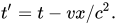
In 1897, Joseph Larmor derived the transformation equations now recognized as the Lorentz transformations in the third part of his series "A dynamical theory of the electric and luminiferous medium," published in the Philosophical Transactions of the Royal Society.[24] This work sought to preserve the form invariance of Maxwell's equations for electrodynamics when shifting from coordinates fixed in the stationary luminiferous ether to those of a material system moving uniformly at velocity relative to the ether, primarily to account for the null result of the Michelson-Morley experiment of 1887 without discarding the ether medium.[25] Larmor's approach built on the FitzGerald-Lorentz contraction hypothesis, positing that bodies and electromagnetic processes undergo physical distortion in the direction of motion through the ether, combined with adjustments to measured time intervals. Larmor initiated the derivation with a first-order approximation akin to Hendrik Lorentz's 1895 local-time correction, which modified the Galilean transformation by a term to synchronize clocks in the moving frame accounting for finite light speed .[19] To extend this to all orders in , he required the transformation to maintain the scalar and vector potentials' form in the wave equation across frames, leading to a scaling factor .![{\displaystyle \epsilon =\left(1-v^{2}/c^{2}\right)^{-1},}}[center] This encapsulates the reciprocal effects of motion on ether interactions, where the moving-frame time differential satisfies and the longitudinal displacement , ensuring phase invariance for plane waves propagating parallel to .[25] The full transformations emerged in two stages: first, a boost-like shift for approximate simultaneity in the moving frame, followed by application of the -scaling to coordinates and a reciprocal adjustment for consistency in the inverse direction.![{\displaystyle t'=t-vx/c^{2}.}}[inline] These yielded the standard relations , , , , with , implying length contraction by and time dilation by for processes in the moving system.[19] Unlike Einstein's 1905 kinematic postulates of constant light speed and relativity principle, Larmor's method relied on dynamical ether stresses causing absolute distortions, with the ether defining an invariant rest frame.[25] Larmor reiterated and refined these results in his 1900 Adams Prize essay Aether and Matter, emphasizing their role in unifying electron dynamics with ether-mediated forces, though he viewed the transformations as auxiliary tools rather than fundamental kinematic symmetries.[26] This derivation preceded Lorentz's complete 1904 version by seven years and Einstein's by eight, marking an independent ether-based path to the mathematical structure underpinning special relativity's predictions for electromagnetic phenomena.[25]Theoretical Perspectives on Fundamental Physics
Commitment to the Luminiferous Ether
Joseph Larmor maintained a steadfast commitment to the luminiferous ether as the fundamental medium for electromagnetic waves and light propagation, viewing it as an absolute, stationary framework distinct from ordinary matter. In his 1894–1898 series of papers titled "A Dynamical Theory of the Electric and Luminiferous Medium," Larmor formulated electromagnetic phenomena as arising from rotational strains and stresses within the ether, integrating Maxwell's equations with a mechanical model of ether dynamics.[27] This approach positioned the ether not as a material substance but as a non-corporeal entity capable of transmitting forces without being dragged by moving bodies.[16] Larmor's adherence persisted despite the 1887 Michelson-Morley experiment's failure to detect Earth's motion through the ether, which he reconciled by incorporating the Lorentz-FitzGerald contraction hypothesis, positing that lengths contract in the direction of motion relative to the ether to nullify expected interference shifts. In his 1897 derivation of what became known as the Lorentz transformation—published prior to Hendrik Lorentz's full articulation—Larmor interpreted these coordinate changes as physical distortions induced by ether interactions during high-speed motion through the medium.[1] This framework preserved the ether's rest frame as absolute, with apparent relativistic effects emerging from ether-matter dynamics rather than a denial of the medium itself. Central to Larmor's ether advocacy was his 1900 monograph Aether and Matter, where he elaborated the dynamical interplay between the ether and atomic matter, arguing that electromagnetic and optical properties stem from ether's elastic responses to material perturbations. Addressing Michelson-Morley directly, Larmor contended that the experiment's null result supported a partially entrained ether model, consistent with aberration and stellar observations, rather than disproving the ether's existence.[20] He emphasized the ether's role in unifying electricity, magnetism, and gravitation, critiquing alternatives that abandoned it as philosophically untenable without a causal medium for wave propagation. Even into the 1900s, Larmor surveyed ether theories affirmatively, as in his 1907 review, underscoring its indispensability for a coherent physics grounded in causal mechanisms.[28]Critiques and Interpretations of Emerging Relativity Theory
Larmor interpreted the Lorentz transformations, which he independently derived in 1897 and systematically presented in his 1900 treatise Aether and Matter, as manifestations of genuine physical distortions induced by an object's absolute motion through the stationary luminiferous ether. Unlike the kinematic reciprocity emphasized in later formulations, Larmor's analysis posited length contraction along the direction of motion and time dilation as dynamical responses to ether stresses on electromagnetic structures within matter, such as electrons, thereby preserving an absolute frame of reference defined by the ether's rest state. This ether-centric view accounted for null results in ether-drift experiments like Michelson-Morley (1887) without invoking observer-dependent conventions, attributing discrepancies to these physical adjustments rather than a denial of absolute space.[29][19] Einstein's 1905 special theory of relativity, by contrast, framed the transformations as symmetric between inertial frames and eliminated the ether as superfluous, introducing the relativity of simultaneity as a fundamental postulate. Larmor critiqued this as an overly abstract, "algebraic" maneuver that obscured the causal role of the ether in mediating electromagnetic forces and establishing absolute time and space, arguing it failed to provide explanatory depth beyond empirical correlations already captured by ether dynamics. He contended that experiments confirmed ether effects but did not necessitate abandoning the absolute reference frame, which he deemed indispensable for first-principles consistency in electrodynamics and optics.[30][31] Into the 1920s, amid growing empirical support for relativity via phenomena like the 1919 solar eclipse observations of light deflection, Larmor steadfastly rejected Einstein's framework, viewing it as incompatible with the ether's foundational status in classical physics. His advocacy persisted in addresses and writings defending ether theory against what he saw as premature paradigm shifts, though this stance contributed to the marginalization of his later contributions as relativity dominated. Larmor's school of thought, emphasizing physical realism over relational geometry, influenced a minority of physicists but yielded to the mathematical elegance and predictive successes of relativity.[32]Major Publications and Dissemination
Seminal Books
Joseph Larmor's principal monograph, Aether and Matter: A Development of the Dynamical Relations of the Aether to Material Systems on the Basis of the Atomic Constitution of Matter, appeared in 1900 from Cambridge University Press.[20] This work consolidated his investigations into ether dynamics and electron theory, positing that electromagnetic fields emerge from distortions and motions within a pervasive luminiferous aether interacting with atomic matter.[33] Larmor employed Hamilton's principle of least action to derive transformations akin to those later formalized in special relativity, including length contraction and time dilation, while maintaining an absolute ether reference frame stationary relative to the mean motion of the solar system.[1] The book addressed optical phenomena such as aberration and the Zeeman effect through aether stresses induced by moving charged particles, which Larmor identified as discrete electrons. He argued that atomic spectra and radiation result from resonant vibrations in this ether-matter system, offering a mechanistic explanation for dispersion and birefringence without invoking nascent quantum ideas.[34] Critically, Larmor critiqued FitzGerald's contraction hypothesis by embedding it in a broader dynamical theory, predicting null results for ether-drift experiments like Michelson-Morley due to compensating Lorentzian effects.[1] This synthesis influenced contemporary British physicists, fostering a research tradition that bridged classical electromagnetism with emerging atomic models until the dominance of relativity.[1] In 1929, Larmor oversaw the publication of his Mathematical and Physical Papers in two volumes by Cambridge University Press, aggregating key articles from periodicals such as the Philosophical Magazine and Proceedings of the Royal Society.[35] Volume I covers dynamics, optics, and early electron work up to 1900, while Volume II extends to relativity critiques and astrophysical applications. These compilations, though not original treatises, systematized his corpus, enabling later scholars to trace the evolution of his ether-based paradigm amid paradigm shifts in fundamental physics.[36]Collected Papers and Key Articles
Larmor's mathematical and physical papers were assembled into a two-volume collection titled Mathematical and Physical Papers, published by Cambridge University Press in 1929.[35] Volume 1 encompasses his earlier works, spanning topics from abstract mathematics such as planimetry on a moving plane to foundational contributions in electrodynamics, including electromagnetic induction in conducting sheets and the dynamics of the electric and luminiferous medium.[37] These papers, originally appearing in journals like Philosophical Transactions of the Royal Society and Proceedings of the Royal Society, trace the evolution of his theories on ether dynamics and electron behavior from the 1880s through the early 1900s.[36] Volume 2 compiles later publications, featuring articles contributed to the Encyclopædia Britannica, biographical notes on contemporaries like Lord Kelvin, and reflective pieces on relativity and emerging quantum concepts.[38] The collection highlights Larmor's persistent advocacy for an ether-based framework amid shifting paradigms in physics, with papers demonstrating rigorous mathematical derivations grounded in classical mechanics.[39] Arranged chronologically, the volumes allow examination of how his ideas on electromagnetic phenomena and material media developed in response to experimental data from the era, such as Michelson-Morley results, without abandoning causal realism in ether interactions. Among the key articles, the three-part series "A Dynamical Theory of the Electric and Luminiferous Medium," published in Philosophical Transactions of the Royal Society (Part I: 1894, Part II: 1896, Part III: 1897), stands out for integrating electron theory into ether dynamics.[24] In Part III, Larmor derived the Lorentz transformation equations independently, introducing the factor to account for length contraction and time dilation in moving media, predating Einstein's synthesis by eight years.[18] This work formalized the radiation formula for accelerated electrons—now known as Larmor's formula—positing that oscillating charges in the ether emit energy proportional to the square of acceleration, providing a dynamical basis for spectral line broadening observed in Zeeman effects.[40] Other influential articles include "On the Theory of Electrodynamics" (1900) in Proceedings of the Royal Society, which refined his electron model against Lorentz's local-time hypothesis, emphasizing absolute ether rest frames for causal consistency. Larmor's later contributions, such as his 1909 Bakerian Lecture on "The Origins of Clerk Maxwell's Electric Ideas," critiqued historical interpretations while defending ether-mediated field propagation against nascent relativistic alternatives.[41] These papers, preserved in the 1929 collection, underscore his empirical fidelity to verifiable electromagnetic data over speculative geometry, influencing subsequent ether critiques until the 1920s.[2]Recognition, Legacy, and Modern Reappraisal
Honors and Awards During Lifetime
Joseph Larmor was elected a Fellow of the Royal Society (FRS) in 1892, recognizing his early contributions to mathematical physics.[42] He later served as one of the society's secretaries from 1901 to 1912.[41] In 1909, Larmor was knighted by King Edward VII, conferring the title Sir Joseph Larmor.[1] He received the Royal Medal of the Royal Society in 1915 for his investigations in physical and optical theory.[1] The society awarded him the Copley Medal in 1921, its highest honor, for researches in mathematical physics, particularly his work on the dynamics of electromagnetism and electron theory.[1] [43] Additionally, Larmor was granted the De Morgan Medal by the London Mathematical Society, acknowledging his advancements in analysis and its applications.[44] Larmor held the presidency of the London Mathematical Society from 1914 to 1915, following earlier roles as treasurer from 1892 to 1912.[3] These distinctions reflected his stature in British scientific institutions during the early 20th century.[43]Enduring Influence on Physics
Larmor's independent derivation of the Lorentz transformations in 1897, which preserve the form of Maxwell's equations to second order in velocity over the speed of light, provided a key mathematical tool later adopted in Einstein's special relativity of 1905, influencing the conceptual shift from absolute to relative space-time in fundamental physics.[8] Although Larmor embedded these transformations within an ether-based framework, their enduring validity stems from their empirical success in unifying electromagnetism and mechanics, as verified through experiments like the Michelson-Morley null result and subsequent particle accelerator data confirming relativistic effects such as time dilation.[26] The Larmor precession theorem, formulated in 1897, quantifies the uniform precession of electron angular momentum around an applied magnetic field at the Larmor frequency , where is the electron charge, the field strength, and the mass; this result explains the linear Zeeman splitting of spectral lines and remains a cornerstone of atomic physics.[45] In contemporary applications, Larmor precession governs spin dynamics in magnetic resonance spectroscopies, enabling precise measurements of molecular environments via nuclear spin alignment./Spectroscopy/Magnetic_Resonance_Spectroscopies/Nuclear_Magnetic_Resonance/NMR_-_Theory/Larmor_Precession) This frequency directly underpins nuclear magnetic resonance (NMR) and magnetic resonance imaging (MRI), where the resonance condition (with gyromagnetic ratio ) aligns nuclear spins for signal detection, facilitating non-invasive diagnostics and structural biology since the 1940s; Larmor's classical derivation aligns with quantum treatments, confirming its robustness across scales.[46] His early electron theory, including the 1897 calculation of radiation from accelerated charges via (in cgs units), informs synchrotron radiation sources and free-electron lasers used in particle physics and materials science today.[41]Contemporary Applications and Reassessments
Larmor's discovery of precession in 1897, now known as Larmor precession, describes the torque-induced circular motion of a magnetic moment in an external magnetic field, with frequency , where is the gyromagnetic ratio and the field strength.[47] This phenomenon underpins nuclear magnetic resonance (NMR) spectroscopy, enabling precise analysis of molecular structures in chemistry and biology through spin alignments and relaxations.[48] In medical imaging, it forms the physical basis for magnetic resonance imaging (MRI), where radiofrequency pulses excite precessing nuclei, producing contrast based on tissue properties; Larmor's original formulation anticipated the resonance conditions central to these devices.[49] Extensions of Larmor precession apply in advanced materials science and condensed matter physics, such as probing strongly correlated electron systems via dynamical mean-field theory simulations, revealing collective spin dynamics in itinerant fermions.[48] In neutron scattering experiments, magnetized foils exploit Larmor precession for spin-flipping, enhancing polarization gradients in spectrometers for high-resolution studies of quantum materials.[50] Optimized field shapes further refine these instruments, minimizing inhomogeneities to improve resolution in Larmor-based neutron diffraction.[51] The Larmor formula, derived in 1897 for non-relativistic radiation from accelerating charges, , remains a cornerstone in classical electrodynamics, applied in particle accelerators to estimate synchrotron losses and in astrophysics for modeling radiation from pulsars and cosmic rays.[7] Modern reassessments credit Larmor with independently deriving the Lorentz transformation in 1900, predating Einstein's 1905 formulation, though Larmor embedded it in an ether framework to explain length contractions as physical distortions rather than relativistic effects.[52] Historians note this anticipation influenced early adopters like Larmor himself, who by 1907 integrated it into ether-based teachings of relativity precursors, highlighting his bridge between classical and modern kinematics despite ether's later rejection.[52] Fringe reinterpretations, such as linking Larmor's ether to elastic media models like Navier-Cauchy for relativistic dynamics, persist but lack empirical consensus against special relativity's predictions.[53]Personal Life and Final Years
Family and Private Interests
Joseph Larmor was born on 11 July 1857 at Ballycarrickmaddy near Magheragall, County Antrim, Ireland, as the eldest of five sons and two daughters born to Hugh Larmor, a farmer who later operated a grocery business in Belfast, and Anna Wright, daughter of Joseph Wright, after whom Larmor was named.[1][3] Larmor never married and had no children, maintaining a solitary personal life characterized by shyness, diffidence, and a small circle of loyal friends to whom he was generous without seeking recognition.[1] Beyond his primary work in mathematical physics, Larmor's private interests encompassed diverse topics including biology such as mitosis, metaphysics, theology and natural theology, the aesthetics of bees and moths, zodiacal light, dilute drugs, ocean floor radioactivity, mountain isostasy, herring migration, and philosophical inquiries into time and mind.[54] His conservative temperament extended to a personal opposition to Irish Home Rule, reflecting a unionist stance rooted in his Irish Presbyterian background and preference for established traditions.[1][54]Health Decline and Death
In the early 1930s, Larmor began suffering from pernicious anemia, a severe form of vitamin B12 deficiency that progressively sapped his physical strength and vitality, though he persisted with scholarly work and civic engagement.[54] This condition, historically often fatal without modern interventions like intrinsic factor therapy (which was emerging but not universally effective at the time), marked a notable deterioration in his later years following decades of robust productivity.[54] Larmor retired from his Lucasian Professorship at the University of Cambridge in 1932 at age 75, relocating to his native Ireland to reside in Holywood, County Down, where he spent his remaining time in relative seclusion amid family ties and local affairs.[3] [1] He died on 19 May 1942 in Holywood at the age of 84, with pernicious anemia likely contributing to his demise alongside advanced age.[7] [3]References
- https://en.wikisource.org/wiki/Dynamical_Theory_of_the_Electric_and_Luminiferous_Medium_III
- https://en.wikisource.org/wiki/Aether_and_Matter/Chapter_10