Hubbry Logo
Larry LittleLarry LittleMain
Open search
Larry Little
Community hub
Larry Little
logo
8 pages, 0 posts
0 subscribers
Be the first to start a discussion here.
Contribute something
Larry Little
Larry Little
from Wikipedia

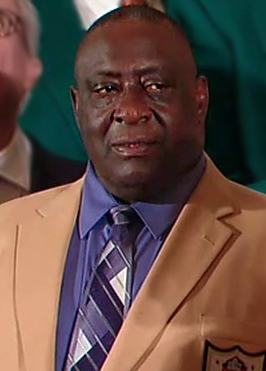
Larry Chatmon Little (born November 2, 1945) is an American former professional football player who was a guard in the American Football League (AFL) and the National Football League (NFL). He played college football for the Bethune–Cookman Wildcats. He signed with the San Diego Chargers as an undrafted free agent in 1967. After two years in San Diego, he was then traded to the Miami Dolphins where he played for the rest of his career, establishing himself as one of the best guards in the NFL.

Key Information

Little was a five-time Pro Bowl selection, and a seven-time All-Pro selection. He was the starting right guard of a dominant Dolphins offensive line which included Hall of Fame center Jim Langer and left guard Bob Kuechenberg, that was instrumental in the Dolphins winning Super Bowl VII during their perfect season in 1972, and Super Bowl VIII the following year. He was elected to the NFL 1970s All-Decade Team, a member of the Miami Dolphins Honor Roll, and was elected to the Pro Football Hall of Fame in 1993.

Early life

[edit]

Little was born in Groveland, Georgia, on November 2, 1945, the second of six children. The family moved to Florida and he grew up in the Overtown neighborhood in Miami.[1][2] His mother was his greatest influence.[3] As a child, his favorite team was the Baltimore Colts.[3] He attended Booker T. Washington Senior High School in Miami, where he played football as a two-way lineman, starting in his junior and senior years.[4][5][6]

He has been inducted into the Booker T. Washington High School Hall of Fame.[7] In 2007, Little was named by the Florida High School Athletic Association to its Team of the Century, to celebrate 100 years of high school football in Florida.[8] In 2016, as part of its Hometown Hall of Fame program, the Pro Football Hall of Fame honored Little with a plaque presented to Booker T. Washington.[9] In 2023, he was inducted into the Florida High School Athletic Association Hall of Fame.[5]

College career

[edit]

Through the efforts of his high school coach Alkin Hepburn, Little was offered a football scholarship to Bethune-Cookman University (then Bethune-Cookman College) where he played on the Bethune–Cookman Wildcats team from 1964 to 1967. He played on both the offensive and defensive lines at the respective tackle positions. He was a team captain, and a three-time All-Southern Intercollegiate Athletic Conference (SIAC) selection.[6][10][11]

His 1966 teammates named him their most valuable player and outstanding defensive player.[12] Little was also named a Little All-American by the Ebony College Scoreboard in 1966.[8][13] He was inducted into the Bethune-Cookman Hall of Fame in 2012.[14]

Little's defensive line coach, and fellow Bethune-Cookman Hall of famer, Cyril Lloyd "Tank" Johnson was Little's favorite coach at any level.[3] Johnson had played at Bethune-Cookman (class of 1958), served as its football team's assistant coach/defensive coordinator (1961-78), and became the school's athletic director (1972-91).[15][16]

Professional career

[edit]

Little went undrafted in 1967. After the draft, he received free agent offers from Miami, San Diego, and Baltimore. He signed as a free agent with the American Football League's San Diego Chargers because they offered him the largest signing bonus ($750).[17] After playing for San Diego in 1967 and 1968, coach Sid Gillman grew frustrated with Little's not controlling his weight. He was traded to the AFL's Miami Dolphins for cornerback Mack Lamb before the 1969 season,[18][10] when he was named an AFL All-Star.[19] "I didn't particularly like the trade," Little said in the January 1974 issue of SPORT.[20] "The Dolphins weren't much then."[21] In his first year with Miami, although an All-Star, the Dolphins' record was a poor 3-10-1.[18]

Future Pro Football Hall of Fame coach Don Shula became the Dolphins' head coach in 1970.[18] Among other things, he helped Little control his weight.[10][21] Of the 11 years he played for the Dolphins (1969-1980), Little played ten of them under Shula (1970-1980), missing only four games in 11 seasons, despite numerous injuries. He was considered an intimidating force run blocking and a superb pass blocker.[10]

Little was a key contributor to the success of the Dolphins' punishing running attack of the early and mid-1970s, which featured Larry Csonka, Mercury Morris, and Jim Kiick. Shula, a coach on the NFL 100th Anniversary All Time Team,[22] said Little played a major role in the Dolphins success as both a pass blocker and run blocker.[10] Little was a member of the 1972 Dolphins championship team that went 17-0, which established a record for team rushing yards at the time (2,960 yards in a 14 game season[23]). The Dolphins' rushing average per year in the 1970s (2,372 yards rushing per year) led the NFL in that decade.[10] Little played under offensive line coach Monte Clark, whom Little acknowledged at his Hall of Fame induction.[24][10]

In 1973, he became to first guard to be paid a $100,000 annual salary.[18]

From 1971 through 1975, Little was named first-team All-Pro five times, and again in 1977; and was second-team All-Pro in 1978 (and named second-team in 1977 by the Associated Press and United Press International).[10][25] He was All-AFC five times.[10] He appeared in five straight NFL Pro Bowls from 1971 to 1975, and appeared in the 1969 AFL All-Star Game.[10][19] He was named the National Football League Players Association's AFC Offensive Lineman of the Year three times (1970-1972).[10] He was named to the NFL 1970s All-Decade Team at guard, along with Joe DeLamielleure.[26]

Coaching

[edit]

He also served as head football coach of his alma mater, from 1983 to 1991, winning Mid-Eastern Athletic Conference championships in 1984 and 1988.[14] He was head coach at North Carolina Central University (NCCU) from 1993 to 1998. At least four of his NCCU players, Shawn Gibbs, Adrian Jones, Trei Oliver, and Dawson Odums went on to become college football coaches.[5][27] In addition, Little served as head coach of the Ohio Glory of the World League of American Football (which eventually became the now-defunct NFL Europe), for one year.[18]

Legacy and honors

[edit]

In 1993, Little was inducted into the Pro Football Hall of Fame, with the NFL's all-time winning coach Don Shula[28] as his presenter.[10] In 2013, he was inducted into Black College Football Hall of Fame.[29][30] He has also been inducted into the Florida Black Colleges Football Hall of Fame, and the Bob Hayes Hall of Fame (2019).[7] In 1978, he was inducted into the Florida Sports Hall of Fame.[31]

On December 16, 1993, Little was added to the Miami Dolphins Honor Roll.[21] In 2011, Little was among the inaugural class entering the Miami Dolphins Walk of Fame.[32]

In 1999, he was ranked number 79 on The Sporting News' list of the 100 Greatest Football Players.[33][34]

Miami's City Commission honored Little by naming a street after him.[35]

Personal life

[edit]

During his playing career and after, he had a boys camp for underprivileged children, the Gold Coast Summer Camp,[7][36] eventually backed by the United Way. He was also listed in Who's Who in Black America.[3][10]

Little's younger brother, David Little, was a linebacker for the Pittsburgh Steelers.[37]

Head coaching record

[edit]

College

[edit]
Hall of Famers Little and Dwight Stephenson, up on the Honor Roll, along with Bob Kuechenberg and Richmond Webb.
Little's bronze bust at the Pro Football Hall of Fame
Year Team Overall Conference Standing Bowl/playoffs
Bethune–Cookman Wildcats (Mid-Eastern Athletic Conference) (1983–1991)
1983 Bethune–Cookman 4–4–1 1–3 T–3rd
1984 Bethune–Cookman 7–3 4–0 1st
1985 Bethune–Cookman 6–4 3–1 2nd
1986 Bethune–Cookman 3–8 2–3 5th
1987 Bethune–Cookman 4–7 2–3 4th
1988 Bethune–Cookman 5–6 4–2 T–1st
1989 Bethune–Cookman 5–5 3–3 T–3rd
1990 Bethune–Cookman 4–7 1–5 6th
1991 Bethune–Cookman 4–6 3–3 T–3rd
Bethune–Cookman: 45–48–1 23–23
North Carolina Central Eagles (Central Intercollegiate Athletic Association) (1993–1998)
1993 North Carolina Central 6–5 5–3 4th
1994 North Carolina Central 6–5 5–3 T–3rd
1995 North Carolina Central 5–6 4–4 5th
1996 North Carolina Central 8–3 5–3 T–4th
1997 North Carolina Central 4–7 4–3 T–4th
1998 North Carolina Central 4–6 3–4 7th
North Carolina Central: 33–32 26–20
Total: 78–80–1
      National championship         Conference title         Conference division title or championship game berth

See also

[edit]

References

[edit]
[edit]
Revisions and contributorsEdit on WikipediaRead on Wikipedia
from Grokipedia
Larry Chatmon Little (born November 2, 1945) is a former American professional football player who played as an offensive guard in the (AFL) and (NFL) for 14 seasons, primarily with the , where he was a key contributor to their back-to-back championships and the league's only in 1972. Born in Groveland, Georgia, Little grew up in Miami, Florida, and attended Bethune-Cookman University, where he played as a before transitioning to offense in the pros. Undrafted out of college, he signed as a with the in 1967, playing two seasons there before being traded to the on July 2, 1969, where he spent the remainder of his playing career through 1980, appearing in 183 total games. Little's on-field prowess earned him widespread recognition as one of the era's premier guards, including five selections (1970, 1972–1975), six first-team honors (1971–1975, 1977), and three NFL Players Association AFC Offensive Lineman of the Year awards (1970–1972). He was a of the Dolphins' dominant offensive line during their 1972 undefeated campaign (14–0 regular season) and playoff run, helping the team amass 2,960 rushing yards en route to and VIII victories, and was later named to the NFL's 1970s All-Decade Team. Following his retirement as a player, Little transitioned into coaching, serving as at Bethune-Cookman University and , as well as with the in . His contributions to football were cemented with induction into the in 1993, presented by Dolphins Don , along with enshrinement in five other halls of fame, including the in 1993. In addition to his athletic legacy, Little has been active in , founding the Larry Little Gold Coast Summer Camp Foundation to support youth development in Miami's Overtown community, drawing from his own experiences growing up in humble circumstances. In 2025, he published a reflecting on his career and the 1972 season. He holds honorary doctorates from Biscayne College (now St. Thomas University) and Bethune-Cookman University, and resides in with his family.

Early life and education

Early life

Larry Little was born on November 2, 1945, in Groveland, Georgia. His family relocated to , when he was a young child, driven by economic hardships in rural Georgia. In , they settled in the Overtown neighborhood, a vibrant but impoverished Black community shaped by the pervasive poverty and of the Jim Crow era. The family's early home in Georgia featured an , underscoring the depth of their financial struggles, which persisted in the urban challenges of Overtown. Growing up amid these conditions, Little developed an early interest in football during grade school, dreaming of a professional career despite the surrounding obstacles. His first organized play came in junior high, where he began honing his skills on the field. Family dynamics played a key role in fostering resilience; Little's older brother George, recognized for his intelligence and strong , served as a guiding influence, emphasizing perseverance through adversity until his untimely murder at age 30. His mother further supported his growth by seeking speech therapy to help him overcome a childhood , instilling values of determination and self-improvement.

High school career

Larry Little attended Senior High School in , , where he developed his athletic skills amid challenging circumstances shaped by his family's poverty in the Overtown neighborhood. Growing up in a large family, Little balanced football with part-time work to help support his household, demonstrating early resilience that influenced his competitive drive. During his high school years from 1960 to 1964, Little emerged as a standout two-way lineman for the Booker T. Washington Wildcats, playing both offense—primarily as a fullback—and defense as a tackle at around 190 pounds. Under the guidance of coach James “Dean Blue” Everett, he contributed to the team's efforts despite not receiving widespread accolades at the time, honing his physicality and technique on the field. Little's performances were described as solid and promising, though he was not considered the top player on his squad and attracted limited college attention initially. Little's high school tenure laid the foundational discipline for his future success, as he navigated academic demands alongside his athletic commitments and familial responsibilities, fostering a that carried into his collegiate and professional careers. By graduation in 1964, he had established himself as one of the school's notable two-way linemen in its history, setting the stage for further growth at Bethune-Cookman College.

College career

Little enrolled at Bethune-Cookman College (now Bethune-Cookman University) in 1964 on a football scholarship, following his standout high school career in . He transitioned to as a two-way lineman, playing both and offensive guard for the Bethune-Cookman Wildcats from 1964 to 1967. During his tenure, Little contributed to consistently strong team performances, with the Wildcats achieving records of 6–3 in 1964, 5–2–1 in 1965, 5–2 in 1966, and 5–2 in 1967, often showcasing robust defensive efforts that limited opponents' scoring. Little was a three-time All-Conference selection in the (SIAC). In his senior year of 1967, he was selected as team captain and received the award for the linemen. He also garnered recognition as an Press All-American that season, highlighting his pivotal role in key games where his blocking and tackling helped secure victories against conference rivals. Little graduated with a degree in in 1967. Despite his collegiate accomplishments, Little went undrafted in the owing to Bethune-Cookman's status as a small, historically college, prompting him to pursue opportunities through tryouts with professional teams.

Professional playing career

San Diego Chargers

Little signed with the as an undrafted on May 3, 1967, receiving a modest of $750—the highest offer among interested teams, including the and Washington Redskins. Initially signed as a , Little's 4.9-second impressed coach , who briefly considered him for or fullback before permanently shifting him to offensive guard due to his 6-foot-1 frame. In his rookie season, he saw limited action, appearing in 10 games without a start as he adjusted to the faster pace of competition. By 1968, Little had secured a full-time role at offensive guard, playing in all 14 games and starting several while helping anchor the line for a Chargers team that finished 9-5. His contributions supported a robust ground game, with San Diego averaging 126.1 rushing yards per game—third-best in the AFL that year—led by backs like Dickie Post and Paul Lowe. Drawing briefly from his college versatility as a two-way player at Bethune-Cookman, Little's athleticism aided his transition to professional blocking schemes. On July 2, 1969, prior to the regular season, the Chargers traded Little to the in exchange for Mack Lamb, reflecting the team's depth at guard and Gillman's frustrations with Little's weight fluctuations nearing 300 pounds.

Miami Dolphins

Little joined the in 1969 via a trade from the San Diego Chargers, a move that marked a pivotal turning point in his career. Under head coach George Wilson that year, he quickly established himself as a starter at right guard, appearing in 12 games with 10 starts during the 1969 season in Miami. The following year, took over as head coach, ushering in an era of dominance for the team and further elevating Little's performance on the offensive line. Little's most prominent seasons came from 1971 to 1973, during which he earned consecutive selections and first-team honors each year. The pinnacle was the 1972 season, when the Dolphins achieved the only perfect record in history, finishing 14-0 in the regular season and 17-0 overall after winning . As a key blocker in Miami's run-heavy offense, Little helped pave the way for , who rushed for 1,117 yards that year. Over his 12 seasons with the Dolphins from 1969 to 1980, Little amassed five appearances (1969, 1971–1974) and six first-team selections (1971–1975, 1977). He played in 183 total games across his career, demonstrating remarkable durability and discipline, particularly in his later years when he incurred minimal penalties—such as just five in 1979 and none in 1980. Little retired following the 1980 season at age 35, concluding a tenure that solidified his role as a cornerstone of Miami's championship offensive line.

Coaching career

Bethune–Cookman University

Little returned to his , , as head football coach in 1983, three years after retiring from the , during which he had served as at Miami Edison High School from 1981 to 1982 and pursued business investments. His appointment marked a for the Pro Football Hall of Famer, who aimed to elevate the Wildcats program within the (MEAC) despite the challenges of coaching at a historically Black college with constrained budgets and facilities. Little's experience as an elite offensive lineman informed his emphasis on disciplined line play and fundamental techniques, fostering a resilient team culture amid limited recruiting resources compared to larger programs. Over his nine-year tenure from 1983 to 1991, Little guided Bethune–Cookman to an overall record of 43–49–2, achieving a .468 , and a 23–23 MEAC mark. The highlight came in , his second season, when the Wildcats went 7–3 overall and a perfect 4–0 in conference play to claim the MEAC championship—the program's first under Little and only its second in history. That undefeated conference campaign showcased a balanced offense and stout defense, culminating in a strong finish that solidified Little's reputation as a builder of competitive HBCU teams. The Wildcats repeated as MEAC co-champions in with a 5–6 overall record and 4–2 conference mark, though they lost to 13–20 in a regular-season game. These titles represented key successes in rebuilding a program that had struggled prior to his arrival, with Little developing talent through rigorous training and leveraging his for motivation. Little's era at Bethune–Cookman was not without hurdles, as the team navigated inconsistent seasons, including a 4–6 finish in amid broader administrative shifts at the university. His departure that December stemmed from performance pressures and institutional changes, though his efforts laid a foundation for future stability by instilling discipline and competitiveness in a resource-limited environment. Throughout, Little prioritized player development over quick wins, contributing to the growth of several athletes who advanced to professional opportunities, while emphasizing the holistic benefits of HBCU athletics for community and personal growth.

Ohio Glory and North Carolina Central

In 1992, Larry Little served as the head coach of the Ohio Glory, a franchise in the World League of American Football (WLAF), becoming the league's first African American head coach. The team competed in the North American East division and finished the season with a 1-9 record, securing their sole victory in a home game against the New York/New Jersey Knights. The Glory played their home games at Ohio Stadium in Columbus, drawing an average attendance of over 15,000 fans despite the struggles on the field. The WLAF suspended operations after the 1992 season due to financial difficulties, leading to the folding of the Ohio Glory and other teams. Following the end of the WLAF, Little returned to the collegiate ranks in 1993 as head football coach at (NCCU), a member of the (CIAA) in . Over his six-year tenure from 1993 to 1998, Little compiled an overall record of 33-32, including three winning seasons (1993: 6-5, 1994: 6-5, and 1996: 8-3). His teams focused on building a strong foundation through player development and discipline, emphasizing fundamentals in a program transitioning within the competitive CIAA landscape. Despite the mixed results, Little's leadership contributed to the growth of several players who later pursued coaching careers, including Shawn Gibbs, Adrian Jones, Trei Oliver, and Dawson Odums. Little's time at NCCU was marked by efforts to elevate the program amid the challenges of Division II athletics, including limited resources compared to higher divisions. In November 1998, after a 4-6 season, the university dismissed him as , citing the need for new direction despite his contributions to team stability. Building on his prior achievements at Bethune-Cookman University, where he had secured conference titles, Little's overall head coaching record across collegiate stops stood at 78-80-1.

Honors and legacy

Playing honors

Larry Little's exceptional performance as an offensive guard earned him numerous accolades during his NFL career, highlighting his dominance in pass protection and run blocking. He was selected to five Pro Bowls, representing the AFL All-Star Game in 1970 and the Pro Bowls in 1972, 1973, 1974, and 1975, where he showcased his agility and power against top defensive linemen. Additionally, Little received six first-team honors (1971–1975, 1977), as recognized by the and other selectors, underscoring his consistent excellence across the AFL and eras. Little played a pivotal role in the ' back-to-back victories, contributing to championships in following the 1972 season and after the 1973 season. His contributions were especially vital during the Dolphins' historic undefeated 1972 campaign, where the team achieved a perfect 14-0 regular-season record en route to a 17-0 overall mark, relying on Little's precise blocking to power one of the league's most effective rushing attacks. Beyond individual selections, Little garnered other significant recognitions for his playing career. He was named to the NFL 1970s All-Decade Team, affirming his status among the era's elite guards. In 1993, he was inducted into the , celebrating his 12 seasons with the franchise and his integral part in their success. Dolphins head coach frequently praised Little's hand placement and leverage techniques, crediting them for enabling the team's dominant ground game.

Coaching achievements

During his tenure as head coach at Bethune–Cookman University from 1983 to 1991, Larry Little led the Wildcats to (MEAC) championships in 1984 and 1988, marking the program's only titles during that era. In 1984, Bethune–Cookman finished with a 10–2 overall record and a 7–0 mark in conference play, earning Little the MEAC Coach of the Year honor. His teams compiled an overall record of 41–52–1, with a 23–23 ledger in MEAC competition, reflecting steady improvement in a competitive conference. Little's coaching at Bethune–Cookman emphasized player development, producing several athletes who advanced to professional football, including Lee Williams, a three-time selection drafted in the second round of the by the . Other notable alumni from his program included John Bostic and Leon Gonzalez, both of whom appeared in games during the mid-1980s. These successes underscored Little's ability to prepare HBCU talent for higher levels of competition. In 1992, Little served as head coach of the in the inaugural season of the World League of American Football (WLAF), guiding the expansion franchise to a 1–9 record in the North American East Division despite roster challenges common to developmental leagues. His offensive schemes focused on innovative play-calling to maximize quarterback mobility and line protection, drawing from his own Hall of Fame experience as an NFL guard, though the team struggled with consistency in a short-lived league. Little returned to college coaching as head coach at North Carolina Central University from 1993 to 1998, where he posted a 33–32 record, including back-to-back winning seasons in 1993 and 1994 (both 6–5). His overall head coaching career spanned 16 years with a 75–93–1 mark across all stops. Little's legacy in coaching includes elevating program standards at both Bethune–Cookman and North Carolina Central through disciplined preparation and community engagement, contributing to his 2013 induction into the Black College Football Hall of Fame, which recognized his dual impact as player and coach.

Hall of Fame induction

Larry Little was inducted into the on January 31, 1993, and enshrined on July 31, 1993, in , recognizing his exceptional career as an offensive guard. Presented by his former coach , the ceremony highlighted Little's remarkable journey from an undrafted free agent signed by the in 1967 for a $750 bonus to a cornerstone of the ' dynasty, including back-to-back victories in 1972 and 1973 and the league's only perfect 17-0 season in 1972. In his enshrinement speech, Little emphasized his perseverance and discipline, crediting his rise to consistent performance in pass blocking and run schemes that set an rushing record of 2,960 yards in 1972, while inspiring teammates through leadership. The event coincided with the induction of other luminaries like and , underscoring Little's place among elites as the fifth Dolphin from the 1970s era to enter the Hall. Earlier, in 1978, Little was inducted into the Sports Hall of Fame, honoring his contributions to professional football in the state after a standout career that included six selections and five appearances with the Dolphins. This recognition affirmed his impact on sports, building on his undrafted entry into the AFL and transformation into one of the league's premier linemen. Little's collegiate roots were celebrated with his 2000 induction into the Bethune-Cookman University Athletic Hall of Fame, where he had excelled as a two-way tackle and All-Conference selection from 1964 to 1967 before launching his pro career. In 2013, he entered the Black College Football Hall of Fame during a ceremony in , Georgia, acknowledging his dual legacy as a dominant player—team captain and three-time All-Southern Intercollegiate honoree at Bethune-Cookman—and later as there, leading to MEAC titles in 1984 and 1988. This enshrinement highlighted his broader influence on HBCU football, bridging his amateur achievements with NFL success and coaching mentorship. Most recently, on September 24, 2023, Little was inducted into the (FHSAA) Hall of Fame in , for his high school prowess as a two-way lineman at Senior High School in , marking a full-circle tribute to the foundations of his athletic journey. Announced on July 25, 2023, as part of a class including fellow Pro Football Hall of Famer , the induction celebrated Little's perseverance from segregated-era high school fields to professional immortality.

Personal life and later years

Family and personal background

Larry Little was born in Groveland, Georgia, but his family relocated to 's Overtown neighborhood when he was a young child, where he grew up in a working-class household with his parents, George and Ida Little, and six siblings. This environment was marked by poverty and the pervasive enforced by in the South, limiting opportunities for Black residents, including access to integrated sports and education. Little has reflected on these barriers as formative challenges that shaped his resilience, navigating a time when Black athletes in faced exclusion from major local teams and facilities. Little married Rosie Little, with whom he has shared a long partnership supporting his professional transitions across cities like and . Together, they raised four children and have become grandparents to ten grandchildren and great-grandparents to four great-grandchildren, maintaining close family ties in the area. The family resided in South Miami-Dade, where Rosie played a key role in managing household stability amid the demands of Little's schedule and subsequent coaching relocations. Little holds honorary doctorates from Biscayne College (now St. Thomas University) and Bethune-Cookman University. Post-retirement, Little has contended with health challenges stemming from his playing days, including multiple injuries that required surgeries and contributed to ongoing mobility issues, alongside a in 2013 and a chronically problematic . Despite these, he remains active in , founding the Larry Little Gold Coast Summer Camp Foundation to provide educational and sports programs for inner-city youth, awarding over $40,000 annually in scholarships for minority students. In recognition of his community roots and contributions, the City of renamed a section of Northwest 11th Terrace in Overtown—near where Little played football as a child—as Larry C. Little Way in March 2023.

Post-coaching activities

After retiring from coaching in 1998, Larry Little remained active in the alumni community, regularly participating in events such as golf tournaments and weekend gatherings that honor former players and support community initiatives. He has attended these occasions to connect with fans and teammates, contributing to charitable causes tied to the organization. Little has continued to deliver motivational speeches and share personal insights at (HBCUs), drawing on his experiences as a Bethune-Cookman alumnus to inspire students and athletes. These engagements often highlight themes of perseverance and opportunity, particularly during visits to his . In 2025, Little co-authored the autobiography From the Outhouse to the Penthouse: The Football Journey of Hall of Famer Larry Little with Joe Zagorski, which chronicles his life from humble beginnings to success and beyond, including lessons from his post-playing years. The book, released in October 2025, features a foreword by former teammate and emphasizes inspirational moments for future generations. That same year, Little returned to Bethune-Cookman University for its homecoming weekend, where he participated in a book-signing event at in Daytona Beach, sharing stories and memories with fans and students. He also maintains an ongoing role as an ambassador for the , joining other inductees in community outreach programs that include meet-and-greet sessions at youth centers, hospitals, and senior facilities during enshrinement events.

References

Add your contribution
Related Hubs
Contribute something
User Avatar
No comments yet.