Hubbry Logo
Lem BarneyLem BarneyMain
Open search
Lem Barney
Community hub
Lem Barney
logo
8 pages, 0 posts
0 subscribers
Be the first to start a discussion here.
Lem Barney
Lem Barney
from Wikipedia

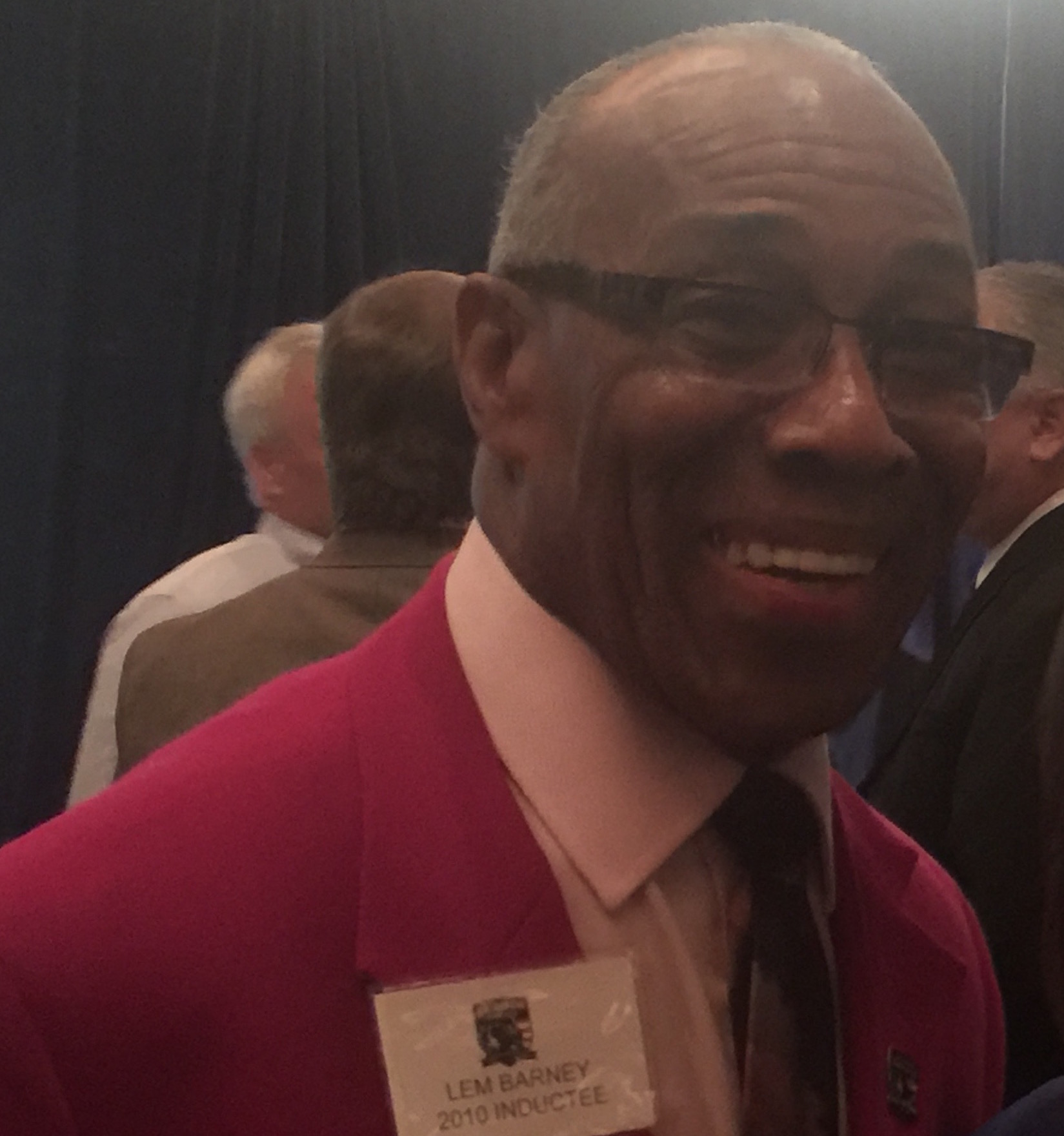
Lemuel Jackson Barney (born September 8, 1945) is an American former professional football player who was a cornerback and return specialist for the Detroit Lions of the National Football League (NFL) from 1967 to 1977, playing occasionally as a punter as well. He played college football for the Jackson State Tigers from 1964 to 1966. He was selected by the Lions in the 1967 NFL/AFL draft. He was named the NFL Defensive Rookie of the Year in 1967, played in seven Pro Bowls, and was selected as a first-team All-Pro player in 1968 and 1969. He was inducted into the Pro Football Hall of Fame in 1992. He has also been inducted into the Detroit Lions Hall of Fame, the Jackson State Sports Hall of Fame, the Michigan Sports Hall of Fame, and the Mississippi Sports Hall of Fame.

Key Information

Early life

[edit]

Barney was born in Gulfport, Mississippi, on September 8, 1945.[1] He attended the 33rd Avenue High School in Gulfport.[2] He played at the quarterback position for his high school football team.[3]

College career

[edit]

Barney attended Jackson State University, a historically black university in Jackson, Mississippi. His son Lem Barney III and grandson Lem Barney IV also followed in his footsteps and graduated from Jackson State. He played college football for the Tigers from 1964 to 1966 under head coach Rod Paige. He had 26 career interceptions at Jackson State, including nine in 1965 and 11 in 1966. He also had punt averages of 41.7 and 42.5 in those two seasons. Barney was an All-Southwestern Athletic Conference selection three straight years. He was also selected as an All-American by Ebony magazine and the Pittsburgh Courier.[4]

Professional career

[edit]

Barney was selected by the Detroit Lions in the second round, 34th overall pick, of the 1967 NFL draft.[2] As a rookie in 1967, Barney appeared in all 14 games as a starting cornerback and led the NFL with 10 interceptions, 232 interception return yards and three interceptions returned for touchdowns.[2] After an injury to Pat Studstill, Barney also took over as the Lions' punter, punting 47 times for an average of 37.4 yards in 1967.[2] On September 17, 1967, in the first quarter of his first NFL game, Barney intercepted the first pass thrown in his direction by Bart Starr and returned it 24 yards for a touchdown.[5][6] In the final game of his rookie season, Barney intercepted three passes within ten minutes and returned one 71 yards for a touchdown.[7][8] At the end of the 1967 season, he was selected by the Associated Press as the NFL Defensive Rookie of the Year.[9]

After the 1967 season, Barney played in the 1968 Pro Bowl,[10] and in the off-season, he was married and also served six months of active duty in the Navy.[9]

Barney went on to be selected to seven Pro Bowls and was selected as a first-team All-NFL player in 1968 and 1969.[2] During his 11 years in the NFL, Barney had 56 interceptions, 1,011 interception return yards, and seven interceptions returned for touchdowns. He also returned 143 punts for 1,312 yards and three touchdowns as well as 50 kickoff returns for 1,274 yards, including a 98-yard return for touchdown.[2]

In March 1978, as part of a wiretap investigation into international drug smuggling, Barney's voice was heard allegedly discussing cocaine and amphetamines.[11] Although investigators stated that Barney was not the focus of the investigation,[12] the controversy received extensive press attention through the spring of 1978, as Barney was called to testify before a New York grand jury.[13][14]

In August 1978, the Lions placed Barney on the injured waiver list.[15] Barney's efforts to sign with another team were unsuccessful,[16] and he did not play during the 1978 season.[2][17] He was officially released by the Lions in February 1979.[18]

Entertainer

[edit]

Barney is an accomplished singer who began singing with choirs in his youth and college.[19] He befriended Motown recording artist Marvin Gaye, when Gaye unsuccessfully tried out for the Lions in 1970. Barney and teammate Mel Farr sang background vocals on Gaye's classic 1971 song "What's Going On".[20][21] In 2015, Barney was invited to sing the national anthem at the Pro Football Hall of Fame induction ceremony.[19]

Barney also had a brief acting career, beginning with a self-portrayal in the 1968 comedy, Paper Lion. In 1973, he was one of the stars of the blaxploitation biker film, The Black Six.[22]

Awards and honors

[edit]

After retiring as a player, Barney received numerous honors, including the following:

NFL career statistics

[edit]
Legend
NFL record
Led the league
Bold Career high

Regular season

[edit]
Year Team Games Interceptions Fumbles Returning
GP GS Int Yds Avg Lng TD Fum FR Yds Avg TD Ret Yds Avg Lng TD
1967 DET 14 14 10 232 23.2 71 3[b][a] 2 0 -5 -5.0 0 9 101 11.2 25 0
1968 DET 14 14 7 82 11.7 62 0 5 5 0 0.0 0 38 749 19.7 98 1
1969 DET 13 13 8 126 15.8 32 0 3 2 25 12.5 0 16 345 21.6 74 1[c]
1970 DET 13 13 7 168 24.0 49 2 2 0 0 0 27 355 13.1 74 1[c]
1971 DET 9 7 3 78 26.0 28 1 5 2 0 0.0 0 23 344 15.0 48 0
1972 DET 14 14 3 88 29.3 64 0 1 1 20 20.0 0 16 125 7.8 26 0
1973 DET 14 14 4 130 32.5 38 0 3 3 0 0.0 0 28 259 9.3 42 0
1974 DET 13 12 4 61 15.3 39 0 0 0 0 0 5 37 7.4 11 0
1975 DET 10 10 5 23 4.6 13 0 0 1 74 74.0 0 8 80 10.0 30 0
1976 DET 14 14 2 62 31.0 26 1 4 1 0 0.0 0 23 191 8.3 30 0
1977 DET 12 11 3 27 9.0 22 0 0 2 49 24.5 0 0 0 0 0
Career 140 136 56 1,077 19.2 71 7 25 17 163 9.6 0 193 2,586 13.4 98 3

Postseason

[edit]
Year Team Games Punt returns
GP GS Ret Yds Avg Lng TD
1970 DET 1 1 5 20 4.0 8 0
Career 1 1 5 20 4.0 8 0

Personal life

[edit]

Barney and his wife, Martha, had a daughter, LaTrece, and a son, Lem III.[33] After retiring from the NFL, Barney worked for many years, starting in 1979, in public affairs for Michigan Consolidated Gas Company.[33] He also worked in the 1980s as a football broadcaster on BET and on pre-season games for the Detroit Lions.[33][34]

In March 1993, after his car crashed into a guardrail on a Detroit freeway, Barney was arrested and charged with driving under the influence and possession of cocaine and marijuana.[35][36][37][38] He was found not guilty of the drug charges following a jury trial in 1994.[39]

In 2006, Barney published an autobiography titled, "The Supernatural: Lem Barney".[40]

He held a public relations post at the Detroit Medical Center starting in 2006. After being fired from that position, he filed an age discrimination lawsuit in 2013.[41] Also in 2013, Barney publicly declared that, in light of revelations about brain injuries resulting from football, he would not play football if he had the chance to live his life over again and predicted that the game of football would be gone in another 20 years.[42]

His nephew Milton Barney also played in the NFL.[43]

As of 2023, Barney was in failing health. He had been diagnosed with dementia and Alzheimer's disease in 2013 and had been under guardianship since 2018.[44] On November 29, 2025, the Pro Football Hall of Fame erroneously released a statement announcing Barney's death.[45][46]

Notes

[edit]

References

[edit]
[edit]
Revisions and contributorsEdit on WikipediaRead on Wikipedia
from Grokipedia
Lem Barney (born September 8, 1945, in ) is an American former professional best known as a for the of the (), where he played his entire 11-season career from 1967 to 1977. Drafted in the second round (34th overall) out of , Barney quickly emerged as one of the league's premier defensive backs, earning the NFL Defensive Rookie of the Year honors in his debut season after leading the league with 10 interceptions. Over his career, he appeared in 140 games, amassing 56 interceptions for 1,077 yards and seven touchdowns, along with 143 punt returns for 1,312 yards and two scores, 50 kickoff returns for 1,274 yards and one touchdown, and 17 fumble recoveries. Barney's versatility extended beyond defense; he also contributed as a early in his career, a punt and kickoff , and even as a backup punter in 1967 and 1969, averaging 35.5 yards on 113 punts for 4,006 yards. His accolades include seven selections, First-Team All-NFL honors in 1968 and 1969, and First-Team All-NFC selections in 1972 and 1975, underscoring his dominance in an era of tough competition. Notable plays include a 71-yard return for a on of his rookie year against the , as well as career-long returns of 98 yards on a kickoff, 94 yards on a (as a ), 74 yards on a punt, and his longest jaunt. For his contributions to the game, Barney was inducted into the in 1992 as part of the Class of that year. Beyond football, Barney pursued interests in music, notably serving as a backup singer for legend during his playing days. This artistic side highlighted his multifaceted talents, blending athletic prowess with vocal performance in the vibrant cultural scene of 1970s .

Early Years

Early Life

Lemuel Joseph Barney was born on September 8, 1945, in . The second of four children and the family's only son, Barney grew up with three sisters in a devout Christian household that emphasized , , and strong . His parents, Lemuel Sr. and Berdell Barney, worked as chefs specializing in Cajun and later operated a service, serving as his primary and influences during his formative years. Raised in the segregated South of , Barney navigated an all-Black community environment that shaped his early experiences, including mandatory and summer jobs such as working on piers loading bananas for $2.35 per hour. His mother initially opposed his participation in football due to its risks but relented on the condition that he play drums in the at halftime, an arrangement that highlighted her nurturing yet protective approach. Barney attended 33rd Avenue High School, an all-Black institution in Gulfport before integration, where he honed his athletic talents across multiple sports. As the , he developed key football skills, including ability and on the field, while earning a reputation as a "roughneck" for his competitive style. He also played , , and , and was a member of the marching and concert bands, receiving citations for his musical performances. Among his high school achievements, Barney earned All-City and All-State honors in football, led his team in passing yards, and notably scored three touchdowns in a single 114-0 victory. Inspired by NFL quarterbacks like , , and star , whom he watched on Sundays, Barney's passion for the game grew steadily. Despite his local recognition, Barney was not heavily recruited by major programs, prompting him to consider skipping college altogether. At his mother's urging, who prioritized higher education, he accepted a football scholarship to nearby Jackson State College (now ), committing due to its proximity to home and the opportunity it provided.

College Career

Lem Barney enrolled at in 1964, where he played football for the Jackson State Tigers under head coach through the 1966 season. Initially a from his high school days, Barney switched to during his year to better suit his skills and the team's needs. This transition proved pivotal, allowing him to excel as a and develop into one of the conference's top defenders. Over his three seasons, Barney amassed 26 interceptions, including nine in 1965 and a school-record-tying 11 in 1966, showcasing his exceptional ball skills and instincts on defense. He earned three-time All-Southwestern Athletic Conference (SWAC) honors as a cornerback, recognizing his consistent impact in the secondary. Additionally, he received All-American recognition from Ebony magazine and the Pittsburgh Courier, highlighting his standout performance among black college players. Barney's defensive prowess contributed significantly to the Tigers' efforts in the SWAC, helping the team achieve winning records each year, including a 6–4 overall mark and third-place conference finish in 1964. His interceptions often disrupted opposing offenses in key games, bolstering Jackson State's competitive standing within the conference during a period of rising prominence for the program.

Professional Football Career

Draft and Rookie Season

Lem Barney was selected by the in the second round, 34th overall, of the 1967 NFL Draft. As a comparative unknown from , where he had amassed 26 career interceptions, Barney faced the challenge of transitioning from a small college program to the professional level against elite competition. Despite these adaptation hurdles, he earned an immediate starting role as the left , while also serving as the team's primary punt and kickoff , and even handling punting duties when needed. In his rookie season, Barney recorded 10 interceptions, tying for the lead, along with 232 interception return yards to lead the league, and returned three of those for . His defensive prowess was highlighted by allowing just one pass in coverage all year, significantly bolstering the Lions' secondary strategy by forcing quarterbacks to avoid his side of the field. Barney's versatility extended to special teams, where he contributed 21 punt returns for 190 yards and 17 kickoff returns for 402 yards, adding dynamic playmaking to the Lions' overall defensive and return game. Barney's standout performance culminated in him being named the NFL Defensive Rookie of the Year by the , marking a seamless integration into the professional ranks and setting the foundation for his Hall of Fame career. His debut game exemplified this impact, as he intercepted the first pass thrown his way and returned it for a , signaling his readiness to contribute immediately to the team's defensive scheme.

Detroit Lions Tenure

Lem Barney spent his entire 11-season NFL career with the Detroit Lions from 1967 to 1977, appearing in 140 games as a cornerback and return specialist. His tenure established him as one of the league's premier defensive backs, known for his ability to disrupt passing attacks and create turnovers that shifted momentum for the Lions' defense. Building on his Defensive Rookie of the Year performance in 1967, Barney maintained a high level of play throughout the decade, contributing to a secondary that relied on his coverage skills during an era of prolific quarterbacks. Defensively, Barney amassed 56 interceptions for 1,077 return yards and 7 touchdowns, with 46 of those picks coming after his rookie season, showcasing his sustained impact on the Lions' pass defense. He also excelled as a punt returner, recording 143 returns for 1,312 yards and 2 touchdowns, adding a dynamic offensive element to his role and often turning special teams plays into scoring opportunities. His return prowess included a 74-yard punt return for a score, highlighting his elusiveness and vision in open field. Barney earned seven selections during his Lions career—in 1967, 1968, 1969, 1972, 1973, 1975, and 1976—along with First-Team All-NFL honors in 1968 and 1969, recognizing his elite status among peers. As a shutdown , he possessed exceptional speed, quickness, and ball skills that allowed him to blanket receivers and capitalize on errant throws, often against Hall of Fame quarterbacks like , whom he intercepted for a 71-yard return in his NFL debut game. This combination of coverage tenacity and return ability made Barney a versatile threat, enhancing the Lions' overall defensive strategy and providing highlight-reel plays that energized the team and its fans.

Retirement

Barney concluded his playing career after the 1977 season with the , having spent his entire 11-year professional tenure with the team. His decision was influenced by the cumulative physical toll of the game, including multiple concussions—later revealed by his doctor to number seven or possibly eight—along with the natural wear from over a decade of high-level competition. At age 32 at the end of the 1977 campaign, Barney reflected on his unwavering loyalty to the as a point of pride, noting the rarity of such longevity with a single franchise in the era. In his final season, Barney appeared in 12 games, starting fewer due to a reduced role amid emerging younger talent, and recorded three interceptions for 27 yards while focusing on guiding rookies and providing veteran leadership on the defensive backfield. This marked a shift from his earlier dominance, where he had amassed a career total of 56 interceptions by retirement, a milestone that underscored his impact as one of the league's premier cornerbacks. The Lions placed him on the injured waiver list in August 1978, and after unsuccessful attempts to join another team, he was officially released in February 1979 at age 33, formalizing his exit from the league. Following his release, Barney transitioned immediately into non-football endeavors, beginning a career in and community affairs with Michigan Consolidated Gas Company in 1979. He expressed satisfaction with ending his career on his terms with the organization that drafted him, emphasizing the personal growth and stability gained from his Lions experience despite the sport's demands.

Career Statistics

Regular Season

Lem Barney played in 140 regular season games during his 11-year career with the from 1967 to 1977, amassing 56 interceptions for 1,077 yards and 7 , 17 fumble recoveries, 143 punt returns for 1,312 yards and 2 , 50 kickoff returns for 1,274 yards and 1 , 47 receptions for 848 yards and 5 , and punting 113 times for 4,006 yards (35.5 average). In his 1967 rookie season, Barney tied for the NFL lead in interceptions with 10 while leading the league in interception return touchdowns with 3, performances that contributed to his first of seven career selections. The table below provides a year-by-year breakdown of his regular season defensive and punt return statistics.
YearGamesInterceptionsInt YardsInt TDFumble RecoveriesPunt ReturnsPunt YardsPunt TD
19671410232304140
1968147820513790
19691381260291911
197013716820252591
1971937812141220
19721438801151080
197314413003272310
197413461005370
197510523018800
19761426211231910
19771232702000

Postseason

Lem Barney appeared in only one postseason game during his 11-year career with the , a 5–0 divisional playoff loss to the on December 26, 1970, at the Cotton Bowl in . As a starting left in his fourth professional season, Barney contributed on special teams with five punt returns for 20 yards, averaging 4.0 yards per return, but recorded no defensive statistics such as interceptions or tackles in the defensively dominated contest where neither team scored an offensive touchdown. His coverage responsibilities helped limit the Cowboys' passing attack led by to 4 completions for 38 yards, though scored on a 26-yard in the first quarter after recovering a Lions fumble and added a in the fourth quarter when Lions was tackled in the end zone. Despite the modest statistical output, Barney's veteran presence bolstered the Lions' secondary in this rare playoff appearance, drawing on his regular-season prowess as a shutdown corner and to provide amid the high-stakes environment. The Lions' 10–4 regular-season campaign marked their first division title since , but the shutout loss ended their postseason hopes, and Barney would not return to the playoffs in subsequent seasons as the team missed the postseason from 1971 to 1977. Barney's overall postseason totals reflect his limited opportunities: one game played with zero interceptions, zero fumble recoveries, and 20 punt return yards, underscoring a career defined more by regular-season excellence than playoff exposure.

Awards and Honors

NFL Accolades

In his debut season of 1967, Barney was named the NFL Defensive Rookie of the Year by the , recognizing his immediate impact as a with exceptional ball skills and playmaking ability. Barney earned seven selections during his career, appearing in the in 1967, 1968, 1969, 1972, 1973, 1975, and 1976, honors that highlighted his consistent performance as one of the league's top defensive backs. These invitations were often driven by his knack for intercepting passes, as he led the with 10 interceptions as a and maintained a strong presence in the secondary throughout his tenure. He received widespread acclaim from contemporary media outlets through multiple All-Pro honors, including first-team selections by the and in both 1968 and 1969. He also earned First-Team All-NFC honors in 1972 (, ) and 1975 (). Additionally, Barney garnered second-team All-Pro recognition in 1967 from the Newspaper Enterprise Association and , in 1970 from the and Newspaper Enterprise Association, and in 1973 from the , Pro Football Writers, and Newspaper Enterprise Association. Within the Detroit Lions organization, Barney was voted the team's in 1967 and 1968, awards that underscored his leadership and contributions to the defense during those early seasons.

Hall of Fame Induction

Lem Barney's induction into the occurred on January 25, 1992, with his enshrinement ceremony taking place on August 1, 1992, in . Presented by his former Detroit Lions defensive coach Jim David, Barney's selection was based on his exceptional career statistics, including 56 interceptions—ranking him among the league's all-time leaders—and his versatility as a who also excelled in punt returns, kickoff returns, and even punting duties, contributing to 11 total touchdowns from various plays. During the enshrinement speech, Barney expressed deep gratitude to his family, teammates, and fans, emphasizing love as the core motivation in his career by quoting 1 Corinthians 13 from the , and he led a to honor fallen football heroes. Barney's honors extended to the Detroit Lions' franchise recognitions, where he was inducted into the team's Hall of Fame in 1980 for his 11-season tenure that included leading the in interceptions as a in 1967. In 2009, he was named to the inaugural class of the Pride of the Lions, the franchise's and Wall of Honor display at , celebrating his status as one of the organization's most impactful defensive backs. Beyond the professional level, Barney received inductions into several regional and collegiate halls of fame. He was enshrined in the Michigan Sports Hall of Fame in 1985, recognizing his contributions during his time with the Lions in the state. In 1986, his hometown roots were honored with induction into the Mississippi Sports Hall of Fame, highlighting his journey from , to NFL stardom. Earlier, in 1983, he was inducted into the Sports Hall of Fame, acknowledging his standout college career where he set school records with 26 interceptions over three seasons. Barney's lasting legacy also includes selections to retrospective NFL teams, such as the first-team on the 1960s All-Decade , selected by the committee for his dominant play in the latter part of the decade. Additionally, in 1994, he was named to the 's 75th Anniversary All-Time as one of the 75 greatest players in league history, underscoring his enduring impact. His 1967 Defensive Rookie of the Year award served as an early indicator of the Hall-worthy career that followed.

Entertainment Ventures

Music and Singing

Lem Barney developed an early interest in music during his college years at , where he was exposed to artists through a campus performance organized by that featured . This experience fueled his passion for singing, which he had begun honing as a youth choir member in . During his tenure with the from 1967 to 1977, Barney's residency in , the epicenter of the sound, led to notable musical collaborations. He formed a friendship with , a fellow sports enthusiast, and provided backup vocals alongside teammate Mel Farr on the title track of Gaye's landmark 1971 album . For their contributions, Barney and Farr received gold records. Barney later described the recording session as a highlight surpassing his football achievements, crediting the connection for the opportunity. Barney continued to showcase his vocal talents at NFL-related events, including singing the at the Pro Football Hall of Fame induction ceremony in , in 2015. His performances highlighted a blend of his athletic legacy and musical pursuits, often drawing on soulful influences from his years.

Acting Appearances

Lem Barney ventured into during his career, leveraging his visibility as a to secure roles that often highlighted his athletic persona. His on-field prominence during the late and early opened doors to opportunities, allowing him to portray versions of himself in sports-themed productions. Barney's acting debut came in the film , a semi-documentary comedy directed by Alex March that chronicled writer George Plimpton's attempt to join the Lions' training camp as a . In the movie, Barney appeared as himself, providing authentic glimpses into team dynamics and practices alongside teammates like . The film, based on Plimpton's book, featured numerous Lions players in cameo roles to enhance its realism. In 1973, Barney took on a more substantial role in the made-for-TV blaxploitation biker film The Black Six, directed by Matt Cimber. He portrayed Frenchy LaBoise, a member of an all-Black seeking after the of a young Black man's brother by a white biker gang. The ensemble cast included fellow NFL stars such as Gene Washington, , , , and , blending action with social commentary on racial tensions. Beyond feature films, Barney made minor guest appearances on NFL broadcast programs, including episodes of NFL Monday Night Football (1970–) and (1956–), where he appeared as himself in his capacity as a Lions and punter. These spots typically involved on-air commentary or sideline features tied to games, extending his public presence from the field to television screens.

Personal Life

Family and Relationships

Lem Barney was first married to Martha Barney, with whom he shared a long-term relationship and raised a in the early years of his NFL career. The couple had two children: a named LaTrece Barney and a son named Lem Barney III. Following their divorce, Barney reportedly married Jacqueline Barney in 1999, marking his second , though this has been disputed in recent documents. Barney's family provided essential support throughout his professional football career, including during the significant relocation from , to after he was drafted by the Lions in 1967. This move from his roots, which instilled strong family values, required adjustment, but his relatives offered encouragement amid the challenges of establishing a new life in the North. In his 1992 Pro Football Hall of Fame induction speech, Barney publicly acknowledged his family's unwavering backing, stating, "Thanks to my family for the support that has been rendered not only through the good times as well as the bad times." The Barney family has maintained an athletic tradition, with son Lem Barney III continuing involvement in sports and education tied to his father's legacy at . Barney's nephew, Milton Barney, briefly pursued an career as a for the in 1987, recording 10 receptions for 175 yards and 2 touchdowns in his lone professional season.

Post-Retirement Activities

After retiring from the following the 1977 season, Lem Barney joined Michigan Consolidated Gas Company in 1979 as a public affairs and community relations specialist, a role he held for over a decade. In this position, he focused on community outreach and public engagement in the area, leveraging his status as a local sports figure to promote company initiatives. During the 1980s, Barney transitioned into broadcasting, serving as a football analyst for 's NFL coverage, where he provided expert commentary alongside play-by-play announcer Charlie Neal. His Hall of Fame induction in 1992 further elevated his profile, opening doors to additional media and public roles. In March 1993, Barney faced legal challenges after a car accident on a freeway, where he was charged with and possession of small amounts of and marijuana; he was subsequently fired from Consolidated Gas. A in 1994 found him not guilty on the drug charges, allowing him to resume professional activities. In 2006, Barney published his autobiography, The Supernatural Lem Barney: An Inspirational and Spiritual Journey of a Hall-of-Famer Who Scored His Greatest When He Reached for God's , which chronicles his NFL career, personal challenges, and spiritual growth. In 2006, Barney took on a public relations position as director of physician relations at the , where he worked to strengthen community ties and promote healthcare services until his termination in February 2013. He filed a against the center alleging and violations of the Family and Medical Leave Act, seeking $270,000 in damages. Throughout his post-retirement years, Barney remained active in , particularly through his public relations roles that emphasized charitable and outreach efforts in . In August 2025, he participated in an interview at the Motown Museum, reflecting on his musical collaborations with . As a revered icon and inductee, his legacy endures as a symbol of excellence and resilience for the franchise. Diagnosed with Alzheimer's and in 2013—conditions linked to repeated concussions during his playing career—Barney's health has been reported to be in advanced stages as of 2023, prompting family disputes over his care and guardianship, with no major public updates on the disputes since then. However, as of August 2025, he remains publicly active, including working out and giving interviews.

References

Add your contribution
Related Hubs
User Avatar
No comments yet.