


Community hub
Recent from talks
Contribute something
Nothing was collected or created yet.
Delaware languages
View on Wikipedia| Delaware | |
|---|---|
| Lënapei èlixsuwakàn | |
| Geographic distribution | United States, in modern times Canada Around the lower Delaware and Hudson rivers in the United States; one or two Munsee speakers in Canada; Unami groups in Oklahoma |
Native speakers | 1 (2022, Munsee) Unami spoken as a second language by Native Americans of the Delaware Tribe of Indians |
| Linguistic classification | Algic |
| Subdivisions | |
| Language codes | |
| ISO 639-2 / 5 | del |
| ISO 639-3 | del |
| Glottolog | comm1246 |
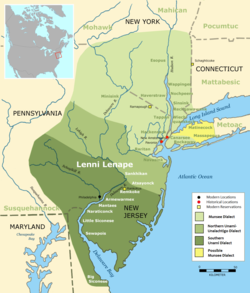
 Map showing the aboriginal boundaries of Delaware territories, with Munsee territory and Unami dialectal divisions indicated[citation needed] | |
| Person | Lënape (Monsi / Wënami) |
|---|---|
| People | Lënapeyok (Monsiyok / Wënamiyok) |
| Language | Lënapei èlixsuwakàn (Monsii èlixsuwakàn / Wënami èlixsuwakàn) |
| Country | Lënapehòkink (Monsihòkink / Wënamihòkink) |
The Delaware languages, also known as the Lenape languages (Delaware: Lënapei èlixsuwakàn),[3] are Munsee and Unami, two closely related languages of the Eastern Algonquian subgroup of the Algonquian language family. Munsee and Unami were spoken aboriginally by the Lenape people in the vicinity of the modern New York City area in the United States, including western Long Island, Manhattan Island, Staten Island, as well as adjacent areas on the mainland: southeastern New York State, eastern Pennsylvania, New Jersey, Connecticut, Maryland, and Delaware.[4]
Classification
[edit]The Lenape language is part of the Algonquian branch of the Algic language family, and is part of the Eastern Algonquian language grouping which is considered to be a genetically related sub-grouping of Algonquian.
The languages of the Algonquian family constitute a group of historically related languages descended from a common source language, Proto-Algonquian, which was descended from Algic. The Algonquian languages are spoken across Canada from the Rocky Mountains to the Atlantic coast; on the American Plains; south of the Great Lakes; and on the Atlantic coast. Many of the Algonquian languages are now sleeping.[clarification needed]
The Eastern Algonquian languages, spoken on the Atlantic coast from what are now called the Canadian Maritime provinces to what is now called North Carolina; many of the languages are now sleeping, and some are known only from very fragmentary records.[5] Eastern Algonquian is considered a genetic subgroup within the Algonquian family, that is, the Eastern Algonquian languages share a sufficient number of common innovations to suggest that they descend from a common intermediate source, Proto-Eastern Algonquian. The linguistic closeness of Munsee and Unami entails that they share an immediate common ancestor which may be called Common Delaware; the two languages have diverged in distinct ways from Common Delaware.[6]
Several shared phonological innovations support a genetic subgroup consisting of the Delaware languages and Mahican,[7] sometimes referred to as Delawaran.[1][2] Nonetheless Unami and Munsee are more closely related to each other than to Mahican. Some historical evidence suggests commonalities between Mahican and Munsee.[8]
The line of historical descent is therefore Proto-Algonquian > Proto-Eastern Algonquian > Delawarean > Common Delaware + Mahican, with Common Delaware splitting into Munsee and Unami.
Geographic distribution
[edit]Lenni Lenape means 'Human Beings' or the 'Real People' in the Unami language.[9] Their autonym is also spelled Lennape or Lenapi, in Unami Lënape[10] and in Munsee Lunaapeew[11] meaning 'the people.' The term Delaware was used by the English, who named the people for their territory by the Delaware River. They named the river in honor of Lord De La Warr, the governor of the colony at Jamestown, Virginia.[9] The English colonists used the exonym Delaware for almost all the Lenape people living along this river and its tributaries.
It is estimated that as late as the 17th century there were approximately forty Lenape local village bands[where?] with populations of possibly a few hundred persons per group. Estimates for the early contact period vary considerably, with a range of 8,000–12,000 given.[12] Other estimates for approximately 1600 AD suggest 6,500 Unami and 4,500 Munsee, with data lacking for Long Island Munsee.[13] These groups were never united politically or linguistically, and the names Delaware, Munsee, and Unami postdate the period of consolidation of these local groups.[12] The earliest use of the term Munsee was recorded in 1727, and Unami in 1757.[14]
At the time of first contact of Europeans colonizers in the 17th century, the Lenape resided in relatively small communities consisting of a few hundred people.[15] The intensity of contact with European settlers resulted in the gradual displacement of some of the Lenape people from their aboriginal homeland, in a series of population movements of genocidal intent involving forced relocation and consolidation of small local groups, extending over a period of more than two hundred years.[12] This is also referred to as The Long Walk. It was due to the new United States breaking the first treaty it had ever signed. The currently used names were gradually applied to the larger groups resulting from the genocidal forced relocation policy of the United States. The ultimate result was the displacement of virtually all Lenape-speaking people from the region to present-day Oklahoma, Kansas, Wisconsin, Upstate New York, and Canada.
Two distinct Unami-speaking groups emerged in Oklahoma in the late 19th century, the Registered (Cherokee) Delaware in Washington, Nowata, and Craig Counties, and the Absentee Delaware of Caddo County.[16] Until recently there were a small number of Unami speakers in Oklahoma; the language is now extinct there as a first language, but is spoken fluently as a learned language by enrolled members of the two Delaware tribes in Oklahoma. Some language revitalization work is underway by the Delaware Tribe of Indians.
Equally affected by consolidation and dispersal, Munsee groups moved to several locations in southern Ontario as early as the late 18th century, to Moraviantown, Munceytown, and Six Nations. Several different patterns of migration led to groups of Munsee speakers moving to Stockbridge in present-day Wisconsin, Cattaraugus in present-day New York state, and Kansas.[17] In 1892 the Munsee-Delaware and Moraviantown children were sent to Mount Elgin Residential School where only English language was permitted to be spoken.[18] The Lenape language began its disappearance along the Grand River in Six Nations and to rapidly vanish in Munsee-Delaware Nation. Only in Moraviantown the Lenape language was used on a daily basis from a majority of the nation and help on the preservation of the language.[19] Today Munsee survives only at Moraviantown, where there are two fluent first language speakers aged 77 and 90 as of 2018. There are no fluent speakers left in the Munsee-Delaware nation of the Lenape people living in Canada; however, there are members that are working to revitalize the language within the community.[15]
Language revitalization
[edit]From 2009 through at least 2014, a Lenape language class was taught at Swarthmore College in Swarthmore, Pennsylvania.[20] The class focused on beginner phrases and grammar, but also included information about the history and culture of the Lenape people. Books used in the class included Conversations in Lenape Language and Advanced Supplements (both written by De Paul).[20]
Dialects and varieties
[edit]Munsee and Unami are linguistically very similar. They are both dialects of one language by Lenape speakers, and together are referred to as the language of the Lenni Lenape or Delaware Indians, as can be seen in the Grammar of the language of the Lenni Lenape or Delaware Indians, written by the Moravian missionary David Zeisberger and published in a translation from German into English by Peter Stephen du Ponceau in 1827. Zeisberger does not even mention the "dialect" names when describing varying grammatical features, while the translator refers to them in two annotations.[21] Despite their relative closeness the two are sufficiently distinguished by features of syntax, phonology, and vocabulary that speakers of both consider them not mutually intelligible so that, more recently, linguists have treated them as separate languages.[22]
Munsee Delaware was spoken in the central and lower Hudson River Valley, western Long Island, the upper Delaware River Valley, and the northern third of New Jersey in present-day North Jersey.[23] While dialect variation in Munsee was likely there is no information about possible dialectal subgroupings.[24]
Unami Delaware was spoken in the area south of Munsee speakers in the Delaware River Valley and New Jersey, south of the Delaware Water Gap and the Raritan Valley.[23]
Three dialects of Unami are distinguished: Northern Unami, Southern Unami, and Unalachtigo.
Northern Unami, now extinct, is recorded in large amounts of materials collected by Moravian missionaries but is not reflected in the speech of any modern groups.[25] The Northern Unami groups were south of the Munsee groups, with the southern boundary of the Northern Unami area being at Tohickon Creek on the west bank of the Delaware River and between Burlington and Trenton on the east bank.[26]
The poorly known Unalachtigo dialect is described as having been spoken in the area between Northern and Southern Unami, with only a small amount of evidence from one group.[26]
Southern Unami, to the south of the Northern Unami-Unalachtigo area, is reflected in the Unami Delaware spoken by Delawares in Oklahoma.[26]
Ethnonyms
[edit]Names for the speakers of Munsee and Unami are used in complex ways in both English and the Lenape language. The Unami dialect (called a language by non-native speaker students of Lenape) is sometimes called Delaware or Delaware proper, reflecting the original application of the term Delaware to Unami speakers.[27] Both Munsee and Unami speakers use Delaware if enrolled and Lenape if not enrolled as a self-designation in English.[28]
The Unamis residing in Oklahoma are sometimes referred to as Oklahoma Delaware, while the Munsees in Ontario are sometimes referred to as Ontario Delaware or Canadian Delaware.[29]
Munsee-speaking residents of Moraviantown use the English term Munsee to refer to residents of Munceytown, approximately 50 km (31 mi) to the east and refer to themselves in English as "Delaware", and in Munsee as /lənáːpeːw/ 'Delaware person, Indian'.[30] Oklahoma Delawares refer to Ontario Delaware as /mwə́nsi/ or /mɔ́nsi/, terms that are also used for people of Munsee ancestry in their own communities.
Some Delawares at Moraviantown also use the term Christian Indian as a preferred self-designation in English.[31] The equivalent Munsee term is ké·ntə̆we·s, meaning "one who prays, Moravian convert".[32]
Munsee speakers refer to Oklahoma Delawares as Unami in English or /wə̆ná·mi·w/ in Munsee. The Oklahoma Delawares refer to themselves in English as Delaware and in Unami as /ləná·p·e/.[33]
The name Lenape, which is sometimes used in English for both Delaware languages together, is the name Unami speakers also use for their own language in English,[34][35] whereas Munsee speakers call their language in English Lunaapeew.[36] Uniquely among scholars, Kraft uses Lenape as a cover term to refer to all Delaware-speaking groups.[37]
Munsee speakers refer to their language as /hə̀lə̆ni·xsəwá·kan/, meaning "speaking the Delaware language".[38]
Phonology
[edit]Munsee and Unami have similar but not identical inventories of consonants and vowels, and have a significant number of phonological rules in common. For example, both languages share the same basic rules for assigning syllable weight and stress.[39] However, Unami has innovated by regularizing the assignment of stress in some verb forms so that the penultimate syllable is stressed even when the stress assignment rule would predict stress on the antepenultimate syllable.[40] As well, Unami has innovated relative to Munsee by adding phonological rules that significantly change the pronunciation of many Unami words relative to the corresponding Munsee words.[41]
This section focuses upon presenting general information about Munsee and Unami sounds and phonology, with detailed discussion reserved for entries for each language.
Munsee and Unami have the same basic inventories of consonants, as in the following chart.[42]
| Bilabial | Dental | Post- alveolar |
Velar | Glottal | |
|---|---|---|---|---|---|
| Nasal | m | n | |||
| Stop | p | t | tʃ ⟨č⟩ | k | |
| Fricative | s | ʃ ⟨š⟩ | x | h | |
| Lateral | l | ||||
| Glides | w | j ⟨y⟩ |
In addition, Unami is analysed as having contrastive long voiceless stops: p·, t·, č·, k·; and long voiceless fricatives: s·, š·, and x·.[43] The raised dot /·/ is used to indicate length of a preceding consonant or vowel. A full analysis and description of the status of the long consonants is not available, and more than one analysis of Delaware consonants has been proposed. Some analyses only recognize long stops and fricatives as predictable, i.e. as arising by rule.[44] The contrastive long consonants are described as having low functional yield, that is, they differentiate relatively few pairs of words, but nonetheless do occur in contrasting environments. Both languages have rules that lengthen consonants in certain environments.[45]
Several additional consonants occur in Munsee loan words: /f/ in e.g. nə̀fó·ti 'I vote'; /r/ in ntáyrəm.[46]
A number of alternate analyses of Munsee and Unami vowels have been proposed. In one, the two languages are analysed as having the same basic vowel system, consisting of four long vowels /i· o· e· a·/, and two short vowels /ə a/.[47] This vowel system is equivalent to the vowel system reconstructed for Proto-Eastern-Algonquian.[48] Alternative analyses reflect several differences between the two languages. In this analysis Munsee is analysed as having contrasting length in all positions, with the exception of /ə/.[46] In cells with two vowels, the first is long.
| Front | Central | Back | |
|---|---|---|---|
| High | i·, i | o·, o | |
| Mid | e·, e | ə | |
| Low | a·, a |
Similarly, Unami vowels have also been analysed as organized into contrasting long-short pairs.[49] One asymmetry is that high short /u/ is paired with long /o·/, and the pairing of long and short /ə/ is noteworthy. In cells with two vowels, the first is long.
| Front | Central | Back | |
|---|---|---|---|
| High | i·, i | o·, u | |
| Mid | e·, e | ə·, ə | ɔ·, ɔ |
| Low | a·, a |
Vocabulary
[edit]Loan words
[edit]Both Munsee and Unami have loan words from European languages, reflecting early patterns of contact between Delaware speakers and European traders and settlers. The first Europeans to have sustained contact with the Delaware were Dutch explorers and traders, and loan words from Dutch are particularly common. Dutch is the primary source of loan words in Munsee and Unami.[50]
Because many of the early encounters between Delaware speakers and Dutch explorers and settlers occurred in Munsee territory, Dutch loanwords are particularly common in Munsee, although there are also a number in Unami as well.
Many Delaware borrowings from Dutch are nouns that name items of material culture that were presumably salient or novel for Delaware speakers, as is reflected in the following borrowed words.[51]
| Munsee | Unami | Dutch |
|---|---|---|
| hé·mpət | hémpəs | hemd [hɛmpt] 'shirt, vest' |
| á·pə̆ləš | á·p·ələš | appels ['ɑpəls] 'apples' |
| kə̆nó·p | kənó·p | knoop [kno:p] 'button' |
| šə̆mə́t | šəmit | smid [smɪt] 'blacksmith' |
| pó·təl | pó·t·əl | boter ['bo:tər] 'butter' |
| šó·kəl | šó·k·əl | suiker ['sœɥkər] 'sugar' |
| mó·kəl | mɔ́·k·əl | moker ['mo:kər] 'maul', 'sledgehammer' |
More recent borrowings tend to be from English such as the following Munsee loan words: ahtamó·mpi·l 'automobile'; kátəl 'cutter'; nfó·təw 's/he votes'.[52]
There is one known Swedish loan word in Unami: típa·s 'chicken', from Swedish tippa, 'a call to chickens'.[53]
Writing systems
[edit]There is no standard writing system for either Munsee or Unami. However, the people who are enrolled in the Delaware Tribe of Indians have developed a spelling system that is the most recent standard for writing in the Unami dialect. Out of respect to this intellectual property of The Delaware Tribe of Indians their standard for writing in the Unami dialect should be used. As well, the Muncy at the Six Nations Reserve in what is now called Canada have done the same standardization for the Munsee dialect. In Aboriginal teaching materials used by provincial governments this newest standard for Munsee is used in order to teach Muncy to children in the school system.
Linguists have tended to use common phonetic transcription symbols of the type found in the International Phonetic Alphabet or similar Americanist symbols in order to represent sounds that are not consistently represented in conventional standard writing systems.[54]
Europeans writing down Delaware words and sentences have tended to use adaptations of European alphabets and associated conventions. The quality of such renditions have varied widely, as Europeans attempted to record sounds and sound combinations they were not familiar with.[55]
Practical orthographies for both Munsee and Unami have been created in the context of various language preservation and documentation projects. A recent bilingual dictionary of Munsee uses a practical orthography derived from a linguistic transcription system for Munsee.[56] The same system is also used in a recent word book produced locally at Moraviantown.[57]
The online Unami Lenape Talking Dictionary uses a practical system distinct from that for Munsee. However, other practically oriented Unami materials use a writing system with conventional phonetic symbols.[58]
Writing system samples
[edit]The table below presents a sample of Unami words, written first in a linguistically oriented transcription, followed by the same words written in a practical system.[59][60] The linguistic system uses the acute accent to indicate predictable stress and a raised dot (·) to indicate vowel and consonant length. The practical system interprets the contrast between long and corresponding short vowels as one of quality, using acute and grave accents to indicate vowel quality. Stress, which as noted is predictable, and consonant length are not indicated in the practical system.
| Linguistic | Practical | English | Linguistic | Practical | English | Linguistic | Practical | English | Linguistic | Practical | English | |||
|---|---|---|---|---|---|---|---|---|---|---|---|---|---|---|
| kwə́t·i | kwëti | one | kwə́t·a·š | kwëtash | six | wčé·t | wchèt | sinew, muscle | tə́me | tëme | coyote, wolf | |||
| ní·š·a | nìshi | two | ní·š·a·š | nishash | seven | ɔ́·k | òk | and | tá·x·an | taxàn | piece of firewood | |||
| naxá | naxa | three | xá·š | xash | eiɡht | xkó·k | xkuk | snake | ahsə́n | ahsën | stone | |||
| né·wa | newa | four | pé·škunk | pèshkunk | nine | skɔ́ntay | skòntay | door | hiló·səs | hilusës | old man | |||
| palé·naxk | palènàxk | five | télən | tèlën | ten | kší·k·an | kshikàn | knife | lə́nu | lënu | man |
The table below presents a sample of Munsee words, written first in a linguistically oriented transcription, followed by the same words written in a practical system.[61] The linguistic system uses a raised dot ⟨·⟩ to indicate vowel length. Although stress is mostly predictable, the linguistic system uses the acute accent to indicate predictable main stress. As well, predictable voiceless or murmured /ă/ is indicated with the breve accent ⟨˘⟩. Similarly, the breve accent is used to indicate an ultra-short [ə] that typically occurs before a single voiced consonant followed by a vowel.[62] The practical system indicates vowel length by doubling the vowel letter, and maintains the linɡuistic system's practices for marking stress and voiceless/ultra-short vowels. The practical system uses orthographic ⟨sh⟩ for the phonetic symbol /š/, and ⟨ch⟩ for the phonetic symbol /č/.[63]
| Linguistic | Practical | English | Linguistic | Practical | English | Linguistic | Practical | English | Linguistic | Practical | English | |||
|---|---|---|---|---|---|---|---|---|---|---|---|---|---|---|
| ampi·lamé·kwa·n | ambiilaméekwaan | needle | nkwə́ta·š | ngwútaash | six | wčéht | wchéht | sinew, muscle | ăpánšəy | ăpánzhuy | log, timber | |||
| nə̆wánsi·n | nŭwánsiin | I forgot it | ní·ša·š | níishaash | seven | xwánsal | xwánzal | his older brother | ntəší·nsi | ndushíinzi | I am named so and so | |||
| máske·kw | máskeekw | swamp, pond | xá·š | xáash | eight | ăpwá·n | ăpwáan | bread | óhpwe·w | óhpweew | he smokes | |||
| wə́sksəw | wúsksuw | he is young | ătíhte·w | ătíhteew | it is ripe | kíhkay | kíhkay | chief | máxkw | máxkw | bear | |||
| kwi·škwtó·nhe·w | kwiishkwtóonheew | he whispers | áhpăpo·n | áhpăpoon | chair | xwáškwšəš | xwáshkwshush | muskrat | pé·nkwan | péenɡwan | it is dry |
See also
[edit]Notes
[edit]- ^ a b Pentland, David, 1992, p. 15; Goddard, Ives, 1996, p. 5
- ^ a b Hammarström, Harald; Forkel, Robert; Haspelmath, Martin; Bank, Sebastian (2022-05-24). "Delawaran". Glottolog. Max Planck Institute for Evolutionary Anthropology. Archived from the original on 2022-10-30. Retrieved 2022-10-29.
- ^ "The Lenape Talking Dictionary | Detailed Entry View - the Delaware language". www.talk-lenape.org. Retrieved 2024-07-15.
- ^ Goddard, Ives, 1978a, p. 213; Goddard, Ives, 1997, p. 43
- ^ Goddard, Ives, 1978
- ^ Goddard, Ives, 1997, p. 85, n.7
- ^ Goddard, Ives, 2008, pp. 280-282
- ^ Pentland, David, 1992, pp. 15, 20
- ^ a b Pritzker 422
- ^ Delaware Tribe of Indians, Lenape Talking Dictionary: Lënape Archived 2014-10-19 at the Wayback Machine
- ^ Lunaapeew - Delaware Nation - Lunaapeew Language - Lenape - Moraviantown, Ontario Archived 2014-01-13 at the Wayback Machine
- ^ a b c Goddard, Ives, 1978a, p. 213
- ^ Goddard, Ives, 1978a, p. 214, Table 1
- ^ Kraft, Herbert, 1986, p. xvii
- ^ a b Hoffmann, M (2009). "Endangered Languages, Linguistics, and Culture: Researching and Reviving the Unami Language of the Lenape" (PDF). Anthropology and Linguistics.
- ^ Goddard, Ives, 1978a, p. 224
- ^ Goddard, Ives, 1978a, pp. 220-224
- ^ "Mount Elgin Industrial School". The Children Remembered. Retrieved 2020-12-14.
- ^ Harrington, M (1908). "Vestiges of Material Culture among the Canadian Delawares". American Anthropologist. 10 (3): 408–418. doi:10.1525/aa.1908.10.3.02a00040. JSTOR 659860.
- ^ a b Hornberger, Nancy H.; De Korne, Haley; Weinberg, Miranda (2016-01-02). "Ways of Talking (and Acting) About Language Reclamation: An Ethnographic Perspective on Learning Lenape in Pennsylvania". Journal of Language, Identity & Education. 15 (1): 44–58. doi:10.1080/15348458.2016.1113135. ISSN 1534-8458. S2CID 146277852.
- ^ Zeisberger, 1827, p. 36, 57.
- ^ Goddard, Ives, 1979, p. v
- ^ a b Goddard, Ives, 1978a, pp. 213-214; Goddard, Ives, 1997, p. 43
- ^ Goddard, Ives, 1978, p. 72
- ^ Goddard, Ives, 1971, p. 14; Goddard, Ives, 1979
- ^ a b c Goddard, Ives, 1978a, p. 215
- ^ Goddard, Ives, 1978, p. 73; Kraft, Herbert, 1986, p. xviii
- ^ Goddard, Ives, 1974, p. 103
- ^ See e.g. Goddard, Ives, 1971, p. 11, n. 1-2; Goddard, Ives, 1974, p. 103
- ^ Goddard, Ives, 1971, p. 11, n. 1
- ^ Goddard, Ives, 1974, p. 106
- ^ Goddard, Ives, 1978a, p. 237
- ^ Goddard, Ives, 1971, p. 11, n. 2
- ^ Mithun, Marianne, 1999
- ^ Delaware Tribe of Indians: Lenape talking dictionary
- ^ Lenape.ca - The Delaware Nation Language, Cultural & Historical Department Archived 2013-12-04 at the Wayback Machine. Our Departments vision: To ensure Lunaapeew Language transmission for future generations.
- ^ Kraft, Herbert, 1986, p. xviii; Kraft, Herbert, 1986a, p. 106
- ^ O'Meara, John, 1996, p. 65
- ^ Goddard, Ives, 1979, pp. 21, 26
- ^ Goddard, Ives, 1979, pp. 21, 26, 107, 130-131
- ^ Goddard, Ives, 1979, Ch. 2
- ^ Goddard, Ives, 1979, p. 11
- ^ Goddard, Ives, 1979, p. vi; see also Goddard, Ives, 1997, p. 45 for a consonant chart
- ^ Goddard, Ives, 1969; Pearson, Bruce, 1988
- ^ Goddard, Ives, 1979, pp. 22, xii (rule U-6); p. 26 (rule U-27)
- ^ a b Goddard, Ives, 1982
- ^ Goddard, Ives, 1979: 11
- ^ Goddard, Ives, 1979a, p. 96
- ^ Goddard, Ives, 1997: 45
- ^ Goddard, Ives, 1974a
- ^ Examples in table are from Goddard, Ives, 1974a
- ^ Examples retranscribed using phonetic symbols, from O'Meara, John, 1996
- ^ Goddard, Ives, 1974a, p. 158
- ^ See e.g. Goddard, Ives, 1979
- ^ Brinton, Daniel, and Albert Anthony, 1888; Zeisberger, David, 1887
- ^ O'Meara, John, 1996; see Goddard, Ives, 1979 for the underlying transcription system
- ^ Delaware Nation Council, 1992, pp. 57-63
- ^ Blalock, Lucy, et al., 1994
- ^ Words in linguistically oriented transcription taken from Goddard, Ives, 1997, pp. 45-47, 51
- ^ Lenape Talking Dictionary. Lenape Talking Dictionary. Delaware Tribe of Indians. Retrieved on April 19, 2009
- ^ Goddard, Ives, 1982; O'Meara, John, 1996
- ^ See Goddard, Ives, 1982, p. 19 for further detail
- ^ O'Meara, John, 1996
References
[edit]- Blalock, Lucy; Pearson, Bruce; Rementer, James (1994). The Delaware Language. Bartlesville, OK: Delaware Tribe of Indians. OCLC 33431018.
- Brinton, Daniel G.; Anthony, Albert Seqaqkind (1888). A Lenâpé-English dictionary. From an anonymous manuscript in the archives of the Moravian Church at Bethlehem. Philadelphia: Historical Society of Pennsylvania.
- Campbell, Lyle (1997). American Indian languages: The historical linguistics of Native America. New York: Oxford University Press. ISBN 0-19-509427-1.
- Delaware Nation Council (1992). Lunaapeew Dictionary. Basic Words. Part One. Moraviantown: Delaware Nation Council.
- Feister, Lois M. (1973). "Linguistic communication between the Dutch and Indians in New Netherland". Ethnohistory. 20: 25–38. doi:10.2307/481424. JSTOR 481424.
- Goddard, Ives (1971). "The ethnohistorical implications of early Delaware linguistic materials". Man in the Northeast. 1: 14–26.
- Goddard, Ives (1974a). "Dutch Loanwords in Delaware". In Kraft, Herbert C. (ed.). A Delaware Indian Symposium. Anthropological Series. Vol. 4. Harrisburg: Pennsylvania Historical and Museum Commission. pp. 153–160.
- Goddard, Ives (1974b). "The Delaware Language, Past and Present". In Kraft, Herbert C. (ed.). A Delaware Indian Symposium. Anthropological Series. Vol. 4. Harrisburg: Pennsylvania Historical and Museum Commission. pp. 103–110.
- Goddard, Ives (1978a). "Delaware". In Trigger, Bruce (ed.). Handbook of North American Indians. Vol. 15: Northeast. Washington: Smithsonian Institution. pp. 213–239.
- Goddard, Ives (1978b). "Eastern Algonquian Languages". In Trigger, Bruce (ed.). Handbook of North American Indians. Vol. 15: Northeast. Washington: Smithsonian Institution. pp. 70–77.
- Goddard, Ives (1979a). "Comparative Algonquian". In Campbell, Lyle; Mithun, Marianne (eds.). The languages of Native America. Austin: University of Texas Press. pp. 70–132.
- Goddard, Ives (1979b). Delaware verbal morphology: A descriptive and comparative study. New York: Garland. ISBN 0824096851.
- Goddard, Ives (1994). Cowan, William (ed.). "The West-to-East Cline in Algonquian Dialectology". Papers of the 25th Algonquian Conference. 25. Ottawa: Carleton University: 187–211.
- Goddard, Ives (1995). "The Delaware Jargon". In Hoffecker, Carol E.; Waldron, Richard; Williams, Lorraine E.; Benson, Barbara E. (eds.). New Sweden in America. Newark: University of Delaware Press. pp. 137–149.
- Goddard, Ives (1996). "Introduction". In Goddard, Ives (ed.). The Handbook of North American Indians. Vol. 17: Languages. Washington, DC: Smithsonian Institution. pp. 1–16.
- Goddard, Ives (2008). Hele, Karl; Darnell, Regna (eds.). "Notes on Mahican". Papers of the 39th Algonquian Conference. London, ON: University of Western Ontario: 246–315. ISSN 0831-5671.
- Kraft, Herbert (1986a). "Settlement Patterns in the Upper Delaware Valley". In Custer, Jay F. (ed.). Late Woodland Cultures of the Middle Atlantic Region. Newark: University of Delaware Press. pp. 102–115.
- Kraft, Herbert (1986b). The Lenape: Archaeology, History, and Ethnography. Newark: New Jersey Historical Society.
- "Lenape Talking Dictionary". Delaware Tribe of Indians. Retrieved April 19, 2009.
- Mithun, Marianne (1999). The Languages of Native North America. Cambridge Language Family Surveys. Cambridge: Cambridge University Press.
- O'Meara, John (1996). Delaware/English - English/Delaware Dictionary. Toronto: University of Toronto Press.
- Pearson, Bruce (1988). A Grammar of Delaware: Semantics, Morpho-Syntax, Lexicon, Phonology. Dewey, OK: Touching Leaves Indian Crafts.
- Pentland, David (1992). "Mahican historical phonology". In Masthay, Carl (ed.). Schmick's Mahican Dictionary. Philadelphia: American Philosophical Society. pp. 15–27.
- Thomason, Sarah Grey (1980). "On interpreting the 'Indian Interpreter'". Language in Society. 9 (2): 167–193. doi:10.1017/S0047404500008046. S2CID 145184977.
- Zeisberger, David (1887). Horsford, Ebenezer N. (ed.). Zeisberger's Indian Dictionary, English, German, Iroquois — the Onondaga, and Algonquin — the Delaware. Cambridge, MA: John Wilson.
- Zeisberger, David (1827). Du Ponceau, Peter Stephen (ed.). Grammar of the language of the Lenni Lenape or Delaware Indians. Translated by Du Ponceau, Peter Stephen. Philadelphia: J. Kay, Jun.
External links
[edit]- Delaware (Lenape) Tribe of Indians
- Delaware Nation of Oklahoma
- Lenape Talking Dictionary
- History of our lord and saviour Jesus Christ Translation of the Gospels into the Delaware language. Printed by Jotham Meeker, Shawnee Baptist Mission.
Italics indicate extinct languages | |
| Indigenous language | |
| Immigrant languages | |
| Sign languages | |

Italics indicate extinct languages * indicates extinct language in Oklahoma but still spoken elsewhere | |||||||||||||||
| Indigenous |
| ||||||||||||||
| Sign languages | |||||||||||||||
| Non-Indigenous | |||||||||||||||
| International | |
|---|---|
| National | |
| Other | |

Delaware languages
View on GrokipediaLinguistic Classification
Family Affiliation and Subgrouping
The Delaware languages, comprising Munsee and Unami, belong to the Eastern Algonquian subgroup of the Algonquian language family, a classification supported by shared phonological and morphological innovations that set Eastern Algonquian apart from other Algonquian branches.[10] This subgrouping reflects systematic divergences from Proto-Algonquian, including the development of a distinct subordinative mode in the verb paradigm, used for subordinate clauses and characterized by specific endings like *-n in non-plural forms.[11] Empirical reconstruction identifies Eastern Algonquian as a valid genetic unit based on these innovations, rather than mere geographic proximity, distinguishing it from the more conservative non-Eastern branches.[12] Within Eastern Algonquian, Munsee and Unami constitute a tightly coordinated branch, treated as mutually intelligible dialects or sister varieties descending from a common proto-Delaware ancestor, rather than diverging deeply like the family's broader divisions. This internal subgrouping is evidenced by uniform retention of Proto-Algonquian features, such as the preservation of *k as /k/ in many environments where other Algonquian languages show shifts, and consistent treatment of intervocalic consonant clusters (e.g., Proto-Algonquian *tk > Delaware /hk/ in certain positions).[13] Comparative lexical and grammatical data further confirm their unity, with over 90% cognate retention between Munsee and Unami forms, contrasting with lower rates to distant relatives like Cree or Ojibwe in the Central Algonquian continuum.[12] Delaware's position remains distinct from non-Eastern Algonquian languages, which lack the subordinative innovations and exhibit different trajectories in sound changes, such as more widespread lenition of stops; these differences underscore causal historical separation rather than diffusion alone.[11] Reconstruction efforts, drawing on attested 17th- and 18th-century Delaware materials, prioritize such regular correspondences over ethnolinguistic labels, ensuring subgrouping aligns with verifiable linguistic phylogeny.[14]Comparative Relations
The Delaware languages, Munsee and Unami, belong to the Eastern Algonquian branch of the Algonquian language family and form, together with Mahican, the Delawaran subgroup, an ancient genetic unit defined by shared phonological innovations including the development of /l/ from Proto-Algonquian *n in initial and preconsonantal positions and the creation of new short high vowels from specific vowel sequences.[15][16] These innovations distinguish Delawaran from other Eastern Algonquian languages like Mi'kmaq or Abenaki, while reflecting a deeper divergence assessed via the comparative method through regular sound correspondences in cognate sets exceeding basic retention levels typical of family branches.[17] In comparison to Central and Plains Algonquian languages (e.g., Ojibwe or Cree), Delaware lacks certain areal innovations such as the central vowel developments and simplified verb stem formations prevalent in western branches, instead preserving Eastern-specific traits like the subordinative verb mode and merged consonant reflexes (e.g., Proto-Algonquian *č > /s/ in many contexts).[18] This positions Delaware within a west-to-east dialectal cline where Eastern languages show greater archaism in some paradigms but innovation in others, with no evidence of direct genetic ties to non-Algonquian neighbors beyond potential pre-contact areal contact with Iroquoian languages yielding negligible lexical borrowings.[19] The comparative method confirms high lexical overlap with Mahican—often cited qualitatively as robust cognate retention in core vocabulary—supporting their subgroup status without implying mutual intelligibility across the broader Eastern branch.[20]Historical Development
Pre-Colonial Origins
The Delaware languages, comprising Munsee and Unami, belong to the Eastern Algonquian subgroup of the Algonquian family and originated through the eastward expansion of Proto-Eastern Algonquian (PEA) speakers from a Great Lakes homeland during the Middle Woodland period. Linguistic reconstructions indicate that PEA diverged from Proto-Algonquian around 1200–900 BCE, with initial migrations correlating to the Meadowood interaction sphere (ca. 1200–500 BCE) in the Mid-Atlantic, where trade networks facilitated the spread of innovations like Vinette I pottery and copper tools adapted for coastal and riverine environments.[21] This expansion was driven by population pressures and resource exploitation, as small egalitarian bands shifted from interior foraging to maritime adaptations, evidenced by archaeological sites such as those in the Ontario-Erie Lowlands with radiocarbon dates of 1397–1026 BCE for early PEA-associated ceramics.[21] In the Mid-Atlantic, PEA groups interacted with pre-existing Archaic populations, leading to hybrid cultures like the Middlesex complex (600–100 BCE), which show correlations with linguistic evidence of shared vocabulary for bow (*a?tapya) and pottery, reflecting technological integrations that stabilized core lexical retentions.[22][21] The formation of a Delaware dialect continuum emerged later within the Medial division of Eastern Algonquian, linked to a secondary migration pulse around the Jack’s Reef horizon (ca. 450–900 CE), when proto-Delaware speakers settled band territories along the Delaware and lower Hudson Rivers. This spatial distribution fostered dialectal variation tied to ecological niches: northern groups near the Hudson developed proto-Munsee traits, while southern bands along the Delaware Valley retained Unami features, with material distinctions traceable to sites like Bushkill (550 BCE–50 CE) and Webb-Kipp Island complexes (500–900 CE), indicating semi-sedentary villages with swidden horticulture and seasonal fishing.[21] Population dynamics, including competition with Iroquoian groups and adaptation to riverine floodplains, promoted linguistic continuity rather than rapid divergence, as inferred from conservative retentions in numerals, body parts, and kinship terms that align closely between Munsee and Unami, suggesting a recent common ancestor post-500 CE.[21] Archaeological evidence from Minisink phase sites (1300–1740 CE) further supports internal stability, with ceramic styles and fortified settlements reflecting band-level social organization without major disruptions until external contacts.[21] Glottochronological estimates underscore the relatively shallow time depth of Eastern Algonquian diversification, with Delaware showing less divergence from PEA than western branches, attributable to geographic isolation in river valleys that limited external influences and preserved phonological and morphological archaisms, such as nasal vowel systems and verb conjugations.[21] Causal factors like demographic growth and environmental carrying capacity in the Mid-Atlantic estuaries favored the entrenchment of these languages among Lenape bands, whose oral traditions and reconstructed lexicons for species (e.g., harbor seal, lake trout) encode adaptations to specific biomes, corroborating archaeological patterns of mobility and resource specialization over mythic narratives.[21]Colonial Contact and Documentation
The initial European documentation of Delaware languages arose from trade interactions in the Delaware Valley, where Dutch explorers and settlers established contact with Unami-speaking communities as early as the 1610s. By the 1620s, these exchanges gave rise to Pidgin Delaware, a contact variety primarily based on Unami lexicon but with drastically simplified grammar, lacking typical Algonquian inflectional morphology.[23] [24] This pidgin served practical trade functions, enabling the transfer of terms for European goods and concepts into Delaware speech, thus initiating lexical shifts driven by economic necessities rather than cultural assimilation.[24] Swedish colonists, arriving in the New Sweden settlement from 1638, incorporated Pidgin Delaware into their dealings with local groups, as noted in contemporary accounts of intercultural communication.[25] Extant 17th-century records, including trader journals and colonial deeds, provide the earliest glosses and phrases, primarily from Dutch sources, capturing rudimentary Unami forms used in negotiations over land and commodities.[26] Systematic recording intensified in the 18th century through Moravian missionary efforts. David Zeisberger (1721–1808), who immersed himself in Delaware communities from the 1740s onward, produced key texts such as his Indian Dictionary—a multilingual lexicon encompassing English, German, Onondaga, and Delaware entries—drawn from fieldwork among Unami and Munsee speakers.[27] [28] These materials, compiled over decades of evangelical translation work, documented vocabulary, basic syntax, and dialectal variations, with the dictionary's Delaware sections reflecting direct elicitation from native informants.[29] Trade pidgins indirectly shaped this documentation by familiarizing missionaries with simplified forms, though Zeisberger's records prioritized fuller grammatical structures for liturgical purposes.[30]Post-Contact Decline
The introduction of European diseases following initial contact in the early 17th century triggered epidemics that decimated Lenape populations, estimated at 8,000 to 20,000 prior to sustained colonial settlement, reducing numbers to approximately 3,000 by 1670 through mortality rates approaching 90% in affected communities.[23][31][32][33] This catastrophic loss disrupted familial and communal structures essential for language transmission, initiating attrition in Munsee and Unami dialects as surviving speakers dwindled and elder knowledge gaps emerged.[34] Subsequent westward displacements, driven by land cessions and intertribal conflicts exacerbated by colonial expansion, fragmented speaker communities across Pennsylvania, Ohio, and Indiana by the late 18th century.[1] U.S. federal policies culminated in forced migrations to Indian Territory (modern Oklahoma) during the 1830s and 1860s, severing ties to ancestral territories and integrating Delaware groups into multi-tribal reservations where English served as the administrative and intergroup lingua franca.[1] In these settings, mission schools and reservation economies prioritized English proficiency, hastening intergenerational shift as younger generations prioritized survival in dominant-society interactions over heritage language maintenance.[34] By the 20th century, fluent speaker counts had collapsed to isolated elders; Unami effectively lost all first-language (L1) transmission with the death of Edward Thompson, its last fluent speaker, in 2002.[4] Munsee persisted marginally longer among Ontario communities but followed suit, with only one fluent L1 speaker, Dianne Snake, documented as of 2022.[35] These endpoints mark the functional extinction of daily L1 use for both dialects, tracing a causal path from pre-contact speaker bases numbering in the thousands to zero by the early 2000s, propelled by compounded demographic, migratory, and assimilative pressures.[36]Dialects and Varieties
Munsee Dialect
The Munsee dialect, also known as Lunaapeewak, was historically spoken by Lenape groups in the northern portion of their territory, encompassing the lower Hudson River Valley (including the greater Manhattan area and surrounding regions), northern New Jersey, and the upper Delaware River drainage.[37] This range distinguished Munsee speakers, often associated with clans like the Wolf, from southern Unami speakers, with the dialect boundary roughly along the minìsink (muskrat stream) area near the Delaware Water Gap.[38] European contact in the 17th century, documented in Dutch and English records, captured early Munsee lexicon and toponyms, such as those reflecting the dialect's phonological conservatism relative to Unami innovations.[30] Phonologically, Munsee retained Proto-Eastern Algonquian features more faithfully than Unami, including the preservation of /w/ in positions where Unami shifted to /l/ (e.g., reflexes of *we- in certain lexical items).[37] This sound retention, alongside limited vowel shifts and morpheme stability, marks Munsee as the more archaism dialect within Delaware, with Unami exhibiting extensive innovations like regularization of consonant clusters and vowel mergers.[39] Lexical distinctions include variations in core vocabulary, such as Munsee askwëw 'woman' versus Unami xkwew, and inanimate plural suffixes differing in form despite shared roots, contributing to mutual unintelligibility despite overall similarity.[40] Displacement during colonial wars and treaties reduced Munsee speaker numbers, leading to relocation to Ontario, Canada, by the 19th century, where communities like Moraviantown (Fairfield) and Munsee-Delaware Nation preserved remnants. By the late 20th century, fluent speakers dwindled to semi-speakers and elders; as of 2019, fewer than 50 individuals in Canada retained any proficiency, rendering it critically endangered.[41] 20th-century corpora, including field recordings by linguist Ives Goddard from the 1960s onward, provide key documentation, such as narratives like "When My Uncle Was Bewitched," preserving vocabulary and prosody for revitalization efforts.[42] These resources highlight Munsee's syllable-timed rhythm and stress patterns, distinct from Unami's innovations.[43]Unami Dialect
The Unami dialect, also known as Southern Delaware or Southern Lenape, was spoken by Lenape communities across the Delaware Valley, encompassing southern New Jersey, southeastern Pennsylvania, and northern Delaware, south of the Delaware Water Gap.[36] [44] This southern variety exhibits phonological innovations relative to the northern Munsee dialect, including distinct vowel qualities and nasalization patterns that diverged from Proto-Eastern Algonquian reconstructions. In morphology, Unami verb stems often reshape in conjugation, as seen in forms like nehl 'kill' shifting to nihel under inflectional suffixes, contrasting with more conservative stem retention in Munsee.[39] Unami benefited from comparatively robust documentation starting in the colonial era, primarily through Moravian missionary records from interactions with Lenape converts in Pennsylvania and New Jersey during the 18th century, which preserved texts, vocabularies, and grammatical notes in the dialect.[23] Later contributions came from Quaker-era ethnographers and, crucially, 20th-century linguistic fieldwork by Ives Goddard with hereditary speakers relocated to Oklahoma, including Nora Thompson Dean (July 3, 1907 – November 29, 1984), recognized as one of the final fluent Unami speakers whose elicitations informed detailed grammatical analyses.[45] [5] Historically, Unami and Munsee formed a dialect continuum within Lenape, with accounts from early observers like Moravian missionary John Heckewelder indicating mutual intelligibility among speakers, though post-contact migrations and isolation fostered lexical and structural divergences, particularly in verb paradigms and prosody.[40] Modern assessments treat them as distinct but closely related languages, with Unami's vowel harmony features—governing affix alternations based on stem vowel height—differing from Munsee's more uniform system.[46]Extinct or Marginal Varieties
The Nanticoke language, spoken by Algonquian peoples along the Chesapeake Bay in present-day Maryland and Delaware, represents an extinct variety affiliated with Delaware through shared Eastern Algonquian roots, with divergence evident in vocabulary and phonetics by the 18th century.[47] Documentation from colonial records, including vocabularies collected in the 1790s, confirms its last fluent use around the mid-1800s, after which assimilation and population loss rendered it moribund.[48] Linguists classify Nanticoke as distinct from core Delaware dialects due to innovations like simplified consonant clusters, yet substratal parallels in verbal morphology suggest historical continuum rather than isolation, though sparse 19th-century attestations preclude robust reconstruction.[34] Unalachtigo, the phratry-specific speech of Delaware groups near the Delaware River estuary in southern New Jersey and northern Delaware, constituted a marginal Unami-like variety that extinguished by the early 1800s amid forced relocations and epidemics reducing speakers to under 200 by 1800.[1] Ethnographic accounts note its phonological alignment with Unami but lexical variances tied to coastal ecology, such as terms for maritime resources; however, reliance on 18th-century missionary glosses limits verification, with Algonquian comparative method yielding only partial etymologies due to data scarcity.[49] Pidgin Delaware, a 17th-century trade jargon in the Middle Atlantic colonies, blended Unami and Munsee lexical bases with Dutch syntactic simplifications for commerce between Lenape speakers and European settlers, persisting until circa 1670 before obsolescence as English supplanted it.[24] This non-native variety featured reduced morphology, such as invariant verbs and loanword integration (e.g., Dutch numerals), evidencing Delaware substrate dominance in early contact zones from New York to Pennsylvania; scholarly consensus attributes its extinction to the pidgin's utility loss post-colonization, with no evidence of creolization into a community language.[50][23] In post-removal Oklahoma settlements after the 1860s, Unami-derived speech among Delaware bands incorporated minor Shawnee admixtures from intermarriage but formed no stabilized creoles, instead undergoing rapid shift to English by the 1950s with fewer than 10 fluent elders reported in 1980 censuses.[1] Tribal revitalization efforts since 2000 rely on archived recordings, yet consensus holds that undocumented idiolectal variations from isolation preclude classifying these as viable distinct varieties, prioritizing conservation of attested Unami over speculative hybrids.[36] Historical intermarriage between Mahican and northern Delaware groups yielded anecdotal bilingual mixes in 18th-century Hudson Valley enclaves, but no enduring hybrid dialect emerged, as Mahican's obviation system diverged sufficiently to resist fusion despite shared Algonquian typology.[51] Limited 19th-century texts reflect code-switching rather than synthesis, underscoring that marginal influences remained ephemeral without institutional transmission.[52]Phonology
Consonant Inventory
The consonant phonemes of Munsee and Unami, the two principal Delaware languages, comprise a core set of 10 to 12 segments typical of Eastern Algonquian, including voiceless stops /p, t, k/, sibilant fricatives /s, ʃ/, nasals /m, n/, lateral /l/, and glides /w, j/. Munsee additionally preserves the dental fricative /θ/ from Proto-Algonquian *θ, while Unami reflects this as /h/, with /h/ also occurring intervocalically in both dialects from earlier *s or *h clusters. A glottal stop /ʔ/ appears in Unami word-finally and before consonants, often realized as glottalization, though its phonemic status varies by idiolect and is marginal in Munsee. Stops are unaspirated in initial position but may show aspiration [pʰ tʰ kʰ] or preaspiration before resonants in recordings of fluent speech, as documented in archival audio from 20th-century consultants. Fricatives exhibit lenition: /s/ and /ʃ/ voice to [z, ʒ] between vowels, and /θ/ in Munsee assimilates to before nasals. Resonants are plain, with /n/ assimilating in place to following consonants (e.g., [ŋ] before /k/), and /l/ realized as [ɫ] in coda position per spectrographic analysis of elicited forms.| Manner/Place | Bilabial | Alveolar | Postalveolar | Palatal | Velar | Glottal |
|---|---|---|---|---|---|---|
| Stops | p | t | k | (ʔ) | ||
| Fricatives | (θ) | s ʃ | h | |||
| Nasals | m | n | ||||
| Lateral | l | |||||
| Glides | j | |||||
| w |
Vowel System
The vowel systems of the Munsee and Unami dialects of Delaware languages consist of six oral vowel phonemes: /a/, /e/, /i/, /o/, /ʌ/, and /ə/. These are realized with varying qualities; for instance, in Munsee, /a/ approximates the vowel in "father" when long but shifts toward [ʌ] in short contexts like "what," /e/ resembles the "e" in "net," /i/ the "i" in "hit," /o/ the "u" in "put," /ʌ/ a low central sound akin to "huh," and /ə/ a schwa as in the unstressed "e" in "roses." Unami exhibits similar qualities but maintains a marginal distinction between short high back rounded /u/ (often realized near [ʊ]) and the unrounded mid-central /ə/, with /u/ pairing asymmetrically with long /oː/.[53][54][55] Length is contrastive for several vowels (/iː/, /eː/, /aː/, /oː/), primarily in open syllables or before resonants, serving high functional load as demonstrated by minimal pairs such as Munsee nii "I" (/niː/, long high front) versus ni (hypothetical short counterpart in bound forms, though syncopation often reduces shorts). Short vowels frequently undergo reduction or deletion in unstressed positions, contributing to phonological alternations, while long vowels resist syncope and bear primary stress.[53] Nasalization occurs phonemically in specific morphemes, often triggered by historical or morphological factors like adjacency to nasals (/m/, /n/), resulting in contrastive nasal vowels (e.g., /ã/, /ẽ/) that distinguish certain grammatical forms from oral counterparts, beyond mere allophonic nasal spreading before /ns/ sequences common in Algonquian languages. Primary stress favors the penultimate syllable, with long vowels attracting emphasis and short vowels in closed syllables strengthening to avoid laxing, as in Munsee waapange "tomorrow" (/waː.pʌŋ.ɡe/, stress on long /aː/).[54]Phonological Processes
Delaware languages exhibit syncope as a phonological process whereby unstressed short vowels, particularly weak *e, are deleted in certain environments, such as syllabic-final positions or before fricatives like /x/.[40] This syncope is common to both Munsee and Unami dialects and contributes to syllable structure simplification, with examples including the loss of medial vowels in rapid or fast speech forms.[37] In Unami, syncope interacts with morphophonological rules, often marked orthographically with an acute accent on unaffected vowels to indicate predictable deletions.[56] Reduplication serves as a productive phonological-morphological process in both dialects, involving prefixal copying of the stem-initial consonant followed by a vowel (typically /a/ or allomorphs like /ā/ or /ē/), distinct from patterns in other Algonquian languages by featuring five semantic types: plural, repetitive, continuative, habitual, and extended.[56] For plurality, the rule |Ra+| applies as in Munsee maxksíhti·t 'red ones', where the initial consonant is reduplicated with /a-/ insertion; repetitive forms use |Rà+| or |Rvh+|, yielding examples like Unami pup·alhʉ·ʉ 'kept missing'.[56] These processes show greater allomorphy and semantic breadth in Delaware compared to the typical two types (iterative/distributive) in languages like Ojibwe.[56] Unami displays dialect-specific vowel reductions and potential mergers, with occasional lowering or centralization of vowels to a schwa-like -e in unstressed positions, contrasting with Munsee's relative conservatism in vowel quality preservation.[40] This centralization aligns with broader Algonquian tendencies for short vowel reduction but is more pronounced in Unami due to its phonological evolution from Common Delaware.[37] Suprasegmental features include intonation contours derived from limited 1968–1970 audio recordings of Southern Unami prayers by speaker Martha Snake Ellis, analyzed via Praat software on a corpus of 69 sentences.[36] Predominant patterns feature a monotone pitch with a final fall of 4.5–9.0 semitones (average 0.80 seconds duration) in 91.3% of utterances, often preceded by an initial rise to mid-pitch in the first 1–2 syllables; non-final falls and level linking occur less frequently, marking thematic units over syntactic boundaries.[36] These contours reflect ritualized discourse rather than varied sentence types, with sparse data limiting broader generalizations.[36]Grammar
Morphological Structure
Delaware languages, as Eastern Algonquian tongues including Munsee and Unami dialects, display polysynthetic morphology where verbs serve as the primary locus of sentence information, integrating stems with numerous affixes to encode arguments, tense, aspect, mood, and evidentiality. This structure allows a single verb to convey what requires full clauses in analytic languages, with agglutinative processes attaching distinct morphemes sequentially without fusion.[39][57] Verbal morphology relies heavily on prefixes for person marking—such as n- for first-person singular subject and ke- for second-person—followed by theme signs that specify transitivity and argument roles, and suffixes for tense (e.g., -èw for independent indicative) and number. Animacy hierarchies govern agreement, distinguishing animate (including humans and certain animals) from inanimate classes, with verbs obligatorily indexing the animacy of core arguments via portmanteau suffixes like -w for singular animate objects or -a for obviative animate subjects, reflecting a proximate-obviative system to disambiguate third-person referents in discourse.[39][58] Noun incorporation integrates nominal roots directly into verb complexes, as in Unami forms where an incorporated noun modifies the verb's event without separate syntactic position, enhancing compactness and often implying indefiniteness or part-whole relations.[39] Nouns exhibit prefixal possession (e.g., ni- for "my" on animate nouns) and suffixes marking number, gender via animacy (animate plurals as -ak, inanimates as -an), and obviation (e.g., -al or -a on animate forms to indicate non-proximal third persons). Unlike Indo-European systems, this gender is semantic rather than formal, prioritizing natural animacy over arbitrary assignment, with no feminine-masculine opposition. Derivational morphology employs suffixes to shift categories, such as -èk for nominalizing verbs into action nouns, underscoring the verb-centric typology where nouns derive meaning from verbal roots.[59][58][39]Syntactic Features
Delaware languages exhibit head-marking syntax, in which verbs encode arguments through affixes for person, number, and obviation, minimizing dependence on word order or noun case marking to express grammatical relations.[60][61] This structure aligns with broader Algonquian patterns, where the verb serves as the syntactic core, incorporating pronominal elements via prefixes such as n- (first person singular) or k- (second person singular).[39] Clause and phrase organization prioritize discourse pragmatics over rigid templates, with flexible word order often favoring verb-initial sequences but permitting variation for topic prominence. In Unami and Munsee varieties, noun roles are clarified morphologically—through obviative marking on non-primary arguments—rather than positional cues, as evidenced in verbal paradigms where subject and object distinctions emerge from inflection alone.[39][61] For example, sentences like n'pendagun ('he hears me') integrate possessor-object relations directly into the verb stem, bypassing independent subject-verb agreement.[61] Possession eschews genitive phrases in favor of relational verb incorporation or direct prefixation on the possessed noun, reflecting a conceptual integration of ownership into nominal or verbal morphology. Forms such as n’dappoanum ('my bread') employ the n- prefix to link possessor and possessed without auxiliary verbs like 'to have,' a pattern consistent across documented texts.[61] This approach extends to complex noun phrases, formed via compounding or preverbal elements, where pragmatic focus dictates linear arrangement over syntactic hierarchy.[39] Analyses of translated narratives, such as those in historical grammars, underscore topic-comment structures, where initial elements establish discourse focus and subsequent clauses follow flexibly, prioritizing informational salience over canonical VSO rigidity.[61] Such features highlight a non-configurational profile, with syntactic cohesion maintained through morphological density rather than linear dependencies.[39]Verbal Conjugation Patterns
Verbal conjugation in Delaware languages follows the Eastern Algonquian pattern, distinguishing between independent and conjunct orders. The independent order primarily marks realis assertions in main clauses, such as declaratives and interrogatives, while the conjunct order encodes subordinate or dependent contexts, including relative clauses, conditionals, and modified forms for past (changed conjunct) or hypothetical events (subjunctive). Imperative orders handle commands, with subtypes for ordinary, prohibitive, and future imperatives. These orders apply across verb classes: animate intransitive (AI) verbs, which inflect for a single animate argument; transitive animate (TA) verbs, which mark two animate arguments with directionality; and transitive inanimate (TI) verbs, targeting inanimate objects.[39] TA verbs employ four thematic paradigms to encode argument structure and hierarchy: Theme I (direct, subject as central actor), Theme II (inverse, object as central), Theme III (second-person subject with first-person object), and Theme IV (first-person subject with second-person object). Inverse marking via Theme II suffixes signals when the object takes precedence over the subject, often reflecting obviative hierarchies where a non-proximate (obviative) participant is demoted with markers like -a, though direct ties to social respect forms are not distinctly attested beyond general Algonquian obviation for participant salience. Obviation extends to third-person distinctions, avoiding ambiguity in narratives by designating proximate (foregrounded) versus obviative forms. In total, combining classes, orders, and themes yields over 20 distinct conjugation sets, though late-recorded varieties show simplification, such as reduced obviative contrasts or merged endings.[39][62] Tense and aspect are indicated via suffixes like preterite -pan or present -s’han in certain conjunct forms, but primary distinctions arise from mode and particles rather than dedicated tense markers. Person and number prefixes include n- (first singular), k- (second singular), and w- (third singular/proximate), with suffixes varying by order and centrality (e.g., independent central endings: -w for singular, -wenan for exclusive first plural; conjunct: -at for second singular). Below is an example paradigm for an AI verb in the independent indicative order (e.g., stem kawi 'sleep', Unami forms):| Person/Number | Form | Gloss |
|---|---|---|
| 1SG | nkawi | I sleep |
| 2SG | kawi | you sleep |
| 3SG | wílawi | he/she sleeps |
| 1PL EXCL | nkawíwena | we (excl.) sleep |
| 2PL | kílawak | you (pl.) sleep |
| 3PL/OBV | wílawak | they sleep |