Respect all members: no insults, harassment, or hate speech.
Be tolerant of different viewpoints, cultures, and beliefs. If you do not agree with others, just create separate note, article or collection.
Clearly distinguish between personal opinion and fact.
Verify facts before posting, especially when writing about history, science, or statistics.
Promotional content must be published on the “Related Services and Products” page—no more than one paragraph per service. You can also create subpages under the “Related Services and Products” page and publish longer promotional text there.
Do not post materials that infringe on copyright without permission.
Always credit sources when sharing information, quotes, or media.
Be respectful of the work of others when making changes.
Discuss major edits instead of removing others' contributions without reason.
If you notice rule-breaking, notify community about it in talks.
Do not share personal data of others without their consent.
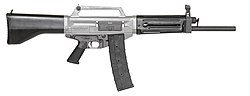
An automatic shotgun is an automatic firearm that fires shotgun shells in fully automatic mode (thereby making it a shotgun) and uses some of the energy of each shot to automatically cycle the action and load a new round.[1] It will fire repeatedly until the trigger is released or ammunition runs out. Automatic shotguns have a very limited range, but provide tremendous firepower at close range.[2]
Automatic shotguns generally employ mechanisms very similar to other kinds of automatic weapons. There are several methods of operation, with the most common being gas, recoil, and blowback operated:
Gas operated designGas operation uses the pressure of the gas (created by the burning propellant) behind the projectile to unlock the bolt assembly and then move it rearward.
They generally store ammunition in detachable box or drum magazines in order to decrease reloading time, whereas most pump-action and semi-automatic shotguns use under-barrel tubular magazines.
Automatic shotgun ammunition choices are slightly limited because the fired shot must provide sufficient recoil energy to reliably cycle the action. This means they are not compatible for use with low powered rounds, e.g. less-than-lethal ammunition. The most common shotgun shell used in combat shotguns contains 00 buckshot, 8 to 10 lead balls, which is very effective against unarmored targets.[4]
A standard shotgun shot fires multiple small projectiles at once, increasing the chances of hitting the target. Shotguns have a short effective range of about 50–70 metres (160–230 ft), but provide a lot of firepower at close range.[2] Automatic fire enhances these effects, due to the increase in the rate of fire.
Long-barreled weapons are associated with precision activities such as hunting and shooting sports.
Automatics typically have much shorter barrels than pump-action shotguns (especially hunting shotguns).[4] Short-barreled shotguns have a very high chance of hitting close range targets, and can even hit multiple targets in one area, which is ideal for close combat situations.[5] Long-barreled pump action shotguns are more accurate and have increased range, which is ideal for hunting and sporting purposes.[6]
Automatic shotguns are generally viewed as less reliable than manual operation shotguns, because there are more moving parts and increased chances of error.[7] If any one piece fails, it will most likely halt the operation and cause damage to the weapon and/or user[citation needed]. Automatic weapons are also more susceptible to jamming[8] and negative effects from dirtiness[citation needed].
Automatic shotguns are intended for use as military combat shotguns. They typically have a high rate of fire and relatively low recoil, making them ideal for engaging targets in a fast-paced, close range combat situation.[2] They are able to fulfill many different combat roles due to the wide variety of shotgun ammunition available.[9]
Automatic shotguns have not seen much use in the United States, but have been slightly more popular in some other countries.[10]
An automatic shotgun is a fully automatic firearm chambered for shotgun shells, capable of sustained fire as long as the trigger remains depressed and ammunition is supplied, with the energy from each discharged shell automatically ejecting the spent casing, loading the next round, and firing it.[1] Unlike semi-automatic shotguns, which require repeated trigger actuation for each shot, automatic models employ mechanisms such as open-bolt inertia or gas operation to achieve continuous cycling, though the intense recoil from large-gauge shotgun loads often limits effective rates of fire to 300-500 rounds per minute.[2]Emerging primarily as experimental military weapons during and after the Vietnam War era, automatic shotguns aimed to provide suppressive fire with the wide pattern and stopping power of buckshot or slugs in close-quarters combat, but practical challenges including poor controllability, rapid ammunition depletion, and excessive barrel climb prevented widespread adoption by major armed forces.[2] Notable designs include the Atchisson Assault Shotgun (later AA-12), developed in 1972 by American inventor Maxwell Atchisson as an open-bolt, inertia-driven system compatible with high-capacity drum magazines, and the South Korean Daewoo USAS-12 from the 1980s, a gas-operated select-fire weapon intended for urban warfare that was briefly exported before import restrictions.[3][4]These shotguns remain niche due to stringent regulations classifying them as machine guns under frameworks like the U.S. National Firearms Act, which impose transfer taxes, registration, and bans on new civilian manufacture post-1986, alongside inherent design trade-offs that favor semi-automatic or pump-action alternatives for reliability and manageability in most tactical scenarios.[2][4]
History
Origins and early inventions
The development of the automatic shotgun, referring primarily to semi-automatic designs that reload via recoil or gas operation, emerged in the late 19th century amid broader advancements in self-loading firearms. Prior shotgun actions were manual, including break-action doubles and pump-actions patented by John M. Browning as early as 1887 for the Winchester Model 1887 lever-action and subsequent pumps. The challenge for automation lay in harnessing the shotgun's relatively low-pressure propellant gases or recoil impulse to cycle heavy shotshells reliably, without fouling from unburnt powder common in black-powder eras transitioning to smokeless loads around 1890. Browning addressed this by prioritizing recoil operation over nascent gas systems, which proved unreliable with shotgun residues.[5]Browning filed U.S. Patent No. 659,786 on May 6, 1899, for a "Recoil Operated Firearm," culminating in the Auto-5 design completed by 1900. This long-recoil system locked the barrel and bolt together during firing, allowing the entire assembly to recoil rearward by a distance greater than the shell length—typically 1.5 to 2 inches—before unlocking, ejecting the spent shell, and chambering a new one from a tubular magazine holding up to five rounds. The mechanism's friction-based inertia dampened excessive motion, enabling function across 12-, 16-, and 20-gauge calibers with black-powder or smokeless ammunition. Unlike earlier failed attempts at gas-operated shotguns, which suffered from port erosion and inconsistent blowback, the Auto-5's simplicity and robustness marked the first commercially viable semi-automatic shotgun.[6]Production began in 1902 at Fabrique Nationale (FN) in Belgium under license, with initial models featuring a distinctive humpback receiver and external hammer, though later variants internalized it for safety. By 1905, over 850 units had shipped, primarily to Europe, before U.S. importation resumed post-World War I embargo. Remington Arms produced a licensed variant, the Model 11, starting in 1905, incorporating refinements like an acceleration spring for smoother cycling. These early automatic shotguns revolutionized hunting and sporting applications by enabling rapid follow-up shots—up to five in under 10 seconds for skilled users—without manual pumping, though reliability demanded meticulous cleaning due to shotshell wadding debris. Adoption was gradual, limited by high cost (around $60–$100 in 1910, equivalent to $1,800 today) and skepticism toward "newfangled" mechanisms among traditionalists favoring double-barrels.[5][6]
Mid-20th century developments
Following World War II, production of the Browning Auto-5 resumed under FN Herstal in Belgium, with the inertia-operated design continuing to dominate semi-automatic shotgun sales due to its reliability across various gauges and loads, including the introduction of lighter "Sweet Sixteen" variants in 16 gauge that gained popularity among hunters for reduced weight without sacrificing performance. The Auto-5's long recoilsystem, which moved both barrel and bolt rearward upon firing, proved durable in field conditions, with over 2.7 million units produced by the century's end, though it required careful maintenance to prevent failures with high-pressure ammunition.[7]A significant shift occurred with the adoption of gas-operated mechanisms, which used propellant gases diverted from the barrel to cycle the action, reducing felt recoil by up to 50% compared to inertia systems and enabling smoother handling of magnum shells. Winchester introduced the Model 50 in 1950 as the first commercially successful American gas-operated semi-automatic shotgun, featuring a self-adjusting gas piston that accommodated varying loads from 2¾-inch to 3-inch shells in 12 and 20 gauge.[8] This design addressed limitations of earlier recoil-operated models by minimizing wear on components and improving cycle reliability in adverse weather, influencing subsequent innovations.Remington Arms advanced this trend with the Model 1100, launched in 1963, which incorporated a dual-piston gas system venting excess gases through barrel ports to propel the bolt, allowing consistent operation with factory loads while rejecting handloads that exceeded pressure thresholds for safety. Available initially in 12 gauge with 4+1 capacity, it weighed approximately 8 pounds and excelled in waterfowl hunting due to its soft recoil and rapid follow-up shots, quickly becoming one of the best-selling semi-automatic shotguns with production exceeding 3 million units by the 1980s.[9][10] These gas systems marked a causal improvement in usability, as empirical testing showed they extended service life under repeated high-volume shooting, such as in trap and skeet competitions, by distributing operational forces more evenly than pure recoil methods.[11]Mid-century refinements also included lighter aluminum receivers and synthetic components to reduce weight, alongside extended magazine tubes for capacities up to 8 rounds in sporting models, enhancing versatility for competitive shooting while complying with hunting regulations limiting effective loads. These developments prioritized empirical recoilmitigation and load adaptability over earlier designs' simplicity, fostering broader adoption among civilian shooters despite higher manufacturing costs.[6]
Post-1980s innovations and full-auto experiments
In the 1980s, the U.S. military initiated the Close Assault Weapon System (CAWS) program to develop an advanced automatic shotgun for close-quarters combat, emphasizing greater effective range up to 100-150 meters through specialized ammunition like flechettes and tungsten buckshot.[12] The program produced prototypes such as the Heckler & Koch HK CAWS, a bullpup-configured, select-fire 12-gauge shotgun with a 10-round detachable magazine, gas-operated mechanism, and modes for semi-automatic and full-automatic fire at approximately 400 rounds per minute.[13] Collaborating with Winchester/Olin, the HK CAWS incorporated ambidextrous controls and recoil mitigation features but was ultimately canceled in the late 1980s due to high development costs, ammunition production challenges, and insufficient performance advantages over existing semi-automatic shotguns.[14]Concurrent with CAWS, the USAS-12 emerged as a production full-automatic shotgun developed by Daewoo Precision Industries in South Korea during the late 1980s.[4] This gas-operated, magazine-fed 12-gauge weapon featured select-fire capability with a cyclic rate of 200-300 rounds per minute, 20- or 32-round box magazines, and a folding stock for compactness, achieving muzzle velocities around 1,100 feet per second with standard buckshot loads.[15] Limited production occurred, primarily for export and law enforcement evaluation, but it saw no widespread military adoption owing to excessive recoil in full-auto mode, logistical burdens of high ammunition consumption, and controllability issues in sustained fire.[4]The Pancor Jackhammer, conceived by designer John Andersen in the early 1980s, represented an innovative bullpup full-automatic shotgun with a top-loading pan magazine holding 10 rounds of 12-gauge shells and a rotary bolt mechanism for reliable cycling.[16] Prototypes underwent U.S. military testing, demonstrating a fire rate of up to 240 rounds per minute and modular suppressibility, yet production never materialized due to funding shortages and the design's complexity, including its unique clamshell disassembly.[17]Post-1980s refinements to earlier concepts culminated in the AA-12, originally prototyped in 1972 but significantly advanced after 1987 when rights were acquired by Military Police Systems, Inc., leading to a 2005 production model with enhanced gas-delayed blowback operation for reduced recoil and reliability across 300 rounds per minute.[3] This select-fire shotgun, compatible with drum magazines holding up to 32 rounds, underwent evaluations by U.S. Special Operations Command in the early 2000s for breaching and suppression roles but was not selected for service, as full-automatic fire proved impractical for most tactical scenarios due to pattern dispersion, barrel climb, and the preference for precise semi-automatic engagement.[18] These experiments underscored persistent challenges in full-auto shotgun design, including the causal mismatch between shotgun payloads' wide spread and the need for sustained automatic fire, rendering them niche or experimental rather than standard issue.[2]
Technical design
Operating mechanisms
Automatic shotguns cycle their actions using energy from the fired shotshell, primarily through gas, recoil, or inertia mechanisms, enabling semi-automatic or selective-fire operation without manual intervention after each shot.[19]Gas-operated systems tap high-pressure gases from ports in the barrel to drive a piston or operating rod, which unlocks the bolt, extracts the spent shell, cocks the firing mechanism, and chambers the next round. This design diverts propellant gases into a cylinder below or beside the barrel, reducing felt recoil by dissipating energy externally while maintaining reliability across various loads, though carbon buildup from gases requires more frequent cleaning. The Remington Model 1100, introduced in 1963, pioneered widespread use of this system in sporting shotguns, with variants like the Mossberg 930 employing similar long-stroke gas pistons for consistent cycling.[20][19][21]Recoil-operated systems, often long-recoil types, lock the barrel and bolt together for initial rearward travel exceeding the shell length upon firing; the barrel then halts via a receiver slot, allowing the bolt to continue unlocking, extracting, and ejecting the shell before springs return it forward to reload. This mechanically simple approach harnesses directrecoil impulse without gas ports, minimizing fouling but imparting higher felt recoil and requiring precise tuning for different ammunition pressures. John Browning's Auto-5, produced from 1902 to 1998 by Browning and FN Herstal, exemplifies long-recoil operation, with over 2.5 million units manufactured.[22][23][19]Inertia-driven systems exploit the gun's recoil against the bolt's mass: upon firing, the receiver recoils rearward while the heavier bolt body resists due to inertia, compressing an internal coil spring between the bolt head and carrier; the spring then expands to drive the bolt rearward for extraction and ejection, followed by forward motion to strip and chamber a new shell. Lighter and with fewer external parts, these avoid gas residue for easier maintenance and function reliably in adverse conditions, though they demand a rigid stock fit and perform best with higher-velocity loads. Benelli's Inertia Driven System, introduced in models like the M2 in 2001, relies on this principle, with the bolt spring compressing approximately 1/4 inch during recoil to initiate cycling.[24][25][19]
Barrel and action configurations
Automatic shotguns, predominantly semi-automatic designs, utilize smoothbore barrels optimized for dispersing shot patterns from shells, though select models incorporate rifled bores to stabilize sabot slugs for greater accuracy at range. Barrel lengths typically range from 18 to 28 inches, with shorter 18- to 20-inch configurations favored in tactical variants for enhanced maneuverability in close quarters while maintaining legal compliance under regulations like the U.S. National Firearms Act's 18-inch minimum for non-classified shotguns; longer barrels, up to 32 inches in some hunting-oriented models, provide higher muzzle velocities and tighter patterns at distance.[26][27] Construction often employs monobloc forging for durability under high-pressure 12-gauge loads, with threaded muzzles common for attaching chokes—fixed cylinder, improved cylinder, modified, or full—to adjust pattern density based on target distance and ammunition.[28] Some designs, such as the Benelli M2 or Beretta A400, support interchangeable barrels for versatility across field, tactical, or competition roles.[29]Action configurations in automatic shotguns center on robust receivers housing the locking mechanism, typically a rotating or tilting bolt to contain pressures exceeding 11,000 psi from magnum loads. Conventional layouts feature a fixed receiver with the barrel rigidly or semi-rigidly attached, integrating a tubular magazine beneath the barrel holding 5 to 10 rounds depending on gauge and jurisdiction; this under-barrel tube aligns with the chamber for gravity-assisted feeding.[30] Alternative configurations, as in magazine-fed models like the Saiga-12 or USAS-12, employ detachable box magazines—often 10- to 20-round capacities—mounted ahead of or inline with the trigger group, enabling faster reloads and compatibility with drum units for sustained fire applications.[31] Rare bullpup variants, such as the UTAS UTS-15, reposition the action behind the trigger for a compact overall length while retaining full-length barrels, though these sacrifice ergonomics for portability.[32] Full-automatic examples, like the AA-12, maintain similar receiver designs but incorporate selective-fire selectors and reinforced components to handle continuous operation rates up to 300 rounds per minute.[33] These setups prioritize reliability under rapid cycling, with gas ports or recoil lugs integrated into the barrel-receiver interface to direct energy for bolt manipulation without excessive wear.[34]
Materials and manufacturing advances
Early automatic shotguns employed forged or machined steel receivers and barrels constructed from chrome-molybdenum alloys such as 4140, prized for their high tensile strength and ability to endure repeated high-pressure shotshell detonations without deformation.[35] These materials provided essential durability for gas-operated and inertia-driven mechanisms, where cyclic stresses from recoil or gas impulses demanded robust construction to prevent failures like cracking under sustained fire.[36]Subsequent manufacturing advances shifted toward lightweight aluminum alloys, such as 6061 or 7075 series, for receivers in semi-automatic designs, particularly inertia-operated models like the Benelli Ultra Light introduced in the early 2000s, which feature alloy receivers to reduce overall weight by approximately 1-2 pounds compared to steel equivalents while maintaining sufficient rigidity through thicker cross-sections and heat treatments.[37][38] Aluminum's corrosion resistance and machinability further enabled its adoption in tactical variants, though steel remains preferred for full-automatic prototypes like the AA-12, which prioritize heat dissipation and longevity under rapid fire rates exceeding 300 rounds per minute.[39][40]Polymer composites, including fiberglass-reinforced synthetics like Rilsan, have supplanted wood for stocks, forends, and pistol grips since the 1990s, offering reduced weight, weather resistance, and impact absorption without compromising the firearm's balance or function, as seen in models like the Benelli M3 Tactical.[41] Technopolymers and advanced alloys have also appeared in non-critical components, such as Beretta's Ultraleggero series, where they contribute to sub-6-pound configurations suitable for extended field use.[42]Precision manufacturing techniques, notably computer numerical control (CNC) machining, have revolutionized production since the 2000s, allowing for intricate milling of receivers from aluminum billets or steel forgings with tolerances under 0.001 inches, enhancing reliability by minimizing play in operating parts and enabling modular designs in Turkish-made semi-automatics that rival European benchmarks.[43][44] This method, combined with investment casting for initial shapes followed by CNC finishing, has lowered costs and accelerated prototyping, facilitating innovations like the SKO Mini's 7075 aluminum receiver machined for compactness.[45] While 3D printing aids rapid design iteration for custom components, it remains ancillary to core production, which relies on subtractive CNC processes for verifiable materialintegrity.[46]
Ammunition considerations
Compatible shell types and gauges
Automatic shotguns are overwhelmingly chambered in 12 gauge, the most versatile and widely available shotgun caliber, enabling compatibility with a broad range of shotshell configurations while supporting the mechanical stresses of rapid cycling.[47] This gauge dominates due to its balance of payload capacity and recoil manageability in gas-operated or inertia-driven systems common to semi-automatic and select-fire designs. Less common chamberings include 20 gauge for lighter-recoiling applications, though full-automatic variants in smaller gauges are rare owing to insufficient gas volume for reliable operation.[48]Compatible shell lengths typically include 2¾-inch standard loads and 3-inch magnum shells, with many models featuring adjustable gas ports or pistons to handle varying pressures and ensure ejection. For instance, the GForce GF25 semi-automatic shotgun accepts both 2¾-inch and 3-inch 12-gauge shells but requires minimum shot velocities of 1300 feet per second for consistent cycling.[49] Low-velocity or reduced-recoil ammunition, such as certain training loads or less-lethal rounds, often fails to generate adequate energy for reliable function in gas-operated automatic shotguns.[50]Shell types encompass birdshot for small game and clays (e.g., #7½ to #4 shot sizes), buckshot for defensive or tactical use (e.g., #4 buck or 00 buck), and rifled slugs for longer-range precision, all within the 12-gauge diameter of approximately 0.729 inches.[51] Steel shot variants are compatible in modern barrels with appropriate chokes, though lead-free loads may produce higher pressures affecting reliability in older or tuned systems. Compatibility ultimately hinges on the firearm's chamber dimensions and operating mechanism, with manufacturers recommending high-brass or full-power loads to mitigate short-stroking in high-rate-of-fire scenarios.[52]
Loading and feeding systems
Most semi-automatic shotguns, the predominant form of automatic shotguns, utilize under-barrel tubular magazines for loading and feeding. Shells are inserted base-first through a loading port at the rear of the receiver, compressing a internal spring and follower that stacks them end-to-end in the tube, with typical capacities of 4 to 8 rounds for 12-gauge models depending on barrel length and legal restrictions.[53][54] During the firing cycle, gas, recoil, or inertia-operated actions drive the bolt rearward to eject the spent shell, after which a pivoting shell lifter or carrier elevates the top shell from the follower into alignment with the chamber; the returning bolt then strips and chambers it.[55][33] This rim-to-rim stacking in tubes accommodates the flared rims of shotgun shells reliably, minimizing jams compared to centerfire rifle cartridges, though tube loading is slower than detachable magazines as shells must be pushed in individually.[56]Detachable box or drum magazines appear in specialized designs, especially full-automatic prototypes like the AA-12 and USAS-12, enabling higher capacities and quicker reloads by swapping pre-loaded units. The AA-12 employs an open-bolt gas-operated system with 8-round box magazines or 20- and 32-round drums, where shells remain in the magazine until the bolt closes upon trigger pull, preventing cook-off in sustained fire.[57] The USAS-12 uses 10-round box or 20-round drum magazines angled at 4-6 degrees to counter recoil-induced misalignment, feeding via a roller-equipped bolt carrier that injects shells positively into the chamber at rates up to 360 rounds per minute.[4] These systems support rapid tactical reloading but demand precise alignment and can suffer feed failures from shell rim interference or inconsistent stacking, issues less prevalent in tubular designs.[58][59]Modern semi-automatic magazine-fed variants, such as the Mossberg 590M or Saiga-12 derivatives, adapt AR-style or AK-pattern boxes holding 5-10 rounds, loaded externally and inserted into a receiver well before releasing the bolt to chamber the top shell.[58][60] While offering versatility for caliber swaps via dedicated magazines, reliability varies with ammunition type, as low-brass or high-velocity loads may exacerbate ramp feeding inconsistencies in rimmed shells.[58] Tubular systems predominate in production models for their simplicity and robustness in field conditions, whereas magazine-fed configurations suit high-volume or military applications despite added complexity.[61]
Performance impacts from ammunition variations
Ammunition variations profoundly influence the operational performance of automatic shotguns, primarily through effects on cycling reliability, recoil impulse, and ballistic outcomes. Gas-operated automatic shotguns harness propellant gases to cycle the action, rendering them more tolerant of diverse load weights and velocities compared to inertia-driven systems, which depend on the shotgun's recoil mass and bolt carrier momentum. Inertia systems often fail to cycle lightweight target loads under 1 ounce or low-velocity ammunition below 1,200 feet per second (fps), as insufficient rearward force prevents full bolt unlocking and extraction.[25][62][63]Heavier loads, such as 3-inch magnum shells with 1-1/8 ounces of shot at 1,300-1,500 fps, reliably cycle in both systems but generate elevated gas pressures in gas-operated designs, accelerating carbon fouling in the piston and port areas after 200-300 rounds without cleaning.[63] Buckshot patterns from high-velocity loads (e.g., 00 buck at 1,600 fps) exhibit tighter spreads—reducing effective range to 25-40 yards due to decreased pellet energy dispersion—but increase muzzle flip in rapid semi-automatic fire, compromising follow-up shot accuracy.[64] Slugs, particularly rifled varieties achieving 1,600-1,800 fps, demand robust extraction to avoid case deformation in high-rate cycling, with sabot slugs in gas systems producing excess gas volume that can overstress adjustable regulators if present.[64]Low-brass, reduced-recoil loads (e.g., 1-ounce birdshot at 1,100 fps) minimize shooter fatigue and enhance controllability during sustained fire but risk short-stroking in non-optimized gas ports, leading to failure-to-feed rates exceeding 20% in unmodified inertia shotguns.[65] Manufacturers like Benelli specify minimum impulse thresholds for inertia models, recommending avoidance of promotional or imported low-power variants to maintain 95%+ reliability in field conditions.[25] Variations in powder burn rates further modulate port pressure timing; slower-burning powders in heavy waterfowl loads (e.g., 3-dram equivalent) delay gas impulse, potentially causing ejection delays in short-barreled automatic designs under 20 inches.[62] Overall, matching ammunition to the shotgun's operating system—prioritizing consistent velocity and pressure curves—ensures optimal performance, with empirical testing revealing gas systems averaging 10-15% broader load compatibility than inertia counterparts.[63]
Operational performance
Advantages in rate of fire and controllability
Automatic shotguns provide a marked advantage in rate of fire over traditional pump-action or bolt-action designs, with full-automatic models achieving cyclic rates of 300 to 360 rounds per minute. The AA-12, for example, sustains a rate of approximately 300 rounds per minute, enabling the discharge of a 20-round drum magazine in under four seconds.[66][67] Similarly, the USAS-12 delivers at least 360 rounds per minute in full-automatic mode, facilitating rapid delivery of multiple projectiles for suppressive effects in confined spaces where shotgun spread enhances hit probability despite reduced precision.[4]This elevated rate of fire supports tactical scenarios requiring volume of fire, such as breaching or close-quarters combat, by allowing operators to engage multiple threats sequentially without manual cycling, unlike semi-automatic shotguns limited by trigger reset times.[68]In terms of controllability, automatic shotgun designs incorporate mechanisms to mitigate the inherent recoil from 12-gauge shells during sustained bursts. The USAS-12's inline barrel-stock configuration aligns the bore axis closely with the shooter's shoulder, reducing torque and muzzle climb to make full-automatic fire more manageable than in offset-stock shotguns.[69] The AA-12 employs a long-stroke gas-operated system with a proprietaryrecoil absorption mechanism that dissipates around 80% of the impulse, combined with a buffer spring, spreading recoil over time for better full-auto stability.[70] Additionally, the substantial weight of these weapons—often 10 pounds or more when loaded with drum magazines—dampsens successive impulses, aiding sustained control compared to lighter semi-automatic alternatives.[71] These features collectively enable effective bursts without excessive deviation, though operator skill remains essential for accuracy.
Limitations due to recoil and reliability
The substantial recoil generated by 12-gauge shotgun loads, ranging from 18 foot-pounds for target ammunition to over 30 foot-pounds for heavier defensive or slug rounds in an 8-pound firearm, poses a primary limitation for automatic shotguns, particularly in full-automatic configurations.[72][73] Each discharge imparts a powerful rearward force due to the high mass and velocity of shot or slugs, and rapid cycling amplifies this effect through successive impulses that induce severe muzzle climb and torque, degrading accuracy beyond initial shots. Testing of the USAS-12 full-automatic shotgun revealed that while two- to three-round bursts remained controllable at 25 yards, longer strings led to pronounced upward and lateral deviation of impact points, necessitating forceful shoulder adjustments between firings to regain sight alignment.[4] This loss of controllability stems from the inherent physics of shotgun ballistics—greater ejecta momentum compared to rifle cartridges—making sustained automatic fire ineffective for aimed engagements past close range, even with features like ribbed buttplates intended to mitigate climb.Reliability challenges further constrain automatic shotguns, as their gas- or recoil-operated actions depend on precise energy transfer from varying shell types, which lack the uniformity of centerfire rifleammunition. Gas systems, common in designs like the USAS-12 and AA-12, are vulnerable to fouling from unburnt powder residues and lead particles in shotgun propellants, causing failures to extract, eject, or feed if maintenance lapses occur.[4][68] Low-velocity or reduced-recoil loads often under-cycle these mechanisms due to insufficient gas pressure, while high-power variants risk over-stressing components; field reports note intermittent jams from hull deformities or crimp inconsistencies across manufacturers. Although prototypes like the AA-12 have endured 22,000 rounds with minimal ammo-related stoppages in controlled tests, broader adoption remains limited by these sensitivities, as military and law enforcement prioritize pump-actions for their mechanical simplicity and performance in dirty, non-standard environments without such dependencies.[68] Full-automatic modes compound reliability risks through accelerated heat buildup and residue accumulation during bursts, contributing to why such shotguns see niche rather than widespread tactical use.
Comparative effectiveness versus other firearms
Automatic shotguns demonstrate superior terminal ballistics in close-quarters battle (CQB) scenarios under 25 meters, where buckshot loads produce multiple wound channels from 8-9 projectiles (typically .33-inch diameter 00 buckshot at 1,200-1,300 fps), often incapacitating threats faster than single-projectile rifle rounds due to greater energy transfer and tissue disruption.[74][75] In contrast, 5.56mm NATO rounds from assault rifles like the AR-15 rely on yawing and fragmentation for lethality, which can underperform against angled or heavy clothing at point-blank ranges, though they maintain consistent penetration.[76][77] Empirical data from ballistic gel tests indicate buckshot patterns retain over 80% effectiveness within 15 meters, minimizing aim precision requirements compared to rifles, which demand sighted fire even in low light or stress.[78]However, automatic shotguns' high cyclic rates (300-450 rounds per minute in models like the AA-12) exacerbate controllability issues, with 12-gauge recoil (17-54 ft-lbs per shot) causing rapid muzzle climb and reduced follow-up accuracy beyond the first few rounds, rendering sustained full-automatic fire less practical than assault rifles' lighter 5-7 ft-lbs recoil and ergonomic design.[79][80] Rifles excel in versatility, with effective ranges exceeding 300 meters and magazine capacities of 30+ rounds enabling suppressive fire without the overheating or reliability failures common in gas-operated automatic shotguns under dirty or varied ammunition conditions.[81][82]In military and tactical contexts, automatic shotguns are niche tools for breaching and room-clearing, outperforming submachine guns or pistols in raw stopping power but inferior to assault rifles for patrol or urban operations beyond 50 meters, where buckshot dispersion exceeds target sizes and velocity drops sharply (e.g., <800 fps at 40 yards).[83][84] Assault rifles mitigate overpenetration risks through bullet tumbling in soft tissue, often limiting drywall traversal to fewer rooms than slugs, while automatic shotguns' drum magazines (20-32 rounds) deplete faster than rifle magazines, prolonging vulnerability during reloads.[80][85]
This comparison underscores automatic shotguns' role as specialized CQB weapons rather than general-purpose firearms, with rifles dominating in balanced effectiveness across ranges and engagement types.[86][87]
Applications and uses
Military and tactical employment
Automatic shotguns have seen limited but specialized employment in military contexts, primarily by special operations forces for close-quarters battle (CQB), door breaching, and rapid engagement of multiple targets in confined urban or shipboard environments.[88] Their high rate of fire—such as 300-400 rounds per minute in models like the AA-12 and USAS-12—provides suppressive capability at short ranges under 50 meters, where the spread of shot compensates for reduced aiming precision.[4][68] However, they have not achieved widespread adoption across conventional forces due to the preference for semi-automatic shotguns in standard breaching and entry roles.[2]In tactical scenarios, full-automatic fire from these weapons excels in overwhelming point-blank threats, such as during anti-piracy operations or counter-terrorism raids, where controllability features like the AA-12's constant recoil reduction system mitigate the inherent kick of 12-gauge loads.[68] The USAS-12, for instance, has been utilized by elite units including Brazil's GRUMEC naval commandos, Colombia's COPES special forces, and South Korea's 707th Special Mission Battalion, with over 30,000 units produced by the mid-1990s for such applications.[4] Similarly, the AA-12 underwent U.S. Marine Corps testing in 2004 for potential urban combat utility but was not selected for service, though limited sales occurred to the Saudi Royal Guard in 2010 and undisclosed operators in Southwest Asia.[68][88]Broader military disinterest stems from practical drawbacks: excessive weight (e.g., 10 pounds for the AA-12), bulky ammunitionlogistics compared to rifle cartridges, and diminished accuracy beyond point-blank range, rendering full-auto modes superfluous against semi-automatic alternatives that suffice for most CQB tasks without the added recoil and control challenges.[2][68] Early prototypes from the Vietnam era, such as the Special Operations Weapon (SOW) in the 1970s and the Close Assault Weapon System (CAWS) in the 1980s, similarly failed adoption trials despite joint service evaluations, as rifles and submachine guns better balance firepower, range, and portability in diverse combat scenarios.[2]
Law enforcement scenarios
Automatic shotguns, classified as machine guns under the National Firearms Act (NFA) of 1934, can be acquired by qualified law enforcement agencies through ATF registration and approval processes, exempting them from civilian transfer restrictions imposed by the 1986 Firearm Owners' Protection Act.[89][90] Despite this legal pathway, their practical deployment in law enforcement remains rare due to inherent design limitations, including severe recoil from 12-gauge full-automatic fire that compromises operator control and accuracy beyond very short ranges.[88]In specialized scenarios, such as SWAT operations involving close-quarters battle (CQB) against heavily armed barricaded suspects or active threats in confined spaces, automatic shotguns offer theoretical advantages like rapid delivery of multiple projectiles for suppressive effect or area denial with buckshot patterns. However, empirical assessments highlight poor controllability during sustained bursts, leading most tactical teams to favor semi-automatic shotguns—such as the Benelli M4 or Mossberg 590—for similar roles, which provide reliable rapid semi-auto fire without the NFA compliance burdens or ergonomic drawbacks of full-automatic variants.[91][92]No documented instances of widespread or operational use of full-automatic shotguns by U.S. law enforcement exist in public records, reflecting a preference for rifles or submachine guns in high-volume fire needs and underscoring the niche status of these weapons even among elite units. Programs exploring full-auto shotguns, like early prototypes, were often discontinued owing to insufficient operational utility compared to established alternatives.[88] International examples, such as potential adoption by military police forces, similarly emphasize semi-automatic configurations for patrol and riot control rather than full-auto modes.[93]
Civilian hunting, sport, and self-defense
Semi-automatic shotguns, often referred to as automatic in civilian contexts, are employed in hunting for scenarios requiring rapid follow-up shots, such as waterfowl, upland birds, turkey, and predator pursuits like coyotes or foxes.[94][95][96] Their gas-operated or inertia-driven systems enable quicker second and third shots compared to pump-actions, reducing user error from manual cycling and mitigating felt recoil for sustained accuracy.[97][96] In the United States, semi-automatic shotguns are legally permissible for big game hunting in states like Pennsylvania, where the Game Commission approved their use for deer, bear, and elk as of April 2018, provided they fire slugs or buckshot in designated areas.[98] However, restrictions apply in certain locales, such as Illinois public lands prohibiting models classified as assault weapons, including some semi-automatic turkey guns like the Mossberg 930.[99]In sporting disciplines, semi-automatic shotguns excel in dynamic competitions emphasizing speed and volume of fire, including 3-gun events and International Practical Shooting Confederation (IPSC) shotgun divisions.[100][101] These platforms demand quick target transitions, where the semi-automatic action's cycle rate—often exceeding 4 rounds per second in capable models like the Beretta 1301—provides a competitive edge over manual alternatives.[100] While over-under shotguns dominate traditional clays like sporting clays due to reliability with lighter loads, semi-autos are favored in practical shotgun sports for their capacity and reduced recoil, allowing competitors to maintain sight picture during strings of shots.[102] Participation in such events has grown, with 3-gun recognized as one of the fastest-expanding shooting sports in the U.S.[103]For self-defense, civilian semi-automatic shotguns offer advantages in home protection through faster follow-up shots and recoil mitigation via gas or inertia systems, enabling effective engagement of multiple threats without the fatigue associated with pump-actions.[104][105] Models such as the Beretta 1301 Tactical and Benelli M2 Tactical are cited for their reliability with defensive loads like buckshot, providing 5-8 round capacities in compact configurations suitable for indoor use.[104][106] Full-automatic variants remain impractical for civilians due to National Firearms Act restrictions requiring registration and transfer taxes, limiting ownership to pre-1986 examples and rendering them unsuitable for typical self-defense scenarios.[4] Empirical assessments prioritize semi-autos for their balance of controllability and stopping power, though patterns emphasize training to manage overpenetration risks with shotgun ammunition.[107]
Notable examples and models
Semi-automatic designs
The Browning Auto-5, introduced in 1902, represented the first commercially successful semi-automatic shotgun, utilizing a long-recoil operating system where the barrel and bolt recoiled together before unlocking to eject the spent shell and load a new one from a tubular magazine.[108] Designed by John M. Browning and initially produced by Fabrique Nationale in Belgium, it was chambered primarily in 12 gauge with barrel lengths from 26 to 32 inches, achieving reliability across various loads due to its friction-based delay mechanism that adjusted to shell power.[6] Production continued until 1998 by multiple manufacturers, with over 2.7 million units made, influencing subsequent recoil-operated designs but requiring manual friction ring adjustments for optimal function with different ammunition velocities.[6]Gas-operated semi-automatic shotguns, which vent propellant gases to drive a piston and cycle the action, gained prominence with the Remington Model 1100, launched in 1963 as a successor to earlier Remington autoloaders like the Model 11.[109] This 12-gauge design featured a self-adjusting gas system with vents in the barrel that directed gases to a piston, reducing felt recoil by about 50% compared to recoil-operated predecessors and enabling reliable cycling of both light target loads and heavier field ammunition without user intervention.[9] Chambered also in 20 and 28 gauge, it held 4+1 rounds in standard configuration and included variants like the Trap model with 28- or 30-inch vent-rib barrels for competitive shooting, contributing to its status as one of the best-selling semi-autos with production exceeding 2 million units before discontinuation in the 1980s.[109]Inertia-driven systems, which harness recoil to accelerate the bolt via a spring-mass interaction without moving the barrel, emerged prominently in Italian designs like those from Benelli, with the M4 Tactical introduced in 1999 featuring the Auto-Regulating Gas-Operated (A.R.G.O.) piston variant for military use but rooted in semi-automatic principles.[110] Adopted by the U.S. Marine Corps as the M1014 in 1999 after rigorous testing, the 12-gauge M4 uses short-stroke gas pistons positioned low in the receiver for reduced muzzle climb, cycling 5+1 rounds from an 18.5-inch barrel and demonstrating reliability in adverse conditions with over 3,000-round endurance tests.[111] The Russian Saiga-12, developed in the early 1990s by Izhmash as a civilian semi-automatic derivative of the Vepr shotgun, employs long-stroke gas operation akin to the AK-47 platform, accepting detachable magazines up to 10 rounds and chambered in 12 gauge with 5.00 or 7.50 shells for enhanced capacity in tactical roles.[112] Its robust stamped-steel construction and adjustable gas ports allow function with diverse loads, though import restrictions in the U.S. since 2014 limited availability.[112] These mechanisms—recoil, gas, and inertia—dominate modern semi-automatic shotgun designs, balancing reliability, recoil mitigation, and adaptability to varying ammunition.
Full-automatic prototypes and production models
The Remington Model 7188, developed in the 1960s at Frankford Arsenal under the "Unconventional Warfare Devices and Techniques" project, represents an early full-automatic shotgun prototype designed specifically for U.S. Navy SEALs during the Vietnam War.[113] The Mk 1 variant appeared in 1967, based on the Remington Model 1100 semi-automatic shotgun, featuring a select-fire mechanism with a high cyclic rate that provided intense close-quarters firepower but suffered from limited magazine capacity and controllability issues due to recoil.[114] Approximately 20 units were produced for testing, though it saw limited field use by SEAL teams appreciating its suppressive capability in jungle environments.[115]In 1972, Maxwell Atchisson patented the Atchisson Assault Shotgun, later known as the AA-12, a gas-operated full-automatic 12-gauge design firing at 300 rounds per minute from an open bolt.[18] Rights were sold in 1987 to Military Police Systems (MPS), which refined the prototype over 18 years with 188 improvements, including a gas system reducing felt recoil by approximately 90% through gas diversion and a heavy recoil spring.[57] Variants included a standard model with a 17.99-inch barrel and a CQB version with a 13-inch barrel; despite U.S. military testing, it was not adopted, with production limited to small numbers for demonstration and potential contracts.[18]The USAS-12, developed in the late 1980s by Gilbert Equipment Company and manufactured by Daewoo Precision Industries in South Korea, emerged as one of the few full-automatic shotgun production models, producing over 30,000 units by the mid-1990s.[4] This gas-operated, selective-fire weapon, influenced by Atchisson's designs, featured a 12-gauge chambering, cyclic rate up to 360 rounds per minute, 10-round box or 20-round drum magazines, and recoil mitigation via rollers, weighing roughly twice that of a standard tactical shotgun for stability.[4] Adopted by elite units such as Brazil's GRUMEC and South Korea's 707th Special Mission Group, its U.S. civilian importation ceased in 1994 under ATF classification as a destructive device requiring National Firearms Act registration.[4]The Heckler & Koch CAWS (Close Assault Weapon System), a joint prototype from the 1980s co-developed with Winchester/Olin, aimed to extend shotgun effectiveness to 100-150 meters using specialized flechetteammunition in a bullpup configuration.[2] This select-fire 12-gauge model held 10 rounds, emphasized ambidextrous controls and reduced recoil, but the U.S. Joint Service Small Arms Program canceled development in the early 1990s due to ammunition costs and performance shortfalls against rifle-caliber alternatives.[14] Only prototypes were built, none entering production.[2]
Regulatory and legal framework
National Firearms Act classifications
Under the National Firearms Act (NFA) of 1934, as codified in 26 U.S.C. Chapter 53, automatic shotguns—defined as those capable of firing more than one shot without manual reloading by a single function of the trigger—are classified as machine guns.[116] This classification applies regardless of the firearm's gauge or barrel length, as the NFA's machine gun definition encompasses "any weapon" meeting the automatic fire criterion, including shotguns.[117] Machine gun status subjects such shotguns to mandatory federal registration with the Bureau of Alcohol, Tobacco, Firearms and Explosives (ATF), a $200 excise tax on manufacture or transfer, and approval via ATF Form 4 for transfers or Form 1 for making.[118]Automatic shotguns may also qualify as short-barreled shotguns (SBS) under NFA provisions if they have a barrel length under 18 inches or an overall length under 26 inches, triggering identical registration and tax requirements independent of their automatic capability.[117] For instance, military or tactical models like the AA-12, when configured with shortened barrels, fall into both categories but are regulated primarily as machine guns due to their full-automatic function.[118] Possession without proper NFA compliance constitutes a felony punishable by up to 10 years imprisonment and fines up to $250,000.The Firearm Owners' Protection Act (FOPA) of 1986, via the Hughes Amendment (18 U.S.C. § 922(o)), prohibits the civilian transfer or possession of machine guns manufactured after May 19, 1986, effectively limiting legal civilian ownership of post-1986 automatic shotguns to government entities or licensed manufacturers for testing and export. Pre-1986 registered examples, such as certain prototypes or imported models, remain transferable to qualified individuals upon ATF approval, though their scarcity and high cost—often exceeding $20,000 due to market restrictions—constrain availability.[117] Suppressors or other accessories attached to automatic shotguns may invoke additional NFA categories, like silencers, requiring separate registration.[118]
International restrictions and export controls
Fully automatic shotguns are classified under international export control regimes as munitions due to their capability for sustained rapid fire, falling within Category ML1 of the Wassenaar Arrangement Munitions List, which encompasses smooth-bore weapons with a calibre less than 20 mm and other automatic weapons with a calibre of 12.7 mm or less.[119] The Wassenaar Arrangement, established in 1996 as a multilateral export control mechanism among 42 participating states including the United States, Russia, and most EU members, requires members to implement national licensing systems for transfers of such items to prevent destabilizing accumulations and irresponsible exports.[120] Participating states must report semi-annually on deliveries of conventional arms, including automatic firearms, to non-members exceeding specified thresholds, with automatic shotguns treated analogously to machine guns in triggering these notifications.[120]Under the United Nations Arms Trade Treaty (ATT), ratified by 113 states as of 2023, exports of automatic shotguns—as small arms and light weapons—are subject to risk assessments to ensure they do not contribute to genocide, crimes against humanity, or serious violations of international humanitarian law.[121] Article 7 mandates prohibitions on transfers where overriding risks exist, with automatic variants like 12-gauge models explicitly referenced in ATT implementation contexts as requiring stringent controls due to their potential for misuse in conflict zones.[122] Non-parties such as the United States adhere to equivalent domestic standards but are not bound by ATT reporting, though bilateral agreements often align with its principles for allied transfers.[121]In practice, exporting countries impose case-by-case licensing, with denials common for destinations lacking end-use assurances; for instance, the European Union's Common Position 2008/944/CFSP harmonizes member state controls on automatic firearms, prohibiting exports to embargoed regions or where diversions to non-state actors are probable.[123] U.S. exports of fully automatic shotguns remain under International Traffic in Arms Regulations (ITAR), requiring Department of State approval via DSP-5 licenses for any permanent or temporary transfer, with no exemptions for quantities under 50 units unlike non-automatic firearms.[124] These controls persist amid recent U.S. regulatory shifts, which eased semi-automatic shotgun exports in 2025 but retained ITAR for full-automatic models to mitigate proliferation risks.[125] Violations, such as unauthorized diversions, have prompted sanctions, underscoring the causal link between lax oversight and escalation in armed conflicts.[126]
Debates on civilian ownership and efficacy
In the United States, civilian ownership of full-automatic shotguns is governed by the National Firearms Act of 1934, which classifies them as machine guns requiring federal registration, a $200 transfer tax, extensive background checks, and approval from the Bureau of Alcohol, Tobacco, Firearms and Explosives (ATF).[127] The 1986 Firearm Owners' Protection Act's Hughes Amendment further prohibited the manufacture or registration of new machine guns for civilian transfer, limiting availability to pre-1986 examples, which number fewer than 200 for shotguns and command prices often exceeding $20,000 due to scarcity.[128] Gun rights organizations, such as the National Rifle Association, argue that empirical data shows no documented instances of crimes committed with legally owned full-automatic firearms, including shotguns, supporting Second Amendment protections for such ownership without heightened risk to public safety.[129] Critics, including gun control advocates, contend that the potential for rapid, high-volume fire in civilian hands could exacerbate mass casualty events, though no peer-reviewed studies specifically link legal full-auto shotgun ownership to increased violence rates; instead, misuse typically involves illegal modifications.[130]Debates on efficacy emphasize practical limitations over theoretical advantages. Proponents highlight the capacity for suppressive fire in scenarios involving multiple intruders, with models like the USAS-12 capable of sustained rates of 360 rounds per minute in full-automatic mode, potentially providing psychological deterrence through sheer volume.[4] However, ballistic and handling analyses reveal severe drawbacks: the intense recoil from successive 12-gauge shells causes rapid muzzle climb and loss of control, rendering aimed fire ineffective beyond 10-15 yards even for trained users, while shotgun patterns disperse too widely for precision at distance.[4]Ammunition expenditure is prohibitive, with full-auto bursts depleting 20- or 32-round magazines in seconds, escalating costs to hundreds of dollars per engagement and increasing risks of overpenetration through walls compared to handguns or rifles.[129]In self-defense contexts, experts note that full-automatic operation offers marginal benefits for typical civilian threats—usually single assailants at close range—where semi-automatic or pump-action shotguns suffice with better controllability and reload efficiency.[131] Military evaluations, such as those of prototypes like the AA-12, underscore unreliability in sustained fire due to gas system fouling from low-pressure shotgun loads, further questioning viability for untrained civilians lacking access to specialized maintenance.[4] Internationally, outright bans in countries like the United Kingdom and Australia reflect concerns over efficacy in non-military roles, prioritizing reduced accidental discharge risks over any suppressive utility.[132] Overall, data from defensive gun use studies indicate no statistical advantage for full-auto configurations, with simpler designs proving more reliable under stress.[129]