


Community hub
Recent from talks
Contribute something
Nothing was collected or created yet.
Medium-density fibreboard
View on Wikipedia | This article needs additional citations for verification. (April 2012) |

Medium-density fibreboard (MDF) is an engineered wood product made by breaking down hardwood or softwood residuals into wood fibre, often in a defibrator, combining it with wax and a resin binder, and forming it into panels by applying high temperature and pressure.[1] MDF is generally denser than plywood. It is made up of separated fibre but can be used as a building material similar in application to plywood. It is stronger and denser than particle board.[2]
The name derives from the distinction in densities of fibreboard. Large-scale production of MDF began in the 1980s, in both North America and Europe.[3]
Over time, the term "MDF" has become a generic name for any dry-process fibreboard.
Physical properties
[edit]MDF is typically made up of 82% wood fibre, 9% urea-formaldehyde resin glue, 8% water, and 1% paraffin wax.[4] The density is typically between 500 and 1,000 kg/m3 (31 and 62 lb/cu ft).[5] The range of density and classification as light-, standard-, or high-density board is a misnomer and confusing. The density of the board, when evaluated in relation to the density of the fibre that goes into making the panel, is important. A thick MDF panel at a density of 700–720 kg/m3 (44–45 lb/cu ft) may be considered as high density in the case of softwood fibre panels, whereas a panel of the same density made of hardwood fibres is not regarded as so. The evolution of the various types of MDF has been driven by differing need for specific applications.
Types
[edit]The different kinds of MDF (sometimes labeled by colour) are:
- Ultralight MDF plate (ULDF)[6]
- Moisture-resistant board is typically green
- Fire retardant MDF is typically red or blue
In Europe, MDF is classified for use by the standard EN 622-5, such as load-bearing for general dry or humid conditions. The light and ultralight MDF are also classified by EN 622-5 for general (non-load-bearing) use.[7]
| EN 622 classification | Use |
|---|---|
| MDF | General purpose board for dry conditions |
| MDF.H | General purpose board for humid conditions |
| MDF.LA | Load-bearing boards for dry conditions |
| MDF.HLS | Load-bearing boards for humid conditions |
| MDF.RWH | Board for rigid underlays in roofs and walls |
Although similar manufacturing processes are used in making all types of fibreboard, MDF has a typical density of 600–800 kg/m3 or 0.022–0.029 lb/in3, in contrast to particle board (500–800 kg/m3) and to high-density fibreboard (600–1,450 kg/m3). In addition, MDF typically has an MOR of 40 MPa and an MOE of 3 GPa. Because it is easier to machine and has good weathering characteristics, it tends to replace particleboard in applications such as furniture, cabinet making, joinery, craft work and flooring.[8]
Manufacturing
[edit]
In Australia and New Zealand, the main species of tree used for MDF is plantation-grown radiata pine, but a variety of other products have also been used, including other woods, waste paper, and fibres. Where moisture resistance is desired, a proportion of eucalypt species may be used, making use of the endemic oil content of such trees.[9]
Chip production
[edit]The trees are debarked after being cut. The bark can be sold for use in landscaping or used as biomass fuel in on-site furnaces. The debarked logs are sent to the MDF plant, where they go through the chipping process. A typical disk chipper contains four to 16 blades. Any resulting chips that are too large may be rechipped; undersized chips may be used as fuel. The chips are then washed and checked for defects. Chips may be stored in bulk, as a reserve for manufacturing.[9]
Fibre production
[edit]Compared to other fibre boards, such as Masonite, MDF is characterised by the next part of the process, and how the fibres are processed as individual, but intact, fibres and vessels, manufactured through a dry process.[9] The chips are then compacted into small plugs using a screw feeder, heated for 30–120 seconds to soften the lignin in the wood, then fed into a defibrator.[9] A typical defibrator consists of two counter-rotating discs with grooves in their faces. Chips are fed into the centre and are fed outwards between the discs by centrifugal force. The decreasing size of the grooves gradually separates the fibres, aided by the softened lignin between them.[9]
From the defibrator, the pulp enters a blowline, a distinctive part of the MDF process. This is an expanding circular pipeline, initially 40 mm in diameter, increasing to 1500 mm. Wax is injected in the first stage, which coats the fibres and is distributed evenly by the turbulent movement of the fibres. A urea-formaldehyde resin is then injected as the main bonding agent. The wax improves moisture resistance and the resin initially helps reduce clumping. The material dries quickly in the final heated expansion chamber of the blowline and expands into a fine, fluffy and lightweight fibre. The glue and the other components (hardener, dye, urea, and so on) can be injected into blowline even at a high pressure (100 bar, 10 MPa, 1,500 psi) and the drying process continues inside a long pipe to the exit cyclones, that is connected to the heating chamber. This fibre may be used immediately, or stored.[9]
Sheet forming
[edit]Dry fibre is sucked into the top of a "pendistor", which evenly distributes fibre into a uniform mat below it, usually of 230–610 mm thickness. The mat is precompressed and either sent straight to a continuous hot press or cut into large sheets for a multiple-opening hot press. The hot press activates the bonding resin and sets the strength and density profile. The pressing cycle operates in stages, with the mat thickness being first compressed to around 1.5 times the finished board thickness, then compressed further in stages and held for a short period. This gives a board profile with zones of increased density, thus mechanical strength, near the two faces of the board and a less dense core.[9]
After pressing, MDF is cooled in a star dryer or cooling carousel, trimmed, and sanded. In certain applications, boards are also laminated for extra strength.
The environmental impact of MDF has greatly improved over the years.[citation needed] Today, many MDF boards are made from a variety of materials. These include other woods, scrap, recycled paper, bamboo, carbon fibres and polymers, forest thinnings, and sawmill off-cuts.
As manufacturers are being pressured to come up with greener products, they have started testing and using nontoxic binders. New raw materials are being introduced. Straw and bamboo are becoming popular fibres because they are a fast-growing, renewable resource.
Comparison with natural woods
[edit]MDF does not contain knots or rings, making it more uniform than natural woods during cutting and in service.[10] However, MDF is not entirely isotropic since the fibres are pressed tightly together through the sheet. Typical MDF has a hard, flat, smooth surface that makes it ideal for veneering, as no underlying grain is available to telegraph through the thin veneer as with plywood. A so-called "premium" MDF is available that features more uniform density throughout the thickness of the panel.
MDF may be glued, doweled, or laminated. Typical fasteners are T-nuts and pan-head machine screws.[11] Smooth-shank nails do not hold well, and neither do fine-pitch screws, especially in the edge. Special screws are available with a coarse thread pitch, but sheet-metal screws also work well. MDF is not susceptible to splitting when screws are installed in the face of the material, but due to the alignment of the wood fibres, may split when screws are installed in the edge of the board without pilot holes.
Advantages
[edit]- Denser than plywood and chipboard
- Consistent in strength and size
- Shapes well
- Stable dimensions (less expansion and contraction than natural wood)
- Takes paint well
- Takes wood glue well
- High screw pull-out strength in the face grain of the material
- Flexible
Disadvantages
[edit]- Low-grade MDF may swell and break when saturated with water
- May warp or expand in humid environments if not sealed
- May release formaldehyde, which is a known human carcinogen[12] and may cause allergy, eye and lung irritation when cutting and sanding[13]
- Dulls blades more quickly than many woods: Use of tungsten carbide-edged cutting tools is almost mandatory, as high-speed steel dulls too quickly.
- Though it does not have a grain in the plane of the board, it does have one into the board. Screwing into the edge of a board will generally cause it to split in a fashion similar to delaminating.
Applications
[edit]
MDF is often used in school projects because of its flexibility. Slatwall panels made from MDF are used in the shop fitting industry. MDF is primarily used for indoor applications due to its poor moisture resistance. It is available in raw form, or with a finely sanded surface, or with a decorative overlay.
MDF is also usable for furniture such as cabinets, because of its strong surface.[14]
MDF's density makes it a useful material for the walls of pipe-organ chambers, allowing sound, particularly bass, to be reflected out of the chamber into the hall.
Interior trim and mouldings
[edit]MDF is widely used in the United Kingdom for painted interior trim, including skirting (base) boards, architraves and window boards, because its smooth, knot-free surface can be machined into crisp profiles and accepts paint evenly.[15] According to the British Woodworking Federation, MDF mouldings are commonly supplied factory-primed, which shortens on-site finishing time and improves surface quality.[16]
- Homebuilding & Renovating* magazine also describes MDF trim as “a robust and affordable solution” that resists warping and swelling better than many softwoods.[17]
Safety concerns
[edit]
When MDF is cut, a large quantity of dust particulate is released into the air.
Formaldehyde resins are commonly used to bind together the fibres in MDF,[18] and testing has consistently revealed that MDF products emit free formaldehyde and other volatile organic compounds that pose health risks at concentrations considered unsafe, for at least several months after manufacture.[19][20][21] Urea-formaldehyde is always being slowly released from the edges and surface of MDF. When painting, coating all sides of the finished piece is a good practice to seal in the free formaldehyde. Wax and oil finishes may be used as finishes, but they are less effective at sealing in the free formaldehyde.[10]
Whether these constant emissions of formaldehyde reach harmful levels in real-world environments is not fully determined. The primary concern is for the industries using formaldehyde. As far back as 1987, the United States Environmental Protection Agency classified it as a "probable human carcinogen", and after more studies, the World Health Organization's International Agency for Research on Cancer (IARC), in 1995, also classified it as a "probable human carcinogen". Further information and evaluation of all known data led the IARC to reclassify formaldehyde as a "known human carcinogen"[12] associated with nasal sinus cancer and nasopharyngeal cancer, and possibly with leukaemia in June 2004.[22]
According to International Composite Board Emission Standards, three European formaldehyde classes are used, E0, E1, and E2, based on the measurement of formaldehyde emission levels. For instance, E0 is classified as having less than 3 mg of formaldehyde out of every 100 g of the glue used in particleboard and plywood fabrication. E1 and E2 are classified as having 9 and 30 mg of formaldehyde per 100 g of glue, respectively. All around the world, variable certification and labeling schemes are there for such products that can be explicit to formaldehyde release, such as that of Californian Air Resources Board.[23]
Veneered MDF
[edit]Veneered MDF provides many of the advantages of MDF with a decorative wood veneer surface layer. In modern construction, spurred by the high costs of hardwoods, manufacturers have been adopting this approach to achieve a high-quality finishing wrap covering over a standard MDF board. One common type uses oak veneer.[24] Making veneered MDF is a complex procedure, which involves taking a slice of hardwood about 1–2 mm thick and then, through high pressure and stretching methods, wrapping them around the profiled MDF boards. This is possible only with simple profiles; otherwise, when the thin wood layer dries, it breaks at bends and angles.
See also
[edit]References
[edit]- ^ Spence, William P. (2005). The Home Carpenters & Woodworker's Repair Manual. New York City: Sterling. ISBN 1-4027-1055-0 p. 114
- ^ "Medium Density Fiberboard, Moulding, Embossing, Kitchen Cabinets – Composite Panel Association". Decorativesurfaces.org. Archived from the original on 2018-07-23. Retrieved 2014-04-02.
- ^ United Nations (2005). European forest sector outlook study: 1960/2000/2020, main report. New York [u.a.]: United Nations. p. 32. ISBN 9211169216.
- ^ R. Kozlowski and M. Helwig (December 1996). Critical Look on Cellulose Modification. Proceedings of the International Symposium on Cellulose Modification. Honolulu, USA.
- ^ ANSI A208.2 MDF for Interior Applications (PDF). Gaithersburg, MD: Composite Panel Association. 2002. p. 3. Archived from the original (PDF) on 2012-01-05. Retrieved 2012-06-06.
- ^ "MDF, LDF, HDF - www.sppd.pl". Sppd.pl. Archived from the original on 2021-08-24. Retrieved 17 January 2018.
- ^ "Wood as bio-based building material", Performance of Bio-based Building Materials, Elsevier, pp. 21–96, 2017, doi:10.1016/b978-0-08-100982-6.00002-1, ISBN 978-0-08-100982-6, retrieved 2024-11-15
- ^ Milner, H.R. (2009), "Sustainability of engineered wood products in construction", Sustainability of Construction Materials, Elsevier, pp. 184–212, doi:10.1533/9781845695842.184, ISBN 978-1-84569-349-7, retrieved 2024-11-15
- ^ a b c d e f g "The Manufacturing Process Medium Density Fibreboard". Australian National University Fenner School. Dept. Forestry, Australian National University. Archived from the original on 8 Feb 2020.
- ^ a b "Medium Density Fibreboard". Design-technology.org. Retrieved 2014-04-02.
- ^ "MDF Board FAQ - Tutorial". Diyaudioandvideo.com. Retrieved 2014-04-02.
- ^ a b "IARC Monographs on the Evaluation of Carcinogenic Risks to Humans Volume 88 (2006) Formaldehyde, 2-Butoxyethanol and 1-tert-Butoxypropan-2-ol". WHO Press. 2006. Archived from the original on 2017-12-01. Retrieved 2009-11-21.
- ^ "An Introduction to Indoor Air Quality", United States Environmental Protection Agency
- ^ "Medium Density Fibreboard". Design-technology.org. Retrieved 2016-12-14.
- ^ "What Is MDF? Properties, Material, Construction & Strength". Skirting World Blog. Skirting World. 2025-05-09. Retrieved 2025-05-19.
- ^ "BWF Guide No. 7 - Medium Density Fibreboard (MDF)" (PDF). British Woodworking Federation. p. 1. Retrieved 2025-05-19.
- ^ Turner, Neil (2025-04-23). "Not sure what type of skirting board you need? Here's how to choose the right one". Homebuilding & Renovating. Retrieved 2025-05-19.
- ^ Mantanis, George I.; Athanassiadou, Eleftheria Th.; Barbu, Marius C.; Wijnendaele, Kris (2018-03-15). "Adhesive systems used in the European particleboard, MDF and OSB industries". Wood Material Science & Engineering. 13 (2): 104–116. doi:10.1080/17480272.2017.1396622. ISSN 1748-0272.
- ^ George E. Myers. "Effects of post-manufacture board treatments on formaldehyde emission : a literature review (1960-1984)" (PDF). Fpl.fs.fed.us. Retrieved 17 January 2018.
- ^ Hodgson, A. T.; Beal, D.; McIlvaine, J. E. R. (1 December 2002). "Sources of formaldehyde, other aldehydes and terpenes in a new manufactured house". Indoor Air. 12 (4): 235–242. doi:10.1034/j.1600-0668.2002.01129.x. PMID 12532755. S2CID 30065953.
- ^ "Aldehyde Emissions From Particleboard and Medium Density Fiberboard Products" (PDF). fpl.fs.fed.us. Retrieved 17 January 2018.
- ^ "Formaldehyde and Cancer Risk". National Cancer Institute. 10 June 2011. Retrieved 17 January 2018.
- ^ "Which Particleboard and Plywood Standard Should you Use?". Amrosia.com. Archived from the original on 9 November 2017. Retrieved 17 January 2018.
- ^ "Veneered MDF". Skirtingboard.co.uk. Retrieved 2014-04-02.
Further reading
[edit]- English, Brent, John A. Youngquist, and Andrzej M. Krzysik, Lignocellulosic Composites Archived 2021-04-20 at the Wayback Machine in Gilbert, Richard D., ed. Cellulosic polymers, blends and composites. New York: Hanser Publishers: 115–130; 1994. Chapter 6
External links
[edit]| Lumber/ timber | |
|---|---|
| Engineered wood | |
| Fuelwood | |
| Fibers | |
| Derivatives | |
| By-products | |
| Historical | |
| See also | |


Medium-density fibreboard
View on GrokipediaMedium-density fibreboard (MDF) is an engineered wood product formed by breaking down wood residuals into lignocellulosic fibres, blending them with synthetic resins and wax, and compressing the mixture under heat and pressure to create dense panels typically ranging from 496 to 801 kg/m³ in density.[1] This dry-process manufacturing yields a homogeneous, nonstructural material denser than particleboard but less so than hardboard, prized for its uniformity and machinability.[2] Developed as an efficient use of wood byproducts, MDF production scaled commercially in the 1980s, leveraging fibre separation techniques to produce smooth-surfaced panels suitable for applications where aesthetic consistency outweighs structural demands.[3] Global output has expanded steadily, with the market valued at approximately $44 billion in 2024 and projected to reach $70-82 billion by the early 2030s, driven by demand in furniture, cabinetry, and interior millwork.[4][5] Key advantages include its stability—exhibiting minimal warping or splitting compared to natural wood—and ease of finishing, as the lack of grain allows for precise cutting, drilling, and painting without splintering, although acrylic paint applied directly to MDF without primer has poor longevity and durability indoors due to the material's high porosity, which causes uneven paint absorption, raised fibers, blotchy finish, weak adhesion, and potential peeling or failure within weeks to months even in dry indoor conditions; primer or sealer is essential for proper adhesion, smooth finish, and long-term durability.[6][7] However, MDF's reliance on urea-formaldehyde resins has sparked concerns over volatile organic compound emissions, particularly formaldehyde, a known carcinogen that can off-gas from panels for extended periods post-manufacture, prompting regulatory limits such as the U.S. EPA's 0.11 ppm standard for MDF to mitigate indoor air quality risks.[8][9] These emissions, exacerbated by humidity and temperature, underscore trade-offs in cost-effectiveness against potential health and environmental impacts, though advancements in low-emission binders aim to address them.[10]
History
Origins and Early Development
Medium-density fibreboard (MDF) originated from innovations in utilizing wood waste for engineered panels, building on early fiberboard technologies. The foundational process stemmed from hardboard development in 1925 by American engineer William H. Mason, who used steam explosion to defibrillate wood chips into fibers, compressing them into dense, binderless sheets primarily for industrial applications like insulation and automotive parts.[11] This Masonite hardboard, produced at densities exceeding 1000 kg/m³, addressed inefficiencies in lumber byproducts but lacked the uniformity and workability needed for broader uses.[12] MDF proper developed in the early 1960s in the United States as a dry-process evolution, incorporating synthetic resins like urea-formaldehyde to bind refined wood fibers at medium densities of 600–800 kg/m³, yielding smoother surfaces and better machinability than hardboard.[13] Commercial production commenced in 1965–1966, with the first dedicated MDF facility operational in Deposit, New York, marking a shift toward scalable manufacturing of defect-free panels for furniture and millwork.[14] Initial plants processed softwood and hardwood residuals, emphasizing cost efficiency amid post-World War II housing booms and resource conservation.[15] Early adoption in the late 1960s focused on refining fiber preparation—via mechanical refining and steam treatment—to minimize voids and enhance strength, while experimentation with resin ratios improved dimensional stability over predecessors like wet-process fiberboards from the 1890s.[16] By the early 1970s, limited North American output expanded modestly, driven by furniture industry demands for paintable, isotropic material, though full commercialization awaited 1980s advancements in pressing technology.[17]Commercialization and Expansion
Commercial production of medium-density fibreboard (MDF) commenced in the United States in 1966, marking the initial commercialization of the material through dedicated manufacturing facilities that combined wood fibres with synthetic binders under heat and pressure.[15] This development built on earlier hardboard technologies but introduced a dry-process method yielding uniform, dense panels suitable for furniture and interior applications.[11] Early adopters, including Norbord, established the first U.S. plants, with production starting at sites like Deposit, New York, around 1965–1966.[17] Expansion into Europe followed in 1973 with the establishment of initial production lines, enabling broader adoption beyond North America.[15] By the 1980s, large-scale mass production had taken hold in both regions, driven by demand for cost-effective alternatives to solid wood and particleboard; output volumes surged as mills scaled operations to meet furniture and cabinetry needs.[11] This period saw MDF penetrate markets previously served by hardboards, owing to its enhanced machinability, smooth surface for finishing, and dimensional stability.[15] Further growth accelerated in the late 1980s and 1990s through process innovations, such as the widespread shift to continuous pressing technologies, which improved efficiency and reduced costs compared to multi-daylight presses.[18] U.S. shipments of MDF, for instance, rose from approximately $454 million in value in 1997 to $530 million by 2000, reflecting expanding domestic and export markets.[19] Globally, the material's versatility fueled its integration into construction and decorative sectors, with production diversifying to include moisture-resistant variants amid rising international trade.[18]Composition and Physical Properties
Core Materials and Binders
The core of medium-density fiberboard (MDF) comprises fine lignocellulosic fibers, predominantly derived from softwood and hardwood residuals such as wood chips, sawdust, and shavings. These fibers are generated via thermomechanical pulping, where wood feedstock is softened with steam and mechanically refined in a pressurized defibrator to separate bundles into individual fibers averaging 1-3 mm in length, preserving lignin as a natural binder supplement without chemical additives.[1][20] Although wood remains the primary source, alternative fibers from non-wood lignocellulosics like bagasse, bamboo, or agricultural residues have been tested in specialized production, typically comprising up to 100% of the furnish in experimental panels but less than 10% in commercial volumes due to variability in fiber quality and bonding efficacy.[2][21] Binders, essential for interfiber adhesion, are synthetic resins applied to dried fibers at 8-12% by oven-dry weight, forming a thermosetting matrix upon hot-pressing. Urea-formaldehyde (UF) resin dominates standard MDF production, offering cost-effective bonding but releasing formaldehyde during curing and service life, with emissions regulated under standards like CARB Phase 2 (≤0.11 ppm for composite core material as of 2010 updates).[22][20] Enhanced variants include melamine-urea-formaldehyde (MUF), incorporating 2-5% melamine for superior durability and reduced emissions, or polymeric methylene diphenyl diisocyanate (pMDI), a non-formaldehyde isocyanate used in premium or exterior-grade boards at similar loadings for stronger bonds and zero added formaldehyde, though at higher cost (20-50% more than UF).[20] Paraffin wax, added at 0.5-2% during blending, functions as a hydrophobic agent rather than a primary binder, minimizing water absorption without altering core density.[1] Resin selection influences panel performance, with UF suiting interior applications and pMDI enabling compliance with stringent emission limits like E1 (≤0.124 mg/m³ formaldehyde as per EN 13986:2004).[2]Appearance and Color Variations
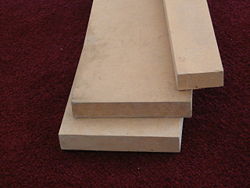
Standard medium-density fiberboard (MDF) exhibits natural color variations ranging from light tan or yellow tones to darker brown shades. These differences are primarily caused by variations in wood fiber composition and manufacturing processes. Lighter MDF often results from higher softwood content, yielding yellow or orange tones, or from lower production temperatures during drying and pressing. Darker MDF typically arises from higher hardwood fiber content, which may produce stronger and denser boards, or elevated temperatures that cause browning or scorching of the fibers through thermal degradation. The resin binder (usually urea-formaldehyde) does not significantly affect natural color variations unless dyes are intentionally added (e.g., green for moisture-resistant types). These variations are normal across batches, suppliers, or regions due to raw material sources.[2][23]Mechanical and Density Characteristics
Medium-density fibreboard (MDF) possesses a nominal density of 600–800 kg/m³, distinguishing it from lower-density particleboard and higher-density variants exceeding 800 kg/m³. Standard commercial grades typically achieve 700–750 kg/m³ through controlled fibre compression and resin integration during hot pressing, yielding a homogeneous structure with minimal voids. This density range balances machinability, weight, and structural integrity, as higher densities enhance fibre packing and resin bonding efficiency, thereby improving load-bearing capacity while avoiding excessive brittleness.[2][24][25] Mechanical properties are governed by standards such as EN 622-5, which classifies MDF into performance grades based on minimum requirements for bending strength (modulus of rupture, MOR), modulus of elasticity (MOE), and internal bond (IB) strength, tested in the weakest in-plane direction under dry conditions (20°C, 65% relative humidity). These values vary by thickness and application, with requirements decreasing for thicker boards (>30–45 mm) due to manufacturing constraints like mat consolidation. Load-bearing grades demand higher thresholds to ensure stability under stress.[26]| Grade | Application | MOR (N/mm², ≤9 mm thick) | MOE (N/mm², ≤9 mm thick) | IB (N/mm², ≤12 mm thick) |
|---|---|---|---|---|
| P1 | General, dry | 23 | 2700 | 0.65 |
| P2 | General, humid | 27 | 2700 | 0.70 (0.35 post-cyclic) |
| P3 | Load-bearing, dry | 29 | 3000 | 0.70 |
| P4 | Load-bearing, humid | 34 | 3000 | 0.70 (0.35 post-cyclic) |
Manufacturing Process
Raw Material Preparation
The primary raw materials for medium-density fibreboard (MDF) consist of wood residues, including green chips, sawdust, shavings, and plywood trim, sourced as co-products from softwood and hardwood lumber and plywood mills.[29] These residues typically arrive with high moisture content, such as 51% for green chips and sawdust or 48% for green shavings, totaling around 3,094 pounds per thousand square feet (793 kg/m³) on an oven-dry basis for a standard panel.[29] While roundwood logs can be used, residues predominate to utilize waste efficiently, with species varying by region (e.g., pines, aspen, birch, oak).[30] [29] Preparation begins with sorting, storage, and, if necessary, washing residues to remove contaminants like debris or bark.[30] For larger pieces, debarking and chipping reduce wood to uniform sizes of 20-30 mm.[31] The chips or residues are then loaded into a digester, where steam at 160-180°C and 6-10 bar pressure softens the lignin binding the wood cells, facilitating separation without chemical additives.[31] [30] Defibration follows in pressurized mechanical refiners, such as disk refiners, where the softened material is sheared into individual fibers through primary and secondary stages, producing a pulp-like furnish suitable for the dry-process MDF production.[29] [30] Screening separates oversize particles and fines, ensuring fiber uniformity before subsequent drying to 8-12% moisture content.[31] No binders or waxes are introduced during this stage; these are applied post-defibration.[32]Fibre Formation and Mat Assembly
The production of wood fibres for medium-density fibreboard (MDF) begins with the mechanical defibrillation of prepared wood chips, typically derived from softwood or hardwood residuals such as sawdust, shavings, or chips.[29] These chips are softened through steam treatment at temperatures around 160–200°C to weaken the lignin bonds, facilitating separation without chemical additives in the standard dry process.[33] The softened chips are then fed into a defibrillator, where opposing grooved steel discs rotate at high speeds under pressure, grinding and exploding the material into individual lignocellulosic fibres averaging 1–3 mm in length.[1] [33] The resulting steam-exploded fibres emerge wet, with moisture contents often exceeding 100% on a dry basis, and are conveyed to flash tube dryers where hot air reduces this to 2–8% to prevent resin curing issues during subsequent steps.[1] Fibre quality is controlled by parameters such as disc gap, steam pressure, and residence time, which influence fibre length distribution and fibrillation degree; shorter fibres enhance board uniformity but may reduce strength if over-refined.[34] This mechanical process contrasts with wet systems used in some paper production, prioritizing energy efficiency for panel applications despite higher fibre damage.[1] Following drying, the fibres are blended with synthetic resins, typically urea-formaldehyde at 8–12% by weight, and sometimes paraffin wax for moisture resistance, using blowline or drum blenders to ensure uniform coating.[1] [29] Mat assembly occurs on a continuous forming line, where resin-impregnated fibres are air-formed into a loose, multi-layered web on a perforated conveyor belt via felting heads or forming boxes that disperse fibres pneumatically to break clumps and achieve even density.[35] The mat, initially 200–300 mm thick with a target loose density of 150–250 kg/m³, is oriented randomly in the plane for isotropic properties, with scalping devices trimming edges and adjusting weight for precise panel dimensions.[36] Layering techniques often place finer surface fibres via sequential forming heads to optimize face quality, while core layers use coarser fibres for bulk.[35] Pre-pressing may compact the mat to 50–100 mm before transfer to the hot press, minimizing handling disruptions.[34]Hot Pressing and Finishing
The hot pressing stage in medium-density fibreboard (MDF) production consolidates the loosely assembled fiber-resin mat into a dense panel by applying elevated temperature and pressure, which simultaneously evaporates internal moisture, activates thermosetting resins like urea-formaldehyde, and forms inter-fiber bonds.[37] This process typically occurs in multi-opening batch presses or continuous flat presses, achieving a target density of 600-800 kg/m³ through controlled compression.[1] Press platens are heated via steam or thermal oil to temperatures of 160-190°C, with optimal ranges of 160-180°C for enhancing mechanical properties such as modulus of rupture (MOR) and internal bond (IB) strength while minimizing thickness swelling.[38] Pressures range from 3-5 MPa (30-50 kg/cm²), applied rapidly after mat loading to avoid uneven consolidation.[39] Cycle times vary with board thickness; for a 16 mm panel, a full cycle including closing, pressing, and opening totals approximately 320 seconds.[38] These parameters produce a vertical density profile featuring higher-density face zones (up to 900-1000 kg/m³) for surface hardness and a lower-density core, which optimizes overall bending strength and screw-holding capacity.[38] Excessive temperatures above 180°C can degrade carbohydrates in fibers, reducing MOR by up to 10% via thermal decomposition.[38] Post-pressing, boards are immediately transferred to cooling lines—such as star dryers or restraint carousels—where they solidify under controlled conditions to counteract steam-induced expansion and minimize warping or delamination risks as temperatures drop below 100°C.[1] Edges are then trimmed via automated saws to exact dimensions, removing flash and ensuring squareness.[1] Surface finishing follows with double-sided sanding on calibrated machines, progressing from coarser grits (e.g., 80-120) to finer ones (150-220) to attain thickness tolerances of ±0.2-0.3 mm and a uniform, defect-free surface for downstream uses like painting or laminating.[1] [38] This sanding step also exposes any internal voids for quality inspection, with defective panels rejected prior to packaging.[40]Types and Variants
Standard and High-Density Forms
Standard medium-density fibreboard (MDF) exhibits a nominal density range of 650 to 800 kg/m³, as defined by International Organization for Standardization (ISO) 16895.[41] This density arises from the compression of wood fibres bonded with resins under heat and pressure, yielding a uniform, smooth-surfaced panel suitable for interior applications such as furniture and cabinetry.[16] Mechanical properties include a modulus of rupture around 40 MPa and modulus of elasticity of 3 GPa, tested per ASTM D1037 standards.[16][42] High-density fibreboard (HDF), a denser variant, achieves densities from 800 to 1000 kg/m³ or higher, often classified under hardboard with specific gravity up to 1.2.[43][44] HDF's increased density results from finer fibre refinement and greater pressing intensity, producing harder, more wear-resistant material compared to standard MDF.[45] This form offers superior surface hardness and bending strength, making it preferable for demanding uses like laminate flooring cores and exterior siding, though it is thinner and less machinable than MDF.[46][47] Key distinctions include HDF's enhanced durability and moisture resistance due to tighter fibre packing, but standard MDF provides better cost-efficiency and ease of shaping for non-structural elements.[48] Both adhere to ANSI A208.2 for North American grading, ensuring consistency in internal bond strength and thickness swelling.[49] Industry classifications, such as those from the Composite Panel Association, categorize MDF by density for specific performance thresholds.[28]Moisture-Resistant and Specialty Grades
Moisture-resistant medium-density fibreboard (MR MDF) incorporates additives such as paraffin wax emulsions or specialized resins during manufacturing to enhance water repellency and reduce swelling under humid conditions, achieving up to 30% less thickness swell compared to standard grades when tested per MR30 standards.[50][51] These boards typically exhibit densities of 720–750 kg/m³ and are dyed green to distinguish them from conventional MDF, though they remain unsuitable for exterior or fully submerged applications due to inherent limitations in long-term water exposure.[52][53] European standard EN 622-5 classifies MR MDF into grades like MDF.H for general humid environments and MDF.HLS for load-bearing uses in such settings, ensuring compliance through cyclic moisture resistance tests that simulate real-world humidity fluctuations.[54] American National Standards similarly denote moisture resistance via suffixes appended to grade designations, prioritizing interior applications in areas like kitchens or bathrooms where intermittent dampness occurs but direct wetting is avoided.[28] Despite these improvements, MR MDF's formaldehyde emissions and edge-sealing requirements mirror those of standard variants, necessitating proper finishing to prevent degradation.[55] Specialty grades extend beyond moisture resistance to address niche performance needs, including fire-retardant MDF formulated with chemical additives to achieve Class 1 or B-s1,d0 fire ratings under EN 13501-1, reducing flame spread for applications in public buildings or transport interiors.[56] Ultra-light MDF variants, often using expanded fibres or foam-core integration, lower density to below 500 kg/m³ for weight-sensitive uses like aerospace components or curved molding, while maintaining machinability akin to standard boards.[57] Slotted or perforated specialty MDF facilitates acoustic panels by enabling sound absorption, with slot dimensions tailored to frequency ranges for auditorium or office dividers.[56] Other variants include high-density water-resistant forms for heavy-duty shelving and melamine-faced grades for pre-finished decorative surfaces, each engineered via resin modifications or overlays to meet specific durability thresholds without compromising MDF's uniform density profile.[58] These specialty products, while costlier—often 20–50% above standard MDF—offer targeted advantages in consistency and waste reduction, though their selection requires verification against project-specific standards to avoid over-specification.[59]Comparisons with Other Wood Products
Versus Solid Natural Wood
Medium-density fibreboard (MDF) exhibits lower mechanical strength than solid natural wood due to its composite structure of defibrillated fibers and synthetic resins, which lacks the intact cellular architecture and grain orientation that enhance load distribution in solid lumber. For instance, the compressive (crushing) strength of MDF is approximately 10 MPa, compared to 40 MPa for typical hardwoods.[60] Similarly, the modulus of rupture (MOR), a measure of bending strength, ranges from 20 to 40 MPa for MDF, while solid hardwoods often exceed 50 MPa, reflecting the anisotropic reinforcement provided by wood's natural fibers.[61][62] These properties make solid wood preferable for structural applications requiring high tensile or shear resistance along the grain, whereas MDF's isotropic uniformity suits non-load-bearing uses but risks failure under impact or sustained stress.| Property | MDF | Solid Hardwood |
|---|---|---|
| Compressive Strength (MPa) | 10 | 40 |
| Modulus of Rupture (MPa) | 20–40 | 50+ |
| Density (kg/m³) | 600–800 | 500–900 (varies by species) |
Versus Particleboard and Plywood
Medium-density fibreboard (MDF) differs from particleboard in its finer wood fiber composition, resulting in a more uniform and denser structure without the coarser particles typical of particleboard, which uses wood chips and flakes bonded with resin. This leads to MDF exhibiting higher mechanical strength, with modulus of rupture (MOR) values ranging from 14.0 to 34.5 MPa compared to particleboard's 11.0 to 23.5 MPa, and better internal bond strength, often 0.5 to 0.87 MPa versus particleboard's lower averages around 0.53 MPa in tested North American products.[22][69][70] MDF also provides superior face screw withdrawal resistance, typically 1201 to 1540 N, making it preferable for applications requiring smooth surfaces and precise machining, such as painted furniture components, whereas particleboard's rougher texture suits cost-sensitive, overlaid panels but sags more under load.[69] Both MDF and particleboard suffer from limited moisture resistance, with thickness swell after 24-hour submersion reaching 5 to 10% for MDF and 4.8 to 25.5% for particleboard, rendering them unsuitable for exterior or high-humidity environments without treatment; however, MDF's density (640 to 800 kg/m³) exceeds particleboard's (typically 500 to 800 kg/m³), contributing to marginally better dimensional stability in dry conditions but increased weight.[22][69][70] Particleboard remains cheaper to produce due to larger particle sizes and lower resin demands, but MDF's lack of voids enables better paint adhesion and edge finishing without splintering.[22] In contrast to plywood, which consists of cross-grained veneer layers for enhanced anisotropic strength, MDF lacks inherent directional reinforcement, yielding lower overall structural integrity; plywood's MOR spans 20.7 to 48.3 MPa and modulus of elasticity (MOE) 6.89 to 13.1 GPa, surpassing MDF's MOE of 1.4 to 3.45 GPa, making plywood suitable for load-bearing uses like flooring or framing. For example, in shelving applications such as wardrobe horizontal shelves, plywood's superior stiffness permits longer unsupported spans without excessive sagging, whereas 17 mm MDF typically requires maximum support spans of 600-800 mm to avoid deflection or deformation under normal loads (e.g., clothing storage, approximately 10-20 kg per shelf); for heavier loads (e.g., shoes or boxes), shorter spans of 500-600 mm or alternatives like thicker MDF or plywood are recommended.[22] Plywood also demonstrates superior moisture resistance, particularly in exterior grades with phenolic adhesives, exhibiting linear expansion as low as 0.15% versus MDF's higher susceptibility to swelling (up to 60.8% thickness increase in untreated tests), though MDF's uniformity avoids plywood's potential for delamination if adhesives fail.[22]| Property | MDF | Particleboard | Plywood |
|---|---|---|---|
| Density (kg/m³) | 640–800 | 500–800 | 400–600 |
| MOR (MPa) | 14–34.5 | 11–23.5 | 20.7–48.3 |
| MOE (GPa) | 1.4–3.45 | 1.7–2.75 | 6.89–13.1 |
| Thickness Swell (%) | 5–10 (dry-wet) | 4.8–25.5 (dry-wet) | Lower (treated <5) |
Applications and Uses
Furniture and Cabinetry
Medium-density fiberboard (MDF) serves as a primary material in furniture and cabinetry production, particularly as a substrate for laminated or veneered panels in applications such as kitchen cabinets, office furniture, and storage units.[71] Its uniform density, typically ranging from 600 to 800 kg/m³, enables precise cutting, drilling, and shaping without splintering or grain-related inconsistencies, making it suitable for mass-produced flat-pack furniture and custom shelving.[72] In particular, for horizontal shelves in wardrobes and similar storage units, 17 mm thick MDF is widely used, with a recommended maximum span between supports of 600-800 mm for typical loads of 10-20 kg per shelf (such as clothing) to prevent sagging or deformation. For heavier loads (such as shoes or boxes), the span should be reduced to 500-600 mm, or thicker MDF or alternative materials like plywood should be used instead. In many Vietnamese wardrobe designs, a 70 cm span is standardized as a safe practice. Thicker MDF panels, measuring 1.27 to 1.91 cm (0.5 to 0.75 inches), are commonly employed as core stock in furniture panels, providing structural support beneath decorative finishes.[73] In cabinetry, MDF's smooth, flat surface accepts paints, laminates, and veneers effectively, reducing finishing costs and achieving consistent aesthetics across large-scale production.[74] Manufacturers favor it for its machinability, allowing intricate profiling and joinery that would be more labor-intensive with solid wood.[75] For instance, in kitchen cabinet construction, MDF boards form carcasses and doors, often coated with high-pressure laminates for durability and ease of cleaning.[76] This usage has driven market growth, with furniture and cabinetry demand contributing to Asia Pacific's 58.87% share of the global MDF market in 2023.[4] MDF's cost-effectiveness—often 30-50% less than comparable plywood—supports its replacement of traditional wood products in budget-oriented furniture lines, though specialty grades may incorporate moisture-resistant resins for cabinet environments prone to humidity.[4][77] Production statistics indicate that furniture applications accounted for a significant portion of the global MDF volume, estimated at over 120 million cubic meters in 2025, reflecting its scalability in automated manufacturing.[78] Despite these benefits, reliance on MDF in load-bearing furniture components requires edge banding to mitigate vulnerability to impacts.[79]Construction and Architectural Elements
Medium-density fiberboard (MDF) finds application in non-structural interior elements of construction and architecture, leveraging its smooth, uniform surface for precise finishing and machining. It is commonly used for trim components such as baseboards, crown moldings, door casings, and window surrounds, where its density—typically ranging from 600 to 800 kg/m³—allows for clean edges and paint adhesion without grain telegraphing.[49][72] These elements benefit from MDF's resistance to warping compared to solid wood, provided they remain in controlled indoor environments.[80] In architectural interiors, MDF serves as substrate for wall paneling, wainscoting, and decorative cladding, often veneered or laminated for aesthetic enhancement. Its machinability supports custom millwork, including chair rails and medallions, enabling complex profiles via CNC routing.[81] Interior door frames and jambs also incorporate MDF for stability and cost efficiency, with thicknesses of 3/4 inch standard for such uses.[80] Acoustic panels in theaters or commercial spaces utilize MDF's density to dampen sound, sometimes perforated for added functionality.[80] MDF contributes to flooring underlayment in non-wet areas, providing a flat base for laminate or vinyl over subfloors, though it lacks the shear strength for primary structural roles like joists or beams.[82] Its adoption in these capacities stems from production scalability, with global output exceeding 100 million cubic meters annually as of 2020, supporting consistent supply for architectural projects.[72] However, applications are confined to dry interiors due to MDF's vulnerability to moisture-induced swelling, which can exceed 10% in humidity above 65%.[83] Specialty moisture-resistant grades extend usability marginally but do not qualify MDF for exterior or load-bearing elements.[82]Industrial and Decorative Purposes
Medium-density fiberboard (MDF) serves industrial roles where its consistent density and dimensional stability are advantageous, such as in the manufacture of speaker enclosures and musical instruments like drums and keyboards, owing to its low resonance and ease of shaping.[84] Thinner panels under 1.27 cm are employed in construction siding applications, providing a uniform substrate resistant to warping under mechanical pulping and pressing processes.[1] In specialized manufacturing, MDF doped with carbon fibers enhances electromagnetic shielding effectiveness, meeting standards like EN 622-5 for electronic component protection while maintaining mechanical integrity.[85] For decorative purposes, MDF's sanded, flat surfaces accept paints, veneers, and laminates effectively, enabling use in moldings, trims, and wall paneling where intricate profiling via machining is required.[72][86] Its versatility supports custom elements like room dividers and retail display backdrops, offering a cost-effective alternative to solid wood for aesthetic enhancements in architectural and interior settings.[87][88] In modern design, decorative MDF panels facilitate visual interest through patterns and finishes, applied in non-structural features like cladding and shelving accents.[89][90]Performance Advantages
Cost and Consistency Benefits
Medium-density fiberboard (MDF) achieves significant cost savings in production through the utilization of wood residues such as sawdust, shavings, and chips—co-products from lumber and other wood processing—rather than requiring high-value solid logs, thereby minimizing raw material expenses and enhancing resource efficiency.[29] Incorporating recycled MDF fibers can further reduce virgin wood costs by up to 10% when comprising 10% of the input, as demonstrated in cost-benefit analyses of blended production methods.[91] Market prices reflect these efficiencies; for instance, a ¾-inch MDF sheet retailed for approximately $28 in late 2024 at major U.S. suppliers, substantially lower than comparable plywood or solid wood panels, which often exceed $50–$100 per equivalent sheet due to higher-grade inputs.[92] The consistency of MDF stems from its manufacturing process, which breaks down wood into fine fibers, mixes them uniformly with resins and wax, and compresses them under heat and pressure to form boards with homogeneous density—typically 600–800 kg/m³—free from natural defects like knots, grain variations, or voids found in solid wood.[93] This uniformity ensures predictable material behavior during machining, reducing scrap rates and tool wear in high-volume production compared to variable natural woods, where inconsistencies can lead to up to 20–30% higher waste in cutting operations.[94] Consequently, manufacturers achieve repeatable quality across batches, simplifying quality control and enabling efficient scaling for applications like furniture components, where dimensional stability minimizes warping or shrinkage variations observed in lumber.[95]Workability and Resource Utilization
Medium-density fiberboard (MDF) exhibits high workability due to its homogeneous structure, lacking the grain patterns and knots found in solid wood, which allows for precise cutting, milling, and shaping without splitting or tear-out.[96] It machines effectively with standard woodworking tools, including saws, routers, and CNC equipment, enabling intricate profiles and tight tolerances essential for furniture components and moldings.[49] However, machining generates significant fine dust, necessitating effective dust collection systems to mitigate health risks, and can accelerate tool wear compared to natural wood due to the abrasive resin and fiber content.[97] In terms of resource utilization, MDF production primarily relies on wood fibers derived from industrial residues such as sawmill scraps, shavings, and low-grade logs, converting what would otherwise be waste into a viable engineered product and thereby reducing the demand for virgin timber.[98] This process achieves high material efficiency, with resource inputs consisting of 56-97% wood mass from fibers and process fuels, minimizing overall waste to 1-3% of inputs.[99] Incorporating up to 10% recycled fibers from post-consumer MDF can further lower virgin wood costs by approximately 10% while maintaining panel quality, though scaling recycled content beyond this requires advanced sorting to avoid performance degradation from adhesives.[100] Innovations in recycling have enabled some producers to reach 70% recycled content in furniture-grade panels, enhancing circularity in wood resource use.[101]Limitations and Criticisms
Durability and Structural Weaknesses
Medium-density fiberboard (MDF) exhibits limited durability in demanding applications due to its composite nature, which relies on compressed wood fibers bonded with resins rather than continuous grain structures found in solid wood. Unlike natural wood, MDF lacks inherent directional strength from fiber alignment, resulting in reduced resistance to mechanical stresses and potential for cracking or splitting under impact or repeated loading. [79] [102] Structurally, MDF demonstrates moderate tensile strength but inferior performance in bending and shear compared to plywood or solid lumber, making it prone to sagging in horizontal spans such as shelves or tabletops when subjected to sustained loads exceeding 20-30 pounds per linear foot without reinforcement. For instance, untreated MDF panels of standard 3/4-inch thickness can deflect up to 1/4 inch or more over a 36-inch unsupported span under moderate weight, accelerating fatigue over time. Similarly, 17 mm thick MDF, commonly used for wardrobe shelves in some markets, is prone to sagging or deformation if unsupported spans exceed 600-800 mm under normal loads such as 10-20 kg of clothing per shelf. For heavier loads (e.g., shoes or boxes), spans should be reduced to 500-600 mm or alternative materials like plywood employed. Many furniture designs in Vietnam standardize on 700 mm spans as a safety measure. [103] [104] [105] Screw-holding capacity in MDF faces is adequate for light-duty assembly, with withdrawal forces typically ranging from 200-600 pounds per screw depending on size and pilot hole preparation, but edge fixation remains weak, often failing under pull-out loads below 100 pounds without augmentation like inserts or dowels. This limitation stems from the uniform density lacking the denser edge grains of solid wood, leading to stripped threads in repeated disassembly scenarios. [106] [107] Overall, while MDF's internal bond strength supports basic rigidity in painted or laminated forms, it cannot endure extreme stresses or dynamic loads equivalent to those tolerated by natural wood, with lifespan in furniture applications often limited to 5-10 years under normal interior use before visible deformation or failure occurs. [75] [103]Moisture Sensitivity and Repair Challenges
Medium-density fiberboard (MDF) exhibits high sensitivity to moisture due to its composition of lignocellulosic fibers bonded with synthetic resins, which lacks the natural water-repellent structure of solid wood or plywood. Exposure to elevated humidity or liquid water causes the fibers to absorb moisture, leading to dimensional changes such as thickness swelling and linear expansion. For instance, standard MDF panels can experience up to 7.1% thickness swelling after 24 hours of immersion in water at 20°C.[108] This swelling is often irreversible, as the material does not fully recover its original dimensions upon drying, resulting in permanent deformation and reduced mechanical integrity.[109] The extent of swelling varies with panel density and initial sorption state, with lower-density MDF showing greater expansion under cyclic humidity conditions.[110] Microstructural analysis reveals that moisture-induced swelling in MDF involves capillary action and hydrogen bonding within the fiber matrix, causing internal stresses and potential delamination of the resin-fiber bonds. Panels tested under relative humidity fluctuations demonstrate that MDF expands and contracts following a sorption isotherm curve, but repeated cycles exacerbate warping and surface degradation.[111] In practical applications, this sensitivity limits MDF's use in humid environments unless protected by moisture-resistant coatings or laminates; uncoated edges are particularly vulnerable, absorbing water like a sponge and leading to edge swelling.[112] Repairing moisture-damaged MDF presents significant challenges because the absorbed water disrupts the adhesive bonds, often rendering the material structurally compromised beyond simple surface restoration. Common repair attempts involve sanding down swollen areas, filling voids with wood putty or epoxy, and reapplying finishes, but these methods fail to restore original density or load-bearing capacity, as the separated fibers do not rebind effectively.[113] In severe cases, delaminated sections require excision and patching, yet the repaired area remains prone to further failure under stress or humidity, frequently necessitating full replacement of the affected component. Industry guidelines emphasize prevention through sealing over remediation, as partial repairs compromise long-term durability and aesthetic consistency.[114] Empirical tests confirm that even after drying and refinishing, repaired MDF exhibits reduced internal bond strength compared to undamaged panels.[115]Painting and Finishing Limitations
Medium-density fibreboard (MDF) is highly porous, which presents significant challenges for painting and finishing. Acrylic paint applied directly to MDF without a primer results in poor longevity and durability indoors. The high porosity causes uneven absorption of the paint, leading to raised fibers, a blotchy finish, weak adhesion, and potential peeling or failure within weeks to months, even in dry indoor conditions.[116][117] Application of a suitable primer or sealer is essential prior to painting. Priming seals the porous surface, equalizes absorbency, promotes strong adhesion, prevents raised fibers, achieves a smooth and uniform finish, and significantly enhances long-term durability.[116][117]Safety and Health Considerations
Formaldehyde Emissions and Exposure Risks
Medium-density fiberboard (MDF) is produced using synthetic resins, primarily urea-formaldehyde (UF) or phenol-formaldehyde (PF), which release formaldehyde (HCHO), a colorless, volatile organic compound, during and after manufacturing through a process known as off-gassing.[118][119] This emission occurs as unreacted formaldehyde and hydrolysis products volatilize from the cured resin, with rates influenced by factors such as temperature, humidity, and ventilation; studies indicate that emissions can persist for months to years, though they decline exponentially over time.[120][121] In controlled chamber tests, MDF samples have shown initial formaldehyde concentrations exceeding 0.1 parts per million (ppm), decreasing to below detectable limits after extended periods under standard conditions.[121] Exposure to formaldehyde from MDF primarily occurs indoors via inhalation from products like furniture, cabinetry, and shelving, where poor ventilation exacerbates concentrations; occupational settings in manufacturing amplify risks through combined dust and gas exposure.[122][123] Acute effects include irritation of the eyes, nose, throat, and respiratory tract, with symptoms such as watery eyes, coughing, and wheezing reported at levels above 0.1 ppm.[67][124] Chronic low-level exposure is linked to reduced lung function, asthma exacerbation, and increased risk of nasopharyngeal cancer and leukemia, as classified by the International Agency for Research on Cancer (IARC) as a Group 1 human carcinogen based on epidemiological evidence from occupational cohorts.[125][126] Regulatory standards aim to mitigate these risks: the U.S. Environmental Protection Agency's TSCA Title VI, effective since 2018, limits MDF emissions to 0.11 ppm (ASTM E1333 test method), aligning with California Air Resources Board (CARB) Phase 2 standards adopted in 2007 and fully phased in by 2012, requiring third-party certification for compliance.[118][127] These limits represent a significant reduction from pre-regulation levels, where emissions could exceed 0.3 ppm, but do not eliminate residual exposure, particularly in high-use environments; alternatives like methylene diphenyl diisocyanate (pMDI)-bonded MDF achieve near-zero emissions but are costlier and less common.[128][129] Ventilation, sealing exposed edges, and selecting certified low-emission products are recommended to minimize risks.[119]Dust Hazards During Processing
Processing medium-density fibreboard (MDF) generates fine wood dust particles, primarily during operations such as cutting, sanding, routing, and machining, due to the material's composition of compressed wood fibers bonded with resins.[130] These particles, often smaller than 10 micrometers, become airborne and pose inhalation risks, with exposure levels exceeding permissible limits in uncontrolled environments leading to acute irritation of the eyes, nose, throat, and skin.[123] Prolonged or repeated exposure to MDF dust can cause mechanical abrasion, chemical irritation, or allergic responses, resulting in dermatitis, nasal dryness, and respiratory symptoms including coughing, wheezing, and reduced lung function.[131][132] Wood dust from MDF is classified as a carcinogen by the International Agency for Research on Cancer (IARC), specifically associated with increased risk of nasal cavity and paranasal sinus cancers following occupational exposure in woodworking industries.[133][134] Studies indicate that cumulative exposure to wood dust concentrations above 5 mg/m³ elevates the odds of respiratory irritation and allergic symptoms, with finer MDF particles penetrating deeper into the lungs compared to coarser wood dusts.[123] The U.S. Occupational Safety and Health Administration (OSHA) sets a permissible exposure limit (PEL) of 15 mg/m³ for total wood dust and 5 mg/m³ for the respirable fraction over an 8-hour time-weighted average, though the American Conference of Governmental Industrial Hygienists (ACGIH) recommends a stricter threshold of 1 mg/m³ for inhalable hardwood dust to minimize cancer risks.[135][132] Beyond health effects, MDF dust presents combustible hazards, as fine particles can form explosive mixtures with air when dispersed in sufficient concentrations (typically above the lower explosive limit of 30-40 g/m³ for wood dusts) and ignited by sparks, static electricity, or open flames during processing.[130] Historical incidents in wood processing facilities demonstrate that accumulated MDF dust has fueled secondary explosions, causing structural damage, fires, and fatalities, with risks amplified in enclosed spaces lacking proper ventilation or dust collection.[136][137] Safety data sheets for MDF emphasize avoiding dust generation in quantities that could create such hazards, underscoring the need for engineering controls to prevent ignition sources and maintain dust below explosive thresholds.[138]Environmental Impacts
Resource Consumption and Sustainability
Medium-density fiberboard (MDF) production primarily relies on wood fibers derived from softwood and hardwood residues, such as sawmill chips, shavings, and bark, which constitute the bulk of raw material inputs.[29] Approximately 1,000-1,200 kg of oven-dry wood fibers are required per cubic meter of MDF, with densities typically ranging from 700-800 kg/m³, enabling efficient material utilization compared to solid lumber by converting low-value wood waste into usable panels.[139] In North American facilities, up to 50% or more of fibers can be recovered or recycled from manufacturing by-products, reducing demand for virgin timber and minimizing waste from primary wood processing.[140] However, global sourcing varies, and reliance on non-residual wood in regions with limited forest management can contribute to pressure on timber supplies if not certified sustainable.[141] Energy consumption in MDF manufacturing is substantial, averaging 10,723-17,546 MJ per cubic meter, predominantly from on-site wood-derived fuels (70-82% of total energy) for drying fibers and pressing boards, supplemented by electricity (around 300-400 kWh/m³) and natural gas.[29][99] This process, involving fiber defibrillation, resin mixing, and hot-pressing at 180-220°C, renders MDF more energy-intensive than solid wood products but leverages renewable biomass energy from production residues, offsetting fossil fuel dependency.[142] Water usage, primarily for fiber washing and steam generation, is estimated at 10-20 m³ per ton of product in integrated facilities, though recycling loops can reduce net consumption.[143] From a sustainability perspective, MDF promotes resource efficiency by valorizing wood waste that would otherwise be landfilled or burned, with lifecycle assessments indicating lower global warming potential than alternatives like steel or plastic composites when sourced from managed forests.[99] Certifications such as FSC or PEFC ensure reduced deforestation risk, as residues from sustainably harvested logs predominate in compliant production, avoiding net forest loss.[144] Nonetheless, challenges persist in recycling end-of-life MDF due to adhesive binders like urea-formaldehyde, limiting circularity and potentially increasing landfill contributions; studies suggest fiber recovery yields of 90-91% are feasible but degrade panel quality beyond 20-25% recycled content without additives.[145] Overall, MDF's sustainability hinges on regional practices, with North American and European producers demonstrating lower impacts through residue utilization, while unregulated sourcing elsewhere amplifies environmental costs.[29]Emissions, Waste, and Lifecycle Effects
Medium-density fiberboard (MDF) production generates emissions primarily from drying, resin application, and hot-pressing stages, including volatile organic compounds (VOCs), formaldehyde, and particulate matter. In tube dryers using urea-formaldehyde (UF) resin with softwood, uncontrolled VOC emissions reach 5.6 pounds per oven-dried ton (lb/ODT) of fiber, while formaldehyde emissions are 0.22 lb/ODT. Hot presses contribute additional VOCs at 0.80 lb per thousand square feet (MSF) of 3/4-inch panel and formaldehyde at 0.48 lb/MSF. Particulate emissions from dryers can be as high as 10.4 lb/ODT filterable PM, necessitating dust collection systems to mitigate airborne hazards.[1] Waste in MDF manufacturing arises from wood fiber processing, panel trimming, and machining errors, with approximately 25% of produced MDF converted to waste through leftovers, defects, or transport losses. Non-hazardous waste generated cradle-to-gate averages 48.55 kg per cubic meter (m³) of MDF, primarily consisting of wood residues and process scraps that are often reused internally or directed to energy recovery. Post-consumer waste management remains challenging due to the adhesive resins, which hinder fiber separation and limit recycling; most end-of-life MDF is landfilled (82% in average U.S. scenarios) or incinerated (18%), with recycling rates near zero for composite panels.[145][144][140] Lifecycle assessments of North American MDF reveal a complex environmental profile, with cradle-to-gate energy consumption at 11,959 megajoules (MJ)/m³ (71% non-renewable) and VOC emissions of 1.32 kg/m³. Fossil global warming potential (GWP) stands at 469 kg CO₂ equivalent (eq)/m³, but biogenic carbon storage in the product offsets this, yielding a net cradle-to-gate GWP of -534 kg CO₂ eq/m³. Cradle-to-grave impacts, incorporating end-of-life disposal, average -123 kg CO₂ eq/m³ under mixed landfill-incineration scenarios, primarily due to long-term carbon sequestration in landfills (-285 kg CO₂ eq/m³ for 100% landfill); incineration with energy recovery provides partial offsets but higher upfront emissions. Emerging recycling technologies, such as chemical disassembly or pyrolysis, offer potential for waste valorization but face economic and technical barriers from resin contamination.[144][144][144]Economic and Market Dynamics
Global Production and Trade
Global production of medium-density fibreboard (MDF) exceeded 110 million cubic meters in 2023, driven primarily by demand in construction and furniture sectors.[146] Asia-Pacific contributed over 65% of this volume, reflecting abundant wood resources and manufacturing capacity in the region.[146] Projections estimate production will reach 121.87 million cubic meters by 2025, growing at a compound annual rate supported by urbanization in emerging markets.[78] China dominates production, outputting 60.455 million cubic meters in 2023, accounting for roughly half of global supply due to its extensive industrial base and access to recycled wood fibers.[147] Other significant producers include Brazil at 6.226 million cubic meters, leveraging eucalyptus plantations for fiber supply.[147] Europe and North America maintain steady output but face constraints from regulatory pressures on emissions and resource availability, limiting expansion relative to Asian counterparts.[148]| Top MDF Producers (2023, million m³) | Volume |
|---|---|
| China | 60.455 |
| Brazil | 6.226 |