Hubbry Logo
MerkitMerkitMain
Open search
Merkit
Community hub
Merkit
logo
8 pages, 0 posts
0 subscribers
Be the first to start a discussion here.
Merkit
Merkit
from Wikipedia

Key Information

The Merkit (/ˈmɜːrkɪt/; Mongolian: [ˈmircɪt]; lit.'Wise Ones') was one of the five major tribal confederations of Mongol[2][3][4][5] or Turkic origin[6][7][note 2] in the 12th-century Mongolian Plateau.

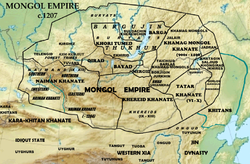
The Merkits lived in the basins of the Selenga and lower Orkhon River (modern south Buryatia, Bulgan Province and Selenge Province).[9] After a struggle of over 20 years, they were defeated in 1200 by Genghis Khan and their lands were incorporated into the Mongol Empire.

Etymology

[edit]

The word Merkit (Merged) with a hard "g" is a plural form derived from the Mongolian word mergen (мэргэн), which means both "wise" and "skillful marksperson", e.g. adept in the use of bow and arrow. The word is also used in many phrases in which it connotes magic, oracles, divination, augury, or religious power. Mongolian language has no clear morphological or grammatical distinction between nouns and adjectives, so mergen may mean "a sage" as much as "wise" or mean "skillful" just as much as "a master". Merged becomes plural as in "wise ones" or "skillful markspeople". In the general sense, mergen usually denotes someone who is skillful and wise in their affairs.[citation needed]

Three Merkits

[edit]

The Merkits were a confederation of three tribes, inhabiting the basin of the Selenga and Orkhon Rivers.

  • The Uduyid Merkits lived in Buur-kheer, near the lower Orkhon River;
  • The Uvas Merkits lived in Tar, between the Orkhon and Selenge Rivers;
  • The Khaad Merkits ("Kings" Merkits) lived in Kharaji-kheer, on the Selenge River.

Relations

[edit]

The Merkits established contact with the Mongol Confederation and Keraites. They were related to Naimans, Khitans,[10] Telengits and Kirghiz.[11]

According to Rashid al-Din Hamadani, the Merkits were a branch of the Mongols.[12] Western European authors of the 13th century mention the Merkits. They believed that they shared a similar appearance and spoke the same language with other Mongol tribes.[13]

Conflict with Genghis Khan

[edit]

Temüjin's mother Hoelun, originally from the Olkhonud, had been engaged to the Merkit chief Yehe Chiledu. She was abducted by Temüjin's father Yesugei, while being escorted home by Yehe Chiledu.

In turn, Temüjin's new wife Börte was kidnapped by Merkit raiders from their campsite by the Onon river around 1181 and given to one of their warriors the brother of Yehe Chiledu named Chilger-Bökö. Temüjin, supported by his brother (not blood-related) Jamukha and his khan etseg ('khan father') Toghrul of the Keraites, attacked the Merkit and rescued Börte within the year. The Merkits were dispersed after this attack. Shortly thereafter she gave birth to a son named Jochi. Temüjin accepted Jochi as his eldest son, but the question lingered throughout Jochi's life of whether he was the son of Genghis Khan or Chilger-Bökö. These incidents caused a strong animosity between Temüjin's family and the Merkits. From 1191 to 1207, Temujin fought the Merkits five times.

By the time he had united the other Mongol tribes and received the title Genghis Khan in 1206, the Merkits seem to have disappeared as an ethnic group. Those who survived were absorbed by other Mongol (Oirats,[14] Buryats,[15] Khalkhas[16]) and Turkic tribes (Kazakhs, Kyrgyzes) and others who fled to the Kipchaks mixed with them. In 1215–1218, Jochi and Subutai crushed the remnants of them under their former leader Toghta Beki's family. The Mongols clashed with the Kankalis or the Kipchaks because they had sheltered the Merkit.

Genghis Khan had a Merkit khatun (queen) named Khulan. She died while Mongol forces besieged Ryazan in 1236.

Late Merkits

[edit]

A few Merkits achieved prominent positions among the Mongols. Great Khan Guyuk's beloved khatun Oghul Qaimish, who was a regent from 1248 to 1251, was a Merkit woman. The traditionalist Bayan and his nephew Toqto'a served as grand chancellors of the Yuan dynasty.

Notes

[edit]

References

[edit]
Revisions and contributorsEdit on WikipediaRead on Wikipedia
from Grokipedia
The Merkit were a confederation of three Mongol tribes inhabiting the basins of the Selenge and Orkhon Rivers in northern during the , forming one of the major nomadic groups on the . Known for their belligerent nature and frequent conflicts with neighboring tribes, the Merkit held a longstanding grudge against Temüjin's lineage due to Yesügei, Temüjin's father, having abducted —a from a Merkit-affiliated group—prompting retaliatory raids. Their most notable clash with Temüjin (later ) occurred around 1200, when they captured and held his wife for several months, an event that galvanized Temüjin to ally with the Kereit leader Ong Khan for a decisive counterattack, ultimately defeating the Merkit core in 1204–1205 and scattering their remnants. Despite this subjugation, Merkit survivors fled westward, where they were pursued and largely eliminated by Mongol forces under in 1216–1217 to prevent future rebellions, leading to their full incorporation into the expanding . Temüjin himself later took a Merkit , Khulan, as a wife, illustrating the complex intermarriages amid conquest. The Merkit's defeat marked a critical step in unifying the steppe tribes under 's leadership, highlighting the role of personal vendettas and strategic alliances in the formation of the Mongol polity.

Name and Origins

Etymology

The name Merkit (also rendered as Mergid or Mierqi in historical sources) is the plural form derived from the Mongolian term mergen (мэргэн), which signifies both "wise" in the sense of intellectual acumen and "skillful" as in an adept archer or hunter proficient with bow and arrow. This etymology reflects the tribe's reputed prowess in warfare and nomadic skills, aligning with descriptions in medieval Mongol chronicles portraying them as formidable adversaries. While the Merkits are often classified as a Turkic or Mongolic group based on linguistic and cultural affiliations, the name's Mongolian roots suggest integration into the broader , possibly indicating a shared lexical heritage among nomadic confederations in the 12th-century . Alternative interpretations linking the root to concepts of "strength" or "fierceness" appear in some genealogical analyses but lack the specificity of the mergen derivation supported by primary linguistic evidence.

Geographical and Historical Origins

The Merkit were a nomadic tribal confederation that emerged in the 12th century on the northern Mongolian Plateau, primarily occupying the basins of the Selenga River and lower Orkhon River, areas now encompassing Selenge Province in Mongolia and southern Buryatia in Russia. This territory, located southeast of Lake Baikal, lay at the ecological transition between open steppes and forested regions, enabling a subsistence pattern that combined pastoralism with hunting and fishing. Chinese dynastic records from the Liao (907–1125) and Jin (1115–1234) periods identify them as nomadic groups in the Selenga valley by the late 10th century, though their coalescence into a distinct confederation likely occurred amid the intensifying tribal rivalries of the early 12th century. The Secret History of the Mongols, an indigenous chronicle dated to circa 1240, delineates the Merkit as comprising three primary divisions: the Uduyid Merkit, Uvas Merkit, and Qa'at Merkit, each led by notable chieftains such as Toghon Taishi of the Uduyid. These groups maintained semi-independent strongholds, including the fortified Taiqal site along the Selenga, which served as a base during conflicts with neighboring tribes. Historical evidence suggests the Merkit originated from mixed steppe populations, with scholarly debate centering on their linguistic affiliations—potentially Turkic in core elements, as inferred from toponymic and onomastic patterns—yet they operated within the Mongolic tribal matrix and were subsumed under the Mongol imperial identity post-conquest. Their prominence in regional power dynamics is evidenced by early 12th-century alliances and feuds, positioning them as key adversaries to proto-Mongol lineages before their decisive subjugation between 1197 and 1217.

Tribal Organization and Society

The Three Merkit Confederations

The Merkit confederation was structured around three principal tribal divisions, each occupying distinct territories in the basins of the and Orkhon Rivers in present-day south-central and adjacent regions. These divisions—the Uduyid Merkit, Uvas Merkit, and Qa'at Merkit—functioned as semi-autonomous units under hereditary leaders known as bekis, coordinating loosely for defense, raids, and alliances while maintaining internal hierarchies based on clan lineages. This organization reflected broader patterns among 12th-century nomads, where geographic separation fostered specialized subsistence strategies, such as fishing and herding along riverine lowlands, yet enabled unified resistance against external threats like the rising Mongol tribes under Temüjin (later ). The Uduyid Merkit, the southernmost division, resided in Buur-kheer near the lower Orkhon River, leveraging fertile floodplains for pastoralism and fortified camps. Led by Toqto'a-beki around 1180–1200, this group played a pivotal role in early conflicts with the Mongols, including the 1187 abduction of Temüjin's wife Börte from the Onon River region, which prompted retaliatory campaigns. Their leadership emphasized kinship ties, with Toqto'a-beki's family dominating decision-making, as evidenced in primary accounts of Mongol-Merkit feuds. North of the Uduyid lay the Uvas (or U'as) Merkit in the area between the Orkhon and Rivers, a transitional zone supporting mixed herding of sheep, horses, and cattle amid seasonal migrations. This division, under chiefs like Dayir-usun, contributed warriors to confederation-wide levies, estimated at several thousand fighters collectively across the Merkits by the late , though precise numbers remain unverified beyond qualitative descriptions in contemporary records. Their strategic position facilitated trade and scouting networks, yet exposed them to Mongol incursions during the 1204–1205 campaigns that dismantled Merkit unity. The Qa'at Merkit, often positioned farthest north along the upper , specialized in river-based economies including fishing weirs and boat raids, with leaders such as Khulgen coordinating defenses against Naiman and Kereit pressures pre-1200. This group, sometimes rendered as Khaad in variant transliterations, maintained distinct dialects and customs suggestive of Turkic influences amid Mongol tribal assimilation, though they allied transiently with other confederations against Temüjin's unification efforts. By 1205, Genghis Khan's forces had subjugated all three, scattering survivors into subordinate roles within the nascent , with remnants documented in 13th-century administrative tallies as integrated tumens.

Social Structure and Governance

The Merkit consisted of three primary tribes—the Uduyid, Qaat, and a third subgroup—each led by a hereditary chief or beki, who coordinated military and migratory activities across the and basins. These leaders, exemplified by Toqto'a-beki of the Uduyid, Dayir-usun of the Qaat, and Qa'atu, operated as a collective known as the "Three Merkit," reflecting a fraternal rather than a singular . Governance emphasized decentralized authority among these aqa-nar ("elder brothers"), senior commanders who held sway through ties, raiding prowess, and consensus in assemblies akin to steppe quriltai for major decisions like warfare or alliances. This structure prioritized military loyalty and elder mediation over formal bureaucracy, with no evidence of a unified ; disputes were resolved via blood feuds or coalitions, as seen in their 1197 abduction of , executed jointly by the three chiefs. Social hierarchy reinforced patrilineal clans, where noble lineages (noyad) dominated and captive integration, fostering resilience but vulnerability to unified external assaults.

Economy, Lifestyle, and Culture

Nomadic Economy and Subsistence

The Merkit sustained themselves through , herding livestock such as sheep, , , and likely across the forest-steppe regions near the Selenge River and , where seasonal migrations followed available pastures to support herd viability. This system provided essential resources including for protein, and for daily nutrition, and hides for and , and for transportation, milking, and military capabilities, mirroring the adaptive strategies of pre-imperial Mongol tribes in the same ecological zone. Herds formed the core measure of and status, with families relocating camps multiple times annually to prevent and leverage seasonal grasses, a practice that demanded intimate knowledge of terrain and weather patterns for survival amid harsh continental climates. Raiding supplemented pastoral yields by targeting neighboring groups for additional livestock, captives, and goods, serving as both economic necessity during lean periods and a means to expand herds without fixed agricultural investment. Such expeditions, often opportunistic rather than declarative of full-scale war, exploited the mobility of horse-mounted warriors to seize resources from rivals like the early , thereby mitigating risks of famine or herd depletion from disease and dzuds—severe winter kills common in the region. Limited evidence suggests supplementary activities like hunting wild game and rudimentary gathering, but these were secondary to animal husbandry, which anchored social organization around clan-based herding units rather than settled cultivation. Trade networks occasionally exchanged surplus hides or animals for metal tools and grains from sedentary neighbors, though self-sufficiency in basics defined their pre-conquest resilience.

Cultural and Religious Practices

The Merkit, as nomadic pastoralists of the , adhered primarily to , a involving rituals mediated by shamans (known as böö in Mongol traditions) to commune with spirits, ancestors, and natural forces. This practice encompassed , where natural elements like rivers, mountains, and animals were seen as inhabited by spiritual entities, and veneration of , the supreme sky deity central to religions. Shamanistic ceremonies often included sacrifices, through bones or drums, and ecstatic trances to seek guidance for , warfare, or tribal decisions, reflecting the harsh environmental demands of their semi-arid homeland southeast of . Although some accounts suggest partial adoption of Nestorian Christianity among Merkit elites or through alliances with converted neighbors like the Kerait and Naiman—possibly as early as the —the predominant religious framework remained indigenous rather than wholesale conversion. This persistence aligned with their Turkic-Mongol ethnic affiliations and resistance to external cultural impositions prior to Mongol conquest. Limited archaeological or textual evidence specific to Merkit rituals underscores the oral and ephemeral nature of these practices, which paralleled those of contemporary tribes without distinct innovations noted in historical records. Culturally, Merkit traditions emphasized communal of sheep, , and camels, supplemented by seasonal and occasional part-time in riverine areas, fostering a mobile lifestyle adapted to the steppes. Social customs included forging alliances via intermarriage, as seen in unions with Naiman royalty, and a martial ethos that prioritized raiding and vengeance feuds, which structured ties and leadership hierarchies around (noble) families. These elements reinforced tribal confederations divided into three main lineages—Uduyid, Uvasiyid, and Qatawin—each maintaining patrilineal descent and collective identity through shared myths and migratory patterns.

Inter-Tribal Relations

Alliances and Trade Networks

The Merkits formed opportunistic alliances with rival confederations to resist Temüjin's unification campaigns in the late 12th and early 13th centuries. Following their raid on Temüjin's encampment and abduction of his wife around 1197, the Merkits allied with , Temüjin's former blood-brother and political adversary, as well as the Naiman tribe, mobilizing joint forces to challenge Mongol consolidation on the . This coalition reflected broader inter-tribal dynamics, where the Merkits leveraged kinship ties and shared opposition to emerging Mongol , though it failed to halt Temüjin's advances. In 1201, the Merkits partnered with the Jalayir tribe in a coordinated attack against Temüjin's forces, aiming to exploit divisions within the nascent Mongol alliance but resulting in a decisive defeat that weakened their . Remnants of the Merkits later aligned with the Kipchak (), forming a defensive pact north of the Mongol sphere; this Merkit-Kipchak alliance was crushed by Mongol armies in the Battle of the Chem River circa 1205, scattering survivors and accelerating the Merkits' subjugation. Trade networks among the Merkits were embedded in the pastoral nomadic economy of the , involving barter of horses, furs, and livestock with neighboring sedentary groups like the Khitans or for iron tools, grain, and cloth, though direct evidence of Merkit-specific routes remains limited in historical records. These exchanges supplemented raiding, with alliances occasionally facilitating access to broader fringes, but conflicts disrupted sustained commercial ties by the early 1200s.

Pre-Conquest Conflicts and Feuds

The Merkit tribes harbored a deep-seated blood feud with the clan, stemming from Yesügei Ba'atur's abduction of —intended as a bride for the Merkit warrior Chiledu—around the mid-, prior to 1162. This act of bride-kidnapping, common among nomads but igniting lasting vengeance, established the Merkits as persistent adversaries to the early . Renowned for their belligerence, the Merkits routinely conducted raids on neighboring groups across the during the , targeting , women, and resources to assert dominance in the competitive nomadic environment. Such inter-tribal skirmishes were exacerbated by scarce pastures and honor-based retaliations, with the Merkits often clashing against proto-Mongol factions and other rivals like the , though they occasionally allied with the latter against common foes. By the late 12th century, these feuds manifested in broader coalitions, as Merkit leaders like Toqtoa Beki joined forces with the and Jalayirs in opposition to Temüjin's rising power, contributing to unstable tribal warfare that preceded unified campaigns. Historical accounts, including the Secret History of the Mongols, portray these conflicts as driven by revenge cycles and territorial pressures rather than centralized strategy.

Military Conflicts with the Mongols

The Capture of Börte and Initial Hostilities

In retaliation for the abduction of Temüjin's mother by his father Yesügei decades earlier, members of the Merkit tribe launched a raid against Temüjin's camp near the Burgi . The Merkits viewed Yesügei's act as the origin of enduring enmity, declaring upon their attack, "It was because of you that we suffered enmity and strife; it is to avenge the quarrel that we have now come." This grudge stemmed from tribal raiding practices common among nomads, where bride capture was a normalized means of alliance-building or , though it often escalated feuds. The raid occurred around 1180, catching Temüjin and his small following unprepared during a period of vulnerability following their recent marriage. Three Merkit warriors from the Uduyid clan—, Chilger Botoq, and their comrade—struck at dawn, killing Temüjin's companion Sorkan-shira and capturing his Börte, along with her coat . Temüjin fled the assault, later reflecting on it as a profound that tested his resolve; he sought solace at mountain before rallying support. Börte was taken to the Merkit heartland near , where she was allotted to Chilger Botoq as a , exemplifying the Merkits' practice of integrating captives into their patrilineal structure. Temüjin responded by forging a temporary alliance with his blood brother Jamukha and the Kereit leader Toghrul (Ong Khan), leveraging oaths of anda (sworn brotherhood) and gifts, including the recovered sable coat presented to Toghrul to invoke reciprocity. This coalition assembled a force estimated at several thousand, launching a nocturnal counter-raid across the Khalkh River against the Merkits' main encampment. The attackers overwhelmed the Merkits in the darkness, slaying many, including key leaders, and rescuing Börte, who had been concealed in a cart by the Merkit woman Qo'aqchin; an old slave identified her hiding place. The Merkits scattered in defeat, marking the first major Mongol-led victory over them and solidifying the blood feud that persisted for decades. Börte's captivity, lasting approximately eight to ten months, resulted in the birth of her son Jochi shortly after her return, prompting persistent uncertainty among Temüjin's followers regarding his paternity due to the circumstances of her abduction.

Genghis Khan's Campaigns Against the Merkits

Following the unification of the Mongol tribes at the 1206 quriltai where Temüjin assumed the title of , he initiated campaigns to eliminate persistent rivals, including the Merkits, who had allied with the and Tayichi'ud against Mongol ascendancy. The Merkits, under leaders such as Toqto'a Beki, had survived earlier conflicts but fled westward after Mongol victories over the in the Chakirmaut region around 1204, seeking refuge among Siberian forest peoples and along the River. assigned his eldest son to lead the pursuit, reportedly to affirm Jochi's loyalty and dispel lingering doubts about his paternity stemming from Börte's earlier captivity among the Merkits. In late 1208 or early 1209, Jochi's forces—comprising Mongol tumens supplemented by allied contingents—engaged the Merkit remnants in the Battle of the River (also known as the Battle of Buqdarma or along the river's tributaries). The Merkits, numbering several tumens and fortified by their nomadic mobility and alliances with Naiman survivors, made a stand in the wooded near the Buqdarma River, but Mongol and feigned retreats disrupted their formations. Jochi's killed Toqto'a Beki and much of the Merkit , capturing thousands of women, children, and dependents while scattering the survivors into the forests or subordinate roles under Mongol oversight. This campaign marked the effective dissolution of the Merkit confederations, with their pastoral lands east of Lake Baikal redistributed to loyal Mongol noyan and the tribe's manpower integrated into Genghis Khan's expanding niru'un (decimal units) for future conquests. Surviving Merkits were enslaved or dispersed, ending their autonomy after decades of intermittent warfare; some elements later reemerged in peripheral alliances, such as with Kipchaks during Jochi's western expeditions in 1218–1219, but the core threat was neutralized. The operation underscored Genghis Khan's strategy of targeted annihilation for hereditary foes, leveraging Jochi's command to consolidate ulus cohesion.

Defeat, Enslavement, and Absorption

Following Genghis Khan's unification of the Mongol tribes in 1206, surviving Merkit groups that had escaped earlier conflicts fled westward, initially aligning with the before seeking alliance with the Kipchak confederation to evade subjugation. In 1207, Genghis dispatched his eldest son to the Altai region to pursue these remnants, resulting in the incorporation of Merkit and Naiman territories into Mongol control, though some Merkits continued to resist by relocating further west. By 1216, Merkit forces under leaders like Toqtoa Beki had regrouped and rebelled, prompting to authorize a decisive campaign in 1217 led by and general to eradicate them. The Mongols tracked the Merkits across the steppes, culminating in battles such as the engagement at the Chem River near the in 1219, where combined Merkit-Qangli armies were decisively defeated, scattering the survivors. In the aftermath, Genghis ordered the slaughter of adult Merkit males, driven by enduring enmity from their 1187 capture of —which led to doubts about Jochi's paternity—and to eliminate any potential for future revolts or rival claims to leadership. Women and children, numbering in the thousands, were enslaved and apportioned among loyal Mongol elites as household servants, concubines, and laborers, effectively dismantling Merkit social structures. The remnants of the Merkit population were gradually absorbed into the , intermarrying with conquering tribes and serving in auxiliary roles within the imperial military and administration. By the 1220s, distinct Merkit identity had dissolved, with descendants contributing to the empire's manpower without retaining autonomous tribal organization or territory.

Legacy and Descendants

Integration into the Mongol Empire

Following the final defeat of Merkit forces in 1205 during campaigns against their leaders Toqtoa and Qulqan, who had allied with the , surviving tribesmen were dispersed and incorporated into Mongol military regiments to prevent regrouping and harness their fighting capabilities. This strategy of "sprinkling" defeated populations across units ensured loyalty through integration and diluted tribal affiliations, with Merkit warriors assigned permanently to mixed tumens under Mongol command. Merkit women and children faced enslavement and redistribution to Genghis Khan's followers, often through or , which accelerated and addressed demographic needs in the expanding empire. Lands previously held by the Merkits in the Selenga and basins were annexed into the Mongol domain by 1206, marking their full territorial incorporation during the quriltai that proclaimed Genghis Khan's supremacy. Remnants of Merkit resistance persisted briefly, prompting further suppression; in 1216–1218, Subutai's forces eradicated rebel Merkit troops, after which survivors either fled to groups like the or were fully absorbed, losing distinct tribal identity within Mongol society. While few Merkits rose to prominence—reflected in their reclassification as without separate status—they contributed manpower to subsequent conquests, embodying Genghis Khan's pragmatic approach to transforming vanquished foes into empire-building assets.

Long-Term Genetic and Cultural Impact

The Merkits, following their decisive defeat by Genghis Khan's forces in –1205, experienced near-total dispersal and enslavement, with surviving males often killed and females and children allocated as nökers (dependents) or concubines to Mongol warriors, facilitating rapid into the dominant and allied lineages. This process erased distinct patrilineal Merkit Y-chromosome markers, as evidenced by the absence of unique haplogroups in modern genetic surveys of Central Asian nomads, where Merkit contributions appear diluted within broader C2-M217 subclades shared by Mongolic and Turkic groups. Remnant Merkit groups fled westward, pursued into the Chu Valley by and in 1217, after which survivors integrated into neighboring tribes, contributing minimally to long-term genetic diversity beyond localized maternal mtDNA lineages. Modern descendants of the Merkits persist in fragmented clan identities (uruk or obok) among , Kyrgyz, and , where surnames or tribal sections named "Merkit" denote historical absorption rather than unbroken continuity, reflecting endogamous preservation amid broader Turkic-Mongol . Genetic studies of these groups show no disproportionate Merkit-specific alleles, underscoring assimilation's efficiency in homogenizing populations under Mongol , with any legacy overshadowed by the expansive Y-chromosomal footprint of Genghisid lines affecting ~0.5% of global males. Culturally, Merkit practices—encompassing shamanistic tengriism, pastoral nomadism, and clan-based raiding—merged seamlessly into the Mongol imperial synthesis, leaving no autonomous artifacts, dialects, or rituals by the era (post-1256), as imperial decrees enforced yasa () over tribal variances. This integration exemplifies the empire's strategy of selective incorporation, where defeated foes' technologies (e.g., Merkit riverine adaptation) enhanced Mongol logistics without preserving ethnic boundaries, contributing to a unified identity that prioritized loyalty to the qan over prior affiliations. By the , Merkit cultural markers had dissipated, evident in the lack of distinct references in chronicles like Rashid al-Din's (c. 1307), which treats them as subsumed tributaries.

Modern Historical Assessment

Modern historians regard the Merkit confederation as a formidable nomadic entity in 12th-century , characterized by fragmented tribal subunits such as the Uduyid, Maidurid, and Todolin, whose resistance to Temüjin's authority exemplified the fragmented politics that necessitated violent unification. Their initial conflicts stemmed from a generational feud—Yesügei Bahadur's abduction of from the Merkit in the mid-12th century—escalating with the Merkit's kidnapping of Temüjin's wife around 1197, which prompted retaliatory campaigns. Defeat occurred in phases: partial setbacks in 1201 allied with the Jalayir, a decisive shattering of their Naiman-Merkit alliance at Chakirmaut in 1204, and final suppression of remnants under Toqtoa Beki by Subutai's forces near the Irtysh River in 1205, with lingering rebels eradicated among the by 1218. Primary accounts like The Secret History of the Mongols (compiled circa 1240) portray the Merkit as inherently belligerent raiders, a narrative shaped by Mongol victors' bias toward justifying conquest and vendetta; in contrast, Jin dynasty annals (Jin Shi) depict them as Khitan vassals engaging in routine steppe skirmishes, offering a less ideologized view of their pastoral-military lifestyle reliant on herding, hunting, and occasional tribute. Historians such as those analyzing Liao-Jin interactions note this dual sourcing reveals systemic intertribal raiding as a causal driver of instability, with Temüjin's targeted elimination of Merkit elites—fearing reprisals over Hö'elün and Börte—representing calculated realpolitik to forge loyalty in a nascent imperium, rather than gratuitous genocide. Recent genetic analyses trace Merkit paternal lineages (via 23 Y-STR markers) persisting in Kazakh Kerey subclans, evidencing absorption into broader Mongol-Turkic populations rather than wholesale extermination, which tempers assessments of their "erasure" in favor of pragmatic enslavement and integration. This legacy underscores the empire's ethnic amalgamation, where defeated groups like the Merkit bolstered manpower for expansions, contributing to the steppe's transformation from warring confederacies to a centralized extractive state by 1206. Scholars caution against overreliance on hagiographic Mongol chronicles, advocating cross-verification with Chinese records to discern patterns of nomadic adaptation over mythic heroism.

References

Add your contribution
Related Hubs
User Avatar
No comments yet.