Hubbry Logo
Periodization of pre-Columbian PeruPeriodization of pre-Columbian PeruMain
Open search
Periodization of pre-Columbian Peru
Community hub
Periodization of pre-Columbian Peru
logo
8 pages, 0 posts
0 subscribers
Be the first to start a discussion here.
Periodization of pre-Columbian Peru
from Wikipedia


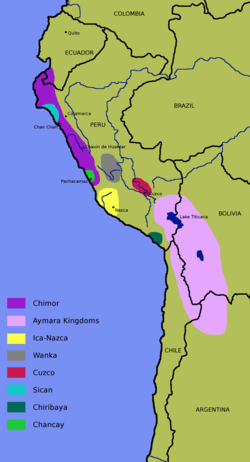
Major cultures in Peru in the Late Intermediate Period (1000–1400)

This is a chart of cultural periods of Peru and the Andean Region developed by John Rowe and Edward Lanning and used by some archaeologists studying the area. An alternative dating system was developed by Luis Lumbreras and provides different dates for some archaeological finds.

Most of the cultures of the Late Horizon and some of the cultures of the Late Intermediate joined the Inca Empire by 1493, but the period ends in 1532 because that marks the fall of the Inca Empire after the Spanish conquest. Most of the cut-off years mark either an end of a severe drought or the beginning of one. These marked a shift of the most productive farming to or from the mountains and tended to mark the end of one culture and the rise of another.

The more recent findings concerning the Norte Chico civilization are not included on this list, as it was compiled before the site at Caral was investigated in detail.

Period Dates Cultures
Lithic and Andean preceramic
Period I 12000 BCE – 9500 BCE Red Zone (12000 BCE – 10500 BCE),
Oquendo (10500 BCE – 9500 BCE)
Period II 9500 BCE – 8000 BCE Chivateros I
Period III 8000 BCE – 6000 BCE Arenal, Chivateros II, Lauricocha I, Playa Chira, Puyenca, Toquepala I
Period IV 6000 BCE – 4200 BCE Ambo, Canario, Siches, Lauricocha II, Luz, Toquepala II
Period V 4200 BCE – 2500 BCE Honda, Lauricocha III, Pernil Alto, Sechin Bajo, Viscachani, Jisk'a Iru Muqu
Period VI (Cotton Pre-ceramic) 2500 BCE – 1800 BCE Norte Chico (Caral), Buena Vista, Casavilca, Culebras, Ventarron, Viscachani, Huaca Prieta, Las Haldas, Jisk'a Iru Muqu
Ceramic
Initial Period (also called Formative Period) 1800 BCE – 900 BCE Early Chiripa, Kotosh, Cupisnique, Toríl (the Cumbe Mayo aqueduct was built c. 1000 BCE), Las Haldas, Qaluyu, Pukara, Casma–Sechin
Early Horizon (Also called Formative Period) 900 BCE – 200 BCE Chavín, Late Chiripa, Paracas, Pechiche, Pukara, Sechura, Casma–Sechin
Early Intermediate  200 BCE – 600 CE Moche, Nazca, Recuay, Lima, Pukara, Tiwanaku, Pechiche, Piura, Salinar, Vicus, Huarpa, Virú
Middle Horizon 600 CE – 1000 CE Wari, Tiwanaku, Piura, Las Ánimas, Sican
Late Intermediate 1000 CE – 1476 CE Chimú, Cajamarca, Piura, Chancay, Chachapoya, Chincha, Chiribaya, Chucuito, Huaman Huilca, Ilo, Qotu Qotu, Pacacocha, Palli Marca, Piura, Sican, Tajaraca, Huaylas, Conchucos, Huamachuco, Rucanas, Chanka, Wanka, Aymara kingdoms (Qulla, Lupaca, Charca, Kana, Qanchi), Ayabaca, Bracamoros, Huancabambas, Tallán, Tumpis, Huarco, Coayllo, Ichma, Parinacota, Cuntis, Chinchaycochas, Huarochiri, Kheswas, Yaro, Atavillo, Cantas, Yauyos, Tarmas, Paltas, Camanas (peruvian culture), Huayuri
Late Horizon 1476 CE – 1534 CE Inca

See also

[edit]

References

[edit]
Revisions and contributorsEdit on WikipediaRead on Wikipedia
from Grokipedia
The periodization of pre-Columbian Peru encompasses the archaeological framework used to sequence the cultural, technological, and societal developments in the Andean region of modern Peru from the earliest human occupations around 15,000 BCE until the Spanish conquest in 1532 CE. Pioneered by archaeologist John H. Rowe in the 1940s and formalized with Edward P. Lanning in the 1960s, this system relies on stylistic changes in ceramics, architecture, and art, corroborated by radiocarbon dating, to delineate evolutionary stages rather than strictly political eras. It highlights Peru's role as a cradle of early complex societies in the Americas, featuring innovations in agriculture, monumental construction, and urbanism long before European contact. This central Peruvian-focused scheme coexists with regional variations and alternatives. The chronology begins with the Preceramic Period (ca. 9500–1800 BCE), marked by the shift from nomadic hunter-gatherers to sedentary communities experimenting with plant domestication, fishing, and early in diverse environments from coastal deserts to highland valleys. Key developments include the construction of monumental platforms and plazas at sites like Caral-Supe (ca. 2600–2000 BCE), representing the Norte Chico civilization—one of the world's oldest known urban centers without ceramics—and evidence of early cotton cultivation and communal feasting. This era, subdivided into lithic and archaic phases, laid the foundations for later Andean complexity through adaptations to arid conditions and the emergence of ritual centers like Kotosh. Transitioning into the Ceramic Period (ca. 1800 BCE–1532 CE), the framework divides into horizons of widespread cultural influence interspersed with intermediate periods of regionalism. The Initial Period (ca. 1800–900 BCE) saw the advent of , intensified with crops like and potatoes, and the rise of ceremonial sites and monumental architecture at diverse locations across Peru. These include Chiripa on , where temple complexes and early weaving technologies flourished; Kotosh in the central highlands, famous for the Templo de las Manos Cruzadas (Temple of the Crossed Hands); Las Haldas on the north coast; and the Casma-Sechín complex (including Sechín Alto and Pampa de las Llamas-Moxeke). Other notable sites from this period are Cupisnique in the north, Toríl (associated with the Cumbe Mayo aqueduct), La Galgada, and Cardal. The Early Horizon (ca. 900 BCE–200 BCE) is defined by the expansive , centered at , which disseminated a distinctive religious of felines, serpents, and hallucinogenic plants across the via trade networks, unifying diverse groups through shared artistic styles. The Early Intermediate Period (ca. 200 BCE–600 CE) featured the proliferation of localized powers, including the Moche on the north coast, renowned for realistic portrait vessels, hydraulic engineering, and pyramid complexes at and Huaca de la Luna; the in the south, famous for geoglyphs like the Nazca Lines and intricate textiles; and highland Recuay and coastal Lima cultures. This gave way to the Middle Horizon (ca. 600–1000 CE), dominated by the Wari (Huari) empire in the central highlands, which imposed administrative centers, road systems, and terraced agriculture over much of , alongside the contemporaneous influence from the , fostering and (corn beer) rituals. The Late Intermediate Period (ca. 1000–1476 CE) emerged after the Wari collapse, characterized by fragmented polities adapting to environmental stresses like droughts, with standout cultures such as the Chimú kingdom on the north coast—builders of the vast adobe city of —and the Chachapoyas in the cloud forests, known for cliff tombs and circular villages. Finally, the Late Horizon (ca. 1476–1532 CE) represents the apogee of pre-Columbian Peru under the , which rapidly expanded from Cuzco to encompass over 2,000 kilometers of territory through military conquest, a sophisticated labor system, and infrastructure like the Qhapaq Ñan road network, integrating diverse ethnic groups into a centralized state with advanced record-keeping and agricultural terraces. This periodization, while influential, continues to evolve with new excavations and dating techniques, underscoring the dynamic interplay of innovation and adaptation in Andean prehistory.

Background and Frameworks

Definition and Purpose

Periodization in the context of pre-Columbian constitutes a chronological framework that divides the of the Andean region into discrete phases primarily defined by shifts in cultural practices, technological innovations, and societal organization, rather than solely by temporal units or isolated traits. This approach distinguishes between "periods," which represent broad spans of contemporaneity across the region, and "stages," which capture evolving similarities in , such as advancements in ceramics, textiles, and . Developed as a tool for interpreting archaeological evidence, enables researchers to align diverse artifacts and site data into a coherent timeline, emphasizing evolutionary developments in Andean societies. The primary purpose of this periodization is to create a standardized structure for cross-regional comparisons, allowing archaeologists to track key technological and economic advancements—like the emergence of pottery production, intensive agriculture, and monumental construction—while elucidating patterns of cultural interaction and exchange among distant communities. By organizing from varied environmental zones, from coastal valleys to highland plateaus, it facilitates the reconstruction of , such as the spread of religious ideologies or trade networks, without relying on written records. This framework is essential for synthesizing fragmented data from multiple excavations, providing a backbone for understanding the progression of pre-Columbian in Peru and the broader Central Andes. In , plays a crucial role by integrating findings from emblematic sites, such as the monumental complex at —representing early urbanism in the Late Preceramic Period—and the religious center of , emblematic of pan-Andean influences during the Early Horizon, into a unified historical sequence. This synthesis aids in constructing comprehensive narratives of societal complexity and continuity across millennia. The standard Rowe-Lanning scheme serves as the foundational model for these divisions. The broad temporal span encompassed by pre-Columbian extends from the earliest evidence of human presence around 12,000–15,000 BCE, marking initial adaptations in the Andean region, to 1532 CE, when the fell to Spanish conquest, concluding the indigenous prehispanic era.

Development of Standard Schemes

The standard periodization scheme for pre-Columbian Peru emerged in the mid-20th century through the work of American archaeologist John H. Rowe, who in 1960 formulated a framework distinguishing "horizons" as eras of widespread stylistic and cultural unification across the , contrasted with "intermediate periods" marked by regional diversification and localized developments. This model, detailed in Rowe's seminal paper "Cultural Unity and Diversification in Peruvian Archaeology," drew on ceramic seriation and cross-dating techniques to establish contemporaneity, building on earlier influences from scholars like Max Uhle and . Horizons, such as the Early and Middle Horizons, reflected pan-Andean integrations often linked to dominant styles like Chavín or Wari, while intermediate periods highlighted autonomous regional sequences, providing a scaffold for correlating archaeological data from diverse environments. In the 1960s, Edward P. Lanning extended this framework backward by integrating pre-ceramic phases, thereby expanding the chronological scope to encompass the earliest human occupations in . Lanning's 1967 book Peru Before the Incas synthesized radiocarbon data and stratigraphic evidence to delineate six pre-ceramic periods (I–VI), bridging the gap between Paleolithic-like foraging societies and the advent of ceramics around 1800 BCE. This integration created the collaborative Rowe-Lanning chart, a comprehensive timeline dividing pre-Columbian history into pre-ceramic phases (e.g., Pre-Ceramic VI: 2500–1800 BCE, associated with early monumental architecture), followed by the Initial Period, Early Horizon (ca. 900 BCE–200 BCE), Early Intermediate Period (ca. 200 BCE–600 CE), Middle Horizon (ca. 600–1000 CE), Late Intermediate Period (ca. 1000–1470 CE), and Late Horizon (ca. 1470–1532 CE). The chart's structure emphasized temporal overlaps and environmental adaptations, using approximate dates calibrated from key sites like Lauricocha and the Ica Valley. The Rowe-Lanning scheme profoundly influenced Andean archaeology by offering a balanced synthesis of coastal, highland, and sierra data, facilitating comparative studies and becoming the foundational reference for subsequent excavations and syntheses. Its adoption stemmed from the model's flexibility in accommodating stylistic evidence while allowing for regional refinements, as seen in its integration into major surveys of Peruvian . However, limitations were acknowledged from the outset, including heavy reliance on styles for —which marginalized non-ceramic contexts—and the initial exclusion of early complex societies, such as the Norte Chico civilization, whose monumental sites were not fully recognized until later in the 1990s. These constraints highlighted the framework's evolutionary nature, prompting ongoing adjustments based on new environmental and bioarchaeological evidence.

Pre-Ceramic Periods

Lithic and Early Archaic Phases

The Lithic and Early Archaic phases encompass the initial human presence in , marked by mobile groups exploiting diverse ecosystems in the highlands, coasts, and valleys during the transition from the Pleistocene to the . These phases, roughly spanning 12,000–6,000 BCE, reflect adaptations to warming climates and changing faunal resources following the end of the last , with no evidence of permanent settlements or domesticated plants. Archaeological evidence primarily consists of lithic tools from caves and open-air sites, indicating , , and basic processing activities. Radiocarbon dates from key sites suggest human arrival in by at least 14,000 BCE, though earlier claims remain debated due to stratigraphic and dating challenges. Period I (c. 12,000–9,500 BCE) corresponds to the Paleo-Indian stage, characterized by the earliest confirmed occupations focused on hunting extinct such as sloths, horses, and camelids. The Pikimachay cave in the Basin highlands stands out as a primary site, yielding unifacial projectile points, burins, and choppers resembling Clovis-style tools from , associated with butchered animal bones in stratified layers. Radiocarbon dates from Pikimachay's lower zones (h and h1) place human activity around 14,150 ± 180 years BP, supporting strategies in a cooler, drier post-glacial landscape. These artifacts, totaling over 280 chipped stone pieces, indicate opportunistic and , with no signs of specialized plant use. Period II (c. 9,500–8,000 BCE) marks an early Archaic shift toward broader resource exploitation, including initial plant processing alongside continued hunting. The Chivateros I complex on the central coast, near the Chillon Valley, exemplifies this phase with a flake-based lithic industry featuring unifacial tools and distinctive grinding stones (manos and metates) that show use-wear from processing wild seeds and tubers. A key radiocarbon date from Chivateros of 10,430 ± 160 BP (calibrated to 12,720–11,718 cal BP) confirms occupation during this interval, with artifacts scattered in eolian sands indicating seasonal campsites. These developments highlight environmental adaptations to rising sea levels and vegetational shifts, transitioning from megafauna reliance to more diverse . Period III (c. 8,000–6,000 BCE) features refined microlithic technologies suited to smaller game and coastal resources, signaling further Archaic diversification. Sites like Arenal in the central highlands and Lauricocha I caves reveal small bladelets, backed microliths, and ground stone tools used for fishing and hunting deer or vicuñas, with evidence of coastal adaptations including early net-making implied by tool forms. At Lauricocha, human burials accompanied by microlithic date to 8,800–8,500 cal , underscoring practices among mobile groups at elevations over 4,000 meters. Open-air sites and rock shelters yield these lithics, reflecting heightened mobility and technological efficiency in exploiting highland puna grasslands and emerging coastal lagoons post-Pleistocene. Overall, these phases laid the groundwork for later pre-ceramic innovations without introducing .

Late Archaic and Cotton Pre-Ceramic

The Late Archaic and Cotton Pre-Ceramic periods mark a transitional phase in pre-Columbian , spanning approximately 6000 to 1800 BCE, during which communities shifted from primarily nomadic to semi-sedentary lifestyles with emerging and monumental , all without the use of ceramics. This era encompasses Periods IV, V, and VI in traditional chronologies, reflecting increasing reliance on cultivated plants and marine resources alongside the development of complex in coastal and highland settings. Key sites such as Ambo and Lauricocha II in Period IV (c. 6000–4200 BCE) provide evidence of early plant , including squash (Cucurbita spp.) and beans (), which supplemented hunting and gathering economies in highland caves and open-air settlements. In Period V (c. 4200–2500 BCE), sites like Paloma on the central coast illustrate heightened dependence on , with assemblages featuring fish bones, , and seabird remains alongside grinding stones for processing wild plants, signaling improved coastal and the onset of more permanent occupations. Basketry and early production emerged during this time, using fibers from local plants for storage and fishing gear, as evidenced by impressions and fragments from coastal middens. These developments laid the groundwork for greater , with populations exploiting diverse environments from fog oases to river valleys, though monumental architecture remained absent. Period VI, known as the Cotton Pre-Ceramic (c. 2500–1800 BCE), represents the pinnacle of pre-ceramic complexity, exemplified by the Norte Chico civilization (Caral-Supe) in north-central coastal , recognized as the oldest known civilization in the . This network of over 30 sites featured monumental , including stepped pyramids and sunken plazas at , where the largest pyramid dates to around 2600 BCE and was constructed using quarried stone filled with shicra bundles of fiber. () cultivation was central to the economy, enabling the production of fishing nets that facilitated trade in marine products like anchovies and shellfish, exchanged for highland obsidian and shells via extensive networks. systems along the Supe, Pativilca, and valleys supported these activities, with no evidence of ceramics but precursors to in knotted cord artifacts used for recording. from sites like (c. 3700–2450 BCE, with main occupation 3000–1800 BCE) and Huaca Prieta (spanning 13,700–3800 cal BP, with late phases aligning to 2500–1800 BCE) confirms this timeline and highlights communal labor in mound-building, absent indicators of warfare such as fortifications or weapons. Recent excavations, such as the 2025 discovery of Peñico in the Supe Valley, continue to reveal the extent of and communal in this civilization.

Ceramic Periods

Initial Period

The Initial Period in pre-Columbian , according to John H. Rowe's scheme spanning approximately 1800–900 BCE, marks the transition to the ceramic era with the widespread adoption of pottery production, monumental architecture, and the development of complex societies, with the construction of early ceremonial across diverse regions. This era built upon pre-ceramic foundations, such as the monumental platforms of the Norte Chico civilization, by introducing sedentary communities focused on ritual and subsistence innovations. Archaeological evidence indicates localized developments without evidence of political unification, as communities in the highlands, coast, and Titicaca Basin pursued independent trajectories of . Principal archaeological sites associated with this period according to Rowe's scheme include Kotosh (central highlands, famous for the Templo de las Manos Cruzadas), La Galgada, Cardal, Las Haldas (north coast), the Casma-Sechín complex (including Sechín Alto and Pampa de las Llamas-Moxeke), Cupisnique (north), and Toríl (with the Cumbe Mayo aqueduct). Key cultures exemplify this regional diversity. In the highlands, the Kotosh tradition featured two-story temple structures with central hearths and ventilation systems, as seen at sites like Kotosh, famous for the Templo de las Manos Cruzadas, and La Seductora, serving as small shrines for communal rituals during the Formative phase (c. 1800–900 BCE). Around the Titicaca Basin, the Early Chiripa phase (c. 1500–1000 BCE) developed sunken courts, such as the rectangular Llusco (13 m x 13 m) and trapezoidal Santiago enclosure, which combined ceremonial functions with nearby residential areas and burials containing offerings like beads. On the north coast, the Cupisnique culture (c. 1500–500 BCE) produced early stirrup-spout vessels, often dark-colored with incised or painted motifs depicting felines and mythical beings, reflecting ideological themes of and capture rituals. Notable sites include Las Haldas, a fortified coastal village covering over 4 hectares with platforms and enclosures indicating defensive and communal organization, the Casma-Sechín complex including Sechín Alto and Pampa de las Llamas-Moxeke, and Cerro Sechín, where 98 carved granite monoliths (dating 1770–1510 BCE) depict warriors, dismembered bodies, and severed heads, suggesting ritualized violence or warfare commemoration. Developments during this period included the first extensive pottery traditions, such as the Wairajirca style in the Huánuco Basin, evolving from plain neckless jars and polished black bottles (c. 1800–1600 BCE) to decorated wide-mouthed vessels with red slips, geometric incisions, and postfired pigments (c. 1400–1200 BCE), signaling technological refinement and cultural exchange. agriculture saw intensification, with starch granule evidence from sites like Canchas Uckro (c. 1100 BCE) indicating expanded cultivation alongside potatoes and manioc, though isotopic analyses (δ¹³C values around -18.9‰) reveal it was not yet a dietary staple, supplemented by marine and C₃ resources. Textile production advanced with cotton techniques, incorporating painted motifs and supplementary weft structures on plain-weave fabrics, as evidenced in coastal and highland assemblages. These innovations supported regional ceremonialism, centered on temple complexes and offerings, fostering social cohesion without centralized authority. The period's significance lies in bridging pre-ceramic to later integrative horizons, with debated suggestions of distant Olmec stylistic influences in motifs like felines, though indigenous developments predominate.

Early Horizon

The Early Horizon, spanning approximately 900 to 200 BCE, marked the first widespread cultural unification in pre-Columbian , centered on the religious and artistic influence of the . This period followed the regional experimentation with pottery styles during the Initial Period, such as those seen in coastal and highland sites, which provided precursors to the more standardized Chavín forms. The Chavín phenomenon facilitated the integration of diverse Andean communities through shared religious practices and iconographic motifs, transforming disparate local traditions into a cohesive horizon of interaction across the highlands, coast, and adjacent regions. At the heart of this unification was the temple complex of , located in the northern highlands of , which served as a major and center. The site's architecture featured distinctive U-shaped platform mounds enclosing sunken circular plazas, with internal galleries, ventilation shafts, and drainage systems that enhanced ritual experiences through controlled acoustics and lighting. prominently included and serpent motifs, as exemplified by the Lanzón Stela—a carved monolith depicting a staff-wielding with feline attributes—symbolizing supernatural power and shamanic transformation. These elements underscored Chavín de Huántar's role in orchestrating religious authority, drawing pilgrims from distant areas for oracular consultations and ceremonies involving hallucinogens. The spread of the Chavín art style across the exemplified this period's integrative developments, characterized by stylized feline motifs, contorted supernatural figures, and innovative ceramic forms like stirrup-spout vessels that combined functionality with symbolic depth. This artistic diffusion extended from the northern coast to the southern highlands, influencing local expressions while promoting networks for exotic goods. emerged as a significant advancement, with the introduction of and working; artisans produced hammered sheets, beads, and ornaments using native metals and simple depletion techniques, signaling elite access to prestige materials. On the south coast, the associated flourished alongside Chavín influence, renowned for its finely embroidered textiles depicting mythical beings and for cavern-style burials in deep shaft tombs containing bundled mummies wrapped in layered garments. The Early Horizon concluded around 200 BCE with the decline of , attributed to environmental perturbations such as prolonged droughts or El Niño events disrupting agricultural stability, compounded by internal social strife and resource competition. This led to the site's partial abandonment and a shift toward regionalism, as centralized religious authority fragmented and local cultures reasserted autonomy, setting the stage for diverse developments in the subsequent period. Archaeological evidence from post-Chavín contexts reveals increased violence, including cranial trauma on skeletal remains, reflecting tensions during this transition.

Early Intermediate Period

The Early Intermediate Period in pre-Columbian , spanning approximately 200 BCE to 600 CE, marked a shift from the centralized influences of the preceding Early Horizon to a of decentralized regional states following the collapse of the Chavín cult around 200 BCE. This era saw the emergence of diverse polities across the coast and highlands, characterized by localized power structures rather than a unifying , with cultural achievements reflecting adaptations to varied environmental and social contexts. Prominent among these were the Moche on the north coast, the on the south coast, and the Recuay in the north-central highlands. The Moche, centered in valleys like the Moche and Virú, developed sophisticated urban centers, exemplified by the monumental adobe complex at Huacas de Moche, which included the massive —a pyramid-like structure covering over 20 hectares—and the nearby Huaca de la Luna, serving as ritual and administrative hubs. Their society featured advanced , including extensive canals that expanded in the arid coastal desert, supporting population growth and agricultural surplus. Moche ceramics are renowned for their realism, particularly portrait vessels that depicted elite individuals with individualized facial features, jewelry, and headdresses, likely used in ceremonial contexts to honor rulers or ancestors. Evidence from Huaca de la Luna reveals practices of ritual , where victims—often warriors—were ritually killed and buried in plazas during events possibly linked to environmental crises like El Niño floods. In the south, the flourished in the Ica and Nazca valleys, producing iconic polychrome ceramics and massive geoglyphs etched into the desert plain, the Nazca Lines, which served ritual purposes related to and . Their iconography frequently included trophy heads—severed human heads depicted or curated in rituals, symbolizing warfare, ancestor veneration, or agricultural renewal, with archaeological finds showing mummified examples from elite tombs. Meanwhile, the Recuay in the Ancash highlands constructed fortified hilltop settlements and produced distinctive stone sculptures, including monolithic figures of and deities carved in , often placed in tombs or plazas to invoke ancestral protection. These sculptures, dating from around 1–700 CE, highlighted a ethos and elite status through detailed representations of and weaponry. Interactions among these cultures involved regional trade networks exchanging goods like Spondylus shells, metals, and ceramics, alongside evidence of conflict through defensive architecture and iconographic motifs of warfare, yet no single dominated the entire region. Artistic styles occasionally echoed Chavín legacies, such as felines and staff-bearing figures in Moche and Recuay motifs, adapting earlier symbolic traditions to local expressions. The period's close around 600 CE showed signs of instability, with increasing highland influences and precursors to broader expansions, setting the stage for subsequent integrations.

Middle Horizon

The Middle Horizon, spanning approximately 600 to 1000 CE, marked a period of significant imperial expansion and cultural integration across the , dominated by the highland cultures of and . The , originating in the Basin of central , developed sophisticated administrative centers featuring planned urban layouts, exemplified by the expansive site of Pikillacta near Cuzco, which included rectangular stone enclosures and multi-story structures designed for elite residence and governance. Similarly, the culture, centered in the Titicaca Basin spanning modern and , constructed monumental architecture such as the Gateway of the Sun, a carved portal depicting mythological figures central to their cosmology. These highland powers exerted influence through conquest and colonization, contrasting with the more regionally focused coastal societies of the preceding Early Intermediate Period. Key developments during this era included extensive administrative conquests facilitated by infrastructure innovations, such as the Wari's vast road network, which connected provincial centers and enabled rapid communication and resource transport via relay runners and waystations. Economic standardization emerged in textiles, with Wari-style tapestry-woven tunics featuring uniform motifs and techniques disseminated across their territories, reflecting centralized production and ideological propagation. Camelid herding intensified to support imperial demands, as evidenced by stable isotope analysis of bones from sites like Castillo de Huarmey, indicating specialized pastoralism with animals raised on diverse highland and coastal forage to supply wool and meat. Religious syncretism characterized interactions between Wari and Tiwanaku, blending iconographic elements like staff-bearing deities into a shared "Wari-Tiwanaku" style found in ceramics and architecture, suggesting cultural exchange rather than strict isolation. Wari influence extended to the Peruvian coast and northern highlands through outposts and stylistic emulation, while Tiwanaku's reach focused southward into the altiplano and beyond, with evidence of coexistence in valleys like Moquegua where both built distinct but proximate settlements, hinting at possible alliances or managed rivalries for resource access. The period's decline around 1000 CE coincided with environmental stressors, including prolonged droughts documented in paleoclimate records from Andean ice cores, which disrupted agriculture and led to the abandonment of major centers like Pikillacta and 's core urban complex. These climate shifts exacerbated resource scarcity, contributing to the fragmentation of imperial control and the transition to more localized polities in the subsequent Late Intermediate Period.

Late Intermediate Period

The Late Intermediate Period in pre-Columbian , spanning approximately 1000 to 1476 CE, marked a phase of political fragmentation and regional autonomy following the collapse of the Wari and influences, leading to the rise of numerous independent polities across the . This era witnessed a shift toward localized power structures, with diverse societies adapting to environmental and social challenges through in , economy, and conflict resolution. Archaeological evidence from coastal and highland sites reveals a of , where communities emphasized self-sufficiency and territorial defense amid increased inter-polity interactions. Prominent among these were the Chimú on the north coast, whose capital at represented one of the largest citadels in the , featuring vast urban complexes with administrative, residential, and ceremonial sectors that supported a centralized kingdom. The Chimú expanded through maritime trade networks, exploiting marine resources like shells and fish via sophisticated coastal vessels, while their artisans produced intricate goldwork inherited from the preceding Sicán tradition, including alloys and deity figures. Further south on the central coast, the flourished with distinctive black-on-white pottery, often depicting anthropomorphic and zoomorphic motifs, alongside elaborate feathered textiles that highlighted their expertise in weaving and dyeing. In the northeastern cloud forests, the Chachapoyas developed circular villages and hilltop fortresses, such as Kuelap, incorporating khipu—knotted-string recording devices—for administrative and possibly purposes, reflecting a society attuned to rugged terrain. Key developments during this period included widespread defensive architecture, such as walled enclosures and hill forts, signaling heightened regional warfare driven by resource competition and territorial disputes among over a dozen polities, from the militaristic Chimú expansions to more theocratic highland groups like the Chachapoyas. Feathered textiles, particularly in Chancay and Chimú contexts, served as status symbols and trade goods, often featuring vibrant and macaw plumes integrated into garments and banners. These societies exhibited significant diversity, with coastal polities like the Chimú and Chancay prioritizing economic specialization and maritime orientation, while highland ones emphasized ritual and defensive strategies; this variation fostered local innovations, including the adaptation of earlier Wari road systems for inter-valley communication. Such expansions and rivalries among these independent kingdoms laid the groundwork for subsequent consolidations, as emerging powers navigated alliances and conflicts in the Andean landscape.

Late Horizon

The Late Horizon, spanning approximately 1476–1532 CE, represents the culmination of pre-Columbian Andean civilization under the , known as Tawantinsuyu, which achieved unprecedented unification across diverse ecological zones from modern-day to . This era began following the expansive military campaigns initiated under Inca Yupanqui, who ascended to power around 1438 CE and implemented foundational reforms that centralized authority, reorganized the Cusco kingdom's administration, and transformed it into an imperial state through conquest and integration of neighboring polities. These reforms included the establishment of a hierarchical and the promotion of Quechua as the empire's to facilitate communication among conquered groups, many of whom originated from the fragmented kingdoms of the preceding Late Intermediate Period. The Inca Empire's structure, Tawantinsuyu or "the four united provinces," divided the realm into four quadrants—Chinchaysuyu (northwest), (northeast), Kuntisuyu (southwest), and Qollasuyu (southeast)—each radiating from the capital at and governed by appointed officials to ensure loyalty and resource flow. Key infrastructural developments, such as the Qhapaq Ñan road network spanning about 40,000 kilometers, connected these suyus, enabling rapid troop movements, trade, and administrative oversight across mountains, deserts, and rainforests; this system featured engineered bridges, way stations (tambos), and paved sections to support the empire's cohesion. The labor system further underpinned expansion, requiring adult males from subject communities to contribute rotational service for , agriculture, and military duties, reciprocated by state provisions to mitigate hardships. Inca conquests integrated major cultures, including the Chimú kingdom on the northern coast in 1470 CE under , whose capital at was repurposed, and the Chachapoyas in the northeastern highlands through campaigns in the mid-15th century, incorporating their fortified hilltop sites into the imperial network. Architectural achievements exemplified this era's engineering prowess, with sites like , constructed circa 1450 CE as a royal estate for , and , the monumental fortress overlooking built from the 1430s onward using precisely fitted megalithic stones without mortar. Administrative efficiency relied on a decimal-based hierarchy for population management and taxation, tracked via knotted strings, alongside extensive qollqas (storehouses) stocked with foodstuffs like and potatoes to buffer against famines and sustain the military. Llamas served as the primary pack animals for transport, compensating for the absence of wheeled vehicles due to rugged terrain. The period ended abruptly with the Spanish arrival led by in 1532 CE, who captured Emperor at , leading to the fall of in 1533 CE and the empire's collapse amid internal divisions and European incursions.

Alternative and Regional Schemes

Lumbreras Periodization

Luis Guillermo Lumbreras, a prominent Peruvian , developed an alternative scheme for pre-Columbian during the and , emphasizing evolutionary stages over stylistic sequences. This framework divides history into three primary stages, each with subperiods, based on socio-economic transformations: the Recolectores (gatherers), characterized by societies transitioning to ; the Agricultores Aldeanos (village farmers), marking the rise of agriculture, pottery, and village life; and the Industriales Urbanos (urban industrialists), focused on and imperial expansion; culminating in the Inka period. Specifically: Recolectores includes the Lítico (15,000–3,000 BCE) and Arcaico (4,000–1,200 BCE); Agricultores Aldeanos comprises the Formativo (1,200 BCE–100 CE) and Desarrollos Regionales (100–800 CE); Industriales Urbanos encompasses the Viejo Imperio (800–1,200 CE), Estados Regionales (1,200–1,470 CE), and Imperio Tawantinsuyo (1,430–1,532 CE). Key differences from the standard Rowe-Lanning scheme include a broader Arcaico period within Recolectores that incorporates early monumental complexes like those in Norte Chico as the onset of Formativo complexity in Agricultores Aldeanos, rather than isolating them in a separate Initial Period. The Desarrollos Regionales subperiod merges elements akin to the Early Intermediate Period, while the Viejo Imperio aligns with the Middle Horizon, prioritizing socio-economic integration and over horizon-based artistic diffusion. Subphases within these stages provide further granularity; for instance, the Formativo highlights the gradual emergence of ceramics and communal architecture, while Desarrollos Regionales aligns with the apogee of cultures such as Moche and , noted for their advanced and craft specialization. Lumbreras' rationale stemmed from a desire to highlight socio-economic transformations, including shifts in production modes and class structures, influenced by Marxist theory and a holistic view of across ecological zones. This approach critiqued earlier models for their overreliance on coastal chronologies and stylistic traits, advocating instead for an evolutionary perspective that integrated regional variations in the central, northern, and southern . The scheme gained adoption in Peruvian national archaeology for its emphasis on local interpretive frameworks and , influencing educational curricula and presentations while complementing, rather than replacing, the Rowe-Lanning standard.

Regional and Modern Variations

Regional variations in the periodization of pre-Columbian reflect the diverse environmental and cultural dynamics across the , with coastal areas exhibiting distinct timelines compared to highland zones. On the coast, the pre-ceramic period extended significantly longer due to reliance on , as evidenced by occupations at Huaca Prieta dating from approximately 14,200 to 13,300 cal yr BP during the , marking early maritime adaptations and interactions with Andean foothills for resources like deer and stone tools. In contrast, highland sites during the Late Pre-Ceramic and Initial Period emphasized ceremonial architecture, such as at Huaricoto and Kotosh, with cultural complexity emerging around 5,000 years ago but featuring more diverse social organizations tied to inland resources rather than the urban centers seen on the coast. Southern and Amazonian adaptations further diverge from central Andean schemes, incorporating local chronologies like the Nazca-Palpa sequence. In the Palpa valleys, from over 150 samples extends the to around 100 BCE, transitioning into the Nasca phase by 260 cal BC, which aligns with the Early Intermediate Period but highlights regional continuity in construction and settlement patterns. Southern schemes center on influences, where the Late Intermediate Period (cal AD 1000–1450) follows the polity's collapse around AD 1000, featuring phases of , population growth, and conflict in areas like Moquegua and Azapa valleys, often blurring into a "terminal Middle Horizon" due to persistent practices. Modern revisions have refined these periodizations through interdisciplinary data, pushing back evidence of complexity and integrating environmental and genetic factors. The Norte Chico region's Late Archaic sites, such as Caral-Supe, demonstrate monumental architecture and regional interaction spheres from 3000 to 1800 BC, establishing it as a cradle of early coastal urbanism without ceramics. Climate reconstructions incorporate El Niño-Southern Oscillation (ENSO) events, which intensified after 3200 cal BP, influencing subsistence shifts during the Late Pre-Ceramic at sites like El Paraíso through increased cultivation and abandonment of environments. Genetic analyses further refine migration models, revealing Andean population continuity from 8–9 ka alongside limited (5–15%) from highlands to Amazonian groups, suggesting multiple peopling events across the Andes-Amazonia divide. A key example of these updates is the work of Markus Reindel and colleagues in the 2000s–2010s, whose Bayesian modeling of radiocarbon dates in Palpa shifted the onset of the Early Intermediate Period for Nasca culture to around 260 cal BC, emphasizing local stylistic phases over broader horizon synchrony. Such revisions underscore ongoing challenges in balancing uniformity—often tied to expansive horizons like Chavín or Wari—with localism, as intermediate periods reveal fragmented regional records that complicate explanations of large-scale cultural dispersals.

Debates and Revisions

Key Archaeological Challenges

One of the primary challenges in applying to pre-Columbian Peruvian sites stems from inconsistencies, largely due to the heavy reliance on radiocarbon (¹⁴C) methods and the complexities of calibration curves. These curves, such as IntCal, exhibit plateaus where multiple calendar dates correspond to the same ¹⁴C value, creating ambiguity in chronological assignments; a notable example is the plateau around 800–400 BCE, which complicates the boundary between the Initial Period and Early Horizon by potentially spanning centuries of cultural development. Researchers have addressed this through Bayesian modeling of ¹⁴C datasets, which refines chronologies by incorporating stratigraphic and contextual priors, yet gaps persist in the Peruvian mid-Holocene record due to limited high-quality samples. Site preservation poses another significant hurdle, as widespread and rapid have destroyed stratigraphic contexts essential for accurate . In the Valley, urban expansion has encroached on huacas (sacred mounds) and settlements, erasing evidence of early coastal occupations and hindering the integration of new data into established timelines. Similarly, in the Cuzco Valley, illegal excavations and modern development have compromised Inca and pre-Inca sites, leading to fragmented artifact assemblages that obscure transitions between periods like the Late Intermediate and Late Horizon. These threats not only reduce the available corpus for analysis but also bias interpretations toward better-preserved highland sites, perpetuating incomplete chronologies. Cultural attribution further complicates periodization, as stylistic overlaps between contemporaneous traditions often result in misassignments to specific horizons or periods. For instance, the Moche (coastal) and Recuay (highland) cultures, both flourishing from approximately 200 BCE to 600 CE, share iconographic and ceramic motifs—such as felines and supernatural beings—leading to early misperiodizations where Recuay artifacts were erroneously linked to Moche phases or vice versa. This overlap reflects interregional interactions rather than strict temporal succession, yet traditional schemes struggled to accommodate such synchronicity without Bayesian refinements to ¹⁴C and stylistic data. Such ambiguities underscore the need for integrated analyses combining ceramics, architecture, and radiometrics to disentangle parallel developments. Early periodization schemes exhibited a pronounced toward highland data, underrepresenting coastal and Amazonian evidence due to logistical challenges and initial research foci on monumental Andean centers. Rowe and Lanning's framework, while foundational, prioritized highland sequences like Chavín, sidelining coastal sites such as those in the Supe Valley and Amazonian settlements, whose ephemeral remains were overlooked until recent surveys. This imbalance distorted perceptions of pan-Andean synchrony, as coastal and lowland data—now revealing via and isotopes—indicate earlier and more diverse trajectories than highland-centric models suggested. Current gaps in bioarchaeological exacerbate these issues, particularly regarding and diet transitions across periods, with limited skeletal samples impeding insights into societal changes. Poor preservation of subadult remains, often due to acidic soils and , has marginalized analyses of childhood stress and nutritional shifts, such as those potentially linked to agricultural intensification in the Early Horizon. Stable isotope studies highlight dietary reliance on and in coastal sites, but transitions to highland staples like potatoes remain underexplored owing to sparse, unevenly distributed assemblages from the Intermediate Periods. Addressing these voids requires expanded, multidisciplinary excavations to link bioarchaeological proxies with chronological frameworks.

Integration with Broader Andean Chronology

The periodization of pre-Columbian , particularly its horizons, provides key anchors for synchronizing chronologies across the broader . The Early Horizon, centered on the (ca. 900–200 BCE), influenced northern extensions into , where the (ca. 3500–1500 BCE) exhibits early ceramic and sedentary patterns contemporaneous with Peru's Late Preceramic to Initial Period, suggesting shared developmental trajectories through coastal adaptations. Similarly, the Middle Horizon's Wari expansion (ca. 600–1000 CE) aligns closely with the contemporaneous Tiwanaku polity in (ca. 500–1000 CE), as both empires developed parallel administrative centers, shared iconography such as the staff-bearing deity, and extensive trade networks that extended Wari influence into southern and Tiwanaku's reach into northern and adjacent Andean regions. Divergences emerge notably in the , where sedentism and complex societies lagged behind Andean timelines, lacking equivalents to Peru's early horizons due to patterns and later agricultural intensification around 500 BCE–500 CE, in contrast to the monumental centralization seen in Chavín or Norte Chico by 3000 BCE. In the northern of , the civilization (ca. 600–1600 CE) followed an independent trajectory, developing unique metallurgical techniques like depletion gilding and alloys, alongside distinct rituals such as ceremony, without direct integration into Peruvian horizon phases. These variations highlight regional environmental and cultural factors shaping asynchronous developments across . Trade networks further illustrate interconnections, with shells from Ecuador's Pacific coasts appearing in Norte Chico sites (ca. 3000–1800 BCE) as prestige items for rituals and status, underscoring early maritime exchanges that linked coastal Peru to northern suppliers. Likewise, and alloys traded from influenced Moche metalwork (ca. 100–700 CE), where northern materials contributed to innovative and alloying techniques, reflecting broader pan-Andean resource flows. Modern syntheses incorporate Peruvian into pan-Andean models that contrast highland state formations with Amazonian "Earth Makers"—complex, earthwork-building societies emphasizing landscape modification over centralized polities—revealing mutual influences like resource exchanges on Andean state development from ca. 500–1500 CE. Future directions emphasize GIS mapping and multi-scale analyses of movement networks, such as those in the spanning and , to refine cross-border chronologies by integrating , historical maps, and field data for tracing pre-Hispanic roads and interactions.

References

Add your contribution
Related Hubs
User Avatar
No comments yet.