Hubbry Logo
Ceramics of Indigenous peoples of the AmericasCeramics of Indigenous peoples of the AmericasMain
Open search
Ceramics of Indigenous peoples of the Americas
Community hub
Ceramics of Indigenous peoples of the Americas
logo
8 pages, 0 posts
0 subscribers
Be the first to start a discussion here.
Contribute something
Ceramics of Indigenous peoples of the Americas
from Wikipedia

Moche portrait vessel, Musée du quai Branly, ca. 100—700 CE head jug
Moche portrait vessel, Musée du quai Branly, ca. 100—700 CE, 16 x 29 x 22 cm
Jane Osti of the Cherokee Nation, with her award-winning pottery, in 2006
Jane Osti (Cherokee Nation), with her award-winning pottery, 2006

Ceramics of Indigenous peoples of the Americas is an art form with at least a 7500-year history in the Americas.[1] Pottery is fired ceramics with clay as a component. Ceramics are used for utilitarian cooking vessels, serving and storage vessels, pipes, funerary urns, censers, musical instruments, ceremonial items, masks, toys, sculptures, and a myriad of other art forms.

Due to their resilience, ceramics have been key to learning more about pre-Columbian Indigenous cultures.

Materials and techniques

[edit]
Hopi Pueblo ceramic tile from the late 19th-early 20th century, in the Brooklyn Museum
Tile, Hopi Pueblo (Native American), late 19th-early 20th century, Brooklyn Museum

The clay body is a necessary component of pottery. Clay must be mined and purified in an often laborious process, and certain tribes have ceremonial protocols to gathering clay. Different tribes have different processes for processing clay, which can include drying in the sun, soaking in water for days, and repeatedly running through a screen or sieve. Acoma and other Pueblo pottery traditionally pound dry clay into a powder and then remove impurities by hand, then running the dry powder through a screen, mixing it with a dry temper, and then mixing water to create a plastic paste.[2] In preparing the clay, potters spend hours wedging it to remove air pockets and humidity that could easily cause it to explode during firing. The clay then needs to "cure" over time.[3]

Coiling is the most common means of shaping ceramics in the Americas. In coiling, the clay is rolled into a long, thin strands that are coiled upon each other to build up the shape of the pottery. While the potter builds the coils up, she also blends them together until there was no trace of the ropes of clay entwined to form the pot, no deviation in the thickness of the walls, and therefore no weaknesses. Potter's wheels were not used prior to European contact and are only used today by a limited number of Native American artists. Pinch pots and other small clay objects could be formed directly by hand. Hohokam potters and their descendants in the American Southwest employed the paddle-and-anvil technique, in which the interior clay wall of a pot was supported by an anvil, while the exterior was beaten with a paddle, smoothing the surface.[4] In precontact South America, ceramics were mass-produced using molds.

Slip is a liquid clay suspension of mineral pigments applied to the ceramics before firing. Slips are typically red, buff, white, and black; however, Nazca culture ceramic artists in Peru perfected 13 distinct colors of slips. They also used a hand-rotated turntable that allowed all sides of a ceramic piece to be painted with ease. These were first used in 500 BCE and continue to be used today.[5] Slips can be applied overall in washes, creating large color fields, often with cloth, or they can be painted in fine detail with brushes. Yucca leaves, chewed slightly to loosen fibers, make excellent brushes that are still in use today in the American Southwest. Negative painting is a technique employed by precontact Mississippian potters in the Eastern Woodlands, Mayan potters in Mesoamerica, and others, which involves covering the ceramic piece in beeswax or another resist, incising a design in the resist, then soaking the piece with a slip. In the firing process the resists melts away, leaving the colored design.

While still green, pottery can be incised with designs. Cords, textiles, baskets, and corncobs have been rolled over wet clay, both as a decoration and to improve heat dispersion in cooking pots. Carved wood or ceramic stamping paddles are used throughout the Southeastern Woodlands to create repeating designs. Clay can also be added to the main ceramic structure to build up designs.

Before firing, ceramics can be burnished or polished to a fine sheen with a smooth instrument, usually a stone. Glazes are seldom used by Indigenous American ceramic artists. Grease can be rubbed onto the pot as well.[2]

Prior to contact, pottery was usually open-air fired or pit fired; precontact Indigenous peoples of Mexico used kilns extensively. Today many Native American ceramic artists use kilns. In pit-firing, the pot is placed in a shallow pit dug into the earth along with other unfired pottery, covered with wood and brush, or dung, then set on fire whereupon it can harden at temperatures of 1400 degrees or more. Finally, the ceramics surface is often polished with smooth stones.

Tempers

[edit]

Tempers are non-plastic materials added to clay to prevent shrinkage and cracking during drying and firing of vessels made from the clay.[6] Tempers may include:

Not all Indigenous American pottery requires added tempers; some Hopi potters use pure kaolin clay that does not require tempering.[3] Some clays naturally contain enough temper that they do not required additional tempers. This includes mica or sand in clays used in some Taos Pueblo, Picuris Pueblo, and Hopi pottery,[2] and sponge spicules in the clay used to produce the "chalky ware" of the St. Johns culture.[15]

Ceramics are often used to identify archaeological cultures. The type of temper (or mix of tempers) used helps to distinguish the ceramics produced by different cultures during particular time periods. For example, the Hohokam used schist containing silver mica as a temper in their plainware; the shiny particles of the mica gave the pottery a mystical shimmer.[16] Grog, sand, and sandstone were all used by Ancestral Pueblo people and other Southwestern cultures.[3] Crushed bone was used as temper in at least some ceramics at a number of sites in Texas.[17] In the Southeastern United States, the earliest ceramics were tempered with fiber such as Spanish moss and palmetto leaves. In Louisiana, fiber as tempering was replaced first by grog and later by shell. In peninsular Florida and coastal Georgia sand replaced fiber as tempering.[18][19] Still later, freshwater sponge spicules became an important temper in the "chalky ware" of the St. Johns culture in northeastern Florida.[15] Locally produced ceramics of the Lucayan people in the Bahamas were characterized by crushed conch shell tempering, as opposed to the quartz sand-tempered ware imported from Hispaniola.[20]

The choice of temper used in ceramics was constrained by what was available, but changes in the choice of temper can provide clues to influence and trade relations between groups. Shell-tempered ware was produced sporadically in various places across the eastern United States, but in the late Woodland and early Mississippian periods it became the predominant temper used across much of the Mississippi Valley and middle Gulf coast, and a major defining characteristic of Mississippian culture pottery.[21][22]

Origin and spread

[edit]

The earliest ceramics known from the Americas have been found in the lower Amazon Basin. Ceramics from the Caverna da Pedra Pintada, near Santarém, Brazil, have been dated to between 7,500 and 5,000 years ago.[23] Ceramics from Taperinha, also near Santarém, have been dated to 8,000 to 7,000 years ago.[24] Some of the sherds at Taperinho were shell-tempered, which allowed the sherds themselves to be radiocarbon dated. These first ceramics-making cultures were fishers and shellfish-gatherers.[25]

Ceramics appeared next across northern South America and then down the western side of South America and northward through Mesoamerica. Ceramics of the Alaka culture in Guyana have been dated to 6,000 to 4,500 years ago.[25] Ceramics of the San Jacinto culture in Colombia have been dated to about 4530 BCE, and at Puerto Hormiga, also in Colombia, to about 3794 BCE. Ceramics appeared in the Valdivia culture in Ecuador around 3200 BCE, and in the Pandanche culture in Peru around 2460 BCE.[26]

The spread of ceramics in Mesoamerica came later. Ceramics from Monagrillo in Panama have been dated to around 2140 BCE, from Tronadora in Costa Rica to around 1890 BCE, and from Barra in the Soconusco of Chiapas to around 1900 BCE. Ceramics of the Purrón tradition in southcentral Mexico have been dated to around 1805 BCE, and from the Chajil tradition of northcentral Mexico, to around 1600 BCE.[26]

The appearance of ceramics in the Southeastern United States does not fit the above pattern. Ceramics from the middle Savannah River in Georgia and South Carolina (known as Stallings, Stallings Island, or St. Simons) have been dated to about 2888 BCE (4500 BP), and ceramics of the Orange and Norwood cultures in northern Florida to around 2460 BCE (4300 BP) (all older than any other dated ceramics from north of Colombia). Ceramics appeared later elsewhere in North America. Ceramics reached southern Florida (Mount Elizabeth) by 4000 BP, Nebo Hill (in Missouri) by 3700 BP, and Poverty Point (in Louisiana) by 3400 BP.[26][27]


Cultural regions

[edit]

North America

[edit]

Arctic

[edit]

Several Inuit groups, such as the Netsilik, Sadlermiut, Utkuhiksalingmiut, and Caribou Inuit (Qaernerimiut) created utilitarian pottery in historic times,[28] primarily to store food. In Rankin Inlet, Nunavut, Canada, when the mine that employed much of the community closed down, the national government created the Rankin Inlet Ceramics Project, whose wares were successfully exhibited in Toronto in 1967. The project foundered but a local gallery revived interest in Inuit ceramics in the 1990s.[29]

Eastern Woodlands

[edit]

Southeastern Woodlands

[edit]

Geological studies show that certain areas of the southeastern portion of North America are rich in kaolins and ball clays (Hosterman, USGS),[clarification needed] the types of plastic clays best suited for pottery. Clay beds which still produce ceramic clays are from primary and secondary deposits formed in the Late Paleocene and Early Miocene Epochs in formations that formed the Gulf Coastal Plain. According to all geological surveys the entire southeastern portion of the continent has abundant clay deposits, with the exception of all of south Florida and a portion of western central Florida (Calver) (Matson).[clarification needed]

Fiber-tempered ceramics associated with shell middens left by Late Archaic hunter-fisher-gatherers appeared in the Atlantic coastal plain of Florida, Georgia and South Carolina starting in 2500 BC. The earliest attested pottery is in the Stallings culture area, around the middle Savannah River.[nb 1] Fiber-tempered pottery of the Orange culture in northeast Florida has been dated to 2000 BC or a bit earlier.[32][33] Fiber-tempered pottery of very similar form spread along coasts and river valleys of the Southeastern United States from the Atlantic coast into Alabama, reaching northwestern Florida (Norwood culture) and the Gulf coast by 1300 BC, the interior Middle South by 1100, and Poverty Point by 1000 BC.[34][35]

Thoms Creek ceramics closely resembled Stallings ceramics, but used more sand and less fiber as temper than Stalling or Orange ware. Thoms Creek ceramics were largely contemporary with Stalling and Orange ceramics, although no Thoms Creek ceramics have been found that are as early as the earliest Stallings. Thoms Creek ceramics overlapped Stallings ceramics in northern Georgia and southern South Carolina, but were the dominant tradition north of the Santee River into North Carolina.[36]

The similarities of the Stallings series ceramics to the earlier Puerto Hormiga ceramics of Colombia, which were both associated with shell rings, and the presence of winds and ocean currents favoring journeys from South America to the Southeastern United States, led James A. Ford, among other archaeologists, to offer the hypothesis that the two areas had connections, and that the technology of fiber-tempered ceramics in the southeastern United States had been imported from Colombia. Other archaeologists have noted that there are no known archaeological sites between Colombia and Florida that are of a type or age consistent with such connections, and that the cultural traditions of the Southeastern United States show no significant changes associated with the appearance of ceramics, indicating that there was no migration or people, and no transfer of technology or other elements of culture, other than the appearance of ceramics.[37]

Later significant developments in ceramics in the Southeastern Woodlands included Mississippian culture pottery in the Mississippi River valley, and Weedon Island pottery, a style of pottery used primarily in ceremonial contexts and high status burials, produced and traded along the Gulf of Mexico coast from southwestern Florida to the Florida panhandle.

  • Swift Creek and Santa Rosa culture pottery post Deptford, northwest Florida, ceremonial decorative pottery, 1000 A.D.
  • Glade and Belle Glade culture pottery fiber or sand-tempered crude pottery, south Florida to central Florida, 500 BCE until 1700 A.D., reference four periods I, II, III and IV
  • Alachua culture pottery northeast, north central Florida, protohistoric period
  • Plaquemine culture pottery, ceramics of the Natchez people, a historic tribe known also to be one of the last of the Plaquemine culture chiefdoms in southwestern Mississippi
  • Fort Walton culture pottery distinctively Mississippi culture in Florida panhandle, developed out of the Weedon Island culture 1000 A.D.

Great Basin

[edit]

Indigenous peoples of the Great Basin based their pottery on basketry. The Fremont culture of central Utah (700–1300 CE) developed pottery after adopting agriculture. Paiute and Washoe people in the western Great Basin developed plain, utilitarian ceramics separately, which was not burnished but occasionally featured red painted designs. The Owens Valley Brown Ware is an example of Paiute/Washoe ceramics, which was used for cooking, food storage, and water jugs. The jugs often featured clay handles that accommodated carrying straps.[38]

Southwestern cultures (Oasisamerica)

[edit]

Pueblo cultures

[edit]
Black-on-white jar, with geometric figure c. 1100-1300, from Kayenta, Arizona, on display at the California Academy of Sciences
Black-on-white jar, ca. 1100-1300, from Kayenta, Arizona, on display at the California Academy of Sciences
Ceramic bowl with geometric design inside from Chaco Canyon in New Mexico, Pueblo III Era
Ceramic bowl from Chaco Canyon in New Mexico, Pueblo III phase
Deer effigy, pottery. Cochiti, New Mexico
Deer effigy, pottery. Cochiti Pueblo
Pottery style Time period
Late Basketmaker II Era 50 BCE – 450 CE
Basketmaker III Era 450 CE – 700 CE
Pueblo I Era 700–900
Pueblo II Era 900–1100
Pueblo III Era 1100–1300
Pueblo IV Era 1300–1600
Historic 1600–1880
Modern 1880–1950
Contemporary 1950–present[39]

O'odham cultures

[edit]

Athabaskan

[edit]

Southern Athabaskans include the Apache and Navajo.

Other

[edit]

Mesoamerican pottery

[edit]

Ancient Mesoamerican pottery is one of the most significant and diverse aspects of the region’s cultural and artistic heritage. Its forms, styles, and functions vary widely across time and geographic location, yet the art of pottery production played a crucial role in both daily life and ceremonial practices for the Mesoamerican peoples. The production and use of pottery in the western hemisphere is thought to have originated in central South America, eventually moving northwards. The Olmec culture originated around 1500 BCE, with pottery found in San Lorenzo dating to 1350 BCE.[40] San Lorenzo is thought of as a distribution center of sorts, with many pieces of Olmec-style pottery produced there and distributed throughout Mesoamerica.[41]

Vessels were most commonly constructed using the coil-and-scrape method.[42] Artists would prepare the clay, then roll it into coils or ropes, stacking them on top of one another to form the desired shape. Once the coils were placed, the artist would smooth the surface to create a solid, unified form. Often, another vessel would be used as a mold to shape the pottery into a specific shape. This technique allowed for the creation of many forms, from simple vessels to intricate figurines.

Slip, a liquefied clay mixture, served both practical and decorative purposes. Slip was applied to the surface of pottery to make it more water-resistant, but it was also used to add decorative elements. The slip could be applied in various colors, with contrasting hues creating detailed designs on the surface.[43] These designs often included naturalistic animals, geometric patterns, and symbolic figures, many of which carried religious or cultural significance.

Olmec-Style Figurines

[edit]

In Olmec archaeological sites throughout the region, small figurines have been found. Some figurines are seated depictions of people with infantile features. These hollow forms have pigment added to their inscribed details. These artifacts have chubby bodies, puffy eyes, and downturned mouths.[44] However, the features vary greatly. Some have unnaturally elongated heads, while others wear helmets with chin straps. Most are nude and lacking genitalia. Some wear loincloths. They are almost always in a seated position with dynamic poses. Some researchers have proposed that the unusual proportions may point to some nature of worship towards infants or people with disorders.[45] Regardless of the purpose for such statues, the craftsmanship is clearly evident.

As with many other forms of Olmec-style art, the baby-face motif is present throughout its ceramics. The distinctive almond-shaped eyes and upturned mouth are indicative of the Olmec culture. This distinctive style allows archaeologists to track the distribution of both individual items’ and the culture’s influence throughout the region.[46] Over time, Olmec pottery techniques were picked up by neighboring cultures, helping to shape the artistic styles of the Maya, Mixtecs, and other Mesoamerican societies.

Teotihuacan Artifacts

[edit]

Vast numbers of terracotta figurines have been found throughout the city of Teotihuacan. These items had a variety of styles and features, with some being hand-built and others cast in a mold.[47] The use of molds shows the widespread significance of the figurines. Although the exact function of these figurines remains a topic of debate, most scholars believe they were used in domestic or private rituals. Fragments of these figurines are often found in residential areas, which suggests they may have played a role in family or individual practices. The figurines vary in appearance, with different poses, clothing, and headdresses that likely had symbolic meaning, possibly tied to familial lineage or social status.[48]

Slab-footed tripod vessels are a signature of the ceramicists of Teotihuacan. These dishes consist of a large pot supported by three legs. The size of these vessels ranges from personal drinking cups to large basins. The range of styles is just as great. The walls can be any combination of concave, straight, unornamented or highly decorative. Some come with lids, although it is unknown if covered vessels were standard. These containers were most likely intended to hold a cacao drink, although there are depictions of slab-footed tripod vessels holding food.[49] These items also show the interregional travel that the Teotihuacans undertook. A multitude of slab-footed tripod vessels are found throughout Mexican archaeological sites. Mayan ceramicists also adapted the style, taking the small, crude supports to substantial, ornamental pillars.[50] The spread of these ceramic items illustrates the interregional connections that existed within Mesoamerica, as well as the role of pottery in facilitating cultural interaction and exchange.

Circum-Caribbean

[edit]

Antilles

[edit]

Ceramics first appeared in the Antilles as part of the Saladoid culture (named for the Saladero site in the Orinoco basin in Venezuela. Saladoid people appeared in Trinidad around 500 BC or a little later, and had reached Puerto Rico by about 250 BC. The Cedrosan variety of Saladoid ceramics appeared in Trinidad early on, although ceramics in the Antilles continued to closely resemble forms on the Venezuela coast into the Current Era. Cedrosan Saladoid vessels have a distinctive bell shape with "zone-incised cross-hatching". Many also have complex designs of white on red paint. Later examples were decorated with purple, black, yellow and orange paint. These ceramics are described as "technologically fine, delicate, and graceful."[51][52]

Other ceramics styles are also known from the Antilles during this time period. Barrancoid trade wares, of a style that had developed in the Orinoco River valley around 1000 BC, have been found in the southernmost Antilles; Trinidad, Tobago, and Saint Vincent. A variant of Saladoid ceramics called Huecan has been found from the north coast of Venezuela to Puerto Rico.[53]

Colombia and Venezuela

[edit]

Fiber-tempered ceramics associated with shell middens left by hunter-fisher-gatherers of the Early Northwest South American Literature appeared at sites such as Puerto Hormiga, Monsú, Puerto Chacho, and San Jacinto in Colombia by 3100 BCE. Fiber-tempered ceramics at Monsú have been dated to 5940 radiocarbon years before present. The fiber-tempered pottery at Puerto Hormiga was "crude", formed from a single lump of clay. The fiber-tempered pottery at San Jacinto is described as "well-made". Sand-tempered coiled ceramics have also been found at Puerto Horrible.[37][54][55]

Ráquira, a town in the Boyacá Department, Colombia, is a major ceramics center, where both Indigenous techniques and those introduced by Europeans are employed to create primarily utilitarian pots based on Chibcha designs. Ceramic mobiles, nativity scenes, and animal figurines are popular, especially ceramic horses, which have been the symbol of Colombian pottery.[56]

La Chamba in the Tolima Department is known for its blackware. The women potters here also create brown and red ware.[57]

Barrancoid and Saladoid ceramics flourished at the lower Orinoco River near the modern settlements of Saladero and Barrancas in Venezuela by 1400 BCE, Tocuyanoid in the Venezuelan State of Lara, while the Santa Ana culture was present around the same time in Trujillo.[58][59]

Andean region

[edit]
Moche Crawling Feline, a stirrup spout vessel with shell inlay, from c. 100–800 CE
Moche Crawling Feline, a stirrup spout vessel with shell inlay, c. 100–800 CE

In the Andes, great civilizations had been created and flourished for thousands of years during the Andean preceramic period. Yet the ceramics appear only during the Initial Period around 1800 BCE. Their main purpose may have been for boiling agricultural produce.[60]

The earliest ceramics in the Andean area have been radiocarbon dated to about 1800 BC, although according to John H. Rowe the date may go back even to 2100 BC. Early ceramics have been found on the central coast at the large settlement of Las Haldas, at Huarmey, as well as at some other sites in the Casma River region, and in Lima area.[61]

Chavín potters (900–200 BC) on the Peruvian coast created distinctive stirrup spout vessels, both incised and highly burnished. These thin-walled effigy pots were fashioned to resemble stylized humans, plants, and animals. Two substyles of Chavín stirrup spout pots include the thicker-walls, glossy-on-matte blackware Cupisnique style and red and black Santa Ana style, both featuring fanged heads.[62] Subsequent Andean cultures revived these ancient ceramics styles and imagery.[63]

Paracas culture, from Peru's desert south coast, created highly detailed ceramics, that were often painted after firing. Paints, made with an acacia resin binder, were commonly warm yellow, olive green, red-orange, white, and black in color. Paracas artists built upon Chavín styles and introduced the double spout-and-bridge vessel and distinctive masks portraying a supernatural "Oculate Being," that combines human, owl, and double-headed snake forms.[64]

Nasca culture, another south coastal Peruvian culture, returned to the less fragile practice slip-painted their ceramics prior to firing. They created thirteen distinct colors, the larger palette found in Pre-Columbian ceramics in the Americas, which included rare pale purple, maroon, and bluish-grey. Nasca artists created ceremonial and utilitarian bowls and beakers, effigy jars, panpipes, and vessels of new designs, including the stepped-fret. These combined sculptural elements with surface painting, often with curvilinear designs emphasized by bold, black outlining. Painters used revolving turntables to paint all sides of a ceramic piece.[65]

Recuay culture effigy jar, c. 100 BCE–300 CE, from the collection of Museum zu Allerheiligen
Recuay effigy jar, c. 100 BCE–300 CE, collection of Museum zu Allerheiligen, Switzerland

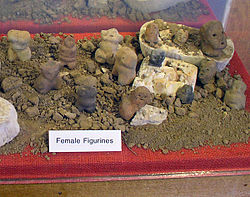
Dominating Peru's north coast from 1–600 CE, the Moche culture excelled at the art of ceramics, which was characterized by symbolic, religious imagery. Moche artists produced some of the more naturalistic, i.e. faithfully representational, artwork of the precolumbian Americas. Moche portrait vessel were so realistic that individuals portrayed at different stages of their life are identifiable. Their paintings on ceramics were narrative and action-packed. Ceramics produced by two-press molds were identical in shape but individualized through unique surface painting. Tens of thousands of Moche ceramics have survived today. The stirrup-spout vessel continued to be the most common form of clay vessel, but Moche artists also created bowls, dippers, jars with long necks, spout-and-handle vessels, and double-chambered vessels that whistled when liquid was poured. Vessels were often effigies portraying elaborate scenes. A fineline painting tradition emerged, which resembles Greek black-figure pottery.[66] A 29,000-square-foot Moche ceramics workshop with numerous kilns was discovered in at the mountain Mayal in the Chicama Valley. The workshop specialized in female figurines.[67]

The Tiwanaku and Wari cultures shared dominance of the Andes, roughly from 500 to 1000 BCE. The Tiwanaku civilizations originated in Lake Titicaca region of Bolivia, and a staff-bearing deity figured largely in their artwork.[68] Tiwanaku artists continued the tradition of naturalistic, ceramic portrait vessels.[69] The ubiquitous Wari ceramics carried over imagery from their textiles and metalwork, such as llama and alpaca imagery. Qunchupata in Peru was the epicenter of Wari ceramic production, featuring pit kilns and firing rooms. The stone floors of the firing rooms had rounded depressions for accommodating larger pots. Some Wari palaces had their own attached kilns. Broken potsherds were used as forms for building new pots and for scrapers. Evidence shows ceramics were often ritually destroyed.[70]

Four Andean civilizations flourished in Late Intermediate Period: the Chancay, Chimú, Lambayeque, and Ica. Luxury goods, including elaborate ceramics, were mass-produced in vast quantities for the middle class as well as nobles. Identical ceramics created in molds took sway over individualized works.[71] The Lambayeque culture of north coastal Peru created press-molded reliefs on blackware ceramics.[72] Chimú ceramics, also predominantly blackware, often featured zoomorphic appliqués, such as monkeys or sea birds. They excelled at the doubled-chambered whistling vessels.[73] Chancay ceramics, from the central coast, featured black-on-white designs on unique shapes, such as female effigies or elongated, oval jars. Their sand-tempered ceramics were hastily painted and left unpolished.[74] Ica culture ceramics, from the southern coasts, were the finest quality of their time. They were still handcrafted and had a wide range of polychrome slips, including black, maroon, orange, purple, red, white, and a glittery deep purple. Designs were abstract and geometric.[75]

The Inca Empire or Tawantinsuyo spanned 3500 miles and controlled the world's largest empire by 1500 CE. Artistically, they unified regional styles. Incan ceramics were geometric and understated, while color schemes remained regionally diverse.[76] Mass-produced pottery, conformed to standardized measurements, such as the urpu, a long-necked jar with handles and a pointed bottom used to transport maize and chicha, maize beer. Qirus were Incan drinking vessels, made from wood or precious metals, as well as ceramics.[77]

Moche warrior pot, c. 100–700 CE, from the British Museum
Moche warrior pot, c. 100–700 CE, British Museum
Andean cultural horizons Time period Cultures/sites
Lithic 10,000–3,000 BCE Guitarrero Cave
Cotton Pre-Ceramic 3000–1800 BCE Norte Chico civilization, Huaca Prieta, Las Haldas
Initial Period 1800–800 BCE Chinchorro, Las Haldas
Early Horizon 800–200 BCE Cupisnique, Paracas, Chavín, Pukará
Early Intermediate Period 200 BCE–500 CE Moche, Nasca, Recuay, Huarpa, Tiwanaku
Middle Horizon 500–900 CE Moche, Lambayeque, Ica, Wari, Tiwanaku
Late Intermediate Period 900–1400 CE Chancay, Chimú, Lambayeque, Ica, Inca
Late Horizon 1400–1534 Inca[78]
Historical 1534–1950 Viceroyalty of Peru, Indigenous peoples of the Andes
Contemporary 1950–present Indigenous peoples of the Andes

Gran Chaco

[edit]
Doña Rosa Brítez with her blackware pottery seated on plastic chair
Doña Rosa Brítez with her blackware pottery

Guaraní ceramics fall into two major categories: na'e, or dishes, and yapepó, pots, pans, and storage containers. These were both utilitarian and ceremonial. The precontact ceramic tradition of the Gran Chaco was dramatically transformed under European colonization, which created a demand for pitchers, cups, and other introduced pottery forms. Author Josefina Pla observed that women are typically potters, and animals associated with men are not represented in Guaraní pottery.[79]

Tobatí, a city near Asunción, Paraguay, is renowned for its ceramics, including tiles and female effigy jars, known as Las gorgas. A reddish-brown slip, known as tapyta in Guaraní, is popular, with blackware being less common.[80] A local ceramic artist, Don Zenón Páez (b. 1927) became famous for his ceramic figures of saints.

Itá, Paraguay is another ceramic center, known for its whimsical, ceramic chickens.[81] Rosa Brítez (b. 1941) is a famous ceramic artist from Itá and has been recognized by UNESCO.

The Museo del Barro, "Museum of Clay," in Asunción features pottery from the Gran Chaco, from Pre-Columbian Guaraní to contemporary mestizo ceramics.[82]

Amazonia

[edit]
Cylindrical vessel. with incised geometric design Marajo island, Brazil, Joanes style, Marajoara phase, 400–1000 CE
Cylindrical vessel. Marajo island, Brazil, Joanes style, Marajoara phase, 400–1000 CE

The pottery tradition at Pedra Pintada in Brazil represents the oldest known ceramics in the Americas.[1] Dating back to 5630 BCE, this same tradition continued for 2500 years. Ceramics from the Taperinha site near Santarém, Brazil date back to 5130 BCE and include sand-tempered bowls and cooking vessels resembling gourds. Other ancient Amazonian ceramic traditions, Mina and Uruá-Tucumã featured shell- and sand-tempered pottery, that was occasionally painted red.[83] Around 1000 CE, dramatic new ceramic styles emerged throughout Amazonia. Amazonian ceramics are geometric and linear in decoration. Polychrome pottery typically features red and black on white slips. Additionally ceramics were decorated by sculpting, incision, excision, and grooving. In the upper and central Amazon, the bark of the caraipé tree, Licania octandra, provided tempering material.[84]

In regions of terra preta, or "black earth", of the Amazon rainforest, an abundance of potsherds were used to develop the soil and build mounds, which protected buildings and cemeteries from seasonal flooding.[85]

Marajó Island, located at the mouth of the Amazon River was a major ceramic center, where the Marajoara Phase of polychrome ceramics last from around 400 to 1300 CE. In the central Amazon, the Mancapuru Phase, or Incised Rim Tradition, emerged in the 5th century CE.[86] Marajoara ceramics, typically tempered with grog,[84] were complex effigies of humans and animals, such as reptiles and birds.[85] The dead were cremated and buried in elaborate ceramic urns. Ceramic artists are active in Marajó, using precontact styles for inspiration.

Women have traditionally been the ceramic artists in the Amazon. Female figures are common in anthropomorphic effigy vessels. Tangas are a unique Amazonian cultural item; they are triangular, concave ceramic pubic coverings held in place by strings, once worn by women of several Amazonian tribes. Today, they are still worn by girls during their puberty rites among Panoan-speaking peoples.[87]

Ceramics forms

[edit]

See also

[edit]

Notes

[edit]

References

[edit]

Bibliography

[edit]
[edit]
Revisions and contributorsEdit on WikipediaRead on Wikipedia
from Grokipedia
The ceramics of constitute a diverse and enduring tradition of clay-based artifacts, encompassing , figurines, and vessels that originated at least 7,500 years ago in and evolved across the continent's varied ecological and cultural landscapes. These fired or low-fired objects, crafted from local clays often tempered with organic fibers, minerals, or shells, served essential utilitarian functions like cooking, storage, and transport, while also embodying ceremonial, , and artistic expressions that conveyed myths, social hierarchies, and spiritual connections to the land. From the fiber-tempered wares of North American Archaic hunter-gatherers to the intricate of Mesoamerican elites and the exchange-oriented ceramics of Andean societies, this craft highlights , regional networks, and cultural resilience among Indigenous groups. In , pottery-making emerged around 5,150 years ago among the Stallings culture in the , where hunter-gatherers produced simple, fiber-tempered vessels using techniques and open firing, marking the continent's earliest known tradition and facilitating seasonal mobility and communal rituals. By the (ca. 1000 BCE–900 CE), designs incorporating stamped patterns from tools like corncobs or paddles appeared on coiled pots, reflecting expanding trade and symbolic complexity in regions from the Southeast to the Southwest, where later developed corrugated and painted wares for storage and . These practices persisted into historic times, with Indigenous potters in areas like continuing coil and slab methods, often infusing spiritual significance tied to the earth's clays. Mesoamerican ceramics trace back to at least 2,500 BCE with handmade figurines from the Pre-Classic period, initially solid and anthropomorphic, used in , , and as grave offerings by cultures like the Olmec and early Maya, who later advanced to molded hollow forms depicting deities and elites. During the Classic Maya era (ca. 250–900 CE), hand-built vessels evolved into finely painted ceramics using slips of iron-rich clays and mineral pigments, serving as elite drinking cups, diplomatic gifts, and narrative canvases illustrating royal rituals, ballgames, and mythological scenes from sites like and . In , Indigenous traditions from cultures such as the Maya and produced thousands of vessels and figurines over millennia, revealing social histories through residue analysis showing uses in food preparation and offerings, with collections underscoring their role in connecting past communities to contemporary Indigenous identities. South American Indigenous ceramics, among the hemisphere's oldest, date to around 4,640–4,460 BCE at sites like Real Alto in , part of the San Pedro complex, featuring incised and simple forms that preceded more complex wares and indicate early sedentary innovations on the coast. Spanning from 900 BCE to 1500 CE across seven countries, these artifacts—including , figurines, and pipes—demonstrate extensive production and exchange networks analyzed through compositional studies of over 7,000 items, revealing interactions among Andean, Amazonian, and coastal groups like the Moche, , and Inca, who employed reduction firing, modeled motifs, and bichrome slips for ritual vessels and daily use. Overall, these ceramics not only adapted to diverse environments but also survived colonial disruptions, with many Indigenous communities today reviving ancestral techniques to preserve cultural and artistic heritage.

Materials and Techniques

Raw Materials

Indigenous ceramicists across the sourced clays primarily from local deposits such as riverbeds, quarries, and volcanic areas, selecting varieties based on their plasticity for shaping and firing properties that determined color and durability after . Common types included clays, which are abundant and fire at low temperatures to produce porous vessels suitable for everyday use, and kaolin clays prevalent in the , valued for their high plasticity, fine texture, and ability to fire to a white or light color when purified. In the Southwest, micaceous clays from regional deposits provided strength and heat resistance due to embedded flakes, enhancing the material's suitability for cooking . These clays' inherent iron content often influenced fired colors, with iron-rich varieties yielding reds or browns in oxidizing atmospheres. To improve workability and prevent cracking from shrinkage during drying and firing, potters incorporated tempers—non-plastic materials mixed into the clay paste at ratios typically around 20-40% by volume. Common tempers included sand or crushed rock for general structural reinforcement, (crushed fired sherds) to reduce warping, and organic materials like plant fibers or , which burned out during firing to create for better . In the , freshwater mussel shell was a preferred temper, ground into small particles and added to clays; this not only minimized shrinkage but also enhanced resistance, allowing vessels to withstand sudden temperature changes during cooking over open fires. Among Mesoamerican groups, particularly in the during the Late to Terminal Classic periods, fresh served as a key temper, sourced from distant eruptions and mixed with local micritic clays to promote at higher firing temperatures, resulting in stronger, less porous ceramics. These temper choices directly interacted with firing techniques, as materials like shell or influenced heat absorption and vessel integrity under wood-fired conditions. Natural pigments for slips and painted decorations were derived from locally available minerals and, less commonly, plant extracts, applied before or after firing to achieve durable colors. Iron oxides, such as , provided red and brown hues when ground into slips and fired, while yielded black tones, both sourced from outcrops or river gravels across various regions. In some cases, plant-based extracts from berries or roots supplemented mineral pigments for subtle tones, though these were more fugitive and used primarily on unfired surfaces.

Forming Methods

Indigenous peoples of the Americas developed a variety of hand-building techniques to shape clay into vessels, figurines, and other forms, relying on the plasticity of local clays often tempered with materials like , shell, or grit to prevent cracking during manipulation. These methods were labor-intensive and required skill to achieve functional and aesthetic results, with coiling emerging as the most widespread approach across diverse regions from to the . Coiling involved rolling out ropes or coils of clay and stacking them to build up the walls of a vessel, then smoothing the seams with fingers, tools, or water to create a seamless surface; this technique allowed for the construction of large, thin-walled pots and was particularly prevalent in the Southwest among Ancestral Puebloan groups, where it facilitated the production of storage jars and cooking vessels beginning around 200 CE during the Basketmaker period. Pinching, another fundamental hand-building method, consisted of starting with a ball of clay and pressing the thumbs and fingers into it to form small open bowls or animal figures, commonly used by Inuit communities for miniature lamps and by Mississippian cultures in the Eastern Woodlands for pots dating back to 1000 CE. Slab construction, where flat sheets of clay were cut and assembled like bricks, was employed for broader or more angular forms, such as trays or architectural elements, and is evident in the adobe-like traditions of the around 300 BCE. Molding techniques supplemented hand-building by using natural or crafted forms to imprint shapes onto clay, enabling the of standardized items like figurines; for instance, in , Olmec-influenced cultures around 1200 BCE pressed clay into carved stone or molds to create hollow figurines with stylized features, a practice that spread to later and traditions. Basketry and gourd molds were also utilized, particularly in the and , where wet clay was draped over coiled baskets or halved gourds to form lightweight, portable containers, as seen in the pottery of circa 500 BCE, which retained basketry impressions after firing. These molding methods were especially effective for replicating complex motifs without advanced technology, highlighting the ingenuity in adapting everyday materials to ceramic production. Simple tools enhanced precision in forming, including bone awls for scoring and joining coils, wooden paddles for thinning walls and adding textures, and shells or stones for smoothing surfaces; among the of the American Southwest, shell tools were used from 300 CE to refine coiled vessels, ensuring even thickness and durability. In the Andean region, specifically among the around 100-700 CE, wooden spatulas and llama bone implements facilitated the detailed shaping of stirrup-spout bottles through and molding combinations. These tools, often sourced from local environments, underscore the resourcefulness of Indigenous potters in achieving refined forms without metal implements.

Firing Processes

Indigenous potters across the employed low-tech firing methods to harden ceramics, primarily using open fires and simple structures that achieved temperatures between 600°C and 900°C, sufficient for without advanced technology. These processes transformed unfired clay into durable vessels by driving off and organics while inducing chemical changes in the clay matrix, often resulting in porous, low-fired suited to local needs. Open-pit firing was the most widespread technique, involving the arrangement of in shallow excavations covered with combustible materials to ensure even heat distribution and minimize breakage. In open-pit firing, potters dug shallow pits in the ground and stacked unfired vessels upright or inverted on a bed of preheated rocks or ash, surrounding and covering them with layers of fuel such as wood shards or dried plant materials before igniting the pile. This method, common among groups like the of and of , allowed temperatures to reach 600–900°C over 1–2 hours, producing with variable oxidation that yielded mottled red-to-black surfaces depending on fuel contact and airflow. The process required calm weather to control flames, with pots often protected by additional coverings like sod or metal sheets in modern adaptations to reduce . Pit and clamp kilns offered slightly more control than open pits, utilizing semi-subterranean depressions or earthen mounds to regulate oxygen flow and temperature gradients, which influenced the final color through reduction atmospheres. Pit kilns, dug as shallow basins, held stacked capped with fuel and a layer of earth or dung to restrict air, fostering low-oxygen conditions that produced darker hues via carbon impregnation. Clamp kilns, built as temporary mounds of clay and fuel around the , similarly enabled controlled reduction, achieving 700–850°C and varied firing results like grayish tones from partial re-oxidation. Fuel selection played a critical role in firing outcomes, with splits, dried grasses, and commonly used to sustain and impart specific effects. Hardwoods like provided steady, high-temperature burns for oxidation, resulting in red , while grasses such as stalks burned quickly for initial heating. , particularly from llamas, sheep, or cows in Andean regions, burned slowly with low smoke due to its , stabilizing temperatures up to 865°C and minimizing through even , though it could enhance reduction when layered thickly. These fuels influenced smoke effects, with dung and wet organics promoting for blackened surfaces by depositing free carbon during cooling. Regional variations adapted these methods to local resources and aesthetics, such as low-oxygen firings in Amazonian traditions that produced blackware through smothered pits using organic fuels to limit air and embed carbon. In contrast, Andean cultures like the Middle Sicán employed higher-temperature updraft kilns—small, semi-closed structures with figure-8 designs—that reached 800–900°C under controlled reduction, using dung and leaves to create glossy black finishes via graphite formation and even carbon penetration. These techniques ensured ceramic durability while reflecting environmental constraints and cultural preferences for color and texture.

Surface Treatments

Surface treatments in the ceramics of represent a critical stage in production, applied after forming to refine texture, add decoration, and improve functionality such as water resistance. These techniques vary by and cultural group but commonly involve the use of natural materials like clay slips, mineral pigments, and stones, reflecting both practical needs and artistic expression. Firing processes subsequently set these treatments, binding them to the vessel surface. Among the primary methods are slip application, incising, stamping, and impressing for patterning, with mineral-based slips, and or burnishing for sheen. Slip application entails coating the leather-hard or dry clay surface with a thin, suspension of clay and water, often mixed with fine temper or pigments, to create a smooth, even base layer. This technique seals minor imperfections, reduces , and provides a uniform color foundation for further decoration, as evidenced in and early ceramics from southcentral where unpigmented slips comprised about 11.6% of analyzed vessels and served to decrease vessel wall permeability. In Ancestral traditions, white or colored slips, derived from local kaolinitic clays, were brushed on as backgrounds for subsequent designs, enhancing visual contrast and cultural symbolism associated with colors like white for purity or clouds. Slips were typically applied in multiple thin layers using brushes made from fibers or animal hair, allowed to dry partially between coats to prevent cracking, and then prepared for additional surface work. Incising, stamping, and impressing techniques introduce decorative motifs by altering the surface texture while the clay remains workable, prior to full drying and firing. Incising involves scratching fine lines or grooves into the surface with sharp tools like bone awls, flint points, or shell edges, creating intricate geometric or figurative patterns; this method is prominent in Eastern Woodlands pottery, where it produced V- or U-shaped incisions for symbolic designs. Stamping employs carved wooden or ceramic paddles pressed repeatedly into the clay to generate uniform, repeating motifs such as chevrons or cross-hatching, a practice widespread in Southeastern traditions to evoke communal rhythms or clan identities. Impressing, often using cord-wrapped sticks, textiles, or shells, adds subtle textures like cordmarking for grip or aesthetic depth, as seen in Mississippi period ceramics where these pre-firing impressions were smoothed over for a tactile finish. Painting on Indigenous American ceramics primarily utilizes pre-firing applications of mineral-based slips or , which vitrify during firing to produce durable colors ranging from black (iron oxides) to red () and white (kaolin). These paints, ground from local minerals and mixed with a clay binder, were applied with fine brushes to create bold designs on slipped surfaces, ensuring through the heat of the . Post-firing , though rarer due to fragility, occurred in some coastal or humid environments using organic or low-fire minerals for subtle enhancements. A notable variant is negative painting, or resist technique, where a , gum, or clay-based resist is applied to block absorption, resulting in light designs against a darker fired background; in area pottery, this produced lighter-colored motifs outlined by black over an underlying red or buff slip, emphasizing for visual complexity. Polishing and burnishing refine the surface to a glossy, reflective quality by rubbing with hard, smooth tools like river pebbles, , or bone, compressing the clay particles and aligning them for luster without glazes. These steps follow slip application on dried but unfired pots, starting from the rim and working downward in circular motions to avoid irregularities. In Mimbres black-on-white pottery of the American Southwest (ca. 1000–1150 CE), the white slip was burnished to an exceptional polish using fine stones, creating a stark, luminous contrast with matte black painted designs derived from iron-rich slips, a technique that highlighted narrative motifs and demonstrated technical mastery. Burnishing not only enhanced but also strengthened the vessel by reducing micro-cracks, a principle applied across traditions from to Mesoamerican groups.

Origins and Development

Earliest Evidence

The earliest evidence for ceramics in the Americas comes from the , where pottery at the Pedra Pintada site in dates to approximately 5630–5000 BCE. These simple, low-fired vessels represent the oldest known ceramics in the . Subsequent developments include the San Pedro complex in coastal (ca. 4640–4460 BCE), followed by the (ca. 3500–1500 BCE), with radiocarbon-dated sherds from sites like Real Alto and Loma Alta confirming fired clay artifacts from 4460–3700 BCE. Initial Valdivia vessels were small and coarse, primarily consisting of simple open bowls and necked jars used for storage and basic food processing. Residue analysis on associated artifacts from Valdivia sites, such as Real Alto, indicates early utilization for cooking, with traces of starchy plants like preserved on stone tools linked to ceramic activities during the Valdivia 3 phase (ca. 2800–2400 BCE). In , fiber-tempered pottery emerges later, with the earliest examples from the Stallings culture in the dated to around 2500 BCE. These Stallings ceramics were coarse and utilitarian, featuring simple forms like bowls and jars suited for boiling and storage in a hunter-gatherer context; site examples in date to around 1700 BCE. The origins of American ceramics have sparked debate between independent invention by and diffusion via Asian migration routes, particularly given the contemporaneous emergence of in around 10,000–6000 BCE. Proponents of transpacific contact, such as Betty Meggers, pointed to superficial similarities in decorative motifs between Valdivia and Japan's Middle Jōmon style (ca. 3000–2000 BCE) as evidence of influence. However, archaeological assessments highlight stylistic discontinuities, including differences in vessel construction, tempering materials, and overall forms—such as the simple, locally adapted necked bowls of versus the more elaborate cord-impressed Jōmon wares—supporting independent development in the without direct Asian transmission.

Diffusion Patterns

Ceramic technology in the Americas originated in around 7500 years ago, with early sites in the and coastal serving as key starting points for subsequent spreads. From these southern hearths, pottery-making diffused northward through coastal and lowland tropical routes, reaching by approximately 2000 BCE and eventually the Eastern Woodlands of by 2500 BCE, as evidenced by shared decorative techniques such as incision and punctation on fiber-tempered vessels. This initial expansion facilitated the exchange of basic forming and firing knowledge, adapted locally to available resources like sand or shell tempers. Subsequent north-to-south diffusion patterns emerged through trade networks extending southward, particularly along the Pacific and Gulf coasts, where shared temper types such as shell indicate ongoing cultural exchanges with Andean regions. Archaeological evidence from sites in southern and northern reveals common use of crushed shell in pastes, suggesting pottery vessels or raw materials moved via overland caravans and riverine paths, influencing vessel forms and surface treatments in intermediate zones like . These interactions, peaking during the Formative period (ca. 2000 BCE–500 CE), highlight how trade routes not only distributed finished ceramics but also transmitted tempering recipes, fostering hybrid styles without uniform adoption. Coastal and inland diffusion pathways diverged significantly, with maritime routes along the Pacific facilitating Andean influences northward into , while overland trails dominated exchanges within . Reed watercraft enabled sea voyages from Ecuadorian ports to western , carrying ideas like stirrup-spout forms and mold-made figures, as seen in shared iconographic motifs on vessels from coastal and Moche sites. In contrast, inland North American spreads relied on river valleys and footpaths, allowing gradual transmission of grit-tempered across the and Woodlands, where local adaptations preserved regional distinctiveness despite stylistic borrowing. A pivotal event in North American diffusion was the Hopewell Interaction Sphere (ca. 200 BCE–500 CE), which distributed ceramic styles across the Eastern Woodlands through extensive exchange networks linking Ohio Valley communities with those in , , and the Plains. Petrographic analysis of vessels from sites like and Kelley reveals replicated decorative motifs, such as cross-hatched rims and rocker-stamped designs on grit-tempered wares, indicating that potters emulated distant techno-styles as symbols of alliance and ritual participation. This sphere's reach, spanning over 2000 kilometers, underscores ceramics' role in social connectivity rather than mere utility. Geographic barriers, such as the dense Amazonian rainforests and Andean cordilleras, promoted isolation and unique adaptations, particularly in the where low-fire traditions developed independently of highland influences. Amazonian potters, like the Cayubaba and Tsimane' in Bolivia's Llanos de Moxos, employed distinctive tempers such as freshwater sponge spicules or , fired in open pits or simple ovens at temperatures below 800°C to suit humid environments and local clays. This seclusion resulted in coiled-and-scraped vessels with minimal , contrasting sharply with the wheel-thrown or mold-formed ceramics of coastal trade zones, and reflects sustained cultural autonomy amid limited overland penetration from Andean or Mesoamerican networks.

Technological Evolutions

The technological evolution of ceramics among reflects gradual innovations in materials and processes, driven by regional needs and interactions. In , particularly during the Classic period (ca. 250–900 CE), potters shifted to using finer clays, which allowed for greater control in forming and finishing vessels. This transition, combined with higher firing temperatures reaching up to 1000°C in updraft kilns, produced more durable with reduced and enabled the creation of thinner walls, enhancing both aesthetic appeal and functionality for elite wares. In the Southwest, Puebloan ceramic traditions demonstrate refinements in wheel-less coiling techniques across sequential cultural phases, from the Basketmaker period (ca. 500 BCE–750 CE) onward. Potters developed efficient horizontal methods, rolling slender clay ropes and scraping interiors smooth to achieve uniform thickness without mechanical aids, allowing for larger, more symmetrical vessels over time. These advancements, honed through generations, supported the production of both utilitarian and ceremonial pottery while maintaining cultural continuity in open-pit firing. Pigment technologies also advanced, notably at (ca. 100 BCE–650 CE), where potters and artists created vibrant, synthetic-like colors through mixtures applied to ceramics. Common formulations included combined with for orangish-red hues and mixed with earths for greens, standardized in clay-based matrices to ensure adhesion during firing. Analytical studies confirm these mixtures were sourced locally and varied by workshop, contributing to the iconic on Teotihuacan vessels. Following European contact in the , some Indigenous communities experimented with introduced glazing techniques, such as lead glazes derived from European models, but adoption remained limited and regionally variable. In northern , for instance, Chimu-Inka descendants produced Early Green Glazed Ware using lead-based slips on traditional forms, yet imperfections like highlight incomplete assimilation of the technology. Overall, most groups persisted with pre-contact methods, prioritizing indigenous clays, , and low-temperature firing to preserve cultural practices amid colonial pressures. These evolutions were occasionally facilitated by diffusion routes, such as trade networks linking and the Southwest, which shared knowledge of firing and pigmentation.

North American Traditions

Arctic and Subarctic

In the and regions, Indigenous ceramic traditions were severely constrained by the harsh environment, including , limited clay deposits, and scarcity of firing fuels like wood, leading to a heavy reliance on (steatite) for essential vessels such as oil lamps and cooking pots rather than fired . The (c. 500 BCE–1000 CE), a society, produced no known ceramics, instead quarrying abundant for durable, heat-retaining lamps () and pots that could withstand from boiling seal oil or without cracking. This material's prevalence in outcrops across the Eastern made it a practical for nomadic hunter-gatherers focused on survival in extreme cold, where clay's fragility in wet conditions posed additional risks. The culture (c. 1000–1500 CE), ancestors of modern , introduced limited ceramic production upon migrating from , primarily in the Western Arctic where better clays were available, but even here quickly dominated for its superior insulation and longevity in cold-climate cooking. Early ceramics, when made, were formed using patch modeling or coiling from local iron-rich clays and tempered with organic materials like grass, moss, feathers, or seal blood to reduce shrinkage, improve insulation against freezing, and enhance pliability during shaping. Firing occurred at low temperatures (often below 600°C) in open pits or turf-covered hearths using scarce or animal fats, resulting in friable, poorly sintered vessels that were sometimes merely sun-baked or sealed post-firing with seal oil to prevent . These techniques prioritized functionality for marine mammals or stewing, reflecting adaptations to resource-poor environments. Decorations on surviving Thule pottery sherds were minimal and utilitarian, featuring simple incised lines, punctates, or impressions made with shells, bones, or wood stamps to add texture for better grip or subtle patterning, though these rarely incorporated overt shamanistic motifs seen more prominently in carvings. Such sparse aligned with the cultures' emphasis on practicality over elaboration, with occasional influences from southern North American groups introducing minor stylistic variations in rim treatments. Post-contact with Europeans (after c. 1500 CE), ceramic traditions declined sharply as imported metal pots and supplanted fragile clay vessels, while enhanced soapstone trade further marginalized pottery-making among groups. However, 20th-century revivals emerged in communities like , , where local clays from mining byproducts inspired hybrid ceramic practices blending traditional tempering and low-fire methods with soapstone-inspired forms, fostering contemporary artistic expression.

Eastern Woodlands

The pottery traditions of the Eastern Woodlands reflect the region's temperate forests and agricultural societies, where ceramics served practical and ceremonial roles among sedentary communities from the Late Archaic through the Mississippian period. Vessels were typically coil-built, emphasizing durability for cooking and storage, with surfaces often textured using cordage impressions to enhance grip and prevent slipping. These cord-marked and collared forms, prevalent in cultures like the Adena and Hopewell, underscore the integration of pottery into daily life and ritual practices tied to maize-based economies. During the Adena and Hopewell periods (c. 1000 BCE–500 CE), potters produced grit-tempered jars and bowls, often featuring incised or stamped designs for use in . Adena ceramics, tempered with grit, , or , included globular bowls and shallow basins, mostly plain but occasionally decorated with diamond-pattern incising or cord marking, and were deposited in burials alongside tools and ornaments. Hopewell pottery expanded on this, using grit temper for cordmarked jars and collared vessels with elaborate incised motifs, such as geometric patterns, placed in conical mounds with exotic trade goods to signify status and cosmological beliefs. These forms highlight the period's emphasis on ceremonial exchange networks across the Midwest and . In the Mississippian period (c. 800–1600 CE), Eastern Woodlands ceramics shifted toward shell-tempered wares, exemplified by -style bottles and vessels that supported complex chiefdoms. At , shell temper improved vessel strength for cooking and serving, with forms like narrow-necked bottles and red-slipped jars common in domestic and elite contexts; vessels depicting humans and animals were crafted specifically for in burial mounds, underscoring hierarchical rituals during the site's peak from the 11th to 13th centuries. Decorative motifs on these ceramics frequently incorporated and serpent , reflecting a tripartite cosmology where birds symbolized Upper World thunderers and serpents represented Under World watery realms, as seen in Ramey Incised designs with falcon scrolls and curvilinear serpentine patterns. The early adoption of techniques in Eastern Woodlands , evident by the Early Woodland period, likely stemmed from patterns originating in southern regions through interactions, enabling the construction of sturdy, textured vessels suited to local clays and firing methods.

Southeastern Woodlands

The ceramics of the Southeastern Woodlands, produced by mound-building societies from the Late Archaic through the Mississippian period, are characterized by a progression from grit- or grog-tempered wares to predominantly shell-tempered , reflecting adaptations for greater vessel durability in humid environments. At the site in northeastern , dating to approximately 1700–1100 BCE, early included simple, fiber- and sand-tempered (rock-tempered) forms used for cooking and storage, marking the introduction of ceramics in the Lower Mississippi Valley without widespread adoption until later periods. By the Coles Creek period (c. 700–1200 CE), potters shifted toward grog-tempered clays, with vessels featuring incised rim decorations and hemispherical bowl forms built around monumental mound complexes, enhancing thermal resistance for daily use. This evolution culminated in the Mississippian period (c. 1000–1600 CE), where crushed freshwater shell became the dominant temper, improving firing stability and reducing breakage during use, as seen in plain and decorated wares across the region. Mississippian shell-tempered emphasized functional forms like globular jars, bottles, and vessels, often with elaborate surface treatments that conveyed cultural symbolism. Negative techniques, involving resist wax or resist-dye methods, produced bold black-and-white designs on bottles depicting human-animal hybrids, such as avian-human figures symbolizing mythological beings, particularly in the and broader Mississippian iconography. These motifs occasionally shared stylistic elements, like curvilinear scrolls, with contemporaneous Eastern Woodlands traditions to the north. Regional variations flourished at major centers: at Etowah in Georgia (c. 1000–1550 CE), complicated stamped featured nested diamond and curvilinear motifs impressed with carved paddles, directly imitating plaited basketry textures for both utilitarian and ceremonial vessels. Similarly, at Moundville in (c. 1050–1550 CE), shell-tempered wares included stamped surfaces with zoned decorations mimicking basketry weaves, alongside incised , highlighting localized adaptations within the broader Mississippian cultural sphere. Ceramics played a vital economic role in Southeastern Woodlands societies, serving as standardized trade goods transported along extensive river networks like the , , and Chattahoochee rivers, facilitating exchange of pottery for exotic materials such as and marine shells. This riverine integrated communities from mound centers to peripheral villages, with shell-tempered vessels acting as containers for foodstuffs and symbolic items, underscoring their dual practical and prestige functions in pre-Columbian economies.

Great Basin and Plateau

The ceramics of the and Plateau regions reflect the adaptations of nomadic and semi-nomadic Indigenous groups to arid environments and high mobility, prioritizing coarse, durable, and lightweight vessels for cooking, storage, and transport among societies. These traditions emerged among groups like the Fremont and later , who relied on locally available clays and tempers to produce functional wares suited to egalitarian, small-scale communities where elaborate artistry was minimal. Unlike more sedentary traditions elsewhere, these ceramics emphasized practicality over aesthetics, with production often occurring opportunistically at seasonal camps. The Fremont culture, spanning approximately 500 to 1300 CE across the eastern and fringes, is renowned for its grayware pottery, typically constructed using coil-and-scrape techniques and featuring paddle-stamped or corrugated exteriors to enhance heat distribution during cooking over open fires. These vessels, often globular jars or bowls tempered with sand or crushed rock, were fired at low temperatures to achieve a gray finish, making them robust for boiling seeds, roots, and small game in mobile foraging economies. Following the Fremont decline around 1300 CE, (Numic-speaking) groups expanded into the region, continuing similar gray-to-brown wares but with increased emphasis on portability; their pottery, dated post-1300 CE, included shallow basins and seed-beaters adapted for processing piñon nuts and other staples in the . In coastal and northern Plateau areas, steatite () served as a non-ceramic alternative for vessel production among and related groups, carved into jars and cups that were lighter and more heat-resistant than for watery environments, though less common inland due to resource scarcity. Fiber-tempering, using grass or materials mixed into the clay, appeared sporadically in wares to reduce weight for transport, yielding thin-walled storage jars that mimicked basketry forms prevalent in the region. Decoration remained sparse, limited to visible coil impressions, occasional punctates, or simple dots incised before firing, underscoring the utilitarian focus of these societies without hierarchical displays. These traditions show influences from southwestern diffusion via Uto-Aztecan language migrations, where Numic expansions around 1000 CE introduced or adapted coil-building and stamping techniques from earlier Basketmaker interactions, blending with local innovations. Limited trade with neighboring Southwest groups occasionally incorporated exotic tempers or forms, but overall, the ceramics remained distinctly plain and mobile-oriented.

Southwest and Oasisamerica

The ceramics of the Southwest and represent a vibrant among desert agriculturalist societies, characterized by coiled construction, painted decorations, and adaptations to arid environments. These pottery styles, primarily from the , Ancestral Puebloan, Mogollon, and Salado cultures, emphasized functional vessels for storage, cooking, and ritual use, often featuring bold geometric motifs that reflected cosmological beliefs and daily life. Produced in village-based communities along river valleys like the Salt, Gila, and , these ceramics highlight technological innovations such as mineral-based paints and textured surfaces, which allowed for durability in harsh climates. Hohokam red-on-buff pottery, dating from approximately 300 to 1450 CE, exemplifies early painted wares in the region, with vessels formed using a paddle-and-anvil technique over a coiled base to create thin, lightweight forms suitable for irrigation-dependent societies in . These pots were typically buff-colored from locally sourced clays, fired at low temperatures to achieve a porous surface, and decorated with red slips applied in geometric motifs such as scrolls, lattices, and life forms like animals or human figures, which symbolized agricultural and community rituals. Paddle decoration involved and texturing the exterior with wooden tools, enhancing grip and aesthetic appeal, while the red-on-buff style spread through trade networks, indicating specialized production centers along the . Ancestral Puebloan black-on-white ceramics, prominent from around 600 to 1300 CE during the Pueblo II and III periods, featured mineral paints derived from iron-rich minerals, applied to smoothed or corrugated surfaces to produce striking contrasts on white-slipped wares. Corrugated textures, created by pinching coils before firing, were common on utility jars for cooking and storage, providing insulation and resistance to , while finer black-on-white bowls and pitchers displayed intricate designs like interlocking scrolls, feathers, and stepped patterns that evoked natural elements such as and corn. These vessels were coiled and fired in reducing atmospheres to fix the black pigment, reflecting the ' shift toward multi-story villages and ceremonial complexes in the region. Mogollon and Salado polychrome pottery traditions, emerging around 1100–1450 CE, incorporated multi-color slips—typically red, black, and white—over coiled bodies to create elaborate ceremonial vessels that bridged utility and symbolism in the southern Southwest. Mogollon potters produced black-on-white wares in the Mimbres Valley, while in the Jornada region they developed polychromes like El Paso Polychrome by the 13th century, using mineral slips for bold geometric and figurative designs on bowls and jars intended for feasts and burials. Salado polychromes, part of the Roosevelt Red Ware complex, featured warm red bases with black and white accents, often depicting interlocking motifs that signified social integration across diverse communities in central Arizona's Tonto Basin. These multi-slipped ceramics were primarily used in ritual contexts, such as kiva ceremonies, underscoring their role in ideological expressions of unity and cosmology. Symbolism in these ceramics drew heavily from kiva murals, where painted scenes of deities, animals, and geometric forms influenced vessel designs to convey spiritual narratives of emergence, fertility, and harmony with the landscape. For instance, motifs like stepped frets and bird figures on black-on-white and pots mirrored kiva at sites like Pottery Mound, symbolizing portals to the and ancestral connections, thereby embedding in broader Puebloan ritual practices. This artistic continuity highlights how ceramics served as portable expressions of sacred knowledge among Oasisamerican peoples. Modern communities continue elements of Hohokam-style coiled pottery in ceremonial contexts.

Mesoamerican Traditions

Formative Period Styles

The Formative Period in , spanning roughly 2000 BCE to 250 CE, witnessed the emergence of distinctive ceramic traditions among early complex societies, particularly those associated with the Olmec culture centered in the Gulf Coast lowlands. Olmec ceramics from this era, dating to approximately 1500–400 BCE, are renowned for their innovative forms and motifs that reflect emerging social hierarchies and ritual practices. Key examples include hollow ceramic figurines featuring "baby-face" characteristics, such as plump cheeks, slanted eyes, and downturned mouths, often interpreted as representations of infants or transformed beings in ceremonial contexts. These figurines, produced in fine white clay and sometimes enhanced with white slip and red pigment, exemplify the Olmec's skill in capturing naturalistic yet symbolic human forms. At sites like San Lorenzo, the primary Olmec center during the Early Formative phase (c. 1200–900 BCE), potters developed fine-paste ceramics using locally sourced clays from alluvial deposits, which were exchanged widely as elite goods across . These vessels and figurines were crafted with high precision, incorporating tempering materials to achieve durability and aesthetic refinement suitable for high-status use. Petrographic analyses of from San Lorenzo reveal compositional variations indicating specialized production workshops that supported reciprocal networks with highland regions, underscoring the ceramics' role in fostering inter-regional alliances. Techniques such as hand-building and low-temperature firing allowed for the creation of thin-walled, lightweight objects that facilitated portability and exchange. A hallmark of Olmec ceramic innovation was the use of molds for producing interchangeable heads on hollow figurines, enabling a form of that standardized iconic motifs across multiple artifacts. This method, evident in the uniform baby-face features on figures from sites like Las Bocas, suggests organized craft specialization and the replication of symbolically potent imagery for broader distribution. Additionally, incised decorations on vessels served as precursors to later , featuring early glyphs and motifs such as convoluted patterns or were-jaguar elements that conveyed cosmological or narrative significance. These incisions, often applied before firing, hint at the integration of visual symbolism in everyday and pottery. Culturally, Olmec ceramics, especially the hollow baby-face figurines, played a central role in shamanistic rituals, embodying themes of transformation, , and power. Seated or kneeling poses, sometimes combined with animalistic traits like cleft heads, allude to shamanic journeys between human and spirit realms, likely used in offerings or ceremonies to invoke or abundance. Such figures were often found in domestic contexts at sites like San Lorenzo, indicating their permeation into both elite and communal life, while their export to areas like Central facilitated the diffusion of Olmec stylistic influences.

Classic Period Innovations

The Classic Period (c. 250–900 CE) in marked a pinnacle of ceramic innovation among Indigenous peoples, particularly in the urban centers of and the , where advancements in paste refinement, painting techniques, and vessel forms reflected growing social complexity and interregional exchange. Building on earlier Olmec foundations of symbolic pottery use, artisans developed fine wares that served elite functions, incorporating and specialized production methods to signify status and importance. These innovations emphasized thin-walled vessels with polished surfaces, enabling widespread and cultural influence across central and beyond. In (c. 100–650 CE), potters produced distinctive Thin Orange ware, characterized by its fine orange paste and thin walls (typically 3–5 mm thick), achieved through careful selection of clays from the Tepexi de Rodríguez region in . This ware featured polished surfaces and subtle incised or stamped decorations, often drawing from the city's iconic such as abstract geometric patterns and deity motifs, though direct talud-tablero representations were more prevalent in than pottery. Production occurred in specialized workshops using molds and stamping tools, with evidence of firing in refractory structures, highlighting organized craft specialization. Thin Orange vessels, including bowls and cylinders, were integral to domestic and ritual contexts, underscoring Teotihuacan's role as a ceramic production hub. Among the Maya, codex-style ceramics emerged as a hallmark of elite artistry during the Classic Period, exemplified by chocolate-ware cylinders painted in fine-line black slip on a cream or chocolate-brown background, mimicking and illustrations of bark-paper codices. These tall, narrow vessels (often 20–30 cm high) depicted hieroglyphic scenes of mythological narratives, courtly rituals, and deity interactions, with texts including dedicatory formulas naming owners, painters, and contents like cacao drinks. Produced via and slip-painting techniques, they were low-fired for to hold liquids, serving as status symbols in elite settings. The codex style, centered in the Usumacinta and Petén regions, allowed for detailed on , blending and visual in ways unprecedented in earlier periods. Tripod vessels became prominent in elite Maya dining and feasting, featuring cylindrical or plate forms supported by three legs, often with supports modeled as or deity effigies, and decorated with scenes of rulers and attendants. These vessels, typically 15–25 cm in , held dry cacao beans or liquids for ceremonial consumption, symbolizing wealth and ritual participation; residue analyses confirm associations with cacao but indicate varied uses beyond drinking, such as storage or presentation. In contexts, similar tripod supports appeared on whistling vessels, enhancing their multifunctional role in elite gatherings. Mold technology advanced significantly for producing complex forms like whistles, particularly in , where double-chambered vessels (11–21 cm tall) were crafted by pressing clay into molds to create interconnected cylinders with integrated whistle mechanisms in effigy heads, such as monkeys or deities. These low-fired pieces, often tripod-supported, produced sounds when filled with liquid and blown, serving and musical purposes in burials and ceremonies. Maya artisans adopted similar molding for figural elements on tripod vessels, combining it with hand-building for efficiency in elite production. Teotihuacan's export of Thin Orange ware extended its influence to the Gulf Coast, where fragments appear in sites like Matacapan, evidencing direct trade routes and local imitations that blended central Mexican styles with regional forms, fostering stylistic hybridization during the Classic Period. This exchange, peaking around 200–600 CE, distributed thousands of vessels, underscoring ceramics' role in economic and cultural networks.

Postclassic Developments

The Postclassic period in Mesoamerican ceramics, spanning roughly 900–1521 CE, marked a shift toward militaristic empires and expanded networks, building on earlier techniques from the Classic era such as slip and firing methods. Under Aztec influence, black-on-orange pottery emerged as a dominant style in central , characterized by fine black lines painted on a polished orange slip surface. Dating to approximately 1350–1520 CE, this ware was produced in multiple regional centers including Texcoco, Chalco, and western Ixtapalapa, as evidenced by neutron-activation analysis of over 85 samples. Common forms included tripod cazuelas—shallow, wide-mouthed cooking vessels supported by three legs—often decorated with motifs reflecting Aztec cosmology, such as skulls symbolizing death and sacrifice. These ceramics served both utilitarian and ritual purposes, circulating widely through imperial tribute and market systems across the Basin of . In the Mixteca region of and , codex-style represented a pinnacle of narrative artistry during the Late Postclassic (ca. 1250–1521 CE), drawing from the pictographic conventions of codices like Group. These vessels, primarily plates and bowls, featured elaborate polychrome scenes depicting mythological events, deities, and elite lineages in a linear, codex-like format, using devices such as difrasismos (metaphorical couplets) and repetitions to convey ritual meanings. Produced in areas like the Puebla-Tlaxcala Valley and Valley of , the 's lustrous surface finish and complex underscored its ceremonial role in elite and religious contexts. This style's widespread distribution highlights the Mixteca-Puebla's influence on broader Mesoamerican artistic traditions. At Cholula, a major pilgrimage and trade center, fine-paste ceramics flourished in the Late Postclassic (ca. 1150–1500 CE), exemplifying for regional markets. These vessels, often with bright slips and intricate Mixteca-Puebla motifs like Borgia Group symbols, utilized high-quality local clays to achieve a compact, refined texture suitable for export. Archaeological evidence from sites like the Patio de los Altares reveals standardized forms such as hemispherical bowls and plates, traded across alongside other goods like textiles. This output supported Cholula's role as an economic hub, with reflecting both local innovation and international stylistic exchanges. Following Spanish contact in 1521 CE, Mesoamerican ceramics incorporated syncretic elements blending indigenous and Christian , particularly in central during the early colonial period (ca. 1521–1650 CE). Fine polychrome wares from Cholula and the Valley of featured motifs like flowers, birds, and leaves alongside Christian symbols such as crosses, often on forms adapted from pre-Hispanic styles like black-on-orange. Examples include censers with pedestal bases resembling European candle holders and figurines depicting Spanish lords in nativity scenes, as documented in ethnohistoric sources like the Códice de los Alfareros de Cuauhtitlan (ca. 1564 CE). These adaptations, seen in red wares with stamped European-inspired patterns, illustrate potters' negotiation of cultural imposition while retaining indigenous techniques. By the mid-16th century, such vessels served both and domestic functions in colonial households.

Circum-Caribbean Traditions

Antillean Pottery

Antillean pottery encompasses the shell-tempered ceramics produced by indigenous island cultures in the , particularly the and peoples, who developed utilitarian vessels adapted to tropical environments and staple food processing. These ceramics were primarily functional, focusing on cooking and storage, with decorative elements reflecting cultural motifs and spiritual beliefs. Originating from migrations across the , these traditions emphasized durability in humid conditions through specific tempering and firing methods. The , flourishing from approximately 500 BCE to 600 CE, introduced sophisticated painted pottery to the , including distinctive white-on-red griddles used for processing , a key dietary staple. These griddles, often large and flat, featured decoration with white slip applied over a red base, creating glossy, narrative designs of animals and geometric patterns that highlighted the potters' skill in slip application and controlled firing. techniques were predominant, allowing for the construction of varied forms like bowls and jars, while conch shell temper provided structural integrity against cracking during open-fire firing at lower temperatures. Incised motifs, inspired by petroglyphs, adorned vessel surfaces, evoking natural and mythical elements central to Saladoid cosmology. This style spread from mainland , with influences from Colombian coastal regions evident in early decorative repertoires. In the subsequent Taíno period (c. 600–1500 CE), pottery evolved toward more modeled forms, incorporating anthropomorphic zemis—ceramic figures representing deities or ancestors with exaggerated human features like prominent eyes and limbs, often integrated into vessel handles or as standalone effigies for ritual use. These designs blended utilitarian and symbolic functions, with vessels tempered by crushed conch shell and for enhanced resistance during cooking. remained the core technique, supplemented by and incision to create petroglyph-inspired motifs such as spirals and anthropomorphic faces, reflecting Taíno spiritual connections to the natural . production was community-based, likely gendered, with women potters shaping daily wares that supported agricultural societies across the . European contact after led to the rapid decline of Antillean pottery production, as populations diminished due to disease, enslavement, and cultural disruption, effectively halting traditional ceramic practices by around 1500 CE. Imported metal and wooden alternatives further supplanted indigenous wares, though some hybrid forms persisted briefly in colonial contexts. Archaeological evidence from sites like those in and underscores this abrupt end, with post-contact assemblages showing sparse native-style sherds.

Mainland Coastal Styles

The ceramics of the mainland coastal styles in northern , particularly along the and Colombian coasts, represent a dynamic tradition shaped by trade, environmental adaptation, and cultural exchanges during the late Formative and early Classic periods. These styles emerged in lowland riverine and coastal environments, where potters utilized locally available clays tempered with sand or shell fragments to produce durable vessels for storage, cooking, and ritual purposes. Key developments include the Barrancoid tradition, which flourished along the lower River in from approximately 1000 BCE to 200 CE, characterized by finely crafted, thin-walled featuring intricate incised decorations and modeled elements. Barrancoid vessels, often traded as prestige items to the , showcased elaborate zoomorphic motifs such as birds, frogs, and mythical creatures, applied through deep incisions and techniques that highlighted the potters' skill in biomorphic representation. These ceramics, including open bowls, jars, and vessels with anthropomorphic or animal-head lugs, were fired at low temperatures in open hearths, resulting in a reddish-brown paste that emphasized the decorative surfaces. The style's diffusion facilitated cultural interactions across the , influencing island with its incised rim designs and modeled adornos. Venezuelan coastal wares from adjacent regions, dating to similar periods, featured red-slipped surfaces enhanced by animal figures, such as serpents and felines, which served both utilitarian and symbolic roles in coastal communities reliant on . Techniques in these coastal styles included paddle-stamping with carved wooden tools to imprint dentate or wavy patterns mimicking hulls and riverine motifs, reflecting the importance of and in these societies. Shell inlays, using marine gastropod fragments embedded into wet clay adornos for eyes or accents, added a luminous quality to figurative elements, linking the ceramics to coastal shell-working traditions. These elements underscore the interconnectedness of coastal networks without extending to highland or interior traditions.

South American Traditions

Andean Ceramics

Andean ceramics represent a pinnacle of pre-Columbian artistry in , evolving from the Early Horizon through the Imperial Inca period with sophisticated forms that integrated functionality, symbolism, and imperial standardization. Spanning highland and coastal regions, these traditions emphasized modeled realism, decoration, and specialized firing techniques, often serving , elite, and administrative roles across diverse ecological zones. Innovations like double-chambered vessels and metallic-sheen wares highlight the technical prowess of cultures such as Chavín, Moche, , and Inca, which adapted to arid coasts and Andean highlands while occasionally incorporating northern coastal motifs in vessel designs. The (c. 900 BCE–200 BCE), based in Peru's northern highlands at sites like , developed distinctive stirrup-spout bottle forms, a vessel type that originated earlier in (c. 2000 BCE) but was refined and popularized by Chavín with incised or low-relief modeled felines, serpents, and mythical hybrids, reflecting Chavín's religious and pan-Andean influence, marking a shift from simple coiled pottery to more complex, symbolic objects. Stirrup-spouts spread southward from here, influencing later coastal styles. Building on this foundation, the (c. 100–800 CE) of Peru's north coast produced extraordinary portrait vessels, primarily stirrup-spout bottles depicting individualized human heads with lifelike details such as facial expressions, deformities, and adornments like ear spools and headdresses. Over 900 examples, mostly of adult males from elite contexts in valleys like Moche and Virú, were crafted in Phases III–IV using two-part molds for the body and head, followed by slip-painting in cream and red hues and post-firing details with organic pigments. These ceramics, recovered from high-status , likely commemorated prominent individuals in rituals or elite households, showcasing the Moche's unparalleled realism in three-dimensional portraiture. Further south, the (c. 100–800 CE) on Peru's coastal plains developed vibrant pottery, applying up to 12 slip colors in intricate scenes on double-spout vessels and modeled trophy heads that evoked ritual violence and fertility. Trophy head forms, common in Phases 5–7, portrayed severed crania with forehead perforations for suspension ropes, blood motifs in red slip, and emerging plants symbolizing agricultural renewal tied to warfare and sacrifice. These ceramics, often associated with mythical beings like the Anthropomorphic Mythical Being, were used in ceremonies amid environmental stresses like , integrating cosmology with social practices. During the Late Horizon, the (c. 1400–1532 CE) imposed standardized blackware ceramics across its territories, favoring aryballus (urpu) forms—pointed-base vessels for inserting into soil to store (corn beer) or for state redistribution at festivals. Produced in highland workshops using local clays and reduction firing for a glossy, metallic black finish, these uniform wares facilitated imperial administration and commensal politics, with mold-making enabling for military and ceremonial needs. Hybrid styles emerged in conquered regions like Chincha Valley, blending Inca forms with local motifs to assert cultural dominance. Central to these achievements were advanced techniques like reduction firing, which restricted oxygen in pit kilns fueled by dung to yield black or iridescent surfaces on Moche and Inca vessels, enhancing durability and aesthetic appeal. Mold-making, using bisque clay matrices for repeated forms, accelerated production in Moche portrait heads and Inca aryballi, allowing for imperial armies while preserving modeled details through and slip-joining.

Amazonian and Gran Chaco Forms

The ceramics of in the Amazonian lowlands and the region of are characterized by low-fired adapted to forested and semi-arid environments, emphasizing portability, functionality, and symbolic expression derived from local ecologies and spiritual beliefs. These traditions, developed independently from highland influences, feature coil-built vessels often tempered with organic materials like fibers or shells to enhance during minimal firing processes conducted in open pits or forest clearings. Unlike more formalized ceramic complexes elsewhere, Amazonian and Gran Chaco prioritizes ephemeral, visionary aesthetics and nomadic utility, with motifs reflecting animistic worldviews where animals and geometric patterns embody cosmic and forces. The Marajoara culture, flourishing on Marajó Island at the mouth of the from approximately 400 to 1400 CE, produced distinctive urns and vessels that served funerary and ceremonial purposes. These large, often anthropomorphic urns were decorated with intricate painted motifs depicting monkeys, birds, snakes, and other zoomorphic figures, symbolizing fertility, transformation, and connections to the spirit world. Constructed using techniques and fired at low temperatures, the incorporated red and white slips to create vibrant contrasts, with animal representations highlighting the culture's deep integration with riverine and mythological narratives. Archaeological evidence from sites reveals these urns were used in secondary burials, where bones were interred alongside , underscoring their role in ancestral . Among the people of the Peruvian Upper Amazon, painted exemplifies a form rooted in shamanic practices. Women artisans coil thin-walled vessels, such as chomos (water containers), using local clays tempered for thermal resistance, then decorate them with —intricate geometric patterns inspired by ayahuasca-induced visions experienced during healing rituals. These designs, featuring interlocking rectilinear and curvilinear motifs in black, red, and white slips, represent a tri-level cosmology of sky, earth, and , serving both utilitarian storage needs and protective spiritual functions. The patterns, transmitted orally from shamans to female potters, evoke the mythic era when such designs enveloped all creation, and is fired in closed metal pots with ashes to achieve a glossy finish. This tradition, persisting for over 1,200 years, integrates cosmology with daily life, where vessels facilitate communal rituals and environmental adaptation. In the region spanning modern-day , , and , the people crafted suited to their semi-nomadic lifestyle, emphasizing lightweight, durable forms for cooking and storage amid arid plains. Pots were built by clay mixed with plant fibers, leaving subtle impressions from the tempering material that aided in even low-temperature firing and reduced breakage during transport. Simple geometric decorations, such as dots, lines, or fingernail impressions, were incised or appliquéd before firing in open hearths, reflecting functional minimalism rather than elaborate symbolism. This homogeneity in form and technique across Chaco groups, including the Toba, supported mobility and resource scarcity, with vessels designed for boiling manioc or meats in communal settings. Common techniques across these regions involve low open-air firings in forest clearings or pits, reaching temperatures of 600–800°C to produce friable yet serviceable ware without permanent kilns. Amazonian potters often employ or post-firing, covering vessels with leaves or fibers over smoldering fires to deposit carbon for black, lustrous finishes that enhance water resistance and aesthetic appeal. Organic tempers like cauixi sponge spicules absorb firing stresses, while minimal fuel from gathered wood underscores sustainable practices tied to seasonal mobility. These methods, observed in groups like the Asurini and Shipibo, highlight adaptation to lowland ecologies, occasionally incorporating traded motifs from distant regions but rooted in local innovation.

Functional and Symbolic Forms

Utilitarian Vessels

Utilitarian vessels among encompassed a range of everyday ceramic forms designed for practical tasks such as cooking, storage, and transport, reflecting adaptations to local environments and subsistence practices. Cooking pots were prevalent across various regions, often featuring globular bodies to retain heat efficiently during prolonged cooking over open fires. In the of the , particularly during the Late Woodland and Upper Mississippian phases like the Huber Phase (post-A.D. 1300), these vessels were typically shell-tempered with everted rims that allowed for easy stirring of contents such as maize-based stews or wild plant mixtures. The everted rim design, combined with cordmarked or plain surfaces, facilitated handling and prevented spillage, supporting seasonal exploitation of marsh resources and . Similarly, in Amazonian traditions, such as the Pacacocha Tradition along the in , globular cooking vessels with charred exteriors from direct fire exposure were common, used for preparing manioc and fish in low-fired, coarse suited to humid tropical conditions. These forms emphasized functionality over decoration, with simple shapes enabling even heat distribution in hearth-based cooking. Storage jars served as essential containers for dry goods like grains, nuts, and seeds, often scaled to household needs in sedentary communities. Among the Ancestral Pueblo peoples of the American Southwest during the Pueblo II and III periods (A.D. 900–1300), large necked jars with wide mouths and full globular bodies were produced in corrugated ware, ideal for storing cornmeal and wild foods in above-ground rooms or subterranean s. These vessels, sometimes reaching capacities of 10 gallons or more, featured thin walls (about 1/4 inch) and smooth interiors to preserve contents, with coiled construction providing structural strength for heavy loads. In kiva contexts, such jars supported communal storage strategies tied to horticulture, underscoring their role in amid arid landscapes. Water carriers, known as ollas, were engineered for portability and evaporation-based cooling in water-scarce regions. In Southwestern Indigenous traditions, including those of the Ancestral Pueblo during the Pueblo II period (A.D. 900–1150), olla-shaped jars with coiled bases and narrow necks were crafted in painted red ware, allowing secure head or transport over long distances. The unglazed porous surfaces promoted slow seepage and evaporation, keeping water cool without spoilage, while the rounded bases and ergonomic shapes enhanced balance during movement across rugged terrain. These vessels, produced in centers like southeastern until around A.D. 1100, integrated regional coiling techniques for durability. Regional adaptations further optimized utilitarian vessels for environmental challenges, such as uneven fire surfaces in open-air cooking. In Mesoamerican cultures, including Maya and Tarascan groups, cooking pots often incorporated bases to elevate the vessel and ensure stability over irregular hearths or ground, preventing tipping during use with fuels like wood or dung. This design allowed multiple items to cook simultaneously between the legs, conserving and time in household settings.

Ritual and Ceremonial Objects

In Indigenous American ceramics, ritual and ceremonial objects served as conduits for spiritual communication, offerings, and communal rites, often embodying deities or ancestors to invoke , , or divine favor. vessels, in particular, were crafted to represent beings, facilitating interactions between the human and spiritual realms during ceremonies. These objects were typically fired with slips or paints that enhanced their visual and symbolic potency, making them suitable for sacred contexts. Among the Maya, effigy vessels such as burners frequently featured modeled faces of deities, including the "old god" (God N), an aged earth deity associated with creation and renewal. These Late Preclassic (ca. 200 B.C.–A.D. 200) censers, recovered from ceremonial caches like those at Chalchuapa's El Trapiche , were used in dedicatory s at temple platforms, where smoke symbolized offerings to the gods. Similarly, two-piece figurine burners depicting dancing clowns—priests of God N—marked transitional periods like the calendar's end, resolving chaos through performance; these Early Classic (ca. 600–900) examples from highlight the vessels' role in embodying divine intermediaries. In the of northern (ca. 500–700 C.E.), goblets depicted in vessels illustrate blood collection during sacrifice ceremonies, where prisoners' blood was offered to warrior-priests and deities like the "Decapitator" god, underscoring themes of elite power and cosmic balance; these goblets, often shown in narrative scenes on stirrup-spout bottles, were themselves artifacts integral to funerary and sacrificial rites. Burial urns in Andean traditions, such as whistling pots from the Huari style (ca. 800–1300 A.D.), functioned in ancestor veneration by producing sounds that mimicked spiritual calls or winds, aiding the deceased's journey to the . These ceramic vessels, often shaped as funerary bundles wrapped in mantles, were placed in graves as offerings to honor ancestors believed to fertilize the earth from below, ensuring agricultural continuity; examples from the Museo Larco depict bundled figures, emphasizing the transformation of the dead into revered entities through ritual interment. Hopi ceramic figures representing kachinas—supernatural spirits—appeared in polychrome pottery like Sikyatki bowls (ca. 1400–1625 C.E.), which depicted human-like katsinam in ceremonial poses to educate on spiritual teachings during rites. These vessels, used in communal ceremonies, symbolized the kachinas' roles in bringing rain and harmony, with motifs of dancers and symbols reinforcing cosmology. Symbolism in these objects often invoked or warfare through motifs like the Olmec were-, a hybrid human-feline figure on ceramic vessels from (ca. 1200–400 B.C.), representing shamanic transformation and rain deities essential for agricultural abundance. The were-jaguar's slanted eyes, fangs, and claw-like features linked to mystical impregnation by jaguar spirits, tying to power; in broader Mesoamerican contexts, such imagery extended to warfare rites, where jaguar attributes symbolized dominance and divine warfare.

Decorative and Figurative Art

Decorative and ceramics among represent a shift toward aesthetic expression, where clay forms transcended utility to embody cultural narratives, spiritual ideals, and artistic innovation across diverse regions. These works, ranging from small-scale figurines to abstract sculptures, often featured intricate modeling and surface treatments that highlighted symbolic motifs, such as anthropomorphic and zoomorphic elements. In the Amazonian and Andean traditions, early examples emerged as standalone pieces, evolving in the Postclassic period to emphasize ornamental detail over mere functionality. Figurines constitute a prominent category of , with early examples in the Americas appearing in the of coastal around 3500–1800 BCE, where small ceramic figures (3–5 inches tall) depicted humanoid forms with exaggerated feminine traits like prominent breasts and elaborate hairstyles formed from clay slabs. These solid, hand-modeled pieces, often found near domestic hearths, combined androgynous attributes—such as breasts alongside male genitals—suggesting multifaceted symbolic roles in social or fertility contexts, and their stylistic simplicity echoes early global ceramic traditions like Japan's Jomon period . Later Amazonian figurine traditions, emerging around AD 400 in chiefdom societies along the lower Amazon estuaries, included diverse Marajoara-style ceramics portraying human and animal forms to symbolize and body transformation, as seen in molded figures emphasizing and reproductive themes. In , Veraguas ceramics from (ca. AD 700–1500) featured ornamental figurative elements, such as double jars with effigy figures representing hybrid human-animal motifs painted in vibrant polychrome, enhancing their decorative appeal through modeled appendages and symbolic adornments. Architectural models in clay further illustrate figurative innovation, particularly in the (Paquimé) culture of (ca. AD 1200–1450), where miniature representations of multi-room houses and structures were crafted as vessels, capturing the adobe architecture of the region's urban centers with detailed modeling of walls, doorways, and roofs. These small-scale forms, often polychrome-painted, served as artistic vignettes of community life and cosmology, distinct from larger utilitarian . Abstract sculptures in the of southern (ca. 100 BCE–800 CE) exemplified biomorphic forms through modeled ceramics depicting mythical beings with organic, flowing contours, such as the "Horrible Bird"—an anthropomorphized raptor with human legs and trophy-head appendages—or the "," a hybrid avian-human figure with hawk-like markings and protrusions evoking natural yet surreal shapes. In later phases (ca. AD 450–700), these evolved into highly abstract iterations with proliferous elements like volutes and tassels on disproportionate heads, prioritizing stylistic experimentation over realism. The artistic evolution of these ceramics toward standalone decorative pieces accelerated in the Postclassic period (ca. AD 950–1519) across , where forms like finely painted codex-style vessels and effigy jars in Aztec and Maya traditions prioritized elaborate motifs—often shared briefly with —over practical use, reflecting broader cultural emphases on , regional styles, and expressive ornamentation. This transition marked a departure from the more restrained Classic-era functionality, fostering ceramics as independent art objects that conveyed identity and narrative through bold, repetitive designs.

Contemporary Practices and Preservation

Modern Revivals

In the 20th century, the Pueblo pottery renaissance gained prominence through the work of of San Ildefonso Pueblo, who revived traditional starting in the 1920s by experimenting with matte and polished slips and using ancestral pit-firing techniques to achieve the distinctive lustrous finish. Her innovations, developed alongside her husband Julian, not only preserved pre-contact methods but also elevated Pueblo ceramics to international acclaim, inspiring subsequent generations of potters to blend heritage with contemporary expression. This revival emphasized cultural continuity amid colonial pressures, transforming pottery into a symbol of Indigenous resilience. Among the Tohono O'odham, modern ceramic practices have evolved to include innovative forms that merge pottery with basketry traditions, reflecting adaptations to contemporary aesthetics while honoring ancestral crafting skills in natural materials from the . In the Amazon, Shipibo-Conibo artisans have adapted their geometric pottery designs—often inspired by ayahuasca visions featuring intricate kené patterns—for modern markets, producing vessels that serve as both ceremonial objects and commodities sold to tourists and collectors, providing economic support to communities through female-led production. Tourism and expanding art markets have significantly influenced these revivals, driving stylistic innovations such as the fine-line painting technique at , where 20th-century potters drew from prehistoric black-on-white designs to create delicate, intricate motifs on thin-walled vessels, catering to collector demand while maintaining cultural narratives. This market orientation encouraged experimentation with scale and decoration, turning into a viable economic pursuit for many Indigenous families. Similarly, among the (Diné), the post-1950s revival featured key figures like Rose Williams, who, building on family traditions in textile , reintroduced hand-coiled and pit-fired wares, training descendants such as her daughter Alice Cling to produce large, traditional-form vessels that bridged weaving heritage with ceramic resurgence. These efforts revitalized a nearly dormant practice, fostering community workshops and sales that sustain cultural knowledge today.

Conservation Challenges

The conservation of Indigenous American ceramics faces multifaceted threats that jeopardize both physical artifacts and their cultural significance. Looting and illicit trade have profoundly impacted collections, particularly from Mayan sites in Mesoamerica, where illegal excavations destroy stratigraphic context essential for understanding ceremonial and utilitarian uses. For instance, the black market trade in unprovenanced Mayan pottery has led to the loss of irreplaceable vessels from sites like Tikal, with the illicit antiquities trade representing a significant portion of the global market despite challenges in precise estimation. Environmental factors exacerbate these risks, as ceramics in archaeological contexts are vulnerable to natural degradation. In the American Southwest, wind and water erosion at ruins like Chaco Canyon have accelerated the deterioration of Ancestral Puebloan pottery, fragmenting exposed vessels and contaminating surfaces with sediments that hinder restoration. Similarly, high humidity in Amazonian storage facilities has caused irreversible cracking and mold growth on fragile lowland ceramics, such as those from the Marajoara culture, due to fluctuating tropical climates that promote salt efflorescence and bio-deterioration. Repatriation efforts represent a critical response to historical dispossession, aiming to return ceramics to Indigenous communities. In the , the Native American Graves Protection and Act (NAGPRA) of 1990 has facilitated the return of thousands of ceramic objects to tribes, including Ancestral Puebloan pots from museum collections, emphasizing cultural affiliation and community stewardship; as of 2024, updated NAGPRA regulations have further streamlined these processes. Internationally, cases involving Andean ceramics, such as the 2019 repatriation of Inca artifacts from the and to and ongoing returns like over 4,000 items in 2024, highlight negotiations under conventions to address colonial-era looting. Innovative preservation methods are increasingly employed to mitigate these challenges, often involving technology and community involvement. Three-dimensional scanning has been applied to Moche vessels in , creating digital replicas that allow non-invasive study and replication for educational purposes while originals remain protected. Community-led museums, such as the Maxwell Museum of Anthropology's collaborations with tribes, prioritize Indigenous curation protocols to safeguard ceramics like sikyatki polychrome wares, integrating with modern climate-controlled storage. Recent exhibitions, such as "Grounded in Clay: The Spirit of " at The in 2023, have further promoted preservation through community-curated displays connecting historical and contemporary Indigenous ceramics.

References

Add your contribution
Related Hubs
Contribute something
User Avatar
No comments yet.