


Community hub
Recent from talks
Contribute something
Nothing was collected or created yet.
Munster
View on Wikipedia
Munster (Irish: an Mhumhain [ə ˈwuːnʲ] or Cúige Mumhan [ˌkuːɟə ˈmˠuːnˠ]) is the largest of the four provinces of Ireland, located in the south west of the island. In early Ireland, the Kingdom of Munster was one of the kingdoms of Gaelic Ireland ruled by a "king of over-kings" (Irish: rí ruirech). Following the Norman invasion of Ireland, the ancient kingdoms were shired into counties for administrative and judicial purposes. In later centuries, local government legislation has seen further sub-division of the historic counties.
Key Information


Munster has no official function for local government purposes. For the purposes of the ISO, the province is listed as one of the provincial sub-divisions of the State (ISO 3166-2:IE) and coded as "IE-M". Munster covers an area of 24,675 km2 (9,527 sq mi). Its population was 1,373,346 in 2022,[2] with Cork being the largest city. Other significant urban centres in the province include Limerick and Waterford.
History
[edit]
In the early centuries AD, Munster was the domain of the Iverni peoples and the Clanna Dedad familial line, led by Cú Roí and to whom the king Conaire Mór belonged. In the 5th century, Saint Patrick spent several years in the area and founded Christian churches and ordained priests. The area was ruled by the Dáirine and Corcu Loígde overlords.
During the Early Middle Ages, most of the area was part of the Kingdom of Munster, ruled by the Eóganachta dynasty. Later rulers from the Eóganachta included Cathal mac Finguine and Feidlimid mac Cremthanin. Notable regional kingdoms and lordships of Early Medieval Munster were Iarmuman (West Munster), Osraige (Ossory), Uí Liatháin, Uí Fidgenti, Éile, Múscraige, Ciarraige Luachra, Corcu Duibne, Corcu Baiscinn, and Déisi Muman.
In the 9th century, the Gaels were joined by Norse Vikings, who founded towns such as Cork, Waterford and Limerick, for the most part, incorporated into a maritime empire by the Dynasty of Ivar, who periodically threatened Munster with conquest in the next century. Around this period Ossory broke away from Munster. The Eóganachta dominated Munster until the 10th century,[5] which saw the rise of the Dalcassian clan, who had earlier annexed Thomond, north of the River Shannon to Munster. Their leaders were the ancestors of the O'Brien dynasty and spawned Brian Boru, perhaps the most noted High King of Ireland, and several of whose descendants were also high kings.
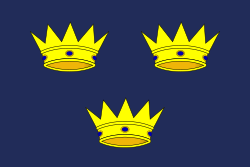
In 1118, Munster fractured into the Kingdom of Thomond under the O'Briens, the Kingdom of Desmond under the MacCarthy dynasty (Eóganachta), and the short-lived Kingdom of Ormond under the O'Kennedys (another Dalcassian sept). The three crowns of the flag of Munster represent these three late kingdoms.
There was Norman influence from the 14th century, including by the FitzGerald, de Clare and Butler houses, two of whom carved out earldoms within the Lordship of Ireland, the Earls of Desmond eventually becoming independent potentates, while the Earls of Ormond remained closer to England. The O'Brien of Thomond and MacCarthy of Desmond surrendered and regranted sovereignty to the Tudors in 1543 and 1565, joining the Kingdom of Ireland. The impactful Desmond Rebellions, led by the FitzGeralds, soon followed.
The area of Munster was colonized in the mid to late 16th century by the British plantations of Ireland during the Tudor conquest of Ireland. A group known as the West Country Men played a role in the colonization of Munster.[6][7] In 1568, attempts to settle a joint stock colony at Kerrycurrihy were made. Richard Grenville seized lands for colonization at Tracton, to the west of Cork harbour. The Munster plantation was the largest colonial venture of the English at the time.[8][9]
In the mid-19th century much of the area was hit hard in the Great Famine, especially the west.[10] The province was affected by events in the Irish War of Independence in the early 20th century, and there was a brief Munster Republic during the Irish Civil War.
The Irish leaders Michael Collins and earlier Daniel O'Connell came from families of the old Gaelic Munster gentry.
Culture
[edit]Noted for its traditions in Irish folk music, and with many ancient castles and monasteries in the province, Munster is a tourist destination. During the fifth century, St. Patrick spent seven years founding churches and ordaining priests in Munster, but a fifth-century bishop named Ailbe is the patron saint of Munster.
In Irish mythology, a number of ancient goddesses are associated with the province including Anann, Áine, Grian, Clíodhna, Aimend, Mór Muman, Bébinn, Aibell and Mongfind. The druid-god of Munster is Mug Ruith and Tlachtga is his daughter. Another legendary figure is Donn.
The province has long had trading and cultural links with continental Europe. The Corcu Loígde had a trading fleet active along the French Atlantic coast, as far south as Gascony, importing wine to Munster. The Eóganachta had ecclesiastical ties with Germany, which show in the architecture of their ceremonial capital at the Rock of Cashel.
The majority of Irish ogham inscriptions are found in Munster, principally in areas occupied by the Iverni, especially the Corcu Duibne.[11] Later, Europe's first linguistic dictionary in any non-Classical language, the Sanas Cormaic, was compiled by Munster scholars, traditionally thought to have been directed by the king-bishop Cormac mac Cuilennáin (d. 908).
The School of Ross in Munster was one of Europe's leading centres of learning in the Early Middle Ages.
Sport
[edit]Several sports in Munster are organised on a provincial basis, or operate competitions along provincial lines. This includes traditionally popular sports such as hurling, Gaelic football, rugby union and soccer, as well as cricket (Munster Cricket Union), hockey (Munster Hockey Union), and others.
Hurling and football
[edit]Munster is noted for its tradition of hurling. Three of the four most successful teams in the All-Ireland Senior Hurling Championship are from Munster; Cork GAA, Tipperary GAA and Limerick GAA. The final of the Munster Senior Hurling Championship is one of the most important days in the Irish GAA calendar.[citation needed] Munster is Ireland's only province whose every single county has won at least one All-Ireland Senior Hurling Championship.

Traditionally, the dominant teams in Munster football are Kerry GAA and Cork GAA, although Tipperary GAA and Limerick GAA have also won All-Ireland Senior Football Championships. Kerry in particular are the most successful county in the history of football.[12]
Rugby union
[edit]Rugby is a popular game in the cities of Limerick and Cork. Munster Rugby is an Irish Rugby Football Union representative side which competes in the United Rugby Championship competition, winning in 2003, 2009, 2011 and 2023 and in the Heineken Cup, winning in 2006 and 2008. Until 2016, the Munster side was the only Irish side to have defeated the New Zealand All Blacks.
Soccer
[edit]
Association football is also a popular game in Munster, with the Munster Football Association governing a number of aspects of the game in the province. In 2025 five Munster clubs play in the League of Ireland: Waterford FC and Cork City F.C., in the League of Ireland Premier Division;[13] and Cobh Ramblers, Treaty United F.C. and Kerry F.C. in the First Division.[14]
Cricket
[edit]In Cricket, the province is represented by the Munster Reds in the Inter-Provincial Cup one-day competition and the Inter-Provincial Trophy Twenty20 competition.[citation needed] Munster does not currently participate in the first-class inter-provincial tournament, though Cricket Ireland does have plans to include Munster in the format.[citation needed]
Irish language
[edit]The Irish language, or more specifically Munster Irish, is spoken as a first language in Gaeltachtaí (Irish speaking areas) in a number of areas in the province. This includes West Kerry (Corca Dhuibhne), South Kerry (Uíbh Ráthach), West Cork (Múscraí), south-west Cork (Oileán Cléire), and parts of Waterford (Gaeltacht na Rinne or Gaeltacht na nDéise).
There are about 35,000 Irish language speakers in Munster, with 9,737 native speakers in the Munster Gaeltacht areas of Cork, Kerry and Waterford. There are also 12,219 pupils attending 45 Gaelscoils (Irish language primary schools) and 15 Gaelcholáiste (Irish language secondary schools) in the province.[15] In 2011, there were 13,193 daily speakers outside the education system in Munster.
Divisions
[edit]| Year | Pop. | ±% |
|---|---|---|
| 1981 | 998,315 | — |
| 1986 | 1,020,577 | +2.2% |
| 1991 | 1,009,533 | −1.1% |
| 1996 | 1,033,903 | +2.4% |
| 2002 | 1,100,614 | +6.5% |
| 2006 | 1,173,340 | +6.6% |
| 2011 | 1,246,088 | +6.2% |
| 2016 | 1,280,020 | +2.7% |
| 2022 | 1,373,346 | +7.3% |
| [2][16][17] | ||
The province is divided into six traditional counties: Clare, Cork, Kerry, Limerick, Tipperary and Waterford. Munster is the largest of Ireland's four provinces by land area, and the third largest by population.
| County | Population (2022)[2] |
Area |
|---|---|---|
| Clare (An Clár) | 127,938 | 3,450 km2 (1,330 sq mi) |
| Cork (Corcaigh) | 584,156 | 7,508 km2 (2,899 sq mi) |
| Kerry (Ciarraí) | 156,458 | 4,807 km2 (1,856 sq mi) |
| Limerick (Luimneach) | 209,536 | 2,756 km2 (1,064 sq mi) |
| Tipperary (Tiobraid Árann) | 167,895 | 4,305 km2 (1,662 sq mi) |
| Waterford (Port Láirge) | 127,363 | 1,858 km2 (717 sq mi) |
| Total | 1,373,346 | 24,684 km2 (9,531 sq mi) |
Urban areas
[edit]


Munster has many large towns, including a number of growing satellite towns, and is the province with the most cities (three) in Ireland.[18] The following is a list of urban areas in Munster in order of size in 2022, with cities and county towns bolded:[19]
Urban areas over 10,000 inhabitants:
Urban areas with 5,000–10,000 inhabitants:
- Nenagh (9,895)[A]
- Youghal (8,564)
- Bandon (8,196)
- Thurles (8,185)
- Newcastle West (7,209)
- Fermoy (6,720)
- Passage West-Monktown (6,051)
- Kinsale (5,991)
- Carrick on Suir (5,752)
- Carrigtwohill (5,568)
- Roscrea (5,542)
- Tipperary (5,387)
- Clonakilty (5,112)
Economy
[edit]2014 CSO figures indicated that GDP per capita in the province ranged from €28,094 in the South Tipperary/Waterford (South-East) region, to €50,544 in Cork and Kerry (South-West).[20] Disposable income in the province was approximately €22,000 per person in 2008 – behind the Eastern and Dublin region (€25,000 per person) and ahead of the Border, Midland and Western regions (€20,000 per person).[21]
| Area | Population | Counties | City | GDP € (2012) | GDP per person € | GDP € (2014) | GDP per person € |
|---|---|---|---|---|---|---|---|
| South-West Region | 660,000 | Cork & Kerry | Cork | €32.3 bn | €48,500 | €33.745 bn | €50,544 |
| Mid-West Region | 380,000 | Limerick & North Tipperary & Clare | Limerick | €11.4 bn | €30,300 | €12.116 bn | €31,792 |
| South-East Region | 460,000 | Waterford & South Tipperary | Waterford | €12.8 bn | €25,600 | €14.044 bn | €28,094 |
| Source: Eurostat[20][22] | |||||||
Agriculture
[edit]Munster's agricultural industry centres around the Golden Vale pasturelands which cover counties Cork, Limerick and Tipperary. Kerry Group manufactures dairy products from the dairy cows of the region. Glanbia is a food producer which operates an "innovation centre" in the region.[23] Dawn Meats operate from County Waterford.[24]
Retail
[edit]Irish-owned retailer Dunnes Stores was founded in Cork. Ireland's largest supermarket group, the Musgrave Group, is based in Munster.
Employment
[edit]Large employers in the region include AOL, Bausch & Lomb, Dairygold, Dell, Amazon, Motorola, Amgen, Pfizer, Analog Devices, Fexco Financial Services, Vistakon, Waterford Crystal, Apple Computer, Intel, Novartis, O2, Lufthansa Technik, Kerry Group, Siemens, Sony and Blizzard Entertainment.
The largest employment hub in Munster is Metropolitan Cork, where a number of multinational firms are located in the Cork city area, including at Little Island. The Shannon Free Zone, in County Clare and near Limerick city, is also a centre of employment.
In media
[edit]A number of television companies and studios have (or had) a Munster-focus. These include RTÉ Cork (RTÉ's regional studio in Cork), South Coast TV and Channel South. Channel South transmitted local programming to Cork, Limerick, and parts of Kerry, Waterford, Clare and Tipperary.
Apart from the local city or regional newspapers, a number of print outlets focus or market themselves on a provincial basis. These include the Avondhu (covering parts of Cork, Waterford, Limerick and Tipperary),[25] the Nationalist & Munster Advertiser, the Munster Express,[26] and others.
See also
[edit]Notes
[edit]- A County Tipperary, arising from the 2014 amalgamation of North Tipperary and South Tipperary councils, has two county towns
References
[edit]- ^ "ISO 3166-2 Newsletter II-1, 19 February 2010, which gives Munster as the official English name of the Province and An Mhumhain as the official Irish name of the Province and cites "Ordnance Survey Office, Dublin 1993" as its source" (PDF). www.iso.org. Archived (PDF) from the original on 3 February 2017. Retrieved 30 December 2012.
- ^ a b c d "Census 2022 - F1004A - Population". Central Statistics Office Census 2022 Reports. Central Statistics Office Ireland. August 2023. Retrieved 16 September 2023.
- ^ Challoner, Richard. A Memorial of Ancient British Piety: or, a British Martyrology, p. 128 Archived 29 February 2020 at the Wayback Machine. W. Needham, 1761. Retrieved 14 March 2013.
- ^ Census of Ireland 2016: 1,280,394 out of 1,890,982 total.
- ^ Downham, Medieval Ireland, 2018, pp. 101-2
- ^ Taylor, Alan (2001). American Colonies, The Settling of North America. Penguin. pp. 119, 123. ISBN 0-14-200210-0.
- ^ Somerset, Anne (2003), Elizabeth I (1st Anchor Books ed.), London: Anchor Books, ISBN 978-0-385-72157-8
- ^ Falkiner, Caesar Litton (1904). Illustrations of Irish history and topography, mainly of the 17th century. London: Longmans, Green, & Co. p. 117. ISBN 1-144-76601-X.
- ^ Moody, T. W.; Martin, F. X., eds. (1967). The Course of Irish History. Cork: Mercier Press. p. 370.
- ^ In 1841, before the Great Famine, there were just under three million people living in the province, but the population dropped devastatingly low due to mass emigration in the 1840s and continued emigration up until the 1980s.
- ^ The ruins of the Iron Age mountaintop fortress Caherconree, preserving the name of Cú Roí, can also be found in their lands.
- ^ "Kingdom's unique structure keeps them well ahead of all pretenders". 26 February 2015. Archived from the original on 11 October 2018. Retrieved 11 October 2018.
- ^ "SSE Airtricity Men's Premier Division". League of Ireland.
- ^ "SSE Airtricity Men's First Division Clubs". League of Ireland.
- ^ "Gaelscoil stats" (PDF). Gaelscoileanna.ie. 2011. Archived (PDF) from the original on 19 April 2012. Retrieved 8 January 2012.
- ^ "Sapmap Area: Province Munster". Census 2016. Central Statistics Office. 2016. Archived from the original on 23 January 2018. Retrieved 23 January 2018.
- ^ for post 1821 figures, 1653 and 1659 figures from Civil Survey Census of those years, Paper of Mr Hardinge to Royal Irish Academy March 14, 1865 Archived 20 September 2010 at the Wayback Machine, For a discussion on the accuracy of pre-famine census returns see J.J. Lee "On the accuracy of the pre-famine Irish censuses" in Irish Population, Economy and Society edited by JM Goldstrom and LA Clarkson (1981) p54, in and also New Developments in Irish Population History, 1700–1850 by Joel Mokyr and Cormac Ó Gráda in The Economic History Review, New Series, Vol. 37, No. 4 (Nov. 1984), pp. 473–488.
- ^ Local Government Reform Act 2014, s. 12: Local government areas (No. 1 of 2014, s. 12). Enacted on 27 January 2014. Act of the Oireachtas. Retrieved from Irish Statute Book on 27 December 2021.
- ^ "Census 2022 - F1015 Population". Central Statistics Office Census 2022 Reports. Central Statistics Office Ireland. August 2023. Retrieved 16 September 2023.
- ^ a b "County Incomes and Regional GDP (Table 9a GDP per person at Basic Prices, 2006 to 2014)". Central Statistics Office. 22 March 2017. Archived from the original on 26 March 2017. Retrieved 27 March 2017.
- ^ "County incomes and regional GDP" (PDF). Archived from the original (PDF) on 19 November 2011.
- ^ "appsso.eurostat.ec.europa". Archived from the original on 6 October 2014. Retrieved 17 July 2015.
- ^ Gianbia Nutritionals Archived 25 February 2017 at the Wayback Machine – Official website
- ^ "Contact Us". www.dawnmeats.com. Archived from the original on 14 September 2017. Retrieved 14 September 2017.
- ^ "About Us". AvondhuPress. Archived from the original on 3 March 2016. Retrieved 21 February 2016.
- ^ "About Us | Munster Express Online". Munster-express.ie. Archived from the original on 6 February 2016. Retrieved 21 February 2016.
External links
[edit]
 Texts on Wikisource:
- Rines, George Edwin, ed. (1920). "Munster". Encyclopedia Americana.
- "Munster (Ireland)". Encyclopædia Britannica (11th ed.). 1911.
- Gilman, D. C.; Peck, H. T.; Colby, F. M., eds. (1905). "Munster". New International Encyclopedia (1st ed.). New York: Dodd, Mead.


The counties are listed per province | ||
 Connacht Connacht |  | |
 Leinster Leinster | ||
 Munster Munster | ||
 Ulster Ulster | ||
| ||
| International | |
|---|---|
| National | |
| Geographic | |
| Other | |

Munster
View on GrokipediaGeography
Physical features and terrain
Munster's topography is characterized by a diverse array of features resulting from tectonic folding during the Variscan Orogeny in the late Paleozoic era, which produced prominent mountain ranges and ridges primarily from Old Red Sandstone formations in the Munster Basin.[8] Differential erosion has sculpted parallel sandstone ridges and valleys across much of the province, particularly in counties Cork, Kerry, and Tipperary, where anticlinal uplifts form the backbone of the landscape.[9] The southwestern Atlantic seaboard features rugged peninsulas, such as the Iveragh and Dingle in Kerry, with steep coastal cliffs and glaciated U-shaped valleys deepened by Pleistocene ice ages.[10] The province's highest elevations occur in the Macgillycuddy's Reeks of County Kerry, culminating in Carrauntoohil at 1,038 meters, Ireland's tallest peak, surrounded by corries and tarns from glacial activity.[11] Inland, the Galtee Mountains reach 919 meters at Galtymore on the Limerick-Tipperary border, while the Knockmealdown and Comeragh ranges in Waterford and Tipperary exhibit similar folded sandstone structures up to 794 meters.[12] Lowland areas contrast with these uplands, including the fertile limestone plains of the Golden Vale in Limerick and North Tipperary, underlain by Carboniferous strata and supporting intensive agriculture. Karst terrain dominates parts of County Clare, as in the Burren, where exposed limestone pavements, sinkholes, and dry valleys reflect intense dissolution and minimal soil cover.[7] Hydrologically, Munster is drained by major rivers including the Shannon, which forms the northern boundary with long stretches in counties Clare and Limerick, and its tributaries like the Fergus; the Munster Blackwater flowing through Waterford and Cork; and the Lee traversing Cork city.[13] Lakes such as Lough Derg on the Shannon and smaller glacial lakes in the uplands punctuate the terrain, contributing to a network of wetlands and bogs in intermontane depressions. The southern coastline, from Cork to Waterford, includes natural harbors and estuaries shaped by post-glacial sea-level rise.[10]Climate and environmental factors
Munster experiences a temperate oceanic climate characterized by mild temperatures, high humidity, and frequent precipitation throughout the year. Average annual temperatures range from approximately 6°C in winter to 16°C in summer, with July marking the warmest month at around 16°C and January the coldest at about 6°C.[14] [15] The region benefits from the moderating influence of the Atlantic Ocean and the North Atlantic Drift, resulting in relatively stable conditions with rare extremes; frost occurs sporadically in winter, while summer highs seldom exceed 20°C. Wind speeds average 15-20 km/h, peaking in winter months like February.[16] Precipitation is abundant, averaging 900-1,200 mm annually across Munster, with higher amounts in the west (e.g., Kerry) due to orographic effects from prevailing southwesterly winds. December is typically the wettest month, contributing up to 120 mm, while rainfall distribution supports lush vegetation and agriculture but contributes to soil erosion and periodic waterlogging. The region's climate facilitates grass-based farming, a cornerstone of the local economy, yet excessive moisture can delay fieldwork and increase disease pressure on crops and livestock.[14] [17] Environmental factors in Munster are heavily shaped by its agricultural intensity, particularly dairy and beef production, which dominate land use and drive nutrient runoff into waterways. Intensive farming has elevated nitrate and phosphate levels in rivers like the Blackwater and lakes such as Lough Derg, impairing water quality; agriculture accounts for the majority of diffuse pollution, with nitrate concentrations in affected rivers remaining elevated despite some reductions from 2010-2023.[18] [19] Flooding poses a recurrent risk, exacerbated by heavy rainfall and riverine systems; climate projections indicate increased frequency of extreme events, with sea-level rise of up to 0.56 m by 2050 threatening coastal areas in counties like Cork and Waterford, potentially costing billions in damages.[20] [21] Peatlands and bogs, covering parts of the landscape, store carbon but face degradation from drainage for farming, releasing stored emissions and reducing biodiversity resilience.[22]History
Ancient origins and medieval kingdoms
The Kingdom of Munster emerged in antiquity as a Gaelic polity associated with the Érainn tribes, who exerted early control over southern Ireland, maintaining a chief fortress at Temuir Érann in the Ballyhoura Hills of present-day County Limerick.[23] These origins trace back to at least the early centuries AD, predating the dominance of later dynasties, with the Érainn representing one of the principal Celtic groups in the region following migrations around 500–100 BC.[23][24] By approximately 400 CE, the Eóganachta dynasty ascended to power, leveraging alliances with Déisi warriors to repel incursions from Leinster and secure territories including parts of modern County Waterford and southern Tipperary.[23] Attributed to the legendary founder Conall Corc in the 5th century, the Eóganachta established their royal seat at Cashel, from which they governed Munster as a centralized kingdom, expanding colonies into Cork and Kerry while asserting influence against provincial high kings.[23][25] This era marked the consolidation of Eóganachta hegemony, lasting from the 5th to the 10th centuries, though punctuated by internal divisions among their branches such as Eóganacht Chaisil and Eóganacht Glendamnach.[25] In the medieval period, the Eóganachta encountered mounting pressures from Viking longphort establishments in the 9th and 10th centuries, alongside rivalry from the northern Dál gCais sept.[23] The dynasty's decline accelerated when Brian Boru of the Dál gCais, succeeding his brother Mathgamain, defeated and killed the Eóganachta king Máel Muad mac Brain in 978, thereby assuming the kingship of Munster and initiating a brief unification under Dál gCais rule.[23][26] Boru's campaigns imposed tributes on subjugated tribes and extended control over Viking-held Limerick, but following his death at the Battle of Clontarf in 1014, Munster fragmented into the northern Kingdom of Thomond under the O'Briens (Dál gCais descendants) and the southern Kingdom of Desmond, where Eóganachta lineages like the MacCarthys regained partial autonomy.[23][26] This division persisted into the 12th century, reflecting the decentralized nature of Gaelic overlordships.[23]English conquests and plantations
The Tudor dynasty's efforts to assert direct crown authority over Ireland extended to Munster in the mid-16th century, building on the 1541 declaration of Henry VIII as King of Ireland, which aimed to integrate Gaelic lords through policies like surrender and regrant, whereby native chieftains would relinquish traditional titles in exchange for English peerages and tenurial rights under common law.[27] In Munster, the powerful FitzGerald earls of Desmond, who controlled vast territories encompassing much of counties Cork, Kerry, Limerick, and Tipperary, resisted these impositions, viewing them as erosions of their semi-autonomous Brehon law-based lordships.[28] This resistance culminated in open conflict, marking the province's integration into English governance via military subjugation rather than voluntary submission. The First Desmond Rebellion erupted in 1569 amid feuds between the Earl of Desmond, Gerald FitzGerald (c. 1533–1583), and the Butlers, exacerbated by crown interventions favoring the latter and suspicions of Desmond's Catholic sympathies during England's Reformation.[29] Forces under Sir Humphrey Gilbert and others ravaged Munster, leading to Desmond's temporary submission in 1573 after heavy losses, including the execution of allies and the imposition of composition rents—fixed payments to replace capricious Gaelic exactions—as a means of fiscal control.[30] However, underlying tensions persisted, with Desmond's release from English custody failing to quell Gaelic alliances or prevent further crown encroachments, setting the stage for escalated conflict. The Second Desmond Rebellion began on 18 July 1579 when James Fitzmaurice FitzGerald, a kinsman, landed at Smerwick with papal-backed Spanish and Italian mercenaries, invoking religious justification against Protestant English rule and rallying discontented Gaelic lords.[31] Desmond initially disavowed the invasion but joined after crown reprisals, leading to widespread insurgency across Munster; English forces under Lord Grey de Wilton crushed the Smerwick garrison in October 1580, massacring 600 surrendering troops.[32] The rebellion devolved into guerrilla warfare, with scorched-earth tactics by crown commander Sir John Perrot causing famine that killed tens of thousands of civilians, as documented in contemporary accounts estimating 30,000 deaths from starvation by 1582.[33] Desmond, hunted as a rebel, was killed on 11 November 1583 near Tralee by local forces, his head dispatched to Queen Elizabeth I in London.[34] Following Desmond's attainder by parliament in 1586, the crown confiscated approximately 300,000 acres (about 574,000 Irish plantation acres) of his palatinate lordship, surveyed in the 1584 Desmond Survey to map forfeitures excluding loyalist holdings.[35][33] The Munster Plantation, formalized in 1586 under commissioners like Sir Valentine Browne, allocated these lands to around 35 English "undertakers"—primarily Devon and Somerset gentry—who received seignories of 4,000 to 12,000 acres each, obligated to settle Protestant tenants, build defenses, and introduce English agriculture and tenure.[36] Notable grantees included Sir Walter Raleigh (12,000 acres near Youghal) and Edmund Spenser (3,000 acres at Kilcolman), with initial plans targeting 15,000 colonists on up to 500,000 acres, though actual settlement reached only about 700 households (roughly 3,000–4,000 people) by the early 1590s, drawn mostly from southwestern England.[31][37] Garrisons of 2,000 crown troops fortified key sites, but the scheme faltered amid native resentment, high costs, and the 1598 incursion by Hugh O'Neill's forces during the Nine Years' War, which razed many plantations and prompted settler evacuations, underscoring the conquest's fragility despite breaking Desmond hegemony.[38] Confiscated lands remained crown property, enabling later 17th-century resettlements under James I and Cromwell, but the Tudor phase established precedents for systematic plantation as a tool of anglicization and control.[27]Famine, emigration, and 19th-century transformations
The Great Famine of 1845–1852, triggered by potato blight (Phytophthora infestans), devastated Munster's rural population, which depended heavily on the potato as a staple crop for small tenant farmers and laborers. The province's population fell from 2,396,161 in the 1841 census to 1,890,711 by 1851, reflecting excess mortality from starvation and typhus, estimated at around 20–25% decline attributable to the crisis, alongside early emigration waves.[39] Workhouses in counties like Cork and Kerry overflowed, with official relief efforts—such as soup kitchens feeding up to 3 million daily at peak in 1847—proving insufficient amid administrative delays and policy debates over dependency on monoculture.[40] Food exports from Irish ports, including Munster's, continued during the famine, totaling over 4,000 ships laden with grain and livestock in 1847 alone, highlighting the distinction between subsistence failure and commercial agriculture.[41] Emigration from Munster surged post-1845, with over 1 million departing Ireland annually in peak years like 1847, primarily to North America, Britain, and Australia; Munster contributed disproportionately, with emigration rates reaching 83.8% of the provincial population's potential outflow by the late 19th century, driven by land scarcity and rural unemployment.[42] Between 1841 and 1900, net overseas migration from Ireland exceeded 5 million, with Munster ports like Cork and Limerick serving as key departure points for "coffin ships" carrying 1.5 million to the United States alone in the famine decade.[43] This exodus, comprising mostly young adults and families, halved Munster's rural holdings under 15 acres by 1871, accelerating farm consolidation as surviving tenants absorbed evicted plots.[44] In the post-famine decades, Munster's economy transformed through agricultural reconfiguration, shifting from tillage and potato dependency to pastoral farming, with grazing land expanding from 56% of farmland in 1851 to over 70% by 1901, boosting dairy output in counties like Cork, home to Europe's largest butter market.[45][46] Railways, expanding from 100 miles in 1850 to over 1,000 by 1870, integrated Munster into export networks, raising land values near ports but deepening rural depopulation inland.[47] Average farm size doubled to 60 acres by century's end, reducing subdivision but entrenching tenancy insecurity under absentee landlords.[48] The Land War of 1879–1882 intensified in Munster, where agrarian leagues organized boycotts and rent strikes against evictions, peaking with over 1,000 cases in Tipperary and Limerick amid a post-1870s agricultural depression.[49] This agitation prompted British Land Acts—1870 granting compensation for improvements, 1881 enabling tenant purchase via loans, and 1903 facilitating transfer of 8 million acres nationwide—transferring ownership from landlords to tenants in Munster, where smallholders gained freehold on 60% of farmland by 1910.[50] These reforms stabilized rural society but perpetuated emigration, with Munster's population stagnating below 1.8 million through 1901.[51]20th-century independence and economic shifts
In the Irish War of Independence (1919–1921), Munster emerged as a primary theater of guerrilla conflict, with County Cork recording the highest levels of violence through ambushes, reprisals, and British military operations, including the widespread use of crown forces like the Black and Tans.[52] The province's Irish Republican Army (IRA) units, drawing on strong local support, disrupted British administration and supply lines, contributing to the eventual Anglo-Irish Treaty of December 1921, which established the Irish Free State encompassing Munster. A notable episode was the Limerick Soviet of April 1919, where approximately 15,000 workers in Limerick city launched a general strike against British-imposed martial law and travel restrictions, temporarily assuming control of local governance, issuing scrip currency, and managing utilities under a strike committee before British pressure and internal divisions ended it after two weeks.[53] The subsequent Irish Civil War (1922–1923) centered heavily on Munster, where anti-Treaty IRA forces, rejecting the treaty's partition and oath provisions, seized key cities including Cork, Limerick, Waterford, and Kerry towns in early 1922, proclaiming an unrecognized "Munster Republic" that controlled over half of Ireland's territory at its peak.[54] Pro-Treaty National Army offensives, supported by artillery and naval blockades, recaptured Limerick in July 1922 after street fighting that killed around 20 combatants, followed by the fall of Waterford and the prolonged siege of Cork in August, where anti-Treaty forces evacuated after destroying docks and infrastructure to deny them to the victors.[55] The conflict's resolution solidified Munster's incorporation into the Free State, though it left lasting divisions, with over 1,000 deaths nationwide and economic disruption from burned buildings and disrupted trade. Post-independence, Munster's economy, long agrarian with emphasis on dairy, beef, and barley production, faced stagnation amid the Free State's protectionist policies under Éamon de Valera's Fianna Fáil governments from 1932, which prioritized self-sufficiency through tariffs and subsidies but yielded slow GDP growth of about 1% annually until the 1950s, exacerbating rural depopulation as over 400,000 emigrated from Ireland between 1926 and 1951.[56] Industrial activity remained modest; Cork's port handled exports but saw limited manufacturing beyond established sectors like brewing (Guinness and Beamish) and Ford's assembly plant (opened 1917, closed 1984), while Limerick experienced decline in milling and bacon curing amid global competition.[57] A pivotal shift occurred in the late 1950s with the transition to export-oriented industrialization under the First Programme for Economic Expansion (1958–1963), which devalued the currency, reduced tariffs, and invited foreign direct investment, spurring factory openings in electronics and pharmaceuticals; Munster benefited from the Shannon Free Zone (established 1959 near Limerick), Ireland's first such initiative, attracting firms like Analog Devices and generating over 1,000 jobs by 1970 through tax incentives.[58] By the 1980s and 1990s, Cork emerged as a hub for multinational operations, including Apple's European headquarters (1980) and chemical plants, while Limerick's Dell facility (1991) employed thousands, reflecting Munster's pivot from subsistence farming—where agriculture still comprised 20% of employment in 1961—to a mixed economy with rising service and tech sectors, though rural counties like Kerry and Tipperary lagged with persistent out-migration.[56]Recent developments since 2000
Munster shared in Ireland's Celtic Tiger economic expansion through the early 2000s, with foreign direct investment fueling growth in pharmaceuticals and technology sectors, particularly in Cork, where multinational firms established major operations contributing to regional GDP increases of over 5% annually in the mid-2000s.[59] Limerick's tech hub, anchored by facilities like Dell's European headquarters until partial relocation in 2009, similarly benefited from the boom, alongside aviation at Shannon Airport.[60] However, the 2008 global financial crisis triggered a severe downturn, with construction halting, unemployment peaking at around 15% regionally by 2012, and a reliance on EU-IMF bailout funds from 2010 imposing austerity measures that reduced public spending and delayed infrastructure projects. Recovery accelerated post-2013, driven by exports and renewed FDI, with Cork's biotech cluster—home to firms like Apple and Pfizer—propelling Munster's GDP growth to exceed national averages, reaching approximately €50 billion by 2022.[61] The province's population expanded from 1,090,394 in the 2002 census to 1,373,346 by 2022, reflecting net immigration during the boom and return migration post-recovery, though tempered by outflows during the recession.[62] Urban centers like Cork (population 222,526 in 2022) and Limerick (58,319) absorbed much of this growth, with 11 towns over 10,000 residents by 2022 compared to fewer two decades prior.[62] Social shifts included rising secularism and diversity, with non-Irish nationals comprising 12% of Munster's population by 2022, up from under 5% in 2002, alongside policy responses to events like the 2009 Limerick floods that prompted €200 million in flood defenses completed by 2017.[63] Culturally, Munster Rugby's triumphs, including Heineken Cup victories in 2006 against Biarritz (23-19) and 2008 against Toulouse (16-13), galvanized provincial identity and tourism, drawing sell-out crowds to Thomond Park and elevating the region's global sports profile.[64] Infrastructure advancements encompassed motorway expansions like the M7 Dublin-Limerick (opened 2010) and M8 Cork-Dublin (2010), reducing travel times and supporting economic integration, while ongoing projects such as the proposed M20 Cork-Limerick motorway aim to enhance connectivity amid post-2020 housing and regional development pressures under Project Ireland 2040.[65][66]Demographics
Population trends and distribution
As of the 2022 census, Munster's population totaled 1,373,346, marking a 7.3% increase from 1,280,394 recorded in 2016.[67] This expansion, equivalent to an average annual growth rate of approximately 1.2%, was propelled primarily by net inward migration and natural increase, though it trailed the national average due to Munster's peripheral position relative to eastern economic hubs. Longer-term trends show Munster's share of Ireland's overall population contracting from 36.7% in 1841 to 26.7% by 2022, a pattern attributable to disproportionate 19th-century famine-era emigration and subsequent slower recovery in rural western areas compared to urbanizing Leinster.[67] Population distribution remains uneven, with over 42% concentrated in County Cork and significant clusters in urban centers like Cork city (224,004 residents) and Limerick city (approximately 58,000 within the broader county of 209,536). Rural counties such as Kerry and Clare exhibit lower densities, averaging under 40 persons per square kilometer, reflecting reliance on agriculture and tourism rather than high-density industry.[62] Growth varied by county between 2016 and 2022, with Waterford expanding fastest at 9% (adding 10,909 residents), driven by manufacturing and port-related employment, while Tipperary saw the slowest rise at 5%.[68]| County | 2022 Population | Change from 2016 (%) |
|---|---|---|
| Cork (total) | 584,156 | 8 |
| Limerick | 209,536 | 7 |
| Tipperary | 167,895 | 5 |
| Kerry | 156,458 | 6 |
| Clare | 127,938 | 7.7 |
| Waterford | 127,363 | 9 |
Urbanization and migration patterns
In Munster, urbanization has intensified since the late 20th century, with population concentration shifting toward major cities amid broader national trends of faster urban growth compared to rural areas. The province's three principal urban centers—Cork, Limerick, and Waterford—accounted for substantial shares of regional expansion between 2016 and 2022. Cork City's population rose to 222,333, reflecting robust inflows tied to employment in manufacturing, pharmaceuticals, and services. Limerick City and County reached 205,444 residents, a 5.4% increase, while Waterford's population grew 10% to 127,363, the fastest rate among Munster counties. These gains contrast with slower rural depopulation, contributing to Munster hosting 11 of Ireland's 49 towns exceeding 10,000 inhabitants in 2022.[69][68][70] Migration patterns in Munster exhibit a net rural-to-urban internal flow, augmenting city populations while straining rural viability. Census data indicate that internal migration within Ireland, based on residence one year prior, drives approximately one-quarter of urban growth through relocations from countryside to cities seeking economic opportunities. In Munster, this manifests as movement toward Cork and Limerick from inland counties like Tipperary and Clare, with limited reverse commuting sustaining some rural retention. Historically, 19th- and 20th-century emigration depleted rural Munster, but post-1990s recovery reversed this via net immigration, primarily to urban hubs; national figures show Ireland's net migration at +79,300 for the year to April 2024, with Munster benefiting from EU and non-EU inflows concentrated in employment sectors. Inter-provincial outflows to Leinster persist modestly, yet provincial population rose 8-9% overall from 2016-2022, underscoring migration's role in countering aging rural demographics.[71][72][73]Language, religion, and cultural identity
The predominant language spoken daily in Munster is English, reflecting the broader linguistic shift across Ireland following centuries of Anglicization, though Irish (Gaeilge) retains official status and cultural significance. Designated Gaeltacht areas, where Irish functions as the primary community language, are concentrated in western Kerry (including the Dingle Peninsula and Corca Dhuibhne), the Beara Peninsula and other pockets in western Cork, and the Ring Gaeltacht (An Rinn) in Waterford, comprising small rural districts totaling under 1% of the province's land area.[74][75] In the 2022 Census of Population, proficiency in Irish was reported by over 40% of residents aged three and over in every Munster county, exceeding the national average of 39.8%, with habitual daily speakers outside education remaining a minority at around 2-3% province-wide, concentrated in Gaeltacht communities.[76][77] The Munster dialect of Irish, known for its distinct phonetic features such as slender 'r' pronunciation and vowel shifts, predominates in these areas, influencing local literature and media.[78] Roman Catholicism constitutes the prevailing religious affiliation in Munster, with 1,002,293 adherents recorded in the 2022 Census, representing approximately 69% of the provincial population, consistent with national trends of gradual decline from 79% in 2011.[79][80] Protestant denominations, including the Church of Ireland, account for under 2% historically tied to Plantation-era settlements in counties like Tipperary and Limerick, while "no religion" identifications have risen to about 20%, driven by urbanization and immigration.[80] Munster's cultural identity emphasizes regional distinctiveness from other Irish provinces, rooted in ancient Gaelic kingdoms like those of the Eóganachta and Dál gCais, preserved through oral traditions, folklore, and a dialect of Irish literature.[81] This manifests in strong communal ties via sports, particularly rugby union via Munster Rugby—drawing fervent support across counties and symbolizing provincial rivalry with Leinster and Ulster—and Gaelic games like hurling, where Munster teams dominate interprovincial competitions.[82] Traditional music, with influences from uilleann pipes and fiddle styles, thrives in festivals and sessions, underscoring a heritage of rural self-reliance and historical resistance to central authority.[83]Government and administration
Counties and local governance
Munster comprises six counties—Clare, Cork, Kerry, Limerick, Tipperary, and Waterford—which serve as the primary administrative divisions for local governance within the province.[84] Local government in these counties operates under Ireland's national framework of 31 local authorities, including county councils for rural areas, standalone city councils in urban centers, and merged city and county councils where applicable. In Munster, this results in seven key local authorities responsible for services such as housing, roads, planning, waste management, and community development. Elected councillors, numbering between 18 and 55 per authority depending on population and area, set policy and adopt annual budgets, while a chief executive oversees implementation and operations.[85] Councillors are elected every five years via proportional representation, with the most recent elections held on 7 June 2024. The structure varies by county to reflect urban-rural balances:| County | Principal Local Authority(ies) | Notes on Structure |
|---|---|---|
| Clare | Clare County Council (28 councillors) | Single county council covering the entire county, divided into four municipal districts (Ennis, Killaloe, Shannon, West Clare) for localized decision-making. |
| Cork | Cork County Council (55 councillors); Cork City Council (31 councillors) | Split administration: county council handles rural and suburban areas with ten municipal districts; city council governs the urban core independently.[86] |
| Kerry | Kerry County Council (33 councillors) | Unified county council with five municipal districts (Cahir, Cashel and Emly, Clonmel, Nenagh, Thurles—post-2014 merger of former North and South Tipperary structures). |
| Limerick | Limerick City and County Council (40 councillors) | Merged entity since 2014, integrating city and county functions under one authority with six municipal districts. |
| Tipperary | Tipperary County Council (40 councillors) | Consolidated post-2014 merger, with five municipal districts. |
| Waterford | Waterford City and County Council (36 councillors) | Unified since 2014, covering both urban and rural areas with three municipal districts. |