Hubbry Logo
search
logo
1621273

NASA Docking System

logo
Community Hub0 Subscribers
Read side by side
from Wikipedia
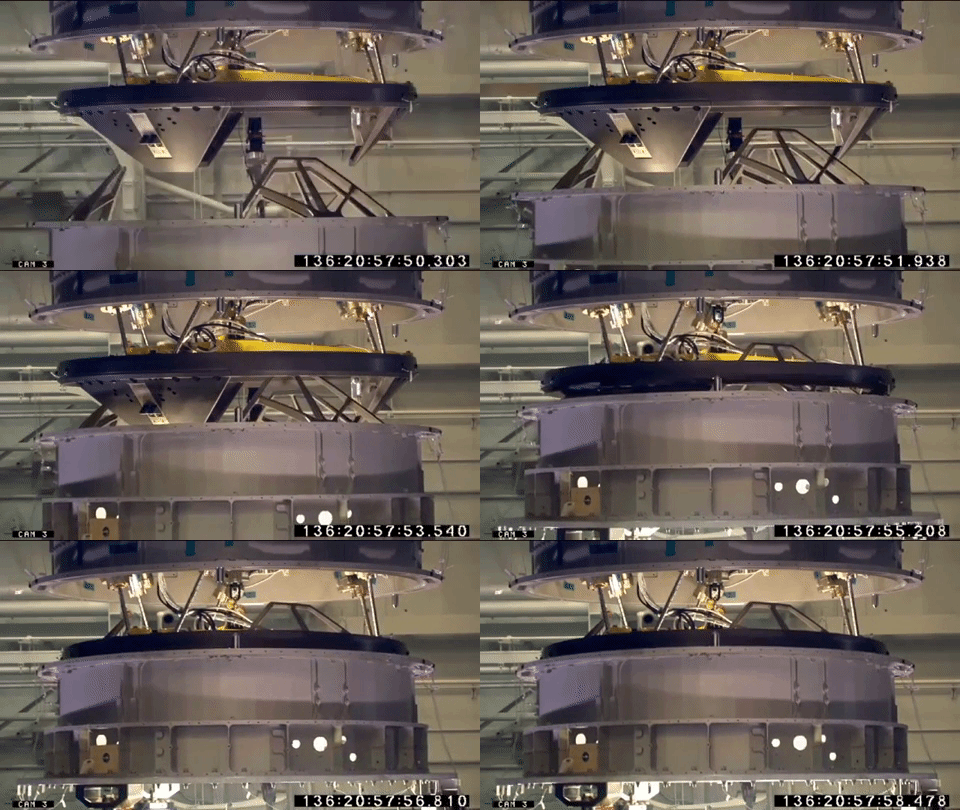
NASA Docking System (active androgynous variant on top, permanently passive variant on the bottom).[citation needed] Mechanical latches (visible on the guide petals) in the active ring clamp onto the passive section for contact and capture
IDAs shown connected to PMA-2 and PMA-3 on the Harmony node.

The NASA Docking System is NASA's implementation of the International Docking System Standard (IDSS), an international spacecraft docking standard promulgated by the International Space Station Multilateral Coordination Board. NDS is a spacecraft docking and berthing mechanism used on the International Space Station (ISS) and the Boeing Starliner and planned to be used on the Orion spacecraft. The international Low Impact Docking System (iLIDS)[1] was the precursor to the NDS. NDS Block 1 was designed, built, and tested by The Boeing Company in Huntsville Alabama. Design qualification testing took place through January 2017.

Using NDS, NASA developed the International Docking Adapter (IDA) to provide two IDSS-compliant docking ports on the ISS. The IDAs were delivered to the ISS starting in 2016. Each of two existing Pressurized Mating Adapters has an IDA permanently attached, so the former PMA function is no longer available for visiting spacecraft. Since 2019, visiting spacecraft that implement IDSS dock to the NDS ports on the IDAs. These include Crew Dragon, Cargo Dragon 2, and Boeing Starliner.

Design

[edit]

NDS supports both autonomous and piloted dockings and includes pyrotechnics for contingency undocking. Once mated the NDS interface can transfer power, data, and air; future implementations will be able to transfer water, fuel, oxidizer and pressurant as well.[1] The passage for crew and cargo transfer has a diameter of 800 millimetres (31 in).[2]

In form and function NDS resembles the Shuttle/Soyuz APAS-95 mechanism already in use for the docking ports and pressurized mating adapters on the International Space Station. There is no compatibility with the larger common berthing mechanism used on the US segment of the ISS, the Japanese H-II Transfer Vehicle, the original SpaceX Dragon, and Orbital Sciences' Cygnus spacecraft. NDS is compatible with the IDSS implementation on SpaceX Dragon 2, both Crew Dragon and Cargo Dragon.

History

[edit]
Testing of the X-38 Low-Impact Docking System.

In 1996, Johnson Space Center (JSC) began development of the Advanced Docking Berthing System,[3] which would later be called the X-38 Low-Impact Docking System.[4][5] After the X-38 was canceled in 2002, development of the mating system continued, but its future was unknown.[3] In 2004, President George W. Bush announced his Vision for Space Exploration and NASA's 2005 Exploration Systems Architecture Study was created in response, recommended the use of the Low Impact Docking System (LIDS) for the Crew Exploration Vehicle (which was later named Orion) and all applicable future exploration elements.[6]

The Hubble Space Telescope received the Soft-Capture Mechanism (SCM) on STS-125.[7] The SCM is meant for unpressurized docking, but uses the LIDS interface to reserve the possibility of an Orion docked mission.[7] The docking ring is mounted on Hubble's aft bulkhead.[7] It may be used for safely de-orbiting Hubble at the end of its service lifetime.[7]

Image showing the design changes from IDSS revision b to c

In February 2010, the LIDS program became modified to be compliant with the IDSS and became known as the international Low Impact Docking System (iLIDS) or simply the NASA Docking System (NDS).[8] In May 2011, the NDS critical design review was completed and qualification was expected to be completed by late 2013.[9]

In April 2012, NASA funded a study to determine if a less complex docking system could be used as the NASA Docking System that both met the international community's desire for a narrower soft capture system ring width, as well as providing the ISS a simpler active docking system compared to the then-planned design.[10] Boeing's proposal was the Soft Impact Mating and Attenuation Concept (SIMAC), a design originally conceived in 2003 for the Orbital Space Plane (OSP) Program.[10]

A leaked NASA internal memo from November 2012, stated that SIMAC had been chosen to replace the previous design and that the majority of the work on the NASA Docking System would be shifted from NASA JSC to Boeing.[11] In August 2014, Boeing announced that the critical design review for the redesigned NDS had been completed.[12] Following this change the IDSS was modified (to rev D), so the new design of the NASA Docking System is still compatible with the standard.[10][2][12]

IDA-1 was part of the payload on SpaceX CRS-7 in June 2015, but was destroyed when the Falcon 9 rocket exploded during ascent.[13]

IDA-2 was delivered successfully on SpaceX's CRS-9 mission in July 2016, and then installed on PMA-2 in August of that year during a spacewalk by Jeffrey Williams and Kathleen Rubins as part of Expedition 48.[14] Crew Dragon Demo-1 was the first spacecraft to dock at this port on 2 March 2019.

IDA-3 was launched on the SpaceX CRS-18 mission in July 2019.[15] IDA-3 is constructed mostly from spare parts to speed construction.[16] It was attached and connected to PMA-3 during a spacewalk on 21 August 2019. [17]

References

[edit]
[edit]
Revisions and contributorsEdit on WikipediaRead on Wikipedia
from Grokipedia
The NASA Docking System (NDS) is a direct-drive electromechanical docking interface designed for spacecraft to connect with the International Space Station (ISS) and support future human spaceflight missions beyond low Earth orbit, featuring soft and hard capture mechanisms for automated alignment, latching, and resource transfer including power and data.[1] Developed as NASA's primary implementation of the International Docking System Standard (IDSS), the NDS enables androgynous docking—meaning either connecting vehicle can serve as the active or passive unit—facilitating international collaboration, crew rescue capabilities, and interoperability for visiting spacecraft weighing 5 to 25 tonnes docking to target complexes up to 375 tonnes.[2] First baselined in 2010 as part of the IDSS established by ISS partners, the NDS Block 1 variant was qualified for flight in 2017 and initially flown on Boeing's CST-100 Starliner during its Crew Flight Test in 2024, which achieved the system's inaugural crewed docking to the ISS. However, the mission encountered propulsion system issues with reaction control thrusters, resulting in the spacecraft's uncrewed return on September 7, 2024, while the crew remained on the ISS until February 2025, returning aboard a SpaceX Crew Dragon.[3][1][4] Key components of the NDS include a Soft Capture System (SCS) with linear actuators and latches for initial alignment using guide petals, capture ring, and mechanical latches, aided by navigation targets such as perimeter reflector targets, followed by a Hard Capture System (HCS) with structural hooks and seals for rigid attachment and umbilical connections via the Power/Data Transfer Umbilical (PDTU).[2] This design draws from legacy systems like the APAS mechanism used on earlier ISS modules but incorporates modern electric actuation for precision control, eliminating hydraulic dependencies and enhancing reliability for long-duration missions.[1] The system's mass is controlled at a not-to-exceed limit of 750 pounds for the full assembly, optimizing it for integration with vehicles like Starliner and NASA's Orion spacecraft.[5] Beyond the ISS, the NDS supports NASA's Artemis program and potential lunar or Mars architectures by standardizing docking for multi-vehicle assemblies, such as gateway habitats in lunar orbit, while ensuring compatibility with international standards to promote joint exploration efforts.[3] Following the 2024 Crew Flight Test and subsequent reviews, ongoing refinements address integration and propulsion challenges, with the first operational flight targeted for late 2025 or beyond. Future NDS variants are planned to include advanced features such as enhanced data rates and autonomous undocking for deep-space applications.[6]

Introduction

Purpose and Applications

The NASA Docking System (NDS) is an androgynous peripheral docking and berthing mechanism designed to implement the International Docking System Standard (IDSS), enabling low-impact connections between spacecraft in active (chaser) or passive (target) configurations.[7] Its primary purpose is to facilitate secure attachments for crew and cargo transfer during space missions, particularly for visiting vehicles docking to the International Space Station (ISS).[1] Key applications include supporting operations for spacecraft such as Boeing's CST-100 Starliner and NASA's Orion capsule, which connect to ISS ports via International Docking Adapters to enable efficient astronaut and supply exchanges.[8][9] The NDS Block 1 was qualified for flight in 2017 and achieved its first crewed docking during Boeing's Starliner Crew Flight Test in 2024. As of 2025, it supports ongoing ISS operations and Artemis program planning.[1] Upon successful docking or berthing, the NDS provides an 800 mm (31.5-inch) diameter passageway for transfers, once protective petals are retracted, allowing the movement of personnel and equipment between vehicles.[7] It enables the exchange of power (via 120 VDC and 28 VDC lines), data (through MIL-STD-1553B and Ethernet interfaces), and air, supporting sustained operations on the ISS and potential future deep-space missions.[7] Initial Block 0 configurations focus on these capabilities without fluid or propellant transfer, with provisions "scarred" for later enhancements to accommodate evolving exploration needs.[7] The system supports both autonomous docking, relying on automated guidance with force-feedback controls, and piloted modes for crew intervention, ensuring flexibility across mission profiles from Low Earth Orbit to beyond.[7] Historically, the NDS evolved as a successor to probe-and-drogue systems, such as those used in earlier Russian and U.S. missions, to meet the demands of multinational partnerships on the ISS by standardizing interfaces and reducing docking disturbances.[1] This shift promotes interoperability among international vehicles, enhancing rescue operations, on-orbit assembly, and collaborative human spaceflight endeavors.[7]

Relation to International Standards

The International Docking System Standard (IDSS) originated as a NASA-led international agreement initiated in 2010 to establish a common docking interface for spacecraft, fostering collaboration among space agencies including the European Space Agency (ESA), Japan Aerospace Exploration Agency (JAXA), Roscosmos, and the Canadian Space Agency (CSA).[10][11] Coordinated through the International Space Station (ISS) Multilateral Coordination Board, the IDSS aims to enable on-orbit crew rescue and joint operations by defining standardized geometric, mechanical, and electrical interfaces that allow diverse spacecraft to dock without proprietary modifications.[2] The NASA Docking System (NDS) directly implements key IDSS requirements to ensure interoperability, incorporating androgynous soft-capture latches for initial alignment, rigid attachment rings for structural integrity, and standardized data/power connectors for umbilical transfers.[11][2] These elements eliminate the need for vehicle-specific adapters, allowing seamless connections between international partners' spacecraft at IDSS-compatible ports on the ISS.[3] NDS evolved from the International Low Impact Docking System (iLIDS), a 2010 precursor technology developed under NASA's Low Impact Docking System (LIDS) framework, which was refined into the full IDSS through iterative international reviews.[12][11] This progression culminated in the IDSS Interface Definition Document (IDD) Revision D, released in April 2015, which formalized the interface specifications for global adoption.[13] By adhering to IDSS, NDS plays a critical role in enabling emergency crew rescue scenarios and multi-vehicle docking configurations on the ISS, where the standard specifies 3 soft-capture latch strikers and 12 pairs of hard-capture hooks per docking interface to secure vehicles ranging from 5 to 375 tonnes.[2]

Design and Components

Core Mechanism

The core mechanism of the NASA Docking System (NDS) facilitates spacecraft attachment through a sequenced soft capture and rigidization process designed for low-impact operations. The Soft Capture System (SCS) deploys a ring structure with three guide petals spaced at 120 degrees, each equipped with mechanical latches that engage striker plates on the mating interface to achieve initial contact and load attenuation.[1] This phase tolerates closing velocities of 0.05 to 0.10 m/s axially and up to 0.04 m/s laterally, along with angular rates not exceeding 0.20 degrees per second, ensuring controlled energy absorption during approach.[2] Alignment guides on the petals then correct minor offsets, retracting the ring to position the interfaces for the subsequent step. Rigid attachment follows via the Hard Capture System (HCS), where 12 active hooks on one NDS engage corresponding passive hooks on the opposing interface, drawing the structures together to compress seals and establish a pressurized pathway.[2] These motorized hooks, driven by electromechanical actuators, provide the structural integrity needed for crew transfer and resource sharing, completing the docking sequence in an automated manner for free-flyer vehicles.[1] Undocking reverses this process using three resettable push-off springs that provide a symmetric separation force of at least 1778 N at 4.2 mm above the HCS mating plane (less than 2670 N when fully mated), ensuring safe clearance without residual contact forces.[2] For contingencies such as hook disengagement failure, certain NDS configurations incorporate pyrotechnic bolts or actuators to enable manual release and forced separation.[7] In berthing operations, the NDS relies on external robotics, such as the Canadarm2 manipulator system, to grapple and precisely align the incoming vehicle before initiating soft capture, a process directed by ground control teams rather than onboard autonomy.[2] This mode accommodates non-propulsive spacecraft but requires additional coordination to achieve the same interface tolerances as free-flyer docking. Key safety features include load-limiting soft stops integrated into the SCS, which use force feedback to dampen excessive motions and prevent overload during capture.[7] The system accommodates lateral misalignments up to 0.10 m and angular offsets of 4.0 degrees in pitch/yaw or roll, minimizing collision risks while maintaining structural margins.[2] Each NDS assembly weighs approximately 750 pounds, optimized for integration with International Space Station docking adapters.[7]

Interface Specifications

The NASA Docking System (NDS) establishes standardized physical, electrical, and utility interfaces to enable secure, interoperable connections between spacecraft, supporting crew transfer, data exchange, and resource sharing in low Earth orbit and beyond. These specifications, derived from the International Docking System Standard (IDSS), prioritize low-impact docking with precise alignment and robust environmental resilience.[2][14] The structural interface features a soft capture ring with an outer diameter of approximately 1.3 meters, incorporating three equally spaced, inward-pointing guide petals for initial contact and misalignment correction during approach. These petals, integrated into the capture mechanism, facilitate soft capture before hard mating via 24 structural attachment points (12 active hooks and 12 passive receptacles). The interface provides an 800 mm diameter pressurized tunnel for crew and cargo passage, ensuring compatibility with host vehicle cross-sections up to 1.8 meters by 1.5 meters while maintaining a minimum clear passageway of 800 mm in the mated configuration.[15][16][7] Electrical and data interfaces support reliable communication and power distribution through redundant pathways. The system uses a MIL-STD-1553B bus for command, telemetry, and control signals, with up to four buses available, alongside dual IEEE 802.3 Ethernet links (100 Base-T and Gigabit) for high-rate data transfer. Power transfer is provided at up to 10 kW nominal via 120 V DC lines, with redundant 28 V DC provisions for low-voltage needs, enabling continuous operation during mated phases.[15][2][12] Utility transfer interfaces in the baseline NDS Block 1 focus on essential life support, with provisions for intermodule ventilation (IMV) air revitalization at 125–210 cubic feet per minute and thermal control via conductive paths achieving 75–187 Btu/hr-°F across the interface. Future Block 2 and beyond will incorporate mechanized umbilicals for additional transfers, including potable and waste water up to 100 kg per cycle, hypergolic fuel and oxidizer via soft goods-compatible ports, and pressurant gases to support propulsion and pressurization needs.[15][17][12] Key performance specifications ensure operational reliability under space conditions. Alignment accuracy requires lateral misalignment of no more than 0.10 meters and angular (pitch/yaw) misalignment of 4 degrees at initial contact, refining to finer tolerances via guide pins and sensors during hard capture. The interfaces withstand vacuum levels below 1.0 × 10^{-4} Pa, temperature extremes from -40°C to +60°C in operational mated states (with survival limits to -65°C and +89°C), and low Earth orbit radiation environments, including UV exposure limited to 58 equivalent sun hours.[2][14][15]

Development and History

Early Concepts

The development of the NASA Docking System traces its origins to 1996, when engineers at NASA's Johnson Space Center initiated the Advanced Docking Berthing System (ADBS) project. This effort focused on creating a next-generation docking mechanism for future human spaceflight vehicles, emphasizing simplified operations and minimized risks during spacecraft mating. The ADBS was envisioned to support emerging exploration architectures beyond the Space Shuttle era, addressing limitations in existing systems through innovative soft-capture technologies.[18] By 2001, the project had evolved into the Low-Impact Docking System (LIDS), specifically tailored for the X-38 Crew Return Vehicle (CRV), an experimental prototype intended as an emergency escape craft for the International Space Station. During this phase, the LIDS team constructed the first Engineering Development Unit (EDU), a 54-inch outer diameter prototype, reaching approximately 60% completion. Key testing included dynamic evaluations of the soft-capture hardware and control systems from 1996 to 2000, which validated closed-loop force feedback for alignment and capture, along with simulations of low-impact operations. However, the X-38 program, including LIDS development, was canceled in 2002 due to budget constraints.[18][19] A primary goal of these early concepts was to drastically reduce docking impact forces compared to traditional probe-and-drogue mechanisms, which impose high loads unsuitable for fragile payloads or reusable spacecraft. LIDS aimed to enable gentler mating through active control, protecting sensitive equipment and crew while accommodating a broader range of vehicle masses and configurations. Early prototypes incorporated electromechanical actuators in the soft-capture system to achieve precise force management, a design element that later influenced Boeing's Soft Impact Mating and Attenuation Concept (SIMAC) redesign for subsequent docking iterations.[18][20]

Standardization and Qualification

In 2010, the NASA Docking System, evolving from earlier Low Impact Docking System concepts, was redesigned for compliance with the International Docking System Standard (IDSS) and initially designated as the international Low Impact Docking System (iLIDS).[7] This interim name was used interchangeably with NASA Docking System (NDS) during the transition, reflecting its alignment with global docking interfaces for the International Space Station (ISS).[21] The redesign emphasized low-impact docking technology to minimize structural loads on the ISS, supporting integration with the Common Docking Adapter (CDA).[7] The NDS Critical Design Review (CDR) was completed in early 2011, validating the system's baseline architecture, including androgynous peripheral docking mechanisms and electrical/mechanical interfaces defined in the IDSS Interface Definition Document.[22] This milestone advanced the project toward qualification, with initial testing phases beginning shortly thereafter at NASA's Johnson Space Center (JSC). In April 2012, NASA tasked Boeing with studying a simplified soft capture mechanism to replace the original iLIDS soft capture system, leading to the selection of the Soft Impact Mating and Attenuation Concept (SIMAC).[20] SIMAC, featuring six independent linear actuators in a Stewart platform configuration, was tailored for the Boeing CST-100 Starliner spacecraft, enabling compatible soft capture with APAS-style rings while meeting IDSS load requirements such as 3900 N tension and 3500 N compression.[20] Boeing's redesign incorporated these elements to enhance reliability for crewed missions, with design completion targeted for June 2015.[20] Boeing completed its CDR for the redesigned NDS in August 2014 as part of the broader Commercial Crew Program review, confirming the integration of SIMAC and other subsystems like propulsion and avionics.[23] Qualification testing, spanning structural, thermal-vacuum, and vibration analyses, was conducted at JSC from 2011 to 2017, utilizing high-fidelity test articles and six-degree-of-freedom (6DoF) simulations to verify capture performance across misalignment scenarios and environmental conditions.[1] Development testing occurred in 2014, followed by qualification 6DoF testing in 2016, achieving 100% capture success in trials involving light and heavy vehicle pairings.[1] The final qualification for NDS Block 1 was achieved in January 2017, certifying the system for ISS operations with the Starliner.[1] Development timelines were impacted by the June 2015 SpaceX CRS-7 launch failure, which destroyed the first International Docking Adapter (IDA-1) intended for ISS installation, necessitating a replacement built from existing parts and delaying overall NDS integration.[24] This event postponed CDA delivery, indirectly affecting NDS qualification schedules tied to ISS port conversions.[24]

Deployment and Operations

Installation on ISS

The International Docking Adapters (IDAs) are critical components for integrating the NASA Docking System (NDS) onto the International Space Station (ISS), converting the legacy Pressurized Mating Adapters (PMAs)—which interface with the Common Berthing Mechanism (CBM) and Androgynous Peripheral Attach System (APAS)—to ports compliant with the International Docking System Standard (IDSS).[25] This adaptation enables automated docking, power transfer, and data exchange for visiting spacecraft such as the Boeing CST-100 Starliner and SpaceX Crew Dragon.[8] Originally, two IDAs were planned for permanent installation on the forward and zenith ports of the Harmony module (Node 2), providing standardized NDS interfaces on the U.S. Orbital Segment while preserving overall station compatibility.[8] The IDSS framework further supports interoperability with legacy Russian docking ports, such as the Probe-and-Drogue systems on Soyuz and Progress vehicles, through dedicated adapters that bridge differing mechanical and electrical interfaces.[2] The installation timeline encountered significant setbacks, beginning with the loss of IDA-1 during the SpaceX Commercial Resupply Services-7 (CRS-7) mission launch failure on June 28, 2015, which destroyed the adapter along with other cargo valued at over $118 million.[26] As a result, IDA-2 was repurposed as the primary unit and launched aboard SpaceX CRS-8 on April 8, 2016, with berthing to the ISS occurring on April 10, 2016; it was fully installed on PMA-2 at the Harmony forward port during Expedition 48's EVA-36 spacewalk on August 19, 2016, lasting nearly seven hours.[27] IDA-3 followed, delivered via SpaceX CRS-17 launched on May 4, 2019, and berthed on May 6, 2019; installation on PMA-3 at the Harmony zenith port was completed during Expedition 60's U.S. EVA-55 on August 21, 2019, in a six-hour and 32-minute spacewalk by astronauts Nick Hague and Andrew Morgan.[28] These delays stemmed from the CRS-7 anomaly, rigorous certification testing for the IDAs under NASA's Commercial Crew Program, and coordination of robotic and human operations to ensure structural integrity and electrical compatibility.[26] The installation process for each IDA begins with robotic extraction from the unpressurized trunk of a visiting cargo vehicle, such as SpaceX Dragon, using the Canadarm2 robotic arm and its Dextre robotic hand to maneuver the adapter into position atop the target PMA.[27] Astronauts then conduct an extravehicular activity (EVA) to tether the IDA securely, mate electrical connectors for power and data umbilicals, and activate heating elements and navigation aids, including laser retro-reflectors for precision docking.[28] Each IDA measures approximately 1.6 meters in diameter and weighs about 526 kg, contributing to the ISS's total mass while minimizing impact on station dynamics through balanced placement and vibration-dampening features.[29] This methodical approach, refined through ground simulations and on-orbit rehearsals, ensured zero defects during both installations and paved the way for operational NDS use without disrupting ongoing ISS missions.[27]

Usage in Missions

The NASA Docking System (NDS) achieved its first operational use during the SpaceX Crew Dragon Demo-1 mission, an uncrewed demonstration flight that autonomously docked to the International Docking Adapter-2 (IDA-2) on the International Space Station (ISS) on March 3, 2019.[30] This successful docking validated the NDS's soft capture and hard mate sequences in a real orbital environment, paving the way for crewed operations. The mission lasted 6 days, during which the spacecraft transferred over 400 pounds of supplies and underwent system checks before undocking and splashing down on March 8, 2019.[31] This was followed by the piloted SpaceX Crew Dragon Demo-2 mission, which launched on May 30, 2020, and docked autonomously to IDA-2 on May 31, 2020, marking the first crewed NDS docking from U.S. soil since the Space Shuttle program's end.[32] NASA astronauts Douglas Hurley and Robert Behnken monitored the process from inside the Crew Dragon, with the spacecraft remaining attached to the ISS for 64 days to support Expedition 63 before returning on August 2, 2020. The mission demonstrated the NDS's reliability for human-rated operations, including pressure integrity and power transfer across the interface.[32] For Boeing's CST-100 Starliner, the NDS saw its first docking during the uncrewed Orbital Flight Test-2 (OFT-2) on May 20, 2022, to IDA-3 after overcoming propulsion and software issues that delayed the approach.[33] The spacecraft completed a series of tests while docked for five days, confirming NDS compatibility for Boeing's commercial crew vehicle before undocking on May 25, 2022. The crewed Crew Flight Test followed on June 5, 2024, with Starliner docking to the ISS at 1:34 p.m. EDT on June 6, 2024, carrying NASA astronauts Barry "Butch" Wilmore and Sunita Williams despite thruster anomalies resolved en route.[34] This mission highlighted the NDS's fault-tolerant design, as the docking proceeded nominally, allowing the crew to transfer to the station. Due to ongoing propulsion concerns, the astronauts remained aboard the ISS for approximately nine months, returning to Earth on March 18, 2025, via SpaceX's Crew-9 mission; Starliner undocked uncrewed and completed its return later in 2025.[35] In cargo operations, SpaceX's Cargo Dragon 2 has utilized the NDS routinely since its debut mission, Commercial Resupply Services-21 (CRS-21), which docked to the ISS on December 7, 2020.[36] As of November 2025, these cargo missions have completed 13 dockings, delivering thousands of pounds of supplies, experiments, and equipment per flight with a 100% success rate following initial qualification tests.[37] For instance, CRS-33 in August 2025 carried over 5,000 pounds of cargo and docked autonomously, supporting ongoing ISS research while demonstrating the NDS's efficiency for high-frequency resupply.[38] Across these missions, the NDS has exhibited strong operational performance, with average docking times of approximately one hour from initial proximity operations to full hard mate, enabling seamless integration without major failures reported.[39] The two NDS-equipped ports on the IDAs have contributed to the ISS's overall capacity to accommodate up to eight vehicles simultaneously across all docking and berthing ports, expanding station capacity for crew rotations, cargo deliveries, and scientific payloads.[40]

Future Applications

Upgrades and Enhancements

The NASA Docking System (NDS) Block 2 represents a significant evolution from Block 1, primarily designed to enable fluid transfer capabilities essential for extended missions in the Artemis program during the 2020s. This upgrade introduces ports compatible with the MOOG fluid transfer coupling, allowing the transfer of storable fluids such as xenon, hydrazine, and nitrogen tetroxide (NTO), which are hypergolic propellants critical for propulsion systems. Additionally, a cryogenic propellant transfer variant is under development, with demonstrations like the LOXSAT-1 mission planned for 2026 to validate transfers of liquids such as liquid oxygen in microgravity environments. These enhancements address the limitations of Block 1, which lacks integrated fluid interfaces, by supporting on-orbit refueling and logistics for lunar and deep-space operations.[41] For the Orion spacecraft, which is powered by the European Service Module (ESM), NDS Block 2 will enable docking to the Lunar Gateway station and incorporate advanced features like active thermal management systems to maintain stable temperatures during docking and power transfer operations. The ESM, provided by the European Space Agency, powers Orion's propulsion, electricity, and life support, while Block 2 enables enhanced power transfer capabilities through the docking interface, facilitating energy sharing between Orion, Gateway elements, and visiting vehicles like lunar landers. This setup supports crew transfers and resource exchange at Gateway, a key outpost in near-rectilinear halo orbit around the Moon, enhancing mission flexibility for Artemis III and beyond. As of April 2025, the Habitation and Logistics Outpost (HALO) module has been delivered to Northrop Grumman for integration, with launches planned no earlier than 2027.[42][43][44] Ongoing testing for Block 2's propellant transfer functions occurs at NASA's Johnson Space Center (JSC), including ground-based simulations that model low-gravity fluid dynamics and docking loads induced by propellant slosh. These simulations use tools like the LaSRS++ software for six-degree-of-freedom docking analyses, ensuring reliable performance during fluid transfers without compromising structural integrity. Recent joint tests with partners, such as SpaceX's Starship Human Landing System, have validated docking mechanisms compatible with NDS Block 2 at JSC over multi-day sessions simulating contact forces and alignment.[45][46] Key challenges in Block 2 development include ensuring compatibility with radiation-hardened electronics to withstand the harsh radiation environment of lunar and Mars missions. Advanced materials are being evaluated to optimize system efficiency, though specific mass reductions target overall mission architectures rather than the docking mechanism alone. Certification for operational use is projected by 2028, aligning with Artemis timelines and ongoing verifications through missions like the Multi-Purpose Robotic Vehicle (MRV) in 2026.[41]

Compatibility and International Use

The NASA Docking System (NDS), as the U.S. implementation of the International Docking System Standard (IDSS), has seen adoption by international space agencies to promote interoperability among crewed and cargo vehicles. The European Space Agency (ESA) has developed the International Berthing and Docking Mechanism (IBDM), a passive IDSS-compatible system intended for use on future cargo and habitation modules, building on the legacy of the Automated Transfer Vehicle (ATV) by enabling standardized docking for resupply and logistics missions.[10] Similarly, the Japan Aerospace Exploration Agency (JAXA) has incorporated IDSS compatibility into its H-II Transfer Vehicle successor, the HTV-X, which automatically docks to the International Space Station's (ISS) IDSS ports for cargo delivery, with its first flight in October 2025 successfully docking to the ISS.[47][48] Roscosmos, through participation in the IDSS development committee alongside NASA, ESA, JAXA, and the Canadian Space Agency, is exploring adapter solutions to integrate its Soyuz and Progress vehicles with IDSS interfaces, facilitating potential cross-vehicle operations.[14] Beyond the ISS, the NDS/IDSS enables applications on the Lunar Gateway, NASA's planned outpost in lunar orbit with initial elements launching no earlier than 2027 and full on-orbit assembly commencing with Artemis IV no earlier than September 2028, where it supports docking for international partners. The Orion spacecraft, equipped with an active NDS, will dock to Gateway ports, while ESA-contributed modules like the International Habitation Module incorporate IDSS-compatible interfaces for seamless integration with visiting vehicles from JAXA, the Canadian Space Agency, and others.[49][43] This standardization underpins crew rescue protocols, allowing any IDSS-equipped vehicle to provide emergency evacuation support to another in distress, ensuring resource transfer for power, data, and safety systems during joint operations.[2] Compatibility with legacy systems presents challenges, particularly for Russian APAS-based docking ports on the ISS, addressed through adapters like the International Docking Adapter (IDA) installed on Pressurized Mating Adapters (PMAs) to convert APAS-95 interfaces to IDSS.[50] These adapters enable non-IDSS vehicles to interface indirectly but highlight the need for dedicated adapters on Russian spacecraft for direct IDSS docking, with ongoing international coordination to resolve alignment, power, and data mismatches.[2] The IDSS supports resource sharing via umbilicals for power (up to 28 VDC and 120 VDC) and data (MIL-STD-1553B and Ethernet), promoting extended docked operations with full interoperability among partners.[2] The broader impact of NDS/IDSS extends to commercial providers, exemplified by Sierra Space's Dream Chaser spaceplane, which features an IDSS-compatible docking system for autonomous ISS resupply missions, enhancing global access to low-Earth orbit.[51] By 2025, over five international vehicles—including crewed systems like Boeing Starliner and cargo platforms like HTV-X and Dream Chaser—have been certified or are in advanced development for IDSS compatibility, fostering a unified framework for collaborative space exploration.[3]

References

User Avatar
No comments yet.