


Community hub
Recent from talks
Contribute something
Nothing was collected or created yet.
Olive ridley sea turtle
View on Wikipedia
| Olive ridley sea turtle | |
|---|---|

| |
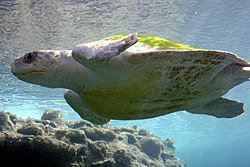
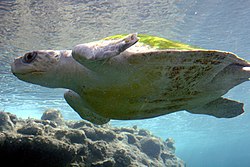
| Olive ridley sea turtle at Kélonia, an aquarium in Saint-Leu, Réunion | |
CITES Appendix I
| |
Scientific classification 
| |
| Kingdom: | Animalia |
| Phylum: | Chordata |
| Class: | Reptilia |
| Order: | Testudines |
| Suborder: | Cryptodira |
| Family: | Cheloniidae |
| Genus: | Lepidochelys |
| Species: | L. olivacea
|
| Binomial name | |
| Lepidochelys olivacea (Eschscholtz, 1829)
| |
| Synonyms[3] | |
| |

The olive ridley sea turtle (Lepidochelys olivacea), also known commonly as the Pacific ridley sea turtle, is a species of turtle in the family Cheloniidae. The species is the second-smallest[4][5] and most abundant of all sea turtles found in the world. L. olivacea is found in warm and tropical waters, primarily in the Pacific and Indian Oceans, but also in the warm waters of the Atlantic Ocean.[4]
This turtle and the related Kemp's ridley sea turtle are best known for their unique synchronised mass nestings called arribadas, where thousands of females come together on the same beach to lay eggs.[4][5]
Taxonomy
[edit]The olive ridley sea turtle may have been first described as Testudo mydas minor by Georg Adolf Suckow in 1798. It was later described and named Chelonia multiscutata by Heinrich Kuhl in 1820. Still later, it was described and named Chelonia olivacea by Johann Friedrich von Eschscholtz in 1829. The species was placed in the subgenus Lepidochelys by Leopold Fitzinger in 1843.[6] After Lepidochelys was elevated to full genus status, the species was called Lepidochelys olivacea by Charles Frédéric Girard in 1858. Because Eschscholtz was the first to propose the specific epithet olivacea, he is credited as the binomial authority or taxon author in the valid name Lepidochelys olivacea (Eschscholtz, 1829). The parentheses indicate that the species was originally described in a different genus.
The generic name, Lepidochelys, is derived from the Greek words lepidos, meaning scale, and chelys, which translates to turtle. This could possibly be a reference to the supernumerary costal scutes characteristic of this genus.[7] The etymology of the English vernacular name "olive" is somewhat easier to resolve, as its carapace is olive green in color.[8] However, the origin of "ridley" is unknown, perhaps derived from "riddle".[9][10] Lepidochelys is the only genus of sea turtles containing more than one extant species: L. olivacea and the closely related L. kempii (Kemp's ridley).[10]
Description
[edit]Growing to about 61 cm (2 ft) in carapace length (measured along the curve), the olive ridley sea turtle gets its common name from its olive-colored carapace, which is heart-shaped and rounded. Males and females grow to the same size, but females have a slightly more rounded carapace as compared to males.[4] The heart-shaped carapace is characterized by four pairs of pore-bearing inframarginal scutes on the bridge, two pairs of prefrontals, and up to nine lateral scutes per side. L. olivacea is unique in that it can have variable and asymmetrical lateral scute counts, ranging from five to nine plates on each side, with six to eight being most commonly observed.[7] Each side of the carapace has 12–14 marginal scutes.
The carapace is flattened dorsally and highest anterior to the bridge. It has a medium-sized, broad head that appears triangular from above. The head's concave sides are most obvious on the upper part of the short snout. It has paddle-like fore limbs, each having two anterior claws. The upper parts are grayish-green to olive in color, but sometimes appear reddish due to algae growing on the carapace. The bridge and hingeless plastron of an adult vary from greenish white in younger individuals to a creamy yellow in older specimens (maximum age is up to 50 years).[7][11]
Hatchlings are dark gray with a pale yolk scar, but appear all black when wet.[7] Carapace length of hatchlings ranges from 37 to 50 mm (1.5 to 2.0 in). A thin, white line borders the carapace, as well as the trailing edge of the fore and hind flippers.[11] Both hatchlings and juveniles have serrated posterior marginal scutes, which become smooth with age. Juveniles also have three dorsal keels; the central longitudinal keel gives younger turtles a serrated profile, which remains until sexual maturity is reached.[7]
The olive ridley sea turtle rarely weighs over 50 kg (110 lb). Adults studied in Oaxaca, Mexico,[7] ranged from 25 to 46 kg (55 to 101 lb); adult females weighed an average of 35.45 kg (78.2 lb) (n=58), while adult males weighed significantly less, averaging 33.00 kg (72.75 lb) (n=17). Hatchlings usually weigh between 12.0 and 23.3 g (0.42 and 0.82 oz).
Adults are sexually dimorphic. The mature male has a longer and thicker tail, which is used for copulation,[7] and the presence of enlarged and hooked claws on the male's front flippers allows him to grasp the female's carapace during copulation. The male also has a longer, more tapered carapace than the female, which has a rounded, dome-like carapace.[7] The male also has a more concave plastron, believed to be another adaptation for mating. The plastron of the male may also be softer than that of the female.[11]
Distribution
[edit]
The olive ridley turtle has a circumtropical distribution, living in tropical and warm waters of the Pacific and Indian Oceans from India, Arabia, Japan, and Micronesia south to southern Africa, Australia, and New Zealand. In the Atlantic Ocean, it has been observed off the western coast of Africa and the coasts of northern Brazil, Suriname, Guyana, French Guiana, and Venezuela. Additionally, the olive ridley has been recorded in the Caribbean Sea as far north as Puerto Rico. A female was found alive on an Irish Sea beach on the Isle of Anglesey, Wales, in November 2016, giving this species its northernmost appearance. It was taken in by the nearby Anglesey Sea Zoo, while its health was assessed.[12] A juvenile female was found off the coast of Sussex in 2020.[13] The olive ridley is also found in the eastern Pacific Ocean from the Galápagos Islands and Chile north to the Gulf of California, and along the Pacific coast to at least Oregon. Migratory movements have been studied less intensely in olive ridleys than other species of marine turtles, but they are believed to use the coastal waters of over 80 countries.[14] Historically, this species has been widely regarded as the most abundant sea turtle in the world.[7] More than one million olive ridleys were commercially harvested off the coasts of Mexico in 1968 alone.[15]
The population of Pacific Mexico was estimated to be at least 10 million prior to the era of mass exploitation. More recently, the global population of annual nesting females has been reduced to about two million by 2004,[16] and was further reduced to 852,550 by 2008.[1][17] This indicated a dramatic decrease of 28–32% in the global population within only one generation (i.e., 20 years).[14]
Olive ridley sea turtles are considered the most abundant, yet globally they have declined by more than 30% from historic levels.[citation needed] These turtles are considered endangered because of their few remaining nesting sites in the world. The eastern Pacific turtles have been found to range from Baja California, Mexico, to Chile. Pacific olive ridleys nest around Costa Rica, Mexico, Nicaragua, and the northern Indian Ocean; the breeding colony in Mexico was listed as endangered in the US on July 28, 1978.[18]
Nesting grounds
[edit].jpg)

Olive ridley turtles exhibit two different nesting behaviours: solitary nesting (the most prevalent) and synchronized mass nesting, termed arribadas.[11] They are unique among sea turtle species in the latter behaviour, for which they are best known. Females return to the same beach from where they hatched, to lay their eggs. They lay their eggs in conical nests about 1.5 ft (0.46 m) deep, which they laboriously dig with their hind flippers.[4] In the Indian Ocean, Arabian Sea near Honavar in Karnataka , the majority of Olive Ridleys nest in two or three large assemblies near Gahirmatha in Odisha. The coast of Odisha in India is one of the largest mass nesting sites for the Olive Ridley, along with the coasts of Mexico and Costa Rica.[4] In 1991, over 600,000 turtles nested along the coast of Odisha in one week. Solitary nesting also occurs in Lothian Island Wildlife Sanctuary in West Bengal and along the Coromandel Coast and Sri Lanka, but in scattered locations. However, olive ridleys are considered a rarity in most areas of the Indian Ocean.[17] Some nesting populations exist in islands of Bangladesh near Cox's Bazar.[19]
They are also rare in the western and central Pacific, with known arribadas occurring only within the tropical eastern Pacific, in Central America and Mexico. In Costa Rica, they occur at Nancite and Ostional beach, and a third arribada beach seems to be emerging at Corozalito. Two active arribada beaches are located in Nicaragua, Chacocente and La Flor, with a smaller arribada beach of unknown status on the Pacific coast of Panama. Historically, arribadas happened at several beaches in Mexico, but in the present arribadas are only observed at Playa Escobilla and Morro Ayuda in Oaxaca, and Ixtapilla in Michoacan.[17]
Although olive ridleys are famed for their arribadas, most of the known nesting beaches are only frequented by solitarily nesting females and support a relatively small quantity of nests (100 to 3,000 nests). The overall contribution and importance of solitary nesting females to the population may be underestimated by the scientific community as the hatching success rate of nests at arribada beaches is generally low, but high at solitary nesting beaches.[7]
Isolated, irregular nesting events also sporadically occur within the species' range.[20]
Foraging grounds
[edit]Some of the olive ridley's foraging grounds near Southern California are contaminated due to sewage, agricultural runoff, pesticides, solvents, and industrial discharges. These contaminants have been shown to decrease the productivity of the benthic community, which negatively affects these turtles, which feed from these communities.[7] The increasing demand to build marinas and docks near Baja California and Southern California are also negatively affecting the olive ridleys in these areas, where more oil and gasoline will be released into these sensitive habitats. Another threat to these turtles is power plants, which have documented juvenile and subadult turtles becoming entrained and entrapped within the saltwater cooling intake systems.[7]
Ecology and behavior
[edit]
Reproduction
[edit]Mating is often assumed to occur in the vicinity of nesting beaches, but copulating pairs have been reported over 1,000 km from the nearest beach. Research from Costa Rica revealed the number of copulating pairs observed near the beach could not be responsible for the fertilization of the tens of thousands of gravid females, so a significant amount of mating is believed to have occurred elsewhere at other times of the year.[7]
The Gahirmatha Beach in Kendrapara district of Odisha (India), which is now a part of the Bhitarkanika Wildlife Sanctuary, is the largest breeding ground for these turtles. The Gahirmatha Marine Wildlife Sanctuary, which bounds the Bhitarkanika Wildlife Sanctuary to the east, was created in September 1997, and encompasses Gahirmatha Beach and an adjacent portion of the Bay of Bengal. Bhitarkanika mangroves were designated a Ramsar Wetland of International Importance in 2002. It is the world's largest known rookery of olive ridley sea turtles. Apart from Gahirmatha rookery, two other mass nesting beaches have been located, which are on the mouth of rivers Rushikulya and Devi. The spectacular site of mass congregation of olive ridley sea turtles for mating and nesting enthralls both the scientists and the nature lovers throughout the world.
Olive ridley sea turtles migrate in huge numbers from the beginning of November, every year, for mating and nesting along the coast of Orissa. Gahirmatha coast has the annual nesting figure between 100,000 and 500,000 each year. A decline in the population of these turtles has occurred in the recent past due to mass mortality. The olive ridley sea turtle has been listed on Schedule – I of the Indian Wildlife (Protection) Act, 1972 (amended 1991). The species is listed as vulnerable under IUCN.[1] The sea turtles are protected under the 'Migratory Species Convention' and Convention of International Trade on Wildlife Flora and Fauna (CITES). India is a signatory nation to all these conventions. The homing characteristics of the ridley sea turtles make them more prone to mass casualty. The voyage to the natal nesting beaches is the dooming factor for them. Since Gahirmatha coast serves as the natal nesting beach for millions of turtles, it has immense importance on turtle conservation.
Olive ridleys generally begin to aggregate near nesting beaches about two months before nesting season, although this may vary throughout their range. In the eastern Pacific, nesting occurs throughout the year, with peak nesting events (arribadas) occurring between September and December. Nesting beaches can be characterized as relatively flat, midbeach zone, and free of debris.[6] Beach fidelity is common, but not absolute. Nesting events are usually nocturnal, but diurnal nesting has been reported, especially during large arribadas.[7] Exact age of sexual maturity is unknown, but this can be somewhat inferred from data on minimum breeding size. For example, the average carapace length of nesting females (n = 251) at Playa Nancite, Costa Rica, was determined to be 63.3 cm (24.9 in), with the smallest recorded at 54.0 cm (21.3 in).[7] Females can lay up to three clutches per season, but most only lay one or two clutches.[11] The female remains near shore for the internesting period, which is about one month. Mean clutch size varies throughout its range and decreases with each nesting attempt.[17]
A mean clutch size of 116 (30–168 eggs) was observed in Suriname, while nesting females from the eastern Pacific were found to have an average of 105 (74–126 eggs).[11] The incubation period is usually between 45 and 51 days under natural conditions, but may extend to 70 days in poor weather conditions. Eggs incubated at temperatures of 31 to 32 °C (88 to 90 °F) produce only females; eggs incubated at 28 °C (82 °F) or less produce solely males; and incubation temperatures of 29 to 30 °C (84 to 86 °F) produce a mixed-sex clutch.[11] Hatching success can vary by beach and year, due to changing environmental conditions and rates of nest predation.
Habitat
[edit]Most observations are typically within 15 km (9.3 mi) of mainland shores in protected, relatively shallow marine waters (22–55 m deep).[11] Olive ridleys are occasionally found in open waters. The multiple habitats and geographical localities used by this species vary throughout its lifecycle.[6]
Feeding
[edit]The olive ridley is predominantly carnivorous. Common prey items include tunicates (salps and sea squirts), starfish, sea urchins, bryozoans, squid, bivalves, snails, barnacles, shrimp, crabs, rock lobsters, and sipunculid worms.[21][22] Additionally, consumption of jellyfish and both adult fish (e.g. Sphoeroides) and fish eggs may be indicative of pelagic (open ocean) feeding.[11] The olive ridley is also known to feed on filamentous algae in areas devoid of other food sources. Captive studies have indicated some level of cannibalistic behavior in this species.[7]
Threats
[edit]
Known predators of olive ridley eggs include raccoons, coyotes, feral dogs and pigs, opossums, coatimundi, caimans, ghost crabs, and the sunbeam snake.[11] Hatchlings are preyed upon as they travel across the beach to the water by vultures, frigate birds, crabs, raccoons, coyotes, iguanas, and snakes. In the water, hatchling predators most likely include oceanic fishes, sharks, and crocodiles. Adults have relatively few known predators, other than sharks and crocodiles, and killer whales are responsible for occasional attacks.[23] On land, nesting females may be attacked by jaguars. Notably, the jaguar is the only cat with a strong enough bite to penetrate a sea turtle's shell, thought to be an evolutionary adaption from the Holocene extinction event.[citation needed] In observations of jaguar attacks, the cats consumed the neck muscles of the turtle and occasionally the flippers, but left the remainder of the turtle carcass for scavengers as most likely, despite the strength of its jaws, a jaguar still cannot easily penetrate an adult turtle's shell to reach the internal organs or other muscles. In recent years, increased predation on turtles by jaguars has been noted, perhaps due to habitat loss and fewer alternative food sources. Sea turtles are comparatively defenseless in this situation, as they cannot pull their heads into their shells like freshwater and terrestrial turtles.[7][24] Females are often plagued by mosquitos during nesting. Humans are still listed as the leading threat to L. olivacea, responsible for unsustainable egg collection, slaughtering nesting females on the beach, and direct harvesting adults at sea for commercial sale of both the meat and hides.[11]
Other major threats include mortality associated with boat collisions, and incidental takes in fisheries. Trawling, gill nets, ghost nests, longline fishing, and pot fishing have significantly affected olive ridley populations, as well as other species of marine turtles.[1][7] Between 1993 and 2003, more than 100,000 olive ridley turtles were reported dead in Odisha, India from fishery-related practices.[25] In addition, entanglement and ingestion of marine debris is listed as a major threat for this species. Coastal development, natural disasters, climate change, and other sources of beach erosion have also been cited as potential threats to nesting grounds.[7] Additionally, coastal development also threatens newly hatched turtles through the effects of light pollution.[26] Hatchlings which use light cues to orient themselves to the sea are now misled into moving towards land, and die from dehydration or exhaustion, or are killed on roads.
The greatest single cause of olive ridley egg loss, though, results from arribadas, in which the density of nesting females is so high, previously laid nests are inadvertently dug up and destroyed by other nesting females.[7] In some cases, nests become cross-contaminated by bacteria or pathogens of rotting nests. For example, in Playa Nancite, Costa Rica, only 0.2% of the 11.5 million eggs produced in a single arribada successfully hatched. Although some of this loss resulted from predation and high tides, the majority was attributed to conspecifics unintentionally destroying existing nests. The extent to which arribadas contribute to the population status of olive ridleys has created debate among scientists. Many believe the massive reproductive output of these nesting events is critical to maintaining populations, while others maintain the traditional arribada beaches fall far short of their reproductive potential and are most likely not sustaining population levels.[7] In some areas, this debate eventually led to legalizing egg collection.
Economic importance
[edit]Historically, the olive ridley has been exploited for food, bait, oil, leather, and fertilizer. The meat is not considered a delicacy; the egg, however, is esteemed everywhere. Egg collection is illegal in most of the countries where olive ridleys nest, but these laws are rarely enforced. Harvesting eggs has the potential to contribute to local economies, so the unique practice of allowing a sustainable (legal) egg harvest has been attempted in several localities.[17] Numerous case studies have been conducted in regions of arribadas beaches to investigate and understand the socioeconomic, cultural, and political issues of egg collection. Of these, the legal egg harvest at Ostional, Costa Rica, has been viewed by many as both biologically sustainable and economically viable. Since egg collection became legal in 1987, local villagers have been able to harvest and sell around three million eggs annually. They are permitted to collect eggs during the first 36 hours of the nesting period, as many of these eggs would be destroyed by later nesting females. Over 27 million eggs are left unharvested, and villagers have played a large role in protecting these nests from predators, thereby increasing hatching success.[7]
Most participating households reported egg harvesting as their most important activity, and profits earned were superior to other forms of available employment, other than tourism. The price of Ostional eggs was intentionally kept low to discourage illegal collection of eggs from other beaches. The Ostional project retained more local profits than similar egg-collection projects in Nicaragua,[17] but evaluating egg-harvesting projects such as this suffers from the short timeline and site specificity of findings. In most regions, illegal poaching of eggs is considered a major threat to olive ridley populations, thus the practice of allowing legal egg harvests continues to attract criticism from conservationists and sea turtle biologists. Plotkin's Biology and Conservation of Ridley Sea Turtles, particularly the chapter by Lisa Campbell titled "Understanding Human Use of Olive Ridleys", provides further research on the Ostional harvest (as well as other harvesting projects). Scott Drucker's documentary, Between the Harvest, offers a glimpse into this world and the debate surrounding it.
Conservation status
[edit]
The olive ridley is classified as vulnerable according to the International Union for Conservation of Nature and Natural Resources, and is listed in Appendix I of CITES. These listings were largely responsible for halting the large-scale commercial exploitation and trade of olive ridley skins.[1] The Convention on Migratory Species and the Inter-American Convention for the Protection and Conservation of Sea Turtles have also provided olive ridleys with protection, leading to increased conservation and management for this marine turtle. National listings for this species range from endangered to threatened, yet enforcing these sanctions on a global scale has been unsuccessful for the most part. Conservation successes for the olive ridley have relied on well-coordinated national programs in combination with local communities and nongovernment organizations, which focused primarily on public outreach and education. Arribada management has also played a critical role in conserving olive ridleys.[17] Lastly, enforcing the use of turtle excluder devices in the shrimp-trawling industry has also proved effective in some areas.[1] Globally, the olive ridley continues to receive less conservation attention than its close relative, Kemp's ridley (L. kempii). Also, many schools arrange trips for students to carry out the conservation project, especially in India.
Another major project in India involved in preserving the olive ridley sea turtle population was carried out in Chennai, where the Chennai wildlife team collected close to 10,000 eggs along the Marina coast, of which 8,834 hatchlings were successfully released into the sea in a phased manner.[27]
In March 2023, in Honnavar, India, local fishers sighted 86 sea turtle nests, with over 5,000 eggs in them, along a 3-km stretch of beach between Apsarakonda and Pavinkorava. The highest number of nests previously recorded in the area, 34, was in 2008.[28]
Gallery
[edit]-
 Taken in a drifting net in the Maldives
 -
 Floating in the Arabian Sea, possibly killed by a boat propeller
 -

-
 Hatchlings in Chennai
 -
 Two olive ridley hatchlings moving into the ocean after being released from a conservation site in Puerto Vallarta, Mexico


References
[edit]- ^ a b c d e f Abreu-Grobois, A.; Plotkin, P. (IUCN SSC Marine Turtle Specialist Group). (2008). "Lepidochelys olivacea". IUCN Red List of Threatened Species. 2008 e.T11534A3292503. doi:10.2305/IUCN.UK.2008.RLTS.T11534A3292503.en. Retrieved 12 November 2021.
- ^ "Appendices | CITES". cites.org. Retrieved 14 January 2022.
- ^ Fritz, Uwe; Havaš, Peter (2007). "Checklist of Chelonians of the World". Vertebrate Zoology. 57 (2): 169–170. doi:10.3897/vz.57.e30895. ISSN 1864-5755. Alt URL
- ^ a b c d e f "Olive ridley Turtle". WWF India. Retrieved 24 February 2018.
- ^ a b Plotkin, Pamela T., ed. (2007). Biology and conservation of ridley sea turtles. Baltimore: Johns Hopkins University Press. ISBN 978-0-8018-8611-9. OCLC 71006746.
- ^ a b c "Lepidochelys olivacea". The Encyclopedia of Life.. Retrieved 16 April 2013.
- ^ a b c d e f g h i j k l m n o p q r s t u v "Recovery Plan for U.S. Pacific Populations of the Olive Ridley Turtle (Lepidochelys olivacea)". Silver Spring, MD: National Marine Fisheries Service. 1998. Retrieved 16 April 2013.
- ^ Ellis, Richard (2003). The Empty Ocean: Plundering the World's Marine Life. Washington: Island Press. ISBN 1-59726-599-3.
- ^ Beolens, Bo; Watkins, Michael; Grayson, Michael (2011). "Lepidochelys olivacea". The Eponym Dictionary of Reptiles. Baltimore: Johns Hopkins University Press. p. 221. ISBN 978-1-4214-0135-5.
- ^ a b Dundee, Harold A. (2001). "The Etymological Riddle of the Ridley Sea Turtle". Marine Turtle Newsletter. 58: 10–12.
- ^ a b c d e f g h i j k Ernst, Carl H.; Barbour, Roger W.; Lovich, Jeffrey E. (1994). Turtles of the United States and Canada. Washington [u.a.]: Smithsonian Inst. Press. ISBN 1-56098-346-9.
- ^ "Scan results 'good news' for health of stranded sea turtle", Retrieved on 26 January 2017.
- ^ "Olive ridley turtle found injured off Seaford beach". BBC News. 19 January 2020. Retrieved 19 January 2020.
- ^ a b "Lepidochelys olivacea – Olive Ridley Turtle, Pacific Ridley Turtle". Species Profile and Threats Database. Department of Sustainability, Environment, Water, Population and Communities. Retrieved 16 April 2013.
- ^ Carr, A. (March 1972). "Great Reptiles, Great Enigmas". Audubon. 74 (2): 24–35.
- ^ Spotila, James R. (2004). Sea Turtles: a Complete Guide to their Biology, Behavior, and Conservation. Baltimore: Johns Hopkins University Press. p. 132. ISBN 0-8018-8007-6.
- ^ a b c d e f g Pamela T. Plotkin, ed. (2007). Biology and Conservation of Ridley Sea Turtles. Baltimore: Johns Hopkins University Press. ISBN 978-0-8018-8611-9.
- ^ "Forging a Future for Pacific Sea Turtles" (PDF). Oceana. 2007. p. 6. Archived from the original (PDF) on 26 December 2014. Retrieved 16 April 2013.
- ^ Farhana Parvin (22 May 2023). "Record year for olive ridley turtles in Bangladesh as conservation work pays off". Mongabay. Retrieved 26 May 2023.
- ^ "Rare turtles rescued in Ka'u". 9 February 2021.
- ^ "Lepidochelys olivacea (Olive Ridley Turtle)" (PDF). The Online Guide to the Animals of Trinidad and Tobago. UWI.
- ^ "Olive Ridley Turtle (Lepidochelys olivacea". Reptiles of Ecuador.
- ^ Michael R. Heithaus, Aaron J. Wirsing, Jordan A. Thomson, Derek A. Burkholder (2008). "A review of lethal and non-lethal effects of predators on adult marine turtles" (PDF). Journal of Experimental Marine Biology and Ecology. 356 (1–2). Elsevier: 43–51. Bibcode:2008JEMBE.356...43H. doi:10.1016/j.jembe.2007.12.013.
{{cite journal}}: CS1 maint: multiple names: authors list (link) - ^ "Jaguar v. sea turtle: when land and marine conservation icons collide". news.mongabay.com. 16 May 2012.
- ^ Shanker, K.; Ramadevi, J.; Choudhury, B. C.; Singh, L.; Aggarwal, R. K. (16 April 2004). "Phylogeography of olive ridley turtles (Lepidochelys olivacea) on the east coast of India: implications for conservation theory". Molecular Ecology. 13 (7): 1899–1909. Bibcode:2004MolEc..13.1899S. doi:10.1111/j.1365-294X.2004.02195.x. PMID 15189212. S2CID 17524432.
- ^ Karnad, Divya; Isvaran, Kavita; Kar, Chandrasekhar S.; Shanker, Kartik (1 October 2009). "Lighting the way: Towards reducing misorientation of olive ridley hatchlings due to artificial lighting at Rushikulya, India" (PDF). Biological Conservation. 142 (10): 2083–2088. Bibcode:2009BCons.142.2083K. doi:10.1016/j.biocon.2009.04.004.
- ^ "Over 8000 turtle hatchlings released", Deccan Chronicle, Chennai, 23 May 2014. Retrieved on 23 May 2014.
- ^ Kumar H., Pavan (17 March 2023). "The more the merrier: Olive ridleys bring cheer to Karnataka". Deccan Herald. Retrieved 15 May 2023.
Further reading
[edit]- Eschscholtz F (1829). Zoologischer Atlas, enthaltend Abbildungen und Beschreibungen neuer Thierarten, während des Flottcapitains von Kotzbue zweiter Reise um die Welt, auf der Russisch-Kaiserlichen Kriegsschlupp Predpriaetië in den Jahren 1823 — 1826. Erstes Heft. Berlin: G. Reimer. iv + 17 pp. + Plates I-V. (Chelonia olivacea, new species, pp. 3–4 + Plate III). (in German and Latin).
- Smith HM, Brodie ED Jr (1982). Reptiles of North America: A Guide to Field Identification. New York: Golden Press. 240 pp. ISBN 0-307-13666-3 (paperback), ISBN 0-307-47009-1 (hardcover). (Lepidochelys olivacea, pp. 36–37).
- Stebbins RC (2003). A Field Guide to Western Reptiles and Amphibians, Third Edition. The Peterson Field Guide Series. Boston and New York: Houghton Mifflin Company. xiii + 533 pp., 56 plates. ISBN 978-0-395-98272-3. (Lepidochelys olivacea, p. 259 + Plate 23).
- Tripathy, Basudev. Awaiting Arribadda: protection of Olive Ridley Turtles (Lepidochelys olivacea) and their habitat at Rushikulya Rookery in Orissa. Wildlife Trust of India. OCLC 824502296.
- "Mass-nesting of turtles begins at Odisha's Gahirmatha". www.downtoearth.org.in. 11 March 2021. Retrieved 21 September 2021.
External links
[edit]
- Olive ridley turtle, NOAA Fisheries
- Olive Ridley Project
- Photos of Olive ridley sea turtle in the Sealife Collection
- https://theoceanconnection.honavar.com/
Cheloniidae family | ||||
|---|---|---|---|---|
| ||||
| Genera |
|  | ||
| †Allopleuron | ||||
| †Argillochelys | ||||
| Caretta | ||||
| †Carolinochelys | ||||
| Chelonia | ||||
| †Eochelone | ||||
| Eretmochelys | ||||
| †Gigantatypus | ||||
| †Glarichelys | ||||
| †Itilochelys | ||||
| Lepidochelys | ||||
| †Mexichelys | ||||
| †Miocaretta | ||||
| Natator | ||||
| †Pacifichelys | ||||
| †Syllomus | ||||
| †Tasbacka | ||||
Phylogenetic arrangement of turtles based on turtles of the world 2017 update: Annotated checklist and atlas of taxonomy, synonymy, distribution, and conservation status. †=Extinct. | ||||

Olive ridley sea turtle
View on GrokipediaTaxonomy and Phylogeny
Classification and Nomenclature
The olive ridley sea turtle (Lepidochelys olivacea) belongs to the domain Eukarya, kingdom Animalia, phylum Chordata, class Reptilia, order Testudines, suborder Cryptodira, family Cheloniidae, subfamily Cheloniinae, genus Lepidochelys, and species L. olivacea.[3][9] The genus Lepidochelys comprises two extant species: the olive ridley (L. olivacea) and the Kemp's ridley (L. kempii), which diverged approximately 3 to 6 million years ago based on molecular clock estimates.[10] The species was formally described by Johann Friedrich von Eschscholtz in 1829, with the type locality in the Pacific Ocean near California.[11] The genus name Lepidochelys originates from the Greek lepidos (scale) and chelys (turtle), alluding to the relatively high number of costal and vertebral scutes on the carapace compared to other sea turtles.[12][13] The specific epithet olivacea derives from Latin, meaning olive-colored, in reference to the shell's dominant greenish-gray pigmentation.[14] Common English names include olive ridley sea turtle and Pacific ridley sea turtle, reflecting its shell coloration and primary oceanic range; in Spanish, it is known as tortuga golfina or olivácea.[1][15] No subspecies are currently recognized, though genetic studies indicate distinct eastern Pacific and Indo-Pacific populations with limited gene flow.[16]Evolutionary History
The genus Lepidochelys, encompassing the olive ridley (L. olivacea) and Kemp's ridley (L. kempii), first appears in the fossil record during the Upper Miocene epoch, approximately 6 million years ago. A partially preserved carapace from the Chagres Formation in Panama represents the oldest known fossil attributed to this genus, exhibiting morphological features akin to modern ridley species, such as a compact, heart-shaped carapace.[17] This specimen, discovered in marine sediments indicative of a tropical coastal environment, suggests that ancestral Lepidochelys inhabited Pacific waters prior to significant tectonic changes in Central America.[17] The divergence between the olive ridley and Kemp's ridley lineages is estimated to have occurred around 3 to 5 million years ago, coinciding with the emergence of the Isthmus of Panama, which physically separated Pacific and Atlantic marine populations.[18] Genetic analyses of mitochondrial DNA indicate that the olive ridley underwent subsequent global dispersal, establishing distinct phylogeographic lineages: an eastern Pacific clade, an Indo-West Pacific clade (including an ancient Indian Ocean lineage dated to approximately 2.2 million years ago), an Atlantic clade, and a unique east coast of India clade.[16] These lineages reflect post-Miocene oceanic connectivity and adaptation to neritic habitats, with nuclear and mitochondrial markers supporting low genetic differentiation within ocean basins but clear inter-oceanic boundaries.[16][19] Phylogenetic reconstructions position L. olivacea within the family Cheloniidae, sharing a close evolutionary affinity with the loggerhead turtle (Caretta caretta), with divergence estimates from shared ancestors in the Pliocene.[20] Despite the ancient origins of sea turtles as a group—tracing back to Cretaceous marine adaptations—the ridleys' evolutionary trajectory emphasizes rapid post-isthmian radiation and behavioral innovations, such as mass nesting (arribadas), potentially linked to predator saturation strategies in tropical latitudes.[19] Fossil evidence remains sparse beyond the Miocene record, underscoring reliance on molecular data for reconstructing recent diversification within Lepidochelys.[17]Physical Characteristics
Morphology and Dimensions
The olive ridley sea turtle (Lepidochelys olivacea) possesses a streamlined body adapted for marine life, featuring a heart-shaped carapace that measures 60–70 cm in curved length in adults, with weights ranging from 35–45 kg.[1][21] The carapace is smooth and nearly circular when viewed from above, olive-green in color with slightly upturned margins and overlapping scutes; it typically includes 5–9 pairs of costal scutes and 12–14 marginal scutes per side.[1][4] The plastron is pale yellow to creamy white, providing contrast to the darker dorsal shell.[22] Paddle-like flippers facilitate propulsion, with the foreflippers bearing one or two visible claws and the hindflippers shorter for steering; the head is small and wedge-shaped, equipped with a slightly hooked beak for feeding.[1][21] Sexual dimorphism manifests in males having a longer, prehensile tail extending beyond the carapace margin, a concave plastron, and elongated claws on the foreflippers compared to females, whose tails are shorter and whose plastron remains flat.[10] Females generally exhibit slightly larger overall body dimensions than males.[23] Hatchlings emerge at 3–4 cm in carapace length, with dark gray to black coloration that lightens as they mature into juveniles.[21]Adaptations and Physiology
The olive ridley sea turtle exhibits specialized physiological adaptations for osmoregulation, enabling survival in saline marine environments through lachrymal salt glands that actively excrete excess sodium chloride ingested from seawater, producing hypertonic secretions via secondary active transport mechanisms.[24] These glands, located near the eyes, maintain ionic balance by secreting fluids with concentrations up to twice that of seawater, preventing dehydration despite dietary and drinking intake of salt.[25] During nesting, plasma electrolyte levels in olive ridleys fluctuate, with elevated sodium and chloride reflecting gland activity under stress, though baseline homeostasis is restored post-nesting.[26] Diving physiology supports extended submergence, with blood oxygen stores supplementing pulmonary reserves to achieve aerobic dive durations of approximately 14 minutes under typical conditions of 26°C water temperature and moderate activity, calculated via estimated aerobic dive limits.[27] Lungs serve as the primary oxygen reservoir, comprising up to 72% of total stores, while blood myoglobin and hemoglobin facilitate O2 delivery during bradycardic dives exceeding 200 meters in depth.[28] [4] Polymorphic behavior correlates with variable dive profiles, but physiological baselines include efficient hypoxia tolerance via reduced metabolic rates during apnea.[29] [30] As poikilotherms, olive ridleys rely on behavioral thermoregulation rather than endothermy, absorbing ambient heat to elevate body temperatures slightly above water via surface basking or positional adjustments in thermoclines, with metabolic rates scaling predictably with temperature per Q10 coefficients observed in related species.[31] [32] Internesting intervals shorten with higher water temperatures, linking thermal cues to reproductive pacing through enzymatic and physiological rate dependencies.[33] Genomic analyses reveal adaptations in heat-shock proteins and ion channels supporting tolerance to tropical thermal regimes.[20] Sensory physiology includes a nictitating membrane protecting large, brown eyes during underwater foraging, alongside olfactory and visual acuity tuned for detecting prey in turbid neritic waters.[34] Navigation leverages geomagnetic sensing via cryptochrome-mediated magnetoreception, enabling precise return to natal beaches, with divergent evolution in sensory gene families enhancing orientation amid oceanic variability.[35] These traits, informed by comparative genomics, underscore adaptations for migratory fidelity without reliance on celestial cues alone.[36]Distribution and Movement
Global Range
The olive ridley sea turtle (Lepidochelys olivacea) occupies tropical and subtropical marine waters worldwide, with a circumtropical distribution spanning the Pacific, Indian, and Atlantic Oceans.[1] [37] This species is the most abundant of all sea turtles, though population densities vary regionally, with the highest concentrations in the eastern Pacific and Indo-Pacific basins.[15] It primarily inhabits neritic zones along continental shelves, rarely venturing into deep oceanic waters beyond migratory corridors.[38] In the Pacific Ocean, olive ridleys range from the coast of Mexico northward to southern California and southward to Chile, with extensive foraging grounds off Central America and equatorial regions.[1] The Indian Ocean hosts substantial populations from East Africa to Southeast Asia, including key areas off India, Oman, and Australia.[37] Atlantic occurrences are sparser, concentrated in the South Atlantic from Brazil to Angola, where recent surveys identified the largest non-arribada nesting aggregation globally, exceeding 20,000 females annually at sites like Barra do Cuanza.[39] Vagrant individuals occasionally appear in temperate zones, such as the northern Gulf of Mexico or Mediterranean, but these represent expansions beyond core habitat limits rather than established populations.[15] Nesting has been recorded in approximately 40 countries, predominantly on sandy beaches in tropical latitudes between 40°N and 40°S, excluding the Gulf of Mexico where suitable conditions are limited.[1] [40] Major rookeries include mass nesting (arribada) events in Mexico's Oaxaca and Michoacán coasts, India's Odisha beaches, and solitary or smaller aggregations across Southeast Asia and West Africa.[1] Genetic studies indicate distinct management units within ocean basins, reflecting limited gene flow and regional adaptations despite the species' broad range.[8]Migration and Key Sites
The olive ridley sea turtle (Lepidochelys olivacea) migrates long distances annually between pelagic foraging habitats and coastal nesting areas, spanning thousands of kilometers across ocean basins.[1] Post-nesting dispersal patterns, tracked via satellite telemetry, reveal nomadic behavior rather than adherence to fixed corridors, with females from Costa Rican populations swimming variably northward, westward, or southward without route overlap.[41] In the eastern tropical Pacific, tracked individuals exhibit continuous, unpredictable movements among dispersed sites, reflecting the species' adaptation to dynamic oceanic conditions.[42] Juveniles, post-hatchling, disperse widely via ocean currents, contributing to the species' broad distribution.[1] Key sites for migration converge on tropical and subtropical nesting beaches, where synchronized arribadas—mass emergences of thousands to hundreds of thousands of females—facilitate concentrated reproduction.[1] In Costa Rica, Ostional Wildlife Refuge records arribadas with up to 476,550 egg-laying females per event, while nearby Nancite sees approximately 57,000 individuals in contemporary events.[43] An emerging site, Corozalito beach (9°50′55.40″ N, 85°22′47.67″ W), hosted 29 arribadas from 2008–2021, totaling over 150,150 females across 12 events in 2019–2021, with the largest involving 21,653 females in October 2021.[43] In India, Odisha state's Gahirmatha rookery, alongside Rushikulya and Devi River mouth beaches, supports over 100,000 nests yearly during arribadas, drawing migrants from the Indian Ocean.[1] These sites represent the species' primary convergence points, though solitary nesting occurs in about 40 countries worldwide.[1]Habitat Utilization
Environmental Preferences
Olive ridley sea turtles primarily inhabit warm tropical and subtropical marine environments, favoring waters with sea surface temperatures ranging from 23.3°C to 30.5°C, with a mean of 27.1°C and over 75% of recorded temperatures falling between 25.0°C and 28.0°C.[44] Gravid females, in particular, remain in waters between 26°C and 33°C during pre-nesting migrations.[45] These turtles exhibit a broad thermal tolerance but avoid colder regions, with stranding events linked to prolonged exposure to sea surface temperatures below typical optima, and cold-stunning occurring below 10°C.[46] Habitat suitability models indicate higher probabilities of occurrence in areas with sea surface temperatures of 28–28.5°C, often coinciding with productive oceanographic features like chlorophyll-a concentrations supporting prey availability.[47] Salinity tolerance is similarly flexible, with individuals recorded in waters ranging from 19.5 to 36.4 practical salinity units (psu), reflecting adaptation to variable coastal and estuarine influences without strict preferences beyond typical open-ocean levels around 35 psu.[45] Depth utilization extends from surface waters to benthic zones, with maximum dive depths exceeding 200 meters, though routine foraging and transit occur in the upper 150 meters of the water column.[4] These preferences align with epipelagic and neritic habitats characterized by dynamic oceanographic conditions, including convergence zones and upwelling areas that enhance foraging efficiency, rather than static environmental thresholds.[48] For nesting, olive ridleys select beaches with mild slopes, medium widths, and medium-grained sand of low salinity, which facilitate mass arribada events by providing suitable substrate for excavation and incubation under stable thermal regimes.[49] Incubation success depends on sand temperatures within 25–35°C, with olive ridley embryos showing lower tolerance to extremes compared to some congeners, underscoring sensitivity to localized coastal microclimates influenced by air and sea temperatures.[50] Overall, these environmental affinities drive distribution patterns, with populations concentrated in regions like the eastern tropical Pacific where converging warm currents and nutrient-rich waters overlap.[51]Foraging and Neritic Zones
Olive ridley sea turtles (Lepidochelys olivacea) predominantly forage in neritic zones, defined as coastal waters extending from the intertidal zone to depths of approximately 200 meters over the continental shelf, where nutrient-rich upwellings and riverine inputs enhance prey availability.[52] These habitats support dense aggregations of gelatinous zooplankton, crustaceans, and small fish, which constitute the bulk of their opportunistic diet, with foraging dives typically reaching depths of 10–50 meters to exploit the thermocline and benthic layers.[53] Satellite telemetry data indicate that post-nesting females from various populations migrate distances of 165–1,050 kilometers to establish residency in these shelf waters, remaining there for extended periods to maximize energy intake before subsequent reproductive cycles.[54] In the eastern Pacific, foraging grounds concentrate along the continental shelf of the Gulf of California and Mexican coasts, where seasonal upwellings drive productivity peaks, attracting turtles via convergent fronts that aggregate prey.[53] Similarly, in the western Atlantic, turtles nesting in northern Australia target shelf-edge habitats off Queensland and the Northern Territory, utilizing areas with muddy substrates and high benthic invertebrate densities.[55] Off the Guiana coast, olive ridleys exploit the nutrient plume from the Amazon River, which fertilizes the broad continental shelf and sustains year-round foraging, with individuals displaying behavioral states of active diving correlated to mesoscale oceanographic features like eddies and fronts.[52] [56] Neritic residency is not universal; some populations, such as those off French Guiana, exhibit restricted movements confined to shelf waters year-round, minimizing oceanic excursions and reducing exposure to open-sea hazards.[52] Stable isotope analyses from Mexican Pacific specimens confirm trophic reliance on shelf-derived carbon sources, with δ¹³C values indicating benthic and pelagic foraging within 50–100 kilometers of shore.[57] These patterns underscore the species' adaptation to productive coastal ecosystems, though anthropogenic pressures like trawling and habitat alteration on continental shelves pose ongoing risks to foraging efficiency.[58]Ecological Interactions
Diet and Trophic Role
The olive ridley sea turtle (Lepidochelys olivacea) exhibits an opportunistic, primarily carnivorous diet consisting of benthic and pelagic invertebrates and small fish, with occasional incorporation of plant material such as algae.[59] Stomach content analyses from stranded individuals in southeastern Brazil reveal that crustaceans occur in 56.25% of non-empty stomachs by frequency, followed by teleost fish at 31.25% and mollusks at 12.5%, while by relative volume, fish dominate at 59.5%, with crustaceans at 24.7%.[60] Specific prey include brachyuran crabs such as Callinectes spp. and Persephona lichtensteinii, and fish like Cynoscion sp., often overlapping with local shrimp fishery bycatch in shallow coastal waters.[60] [61] Foraging occurs in neritic zones during inter-nesting periods and extends to pelagic habitats, where turtles passively exploit ocean currents to access gelatinous zooplankton like salps and cnidarians, alongside crustaceans and small pelagic fish, particularly in upwelling-influenced coastal areas.[59] Stable isotope analysis of skin samples from 346 individuals across the eastern Pacific (2003–2009) confirms omnivorous habits, with dietary niche width varying regionally—narrower in the Gulf of California (1.0‰²) and broader in the Peru Current (2.7‰²)—reflecting adaptation to local prey availability without consistent shifts in baseline food web structure.[59] This generalist strategy enables exploitation of ephemeral resources, such as aggregations near flotsam or during seasonal productivity peaks.[59] In marine food webs, olive ridleys occupy a trophic position of approximately 3.1, positioning them as secondary consumers that exert top-down pressure on invertebrate populations, including crabs, shrimp, and jellyfish, thereby influencing benthic community dynamics and potentially mitigating blooms of gelatinous organisms in tropical-subtropical ecosystems.[59] Their nomadic foraging across vast oceanic scales (>3 million km² in the eastern Pacific) underscores a flexible role in linking neritic and pelagic trophic levels, though regional isotopic consistency suggests limited ontogenetic or sex-based variation in this positioning.[59] As prey for larger predators like sharks, they also contribute biomass transfer upward, supporting higher trophic tiers in open-ocean and coastal environments.[59]Predation and Symbiosis
Predators target olive ridley sea turtles (Lepidochelys olivacea) at various life stages, with eggs and hatchlings facing the highest mortality rates from terrestrial and avian species on nesting beaches. Nest predation rates have reached approximately 30% in long-term studies at sites like Corozalito, Costa Rica, from 2008 to 2021, primarily by raccoons (Procyon lotor), coatis (Nasua narica), coyotes (Canis latrans), feral dogs, and ghost crabs (Ocypode spp.), identified through tracks and direct observations on over 24% of predated nests.[62][63] Avian predators, such as vultures and gulls, also consume eggs during arribadas, though turtles employ avoidance behaviors like rapid burial to mitigate losses.[64] Introduced species exacerbate impacts, with feral pigs, cats, and rats contributing to near-total egg loss in some regions.[65][66] Hatchlings emerging from nests are vulnerable to predation by shorebirds, crabs, and small mammals immediately upon reaching the surf, as well as pelagic fish like jacks during their swim to offshore nursery areas.[1] Studies at Ostional, Costa Rica, document avian attacks on hatchlings, with opportunistic feeding intensified during mass emergences that may overwhelm predators via saturation.[64] Jaguars (Panthera onca) exhibit surplus killing during arribadas, killing far more turtles than they consume, as observed in Nancite, Costa Rica.[67] Adult olive ridleys face predation primarily from large sharks, including tiger sharks (Galeocerdo cuvier), and killer whales (Orcinus orca), though encounters are rarer due to the species' neritic distribution and schooling behavior.[1] Evidence from strandings and bite marks confirms these apex predators target adults in open waters.[13] Olive ridleys host diverse epibiotic communities, primarily commensal relationships where organisms attach to the turtle's carapace, skin, or plastron for transport and habitat without significant benefit or harm to the host. Common epibionts include diatoms (e.g., Chelonella spp.), barnacles (Platylepas spp., Chelonibia spp.), bryozoans, and algae, with higher biomass on skin than shell surfaces at sites like Playa Camaronal, Costa Rica.[68][69] These assemblages vary by region and turtle condition, potentially increasing drag if overgrown but aiding in camouflage or nutrient cycling in some cases; no obligate mutualisms, such as cleaning by fish, are well-documented for this species.[70][71] Epibiont prevalence correlates with migration and foraging, with barnacles showing host-specificity across sea turtle taxa.[72]Reproductive Processes
Mating Behaviors
Mating in olive ridley sea turtles (Lepidochelys olivacea) occurs primarily in offshore waters near nesting beaches, with males and females aggregating in these regions up to two months before the onset of nesting activities.[9] Observations confirm copulation events extending beyond coastal zones, including instances 85 km offshore in deeper habitats, indicating that mating is not confined to shallow nearshore areas.[73] During these encounters, mating pairs frequently surface and remain visible for prolonged durations, facilitating detection from vessels.[74] Courtship involves males approaching and mounting females from behind, securing position by grasping the female's carapace with the elongated claws of their foreflippers, a trait adapted for aquatic copulation across sea turtle species including olive ridleys.[75] Males possess a concave plastron that aids in maintaining leverage during intromission, while females may exhibit rejection behaviors such as vertical orientation in the water to deter unwanted advances.[76] Copulation durations vary but can extend over several hours, with pairs bobbing at the surface intermittently.[77] Mate selection shows evidence of size assortativity, where individuals preferentially pair with partners of comparable straight carapace length; for instance, analyses at major arribada sites reveal positive correlations between male and female sizes, potentially enhancing male competitive advantages and female fecundity through larger clutch sizes.[78] Both sexes typically engage in polygamous mating, with females storing sperm from multiple males to fertilize eggs over successive clutches within a season.[80] Sexual maturity is attained around 15 years of age, enabling earlier reproductive onset compared to larger sea turtle congeners.[81]Nesting and Arribadas
Female olive ridley sea turtles (Lepidochelys olivacea) exhibit both solitary nesting and synchronized mass-nesting events known as arribadas, where thousands to hundreds of thousands of individuals emerge simultaneously onto beaches to deposit eggs. During nesting, females typically come ashore at night, select a site above the high tide line on sandy beaches, and excavate a body pit followed by an egg chamber approximately 60 cm deep using their hind flippers. Each female deposits an average clutch of 100-110 eggs, which are spherical and about 3.5 cm in diameter, before covering the chamber with sand, camouflaging the site, and returning to the sea. Internesting intervals between clutches range from 15 to 30 days, with most females laying 1-3 clutches per season. Incubation periods last 45-65 days, influenced by sand temperature and moisture.[1][4][48] Arribadas, derived from the Spanish word for "arrival," represent a distinctive reproductive strategy primarily observed in olive ridleys, concentrating nesting to overwhelm predators through sheer numbers—a phenomenon termed predator swamping—which enhances overall nest survival despite high egg and hatchling mortality from inter-turtle trampling and erosion. These events recur approximately every 28-30 days, often aligning with the last quarter moon phase to minimize lunar illumination, though exact triggers remain debated and may involve offshore aggregation, pheromonal cues, tidal patterns, or geomagnetic factors. Arribadas occur year-round in tropical regions but peak seasonally; for instance, major events at India's Gahirmatha and Rushikulya beaches align with February-April, while Costa Rica's Ostional sees peaks from September to December.[82][1][83] Principal arribada sites include Ostional and Nancite in Costa Rica, La Escobilla in Oaxaca, Mexico, and Odisha's eastern coast in India, where events can involve over 600,000 turtles, as recorded at Rushikulya in 2025. At these locations, females may nest annually or biennially, with remigration intervals shorter than in other sea turtle species, enabling higher reproductive output but limiting energy reserves per event. Solitary nesting predominates at non-arribada beaches, but arribada participation varies; some females nest individually even at mass sites, suggesting behavioral plasticity. This strategy's evolutionary persistence implies net fitness benefits, as synchronized hatching pulses similarly satiate predators.[5][84][4]Embryonic Development
Embryonic development in the olive ridley sea turtle (Lepidochelys olivacea) transpires within leathery eggs buried in beach sand at depths of approximately 40-60 cm, where environmental conditions dictate developmental trajectories. The incubation duration spans 48-70 days under natural conditions, with embryo growth rates inversely proportional to mean sand temperature; development accelerates at higher temperatures but halts or fails entirely when nest temperatures exceed 35°C, as observed in field studies at mass-nesting sites where all embryos perished under such thresholds.[50][13] Oxygen availability, influenced by nest compaction and moisture, further modulates viability, with microbial abundance in sand correlating to reduced hatching success through potential asphyxiation or infection.[85] Temperature-dependent sex determination governs gonadal differentiation during a thermosensitive window in mid-incubation, typically around stages where the embryo occupies 25-75% of egg volume; cooler temperatures (below ~29-30°C) yield males, while warmer ones produce females, with pivotal temperatures estimated at 30.24°C for balanced sex ratios in Pacific populations.[86][87] This mechanism, verified through incubation experiments, underscores vulnerability to nest microclimate fluctuations, where shaded or deeper nests may skew ratios toward males despite overall female-biased production in warmer rookeries.[88] Embryos progress through defined morphological stages, progressing from initial cleavage to organogenesis and eventual yolk sac absorption, with structural alterations in the eggshell—including micropyle closure and calcium resorption—facilitating nutrient transfer; calcium mobilization from shell to embryo commences around day 40 at 29.5°C, supporting skeletal formation.[89][90] Maternal effects, including egg size and yolk provisioning, interact with incubation temperature and paternal genetics to influence hatchling morphology and performance, such as crawling and swimming capabilities, with lower temperatures enhancing certain organ developments like spleen maturation.[91][92] Upon completing development, embryos pip the shell internally, remaining subterranean for 1-7 days in a "hatchling chamber" before synchronized emergence, often nocturnally, to evade surface predators and desiccation.[93] Hatching rates in natural nests vary widely (0.8-88%), constrained by intrinsic embryonic resilience and extrinsic nest disturbances prevalent in arribada events.[13]Population Dynamics
Abundance and Trends
The olive ridley sea turtle (Lepidochelys olivacea) maintains the largest population among the seven extant sea turtle species, with estimates of approximately 800,000 annual nesting females globally.[21] This figure derives primarily from monitoring at major rookeries, where arribada events—synchronized mass nestings—facilitate census efforts, though solitary nesting complicates comprehensive counts. Total mature individuals exceed this nesting metric due to remigration intervals of 1–3 years, but precise global totals remain uncertain owing to incomplete data across oceanic basins. Key nesting aggregations occur in the eastern Pacific, where sites like La Escobilla in Oaxaca, Mexico, host up to 200,000–500,000 females per season during peak arribadas, alongside Playa Nancite in Costa Rica and Las Baulas National Park.[1] In the Indian Ocean, Gahirmatha Marine Sanctuary in Odisha, India, supports 100,000–300,000 nesting females annually, while western Atlantic and African populations, such as in Gabon, number in the low thousands to tens of thousands.[1] These hotspots account for the bulk of documented abundance, with smaller, dispersed rookeries contributing variably. Population trends indicate an overall global decline, with many index sites showing reductions of 30–50% over recent decades, attributed to persistent threats despite conservation gains.[8] However, protected arribada beaches in Mexico and some Indian sites exhibit stabilization or modest increases following nest protection and bycatch mitigation, as evidenced by sustained or rising nest counts in monitoring programs.[94] Regional variability persists, with eastern Pacific populations demonstrating resilience in managed areas, while unprotected or heavily fished zones continue downward trajectories; long-term data gaps hinder definitive trend assessments beyond major rookeries.Genetic Variation
Genetic studies of the olive ridley sea turtle (Lepidochelys olivacea) using mitochondrial DNA (mtDNA) control region sequences reveal low overall haplotype diversity, with only eight haplotypes identified across 363 individuals from Atlantic rookeries, compared to 16 in the Eastern Pacific and 17 in the Indo-West Pacific.[16] Nucleotide diversity is similarly reduced, particularly in Atlantic populations, reflecting historical bottlenecks and limited maternal lineage variation.[16] Genome-wide analyses confirm low heterozygosity at 6.45 × 10^{-4}, with evidence of declining effective population size since approximately 5 million years ago, punctuated by severe bottlenecks during Pleistocene glacial periods.[36] Population genetic structure exhibits strong differentiation between ocean basins, evidenced by pairwise FST values as high as 0.87 between the Atlantic and Eastern Pacific, indicating restricted female-mediated gene flow across these regions.[16] Within basins, however, connectivity is high, as demonstrated by low genetic differentiation among foraging aggregations and rookeries in the southwest Atlantic, where mixed-stock analyses assign most individuals to distant natal origins like Angola or nearby Brazilian sites such as Sergipe.[95] This pattern aligns with long-distance oceanic migrations and philopatry to natal beaches, yet suggests male-biased dispersal contributes to intra-basin homogeneity.[16] Polyandry and multiple paternity per clutch mitigate some loss of diversity, with frequencies exceeding 80% in solitary nesting populations and varying seasonally in arribada events, where early-season clutches show higher multi-sire contributions.[96][97] Microsatellite loci confirm multiple paternal alleles in broods, enhancing effective population size despite low mtDNA variation.[98] Such reproductive strategies buffer against inbreeding but do not fully offset basin-wide declines, underscoring vulnerability to localized threats.[99] For conservation, these findings support delineation of Regional Management Units by ocean basin to preserve distinct lineages, as low diversity in the Atlantic—coupled with moderate structure (ΦST = 0 to 0.15 within regions)—heightens extinction risk from stochastic events.[16] Prioritizing connectivity within basins while protecting trans-oceanic migrants is essential, given empirical evidence of recent recolonization dynamics from Indo-West Pacific sources.[16]Threats and Vulnerabilities
Natural Factors
Predation constitutes a primary natural threat to olive ridley sea turtles across life stages, with eggs and hatchlings experiencing the highest vulnerability due to their exposure during nesting and emergence.[1] Native beach predators such as ghost crabs, coatis, birds, and snakes frequently consume eggs, while raccoons and ants contribute to nest losses, often destroying up to significant portions of clutches in unprotected areas.[100] Hatchlings face predation from shorebirds, vultures, and crabs upon emergence, as well as sharks and crocodiles during their swim to the sea, resulting in mortality rates exceeding 90% for this phase in many populations.[101] [10] Juvenile and adult olive ridleys encounter fewer predators owing to their size and protective carapace, though large sharks, killer whales, and occasionally large fish or crocodiles pose risks during foraging or migration.[102] [103] Opportunistic attacks by jaguars or cougars occur on some nesting beaches, particularly in regions with overlapping habitats.[10] These predation events, while density-dependent and regulated in stable ecosystems, can intensify during mass nesting events (arribadas), where synchronized emergences attract concentrated predator activity.[8] Infectious diseases and parasitism further exacerbate natural vulnerabilities, with spirorchiid trematodes (blood flukes) documented in olive ridleys causing granulomatous lesions in vital organs such as the brain, heart, lungs, and intestines through egg emboli.[104] External parasites like Ozobranchus leeches inflict skin erosions and serve as vectors for pathogens, while internal flatworms and fungi (e.g., Aspergillus, Fusarium) are prevalent in both juveniles and adults, potentially weakening immune responses and increasing susceptibility to secondary infections.[105] [106] Though prevalence varies by region, these conditions contribute to sporadic die-offs, independent of anthropogenic stressors.[8] Environmental variability, including sand temperature fluctuations driven by air temperature and precipitation, influences embryonic survival by altering incubation durations and sex ratios, with excessively high temperatures risking hatchling deformities or mortality.[107] Natural oceanic phenomena, such as strong currents or upwelling events, can disrupt foraging grounds, leading to nutritional stress in neritic habitats where olive ridleys aggregate.[8] These factors, while adaptive in evolutionary terms, pose acute risks during population bottlenecks.[102]Human-Induced Pressures
Coastal development constitutes a primary human-induced pressure on olive ridley sea turtles, as urbanization and infrastructure projects erode nesting beaches and reduce suitable habitat. In India, construction activities have diminished nesting sites, exacerbating beach erosion and nest loss from inundation. Similarly, sea walls erected in Puerto Vallarta, Mexico, have intensified erosion, further limiting nesting areas.[8] Marine pollution, particularly plastic debris, poses lethal risks through ingestion, with olive ridleys mistaking bags and lines for jellyfish, resulting in intestinal blockages and starvation. Necropsies in Costa Rica have revealed plastics in turtle stomachs and nostrils, confirming direct causation of mortality. Oil spills from exploration and mining overlap with foraging grounds, damaging respiratory systems, skin, and blood chemistry.[8] Anthropogenically driven climate change amplifies vulnerabilities via elevated nesting beach temperatures and sea level rise. Rising sand temperatures skew hatchling sex ratios toward females, with pivotal temperatures recorded at 29.9°C in Mexico and 30.5°C in Costa Rica; temperatures exceeding 35°C reduce hatching success to near zero. Sea level projections of 20 cm to 1.8 m by 2100 threaten to inundate nests, increasing exposure to predators and desiccation.[8][108] Artificial light pollution disrupts nesting behaviors, deterring females from emerging ashore and disorienting hatchlings, which misdirect toward inland lights instead of the sea, elevating predation and dehydration risks. Vessel strikes from boat hulls and propellers inflict blunt trauma and lacerations, with documented cases of olive ridleys washing ashore dead in India bearing such injuries. In the U.S., hundreds to thousands of sea turtles annually suffer strikes, contributing to population declines.[1][109][110]Bycatch and Harvesting Impacts
Bycatch in commercial and artisanal fisheries represents a primary anthropogenic threat to olive ridley sea turtles, with incidental capture in gear such as gillnets, longlines, and shrimp trawls leading to high mortality rates. Global estimates indicate that fisheries bycatch contributes to the annual death of approximately 250,000 sea turtles across species, with olive ridleys disproportionately affected in regions like the Pacific and Indian Oceans due to their foraging and migratory overlaps with fishing grounds.[111] In the Bay of Bengal, bycatch rates in trawl fisheries have been documented as causing drastic mortality, particularly among mature individuals during breeding aggregations.[112] A 2024 study on artisanal fisheries reported a 59% mortality rate for captured turtles, with bycatch peaking seasonally and varying by gear type, such as higher incidences with certain net configurations perceived by fishers.[113] [114] In tuna gillnet fisheries, olive ridleys comprise about 68.8% of observed sea turtle bycatch, with roughly 10% mortality at haul and 90% released alive, though post-release survival may be lower due to injuries.[115] Over an 18-year period ending around 2010, a Duke University analysis estimated up to 1.5 million sea turtles caught globally in fisheries, underscoring the scale of cumulative impacts on populations.[102] Despite mitigation efforts like turtle excluder devices in some trawls reducing U.S. bycatch by up to 60% since 1990, persistent high rates in unregulated or international waters continue to hinder recovery, particularly for vulnerable aggregations.[116] Direct harvesting, including the collection of eggs and slaughter of adults for meat, historically drove population declines through mass killings on nesting beaches and widespread egg poaching.[1] Although prohibited in many regions, subsistence and commercial consumption persists in parts of Latin America, Asia, and Africa, with surveys indicating 25-32% of respondents in studied communities reporting recent intake of turtle products.[117] Egg harvesting disrupts reproductive output, as females may abandon nests or face increased predation on remaining clutches, while adult mortality from meat harvesting targets prime breeding individuals, amplifying demographic imbalances.[1] In areas like Nicaragua and India, ongoing illegal trade exacerbates pressures, though enforcement has curbed large-scale operations compared to pre-1990s levels.[118]Conservation Initiatives
Protective Frameworks
The olive ridley sea turtle (Lepidochelys olivacea) receives protection under multiple international agreements aimed at regulating trade, migration, and habitat conservation. It is classified as Vulnerable on the IUCN Red List, indicating a high risk of extinction in the wild due to population declines driven by anthropogenic factors.[8] The species is listed in Appendix I of the Convention on International Trade in Endangered Species of Wild Fauna and Flora (CITES), which prohibits international commercial trade in specimens and requires strict regulation of any non-commercial activities.[119] Under the Convention on the Conservation of Migratory Species of Wild Animals (CMS), also known as the Bonn Convention, olive ridleys are afforded Appendix I status for strictly protected migratory species and Appendix II for those requiring international cooperative agreements, with associated Memoranda of Understanding (MoUs) promoting regional conservation efforts such as the IOSEA Marine Turtle MoU for the Indian Ocean and South-East Asia region.[119][40] In the Western Hemisphere, the Inter-American Convention for the Protection and Conservation of Sea Turtles (IAC) provides a binding framework for range states, including Mexico, Costa Rica, and Ecuador—key nesting areas—focusing on reducing bycatch, protecting nesting beaches, and mitigating habitat loss through coordinated policies and research.[120] In the United States, where olive ridleys occur as vagrants or in Pacific populations, the species is protected under the Endangered Species Act (ESA) of 1973, with Eastern Pacific distinct population segments listed as threatened, imposing take prohibitions and requiring recovery planning that includes international cooperation.[121][10] National policies in major range countries reinforce these frameworks. In India, a primary nesting site in the Indian Ocean, olive ridleys are scheduled under the Wildlife Protection Act of 1972, granting them the highest level of legal safeguards against hunting, trade, and egg collection, supplemented by coastal regulations during arribada seasons.[8] Mexico designates the species as endangered under its Norma Oficial Mexicana (NOM-059-SEMARNAT-2010) and establishes federal protections for arribada beaches like La Escobilla, prohibiting egg harvesting and enforcing seasonal beach closures.[122] These laws often integrate with marine protected areas (MPAs), though their efficacy is limited by the turtle's high mobility across jurisdictions, necessitating transboundary enforcement.[41] Despite these measures, implementation challenges persist, including inconsistent enforcement and illegal activities, as documented in peer-reviewed assessments of global threats.[8]Intervention Outcomes
Conservation interventions for the olive ridley sea turtle (Lepidochelys olivacea), including nesting beach protection, nest relocation to hatcheries, and patrolling to deter poaching, have resulted in population increases at several key sites. In Odisha, India, particularly at Gahirmatha and Rushikulya beaches, annual mass nesting events (arribadas) have reached record levels, with approximately 900,000 turtles observed in early 2025, attributed to sustained efforts like the Indian Coast Guard's Operation Olivia, which involves extensive patrolling and enforcement of fishing bans during nesting seasons.[123] [124] These measures, initiated in the 1980s, have facilitated rebounds following low-nesting years, such as the absence of arribadas at Rushikulya in 2023–2024.[125] In Costa Rica, protection at established arribada beaches like Ostional and Nancite has maintained stable nesting populations, with trend analyses indicating no significant decline over monitoring periods spanning decades. Emerging sites, such as Corozalito and Camaronal, show marked growth, with nests increasing from about 1,000 per year in 2008 to over 47,000 by 2019, linked to expanded habitat protection and community-based monitoring.[8] [5] Nest relocation to hatcheries has enhanced hatching success by reducing predation and erosion losses, though rates vary by site and conditions; studies report medians around 60% for relocated olive ridley nests, with some achieving 80–89% under controlled incubation.[126] [127] However, hatchery outcomes can underperform in situ nests if sand composition or temperature regimes differ, emphasizing the need for site-specific protocols.[94] Bycatch mitigation, including gear modifications and seasonal closures, has contributed to positive abundance trends in eastern Pacific regional management units, where release rates exceed 90% for incidentally captured turtles in monitored gillnet fisheries.[128] [115] Despite these gains, overall global populations remain vulnerable, with intervention efficacy limited by persistent illegal harvest and fishery pressures in unprotected areas.[129]Policy Debates
In Costa Rica's Ostional Wildlife Refuge, a policy permits the community-managed harvest of olive ridley eggs during arribadas, targeting the upper layers of nests deemed "doomed" to low survival rates due to trampling and predation, with approximately 17% of eggs collected annually since the 1980s.[130] Proponents argue this reduces illegal poaching by providing economic incentives—generating revenue through sales regulated by the Ministry of Environment and Energy (MINAE)—while maintaining population stability, as evidenced by consistent nesting numbers over decades.[130] Critics contend that legal trade sustains demand, facilitates laundering of eggs from protected species like leatherbacks, and undermines international prohibitions on consumptive use under agreements such as the Inter-American Convention for the Protection and Conservation of Sea Turtles (IAC, 2001), with studies revealing 96.9% non-compliance in traceability requirements despite regulations like Executive Decree #28203 (1999).[131] Economic analyses in similar regimes in Nicaragua highlight poverty alleviation benefits but question long-term ecological sustainability without rigorous monitoring, as historical harvests in Mexico—legal until 1990—contributed to population declines before bans were enforced.[132][133] Fisheries management policies, particularly seasonal bans, spark conflicts between bycatch reduction and livelihoods, as seen in Odisha, India, where a seven-month prohibition on mechanized fishing within 20 km of the coast—enforced since the 1990s at sites like Gahirmatha—aims to protect mass nesting events involving up to 640,000 females.[134] These measures correlate with nesting recoveries, but local fishermen, numbering around 8,000 affected families, protest the bans for income losses estimated at thousands of rupees per season, demanding enhanced compensation (e.g., diesel subsidies and alternative employment), with incidents of arrests for violations underscoring enforcement challenges.[135][136] Government responses include partial payouts, such as Rs. 3,000–5,000 per family in 2019, yet ongoing demonstrations highlight inadequate alternatives and question the bans' proportionality, given olive ridley's migratory range and incidental bycatch elsewhere.[137] Community-based political ecology perspectives emphasize that top-down national and international frameworks often override local rights, favoring habitat protection over sustainable use without addressing socioeconomic dependencies.[130] Coastal development policies versus nesting habitat preservation represent another focal debate, exemplified by the Dhamra Port project in Odisha, initiated in 1997 near the Gahirmatha rookery, which hosts over 350,000 nesting olive ridleys annually.[138] Opponents, including NGOs like Greenpeace and the Wildlife Protection Society of India, argue the lack of comprehensive environmental impact assessments ignores risks such as dredging-induced sedimentation, light pollution disrupting arribadas, and cumulative effects from associated industries like steel plants, potentially violating India's Wildlife Protection Act (1972).[138] The International Union for Conservation of Nature (IUCN) faced backlash for advisory involvement with the Dhamra Port Company Limited (DPCL), criticized as prioritizing corporate partnerships over stakeholder consultations and guideline adherence, leading to a 2010 grievance filing that questioned the organization's impartiality.[138] Proponents cite mitigation promises like turtle-friendly lighting, but empirical data on port operations' long-term impacts remain limited, fueling arguments that economic development (e.g., trade revenue) should not preempt evidence-based conservation under frameworks like CITES Appendix I, where olive ridleys are listed since 1975.[138]Human Dimensions
Economic Exploitation
Olive ridley sea turtles (Lepidochelys olivacea) are exploited economically mainly through the harvest of eggs and meat, with historical commercial fisheries and ongoing local markets providing revenue despite regulatory bans in many regions. Egg collection targets arribada events where mass nesting leads to high egg mortality from trampling and predation, allowing harvest of "doomed" clutches under managed systems. In Ostional, Costa Rica, a community cooperative established in 1987 legally gathers such eggs, yielding 4,137,000 eggs in 2001 for a gross revenue of US$1,011,615, sold wholesale at approximately US$0.05 per egg to intermediaries who distribute to urban markets at retail prices of US$0.12–0.37 per egg.[139] This generates supplemental income for participants, averaging US$70–100 monthly per cooperative member, and is framed as a poverty-alleviation strategy tied to conservation by clarifying property rights and improving market efficiency over open-access poaching.[140][139] Meat harvesting historically supported larger-scale operations, particularly in Mexico's Pacific coast, where olive ridleys comprised the bulk of catches due to their abundance. The Oaxaca fishery, operational from 1955, peaked at 218,000 turtles in 1968 and processed 28,000 annually by 1985, generating US$707,280 in revenue from meat, leather, and bone meal exports to markets in Spain, Japan, and the United States.[139][141] In Ecuador, a fishery established around 1970 landed several thousand olive ridleys yearly for frozen meat export until restrictions tightened.[121] These activities often exceeded quotas—illegal catches averaged 44% above official records in Oaxaca during the 1970s—driven by demand for calipee in leather goods and meat as a protein source, but led to population declines prompting a 1990 nationwide ban on turtle hunting and egg collection in Mexico.[141] Post-ban, exploitation persists via black markets and subsistence fisheries, particularly in Pacific islands and Central America, where meat is sold locally for consumption and eggs poached for high-value urban trade—such as US$0.65 per egg in Mexico City during 1989–1990 poaching surges.[141] In the Solomon Islands, freedivers harvest thousands of sea turtles annually, including olive ridleys, for meat sales at markets, with national estimates exceeding 11,000 individuals yearly as of recent surveys, though species-specific values remain undocumented due to informal trade.[142] Economic incentives, including nutritional value and quick cash from sales, sustain these practices amid poverty, often outcompeting conservation enforcement despite legal frameworks.[140] Less emphasis falls on shells or oil for olive ridleys, as their smaller size yields lower calipee compared to larger species like greens.[139]Cultural and Subsistence Roles
In coastal communities of Central America, particularly in Ostional, Costa Rica, olive ridley sea turtle eggs have been harvested for subsistence since at least the 1980s, with a community-managed program established in 1987 allowing cooperative members to collect eggs from the initial waves of arribada nesting to minimize poaching of later clutches.[143] This legal harvest, involving up to 1-2% of total eggs laid during mass events, provides economic benefits through sales while aiming to sustain populations by reducing incentives for illegal extraction elsewhere.[132] Similar subsistence practices occur in Mexico, where olive ridley eggs and meat were traditionally consumed by indigenous and local groups until legal protections expanded in 1990, though unregulated collection persists in some areas despite bans dating to 1927 for eggs.[144] In Nicaragua's La Flor reserve, post-1980 monitoring led to subsistence egg harvesting initiatives to balance community needs with conservation, reflecting historical reliance on turtles for protein in tropical coastal diets.[132] Along India's Odisha coast, where major arribadas draw local attention, eggs are occasionally gathered for food despite prohibitions under the Wildlife Protection Act of 1972, underscoring persistent subsistence pressures amid cultural familiarity with nesting events.[8] These practices, often viewed as traditional rights by harvesters, have drawn scrutiny for depleting nests, with studies indicating that even low-level collection can impact hatchling recruitment when combined with other threats.[145] Cultural roles are less documented but include spiritual inclusion in Vezo practices in Madagascar, where olive ridleys feature alongside other species in indigenous rituals tied to marine ecosystems.[5] In broader Central American indigenous contexts, sea turtles symbolize messengers between sea and land, influencing community stewardship narratives around olive ridley nesting sites.[146] However, such significance is often generalized across turtle species rather than species-specific, with modern roles shifting toward conservation awareness during arribada observations.[147]References
- https://timesofindia.indiatimes.com/city/[kolkata](/page/Kolkata)/olive-ridley-turtles-choose-mates-of-similar-size-reveals-new-study/articleshow/120892688.cms