Hubbry Logo
List of Ontario colonization roadsList of Ontario colonization roadsMain
Open search
List of Ontario colonization roads
Community hub
List of Ontario colonization roads
logo
8 pages, 0 posts
0 subscribers
Be the first to start a discussion here.
List of Ontario colonization roads
from Wikipedia
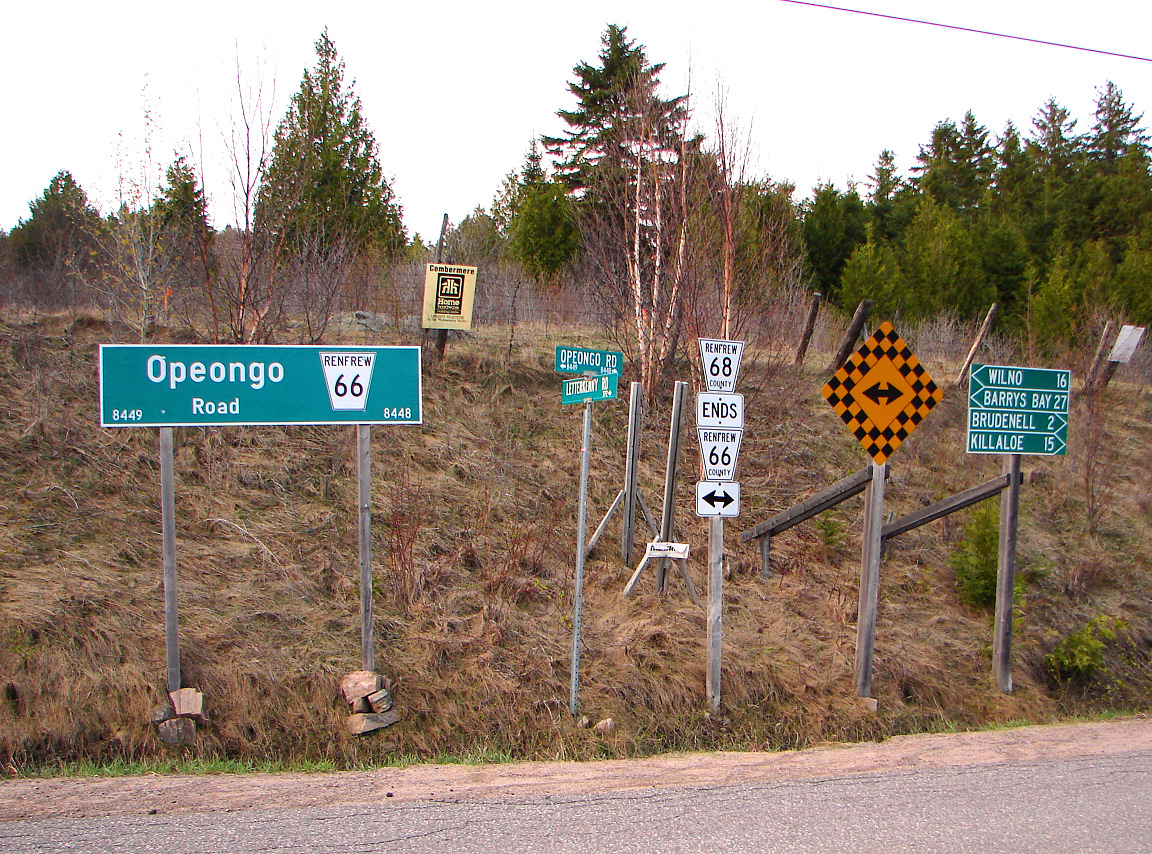
Road signs marking the Opeongo Road

The colonization roads were created during the 1840s and 1850s to open up or provide access to areas in Central and Eastern Ontario for settlement and agricultural development. The colonization roads were used by settlers to lead them toward areas for settlement, much like modern-day highways.

History

[edit]
A corduroy road in 1901, winding through a stripped forest in Brudenell Township, is representative of the appearance of colonization roads in central Ontario after logging razed the forests by the early 1900s.

The colonization roads of the 1840s and 1850s were preceded by other government-sponsored road programmes going back to the period immediately after the American Revolutionary War. One early road was cut through the geographic Beverley Township from Ancaster westward toward the Grand River by two Englishmen named Ward and Smith in 1799–1800.[1] This allowed European settlers to access the northern part of the Grand River Valley. During and after the War of 1812, government spending on roads in Upper Canada (present-day Ontario) increased significantly,[2] leading to the improvement and extension of a number of roads. Roads into the interior were still not plentiful, however.[3] By this time, a number of townships had been established along the northern shores of Lake Erie and Lake Ontario, which contained generally fertile land composed of glacial till and clay-rich loam; at this time, Upper Canada was "essentially one long, thin strip of settlement"[3] along these shores, according to historian Andrew Burghardt. As these townships filled up, development pressure increased toward the interior, but the colonial government struggled to maintain Upper Canada's principal roads and bridges.[4] The government pursued private toll roads, empowering corporations to borrow money to finance roadway improvements, which would then theoretically be paid for from toll income.[4] London, which during the 1820s and 1830s was one of the few major settlements in Upper Canada that was not situated on a lake or canal, relied heavily on road connections.[4] Numerous road companies suffered from financial problems; Burghardt notes that "[i]t is clear that before the advent of the railway it was difficult to supply adequate means of land transportation at a bearable cost."[5]

By this time, the focus of development had shifted toward Western Ontario, and new roads to the interior were laid out under the auspices of colonization companies. One of the most prominent of these was the Canada Company, which subdivided the Huron Tract into lots, and which was based inland at Guelph. It opened the western part of Upper Canada to settlement by building routes such as the Huron Road and the Toronto–Sydenham Road during the 1830s and 1840s.[6] As these areas also filled, the government came under pressure to open up the unforgiving terrain of the Canadian Shield to settlement and sought to establish a network of east–west and north–south roads between the Ottawa Valley and Georgian Bay. This area was known as the Ottawa–Huron Tract.[7]

In 1847, an exploration survey was carried out by Robert Bell to lay out the lines that would become the Opeongo, Hastings, and Addington Roads. The Public Lands Act, passed in 1853, permitted the granting of land to settlers who were at least 18. Those settlers who cleared at least 12 acres (4.9 ha) within four years, built a house within a year, and resided on the grant for at least five years would receive the title to that land. The government subsequently built over 1,600 kilometres (1,000 mi) of roads over the following 20 years to provide access to these grants.[8]

However, the promises of fertile land in this new northern tract of wilderness proved false. Beneath thin layers of sparsely spread soil was solid granite. Where this granite descended deeper, valleys formed and filled with muskeg. Despite an early influx of settlers, the vast majority of grants were abandoned by the turn of the century; only 40% remained. During the first half of the 1900s, many of these colonization roads were incorporated into the growing provincial highway network. Some sections were improved to modern highway standards, while others were subsequently bypassed or abandoned. The roads that were not incorporated as highways either became local roads or were consumed by nature.[9]

Though many other roads in the province can be considered "colonization roads", such as Yonge Street, Hurontario Street, Provincial Road (later Highway 2), Talbot Trail, and the Penetanguishene Road, they were either constructed for military purposes or by private investment.

In October 2016, the imagineNATIVE Film + Media Arts Festival premiered a documentary titled Colonization Road at the TIFF Bell Lightbox in Toronto. The documentary explores these roads within various treaty territories of Canada and the relationships which surround them. The film has toured throughout Canada, and in January 2017, the Firsthand program on CBC Television aired a broadcast version of Colonization Road.[10]

Description

[edit]

The terrain these roads pass through is interlaced with many hills, lakes, forests, swamps and bedrock outcroppings. The location of many of these roads is in the Canadian Shield, among the most rugged terrain in Ontario. The soil is generally thin and unsuitable for the agricultural development that these roads were built to spur.

Most of the colonization roads are not provincially maintained highways. Instead, they follow county roads and local town/township roads. A few have even been converted into hiking trails and bike trails.

List of colonization roads

[edit]

Below is a list of all the colonization roads.

Addington Road

[edit]
The Addington Road was surveyed as far north as the Opeongo Line in Brudenell
The Addington Road
LocationClareviewBrudenell
Length113 km (70 mi)
Formed1855–1865

The Addington Colonization Road was one of the initial routes surveyed in 1847. The contract to construct the road was awarded to A. B. Perry, who completed more than half of the length from the Clare River to the Opeongo Line by 1856.[11] In the south, it began in the village of Clareview and travelled north to the Opeongo Line, where the village of Brudenell was established. From north of Clareview to the community of Ferguson Corners (southwest of Denbigh), Highway 41 follows the old road, though in many places bypasses have been constructed and the old road named the Addington Road followed by a number from one to eight.[clarification needed] North of Ferguson Corners, the old road has been overtaken by the forest, though short spurs are evident west of Denbigh and north and south of Quadeville.

Bobcaygeon Road

[edit]
The Bobcaygeon Road near the old Peterson Road, west of Carnarvon
The Bobcaygeon Road
LocationBobcaygeonDorset
Length89 km (55 mi)
Formed1856–1863

The Bobcaygeon Colonization Road opened up the northern half of Peterborough and Victoria counties and much of Haliburton County. The road begins in the village of Bobcaygeon and travels north through Minden, ending north of the Peterson Road (Highway 118). The old road was surveyed as far north as the Oxtongue River but never continued beyond that. It now forms the boundary between Minden Hills and Algonquin Highlands and the boundary between Muskoka and Haliburton further north. The former Highway 649 and Highway 121 were eventually routed the majority of the southern half of this road. From Minden north to Highway 118, the road is a paved township road. Between Ox Narrows and Dorset, Highway 35 generally follows the original survey line.

Buckhorn Road

[edit]
The Buckhorn Road
LocationBuckhornGooderham
Length48 km (30 mi)
Formed1855–1865

The Buckhorn Road begins just north of Peterborough at Lakefield Road. From Peterborough to the town of Buckhorn, the Buckhorn Road is referred to as Peterborough County Road 23 and is still labelled as the Buckhorn Road at many intersections. North of Buckhorn, the road is listed as Peterborough County Road 36 until Flynn's Turn. From there, Peterborough County Road 507 is renamed the Buckhorn Road until it reaches the town of Gooderham. Slightly west of Gooderham, the old colonization road continues via Haliburton County Road 3, also known as Glamorgan Road, until it reaches Highway 118 just outside Haliburton.

Burleigh Road

[edit]
The Burleigh Road
LocationBurleigh Falls–The Peterson Road
Length32 km (20 mi)
Formed1850s

The old Burleigh Road began in Burleigh Falls and continued north along Ontario Highway 28. Along the way, Burleigh Street in the town of Apsley echoes the name of the colonization road. In Haliburton County, the route turned northwest at Kidd's Corners and followed Dyno Road (Haliburton County Road 48) past the Dyno Mine site. At the town of Cheddar, the road briefly jogged west following Highway 118 to the former community of Cope Falls.[12] The Burleigh Road then turned north, following present-day Loop Road (Haliburton County Road 648) to Wilberforce. Here, Burleigh Road still exists as Haliburton County Road 15, running roughly north on the eastern side of Clement Lake and the western side of Grace Lake until it meets the Kennaway Road. Part of this stretch is now a recreational trail.[13] The remainder of the northbound tract is an unpaved road running to Fourcorner Lake, where the intersection of the Burleigh and Peterson roads was located.[14]

Cameron Road

[edit]
The Cameron Road
LocationRosedaleMinden
Formed1850s

The Cameron Road ran north from Rosedale to Minden and is now the route of Highway 35.

Frontenac Road

[edit]
Frontenac Road near Mountain Grove
The Frontenac Road
LocationKingstonMatawatchan
Length66 km (41 mi)
Formed1852–1862

The Frontenac Road travelled north from Kingston to the Madawaska River at Matawatchan.

The road was first surveyed in 1852 and 1853 by Provincial Land Surveyor Thomas Fraser Gibbs. Warren Godfrey (for whom a town along the road is named) oversaw construction, completing the road as far north as the Mississippi Road at Plevna via Parham, Mountain Grove and Ardoch. This task was finished by 1862. An extension northwest to the Madawaska River at Matawatchan was completed by 1869.[15][16] However, much of this section has been lost to the forest.

Garafraxa Road

[edit]
The Garafraxa Road
LocationGuelphOwen Sound
Formed1837–1848

The Garafraxa Road was built to extend Brock Road north from Guelph to the new settlement of Sydenham, renamed Owen Sound in 1851, on Georgian Bay. An Order in Council was passed that called for the building of this road on April 13, 1837. Deputy Surveyor Charles Rankin was allowed to lay a line between Oakville and Sydenham. Rankin surveyed the line north of Arthur before the 1837 Upper Canada Rebellion broke out in Toronto. In 1839, John McDonald was hired to resurvey the line. He completed the survey between Guelph and Fergus that year, and to Arthur by October 1842.[17] Construction of the line between Arthur and Sydenham began at both ends in 1843.[18] The entire route was navigable by 1848. By 1861, the majority had been gravelled, and tollgates were briefly established between Fergus and Owen Sound. The entire route became part of Highway 6 in 1920.[17]

Great North Road

[edit]
The Great North Road
LocationParry SoundCommanda
Length97 km (60 mi)
Formed1867–1871

The Great North Road connected Parry Sound Road in Parry Sound with the Nipissing Road in Commanda. Today, Highway 124 largely follows the old road.[19]

Hastings Road

[edit]
The Hastings Road
LocationMadocWhitney
Length113 km (70 mi)
Formed1854–1858

The Hastings Road was surveyed and built to the northern boundary of Hastings county, north of the hamlet of Lake St. Peter. It was continued north into the district of Nipissing as the North Road, and at one time could be driven to an intersection with the current Highway 60 between Whitney and Madawaska. It previously intersected with the Snow, Monck and Peterson roads.[20]

Lavant Road

[edit]
The Lavant Road
LocationThe Snow Road – former Ontario Highway 511

Mississippi Road

[edit]
The Mississippi Road
LocationPlevnaBancroft
Length98 km (61 mi)
Formed1856–1866

The Mississippi Road began at a junction with the Frontenac Road and the Snow Road in the village of Plevna and travelled northwest, bisecting the Addington Road near Denbigh. It ended at the Hastings Road in Bancroft, where the Monck Road continued west. Today, Brule Lake Road and Buckshot Lake Road (Lennox and Addington County Road 30) follow a majority of the southwest portion of the road. Between Denbigh and Bancroft, Highway 28 travels adjacent to the old road, which has generally been overrun by trees.

Monck Road

[edit]
The Monck Road
LocationAtherleyBancroft
Length172 km (107 mi)
Formed1866–1873

The Monck Road was a dual-purpose road that established colonization and military routes east from Lake Couchiching to the junction of the Hastings and Mississippi colonization roads at what is now Bancroft. In the words of the Peterborough Review,[21] "The Monck Road is intended to traverse the entire back country from East to West, and to be adapted to military purposes." The Monck Road was surveyed through 1864 and 1865. Construction began the following year under Chief Engineer and was completed seven years later in 1873. It was named in honour of Charles Stanley Monck, who was Governor General of Canada at that time.[22][23] It is one of the oldest provincial roads north of Toronto.

The Monck Road starts at Atherley and runs beside Simcoe County Road 44 (Rama Road) and Simcoe County Road 45 (Monck Road) into the City of Kawartha Lakes. It crosses Highway 35 at Norland and carries on to Kinmount, where it turns right and crosses over the Burnt River. The Monck Road then turns left up the hill and continues along Haliburton County Road 503, which runs via Furnace Falls to Tory Hill and then along Highway 118 and Highway 28 until Bancroft. From Lake Couchiching, it extends 150 kilometres east to the Hastings Road at Bancroft.

Present-day road names have been preserved along the route in Orillia, Norland, Kinmount, Cardiff and Bancroft.

Muskoka Road

[edit]
The Muskoka Road
LocationLake CouchichingSundridge
Length203 km (126 mi)
Formed1858–1875

The Muskoka Road, most of which now forms Highway 11, was constructed in the late 1850s and early 1860s, quickly becoming the primary trunk road to Lake Nipissing. A series of towns eventually would flourish along its length, the first of which was Bracebridge. East of Muskoka Falls, Thomas J. McMurray established a 400-acre (1,600,000 m2) townsite in the spring of 1861 at the intersection of the Muskoka Road and the Peterson Road.[24]

Construction on the Muskoka Road began in 1858. At the time of Bracebridge's founding, the road did not extend beyond the Muskoka River.[24] It was opened as far as Sundridge by 1875. Today Highway 11 follows a majority of the route but bypasses it in several locations, notably between Bracebridge and Huntsville.

Old Dawson Trail

[edit]
Old Dawson Trail
Length530 mi[25] (850 km)
Existed1871; 154 years ago (1871)–present

The Old Dawson Trail is the remnant of the first all-Canadian route that linked the Great Lakes with the Canadian prairies. It was a water and land route that began at Port Arthur, Ontario (now Thunder Bay) and ended at St. Boniface, Manitoba (now Winnipeg). The land portions of the trail are usually referred to as Dawson Road.

Route

[edit]

The Dawson Trail started as a road heading northwest from Port Arthur along the Shebandowan River, up to Shebandowan Lake. From there, the trail followed a series of lakes and rivers heading west, eventually ending up at the Rainy River and Lake of the Woods along the International Boundary. After crossing Lake of the Woods, the road continued for approximately 10 miles (16 kilometres) through the U.S. at Northwest Angle, overland back into Canada to Richer, Manitoba and then to its end at St. Boniface. The total distance of the trail was approximately 530 miles (850 kilometres). Travelers were required to load and unload their freight as many as 70 times throughout the journey.[25][26] Segments of the Old Dawson Trail are still in use today in both provinces. Ontario Highways 102 and 11 follow Dawson Road from Thunder Bay to Shebandowan. From there, Highway 11 generally follows the original water route west to Rainy River. In Manitoba, Dawson Road formed the original course of Manitoba Highway 12 from St. Boniface to Ste. Anne. This route is now part of Provincial Road 207 between the communities of Richer and Lorette. The abandoned road between Northwest Angle and Richer has mostly fallen into disrepair, except for segments that are now part of Provincial Roads 503 and 505, accessible via the Trans-Canada Highway from the north and Provincial Road 308 from the east. Segments of Dawson Road in and around Winnipeg remain in use, but are disconnected by the Red River Floodway, the Perimeter Highway, and Lagimodiere Boulevard.

MOM's Way is a network of highways that serve as a modern day successor to Dawson Road between Winnipeg and Thunder Bay. Highways 102 and 11 in Ontario and Highway 12 south of Ste. Anne in Manitoba are part of this network. A cairn and plaque commemorating the Dawson Road was erected by the Historic Sites and Monuments Board of Canada in 1933. The landmark is located next to the local municipal office in Ste. Anne, Manitoba.[25]

History

[edit]

In 1857, the Government of Canada commissioned engineer Simon J. Dawson to survey a route from Lake Superior to the Red River Colony, thereby allowing travel from the east without having to take the existing routes through the United States. Dawson surveyed the route in 1858 and construction began in 1868. The entire trail, including the roads, was completed in 1871 and afterwards named after Dawson.[27][25]

The Wolseley Expedition used the trail before the route was completed to reach the Red River Colony and quell the Red River Rebellion of 1870. This rebellion led to the establishment of the Province of Manitoba later that year. In 1873, the Dawson route was used by some 1,600 people, however, most travelers still preferred to use the much less arduous southern route through Duluth and Emerson. Much of the Dawson Trail was abandoned after the completion of the railroad between Fort William and Winnipeg in the 1880s, although local residents continued to make use of the roads.[28]

[edit]

Ottawa and Opeongo Road

[edit]
Old farm along the Opeongo Line
The Ottawa and Opeongo Road
LocationOpeongo LakeRenfrew
Length106 km (66 mi)
Formed1854–1865

The Ottawa and Opeongo Road, also known as the Opeongo Line, was one of the initial colonization roads surveyed by Hamlet Burritt and A. H. Sims under the supervision of Robert Bell in 1851–52. It was constructed westward from Renfrew beginning in 1854, reaching as far as the Hastings Road in Whitney by 1865; thereafter the survey line continued to Opeongo Lake.[29] Today, Highway 60 follows the old road between Algonquin Park and east of Barry's Bay. At that point, the road branches out to the southeast, following portions of Renfrew County Road 66, 512 and 64. Approximately 5 kilometres (3.1 mi) west of Dacre, it encounters Highway 41. From there to Renfrew, Highway 132 follows the old road.[30] Several songs have been written about the Opeongo Line, one of the most recent by Canadian singer-songwriter Terry McLeish. His song, "The Opeongo Line", has been included in several musicals and a tourist CD production of this historic road.

The now-abandoned settlement of Newfoundout was created as a result of the Opeongo Road and Public Land Act. Thirteen pioneer families took up occupation on the land they had been granted up a mountainside 6 kilometres (3.7 mi) off the main road. These families struggled to farm the rocky soil for thirty years, from the 1860s to the 1890s, while their settlement failed to attract institutions or other settlers. It was officially declared abandoned by 1948. More recently, the ruined log cabins have occasionally attracted photographers due to their high level of preservation.[31]

Parry Sound Road

[edit]
The Parry Sound Road
LocationNorth of BracebridgeParry Sound
Length72 km (45 mi)
Formed1862—1867

The Parry Sound Road ran between Bracebridge and Parry Sound. The communities of Rosseau and Horseshoe Lake were developed along the route.

The road began 15 km north of Bracebridge on the Muskoka Road and proceeded in a northerly and later northwesterly direction.[32]

The route follows present-day Muskoka District Road 4 (Manitoba Street, Raymond Road), Muskoka District Road 35, Highway 141, and Highway 400/Highway 69.

A portion of the old tract exists as Old Parry Sound Road east of Ullswater, Ontario.

Pembroke and Mattawan Road

[edit]
The Pembroke and Mattawan Road
LocationPembrokeMattawa
Length158 km (98 mi)
Formed1856–1866

The Pembroke and Mattawan Road was proposed by the Minister of Agriculture Allan McNab in 1852. A survey was conducted in 1853 and construction began in 1854. By 1875, the road was officially open in the summer months. The original road went through what is now Canadian Forces Base Petawawa and the Atomic Energy lands north of the town of Chalk River. It followed what is now the Balmer Bay road east of the town of Deep River. West of Deep River, the old road winds back and forth across Highway 17, which was built in the 1930s.[33]

Peterson Road

[edit]
The Peterson Road
LocationBracebridgeBarry's Bay
Length164 km (102 mi)
Formed1858–1863

The Peterson Road began at Muskoka Falls near Bracebridge[34] and travelled east to Maynooth, where it met the Hastings Road. From Maynooth, it snaked its way northeast to Barry's Bay to meet the Opeongo Line. It was surveyed by Joseph Peterson and built between 1858 and 1863 at a cost of around $39,000. Poor soil led to little settlement in the area and some sections were already overgrown by the 1870s, but the Maynooth-Combermere section proved to be a useful logging route.

Today, the section from Bracebridge to Maynooth has mostly been consumed by the forest, though Highway 118 follows adjacent to the old road as far as Haliburton.[35] Two small sections remain as local township roads near Carnarvon named Peterson Road and Tulip Road. The old road that runs from Haliburton to the north end of Benoir Lake, on the Elephant Lake Road is now untraceable. This part runs through the south end of Algonquin Park.

The section from Maynooth to Combermere to Barry's Bay is now the route of Highway 62.[36]

Rosseau-Nipissing Road

[edit]
The Nipissing Road
LocationRosseauNipissing
Length111 km (69 mi)
Formed1864–1875

The Rosseau-Nipissing Road, also called the Nipissing Road, encouraged settlement in what is now Parry Sound. The project was authorized in 1864, with surveying done from 1864 to 1865. Construction began in 1866, and the road was open by 1873. The Northern and Pacific Junction Railway built between Gravenhurst and Callander rendered the Rosseau-Nipissing road obsolete by 1886, yet much of it is still often used.[37][38]

Snow Road

[edit]
Township Road 506 in Plevna, the junction of the Mississippi, Frontenac and Snow Roads
The Snow Road
LocationMaberlyPlevna

The Snow Road is a short, minor branch of the colonization road network that connected the northern end of the agricultural settlement in Maberly with the southeastern end of the Mississippi Road in Plevna. The Lavant Road branches off to the east at the midpoint of the road. Today, County Road 36 follows the Snow Road through Lanark County, while part of Highway 7 follows the portion lying within Frontenac County.

Victoria Road

[edit]
North of the Head River, Kawartha Lakes 35 enters the Canadian Shield
The Victoria Road
LocationGlenarmVankoughnet

The Victoria Road continued north of its current terminus in Uphill into what is now the Queen Elizabeth II Wildlands Provincial Park. It then followed the Black River north-east to the Peterson Road in Vankoughnet; this part of the road fell into disuse in the late 1800s. Between 1956 and 1998, the portion of The Victoria Road between Highway 46 (Highway 48 after 1975) and Highway 503 was designated as Secondary Highway 505. On January 1, 1998, the entire road south of Uphill was designated as Victoria County Road 35. Victoria County was restructured as the city of Kawartha Lakes on January 1, 2001. At the same time, the Victoria Road was renamed as Kawartha Lakes Road 35.

See also

[edit]

References

[edit]
[edit]
Revisions and contributorsEdit on WikipediaRead on Wikipedia
from Grokipedia
The colonization roads were a network of rudimentary highways constructed mainly during the 1840s and 1850s by the government of the to provide access to undeveloped interior regions of central and for timber harvesting and free-grant land settlement. These roads followed surveyed lines offering 100-acre lots to settlers who cleared land and erected basic structures, with the primary aims of populating remote areas, exploiting vast pine forests for export, and redirecting surplus population from densely settled southern counties amid post-war immigration pressures. Built hastily using local labor and minimal engineering—often mere axe-cleared paths through bush—they connected established towns like Perth and to hinterlands, facilitating the influx of Irish, German, and other European immigrants but suffering from chronic flooding, washouts, and inadequate upkeep that hindered long-term viability. Prominent routes included the Opeongo Road from to Bark Lake, the Road from Rice Lake to Bancroft, and the Bobcaygeon Road northward from , which collectively spurred localized farming and economies yet saw high abandonment rates due to rocky soils, isolation, and economic shifts toward railways by the 1870s. Over time, segments evolved into provincial highways such as parts of Highway 7 and 60, preserving their legacy as foundational infrastructure for 's expansion despite limited success in achieving widespread agricultural .

Historical Background

Government Initiatives and Policy Drivers

Lands Department spearheaded surveys for roads beginning in , targeting unsettled regions such as the -Huron Tract to enable land access and settlement. These initial efforts, exemplified by the survey of the and Opeongo Road conducted by Provincial Land Surveyor Bell and assistant Hamlet Burritt from to 1852, emphasized practical routes through forested areas rather than elaborate infrastructure. Policy emphasized cost containment by favoring rudimentary bush roads—cleared paths dependent on settlers' statute labor (typically 1-3 days annually per adult male)—over fully engineered and maintained highways, thereby leveraging local effort to offset provincial expenditures. The Public Lands Act of 1853 institutionalized this approach, creating a dedicated Fund of $30,000 to finance construction of access roads into free-grant territories, administered exclusively by until municipal handover provisions in 1913. Commissioners within the department, including Andrew Russell—who assumed oversight of surveys and settlement duties by —allocated these funds strategically, prioritizing viable lines like the Opeongo extension while directing settler labor for clearing and upkeep to advance without undue reliance on direct outlays. Under this framework, agents oversaw the opening of 481 miles (775 km) of roads between 1853 and 1860, a measured expansion addressing the economic inefficiency of vast underused lands through targeted infrastructural intervention.

Key Periods of Development (1850s–1890s)

In the , the West prioritized colonization roads in the Ottawa-Huron Tract to mitigate from the ongoing and to open lands for resettlement, often through low-cost prototypes that leveraged local labor. The Opeongo Road, surveyed in 1852 by Provincial Land Surveyor Robert Bell, saw 100 miles completed by January 1854 as a rudimentary winter route from Farrell's Landing on the to Opeongo Lake, serving as an early model despite fiscal limitations and negotiations with settlers for construction contributions. Similarly, the Hastings Road commenced in 1854, targeting the southern to facilitate penetration into rocky terrains, though initial efforts revealed challenges like poor soil quality that limited agricultural success. These initiatives reflected adaptive policymaking, with road building tied to democratic local inputs amid economic pressures. The 1860s and 1870s marked expansions into Muskoka and northern regions post-Confederation in 1867, driven by surging lumber demands that overshadowed faltering farming prospects. The Muskoka colonization road began construction in 1860 from , reaching the north branch of the Muskoka River falls by 1862 and extending to Huntsville by 1871, thereby enabling timber hauling and sporadic settlement. Road development continued northward, with settlers arriving as early as , though the route's extension highlighted government persistence in providing access despite known hardships like abandoned farms. This phase adapted to resource realities, as petitions for road repairs—such as those in 1870 for the Peterson Road—underscored ongoing state investment in infrastructure to support booms over pure . By the and , focus shifted to northern extensions like those branching to Parry Sound, even as expanding railways posed competition for bulk transport, with roads maintaining utility for remote, feeder access in undeveloped areas. The Parry Sound colonization road, completed as an extension of the Muskoka route by 1866 but with subsequent branches, exemplified this durability, as governments repaired and extended networks to sustain flows where rails lagged. Overall, these decades showed policy evolution: initial settlement failures prompted pivots to economic extraction, with road building persisting through local and state grants until the early , when rail dominance began eclipsing but not erasing their role.

Purpose and Economic Rationale

Land Settlement and Resource Utilization

The Ontario colonization roads targeted extensive Crown lands, including the Ottawa-Huron Tract, which government officials regarded as economically underproductive despite ongoing indigenous practices such as hunting and trapping that maintained low population densities and limited sustained yields from the land. These areas, characterized by dense forests and rocky terrain, were prioritized for transformation into settled agricultural zones to enhance overall provincial productivity and create taxable property bases through permanent farming communities. The policy rationale rested on the observable efficiency of European-style intensive agriculture, which, by clearing land for crops and pasture, could generate higher caloric output per acre and support denser settlements compared to nomadic or seasonal resource uses. Access provided by the roads directly enabled settlers to undertake bush clearing and preparation, converting previously inaccessible into viable farmlands. Settlers received free grants of 100 to 200 acres along these routes conditional on performing settlement duties like and , which accelerated the shift from forested tracts to cultivated fields. This investment facilitated utilization by linking remote lots to markets, thereby incentivizing in improvements that increased land values and agricultural returns. By the 1880s, regions opened via efforts saw expanded farm operations, contributing to broader trends in where production roughly tripled from mid-century levels amid rising settlement. The emphasis on land settlement underscored a causal strategy to monetize natural resources through deployment, with roads serving as the critical conduit for labor and materials needed to establish productive homesteads. While initial yields were modest due to exhaustion and market distances, long-term utilization patterns demonstrated the viability of converting "waste" lands into assets yielding grains, , and timber revenues, thereby bolstering provincial finances via property taxes and export commodities. Empirical outcomes validated the approach, as settled counties exhibited sustained and diversified economic activity beyond subsistence hunting.

Incentives for Immigration and Labor

To attract settlers to undeveloped regions, the West (later ) offered free grants of 50-acre lots along colonization roads, conditional on fulfilling settlement duties such as cultivating at least 12 acres and erecting a habitable house within four years; these duties often included statute labor on road maintenance, providing laborers with a pathway to land ownership through physical contribution rather than cash purchase. Initial road crews received wages or bounties funded by the 1853 Colonization Fund, enabling immigrant workers to gain skills in clearing and while accessing nearby free grants upon completion. This system absorbed waves of Irish famine refugees arriving in the late , channeling their labor into like road building to mitigate urban and build self-sufficiency; Irish migrants, alongside English, French-Canadian, Polish, and Prussian workers, formed the core labor force, with settlement grants serving as a pragmatic alternative to by tying employment to productive development. Over time, completed roads reduced overland transport costs from remote timber stands to markets, incentivizing private capital in sawmills and related enterprises that further employed and reinforced labor demand without ongoing subsidies.

Construction Practices and Challenges

Engineering Techniques and Materials

The construction of Ontario's roads relied on rudimentary 19th-century techniques adapted to dense forests and limited resources, emphasizing manual clearing and minimal earthworks. Trees were felled and underbrush removed using axes to chop a standard width of 66 feet, allowing passage for horse-drawn wagons while preserving surveyed allowances for future expansion. Stumps were often left in place initially to expedite progress, with gradual removal as settlers maintained routes, reflecting the era's prioritization of speed over smoothness. Where terrain permitted, roads were graded by scraping with basic implements like shovels and adzes for shaping, forming a dirt surface prone to rutting but sufficient for seasonal . Drainage was incorporated via shallow side ditches dug parallel to the roadway, though these were frequently inadequate in clay-heavy soils or neglected due to maintenance shortfalls, leading to persistent mud holes. In swampy sections, construction prevailed, involving transverse logs laid side-by-side without notching to distribute weight and prevent sinking—a technique borrowed from Indigenous and early settler practices, as seen in routes like the Buckhorn Road where original log beds endured into the . Materials were sourced exclusively locally to minimize costs, with no importation of gravel or macadam until later upgrades. Bridges and causeways employed felled timber, often cedar logs for their rot resistance, laid in simple cross-plank or piled configurations spanning streams up to several feet wide; these structures, like those on the Opeongo Road, required frequent replacement due to uneven spans and exposure but demonstrated durability when using abundant regional hardwoods. Initial narrow traveled portions—effectively 12 to 16 feet between ditches—suited single-file wagon traffic, with selective widening to full 66 feet occurring post-1870s as traffic increased and statute labor improved alignments. This approach ensured many segments' longevity, with original grades still forming rural concessions today owing to stable forest-derived substrates and adaptive settler repairs. ![Colonization road in 1901, colourised][float-right]

Labor Sources and Logistical Hurdles

The of Ontario's colonization roads relied on a workforce comprising local laborers, recent immigrants, and incentivized through land grants and wages. Contractors often employed teams of axemen, teamsters, and general laborers, supplemented by statute labor requiring adult males to contribute days of work annually. Immigrants from , including Catholics, formed a significant portion of the settler-labor pool in areas like the Ottawa-Huron Tract, drawn by promises of free land after initial road-building obligations; English Protestants, French-Canadians, Poles, and Prussians also participated, though many had prior experience in West. Family units were common, with claiming adjacent lots to consolidate holdings—evident in Brudenell Township along the Opeongo Road, where 126 farm families resided by 1871, supporting sustained clearing and maintenance efforts over individual transient labor. Logistical challenges compounded the reliance on voluntary commitment, as supply lines depended on rudimentary waterways and nascent trails prone to holes and washouts, delaying material delivery for bridges and grading. Winter conditions necessitated annual halts in major , with roads becoming impassable by early spring—as noted in 1852 surveys of the Opeongo Road—limiting work to frost-hardened ground and forcing stockpiling of tools and provisions beforehand. High attrition rates among workers and initial settlers underscored the harsh vetting process, with many abandoning free-grant lots due to poor , isolation, and inadequate yields, leaving gaps in road upkeep and weeding out those unfit for long-term perseverance. For instance, along the Opeongo Road in Brudenell by 1863, only 106 of 158 surveyed lots were occupied, reflecting roughly one-third failure in early establishment phases akin to first-winter trials. This desertion dynamic, driven by voluntary incentives rather than , ensured that persisting families demonstrated resilience essential for viable occupancy, as transient labor proved unreliable for enduring .

Catalog of Roads

Addington Road

The Addington Road was a in designed to facilitate access to timber resources and promote settlement in the hinterlands of . Extending approximately 117 kilometers (73 miles) northward from the Clare River in to the Peterson Road (also known as the Opeongo Line) in Brudenell , it connected southern agricultural areas to the more remote northern tracts. Surveyed initially in 1847 under the direction of provincial authorities, with construction contracted to surveyor , the road traversed challenging terrain from near Kaladar northward through Addington County. Its primary economic aim was to exploit timber stands, as evidenced by the harvest of 23,000 white pine and 2,000 red pine logs in the vicinity during 1860 alone. However, settlement along the route proved limited due to the predominance of rocky, stony soils unsuitable for sustained , leading many early pioneers to abandon their lots despite initial incentives. Today, large segments of the Addington Road lie abandoned or have reverted to rudimentary paths, with overgrown or faded sections reflecting the road's obsolescence for modern travel. Remaining accessible portions are utilized as recreational trails, including for off-road vehicles like ATVs in designated areas, though some trails have been gated to restrict motorized access and protect private landholdings.

Bobcaygeon Road

The Bobcaygeon Road, initiated as a road in 1856, extended northward from Bobcaygeon to promote settlement in the inland districts of what is now the area, facilitating access to lands suitable for and . Construction officially commenced on October 16, 1856, with an initial section considered operational by that year, aiming to connect settled townships to the Canadian Shield's edge. By 1857, the road had advanced to Kinmount, approximately 20 kilometers north, enabling early settler ingress into and Victoria counties' northern halves. Further development in the late 1850s pushed the route to Minden by 1858, spanning roughly 40 miles overall from Bobcaygeon, with the path supporting timber extraction southward via adjacent waterways and rudimentary agricultural clearings. This extension into Haliburton County targeted resource utilization, where logging predominated due to the terrain's limitations for intensive farming, though southern segments saw moderate establishment of sawmills by 1863. Reports from Crown Lands agents noted fair settlement density along these initial stretches, underscoring the road's role in Peterborough County's northward expansion without achieving widespread agricultural transformation. In contemporary times, remnants of the Bobcaygeon Road persist as local thoroughfares, such as segments near Highway 118, preserving traces of its original alignment amid evolved patterns favoring over . The infrastructure's legacy reflects partial success in initial goals, with enduring challenges from rugged limiting long-term farming viability beyond adjuncts.

Buckhorn Road

The Buckhorn Road, established as one of Ontario's colonization roads in the 1860s, extended northward from the vicinity of through the town of Buckhorn into the provisional County of Haliburton, facilitating access to Crown lands for timber harvesting and potential agricultural settlement in townships such as Harvey, Galway, and . Surveyed in 1863 with construction beginning in 1865, the route primarily followed portage paths between the interconnected , reflecting the region's heavy reliance on water-based navigation for and operations, which diminished the road's necessity and utility for overland travel. The road measured approximately 30 miles from Buckhorn northward to its limits near the Drag River, though full completion to Haliburton Village occurred only by 1874 amid persistent engineering difficulties posed by rocky Shield terrain. Settlement along the Buckhorn Road was sparse due to thin, infertile soils unsuitable for large-scale farming, leading to its underutilization compared to other colonization routes; early homesteaders focused on and supplemental lumbering, with the original corduroy construction—logs laid over —remaining largely intact beneath modern surfacing in remote sections. The road's development opened Harvey Township for limited European and settlement, as evidenced by 1870s assessment rolls showing modest tied to proximity to the route, but competition from steamer services on adjacent lakes like Pigeon and Stony further constrained its role in economic expansion. Today, segments of the Buckhorn Road persist as County Roads 36 and 507, primarily serving recreational purposes such as cottage access, , and snowmobiling trails, with improved passability supporting rather than commercial or . Historical markers and remnants of early underscore its legacy as a least-traveled colonization artery, where environmental constraints overrode initial government incentives for inland development.

Burleigh Road

The Burleigh Road originated at Burleigh Falls on the Trent-Severn Waterway, providing a northward link from settled areas near to the undeveloped Ottawa-Huron Tract in , with the intent of promoting land access and during the 1860s. Surveyed in 1860 by James W. Fitzgerald from Burleigh Rapids to the northern boundary of Burleigh Township, the route spanned approximately 23 miles by the end of 1862. Construction faced significant hurdles from the outset, including slow progress through difficult terrain characterized by irregular, tortuous paths and initial sections that were desolate, timber-denuded, and marked by poor soil quality over bare rock unsuitable for sustained agriculture. A 1866 report by a colonization roads official highlighted these issues, noting the road's "irregular tortuous and injudicious location," which impeded efficient development despite ongoing efforts. Settlement along the road yielded limited results, with Burleigh Township recording just 46 residents by , as the rocky, low-fertility lands rendered farming largely unviable and shifted economic reliance to timber extraction, particularly white pine harvesting in camps. This pattern underscored the road's role in resource access over agricultural expansion, aligning with broader challenges in the Precambrian Shield region's efforts.

Cameron Road

The Cameron Road was constructed in the 1850s as a colonization road in Victoria County, , to supplement the longer Victoria Road by providing targeted access to northern townships for agricultural settlement. Unlike broader resource-extraction routes, it emphasized farming by linking established southern areas like to undeveloped lands northward, enabling settlers to clear timber and establish homesteads in townships such as Bexley and Somerville. The route passed through Rosedale, the hamlet of Cameron, Coboconk, and Norland, facilitating the influx of immigrants seeking arable plots amid the region's lakes and forests. Spanning key segments within Victoria County—approximately 20 miles from the vicinity of Cameron village northward to the county's limits—the road addressed gaps in the primary colonization network, promoting denser farmsteads along its path. It supported as an initial step for clearance but prioritized long-term cultivation, with drawing on grants to develop mixed farms growing crops like oats, potatoes, and hay suited to the thin soils. By the late , portions aligned with emerging highways, evolving into modern Highway 35 north of , though maintenance challenges from swamps and rocky terrain persisted into the early 20th century.

Frontenac Road

The Frontenac Road, surveyed in 1852–53 by Provincial Land Surveyor Fraser Gibbs, extended northward from Sydenham in southern as an early pioneer route through the Ottawa-Huron Tract. Constructed primarily as a summer road by contractor Warren Godfrey, it spanned approximately 41 miles by 1855, traversing Olden and Clarendon townships to intersect the Mississippi Road. This route facilitated initial access to crown lands, enabling lumbering operations and limited settlement amid rugged terrain dominated by Precambrian Shield rock. Contractors and early settlers contributed to road improvements while clearing adjacent lots for farming, though persistent challenges including rocky soils and isolation led to widespread abandonment of pioneer homesteads along the corridor. Despite high settler attrition, the Frontenac Road opened pathways for resource extraction, including granite quarrying in the Frontenac Arch region, where durable stone from local outcrops supported regional development into the late . The road's legacy persists in communities like Godfrey and Mountain Grove, marking a foundational yet arduous extension into northern .

Garafraxa Road

The Garafraxa Road, one of Ontario's early colonization roads, was surveyed in 1837 by Charles Rankin to connect settled areas in County with the undeveloped Queen's Bush region extending northward toward . Construction began in 1841, delayed initially by logistical challenges and the aftermath of the 1837-1838 , which disrupted surveying efforts in Garafraxa Township. The road followed a southwestern route originating near and Orangeville, traversing approximately 50 miles of challenging terrain including highlands and forests to promote agricultural settlement in and Grey Counties. Unlike many colonization roads that faced abandonment due to poor soil or isolation, the Garafraxa Road achieved notable success in the 1840s and 1850s by enabling access to fertile lands, drawing immigrants primarily from Britain and to establish farms along its length. By the mid-1850s, settlements had proliferated in adjacent townships, supported by the road's role in linking to emerging ports on for timber export and supply transport. This facilitated economic viability in the region, contrasting with less productive eastern colonization efforts. Today, substantial portions of the original Garafraxa Road alignment form segments of , particularly through Dufferin and Grey Counties, where it continues as a vital conduit for local traffic and despite modern paving and widening.

Great North Road

The Great North Road, constructed during the 1860s, formed part of Ontario's colonization initiatives to facilitate settlement in the expansive and underdeveloped . Originating at Sault Ste. Marie, the road extended eastward into the interior, with initial efforts focusing on clearing and grading a rudimentary path through dense forest and rugged terrain. By , approximately 20 miles had been graded and bridged to Rydal Bank, marking the primary completed segment amid broader plans for connectivity to areas like Goulais Bay further east and potentially westward toward Spanish River. This northern push encountered severe logistical challenges, including the isolation of Algoma's Precambrian Shield landscape, which featured thin soils unsuitable for large-scale , prolonged winters, and limited access to markets or supply lines. Settlement incentives under free grant policies failed to draw sufficient pioneers, as the remoteness amplified risks of crop failure, disease, and abandonment, resulting in sparse habitation along the route. Only partial infrastructure persisted, with the unfinished portions reverting to bush trails, underscoring the venture's ultimate collapse despite government surveys and appropriations.

Hastings Road

The Hastings Road formed a key northward extension of Ontario's colonization road system into during the 1850s and 1860s, primarily to provide operators with overland access to central Ontario's forested interior. Construction commenced in 1854 under provincial directives aimed at penetrating the Canadian Shield's timber stands, with completion of the initial surveyed route occurring between 1856 and 1858 despite challenging terrain and rudimentary engineering. interests, facing logistical constraints in harvesting and reserves, lobbied aggressively for such routes to bypass waterways and enable direct extraction from 's upland tracts. Spanning roughly 100 miles northward from the vicinity of Bancroft, the road traversed dense bush and rocky outcrops, linking southern settlements like to remote northern townships such as Herschel and Wicklow. This alignment prioritized timber hauling over immediate agricultural viability, as the thin soils and isolation deterred widespread farming; instead, it served as a supply corridor for camps until rail alternatives emerged in the 1870s. The route's design—often no wider than a path with sections over wetlands—reflected cost-driven priorities, allocating lots along the corridor to incentivize maintenance by grantees. Beyond , the road established enduring connections to iron prospects in northern , where ore deposits along its path supported exploratory ventures from the 1860s onward, including access to sites near Coe Hill. Segments persist today as the Old Hastings Road, repurposed for recreational use like ATV trails, preserving traces of its original grading amid reforestation and abandonment of failed settler hamlets. These remnants underscore the road's partial success in resource extraction over sustained colonization, with gravel-surfaced portions integrated into local networks but much of the northern extension reverting to footpaths.

Lavant Road

Lavant Road was established in the 1850s as part of Ontario's colonization road initiatives to facilitate settlement in the Ottawa-Huron Tract, functioning as a short eastern branch primarily serving Lavant Township in . This route connected to the Opeongo Road network, providing access to inland areas designated for agricultural development amid the government's efforts to populate remote lands with immigrant farmers. The road targeted farming-focused settlement, but Lavant Township's swampy and rocky terrain hindered rapid progress, with the area recording just 40 residents as late as despite earlier surveying in 1822 and initial openings around 1823. Unlike major colonization arteries, Lavant Road remained low-profile, emphasizing local access for rather than extensive timber extraction or transit corridors. By 1866, the Perth Courier praised it as "an evidence of progress in the right direction," reflecting incremental improvements in connectivity for sparse rural communities. Its modest scale—serving a slow to populate due to environmental challenges—exemplified the uneven success of 19th-century settlement schemes in marginal lands.

Mississippi Road

The Mississippi Road, a key component of Ontario's mid-19th-century colonization infrastructure, was surveyed in 1857 by Provincial Land Surveyor John Allan Snow to promote settlement in the forested Ottawa-Huron Tract. spanned from 1857 to 1859, after which the route was redesignated the Snow Road in recognition of its surveyor, enabling settlers to access crown lands previously isolated by dense bush and swamps. The road originated at Balfour's Bridge spanning the in eastern , extending northward roughly 60 miles through challenging terrain toward intersections with the Hastings and Monck Roads near Bancroft, thereby linking southern settlements to northern frontiers. Its proximity to the supported early economic development by improving overland transport to water-powered mills, which processed local timber and grain for export, though initial builds featured rudimentary sections prone to flooding and decay. By 1865, provincial reports documented 25 unfinished causeways along 37 miles of related segments, underscoring ongoing maintenance demands as settlers petitioned for repairs to sustain access to markets and reduce isolation during harsh winters. Despite these hurdles, the road catalyzed modest in townships like Anglesea and , where it directed Irish and Scottish immigrants to 100-acre lots under free grant policies, though abandonment rates remained high due to poor soil and remoteness. In later decades, the alignment influenced railway development, including the 1883 Kingston and Pembroke line's Snow Road station near the crossing, further integrating the area into broader trade networks. Contemporary remnants, such as Lanark County's Road 36, trace this path, preserving evidence of slash-and-burn clearing techniques used during original construction.

Monck Road

Monck Road was surveyed in 1864–1865 and constructed between 1866 and 1873 as a dual-purpose route in , intended to provide a secure alternative to vulnerable waterways while opening northern wilderness for civilian settlement. Unlike standard colonization roads, it incorporated wider alignments and reinforced bridges to support heavier loads, including potential artillery transport, reflecting strategic priorities amid post-Confederation concerns over regional defense. The project cost the provincial government $48,000 and spanned roughly 100 miles overall, traversing challenging terrain from near northward through districts including Victoria County. In Victoria County, Monck Road extended access into townships such as Somerville, Dalton, and adjacent areas toward Fenelon Township, targeting sparsely settled lands for agricultural and lumber development. This segment promoted moderate , attracting limited numbers of settlers—primarily farmers and loggers—who cleared land amid rocky soils and dense forests, though remained gradual due to isolation and marginal farming viability. Historical accounts note it as one of four key roads (alongside Cameron, Bobcaygeon, and Portage) engineered to integrate the county's northern frontiers with southern markets, yet settlement density lagged behind more fertile routes. By the late , the road's military rationale diminished, shifting focus to economic linkages, but ongoing maintenance challenges and competition from railways curtailed its prominence. Today, the Victoria County portion endures as fragmented rural roadways, including County Road 45, supporting sparse agricultural operations and recreational use rather than intensive development.

Muskoka Road

The Muskoka Road originated as a route under Ontario's 1850s-1860s program to develop northern districts through free land grants of 100 acres to settlers who cleared and cultivated at least and erected a dwelling within five years. Construction commenced in 1858 at in Morrison Township, advancing northward through dense bushland to promote agricultural settlement and resource access. By 1861, the road arrived at the Bracebridge site, coinciding with the surveying of adjacent townships including Morrison, Muskoka, Draper, and Macaulay for . From Bracebridge, the road extended roughly 50 miles northward in the 1860s, linking to the Parry Sound Road at its intersection with the Magnetawan River and thereby opening pathways to the Muskoka Lakes and shoreline. This northern segment traversed hilly terrain, enabling settlers to penetrate lake-adjacent concessions for timber harvesting, small farms, and portage routes that supplemented overland travel with water navigation. Unlike more arduous colonization roads in remote areas, the Muskoka Road's proximity to navigable lakes facilitated log transport and supply chains, reducing isolation for early homesteaders. Post-1870s completion of extensions, such as the 1875 link to southern Parry Sound corridors, the road underpinned robust settlement growth in Muskoka, with townships achieving higher occupancy rates than many or counterparts due to lake-accessible soils suited for and . It presaged recreational development by exposing the district's scenic waterways to influxes of Irish and Scottish immigrants, whose clearings laid groundwork for later seasonal visitors, though primary economic drivers remained lumber mills and into the late .

Old Dawson Trail

The Old Dawson Trail, originally known as the Dawson Route, was surveyed in 1857–1858 by civil engineer Simon James Dawson under contract to the Canadian government to establish an overland and water connection from Lake Superior to the Red River Settlement, avoiding U.S. territory. This initiative aimed to facilitate military and civilian access to the northwest, supporting colonial expansion and potential railway scouting. The route extended approximately 850 kilometers westward from Fort William (now Thunder Bay, Ontario) through rugged terrain, including swamps, rivers, and portages, to present-day Winnipeg, Manitoba. Construction proceeded in phases, commencing in as an emergency employment project for and other workers following severe crop failures in the Red River area that threatened famine. Road-building efforts focused on clearing paths and improving portages, with completion of the primary land sections by 1871, though full usability for heavy transport remained limited due to environmental challenges. The trail proved vital during the 1870 , transporting 500 British troops and supplies overland to quell the , demonstrating its strategic military value despite arduous conditions that caused significant delays and hardships. Post-completion, the route supported settler migration, with records indicating around 2,700 immigrants utilizing it by 1878, though high costs, difficult navigation, and competition from cheaper U.S. routes via curtailed its commercial viability for freight. It represented an early effort in linking to western territories, aiding Confederation's goals of national cohesion and resource access, but was largely supplanted by the Canadian Pacific Railway in the 1880s. Remnants of the Old Dawson Trail endure in modern infrastructure, with Ontario Highways 11 and 102 tracing portions from toward the Manitoba border, while undeveloped sections serve recreational uses such as canoeing, hiking, and snowmobiling in protected areas like . Its legacy highlights the engineering and logistical feats required for 19th-century frontier development, as well as the human costs borne by laborers and travelers in harsh northern environments.

Ottawa and Opeongo Road

The and Opeongo Road, commonly referred to as the Opeongo Road or Opeongo Line, served as a primary route in the , extending westward from the through toward Opeongo Lake. Surveyed in 1852 by Robert Bell, Provincial Land Surveyor, the initial 160 kilometers were constructed as a by 1854, starting at Farrell's Landing on the and reaching Opeongo Lake. Construction progressed from westward beginning in 1854, with the core segment of approximately 106 kilometers from Renfrew to Barry's Bay completed by the late 1850s, enabling access to previously isolated interior townships. This road exemplified early efforts to penetrate the Canadian Shield's challenging terrain, where rocky soil and dense forests demanded rudimentary like sections over wetlands. Settlement along the road accelerated after 1855, when T.P. French was appointed to oversee colonization, offering free 100-acre lots to encourage pioneers to clear land and establish farms. By 1858, around 200 families, predominantly Irish immigrants fleeing famine and economic hardship in Ireland, had taken up lots along the route, forming tight-knit communities in townships such as Grattan, Brougham, and Sebastopol. These Irish settlers introduced traditions like Catholic parishes and Gaelic place names, fostering enduring cultural enclaves evident in local festivals and architecture, such as log homes adapted to the harsh winters. The road's path through marginal farmland limited agricultural yields to subsistence levels, with many families supplementing income through logging and seasonal labor, yet it anchored a distinct rural Irish-Canadian identity in the region. Further extensions reached the Hastings Road at Whitney by 1865, integrating the Opeongo corridor into broader colonization networks, though the segment remained the densest populated stretch. Irish dominance persisted, with enclaves like Barry's Bay developing as service hubs featuring mills and taverns that supported overland travel, despite the road's initial narrow gauge limiting it to wagons and foot traffic. Demographic data from early censuses indicate that Irish-born residents comprised over 60% of households in adjacent concessions by 1871, underscoring the road's role in channeling transatlantic migration patterns directly into the Canadian interior.

Parry Sound Road

The Parry Sound Road, a key colonization road in , extended northwest from Rosseau on Lake Rosseau to the port at Parry Sound on , covering approximately 70 miles of rugged terrain. Construction began in 1863 under surveyor John Stoughton Dennis and was completed by 1867, branching from the Muskoka Colonization Road at Rosseau to provide the first reliable overland connection to the isolated outpost at Parry Sound. This route, often rudimentary with sections over swamps and rocky outcrops, marked a northern extension aimed at linking interior Muskoka areas to access points. In the , the road primarily supported haulage, allowing teams of oxen and wagons to convey felled timber from surrounding townships like Humphrey and Foley to Parry Sound's waterfront for loading onto vessels bound for markets via the bay. Harvests from vast white pine stands inland relied on this until seasonal freezes improved its passability for heavier loads, though washouts and isolation frequently disrupted operations. The road's utility intertwined with railway development, as lines like the , and Sound Railway—chartered in the —converged on Parry Sound, eventually supplanting portions of the route for bulk timber transport while repurposing surviving alignments for local access. By the late , segments evolved into modern highways such as 141, preserving the corridor's role in regional connectivity despite initial engineering limitations.

Pembroke and Mattawan Road

The Pembroke and Mattawa Road was established as a colonization road in the Upper , primarily to serve as a supply corridor for the region's burgeoning lumber industry. Construction commenced in 1853 under provincial auspices, with the route opening to traffic the following year after rapid completion efforts. Extending approximately 50 miles eastward from the town of Pembroke into densely forested and undeveloped , the road targeted the transportation of provisions, equipment, and personnel to isolated camps along tributary rivers feeding the . Although colonization roads were designed to encourage permanent agricultural settlement by offering land grants to pioneers, the Pembroke and Mattawa Road yielded sparse farming communities due to its remote location and challenging terrain, characterized by thick stands of pine and hardwood, swamps, and limited arable soil. Early settlers, often drawn from Irish, Scottish, and German immigrant groups, attempted to clear small holdings for and subsistence, but survival hinged on supplementary timber work, such as cutting cordwood or hauling for mills, amid harsh winters and poor . Provincial records from the document ongoing expenditures for bush clearing and building to maintain accessibility, underscoring the route's logistical primacy over settlement promotion. The road's economic role centered on sustaining the Ottawa Valley's square timber trade, which dominated the local economy through the by exporting pine rafts to British markets via the . It bypassed major Indigenous portage trails to the north, focusing instead on penetrating white pine stands for commercial exploitation, with supply wagons traversing the route to depots supporting operations that harvested millions of board feet annually. By the late , as timber resources depleted nearer the river, the road's utility waned, though repairs continued sporadically into the to link emerging townships like Alice and Clara. Limited demographic data from census enumerations indicate fewer than a dozen households per five-mile segment by 1871, reflecting the predominance of transient lumber hands over rooted farmers.

Peterson Road

The Peterson Road was constructed from 1858 to 1863 as an east-west colonization route spanning approximately 114 miles (183 km) between the Muskoka Road to the west, near Muskoka Falls south of Bracebridge, and the Opeongo Road to the east along the Madawaska River. Named for Joseph S. Peterson, the Belleville-based surveyor who planned its alignment, the road formed part of Ontario's government-sponsored network to promote settlement of crown lands by offering free grants of 100 acres to immigrants, primarily from , , and Britain, in exchange for clearing and cultivating the land. The total construction cost reached about $39,000, with work advancing simultaneously from both ends to expedite access to timber-rich and potentially mineral-bearing interiors. In the Haliburton Highlands region, the Peterson Road's central segment crossed townships including Stanhope, Guilford, and Harburn, intersecting north-south arteries like the Bobcaygeon Road and providing a vital link for early loggers and prospectors entering the Shield's challenging terrain. This portion, now partially overlaid by Highway 118 and local roads such as those near Haliburton Village, facilitated initial exploration but saw limited long-term agricultural success due to thin soils and rocky outcrops, with many grantees abandoning claims by the 1870s. Communities like Peterson's Corners, established along the route, briefly thrived as milling and supply hubs but declined into ghost towns by 1880 as rail lines diverted traffic eastward to Haliburton and better routes emerged. Although surveyed with hopes of unlocking mineral resources in the Haliburton area—part of broader provincial promotion of the region's geological potential—the road did not yield significant booms, as deposits proved sporadic and uneconomical without advanced . Instead, its primary utility shifted toward seasonal access, with operations dominating until overharvesting and economic shifts reduced activity; remnants today serve recreational and local , underscoring the road's role in probing but not fully colonizing the highlands.

Rosseau-Nipissing Road

The Rosseau-Nipissing Road, constructed as part of Ontario's broader colonization efforts in the mid-19th century, spanned approximately 111 kilometers from the village of Rosseau on Lake Joseph northward to Nipissing village on . Authorized by the provincial government in 1864 to promote agricultural settlement and resource development in the undeveloped , the road followed a surveyed route through dense forests and challenging terrain. Work on the road began shortly after authorization, with major construction phases occurring between 1866 and 1875, culminating in its completion as an all-weather route by 1877 that supported thrice-weekly service. This infrastructure linked Muskoka's emerging settlements to northern frontiers, facilitating the transport of supplies, timber, and potential emigrants while aligning with the government's strategy of clearing crown lands for homesteaders through free grants under the Free Grants and Homestead Act of 1868. Settlement along the road saw an initial wave of pioneers, including farmers and loggers, who established temporary communities such as those near Ashdown Corners and North Seguin, but long-term success proved elusive due to thin soils, short growing seasons, and isolation from markets. By the late , many lots remained uncleared, and populations dwindled as settlers relocated southward or to railway-accessible areas, leaving behind abandoned cabins and overgrown trails that persist as "ghost road" remnants today.

Snow Road

The Snow Road, a minor eastern branch of Ontario's 19th-century colonization road network, was surveyed in 1856 by government engineer and constructed to connect the town of Perth with remote settlements in Palmerston and Lavant townships, spanning roughly 30 miles northward through and Frontenac counties. This route formed part of broader efforts by the to open Crown lands in the Ottawa-Huron Tract for European settler agriculture, providing access to timber, production, and potential farmland amid the Precambrian Shield's challenging landscape. Initial construction relied on rudimentary bush-clearing techniques, yielding a narrow path prone to seasonal washouts and isolation, which deterred sustained settlement despite free land grants. By the late , sparse pioneer farms emerged, but rocky outcrops and acidic, nutrient-poor soils rendered large-scale farming unviable, leading to early abandonment by many grantees who reverted to lumbering or subsistence activities rather than permanent homesteading. The road's limited success underscored systemic obstacles in colonization projects, including inadequate funding for maintenance and underestimation of geological barriers, with stalling until a railway junction at Snow Road Station in 1881 provided marginal revival through logging ties. Designated as former Highway 511, it remains a local artery today, emblematic of how such often prioritized resource extraction over viable agrarian communities.

Victoria Road

Victoria Road, constructed between 1859 and 1864, formed a key northward extension of Ontario's colonization roads network, targeting settlement in the region of what was then Victoria County. Spanning approximately 38.5 miles from the village of , it traversed townships including Bexley and Longford before terminating at the junction with Peterson Road in Oakley Township. The route was engineered to provide access to inland lakes and forested lands suitable for moderate-scale farming, though geological constraints like thin soils limited widespread agricultural viability. Designed to attract immigrants for land clearance and cultivation, the road facilitated limited settlement by linking southern established areas to northern frontiers, including pathways toward Muskoka District. Some European settlers arrived in the to homestead along its path, establishing small farms amid hardwood bush and proximity to waterways like Head Lake, but persistent challenges such as rocky terrain and isolation resulted in few long-term successes, with many properties reverting to forestry or abandonment. Communities emerged sporadically, including the hamlet of Victoria Road itself, bolstered by later rail intersections that enhanced lumber transport over farming. By the late , the road's primary utility shifted toward resource extraction rather than dense , reflecting the modest empirical outcomes of its developmental intent in the Kawarthas.

Settlement and Economic Impacts

and Land Clearance

The construction of Ontario's colonization roads in the mid-19th century facilitated initial surges in settler populations along their routes, though growth was uneven and marked by significant attrition. For instance, along the Opeongo Road in , by 1863, 106 of 158 lots in Brudenell Township were occupied, primarily by settlers who had arrived since 1855, reflecting a rapid influx driven by free land grants and road access. Similar patterns emerged in Muskoka, where the Muskoka Colonization Road, completed to Bracebridge by 1861, spurred agricultural occupancy, with the proportion of occupied land under cultivation rising from 2.45% in 1861 to 7.30% by 1871, indicative of expanding settler presence despite challenging terrain. Overall, these roads enabled hundreds of families to claim lots in previously inaccessible areas, but high abandonment rates—often exceeding 50% in early years—tempered net demographic gains, as many settlers relocated southward due to crop failures and isolation. Land clearance proceeded at modest rates, constrained by dense forests and rocky soils typical of the Canadian Shield regions traversed by these roads. Historical assessments of Upper Canadian settlement, applicable to efforts, document average clearing rates of 1.47 to 3.18 acres per year per adult male laborer, based on local tax assessments from the early , with similar or slower progress expected in northern tracts due to poorer soil quality. In areas like Emily Township, mean rates hovered around 1.35 acres per year in the , with over half of settlers clearing one acre or less annually, underscoring the labor-intensive nature of converting woodland to farmland. By the 1870s, persistent farms along major roads such as Opeongo and Muskoka had cleared 10 to 26 acres on average, sufficient for subsistence but far short of full lot utilization, as families prioritized immediate survival over extensive habitat conversion. Despite initial churn, net stabilization occurred through natural increase, as settler families exhibited high fertility rates characteristic of 19th-century rural , where birth rates exceeded 40 per 1,000 , outpacing mortality and losses in viable communities. This dynamic transformed sparse road corridors into nucleated settlements by the late , with cleared acreages supporting multi-generational farms that anchored regional demographics, even as broader goals faltered due to environmental limits. Empirical evidence from and land records confirms that while clearance per road did not reach ambitious targets like 10,000 acres annually, cumulative efforts—bolstered by family expansions—yielded enduring habitat alterations and modest demographic footholds in otherwise marginal lands. The colonization roads constructed in during the 1850s and 1860s provided critical access to timber-rich interior regions, enabling expansion of the lumber industry beyond river-based extraction in the . Lumber firms, facing depletion of easily accessible white pine stands along waterways, lobbied provincial authorities for these routes to penetrate central 's forests, as seen with the Old Hastings Road, which connected settled areas to untapped timber limits in and adjoining counties. This infrastructure shift followed the timber frontier's inland movement in the early 1850s, where settlers and loggers utilized cleared paths for shanty operations and log drives, supplementing square timber exports that peaked province-wide around 1860 with over 600,000 loads annually to Britain. In regions like Victoria County, roads such as the Victoria Colonization Road supported active timber harvesting amid marginal farmland, creating markets for sawn lumber and cordwood that sustained local economies through the 1860s boom, even as agricultural viability lagged. These pathways lowered transport costs for felled trees to mills and waterways, fostering secondary industries like sawmills along the routes and integrating with existing canal systems, such as the , for downstream shipment. Provincial timber licenses, tied to road-adjacent lots, generated revenues from stumpage fees and royalties, though exact provincial aggregates post-road construction remain sparsely documented in surviving fiscal records from the era. As precursors to rail networks, the colonization roads mitigated geographic isolation in northern townships, establishing alignments that informed later (CPR) surveys and sidings in the 1880s. By pioneering overland routes through the Ottawa-Huron Tract, they facilitated resource flows that railways amplified, transitioning bulk timber from sled-and-drive dependency to rail-haul efficiency without supplanting the roads' initial extractive role. This linkage underscored the roads' function in chaining rudimentary infrastructure to industrial-scale extraction, prioritizing timber over minerals in the pre-rail phase.

Interactions with Indigenous Communities

Pre-Existing Trails and Land Use

Prior to the construction of Ontario's colonization roads in the mid-19th century, maintained extensive networks of trails across the province, primarily consisting of footpaths and portage routes that linked waterways for , , and seasonal migration. These trails, often following natural contours such as animal paths and ridgelines, facilitated pedestrian and canoe-based travel but were narrow, typically 1-2 meters wide, and optimized for light loads carried by individuals. Many colonization roads, such as those in southern and , were aligned with or extended these pre-existing routes, leveraging their established alignments through forested terrain to reduce surveying costs and environmental resistance. Indigenous trails were inherently seasonal and capacity-limited, relying on frozen ground in winter for sleds or dry conditions in summer to avoid bogs and flooding, with portages requiring manual hauling around rapids or falls. In contrast, colonization roads introduced innovations like corduroy construction over wetlands and graded surfaces for wagon wheels, enabling year-round access and supporting heavier freight—up to several tons per team—essential for transporting , , and timber extraction equipment. This shift from low-volume, weather-dependent paths to durable, high-capacity corridors marked a fundamental advancement, allowing systematic penetration into remote areas previously accessible only intermittently. Land use along these trails reflected low-density Indigenous occupation, with pre-contact populations in central and estimated at densities below 0.5 persons per , sustained by mobile , , and gathering rather than fixed . Such sparse utilization—encompassing seasonal camps rather than permanent villages in the targeted zones—permitted intensive European-style clearance and farming without displacing prior high-yield land productivity, as the regions yielded minimal surplus under traditional practices. This low baseline output, derived from vast territories supporting small groups via harvesting, contrasted with the roads' facilitation of dense settlement grids, where cleared lots could support yields orders of magnitude higher through plow and market-oriented crops.

Displacement Effects and Treaty Contexts

The construction of Ontario's colonization roads generally followed land cessions formalized through treaties in the mid-19th century, such as the Robinson-Huron Treaty signed on September 24, 1850, which surrendered approximately 35,000 square miles of territory north of to in exchange for perpetual annuities starting at £4 per capita (later increased to £1.60 in practice) and the establishment of reserves for Indigenous use. Similarly, the Robinson-Superior Treaty of September 7, 1850, ceded lands north of under comparable terms, enabling surveys and infrastructure like roads to open these areas for European settlement without direct violation of treaty provisions, as roads were built on ceded tracts post-ratification. These agreements legally framed settlement as permissible on surrendered lands, with preserved on reserves and for , , and in unceded portions, though enforcement varied. In regions without comprehensive treaties, such as the traversed by roads like the Opeongo Road (surveyed 1847, constructed 1853–1870s), settlement proceeded on Crown-assumed lands traditionally used by Algonquin , resulting in de facto displacement through land grants to settlers rather than formal expropriation. Verifiable effects included localized disruptions to traditional and patterns, as road allowances and adjacent clearing fragmented seasonal migration routes and reduced availability in cleared zones, though historical records document no direct causal link to famines or mass starvation among affected groups. Algonquin oral histories and early settler accounts note increased competition for fur-bearing animals and near roads, but quantitative data on declines tie more broadly to epidemics and collapse predating road construction. Within treaty frameworks, road-enabled settlement indirectly supported sustainability by boosting provincial revenues from timber and on ceded lands, though the Crown's to adjust annuities upward as revenues exceeded £15,000 annually—contrary to treaty wording—limited direct benefits to signatory bands. This economic expansion facilitated trade opportunities for Indigenous communities adjacent to roads, including wage labor in logging and guiding, offsetting some territorial pressures without negating underlying land loss. Legal challenges, such as ongoing claims under the for unfulfilled annuity escalations, underscore interpretive disputes but affirm the roads' placement within, rather than antecedent to, agreements where applied.

Criticisms and Contemporary Debates

Effectiveness in Achieving Settlement Goals

The colonization roads facilitated initial settlement by providing access to free grant lots in remote areas of the Ottawa-Huron Tract and beyond, with early occupancy rates reaching up to 67% along segments like the Opeongo Road by 1863, where 106 of 158 lots were taken up. However, retention proved low, dropping to approximately 27% by 1871 on that same road, as only 34 of 126 farm families persisted amid challenges including poor soil quality—91% of surveyed land in areas like deemed unsuitable for —and isolation from markets. High abandonment rates were further exacerbated by forest fires, settler inexperience, and limited economic viability beyond temporary lumbering, leaving remnants of permanent communities in pockets such as while many others migrated south or relied on charity. Government expenditures on these roads, including grants totaling at least $595,000 by the late , often encountered overruns through delays, contested allocations, and maintenance disputes, as settlers petitioned for reallocations like the $4,000 earmarked in 1870 for Opeongo Road repairs toward local priorities instead. These costs reflected the rugged terrain's demands but yielded mixed returns, as roads built townships in viable locales yet failed to sustain broad agricultural due to the Canadian Shield's limitations, prompting shifts toward resource extraction over farming. Compared to railways, which emerged later and prioritized resource corridors, colonization roads offered a lower-barrier entry for pioneering remote interiors, enabling preliminary land clearance and side-road development before rail infrastructure could justify investment in sparsely populated regions. While railways accelerated extraction post-1880s and realigned some settlements, the roads' upfront accessibility proved superior for initial dispersed settlement goals, though neither fully overcame the Tract's environmental constraints without supplemental industries.

Colonial Narratives vs. Developmental Necessity

The construction of Ontario's colonization roads in the 1850s responded primarily to pragmatic demographic and economic pressures rather than abstract colonial ideology. By mid-century, southern Ontario's arable lands were largely occupied, with the population exceeding available farmland and contributing to urban underemployment amid an agrarian-dominant economy. Government initiatives, such as the colonization of the Ottawa-Huron Tract, aimed to redirect surplus labor northward by providing access to uncleared Crown lands, thereby averting social stagnation and fostering self-sustaining settlement through individual land grants. This approach aligned with causal imperatives of resource allocation: limited southern capacity necessitated expansion into the Canadian Shield to sustain population growth and prevent economic bottlenecks. Contemporary critiques often frame these roads as instruments of systemic , emphasizing their role in facilitating Indigenous displacement over settler-driven development. The 2016 documentary Colonization Road, produced by CBC, follows comedian Ryan McMahon in exploring the roads' origins as pathways for settler influx, portraying them as enablers of land dispossession and economic disruption for [First Nations](/page/First Nations) communities. Such narratives, prevalent in and academic discourse, selectively highlight adverse effects on pre-existing land users while downplaying the agency of —who comprised the bulk of migrants—in clearing forests, establishing farms, and integrating remote areas into broader markets. This perspective, shaped by institutional biases toward foregrounding historical inequities, underrepresents empirical drivers like the 1850s land scarcity that compelled governments to subsidize for viable . In contrast, a realist assessment underscores the roads' alignment with productive economic realism, where state in access routes catalyzed private capital deployment and long-term wealth creation. By linking hinterlands to southern hubs, the network enabled timber harvesting, agricultural expansion, and eventual rail connectivity, transforming marginal terrains into revenue-generating assets without relying on coercive central planning. Historical records indicate that these efforts relieved immediate population strains while laying foundations for Ontario's resource-based growth, as settlers converted "waste lands" into taxable properties through voluntary migration and labor. Accounts prioritizing developmental outcomes, often from economic histories rather than advocacy-focused media, affirm that the roads embodied pragmatic adaptation to scarcity, yielding measurable gains in cleared acreage and regional output by the 1870s, rather than serving as mere vectors of domination.

References

Add your contribution
Related Hubs
User Avatar
No comments yet.