


Community hub
Recent from talks
Contribute something
Nothing was collected or created yet.
Beatrix of the Netherlands
View on Wikipedia | You can help expand this article with text translated from the corresponding article in Dutch. (October 2021) Click [show] for important translation instructions.
|
Key Information


| Dutch royal family |
 |
|
| * Member of the Dutch royal house |
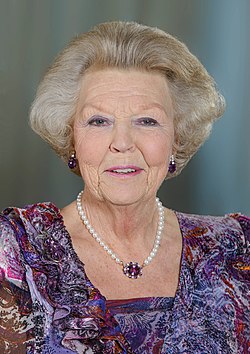
Beatrix[1] (Beatrix Wilhelmina Armgard, Dutch pronunciation: [ˈbeːjaːtrɪks ˌʋɪlɦɛlˈminaː ˈʔɑr(ə)mɡɑrt] ⓘ; born 31 January 1938) is a member of the Dutch royal house who reigned as Queen of the Netherlands from 30 April 1980 until her abdication in 2013.
Beatrix was born during the reign of her maternal grandmother, Queen Wilhelmina, and became heiress presumptive upon the accession of her mother, Queen Juliana, in 1948. Beatrix attended a public primary school in Canada during World War II, and then finished her primary and secondary education in the Netherlands in the post-war period. In 1961, she received her law degree from Leiden University. In 1966, Beatrix married Claus von Amsberg, a German diplomat, with whom she had three children. When her mother abdicated on 30 April 1980, Beatrix succeeded her as queen.
Beatrix's reign saw the country's Caribbean possessions reshaped with Aruba's secession and becoming its own constituent country within the kingdom in 1986. This was followed by the dissolution of the Netherlands Antilles in 2010, which created the new special municipalities of Bonaire, Sint Eustatius, and Saba, and the two new constituent countries of Curaçao and Sint Maarten.
On Koninginnedag (Queen's Day), 30 April 2013, Beatrix abdicated in favour of her eldest son, Willem-Alexander.[2] At the time of her abdication at age 75, Beatrix was the oldest reigning monarch in the country's history.[3]
Early life
[edit]Princess Beatrix Wilhelmina Armgard was born on 31 January 1938 at Soestdijk Palace in Baarn, Netherlands, as the first child of Princess Juliana of the Netherlands and her husband, Prince Bernhard of Lippe-Biesterfeld.[4] Beatrix was baptised on 12 May 1938 in the Great Church in The Hague.[5] Her five godparents were King Leopold III of Belgium; Princess Alice, Countess of Athlone; Beatrix's maternal great-great-aunt Elisabeth, Princess of Erbach-Schönberg; her paternal great-uncle Duke Adolf Friedrich of Mecklenburg; and Countess Allene de Kotzebue.[6] Beatrix's middle names are the first names of her grandmothers, Queen Wilhelmina of the Netherlands and Armgard, Princess of Lippe-Biesterfeld.
When Beatrix was one year old, in 1939, her younger sister Princess Irene was born.[4]
.jpg)
World War II broke out in the Netherlands on 10 May 1940 (Westfeldzug). On 13 May, the Dutch Royal Family evacuated to London, United Kingdom. One month later, Beatrix went to Ottawa, Ontario, Canada, with her mother Juliana and her sister Irene, while her father Bernhard and maternal grandmother Queen Wilhelmina remained in London.[4] The family lived at the Stornoway residence (now the residence of the Leader of the Opposition in the Parliament of Canada).[7] With bodyguards and ladies in waiting, the family summered at Bigwin Inn on Lake of Bays, Ontario, where four private stone cottages of the resort served as their retreat. While on Bigwin Island, the constitution of the Netherlands was stored in the safe of Bigwin Inn's rotunda building. Princess Juliana and her family were remembered for their "down to earth" friendliness, general gratefulness and great reverence for their homeland and people, to whom they paid homage by refraining from all luxuries offered to guests at the resort that was once billed as the largest and most luxurious summer resort in Canada. To provide them with a greater sense of security, culinary chefs and staff catered to personal orders at meal time. Upon their departure, the hotel musicians of the Bigwin Inn Orchestra assembled dockside; and at every public performance afterward through to the end of World War II, the Wilhelmus was played. In the years following the shuttering and neglect of the island resort, the "Juliana" cottages were well maintained and preserved in an informal tribute to Princess Juliana and her family. In appreciation for the protection of her and her daughters, Princess Juliana established the custom of delivery to the Canadian government every spring of tulips, which is the centrepiece of the Canadian Tulip Festival.
The second sister of Beatrix, Princess Margriet, was born in Ottawa in 1943.[4] During their exile in Canada, Beatrix attended nursery[8] and Rockcliffe Park Public School, a primary school where she was known as "Trixie Orange".[9][10]
On 5 May 1945, the German troops in the Netherlands surrendered. The family returned to the Netherlands on 2 August 1945. Beatrix went to the progressive primary school De Werkplaats in Bilthoven run by pacifist social reformers Kees Boeke and Beatrice Boeke-Cadbury. Her third sister Princess Christina was born in 1947.[4] On 6 September 1948, her mother succeeded her grandmother Wilhelmina as Queen of the Netherlands. Since she had no brothers, Beatrix became the heiress presumptive to the Dutch throne at the age of ten.
Education
[edit]
In April 1950, Princess Beatrix entered the Incrementum, a part of Baarnsch Lyceum, where, in 1956, she passed her school graduation examinations in the subjects of arts and classics.[11] Her tutor from April 1951 was Gertrude Büringh Boekhoudt, who remained a close confidant until her death in 1982.[12]
In 1954, Beatrix served as a bridesmaid at the wedding of Baroness van Randwijck and Mr. T Boey.[13]
On 31 January 1956, Beatrix celebrated her 18th birthday. From that date, under the Constitution of the Netherlands, she was entitled to assume the Royal Prerogative. At that time, her mother installed her in the Council of State.[14]
The same year her studies at Leiden University began. In her first years at the university, she studied sociology, jurisprudence, economics, parliamentary history and constitutional law.[11] In the course of her studies she also attended lectures on the cultures of Suriname and the Netherlands Antilles, the Charter for the Kingdom of the Netherlands, international affairs, international law, history and European law.
The princess also visited various European and international organisations in Geneva, Strasbourg, Paris, and Brussels. She was also an active member of the VVSL (Female Union for Students in Leiden), now called L.S.V. Minerva, after merging with the Leidsch Studenten Corps (which before then was male-only). In the summer of 1959, she passed her preliminary examination in law, and she obtained her law degree in July 1961.[11]
Political involvement
[edit] | This section of a biography of a living person needs additional citations for verification. (June 2018) |

In 1965, Beatrix became engaged to the German aristocrat Claus von Amsberg, a diplomat working for the German Foreign Office. There was a massive protest on their wedding day in Amsterdam on 10 March 1966. Prince Claus had served in the Hitler Youth and the Wehrmacht and therefore was easily associated with German Nazism. Protests included slogans like "Claus 'raus!" (Claus out!) and "Mijn fiets terug" ("Return my bicycle" – a reference to German soldiers confiscating Dutch bicycles during WWII). A group of Provos threw a smoke bomb at the Golden Coach, resulting in a street battle with the police.
As time went on, Prince Claus became one of the most popular members of the Dutch monarchy.[15]
On 25 November 1975, Beatrix and Prince Claus attended the independence ceremony of Suriname, held in the new nation's capital, Paramaribo, representing her mother the Queen.
As a monarch, Beatrix had weekly meetings with the prime minister. She signed all new Acts of Parliament and royal decrees, and until a constitutional change late in her reign, appointed the informateur, an official who is responsible for chairing coalition talks in the formation of new governments. At the state opening of parliament each September, she made a Speech from the Throne, in which the government announced its plans for the coming parliamentary year. As Queen, she was president of the Council of State. Her role was largely ceremonial and as a focus of national unity, she did not make legislative or executive decisions.
Beatrix is a member of the Bilderberg Group.[16]
Marriage and children
[edit]Engagement to Claus
[edit]On 28 June 1965, the engagement of Princess Beatrix to the German diplomat Claus von Amsberg was announced. Claus and Beatrix had met at the wedding-eve party of Princess Tatjana of Sayn-Wittgenstein-Berleburg and Moritz, Landgrave of Hesse, in summer 1964. After Parliament consented to the marriage, Claus von Amsberg became a Dutch citizen, and upon his marriage became Prince Claus of the Netherlands, Jonkheer van Amsberg.
Wedding, 1966
[edit].jpg)
Beatrix married Claus von Amsberg on 10 March 1966 in civil and religious ceremonies.[17] The bride wore a traditional gown with train in duchesse silk satin, designed by Caroline Bergé-Farwick of Maison Linette, in Den Bosch, and the Württemberg Ornate Pearl Tiara. The senior bridesmaids were the bride's youngest sister, Princess Christina of the Netherlands; Princess Christina of Sweden; Lady Elizabeth Anson; Joanna Roëll; Eugénie Loudon; and the bridegroom's sister, Christina von Amsberg. The junior bridesmaids were Daphne Stewart-Clark and Carolijn Alting von Geusau, with page boys Joachim Jencquel and Markus von Oeynhausen-Sierstorpff.[18]
The royal couple travelled to the ceremony together in the gold state carriage.[19] The civil ceremony was conducted by the Mayor of Amsterdam, Gijsbert van Hall, at Amsterdam City Hall. The marriage blessing took place in the Westerkerk, conducted by the Rev. Hendrik Jan Kater, with a sermon by the Rev. Johannes Hendrik Sillevis Smitt.[20]
Children
[edit],_Bestanddeelnr_253-8804.jpg)
The royal couple had three sons. They lived at Drakensteyn Castle in Lage Vuursche with their children until Beatrix ascended the throne. In 1981, they moved into Huis ten Bosch Palace in The Hague.
| Name | Birth | Death | Marriage | ||
|---|---|---|---|---|---|
| Date | Spouse | Issue | |||
| Willem-Alexander of the Netherlands | 27 April 1967 | 2 February 2002 | Máxima Zorreguieta Cerruti | ||
| Prince Friso of Orange-Nassau | 25 September 1968 | 12 August 2013 | 24 April 2004 | Mabel Wisse Smit |
|
| Prince Constantijn of the Netherlands | 11 October 1969 | 19 May 2001 | Laurentien Brinkhorst | ||
Accession and inauguration
[edit]

From the 1970s, Beatrix began to prepare more intensively for her future position as head of state. She made many trips abroad with Prince Claus, including a controversial one to the Soviet Union.
After the Lockheed affair, Beatrix and Claus began to delve into the royal household and made plans to adapt it. In addition, they asked advisers to prepare for Beatrix's reign. On 31 January 1980, the birthday of her eldest daughter and heiress presumptive, Queen Juliana announced during a live television speech that she wished to abdicate on 30 April in favor of her daughter Beatrix.
That Beatrix would succeed her mother as queen was not a matter of course when she was born. It was not until 1983 that the Constitution was amended in such a way that the eldest child of the head of state becomes the legal heir to the throne. Until then, it had been arranged that the eldest son always had priority over a daughter. It was only after it was clear that Juliana was biologically unable to have any more children, let alone a son, that Beatrix was certain that she was the intended successor.
On 30 April 1980, Juliana abdicated, and Beatrix became the 13th member of the House of Orange to reign over the Netherlands. She was sworn in and inaugurated as monarch during a joint session of the two chambers of the States General at a ceremony held in the Nieuwe Kerk in Amsterdam later that day.
Reign
[edit]Beatrix's constitutional duties included those typically accorded to a head of state; this includes having to sign every piece of legislation before it becomes law, formally appointing various officials, receiving and accrediting ambassadors, and awarding honours and medals, among others. Outside of these constitutional duties, her other informal roles included being the highest representative of the kingdom internationally and to be a unifying figure locally.
Beatrix was rarely quoted directly in the press during her reign, for the government information service (Rijksvoorlichtingsdienst) made it a condition of interviews that she should not be quoted. This policy was introduced shortly after her inauguration, reportedly to protect her from political complications that might arise from "off-the-cuff" remarks. It did not apply to her son Prince Willem-Alexander.
Throughout much of her reign, Beatrix had a considerable role in the cabinet formation process; notably she appointed the informateur and formateur, the person who leads the negotiations that ultimately lead to the formation of a government. However, this was changed in 2012, and now the largest party in the States General appoints a "scout" who then appoints an informateur.
Beatrix was included in Andy Warhol's portrait series in 1985 as one of four Reigning Queens, alongside Elizabeth II, Margrethe II of Denmark and Ntfombi of Eswatini.[21]
On 1 January 1986, Aruba seceded from the Netherlands Antilles and became a separate constituent country within the Dutch Kingdom.
Kissed by a bystander
[edit]
During 1988 Queen's Day, Queen Beatrix was kissed by a bystander, later identified as Maarten Rijkers, when she walked through the crowd of people at a flea market in the Jordaan. When Beatrix walked alongside Rijkers he said "Give me a kiss, girl", after which he gave her a hug and two kisses.[22] It received wide media attention and appeared to be a historic moment.[23][24] An image of this scene was published in large on the front page of De Telegraaf. Even 25 years later in 2013, NRC Handelsblad wrote an article about it and the impact of it.[23]
The reaction of the Queen was seen by people as very positive and was a boost for her reputation in the "Jordaan" region of Amsterdam. The visit was promoted as a "spontaneous visit" to boost her popularity as she was not very popular in the region. Historian and Dutch royalty watcher J. G. Kikkert said in a lecture that the kiss had been staged, based on what he called "usually very reliable sources".[23][24] He also noted that although the visit and the kiss might not have been her idea, but that of others, she certainly would have given her approval as she was known not to leave things to chance.
Later years
[edit]On 6 October 2002, the Queen's husband, Prince Claus, died after a long illness. A year and a half later her mother died after long suffering from senile dementia, while her father succumbed to cancer in December 2004.

On 8 February 2005, Beatrix received a rare honorary doctorate from Leiden University, an honour the Queen does not usually accept. In her acceptance speech she reflected on the monarchy and her own 25 years as Queen.[25] The speech was broadcast live.[26]
On 29 and 30 April 2005, she celebrated the 25th anniversary of her reign. She was interviewed on Dutch television, was offered a concert on Dam Square in Amsterdam, and a celebration took place in The Hague, the country's seat of government.
On 31 May 2006 the 6th Polish Air Assault Brigade would receive the Militaire Willemsorde der 4e klasse in The Hague. Beatrix was to tie the prestigious medal to the standard of the incumbents of the 1st Independent Polish Parachute Brigade.[27]
In 2009, Forbes estimated her wealth at US$300 million.[28]
On 30 April 2009, Beatrix and other members of the royal family were targeted in a car attack by a man named Karst Tates. He crashed his Suzuki Swift into a parade in Apeldoorn, narrowly missing a bus carrying the Queen, before dying as a result of his injuries. Five people were killed instantly, with two victims also succumbing to their injuries afterward. Other victims of the crash were critically hurt. One week after the attack, another victim succumbed to the injuries he had sustained. The royal party was unharmed, but the Queen and members of her family saw the crash at close range. Within hours, Beatrix made a rare televised address to express her shock and condolences. The man reportedly told police he was deliberately targeting the royal family.[29]
Abdication
[edit]
In a broadcast on national media on 28 January 2013, Beatrix announced her intention to abdicate on 30 April (Koninginnedag), when she would have been on the throne for exactly 33 years. Beatrix stated that it was time to "place the responsibility for the country in the hands of a new generation."[30] Her heir apparent was her eldest son, Prince Willem-Alexander.[31] She was the third successive Dutch monarch to abdicate, following her grandmother and her mother.[31] The broadcast was followed by a statement from Prime Minister Mark Rutte who paid tribute to Beatrix, saying "Since her investiture in 1980, she has applied herself heart and soul to Dutch society."[30]
The royal transition, which included the inauguration of Willem-Alexander as king, took place on 30 April 2013.[32]
Post-abdication
[edit]Beatrix continues to undertake some royal duties and is a patron of many organisations. She lives in the small moated Drakensteyn Castle near the village of Lage Vuursche, and a townhouse near Noordeinde Palace.[33]
Honorific eponyms
[edit]Beatrix has given her name to a number of facilities in the Netherlands and beyond. These include:
- Streekziekenhuis Koningin Beatrix, regional hospital in Beatrixpark, Winterswijk.[34]
- Queen Beatrix International Airport in Aruba.
- Reina Beatrix School in Aruba.[35]
- Queen Beatrix Hospital Medical Center, Sint Eustatius.[36]
- Queen Beatrix Chair in Dutch Studies at UC Berkeley[37]
- Queen Beatrix Nursing Home, Albion Park Rail, NSW, Australia.[38]
A few parks in the country also bear her name:
- Beatrixpark in the Oud-Zuid neighbourhood in Amsterdam.
- Beatrixpark in Almere.
- Beatrixpark in 's-Hertogenbosch.
- Beatrixpark in Utrecht.
- Beatrixpark in Schiedam.
It has been speculated that Beatrix is De Onbekende Beeldhouwer (Unknown Sculptor), whose work has been appearing in Amsterdam since 1983. There has been no confirmation of this.[39]
Titles, styles, honours and arms
[edit]
- 31 January 1938 – 30 April 1980: Her Royal Highness Princess Beatrix of the Netherlands, Princess of Orange-Nassau, Princess of Lippe-Biesterfeld[40]
- 30 April 1980 – 30 April 2013: Her Majesty The Queen of the Netherlands, Princess of Orange-Nassau, Princess of Lippe-Biesterfeld[40]
- 30 April 2013 – present: Her Royal Highness Princess Beatrix of the Netherlands, Princess of Orange-Nassau, Princess of Lippe-Biesterfeld[40]
Princess Beatrix has held titles throughout her life, as a granddaughter or daughter of a monarch, and eventually as the Sovereign. Beatrix's official title was Her Majesty the Queen of the Netherlands, Princess of Orange-Nassau, etc., etc., etc.[40] The triple etc. refers to the monarch's many dormant titles. She signed official documents with only "Beatrix". In common parlance, she was referred to as The Queen (de koningin or de vorstin) or Her Majesty (Hare Majesteit). But when in conversation with the queen the practice was to initially address her as "Your Majesty" or in Dutch as "Uwe Majesteit"[41] and thereafter as "Mevrouw" (ma'am).[42]
Beatrix has received honours and awards from countries around the world, both during her life as a princess and as a monarch. In her capacity as the Sovereign she was Grand Master of the Military Order of William (Militaire Willemsorde) and the other Dutch orders of merit. She is a Stranger Lady of the Most Noble Order of the Garter and the 1,187th Dame of the Order of the Golden Fleece in Spain, and she has received numerous other medals and decorations.
From birth till her inauguration as queen, she had the following name and titles, to which she reverted after her abdication: Her Royal Highness Princess Beatrix of the Netherlands, Princess of Orange-Nassau, Princess of Lippe-Biesterfeld.[43]
Arms
[edit]
|
Azure, billetty Or a lion with a coronet Or armed and langued Gules holding in his dexter paw a sword Argent hilted Or and in the sinister paw seven arrows Argent pointed and bound together Or. |
.svg)

Ancestry
[edit]| Ancestors of Beatrix of the Netherlands | |||||||||||||||||||||||||||||||||||||||||||||||||||||||||||||||||||||||||||||||||||||||||||||||||||||||||||||||||||||||||||||||||||||||||||||||||||||||||||||||||||||||||||||||||||||||||||||||||||||||||||||||||||||||||||||||||||||||||||||||||||||||||||||||||||||||||||||||||||||||||
|---|---|---|---|---|---|---|---|---|---|---|---|---|---|---|---|---|---|---|---|---|---|---|---|---|---|---|---|---|---|---|---|---|---|---|---|---|---|---|---|---|---|---|---|---|---|---|---|---|---|---|---|---|---|---|---|---|---|---|---|---|---|---|---|---|---|---|---|---|---|---|---|---|---|---|---|---|---|---|---|---|---|---|---|---|---|---|---|---|---|---|---|---|---|---|---|---|---|---|---|---|---|---|---|---|---|---|---|---|---|---|---|---|---|---|---|---|---|---|---|---|---|---|---|---|---|---|---|---|---|---|---|---|---|---|---|---|---|---|---|---|---|---|---|---|---|---|---|---|---|---|---|---|---|---|---|---|---|---|---|---|---|---|---|---|---|---|---|---|---|---|---|---|---|---|---|---|---|---|---|---|---|---|---|---|---|---|---|---|---|---|---|---|---|---|---|---|---|---|---|---|---|---|---|---|---|---|---|---|---|---|---|---|---|---|---|---|---|---|---|---|---|---|---|---|---|---|---|---|---|---|---|---|---|---|---|---|---|---|---|---|---|---|---|---|---|---|---|---|---|---|---|---|---|---|---|---|---|---|---|---|---|---|---|---|---|---|---|---|---|---|---|---|---|---|---|---|---|---|---|---|---|
| |||||||||||||||||||||||||||||||||||||||||||||||||||||||||||||||||||||||||||||||||||||||||||||||||||||||||||||||||||||||||||||||||||||||||||||||||||||||||||||||||||||||||||||||||||||||||||||||||||||||||||||||||||||||||||||||||||||||||||||||||||||||||||||||||||||||||||||||||||||||||
Prime Ministers during her reign
[edit]

| Polity | Prime Minister | Start year | End year |
|---|---|---|---|
| Aruba | Henny Eman | 1986 | 1989[44] |
| Nelson O. Oduber | 1989 | 1994 | |
| Henny Eman | 1994 | 2001 | |
| Nelson O. Oduber | 2001 | 2009 | |
| Mike Eman | 2009 | 2013 | |
| Netherlands | Dries van Agt | 1977 | 1982 |
| Ruud Lubbers | 1982 | 1994 | |
| Wim Kok | 1994 | 2002 | |
| Jan Peter Balkenende | 2002 | 2010 | |
| Mark Rutte | 2010 | 2013 | |
| Netherlands Antilles | Dominico Martina | 1979 | 1984 |
| Maria Liberia Peters | 1984 | 1986 | |
| Dominico Martina | 1986 | 1988 | |
| Maria Liberia Peters | 1988 | 1993 | |
| Susanne Camelia-Römer | 1993 | ||
| Alejandro Felippe Paula | |||
| Miguel Arcangel Pourier | 1994 | 1998 | |
| Susanne Camelia-Römer | 1998 | 1999 | |
| Miguel Arcangel Pourier | 1999 | 2002 | |
| Etienne Ys | 2002 | 2003 | |
| Ben Komproe | 2003 | ||
| Mirna Louisa-Godett | 2003 | 2004 | |
| Etienne Ys | 2004 | 2006 | |
| Emily de Jongh-Elhage | 2006 | 2010 | |
| Curaçao | Gerrit Schotte | 2010 | 2012 |
| Stanley Betrian | 2012 | 2012 | |
| Daniel Hodge | 2012 | 2013 | |
| Sint Maarten | Sarah Wescot-Williams | 2010 | 2013 |
Notes
[edit]- ^ Specifically, a member of the Protestant Church in the Netherlands; previously a member of the Dutch Reformed Church before its 2004 merger.
References
[edit]- ^ Members of the Royal House: Princess Beatrix of the Netherlands – official website of the Royal house of the Netherlands
- ^ de Jong, Perro (30 April 2013). "The Netherlands' love and respect for Beatrix". BBC. Retrieved 5 June 2015.
- ^ Myrtille van Bommel, "Beatrix oldest Dutch reigning monarch Archived 3 November 2013 at the Wayback Machine", Radio Netherlands Worldwide, 2011. Retrieved on 15 May 2012.
- ^ a b c d e Youth Archived 5 May 2009 at the Wayback Machine. The Dutch Royal House. Retrieved on 11 July 2008.
- ^ (in Dutch) Geschiedenis Archived 4 October 2015 at the Wayback Machine, Grote Kerk Den Haag. Retrieved on 15 May 2012.
- ^ De vijf peetouders van prinses Beatrix. The Memory of the Netherlands. Retrieved on 11 July 2008.
- ^ "CBC News". Canadian Broadcasting Corporation. 18 January 2008. Retrieved 5 March 2010.
- ^ Education Archived 5 May 2009 at the Wayback Machine. The Dutch Royal House. Retrieved on 11 July 2008.
- ^ Davison, Janet. "Abdicating Dutch queen was a wartime Ottawa schoolgirl". Canadian Broadcasting Corporation. Retrieved 29 April 2013.
- ^ "National Capital Commission". Canadascapital.gc.ca. Archived from the original on 13 October 2009. Retrieved 5 March 2010.
- ^ a b c "Het Koninklijk Huis". Koninklijkhuis.nl. Archived from the original on 25 February 2010. Retrieved 5 March 2010.
- ^ Oltmans 1996, pp. 4–7, 9, 12–13, 18.
- ^ "Princess Beatrix Bridesmaid at Wedding". British Pathe.
- ^ "e CV Reine Beatrix". coe.int. Retrieved 20 January 2017.
- ^ "De huwelijksjaren van Beatrix en Claus". NOS.nl (in Dutch). 9 February 2010. Retrieved 21 September 2025.
- ^ "Bilderberg Meeting of 1997 Assembles". PR Newswire. 13 June 1997. Archived from the original on 30 April 2011.
- ^ "Video: Wedding of Princess Beatrix and Claus von Amsberg". YouTube. 30 November 2008. Archived from the original on 31 October 2021.
- ^ "Royal wedding Beatrix and Claus".
- ^ "Wedding of Princess Beatrix and Claus von Amsberg". Amsterdam Palace. Archived from the original on 17 April 2016.
- ^ "Queen Beatrix: marriage and family". Dutch Royal House. Archived from the original on 26 June 2012.
- ^ Los Angeles Times. Muchnic, Suzanne. The Art Galleries: Downtown, articles.latimes.com; 20 December 1985.
- ^ Communicatie, FIZZ Marketing &. "Ons Amsterdam | 130 jaar koninklijk feest in de hoofdstad". onsamsterdam.nl. Archived from the original on 10 April 2021.
- ^ a b c "Special Beatrix". Issuu. 29 January 2013.
- ^ a b "Markante momenten Beatrix". nos.nl. 29 January 2013.
- ^ [1] Archived 5 April 2005 at the Wayback Machine
- ^ "The complete broadcast". Archived from the original on 7 August 2017. Retrieved 14 February 2005.
- ^ "Chapter 8. The process of Polish rehabilitation in 2006". Polish forces in the West. Archived from the original on 5 January 2019. Retrieved 10 January 2016.
- ^ "In Pictures: The World's Richest Royals". Forbes.com. 30 August 2007. Retrieved 5 March 2010.
- ^ NO. "Koninklijke familie was doelwit (Royal family was the target) (Dutch)". Archived from the original on 3 May 2009. Retrieved 1 May 2009.
- ^ a b "Dutch Queen to abdicate in April for son". Al Jazeera. 28 January 2013. Retrieved 28 January 2013.
- ^ a b "Queen Beatrix of the Netherlands to abdicate for son". BBC. 28 January 2013. Retrieved 28 January 2013.
- ^ "Time and place of abdication and investiture, 28 January 2013". Royal Dutch House.
- ^ (Dutch) Verhuizing Prinses Beatrix, Koninklijk Huis. Retrieved 24 July 2013.
- ^ services, HPU internet. "Home | SKB Winterswijk". skbwinterswijk.nl. Retrieved 18 November 2019.
- ^ "List of Schools - VisitAruba.com". visitaruba.com. Retrieved 18 November 2019.
- ^ University of Sint Eustatius School of Medicine "The University of Sint Eustatius School of Medicine". Archived from the original on 28 December 2011. Retrieved 28 March 2016.
- ^ [2] Archived 19 July 2012 at the Wayback Machine
- ^ "Queen Beatrix Nursing Home | Zadro Constructions". zadro.com.au. Archived from the original on 9 April 2013. Retrieved 18 November 2019.
- ^ Depictions, text in Dutch Retrieved 23 June 2017.
- ^ a b c d H.M. (koningin Beatrix) Beatrix Wilhelmina Armgard Archived 16 June 2012 at the Wayback Machine (Parlement.nl)
- ^ "The Dutch Royal House; FAQ; "How should I address members of the Royal House?"". Archived from the original on 10 June 2007. Retrieved 29 June 2008.
- ^ Van den Bor, Conny (29 April 2010). "Queen Beatrix – still impeccable after 30 years". Radio Netherlands Worldwide. Archived from the original on 11 November 2013. Retrieved 28 January 2013.
- ^ "Prins van Oranje wordt Koning Willem-Alexander" (in Dutch). Website of the Royal House. 28 January 2013. Retrieved 28 January 2013.
- ^ Aruba received status aparte in 1986.
Books
[edit]- Oltmans, Willem (25 September 1996). Liegen Tegen Beatrix (PDF). Breda, Netherlands: Papieren Tijger. ISBN 978-90-6728-084-6.
External links
[edit]
- Official website of Princess Beatrix
- Newspaper clippings about Beatrix of the Netherlands in the 20th Century Press Archives of the ZBW
| Kingdom of Holland (1806–1810) |  | |
|---|---|---|
| Kingdom of the Netherlands1 (1815–present) | ||
1. See also the Sovereign Principality of the United Netherlands (1813–1815) and the United Kingdom of the Netherlands (1815–1839). | ||
Members of the Spanish Order of the Golden Fleece | ||
|---|---|---|
| Grand Master |
| .svg) |
| Knights |
| |
Note: Within parentheses, the year when inducted into the Order | ||
| Sovereign |
|  |
|---|---|---|
| Royal Knights and Ladies (Companion) | ||
| Stranger Knights and Ladies Companion | ||
| Knights and Ladies Companion |
| |
| Officers |
| |


Beatrix of the Netherlands
View on GrokipediaEarly Life and Education
Birth and Family Background
Beatrix Wilhelmina Armgard was born on 31 January 1938 at Soestdijk Palace in Baarn, Netherlands, as the eldest child and first daughter of Crown Princess Juliana of the Netherlands and her consort, Prince Bernhard of Lippe-Biesterfeld.[7][8] Her birth occurred during the reign of her maternal grandmother, Queen Wilhelmina, who had ascended the throne in 1890 and led the Netherlands through the early 20th century, including the interwar period marked by economic challenges and rising European tensions.[8][9] Juliana, born in 1909 as Wilhelmina and Henry's only child, had married Bernhard in 1937; he originated from the minor German noble house of Lippe-Biesterfeld, which traced its roots to the princely Lippe state but held no sovereign status by the 20th century.[7][9] The union elevated Bernhard to prince consort, positioning the couple as direct heirs in the House of Orange-Nassau, the Dutch royal dynasty established in the 16th century through William the Silent's leadership in the Dutch Revolt against Spanish rule.[8] Beatrix's three younger sisters—Irene (born 5 August 1939), Margriet (born 19 January 1943), and Christina (born 18 February 1947)—completed the family, all raised within the Protestant tradition of the Orange-Nassau line amid the constitutional monarchy's emphasis on parliamentary oversight.[7][9]The family's patrilineal ties to Lippe introduced a German element to the Orange-Nassau succession, reflecting inter-European noble intermarriages common before World War I but scrutinized in the 1930s amid Nazi Germany's ascent; Bernhard, despite his Lippe background, publicly affirmed loyalty to the Netherlands and rejected Nazi affiliations.[8] This background underscored Beatrix's position as presumptive heir from birth, given the absence of male successors and the Dutch law of absolute primogeniture not yet in effect, which prioritized her over sisters in the line of succession.[7][9]
Childhood and World War II Experiences
Princess Beatrix Wilhelmina Armgard was born on 31 January 1938 at Soestdijk Palace in Baarn, Netherlands, as the first child and eldest daughter of Crown Princess Juliana and Prince Bernhard of Lippe-Biesterfeld.[3] Her sister Princess Irene followed on 5 August 1939.[10] Beatrix's early childhood in the Netherlands was spent in the secure environment of the royal palaces, including Soestdijk, amid the escalating tensions in Europe leading to World War II.[9] The German invasion of the Netherlands began on 10 May 1940, prompting the evacuation of the royal family. Queen Wilhelmina fled to London on 13 May to establish a government-in-exile, while Juliana, with her daughters Beatrix (aged two) and Irene (aged nine months), initially joined her there before departing for Canada to ensure greater safety from potential German bombing campaigns.[10] They arrived in Halifax on 11 June 1940 aboard the Dutch cruiser HNLMS Sumatra, then proceeded to Ottawa at the invitation of Governor General the Earl of Athlone, settling at 21 Lysander Place in Rockcliffe Park.[11] Prince Bernhard remained in London, participating in Allied military efforts.[3] In Ottawa, Beatrix experienced a relatively normal childhood for a royal exile, attending Rockcliffe Park Public School alongside local children, which fostered informal interactions uncommon for her station.[12] Juliana supported the Canadian war effort through activities such as knitting for soldiers and promoting Dutch-Canadian solidarity, while giving birth to Princess Margriet on 19 January 1943 at the Ottawa Civic Hospital—a facility granted perpetual tax exemption by the Canadian government to avoid implications for the infant's citizenship status.[3] [10] The family resided in Canada until the Netherlands' liberation in May 1945, returning to Soestdijk Palace on 2 August 1945 amid widespread public rejoicing.[13] These wartime years, though marked by separation from her father and the homeland, provided Beatrix with early exposure to resilience and international alliances that would later influence her worldview.[14]Academic and Intellectual Development
Beatrix began her primary education at a public school in Ottawa, Canada, during the family's exile in the United Kingdom and North America amid World War II.[3] Upon the royal family's return to the Netherlands in 1945, she continued primary schooling at De Werkplaats, an experimental institution founded by educator Kees Boeke in Bilthoven, emphasizing progressive methods.[15] In April 1950, she commenced secondary education in a specialized class known as Incrementum, tailored for her and select peers at the palace, before transferring to the Baarnsch Lyceum, where she completed her gymnasium exams in arts and classics in 1956.[16] These studies provided a foundation in humanities, aligning with the rigorous classical curriculum typical of Dutch elite secondary education at the time. Beatrix enrolled at Leiden University in 1956, pursuing a broad curriculum that included law, sociology, jurisprudence, economics, parliamentary history, and constitutional subjects essential for her future role.[17] She resided at Rapenburg 45 during her studies and participated in extracurriculars such as the De Vliet rowing club, reflecting a balanced approach to personal development.[17] In 1961, she obtained a law degree (meester in de rechten), capping five years of focused academic work that emphasized legal and governance principles over specialized research.[9] This qualification, rare among European royals of her era, underscored her deliberate preparation for monarchical responsibilities through systematic intellectual engagement with statecraft and societal structures. In 2005, Leiden University awarded her an honorary doctorate, recognizing her sustained contributions to public life informed by these early scholarly pursuits.[17]Marriage and Family
Engagement to Claus von Amsberg and Public Opposition
On 28 June 1965, Queen Juliana and Prince Bernhard announced the engagement of Princess Beatrix to Claus von Amsberg, a 38-year-old German diplomat serving at the German embassy in Brussels.[5] The couple had met the previous year at the wedding of Moritz, Landgrave of Hesse, and Princess Tatiana of Sayn-Wittgenstein-Berleburg in Germany, with their relationship developing through subsequent correspondence and meetings.[18] The announcement followed an investigation into von Amsberg's background, including a report commissioned from Louis de Jong, director of the Netherlands Institute for War Documentation, which examined his activities during World War II.[5] Von Amsberg's German nationality and wartime history fueled immediate public opposition, rooted in memories of the Nazi occupation of the Netherlands from 1940 to 1945, during which over 200,000 Dutch citizens perished, including a disproportionate number of Jews deported to concentration camps.[19] As a teenager, von Amsberg had been a compulsory member of the Deutsches Jungvolk and Hitler Youth, organizations required for German boys of his age under the Nazi regime, and later served briefly in the German army before being captured by American forces in Italy in 1945 without participating in combat against the Allies.[20] Critics, including former resistance fighters, academics, and Jewish community leaders, protested the match, viewing it as insensitive to national trauma and questioning the suitability of a German consort for the future queen.[21] Petitions and demonstrations emerged, with some demanding parliamentary rejection of the union, though Queen Juliana granted permission after deliberation.[22] The controversy highlighted postwar Dutch-German tensions, with polls indicating majority disapproval among the public; a 1965 survey by the Dutch institute NIPO found only 22% support for the engagement, while 54% opposed it.[23] Opposition extended to boycotts by figures such as three rabbis who declined invitations to related events, citing von Amsberg's past affiliations.[19] Despite this, the government and royal family proceeded, requiring von Amsberg to renounce his German titles and swear allegiance to the Dutch constitution as a precondition for naturalization.[24] The engagement debate in parliament underscored constitutional scrutiny, but approval was ultimately granted, setting the stage for the wedding amid escalating protests.Wedding and Immediate Aftermath
The wedding of Princess Beatrix to Claus von Amsberg occurred on March 10, 1966, beginning with a civil ceremony at the Amsterdam City Hall conducted by Mayor Gijsbert van Hall, as required by Dutch law.[4] This was followed by a religious ceremony in the Westerkerk church in Amsterdam, attended by royal family members and dignitaries.[25] Von Amsberg, a 38-year-old German diplomat from a Prussian family, had served briefly in the Wehrmacht toward the end of World War II after compulsory membership in the Hitler Youth, though Allied forces later determined he held no Nazi sympathies.[25] [26] Public opposition, rooted in lingering resentment over the Nazi occupation of the Netherlands—which resulted in the deaths of approximately 250,000 Dutch citizens, including 165,000 Jews—intensified during the wedding procession.[19] Youth protesters threw smoke bombs at the couple's carriage, chanting against the union with a German, leading to clashes with police and the arrest of 19 individuals.[26] Demonstrations also occurred at a memorial for Dutch victims of Nazism, and Dutch rabbis boycotted the event in protest.[19] Despite the disturbances, the ceremonies proceeded without interruption, highlighting the divide between official proceedings and segments of public sentiment still scarred by wartime experiences. In the immediate aftermath, the couple's honeymoon plans were kept confidential to avoid further incidents, reflecting the tense atmosphere.[26] Von Amsberg renounced his German citizenship, adopting Dutch nationality as Prince Claus of the Netherlands, a step intended to assuage national concerns.[4] While initial hostility persisted among some groups, the marriage marked a pivotal moment, with Claus gradually gaining acceptance in Dutch society over subsequent years through his public service and demeanor.[27]Children and Family Dynamics
Beatrix and Prince Claus had three sons, all born at the University Medical Center Utrecht: Willem-Alexander on 27 April 1967, Johan Friso on 25 September 1968, and Constantijn on 11 October 1969.[28][29][30] The couple raised their children at Drakensteyn Castle in Lage Vuursche, emphasizing a relatively normal upbringing away from the main royal palaces to foster independence and education; the princes attended local schools and later pursued university studies, with Willem-Alexander and Constantijn studying at Leiden University.[5][31] Family life centered on Claus's role as an involved father, balancing royal duties with private time, though Beatrix prioritized her sons' preparation for public life amid her own pre-accession responsibilities. In 2004, Friso renounced his claim to the throne to marry Mabel Wisse Smit after parliament withheld approval due to her undisclosed past associations with drug criminal Klaas Bruinsma, shifting the succession directly to Constantijn and highlighting tensions between personal choice and constitutional requirements.[32][33] On 17 February 2012, Friso sustained irreversible brain damage from oxygen deprivation during an off-piste skiing avalanche in Lech, Austria, remaining in a coma until his death on 12 August 2013 at age 44; Beatrix, who had lost Claus to Parkinson's and pneumonia in October 2002, managed the family's grief privately.[34][35] Post-2013 abdication, Beatrix sustained close relations with Willem-Alexander (now king), his family, and Constantijn's household, frequently participating in state events and supporting her eight grandchildren while residing primarily at Drakensteyn; Friso's daughters, Luana and Zaria, maintained ties to the family despite their non-membership in the royal house.[4] The dynamics reflected a commitment to duty and resilience, with no public reports of significant rifts, though Friso's renunciation and accident underscored vulnerabilities in the tightly knit unit.[36]Pre-Accession Role
Political Activities as Princess
Upon Queen Juliana's accession to the throne on September 4, 1948, Beatrix, then aged 10, became heir presumptive and began gradual preparation for her future role, including attendance at official events and study of constitutional matters.[8] Her formal involvement in governance commenced on January 31, 1956, her 18th birthday, when Queen Juliana installed her as a member of the Council of State, the government's primary advisory body on legislation, administrative matters, and judicial appointments.[37] In this capacity, Beatrix participated in advisory sessions, gaining insight into policy formulation while adhering to the constitutional monarchy's limits on royal influence.[38] As Princess of Orange following her marriage to Claus von Amsberg on March 10, 1966, Beatrix expanded her representational duties, accompanying her husband on working visits to the Netherlands' overseas territories. Notable among these was a 1966 tour of Suriname, where she engaged with local leaders and communities to strengthen ties ahead of the territory's path to independence.[39] In November 1975, she and Prince Claus represented Queen Juliana at Suriname's independence ceremony in Paramaribo on November 25, marking the formal transfer of sovereignty after negotiations on economic and refugee provisions.[40] Similar visits to the Netherlands Antilles underscored her role in fostering relations with the Kingdom's constituent countries, though these were ceremonial rather than decision-making.[40] Beatrix also undertook international representations, such as visits to the United Nations Headquarters in New York, where she met with Secretary-General U Thant to discuss global issues, reflecting the monarchy's symbolic diplomatic function.[41] These activities, conducted under Queen Juliana's authority, emphasized continuity and national unity without partisan engagement, aligning with the Netherlands' parliamentary system where executive power resides with the cabinet. Throughout the 1960s and 1970s, she attended domestic ceremonies and provincial tours, such as engagements in Ridderkerk, to maintain public connection amid social upheavals like the 1966 wedding protests.[3] Her pre-accession role thus focused on advisory and symbolic contributions, preparing her for queenship while respecting constitutional boundaries.[8]Public Duties and Preparation for the Throne
As heir presumptive following Queen Juliana's accession in 1948, Princess Beatrix gradually assumed public duties representing the monarchy. These included ceremonial engagements and visits within the Netherlands and its territories, such as her trip to Curaçao in the Dutch West Indies.[42] A notable international role occurred on 25 November 1975, when Beatrix represented the Dutch crown at Suriname's independence ceremony in Paramaribo, attending alongside Prime Minister Henck Arron and President Johan Ferrier amid the formal transfer of sovereignty from the Kingdom of the Netherlands.[43][44] This event underscored her function in symbolizing continuity during decolonization processes. In preparation for potential accession, Beatrix engaged in activities to familiarize herself with governance and diplomacy, including official engagements that involved interaction with public institutions, businesses, and associations. These efforts, alongside her academic background in law, equipped her for constitutional responsibilities, though specifics on internal advisory roles remain limited in public records. She also participated in charitable initiatives, reflecting the monarchy's traditional societal involvement.[45]Reign (1980–2013)
Accession and Inauguration
On April 30, 1980, Queen Juliana formally abdicated the Dutch throne in favor of her eldest daughter, Beatrix, by signing the Instrument of Abdication in the Mozeszaal of the Royal Palace of Amsterdam at 10:07 a.m. local time.[46] This act immediately transferred sovereignty to Beatrix, marking her as the sixth reigning queen and the 34th member of the House of Orange-Nassau to ascend the throne.[47] The abdication followed Juliana's announcement on January 31, 1980, citing her age and desire to retire after 32 years of rule.[48] Beatrix's accession was followed directly by the constitutional inauguration ceremony at the Nieuwe Kerk in Amsterdam, attended by a joint session of the States General comprising the House of Representatives and the Senate.[47] In a procession from the palace, Beatrix walked under a traditional pergola adorned with fishing nets to the church, symbolizing Amsterdam's maritime heritage.[48] There, she delivered a speech emphasizing unity and constitutional fidelity before swearing the required oath: "I swear to the people of the Kingdom that I, together with my heirs and successors, shall always observe and uphold the Constitution, and that I shall defend and preserve the independence and the territory of the Kingdom with all my powers; that I shall protect the freedom and rights of all my subjects and employ all means entrusted to me by the Constitution and the laws for the maintenance of national independence and unity."[47] This oath, mandated by Article 42 of the Dutch Constitution, constitutes the monarch's formal acceptance of the throne and commitment to parliamentary democracy.[46] The inauguration proceedings included a balcony appearance at the palace where Beatrix, Prince Claus, and their sons greeted crowds, followed by a concert on Amsterdam's canals and a gala dinner at the palace.[47] However, the day was overshadowed by protests from leftist groups opposed to the monarchy, culminating in the "Kragt" riots near the Concertgebouw, where demonstrators clashed with police, resulting in arrests and property damage amid broader anti-establishment sentiments.[49] Despite these disturbances, the core ceremonial elements proceeded as planned, underscoring the continuity of Dutch monarchical tradition in a constitutional framework.[50]Constitutional Influence and Domestic Affairs
As Queen of the Netherlands from 1980 to 2013, Beatrix operated within a constitutional monarchy where executive authority resides jointly with the monarch and ministers, but ministers bear sole responsibility to Parliament for government actions.[51] The Dutch Constitution limits the monarch's direct involvement in policy-making, prohibiting personal political influence while requiring formal assent to laws and appointments.[52] Beatrix fulfilled ceremonial duties such as signing legislation, including landmark domestic reforms like the 1984 Abortion Act legalizing termination up to 24 weeks with conditions, and the 2001 same-sex marriage law, the first globally.[51] In cabinet formations following elections, Beatrix appointed informateurs—neutral figures tasked with assessing coalition viability among parliamentary parties.[53] For instance, after the 1981 elections yielding no majority, she designated Ruud Lubbers and Willem De Koning as informateurs, leading to a center-right coalition of Christian Democratic Appeal (CDA) and People's Party for Freedom and Democracy (VVD).[53] Similarly, in 2010 amid protracted talks, she tasked Herman Tjeenk Willink with providing rapid insights, reflecting her role in facilitating negotiations without dictating outcomes.[53] These appointments, conducted after consulting party leaders, underscored her stabilizing function in a fragmented multi-party system, though parliamentary reforms in 2012 curtailed such monarchial discretion to enhance elected bodies' primacy.[53] Beatrix maintained regular private audiences with successive prime ministers, including Dries van Agt (1977–1982), Ruud Lubbers (1982–1994), Wim Kok (1994–2002), Jan Peter Balkenende (2002–2010), and Mark Rutte (2010–2013), offering a confidential forum for discussing national matters.[1] These meetings, held weekly or as needed, emphasized unity and continuity amid domestic challenges like the 1980s economic restructuring, which reduced unemployment from 11.6% in 1983 to 4.1% by 2001 through wage moderation and welfare adjustments.[1] Her annual Throne Speech on Budget Day (Prinsjesdag) conveyed government priorities, such as environmental policies and integration efforts post-2000s immigration surges, without personal endorsement.[51] During her reign, the Netherlands navigated key domestic shifts, including the 1990s "Polder Model" consensus on labor and social policy, and the 2010 dissolution of the Netherlands Antilles into autonomous entities, which Beatrix formally oversaw via royal decrees.[52] Critics occasionally questioned her indirect sway through preferred informateurs like Lubbers, but constitutional accountability ensured ministers' primacy, preserving the system's checks against monarchical overreach.[53] Beatrix's approach prioritized impartiality, contributing to political stability across 13 cabinets.[1]Foreign Relations and State Visits
Queen Beatrix, as head of state, represented the Netherlands in ceremonial aspects of foreign relations, emphasizing diplomatic protocol, bilateral ties, and the promotion of Dutch economic and cultural interests during her 33-year reign. While substantive foreign policy was directed by the government and ministers, Beatrix actively participated in preparations for state visits, reflecting her longstanding interest in international affairs, which involved coordinating agendas to highlight trade, development aid, and historical connections. Her engagements underscored the Netherlands' commitments to multilateral institutions like NATO and the European Union, where Dutch influence focused on free trade, peacekeeping contributions, and Atlantic security cooperation.[54] Beatrix undertook 54 outgoing state visits between 1980 and 2013, often accompanied by Prince Claus and relevant cabinet members, to strengthen partnerships in Europe, North America, Asia, and beyond. Notable among these was her 1982 visit to the United States from April 18 to 22, hosted by President Ronald Reagan, during which she addressed a joint session of Congress on April 21 to commemorate 200 years of uninterrupted diplomatic relations, emphasizing shared democratic values and economic collaboration.[55][56] Other significant trips included her inaugural state visit to India in January 1986, followed by a return in October 2007 to bolster economic dialogues after 21 years, and a 1997 visit to Egypt to advance development and cultural exchanges. Her final state visit occurred in January 2013 to Singapore, marking the first such trip by a Dutch monarch to the city-state and focusing on trade and innovation ties.[57][58][59] Incoming state visits to the Netherlands under Beatrix similarly numbered in the dozens, hosting leaders to reciprocal banquets and discussions at royal residences like the Palace Noordeinde. Examples include the 1984 visit by a foreign president and the 2005 reception for Russian President Vladimir Putin, where Beatrix highlighted enduring bilateral relations dating back centuries. These events reinforced the Netherlands' role as a neutral broker in European diplomacy, though her influence remained symbolic amid government-led negotiations on issues like EU enlargement and post-Cold War security.[60][61]Social Initiatives and Charitable Work
Queen Beatrix advocated for environmental conservation as a key social initiative during her reign, frequently addressing sustainability in public speeches to promote awareness and behavioral change. In her 1988 Christmas address, she warned that environmental neglect was causing "the earth [to be] slowly dying," critiquing industrial practices and calling for collective responsibility to preserve natural resources.[62] This reflected her emphasis on causal links between human activity and ecological decline, urging reduced consumption and better resource management. By 2011, in another Christmas message, she praised emerging private and public programs for energy-efficient practices, encouraging widespread adoption of water and energy conservation to mitigate long-term planetary risks.[63] These addresses positioned her as a proponent of pragmatic, evidence-based environmental stewardship aligned with the Netherlands' historical focus on water management and flood prevention. Beatrix extended her charitable efforts through patronage of organizations tackling health and social vulnerabilities. She maintained longstanding ties to the Prinses Beatrix Spierfonds, established in 1956 to fund research into neuromuscular diseases, supporting grants for therapeutic advancements such as studies on muscle fiber models in mouse experiments targeting conditions like Duchenne muscular dystrophy.[64] The fund, bearing her name, directed resources toward clinical trials and innovative treatments, reflecting her commitment to empirical medical progress over her 33-year reign. Additionally, as head of state, she backed initiatives aligned with the Netherlands Red Cross, which under royal involvement advanced disaster preparedness and community resilience projects, including climate adaptation efforts.[65] Her role extended to fostering social cohesion via support for refugee aid and care societies, though specific allocations during her tenure emphasized practical aid over expansive welfare expansion. These activities underscored a focus on verifiable outcomes, such as funded research yielding potential therapies and preventive programs reducing disaster impacts, rather than symbolic gestures.[66]Controversies, Protests, and Criticisms
The inauguration of Beatrix as queen on April 30, 1980, was overshadowed by violent riots in central Amsterdam, where thousands of squatters and left-wing protesters clashed with police over housing shortages and the perceived irrelevance of the monarchy amid economic stagnation. Rallying under the slogan "Geen woning, geen kroning" ("No housing, no coronation"), demonstrators erected barricades, set vehicles ablaze, and vandalized storefronts, leading to over 200 arrests and dozens of injuries, though no fatalities.[67] [68] The unrest, fueled by urban squatting movements and anti-establishment sentiment, highlighted tensions between the royal institution and radical youth subcultures, with protesters viewing the ceremony as a lavish display disconnected from societal needs.[69] Throughout her reign, republican sentiments occasionally surfaced in smaller protests, often criticizing the monarchy's taxpayer funding and symbolic role in a modern democracy, though support for the institution remained high, with approval ratings consistently above 70%.[70] In 2012, Beatrix faced domestic backlash from anti-immigration politician Geert Wilders after wearing a headscarf during a visit to a mosque in Abu Dhabi, with critics accusing her of undue deference to Islamic practices amid debates over multiculturalism and cultural assimilation in the Netherlands.[71] Beatrix dismissed the controversy as "nonsense," emphasizing diplomatic protocol, but it underscored divisions between traditional royal neutrality and rising populist concerns over national identity.[72] Her annual Christmas addresses, which frequently advocated tolerance and social cohesion, drew criticism from figures on the right for appearing to prioritize abstract ideals over empirical challenges like immigration-related crime and failed integration policies following high-profile incidents such as the 2004 murder of filmmaker Theo van Gogh by an Islamist extremist. Such critiques, voiced by emerging parties like the Party for Freedom, portrayed the speeches as out of touch with public frustrations, though mainstream outlets often framed them as unifying rather than divisive. The monarchy under Beatrix largely weathered these episodes without systemic erosion of popularity, but they reflected ongoing debates about its relevance in a secular, pluralistic society.Response to Crises and Later Years
Queen Beatrix demonstrated a hands-on approach to national tragedies by personally visiting disaster sites and delivering messages of solidarity. On October 5, 1992, the day after El Al Flight 1862 crashed into apartment buildings in Amsterdam's Bijlmermeer neighborhood, killing 43 people and injuring hundreds, Beatrix toured the wreckage with Prime Minister Ruud Lubbers to express condolences and assess the damage.[73] The incident, involving a Boeing 747 freighter that lost two engines shortly after takeoff, prompted ongoing investigations into safety lapses and environmental contamination concerns, with Beatrix's presence underscoring the monarchy's role in national mourning.[74] In response to political violence, Beatrix issued public statements condemning attacks on democratic figures. After the assassination of filmmaker Theo van Gogh on November 2, 2004, by an Islamist extremist who slit his throat and left a manifesto threatening further violence, she remarked that the killing evoked memories of Pim Fortuyn's murder two years prior and urged against resignation to a climate of intolerance.[75] Beatrix also met with Muslim women affected by heightened tensions, a gesture aimed at fostering community cohesion amid fears of backlash, though some critics viewed it as overly conciliatory toward the perpetrators' ideological community.[76] The van Gogh murder, linked to his film criticizing Islamic treatment of women, intensified debates on immigration and integration, with Beatrix's interventions emphasizing resilience in Dutch society.[77] Beatrix addressed the 2009 Queen's Day attack in Apeldoorn, where a deranged driver plowed a car into a royal parade on April 30, killing eight people including family members of Willem-Alexander. In a televised address, she described the event as a "terrible tragedy that shocked us all deeply," highlighting the personal toll while calling for national unity.[78] The incident, targeting the royal family during festivities, reinforced security protocols but did not deter public engagements. Constitutionally, Beatrix played a mediating role in governmental impasses. During the 2010 coalition collapse on February 20, triggered by disputes over extending Dutch troops in Afghanistan—where the Netherlands had deployed around 2,000 personnel since 2006—Prime Minister Jan Peter Balkenende tendered the cabinet's resignation to her, leading to early elections.[79] Her involvement in consultations with party leaders facilitated the formation of a new minority government under Mark Rutte later that year, stabilizing politics amid economic pressures from the global financial crisis.[80] In her later years on the throne, Beatrix focused on continuity and succession preparation, increasingly sharing duties with Crown Prince Willem-Alexander amid health challenges following Prince Claus's death in 2002 and her own advancing age. She maintained a rigorous schedule of state visits and domestic engagements, symbolizing stability through economic recoveries and social shifts, until announcing her abdication in 2013.[81] Her tenure's final phase emphasized the monarchy's adaptability, with Beatrix credited for bridging generational transitions without major institutional upheaval.[1]Abdication
Decision and Announcement
On 28 January 2013, Queen Beatrix announced her decision to abdicate the throne in a televised address broadcast from Huis ten Bosch Palace in The Hague.[6][82] In the speech, delivered just days before her 75th birthday on 31 January, she stated that after 33 years as monarch, she had decided to step down on 30 April 2013, in favor of her eldest son, Willem-Alexander, citing the need to make way for a new generation to assume responsibility for the kingdom's future.[83][84] Beatrix emphasized that fulfilling the duties of head of state had been an "extraordinary and intense experience" that brought her deep fulfillment, but she now felt that the moment had arrived to relinquish the crown, especially as Willem-Alexander had prepared extensively for the role over many years.[82][6] She highlighted the monarchy's 200th anniversary in 2013 as a symbolic juncture for the transition, underscoring her confidence in her son's ability to guide the Netherlands amid contemporary challenges.[85] The announcement followed the Dutch tradition of voluntary abdication, as practiced by her mother, Queen Juliana, in 1980, reflecting Beatrix's assessment that her age and the evolving demands of the position warranted the change.[6][83] The decision had been contemplated privately for some time, with Beatrix consulting family and advisors, though it surprised some observers given her previous indications of intent to reign for life.[82] Upon abdication, she would assume the title of Princess of the Netherlands and retain her roles in various foundations, allowing her to withdraw from constitutional duties while remaining active in non-official capacities.[84][6]Ceremony and Transition
The abdication ceremony occurred on April 30, 2013, in the Mozeszaal of the Royal Palace in Amsterdam, commencing shortly after 10:00 a.m.[86][87] Queen Beatrix signed the formal instrument of abdication in the presence of her heirs, including Crown Prince Willem-Alexander and Princess Máxima, as well as cabinet ministers and other dignitaries.[84][88] This act immediately transferred the throne to her eldest son, Willem-Alexander, who became the first King of the Netherlands since William III in 1890, ending a 123-year period without a reigning king.[89][90] Upon completion of the signing, Beatrix, now styled as Princess Beatrix, addressed the assembled group, expressing her trust in Willem-Alexander's capacity to fulfill the royal duties.[91] The former queen, her son, and daughter-in-law then appeared on the palace balcony to acknowledge the gathered crowds, many clad in orange in observance of the traditional Queen's Day festivities.[87][92] This public moment symbolized the continuity of the monarchy amid widespread celebrations across the country. The transition extended to the inauguration of King Willem-Alexander at the Nieuwe Kerk later that morning, where he swore an oath of office before a joint session of the States General, comprising both houses of parliament.[86][93] The crown was symbolically placed beside him during the proceedings, underscoring the constitutional nature of the Dutch monarchy without a coronation.[93] Following the investiture, the royal family participated in a boat procession along the Amstel River and further public engagements, marking the shift to the era of King Willem-Alexander and Queen Máxima.[84] The day's events, overlapping with national holidays, drew an estimated 800,000 attendees to Amsterdam, reflecting broad public support for the seamless handover.[91] Princess Beatrix retained certain ceremonial roles initially, such as representing the Netherlands at select international events, while fully ceding executive monarchical functions to her successor, ensuring a structured devolution of responsibilities without disruption to state affairs.[94] The abdication, consistent with precedents set by her mother Juliana in 1980 and grandmother Wilhelmina in 1948, reinforced the tradition of voluntary succession in the House of Orange-Nassau.[84]Post-Abdication Activities
Continued Public Engagements
Following her abdication on 30 April 2013, Princess Beatrix retained her roles as protectress and honorary member of numerous organizations, enabling her to continue public engagements centered on cultural, environmental, and developmental causes.[95] These activities, often selective given her age, include visits to the Dutch Caribbean territories to support conservation efforts and attendance at domestic events promoting arts and international aid.[96] In October 2024, she traveled to Sint Maarten and Saba, where she engaged with the Perpetual Plastics project operated by the non-governmental organization EPIC Sint Maarten, which focuses on nature preservation through plastic waste management.[97] Similar trips underscore her ongoing commitment to environmental initiatives in the Kingdom's overseas territories, building on her longstanding patronage of groups like the World Wildlife Fund Netherlands. On 21 October 2025, she opened a photographic exhibition at the Rijksmuseum in Amsterdam marking the centenary of Simavi, a Dutch foundation aiding water and sanitation projects; the display featured portraits by photographer Sacha de Boer of women from Kenya and Indonesia.[98] Princess Beatrix has also appeared at musical and commemorative events, such as attending a performance by the European Union Youth Orchestra in Amsterdam in August 2025. In March 2025, she joined Princess Mabel for a public outing in The Hague, highlighting her continued involvement in royal representational duties.[99] These engagements reflect a pattern of low-key yet purposeful participation, prioritizing substantive contributions over ceremonial frequency.Recent Developments and Health
Princess Beatrix has maintained an active schedule of public engagements into her late 80s, focusing on charitable, cultural, and environmental causes. In November 2024, she visited Sint Maarten and Saba from November 12 to 15 to support initiatives by the Dutch Caribbean Nature Alliance, emphasizing conservation efforts in the region.[100] On November 28, 2024, she attended the Erasmus Prize ceremony in Amsterdam alongside King Willem-Alexander, Queen Máxima, and Princess Irene.[101] Earlier that month, on October 11, 2024, she viewed an exhibition at Paleis Het Loo featuring Andy Warhol's "Reigning Queens" series, which included her portrait.[102] In 2025, Beatrix participated in the NLdoet volunteer campaign on March 15 in Utrecht, engaging in hands-on community service at age 87.[103] She attended the Prince Friso Engineer Award ceremony on March 12 with Princess Mabel.[104] On April 7, she joined family members at the King's Day Concert in Rotterdam.[105] July 5 marked her presence at the 60th anniversary of the Horse Riding for the Disabled Foundation.[106] She also appeared at Sail Amsterdam on August 23 and Prinsjesdag on September 16.[107][108] No major health issues have been publicly reported for Princess Beatrix in recent years, enabling her sustained involvement in these activities despite turning 87 on January 31, 2025.[109] Her continued travel, including to the Caribbean, and participation in events indicate resilience, though royal health disclosures remain limited to confirmed matters.[110]Legacy
Achievements and Stabilizing Role
Beatrix's 33-year reign from 30 April 1980 to 30 April 2013 provided a period of political stability in the Netherlands, characterized by her role as a unifying figure amid fragmented party politics and social changes.[81] As head of state, she consulted on coalition formations, helping navigate the multiparty system without direct political involvement, in line with constitutional limits.[111] Her presence symbolized continuity for the House of Orange-Nassau, which has been regarded as a stabilizing institution since the 19th century.[111] In the later years of her tenure, Beatrix contributed to modernizing the monarchy's functions, including a 2012 constitutional adjustment that shifted primary responsibility for government formation to the House of Representatives, reducing the monarch's direct involvement while maintaining oversight.[1] Her decision to abdicate at age 75 in favor of her son Willem-Alexander marked the first male succession in over a century, aligning the institution with contemporary expectations and ensuring smooth transition without crisis.[111] This pragmatic approach reinforced public trust in the monarchy as an adaptive, enduring element of Dutch society.[111] Beatrix also advanced environmental awareness through public addresses, notably her 1988 Christmas speech warning that "the earth is slowly dying" due to deterioration, urging action on sustainability.[62] She encouraged adoption of eco-friendly practices via programs and private initiatives, emphasizing responsible resource use in line with national priorities like water management.[112] These efforts positioned her as an advocate for long-term ecological stewardship, complementing the Netherlands' technological advancements in flood control and green policies during her era.[112]Criticisms and Debates on Monarchy
Criticisms of the Dutch monarchy during Queen Beatrix's reign (1980–2013) centered on its financial burden, perceived undemocratic character, and symbolic role in social inequalities. By 2012, the monarchy's annual cost to taxpayers exceeded €39 million, including €18 million in personal allowances for Beatrix and her family, surpassing expenditures for many other European royals and drawing accusations of extravagance amid economic pressures.[113] [114] Republican advocates, such as members of the pressure group Republiek, contended that hereditary succession inherently contradicted egalitarian principles, arguing for replacement with an elected president to ensure accountability and eliminate nepotism without relying on unelected symbolism.[115] Public protests underscored these tensions, particularly linking monarchical pomp to broader societal grievances. Beatrix's 1966 wedding to Prince Claus von Amsberg, a former German Wehrmacht officer, sparked demonstrations fueled by World War II resentments, with protesters hurling smoke bombs in Amsterdam and resulting in 19 arrests.[26] Her 1980 investiture provoked larger unrest, as Amsterdam squatters erected barricades and rioted under the slogan "Geen woning, geen kroning" (No housing, no coronation), protesting housing shortages and excessive security; clashes injured at least 125 people and led to hundreds of arrests, framing the event as emblematic of elite detachment from urban poverty.[67] [68] Debates also questioned the monarchy's subtle influence on governance, with Beatrix described as maximizing constitutional prerogatives in consultations with ministers and forming cabinets, potentially exceeding ceremonial bounds despite formal limits.[81] Critics from parties like the Reform Party in the early 2000s challenged this as fostering undue deference in a parliamentary system, though such views gained limited traction given the institution's stabilizing role post-crises.[116] Republicans further argued that traditions like abdication perpetuated inefficiency, preferring merit-based leadership over familial continuity, yet these positions remained fringe amid prevailing public attachment to the House of Orange.[115]Public Perception and Polling Data
During her tenure as Queen from 1980 to 2013, Beatrix maintained consistently high public approval ratings in the Netherlands, reflecting her role in stabilizing the monarchy amid economic challenges and family controversies. A 1987 poll found that 90 percent of the Dutch population viewed her as sympathetic to very sympathetic, underscoring her personal popularity at the time.[117] By 2012, her approval rating had risen from 75 percent to 80 percent, partly attributed to public interest sparked by the television series Beatrix, Oranje onder vuur, which portrayed key events in her life.[118] This upward trend culminated in her abdication announcement in January 2013, when she was at a peak of popularity; a contemporaneous survey showed 26 percent of respondents naming her the most popular member of the royal family, a doubling from 12 percent five years prior.[119] Public perception of Beatrix was shaped by her dutiful public image and perceived distance, with approval occasionally dipping in the late 20th century due to limited visibility into her private life and events like the 2004 engagement controversy involving Prince Friso and Mabel Wisse Smit, which led to his loss of succession rights.[120] Despite such incidents, she was often credited with enhancing the monarchy's resilience, as evidenced by her recognition as Woman of the Year in 1985.[117] Polling data from the era highlighted her as a stabilizing figure, with broader monarchy support bolstered by her long service, though specific metrics for her post-2000 years are sparser amid shifting media focus. Following her abdication on April 30, 2013, Beatrix transitioned to the role of Princess, where she retained strong public esteem as an elder statesman-like figure. In 2021 assessments, she was grouped among the royal family's most popular members alongside Princess Amalia, amid discussions of leveraging senior royals for public engagement.[121] Recent analyses, such as a 2025 poll on monarchy popularity, draw parallels to her 1990s dips followed by recoveries, noting her enduring appeal in contrast to fluctuating support for the institution overall, which hovered around 51 percent in 2022 surveys favoring the system.[122][123] Her post-reign activities, including charitable work and state funerals, have reinforced perceptions of her as a low-key, respected elder, with no major polling declines reported specific to her person.Titles, Honors, and Ancestry
Titles and Styles
Beatrix's full name is Beatrix Wilhelmina Armgard.[3][16] From her birth on 31 January 1938 until her accession on 30 April 1980, she held the titles Her Royal Highness Princess Beatrix of the Netherlands, Princess of Orange-Nassau, Princess of Lippe-Biesterfeld.[3][16] Upon succeeding her mother Queen Juliana, her regal style became Her Majesty Beatrix, by the Grace of God, Queen of the Netherlands, Princess of Orange-Nassau, Princess of Lippe-Biesterfeld, etc., etc., etc.[37][16] Following her abdication on 30 April 2013 in favor of her son Willem-Alexander, she reverted to the pre-accession titles as Her Royal Highness Princess Beatrix of the Netherlands, Princess of Orange-Nassau, Princess of Lippe-Biesterfeld.[2][16] As queen, Beatrix was formally addressed as "Your Majesty" (Uwe Majesteit in Dutch), a style she reintroduced during her reign, diverging from the more informal "Madam" (Mevrouw) used under Juliana.[37][124] In subsequent conversation, the address shifted to "Ma'am" (Mevrouw). In her current capacity as princess, she is styled "Your Royal Highness" (Uwe Koninklijke Hoogheid), consistent with protocol for members of the Dutch royal house below the sovereign.[125][126]| Period | Primary Title and Style |
|---|---|
| 31 January 1938 – 30 April 1980 | Her Royal Highness Princess Beatrix of the Netherlands, Princess of Orange-Nassau, Princess of Lippe-Biesterfeld |
| 30 April 1980 – 30 April 2013 | Her Majesty Queen Beatrix of the Netherlands, etc. |
| 30 April 2013 – present | Her Royal Highness Princess Beatrix of the Netherlands, Princess of Orange-Nassau, Princess of Lippe-Biesterfeld |