


Community hub
Recent from talks
Contribute something
Nothing was collected or created yet.
Pumpernickel
View on Wikipedia | This article needs additional citations for verification. (July 2009) |
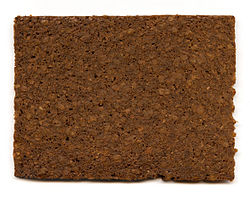
 A very dense wholegrain Westphalian pumpernickel | |
| Type | Rye bread |
|---|---|
| Place of origin | Germany |
| Region or state | Westphalia |
| Main ingredients | Rye flour, rye berries |

Pumpernickel (English: /ˈpʌmpərnɪkəl/; German: [ˈpʊmpɐˌnɪkl̩] ⓘ) is a typically dense, slightly sweet rye bread traditionally made with sourdough starter and coarsely ground rye. It is sometimes made with a combination of rye flour and whole rye grains ("rye berries").
At one time, it was traditional peasant fare, but largely during the 20th century various forms became popular with other classes through delicatessens and supermarkets. Present-day European and North American pumpernickel differ in several characteristics, including the use of additional leaveners. The less dense North American version may eschew rye grains, have coloring and flavoring agents, add wheat flour, glazed crust, a higher baking temperature, and a dramatically shortened baking time.
Etymology
[edit]

Contemporary English pumpernickel is a loanword from German Pumpernickel (compare also German Pompernickel and Bompernickel), referring to a black bread from Westphalia. The word is found in English-language literature as early as 1738. Before its use to refer to the bread, the German word was used to mean "lout" (and can later be found in southern German-speaking areas in use for "vivacious child" or "small, plump person or child"). The German word is constructed from two elements: Early modern German pumper meaning 'fart' (recorded in 1558 in this sense) or "to knock, fall noisily", from which the sense of "fart" derived (Middle High German pumpern). The second element, Nickel, is pet form of the name Nikolaus.[1] An earlier word for the bread is attested in English as cranck broat, meaning "sick bread".[1]
The Oxford English Dictionary highlights that while there is uncertainty around the exact sense of the word Pumpernickel as used in German to refer to the bread, "it is clearly depreciative", potentially a negative means of describing Westphalian bread by outsiders. According to the dictionary, "This type of bread was probably so called either on account of its being difficult to digest and causing flatulence or in a more general allusion to its hardness and poor quality".[1]
As early as the 1600s, a folk etymology is recorded that proposes that the name Pumpernickel derives from the French bon pour Nicole ("good only for Nicole"), where Nicole was purportedly the name of a horse. While false, this etymology is found in early modern German and is reflected in the form bonpournikel.[1]
Germany
[edit]Pumpernickel has been long associated with the Westphalia region of Germany, first referred to in print in 1450. Although it is not known whether this and other early references refer to precisely the bread that came to be known as Pumpernickel, Westphalian pumpernickel is distinguished by the use of coarse rye meal and a very long baking period, which gives the bread its characteristic dark color. Like most traditional all-rye breads, pumpernickel is made with an acidic sourdough starter, which preserves dough structure. The acid inactivates the rye protein, amylase, which converts the starch to sugar. That sourdough starter is sometimes augmented, or replaced, in commercial baking by adding citric acid or lactic acid along with commercial yeast.[2]

Traditional German pumpernickel contains no coloring agents, instead relying on the Maillard reaction to produce its characteristic deep brown color, its sweet, dark chocolate, coffee flavor, and its earthy aroma. To achieve this, loaves are baked in long, narrow lidded pans 16 to 24 hours in a low-temperature—about 120 °C (250 °F), steam-filled oven. Like French sandwich bread, or a Pullman loaf, Westphalian pumpernickel has little or no crust. It is very similar to rye Vollkornbrot, a dense rye bread with large amounts of whole grains added.[citation needed] German pumpernickel is often sold sliced in small packets in supermarkets, where it may be paired with caviar, smoked salmon, sturgeon, and other expensive products on an hors d'oeuvre tray.[citation needed]
Netherlands
[edit]Pumpernickel varieties are popular in the Netherlands, where it has been a common part of the diet for centuries.[3] It is known there as Fries roggebrood or 'Frisian rye bread', as this variety of rye bread originates in the Dutch province of Friesland, and is significantly different from, for example, Brabants roggebrood, rye bread made with yeast, from the province of North Brabant.
North America
[edit]The term "pumpernickel" is often used in North America, especially in the United States, to refer to an airy style of dark-colored wheat-and-rye sandwich bread or bagel originally popularized by Ashkenazi Jewish delis. These products often forgo the sourdough starter, long bake times, and steaming, and instead use baker's yeast and short dry bakes that do not allow for the same degree of Maillard browning as traditional German methods. To compensate, ingredients such as molasses, caramel color, coffee, and cocoa powder are added for both color and flavor. Some shops and bakeries, especially those in Canada, do use recipes that produce a traditional dense loaf.[4][5][6]
See also
[edit]References
[edit]- ^ a b c d Oxford English Dictionary, “pumpernickel (n.),” September 2024, https://doi.org/10.1093/OED/8482737662.
- ^ From the label of a German-style Pumpernickel sold by Trader Joe's in eastern Massachusetts
- ^ "Graansoorten" [Grain varieties]. Nederlands BakkerijMuseum. Archived from the original on 2018-11-13.
- ^ "Pumpernickel Bread: Real versus American-style". CooksInfo. 6 August 2010. Retrieved 28 February 2024.
- ^ Ephanov, Nikita (13 January 2024). "The Difference Between American And German Pumpernickel Bread". Yahoo Finance. Retrieved 28 February 2024.
- ^ Trillin, Calvin (27 March 2000). "The Magic Bagel". The New Yorker. p. 53. Retrieved 3 November 2020.
External links
[edit]- pumpernickel at the Merriam-Webster Online Dictionary
- How to make an American pumpernickel bread Archived 2008-05-11 at the Wayback Machine
- How to make authentic German pumpernickel bread
- Description of Schupp "bon pour Nicol" quotation
| History | |||||||||
|---|---|---|---|---|---|---|---|---|---|
| Types | |||||||||
| Religious dietary laws | |||||||||
| Chefs | |||||||||
| Religious foods | |||||||||
| Breads |
| ||||||||
| Sweets |
| ||||||||
| Pastries | |||||||||
| Fried foods | |||||||||
| Dumplings, pastas and grain dishes | |||||||||
| Casseroles and savory baked dishes | |||||||||
| Snacks and other baked goods | |||||||||
| Sandwiches | |||||||||
| Egg dishes | |||||||||
| Meat dishes | |||||||||
| Fish dishes | |||||||||
| Salads and pickles | |||||||||
| Vegetable dishes | |||||||||
| Soups and stews | |||||||||
| Cheeses and other dairy products | |||||||||
| Condiments, dips and sauces | |||||||||
| Beverages | |||||||||
| Herbs, spices and seasonings | |||||||||
| Eateries | |||||||||
| Related lists | |||||||||

| International | |
|---|---|
| National | |

Pumpernickel
View on GrokipediaOrigins and Etymology
Etymology
The word pumpernickel originates from the Westphalian dialect of Low German, where it is a compound of pumpern ("to break wind" or "to fart," an onomatopoeic term) and Nickel (a diminutive of Nikolaus, referring to a goblin, rascal, or devilish figure in folklore). This etymology yields a literal meaning of "devil's fart" or "goblin's fart," a humorous reference to the bread's dense, fibrous rye composition, which was believed to induce flatulence.[5][8] The earliest references to the coarse rye bread type from Westphalia appear in print around 1450, though these initially describe the food without using the specific term pumpernickel, which emerged later as a colloquial name for it.[9] The term entered English in the mid-18th century via German immigrants, with the first documented use in 1738; early English references preserved the derogatory and digestive connotations, often applying it to the bread's rustic quality.[5][10] While alternative folk etymologies exist—such as links to pumpen ("to bump" or "to pound," suggesting the bread's heaviness) or regional slang for unrefined peasant foods—linguists consider the flatulence-derived origin the most historically and phonetically supported explanation.[11][8]Historical Development
Pumpernickel originated in the Westphalia region of Germany during the 15th century as a staple peasant food crafted from coarse rye flour, which was more accessible and affordable than scarce wheat during periods of economic hardship and poor harvests.[12] The bread's first known printed reference dates to 1450, describing it as the "black bread of Westphalia," though it is unclear if this precisely matches the modern form.[9] Initially a simple, dense loaf suited to rural diets, it gained recognition for its durability, allowing it to remain edible for extended periods without preservatives.[13] By the 17th and 18th centuries, pumpernickel, often referred to as Schwarzbrot or black bread, became a valued component of army rations, particularly during the Thirty Years' War (1618–1648), due to its exceptionally long shelf life—up to several weeks—which made it ideal for military campaigns in resource-limited regions.[11] German soldiers subsisting on this coarse Westphalian peasant bread nicknamed it pumpernickel toward the war's end, a term possibly alluding to its reputed digestive effects in Low German dialect.[14] Its practicality extended its use beyond Westphalia, contributing to wider familiarity across Europe by the mid-18th century, as evidenced by its entry into English lexicon in the 1700s to denote a similar dark rye bread.[15] The 19th century brought industrialization to Westphalian baking, enabling the first commercial production of pumpernickel on a larger scale; for instance, baker Wilhelm Mestemacher established a specialized facility in Hamm in 1871, shifting from artisanal methods to mechanized processes while preserving traditional recipes.[16] This commercialization elevated pumpernickel from rural fare to a regionally recognized specialty, supported by early 20th-century German baking regulations that emphasized authenticity in rye bread production.[17] Following World War II, traditional pumpernickel baking declined as modern electric ovens replaced labor-intensive steam-baking techniques, leading to simplified, less authentic versions that prioritized speed over heritage methods.[18] A revival emerged in the 1980s and 1990s through cultural heritage initiatives and the back-to-basics Lebensreform movement, which championed whole-grain breads like pumpernickel for their nutritional value amid growing interest in pre-industrial foods.[17] This resurgence culminated in formal protection, with Westfälischer Pumpernickel receiving EU Protected Geographical Indication (PGI) status on November 21, 2014, ensuring adherence to Westphalian traditions and restricting the name's use to qualifying products from the region.[19]Traditional Preparation
Ingredients
Traditional pumpernickel relies on a simple set of ingredients centered around 100% coarsely ground whole rye berries or rye meal, often referred to as Roggenschrot or Schnuck, which imparts the bread's dense texture and allows for natural darkening through the Maillard reaction during prolonged baking.[20] This rye constitutes 100% of the flour content, made solely from wholemeal rye and rye grains with hulls and shoots without wheat or other grains, to qualify under protected designations.[21] Under PGI, optional ingredients include malt extract and sugar-beet syrup for subtle sweetness and enhanced browning. Leavening primarily comes from a natural sourdough starter in authentic recipes, though commercial yeast is optionally permitted under protected designations, with the sourdough preferment developing a tangy flavor through a 24- to 48-hour fermentation period.[20] The dough achieves approximately 100% hydration with water, creating a sticky, batter-like consistency that supports steam-based rising during baking, complemented only by salt for seasoning.[22] No added sugars, fats, or artificial colorants are used in traditional formulations, preserving the bread's rustic integrity.[21] The rye is ideally sourced from Westphalian fields within the protected geographical area, prioritizing local, whole-grain varieties to maintain regional authenticity and nutritional wholeness.[21]Baking Process
The traditional baking process for pumpernickel is a labor-intensive method that relies on low heat and extended time to develop its distinctive characteristics without additives or high temperatures. The process begins with mixing coarse rye meal with sourdough starter and water to create a stiff, sticky dough; this mixture is not kneaded but simply combined and allowed a short fermentation period of several hours, including proofing, before being portioned into lidded earthenware or metal pots.[23][22] The filled pots are sealed tightly to prevent drying and placed in a steam-injected oven for a prolonged baking period of 16 to 24 hours at temperatures ranging from 100°C to 120°C (212°F to 248°F).[24][22] This slow, moist heat environment facilitates enzymatic activity in the rye, where amylase enzymes break down complex starches into simpler sugars, contributing to the bread's subtle natural sweetness.[25] Simultaneously, the extended low-temperature exposure promotes a gradual Maillard reaction—a non-enzymatic browning process between amino acids and reducing sugars—that generates melanoidins responsible for the bread's deep dark color and caramelized notes, as well as key aroma compounds like 2-acetyl-1-pyrroline and guaiacol.[26] The sealed lids and steam prevent crust formation, yielding a dense, moist crumb with an earthy aroma derived from the Maillard reaction and caramelization of rye-derived sugars.[27] Upon completion of baking, the loaves remain in the pots and are cooled undisturbed for at least 24 hours at room temperature, allowing the structure to firm up and flavors to mature.[28] Traditionally, the cooled pumpernickel is sliced very thinly—often using a taut string or a specialized serrated knife—to preserve its texture and enhance its suitability for open-faced sandwiches.[22]Regional Variations
In Germany
In Germany, Westfälischer Pumpernickel holds Protected Geographical Indication (PGI) status under European Union law, registered on 21 November 2014, which mandates its production exclusively in the Westphalia region of North Rhine-Westphalia using traditional methods.[19] This certification ensures the bread is made solely from coarse rye meal or a mix of rye flour and whole rye grains sourced preferentially from the region, with no yeast, chemical raising agents, sugar, or other additives permitted.[29] The baking process occurs in a closed system at temperatures between 100°C and 130°C for a minimum of 16 hours, often extending to 24 hours, resulting in a dense, dark loaf with a slightly sweet flavor from natural caramelization via the Maillard reaction.[29] Contemporary production remains artisanal and limited, overseen by the Schutzgemeinschaft Westfälischer Pumpernickel e.V., an association founded in 2010 by five initial producers to safeguard the specialty.[30] These certified bakeries, such as the historic Haverland in Soest—dating back to 1570—prioritize handmade techniques and regional rye varieties, maintaining small-scale operations that preserve the bread's authenticity.[31] Unlike generic rye breads, which may incorporate wheat flour, shortenings, or faster baking for lighter textures, Westfälischer Pumpernickel emphasizes its characteristic heaviness, sour tang, and unadulterated composition, historically branded as a premium Westphalian product since the 19th century.[32] As a cornerstone of Westphalian cuisine, it is commonly enjoyed thinly sliced with butter, regional cheeses like Soester Käse, or cured meats such as Westphalian ham, reflecting its role in everyday meals and hearty spreads.[33] The bread features prominently in local cultural events, including trade fairs like the International Green Week in Berlin, where it showcases regional heritage.[34] Producers grapple with sustaining these traditions amid modern pressures, notably climate variability in the 2020s, which has led to fluctuating crop yields due to droughts and extreme weather.In the Netherlands
In the Netherlands, pumpernickel is commonly known as roggebrood or fries roggebrood, particularly in the northern province of Friesland, where it has been a dietary staple for centuries due to the region's historical reliance on rye cultivation. Introduced through proximity to Germany's Westphalian border, this adaptation evolved into a versatile everyday bread, diverging from the denser German original by incorporating regional baking practices that emphasize accessibility and milder flavors.[35][36] Dutch roggebrood typically blends rye flour with up to 30-50% wheat flour for a lighter, less compact crumb compared to the 100% rye German pumpernickel, resulting in a softer texture suitable for slicing. Sweetness is achieved through natural Maillard reactions during baking or additions like molasses or malt, yielding a slightly sweet-sour profile, while baking occurs for 8-12 hours or longer, often using covered or steamed methods.[37][38] Commercial production dominates, with brands like Bolletje leading since introducing pumpernickel-style roggebrood in 1967, often pre-sliced and packaged for convenience as a breakfast or lunch item. This mass production has integrated it deeply into modern Dutch cuisine, where it is frequently topped with butter, cheese, cold cuts, or served alongside pea soup (erwtensoep), enhancing its role in daily meals.[39][40] In recent years, organic and whole-grain variants have gained traction, maintaining the bread's softer crumb while appealing to health-conscious consumers, though traditional density remains a point of contrast with the German style.[35]In North America
Pumpernickel arrived in North America in the 19th century through waves of German and Eastern European Jewish immigrants, who adapted the bread to local tastes and production methods, particularly as a staple sandwich loaf in urban centers like New York City.[41] In the United States, it became a cornerstone of Jewish-American deli culture, often featured in iconic sandwiches such as pastrami on rye-and-pumpernickel swirl bread, reflecting the fusion of Old World traditions with American convenience.[42] North American versions diverge significantly from their Westphalian roots, typically incorporating refined rye flour blended with wheat flour for better rise and texture, along with molasses, coffee, or cocoa to achieve the signature dark color and subtle sweetness. Commercial yeast is used instead of natural sourdough, allowing for a shorter rising time of about 1 to 2 hours and baking in 40 to 60 minutes, resulting in a lighter, airier loaf suitable for slicing.[43][44] Commercial brands like Pepperidge Farm played a key role in popularizing pre-sliced pumpernickel nationwide starting in the mid-20th century, making it accessible beyond ethnic enclaves and embedding it in everyday American baking.[45] Regional differences emerged, with denser, heartier loaves common in Midwest communities with strong German heritage, such as Pennsylvania Dutch areas, while East Coast varieties tend to be lighter and more refined. In Canada, pumpernickel often includes caraway seeds for added flavor, aligning with broader rye bread traditions influenced by European settlers.[46] In the 21st century, a revival among artisanal bakers has seen efforts to recreate more authentic, slower-fermented versions using whole rye grains and minimal additives, though sweetened commercial loaves continue to dominate supermarket shelves.[47]Cultural Significance and Modern Uses
Culinary Applications
In traditional German cuisine, pumpernickel is often served in thin slices as part of Brotzeit, a casual snack or light meal featuring open-faced sandwiches with cold cuts, cheeses, and spreads. It pairs particularly well with Westphalian ham, a smoked, cured pork specialty from the same region, enhancing the bread's dense, slightly sweet rye flavor with the ham's salty richness. Similarly, it complements liverwurst, a smooth liver sausage, and quark, a fresh, creamy cheese, creating balanced bites that highlight the bread's hearty texture.[48][49][50] Internationally, pumpernickel serves as a base for open-faced sandwiches, including influenced versions of Denmark's smørrebrød, where it substitutes for traditional rugbrød in toppings like smoked salmon, roast beef, or pickled herring, providing a robust, earthy foundation. In Jewish deli traditions, particularly in North America, pumpernickel is a staple for the Reuben sandwich, layered with corned beef, Swiss cheese, sauerkraut, and Russian dressing, its malty depth contrasting the tangy fillings.[51][52][53][54] Modern recipes incorporate pumpernickel in creative ways, such as toasting cubes into croutons for salads, where its chewy texture adds crunch without overpowering dressings. It also features in holiday stuffings, combined with sausage, apples, and herbs for a flavorful side dish that brings rye's nuttiness to festive meals. Contemporary fusion dishes include avocado toast on pumpernickel slices, topped with sea salt and chili flakes, offering a nutrient-dense, earthy twist on the trend.[55][56][57] For beverage pairings, pumpernickel's rye earthiness matches well with German Altbier, a malty amber ale that echoes the bread's subtle sweetness, or Scandinavian aquavit, whose caraway notes complement it alongside smoked fish or charcuterie. It generally avoids acidic wines, as high-acidity varieties can clash with the bread's robust profile, favoring softer, fruit-forward options instead.[58][59][60] In the 2020s, pumpernickel has gained traction in health-focused menus, valued for its high fiber content in vegan recipes like oil-free loaves or bagel alternatives, and low-carb adaptations that maintain satiety without refined grains.[61][62][63]Nutritional Profile
Pumpernickel bread, particularly the traditional German variety made from 100% whole rye grains, offers a nutrient-dense profile dominated by complex carbohydrates and fiber. Per 100 grams, it typically contains approximately 45-50 grams of carbohydrates, primarily from the starchy endosperm and bran of rye grains, along with 10-15 grams of dietary fiber derived from the coarse rye bran that contributes to its dense texture.[64][65] Protein levels hover around 8-9 grams, sourced from the proteins in rye, while fat content remains low at 2.5-3.5 grams, making it a suitable option for those seeking sustained energy without excess calories.[66] In terms of micronutrients, pumpernickel is notably rich in several B vitamins, including thiamine (about 0.4 mg per 100 grams) and niacin (around 3.8 mg), which support energy metabolism, as well as magnesium (approximately 36-50 mg) and iron (2.8 mg).[66][67] These nutrients stem from the whole-grain rye base, which retains the bran and germ layers. The bread's glycemic index is low, typically ranging from 45 to 56, attributed to the slow breakdown of its dense, unrefined starches during digestion.[68][69] The high fiber content in traditional pumpernickel promotes digestive health by aiding regularity and supporting gut microbiota, while also contributing to cardiovascular benefits through cholesterol-lowering effects.[70][71] Its natural sugars, formed during the prolonged low-temperature baking process, provide steady energy release without sharp blood sugar spikes, enhancing satiety.[72] A 2025 meta-analysis of randomized controlled trials indicated that rye consumption, including breads like pumpernickel, reduces postprandial insulin area under the curve, potentially lowering type 2 diabetes risk when incorporated regularly into diets.[73] Compared to North American adaptations, traditional German pumpernickel boasts higher fiber (up to 15 g per 100 g in whole rye formulations) and lacks added sugars, whereas U.S. versions often include 1-2 grams of sweeteners like molasses per slice, resulting in a lighter texture and slightly elevated glycemic response.[74][66] However, rye-based breads like pumpernickel contain phytic acid, an antinutrient in the bran that can bind minerals such as iron and zinc, potentially reducing their absorption by 50-80% in some cases.[71][75] For optimal integration into a balanced diet, nutrition experts recommend 1-2 slices (about 50-60 grams total) daily, paired with protein or healthy fats to maximize benefits and mitigate any phytic acid effects through varied nutrient intake.[70]| Nutrient (per 100g) | Amount | % Daily Value* |
|---|---|---|
| Carbohydrates | 45-50g | 16-18% |
| Dietary Fiber | 10-15g | 36-54% |
| Protein | 8-9g | 16-18% |
| Total Fat | 2.5-3.5g | 3-5% |
| Magnesium | 36-50mg | 9-12% |
| Iron | 2.8mg | 16% |
| Thiamine (B1) | 0.4mg | 33% |