


Community hub
Recent from talks
Contribute something
Nothing was collected or created yet.
Israeli couscous
View on Wikipedia | |||||||
| Alternative names | Ben-Gurion rice Israeli couscous | ||||||
|---|---|---|---|---|---|---|---|
| Type | Pasta | ||||||
| Course | Side dish | ||||||
| Place of origin | Israel | ||||||
| Created by | Osem | ||||||
| Main ingredients | Wheat | ||||||
| 200 kcal (840 kJ)[1] | |||||||
| |||||||
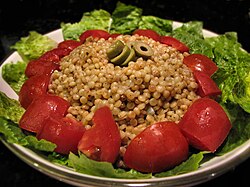
Ptitim (Hebrew: פְּתִיתִים, pṯīṯīm, lit. 'flakes', singular: פְּתִית, pṯīṯ, lit. 'flake')[2] is a type of toasted grain-shaped pasta. Other names for it include Ben-Gurion rice (used especially for the original rice-shaped varieties) and Israeli couscous (used especially for the ball-shaped varieties), both terms hinting at its origins in the rice shortages experienced in 1950s Israel.[3]
History
[edit].jpg)
Ptitim was created in 1953,[4] during the austerity period in Israel.[5]
Israel's first prime minister, David Ben-Gurion, asked Eugen Proper, one of the founders of the Osem food company, to devise a wheat-based substitute for rice.[6] The company took up the challenge and developed ptitim, which is made of hard wheat flour and toasted in an oven. Ptitim was initially produced with a rice-shape, but after its success Osem also began to produce a ball-shaped variety inspired by couscous.[7]
Consequently, ptitim is sometimes called "Ben-Gurion rice".[3]
Preparation
[edit]Ptitim is made by extruding dough through a round mold, before it is cut and toasted, giving it the uniform natural-grain-like shape[7] and its unique nutty flavor.[8] Unlike common types of pasta and couscous, ptitim was factory-made from the outset, and therefore is rarely seen home-made from scratch. The store-bought product is easy and quick to prepare.[9]
In Israel, ptitim is popular among children, who eat it plain, or mixed with fried onion and tomato paste.[6] Ptitim is now produced in ring, star, and heart shapes for added appeal.[3] Varieties made with whole wheat and spelt flour are also available for health-conscious consumers.[10][6] Ptitim has also been popularised in other countries,[3] and in the United States, it can be found on the menus of contemporary American chefs and in gourmet markets.[11]
.jpeg)

Ptitim can be used in many different types of dishes, both hot and cold.[9] The grains retain their shape and texture even when reheated, and they do not clump together.[11] Commonly, ptitim is prepared with sautéed onions or garlic (vegetables, meat, chicken or sausage can also be added). The ptitim grains may be fried for a short time before adding water.[3] They can also be baked, go in soup, served in a pie, used for stuffing, or made as a risotto.[6] Ptitim may also be used in other dishes as a substitute for pasta or rice.[12] American chef Charlie Trotter has produced a number of recipes for ptitim-based gourmet dishes,[6] even as a dessert.[7]
Similar products
[edit]European Foods
[edit]Ptitim is very similar to the German farfel, which was brought by German Jews from Europe beginning in the 1800s, and the two are often substituted for each other.[13]
The Sardinian fregula is a hand-rolled, toasted semolina product dating back to the 14th century. Ptitim has a similar nutty flavour to fregula, but is extruded rather than rolled.
Ptitim also resembles some products of the pastina family, in particular acini di pepe, orzo ("risoni") and stellini. However, unlike pastina, the ptitim grains are pre-baked/toasted[14].
Southwest Asian and North African Foods
[edit]Moghrabieh in Jordan, Lebanon and Syria is made from durum wheat semolina, maftoul in Palestinian cuisine is made from bulgur and wheat, and Amazigh berkoukes (aka abazine, aïch) is semolina-based.[14][5]
Berkoukes is documented in North African literature as early as the 12th century, and maftoul and moghrabieh likely date back to the early modern period, when couscous was brought to the Levant from North Africa.
While ptitim is produced by extrusion through a die like many pastas,[13] moghrabieh, maftoul and berkoukes are produced by rolling dough between the palms or fingers, or between the hands and a flat surface.[4] Ptitim is toasted before it is packaged and sold, while moghrabieh, maftoul and berkoukes are sold untoasted, but often toasted during their preparation by the consumer.
See also
[edit]

References
[edit]- ^ USDA FoodData Central: ORIGINAL Israeli(PEARL) COUSCOUS, ORIGINAL (Branded, 1068523). Access date 2021-01-10. Publish date 2020-08-27
- ^ "Wondering about Israeli Couscous or How to Cook It?". The Spruce Eats.
- ^ a b c d e Gur, Janna (2008). "Simple Pleasures". The Book of New Israeli Food: A Culinary Journey. Schocken Books. p. 127. ISBN 978-0805212242.
- ^ a b Crum, Peggy (10 February 2010). "Featured Food: Israeli Couscous" (PDF). Recipe for Health. Residential and Hospitality Services, Michigan State University. Retrieved 7 April 2017.
- ^ a b Marks, Gil (2010). "Couscous". Encyclopedia of Jewish Food. Houghton Mifflin Harcourt. pp. 315–317. ISBN 978-0544186316.
- ^ a b c d e Doram Gaunt (9 May 2008). "Ben-Gurion's Rice". Haaretz.
- ^ a b c Martinelli, Katherine (3 November 2010). "Ben Gurion's Rice and a Tale of Israeli Invention". Food. The Forward.
- ^ "Stocking Your Fridge and Pantry". What Good Cooks Know: 20 Years of Test Kitchen Expertise in One Essential Handbook. America's Test Kitchen. 2016. p. 134. ISBN 978-1940352664.
- ^ a b Callard, Abby (22 March 2010). "Newly Obsessed With Israeli Couscous". Arts & Culture. Smithsonian. Washington, D.C.
- ^ Sharon Wrobel (6 July 2006). "Half of Israeli households buy low-fat products". The Jerusalem Post.
- ^ a b Faye Levy (5 October 2007). "Petit ptitim". The Jerusalem Post.
- ^ Meador, David (14 October 2015). "Squash provides fantastic fall flavors". Living, Food & Drink: Cooking with Local Chefs. The Bradenton Herald.
- ^ a b Koenig, Leah. "The Truth About Israeli Couscous". Taste Cooking. Retrieved 4 September 2023.
- ^ a b "Israeli Couscous". GourmetSleuth.com. Archived from the original on 26 June 2012. Retrieved 5 June 2012.
External links
[edit]
- How to Cook Israeli Couscous
- Israeli Couscous Recipes Archived 2014-07-13 at the Wayback Machine
| History | |||||||||
|---|---|---|---|---|---|---|---|---|---|
| Types | |||||||||
| Religious dietary laws | |||||||||
| Chefs | |||||||||
| Religious foods | |||||||||
| Breads |
| ||||||||
| Sweets |
| ||||||||
| Pastries | |||||||||
| Fried foods | |||||||||
| Dumplings, pastas and grain dishes | |||||||||
| Casseroles and savory baked dishes | |||||||||
| Snacks and other baked goods | |||||||||
| Sandwiches | |||||||||
| Egg dishes | |||||||||
| Meat dishes | |||||||||
| Fish dishes | |||||||||
| Salads and pickles | |||||||||
| Vegetable dishes | |||||||||
| Soups and stews | |||||||||
| Cheeses and other dairy products | |||||||||
| Condiments, dips and sauces | |||||||||
| Beverages | |||||||||
| Herbs, spices and seasonings | |||||||||
| Eateries | |||||||||
| Related lists | |||||||||

| Types |
| ||||||||||
|---|---|---|---|---|---|---|---|---|---|---|---|
| Cooking | |||||||||||
| Producers |
| ||||||||||
| Equipment manufacturers | |||||||||||
| See also | |||||||||||
Israeli couscous
View on GrokipediaOverview and Characteristics
Definition and Physical Properties
Israeli couscous, known in Hebrew as ptitim, is a type of extruded and toasted pasta made primarily from durum wheat semolina or hard wheat flour mixed with water. The dough is forced through perforated plates to form small pellets, which are then baked in an oven, imparting a characteristic toasted flavor and color. This distinguishes it from traditional North African couscous, which consists of steamed granules of semolina rather than a baked pasta product.[6][7][8] The most common form features round, pearl-like shapes, though original versions were rice-shaped and variants include stars or small squares. These pearls are larger than those of Moroccan couscous, typically measuring several millimeters in diameter, with a dry, hard uncooked texture and a light golden-brown appearance due to the toasting process. Some commercial products incorporate additives like rosemary extract for preservation.[9][10][11] When prepared by boiling, the pearls expand and develop a tender yet chewy al dente texture, accompanied by a mild, nutty taste derived from the toasting. This chewiness and flavor absorption make it suitable for various dishes, contrasting with the fluffier consistency of steamed traditional couscous. Nutritional composition per 100g uncooked includes approximately 360 kcal, with low fat (around 1.5g) and high carbohydrates from the wheat base.[12][13][14]Distinction from Traditional Couscous
Traditional couscous, originating from North African culinary traditions such as those in Morocco, consists of fine granules formed by moistening and rolling semolina wheat flour into tiny balls approximately 0.5 to 1 millimeter in diameter.[15] These granules are traditionally steamed rather than boiled, yielding a light, fluffy texture that readily absorbs broth flavors without becoming chewy.[16] Israeli couscous, known as ptitim in Hebrew, features much larger, pea-sized pearls around 5 millimeters in diameter, produced by extruding a dough of hard wheat semolina and wheat flour through perforated plates to form uniform spheres, followed by oven-toasting.[17][18] This manufacturing yields a denser, chewier bite with a nutty, toasted flavor absent in traditional varieties, which undergo no roasting.[19] Preparation methods diverge accordingly: traditional couscous requires multiple steamings in a couscoussier over simmering liquids for 15-30 minutes to separate and fluff the grains, while Israeli couscous cooks like pasta by boiling in salted water or stock for 8-10 minutes to an al dente consistency.[15][18] The larger size and toasted exterior of Israeli couscous make it less prone to clumping and more suitable for standalone dishes, contrasting the delicacy of traditional couscous best suited to stews.[20]Historical Development
Origins in 1950s Israel
![Ptitim development under Ben-Gurion][float-right] In 1953, during Israel's austerity period following the War of Independence, Prime Minister David Ben-Gurion tasked the Osem food company with developing a domestic rice substitute amid severe shortages of imported rice.[21] [22] Osem, founded by Jewish immigrants and known for wheat-based products, responded by inventing ptitim—small, toasted spheres of wheat flour and semolina extruded and baked to mimic rice grains in texture and appearance.[3] [2] This innovation leveraged Israel's abundant wheat supplies, which were cheaper and more readily available than rice, addressing both economic constraints and food security needs in a young nation absorbing mass immigration.[4] The product, named ptitim (Hebrew for "little flakes" or "crumbles"), was quickly adopted and popularly dubbed "Ben-Gurion rice" in reference to its origins.[23] [24] Developed under the direction of Osem co-founder Eugen Proper, ptitim provided a versatile, nutritious staple that integrated into everyday meals, helping sustain the population through rationing until economic stabilization in the late 1950s.[21] While initially a pragmatic response to scarcity rather than a culinary tradition, its enduring popularity reflects Israel's post-independence emphasis on self-reliance and resourcefulness in food production.[3]Role in Austerity Measures
In the early years of the State of Israel, following independence in 1948, the country implemented stringent austerity measures from 1949 to 1959 to manage severe economic constraints, including food rationing and import restrictions amid ongoing immigration and limited foreign currency reserves.[21] Rice, a preferred staple, faced acute shortages due to reliance on imports and high costs, prompting the government to seek domestic wheat-based alternatives to reduce dependency and ensure food security.[3][2] In 1953, Prime Minister David Ben-Gurion directly commissioned Eugen Proper, a founder of the Osem food company, to develop a rice substitute using locally abundant wheat flour rather than scarce imports.[21][3] Osem responded by inventing ptitim, oven-toasted semolina pellets initially molded into rice-like grains, which could be produced efficiently at scale and provided a similar texture and versatility when cooked.[2][25] This innovation, quickly nicknamed "Ben-Gurion rice," directly addressed rationing challenges by offering an affordable, nutritious option that stretched limited resources and supported caloric needs during the regime's distribution quotas.[3][1] The introduction of ptitim played a pivotal role in sustaining civilian diets under austerity, as its wheat base aligned with Israel's agricultural strengths and government subsidies for domestic grains, helping to mitigate malnutrition risks in a population swelled by over 700,000 immigrants between 1948 and 1951.[21] Its rapid adoption—initially distributed through ration cards—demonstrated practical efficacy, with production expanding to pearl-like shapes by the late 1950s, evolving from a mere substitute into a culturally embedded food while underscoring state-led ingenuity in crisis response.[3][26]Production Process
Manufacturing Techniques
Israeli couscous, known as ptitim in Hebrew, is produced industrially from semolina derived from hard wheat flour mixed with water to form a dough.[26] This dough is extruded through perforated dies or round molds to create uniform spherical or rice-like pellets, a process that ensures consistent size and shape unlike hand-rolled traditional couscous.[5] [27] Following extrusion, the pellets are cut to precise lengths and typically dried to set their form and reduce moisture content.[27] The key step involves toasting or roasting the dried pellets in large industrial ovens at high temperatures, which caramelizes the exterior, imparts a distinctive nutty flavor, and hardens the grains for extended shelf life and resistance to overcooking during preparation.[26] [4] This toasting differentiates ptitim from untoasted pasta forms and contributes to its chewy texture when boiled.[5] Commercial production, pioneered by the Osem company in 1953, relies on automated machinery for scalability, with variations in pellet size (typically 2-3 mm in diameter for pearl shapes) and optional additions like salt during dough mixing.[3] Modern facilities maintain strict quality controls to ensure uniformity, though artisanal or small-batch replications may involve manual extrusion approximations, which are less precise.[5]Commercial Production and Variations
Israeli couscous, or ptitim, is manufactured industrially by extruding a mixture of wheat flour and water through perforated plates to form small spherical pearls or rice-like grains, followed by roasting in ovens to dehydrate and toast the product, giving it a nutty flavor and firm texture.[28] This mechanized process, distinct from the hand-rolled methods of traditional North African couscous, was developed for large-scale output and has been the standard since its inception.[29] The roasting step, typically conducted at high temperatures, hardens the granules and prevents them from becoming mushy when boiled, allowing for extended shelf life and consistent cooking results in commercial packaging.[4] [30] Primary production occurs in Israel by companies like Osem, using hard wheat semolina as the base ingredient, though the process is replicated internationally.[1] Variations in commercial ptitim include the original rice-shaped form, introduced first, and the later pearl-shaped version, which dominates global markets for its chewiness and versatility.[31] [1] Some brands offer whole wheat variants for higher fiber content, made by substituting whole grain flour in the extrusion process.[13] Tri-color pearl couscous, infused with vegetable extracts for hues like red, green, and orange, provides visual appeal while maintaining the toasted profile.[17] Leading brands such as Roland, Osem, RiceSelect, and Bob's Red Mill produce these, with Osem retaining traditional Israeli recipes and others adapting for export markets.[32]Culinary Preparation and Uses
Basic Cooking Methods
Israeli couscous, or ptitim, is typically prepared using an absorption method that involves toasting the pearls in fat before simmering in liquid to achieve a tender yet chewy texture.[33][12] In this approach, 1 cup of dry couscous is heated in a saucepan over medium-high heat with 1-2 tablespoons of oil or butter, stirring frequently until the pearls turn lightly golden and emit a nutty aroma, which takes 4-5 minutes and helps seal the starch for better liquid absorption without disintegration.[34][35] Boiling broth or water—using a ratio of 1:1.25 to 1:1.5 (1 cup dry couscous to 1¼–1½ cups water or broth)—is then added along with salt to taste, brought to a boil, covered, and simmered on low heat for 10-15 minutes until the liquid is fully absorbed and the pearls are al dente.[36][12] The pot is removed from heat, left covered for 5 minutes to steam, and fluffed with a fork before serving.[37] An alternative boiling method treats Israeli couscous like pasta, suitable for quicker preparation or when draining excess liquid is preferred.[29] A large pot is filled two-thirds with salted water and brought to a rolling boil, the couscous (about 8 ounces per 4 quarts water) is added, and simmered uncovered for 8-10 minutes until al dente, followed by draining in a colander.[29] This method yields looser grains but may result in less flavor intensity compared to toasting, as the initial dry-heating step enhances nuttiness and texture firmness.[38][35] Both techniques accommodate additions like onions or garlic sautéed beforehand for base flavor, though basic versions omit them to highlight the product's inherent toasted wheat profile.[12] Overcooking risks mushiness due to the pearls' dense structure from extrusion and oven-toasting during manufacturing.[33]Traditional Israeli Applications
In Israeli households, ptitim has traditionally been prepared as a simple, quick-cooking side dish, often boiled in water or broth and flavored minimally with tomato paste or diluted ketchup to impart a red hue and mild tang, serving as an everyday staple particularly favored by children.[39] This preparation echoes its origins as a rice substitute, where it is cooked al dente in about 8-10 minutes and paired with proteins like chicken or vegetables in one-pot meals.[40] Home cooks frequently sauté onions in oil or butter before adding the grains and liquid, enhancing flavor without complexity, a method rooted in mid-20th-century resource constraints.[41] Ptitim also features in traditional soups and stews, where it absorbs broth flavors while maintaining texture, as in vegetable or chicken-based marak (soup) dishes common in family settings.[42] For variety, it may be fried lightly in fat prior to simmering, yielding a nuttier taste suitable for accompaniments to grilled meats or stews, reflecting its versatility in everyday Ashkenazi and Sephardi-influenced home cooking.[41] These applications prioritize affordability and ease, with portions typically yielding 2-3 cups cooked from 1 cup dry, emphasizing its role in sustaining growing populations post-1950s.[2]Global Recipe Adaptations
Israeli couscous, known internationally as pearl couscous, has been adapted into fusion recipes that blend its chewy texture with flavors from diverse culinary traditions, particularly in North American and European contexts where it serves as a versatile grain substitute in salads, pilafs, and side dishes.[43][44] In Asian-inspired preparations, it pairs with ingredients like ginger, soy sauce, and baby bok choy to create stir-fry-like dishes that mimic rice-based recipes while leveraging its pasta-like qualities for better sauce absorption.[43] Similarly, Thai adaptations incorporate grated carrots, scallions, peanuts, and bouillon for a vibrant salad evoking Southeast Asian noodle dishes.[44] Other variations include shiitake mushrooms with quinoa for an umami-rich side, highlighting its compatibility with East Asian mushrooms and proteins.[45] Mediterranean and Italian influences appear in pesto-infused pilafs with carrots, where the couscous absorbs basil-garlic flavors akin to orzo in risotto-style preparations.[46] In broader Western applications, recipes top it with crispy garlic-anchovy breadcrumbs for a garlicky crunch, adapting it into comforting, pasta-esque mains.[47] These adaptations, popularized since the early 2000s through commercial availability in the U.S. and Europe, emphasize cold or room-temperature servings in bowls with fruits like Asian pears, cranberries, and ginger vinaigrette for seasonal salads.[48]Nutritional Profile
Macronutrients and Micronutrients
A standard uncooked serving of Israeli couscous (approximately 45 grams, equivalent to about 1/4 cup dry) yields roughly 170-180 calories, with the majority derived from carbohydrates (35-40 grams), followed by protein (6-8 grams) and negligible fat (0-1 gram).[49][13] Dietary fiber contributes 2 grams per serving in refined varieties, increasing to 4-5 grams in whole wheat formulations due to retained bran.[50] When cooked (typically yielding 1 cup or 135-157 grams), values adjust to about 200-213 calories, 40-42 grams carbohydrates, 7-8 grams protein, 1-2 grams fiber, and under 2 grams fat, reflecting water absorption without significant nutrient loss from boiling.[51][52]| Nutrient (per 45g dry serving) | Amount | Notes |
|---|---|---|
| Calories | 170-180 | Primarily from complex carbohydrates[49][13] |
| Carbohydrates | 35-40g | Includes minimal sugars (0.5-1g)[50] |
| Protein | 6-8g | Plant-based, comparable to other wheat pastas[53] |
| Total Fat | 0-1g | Low saturated fat content[49] |
| Dietary Fiber | 2g | Higher (up to 5g) in whole wheat variants for digestive support[50] |