


Community hub
Recent from talks
Contribute something
Nothing was collected or created yet.
Taramasalata
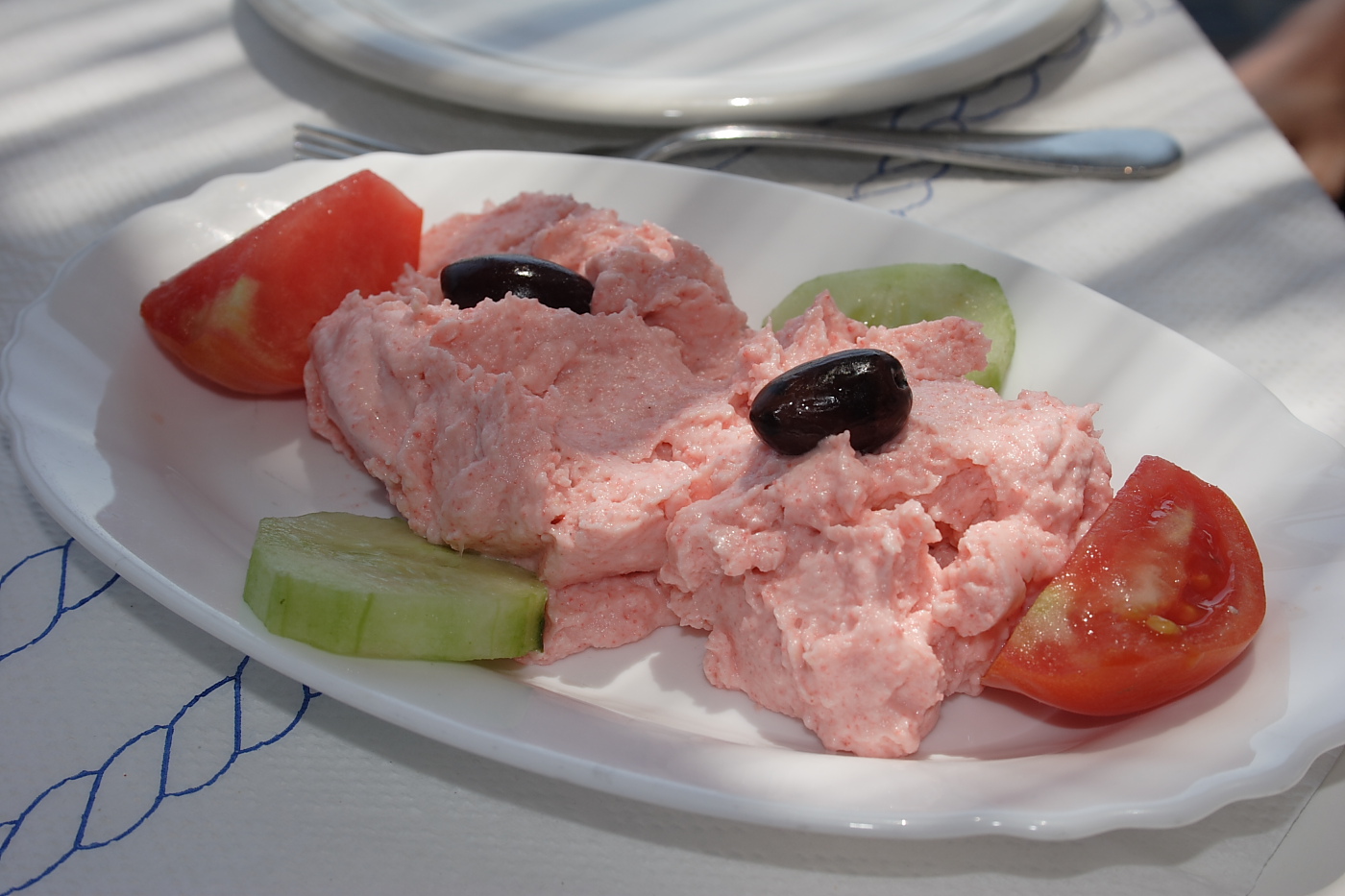
View on Wikipedia A plate of taramasalata with garnishes | |
| Type | Spread |
|---|---|
| Course | Meze |
| Place of origin | Greece |
| Main ingredients | Tarama (salted and cured roe of cod or carp), bread crumbs or mashed potatoes, lemon juice or vinegar, olive oil |

Taramasalata or taramosalata (Greek: ταραμοσαλάτα; from taramás 'fish roe' < Turkish: tarama[1] + Greek: saláta 'salad' < Italian: insalata[2]) is a meze made from tarama, the salted and cured roe (colloquially referred to as caviar) of the cod, carp, or grey mullet (bottarga) mixed with olive oil, lemon juice, and a starchy base of bread or potatoes, or sometimes almonds. Variants may include garlic, spring onions, or peppers, or vinegar instead of lemon juice.[3][4] While not traditionally Greek, smoked rather than cured cod's roe is more widely available in some places, and often used. Bottarga is usually much more expensive than cod roe.[5]
Traditionally the dish is made with a pestle and mortar, giving a slightly grainy texture, but commercial taramasalata is usually very smooth.[5]
Taramasalata is usually served as a meze, often with ouzo, as a spread on bread.[6] The colour can vary from creamy beige to pink, depending on the type of roe and colourings used. Most taramasalata sold commercially is dyed pink, but high-quality taramasalata is beige.[3]
In Greece, taramasalata is often served on Clean Monday (Καθαρά Δευτέρα, Kathará Deftéra), the first day of Great Lent, with onions and lemon.[6]
Etymology
[edit]Borrowed from Greek word ταραμάς (roe), itself a borrowing from Turkish tarama.[7] Normally, tarama is the salted roe itself, but sometimes the prepared dish is also called tarama.[4]
The spelling taramosalata reflects the Greek, but in English the a spelling is common.[8]
Salată de icre
[edit]
.jpg)
A similar dip or spread, salată de icre ('roe salad' in Romanian) is also common in Romania and Bulgaria (known as хайвер, or haiver), and Israel (where it is known as ikra). It is made with pike or carp roe, but generally with sunflower or vegetable oil instead of olive oil, sometimes with a thickener like white bread. It is mass-produced and is widely available in grocery shops and supermarkets, as well as being made at home, in which case chopped onions are commonly added. It has a consistency and taste similar to mayonnaise, with the roe taking the place of the egg as protein.[citation needed] The traditional production method of salată de icre is standardized under the Romanian departmental standard N.I.D. 927-70 N 23 and registered as an EU Traditional Speciality Guaranteed under the name "Salată tradițională cu icre de carp". The roe of this product is for over 50% carp based.[9]
A dip, fasole bătută or fasole făcăluită (mashed beans), prepared with mashed beans, sunflower oil, garlic and chopped onions, is sometimes called icre de fasole (beans roe).[10]
See also
[edit]
References
[edit]- ^ Ayverdi, İlhan (2005). "tarama". Misalli Büyük Türkçe Sözlük [Misalli Great Turkish Dictionary]. Vol. 3 (O–Z). Kubbealtı. p. 3069. ISBN 975-6444-24-X.
- ^ "taramasalata". The American Heritage Dictionary of the English Language. Houghton Mifflin Company.
- ^ a b Kochilas, Diane (February 28, 2012). "Tarama, Greek cod roe, explained". DianeKochilas.com. Retrieved January 27, 2017.
- ^ a b Basan, Ghillie; Basan, Jonathan (15 April 1997). Classic Turkish Cooking. Macmillan. p. 68. ISBN 0312156170.
- ^ a b Felicity Cloake (13 May 2015). "How to make the perfect taramasalata". The Guardian. Retrieved 4 June 2017.
- ^ a b Susanna Hoffman, Victoria Wise, The Olive and the Caper: Adventures in Greek Cooking, 2004, ISBN 1563058480, p. 43
- ^ Georgios Babiniotis, ed., Λεξικό της Νέας Ελληνικής Γλώσσας
- ^ Taramosalata is the spelling in the Oxford English Dictionary, with -a- given as an alternate form. -a- is the only spelling given in The Macquarie Dictionary (1995) for Australian English; in Chambers Dictionary (1994), Collins English Dictionary 6th Edition (2003), Concise Oxford Dictionary 9th Edition (1995), and The Times English Dictionary (2000), all of which represent British English but indicate alternate US spellings and indicate nothing here. -o- is also given, but second so that -a- is preferred, by Longman Dictionary of the English Language (1988) (British publisher). The word was not given at all a few decades ago such as in [Merriam-]Webster's New Collegiate Dictionary (1977) or their three-volume 3rd International (1971) and is now given with -a- in The American Heritage Dictionary, see note above.
- ^ "Publication of an application for registration of a name pursuant to Article 50(2)(b) of Regulation (EU) No 1151/2012 of the European Parliament and of the Council on quality schemes for agricultural products and foodstuffs (2021/C 222/09)". European Union.
- ^ Perianu, Catherina (2008). "Précarité alimentaire, austérité" [Food insecurity and austerity]. Manger pendant la dernière décennie communiste en Roumanie / Eating in the last decade of Communism in Romania (in French). 6 (6). doi:10.4000/aof.4513. Retrieved 2012-02-24.

| Fish | |
|---|---|
| Shellfish | |
| Other seafood | |
| Processed seafood | |
| Seafood dishes | |
| Health hazards | |
| Advisory services | |
| Animal welfare | |
| Related topics | |


Taramasalata
View on GrokipediaOverview and Description
Definition and Composition
Taramasalata is a traditional Greek and Turkish meze, served as an appetizer or dip in Mediterranean cuisine. It is primarily made from salted and cured fish roe, known as tarama, which serves as the foundational ingredient providing a briny, savory base. The roe is typically sourced from cod or carp, though variations may include mullet or other species, contributing to its distinctive seafood character.[2] The core composition involves blending the fish roe with olive oil and lemon juice to create a smooth, emulsified texture, while a starch base such as soaked bread or mashed potatoes is incorporated to achieve a creamy consistency and balance the saltiness. This combination results in a versatile cold spread or paste that is spreadable and suitable for pairing with bread or vegetables. Depending on the roe type, taramasalata exhibits a color ranging from creamy beige to pale pink, with commercial versions sometimes artificially dyed for vibrancy.[2][6] In Orthodox Christian traditions, taramasalata holds particular significance during Lent, as it is fish-based and thus permissible under fasting rules that prohibit meat and dairy, making it a nutritious option in Lenten meals.[7]Sensory Characteristics
Taramasalata presents as a smooth, emulsified paste, typically exhibiting a beige tone when prepared with smoked cod roe or carp roe.[8] Commercial varieties often feature a brighter pink color due to added dyes, while traditional versions maintain a more subdued, natural shade.[2] The texture of taramasalata is creamy and highly spreadable, owing to the emulsification process that incorporates oil and starch for a velvety consistency.[9] A subtle graininess from the roe particles provides a gentle contrast, particularly in homemade preparations, whereas commercial versions tend to be smoother and more uniform.[2] This balance contributes to its versatile mouthfeel as a meze spread. In terms of flavor, taramasalata offers a salty and briny profile dominated by the roe, tempered by the tangy acidity of lemon that cuts through the richness of olive oil.[10] Subtle fishy undertones emerge without overwhelming the palate, creating a harmonious savory depth.[11] The roe and oil play key roles in establishing this balanced, addictive taste.[9] The aroma of taramasalata is mildly oceanic, reflecting the sea-derived roe, with faint citrusy notes that evoke fresh maritime elements.[2]History and Etymology
Origins in Greek Cuisine
The practice of preserving and consuming fish roe in Greece dates back to ancient times, where salted fish and roe, known as tarichi, served as dietary staples and were offered in rituals to deities like Poseidon for safe maritime voyages.[12][13] These early traditions evolved into more structured preserved roe dishes during the Byzantine Empire, where salted roe known as taramas was a common staple, particularly in monastery kitchens, serving as an affordable alternative to imported caviar for the less affluent.[12] During the 11th and 12th centuries, high-ranking monks of noble origin consumed similar roe preparations, including botargo, during Lenten fasts, as documented in contemporary texts like Symeon Seth's Properties of Foods, which noted their prevalence despite occasional dietary cautions.[5] These Byzantine practices reflected broader Eastern Mediterranean traditions of preserving fish eggs through salting, influenced by the region's abundant seafood resources. Under Ottoman rule, taramas gained further traction as salted fish roe became more accessible in the late 18th century, with exports making premium varieties like black caviar available to commoners, while taramas from cod or carp remained a humble option relished during fasts, as observed in 1830 accounts from Ioannina.[5] By the 19th century, taramas preparations evolved into a distinct Lenten food in Greece, utilizing locally abundant carp or cod roe from the Aegean Sea, aligning with Orthodox fasting customs that prohibited meat and dairy but permitted certain seafood.[7] This period saw its integration into meze culture, with early mentions in Greek culinary writings, such as pre-World War I descriptions of red caviar-based dips.[5] The dish's presence in modern Greek cuisine was further enriched by the 1923 population exchange between Greece and Turkey, when over 1.2 million Greek Orthodox refugees from Asia Minor, Eastern Thrace, and Istanbul contributed to the broader meze traditions observed in communal fasting meals like those on Clean Monday.[12] The word "taramas" itself derives from Turkish "tarama," underscoring shared Ottoman-era culinary exchanges in the Eastern Mediterranean.Linguistic Evolution
The term taramasalata originates from Modern Greek taramosaláta, a compound word formed from taramás (referring to preserved or salted fish roe, borrowed from Turkish tarama, meaning soft roe or caviar) and saláta (salad, derived from Italian insalata).[14][15][16] This etymology literally translates to "roe salad," reflecting the dish's core ingredient of processed fish eggs mixed into a spreadable form. The borrowing of tarama into Greek occurred under Ottoman Turkish influence, which facilitated culinary and linguistic exchanges across the Eastern Mediterranean during the post-Byzantine eras.[17] While preserved fish roe was referenced in Byzantine Greek texts using terms like botargo, the specific term taramás entered Greek nomenclature during the Ottoman period, leading to the modern compound taramasalata by the early 20th century, with the first English recordings appearing around 1910–1915.[16][5] This shift marked a transition from standalone terms for the roe itself to descriptive phrases emphasizing the prepared salad-like mixture. Related terms highlight cross-cultural adaptations: in Turkish, the roe is simply tarama, while the prepared dish is known as tarama salatası (roe salad).[18] English borrowings include informal labels like "tarama dip" or "Greek roe spread," often used in culinary contexts to describe the meze.[9] A parallel nomenclature appears in Romanian as salată de icre (roe salad), a distinct term for a similar roe-based spread that developed within 19th-century Eastern European culinary traditions influenced by regional fishing practices.[19]Preparation Methods
Essential Ingredients
Taramasalata, a traditional Greek meze dip, relies on a few key components to achieve its characteristic creamy texture and briny flavor. The core ingredient is salted or cured fish roe, known as tarama, typically sourced from cod, carp, or mullet in the Mediterranean region.[3][8] Smoked cod roe imparts a pale beige hue and subtle smokiness, while carp roe offers a milder, beige profile; both must be sustainably harvested from reputable fishmongers to ensure quality and environmental responsibility.[2][9] This roe provides the dip's essential salty, oceanic base, which is balanced and emulsified during preparation.[3] Extra-virgin olive oil, preferably from Greek olives, serves as the primary fat for richness and smooth emulsification, contributing to the dip's velvety consistency.[3][8] Fresh lemon juice acts as the acidic element to cut through the saltiness of the roe and enhance blending, with white wine vinegar occasionally used as a substitute in traditional recipes.[2][3] A starch binder is crucial for thickening and mellowing the mixture without overpowering the roe; day-old white bread, soaked in water and with crusts removed, is the classic choice, though boiled potatoes provide a similar neutral base in some preparations.[9][8] These elements collectively yield a spread where the roe's intensity is tempered by subtle acidity and creaminess.[2] Optional seasonings include minimal amounts of grated onion for a gentle sharpness, garlic for aromatic depth, or white pepper for mild heat, all used sparingly to preserve authenticity.[3][9]Step-by-Step Process
The preparation of taramasalata traditionally takes 20-30 minutes for small batches and is best done fresh to preserve the delicate flavors of the roe, though it can be stored in an airtight container in the refrigerator for 2-3 days.[3][8] Initial steps begin with preparing the starch binder: soak day-old white bread in water to soften it, then squeeze out the excess moisture until dry, or alternatively, boil peeled potatoes until tender and mash them smoothly.[9][20] If the fish roe is excessively brined, desalt it by rinsing under cold water or soaking briefly to balance its natural salinity.[3] The blending technique starts by mashing the roe with a wooden spoon to break it down, incorporating the prepared bread or mashed potatoes to form a base mixture.[2] Gradually add olive oil while whisking vigorously to emulsify the ingredients into a smooth, creamy consistency, then introduce lemon juice to provide acidity and brighten the flavors.[9][8] This emulsification process yields the characteristic creaminess that defines taramasalata's texture.[21] For final adjustments, fold in additional starch binder as needed to reach the desired creaminess, then taste the mixture and season sparingly to allow the roe's briny essence to remain prominent.[3][20] Common tools for preparation include a mortar and pestle for the traditional hand-made approach, which yields a rustic texture, or a food processor and electric mixer for more efficient blending in modern settings.[2][22][21]Regional Variations
Greek and Mediterranean Forms
In the classic Greek form, taramasalata is prepared using salted cod roe, which imparts a natural pale pink hue to the dip, blended with soaked bread or boiled potatoes, grated onion, lemon juice, and extra virgin olive oil to create a creamy, emulsified texture.[2] This version emphasizes the briny, fishy essence of the roe while balancing it with the acidity of lemon, and it is traditionally served chilled in Greek tavernas as part of a meze platter, often accompanied by crusty bread or pita for dipping.[9] The use of cod roe distinguishes the Greek iteration by providing a vibrant yet subtle coloration and flavor profile rooted in Aegean fishing practices.[2] The Cypriot variation closely mirrors the Greek recipe but frequently substitutes mashed potatoes for bread as the primary thickener, yielding a slightly denser consistency, and incorporates a higher proportion of garlic for added pungency.[9] This adaptation reflects Cyprus's island heritage, where abundant local potatoes and intensified garlic flavors enhance the dip's role in meze spreads, often drawing from carp roe to maintain a beige-to-pale pink tone.[23] Shared Mediterranean staples like olive oil unify these forms, providing the emulsifying base that achieves the signature smoothness.[9] In Turkish-influenced Aegean regions, the dish is known simply as tarama and features a firmer texture achieved through minimal oil incorporation and the use of bread soaked in milk rather than water, avoiding onion or garlic to preserve a purer roe flavor.[9] Typically made with carp roe, this version highlights a more concentrated brininess, served as a lighter meze in coastal settings where etymological ties to the Turkish term for fish roe underscore its cross-cultural roots.[18] Italian parallels appear in Sicilian bottarga spreads, where salted and dried mullet or tuna roe—known as bottarga—is grated or pureed into creamy preparations with olive oil and minimal binders, offering loose similarities in roe-based savoriness but lacking taramasalata's full emulsion for a less creamy, more granular result.[24] Unlike the lemon-forward brightness of taramasalata, these spreads in Sicily emphasize the roe's inherent saltiness, often used as a topping or simple paste rather than a whipped dip.[25]Balkan and Eastern European Adaptations
In Romania, salată de icre represents a prominent adaptation of the roe-based dip, utilizing roe from carp, pike, cod, or herring, with freshwater sources like carp or pike abundant in the Danube Delta and local rivers. The preparation involves whipping the roe with sunflower oil, lemon juice, and sparkling water or soaked bread to create a light, airy texture, often enhanced with finely chopped onions or shallots for added sharpness. This version is creamier than the Greek original due to the generous use of neutral oil and aeration techniques. It has been a traditional appetizer for festive meals, such as Easter and New Year's celebrations, reflecting Romania's culinary emphasis on local fish resources.[19][26] Similar roe salads appear in neighboring Balkan countries, adapting the dish to regional ingredients and traditions as variations of the Romanian style. These Eastern European forms prioritize accessible roe sources from inland and river fisheries, fostering earthier, less briny tastes suited to continental palates.[27][28] The linguistic roots of these names trace to Turkish "tarama" via Ottoman influence, with "icre" in Romanian and "ikra" in Slavic languages denoting fish roe and underscoring shared culinary heritage across the region.[29]Cultural and Culinary Role
Traditional Uses and Serving
Taramasalata is traditionally served as a spread on crusty bread, rusks, or crackers, often mounded in a small bowl garnished with a drizzle of olive oil and a lemon wedge for added freshness.[30][8][3] This presentation highlights its creamy texture and briny flavor profile, making it an inviting starter that balances richness with acidity.[31] In regional tweaks, it may appear alongside raw vegetables or pita wedges in coastal areas, adapting slightly to local breads.[32] As an integral part of Greek meze tables, taramasalata is portioned in small amounts to encourage sharing during communal meals, particularly in Lenten observances and celebrations like Clean Monday, the first day of Orthodox Lent.[33][12][34] It features prominently in these fasting periods as a non-meat option, symbolizing the start of spiritual preparation through simple yet flavorful dishes.[35][36] Commonly paired with ouzo, tsipouro, or white wine, taramasalata complements seafood, fresh vegetables, and other dips such as tzatziki on the meze platter, enhancing the overall dining experience with its salty notes.[33][21][30] In casual settings, it is eaten by spreading onto bread with fingers or using small forks, fostering an informal atmosphere.[37][38] This shared consumption embodies Mediterranean hospitality, where meze like taramasalata promotes community and generosity at the table.[39][40][41]Modern Commercialization
In the late 20th century, taramasalata transitioned to industrial production in Greece by local brands such as Alpha Taste, using cured or pasteurized carp or cod roe blended with olive oil, lemon juice, and bread or potatoes for consistency and safety.[42] These processes allow for large-scale output, with products packaged in jars and tubs that extend shelf life through pasteurization, making them suitable for wider distribution beyond traditional markets.[43][44] Export of commercially produced taramasalata has expanded its global footprint, with Greece supplying Europe, North America, and Australia primarily through specialty Greek delis, supermarkets, and online retailers. In North America, for instance, Krinos products are stocked in chains like Whole Foods and available via platforms such as Amazon, catering to diaspora communities and gourmet enthusiasts.[45] Recent innovations include pre-packaged dips tailored for supermarket shelves, such as Odysea's ready-to-eat tubs, which maintain traditional flavors while offering convenience for modern consumers. Vegan alternatives emerged in the 2010s, substituting fish roe with plant-based options like seaweed caviar or nut-based emulsions to mimic texture and brininess, appealing to dietary restrictions without compromising the dip's cultural essence.[44][46] Market trends highlight taramasalata's appeal in health-conscious segments, driven by its high omega-3 fatty acid content from roe, which supports cardiovascular and brain health.[47] However, post-2000s overfishing in the Mediterranean has raised sustainability challenges for roe sourcing, prompting some producers to explore certified or alternative supplies to address environmental concerns. In November 2025, the General Fisheries Commission for the Mediterranean adopted new management measures to address overfishing in the Mediterranean and Black Sea, potentially benefiting sustainable roe sourcing.[48][49][50]References
- https://en.wiktionary.org/wiki/taramosalata