
.svg/250px-Number-systems_(NZQRC).svg.png)


.svg/2000px-Number-systems_(NZQRC).svg.png)
Community hub
Recent from talks
Contribute something
Nothing was collected or created yet.
Rational number
View on Wikipedia.svg)


In mathematics, a rational number is a number that can be expressed as the quotient or fraction of two integers, a numerator p and a non-zero denominator q.[1] For example, is a rational number, as is every integer (for example, ). The set of all rational numbers is often referred to as "the rationals",[2] and is closed under addition, subtraction, multiplication, and division by a nonzero rational number. It is a field under these operations and therefore also called the field of rationals[3] or the field of rational numbers. It is usually denoted by boldface Q, or blackboard bold


A rational number is a real number. The real numbers that are rational are those whose decimal expansion either terminates after a finite number of digits (example: 3/4 = 0.75), or eventually begins to repeat the same finite sequence of digits over and over (example: 9/44 = 0.20454545...).[4] This statement is true not only in base 10, but also in every other integer base, such as the binary and hexadecimal ones (see Repeating decimal § Extension to other bases).
A real number that is not rational is called irrational.[5] Irrational numbers include the square root of 2 (), π, e, and the golden ratio (φ). Since the set of rational numbers is countable, and the set of real numbers is uncountable, almost all real numbers are irrational.[1]

The field of rational numbers is the unique field that contains the integers, and is contained in any field containing the integers. In other words, the field of rational numbers is a prime field. A field has characteristic zero if and only if it contains the rational numbers as a subfield. Finite extensions of are called algebraic number fields, and the algebraic closure of is the field of algebraic numbers.[6]
In mathematical analysis, the rational numbers form a dense subset of the real numbers. The real numbers can be constructed from the rational numbers by completion, using Cauchy sequences, Dedekind cuts, or infinite decimals (see Construction of the real numbers).
Terminology
[edit]In mathematics, "rational" is often used as a noun abbreviating "rational number". The adjective rational sometimes means that the coefficients are rational numbers. For example, a rational point is a point with rational coordinates (i.e., a point whose coordinates are rational numbers); a rational matrix is a matrix of rational numbers, though it sometimes also refers to a matrix whose entries are rational functions; a rational polynomial may be a polynomial with rational coefficients, although the term "polynomial over the rationals" is generally preferred, to avoid confusion between "rational expression" and "rational function" (a polynomial is a rational expression and defines a rational function, even if its coefficients are not rational numbers). However, a rational curve is not a curve defined over the rationals, but a curve which can be parameterized by rational functions.
Etymology
[edit]Although nowadays rational numbers are defined in terms of ratios, the term rational is not a derivation of ratio. On the contrary, it is ratio that is derived from rational: the first use of ratio with its modern meaning was attested in English about 1660,[7] while the use of rational for qualifying numbers appeared almost a century earlier, in 1570.[8] This meaning of rational came from the mathematical meaning of irrational, which was first used in 1551, and it was used in "translations of Euclid (following his peculiar use of ἄλογος)".[9][10]
This unusual history originated in the fact that ancient Greeks "avoided heresy by forbidding themselves from thinking of those [irrational] lengths as numbers".[11] So such lengths were irrational, in the sense of illogical, that is "not to be spoken about" (ἄλογος in Greek).[12]
Arithmetic
[edit]Irreducible fraction
[edit]Every rational number may be expressed in a unique way as an irreducible fraction where a and b are coprime integers and b > 0. This is often called the canonical form of the rational number.

Starting from a rational number its canonical form may be obtained by dividing both a and b by their greatest common divisor, and, if b < 0, changing the sign of the resulting numerator and denominator.
Embedding of integers
[edit]Any integer n can be expressed as the rational number which is its canonical form as a rational number.

Equality
[edit]- if and only if


If both fractions are in canonical form, then:
- if and only if and [13]


Ordering
[edit]If both denominators are positive (particularly if both fractions are in canonical form):
- if and only if


On the other hand, if either denominator is negative, then each fraction with a negative denominator must first be converted into an equivalent form with a positive denominator—by changing the signs of both its numerator and denominator.[13]
Addition
[edit]Two fractions are added as follows:
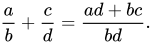
If both fractions are in canonical form, the result is in canonical form if and only if b, d are coprime integers.[13][14]
Subtraction
[edit]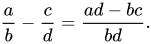
If both fractions are in canonical form, the result is in canonical form if and only if b, d are coprime integers.[14]
Multiplication
[edit]The rule for multiplication is:
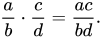
where the result may be a reducible fraction—even if both original fractions are in canonical form.[13][14]
Inverse
[edit]Every rational number has an additive inverse, often called its opposite,

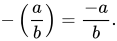
If is in canonical form, the same is true for its opposite.
A nonzero rational number has a multiplicative inverse, also called its reciprocal,
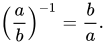
If is in canonical form, then the canonical form of its reciprocal is either or depending on the sign of a.


Division
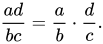
[edit]If b, c, d are nonzero, the division rule is

Thus, dividing by is equivalent to multiplying by the reciprocal of [14]


Exponentiation to integer power
[edit]If n is a non-negative integer, then
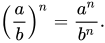
The result is in canonical form if the same is true for In particular,


If a ≠ 0, then
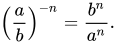
If is in canonical form, the canonical form of the result is if a > 0 or n is even. Otherwise, the canonical form of the result is


Continued fraction representation
[edit]A finite continued fraction is an expression such as
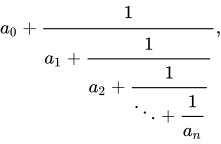
where an are integers. Every rational number can be represented as a finite continued fraction, whose coefficients an can be determined by applying the Euclidean algorithm to (a, b).
Other representations
[edit]- common fraction:
- mixed numeral:
- repeating decimal using a vinculum:
- repeating decimal using parentheses:
- continued fraction using traditional typography:
- continued fraction in abbreviated notation:
- Egyptian fraction:
- prime power decomposition:
- quote notation:


![{\displaystyle [2;1,2]}](https://wikimedia.org/api/rest_v1/media/math/render/svg/1887ebaaed6f055311780a6b5c6eb3c2d43481e7)


are different ways to represent the same rational value.
Formal construction
[edit]
The rational numbers may be built as equivalence classes of ordered pairs of integers.[13][14]
More precisely, let be the set of the pairs (m, n) of integers such n ≠ 0. An equivalence relation is defined on this set by


Addition and multiplication can be defined by the following rules:


This equivalence relation is a congruence relation, which means that it is compatible with the addition and multiplication defined above; the set of rational numbers is the defined as the quotient set by this equivalence relation, equipped with the addition and the multiplication induced by the above operations. (This construction can be carried out with any integral domain and produces its field of fractions.)[13]

The equivalence class of a pair (m, n) is denoted Two pairs (m1, n1) and (m2, n2) belong to the same equivalence class (that is are equivalent) if and only if


This means that

Every equivalence class may be represented by infinitely many pairs, since


Each equivalence class contains a unique canonical representative element. The canonical representative is the unique pair (m, n) in the equivalence class such that m and n are coprime, and n > 0. It is called the representation in lowest terms of the rational number.
The integers may be considered to be rational numbers identifying the integer n with the rational number

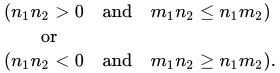
A total order may be defined on the rational numbers, that extends the natural order of the integers. One has

If
Properties
[edit]The set of all rational numbers, together with the addition and multiplication operations shown above, forms a field.[13]
has no field automorphism other than the identity. (A field automorphism must fix 0 and 1; as it must fix the sum and the difference of two fixed elements, it must fix every integer; as it must fix the quotient of two fixed elements, it must fix every rational number, and is thus the identity.)
is a prime field, which is a field that has no subfield other than itself.[15] The rationals are the smallest field with characteristic zero. Every field of characteristic zero contains a unique subfield isomorphic to
With the order defined above, is an ordered field[14] that has no subfield other than itself, and is the smallest ordered field, in the sense that every ordered field contains a unique subfield isomorphic to
is the field of fractions of the integers [16] The algebraic closure of i.e. the field of roots of rational polynomials, is the field of algebraic numbers.


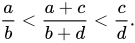
The rationals are a densely ordered set: between any two rationals, there sits another one, and, therefore, infinitely many other ones.[13] For example, for any two fractions such that
(where are positive), we have

Any totally ordered set which is countable, dense (in the above sense), and has no least or greatest element is order isomorphic to the rational numbers.[17]
Countability
[edit]
The set of positive rational numbers is countable, as is illustrated in the figure.
More precisely, one can sort the fractions by increasing values of the sum of the numerator and the denominator, and, for equal sums, by increasing numerator or denominator. This produces a sequence of fractions from which one can remove the reducible fractions (in red on the figure), obtaining a sequence that contains each rational number exactly once. This establishes a bijection between the rational numbers and the natural numbers, which maps each rational number to its rank in the sequence.
A similar method can be used for numbering all rational numbers (positive and negative).
As the set of all rational numbers is countable, and the set of all real numbers (as well as the set of irrational numbers) is uncountable, the set of rational numbers is a null set, that is, almost all real numbers are irrational, in the sense of Lebesgue measure.[18]
Real numbers and topological properties
[edit]The rationals are a dense subset of the real numbers; every real number has rational numbers arbitrarily close to it.[13] A related property is that rational numbers are the only numbers with finite expansions as regular continued fractions.[19]
In the usual topology of the real numbers, the rationals are neither an open set nor a closed set.[20]
By virtue of their order, the rationals carry an order topology. The rational numbers, as a subspace of the real numbers, also carry a subspace topology. The rational numbers form a metric space by using the absolute difference metric and this yields a third topology on All three topologies coincide and turn the rationals into a topological field. The rational numbers are an important example of a space which is not locally compact. The rationals are characterized topologically as the unique countable metrizable space without isolated points. The space is also totally disconnected. The rational numbers do not form a complete metric space, and the real numbers are the completion of under the metric above.[14]


p-adic numbers
[edit]In addition to the absolute value metric mentioned above, there are other metrics which turn into a topological field:
Let p be a prime number and for any non-zero integer a, let where pn is the highest power of p dividing a.

In addition set For any rational number we set


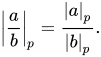
Then

The metric space is not complete, and its completion is the p-adic number field Ostrowski's theorem states that any non-trivial absolute value on the rational numbers is equivalent to either the usual real absolute value or a p-adic absolute value.


See also
[edit]- Dyadic rational
- Floating point
- Ford circles
- Gaussian rational
- Naive height—height of a rational number in lowest term
- Niven's theorem
- Rational data type
References
[edit]- ^ a b Rosen, Kenneth (2007). Discrete Mathematics and its Applications (6th ed.). New York, NY: McGraw-Hill. pp. 105, 158–160. ISBN 978-0-07-288008-3.
- ^ Lass, Harry (2009). Elements of Pure and Applied Mathematics (illustrated ed.). Courier Corporation. p. 382. ISBN 978-0-486-47186-0. Extract of page 382
- ^ Robinson, Julia (1996). The Collected Works of Julia Robinson. American Mathematical Soc. p. 104. ISBN 978-0-8218-0575-6. Extract of page 104
- ^ "Rational number". Encyclopedia Britannica. Retrieved 2020-08-11.
- ^ Weisstein, Eric W. "Rational Number". Wolfram MathWorld. Retrieved 2020-08-11.
- ^ Gilbert, Jimmie; Linda, Gilbert (2005). Elements of Modern Algebra (6th ed.). Belmont, CA: Thomson Brooks/Cole. pp. 243–244. ISBN 0-534-40264-X.
- ^ Oxford English Dictionary (2nd ed.). Oxford University Press. 1989. Entry ratio, n., sense 2.a.
- ^ Oxford English Dictionary (2nd ed.). Oxford University Press. 1989. Entry rational, a. (adv.) and n.1, sense 5.a.
- ^ Oxford English Dictionary (2nd ed.). Oxford University Press. 1989. Entry irrational, a. and n., sense 3.
- ^ Shor, Peter (2017-05-09). "Does rational come from ratio or ratio come from rational". Stack Exchange. Retrieved 2021-03-19.
- ^ Coolman, Robert (2016-01-29). "How a Mathematical Superstition Stultified Algebra for Over a Thousand Years". Retrieved 2021-03-20.
- ^ Kramer, Edna (1983). The Nature and Growth of Modern Mathematics. Princeton University Press. p. 28.
- ^ a b c d e f g h i j k l Biggs, Norman L. (2002). Discrete Mathematics. India: Oxford University Press. pp. 75–78. ISBN 978-0-19-871369-2.
- ^ a b c d e f g h i "Fraction - Encyclopedia of Mathematics". encyclopediaofmath.org. Retrieved 2021-08-17.
- ^ Sūgakkai, Nihon (1993). Encyclopedic Dictionary of Mathematics, Volume 1. London, England: MIT Press. p. 578. ISBN 0-2625-9020-4.
- ^ Bourbaki, N. (2003). Algebra II: Chapters 4 - 7. Springer Science & Business Media. p. A.VII.5.
- ^ Giese, Martin; Schönegge, Arno (December 1995). Any two countable densely ordered sets without endpoints are isomorphic - a formal proof with KIV (PDF) (Technical report). Retrieved 17 August 2021.
- ^ Royden, Halsey; Fitzpatrick, Patrick (2017-02-13). Real Analysis (4th ed.). Pearson. pp. 7–54. ISBN 9780134689494.
- ^ Anthony Vazzana; David Garth (2015). Introduction to Number Theory (2nd, revised ed.). CRC Press. p. 1. ISBN 978-1-4987-1752-6. Extract of page 1
- ^ Richard A. Holmgren (2012). A First Course in Discrete Dynamical Systems (2nd, illustrated ed.). Springer Science & Business Media. p. 26. ISBN 978-1-4419-8732-7. Extract of page 26
- ^ Weisstein, Eric W. "p-adic Number". Wolfram MathWorld. Retrieved 2021-08-17.
Notes
[edit]External links
[edit]

- "Rational number", Encyclopedia of Mathematics, EMS Press, 2001 [1994]
- "Rational Number" From MathWorld – A Wolfram Web Resource

Number systems | |
|---|---|
| Sets of definable numbers | |
| Composition algebras |
|
| Split types | |
| Other hypercomplex | |
| Infinities and infinitesimals | |
| Other types | |


| International | |
|---|---|
| National | |
| Other | |

Rational number
View on GrokipediaDefinition and Terminology
Definition
A rational number is any number that can be expressed as the quotient or fraction , where and are integers and .[3] This definition presupposes the existence of the integers, which form the building blocks for constructing the rationals through division.[3] Rationals are commonly denoted using fractional notation , where the fraction is typically reduced to lowest terms by dividing both numerator and denominator by their greatest common divisor, ensuring and .[4] Examples include (half), (negative three-quarters), and (showing that all integers are rational numbers).[3] The set of rational numbers forms a proper subset of the real numbers, excluding irrational numbers that cannot be expressed as such ratios.[5][6] The concept of ratios underlying rational numbers was recognized in ancient civilizations, such as the Egyptians who represented fractions as sums of unit fractions for practical computations.[7]Terminology and Etymology
The term "rational number" derives from the Latin adjective rationalis, rooted in ratio, which means "reason," "calculation," or "proportion." This etymology underscores the conceptual link to proportional reasoning, as rational numbers are fundamentally ratios of two integers, a idea central to ancient mathematical discourse on commensurability.[8][9] In the evolution of mathematical terminology, "rational" emerged to differentiate numbers expressible as ratios from those that are not, such as irrational roots. Ancient Greek mathematicians like Euclid, in his Elements (circa 300 BCE), developed the theory of ratios in Book V without using the modern term "rational," but his treatment of commensurable magnitudes—ratios of integers—provided the foundation for later distinctions between rational and irrational quantities. The explicit use of "rational" in this context appeared in Renaissance translations of Euclid, with "irrational" first recorded in English mathematical texts around 1551 to contrast with expressible ratios.[10][11] The key term "fraction," denoting a rational number less than one in its basic form, originates from the Latin fractio (a breaking), derived from the verb frangere (to break), evoking the division of a whole into parts. Within fractional representation, the "numerator" stems from Late Latin numerator (a counter), from numerus (number), signifying the quantity of parts selected, while the "denominator" comes from Medieval Latin denominator (one that names), from denominare (to name), indicating the total units into which the whole is divided.[12][13][14] Distinctions like "proper fraction" (numerator smaller than denominator) and "improper fraction" (numerator greater than or equal to denominator) developed in the early modern period, with "improper" first appearing in English in 1542 in Robert Recorde's The Ground of Artes, reflecting the notion that such fractions exceed the "proper" piece of a whole. A "mixed number," combining an integer with a proper fraction (e.g., ), arose as a practical notation for values greater than one, its terminology descriptively indicating a mixture of whole and fractional components without a specific ancient Latin root.[15] Fractional notation itself has ancient origins, with systematic use appearing in Indian mathematics around the 7th century CE; Brahmagupta's Brahmasphutasiddhanta (628 CE) presented fractions as one number above another, separated by a space, marking an early precursor to modern vinculum-barred forms. This convention spread through Islamic scholars like al-Hassâr in the 12th century, who introduced the horizontal bar, before full Western adoption in medieval Europe via Fibonacci's works.[16]Representations
Fractional Representation
A rational number is commonly expressed in fractional form as , where and are integers with and the greatest common divisor . This representation, known as the irreducible or lowest terms form, ensures the fraction is in its simplest state by eliminating any common factors between the numerator and denominator other than 1.[3][17] To obtain this standard form from any given fraction, the simplification process involves computing the GCD of the absolute values of the numerator and denominator using the Euclidean algorithm and then dividing both by this value. For instance, consider : the GCD of 4 and 8 is 4, so dividing yields . This method guarantees the fraction is reduced, preserving the value while minimizing the integers involved.[3] Sign conventions in fractional representations allow the negative sign to appear in either the numerator or denominator, but the standard practice is to place it in the numerator with a positive denominator to maintain consistency. For example, , , and all represent the same rational number, but the form with is preferred.[17] Rational numbers greater than 1 in absolute value can also be written as mixed numbers, which combine a whole number and a proper fraction, such as for . To convert a mixed number to an improper fraction, multiply the whole number by the denominator, add the numerator, and place the result over the denominator: . Conversely, to convert an improper fraction like to mixed form, divide the numerator by the denominator to get the whole number and remainder. However, improper fractions are generally preferred in advanced mathematics for their compactness and ease in algebraic manipulations.[18] Every nonzero rational number possesses a unique irreducible fractional representation with a positive denominator, providing a canonical way to identify and compare them unambiguously.[17]Decimal Representation
The decimal representation of a rational number in lowest terms, where and are integers with , is either terminating or eventually repeating.[19] A terminating decimal ends after a finite number of digits after the decimal point, while an eventually repeating decimal consists of a (possibly empty) non-repeating prefix followed by a repeating sequence of digits that continues indefinitely.[20] This dichotomy distinguishes rational numbers from irrationals, whose decimal expansions are non-terminating and non-repeating.[21] A decimal expansion terminates if and only if the denominator , after simplification, has no prime factors other than 2 and/or 5.[22] In such cases, the fraction can be rewritten with a denominator that is a power of 10 by multiplying numerator and denominator by appropriate powers of 2 or 5 to balance the factors.[23] For example, terminates after one digit, as requires multiplying by to get denominator 10; similarly, , where multiplying by yields denominator .[22] The number of decimal places equals the maximum of the exponents of 2 and 5 in .[23] For all other rational numbers, where has at least one prime factor different from 2 or 5, the decimal expansion is eventually repeating.[19] The repeating part, known as the repetend, begins after a non-repeating prefix whose length is determined by the highest power of 2 or 5 dividing . If is coprime to 10 (no factors of 2 or 5), the expansion is purely repeating with no non-repeating part; otherwise, it is mixed or eventually repeating.[20] For instance, is purely repeating with period 1, while has a non-repeating digit "1" (length 1, matching the power of 2 in 6=2·3) followed by a repeating "6".[20] Another example is , a pure repetend of length 6, and , mixed with non-repeating "08" (length 2, from 12=2^2·3) and repeating "3".[24] To obtain the decimal expansion, perform long division of by , which generates digits sequentially; the process terminates if a remainder of 0 occurs, or repeats when a remainder repeats, signaling the start of the repetend.[25] The length of the repetend, or period, for (with coprime to 10) is the multiplicative order of 10 modulo , the smallest positive integer such that .[24] This order divides , Euler's totient function, and for general , the period is the order modulo the part of coprime to 10.[26] For example, the period of is 6, as 6 is the smallest with .[24] Except for terminating decimals, every rational number has a unique infinite decimal expansion.[19] Terminating decimals admit a dual representation: the finite form and an equivalent infinite repeating form ending in 9s. For example, , since both equal .[25] This non-uniqueness arises because the repeating 9s expansion corresponds to the limit of the sequence approaching the terminating value from below.[21] In standard convention, the terminating form is preferred for simplicity.[25]Continued Fraction Representation
A continued fraction provides an alternative representation for rational numbers as a finite expression of the form , where is a non-negative integer and are positive integers.[27] This notation denotes the value , offering a way to express rationals through nested fractions with integer terms.[27] To construct the continued fraction expansion of a rational number in lowest terms (with ), apply the Euclidean algorithm: divide by to get quotient and remainder , so with ; then divide by to get and , continuing until a remainder of zero is reached, yielding the coefficients .[28] For example, gives , then , so .[27] Similarly, yields , then , so .[27] Every rational number has a unique finite continued fraction expansion under the convention that partial quotients are positive integers greater than or equal to 1, except that expansions ending with admit an equivalent form , allowing two representations in such cases.[29] The partial quotients, or convergents, (computed recursively via , , ; similarly for with , ), provide successive rational approximations to the number, with each improving upon the previous and the final convergent equaling the exact rational.[30] Unlike the infinite expansions for irrational numbers, rational numbers yield finite continued fractions, making this representation exact and terminating.[27] Continued fractions are particularly valuable in Diophantine approximation, where the convergents yield the best rational approximations to a number by denominators up to a given size, though for rationals, the process terminates exactly rather than providing ongoing approximations.[31]Other Representations
Rational numbers can be represented in any integer base using positional notation, where the expansion is either finite or eventually periodic, analogous to their decimal representations. For example, in binary (base 2), , which terminates, while , which repeats. This property holds because the denominator of a reduced rational, when factored into primes, determines whether the expansion terminates (if all prime factors divide some power of ) or repeats otherwise.[32] Another representation is the Egyptian fraction, where a positive rational (with positive integers) is expressed as a sum of distinct unit fractions, i.e., with distinct positive integers . Every positive rational admits such a decomposition, as proven in modern times though known empirically to ancient Egyptians. The greedy algorithm computes one such expansion by repeatedly subtracting the largest possible unit fraction less than or equal to the remainder; for instance, , obtained by taking (the largest unit fraction ≤ ) and then applying the method to the remainder . This method always terminates but may not yield the representation with the fewest terms.[33][34] The Stern-Brocot tree provides an enumerative representation of all positive rationals, structured as an infinite binary tree where each level consists of reduced fractions in lowest terms, generated by starting with and (representing 0 and ∞) and iteratively inserting mediants between adjacent fractions and . Every positive rational appears exactly once in reduced form in this tree, with no repetitions, offering a systematic way to list them without duplicates. Independently discovered by Moritz Stern in 1858 and Achille Brocot in 1861, the tree also encodes continued fraction expansions via left and right paths.[35] Similarly, the Calkin-Wilf tree enumerates all positive rationals exactly once through a binary tree where the root is , the left child of is , and the right child is , with each node in reduced terms. This structure, introduced by Neil Calkin and Herbert Wilf in 2000, corresponds bijectively to positive integers via breadth-first traversal, demonstrating the countability of the rationals.[36] Rationals also appear in modular representations, such as on the projective line over the rationals , which consists of equivalence classes of points in under scalar multiplication by nonzero rationals, identifying the line with . This compactifies the affine line of rationals by adding a point at infinity, useful in algebraic geometry for studying rational points and maps.[37]Arithmetic Operations
Equality and Canonical Forms
Two rational numbers expressed as fractions and , where are integers and , are equal if and only if .[38] This condition arises from the definition of rational numbers as equivalence classes of integer pairs, where equality holds when the cross products match.[39] To see why this holds, suppose . Multiplying both sides by yields , preserving equality since . Conversely, if , then , confirming the fractions represent the same rational.[38] This cross-multiplication approach provides an exact test without requiring simplification of either fraction beforehand.[39] The canonical form of a rational number is its unique irreducible fraction , where and are integers with and . To obtain this form, divide both numerator and denominator by their greatest common divisor, then adjust the sign to ensure a positive denominator. For instance, simplifies to since , while becomes to maintain the positive denominator.[40] This representation ensures uniqueness within the equivalence class of fractions denoting the same rational.[40] To check equality algorithmically without full simplification, compute the integer products and and compare them directly, leveraging exact integer arithmetic.[38] This method avoids the precision loss inherent in converting fractions to decimal approximations for comparison, providing reliable results for exact rational identity as long as the products fit within the integer representation limits.[39]Ordering
The rational numbers form a totally ordered set under the standard ordering, where for any two rationals and , exactly one of , , or holds, and the order is compatible with the field operations.[41] Specifically, if and only if , where positive elements are those greater than 0.[41] For fractions in canonical form with positive denominators, the order can be determined without subtraction by cross-multiplication: for and , if and only if .[42] For example, to compare and , compute and ; since , it follows that .[42] The rational numbers satisfy the density property: between any two distinct rationals , there exists another rational such that .[43] One such is the mediant of and (with positive denominators), which lies strictly between them.[44] The rationals also possess the Archimedean property: for any positive rationals and , there exists a positive integer such that .[45] This follows from the ordered field structure of the rationals, where the natural numbers are unbounded above.[45] Unlike the real numbers, the rationals lack the least upper bound property: there exist nonempty subsets of the rationals that are bounded above but have no least upper bound in the rationals.[46] For instance, the set of rationals whose square is less than 2 has upper bounds like 2 but no smallest such bound within the rationals.[46]Addition and Subtraction
To add two rational numbers expressed as fractions and , where and , compute .[47] The resulting fraction should then be reduced to lowest terms by dividing numerator and denominator by their greatest common divisor (GCD). For example, , which is already in lowest terms.[47] Subtraction follows analogously: , again reducing the result. For instance, .[47] These operations preserve rationality, as the sum or difference of two rationals is always rational, since the numerator and denominator remain integers.[48] To perform addition or subtraction efficiently, especially with unequal denominators, convert the fractions to a common denominator using the least common multiple (LCM) of and . The LCM can be computed via the formula , where is the greatest common divisor found using the Euclidean algorithm: repeatedly replace the larger number by its remainder modulo the smaller until the remainder is zero, with the last non-zero remainder being the GCD.[49] This minimizes intermediate values compared to using the product directly.[50] Addition of rationals satisfies commutativity () and associativity ().[51] Every rational has an additive inverse , such that .[48] Subtraction is defined as adding the additive inverse.[47] In computational implementations using fixed-precision integers, addition and subtraction of rationals may lead to overflow in the numerator or denominator during intermediate steps, such as cross-multiplication; however, using arbitrary-precision integers avoids this issue and ensures exact results.[52]Multiplication and Division
Multiplication of two rational numbers and , where and , is defined as .[53] For example, , where the fraction is simplified by dividing numerator and denominator by their greatest common divisor.[1] This operation satisfies several key properties: it is commutative, meaning ; associative, so ; and distributive over addition, with .[53] The multiplicative identity is , since .[53] Additionally, the rational numbers have no zero divisors other than zero itself: if , then either or .[53] Division of rational numbers is defined as multiplication by the reciprocal: , provided to ensure the reciprocal exists.[53] For instance, .[53] To minimize computational errors, especially with large numerators and denominators, it is advisable to simplify by canceling common factors between the numerators and denominators before performing the multiplication, as this reduces the size of the intermediate products.[54] In the earlier example, canceling the common factor of 3 in yields directly.[1]Exponentiation to Integer Powers
For a rational number expressed in lowest terms as where and are integers with , raising it to a positive integer power is defined by repeated multiplication, yielding .[48][55] For example, .[48] Any non-zero rational number raised to the power of zero equals 1, consistent with the general rule for exponentiation where the base is non-zero. For negative integer exponents, where and .[55] For instance, . The operation preserves rationality: the result of raising a non-zero rational to any integer power is always rational, as the numerator and denominator remain integers.[48] Exponentiation to integer powers on the rationals obeys standard rules, such as and for compatible integer exponents and , where the base is a non-zero rational.[56]Algebraic Properties
Field Structure
The rational numbers , defined as the set of all fractions where and , with equivalence if , form a field under the standard operations of addition and multiplication inherited from the integers.[53] These operations are defined as and , and the field axioms are verified by reducing computations to integer arithmetic and leveraging the ring structure of .[53] More precisely, is the field of fractions of the ring , obtained by adjoining multiplicative inverses for all nonzero integers.[2] The field axioms include closure under addition and multiplication (ensured by the definitions above), associativity and commutativity of both operations (inherited from ), the existence of additive and multiplicative identities (0 and 1, respectively), additive inverses ( ), multiplicative inverses for nonzero elements ( if ), and distributivity of multiplication over addition.[53] All these properties hold without exception in , distinguishing it from finite fields or rings without full inverses.[53] The characteristic of is 0, as the multiple (n times) equals the integer n, which is nonzero for any positive integer n.[57] is also an ordered field, with the standard order if (assuming positive denominators for simplicity), compatible with the operations: addition preserves order, and multiplication preserves order for positive elements.[53] This makes the smallest ordered field, as every ordered field contains a unique subfield isomorphic to .[2] The integers embed as a subring of , but extends this by including multiplicative inverses for all nonzero integers, yielding a full field structure that is unique up to isomorphism among fields of characteristic 0.[2] Specifically, is the prime field of characteristic 0, the smallest field containing an isomorphic copy of and generated by 1 under field operations.[2]Closure and Embeddings
The set of rational numbers is closed under the operations of addition, subtraction, and multiplication, meaning that the result of any such operation on two rational numbers is again a rational number.[58] It is also closed under division, provided the divisor is non-zero, as the quotient of two non-zero rationals can always be expressed as a ratio of integers.[59] However, is not closed under the extraction of roots; for instance, the square root of 2 is irrational and thus not in . The integers embed into via the canonical map defined by for each integer .[17] This embedding is an injective ring homomorphism that preserves addition and multiplication, making a subring of .[60] Consequently, every integer is a rational number, but the converse does not hold, as there exist rationals like that are not integers.[58] The identity map provides a natural embedding of into itself, which is trivially bijective and preserves all field operations. itself is not algebraically closed, as it lacks roots for certain polynomials with rational coefficients, such as .[61][62]Countability
The set of rational numbers is countable, meaning there exists a bijection between and the natural numbers , and thus . This was first established by Georg Cantor in 1873.[63] To prove the countability of , first consider the positive rationals . Each element can be uniquely represented as a reduced fraction where and are positive integers with . Group these fractions by the "height" , starting from . For each fixed , there are finitely many such pairs with and . Enumerate the fractions within each group in order of increasing (or ), and traverse the groups in a zigzag pattern across the infinite grid of positive integers, skipping non-reduced fractions to ensure each rational appears exactly once. This process yields a bijection from to . To extend to all of , map zero to 0 (or include it separately), and handle negative rationals by pairing each positive rational with its negative counterpart, preserving countability since the union of two countable sets is countable. A formal bijection relies on Cantor's pairing function, which establishes a bijection given by . Since is in bijection with the set of reduced pairs , which is a subset of , and subsets of countable sets are countable, is countable; the extension to follows similarly. An explicit enumeration of the positive rationals can be obtained via the Calkin-Wilf tree, a binary tree where each node (in lowest terms) has left child and right child , with root ; breadth-first traversal lists every positive rational exactly once. This structure, introduced by Neil Calkin and Herbert Wilf in 2000, provides a recursive way to generate the bijection without reducing fractions explicitly.[64] The countability of implies that it forms a countable dense subset of the real numbers , as every interval in contains infinitely many rationals, yet the total set remains enumerable.[65]Relations to Other Number Systems
Embedding in Real Numbers
The real numbers are constructed as the metric completion of the rational numbers with respect to the absolute value metric, ensuring that every Cauchy sequence of rationals converges to a real number. One standard method defines as the set of equivalence classes of Cauchy sequences of rationals, where two sequences are equivalent if their difference converges to zero.[66] Another approach uses Dedekind cuts, partitioning the rationals into two nonempty subsets and such that all elements of are less than all elements of , no greatest element exists in , and every real number corresponds to such a cut.[67] These constructions embed naturally into as a subfield, preserving the field operations and order. This embedding is dense: for any two distinct real numbers , there exists a rational such that .[68] Consequently, every real number is the limit of a sequence of rationals, allowing to approximate any element of arbitrarily closely. Algebraically, is a real closed field containing as a subfield, where every positive element has a square root and every odd-degree polynomial over has a root.[69] For instance, the irrational lies outside but can be approximated by rationals via the convergents of its continued fraction expansion , such as , , and , which satisfy .[70] Historically, these constructions addressed the incompleteness of , exemplified by gaps like the absence of a supremum for the set , prompting 19th-century mathematicians to formalize for a complete ordered field.[71]Topological Properties
The rational numbers inherit the subspace topology from the real numbers , meaning that a subset is open if and only if there exists an open set such that .[72] This topology is metrizable, induced by the standard Euclidean metric for .[72] A basis for the topology on consists of sets of the form , where and .[73] The metric space is incomplete, as it contains Cauchy sequences that do not converge within . For instance, the sequence of partial decimal approximations to —3, 3.1, 3.14, 3.141, 3.1415, ...—is Cauchy in because the terms become arbitrarily close, yet its limit lies outside .[66] This incompleteness highlights the "gaps" in , distinguishing it topologically from the complete space . The space is totally disconnected, possessing no connected subsets with more than one point. For any two distinct points with , an irrational number exists, and the sets and are nonempty, disjoint, open in , and their union contains .[74] Every open interval in is itself disconnected, reflecting the dense interspersion of irrationals.[74] As a countable metric space without isolated points—since every neighborhood of a rational contains infinitely many others due to the density of in — is not locally compact.[75] Compact subsets of must be finite, as any infinite subset has a limit point outside or violates sequential compactness.[75]p-adic Numbers
In the context of rational numbers, the p-adic numbers arise from a different notion of "size" or valuation, distinct from the usual absolute value. For a fixed prime number , the p-adic valuation on the nonzero rationals is defined by writing a rational in lowest terms and setting , where for a nonzero integer is the highest power of dividing , i.e., the exponent of in its prime factorization.[76] By convention, . This valuation measures the extent to which divides the numerator relative to the denominator, providing a way to quantify divisibility by powers of .[77] The p-adic metric is then derived from this valuation: for rationals and , the distance is if , and .[76] This metric satisfies the ultrametric inequality , making the rational numbers a metric space with a non-Archimedean topology where "closeness" emphasizes congruence modulo high powers of .[77] The p-adic numbers form the completion of with respect to this metric, obtained by adjoining limits of all Cauchy sequences in under ; the rationals are dense in , ensuring that embeds naturally as a subfield.[76] Elements of can be represented via p-adic expansions, analogous to decimal expansions but in base and extending infinitely to the left. Any admits a unique series expansion of the form where is sufficiently negative, each digit is an integer with , and the series converges in the p-adic metric.[77] This representation is written as _p, with the "decimal" point separating non-negative and negative powers of .[76] The field is locally compact and complete under the p-adic metric, differing fundamentally from the real numbers in its non-Archimedean nature, where there are infinitesimally small nonzero elements relative to the valuation.[77] It plays a crucial role in number theory, for instance, in solving systems of congruences via Hensel's lemma, which lifts solutions modulo to solutions in , the ring of p-adic integers.[76]Formal Constructions
As Equivalence Classes of Pairs
One formal way to construct the rational numbers is as the set of equivalence classes of ordered pairs of integers, where each pair consists of an integer (the numerator) and a nonzero integer (the denominator). The equivalence relation on is defined by if and only if . This relation is reflexive, symmetric, and transitive, partitioning the set of pairs into equivalence classes, each denoted , which represent the rational numbers.[78][17][79] Addition and multiplication on these equivalence classes are defined componentwise to mimic fractional arithmetic while remaining within integers. Specifically, for equivalence classes and , These operations are associative, commutative, and distributive, with additive identity and multiplicative identity . Additive inverses exist as , and nonzero elements have multiplicative inverses provided .[78][17][79] To ensure the operations are well-defined on equivalence classes rather than specific representatives, one verifies that if and , then the sums and products of the pairs are equivalent: for addition, , and similarly for multiplication. This construction yields a field structure on , satisfying all field axioms, including the existence of inverses for nonzero elements.[78][17][79] This pair-based approach avoids direct use of fractions, operating solely with integers and their products, yet establishes a natural isomorphism to the intuitive notion of rationals via the mapping , where equivalent pairs yield the same fraction. The integers embed into via the injective homomorphism , preserving addition and multiplication.[78][17][79]Quotient Field of Integers
In commutative algebra, the rational numbers arise as the quotient field of the ring of integers , which is an integral domain. More abstractly, is obtained by localizing at the multiplicative set , yielding the ring of fractions . Since has no zero divisors, every element of is invertible in this localization, making a field; concretely, its elements can be represented as equivalence classes of pairs with , , under the relation if there exists such that , though the pair representation aligns with the explicit construction in equivalence classes of pairs.[80] A key feature of this construction is its universal property: for any injective ring homomorphism into a field , there exists a unique ring homomorphism such that , where is the natural embedding sending . To see this, define ; since for (as has no zero divisors and is nonzero on ), this is well-defined and preserves addition and multiplication because the operations in are induced componentwise from . Uniqueness follows from the fact that every element of is generated by elements of under inversion.[80][81] This universal property implies that is the smallest field containing (up to the embedding ), in the sense that any field containing an isomorphic copy of must contain a subfield isomorphic to . Moreover, any two such quotient fields of are isomorphic via a unique isomorphism compatible with the embeddings from .[81][82] One advantage of viewing through this lens is its generalization: for any integral domain , the localization at yields the field of fractions of , providing a uniform way to adjoin inverses for nonzero elements while preserving the ring structure.[80]History
Ancient Origins
The earliest known uses of rational numbers appear in ancient Mesopotamia around 2000 BCE, where Babylonian mathematicians employed a sexagesimal (base-60) system to represent fractions, particularly in astronomical calculations. This system allowed for precise divisions of circles into 360 degrees and time into hours, minutes, and seconds, with tablets from sites like Senkerah containing tables of squares and cubes up to 59 and 32, respectively, to facilitate computations involving rational proportions.[83] These fractions were essential for predicting celestial events, demonstrating an advanced practical grasp of rational quantities without symbolic algebraic notation. In ancient Egypt, rational numbers were expressed as sums of distinct unit fractions (fractions with numerator 1), a method evident in the Rhind Papyrus, dated to approximately 1650 BCE and copied by the scribe Ahmes. The papyrus includes a table decomposing fractions of the form 2/n (for odd n from 5 to 101) into such sums, for example, 2/5 = 1/3 + 1/15, applied to problems in geometry, area measurement, and resource allocation.[84] This approach reflected a preference for unit fractions in practical arithmetic, avoiding more general forms. Babylonian scribes also solved linear equations involving rational coefficients without formal algebraic notation, relying instead on reciprocal tables and step-by-step procedures during the Old Babylonian period (c. 2000–1900 BCE). For instance, they addressed problems like finding x such that (2/3) × (2/3) × x + 100 = x, yielding x = 180 through tabular lookups and proportional reasoning.[83] In ancient Greece, around the 5th century BCE, the Pythagorean school initially viewed all quantities as rational ratios of integers, but the discovery of irrational numbers—such as √2, proven via contradiction using the Pythagorean theorem on an isosceles right triangle—challenged this belief and highlighted the distinction between rationals and irrationals.[85] By c. 300 BCE, Euclid formalized ratios in his Elements, Book V, defining a ratio as the relation between two magnitudes of the same kind and proportion as equality of such ratios, applicable to both commensurable (rational) and incommensurable cases, providing a rigorous framework for geometric and arithmetic manipulations akin to rational numbers.[86] In India, during the 5th century CE, Aryabhata incorporated fractions into trigonometric computations in his Āryabhaṭīya (c. 499 CE), using them to construct sine tables via the Pythagorean theorem and approximate π as 62,832/20,000 (≈3.1416), advancing spherical astronomy and geometric projections.[87]Development in Modern Mathematics
In the Renaissance, the notation for rational numbers advanced significantly with the introduction of decimal fractions by Simon Stevin in his 1585 pamphlet La Thiende. Stevin proposed representing fractions using powers of ten, allowing for a positional system that extended beyond integers to include terminating and repeating decimals, thereby simplifying arithmetic operations on rationals and facilitating their use in engineering and commerce.[88] The formalization of rational numbers within abstract algebra progressed in the 19th century through Richard Dedekind's axiomatization of fields in 1871. In his supplements to Dirichlet's Vorlesungen über Zahlentheorie, Dedekind defined a field as a commutative ring with unity where every nonzero element has a multiplicative inverse, positioning the rationals as the prime field of characteristic zero and the foundational example of an ordered field. This abstraction enabled the study of extensions and structures beyond the rationals, influencing algebraic number theory.[67] Set-theoretic constructions of the rationals emerged in the late 19th century, building on Giuseppe Peano's 1889 axioms for the natural numbers, which provided a rigorous foundation for arithmetic from which integers and then rationals could be derived as equivalence classes of pairs. Concurrently, Georg Cantor proved in 1874 that the rationals are countable, demonstrating a bijection between and the natural numbers via a zigzag enumeration of positive fractions in lowest terms, highlighting their "small" infinity compared to the reals.[63] In the 20th century, rational numbers played a central role in model theory, where serves as the prime model of the theory of ordered fields, embedding elementarily into every countable model due to its countable dense linear order without endpoints. This structure exemplifies a complete, decidable theory with quantifier elimination after naming constants. Additionally, Hilbert's 1900 problems encompassed foundational questions in logic, including aspects of decidability for arithmetic systems; the first-order theory of the rationals as a dense linear order without endpoints was affirmatively resolved as decidable, with algorithms existing via its axiomatization and completeness properties.References
- https://en.wiktionary.org/wiki/rational