


Community hub
Recent from talks
Contribute something
Nothing was collected or created yet.
Textus Receptus
View on Wikipedia
| Part of a series on the |
| Textus Receptus |
|---|
 |
 Christianity portal Christianity portal |
The Textus Receptus (Latin for 'received text') is the succession of printed Greek New Testament texts starting with Erasmus' Novum Instrumentum omne (1516) and including the editions of Stephanus, Beza, the Elzevir house, Colinaeus and Scrivener.[1][2][3][4]
Erasmus' Latin/Greek New Testament editions and annotations were a major influence for the original German Luther Bible and the translations of the New Testament into English by William Tyndale. Subsequent Textus Receptus editions constituted the main Greek translation-base for the King James Version, the Spanish Reina-Valera translation, the Czech Bible of Kralice, the Portuguese Almeida Recebida, the Dutch Statenvertaling, the Russian Synodal Bible and many other Reformation-era New Testament translations throughout Western, Northern and Central Europe.
Despite being viewed as an inferior form of the text of the New Testament by many modern textual critics, some Conservative Christians still view it as the most authentic text of the New Testament. This view is generally based upon a theological doctrine of the supernatural providential preservation of scripture.[5]
Textual origin
[edit]

The Textus Receptus most strongly resembles the Byzantine text-type, as its editor Erasmus mainly based his work on manuscripts following the Byzantine text. However, Erasmus sometimes followed the Minuscule 1 (part of the proposed Caesarean text-type in the Gospels) in a small number of verses, additionally following the Latin Vulgate translated by Jerome in the 4th century in a few verses, including Acts 9:6 and in placing the doxology of Romans into chapter 16 instead of after chapter 14 as in most Byzantine manuscripts.[6][7][8][9] In the Book of Revelation, Erasmus' text primarily follows the Andreas text-type, named after Andreas of Caesarea (563–614), who used it in his widely influential commentary on Revelation.[10]
For the first edition, Erasmus had direct access to around 8 Greek manuscripts in Basel, although he used Manuscript 2105 mainly for his copious annotations which were based on notes prepared over the previous decade on unknown manuscripts in England and Brabant. The Greek manuscripts used in the creation of Erasmus' first edition are the following:[11][6][7][8][12][13]
| GA | Date | Name | Text-type | Contents |
|---|---|---|---|---|
| 2817 | 11th century | Codex Basilensis A. N. III. 11 | Byzantine | Pauline Epistles |
| 1 | 12th century | Codex Basiliensis A. N. IV. 2 | Caesarean/Byzantine | Acts, Epistles, Gospels |
| 2 | 12th century | Codex Basilensis A. N. IV. 1 | Byzantine | Gospels |
| 2814 | 12th century | Augsburg I.1.4° 1 | Andreas/Byzantine | Revelation |
| 2815 | 12th century | Codex Basilensis A. N. IV. 4 | Byzantine | Acts, Epistles |
| 4 | 13th century | Minuscule 4/Codex Regius 84 | Mixed/Byzantine | Gospels |
| 2816 | 15th century | Codex Basilensis A. N. IV. 5 | Byzantine | Acts, Epistles |
| 817 | 15th century | Codex Basilensis A. N. III. 15 | Byzantine | Gospels |
Even though Erasmus had only one manuscript of Revelation when he created the Textus Receptus, F.H.A Scrivener notes that in a few places such as Revelation 1:4 and Revelation 8:13, Erasmus refers to manuscripts which he had seen earlier during his travels.[13] For subsequent editions, Erasmus had the benefit of many European correspondents (he wrote "The New Testament has made me friends everywhere")[14] and was able to get more collaborators or subeditors: for example, future English Catholic bishop Cuthbert Tunstall helped with the second edition;[15] and he had friendly interactions with Spanish Cardinal Ximénez de Cisneros who sent a Complutensian Polyglot in time for Erasmus' 1527 fourth edition, particularly used for improving Revelation.[16]
Other manuscripts were available to later editors of the Textus Receptus. Robert Stephanus had access to over a dozen manuscripts, including Codex Bezae and Regius,[9] additionally making use of the Complutensian Polyglot.[17] Stephanus' edition of the Textus Receptus became one of the two "standard" texts of the Textus Receptus alongside those of Theodore Beza. Like Stephanus, Beza had access to a larger manuscript pool than Erasmus, including Codex Claromontanus and the Codex Bezae; however, he made very little use of them in his editions.[9]
Last verses of Revelation
[edit]Although contested by some defenders of the Textus Receptus, it is widely accepted that because the manuscript which Erasmus used lacked the last six verses of Revelation, he used the Latin Vulgate to backtranslate the last verses of Revelation into Greek. However, he also used the notes of Valla, such as in the reading "Amen. Even so, come Lord Jesus" in Revelation 22:20, which does not completely agree with the Latin Vulgate. In this process, Erasmus introduced many distinct readings into the text of Revelation. Some of these readings were later edited out by Stephanus in his editions of the Textus Receptus, but some distinct Erasmian readings remained, such as the words "book of life" instead of "tree of life" in Revelation 22:19.[18]
Some defenders of the Textus Receptus have argued that Erasmus used other Greek manuscripts for the last six verses of Revelation. Manuscripts such as 2049, 2067 and 296 which contain similar readings to the Textus Receptus have been proposed as possible sources for Erasmus' readings in the book of Revelation. However, critical scholarship today views these manuscripts as being more likely being influenced by the printed Textus Receptus editions, instead of them being a source for the readings of Erasmus. It has also been noted that even if these manuscripts did not copy the Textus Receptus, that since Erasmus did not produce impossible Greek, it is possible for such manuscripts to contain similar readings by coincidence.[18]
History
[edit]Erasmus
[edit]
Erasmus had been working for years making philological notes on scriptural and patristic texts. In 1512, he began his work on the Latin New Testament. He consulted all the Vulgate manuscripts that he could find to create an edition without scribal corruptions and with better Latin. In the earlier phases of the project, he never mentioned a Greek text: "My mind is so excited at the thought of emending Jerome's text, with notes, that I seem to myself inspired by some god. I have already almost finished emending him by collating a large number of ancient manuscripts, and this I am doing at enormous personal expense."[19]

He included the Greek text to defend the superiority of his Latin version over the Vulgate. He wrote, "There remains the New Testament translated by me, with the Greek facing, and notes on it by me."[20] He further demonstrated the reason for the inclusion of the Greek text when defending his work: "But one thing the facts cry out, and it can be clear, as they say, even to a blind man, that often through the translator's clumsiness or inattention the Greek has been wrongly rendered; often the true and genuine reading has been corrupted by ignorant scribes, which we see happen every day, or altered by scribes who are half-taught and half-asleep."[21]
Erasmus's new work was published by Froben of Basel in 1516, becoming the first published Greek New Testament, the Novum Instrumentum omne, diligenter ab Erasmo Rot. Recognitum et Emendatum. For the Greek text, he used manuscripts: 1, 1rK, 2e, 2ap, 4ap, 7, 817.[22] In his research in England and Brabant for annotations on particular words, he had already consulted several other manuscripts and was particularly interested in patristic quotations as evidence of early readings. For subsequent editions he used more manuscripts, and consulted with his vast network of correspondents.
Typographical errors, attributed to the rush to print the first edition, abounded in the published text. Erasmus also lacked a complete copy of the Book of Revelation and translated the last six verses back into Greek from the Latin Vulgate to finish his edition. Erasmus adjusted the text in many places [citation needed] to correspond with readings found in the Vulgate or as quoted in the Church Fathers; consequently, although the Textus Receptus is classified by scholars as a late Byzantine text, it differs in nearly 2,000 readings from the standard form of that text-type, as represented by the "Majority Text" of Hodges and Farstad (Wallace, 1989). The edition was a sell-out commercial success and was reprinted in 1519, with most but not all of the typographical errors corrected.[23]
Erasmus had been studying Greek New Testament manuscripts for many years, in the Netherlands, France, England and Switzerland, noting their many variants, but had only six Greek manuscripts immediately accessible to him in Basel.[22] They all dated from the 12th century or later, and only one came from outside the mainstream Byzantine tradition. Consequently, most modern scholars consider his Greek text to be of dubious quality.[24]
With the third edition of Erasmus's Greek text (1522) the Comma Johanneum was included because "Erasmus chose to avoid any occasion for slander rather than persisting in philological accuracy" even though he remained "convinced that it did not belong to the original text of l John."[25]
Popular demand for Greek New Testaments led to a flurry of further authorized and unauthorized editions in the early sixteenth century, almost all of which were based on Erasmus's work and incorporated his particular readings but typically also making a number of minor changes of their own.[26]
Complutensian Polyglot
[edit]Complutensian Polyglot Bible is the name given to the first printed polyglot of the entire Bible. The edition was initiated and financed by Cardinal Francisco Jiménez de Cisneros (1436–1517).
Some such as the Trinitarian Bible Society also associate the Complutensian Polyglot with the Textus Receptus tradition.[27] However, it is not usually named as part of the Textus Receptus, though it influenced the Textus Receptus and was utilized by editors of the Textus Receptus, including Colinaeus, Stephanus and Erasmus himself in later editions.[27][17][28][29]
Estienne (Stephanus) and Beza
[edit]
Robert Estienne, known as Stephanus (1503–1559), a printer from Paris, edited the Greek New Testament four times, in 1546, 1549, 1550 and 1551, the last in Geneva. The edition of 1551 contains the Latin translation of Erasmus and the Vulgate. Estienne's version was re-issued with minor revisions of the Greek by Genevan leader Theodore Beza in 1565, 1582, 1588–89, 1598 and 1611.[30]
Colinaeus
[edit]Simon de Colines (1480 – 1546) printed an edition of the Textus Receptus, which was primarily based upon the work of Erasmus and the Complutensian Polyglot.[27][4] This edition of the Textus Receptus began to be printed in 1534, however its influence was minimal and it was not used by later editors of the Textus Receptus.[31]
Elzevir brothers
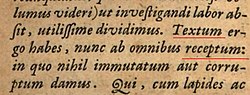
[edit]The origin of the term Textus Receptus comes from the publisher's preface to the 1633 edition produced by Bonaventure and his nephew Abraham Elzevir who were partners in a printing business at Leiden. The preface reads, Textum ergo habes, nunc ab omnibus receptum: in quo nihil immutatum aut corruptum damus ("so you hold the text, now received by all, in which [is] nothing corrupt"). The two words textum and receptum were modified from the accusative to the nominative case to render Textus Receptus. Over time, that term has been retroactively applied even to Erasmus's editions, as his work served as the basis of the others.[32]
F.H.A. Scrivener
[edit]
In 1894, Frederick Henry Ambrose Scrivener produced a significant Greek edition of the Textus Receptus, based on the textual variants that the translators of the King James Version (KJV) had utilized. The translators of the King James Version did not rely on a single edition of the Textus Receptus but instead they incorporated readings from multiple editions of the Textus Receptus, including those by Erasmus, Stephanus, and Beza. Additionally, they consulted the Complutensian Polyglot and the Latin Vulgate itself. This resulted in a Greek text that, while rooted in the tradition of the Textus Receptus, uniquely aligned with the particular readings of the King James Version.[33][34]
Textual criticism
[edit]John Mill (1645–1707) collated textual variants from 82 Greek manuscripts. In his Novum Testamentum Graecum, cum lectionibus variantibus MSS (Oxford 1707) he reprinted the unchanged text of the Editio Regia, but in the index he enumerated 30,000 textual variants.[35]
Shortly after Mill published his edition, Daniel Whitby (1638–1725) attacked his work by asserting that the text of the New Testament had never been corrupted and thus equated autographs with the Textus Receptus. He considered the 30,000 variants in Mill's edition a danger to Holy Scripture and called for defending the Textus Receptus against these variants.[36]
Johann Albrecht Bengel (1687–1752) edited in 1725 Prodromus Novi Testamenti Graeci Rectè Cautèque Adornandi and in 1734 Novum Testamentum Graecum. Bengel divided manuscripts into families and subfamilies and favoured the principle of lectio difficilior potior ("the more difficult reading is the stronger").
Johann Jakob Wettstein's apparatus was fuller than that of any previous editor. He introduced the practice of indicating the ancient manuscripts by capital Roman letters and the later manuscripts by Arabic numerals. He published in Basel Prolegomena ad Novi Testamenti Graeci (1731).
J. J. Griesbach (1745–1812) combined the principles of Bengel and Wettstein. He enlarged the Apparatus by considering more citations from the Fathers, and various versions, such as the Gothic, the Armenian, and the Philoxenian. Griesbach distinguished a Western, an Alexandrian, and a Byzantine Recension.[37] Christian Frederick Matthaei (1744–1811) was a Griesbach opponent.
Karl Lachmann (1793–1851) was the first who broke with the Textus Receptus. His object was to restore the text to the form in which it had been read in the Ancient Church in about AD 380. He used the oldest known Greek and Latin manuscripts.
Constantin von Tischendorf's Editio Octava Critica Maior was based on Codex Sinaiticus.
Westcott and Hort published The New Testament in the Original Greek in 1881 in which they rejected what they considered to be the dated and inadequate Textus Receptus. Their text is based mainly on Codex Vaticanus in the Gospels.[38]
Defense
[edit]Frederick von Nolan, a 19th-century historian and Greek and Latin scholar, spent 28 years attempting to trace the Textus Receptus to apostolic origins. He was an ardent advocate of the supremacy of the Textus Receptus over all other editions of the Greek New Testament, and he argued that the first editors of the printed Greek New Testament intentionally selected those texts because of their superiority and disregarded other texts, which represented other text-types because of their inferiority.
It is not to be conceived that the original editors of the [Greek] New Testament were wholly destitute of plan in selecting those manuscripts, out of which they were to form the text of their printed editions. In the sequel it will appear, that they were not altogether ignorant of two classes of manuscripts; one of which contains the text which we have adopted from them; and the other that text which has been adopted by M. Griesbach.[39]
Regarding Erasmus, Nolan stated:
Nor let it be conceived in disparagement of the great undertaking of Erasmus, that he was merely fortuitously right. Had he barely undertaken to perpetuate the tradition on which he received the sacred text he would have done as much as could be required of him, and more than sufficient to put to shame the puny efforts of those who have vainly labored to improve upon his design. [...] With respect to Manuscripts, it is indisputable that he was acquainted with every variety which is known to us, having distributed them into two principal classes, one of which corresponds with the Complutensian edition, the other with the Vatican manuscript. And he has specified the positive grounds on which he received the one and rejected the other.[40]

The Textus Receptus was defended by John William Burgon in his The Revision Revised (1881) and also by Edward Miller in A Guide to the Textual Criticism of the New Testament (1886). Burgon supported his arguments with the opinion that the Codex Alexandrinus and Codex Ephraemi were older than the Sinaiticus and the Vaticanus; and also that the Peshitta translation into Syriac (which supports the Byzantine Text) originated in the 2nd century. Miller's arguments in favour of readings in the Textus Receptus were of the same kind.[41] However, both Burgon and Miller believed that although the Textus Receptus was to be preferred to the Alexandrian Text, it still required to be corrected in certain readings against the manuscript tradition of the Byzantine text. In that judgement, they are criticised by Edward F. Hills, who argues that the principle that God provides truth through scriptural revelation also must imply that God must ensure a preserved transmission of the correct revealed text, continuing into the Reformation era of biblical translation and printing. For Hills, the task of biblical scholarship is to identify the particular line of preserved transmission through which God is acting; a line that he sees in the specific succession of manuscript copying, textual correction and printing, which culminated in the Textus Receptus and the King James Bible. Hills argues that the principle of providentially-preserved transmission guarantees that the printed Textus Receptus must be the closest text to the Greek autographs and so he rejects readings in the Byzantine Majority Text where they are not maintained in the Textus Receptus. He goes so far as to conclude that Erasmus must have been providentially guided when he introduced Latin Vulgate readings into his Greek text;[42] and even argues for the authenticity of the Comma Johanneum.[43]
Hence the true text is found not only in the text of the majority of the New Testament manuscripts but more especially in the Textus Receptus and in faithful translations of the Textus Receptus, such as the King James Version. In short, the Textus Receptus represents the God-guided revision of the majority text.[44]
Hills was the first textual critic to defend the Textus Receptus. Although others have defended it per se, they are not acknowledged textual critics (such as Theodore Letis and David Hocking) or their works are not on a scholarly level (such as Terence H. Brown and D. A. Waite[45]).[46]
Providential preservation
[edit]Those who still advocate the use of the Textus Receptus often rely upon a theological stance of supernatural providential preservation, arguing that a reliance upon naturalism to establish the text of the New Testament is contrary to divine revelation.[5] Thus, they have cited passages such as Psalm 12:6–7, Psalm 119:89, Matthew 5:18, Psalm 117:2, Matthew 24:35 and 1 Peter 1:25[47][48] as evidence that God would miraculously preserve every single true reading of the Bible. This interpretation, however, has been challenged by critics of the Textus Receptus who often assert that these scriptural passages pertain to God's oral communication with humanity rather than the written scriptures or to a more general preservation in the New Testament manuscripts as a whole.[49][48][5]
Relationship to Byzantine text
[edit]
The Textus Receptus was mainly established on a basis of manuscripts of the Byzantine text-type, also called 'Majority text', and usually is identified with it by its followers. However, in addition, over many years, Erasmus had extensively annotated New Testament citations in early Fathers, such as Augustine and Ambrose, whose biblical quotations more frequently conformed to the Western text-type; and he drew extensively on these citations (and also on the Vulgate) in support of his choice of Greek readings.
The Textus Receptus differs from the Majority Text edition of Robinson and Pierpont in 1,838 Greek readings, of which 1,005 represent "translatable" differences. Most of these variants are minor; however, Byzantine manuscripts usually exclude the Comma Johanneum and Acts 8:37, which are present in the Textus Receptus. Despite these differences, printed editions based on the Byzantine text agree far more closely with the Textus Receptus than with the critical text, as the Majority Text disagrees with the critical text 6,577 times in contrast to the 1,838 times it disagrees with the Textus Receptus. Additionally, multiple of the agreements between the Textus Receptus and the Byzantine text are very significant, such as the reading of "God" in 1 Timothy 3:16 and the inclusion of the Story of the Adulteress.[50][51] Sometimes the Textus Receptus contains readings which are present within the Byzantine text-type, but form a minority therein. This includes the reading "through his blood" in Colossians 1:14, which is contained in around 40% of the Byzantine manuscripts of Colossians, being omitted from the Byzantine critical edition of Robinson and Pierpont and that of Hodges and Farstad.[52][53]
F. H. A. Scrivener (1813–1891) remarked that at Matt. 22:28; 23:25; 27:52; 28:3, 4, 19, 20; Mark 7:18, 19, 26; 10:1; 12:22; 15:46; Luke 1:16, 61; 2:43; 9:1, 15; 11:49; John 1:28; 10:8; 13:20, Erasmus followed the readings of Minuscule 1 (Caesarean text-type).[7] For Revelation, Erasmus used Minuscule 2814, which follows the Andreas text-type. The Andreas text-type has been called a subtype of the Majority Text in Revelation, which is divided into the Koine form of Revelation and the Andreas type of Revelation.[54]
Dean Burgon, an influential supporter of the Textus Receptus declared that it needs correction.[55] He suggested 150 corrections in its Gospel of Matthew alone.[56]
- Matthew 10:8 has Alexandrian reading νεκροὺς ἐγείρετε (raise the dead) omitted by the Byzantine text.[57][58]
- Acts 20:28 has Alexandrian reading τοῦ Θεοῦ (of God) instead of Byzantine τοῦ Κυρίου καὶ Θεοῦ (of the Lord and God).
Controversial readings
[edit]The Textus Receptus contains many well known variants, such as the Comma Johanneum, Confession of the Ethiopian eunuch, the long ending of Mark, the Pericope Adulterae, the reading "God" in 1 Timothy 3:16 and the reading "book of life" in Revelation 22:19.[59]
Comma Johanneum (1 John 5:7)
[edit]The Comma Johanneum is a Trinitarian text included in 1 John 5:7 within the Textus Receptus, however the comma is seen as an interpolation by almost all textual critics.[60] The comma is mainly attested in the Latin manuscripts of the New Testament, being absent from the vast majority of Greek manuscripts of the New Testament, the earliest Greek manuscript being from the 14th century.[61] It is also totally absent in the Ethiopic, Aramaic, Syriac, Georgian, Arabic and from the early pre-12th century Armenian witnesses to the New Testament.[62] And as a result, modern translations as a whole, both Catholic and Protestant, do not include the comma in the main body of the text.[63]
.jpg)
The text (with the comma in italics and enclosed by brackets) in the King James Bible reads:
7For there are three that beare record [in heaven, the Father, the Word, and the Holy Ghost: and these three are one.] 8[And there are three that beare witnesse in earth], the Spirit, and the Water, and the Blood, and these three agree in one.
— King James Version (1611)
In the Greek Textus Receptus (TR), the verse reads thus:[65]
ὅτι τρεῖς εἰσιν οἱ μαρτυροῦντες εν τῷ οὐρανῷ, ὁ πατήρ, ὁ λόγος, καὶ τὸ Ἅγιον Πνεῦμα· καὶ οὗτοι οἱ τρεῖς ἕν εἰσι.
The earliest surviving Latin manuscripts containing the comma date back to the 5th to 7th centuries. These include the Freisinger fragment (6th-7th century),[66] León palimpsest (7th century),[67] besides the younger Codex Speculum (5th century).[68] Its first full appearance in Greek is from the Greek version of the Acts of the Lateran Council in 1215.[69] It subsequently appears in the writings of Emmanuel Calecas (died 1410), Joseph Bryennius (1350 – 1431/38) and in the Orthodox Confession of Moglas (1643).[70][71][61] While there are no comprehensive Patristic Greek references to the comma, F.H.A. Scrivener notes potential allusions to it somewhere around the 5th century in two Greek texts: Synopsis of Holy Scripture and the Disputation with Arius of Pseudo-Athanasius.[72] It is only found in a few later Greek manuscripts: 61 (c. 1520), 629 (14th), 918 (16th century), 2318 (18th century), 2473 (17th century), and in the margins of 88 (11th century with margins added at the 16th century), 177 (BSB Cod. graec. 211), 221 (10th century with margins added at the 15th/16th century), 429 (14th century with margins added at the 16th century), 636 (16th century) and possibly 635 (11th century, added later into the margin).[61]

The Codex Vaticanus in some places contains umlauts to indicate knowledge of variants. Although there has been some debate on the age of these umlauts and if they were added at a later date, according to a paper made by Philip B. Payne, the ink seems to match that of the original scribe.[73] The Codex Vaticanus contains these dots around 1 John 5:7, however according to McDonald, G. R, it is far more likely that the scribe had encountered other variants in the verse than the Johannine comma, which is not attested in Greek manuscripts until the 14th century.[61]
The Johannine comma gained a stronger position within the Latin tradition, especially in the middle ages, being referenced to by Peter Abelard (12th century), Peter Lombard (12th century), Bernard of Clairvaux (12th century), Thomas Aquinas (13th century) and William of Ockham (14th century) among many others.[61] The first undisputed work to quote the Comma Johanneum as an actual part of the Epistle's text appears to be the 4th century Latin homily Liber Apologeticus, probably written by Priscillian of Ávila (died 385), or his close follower Bishop Instantius.[69] However some have argued that the 3rd-century Church father Cyprian (died 258) knew of the comma earlier, who in Unity of the Church 1.6 may have quoted the Johannine comma: "Again it is written of the Father, and of the Son, and of the Holy Spirit, 'And these three are one.'"[74] Nevertheless, other scholars believe that he was giving an allegorical interpretation of the three elements mentioned in the uncontested part of the verse instead of quoting the Johannine comma itself.[69]
Confession of the Ethiopian Eunuch (Acts 8:37)
[edit]
The confession of the Ethiopian eunuch is a variant reading in Acts 8:37, widely seen by Textual Critics to be a later interpolation into the text. It is found in the King James Version due to its existence within the Textus Receptus.[75][76][77][78]
It reads in the King James Version as:[79]
And Philip said, If thou believest with all thine heart, thou mayest. And he answered and said, I believe that Jesus Christ is the Son of God.
In the Greek of the Textus Receptus, the verse reads:
ειπεν δε ο φιλιππος ει πιστευεις εξ ολης της καρδιας εξεστιν αποκριθεις δε ειπεν πιστευω τον υιον του θεου ειναι τον ιησουν χριστον
Erasmus himself decided to include the verse in his edition of the Greek text due to its presence in the Latin Vulgate of his day and due to being in the margin of Minuscule 2816 (15th century), which he used in his compilation of the Textus Receptus.[80][81][82] The reading is quoted by many western early Christian writers, such as Irenaeus (130 – c. 202), Cyprian (210 – 258), Ambrose (339 – 397) and Augustine (354 – 430). The verse is found in the Codex Glazier (4-5th century), the Harclensis Syriac (7th century), some Old Latin and Vulgate manuscripts alongside some Ethiopian, Georgian and Armenian manuscripts. Nevertheless, the earliest Greek manuscript to contain the verse is Codex Laudianus (550)[83][84] and it is not found in 𝔓45 (250), 𝔓74 (7th century), Codex Sinaiticus (4th century), Vaticanus (4th century). Alexandrinus (5th century), Ephraemi Rescriptus (5th century), Codex Athous Lavrensis (8th-9th century) and a multitude of other codices and cursives.[85]
Pericope Adulterae (John 7:53-8:11)
[edit]The Pericope Adulterae is a passage found in John 7:53-8:11.[86] It is viewed by most New Testament scholars as an interpolation, including Evangelical scholars.[87] The pericope does not occur in the earliest Greek manuscripts discovered in Egypt. The Pericope Adulterae is not in 𝔓66 or in 𝔓75, both of which have been assigned to the late 100s or early 200s, nor in two important manuscripts produced in the early or mid 300s, Sinaiticus and Vaticanus. The first surviving Greek manuscript to contain the pericope is the Latin-Greek diglot Codex Bezae, produced in the 400s. The Codex Bezae is also the earliest surviving Latin manuscript to contain it. Out of 23 Old Latin manuscripts of John 7–8, seventeen contain at least part of the pericope, and represent at least three transmission-streams in which it was included.[88][89][90][91]

Alongside the Old Latin manuscripts, the Pericope Adulterae is found in most Byzantine text-type manuscripts, Palestinian Syriac manuscripts, the Latin Vulgate and some Armenian manuscripts.[92][93] The earliest Greek writing to explicitly reference the passage is the Didascalia Apostolorum (3rd century). The passage is later referenced to in Greek by Didymus the Blind (4th century) alongside the Apostolic Constitutions (4th century), the Synopsis Scripturae Sacrae (6th century) and the 6th century canon tables of the Monastery of Saint Epiphanus.[94][91][95] Additionally, some manuscripts such as Codex Regius (8th century) and Codex Sangallensis (9th century) contain a large gap after John 7:52, thus indicating knowledge of the passage despite being omitted.[96][97] Due to its presence within most manuscripts within the Byzantine text-type, it is also a characteristic of Byzantine printed editions of the New Testament such as the texts of Maurice A. Robinson & William G. Pierpont and The Greek New Testament According to the Majority Text (Hodges-Farstad).[98][99]
There is now a broad academic consensus that the passage is a later interpolation added after the earliest known manuscripts of the Gospel of John. This has been the view of "most NT scholars, including most evangelical NT scholars, for well over a century".[100] Bishop J. B. Lightfoot wrote that absence of the passage from the earliest manuscripts, combined with the occurrence of stylistic characteristics atypical of John, together implied that the passage was an interpolation. Nevertheless, he considered the story to be authentic history.[101] Bart D. Ehrman concurs in Misquoting Jesus, adding that the passage contains many words and phrases otherwise alien to John's writing.[102] The evangelical Bible scholar Daniel B. Wallace agrees with Ehrman.[103] However, advocates of the Byzantine priority theory and those who view the Textus Receptus as the most accurate text have attempted to argue for the Johannine authorship of the story.[104] They have argued that there are points of similarity between the pericope's style and the style of the rest of the gospel, saying that anomalies in the transmission of the Pericope Adulterae may be explained by the Lectionary system, where due to the Pericope Adulterae being skipped during the Pentecost lesson, some scribes would relocate or omit the story to not interviene with the flow of the Pentecost lesson.[93][105]
Book of life (Revelation 22:19)
[edit]The Textus Receptus in Revelation 22:19 reads "book of life" instead of the Nestle-Aland reading "tree of life", which the Textus Receptus contains on the grounds of the Latin Vulgate (380) reading, however it is also attested within the scriptural quotations of Ambrose (339 – 4 April 397) and in some Coptic manuscripts.[106][107] Modern textual critics see the Latin Vulgate reading which found its way into the Textus Receptus as a typo caused by the similarity of the Latin words for book "libro" and tree "ligno".[108][109]
Fellowship (Ephesians 3:9)
[edit]The Textus Receptus contains a unique reading "fellowship" (koinonia) instead of "administration" (oikonomia) in Ephesians 3:9.[110][111] This variant is found in 10% of the Greek manuscripts of Ephesians alongside its inclusion in the Textus Receptus. It is missing from the Sinaiaticus (4th century), Vaticanus (4th century), Alexandrinus (5th century) and Papyrus 46 (3rd century).[112]
The longer ending of Mark (Mark 16:9-20)
[edit]Mark 16:9-20 or the longer ending of Mark is a variant found within the Textus Receptus which has generally been assumed to have been a later addition into the text by modern textual critics.[113] The earliest extant complete manuscripts of Mark, Codex Sinaiticus and Codex Vaticanus, two 4th-century manuscripts, do not contain the last twelve verses, 16:9–20. It is also omitted by one Syriac manuscript, the Syriac Sinaiticus (4th century) and one Old Latin manuscript, the Codex Bobbiensis (430). It is also missing from some Georgian and Armenian manuscripts and is omitted by Eusebius of Caesarea (4th century), Hesychius of Jerusalem (5th century), Severus of Antioch (5th century) and possibly Origen (3rd century).[114][115][116]
It is included in the Majority/Byzantine Text (over 1,500 manuscripts of Mark), Family 13, Codex Alexandrinus (5th century), Codex Bezae (5th century), Codex Ephraemi (5th century), Codex Koridethi (9th century), Athous Lavrensis (9th century), Codex Sangallensis 48 (9th century), minuscules: 33, 565, 700, 892, 2674. The Vulgate (380) and most of the Old Latin, Syriac Curetonian (5th century), Peshitta (5th century), Bohairic, most Sahidic, Gothic (4th century) and the Harklean Syriac (600). The passage is also cited by the Epistula Apostolorum (120-140), possibly Justin Martyr (160), Diatessaron (160–175 ), Irenaeus (180), Hippolytus (died 235), Vincent of Thibaris (256), De Rebaptismate (258), Acts of Pilate (4th century), Fortunatianus (350) and the Apostolic Constitutions (4th century)[114][117][116][118][119]
Due to its presence within most manuscripts within the Byzantine text-type, it is also a characteristic of Byzantine printed editions of the New Testament such as the texts of Maurice A. Robinson & Willia1 Timothy 3:16m G. Pierpont, The Greek New Testament According to the Majority Text (Hodges-Farstad)[98][99] and the Eastern Orthodox Patriarchal text.[120][121]
God was manifest in the flesh (1 Timothy 3:16)
[edit]
One noteworthy variant within the Textus Receptus is the reading "God" (theos) in 1 Timothy 3:16, as it concerns a very important theological point. This reading is not found in the earliest manuscripts known today, which instead read "who" (hos), which is why modern versions do not contain the word "God" in this verse.[122][123]
The reading "God" is supported most Byzantine text-type manuscripts, Codex Athous Lavrensis (8th century), Minuscule 81 (11th century), Minuscule 1739 (10th century), Minuscule 614 (13th century), Gregory of Nyssa (4th century), Didymus (4th century), John Chrysostom (4th century), Euthalius (4th century) and Theodoret (5th century), while the reading "who" is found in the Codex Sinaiaticus (4th century), Alexandrinus (5th century), Ephraemi Rescriptus (5th century), Gothic manuscripts, Jerome (4th century), Origen (3rd century) and Epiphanus (4th century).[124] The Sinaiticus, Alexandrinus and Ephraemi Rescriptus were corrected by later scribes to add the reading "theos".[125]
It is hard for thee to kick against the pricks (Acts 9:5-6)
[edit]The reading "It is hard for thee to kick against the pricks" is found in the Textus Receptus in Acts 9:5, which is lacking in most Greek manuscripts. Erasmus admitted himself that these words were not found in the Greek manuscripts he had access to, however decided to include the words due to their presence in the Latin Vulgate.[126] These words are found in verse 4 instead of verse 5 in two Greek manuscripts: 431 and Codex Laudianus. They are also found in the Palestinian Syriac manuscripts alongside in the writings of Augustine and Petilianus. While these words are found in verse 5 as in the Textus Receptus in the Vetus Latina manuscripts, Vulgate manuscripts and in the writings of Ambrose (339 – 4 April 397) and Lucifer of Cagliari (died 370).[127]
After these words, the Textus Receptus contains the reading "And he trembling and astonished said, Lord, what wilt thou have me to do? And the Lord said unto him". These words are found found in the 7th century Harclean Syriac version, the Latin Vulgate, Vetus Latina manuscripts alongside the 4th or 5th century Coptic Codex Glazier. However, there are no extant Greek manuscripts today to include these words.[127]
Some such as Clark have argued that the words "It is hard for thee to kick against the pricks" should be included in Acts 9 because they fit Lukan style more accurately. Nevertheless, Bruce M. Metzger has argued that these words are more likely added by copyists trying to harmonize Acts 9 later accounts of Paul's conversion.[127]
Other controversial readings
[edit]| Verse | Variant | Witnesses to contain the same reading as the TR reading | Witnesses against the TR reading | Other information |
|---|---|---|---|---|
| Mark 9:44 and 9:46 | Some manuscripts omit these verses in their entirety. | Alexandrinus (5th century), Bezae (5th century), Cyprius (9th century), Koridethi (9th century), the Latin Vulgate, the Byzantine Majority text.[128][129] | Vaticanus (4th century), Sinaiticus (4th century), Ephraemi Rescriptus (5th century), Regius (8th century), Washingtonianus (5th century), Family 1[128] | |
| John 5:3–4 | Some manuscripts omit most of the words in these verses. | The Byzantine Majority text (most manuscripts of John), Including Tischendorfianus III (9th century), Petropolitanus (9th century) and Vaticanus 354 (10th century).[130] It is also quoted by Tertullian (3rd century).[131] | Papyrus 66 (3rd century), Papyrus 75 (3rd century), Codex Sinaiticus (4th century, original hand), Codex Alexandrinus (5th century, original hand), Codex Vaticanus (4th century), Codex Ephraemi Rescriptus (5th century, original hand), and Codex Regius (8th century).[130] | |
| John 7:8 | Some manuscripts read "not" instead of "yet" as in the Textus Receptus | Papyrus 66 (3rd century), Papyrus 75 (3rd century), Codex Vaticanus (4th century), Codex Regius (8th century), Codex Borgianus (5th century), Codex Washingtonianus (late 4th/early 5th century), Codex Athous Lavrensis (9th century), Harklean Syriac (7th century), Family 1 (12th-14th centuries), Family 13 (11th-15th centuries), Uncial 070 (6th century), Uncial 0105 (5th/6th century), Uncial 0250 (9th century).[132] | Codex Bezae Cantabrigiensis (5th century), Codex Sinaiticus (4th century), Codex Cyprius (9th century), Minuscule 1241 (12th century), Bohairic (Coptic version, 3rd/4th century), Latin Vulgate (4th century, translated by Jerome).[132] | Metzger argued that although the word "yet" is found 3rd century Papyri, it was still likely added to avoid an inconsistency with the narrative.[133] |
| Acts 23:9 | Some manuscripts omit the words "let us not fight against God" found in the Textus Receptus | Most manuscripts of the Byzantine text-type (majority of all Greek manuscripts of Acts), including H, L, P.[133] | This phrase, which also appears in Acts 5:39, does not appear in – Papyrus 74 (7th century), Codex Sinaiticus (4th century), Codex Alexandrinus (5th century, original hand), Codex Vaticanus (4th century), Codex Ephraemi Rescriptus (5th century, original hand), Codex Laudianus (6th century), and Codex Athous Lavrensis (9th century).[134] | |
| Revelation 1:8 | The Textus Receptus adds the words "the beginning and the ending". | This phrase appears in: 2344, Codex Sinaiticus (4th century), Old Latin manuscripts, the Latin Vulgate (4th century), and 20 other Greek minuscules[133] | All other witnesses to Revelation | Metzger argued for the TR reading to be a harmonization from Revelation 21:6[133] |
| Revelation 6:12 | The Textus Receptus adds the words "and, lo" before the word "earthquake". | Alexandrinus (5th century) 296, 2066, Vulgate (4th century) and Primasius (6th century) | Codex Sinaiticus (4th century), Codex Ephraemi Rescriptus (5th century), Codex Vaticanus (4th century), 1006, 1611, 1854, 2053, 2344, some of the Old Latin, Harklean Syriac, Armenian and Ethiopian[133] | |
| Revelation 15:3 | The TR reads "Holy" instead of "nations" or "ages". | A few Greek witnesses (296, 2049) and several Latin writers, such as: Tyconius (4th century), Cassidorus (6th century), Apringius (6th century) and the earliest commentary on Revelation from Victorinus of Pettau (3rd century).[133] | The reading "nations" is found in A, P, 046, 051, most minuscules, some Old Latin manuscripts, Coptic, Armenian and Ethiopian manuscripts. The reading "ages" is found in C, p47, 94, 469, 1006, 1611, the Vulgate, Harklean Syriac and many other Greek manuscripts.[133] | |
| Revelation 22:21 | Inclusion of the word "Amen" at the end | 046, 051, Sinaiticus, almost all Greek minuscules, Harklean Syriac, Coptic, Armenian, Ethiopian manuscripts[133] | Alexandrinus, 1006, 2065, 2432, Codex Fuldensis and some Old Latin manuscripts[133] |
Variants within the Textus Receptus editions
[edit]Although the Textus Receptus tradition is very uniform, there are some variants between the different editions of the Textus Receptus. There are around 283 differences between the editions of Scrivener and Stephanus, while the number is 190 between the editions Scrivener and Beza. Most of these variants are insignificant, and often deal with spelling differences, word order or other minor differences.[27]
The following examples are from F.H.A Scrivener, who listed the variants between the Textus Receptus editions:[135]
- Beza adds "de" after "husteron", which is lacking in the text of Stephanus in Mark 1:21´.
- Beza reads "kaleseis" instead of "kalesousi" in Matthew 1:23. Beza's reading is only supported by Codex D.
- Unlike Stephanus, Beza includes the words "tou theou" after "agapen" in 1 John 3:16. This reading is also found in the Complutensian Polyglot.
- Beza omits the word "hoti" in Matthew 9:33, which is found in the text of Stephanus.
- Stephanus includes the word "amen" at the end of Mark 16:20, which is also omitted by Beza and Erasmus. This reading is found in the Complutensian Polyglot.
- Beza and Elzevir read "apothanontos", while Stephanus reads "apothanontes" in Romans 7:6. The reading of Beza has been proposed to have been supported by John Chrysostom (347 – 14 September 407), but it is absent from the existing Greek manuscripts. However Beza's argument that Chrysostom's manuscript included the reading "apothanontos" has been disputed as being a misinterpretation of his commentary, as there are places where Chrysostom's commentaries contain the common Greek reading of "apothanontes". Beza argued that later authors had interpolated the reading into Chrysostom's commentary.[136]
English translations from the Textus Receptus
[edit]- Tyndale New Testament 1526–1530
- Coverdale Bible 1535
- Matthew Bible 1537
- Taverner's Bible 1539
- Great Bible 1539
- Geneva Bible 1560–1644
- Bishops' Bible 1568
- Douay–Rheims Bible 1582, 1610, 1749–1752. Base translation is from the Vulgate but 1749–52 editions onwards (Challoner revisions) contain major borrowings from the Tyndale, Geneva and King James versions.[137][138][139]
- King James Version 1611, 1613, 1629, 1664, 1701, 1744, 1762, 1769, 1850
- English Dort Version 1657, English translation of the Statenvertaling by Theodore Haak
- Quaker Bible 1764
- Webster's Revision 1833
- Young's Literal Translation (YLT) 1862, 1887, 1898
- Rotherham's Emphasized Bible (EBR) 1872 edition.
- Cambridge Paragraph Bible 1873 edition of the KJV in paragraph format, edited by F. H. A. Scrivener.
- Julia E. Smith Parker Translation 1876
- New King James Version (NKJV) 1982 (New Testament 1979). With an anglicized version originally known as the "Revised Authorized Version".
- Green's Literal Translation 1985. Included in The Interlinear Translation 1986.
- Third Millennium Bible 1998
- New Cambridge Paragraph Bible 2005 edition of the KJV, paragraph format with modernised spelling; edited by David Norton.
- Modern English Version 2014[140]
- Literal Standard Version 2020
- King James Version 2023 Edition 2023
See also
[edit]- Other text-types
- Other articles
- Minuscule 177 – manuscript close to Textus Receptus
- King-James-Only Movement
- Textual criticism
- Biblical manuscripts
- List of major textual variants in the New Testament
References
[edit]- ^ "In time, Erasmus' text became known as the "Textus receptus" (largely through a marketing strategy employed by the Elzevir publishers in 1633) - the "received text" implying verbal inspiration." Eisener, Wendell L. (1999). Matthew's Beatitudes in English: a comparative study in the history of translation (Thesis). Acadia University.
- ^ Epp, Eldon Jay (2020-11-30). Perspectives on New Testament Textual Criticism, Volume 2: Collected Essays, 2006–2017. BRILL. ISBN 978-90-04-44233-7.
- ^ Robertson, A. T. (2014-08-01). An Introduction to the Textual Criticism of the New Testament. Wipf and Stock Publishers. ISBN 978-1-4982-0089-9.
- ^ a b Doble, Peter; Kloha, Jeffrey (2014-07-24). Texts and Traditions: Essays in Honour of J. Keith Elliott. BRILL. ISBN 978-90-04-27393-1.
- ^ a b c Wettlaufer, Ryan Donald (2013-03-01). No Longer Written: The Use of Conjectural Emendation in the Restoration of the Text of the New Testament, the Epistle of James As a Case Study. BRILL. ISBN 978-90-04-23533-5.
- ^ a b Andrews, Edward D. (2023-06-15). THE TEXTUS RECEPTUS: The "Received Text" of the New Testament. Christian Publishing House. ISBN 979-8-3984-5852-7.
- ^ a b c F. H. A. Scrivener, A Plain Introduction to the Criticism of the New Testament, (George Bell & Sons: London 1894), vol. 2, pp. 183–184.
- ^ a b Daniel Wallace, "Some Second Thoughts on the Majority Text", Bibliotheca Sacra, July–September, 1989, p. 276.
- ^ a b c Waltz, Robert B. (23 January 2025). The Encyclopedia of New Testament Textual Criticism. Robert B. Waltz.
- ^ Waltz, Robert B. (23 January 2025). The Encyclopedia of New Testament Textual Criticism. Robert B. Waltz.
- ^ Heide, Martin (2023-02-07). "Erasmus and the Search for the Original Text of the New Testament". Text & Canon Institute. Retrieved 2024-02-08.
- ^ Andrews, Edward D. (2019-02-02). INTRODUCTION TO THE TEXT OF THE NEW TESTAMENT: From The Authors and Scribe to the Modern Critical Text. Christian Publishing House. ISBN 978-1-949586-78-7.
- ^ a b Scrivener, Frederick Henry Ambrose (1883). A Plain Introduction to the Criticism of the New Testament for the Use of Biblical Students. Deighton, Bell.
As Apoc. 1 was mutilated in the last six verses, Erasmus turned these into Greek from the Latin; and some portions of his self-made version, which are found (however some editors may speak vaguely) in no one known Greek manuscript whatever, still cleave to our received text ^. Besides this scanty roll, however, he not rarely refers in his Annotations to other manuscripts he had seen in the course of his travels (e. g. on Heb. i. 3; Apoc. i. 4; viii. 13), yet too indistinctly for his allusions to be of much use to critics. Some such readings, as alleged by him, have not been found elsewhere
- ^ "Preface". The Correspondence of Erasmus. University of Toronto Press. 1 December 1977. pp. xi–xv. doi:10.3138/9781442681002-002. ISBN 978-1-4426-8100-2.
- ^ "The Galileo Project". galileo.rice.edu.
- ^ "Erasmus's 1527 New Testament - Trinitarian Bible Society". www.tbsbibles.org.
- ^ a b Koester, Helmut (2012-10-25). History and Literature of Early Christianity. Walter de Gruyter. ISBN 978-3-11-081265-7.
- ^ a b Krans, Jan. "Erasmus and the Text of Revelation 22:19" (PDF). TC: A Journal of Biblical Textual Criticism.
- ^ "Epistle 273" in Collected Works of Erasmus Vol. 2: Letters 142 to 297, 1501–1514 (tr. R.A.B. Mynors and D.F.S. Thomson; annotated Wallace K. Ferguson; Toronto: University of Toronto Press, 1976), 253.
- ^ "Epistle 305" in Collected Works of Erasmus. Vol. 3: Letters 298 to 445, 1514–1516 (tr. R.A.B. Mynors and D.F.S. Thomson; annotated by James K. McConica; Toronto: University of Toronto Press, 1976), 32.
- ^ "Epistle 337" in Collected Works of Erasmus Vol. 3, 134.
- ^ a b W. W. Combs, Erasmus and the textus receptus, DBSJ 1 (Spring 1996), 45.
- ^ Bruce M. Metzger, Bart D. Ehrman, The Text of the New Testament: Its Transmission, Corruption and Restoration, Oxford University Press, 2005, p. 145.
- ^ Bruce Metzger The Text of the New Testament, p. 99
- ^ H. J. de Jonge, Erasmus and the Comma Johanneum, Ephemerides Theologicae Lovanienses (1980), p. 385 Archived 2014-09-03 at the Wayback Machine
- ^ S. P. Tregelles, An Account of the Printed Text of the Greek New Testament, London 1854, p. 29.
- ^ a b c d "The Received Text".
- ^ Garcia Pinilla, Ignacio (2017). Reconsidering the Relationship between the Complutensian Polyglot Bible and Erasmus' Novum Testamentum in Erasmus' Edition of the New Testament. Basel: Mohr Siebeck. p. 70. Retrieved 31 May 2023.
- ^ "Polyglot Bibles".
but in the fourth edition of Erasmus' work (1527), which forms the basis of the "Textus receptus", a strong influence of Ximenez' text is generally recognized.
- ^ "The Text of the New Testament". rsc.byu.edu.
- ^ Horne, Thomas Hartwell (1856). An Introduction to the Critical Study and Knowledge of the Holy Scriptures. Longman, Brown, Green, Longmans & Roberts.
- ^ Bruce M. Metzger, Bart D. Ehrman, The Text Of The New Testament: Its Transmission, Corruption and Restoration, Oxford University Press, 2005, p. 152.
- ^ Scrivener, Frederick Henry Ambrose (1894). The New Testament in the original Greek, according to the text followed in the Autnorized Version. University of California Libraries. Cambridge : University Press.
{{cite book}}: CS1 maint: publisher location (link) - ^ Scrivener, Frederick H. (2004-04-01). The Authorized Version of the English Bible (1611): Its Subsequent Reprints and Modern Representatives. Wipf and Stock Publishers. ISBN 978-1-59244-634-6.
- ^ T. Robertson, An Introduction to the Textual Criticism of the New Testament, Nashville: Broadman, 1925, pp. 107–108.
- ^ Whitby, Daniel (1 January 1710). "Additional Annotations to the New Testament: With Seven Discourses; and an Appendix Entituled Examen Variantium Lectionum Johannis Millii, S.T.P. in Novum Testamentum". W. Bowyer – via Google Books.
- ^ J. J. Griesbach, Novum Testamentum Graece, (London 1809)
- ^ Westcott & Hort, The New Testament In The Original Greek (New York 1882)
- ^ An Inquiry into the Integrity of the Greek Vulgate, or Received Text of the New Testament; in which the Greek Manuscripts are newly classed; the Integrity of the Authorised Text vindicated; and the Various Readings traced to their Origin (London, 1815), ch. 1. The sequel mentioned in the text is Nolan's Supplement to an Inquiry into the Integrity of the Greek Vulgate, or Received Text of the New Testament; containing the Vindication of the Principles employed in its Defence (London, 1830).
- ^ ibid., ch. 5
- ^ Edward Miller, A Guide to the Textual Criticism of the New Testament (The Dean Burgon Society Press: 2003), pp. 30–37. 57–59.
- ^ Edward F. Hills, King James Version Defended!, pp. 199–200.
- ^ Edward F. Hills, King James Version Defended!, pp. 209–213.
- ^ "Far Eastern Bible College – A History of My Defence of the King James Version". Archived from the original on 2017-02-22. Retrieved 2009-10-15.
- ^ "D. A. Waite".
- ^ Daniel Wallace, The Majority Text Theory: History, Methods, and Critique, in The Text of the New Testament in Contemporary Research, Wm. Eerdmans 1995, p. 301.
- ^ "Statement of Doctrine of Holy Scripture".
- ^ a b "What is the Preservation of Scripture?". theaquilareport.com. Retrieved 2024-07-01.
- ^ Andrews, Edward D. (2023-06-15). THE TEXTUS RECEPTUS: The "Received Text" of the New Testament. Christian Publishing House. ISBN 979-8-3984-5852-7.
- ^ Michael D. Marlowe states:[1] yet it differs from the Received Text in about a thousand places, most of them being trivial. while Daniel B. Wallace [2] Archived 2007-08-05 at the Wayback Machine has counted 1,838 differences between it and the Textus Receptus.
- ^ "What about the Majority Text?". www.bible-researcher.com. Retrieved 2024-01-17.
- ^ Wilbur N. Pickering (2020-06-25). The Greek New Testament According To Family 35, Third Edition.
- ^ Zane C. Hodges, Arthur L. Farstad (1984). The Greek New Testament According to the Majority Text (Hodges-Farstad GNT).
- ^ Beale, G. K. (2013-09-07). The Book of Revelation. Wm. B. Eerdmans Publishing. ISBN 978-1-4674-2230-7.
- ^ J. W. Burgon, The Revised Revision (London 1883), p. 548.
- ^ J. W. Burgon, Revised Revision (London 1883), p. 242.
- ^ NA26, p. 24.
- ^ J. W. Burgon, The Revised Revision, p. 108; Edward Miller, Textual Commentary Upon the Holy Gospels, p. 75.
- ^ Andrews, Edward D. (2023-06-15). THE TEXTUS RECEPTUS: The "Received Text" of the New Testament. Christian Publishing House. ISBN 979-8-3984-5852-7.
- ^ Finnegan, Sean (2015-12-08). "The Story Behind The Comma Johanneum (1 John 5.7)". Restitutio. Retrieved 2024-07-05.
- ^ a b c d e McDonald, G. R (2011). Raising the ghost of Arius : Erasmus, the Johannine comma and religious difference in early modern Europe (Doctoral dissertation). Leiden University. hdl:1887/16486.
- ^ "CATHOLIC ENCYCLOPEDIA: Epistles of Saint John". www.newadvent.org. Retrieved 2024-05-24.
The Armenian manuscripts, which favour the reading of the Vulgate, are admitted to represent a Latin influence which dates from the twelfth century
- ^ Metzger, Bruce. A Textual Commentary on the Greek New Testament. pp. 716-718. 1975.
- ^ Scrivener, Frederick Henry Ambrose; Edward Miller (1894). A Plain Introduction to the Criticism of the New Testament. 2 (4 ed.). London: George Bell & Sons. p. 86.
- ^ "Bible Gateway passage: 1 John 5:7 - New English Translation". Bible Gateway. Retrieved 2024-05-19.
- ^ 'r' in the UBS-4 also 'it-q' and Beuron 64 are apparatus names today. These fragments were formerly known as Fragmenta Monacensia, as in the Handbook to the textual criticism of the New Testament, by Frederic George Kenyon, 1901, p. 178.
- ^ Aland, B.; Aland, K.; J. Karavidopoulos, C. M. Martini, B. Metzger, A. Wikgren (1993). The Greek New Testament. Stuttgart: United Bible Societies. p. 819. ISBN 978-3-438-05110-3.
{{cite book}}: CS1 maint: multiple names: authors list (link) [UBS4] - ^ Catholic Encyclopedia, "Epistles of St John"
- ^ a b c "The Comma Johanneum and Cyprian | Bible.org". bible.org. Retrieved 2024-05-19.
- ^ The orthodox confession of the catholic and apostolic Eastern-Church, p.16, 1762. Greek and Latin in Schaff The Creeds of Christendom p. 275, 1877
- ^ "Philip Schaff: Creeds of Christendom, with a History and Critical notes. Volume I. The History of Creeds. - Christian Classics Ethereal Library". www.ccel.org. Retrieved 2024-05-19.
- ^ Scrivener, Frederick Henry Ambrose (1894). A Plain Introduction to the Criticism of the New Testament for the Use of Biblical Students. G. Bell.
- ^ Payne, Philip B.; Canart, Paul (2000). "The Originality of Text-Critical Symbols in Codex Vaticanus". Novum Testamentum. 42 (2): 105–113. doi:10.1163/156853600506799. ISSN 0048-1009. JSTOR 1561327.
- ^ Et iterum de Patre et Filio et Spiritu Sancto scriptum est—Et hi tres unum sunt. Cyprian, De Unitate Ecclesiæ (On the Unity of the Church) IV. "Epistles of Saint John", Catholic Encyclopedia.
- ^ Ehrman, Bart D. The Reliability of the New Testament. Fortress Press. ISBN 978-1-4514-1715-9.
- ^ White, James R.; Baird, Dr Mike (June 2009). The King James Only Controversy: Can You Trust Modern Translations?. Baker Books. ISBN 978-0-7642-0605-4.
- ^ "The Multivalence of the Ethiopian Eunuch and Acts 8:37" (PDF). TC: A Journal of Biblical Textual Criticism.
- ^ "Why Is Acts 8:37 Omitted from Many Bible Translations?". Catholic Answers. Retrieved 2024-05-21.
- ^ "Bible Gateway passage: Acts 8:37 - King James Version". Bible Gateway. Retrieved 2024-05-21.
- ^ White, James R.; Baird, Dr Mike (June 2009). The King James Only Controversy: Can You Trust Modern Translations?. Baker Books. ISBN 978-0-7642-0605-4.
- ^ Kurt Aland & Barbara Aland, The Text of The New Testament (rev. ed. 1987, Grand Rapids, Eerdmans) pages 303–304.
- ^ Brooke Foss Westcott & Fenton John Anthony Hort, The New Testament in the Original Greek (1881, Cambridge & London, Macmillan & Co.) vol. 2 (Appendix) page 93.
- ^ Epp, Eldon Jay (2005-06-01). Perspectives on New Testament Textual Criticism: Collected Essays, 1962-2004. BRILL. ISBN 978-90-474-0695-2.
- ^ "The Multivalence of the Ethiopian Eunuch and Acts 8:37" (PDF). TC: A Journal of Biblical Textual Criticism.
- ^ Bruce M. Metzger, A Textual Commentary on the Greek New Testament A Companion Volume to the UBS Greek New Testament (1971, United Bible Societies) loc.cit.; UBS version loc.cit.
- ^ John 7:53–8:11
- ^ Wallace, Daniel B. (2009). Copan, Paul; Craig, William Lane (eds.). Contending with Christianity's Critics: Answering New Atheists and Other Objectors. B&H Publishing Group. pp. 154–155. ISBN 978-1-4336-6845-6.
- ^ Keith, Chris (2009-04-07), The Pericope Adulterae, the Gospel of John, and the Literacy of Jesus, Brill, ISBN 978-90-474-4019-2, retrieved 2024-01-13
- ^ Knust, Jennifer; Wasserman, Tommy (2018-11-13). To Cast the First Stone: The Transmission of a Gospel Story. Princeton University Press. ISBN 978-0-691-18446-3.
- ^ Petersen, William Lawrence (2011-12-09). Patristic and Text-Critical Studies: The Collected Essays of William L. Petersen. BRILL. ISBN 978-90-04-19289-8.
- ^ a b Keith, Chris (2009). The Pericope Adulterae, the Gospel of John, and the Literacy of Jesus. BRILL. ISBN 978-90-04-17394-1.
- ^ Petersen, William Lawrence (2011-12-09). Patristic and Text-Critical Studies: The Collected Essays of William L. Petersen. BRILL. ISBN 978-90-04-19289-8.
- ^ a b Robinson, Maurice (1998-01-01). "Preliminary observations regarding the pericope adulterae based upon fresh collations of nearly all continuous-text manuscripts and over one hundred lectionaries". Conference Papers.
- ^ "Vol. 36, 1982 of Dumbarton Oaks Papers on JSTOR". www.jstor.org. Retrieved 2024-01-27.
- ^ Knust, Jeniffer (2007). "Early Christian Re-Writing and the History of the Pericope Adulterae". academia.edu. Journal of Early Christian Studies. pp. 499–500. Retrieved October 12, 2022.
- ^ Black, David Alan; Cerone, Jacob N. (2016-04-21). The Pericope of the Adulteress in Contemporary Research. Bloomsbury Publishing. ISBN 978-0-567-66599-7.
- ^ Lunn, Nicholas P. (2015-04-30). The Original Ending of Mark: A New Case for the Authenticity of Mark 16:9-20. James Clarke & Company Limited. ISBN 978-0-227-90459-6.
- ^ a b Maurice A. Robinson & William G. Pierpont. The New Testament In The Original Greek Byzantine Textform [By, Maurice A. Robinson & William G. Pierpont] [© 2005].
- ^ a b Zane C. Hodges, Arthur L. Farstad (1984). The Greek New Testament According to the Majority Text (Hodges-Farstad GNT).
- ^ Wallace, Daniel B. (2009). Copan, Paul; Craig, William Lane (eds.). Contending with Christianity's Critics: Answering New Atheists and Other Objectors. B&H Publishing Group. pp. 154–155. ISBN 978-1-4336-6845-6.
- ^ "The passages which touch Christian sentiment, or history, or morals, and which are affected by textual differences, though less rare than the former, are still very few. Of these, the pericope of the woman taken in adultery holds the first place of importance. In this case a deference to the most ancient authorities, as well as a consideration of internal evidence, might seem to involve immediate loss. The best solution may be to place the passage in brackets, for the purpose of showing, not, indeed, that it contains an untrue narrative (for, whencesoever it comes, it seems to bear on its face the highest credentials of authentic history), but that evidence external and internal is against its being regarded as an integral portion of the original Gospel of St. John." J.B. Lightfoot, R.C. Trench, C.J. Ellicott, The Revision of the English Version of the NT, intro. P. Schaff, (Harper & Bro. NY, 1873) Online at CCEL (Christian Classic Ethereal Library)
- ^ Ehrman, Bart D. (2008). Whose Word is It?: The Story Behind who Changed the New Testament and why. Continuum. p. 65. ISBN 978-1-84706-314-4.
- ^ Phillips, Peter (2016). Hunt, Steven A.; Tolmie, D. Francois; Zimmermann, Ruben (eds.). Character Studies in the Fourth Gospel. William B. Eerdmans Publishing Company. p. 408. ISBN 978-0-8028-7392-7.
- ^ "Why John 7.53–8.11 is in the Bible - Trinitarian Bible Society". www.tbsbibles.org. Retrieved 2024-02-13.
- ^ The Greek New Testament According to the Majority Text with Apparatus: Second Edition, by Zane C. Hodges (Editor), Arthur L. Farstad (Editor) Publisher: Thomas Nelson; ISBN 0-8407-4963-5
- ^ Hoskier, H. C. (Herman Charles) (1911). Concerning the date of the Bohairic version; covering a detailed examination of the text of the Apocalypse and a review of some of the writings of the Egyptian monks. Cornell University Library. London : B. Quaritch.
- ^ Houghton, H. A. G. (2016). The Latin New Testament: A Guide to Its Early History, Texts, and Manuscripts. Oxford University Press. ISBN 978-0-19-874473-3.
- ^ McAllister, Colin (2020-03-26). The Cambridge Companion to Apocalyptic Literature. Cambridge University Press. ISBN 978-1-108-42270-3.
- ^ Andrews, Edward D. (2023-06-15). THE TEXTUS RECEPTUS: The "Received Text" of the New Testament. Christian Publishing House. ISBN 979-8-3984-5852-7.
- ^ White, James R. (June 2009). The King James Only Controversy: Can You Trust Modern Translations?. Baker Books. ISBN 978-0-7642-0605-4.
- ^ Neville Figgis, CR: His Life, Thought and Significance. BRILL. 2021-11-29. ISBN 978-90-04-50312-0.
- ^ Wilbur N. Pickering (2020-06-25). The Greek New Testament According To Family 35, Third Edition.
- ^ Hester, David W. (2015-03-19). Does Mark 16:9–20 Belong in the New Testament?. Wipf and Stock Publishers. ISBN 978-1-4982-0159-9.
- ^ a b Jr, James Snapp (2022-06-01). "A Case for the Longer Ending of Mark by James Snapp". Text & Canon Institute. Retrieved 2024-02-03.
- ^ Head, Peter M. (2022-06-14). "A Case against the Longer Ending of Mark by Peter Head". Text & Canon Institute. Retrieved 2024-02-03.
- ^ a b Lunn, Nicholas P. (2014-10-01). The Original Ending of Mark: A New Case for the Authenticity of Mark 16:9–20. Wipf and Stock Publishers. ISBN 978-1-63087-520-6.
- ^ Amphoux, Christian; Elliott, James Keith (2011-12-09). Textual Research on the Psalms and Gospels / Recherches textuelles sur les psaumes et les évangiles: Papers from the Tbilisi Colloquium on the Editing and History of Biblical Manuscripts. Actes du Colloque de Tbilisi, 19-20 septembre 2007. BRILL. ISBN 978-90-04-21443-9.
- ^ "Bible Gateway passage: Mark 16:9-11 - New English Translation". Bible Gateway. Retrieved 2024-07-02.
- ^ Houghton, H. A. G.; Parker, David C.; Strutwolf, Holger (2019-12-02). The New Testament in Antiquity and Byzantium: Traditional and Digital Approaches to its Texts and Editing. A Festschrift for Klaus Wachtel. Walter de Gruyter GmbH & Co KG. ISBN 978-3-11-059030-2.
- ^ Karavidopoulos, Ioannes D. "THE ECUMENICAL PATRIARCHATE'S 1904 NEW TESTAMENT EDITION AND FUTURE PERSPECTIVES" (PDF).
{{cite journal}}: Cite journal requires|journal=(help) - ^ "The Patriarchal Greek New Testament (PATr)". www.logos.com. Retrieved 2021-07-22.
- ^ Andrews, Edward D. (2023-06-15). THE TEXTUS RECEPTUS: The "Received Text" of the New Testament. Christian Publishing House. ISBN 979-8-3984-5852-7.
- ^ Gutjahr, Paul C. (2017). The Oxford Handbook of the Bible in America. Oxford University Press. ISBN 978-0-19-025884-9.
- ^ Andrews, Edward D. (2019-02-02). INTRODUCTION TO THE TEXT OF THE NEW TESTAMENT: From The Authors and Scribe to the Modern Critical Text. Christian Publishing House. ISBN 978-1-949586-78-7.
- ^ Andrews, Edward D. (2020-02-21). FROM SPOKEN WORDS TO SACRED TEXTS: Introduction-Intermediate to New Testament Textual Studies. Christian Publishing House. ISBN 978-1-949586-98-5.
- ^ McDonald, Grantley (2016-07-27). Biblical Criticism in Early Modern Europe: Erasmus, the Johannine Comma and Trinitarian Debate. Cambridge University Press. ISBN 978-1-316-79078-6.
- ^ a b c Metzger, Bruce Manning (1971). A Textual Commentary on the Greek New Testament: A Companion Volume to the United Bible Societies' Greek New Testament (3d Ed.). United Bible Societies. ISBN 978-3-438-06010-5.
- ^ a b Lincoln H. Blumell, A Text-critical comparison of the King James New Testament with certain modern translations, Studies in the Bible and Antiquity, vol. 3 (2011) page 86.
- ^ Waltz, Robert B. (23 January 2025). The Encyclopedia of New Testament Textual Criticism. Robert B. Waltz.
- ^ a b [[Frederick Henry [Ambrose] Scrivener]], A Plain Introduction to the Criticism of the New Testament (3d ed. 1883, London) pages 607–609; Brooke Foss Westcott & Fenton John Anthony Hort, The New Testament in the Original Greek (1881, Cambridge & London, Macmillan & Co.) vol. 2 (Appendix) page 77; Bruce M. Metzger, A Textual Commentary on the Greek New Testament A Companion Volume to the UBS Greek New Testament (1971, United Bible Societies) loc.cit.; UBS, loc.cit.; Kurt Aland & Barbara Aland, The Text of the New Testament (2nd ed.1989, Grand Rapids, Eerdmans) page 303.
- ^ DeConick, April; Shaw, Gregory; Turner, John D. (2013-08-22). Practicing Gnosis: Ritual, Magic, Theurgy and Liturgy in Nag Hammadi, Manichaean and Other Ancient Literature. Essays in Honor of Birger A. Pearson. BRILL. ISBN 978-90-04-24852-6.
- ^ a b Kannaday, Wayne Campbell (2004). Apologetic Discourse and the Scribal Tradition: Evidence of the Influence of Apologetic Interests on the Text of the Canonical Gospels. Society of Biblical Lit. ISBN 978-1-58983-101-8.
- ^ a b c d e f g h i Metzger, Bruce M. (Bruce Manning) (1994). A textual commentary on the Greek New Testament : a companion volume to the United Bible Societies' Greek New Testament. Internet Archive (fourth revised ed.). Stuttgart : Deutsche Bibelgesellschaft; U.S.A. : United Bible Societies. ISBN 978-3-438-06010-5.
- ^ Bruce M. Metzger, A Textual Commentary on the Greek New Testament A Companion Volume to the UBS Greek New Testament (1971, United Bible Societies) loc.cit.
- ^ Scrivener, Frederick Henry Ambrose (2010-10-21). The Authorized Version of the English Bible (1611): Its Subsequent Reprints and Modern Representatives. Cambridge University Press. ISBN 978-1-108-02463-1.
- ^ Krans, Jan (2006-09-01). Beyond What Is Written: Erasmus and Beza as Conjectural Critics of the New Testament. BRILL. ISBN 978-90-474-1051-5.
- ^ Reid, G. J. "The Evolution of Our English Bible", The American Catholic Quarterly Review, Vol. XXX, pp. 581, 1905.
- ^ Bobrick, Benson (2001). The Making of the English Bible. Phoenix. p. 195.
- ^ Newman, John Henry Cardinal "The Text of the Rheims and Douay Version of Holy Scripture", The Rambler, Vol. I, New Series, Part II, July 1859.
- ^ "Home – MEV – Modern English Version".
Sources
[edit]- Martin Arhelger, Die Textgrundlage des Neues Testaments, 2006 Archived 2011-11-15 at the Wayback Machine (in German)
- Martin Arhelger, Die Textgrundlage des Neuen Testaments (2008) Archived 2011-11-15 at the Wayback Machine, pp. 74–79 – differences between editions of Textus Receptus
- Bruce M. Metzger, Bart D. Ehrman, The Text of the New Testament: Its Transmission, Corruption and Restoration, Oxford University Press, 2005.
- Jacob van Bruggen. The Ancient Text of the New Testament. Winnipeg, Man.: Premier, 1976. ISBN 0-88756-005-9
- Pickering, Wilbur N. The Identity of the New Testament Text. Rev. ed. Nashville, Tenn.: T. Nelson Publishers, 1980. ISBN 0-8407-5744-1 pbk.
- W. W. Combs, Erasmus and the Textus Receptus, DBSJ 1 (Spring 1996): 35-53.
- Daniel B. Wallace, Some Second Thoughts on the Majority Text. Bibliotheca Sacra 146 (1989): 270-290.
- James White. King James Only Controversy, Can You Trust the Modern Translations? Bethany House, 1995.
- Edward F. Hills. The King James Version Defended. Des Moines, Iowa, The Christian Research Press, 1984. An online version of Hills' book is available here Archived 2009-06-03 at the Wayback Machine and here.
- Martin Heide: Der einzig wahre Bibeltext? Erasmus von Rotterdam und die Frage nach dem Urtext, 5. Auflage Nürnberg: VTR, 2006, ISBN 978-3-933372-86-4.
- H. J. de Jonge, Daniel Heinsius and the Textus Receptus of the New Testament
- S. P. Tregelles, The Printed Text of the Greek New Testament, London 1854.
External links
[edit]- Text
- Robert Estienne, Novum Testamentum Græce (1550)
- Abraham Elzevir, Elzevir Textus Receptus (1624)
- Scrivener, Novum Testamentum : Textus Stephanici A.D. 1550 : accedunt variae lectiones editionum Bezae, Elzeviri, Lachmanni, Tischendorfii, Tregellesii (Cambridge 1877)
- Scrivener, Novum Testamentum : Textus Stephanici A.D. 1550 : accedunt variae lectiones editionum Bezae, Elzeviri, Lachmanni, Tischendorfii, Tregellesii, Westcott-Hort, Versionis Anglicanae Emendatorum (1887)
- Modern textual criticism
- The Textus Receptus at the Encyclopedia of Textual Criticism
- Westcott & Hort vs. Textus Receptus from Bible Research
- The Majority Text Compared to the Received Text Bible Research
- Comparison of the Textus Receptus with other manuscript editions on the Manuscript Comparator
- Defense of Textus Receptus
- A Brief Look at the Textus Receptus
- Is the Received Text Based on a Few Late Manuscripts?
- A Wiki Style site promoting the Textus Receptus and the King James Version
- Bible For Today
- Dean Burgon Society
| Original works |
|  |
|---|---|---|
| Translations |
| |
| Related topics | ||
