


Community hub
Recent from talks
Contribute something
Nothing was collected or created yet.
Relative permittivity
View on Wikipedia| Material | εr |
|---|---|
| Vacuum | 1 (by definition) |
| Air | 1.00058986±0.00000050 (at STP, 900 kHz),[1] |
| PTFE/Teflon | 2.1 |
| Polyethylene/XLPE | 2.25 |
| Polyimide | 3.4 |
| Polypropylene | 2.2–2.36 |
| Polystyrene | 2.4–2.7 |
| Carbon disulfide | 2.6 |
| BoPET | 3.1[2] |
| Paper, printing | 1.4[3] (200 kHz) |
| Electroactive polymers | 2–12 |
| Mica | 3–6[2] |
| Silicon dioxide | 3.9[4] |
| Sapphire | 8.9–11.1 (anisotropic)[5] |
| Concrete | 4.5 |
| Pyrex (glass) | 4.7 (3.7–10) |
| Neoprene | 6.7[2] |
| Natural rubber | 7 |
| Diamond | 5.5–10 |
| Salt | 3–15 |
| Melamine resin | 7.2–8.4[6] |
| Graphite | 10–15 |
| Silicone rubber | 2.9–4[7] |
| Silicon | 11.68 |
| GaAs | 12.4[8] |
| Silicon nitride | 7–8 (polycrystalline, 1 MHz)[9][10] |
| Ammonia | 26, 22, 20, 17 (−80, −40, 0, +20 °C) |
| Methanol | 30 |
| Ethylene glycol | 37 |
| Furfural | 42.0 |
| Glycerol | 41.2, 47, 42.5 (0, 20, 25 °C) |
| Water | 87.9, 80.2, 55.5 (0, 20, 100 °C)[11] for visible light: 1.77 |
| Hydrofluoric acid | 175, 134, 111, 83.6 (−73, −42, −27, 0 °C), |
| Hydrazine | 52.0 (20 °C), |
| Formamide | 84.0 (20 °C) |
| Sulfuric acid | 84–100 (20–25 °C) |
| Hydrogen peroxide | 128 aqueous–60 (−30–25 °C) |
| Hydrocyanic acid | 158.0–2.3 (0–21 °C) |
| Titanium dioxide | 86–173 |
| Strontium titanate | 310 |
| Barium strontium titanate | 500 |
| Barium titanate[12] | 1200–10,000 (20–120 °C) |
| Lead zirconate titanate | 500–6000 |
| Conjugated polymers | 1.8–6 up to 100,000[13] |
| Calcium copper titanate | >250,000[14] |

The relative permittivity (in older texts, dielectric constant) is the permittivity of a material expressed as a ratio with the electric permittivity of a vacuum. A dielectric is an insulating material, and the dielectric constant of an insulator measures the ability of the insulator to store electric energy in an electrical field.
Permittivity is a material's property that affects the Coulomb force between two point charges in the material. Relative permittivity is the factor by which the electric field between the charges is decreased relative to vacuum.
Likewise, relative permittivity is the ratio of the capacitance of a capacitor using that material as a dielectric, compared with a similar capacitor that has vacuum as its dielectric. Relative permittivity is also commonly known as the dielectric constant, a term still used but deprecated by standards organizations in engineering[15] as well as in chemistry.[16]
Definition
[edit]Relative permittivity is typically denoted as εr(ω) (sometimes κ, lowercase kappa) and is defined as
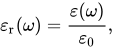
where ε(ω) is the complex frequency-dependent permittivity of the material, and ε0 is the vacuum permittivity.
Relative permittivity is a dimensionless number that is in general complex-valued; its real and imaginary parts are denoted as:[17]

The relative permittivity of a medium is related to its electric susceptibility, χe, as εr(ω) = 1 + χe.
In anisotropic media (such as non cubic crystals) the relative permittivity is a second rank tensor.
The relative permittivity of a material for a frequency of zero is known as its static relative permittivity.
Terminology
[edit]The historical term for the relative permittivity is dielectric constant. It is still commonly used, but has been deprecated by standards organizations,[15][16] because of its ambiguity, as some older reports used it for the absolute permittivity ε.[15][18][19] The permittivity may be quoted either as a static property or as a frequency-dependent variant, in which case it is also known as the dielectric function. It has also been used to refer to only the real component ε′r of the complex-valued relative permittivity.[citation needed]
Physics
[edit]In the causal theory of waves, permittivity is a complex quantity. The imaginary part corresponds to a phase shift of the polarization P relative to E and leads to the attenuation of electromagnetic waves passing through the medium. By definition, the linear relative permittivity of vacuum is equal to 1,[19] that is ε = ε0, although there are theoretical nonlinear quantum effects in vacuum that become non-negligible at high field strengths.[20]
The following table gives some typical values.
| Solvent | Relative permittivity | Temperature | |
|---|---|---|---|
| C6H6 | benzene | 2.3 | 298 K (25 °C) |
| Et2O | diethyl ether | 4.3 | 293 K (20 °C) |
| (CH2)4O | tetrahydrofuran (THF) | 7.6 | 298 K (25 °C) |
| CH2Cl2 | dichloromethane | 9.1 | 293 K (20 °C) |
| NH3(liq) | liquid ammonia | 17 | 273 K (0 °C) |
| C2H5OH | ethanol | 24.3 | 298 K (25 °C) |
| CH3OH | methanol | 32.7 | 298 K (25 °C) |
| CH3NO2 | nitromethane | 35.9 | 303 K (30 °C) |
| HCONMe2 | dimethyl formamide (DMF) | 36.7 | 298 K (25 °C) |
| CH3CN | acetonitrile | 37.5 | 293 K (20 °C) |
| H2O | water | 78.4 | 298 K (25 °C) |
| HCONH2 | formamide | 109 | 293 K (20 °C) |
The relative low frequency permittivity of ice is ~96 at −10.8 °C, falling to 3.15 at high frequency, which is independent of temperature.[21] It remains in the range 3.12–3.19 for frequencies between about 1 MHz and the far infrared region.[22]
Measurement
[edit]The relative static permittivity, εr, can be measured for static electric fields as follows: first the capacitance of a test capacitor, C0, is measured with vacuum between its plates. Then, using the same capacitor and distance between its plates, the capacitance C with a dielectric between the plates is measured. The relative permittivity can be then calculated as

For time-variant electromagnetic fields, this quantity becomes frequency-dependent. An indirect technique to calculate εr is conversion of radio frequency S-parameter measurement results. A description of frequently used S-parameter conversions for determination of the frequency-dependent εr of dielectrics can be found in this bibliographic source.[23] Alternatively, resonance based effects may be employed at fixed frequencies.[24]
Applications
[edit]Energy
[edit]The relative permittivity is an essential piece of information when designing capacitors, and in other circumstances where a material might be expected to introduce capacitance into a circuit. If a material with a high relative permittivity is placed in an electric field, the magnitude of that field will be measurably reduced within the volume of the dielectric. This fact is commonly used to increase the capacitance of a particular capacitor design. The layers beneath etched conductors in printed circuit boards (PCBs) also act as dielectrics.
Communication
[edit]Dielectrics are used in radio frequency (RF) transmission lines. In a coaxial cable, polyethylene can be used between the center conductor and outside shield. It can also be placed inside waveguides to form filters. Optical fibers are examples of dielectric waveguides. They consist of dielectric materials that are purposely doped with impurities so as to control the precise value of εr within the cross-section. This controls the refractive index of the material and therefore also the optical modes of transmission. However, in these cases it is technically the relative permittivity that matters, as they are not operated in the electrostatic limit.
Environment
[edit]The relative permittivity of air changes with temperature, humidity, and barometric pressure.[25] Sensors can be constructed to detect changes in capacitance caused by changes in the relative permittivity. Most of this change is due to effects of temperature and humidity as the barometric pressure is fairly stable. Using the capacitance change, along with the measured temperature, the relative humidity can be obtained using engineering formulas.
Chemistry
[edit]The relative static permittivity of a solvent is a relative measure of its chemical polarity. For example, water is very polar, and has a relative static permittivity of 80.10 at 20 °C while n-hexane is non-polar, and has a relative static permittivity of 1.89 at 20 °C.[26] This information is important when designing separation, sample preparation and chromatography techniques in analytical chemistry.
The correlation should, however, be treated with caution. For instance, dichloromethane has a value of εr of 9.08 (20 °C) and is rather poorly soluble in water (13 g/L or 9.8 mL/L at 20 °C); at the same time, tetrahydrofuran has its εr = 7.52 at 22 °C, but it is completely miscible with water. In the case of tetrahydrofuran, the oxygen atom can act as a hydrogen bond acceptor; whereas dichloromethane cannot form hydrogen bonds with water.
This is even more remarkable when comparing the εr values of acetic acid (6.2528)[27] and that of iodoethane (7.6177).[27] The large numerical value of εr is not surprising in the second case, as the iodine atom is easily polarizable; nevertheless, this does not imply that it is polar, too (electronic polarizability prevails over the orientational one in this case).
Lossy medium
[edit]Again, similar as for absolute permittivity, relative permittivity for lossy materials can be formulated as:
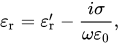
in terms of a "dielectric conductivity" σ (units S/m, siemens per meter), which "sums over all the dissipative effects of the material; it may represent an actual [electrical] conductivity caused by migrating charge carriers and it may also refer to an energy loss associated with the dispersion of ε′ [the real-valued permittivity]".[17]: 8 Expanding the angular frequency ω = 2πc / λ and the electric constant ε0 = 1 / μ0c2, which reduces to:

where λ is the wavelength, c is the speed of light in vacuum and κ = μ0c / 2π = 59.95849 Ω ≈ 60.0 Ω is a newly introduced constant (units ohms, or reciprocal siemens, such that σλκ = εr remains unitless).
Metals
[edit]Permittivity is typically associated with dielectric materials, however metals are described as having an effective permittivity, with real relative permittivity equal to one.[28] In the high-frequency region, which extends from radio frequencies to the far infrared and terahertz region, the plasma frequency of the electron gas is much greater than the electromagnetic propagation frequency, so the refractive index n of a metal is very nearly a purely imaginary number. In the low frequency regime, the effective relative permittivity is also almost purely imaginary: It has a very large imaginary value related to the conductivity and a comparatively insignificant real-value.[29]
See also
[edit]References
[edit]- ^ Hector, L. G.; Schultz, H. L. (1936). "The Dielectric Constant of Air at Radiofrequencies". Physics. 7 (4): 133–136. Bibcode:1936Physi...7..133H. doi:10.1063/1.1745374.
- ^ a b c Young, H. D.; Freedman, R. A.; Lewis, A. L. (2012). University Physics with Modern Physics (13th ed.). Addison-Wesley. p. 801. ISBN 978-0-321-69686-1.
- ^ Borch, Jens; Lyne, M. Bruce; Mark, Richard E. (2001). Handbook of Physical Testing of Paper Vol. 2 (2 ed.). CRC Press. p. 348. ISBN 0203910494.
- ^ Gray, P. R.; Hurst, P. J.; Lewis, S. H.; Meyer, R. G. (2009). Analysis and Design of Analog Integrated Circuits (5th ed.). Wiley. p. 40. ISBN 978-0-470-24599-6.
- ^ Harman, A. K.; Ninomiya, S.; Adachi, S. (1994). "Optical constants of sapphire (α‐Al2O3) single crystals". Journal of Applied Physics. 76 (12): 8032–8036. Bibcode:1994JAP....76.8032H. doi:10.1063/1.357922.
- ^ "Dielectric Materials—The Dielectric Constant". Retrieved June 17, 2023.
- ^ "Properties of silicone rubber". Azo Materials.
- ^ Fox, Mark (2010). Optical Properties of Solids (2 ed.). Oxford University Press. p. 283. ISBN 978-0199573370.
- ^ "Fine Ceramics" (PDF). Toshiba Materials.
- ^ "Material Properties Charts" (PDF). Ceramic Industry. 2013.
- ^ Archer, G. G.; Wang, P. (1990). "The Dielectric Constant of Water and Debye-Hückel Limiting Law Slopes". Journal of Physical and Chemical Reference Data. 19 (2): 371–411. doi:10.1063/1.555853.
- ^ "Permittivity". schools.matter.org.uk. Archived from the original on 2016-03-11.
- ^ Pohl, H. A. (1986). "Giant polarization in high polymers". Journal of Electronic Materials. 15 (4): 201. Bibcode:1986JEMat..15..201P. doi:10.1007/BF02659632.
- ^ Guillemet-Fritsch, S.; Lebey, T.; Boulos, M.; Durand, B. (2006). "Dielectric properties of CaCu3Ti4O12 based multiphased ceramics" (PDF). Journal of the European Ceramic Society. 26 (7): 1245. doi:10.1016/j.jeurceramsoc.2005.01.055.
- ^ a b c IEEE Standards Board (1997). "IEEE Standard Definitions of Terms for Radio Wave Propagation". IEEE STD 211-1997: 6. doi:10.1109/IEEESTD.1997.8638365 (inactive 1 July 2025).
{{cite journal}}: CS1 maint: DOI inactive as of July 2025 (link) - ^ a b Braslavsky, S.E. (2007). "Glossary of terms used in photochemistry (IUPAC recommendations 2006)" (PDF). Pure and Applied Chemistry. 79 (3): 293–465. doi:10.1351/pac200779030293. S2CID 96601716.
- ^ a b Linfeng Chen & Vijay K. Varadan (2004). Microwave electronics: measurement and materials characterization. John Wiley and Sons. p. 8, eq.(1.15). doi:10.1002/0470020466. ISBN 978-0-470-84492-2.
- ^ King, Ronold W. P. (1963). Fundamental Electromagnetic Theory. New York: Dover. p. 139.
- ^ a b John David Jackson (1998). Classical Electrodynamics (Third ed.). New York: Wiley. p. 154. ISBN 978-0-471-30932-1.
- ^ Mourou, Gerard A. (2006). "Optics in the relativistic regime". Reviews of Modern Physics. 78 (2): 309. Bibcode:2006RvMP...78..309M. doi:10.1103/RevModPhys.78.309.
- ^ Evans, S. (1965). "Dielectric Properties of Ice and Snow–a Review". Journal of Glaciology. 5 (42): 773–792. doi:10.3189/S0022143000018840. S2CID 227325642.
- ^ Fujita, Shuji; Matsuoka, Takeshi; Ishida, Toshihiro; Matsuoka, Kenichi; Mae, Shinji, A summary of the complex dielectric permittivity of ice in the megahertz range and its applications for radar sounding of polar ice sheets (PDF)
- ^ Kuek, CheeYaw. "Measurement of Dielectric Material Properties" (PDF). R&S.
- ^ Costa, F.; Amabile, C.; Monorchio, A.; Prati, E. (2011). "Waveguide Dielectric Permittivity Measurement Technique Based on Resonant FSS Filters". IEEE Microwave and Wireless Components Letters. 21 (5): 273. Bibcode:2011IMWCL..21..273C. doi:10.1109/LMWC.2011.2122303. S2CID 34515302.
- ^ 5×10⁻⁶/°C, 1.4×10⁻⁶/%RH and 100×10−6/atm respectively. See A Low Cost Integrated Interface for Capacitive Sensors, Ali Heidary, 2010, Thesis, p. 12. ISBN 9789461130136.
- ^ Lide, D. R., ed. (2005). CRC Handbook of Chemistry and Physics (86th ed.). Boca Raton, Florida: CRC Press. ISBN 0-8493-0486-5.
- ^ a b AE. Frisch, M. J. Frish, F. R. Clemente, G. W. Trucks. Gaussian 09 User's Reference. Gaussian, Inc.: Walligford, CT, 2009.- p. 257.
- ^ Lourtioz, J.-M.; et al. (2005). Photonic Crystals: Towards Nanoscale Photonic Devices. Springer. pp. 121–122. ISBN 978-3-540-24431-8. equation (4.6), page 121
- ^ Lourtioz (2005), equations (4.8)–(4.9), page 122

Relative permittivity
View on GrokipediaFundamentals
Definition
Relative permittivity, denoted as , is defined as the ratio of the permittivity of a material () to the permittivity of vacuum (), mathematically expressed as . This quantity characterizes a material's response to an electric field in terms of charge storage capacity relative to vacuum.[6] As a dimensionless scalar, quantifies the degree of polarization induced in the material by an external electric field, which effectively reduces the net field strength inside the material compared to that in vacuum. Materials with exhibit enhanced polarizability, allowing them to support greater electric displacement for a given field intensity.[7] The concept emerged in the 19th century from investigations into dielectrics, with Michael Faraday coining the term "specific inductive capacity" in his 1837 studies to describe this property. By definition, for vacuum; typical values include 5–10 for glass and approximately 80 for water at room temperature.[8][9][3]Terminology
Relative permittivity is also known as the dielectric constant, relative dielectric constant, and—particularly in historical contexts—specific inductive capacity.[10][11] The term dielectric constant, first documented in scientific literature around 1875, became a standard descriptor for the property in the late 19th century. Specific inductive capacity, introduced by Michael Faraday in the 1830s, referred to the material's ability to store electric charge relative to vacuum and laid the groundwork for modern understandings.[11][12] In notation, the SI standard uses the symbol ε_r to denote relative permittivity, distinguishing it clearly from the absolute permittivity ε, defined as ε = ε_r ε_0 where ε_0 is the vacuum permittivity (8.854 × 10^{-12} F/m).[13][14] Older texts frequently employ κ for the dielectric constant, while in German-language literature, the equivalent term Dielektrizitätskonstante is abbreviated as DK.[15] Contextually, relative permittivity is sometimes called simply "permittivity" in engineering discussions, though this can lead to ambiguity with absolute permittivity.[16] In optics, for non-magnetic materials where the relative permeability μ_r ≈ 1, it relates to the refractive index n through the approximation n ≈ √ε_r, connecting electromagnetic properties across disciplines.[17] The evolution of terminology reflects a shift toward precision: while "dielectric constant" remains in widespread use, IUPAC recommendations favor "relative permittivity" to emphasize its dimensionless, relative nature and avoid implying a true constant independent of frequency or conditions.[10][13]Physical Principles
Relation to Permittivity and Fields
In the context of electrostatics, the relative permittivity describes the response of a dielectric material to an applied electric field at the macroscopic level. In vacuum, where no material is present, , and the electric displacement field is simply , with being the vacuum permittivity.[18] When a dielectric material is introduced, the material polarizes, inducing a polarization density that modifies the displacement field according to .[19] For linear isotropic dielectrics, the polarization is proportional to the electric field, , where is the electric susceptibility of the material. Substituting this into the expression for yields , where is the absolute permittivity and . This relation highlights how quantifies the enhancement of the displacement field beyond the vacuum case due to material polarization.[18][19] The role of becomes evident in practical devices such as parallel-plate capacitors. The capacitance of such a device filled with a dielectric is given by , where is the plate area and is the separation distance. Compared to the vacuum capacitance , the factor increases the stored charge for a given voltage, enhancing energy storage capacity. For example, in materials like water (), this effect dramatically boosts capacitance relative to air ().[20] At interfaces between dielectrics with different , boundary conditions from Maxwell's equations govern field behavior. The tangential component of is continuous across the interface, while the normal component of is continuous in the absence of free surface charge.[18][21] These conditions lead to refraction of electric field lines, analogous to Snell's law in optics but involving the tangents of the angles with the normal: . Thus, field lines bend away from the normal when entering a higher- medium, reflecting the material's greater ability to support displacement.[22]Microscopic Origins
The relative permittivity of a material arises from the polarization response of its atoms and molecules to an applied electric field, where polarization represents the dipole moment per unit volume induced by the field. This response originates at the microscopic level through several distinct mechanisms that shift or align charges within the material.[23] The primary types of polarization include electronic, atomic (also known as ionic), orientational, and interfacial. Electronic polarization occurs due to the displacement of electron clouds relative to atomic nuclei, creating induced dipoles in all materials; this mechanism is fast and dominates at high frequencies up to the optical range (~10^{15} Hz). Atomic polarization involves the relative displacement of positively and negatively charged ions in crystalline lattices, such as in ionic solids, and is effective up to infrared frequencies (~10^{13} Hz). Orientational polarization arises from the alignment of permanent electric dipoles in polar molecules, like water, under the field; this is prevalent in liquids and gases. Interfacial polarization, also called space-charge polarization, results from the accumulation of free charges at material boundaries or defects, leading to charge separation; it is the slowest mechanism and significant at low frequencies below the kilohertz range.[24] These microscopic polarizabilities link to the macroscopic relative permittivity through relations like the Clausius-Mossotti equation, which accounts for the local field experienced by molecules in a dense medium: Here, is the number density of molecules, is the molecular polarizability, and is the vacuum permittivity. This equation connects the bulk dielectric response to atomic-scale properties, assuming non-interacting induced dipoles, and is particularly applicable to nonpolar dielectrics where electronic polarization dominates.[23] The temperature dependence of relative permittivity is primarily influenced by orientational polarization, which decreases with increasing temperature due to thermal agitation randomizing dipole alignments, as described by Debye's theory of polar molecules (1929). In this model, the orientational contribution to polarization follows , leading to a Curie-like behavior in the static dielectric constant for polar liquids. Electronic and atomic polarizations are largely temperature-independent.[23][25] Frequency effects cause dispersion in , where the value drops at higher frequencies because slower polarization mechanisms—such as orientational and interfacial—cannot follow rapid field oscillations, while electronic polarization persists. For instance, orientational effects cease beyond microwave frequencies due to molecular rotational inertia. Detailed analysis of this frequency-dependent complex permittivity, including losses, is covered in the section on complex permittivity.[23][24]Measurement
Experimental Techniques
The measurement of relative permittivity, denoted as , has evolved from early electrostatic experiments to precise modern techniques. In 1837, Michael Faraday conducted pioneering work using Leyden jars to investigate the inductive capacity of materials, effectively measuring how insulators enhanced charge storage in capacitors, laying the foundation for quantitative assessments of dielectric properties.[26] These historical methods relied on observing charge accumulation and discharge, but lacked the standardization seen today. Modern protocols, such as ASTM D150 established in 1922, provide standardized procedures for AC-based permittivity measurements on solid insulators, ensuring reproducibility across laboratories.[27] Capacitance methods remain the cornerstone for low-frequency and static measurements of . In the parallel-plate capacitor setup, a dielectric sample is inserted between two conductive plates separated by distance , with plate area . The capacitance is measured using an LCR meter, and is computed via the formula , where is the vacuum permittivity ( F/m). This approach assumes uniform fields and negligible fringing effects, achieving accuracies suitable for many engineering applications. Variations, such as the guarded electrode configuration, incorporate a surrounding guard ring to minimize edge effects and stray capacitance, enhancing precision for thin or irregular samples. For instance, in ASTM D150 procedures, samples are typically thin films or sheets under controlled voltage (e.g., 1 V), with measurements at frequencies from 60 Hz to 1 MHz.[27] At higher frequencies, resonance techniques like cavity perturbation are employed to probe without direct contact in some setups. A small dielectric sample is introduced into a resonant microwave cavity, perturbing its resonant frequency . The frequency shift relates to approximately through times a geometric factor involving sample and cavity volumes, allowing extraction of from calibration curves.[28] This method excels for frequencies in the GHz range, such as 1-10 GHz using rectangular or cylindrical cavities, and is particularly useful for low-loss materials where broadband coverage is not required.[29] Systems often automate the perturbation via vector network analyzers for rapid, non-destructive testing.[30] For broadband characterization spanning DC to GHz, time-domain methods utilize dielectric spectroscopy with pulse propagation. Short electrical pulses are launched into a transmission line (e.g., coaxial or stripline) loaded with the sample, and the reflected or transmitted waveform is analyzed to derive time-dependent responses, from which frequency-domain is obtained via Fourier transform.[31] This approach, often implemented with time-domain reflectometry, captures dispersive effects over wide frequency bands (up to 100 GHz) by measuring pulse delay and attenuation, making it ideal for heterogeneous or liquid samples.[32] Common error sources in these techniques include poor electrode-sample contact, which introduces air gaps altering effective , and non-uniform sample thickness, leading to averaged values that deviate from bulk properties.[33] Fringing fields and surface roughness exacerbate inaccuracies in capacitance setups, while cavity methods are sensitive to sample positioning. With careful preparation, such as vapor-deposited electrodes and micrometer-controlled spacing, precision can reach 0.1% for solid samples at low frequencies. These methods primarily yield the real part of permittivity; complex aspects, including losses, are addressed in specialized frequency-domain analyses.[28]Complex Permittivity and Losses
In materials subjected to alternating electric fields, the relative permittivity ε_r becomes frequency-dependent and is generally represented as a complex quantity, ε_r(ω) = ε_r' - j ε_r'', where ω is the angular frequency, ε_r' is the real part associated with energy storage and polarization, and ε_r'' is the imaginary part representing energy dissipation or losses.[34] The real part ε_r' determines the material's ability to store electric energy, while the imaginary part ε_r'' quantifies the conversion of electric field energy into heat through various relaxation and conduction mechanisms.[35] The extent of these losses is often characterized by the loss tangent, defined as tan δ = ε_r'' / ε_r', which provides a dimensionless measure of the ratio of dissipated to stored energy; low values of tan δ (e.g., < 0.01) indicate low-loss dielectrics suitable for high-frequency applications.[36] Frequency dispersion in the complex relative permittivity arises from the delayed response of molecular dipoles or charges to the oscillating field, leading to variations in ε_r' and ε_r'' across different frequencies. A foundational model for this behavior is the Debye relaxation model, which describes a single relaxation process as where ε_s is the static (low-frequency) relative permittivity, ε_∞ is the high-frequency relative permittivity (approaching the optical limit), and τ is the relaxation time constant governing the transition between these limits.[37] In this model, ε_r' decreases from ε_s to ε_∞ with increasing frequency, while ε_r'' peaks near the relaxation frequency ω = 1/τ, reflecting maximum energy loss. This single-relaxation approximation is particularly effective for polar liquids like water, though more complex materials may require multi-relaxation extensions.[38] Losses in dielectrics are quantified through several methods that relate measurable quantities to the complex permittivity. Power dissipation, derived from the time-averaged Poynting theorem, is proportional to ω ε_0 ε_r'' |E|^2 / 2, where ε_0 is the vacuum permittivity and |E| is the electric field magnitude, allowing losses to be inferred from temperature rise or calorimetric measurements in the material.[39] In resonant structures, such as cavities or transmission lines, the quality factor Q (ratio of stored to dissipated energy) provides another metric, with dielectric losses contributing to 1/Q_d = ε_r'' / ε_r' = tan δ at the resonant frequency.[40] Impedance analysis, often using vector network analyzers with coaxial or waveguide fixtures, extracts ε_r' and ε_r'' from reflection or transmission coefficients via fitting to transmission line models, enabling broadband characterization of lossy media.[41] Representative values of ε_r' and tan δ for common materials illustrate the range of behaviors, from high-loss polar substances to low-loss insulators. The following table summarizes data at room temperature (~20–25°C) for water (a high-permittivity, lossy dielectric) and polytetrafluoroethylene (PTFE, a low-loss polymer), highlighting frequency dependence:| Material | Frequency | ε_r' | tan δ | Notes |
|---|---|---|---|---|
| Water | ~1 Hz (static) | ~80 | ~0.0001 | High storage, negligible conduction loss at DC.[37] |
| Water | 10 GHz | ~61 | ~0.53 | Significant dispersion near relaxation frequency.[37] |
| Water | 2.45 GHz | ~78 | ~0.16 | Microwave regime, balanced storage and dielectric heating potential.[42] |
| PTFE | 10 GHz | ~2.1 | ~0.0002 | Stable low-loss behavior across microwaves.[43][44] |