

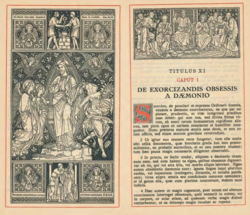

Roman Ritual
View on WikipediaKey Information


The Roman Ritual (Latin: Rituale Romanum), also known as the Ritual[1] is one of the official liturgical books of the Roman Rite of the Latin Church of the Catholic Church. It contains all of the services that a priest or deacon may perform; and are not contained in the Missale Romanum, Pontificale Romanum, or Caeremoniale Episcoporum, but for convenience does include some rituals that one of these books contains.
Since 1969, the Roman Ritual has been divided into different volumes by subject, for standard use in the Latin Church, yet priests and communities that celebrate pre-Second Vatican Council rituals still use the edition of 1952.
History
[edit]When ritual manual books first were written, the Sacramentary in the West and the Euchologion in the East, they contained all of the bishops' and priests' parts for all rituals, not only for Mass and Divine Liturgy, respectively, but for all of the other Sacraments, blessings, other rituals, and all sacramentals.[2]
From one book to many
[edit]The contents of the Roman Ritual and Pontificale Romanum were in the Sacramentaries. In the Eastern Churches this state of things still largely continues. In the West a further development led to the distinction of books, not according to the persons who use them, but according to the rituals for which they are used. The Missal, containing the whole Mass, succeeded by the Sacramentary. Some early missals included other rituals for the convenience of celebrants, but on the whole this later arrangement involved the need of other books to supply the non-Eucharistic rituals of the Sacramentary. These books, when they appeared, were the predecessors of the Pontificale Romanum and Roman Ritual. The bishop's functions, including Ordination and Confirmation, filled the Pontificale Romanum. The priest's functions, including Baptism, Penance, Matrimony, and Extreme Unction, were contained in a variety of little handbooks that eventually the Roman Ritual replaced.[2]
Codification
[edit]The Pontificale Romanum emerged first. The book under this name, also known as the Pontifical of Egbert, occurs already in the eighth century. From the ninth there was a multitude of pontificals. For priests' functions there was no uniform book until 1614. Some of these functions were contained in the pontificals; often the principal ones were added to missals and books of hours. Then special books were arranged, but there was no uniformity in arrangement or name. Through the Middle Ages a great number of handbooks for priests having the care of souls were written. Every local rite and almost every diocese had them; indeed many were compilations for the convenience of one specific priest or church. Such books had many titles: Manuale, Liber Agendarum, Agenda, Sacramentale, or Rituale. Specimens of such medieval predecessors of the Ritual are the Manuale Curatorum of Roeskilde in Denmark (first printed in 1513; edited by J. Freisen, Paderborn, 1898), and the Liber Agendarum of Schleswig (printed in 1416; Paderborn, 1898). The book of Roeskilde contains the rituals for benediction of salt and water, Baptism, Matrimony, benediction of a house, visitation of the sick with Viaticum and Extreme Unction, prayers for the dead, funerals, prayers for pilgrims, benediction of fire on Holy Saturday, and other benedictions. The book of Schleswig has much of the Holy Week rituals, and those for All Souls, Candlemas, and Ash Wednesday. In both many rituals differ from the Roman forms.[2]
16th century
[edit]In the sixteenth century, while the other liturgical books were being revised and issued as uniform standards, there was naturally a desire to substitute an official book for the varied collections. But the matter did not receive the attention of the Holy See for some time. First, various books were issued in Rome with the idea of securing uniformity, but without official sanction. Albert Castellani in 1537 published a Sacerdotale of this kind; in 1579 in Venice another version appeared that Grancesco Samarino, Canon of the Lateran Archbasilica arranged and which was re-edited in 1583 by Angelo Rocca. In 1586 Giulio Antonio Santorio, Cardinal of St. Severina, printed a handbook of rituals for the use of priests, which, according to Pope Paul V, "he had composed after long study and with much industry and labor" (Apostolicae Sedis). This book is the foundation of the current Ritual. On 17 June 1614, Paul V authorized the first edition of the official Rituale Romanum by the Constitution Apostolicae Sedis. In this, he pointed out that Clement VIII had already issued a uniform text of the Pontificale Romanum and the Caeremoniale Episcoporum. "It remained", the Pope continued, "that the sacred and authentic rites of the Church, to be observed in the administration of sacraments and other ecclesiastical functions by those who have the care of souls, should also be included in one book and published by authority of the Apostolic See; so that they should carry out their office according to a public and fixed standard, instead of following so great a multitude of Rituals".[2]
Post-Tridentine uniformity
[edit]But, unlike the other books of the Roman Rite, the Ritual has never been imposed as the only standard. Pope Paul V did not abrogate all other collections of the same kind or command only the use of his book. He stated: "Wherefore we exhort in the Lord" that it should be used. The result was that the old local rituals were never altogether abrogated. After the appearance of the Roman edition these others were gradually conformed to it. They continued to be used, but had many of their prayers and ceremonies modified to agree with the Roman edition. This applies especially to the rites of Baptism, Holy Communion, the form of absolution, and Extreme Unction. The ceremonies also contained in the Missal (benediction of holy water, the processions of Candlemas and Palm Sunday, etc.), and the prayers in the Breviary (e. g. the Office of the Dead) are necessarily identical with those of Paul V's Ritual; these have the absolute authority of the Missal and Breviary. On the other hand, many nations preserved local customs for the celebration of the Sacrament of Matrimony, visitation of the sick, special benedictions, processions, and sacramentals not found in the Roman edition and still printed in various diocesan rituals. It is then by no means the case that every priest of the Roman Rite used the Ritual. Very many dioceses or provinces still had their local handbooks under the name of Rituale, Ordo Administrandi Sacramenta, etc., though all of these conformed to the Roman texts in the principal elements. Most contained practically all the rituals of the Roman edition, along with local additions or supplements.[2]
18th–20th centuries
[edit]Pope Benedict XIV in 1752 revised the Roman Ritual, together with the Pontificale Romanum and Cærimoniale Episcoporum. His new editions of these three books were published by the brief Quam ardenti of 25 March 1752, which quoted Pope Paul V's constitution at length and was printed, as far as it concerns this book, in the beginning of the Ritual. He added to Paul V's text two forms for giving the Papal blessing (V, 6 and VIII, 31). Meanwhile, a great number of additional blessings were added in an appendix. This appendix grew nearly as long as the original book. Under the title Benedictionale Romanum it is often issued separately. Pope Leo XIII approbated an editio typica published by Pustet in Ratisbon in 1884.[2] In 1925, the Holy See under the authority of Pope Pius XI issued another typical edition of the Ritual, which, as the decree of the Sacred Congregation of Rites of 10 June 1925 explained, had been adapted to the norms and guidelines of the Codex Juris Canonici of 1917, and the revised rubrics of the Missal and Breviary.
The latest typical edition of the Ritual was published in 1952.[3]
1969 to present
[edit]With the advent of the Second Vatican Council the Ritual was divided into different fascicles and revised, with each fascicle being published as a single volume from 1969 onward. They are prefaced with theological introductions and their translation into vernacular languages is overseen by the Episcopal Conferences. The current authoritative Latin editions are:
- Ordo celebrandi Matrimonium (Typis Polyglottis Vaticanis, editio typica 1969; editio typica altera 1991, 2008)
- Ordo Exsequiarum (Typis Polyglottis Vaticanis, 1969)
- Ordo Unctionis infirmorum eorumque pastoralis curae (Typis Polyglottis Vaticanis, 1972)
- Ordo Initiationis Christianae adultorum (Typis Polyglottis Vaticanis, 1972)
- Ordo professionis religiosae (Typis Polyglottis Vaticanis, 1970, 1975)
- Ordo Baptismi parvulorum (Typis Polyglottis Vaticanis, editio typica 1969; editio typica altera 1973, 1986, 2003)
- De sacra communione et de cultu mysterii eucharistici extra Missam (Typis Polyglottis Vaticanis, 1974)
- Ordo Paenitentiae (Typis Polyglottis Vaticanis, 1974)
- Ordo Confirmationis (Typis Polyglottis Vaticanis, editio typica 1973, 2003)
- De Benedictionibus (Typis Polyglottis Vaticanis, editio typica 1984, 1985, 1993, 2013)
- De Exorcismis et supplicationibus quibusdam (Typis Polyglottis Vaticanis, 1999, 2013)
The second section of the Ritual, the Benedictionale, was also extensively revised and published in 1987 as De Benedictionibus.
The Rite of Exorcism also underwent a series of revisions and was finally promulgated in 1999 as De exorcismis et supplicationibus quibusdam (Concerning Exorcisms and Certain Supplications).
Contents
[edit]![[icon]](https://en.wikipedia.org/wiki/File:Wiki_letter_w_cropped.svg) | This section needs expansion. You can help by adding missing information. (June 2016) |
The Rituale Romanum is divided into ten "titles" (tituli). All, except the first, are subdivided into chapters. The first being called “Ultimum, Gh.” In each title (except I and X), the first chapter gives the general rules for the sacrament or function, while the others give the exact ceremonies and prayers for various cases of administration.[2]
Other rituals
[edit]The Ambrosian Rite has its own ritual (Rituale Ambrosianum, published by Giacomo Agnelli at the Archiepiscopal Press, Milan).[2]
In the Byzantine Rite, the contents of the ritual are contained in the Euchologion.[2]
The Armenians have a ritual book (Mashdotz) similar to the Roman Ritual.[2]
Other churches not in communion with the Holy See have not yet arranged the various parts of this book[which?] in one collection. Nearly all the Eastern Catholic Churches, however, now have ritual books formed on the Roman model.[2]
See also
[edit]References
[edit]- ^ "CATHOLIC ENCYCLOPEDIA: Ritual". New Advent. Retrieved 2024-07-11.
- ^ a b c d e f g h i j k
 One or more of the preceding sentences incorporates text from a publication now in the public domain: Herbermann, Charles, ed. (1913). "Ritual". Catholic Encyclopedia. New York: Robert Appleton Company.
- ^ "Celebration of old rite: Holy See responds to questions presented by bishops". Vatican News. 2021-12-18. Retrieved 2021-12-18.

External links
[edit]Further reading
[edit]- Roy, Neil J. (2011). "The Development of the Roman Ritual: A Prehistory and History of the Rituale Romanum". Antiphon: A Journal for Liturgical Renewal. 15 (1): 4–26. doi:10.1353/atp.2011.0017. ISSN 1543-9933.
| Sacraments | |||||||||||
|---|---|---|---|---|---|---|---|---|---|---|---|
| Eucharistic liturgies | |||||||||||
| Canonical hours, Liturgical hours | |||||||||||
| Other liturgical services | |||||||||||
| Liturgical literature | |||||||||||
| Liturgical language | |||||||||||
| Liturgical rites |
| ||||||||||

Roman Ritual
View on GrokipediaDefinition and Purpose
Overview and Etymology
The Rituale Romanum, commonly referred to as the Roman Ritual, is the official liturgical book of the Roman Rite in the Catholic Church that details the rites, prayers, and rubrics for the administration of the seven sacraments—excluding those integrated into the Mass—along with blessings, exorcisms, processions, and other pastoral ceremonies performed by priests.[5][6] Its purpose is to ensure the efficacious conferral of sacramental grace, fostering the spiritual life of the faithful through standardized ecclesiastical actions that invoke divine intervention and sanctify everyday objects, persons, and events.[4] This manual underscores the priest's role as mediator between God and the laity, emphasizing ritual precision to maintain doctrinal integrity and liturgical uniformity across dioceses.[7] Promulgated by Pope Paul V on June 17, 1614, via the bull Apostolicæ Sedi, the Roman Ritual emerged as a response to the Council of Trent's (1545–1563) mandate for liturgical reform, aiming to eliminate regional variations and Protestant-influenced deviations by codifying practices rooted in the ancient traditions of the Roman Church.[3] Before its issuance, priests relied on diverse local ritual books, often adapted from medieval manuscripts, which led to inconsistencies in sacramental administration; the standardized Rituale Romanum thus preserved core Roman liturgical patrimony while adapting elements from earlier ordines and pontificals.[8] The etymology of "Rituale Romanum" traces to Latin ritus, signifying a formal religious ceremony, custom, or prescribed usage, from which derives the adjective ritualis ("pertaining to rites"), with Romanum denoting its authoritative origin in the Roman See.[9][10] This nomenclature highlights the book's function as a compendium of ordered, sacred actions (ritus) specific to the Latin liturgical tradition centered in Rome, distinguishing it from Eastern or other Western rites.[6]Theological and Canonical Role
The Rituale Romanum, or Roman Ritual, encapsulates the Catholic Church's sacramental theology by prescribing the rites for administering the sacraments of baptism, confirmation (by bishops), penance, holy matrimony, and anointing of the sick, alongside sacramentals such as blessings and exorcisms. These rituals underscore the doctrine that sacraments are efficacious signs of grace, instituted by Christ and conveyed ex opere operato through proper matter, form, minister, and recipient disposition, independent of the minister's personal holiness. The rites emphasize the priest's role as Christ's instrument in channeling divine sanctification, with exorcistic elements in baptism and other sacraments highlighting spiritual warfare against sin and demonic influence as integral to redemption.[4] Theologically, the Roman Ritual integrates patristic and scholastic understandings of liturgy as participatory in Christ's paschal mystery, where visible ceremonies manifest invisible realities of justification and divinization. Blessings and processions within the text extend sacramental grace analogously, fostering devotion and protection without conferring the indelible character of sacraments. This framework aligns with the Church's teaching on the hierarchy of liturgical acts, prioritizing sacraments for their necessity in salvation while valuing sacramentals for pious disposition.[3] Canonically, the 1614 edition promulgated by Pope Paul V established the Roman Ritual as the normative liturgical book for the Latin Rite, binding priests under ecclesiastical law to its rubrics for licit and valid administration. The Council of Trent's reforms, implemented via the Sacred Congregation of Rites established in 1588, enforced its use to curb regional abuses and ensure doctrinal purity in sacramental conferral. Under the 1917 Code of Canon Law, substantial adherence was required (e.g., Canon 732 for matrimony), with unauthorized deviations risking illicitness, though essential form preserved validity in necessity. This juridical status reinforced unity in worship, reflecting the Church's authority to regulate rites for pastoral efficacy.[8][4]Historical Development
Early Origins in Patristic and Carolingian Eras
The sacramental and ritual practices that would later form the basis of the Roman Ritual emerged in the patristic period through localized but evolving liturgical traditions rooted in apostolic precedents. Early descriptions, such as those in the Apostolic Tradition attributed to Hippolytus of Rome around 215 AD, outline detailed rites for baptism—including exorcisms, renunciation of Satan, anointing with oil, trine immersion in water, and post-baptismal anointing—as well as ordination prayers for bishops, presbyters, and deacons, emphasizing the invocation of the Holy Spirit.[11][12] These texts reflect Roman practices but also highlight regional adaptations, with no centralized codex; instead, rituals were transmitted orally and through community custom, as evidenced by Justin Martyr's mid-second-century account of baptism and Eucharist in Rome, involving catechesis, immersion, and communal thanksgiving prayers.[13] By the late patristic and early medieval transition, collections known as Ordines Romani began documenting rubrics for Roman liturgical ceremonies, including non-eucharistic sacraments like baptism, ordination, and burial rites performed in papal stational liturgies. Composed primarily between the seventh and ninth centuries but preserving earlier customs, these ordines provided stage directions—such as processions, vestments, and acclamations—for rites like the baptismal scrutiny and chrismation, distinguishing them from prayer texts alone and emphasizing ceremonial precision in the Roman curia.[14][15] This development marked a shift toward more structured documentation amid growing church organization post-Constantine, though variations persisted due to the absence of mandatory uniformity. In the Carolingian era, from the mid-eighth century onward, liturgical reforms under Pepin the Short and Charlemagne actively promoted Roman models to foster imperial and ecclesiastical unity, extending to sacramental rites beyond the Mass. Pepin's 754 adoption of the Roman liturgy, followed by Charlemagne's importation of texts like the Hadrianum sacramentary (c. 785–791), integrated Roman ordines into Frankish practice, with councils such as Frankfurt (794) enforcing standardized books and chants.[16][17] Alcuin's editorial work at the York and Tours scriptoria adapted these for broader use, incorporating rubrics for rituals like anointing of the sick and exorcisms into sacramentaries, while blending limited Gallican elements for practicality; this gradual dissemination via monastic copying laid the foundation for Latin Western uniformity, countering prior Gallo-Frankish diversity.[18][19]Medieval Fragmentation and Regional Variations
Following the Carolingian era's promotion of Roman liturgical books, the rituals associated with sacraments, blessings, and other priestly functions in the Roman Rite fragmented considerably during the Middle Ages, as dioceses and religious communities adapted practices to local needs and traditions. This diversification arose from the replacement of comprehensive sacramentaries with specialized missals for Mass, necessitating separate manuals for parish priests, which evolved independently without centralized oversight.[3] Diocesan autonomy, combined with the persistence of oral customs and monastic influences, resulted in varied rubrics for key rites such as baptism, matrimony, and exorcisms, often incorporating regional prayers, gestures, or sequences absent from curial Roman models.[1] Priests' handbooks, termed manualia, agendae, or sacramentalia, proliferated in manuscript form from the 11th century onward, reflecting these adaptations; for instance, the Liber Agendarum from Schleswig, dated to 1416, included distinctive ceremonies for Holy Week and the blessing of candles at Candlemas, diverging from Roman norms in structure and content.[1] Similarly, the Manuale Curatorum of Roeskilde, printed in 1513, encompassed blessings of salt and water alongside sacramental forms tailored to northern European contexts, highlighting how geographical distance and cultural variances fostered such divergence.[1] In France, early printed examples like the 1497 Manuale Sacerdotum under Bishop Jean Simon de Champigny integrated Gallican remnants, such as extended litanies or processional elements, into otherwise Roman frameworks.[3] This regional heterogeneity extended to England, where the Sarum Use, originating in the 11th century at Salisbury Cathedral, influenced ritual manuals with accretions comprising roughly ten percent non-Roman material, including unique antiphons and ceremonial actions in sacramental rites that persisted until the 16th century.[20] Such variations, while rooted in the Roman Rite's core, arose causally from practical exigencies—like accommodating local saints' feasts or vernacular influences in rubrics—and the absence of printed standardization until the late 15th century, which amplified inconsistencies across the Latin West.[3] By the eve of the Reformation, these diocesan peculiarities contributed to liturgical confusion and potential abuses, prompting the Council of Trent's decrees to mandate uniformity by suppressing rites less than 200 years old and commissioning corrected Roman books.[1]Tridentine Codification and Standardization
The Council of Trent, convened from 1545 to 1563, addressed liturgical abuses and variations exacerbated by the Protestant Reformation, decreeing in its twenty-second session on September 17, 1562, that liturgical books be corrected according to the original texts of the Fathers and approved by the Roman Church to ensure uniformity and doctrinal purity.[21] This mandate extended beyond the Mass to sacramental rites, prompting subsequent papal efforts to standardize the Roman Ritual, a compendium of rites for sacraments, blessings, and other ceremonies performed by priests.[8] Following Trent's directives, Pope St. Pius V promulgated the Roman Missal in 1570 and the Breviary in 1568, establishing norms for the Mass and Divine Office, but the Ritual's codification occurred later under Pope Paul V.[3] In preparation, revisions began under Clement VIII, who in 1595 commissioned corrections to align with Tridentine standards, drawing from earlier models like the 1523 Sacerdotale Romanum.[1] Paul V issued the first official Rituale Romanum on June 17, 1614, via the apostolic constitution Apostolicæ Sedis, mandating its use to eliminate regional divergences and ensure fidelity to Roman tradition.[1][3] The 1614 Rituale organized rites into sections on sacraments (baptism, penance, Eucharist, extreme unction, matrimony), non-sacramental blessings, and processions, providing rubrics, prayers, and ceremonies in Latin for universal application by non-bishop priests.[8] While bishops retained authority over certain customs and could approve diocesan variants if rooted in antiquity (per Trent's tolerance for rites over 200 years old), the Roman Ritual became the normative text, printed by Vatican authority and disseminated widely to foster liturgical unity.[3] This standardization countered medieval fragmentation, where local ordines and pontificals proliferated, often incorporating unapproved innovations or heretical influences.[1] Subsequent editions under Urban VIII (1634) refined texts and music but preserved the core structure, with the 1614 version serving as the foundation until the 20th century.[1] The codification reflected causal priorities of doctrinal clarity and ecclesiastical discipline, privileging empirical alignment with patristic sources over permissive diversity, thereby reinforcing the Roman Church's authority amid confessional conflicts.[22]Post-Tridentine Stability and Minor Adjustments
Following the promulgation of the Rituale Romanum by Pope Paul V on June 17, 1614, via the constitution Apostolicæ Sedis, the text established a standardized framework for the rites of sacraments, sacramentals, blessings, and processions, which persisted with minimal alteration for over three centuries.[3] This stability reflected the Tridentine emphasis on uniformity to counter regional variations and abuses identified in earlier medieval practices, ensuring that priests across the Latin Church followed a unified ceremonial discipline without significant doctrinal shifts.[8] The ritual's core structure—divided into sections on sacraments, non-sacramental blessings, processions, and exorcisms—remained intact, with subsequent editions primarily reprinting the 1614 base text under papal approbation to maintain fidelity.[1] Minor adjustments occurred through periodic revisions, often driven by the need to incorporate newly approved prayers, refine rubrics for clarity, or expand the collection of blessings in response to pastoral demands. For instance, Pope Benedict XIV issued a revised edition in 1752, coordinating changes with updates to the Pontificale Romanum and Cærimoniale Episcoporum to harmonize episcopal and parochial ceremonies; these modifications included precise rubrical clarifications and additions to sacramental forms but preserved the essential rites without introducing novelties.[1] Similarly, Pope Leo XIII re-edited the ritual in 1884, focusing on typographical corrections, updated indices, and modest expansions to the blessings section, such as incorporating devotions reflective of 19th-century piety while adhering to the Tridentine corpus.[23] These papal interventions, typically approved by the Congregation of Rites, emphasized enrichment—particularly in the appendix of blessings, which grew from around 100 in 1614 to over 200 by the late 19th century—rather than overhaul, as evidenced by the consistent retention of Latin texts and gestural prescriptions.[3] The era also saw the suppression of non-Roman local rituals that predated Trent by less than 200 years, compelling dioceses to adopt the Rituale Romanum and fostering broader implementation; by the 18th century, most European and missionary territories conformed, with exceptions limited to ancient rites like the Ambrosian or Mozarabic.[1] Such adjustments reinforced causal uniformity in sacramental administration, reducing variances that could undermine doctrinal coherence, though they occasionally addressed practical issues like abbreviated forms for urgent baptisms in mission contexts. Overall, these changes were incremental and conservative, preserving the ritual's role as a bulwark against innovation until external pressures emerged in the 20th century.[24]20th-Century Pressures and Pre-Vatican II Context
The liturgical movement, originating in monastic circles in the late 19th century and gaining traction in the early 20th, exerted growing influence on Catholic sacramental practices by emphasizing historical restoration, active participation, and pastoral adaptation amid industrialization, secularization, and the disruptions of two world wars.[25] Scholars and reformers, such as those at the Abbey of Solesmes, advocated recovering ancient forms of worship to counteract perceived devotional passivity among the laity, though papal oversight tempered enthusiasm to preserve doctrinal integrity and avoid subjectivism.[26] This movement indirectly pressured the Roman Ritual's rubrics, as discussions on vernacular explanations during sacraments and simplified ceremonies emerged in pastoral theology, reflecting broader concerns over declining catechesis and Church attendance in urbanizing societies.[27] Pope Pius X's 1903 motu proprio Tra le sollecitudini marked an early pivotal response, prioritizing Gregorian chant and sacred polyphony in liturgical ceremonies while calling for the faithful's "active participation" through attentive engagement, which later interpreters extended to external involvement in rites like baptism and confirmation.[28] Complementing this, his 1910 decree Quam singulari lowered the age of First Communion to around seven years, altering sacramental sequencing and prompting rubrical adjustments in ritual books to facilitate earlier eucharistic preparation, thereby addressing empirical observations of children's spiritual neglect in modern family structures.[29] These interventions aimed at revitalizing sacramental life without undermining the Ritual's Latin core, yet they fueled demands for further accessibility amid rising literacy and missionary expansions in non-European contexts. Under Pius XII, the 1947 encyclical Mediator Dei endorsed the movement's principles—such as lay liturgical education and communal prayer—while critiquing excesses like archaeological fixation on patristic models or arbitrary innovations, insisting that rites evolve organically under ecclesiastical authority to convey immutable truths.[26] This document, responding to post-war spiritual renewal efforts, highlighted pressures from theological scholarship questioning medieval accretions in sacramental forms, though it reaffirmed the Roman Ritual's post-Tridentine stability as essential for universality. The 1952 typical edition of the Rituale Romanum incorporated minor rubrical clarifications and updated blessings, reflecting cautious integration of movement insights without substantive textual overhaul, as commissions balanced tradition against pastoral exigencies like streamlined exorcism rites amid reported increases in psychological distress cases.[30] Pre-Vatican II context thus featured relative continuity in the Roman Ritual, with no comprehensive revision akin to the 1955 Holy Week reforms, yet mounting intellectual and demographic pressures—evidenced by international liturgical congresses from 1910 onward—underscored tensions between immutable sacramental efficacy and adaptive expression.[31] Reformers cited empirical data on low participation rates, such as limited lay comprehension of Latin ceremonies, to argue for explanatory aids, while critics within the Church hierarchy, echoing Pius XII's warnings, viewed unchecked changes as risking causal dilution of grace transmission through altered signs.[32] By 1962, these dynamics positioned the Ritual as a focal point for conciliar deliberation, amid a Church confronting modernism's philosophical challenges and global evangelization needs.[26]The Tridentine Roman Ritual (1614–1969)
Publication Under Paul V
Pope Paul V promulgated the first official edition of the Rituale Romanum on June 17, 1614, through the apostolic constitution Apostolicæ Sedis.[3][1] This document authorized a standardized manual for priests administering sacraments, blessings, processions, exorcisms, and other pastoral rites outside the Mass and Divine Office, aiming to resolve inconsistencies arising from diverse local ritual books that had proliferated since the medieval period.[3][1] The preparation of the 1614 edition drew upon earlier compilations, including Agostino Patrizi da Chiecchi’s Sacerdotale of 1523, Alberto Samarini’s 1579 ritual, and Cardinal Giulio Antonio Santori’s Rituale Sacramentorum Romanum of 1602, which had been commissioned by Pope Gregory XIII.[3] Paul V’s version refined these precedents to align with the Roman liturgical tradition, incorporating elements from the Roman Pontifical of Clement VIII (1595) and the Caeremoniale Episcoporum of 1600, while organizing the content into four main parts: administration of the sacraments, blessings and sacramentals, processions, and exorcisms, supplemented by chants and formulas for parish registers.[3][1] Unlike Pope Pius V’s 1570 missal, which mandated exclusive use of the Roman Missal except for rituals in continuous local use for at least two centuries, Paul V did not abrogate existing diocesan rituals but urged their conformity to the Roman standard over time.[1] This approach fostered gradual uniformity without immediate suppression, allowing variants such as those in certain French or Spanish dioceses to persist with modifications, though the Rituale Romanum increasingly became the normative text for the Latin Church.[1] The edition was printed in Rome shortly after promulgation, serving as the foundation for subsequent Tridentine rituals until the mid-20th century.[3]Core Structure and Rubrics
The Rituale Romanum promulgated by Pope Paul V on June 17, 1614, organizes its content into ten titles (tituli), providing a systematic framework for rites performable by priests outside the missal, pontifical, or ceremonial. The initial title establishes general norms for sacramental administration, including preparatory requirements, vestments (typically surplice and stole), and conditions for validity, such as the minister's state of grace and the recipient's disposition. Subsequent titles detail specific sacraments—baptism (Title II), penance (Title III), holy communion and viaticum (Title IV), extreme unction (Title V), and marriage (Title VI)—followed by sections on funerals (Title VII), various blessings (Title VIII), processions (Title IX), and exorcisms with other functions (Title X). This sequence prioritizes core sacramental ministry before ancillary pastoral rites, drawing from the 1523 Sacerdotale Romanum model of sacraments, blessings, and processions.[3][4] Rubrics, rendered in red ink (rubrica denoting their color and regulatory nature), intersperse the texts with mandatory directives on execution, ensuring liturgical uniformity mandated by the Council of Trent and Paul V's constitution Apostolicæ Sedis. These include precise gestures (e.g., signing the cross during exorcisms), spatial arrangements (e.g., positioning the sick for unction), textual variations for solemn versus private forms, and prohibitions against deviations, such as unauthorized additions to sacramental formulas. For baptism, rubrics prescribe exorcising salt and water, triple infusion, and conditional rites for doubtful cases; for marriage, they require public consent exchange before witnesses and nuptial blessing conditions. Non-observance risked invalidity or irregularity, with the 1614 edition enforcing Roman observance "as far as possible" to supplant regional customs.[33][34] Titles II through IX commence with a chapter of general rules tailored to their rite, covering ordinary and extraordinary ministers, fasting stipulations, and liturgical seasons, while Title I's rubrics apply universally, such as genuflections before the Eucharist or use of holy oils blessed on Holy Thursday. This rubricated structure served as a portable vade mecum for parochial clergy, embedding causal safeguards against abuse—e.g., verifying consent in matrimony to avert clandestine unions—while accommodating essentials like emergency baptisms without full apparatus. Editions post-1614 retained this skeleton with minor accretions, like appended blessings, until 20th-century revisions.[35][36]Implementation Across the Church
The Rituale Romanum promulgated by Pope Paul V on June 17, 1614, via the constitution Apostolicæ Sedis, served as a standardized guide for sacramental and pastoral rites performed by diocesan clergy in the Latin Church, harmonizing practices with the Roman Pontifical of 1595 and other curial books.[3] The document emphasized uniformity in essentials to counter post-Reformation fragmentation, drawing from earlier compilations like Cardinal Giulio Antonio Santori's ritual, but it explicitly avoided mandating exclusive use or suppressing extant local or diocesan rituals.[1] Bishops were urged to align their customs with this model, yet enforcement relied on voluntary adoption rather than papal decree, reflecting a pragmatic approach to liturgical centralization.[3] Adoption proceeded unevenly in the initial decades, with many European dioceses producing amended editions incorporating regional linguistic or ceremonial adaptations while preserving the core rubrics; for instance, the 1625 Rituale Strigoniense of Esztergom largely mirrored the Roman text but omitted immersion in baptism and added Hungarian elements.[37] By the late 17th and 18th centuries, the Roman Ritual's influence expanded through reprints and supplements approved by the Congregation of Rites, such as those in 1742 and later, which addressed minor rubrical clarifications without altering substance.[3] In missionary territories and newly established sees, it functioned as the default, facilitating consistent catechesis and sacramental discipline amid Counter-Reformation efforts.[1] Privileges for ancient customs persisted, exempting certain entities from full conformity; mendicant orders like the Dominicans and Carmelites, possessing pre-Tridentine liturgical traditions, maintained proprietary rituals for internal use, though they often referenced Roman norms for external ministries.[4] Dioceses with rites antedating the Council of Trent by over two centuries—mirroring exceptions granted for the Missal—could retain variations, as seen in limited survivals like Milanese or Sarum influences, albeit these waned under centralizing pressures.[3] By the 19th century, the Rituale Romanum achieved near-universal prevalence in the Latin patriarchate, with over 90% of diocesan rituals deriving directly from it, bolstered by Vatican oversight via the Acta Apostolicae Sedis for rubrical queries.[3] This gradual implementation underscored the Roman Ritual's role in fostering doctrinal unity without eradicating legitimate diversity.Post-Vatican II Reforms
Motivations from Sacrosanctum Concilium
Sacrosanctum Concilium, promulgated on December 4, 1963, by Pope Paul VI, outlined principles for liturgical renewal that extended beyond the Mass to sacraments, sacramentals, blessings, and other rites compiled in the Roman Ritual, aiming to enhance the faithful's engagement with these pastoral acts.[38] The document emphasized fostering "full, conscious, and active participation" in the liturgy as the primary goal, applicable to rites like baptism, penance, and exorcisms, where passive observance had often prevailed due to Latin exclusivity and ceremonial complexity.[38] This motivation stemmed from the recognition that such participation nourishes Christian life and builds ecclesial communion, prompting revisions to make rituals more accessible without altering their essential sacramental nature.[38] Central to these reforms was the call for simplification and elimination of "useless repetitions" in rites, as articulated in Article 34, to render ceremonies "short, clear, and free from useless repetitions" while preserving their nobility and substance.[38] For sacraments and sacramentals, Article 62 directed the removal of "elements which, with the passage of time, came to be duplicate, or were added with but little advantage," alongside adaptations to contemporary pastoral needs, ensuring rites like those for anointing the sick or marriage better signified grace and encouraged communal involvement.[38] Article 79 specifically mandated revising sacramentals—encompassing blessings and exorcisms—for "conscious, active, and easy participation of the faithful," reflecting a broader intent to align these with the "liturgical formation of the people" as outlined in Articles 14 and 48.[38] The use of vernacular languages was another key motivation, permitted in Article 63 for parts of sacraments and sacramentals "which may be said aloud" to aid comprehension and devotion, particularly in instruction and comfort for the laity.[38] This provision targeted the Roman Ritual's predominantly Latin framework, which had hindered understanding in diverse regions, while Article 37-40 allowed for legitimate adaptations to local customs and mission contexts, provided the Roman Rite's unity remained intact.[38] Overall, these directives sought to restore rites' primitive vigor—drawing on patristic norms where beneficial—and counteract devotional abuses, prioritizing pastoral efficacy over rigid uniformity, as evidenced in calls to revise specific rituals like marriage (Article 77).[38]The 1970 De Ritibus Servandis Revision
The instruction Liturgicae instaurationes, issued on 5 September 1970 by the Congregation of Rites (later the Congregation for Divine Worship), established norms for the observance of rites (de ritibus servandis) in the post-Vatican II liturgical reforms, including those affecting the Roman Ritual.[39] Approved by Pope Paul VI, the document sought to implement Sacrosanctum Concilium's directives by mandating fidelity to newly promulgated liturgical books, prohibiting private innovations, and requiring the exclusive use of revised texts once approved.[39] It emphasized that bishops and priests must adhere to these books for sacraments, blessings, and sacramentals, with Latin remaining the normative language while permitting vernacular translations approved by competent authority.[39] This revision marked a shift from the detailed, uniform rubrics of the Tridentine Rituale Romanum (last typical edition 1952) toward simplified procedures fostering active participation and pastoral efficacy.[40] Rubrics were streamlined to reduce ceremonial complexity, eliminate redundancies, and incorporate more scriptural readings and communal elements, aligning with conciliar goals of noble simplicity and fuller expression of the rites' spiritual meaning.[39] For instance, norms for sacramental administration encouraged flexibility in non-essential gestures while preserving essential forms and matter, subject to episcopal oversight to prevent abuses.[39] The de ritibus servandis guidelines applied to the emerging separate Ordines replacing the monolithic ritual book, such as the Ordo Professionis Religiosae promulgated in 1970, which included updated rubrics for religious vows emphasizing communal celebration and adaptation to local contexts.[40] Episcopal conferences were directed to propose adaptations for Holy See approval, ensuring cultural relevance without altering doctrinal substance, though implementation varied amid transitional challenges.[39] By 1970, over a dozen such Ordines had been issued or were in preparation, with rubrics prioritizing intelligibility and engagement over historical elaboration. This framework guided the full reform, culminating in the 1973 Ordo Paenitentiae and subsequent volumes, though traditional editions remained available for limited use under later indults.Key Alterations to Rites and Texts
The post-Vatican II revisions to the Roman Ritual, implemented through a series of new ordines promulgated by the Congregation for Divine Worship between 1968 and 1975, fundamentally restructured the pre-conciliar Rituale Romanum by dividing its contents into specialized ritual books for each sacrament and sacramental, rather than maintaining a single comprehensive volume. This shift aimed to facilitate pastoral flexibility and adaptation, as directed by Sacrosanctum Concilium (SC), which mandated revisions to restore "noble simplicity" by eliminating duplications, reducing unnecessary repetitions, and aligning rites more closely with their theological essence (SC 21, 34, 50). For instance, the rite of infant baptism was shortened by condensing exorcisms and introductory rites, introducing multiple optional forms for clinical or emergency settings, and emphasizing parental involvement through renewed baptismal promises (SC 66-67).[38] Textual alterations included updated scriptural readings, expanded prefaces, and prayers recast to highlight communal participation and the paschal mystery, often drawing from patristic sources while permitting vernacular translations for greater accessibility (SC 36, 63). In the rite of marriage, ceremonies were simplified by removing certain nuptial blessings from the Mass proper and integrating civil consent more explicitly, with texts shifting focus toward mutual love and spousal commitment over explicit references to procreation and indissolubility as primary ends, a change critiqued by some liturgists for potentially underemphasizing sacramental permanence. The anointing of the sick rite was revised to broaden eligibility beyond the imminent dying, renaming viaticum contexts and incorporating communal elements like laying on of hands by lay ministers in emergencies (SC 72).[38][41] Blessings and sacramentals underwent simplification, with many optional forms added for diverse pastoral needs and cultural adaptations encouraged (SC 79), though major exorcisms retained core formulas from the 1614 edition until a 1999 update. Confirmation rites were streamlined, incorporating a renewal of baptismal promises and variable readings tied to the liturgical year (SC 71). These changes, while rooted in SC's call for rites that foster "full, conscious, and active participation" (SC 14), have been debated for introducing variability that some argue dilutes uniformity, as evidenced by permissions for local conferences to approve adaptations. Overall, the revisions prioritized intelligibility and engagement over ceremonial elaboration, resulting in texts approximately 30-50% shorter in many sacraments compared to Tridentine forms.[38][42]Contents and Rites
Administration of Sacraments
The Rituale Romanum delineates the rites for sacraments administered by priests, encompassing Baptism, Penance, the Eucharist (including Viaticum and distribution to the sick), Extreme Unction (Anointing of the Sick), and Matrimony, while excluding Holy Orders (reserved to the Pontificale Romanum) and the Mass itself (in the Missale Romanum).[4][3] These rites follow a sequential order beginning with general rubrics on ministerial preparation, recipient eligibility, and sacramental validity, such as the priest vesting in surplice and stole, ensuring the use of holy water and oils blessed per Roman norms, and adhering to Latin formularies with precise gestures like signation and imposition of hands.[34] Baptism occupies the initial specific chapter, prescribing solemn administration for infants via exorcism of salt, multiple anointings with oil of catechumens, triple immersion or affusion of water in the Trinitarian formula ("I baptize thee in the name of the Father, and of the Son, and of the Holy Ghost"), followed by a white garment, candle lighting, and the Our Father; private baptism for emergencies permits simplified effusion by any person using natural water, with subsequent supply of ceremonies by a priest.[4] Adult baptism includes extended catechumenal rites with scrutinies over multiple sessions.[34] Confirmation, though primarily episcopal, includes rubrics for priests delegated ad hoc by the ordinary, involving anointing with chrism on the forehead while reciting "N., receive the sign of the cross" and other prayers, typically integrated post-baptism or separately for the faithful.[3] Penance details the rite of general confession for public penitents or private auricular confession, with the priest seated, hearing sins, assigning satisfaction, and absolving via the indicative form "I absolve thee from thy sins in the name of the Father, and of the Son, and of the Holy Ghost," emphasizing contrition and discretion.[4][34] For the Eucharist, the Ritual covers distribution of Holy Communion outside Mass, Viaticum for the dying (preceded by absolution and anointing if needed, with the particle placed directly on the tongue while kneeling), and Communion of the Sick, all requiring the priest's purification of the chalice and adherence to fasting rules, with prayers like "Behold the Lamb of God" before reception.[4] Extreme Unction mandates anointing the senses (eyes, ears, nostrils, lips, hands, feet) with oil of the infirm, each with a specific prayer invoking remission of sins (e.g., "Through this holy unction and His most tender mercy, may the Lord pardon thee whatsoever sins thou hast committed by sight"), repeatable in danger of death, conditional if doubt of consciousness exists.[34] Matrimony requires the couple's exchange of consent before witnesses in facie ecclesiae, with the priest interrogating free will, blessing rings, veiling the bride, and intoning a nuptial blessing post-Gospel if within Mass, prohibiting clandestine unions and enforcing impediments like consanguinity per canon law.[4] All rites underscore the ex opere operato efficacy contingent on valid matter, form, and intent, with rubrics prohibiting innovations to preserve uniformity decreed by the Council of Trent.[3]Blessings, Exorcisms, and Sacramentals
The Roman Ritual allocates substantial sections to blessings, exorcisms, and sacramentals, which serve to sanctify the faithful, repel evil influences, and consecrate elements for devotional use. These rites, standardized in the 1614 edition issued by Pope Paul V on June 1 of that year, draw from ancient Christian traditions while emphasizing the priest's role in channeling divine grace. Blessings typically involve prayers, sprinklings with holy water, and signs of the cross, distinguishing between ordinary (performed by any priest) and reserved (requiring episcopal approval) forms. Exorcisms, both minor (integrated into sacraments like baptism) and solemn (for suspected possession), invoke Christ's authority to expel demonic forces. Sacramentals, defined as sacred signs analogous to sacraments but producing effects ex opere operantis Ecclesiae, include blessed objects like holy water and salt, whose preparation rites incorporate exorcistic prayers to purify them from malefic influences.[43] Blessings in the Ritual are categorized by recipient, encompassing persons, animals, places, sacred objects, and everyday items, with over 100 distinct formularies documented in traditional editions. For persons, rites address expectant mothers, the sick (including children via specific prayers and relic use), pilgrims, and papal indulgenced blessings granting plenary remission of sin. Animal blessings cover livestock like cattle, bees, and silkworms, often tied to agricultural needs. Places receive consecrations for homes (e.g., at Epiphany or Easter), schools, hospitals, fields, and even industrial sites like mills or blast furnaces, invoking protection against harm. Sacred objects include altars (anointed with chrism at four points for fixed ones), vestments, bells (accompanied by seven penitential psalms), and Stations of the Cross. Ordinary items feature blessings for food (e.g., Easter eggs, wine on St. John's feast), vehicles (automobiles, ships), and tools (e.g., seismographs invoking St. Emidius, approved 1924). These rites underscore the Church's sacramental extension into daily life, with holy water, incense, and relics as recurrent elements.[35] The solemn exorcism rite, detailed in Title XI of the Ritual, is a structured liturgical confrontation reserved for verified demonic possession, requiring the bishop's explicit permission and performed by an appointed priest in a stole over a surplice. Formalized in the 1614 edition, it comprises preparatory prayers, litanies of the saints, psalms (e.g., Psalm 90), Gospel readings (e.g., Mark 16:15-18 on casting out devils), and imperative commands in Latin directing the demon to depart in Christ's name, repeated as needed. The rite includes 21 prudential directives for the exorcist, such as ensuring the possessed is restrained, avoiding undue fatigue, and using sacramentals like holy water, a crucifix, and relics to manifest and expel the entity. Physical signs of possession—superhuman strength, aversion to sacred objects, and knowledge of hidden things—guide discernment, with the process potentially spanning multiple sessions until liberation. Minor exorcisms, by contrast, appear in baptismal rites to renounce Satan collectively. This framework persisted unchanged until post-1969 revisions, reflecting centuries of pastoral experience in addressing preternatural phenomena.[44][45] Sacramentals' efficacy relies on the faith of the Church and recipient, as outlined in the Ritual's rubrics, with blessings producing items like Gregorian holy water (exorcised with salt for enhanced potency against evil), scapulars (e.g., Mount Carmel's, with investiture), rosaries (various devotions), and medals (e.g., St. Benedict's, inscribed with exorcistic formulas). The preparation of holy water and salt involves explicit exorcisms: salt is adjured to expel demons by the living God, then mixed with water amid prayers for spiritual cleansing. Other examples include blessed candles for safe childbirth, palms for Palm Sunday, and oils for the sick, all intended to foster devotion, avert temptation, and remit venial sin. These rites, integral to pastoral ministry, numbered in the hundreds by the mid-20th century, highlight the Ritual's role in extending sacramental grace beyond the seven sacraments.[35][46]Processions and Other Pastoral Rites
The Roman Ritual prescribes liturgical processions in Title X, detailing rubrics for both fixed annual observances and ad hoc supplications to invoke divine aid. These include the Greater Litanies on the feast of Saint Mark (April 25) and the three Minor Rogation Days immediately preceding Ascension Thursday, where participants, led by clergy in purple copes, chant the Litany of the Saints followed by penitential psalms (Psalms 6, 31, 37, 50, 101, 129, and 142) and specific collects against perils such as pests, storms, and famine.[36] [47] The processions emphasize public penance and agrarian petition, adapting early medieval practices to beseech protection for crops and communities, with the faithful processing from church to designated stations while reciting antiphons like Exsurgat Dominus.[48] Other mandated processions encompass the solemn Eucharistic procession on Corpus Christi, conducted after Mass with the Blessed Sacrament exposed in a monstrance, accompanied by hymns such as Pange lingua gloriosi and Tantum ergo, and terminating at temporary altars for Benediction; as well as preparatory processions in sacramental contexts, such as escorting catechumens to the baptistery with Psalms 99 and 22.[36] Extraordinary processions address temporal afflictions, including those for procuring rain (with Psalms 62 and 142), repelling tempests (Psalms 20 and 28), alleviating famine or epidemics (Litany of the Saints plus Psalm 50), or offering thanksgiving post-deliverance, each specifying vestments, psalmody, and orations tailored to the crisis.[36] Funeral processions from home to church and church to cemetery feature the cross borne ahead, Psalms like 129 (De profundis), and antiphons evoking resurrection, with participants holding lighted candles.[36] Complementing these, the Ritual furnishes non-sacramental pastoral rites for the sick and dying, centered on spiritual consolation and preparation for judgment. The visitation of the infirm entails the priest's arrival with holy water for aspersion, recitation of Psalms (e.g., 50 for mercy), a Gospel pericope on healing or faith, and concluding prayers for bodily and eternal recovery, performed routinely to sustain hope amid suffering.[36] [49] For those in extremis, the commendation of the soul deploys the Seven Penitential Psalms, a dedicated Litany for the Dying (invoking saints and angels for safe passage), and orations entrusting the departing to God's mercy, such as Profiscere, anima Christiana, excluding Viaticum or Anointing yet fostering contrition through imminent-death awareness.[36] [50] These rites, drawn from medieval ordines like Ordo Romanus XLIX (c. 800), prioritize causal efficacy in prompting repentance via ritual structure over mere emotional support.[50]Usage, Rubrics, and Variations
Ministerial Requirements and Permissions
The rites outlined in the Roman Ritual are principally administered by ordained ministers, with rubrics aligning to the Code of Canon Law (1983) specifying ordinary and extraordinary ministers for sacraments and sacramentals. Priests serve as the primary ministers for most rites, including the administration of penance, anointing of the sick, and the majority of blessings, while deacons may perform baptisms, assist in marriages, and impart certain lower blessings. Bishops retain exclusive faculties for confirmation (except when delegated to priests via chrism consecrated by the bishop or apostolic indult) and ordination-related rites. Laypersons are permitted as extraordinary ministers only in cases of necessity, such as emergency baptisms using the rite's simplified form or distribution of Holy Communion under specific delegation.[51][52]| Sacrament | Ordinary Minister(s) | Permissions/Notes |
|---|---|---|
| Baptism | Priest or deacon | Any person (including lay) in danger of death; rite adapted accordingly. Local ordinary may designate extraordinary ministers for non-emergency cases.[51] (Can. 861, 849) |
| Confirmation | Bishop | Priests with chrism and faculty from law or delegation; rite follows Pontificale Romanum or delegated form.[51] (Can. 882-883) |
| Eucharist (distribution) | Priest, deacon, or instituted acolyte | Lay extraordinary ministers of Holy Communion require designation by competent authority for pastoral need.[51] (Can. 910) |
| Penance | Priest with faculties | Faculties granted by competent authority (e.g., bishop or confessor general); general absolution requires apostolic or grave necessity permission. (Can. 966-967, 961) |
| Anointing of the Sick | Priest | Any priest; multiple priests possible with one set of formularies. No special permission beyond ordination.[52] (Can. 1002-1003) |
| Holy Matrimony | Local ordinary, parish priest, or delegate | Deacon or priest assists; witnesses required; dispensation for mixed marriages from competent authority. (Can. 1108-1116) |