


Community hub
Recent from talks
Contribute something
Nothing was collected or created yet.
2K12 Kub
View on Wikipedia
 | This article needs additional citations for verification. (May 2025) |
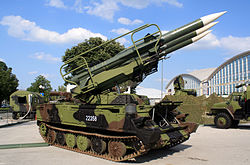
The 2K12 "Kub" (Russian: 2К12 Куб; English: 'cube') (NATO reporting name: SA-6 "Gainful") mobile surface-to-air missile system is a Soviet low to medium-level air defence system designed to protect ground forces from air attack. 2К12 is the GRAU designation of the system.
Key Information


Each 2K12 battery consists of a number of similar tracked vehicles, one of which carries the 1S91 (SURN vehicle, NATO designation "Straight Flush") 25 kW G/H band radar (with a range of 75 km (47 mi)) equipped with a continuous wave illuminator, in addition to an optical sight. The battery usually also includes four triple-missile transporter erector launchers (TELs), and four trucks, each carrying three spare missiles and a crane. The TEL is based on a GM-578 chassis, while the 1S91 radar vehicle is based on a GM-568 chassis, all developed and produced by Russian manufacturer MMZ.
Development
[edit]
The development of the 2K12 started after 18 July 1958 at the request of the CPSU Central Committee.[2] The system was set the requirements of being able to engage aerial targets flying at speeds of 420 to 600 m/s (820–1,200 kn) at altitudes of 100 to 7,000 m (330 to 23,000 ft) at ranges up to 20 km (12 mi), with a single shot kill probability of at least 0.7.[2]
The systems design was the responsibility of the now Tikhomirov Scientific Research Institute of Instrument Design (NIIP). In addition to NIIP several other design bureaus were involved in the creation of the Kub missile system including Mytishchi Machine-Building Plant which designed and produced the chassis of the self-propelled components. Many of the design bureaus would later go on to co-operate in the development of the successor to the 2K12 "Kub", the 9K37 "Buk".
First trials of the missile system were started at the end of 1959 to discover a series of problems:
- low power for the missile radar seeker and badly designed nose cone
- missile air inlets design failure
- low quality of heat shield inside the afterburner chamber (titanium was replaced by steel).
In August 1961 Toropov was replaced by Lyapin as the Chief Designer of Vympel and in January 1962 Tikhomirov was replaced by Figurovskiy as the Chief Designer of NIIP. Still, the work was not intensified. Before 1963 only 11 of 83 missiles fired had the seeker head installed; only 3 launches were successful.
Kub downed its first-ever air target on February 18, 1963, during the state trials at Donguz test site, Orenburg Oblast. It was an Ilyushin Il-28 bomber.
The system entered an extended testing period between 1959 and 1966, after overcoming the technical difficulties of producing the 2K12 "Kub" the system was accepted into service on 23 January 1967 and went into production that same year.[2]
It is sometimes claimed that the M-11 Shtorm naval system is a version of the 3M9 but this is not the case, as the M-11 Shtorm is a separate system and, unusually for Russian surface-to-air missiles, has no land-based variant.
| Kub | Kvadrat | ||||||||||||||||
| Kub-M1 | Kub-M | ||||||||||||||||
| Kub-M3 | |||||||||||||||||
| Kub-M4 | |||||||||||||||||
| Buk | |||||||||||||||||
The 2K12 "Kub" was recommended for modernisation work in 1967 with the goal of improving combat characteristics (longer range, improved ECCM, reliability and reaction time) established for the new chief designer Ardalion Rastov. A modernised variant underwent trial testing in 1972 eventually being adopted in 1973 as the "Kub-M1".[2] The system underwent another modernisation between 1974 and 1976, again the general combat characteristics of the system were improved with the "Kub-M3" clearing testing and entering service in 1976.[2]
After the Rastov visit to Egypt in 1971 to see Kub in operation[3] he decided upon the development of a new system, called Buk, where each TEL should have its own fire control radar (TELAR) and is able to engage multiple targets from multiple directions at the same time.
The final major development of the Kub missile system was achieved during the development of its successor, the 9K37 "Buk" in 1974. Although the Buk is the successor to Kub it was decided that both systems could share some interoperability, the result of this decision was the "Kub-M4" system.[2] The Kub-M4 used Kub-M3 components which could receive fire control information from the 9А310 transporter erector launcher and radar (TELAR) of the 9K37 Buk. The advantage of interoperability was an increase in the number of fire control channels and available missiles for each system as well as a faster service entry for Buk system components. The Kub-M4 was adopted into service in 1978 following completion of trials.[2]
| External images | |
|---|---|
 Photo of one of the Buk prototype, based on Kub components Photo of one of the Buk prototype, based on Kub components | |
| Photo of one of the Buk prototype, based on Kub components (sideview) |
Some early development implementations of the Buk missile system heavily utilized Kub components, including the 3M9 missile.[4]
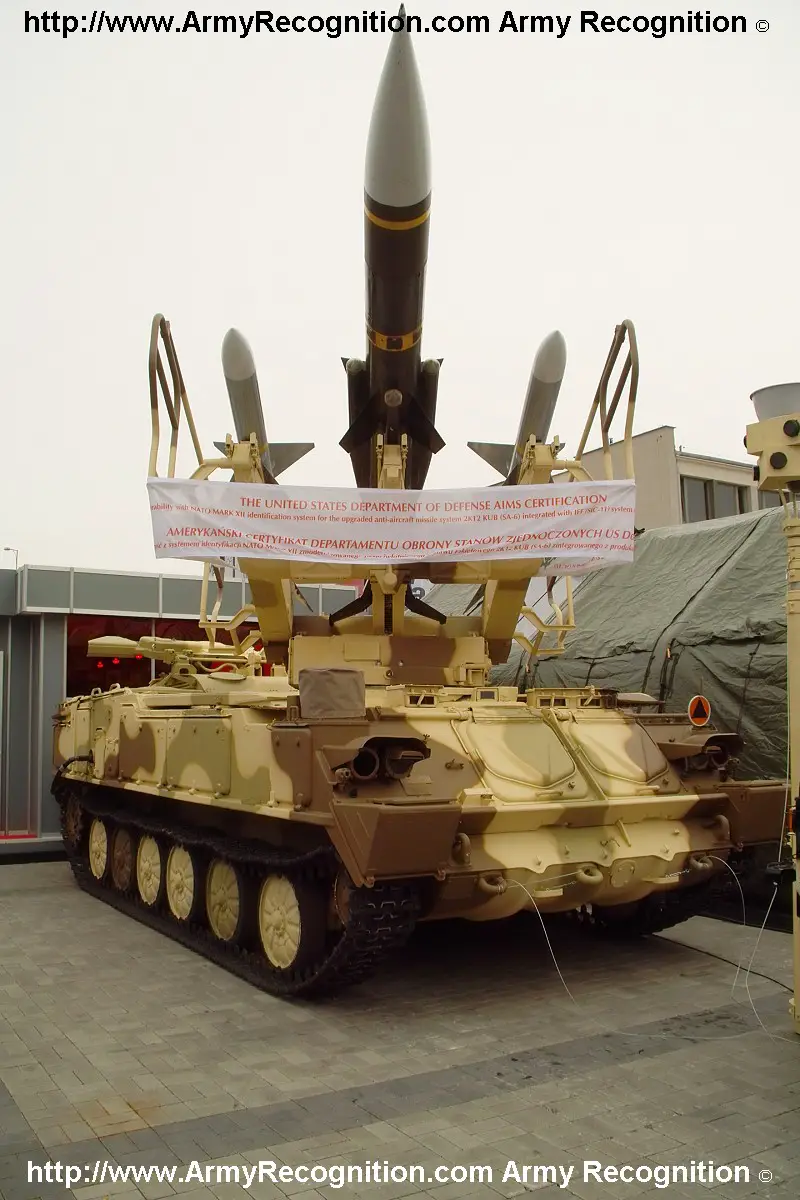
There are several plans to integrate active radar homing missiles into Kub. For instance, Polish WZU of Grudziadz demonstrated a project of a Sparrow-armed Kub at the MSPO 2008 defence exhibition in Kielce.[5][6][7] It is reported also that Vympel initiated some work to use its RVV-AE air-to-air missile to modernise the Kvadrat SAM system.[8]
Also, the Czech company RETIA presented a SURN (fire control radar) upgrade featuring an optical channel and new multiple-function color displays as well as the radar upgrade and the IFF system.[9]
In 2011 a Kub upgraded launcher (named "2K12 KUB CZ") with three Aspide 2000 missiles in launch containers was presented at the International Exhibition of Defence and Security Technologies (IDET) exposition in Brno. The modifications were made by Retia.[10]
Description
[edit]
The 2K12 system shares many components with the 2K11 Krug (SA-4) system. In many ways they are designed to complement each other; 2K11 is effective at long ranges and high altitudes, 2K12 at medium ranges and intermediate altitudes.
The system is able to acquire and begin tracking targets using the 1S91 "Самоходная установка разведки и наведения" (SPRGU - "Self-propelled Reconnaissance and Guidance Unit" / NATO: "Straight Flush" radar) at 75 km (47 mi) and begin illumination and guidance at 28 km (17 mi). IFF is also performed using this radar. It can only guide one or two missiles to a single target at any time. The missile is initially command guided with terminal semi-active radar homing (SARH), with target illumination provided by the "Straight Flush" radar. Detonation is via either the impact or proximity fuze. On the latest models, this vehicle is also fitted with an optical tracking system which allows engagement without the use of the radar (for active RF emissions stealth reasons, or due to heavy ECM jamming) in which case the effective altitude is limited to 14 km/46000 ft. The optical tracking method also allows engagements to altitudes below that where the radar is able to track targets. Maximum target speed is around Mach 2 for head-on engagements and Mach 1 for tail-chase engagements. Top speed of the missile is approximately Mach 2.8.
In contrast to the elaborate Patriot missile or even the simpler Hawk system fielded by US forces, most of the system rides on two tracked self-propelled vehicles, rather than towed or mounted on trucks, and either the launcher or control vehicle can be set to launch in only 15 minutes after changing location.
| 3M9 | |
|---|---|
 | |
| Type | Surface-to-air missile |
| Place of origin | Soviet Union |
| Production history | |
| Variants | 3M9, 3M9M1, 3M9M3, 3M9M4 |
| Specifications (3M9) | |
| Mass | 599 kg |
| Length | 5,800 mm |
| Diameter | 335 mm |
| Wingspan | 1.245 m |
| Warhead | Frag-HE |
| Warhead weight | 59 kg |
Detonation mechanism | Contact and proximity |
| Propellant | integral rocket motor/ramjet booster and sustainer motor |
Operational range | 24 kilometres (15 mi) |
| Flight altitude | Max. 14,000 metres (46,000 ft) Min. 100 metres (330 ft) |
| Maximum speed | Mach 2.8 |
Guidance system | semi-active radar homing |
Launch platform | 2P25 TEL |
Missiles
[edit]| IVC 3M20M3 Peniye | |
|---|---|
| Type | Surface-to-air missile training target imitator system |
| Place of origin | Soviet Union/ Russia Russia |
| Specifications | |
| Mass | 600 kg |
| Length | 5,841 mm |
| Wingspan | 932 mm |
| Warhead | no |
| Propellant | integral rocket motor/ramjet booster and sustainer motor |
Operational range | 24 kilometres (15 mi) |
| Flight altitude | 500–6,000 metres (1,600–19,700 ft) |
| Maximum speed | 200–600 m/s |
Guidance system | semi-active radar homing |
Launch platform | 2P25 TEL |
The fairly large missiles have an effective range of 4–24 km (2.5–14.9 mi) and an effective altitude of 50–14,000 m (160–45,930 ft). The missile weighs 599 kg (1,321 lb) and the warhead weighs 56 kg (123 lb). Top missile speed is approx. Mach 2.8. The combined propulsion system 9D16K included solid fuel rocket motor which, when burned out, forms the combustion chamber for a ramjet in a pioneering design putting this missile far ahead of its contemporaries in terms of propulsion.
The missile was fitted with a semi-active radar seeker 1SB4, designed by MNII Agat, which was able to track the target by Doppler frequency since the start. Later upgrades (3M9M3 missile) could do this before the start. Chief Designer of the seeker head was Yu.N. Vekhov, since 1960 – I.G. Akopyan.
In 1977 a new version, the 3M9M1 (DoD designation SA-6B) was created with three missiles fitted onto a different chassis (the same as that of the 9K37 "Buk" (NATO reporting name "Gadfly" / DoD SA-11 ), the 2K12 effective replacement) with an integrated "Fire Dome" missile guidance radar. For comparisons between the 2K12, 9K37, see the 9K37 Buk entry.
An earlier incremental upgrade saw the 2K12 missiles replaced with the 2K12E versions and this system was known as Kvadrat ("Квадрат", meaning square). This name was derived from the most common arrangement pattern of the military vehicles of the 2K12 complex, when the 1S91 radar is located at the center and 4x2P25 TELs at the vertices of a square around the radar.
Comparison
[edit]| Complex (GRAU designation) |
Kub | Kub-M1 | Kub-M3 | Kub-M4 (Buk-M1) |
|---|---|---|---|---|
| Introduced | 1967 | 1973 | 1976 | 1978 |
| Missiles per TEL | 3 | 3 | 3 | 3 |
| Engagement range | 6–22 km | 4–23 km | 4–25 km | 4–24 km |
|
Engagement altitude |
100–7,000 m | 80–8,000 m | 20–8,000 m | 30–14,000 m |
| Missile speed (Mach) |
1.75 | 1.75 | 2 | 2 |
| Maximum target speed (Mach) |
1.75 | 1.75 | 1.75 | 1.75 |
| Response Time (seconds) | 26–28 | 22–24 | 22–24 | 24 |
| missile Weight, kg | 630 kg | 630 kg | 630 kg | 630 kg |
|
Simultaneous engagements |
1 | 1 | 1 | 2 |
| Deployment time (minutes) | 5 | 5 | 5 | 5 |
1S91 radar
[edit]
SURN 1S91 vehicle included two radar station – a target acquisition and distribution radar 1S11 and a continuous wave illuminator 1S31, in addition to an IFF interrogator and an optical channel.
While 1S31 antenna was installed on the upper section of the superstructure and the 1S11 on the lower, they could turn around independently. To make the height of the vehicle lower the central cylinder was able to hide inside the prime mover.
The acquisition range of the radar was reported as 50 km (31 mi) for an F-4 Phantom II type of target.
Total weight of the 1S91 vehicle with a crew of 4 was 20.3 tonnes and 2P25 vehicle with 3 missiles and a crew of 3 was 19.5 t.
Additional radar
[edit]The 2K12 can also be used at a regimental level, if used as such it can be accompanied by a number of additional radar systems for extended air search at longer range and lower altitude, to supplement the 1S91 "Straight Flush". These systems include the:
- P-12 "Spoon Rest", a VHF early warning radar (also used by the S-75 Dvina), with a 200 kilometres (120 mi) range.
- P-40 "Long Track", an E band early warning radar (also used by the 2K11 Krug and 9K33 Osa), with a 370 kilometres (230 mi) range.
- P-15 "Flat Face A", a UHF early warning radar (also used by the S-125 Neva, with a 150 kilometres (93 mi) range.
- "Thin Skin" or "Side Net" E band height finding radar (also used by the S-75, 2K11 Krug and S-200, range 240 km (150 mi)
- "Score Board" IFF radar
The "Spoon Rest" and "Thin Skin" are mounted on a truck, "Long Track" on a tracked vehicle (a modified AT-T) and "Flat Face" on a van. The "Score Board" IFF radar is mounted on a free standing tri-pod.
Without the P-40 "Long Track" mobile radar vehicle, the 2K12 is unable to track aircraft at high altitudes.
-
 1S91 (or SURN) vehicle in an open-air military museum, Kineshma
 -
 1S91 first/second operator console
 -
 1S91 third operator console
 -
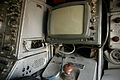 1S91 teleconsole
 -
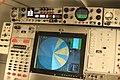 1S91 main operator console (after upgrade)
 -
 1S91 third operator console (after upgrade)
 -
 1S91 teleconsole (after upgrade)
 -
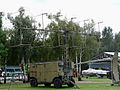 NRS-12 "Score Board" IFF radar (bottom left - mounted on tri-pod) and P-12 "Spoon Rest" (centre - mounted on a towable generator).


Operational history
[edit]Middle East
[edit]Yom Kippur War
[edit]In the 1973 Yom Kippur War, the Egyptian and Syrian 2K12s surprised the Israeli military, who were accustomed to having air superiority over the battlefield. The highly mobile 2K12 took a heavy toll on the slower A-4 Skyhawk and even the F-4 Phantom, forming a protective umbrella until they could be removed. The radar warning receivers on the Israeli aircraft did not alert the pilot to the fact that he was being illuminated by the radar. The 2K12 performed well according to a conversation between Israeli General Peled and Henry Kissinger, and caused the most Israeli losses of any Egyptian anti-aircraft missile, followed by the 9K32 Strela-2.[11]
The superior low altitude performance of the weapon, and its new CW semi-active missile seeker resulted in a much higher success rate compared to the earlier S-75 Dvina and S-125 Neva systems. While exact losses are disputed, around 40 aircraft are usually cited as lost to SAMs, and the 2K12 Kub proved the most effective of the three weapons. But in subsequent conflicts, its performance declined as captured examples resulted in effective counter-measures being developed.[12]
1982 Lebanon war
[edit]
The Syrians also deployed the 2K12 Kub to Lebanon in 1981 after the Israelis shot down Syrian helicopters near Zahlé. The SAM batteries were placed in the Bekaa Valley near the Beirut-Damascus road. They remained close to the existing Syrian air defense system but could not be fully integrated into it.[clarification needed] Early in the 1982 Lebanon war, the Israeli Air Force concentrated on suppressing the SAM threat in the Beqaa Valley, launching Operation Mole Cricket 19. The result was a complete success. Several 2K12 Kub batteries, along with S-75s and S-125 systems, were destroyed in a single day. While Syria's own air defenses remained largely intact, its forces in Lebanon were left exposed to attacks by Israeli strike aircraft for the remainder of the war. It has been reported, however, that at least one Israeli F-4 Phantom fighter-bomber was shot down in the area by a 2K12 Kub on July 24, 1982.[13]
South African Border War
[edit]The People's Armed Forces for the Liberation of Angola (FAPLA) procured a number of 2K12 Kub systems from the Soviet Union in 1981.[14] According to the Central Intelligence Agency, Angola had obtained sixteen TEL launchers for the 2K12 Kub systems, which were deployed in the Moçâmedes District.[15] The South African military noted that the missiles would make it difficult for it to provide air cover for its cross-border operations against guerrillas of the People's Liberation Army of Namibia, which were operating from Angolan sanctuaries.[16] All of Angola's 2K12 Kub launchers were destroyed in a South African preemptive strike as part of Operation Protea.[14]
2K12 Kub missile sites were also operated by Cuban expeditionary forces in Angola during Operation Excite/Hilti.[17] On 26 June 1988, six 3M9M3 missiles launched from a Cuban 2K12 Kub battery were fired at a South African weather balloon being used as a radar decoy over Tchipa.[17] South African observers used the firing data to plot the location of the 2K12 Kub launchers and destroyed them in a concentrated bombardment with G5 howitzers.[17]
Western Sahara War
[edit]Forces of the Polisario Front acquired two full batteries of 2K12 Kub missiles from Algeria during the Western Sahara War, which they used effectively against the fighters of the Royal Moroccan Air Force, including shooting down two Mirage F1 fighters in 1981 during a major battle in Guelta Zemmur.[18]
Poland
[edit]On 19 August 2003, a Polish Air Force Su-22M4K was accidentally shot down by friendly fire during an exercise by a Polish 2K12 Kub battery. The aircraft was flying 21 km (13 mi) from the coast over the Baltic Sea near Ustka. The pilot, General Andrzej Andrzejewski, ejected and was rescued after two hours in the water.[19]
Libya
[edit]The system was deployed by Libya during the border dispute with Chad and proved a threat for French aircraft. On 16 February 1986, the system failed in detecting low flying French jets which were attacking the Ouadi Doum airbase. On January 7, 1987, the French Air Force were successful in destroying a 2K12 Kub radar site in the Faya Largeau area with SEPECAT Jaguars armed with Martel anti-radiation missiles.[20]
In March, the Chadian rebels captured Ouadi Doum air base, seizing virtually all heavy equipment used for the defense of this airfield, intact. Most of this equipment was transported to France and the United States in the following days, but some 2K12 Kub systems remained in Chad.[21]
With this catastrophe, the Libyan occupation of northern Chad – and the annexation of the Aouzou Strip – was over: by 30 March, the bases at Faya Largeau and Aouzou had to be abandoned. The LARAF now had a completely different task: its Tu-22Bs were to attack the abandoned bases and destroy as much equipment left there as possible. The first strikes were flown in April, and they continued until 8 August 1987, when two Tu-22Bs tasked to strike Aouzou were ambushed by a captured 2K12 Kub battery used by the Chadian Army. One of the bombers was shot down.[22]
Libyan air defense, including 2K12 Kub batteries, was active during the 2011 military intervention in Libya.[23]
Iraq
[edit]Several 2K12 Kub batteries, along with other SAM systems and military equipment, were supplied to Iraq before and during the Iran–Iraq War as part of large military packages from the Soviet Union. The batteries were active since the start of the war in September 1980, scoring kills against U.S-supplied Iranian F-4 Phantoms and Northrop F-5s.[24][25][26]
The SA-6/Kub was also used during the 1991 Gulf War. The threat posed by these SAMs led to the US Navy outfitting the ALQ-167 Bullwinkle Jamming pod on their F-14A/A+ Tomcats and A-6E TRAM/SWIP Intruder aircraft.[27] On the opening night of Desert Storm, on 17 January 1991, a B-52G was damaged by a missile. Different versions of this engagement are told. It could have been an S-125 or a 2K12 Kub while other versions report a MiG-29 hit the bomber with a R-27R missile.[28] However, the U.S. Air Force disputes these claims, stating the bomber was actually hit by friendly fire, an AGM-88 High-speed, Anti-Radiation Missile (HARM) that homed on the fire-control radar of the B-52's tail gun; the jet was subsequently renamed In HARM's Way.[29] Shortly following this incident, General George Lee Butler announced that the gunner position on B-52 crews would be eliminated, and the gun turrets permanently deactivated, commencing on 1 October 1991.[30]
On January 19, 1991, a USAF F-16 (serial 87-228) was shot down by a 2K12 Kub during the massive (though ill-fated) Package Q Strike against a heavily defended Baghdad. It was the tenth coalition aircraft lost in combat in Operation Desert Storm. The pilot, Captain Harry 'Mike' Roberts, ejected safely but was taken prisoner and freed in March 1991. The aircraft was on a mission to attack the Air Defense Headquarters Building. It had flown 4 combat missions before being lost.[31]
The 2K12 Kub threat was largely controlled by Allied EW assets together with the older S-75s and S-125 missile systems. Most of the losses were due to IR guided SAMs.[32]
Kubs continued to be used by the Iraqi military, along with other SAM systems, to challenge the Western imposed no-fly zones during the 1990s and early 2000s. They were not able to shoot down any Coalition aircraft though several sites were destroyed as retaliation. In one incident, on September 11, 1996, during Operation Provide Comfort II, one missile was fired against two USAF F-16 in northern Iraq but missed.[33] On December 30, 1998, a 2K12 Kub site near Talil fired 6-8 missiles at aircraft enforcing the Southern Watch component of the NFZ. American F-16s responded by dropping six GBU-12 laser-guided bombs on the site and also launching two HARMs "as a preemptive measure" to warn Iraqi radar operators against carrying out more firings.[34]
Bosnia and Yugoslavia
[edit]Army of Republika Srpska forces, using modified 2K12 Kub systems were successful in shooting down Scott O'Grady's F-16 in 1995[35][36]
One Mi-17 was shot down by a Kub on May 28, 1995, killing the Bosniak Minister Irfan Ljubijankić, and 6 other crew and passengers.[37]
During the Kosovo War in 1999, on the first night of the war (March 24/25), a Yugoslav Air Force MiG-29 flown by Maj. Predrag Milutinović was downed by a Kub battery in a friendly fire incident, while approaching Niš Airport after an unsuccessful engagement with NATO aircraft.
The Yugoslav Air Defence had 22 2K12 Kub batteries. Using shoot and scoot tactics, the self-propelled ground system demonstrated a good survivability with only three radars lost in the face of nearly four-hundred AGM-88 shots. As comparison the fixed S-75 and S-125 sites suffered losses to around 66 to 80 percent.[38] According to the then-commander of Air force and air defense General Spasoje Smiljanić, during the 78 day campaign, 2K12 Kub had 46 shooting with 70 missiles.[39]
Syrian Civil War
[edit]On April 14, 2018, American, British, and French forces launched 103 air-to-surface and cruise missiles targeting sites in Syria. According to the Russian military, twenty-one Kub missiles launched in response allegedly destroyed eleven incoming missiles,[40] However, the American Department of Defense claimed no Allied missiles were shot down.[41]
Yemen Civil War
[edit]South Yemen formerly operated these systems in the South Yemeni air defense forces. Later, United Yemen purchased a large number of these systems in the 1990s and they entered service with the Yemeni air defense forces in 1999. On 6 June 2019, Houthi forces successfully shot down a USAF MQ-9. CENTCOM officials blamed the shoot down on a Houthi-operated and domestically made Fater-1 missile – a SAM system upgraded from a Soviet 2K12 Kub air defence system.[42]
War in Ukraine
[edit]Ukraine retired its Kub batteries in the early 2000s to focus on the more modern Buk systems, but with the outbreak of the Russo-Ukrainian war in 2014, Ukraine's Aerotekhnika company begun repairing some of the 89 Kub units in storage and modernize them to the Kub M3/2D standard. According to Ukrainian media, two units were operational in 2021, while the Pentagon estimated that only one was operational prior to the Russian invasion in 2022.[43]
On 17 March 2023, the Slovak government approved the transfer of two Kub missile launchers, one Kub radar, spare parts, 52 pieces of 3M9ME missiles and 148 pieces of 3M9M3E missiles to Ukraine. [44]
On 10 May 2023, the President of Czech Republic, Petr Pavel, has announced that his country will send two "2K12 Kub' missile systems to Ukraine with a "relatively large number" of missiles.[45] On late August 2023, photos of Czech 2K12M2 Kub-M2 systems in Ukrainian service appeared on social media.[43]
Operators
[edit]


Current
[edit] Algeria − Unknown number of 2K12 Kvadrat in service as of 2024[46]
 Angola − 16 2K12-ML Kvadrat-ML in service as of 2024[47]
 Armenia − Unknown number in service as of 2024[48]
 Bosnia and Herzegovina − 20 as of 2024[49]
 Bulgaria − Unknown number in service as of 2024[50]
 Chad − 4 as of 2024[51]
 Cuba − Unknown number in service as of 2024[52]
 Czech Republic − 8 2K12M2 Kub-M2 as of 2024[53]
 Egypt − 56+ as of 2024[54]
 Germany - At least 1 operational system retained from East German stocks for threat simulation[55]
 Hungary − 16 as of 2024[56]
 India − 180 as of 2024[57]
 Kazakhstan − Unknown number in service as of 2024[58]
 Myanmar − Unknown number of 2K12 Kvadrat-M in service as of 2024[59]
 Poland − 20 as of 2024[60]
 Romania − 32 as of 2024[61]
 Serbia − 12 batteries in service with the Serbian Air Force and Air Defence as of 2024[62]
 Slovakia − Unknown number in service as of 2024[63]
 Syria − Unknown number in service prior to the fall of the Assad regime[64]
 Tanzania − Unknown number in service as of 2024. Serviceability doubtful[65]
 Turkmenistan − Unknown number in service as of 2024[66]
 Ukraine − Two batteries donated by the Czech Republic and two launchers donated by Slovakia in 2023[67]
 Vietnam − Unknown number in service as of 2024[68]


Non-state
[edit] Artsakh − Operated an unknown number in 2016[69]
 Libyan National Army − Unknown number of 2K12 Kvadrat in service as of 2024[70]
 Polisario Front − At least 4[71]


Former
[edit]- Czechoslovakia[72] − Passed on to successor states.
 East Germany[73] − Passed on to the unified German state.
 Iraq[71]
 North Korea[71]
 Libya[71]
 Russia − 400 in 2002[71]
 Soviet Union − 800 in 1989.[74] Passed on to successor states.
 North Yemen[75] − Passed on to the unified Yemeni state.
 South Yemen[75][76] − Passed on to the unified Yemeni state.
 Yemen[71]
 Yugoslavia[77] − Passed on to successor states.


-
 "Side Net" height finding radar. Photo by Nellis AFB.
 -
 P-40 "Long Track" early warning radar. Photo by Nellis AFB.
 -
 An 1S91 (Straight Flush) radar of the Hungarian Army's 2K12 Kub missile system

.jpg)


References
[edit]- ^ "ЗРК "Куб"". Pvo.guns.ru. Archived from the original on 21 April 2012. Retrieved 15 August 2012.
- ^ a b c d e f g "САМОХОДНЫЙ ЗЕНИТНЫЙ РАКЕТНЫЙ КОМПЛЕКС 2К12 "КУБ" (SA-6 GAINFUL)" (in Russian). pvo.guns.ru. 11 April 2004. Archived from the original on 21 December 2008. Retrieved 19 November 2008.
- ^ "Chief Designer Ardalion Rastov". www.milparade.udm.ru. 31 August 1998. Archived from the original on 23 January 2009. Retrieved 23 August 2008.
- ^ (in Russian) Buk (9K37, SA-11, Gadfly) Archived 4 May 2009 at the Wayback Machine, ARMS-EXPO website
- ^ "Sparrow missile integration with SA-6". Archived from the original on 29 November 2014. Retrieved 14 November 2014.
- ^ "Jane's- Surface to Air". Archived from the original on 2 July 2012. Retrieved 17 January 2009., Poland's WZU shows Sparrow-armed Kub[permanent dead link] at Jane's Information Group website
- ^ "2K12 Kub modernisation for Polish Army at MSPO 2007 Defence Exhibition". www.armyrecognition.com. Archived from the original on 24 September 2011. Retrieved 3 August 2009.
- ^ RV-77 could create a smarter Kub Archived 26 February 2009 at the Wayback Machine at Jane's Information Group website
- ^ SAM system modernization Archived 1 November 2009 at the Wayback Machine at RETIA, a.s.
- ^ The Czech company RETIA, a.s. is replacing – three deadly fingers – of the Surface to Air Missile (SAM) system 2K12 KUB at RETIA, a.s.
- ^ "The White House Memorandum of Conversation" (PDF).
- ^ C Kopp (6 July 2009). "3M9ME Gainful SAM launch from TEL". p. 1. Archived from the original on 2 January 2015. Retrieved 14 November 2014.
- ^ "Israelis Bomb Lebanese Sites, Lose One Plane - The Washington Post". The Washington Post.
- ^ a b Vanneman, Peter (1990). Soviet Strategy in Southern Africa: Gorbachev's Pragmatic Approach. Stanford: Hoover Institution Press. pp. 41–57. ISBN 978-0817989026.
- ^ "SA-6 Equipment: Moccamedes SAM Support Facility, Angola" (PDF). Langley: Central Intelligence Agency. 1980–1981. Archived from the original (PDF) on 23 January 2017. Retrieved 20 May 2017.
- ^ Jaster, Robert Scott (1997). The Defence of White Power: South African Foreign Policy under Pressure. Basingstoke: Palgrave-Macmillan. pp. 66–68, 93–103. ISBN 978-0333454558.
- ^ a b c George, Edward (2005). The Cuban intervention in Angola. New York: Frank Cass Publishers. p. 244. ISBN 978-0415647106.
- ^ Cooper, Tom. "Morocco, Mauritania & West Sahara since 1972". ACIG.org. Archived from the original on 4 March 2016. Retrieved 1 January 2016.
- ^ "Poland's Black Wednesday".
- ^ "In 1987, the French Air Force Staged a Daring Raid on Libyan Defenses". 2 January 2017.
- ^ "Chad Victory over Libyans a Major Setback for Kadafi". Los Angeles Times. 25 March 1987.
- ^ "Online.de". Archived from the original on 25 April 2011. Retrieved 31 July 2009.
- ^ Burns, John F. (21 June 2011). "Cameron Rebuts Commanders' Concerns About Libya Campaign". New York Times. Libya. Archived from the original on 18 January 2013. Retrieved 7 November 2012.
- ^ Cordesman, Anthony; Wagner, Abraham R. (26 September 2003). "Chapter XIII: The Air and Missile Wars and Weapons of Mass Destruction". The Lessons of Modern War: Volume II, The Iran–Iraq War (PDF). Center for Strategic and International Studies. Archived (PDF) from the original on 18 April 2009. Retrieved 29 May 2013.
- ^ "Iranian_F_5_LOSSES any ejections". Ejection-history.org.uk. Archived from the original on 3 November 2013. Retrieved 1 November 2013.
- ^ "Chronological Listing of Iranian Air Force McDonnell-Douglas F-4 Phantom II Losses & Ejections". Ejection-history.org.uk. Archived from the original on 10 July 2015. Retrieved 1 November 2013.
- ^ Morgan, Rick (2017). A-6E Intruder Units: 1975-1996. Osprey Publishing. pp. 71–72.
- ^ Lake 2004, p. 48.
- ^ Lake 2004, pp. 47–48.
- ^ Condor 1994, p. 44.
- ^ "Airframe Details for F-16 #87-0228". f-16.net. Archived from the original on 28 November 2014. Retrieved 14 November 2014.
- ^ "Coalition Aircraft Combat Attrition". Rjlee.org. Archived from the original on 21 January 2012. Retrieved 15 August 2012.
- ^ "Operation Provide Comfort II". Globalsecurity.org. Retrieved 16 April 2020.
- ^ John Pike. "Operation Southern Watch". Globalsecurity.org. Archived from the original on 3 November 2011. Retrieved 19 May 2011.
- ^ "All For One" Archived 12 August 2013 at the Wayback Machine, June 19, 1995, Kevin Fedarko and Mark Thompson, Time
- ^ "Airframe details for 89-2032". f-16.net. Archived from the original on 28 November 2014. Retrieved 14 November 2014.
- ^ Roger Cohen, Serbs Kill a Bosnian Leader and Take More Hostages; Copter Downed - 33 Britons Are Seized, The New York Times, 29 May 1995.
- ^ Andrew, Martin (14 June 2009). "Revisiting the Lessons of Operation Allied Force". Air Power Australia Analyses. VI (4). Ausairpower.net: 1. Archived from the original on 28 June 2009. Retrieved 15 August 2012.
- ^ Spasoje Smiljanić. "Borba Davida i Golijata | Ostali članci". Večernje novosti. Archived from the original on 9 September 2013. Retrieved 1 November 2013.
- ^ "Briefing by Russian Defence Ministry official Major General Igor Konashenkov (April 16, 2018)". Archived from the original on 18 April 2018. Retrieved 19 April 2018.
- ^ "Department of Defense Press Briefing by Pentagon Chief Spokesperson". U.S. DEPARTMENT OF DEFENSE. Archived from the original on 22 April 2018. Retrieved 23 April 2018.
- ^ "Statement from US Central Command on attacks against U.S. observation aircraft". U.S. Central Command.
- ^ a b Roblin, Sébastien (30 August 2023). "The Three Fingers of Death Have Arrived in Ukraine". Popular Mechanics. Retrieved 3 September 2023.
- ^ "Slovakia will donate jet fighter to Ukraine". RTVS. 17 March 2023. Retrieved 24 October 2023.
- ^ "Czech Republic supplies Ukraine with two Kub air defence systems – Czech President". news.yahoo.com. 11 May 2023.
- ^ IISS 2024, p. 344.
- ^ IISS 2024, p. 472.
- ^ IISS 2024, p. 179.
- ^ IISS 2024, p. 76.
- ^ IISS 2024, p. 78.
- ^ IISS 2024, p. 482.
- ^ IISS 2024, p. 428.
- ^ IISS 2024, p. 84.
- ^ IISS 2024, p. 351.
- ^ "Flugabwehrraketensystem SA-6". Bundeswehr (in German). Retrieved 13 February 2024.
- ^ IISS 2024, p. 104.
- ^ IISS 2024, p. 267.
- ^ IISS 2024, p. 187.
- ^ IISS 2024, p. 297.
- ^ IISS 2024, p. 125.
- ^ IISS 2024, p. 131.
- ^ IISS 2024, pp. 133−134.
- ^ IISS 2024, p. 136.
- ^ IISS 2024, p. 387.
- ^ IISS 2024, p. 524.
- ^ IISS 2024, p. 209.
- ^ Roblin, Sébastien (30 August 2023). "The Three Fingers of Death Have Arrived in Ukraine". Popular Mechanics. Retrieved 5 May 2024.
- ^ IISS 2024, p. 326.
- ^ IISS 2016, p. 181.
- ^ IISS 2024, p. 371.
- ^ a b c d e f O'Halloran & Foss 2002, p. 172.
- ^ IISS 1989, p. 46.
- ^ IISS 1989, p. 47.
- ^ IISS 1989, p. 34.
- ^ a b IISS 1989, p. 118.
- ^ Cooper 2017, p. 41.
- ^ IISS 1989, p. 91.

Sources
[edit]- Cooper, Tom (2017). Hot Skies Over Yemen, Volume 1: Aerial Warfare Over the South Arabian Peninsula, 1962-1994. Solihull, UK: Helion & Company Publishing. ISBN 978-1-912174-23-2.
- International Institute for Strategic Studies (1989). The military balance, 1989-1990. London: Brassey's. ISBN 978-0080375694.
- International Institute for Strategic Studies (2016). The Military Balance 2016. Vol. 116. Routledge. ISBN 9781857438352.
- International Institute for Strategic Studies (2024). The Military Balance 2024. Taylor & Francis. ISBN 978-1-040-05115-3.
- O'Halloran, James C.; Foss, Christopher F., eds. (2002). Jane's Land-Based Air Defense 2002-2003 (15th ed.). Janes Information Group. ISBN 978-0-7106-2437-6.
External links
[edit]
- Kub system walkarounds
- Kub 3M9 (SA-6 Gainful) Archived 6 March 2016 at the Wayback Machine at Federation of American Scientists website
- Needles in the Haystack – Hunting Mobile Electronic Targets, Maj Michael Pietrucha, USAF
- Radar Sites near the North Gate, photos of Soviet radars at Area 51 North Gate
- Photos of Polish Kub
2K12 Kub
View on GrokipediaDevelopment
Origins and Strategic Requirements
The development of the 2K12 Kub surface-to-air missile system was initiated by a decree from the CPSU Central Committee and the USSR Council of Ministers on July 18, 1958, assigning primary responsibility for system design to the Tikhomirov Scientific Research Institute of Instrument Engineering (NIIP) and missile development to Vympel.[7][3] This effort addressed deficiencies in Soviet tactical air defense, as prior systems like the S-75 Dvina (SA-2 Guideline) prioritized strategic high-altitude intercepts over mobile, low-altitude protection for forward-deployed forces.[8] Formal design work commenced in 1959, focusing on integration with tracked chassis from the Mytishchi Machine-Building Plant (MMZ) to enable rapid deployment with armored units.[6] Strategically, the Kub emerged from Cold War assessments of potential NATO air superiority in a European theater conflict, where low-level tactical strikes by aircraft such as the F-100 Super Sabre or F-105 Thunderchief could exploit terrain to bypass fixed-site radars and longer-range SAMs.[3] Soviet doctrine for the PVO-SV (Ground Forces Air Defense) emphasized layered, mobile defenses to shield motorized rifle and tank divisions during high-speed offensives, necessitating a system that could neutralize threats without hindering maneuverability.[8] The Kub was thus conceived as a divisional asset to counter aircraft employing low-altitude ingress tactics, filling a gap left by less agile predecessors like the S-25 Beriev, which lacked sufficient battlefield mobility.[3] Key requirements included engagement of subsonic and supersonic targets (up to 1,500 km/h) at altitudes from 100 meters to 7 kilometers and slant ranges of 3 to 24 kilometers, with all-weather operation, semi-active radar homing, and a reaction time under one minute to support dynamic frontline repositioning.[7] These parameters derived from analyses of Western aviation trends, prioritizing volume fire (three missiles per launcher) and resistance to electronic countermeasures over extended range, to achieve high single-shot kill probabilities against maneuvering jets in cluttered environments.[3] The system's tracked configuration ensured compatibility with T-54/55 tank formations, reflecting causal priorities in Soviet operational art for integrated mechanized warfare.[6]Design and Testing Milestones
The development of the 2K12 Kub surface-to-air missile system was initiated by a decree from the CPSU Central Committee and the USSR Council of Ministers on July 18, 1958, aiming to create a mobile system capable of engaging low- to medium-altitude aircraft threats that evaded earlier defenses like the S-75 Dvina.[7] System design responsibilities were assigned to the Tikhomirov Scientific Research Institute of Instrument Engineering (NIIP) for overall integration and the Vympel design bureau for the missile, while the Moscow Machine-Building Enterprise (MMZ) handled the tracked chassis based on the BTR-152 modifications.[3] Detailed design work commenced in 1959, focusing on semi-active radar homing for the 3M9 missile and a tracked 1S91 radar vehicle to enable rapid deployment within motor rifle divisions.[4][6] Initial prototype construction and ground testing occurred amid technical challenges, including radar tracking reliability and missile propulsion stability, with joint state trials originally targeted for the second quarter of 1961 but delayed due to integration issues.[9] By 1962, flight tests demonstrated the system's ability to intercept targets at altitudes up to 12 kilometers and ranges of 24 kilometers, with a notable early success in downing an Ilyushin Il-28 bomber simulating low-level attack profiles.[3] An extended evaluation phase from 1959 to 1966 addressed these hurdles through iterative modifications, culminating in the system's acceptance for serial production in 1966 after validation of its mobility, with setup times under 5 minutes and resistance to electronic countermeasures.[4] The 2K12 Kub achieved full operational status with the Soviet Army in 1967, marking a milestone in divisional air defense by providing all-weather, track-via-missile guidance against maneuvering targets at speeds up to 700 meters per second.[10] This timeline reflected Soviet priorities for countering NATO tactical aviation advances, prioritizing empirical performance over rushed deployment despite initial delays from complex fire control algorithms.[6]System Design
Launcher and Mobility Features
The 2P25 serves as the transporter-erector-launcher (TEL) for the 2K12 Kub surface-to-air missile system, mounting three ready-to-fire 3M9 missiles on rail launchers.[3] Built on the tracked GM-578 chassis, derived from the ZSU-23-4 Shilka self-propelled anti-aircraft gun platform, the launcher emphasizes high cross-country mobility to accompany mechanized forces.[7] With a combat weight of 19.5 tons, it achieves a maximum road speed of 50 km/h, enabling operational ranges suitable for divisional maneuvers.[7] Deployment from traveling to firing position requires approximately 5 minutes, during which the missile rails elevate using electric drives synchronized with guidance data from the 1S91 radar vehicle.[7] This rapid setup supports shoot-and-scoot tactics, allowing the system to fire and relocate within the same timeframe to evade counter-battery fire.[3] The non-amphibious design prioritizes tracked propulsion for rough terrain, though reloading the launcher with spare missiles from transport vehicles takes about 10 minutes.[11] Mobility features include robust suspension for sustained off-road travel alongside tank divisions, with the chassis providing stability for accurate missile launches post-emplacement.[3] The 2P25's integration of transport, erection, and launch functions in a single vehicle enhances the system's tactical flexibility, distinguishing it from less mobile predecessors like the SA-2 Guideline.[3]Missile Specifications
The 3M9 missile, the primary guided projectile of the 2K12 Kub system, features a two-stage design with a solid-propellant booster rocket for initial acceleration and a ramjet sustainer engine for powered flight, enabling high-speed engagement of low- to medium-altitude targets.[11][5] Guidance relies on semi-active radar homing, where the missile homes in on radar reflections from the target illuminated by the system's fire control radar.[5] The warhead is a high-explosive fragmentation type weighing approximately 57-59 kg, detonated by proximity or impact fuze for optimal lethality against aircraft and missiles.[7][12] Key technical parameters of the 3M9 missile are summarized below:| Parameter | Specification |
|---|---|
| Length | 5.8 m |
| Diameter | 0.33-0.34 m |
| Wingspan | 1.24-1.25 m |
| Launch weight | 599-600 kg |
| Maximum speed | Mach 2.8 (approximately 850 m/s) |
| Effective range | 3-24 km |
| Effective altitude | 100 m to 14 km |
| Propulsion | Solid-fuel booster / ramjet sustainer |
Radar and Guidance Systems
The 2K12 Kub employs the 1S91 SURN (NATO designation Straight Flush) as its primary radar and guidance vehicle, a tracked platform integrating acquisition, tracking, and illumination radars for low- to medium-altitude air defense.[3] The system detects and tracks aerodynamic targets at speeds up to 600 m/s, with a maximum engagement range of 24 km and altitude ceiling of 14 km, prioritizing threats maneuvering at altitudes from 100 m to 7 km.[13][2] The 1S91 mounts two independently steerable parabolic antennas: the lower 1S11 for continuous wave search and target acquisition in the C-band (4-8 GHz), offering a detection range of up to 75 km against fighter-sized targets at 500 m altitude.[14][3] The upper antenna performs monopulse tracking and target illumination in the X-band (8-12 GHz), enabling precise angular measurements and illumination for semi-active homing during the terminal phase.[14][2] Integrated identification friend-or-foe (IFF) interrogators, often paired with external NRS-12 "Score Board" secondary radars, support discrimination of hostile aircraft.[3] Guidance for the 3M9 missile relies on a semi-active radar homing (SARH) mode, with initial radio-command line-of-sight corrections from the 1S91 to steer the missile toward the target during boost and midcourse phases, transitioning to autonomous homing on the radar-illuminated target reflection in the terminal phase.[13][3] The 1S91 can simultaneously track up to 12 targets while illuminating one for engagement, with a crew of four operators managing acquisition, tracking, guidance, and telemetry via dedicated consoles.[3] This configuration provides rapid reaction times of under 30 seconds from target detection to missile launch, though vulnerability to electronic countermeasures and chaff prompted later doctrinal adaptations emphasizing mobility and low-level ambush tactics.[2][3]Variants and Upgrades
Soviet-Era Variants
The original 2K12 Kub system, adopted by Soviet forces on May 4, 1967, following trials from 1965 to 1966, featured the 3M9 missile with a semi-active radar homing seeker, 1S91 radar vehicle for target acquisition and guidance, and 2P25 tracked launchers carrying three missiles each.[8] It provided low- to medium-altitude defense with an effective range of 3 to 24 kilometers and altitude coverage up to 14 kilometers, emphasizing mobility for divisional air defense against tactical aircraft.[4] The 2K12M Kub-M1, introduced in 1973, expanded the engagement envelope through modifications to the missile seeker for improved resistance to electronic countermeasures and the ability to interrupt and reacquire radar locks on maneuvering targets.[3] These enhancements addressed vulnerabilities exposed in early deployments, such as susceptibility to jamming, while maintaining the core tracked BAZ-611 vehicle chassis for rapid redeployment within 5 minutes of firing.[8] The variant prioritized reliability and ECCM capabilities, with upgraded fire control allowing simultaneous tracking of up to six targets and engagement of three.[3] Subsequent iterations included the 2K12M3 Kub-M3 of 1976, which incorporated incremental radar and missile refinements for higher velocity interceptors and a reduced minimum engagement altitude of 25 meters, enabling better performance against low-flying threats like helicopter assaults or terrain-hugging jets.[3] Missile speed improvements extended effective range slightly beyond the original, with the system retaining NATO designation SA-6 Gainful Mod 3.[4] The 2K12 Kub-M4, fielded in 1978, represented a transitional upgrade integrating Kub-M3 firing units and 1S91 radars with the newer 9M38 missile from the emerging Buk system, bridging to more advanced multi-channel capabilities while preserving the Kub's three-missile launcher configuration.[4] This variant enhanced overall reaction time and integration with divisional networks but was short-lived as the full 9K37 Buk superseded it by the early 1980s.[8] All Soviet-era variants emphasized self-propelled mobility on BAZ or GM-575 chassis, with diesel-electric drive for cross-country speeds up to 65 km/h, prioritizing survivability in forward areas over static defenses.[3]Post-Soviet Modernizations and Export Adaptations
Following the Soviet Union's dissolution in 1991, modernization efforts for the 2K12 Kub focused on extending operational life amid resource constraints, with successor states prioritizing integration of digital electronics, improved electronic counter-countermeasures (ECCM), and compatibility with modern command networks rather than wholesale replacement. Russia largely phased out the Kub in favor of the 9K37 Buk, resulting in minimal indigenous upgrades, though some export-oriented enhancements were proposed.[4][15] Polish defense firms led significant post-Soviet adaptations, particularly through Wojskowe Zakłady Uzbrojenia S.A. (WZU), which developed upgrade packages replacing analog components with digital systems to enhance reliability, jamming resistance, and target detection distances exceeding original specifications. These modifications include updated fire control radars and launchers, enabling engagement of low-flying cruise missiles and aircraft in contested electronic warfare environments; WZU systems have been tested in NATO exercises, demonstrating interoperability improvements.[16][17] Czech company RETIA a.s. offers analogous modernizations targeting the 1S91 radar vehicle and 2P25 launchers, incorporating chassis overhauls, new cabling, power supplies, and air conditioning for sustained operations, alongside radar digitization for better low-altitude detection and potential replacement of 3M9 missiles with compatible Western seekers to counter stealthy threats. These upgrades aim to cover areas up to 4,000 square kilometers and have been marketed for export to former Warsaw Pact nations retaining Kub inventories.[18][19] Export adaptations often customized these enhancements for specific operators; for instance, Ukrainian modernizations of stored units incorporated partial digital retrofits for extended range and ECCM, while proposals from Russian firms like Almaz-Antey explored hybrid integrations with Buk components for third-party sales, though adoption remained limited due to competition from newer systems. Such variants prioritize cost-effective life extension over radical redesign, preserving the Kub's mobility while addressing gaps in engaging precision-guided munitions.[20][15]Operational Doctrine
Deployment Tactics
The 2K12 Kub is typically deployed in batteries comprising one 1S91 SURN engagement radar vehicle and three to four 2P25 transporter-erector-launchers, each loaded with three 3M9 missiles, accompanied by reload vehicles such as the 2T7 transloader.[3] This organization supports independent operation, encompassing target search, identification, illumination, and semi-active radar homing guidance for intercepts.[3] Batteries are often augmented by separate acquisition radars like the P-15 Flat Face or P-40 Long Track to extend detection range.[3] High mobility defines the system's tactical employment, with all major components mounted on tracked GM-578 or similar chassis, enabling relocation within five minutes to execute shoot-and-scoot maneuvers that mitigate vulnerability to counter-battery fire or air strikes.[3][7] Designed for divisional air defense within ground force maneuver units, Kub batteries advance with armored and mechanized formations to provide dynamic protection against low- to medium-altitude threats, including aircraft, helicopters, and cruise missiles flying at speeds up to 600 m/s.[3] Deployment prioritizes positioning along anticipated enemy air avenues, with rapid setup times of five minutes allowing integration into fluid battlefield scenarios.[7] In firing doctrine, the system engages targets at altitudes from 100 to 7,000 meters and ranges of 6 to 25 kilometers, capable of tracking up to six aerial targets simultaneously and guiding missiles in single or salvo modes for a single-hit probability of approximately 0.7 to 0.95 depending on conditions.[3] Tactical principles emphasize autonomous, direct attacks exploiting the missile's proportional navigation and continuous illumination, though limitations in low-altitude coverage and radar scan rates necessitate complementary low-level defenses.[7] Historical applications have occasionally involved semi-static emplacements in revetments for sustained coverage, despite the emphasis on mobility in Soviet operational manuals.[3]Integration with Other Systems
The 2K12 Kub operates within the Soviet Ground Forces' air defense framework as a divisional and regimental asset, complementing longer-range systems like the 2K11 Krug (SA-4 Ganef) for high-altitude threats and shorter-range point defenses such as the 9K33 Osa (SA-8 Gecko).[3] A standard Kub regiment comprises three batteries, each with one 1S91 radar vehicle and three to four 2P25 launchers, coordinated via the regimental command post that interfaces with motorized rifle or tank division headquarters for synchronized engagements against low- to medium-altitude aircraft.[21] This tactical integration emphasizes mobility and autonomy, allowing batteries to maneuver with forward units while receiving sector-specific target cues from divisional reconnaissance assets to prioritize threats like strike aircraft or helicopters.[4] The system's 1S91 SURN radar provides inherent search and track functions up to 75 km, but supports external data links for cueing from brigade- or division-level radars, such as the P-15 Flat Face or P-40 Long Track, extending effective detection envelopes and reducing vulnerability to saturation attacks in layered defenses.[3] Command guidance relies on continuous wave illumination from the 1S91, with no direct fire control handover to higher systems, though regimental operators can manually designate targets based on shared situational data via voice radio or telecode links during joint operations.[2] In practice, this setup integrates Kub batteries into maneuver brigades, where they shadow armored columns to counter tactical air support, as evidenced by organizational manuals specifying attachment to forward regiments for real-time threat response.[21] Post-Soviet modernizations enhance network compatibility; for instance, the Kub-M3 variant incorporates digital interfaces for linkage with Buk-M1 or Tor systems, enabling automated target handoff and shared radar pictures in brigade-level integrated air defense networks.[18] Upgrades like those by Czech firm RETIA replace analog components with modular C2 stations, allowing compatibility with NATO-standard data links in export users, though retention of legacy radio frequencies limits full interoperability without additional relays.[18] Russian forces have tested hybrid operations pairing upgraded Kubs with S-300 batteries for volume fire, leveraging the former's low-altitude specialization to fill gaps in echeloned defenses against cruise missiles and drones.[4] These adaptations prioritize backward compatibility over full network-centric redesign, reflecting resource constraints in sustaining legacy platforms amid evolving threats.[15]Combat History
Yom Kippur War (1973)
The 2K12 Kub (NATO: SA-6 Gainful) made its combat debut during the Yom Kippur War, which began on October 6, 1973, with simultaneous Egyptian crossings of the Suez Canal into the Sinai Peninsula and Syrian assaults on the Golan Heights. Egyptian forces integrated the export variant, 2K12E Kvadrat, into their forward air defense structure, deploying batteries to advance with mechanized units and provide mobile protection against low-flying Israeli aircraft that had previously exploited gaps in fixed SAM coverage from SA-2 Guideline and SA-3 Goa systems. Syrian operators similarly positioned Kub units to support their armored thrusts, leveraging the system's short reaction time of 26 seconds and ability to engage targets at altitudes as low as 100 meters. Estimates place the combined Egyptian and Syrian deployment at around 30 batteries, enabling dense overlapping coverage that initially neutralized Israeli air interdiction efforts against ground advances.[3][22] The Kub's track-via-missile guidance and continuous-wave semi-active seeker yielded higher hit probabilities than predecessor systems, particularly against maneuvering jets at medium-to-low altitudes, where Israeli F-4 Phantoms and A-4 Skyhawks operated to strike Egyptian bridging operations and Syrian tank concentrations. In the war's opening days, SA-6 batteries contributed significantly to Israeli Air Force losses, with surface-to-air missiles overall downing about 40 aircraft out of roughly 100 total fixed-wing attrition, the Kub accounting for the largest share due to its mobility and low-altitude efficacy. A Dutch UN observer reported SA-6 fire accounting for up to 30 Israeli aircraft downed in a single day over the Golan, while Egyptian integrated defenses, bolstered by Kub mobility, claimed 14 confirmed kills in early engagements. These successes stemmed from tactical innovations like rapid "shoot-and-scoot" relocations within five minutes, though fixed revetment use in some cases exposed units to counterstrikes.[3][23][24] Israeli adaptation mitigated the threat by October 8–9, as the IAF shifted to terrain-masking low-level approaches, deployed electronic jamming pods on strike aircraft, and conducted dedicated suppression of enemy air defenses (SEAD) missions using AGM-45 Shrike antiradiation missiles to blind 1S91 radar vehicles. By war's end on October 25, Israeli artillery, drones, and precision strikes had destroyed or neutralized most forward Kub batteries, limiting their sustained impact despite initial Arab claims of over 200 total air kills (disputed by Israeli figures of 102–106 losses, mostly to ground fire). The Kub's performance nonetheless demonstrated the disruptive potential of mobile SAMs against air dominance, prompting Israeli doctrinal shifts toward enhanced ECM and standoff weapons, while exposing system vulnerabilities like radar susceptibility to jamming when not dispersed.[3][25][26]1982 Lebanon War
During the 1982 Lebanon War, Syrian forces deployed multiple 2K12 Kub (SA-6 Gainful) batteries in Lebanon's Bekaa Valley as part of an integrated air defense network supporting their military presence against Palestinian Liberation Organization (PLO) positions and potential Israeli incursions.[27] These systems, numbering around 10-12 launchers integrated with SA-2 and SA-3 sites, were positioned near the Beirut-Damascus highway to cover Syrian troop concentrations and supply lines, following their initial deployment to the region in 1981 after Israeli intercepts of Syrian helicopters.[28] The batteries relied on continuous-wave radar illumination for semi-active homing, making them vulnerable to detection and electronic countermeasures once activated.[29] Israel's Operation Peace for Galilee commenced on June 6, 1982, with ground forces advancing into southern Lebanon to dismantle PLO infrastructure, prompting Syrian air defense activations in the Bekaa Valley on June 8-9.[30] In response, the Israeli Air Force (IAF) executed Operation Mole Cricket 19 on June 9, a coordinated suppression of enemy air defenses (SEAD) campaign involving over 100 aircraft, unmanned drones for baiting radars, standoff anti-radiation missiles (e.g., AGM-45 Shrike), and precision strikes with cluster munitions and artillery.[27] Syrian Kub operators illuminated radars to engage incoming IAF formations, firing approximately 57 SA-6 missiles across the engagement, but achieved only one confirmed hit on an Israeli aircraft—a drone or low-value target in initial probes—due to effective Israeli jamming, decoys, and preemptive neutralization of acquisition radars.[31] By the operation's end on June 9, IAF strikes had destroyed 17-19 of Syria's 19 operational SAM batteries in the Bekaa Valley, including most Kub sites, through layered attacks that first blinded surveillance radars (e.g., P-12 Spoon Rest) and then targeted launchers with direct hits from F-16s and F-15s.[28][29] Surviving Kub units relocated sporadically but fired ineffectively in subsequent days, contributing to no further verified IAF fixed-wing losses amid over 1,000 sorties; total Israeli aircraft attrition from all SAMs (including SA-6, SA-7, and guns) remained under 5%, primarily non-combat or repairable damage.[27] The engagement exposed tactical limitations of the 2K12 Kub against integrated SEAD, as static deployments and radar emissions allowed predictive targeting, rendering the system's low-altitude intercept capability moot without mobility or low-probability-of-intercept upgrades.[7] Syrian reports claimed higher successes, but independent analyses attribute discrepancies to unverified launches and radar spoofing, with no corroborated evidence of additional kills beyond the single hit.[28] ![Syrian SA-6 battery in deployment][float-right] The Bekaa Valley outcome validated Israeli doctrinal emphasis on electronic warfare dominance and real-time intelligence from ELINT aircraft, which mapped Syrian radar patterns pre-war, enabling first-strike decapitation of command nodes.[29] For the 2K12 Kub, the war highlighted dependencies on supporting assets like early-warning radars and fighters for coverage, as isolated firings yielded poor hit probabilities (under 2%) against maneuvering targets employing terrain masking and chaff.[31] Post-conflict, Syria reinforced Lebanon with additional Kubs, but the initial rout prompted Soviet doctrinal reviews on SAM survivability, influencing later export modifications for better emitter control.[28]South African Border War and Western Sahara War
In the Western Sahara War (1975–1991), the Polisario Front received support from Algeria, including Soviet-supplied surface-to-air missile systems, with U.S. intelligence assessing that Libya provided the guerrillas with three to four SA-6 launchers alongside other equipment for bases in Algeria during the early 1980s.[32] Independent analysis confirms Polisario operated approximately two 2K12 Kub batteries, likely sourced from Libya in the same period, enhancing their capability to challenge Moroccan air superiority.[33] By the mid-1980s, CIA reports noted Polisario forces relocating SA-6 equipment eastward beyond Morocco's defensive sand berm, positioning it for potential ambushes on low-flying Moroccan aircraft conducting reconnaissance or strikes.[34] Morocco attributed several aircraft losses to SA-6 fire, including a Mirage F1 fighter downed during a Polisario offensive on October 12, 1981, though some claims specified SA-6 or SA-8 interchangeably without independent verification of the exact system.[35] During the South African Border War (1966–1990), particularly its extension into Angola from 1975 onward, Cuban expeditionary forces integrated 2K12 Kub batteries into layered air defenses supporting the People's Armed Forces for the Liberation of Angola (FAPLA) against South African Defence Force (SADF) incursions aimed at aiding UNITA rebels.[36] The introduction of radar-guided systems like the Kub in the 1980s compelled the South African Air Force to shift toward low-altitude, terrain-masking flight profiles during operations such as those around Cuito Cuanavale (August 1987–March 1988), minimizing exposure to medium-altitude engagement envelopes while relying on electronic countermeasures and standoff munitions.[37] Despite the psychological and tactical impact—evident in SADF adaptations to Soviet export-grade SAM threats—no confirmed shootdowns of SAAF fixed-wing aircraft by Kub missiles occurred, with engagements limited to ineffective firings against radar decoys and ground targets.[36] This reflected the Kub's operational challenges in Angola's contested airspace, where SAAF Mirage F1s and electronic warfare assets often outmaneuvered or jammed the system's 1S91 radar guidance.Yugoslav Wars and Other 1990s Conflicts
During the Bosnian War, elements of the Army of Republika Srpska integrated 2K12 Kub systems into their air defenses to counter NATO aircraft enforcing the no-fly zone under Operation Deny Flight. On June 2, 1995, a Bosnian Serb SA-6 battery near Banja Luka fired two missiles at low-flying U.S. Air Force F-16C Fighting Falcons on combat air patrol, striking one aircraft (call sign Basher 52, serial 89-2032) piloted by Captain Scott O'Grady approximately 10 feet behind the cockpit, severing the tail and hydraulics.[38][39] O'Grady ejected over hostile territory south of Bihac, evading capture for six days before rescue by U.S. Marine Corps helicopters from HMH-464.[38][40] This engagement demonstrated the Kub's effectiveness against maneuvering fighters at medium altitudes using semi-active radar homing, despite prior NATO SEAD operations that had targeted Serb radars.[38] In the 1999 Kosovo War, the Federal Republic of Yugoslavia's air defense forces deployed 2K12 Kub batteries as part of an integrated system combining early warning radars, SA-3 Goa missiles, and fighters to contest NATO's Operation Allied Force air campaign, which ran from March 24 to June 10.[41] Yugoslav Kub operators emphasized mobility, dispersing launchers and using "shoot-and-scoot" tactics to relocate after firings and avoid precision strikes from NATO assets like F-16CJs with AGM-88 HARMs.[42] Over the campaign, SA-6 batteries expended 477 missiles amid more than 800 total SAM launches, creating a persistent low-to-medium altitude threat that forced NATO pilots to employ jamming, standoff weapons, and low-level ingress routes.[43] However, no confirmed downings of NATO manned aircraft were attributed to the Kub, with verified losses—the F-117A Nighthawk on March 27 and F-16C Fighting Falcon on May 2—resulting from SA-3 engagements enabled by opportunistic radar usage and modifications like passive detection modes.[43][44] One documented Kub firing downed a Yugoslav MiG-21bis in a friendly fire incident near Niš Airport during an intercept attempt.[45] NATO strikes destroyed or damaged multiple Kub components, including launchers and radars, through persistent suppression efforts.[42] No verified 2K12 Kub deployments or engagements were recorded in other 1990s conflicts such as the First Chechen War or Angolan Civil War extensions, where Soviet-era systems were present but not prominently attributed to this platform in declassified assessments.[46]Iraq Wars and Libyan Civil War
Iraqi forces acquired the 2K12 Kub in the 1970s and integrated it into their air defense network, deploying approximately 25 batteries by 1990, including with elite Republican Guard units.[47] During Operation Desert Storm, which began on January 17, 1991, these mobile systems were positioned to protect strategic sites such as Baghdad and Scud launch areas, leveraging their low-altitude tracking capability against coalition ingress tactics.[48] However, coalition suppression of enemy air defenses (SEAD) operations, utilizing AGM-88 HARM anti-radiation missiles and electronic countermeasures, targeted the vulnerable 1S91 Straight Flush radars, destroying or disabling numerous batteries within the first days of the air campaign.[49] Iraqi Kub operators launched missiles sporadically, but achieved no confirmed shootdowns of coalition fixed-wing aircraft, as attackers flew low to evade radar detection and employed jamming pods like the ALQ-167.[50] The system's effectiveness was further undermined by poor integration with Iraq's broader defenses and operator inexperience against sophisticated electronic warfare.[51] In the 2003 invasion of Iraq (Operation Iraqi Freedom, commencing March 20, 2003), surviving Kub systems—estimated at fewer than a dozen operational units after years of sanctions and prior degradation—were dispersed but played negligible roles due to preemptive coalition strikes and rapid air superiority achievement.[52] No engagements involving Kub missiles against invading aircraft were reported, with Iraq's air defenses relying more on short-range systems amid widespread abandonment or destruction of longer-range assets.[53] The outdated nature of the remaining equipment, combined with coalition dominance in SEAD and precision strikes, prevented any meaningful threat from the Kub. Libyan government forces under Muammar Gaddafi utilized inherited 2K12 Kub batteries during the 2011 civil war, positioning them around key regime strongholds like Tripoli and Sirte to contest NATO-enforced no-fly zones established under UN Security Council Resolution 1973 on March 17, 2011.[54] NATO's Operation Unified Protector, initiating airstrikes on March 19, rapidly neutralized Libya's integrated air defense system, including Kub launchers and radars, through targeted bombings that declared the network inoperative within days.[55] Gaddafi's Kub units fired blindly at high-altitude NATO aircraft but scored no hits, as the systems' aging components and lack of maintenance proved inadequate against standoff munitions and stealthy operations; subsequent NATO focus shifted to ground force interdiction.[4] The rapid collapse highlighted the Kub's vulnerabilities to modern precision-guided SEAD in asymmetric conflicts without robust electronic support.Syrian Civil War and Yemen Civil War
In the Syrian Civil War, which began in 2011, the Syrian Arab Army maintained the 2K12 Kub as a key component of its mobile surface-to-air missile defenses, primarily tasked with protecting ground forces and strategic sites from low- to medium-altitude aerial threats.[56] These systems, numbering around 50 launchers in the pre-war inventory, were integrated into a multi-layered air defense network alongside older S-75 and S-200 batteries, but faced repeated degradation from Israeli airstrikes targeting Syrian and Iranian-linked positions.[56] Specific engagements involving the Kub were rare and largely ineffective against modern precision-guided munitions; for instance, during the April 2018 U.S., U.K., and French missile strikes on chemical facilities, Syrian defenses—including legacy systems like the SA-6—fired over 100 missiles in retaliation but failed to intercept any incoming Tomahawks or Storm Shadows, with U.S. assessments confirming negligible impact.[57] The Kub's role diminished over time as Israeli operations systematically suppressed Syrian air defenses, destroying numerous SAM sites and contributing to the system's limited combat record in the conflict.[58] During the Yemen Civil War, ongoing since 2014, Houthi forces captured and operationalized 2K12 Kub systems from Yemeni Republican Guard stocks, supplemented by Iranian technical support that may have enabled local adaptations like the Fater-1 variant.[59] These mobile SAMs proved effective against unmanned threats from the Saudi-led coalition and U.S. forces, particularly MQ-9 Reaper drones conducting surveillance and strikes. Houthi claims, corroborated by video footage, include downing an MQ-9 on December 28, 2024, over al-Bayda province using a Kub missile, described as the 13th such success with this system amid broader assertions of 14 Reaper shootdowns since November 2023.[60] [61] The Kub's semi-active radar homing and ability to engage low-altitude targets in Yemen's rugged terrain allowed it to exploit gaps in drone flight profiles, though coalition sources note that Houthi successes often involve older, slower-moving UAVs rather than evading advanced countermeasures.[62] By April 2025, Houthis had reportedly downed at least seven U.S. Reapers in under six weeks, inflicting losses exceeding $200 million, underscoring the system's enduring relevance against asymmetric aerial operations despite its 1960s origins.[63]Russo-Ukrainian War (2014–Present)
The 2K12 Kub system has been employed by Russian forces and proxy militias in the Donbas region since the onset of hostilities in April 2014, serving as a mobile air defense asset to protect ground troops from Ukrainian fixed-wing aircraft and helicopters operating at low to medium altitudes. Limited air operations by both sides during the 2014–2021 phase restricted notable engagements, with Russian and separatist units relying on the Kub's radar-guided missiles for point defense amid a tacit avoidance of full-scale aerial confrontation.[64][65] Following Russia's full-scale invasion on February 24, 2022, Kub batteries were integrated into Russian air defense networks to shield armored columns, logistics hubs, and forward positions from Ukrainian Su-27, MiG-29 fighters, Bayraktar TB2 drones, and emerging FPV threats, leveraging the system's rapid deployment and ability to engage targets at ranges up to 24 km. The Kub's "three fingers of death" configuration—comprising the 1S91 radar vehicle and up to three 2P25 launchers—proved tactically flexible in fluid frontline conditions, though its analog-era electronics and vulnerability to electronic warfare and loitering munitions exposed units to attrition by Ukrainian artillery and drone strikes. Open-source visual confirmations document multiple Russian Kub losses to such attacks, underscoring the system's challenges against modern asymmetric threats despite its historical efficacy in contested airspace.[66][65] Ukraine inherited approximately 70 Kub systems from Soviet-era stocks by 2014, which were partially operational at the invasion's start and contributed to early defensive efforts against Russian airstrikes, including adaptations for drone interception.[64] Facing missile shortages, Ukraine refurbished legacy Kubs and received foreign aid: the Czech Republic donated two complete systems with missiles in May 2023, while Slovakia transferred launchers, radars, and 52 missiles in March 2023 to augment short-range coverage.[67] Ukrainian forces have hybridized Kubs with Western seekers and digital upgrades, such as "FrankenBuk" integrations linking Kub launchers to Buk radars for improved target acquisition against Russian Shahed drones and cruise missiles.[68][69] These efforts reflect causal adaptations to sustain layered defenses amid attrition, though the aging platform's single-target engagement limit hampers saturation responses.[66]Effectiveness Analysis
Verified Engagements and Kill Ratios
The 2K12 Kub demonstrated its highest combat effectiveness during its debut in the 1973 Yom Kippur War, where Egyptian and Syrian operators achieved tactical surprise against Israeli aircraft operating at low to medium altitudes. Analyses estimate that surface-to-air missiles (SAMs) accounted for around 40 Israeli fixed-wing losses, with the Kub proving the most lethal among deployed systems like the S-75 (SA-2) and S-125 (SA-3), due to its mobility, continuous-wave semi-active radar homing, and low-altitude engagement capability.[3] Exact attributions remain disputed, as Arab claims exceeded 200 total aircraft downed while Israeli records acknowledge about 102 total losses (including air-to-air), with initial Kub engagements yielding high success rates before Israeli pilots adapted via low-level tactics and electronic countermeasures.[3] Subsequent conflicts revealed declining kill ratios as adversaries developed suppression of enemy air defenses (SEAD) techniques. In the 1982 Lebanon War's Bekaa Valley operations, Syrian Kub batteries registered no confirmed Israeli aircraft kills, despite firing; Israeli forces destroyed 19 Kub sites using drones for targeting, standoff jamming (e.g., ALQ-162), and precision strikes, achieving zero losses to SAMs in the operation.[3] During the 1991 Gulf War, Iraqi Kub systems downed one U.S. F-16C on January 19 over Baghdad—Captain Larry Maysey's aircraft, hit during a large-scale strike—but failed against most coalition sorties amid overwhelming SEAD and stealth integration.[70] Laboratory and early combat-derived single-shot kill probabilities (Pk) for the baseline 3M9 missile hovered around 0.7 against non-maneuvering targets, rising to 0.8–0.95 in upgraded variants like Kub-M1/M3 with improved seekers and ECCM.[3] Real-world ratios varied sharply: initial Yom Kippur salvos approached 10–20% per engagement against surprised formations, but dropped below 5% in later phases and conflicts as pilots employed terrain masking, chaff, and jamming, underscoring the system's vulnerability to operational adaptation over raw kinematics. Verification challenges persist across engagements, with optical/radar confirmations rare amid propaganda and classification; independent analyses prioritize cross-referenced pilot reports and wreckage evidence over unilateral claims.[3]Strengths in Low-Altitude Defense
The 2K12 Kub system's design prioritizes low-altitude engagements, with a baseline minimum intercept altitude of 100-200 meters, permitting effective defense against terrain-hugging aircraft and helicopters that evade higher-altitude systems.[7] Upgraded variants, such as the Kub-M3, extend this capability down to 20 meters through enhanced radar resolution and missile dynamics.[3] This low envelope, combined with a maximum range of up to 22 kilometers at low altitudes, addresses gaps in divisional air defense where threats exploit ground clutter and nap-of-the-earth flight paths.[7] The 1S91 SURN radar vehicle bolsters low-altitude performance via its dual-frequency modes: the 1S11 acquisition radar detects targets from 30 meters altitude at 3-70 kilometer ranges, employing moving target indication to reject ground clutter, while the 1S31 tracking/illumination channel provides 0.5-degree angular accuracy for precision guidance.[7] [3] Continuous-wave semi-active homing on the 3M9 missile leverages Doppler processing to discriminate closing targets amid low-level interference, yielding a single-missile hit probability of at least 0.7 against speeds up to 600 m/s.[7] The system's 22-24 second reaction time from detection to launch further enables rapid salvoes against transient low-altitude incursions.[3] In the 1973 Yom Kippur War, Egyptian Kub deployments validated these attributes, downing Israeli low-flying jets amid coordinated SAM-AAA tactics that inflicted roughly 40 aircraft losses to missiles overall, compelling attackers to higher altitudes where vulnerabilities increased.[53] [3] The Kub's tracked mobility—repositioning and relaunch readiness in under five minutes—sustained coverage for maneuvering ground forces, proving resilient against low-altitude suppression attempts.[3]Vulnerabilities and Countermeasures
The 2K12 Kub's radar-guided missiles, reliant on the 1S91 SURN engagement radar for target acquisition, illumination, and semi-active homing, demonstrate susceptibility to electronic jamming, particularly noise jamming targeted at the continuous-wave illumination frequency during terminal guidance.[71] This vulnerability arises from the system's dependence on uninterrupted radar emissions, which can be overwhelmed by high-power ECM pods or standoff jammers, disrupting lock-on and guidance commands.[72] While earlier variants showed improved resistance over prior Soviet systems like the SA-2, advanced noise or deception jamming reduces hit probabilities, especially against maneuvering targets at extended ranges.[19] Line-of-sight limitations of the low- to medium-altitude radar further expose the Kub to low-flying aircraft using terrain masking or nap-of-the-earth tactics, as the system's detection horizon restricts engagement of targets below radar coverage angles.[72] In the 1973 Yom Kippur War, Egyptian Kub batteries initially inflicted heavy losses on Israeli aircraft, but subsequent adaptations, including low-altitude penetration flights, mitigated this by exploiting the radar's minimum engagement altitude of approximately 100 meters and horizon constraints.[73] Operator error or poor positioning can exacerbate these issues, as the system's effectiveness drops against saturated attacks or agile, high-speed intruders evading predicted intercepts. Countermeasures against the Kub emphasize suppression of enemy air defenses (SEAD), often employing anti-radiation missiles like the AGM-45 Shrike that home on the 1S91's radar emissions to destroy launchers before missile firing.[27] During Operation Mole Cricket 19 in Lebanon's Bekaa Valley on June 9, 1982, Israeli forces integrated unmanned reconnaissance drones for precise SAM site location, followed by electronic jamming from support aircraft and Shrike launches, resulting in the destruction of 19 Syrian Kub batteries with minimal losses.[27] Additional tactics include standoff ECM aircraft to blind acquisition radars, decoy drones for saturation overload, and precision strikes with cluster munitions or guided bombs once radars are suppressed, rendering the mobile but radar-dependent launchers vulnerable during deployment.[74] Upgrades in later variants, such as enhanced frequency agility, have partially addressed jamming but do not eliminate the core reliance on detectable emissions.[50]Comparative Performance Against Peer Systems
The 2K12 Kub exhibited greater operational mobility than the contemporaneous American MIM-23 Hawk system, featuring fully tracked 2P25 launch vehicles and integrated 1S91 radar units that enabled setup times under 5 minutes and rapid displacement to evade counter-battery fire, in contrast to the Hawk's reliance on towed launchers and separate illumination radars that extended deployment to 30-60 minutes in early configurations.[75] This mobility advantage allowed Kub batteries to support maneuvering ground forces more effectively during dynamic battles, such as in the 1973 Yom Kippur War, where Egyptian and Syrian units achieved initial kill ratios exceeding 10:1 against Israeli aircraft before adaptations like standoff jamming diminished returns.[53][76] In engagement capabilities, the Kub's command-guided missiles prioritized low-altitude threats (minimum 100 m) with a 24 km maximum range and Mach 2.8 speed, outperforming the Hawk's semi-active homing in cluttered environments by reducing susceptibility to decoys, though the Hawk offered a broader high-altitude ceiling (up to 18 km) and longer range (up to 40 km in Phase III variants).[53] Western European peers like the French Crotale and German Roland systems, both entering service around 1971-1974, matched the Kub's short-to-medium range (8-15 km) and electro-optical backups for all-weather operation but lacked its volume of fire, with only four missiles ready per launcher versus the Kub's three hypersonic rounds on a rotating turret.[53] Relative to other Soviet tactical SAMs, the Kub provided enhanced autonomy over the 2K11 Krug (SA-4 Ganef), integrating search, track, and illumination functions within a single battery without requiring external cueing radars, which the Krug needed for its longer 57 km range and higher 27 km ceiling but at the cost of slower reaction times (25-30 seconds versus Kub's 18-24 seconds).[3] This self-containment made the Kub more suitable for divisional air defense against tactical jets and helicopters, complementing the Krug's role in higher-altitude intercepts, though both systems proved vulnerable to advanced electronic countermeasures, as evidenced by low success rates (under 10%) in the 1991 Gulf War for unupgraded variants.[53]| System | Max Range (km) | Max Altitude (km) | Reaction Time (s) | Guidance Type | Mobility Level |
|---|---|---|---|---|---|
| 2K12 Kub | 24 | 14 | 18-24 | Command | High (tracked) |
| MIM-23 Hawk | 40 | 18 | 30-60 | Semi-active radar | Medium (towed/semi-mobile) |
| 2K11 Krug | 57 | 27 | 25-30 | Command track-via-missile | Low (transporter-erector) |