Hubbry Logo
SandžakSandžakMain
Open search
Sandžak
Community hub
Sandžak
logo
8 pages, 0 posts
0 subscribers
Be the first to start a discussion here.
Sandžak
Sandžak
from Wikipedia

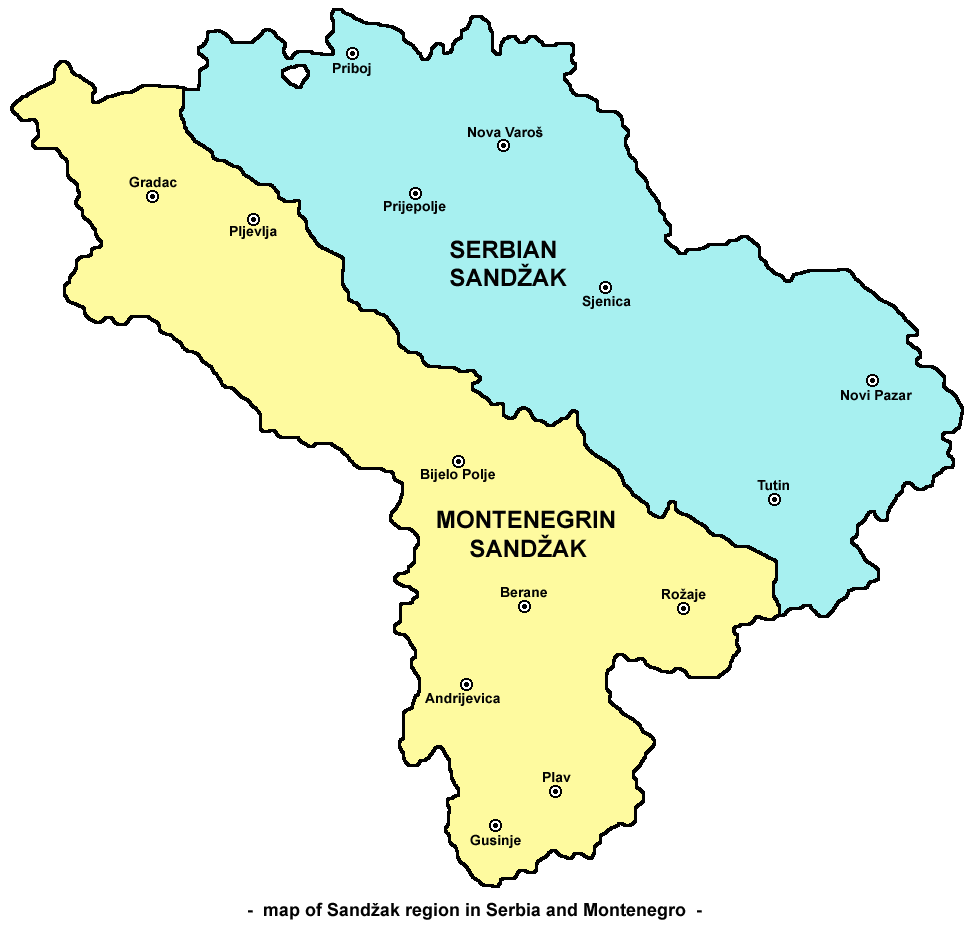
Sandžak (Serbian: Санџак; Bosnian: Sandžak) is a historical[1][2][3] and geo-political region in the Balkans, located in the southwestern part of Serbia and the eastern part of Montenegro.[4] The Bosnian/Serbian term Sandžak derives from the Sanjak of Novi Pazar, a former Ottoman administrative district founded in 1865. Sandžak is inhabited by a plurality of ethnic Bosniaks.[5]

Key Information

Various empires and kingdoms have ruled over the region. In the 12th century, Sandžak was part of the region of Raška under the medieval Serbian Kingdom. During the Ottoman territorial expansion into the western Balkans in a series of wars, the region became an important administrative district, with Novi Pazar as its administrative center.[6] Sandžak was under Austro-Hungarian occupation between 1878 and 1909 as a garrison, until an agreement between Austria-Hungary and the Ottoman Empire resulted in the withdrawal of Austro-Hungarian troops from Sandžak in exchange for full control over Bosnia.[7][8] In 1912, it was divided between the Kingdom of Montenegro and the Kingdom of Serbia.

Novi Pazar serves as Sandžak's economic and cultural center and is the region's most populous city. Sandžak has a diverse and complex ethnic and religious composition, with significant Eastern Orthodox, Roman Catholic, and Sunni Muslim populations. Bosniaks comprise ethnic majority in this region.[citation needed]

Etymology

[edit]

The Serbo-Croatian term Sandžak (Serbian Cyrillic: Санџак) is the transcription of Ottoman Turkish sancak (sanjak, "province");[9] the Sanjak of Novi Pazar, known in Serbo-Croatian as Novopazarski sandžak. Historically, it is known as Raška by the Serbs. The region is known as Sanxhak in Albanian.[10]

Geography

[edit]

Sandžak stretches from the southeastern border of Bosnia and Herzegovina[11] to the borders with Kosovo[12][13][14] and Albania[14] at an area of around 8,500 square kilometers. Six municipalities of Sandžak are in Serbia (Novi Pazar, Sjenica, Tutin, Prijepolje, Nova Varoš, and Priboj[15]), and seven in Montenegro (Pljevlja, Bijelo Polje, Berane, Petnjica, Rožaje, Gusinje, and Plav).[16] Sometimes the Montenegrin municipality of Andrijevica is also regarded as part of Sandžak.

The most populated municipality in the region is Novi Pazar (100,410),[17] while other large municipalities are: Pljevlja (31,060),[18] and Priboj (27,133).[17] In Serbia, the municipalities of Novi Pazar and Tutin are part of the Raška District,[19] while the municipalities of Sjenica, Prijepolje, Nova Varoš, and Priboj, are part of the Zlatibor District.[19]

History

[edit]

Ottoman rule

[edit]

The Serbian Despotate was invaded by the Ottoman Empire in 1455. Apart from the effect of a lengthy period under Ottoman domination, many of the subject populations were periodically and forcefully converted to Islam[20][21] as a result of a deliberate move by the Ottoman Turks as part of a policy of ensuring the loyalty of the population against a potential Venetian invasion. However, Islam was spread by force in the areas under the control of the Ottoman sultan through the devşirme system of child levy enslavement,[20][22] by which indigenous European Christian boys from the Balkans (predominantly Albanians, Bulgarians, Croats, Greeks, Romanians, Serbs, and Ukrainians) were taken, levied, subjected to forced circumcision and forced conversion to Islam, and incorporated into the Ottoman army,[20][22] and jizya taxes.[20][21][23]

The Islamization of Sandžak was otherwise caused by a number of factors, mainly economic, as Muslims didn't pay the devşirme tributes and jizya taxes.[24] The Muslims were also privileged compared to Christians, who were unable to work in the administration or testify in court against Muslims, as they were treated as dhimmi.[25] The second factor that contributed to the Islamization were migrations; a large demographic shift occurred after the Great Turkish War (1683–1699). Part of the Slavic-speaking Orthodox Christian population was expelled northwards, while other Christians and Muslims were driven to the Ottoman territory.[26] The land abandoned by the Eastern Orthodox Serbs was settled by populations from neighbouring areas who either were or became Muslim in Sandžak. Large migrations occurred throughout the 18th and 19th centuries.[26] The third factor of Islamization was the geographical location of Sandžak, which allowed it to become a trade centre, facilitating conversions amongst merchants.[26] The tribal migrations to Sandžak had contributed a large role to its history and identity along with culture.[27][28]

Sanjak of Novi Pazar, 1878

The second half of the 19th century was very important in terms of shaping the current ethnic and political situation in Sandžak.[29] Austria-Hungary supported Sandžak's separation from the Ottoman Empire, or at least its autonomy within it.[29] The reason was to prevent the kingdoms of Montenegro and Serbia from unifying, and allow Austria-Hungary's further expansion into the Balkans. Per these plans, Sandžak was seen as part of the Condominium of Bosnia and Herzegovina, while its Muslim population played a significant role, giving Austrian-Hungarians a pretext of protecting the Muslim minority from the Eastern Orthodox Serbs.[29]

Sandžak was an administrative part of the Sanjak of Bosnia until 1790, when it become a separated Sanjak of Novi Pazar.[30] However, in 1867, it become a part of the Bosnia Vilayet that consisted of seven sanjaks, including the Sanjak of Novi Pazar.[31] This led to Sandžak Muslims identifying themselves with other Slavic Muslims in Bosnia.[32]

Albanian speakers gradually migrated or were relocated to the Ottoman provinces of Kosovo and North Macedonia, leaving a primarily Slavic-speaking population in the rest of the region (except in a southeastern corner of Sandžak that ended up as a part of Kosovo).[33]

Some members of the Albanian Shkreli and Kelmendi tribes began migrating into the lower Pešter and Sandžak regions at around 1700. The Kelmendi chief had converted to Islam, and promised to convert his people to.[34] A total of 251 Kelmendi households (1,987 people) were resettled in the Pešter area on that occasion, however five years later part the exiled Kelmendi managed to fight their way back to their homeland, and in 1711 they sent out a large raiding force to bring back some other from Pešter too.[34] The remaining Kelmendi and Shkreli converted to Islam and became Slavophones by the 20th century, and as of today they now self-identify as part of the Bosniak ethnicity, although in the Pešter plateau they partly utilized the Albanian language until the middle of the 20th century, particuarily in the villages of Ugao, Boroštica, Doliće, and Gradac.[35] Since the 18th century, many people originating from the Hoti tribe have migrated to and live in Sandžak, mainly in the Tutin area, but also in Sjenica.[36]

Ethnographic map of the Balkans, 1880

Balkan Wars and the World War I

[edit]

In October 1912, during the First Balkan War, Serbian and Montenegrin troops seized Sandžak, which was then divided between the two countries.[citation needed] This led to the displacement of many Slavic Muslims and Albanians, who migrated to Ottoman Turkey as muhajir.[citation needed]

After the war, Sandžak became a part of the newly formed State of Slovenes, Croats and Serbs.[29] The region acted as a bridge between the Muslims in the West in Bosnia and Herzegovina and those in the East in Kosovo and North Macedonia. However, the Slavic Muslims of Sandžak suffered economic decline due to the defeat and collapse of the Ottoman Empire, which had been their primary source of economic stability.[37] Additionally, the agrarian reform implemented in the Kingdom of Yugoslavia worsened their economic situation, leading to the emigration of Muslims from Sandžak to the Ottoman Empire.[37]

During World War I, Sandžak was occupied by Austria-Hungary. In 1919, an Albanian revolt, which later came to be known as the Plav rebellion rose up in the Rožaje, Gusinje, and Plav districts, fighting against the inclusion of Sandžak in the Kingdom of Serbs, Croats and Slovenes.[38][39][40] As a result, during the Serbian army's second occupation of Rožaje, which took place in 1918-1919, seven hundred Albanian citizens were slaughtered in Rožaje.[citation needed] In 1919, Serb forces attacked Albanian populations in Plav and Gusinje, which had appealed to the British government for protection.[citation needed] About 450 local civilians were killed after the uprising was quelled.[41] These events resulted in a large influx of Albanians migrating to the Principality of Albania.[42][43]

World War II

[edit]
Protectorate of Albania, 1941

In World War II, Sandžak was the battleground of several factions. In 1941, the region was partitioned between the Italian governorate of Montenegro, the Italian protectorate over the Kingdom of Albania, and the Territory of the Military Commander in Serbia.[44] The Muslim population was in general anti-partisan.[45] They were organized in small formations known in historiography as the Sandžak Muslim militia. These formations depending on their location and regional politics were affiliated to Albanian nationalist groups linked to Balli Kombëtar in central and south Sandžak or to Muslim Ustaše groups in the north. Many Orthodox Serbs organized in the Serbian nationalist Chetniks. The stance of these factions towards the Nazi forces ranged from armed resistance to open collaboration. Smaller groups of both Orthodox Serbs and Muslims organized after 1943 in the Yugoslav Partisan Anti-Fascist Council of the People's Liberation of Sandžak. Each faction sought the inclusion of Sandžak in the post-war period into separate states. Albanian militia fought for inclusion in Greater Albania, while Ustaše formations wanted at least part of Sandžak to join the Independent State of Croatia. Amonge these factions, the Yugoslavs, Slavic Muslims, Serbs, and Montenegrins adopted different strategies. Muslims wanted either unification with Bosnia under a federal Yugoslavia or the establishment of an autonomous Sandžak region. Serbs and Montenegrins wanted the area to either pass entirely to Serbia or Montenegro.[46]

The formal partition of Sandžak between Italian and German spheres of influence was largely ignored as local politics shaped control over the area. Prijepolje which formally was within the Italian area of rule in Montenegro was in fact under the NDH-affiliated Sulejman Pačariz, while Novi Pazar in the German sphere was led by the Albanian nationalist Aqif Bluta. Clashes between Albanians and Serbs in south Sandžak began in April 1941. In other cities of Sandžak similar battles between different factions played out. Otto von Erdmannsdorf, the special envoy of Germany to Sandžak mentioned in his correspondence that up to 100,000 Albanians from Sandžak wanted to be moved from Serbia under the jurisdiction of Albania.[47] The Italian and German forces considered to enact population exchange from Sandžak to Kosovo to stop interethnic violence between Serbs and Albanians. Peter Pfeiffer, diplomat of the Foreign Office of Germany warned that relocation plans would cause a great rift between the German army and Albanians and they were abandoned. In November 1941 as clashes continued Albanians defeated the Chetniks in the battle of Novi Pazar. The battle was followed by reprisals against the Serbs of Novi Pazar. In 1943, Chetnik forces based in Montenegro conducted a series of ethnic cleansing operations against Muslims in the Bihor region of modern-day Serbia. In May 1943, an estimated 5400 Albanian men, women and children in Bihor were massacred by Chetnik forces under Pavle Đurišić.[48] In a reaction, the notables of the region then published a memorandum and declared themselves to be Albanians. The memorandum was sent to Prime Minister Ekrem Libohova whom they asked to intervene so the region could be united to the Albanian kingdom.[49] It has been estimated that 9,000 Muslims were killed in total by the Chetniks and affiliated groups during the war in Sandžak.[50] The Jewish community of Novi Pazar was initially not harassed because the city didn't have any considerable concentration of German forces, but on March 2, 1942 the city's Jews were rounded up by the German army and killed in extermination camps (the men in Bubanj and the women and children in Sajmište).[51][52]

1943 year saw the creation of the SS-Police "Self-Defence" Regiment Sandžak, being formed by joining three battalions of Albanian collaborationist troops with one battalion of the Sandžak Muslim militia.[53][54] At one point around 2,000 members of the SS regiment operated in Sjenica.[55] Its leader was Sulejman Pačariz,[56] an Islamic cleric of Albanian origin.[57]

Area under jurisdiction of the National Anti-Fascist Council of the People's Liberation of Sandžak (ZAVNOS), 1945

The Anti-Fascist Council of People's Liberation of Sandžak (AVNOS) had been founded on 20 November 1943 in Pljevlja.[58] In January 1944, the Land Assembly of Montenegro and the Bay of Kotor claimed Sandžak as part of a future Montenegrin federal unit. However, in March, the Communist Party opposed this, insisting that Sandžak's representatives at AVNOJ should decide on the matter.[59] In February 1945, the Presidency of the AVNOJ made a decision to oppose the Sandžak's autonomy. The AVNOJ explained that the Sandžak did not have a national basis for an autonomy and opposed crumbling of the Serbian and Montenegrin totality.[60] On 29 March 1945 in Novi Pazar, the AVNOS accepted the decision of the AVNOJ and divided itself between Serbia and Montenegro.[61] Sandžak was divided based on the 1912 demarcation line.[60]

Yugoslavia

[edit]

Economically, Sandžak remained undeveloped. It had a small amount of crude and low-revenue industry. Freight was transported by trucks over poor roads. Schools for business students, which remained poor in general education, were opened for working-class youth. The Sandžak had no faculty, not even a department or any school of higher education.[37]

Sandžak saw a process of industrialisation, during which factories were opened in several cities, including Novi Pazar, Prijepolje, Priboj, Ivangrad, while the coal mines were opened in the Prijepolje area. The urbanisation caused a major social and economic shift. Many people left villages for towns. The national composition of the urban centres was changed to the disadvantage of the Muslims, as most of those who inhabited the cities were Serbs. The Muslims continued to lose their economic status, continuing the trend inherited from the time of the collapse of the Ottoman Empire and the agrarian reform in the Kingdom of Yugoslavia.[37] The emigration of the Muslims to Turkey also continued, caused by the general underdevelopment of the region, disagreement with the communist authorities and the mistrust with the Serbs and Montenegrins, but also due to the nationalisation and expropriation of property. Serbs from Sandžak also moved to the wealthier regions of the central Serbia or to Belgrade or Vojvodina, while the Muslims moved to Bosnia and Herzegovina as well.[62]

1991 Referendum on autonomy

[edit]

Between 25 and 27 October 1991, a referendum on Sandžak's autonomy was held, organized by the Muslim National Council of Sandžak (MNVS) which consisted of the Muslim Party of Democratic Action (SDA) and other Bosnian Muslim organizations and parties.[63] It was declared illegal by Serbia. According to the SDA, 70.2% of the population participated in the referendum with 98.92% voting in favor of autonomy.[64]

Contemporary period

[edit]

With the democratic changes in Serbia in 2000, the ethnic Bosniaks were enabled to start participating in the political life in Serbia and Montenegro, including Rasim Ljajić, an ethnic Bosniak, who was a minister in the verious governments of Serbia, and Rifat Rastoder, who was the Deputy President of the Parliament of Montenegro. Census data shows a general emigration of all ethnicities from this underdeveloped region.[citation needed]

Demographics

[edit]
Ethnic map of Sandžak (including Plav and Andrijevica) according to the 2002 census in Serbia and 2003 census in Montenegro. Note: map shows the ethnic majority populations within the municipalities
Ethnic map of Sandžak (excluding Plav and Andrijevica) according to the 2002 census in Serbia and 2003 census in Montenegro. Note: map shows the ethnic majority populations within the settlements

The population of the sanjak of Novi Pazar was ethnically and religiously diverse. In 1878-81, Muslim Slav muhacirs (refugees) from areas which became part of Montenegro, settled in the sanjak. As Ottoman institutions only registered religious affiliation, official Ottoman statistics about ethnicity do not exist. Austrian, Bulgarian and Serbian consulates in the area produced their own ethnographic estimations about the sanjak. In general, three main groups lived in the region: Orthodox Serbs, Muslim and Catholic Albanians and Muslim Slavs (noted in contemporary sources as Bosniaks). Small communities of Romani, Turks and Jews lived mainly in towns. The Bulgarian foreign ministry compiled a report in 1901-02. The five kazas (districts) of the sanjak of the Novi Pazar at that time were: Akova, Sjenica, Kolašin, Novi Pazar, and Nova Varoš. According to the Bulgarian report, in the kaza of Akova there were 47 Albanian villages which had 1,266 households. Serbs lived in 11 villages which had 216 households.[65] The town of Akova (Bijelo Polje) had 100 Albanian and Serb households. There were also mixed villages - inhabited by both Serbs and Albanians - which had 115 households with 575 inhabitants. The kaza of Sjenica was inhabited mainly by Orthodox Serbs (69 villages with 624 households) and Bosnian Muslims (46 villages with 655 households). Seventeen villages had a population of both Orthodox Serbs and Bosnian Muslims. Albanians (505 households) lived exclusively in the town of Sjenica. The kaza of Novi Pazar had 1,749 households in 244 Serb villages and 896 households in 81 Albanian villages. Nine villages inhabited by both Serbs and Albanians had 173 households. The town of Novi Pazar had a total of 1,749 Serb and Albanian households with 8,745 inhabitants.[66] The kaza of Kolašin had 27 Albanian villages with 732 households and 5 Serb villages with 75 households. The administrative centre of the kaza, Šahovići, had 25 Albanian households. The kaza of Novi Varoš, according the Bulgarian report, had 19 Serbian villages with 298 households and "one Bosnian village with 200 houses".[67] Novi Varoš had 725 Serb and some Albanian households.[68]

The last official registration of the population of the sanjak of Novi Pazar before the Balkan Wars was conducted in 1910. The 1910 Ottoman census recorded 52,833 Muslims and 27,814 Orthodox Serbs. About 65% of the population were Muslims and 35% Serbian Orthodox. The majority of the Muslim population were Albanians.[69]

The last Yugoslav pre-war census of 1931 counted in Bijelo Polje, Prijepolje, Nova Varoš, Pljevlja, Priboj, Sjenica and Štavica a total population of 204,068. They were mostly counted as Orthodox Serbs or Montenegrins (56.5%) and Bosnian Muslims (43.1%).[46]

Most Bosniaks declared themselves ethnic Muslims in 1991 census. By the 2002-2003 census, however, most of them declared themselves Bosniaks. There is still a significant minority that identify as Muslims (by ethnicity). There are still some Albanian villages (Boroštica, Doliće and Ugao) in the Pešter region.[70] There were a larger presence of Albanians in Sandžak in the past, however due to various factors such as migration, assimilation, along with mixing, many identify as Bosniaks instead.[27][71][72] Catholic Albanian groups which settled in Tutin and Pešter in the early 18th century were converted to Islam in that period. Their descendants make up the large majority of the population of Tutin and the Pešter plateau.[73]

The Slavic dialect of Gusinje and Plav (sometimes considered part of Sandžak) shows very high structural influence from Albanian. Its uniqueness in terms of language contact between Albanian and Slavic is explained by the fact that most Slavic-speakers in today's Plav and Gusinje are of Albanian origin.[74]

Ethnic structure

[edit]

The total population of the municipalities of Sandžak in Serbia and Montenegro is around 361,656. A majority of people in Sandžak identify as Bosniaks. They form 54.8% (198,100) of the region's population. Serbs form 30% (112,217), Montenegrins 5% (18,346), ethnic Muslims 3.4% (12,234), and Albanians 1% (3,722). About 17,037 (4.7%) people belong to smaller communities or have chosen to not declare an ethnic identity.

Municipality Ethnicity (2022 Serbian census and 2023 Montenegrin census) Total
Bosniaks % Serbs % Montenegrins % Muslims % Albanians % others %
Novi Pazar (Serbia) 85,204 79.8 14,142 13.2 34 0.03 1,851 1.7 200 0.2 5,289 4.9 106,720
Bijelo Polje (Montenegro) 12,315 31.8 16,675 43.1 5,751 14.9 2,916 7.5 55 0.1 950 2.4 38,662
Tutin (Serbia) 30,413 92 704 2.1 1 0 340 1 16 0.05 1,579 4.8 33,053
Prijepolje (Serbia) 12,842 39.8 14,961 46.4 37 0.1 1,945 6 10 0.03 2,419 7.5 32,214
Berane (Montenegro) 1,103 4.5 14,742 59.8 6,548 26.5 532 2.1 28 0.1 1,692 6.8 24,645
Pljevlja (Montenegro) 1,765 7.3 16,027 66.4 4,378 18.1 797 3.3 0 0 1,167 4.8 24,134
Sjenica (Serbia) 17,665 73.3 3,861 16 3 0.01 1,069 4.4 26 0.1 1,459 6 24,083
Priboj (Serbia) 4,144 17.6 16,909 71.9 47 0.2 914 3.9 2 0.01 1,498 6.3 23,514
Rožaje (Montenegro) 19,627 84.6 593 2.5 868 3.7 738 3.2 1,176 5 182 0.8 23,184
Nova Varoš (Serbia) 673 5 11,901 88.1 9 0.07 308 2.3 4 0.03 612 4.5 13,507
Plav (Montenegro) 5,940 65.6 1,546 17.1 372 4.1 236 2.6 853 9.4 103 1.1 9,050
Petnjica (Montenegro) 4,162 83.9 47 0.9 237 4.8 461 9.3 0 0.00 50 1 4,957
Gusinje (Montenegro) 2,247 57.1 109 2.7 61 1.5 127 3.2 1,352 34.4 37 0.9 3,933
Sandžak 198,100 54.8 112,217 30 18,346 5 12,234 3.4 3,722 1 17,037 4.7 361,656

Religious structure

[edit]

Religion in Sandžak is also as diverse as the ethnic composition, most of the Bosniaks being Muslim while a majority of the Serbs being Orthodox Christian. However, because of the prolonged Ottoman rule, Sandžak is more Muslim orientated.

Municipality Religion (2022 Serbian census[75] and 2023 Montenegrin census[76]) Total
Muslims % Orthodox % others %
Novi Pazar (Serbia) 88,493 82.9 13,690 12.8 4,537 4.2 106,720
Bijelo Polje (Montenegro) 17,202 44.4 20,956 54.2 504 1.3 38,662
Tutin (Serbia) 30,909 93.5 646 1.9 1,498 4.5 33,053
Prijepolje (Serbia) 15,066 46.7 14,941 46.4 2,207 6.8 32,214
Berane (Montenegro) 3,698 15 20,384 82.7 563 2.3 24,645
Pljevlja (Montenegro) 4,092 16.9 19,330 80.1 712 2.9 24,134
Sjenica (Serbia) 18,860 78.3 3,808 15.8 1,415 5.9 24,083
Priboj (Serbia) 5,119 21.7 16,687 70.9 1,708 7.2 23,514
Rožaje (Montenegro) 22,378 96.5 715 3.1 91 0.4 23,184
Nova Varoš (Serbia) 1,069 7.91 11,742 86.9 696 5.1 13,507
Plav (Montenegro) 7,164 79.1 1,800 19.9 86 0.9 9,050
Petnjica (Montenegro) 4,881 98.4 65 1.3 11 0.2 4,957
Gusinje (Montenegro) 3,640 92.5 122 3.1 171 4.3 3,933
Sandžak 222,571 61.5 124,886 34.5 14,199 3.9 361,656
[edit]

See also

[edit]

References

[edit]

Bibliography

[edit]
[edit]
Revisions and contributorsEdit on WikipediaRead on Wikipedia
from Grokipedia
Sandžak is a historical geo-political region in the western , encompassing territory in southwestern and eastern between and . The term derives from the sancak, denoting an administrative district governed by a military flag-bearer, specifically referencing the established in the . Predominantly inhabited by —a South Slavic ethnic group adhering mostly to —the region also includes Serb and Montenegrin communities, forming a multiethnic mosaic shaped by centuries of Ottoman rule and subsequent partitions. Historically, the functioned as an Ottoman buffer zone to separate expanding and , maintaining a delicate balance until its division between the two states after the in 1912–1913. This arrangement persisted through the interwar and into the socialist era, where ethnic —later recognized as —faced assimilation pressures amid broader Yugoslav policies favoring federal unity over regional identities. Post-1990s Yugoslav dissolution, Sandžak lacks formal autonomy despite Bosniak-majority municipalities like , where over 80 percent identify as Bosniak-Muslim, leading to ongoing advocacy for enhanced and amid Serbia's centralized . The region's defining features include medieval Serbian Orthodox heritage sites, such as UNESCO-listed monasteries from the Rascia state, juxtaposed with Ottoman-era mosques, underscoring its role as a cultural crossroads with persistent ethnic dynamics.

Etymology

Name Origins and Historical Usage

The term Sandžak derives from the word sancak, literally meaning "" or "," which designated a mid-level administrative and in the , governed by a sancakbeyi () who bore the sultan's standard as a symbol of authority. This usage reflected the empire's provincial structure, where sanjaks formed subdivisions under larger eyalets or vilayets, often centered on key fortresses or towns for strategic control. The modern region of Sandžak adopted the name from the Ottoman , an administrative unit established in 1865 during the reforms to consolidate control over the highlands between the and the . Named after its administrative center, (Turkish: Yeni Pazar, "New Bazaar"), the sanjak encompassed territories previously part of the and the , serving as a deliberate to inhibit territorial unification between the two emerging Balkan states. It was reorganized in 1880, when it was detached from the Bosnia Vilayet and attached to the , and again in 1902, reflecting ongoing Ottoman efforts to manage ethnic and administrative complexities in the area. Following the Ottoman defeat in the First Balkan War of 1912, the Sanjak of Novi Pazar was partitioned: its northern parts, including Novi Pazar, were annexed by the Kingdom of Serbia on December 6, 1912, while southern areas fell to the Kingdom of Montenegro by May 1913, effectively dissolving the Ottoman administrative entity. Despite this division, the name Sandžak endured in ethnic Bosniak (Muslim) and local discourse to describe the transborder cultural and geographic continuity, distinct from official Serbian (Raška) or Montenegrin designations, which emphasize medieval Serbian heritage over Ottoman nomenclature. This historical layering underscores the name's evolution from an imperial administrative label to a marker of regional identity amid post-Ottoman state fragmentation.

Geography

Location and Administrative Divisions

Sandžak is a historical and geographical region in southeastern , straddling the border between southwestern and eastern . It lies within the , bordered by to the west, to the south, and further southwest, with approximate central coordinates around 43°N and 20°E . The region covers an estimated area of about 8,500 square kilometers, though exact boundaries vary by definition as Sandžak lacks formal administrative status in either country. In Serbia, Sandžak corresponds primarily to the Raška District (Raški okrug) and parts of the Zlatibor District, encompassing six municipalities: Novi Pazar, Sjenica, Tutin, Prijepolje, Priboj, and Nova Varoš. These municipalities, with a combined area of approximately 8,687 square kilometers in the broader Serbian Sandžak zone, are administered under Serbia's provincial structure within the autonomous province of Vojvodina's oversight framework, though geographically distant. Novi Pazar serves as the unofficial regional center due to its population and cultural significance. In Montenegro, Sandžak includes six to seven municipalities, typically Pljevlja, , , Plav, , and , with occasional inclusion of partial areas from or Andrijevica depending on ethnic and historical delineations. These fall under Montenegro's northern administrative regions without a unified Sandžak , reflecting the post-Yugoslav decentralization. The division stems from the 1913 and subsequent state formations, resulting in no cross-border administrative entity today.

Topography and Climate

The Sandžak region consists primarily of mountainous terrain and high plateaus within the , featuring landscapes, rolling hills, streams, and meadows. It includes the Pešter Plateau, a significant highland area with elevations ranging from 1,150 to 1,492 meters, and forms a geographic cul-de-sac against the Pešter massif in its Serbian portion. The Serbian part spans approximately 8,687 km² with an average elevation of 755 meters, incorporating valleys such as the Ibar and Lim that traverse the highlands and facilitate connectivity. The climate is classified as mountainous continental, dominated by long, dense winters with heavy snowfall and shorter, cooler summers, particularly at higher elevations. Exceptions occur in valleys like the Ibar and Vidrenjak, where summers are milder. In , the region's central city, winters are very cold with average temperatures around -2°C to 3°C and significant snow, while summers are warm, peaking at about 22°C in ; annual averages 700-900 mm, distributed throughout the year with peaks in spring and autumn.

History

Medieval and Pre-Ottoman Foundations

The region of Raška, encompassing the area now known as Sandžak, formed the nucleus of the early medieval Serbian state following Slavic migrations into the Balkans during the 6th and 7th centuries CE, where Serb tribes established settlements amid Roman and Byzantine ruins. By the 9th century, Ras—located near modern Novi Pazar—emerged as a central fortified settlement and administrative hub, referenced in Byzantine chronicles like De Administrando Imperio as the borderland core of Serbian principalities under rulers such as Vlastimir (r. c. 830–851), marking the transition from tribal entities to organized polities under nominal Byzantine suzerainty. Stability and consolidation arrived with the , particularly under (r. 1166–1196), who unified fragmented Serbian lands around Raška, defeated Byzantine forces at Pantino in 1163, and laid the foundations for state expansion through military campaigns and alliances, establishing the that endured until 1371. Nemanja's rule centered power in Ras, which served as the political capital, evidenced by early fortifications and the Church of the Holy Apostles Peter and Paul (dated to the 8th–9th centuries, with later reconstructions), symbolizing the adoption of Orthodox Christianity as a unifying force. Under Nemanja's successors, Raška evolved into a kingdom with Stefan Nemanja's son, , receiving royal coronation in 1217 from Archbishop Sava, formalizing ecclesiastical independence via the autocephalous . This period saw cultural efflorescence, including the construction of monasteries like Đurđevi Stupovi (founded 1170–1171 by Nemanja) and Sopoćani (built 1260 by Uroš I), which blended Romanesque and Byzantine architectural styles and housed significant frescoes, such as the at Mileševa (c. 1235), underscoring Raška's role as a crossroads of Western and Eastern Christian influences. The Serbian state peaked as an empire under (r. 1331–1355), who proclaimed himself in 1346 and expanded into Byzantine territories, but Raška retained its foundational status until Ottoman incursions in the mid-14th century eroded central authority, culminating in the in 1389 and the fall of regional strongholds by 1459. These pre-Ottoman developments entrenched Orthodox Christian institutions and Serbian in the region, shaping its demographic and cultural baseline prior to later transformations.

Ottoman Administration (15th–19th Centuries)

The Ottoman conquest of the Sandžak region, historically known as Raška, occurred progressively during the mid-15th century, with Isa-beg Ishaković, a prominent Ottoman commander and governor, establishing key settlements including around 1459 as a strategic administrative and commercial center. Initially integrated into the broader Bosnian administrative framework, the area formed part of the , where Ottoman defters recorded local populations and distributions to consolidate control through land grants to sipahis. This structure facilitated tax collection via the system, emphasizing military obligations and agrarian output, while fostering early Islamic institutions such as mosques and waqfs endowed by figures like Isa-beg. Demographic shifts marked Ottoman rule from the 15th to 17th centuries, characterized by gradual Islamization through voluntary conversions, incentives for Muslim settlers from , and emigration or flight of segments of the Christian population amid levies and economic pressures. By the , Ottoman registers indicated a mixed but increasingly Muslim-majority composition in urban centers like , supported by the construction of religious and defensive infrastructure that reinforced Ottoman cultural dominance. Rural areas retained more Christian communities under haraç taxation, though periodic rebellions, such as local uprisings against heavy impositions, underscored tensions in governance. In the , reforms prompted administrative reorganization, culminating in the formal creation of the in as a distinct unit under the to buffer emerging Serbian and Montenegrin ambitions. These changes introduced centralized bureaucracy, , and legal equality edicts, yet faced resistance from local Muslim elites and Albanian tribes, exacerbating unrest during events like the 1809 insurgent incursions that briefly disrupted control before Ottoman reconquest. By the late , amid the , the region's strategic role intensified, with uprisings and reforms highlighting the fraying imperial cohesion while preserving Ottoman sovereignty until the early 20th century.

Balkan Wars and Division (1912–1913)

The First Balkan War commenced on October 8, 1912, when Montenegro declared war on the Ottoman Empire and its forces promptly invaded the Sanjak of Novi Pazar from the northwest, targeting areas such as Pljevlja and Bijelo Polje. Concurrently, Serbia, allied within the Balkan League, deployed its Third Army eastward from Niš, advancing through Kosovo and into the Sanjak, where it captured Novi Pazar and surrounding eastern districts by late November 1912 amid the collapse of Ottoman defenses. Ottoman troops, outnumbered and demoralized following defeats elsewhere, offered sporadic resistance but largely withdrew by December 1912, leaving the under de facto Serbian and Montenegrin occupation. This rapid conquest displaced residual Ottoman administration and exposed tensions between the allied occupiers, as both sought to consolidate control over the resource-rich, ethnically diverse territory predominantly inhabited by Muslim and . To avert clashes between their armies during the armistice period, negotiated a bilateral partition formalized on August 10, 1913, coinciding with the Treaty of Bucharest that resolved broader Balkan territorial disputes after the Second Balkan War. Under this arrangement, incorporated the eastern —encompassing , , and —while gained the western portion, including , Prijepolje's outskirts, and , establishing a that largely persists today. This division disregarded prior great power efforts, such as those post-Congress of in 1878, to maintain the as a demilitarized buffer separating the two Slavic kingdoms, thereby facilitating direct Serbian access to Montenegrin territories and exacerbating Austro-Hungarian concerns over regional stability.

Interwar Period and World War I Aftermath

Following the and the unification of into the Kingdom of Serbs, Croats, and Slovenes on 1 December 1918, the Sandžak region—previously divided between Serbia and Montenegro after the of 1912–1913—was formally incorporated into the new state without altering its administrative split: the northern portion (including ) fell under Serbian control within the Užice District, while the southern part (including and ) remained under Montenegrin administration as part of the Zeta region. This division reflected ongoing tensions from pre-war occupations, exacerbated by post-war violence in southern territories, where Serbian and Montenegrin forces suppressed perceived disloyalty among Muslim populations amid the broader turmoil of and land disputes. The interwar era (1918–1941) saw centralized governance from impose policies that systematically disadvantaged the Muslim majority in Sandžak, including land expropriations under agrarian reforms favoring Orthodox Serbs, restrictions on , and administrative neglect that stifled . intensified Serbian nationalism's resurgence, leading to incidents such as the 1924 Sahovići massacre, where several hundred Montenegrin were killed by local forces amid reprisals for alleged resistance. In response, formed political bodies like the Yugoslav Muslim Organization (JMO) on 17 January 1919, led by figures such as Mehmed Spaho, to advocate for and cultural autonomy within the kingdom's multi-ethnic framework, though these efforts yielded limited concessions amid the 1921 Constitution's unitary structure. Repression prompted mass emigration, with approximately 70,000 Muslims fleeing Sandžak for Turkey, Albania, and Western Europe between 1918 and 1941 due to economic hardship, violence, and policies encouraging "colonization" by Serb settlers. The 1921 census recorded around 125,000 Muslims in the region (comprising about 40% of the population in Serbian-held areas), but subsequent undercounting and assimilation pressures eroded communal cohesion. By the late 1930s, under Prime Minister Milan Stojadinović's regime, sporadic border clashes and small-scale expulsions further highlighted the kingdom's failure to integrate Sandžak's Muslims, setting the stage for wartime fractures.

World War II Occupations and Partisan Resistance

Following the Axis on April 6, 1941, Sandžak was partitioned between occupation in the northern areas, administered as part of the Territory of the Military Commander in , and Italian occupation in the southern portions, incorporated into the Governorate of and the expanded Albanian puppet state. The demarcation line between these zones fluctuated during 1941 before stabilizing, placing key towns like near the border and fostering cross-border movements by resistance groups. prompted to occupy the former Italian territories, incorporating them into operational zones while relying on local collaborators. In response to occupation, royalist Chetnik forces under Dragoljub Mihailović organized in the Lim-Sandžak area from May 1941, initially cooperating with communist-led Partisans in a joint uprising against Italian forces starting July 13, 1941, which liberated towns such as Bijelo Polje. This alliance fractured by late 1941 amid ideological clashes, with Chetniks increasingly collaborating with Italians and later Germans to combat Partisans, whom they viewed as greater threats to Serbian interests than the Axis powers. Partisans, directed by the Communist Party of Yugoslavia, established operational committees in Sandžak towns including Novi Pazar and Pljevlja under leaders like Rifat Burdžović, focusing on guerrilla warfare and recruitment across ethnic lines despite initial setbacks like the collapse of the Užice Republic in November 1941. To counter the uprising and shield Muslim communities from Chetnik reprisals, Italian authorities armed local Muslim militias in Sandžak starting in mid-1941, forming units that numbered around 2,000 regulars by and targeted both Partisans and Serb civilians in ethnic violence. These forces, later partially integrated into German command after , participated in battles such as the defense of against Partisan assault on December 22, 1941, where communist detachments sought to secure supply routes following their withdrawal from western Serbia. German efforts to bolster collaboration included recruiting Sandžak Muslims into divisions like Handschar in and in 1944, though desertions plagued these units, with over 1,000 from fleeing in September 1944. Intergroup conflicts intensified ethnic tensions, with conducting massacres against , militias retaliating against Serbs, and Partisans executing reprisals against collaborators, resulting in widespread village burnings and population displacements across the region. By 1944, Partisans dominated through superior organization and Allied support, defeating Axis and collaborator forces in operations like the failed German Operation Draufgänger in July 1944 near , where over 400 German troops deserted to join them. Full liberation occurred by April 1945 as Partisan advances cleared remaining pockets of resistance, paving the way for communist consolidation in Sandžak.

Socialist Yugoslavia (1945–1991)

Following the establishment of the in 1945, the Sandžak region was incorporated into the federal structure without any distinct administrative autonomy, remaining divided between the and the . The pre-war district in the Serbian portion was abolished in 1947, with its territories reorganized into two oblasti administered from and , effectively dissolving any regional cohesion. This division reflected the central communist policy of suppressing ethnic particularism in favor of "," prioritizing federal integration over historical or geographic unity. The Muslim population of Sandžak, which had included collaborators with Axis forces during , initially encountered suspicion and purges but was gradually integrated into the socialist system through land reforms, collectivization, and participation in the League of Communists of . A pivotal development occurred in 1968 when Yugoslav authorities constitutionally recognized as a distinct , equivalent to other South Slavic groups like Serbs and Croats, allowing for cultural and educational expression in the Serbian and Ijekavian dialects. This recognition followed earlier allowances in the 1961 census for self-identification as "Muslim" in terms of , marking a shift from prior classifications that subsumed them under Serb or Croat identities or left them undeclared. Demographic trends in Sandžak during this period showed a rising share of self-identified , particularly evident in the 1971 census where the category gained widespread adoption in the region, reflecting both natural growth and the appeal of the newly affirmed . Subsequent censuses in reinforced this, with forming majorities in several municipalities across the divided territory, though exact regional aggregates were not officially tabulated due to the lack of a unified Sandžak administrative unit. Emigration persisted, including Serbs and seeking industrial jobs in or urban centers, while experienced relative improvements in education and within republican assemblies. Economically, Sandžak benefited from broader Yugoslav investments in infrastructure and , such as and operations, which elevated living standards toward national averages, though the region remained underdeveloped compared to more industrialized areas. The 1974 constitution granted no special status to Sandžak, embedding it fully within the republics' frameworks and prohibiting organized movements under the federal emphasis on non-alignment and internal stability. By the late , following Josip Broz Tito's death in 1980, and rising republican tensions began to strain this integration, foreshadowing ethnic , but overt demands for regional remained marginal until the federal dissolution.

Wars of Yugoslav Dissolution and 1991 Autonomy Referendum

As Yugoslavia began to disintegrate in 1991 amid rising nationalist tensions, the Bosniak population in Sandžak, fearing marginalization within the newly assertive Serbian-dominated rump Yugoslavia, pursued greater regional autonomy to preserve their ethnic and cultural identity. The Party of Democratic Action (SDA) and the Muslim National Council of Sandžak (MNVS) organized a referendum on autonomy, held from 25 to 27 October 1991, in which voters were asked if they supported Sandžak's status as an autonomous region within Yugoslavia with rights to self-governance, cultural preservation, and economic development. Approximately 185,000 residents participated, representing about 70 percent of the eligible population primarily consisting of Bosniaks, with 98 percent approving the autonomy proposal. The referendum excluded one of Sandžak's six municipalities due to logistical issues, and Serbian authorities dismissed it as unconstitutional and unrecognized, viewing it as a separatist move amid the federal crisis. Despite the referendum's symbolic push for autonomy, Sandžak largely escaped the large-scale armed combat that engulfed neighboring Bosnia and Herzegovina from 1992 to 1995, owing to its mixed ethnic composition, strategic position, and lack of unified separatist militias capable of sustaining insurgency. However, the outbreak of the Bosnian War intensified ethnic pressures, with Yugoslav People's Army (JNA) forces encircling key towns like Novi Pazar to exert psychological control and deter cross-border support for Bosniak fighters in Bosnia, while local Serb paramilitaries and police engaged in sporadic intimidation tactics against Bosniaks. Belgrade escalated state-sponsored violence, including arson attacks on Bosniak homes, beatings, and arrests, as part of a broader policy to suppress perceived loyalties to Bosnian Muslims and encourage emigration, resulting in hundreds of incidents documented between 1992 and 1993. These actions, while not rising to systematic ethnic cleansing on the scale seen in Bosnia, created an atmosphere of sustained fear, displacing an estimated several thousand Bosniaks and straining interethnic relations without provoking full-scale retaliation. Firebombings and military harassment persisted into the late 1990s, only abating after the 1999 NATO intervention in Kosovo shifted regional dynamics.

Post-2000 Reforms and State Dissolution Impacts

Following the on October 5, 2000, pursued democratic reforms that included normative advancements in , such as the establishment of national councils for ethnic groups and exemptions for minority parties from the 5% introduced via changes in late 2000. These measures enabled Bosniak political parties in Sandžak, including the (SDA) and List for Sandžak, to secure parliamentary seats and local influence, with holding majorities in three Serbian municipalities (, , and Tutin) by the mid-2000s. However, implementation lagged due to political patronage and insufficient funding for cultural and educational initiatives, perpetuating grievances over underdevelopment and discrimination. Demands for territorial , which had intensified during the wars, diminished after in both and , as Bosniak leaders prioritized integration into state structures over secessionist rhetoric to avoid alienating central governments amid EU accession pressures. The 2001 formation of the Bosniak National Council in Serbia formalized advocacy for cultural , focusing on language rights, , and media rather than political separation, though sporadic calls for regional persisted, as evidenced by Muamer Zukorlić's 2016 accusations of state "genocide" against and proposals. laws enacted in 2002 and expanded in 2007 devolved powers to municipalities, benefiting Sandžak's local governance in areas like budgeting and services, but stopped short of regional consolidation, leaving the area divided into the without unified Sandžak-level administration. The 2003 Constitutional Charter creating the State Union of Serbia and Montenegro briefly preserved cross-border cohesion for Sandžak, but Montenegro's independence referendum on May 21, 2006—passing with 55.5% approval and formalizing separation on June 3—permanently split the region, with Serbia retaining six municipalities (Novi Pazar, Sjenica, Tutin, Prijepolje, Nova Varoš, and Priboj) and Montenegro three (Rožaje, Pljevlja, and Bijelo Polje). Bosniaks, comprising about 15% of Montenegro's population, overwhelmingly supported independence (over 90% in Sandžak municipalities), expecting reciprocal autonomy arrangements, but post-independence Montenegrin governments under Milo Đukanović failed to deliver on pre-referendum pledges, leading to disillusionment and heightened identity politics. This division exacerbated economic fragmentation, as trade and familial ties across the new border faced customs barriers, though EU-facilitated regional cooperation mitigated some disruptions; synthetic control analyses indicate no long-term GDP impact on Serbia's Sandžak but transitory gains for Montenegro overall. In Serbia, the 2006 Constitution reinforced minority quotas (e.g., 19 reserved parliamentary seats, including for ), yet Sandžak's Bosniak population—estimated at 150,000–200,000—continued facing socioeconomic marginalization, with rates exceeding 40% in key municipalities as of and uneven access to higher education in . advocacy revived intermittently, as in 2019 proposals for a Sandžak assembly, but consistently rejected them to preserve , viewing them as incompatible with post-Yugoslav stability. In Montenegro, gained vice-presidential representation and cultural councils, but cross-border unity eroded, fostering parallel Islamic structures and mild risks amid unfulfilled integration promises. Overall, while reforms curbed overt violence, the dissolution entrenched administrative silos, sustaining low-level tensions without resolving core demands for equitable development.

Demographics

Ethnic Composition and Distribution

The Sandžak region features a bifurcated ethnic landscape, with —South Slavic Muslims—forming dense majorities in central and eastern municipalities, while Serbs predominate in western and northern areas. This distribution stems from historical settlement patterns, including Ottoman-era Islamization among local and subsequent migrations. Official censuses provide the primary empirical measure, revealing as the plurality or majority in core areas like and , alongside significant Serb populations in peripheral zones. Smaller groups include in southern enclaves, Roma scattered across settlements, and negligible numbers of Croats, Gorani, and others. In Serbia's portion of Sandžak, the 2022 census records Bosniaks totaling 153,801 nationwide, with over 90% concentrated in the region's municipalities: Novi Pazar (85,204 Bosniaks, comprising 81% of the local population), Tutin (over 95%, with a municipal population of 33,053), and Sjenica (approximately 75%). Serbs, numbering around 120,000-140,000 in these areas, hold majorities exceeding 80% in Nova Varoš and Priboj, with mixed demographics in Prijepolje (roughly 55% Serb, 40% Bosniak). These figures reflect self-declared identities, with minor Roma (1-2%) and Albanian presences. Montenegro's Sandžak municipalities host the bulk of the country's 58,956 per the 2023 census, concentrated in (over 90%, population around 15,000), Petnjica, and , where they exceed 70-80%. Plav features a tripartite split with at about 50%, at 40%, and /Serbs at 10%. Serbs and dominate (over 60% combined) and (around 50% Serbs/, 30% ). total 30,978 nationally but cluster in Plav-, comprising under 5% regionally.
MunicipalityCountryBosniaks (%)Serbs/Montenegrins (%)Albanians (%)Others (%)
8113<16
Tutin95302
Sjenica752005
Prijepolje405505
Rožaje>90<50<5
Plav5010400
2060020
This table aggregates approximate percentages from recent censuses, highlighting dominance in highland and valley cores versus Serb strongholds in broader plains. Population declines since 2011—driven by emigration and low birth rates—have intensified ethnic clustering, with showing higher fertility but net outflows to .

Religious Demographics and Sectarian Dynamics

The religious landscape of Sandžak is characterized by a near binary division between Sunni , primarily ethnic , and Eastern Orthodox Christians, mainly ethnic Serbs, with religion serving as a key marker of ethnic identity. In the Serbian portion of the region, constitute majorities in core municipalities such as (approximately 82% Muslim per 2011 census data), Tutin (over 90%), and (around 75%), while Orthodox Christians predominate in (over 90%) and form significant pluralities in mixed areas like (roughly 50% Orthodox) and (about 60%). In Montenegro's Sandžak municipalities, similar patterns hold: exceeds 85% Muslim, Plav around 60%, about 40%, and 30-40%, against Orthodox majorities elsewhere, yielding an overall regional share of roughly 50% against 45% Orthodox, with small Catholic, atheist, and other minorities. These figures derive from national censuses, though self-identification variations and migration have led to debates over accuracy, with some advocates claiming undercounts due to historical sensitivities. Muslims in Sandžak overwhelmingly follow the of , rooted in Ottoman traditions emphasizing tolerance and syncretism with local customs, under the auspices of the Islamic Community of Sandžak (Mešihat), headquartered in . This body, led by figures like until his death in 2021, administers over 200 mosques and promotes moderate interpretations, countering external radical influences. Orthodox Christians fall under the Serbian Orthodox Church's of Ras-Prizren (for and Tutin areas) and of Mileševa (for and surrounding), preserving medieval Serbian heritage sites like the Sopoćani and Đurđevi Stupovi monasteries amid a network of parishes. Sectarian dynamics reflect ethnic fault lines more than theological disputes, with historical coexistence under Ottoman millet systems giving way to 20th-century frictions exacerbated by Yugoslav dissolution. While Sandžak escaped the mass violence of neighboring Bosnia in the —despite isolated incidents like Serb attacks on Muslim villages—underlying tensions persist, fueled by nationalist , economic disparities, and autonomy demands that pit Bosniak Muslim aspirations against Serb Orthodox integrationist views. Religious leaders from both communities have actively discouraged and promoted , as recommended in post-conflict analyses, contributing to relative stability since 2000. A fringe challenge involves limited Salafi-Wahhabi infiltration, often Saudi-financed via post-war aid, manifesting in isolated beard-length enforcements or village takeovers, but these remain marginal (affecting under 1% of ) and are actively opposed by the mainstream Islamic Community as alien to Hanafi norms. Overall, causal factors like shared and sustain pragmatic tolerance, though external Balkan and migration-driven depopulation risk amplifying divides.

Population Changes and Migration Patterns

The population of Sandžak experienced significant outflows during the mid-20th century, particularly among the Muslim (predominantly Bosniak) communities, driven by economic pressures and perceived policies under socialist . Between the and early 1970s, waves of targeted , with approximately 15,000 Muslims departing from key municipalities like , , and Tutin in the alone; these movements were facilitated by bilateral agreements and reflected broader patterns of religiously marked migration from Muslim-majority regions in , totaling nearly 140,000 to nationwide during the decade. The 1991 recorded a total of around 420,000 across Sandžak's municipalities, with 278,000 in the Serbian portion and 162,000 in the Montenegrin portion, though subsequent indicated stagnation or decline amid economic . By 2002, Serbia's Sandžak municipalities showed only a marginal increase of 747 residents over 1991 levels, reflecting net losses from and low natural growth; the 2011 further documented 201,728 residents in Serbia's share, signaling accelerated depopulation. Montenegro's northern Sandžak municipalities followed similar trends, contributing to an overall regional total estimated at 361,656 by the early 2010s, with affecting all ethnic groups due to limited opportunities. The Wars of Yugoslav Dissolution in the 1990s exacerbated migration, prompting an estimated 70,000 residents—primarily Bosniaks—to flee repression, economic sanctions, and proximity to conflicts in Bosnia and Kosovo, with destinations including Germany and Scandinavia; Yugoslav forces' encirclement of Novi Pazar heightened fears, though Sandžak avoided direct combat. Concurrently, Serb populations in Bosniak-majority areas faced job losses in the public sector and social pressures, leading to departures that intensified ethnic homogenization; between 1991 and 2002, reported emigrants from select Sandžak municipalities rose from 2.3% to 12.6% of the local population, often via established networks to Western Europe. Post-2000, migration patterns persisted with ongoing outflows of and working-age individuals to countries, driven by persistent underinvestment and rates exceeding regional averages; while remittances provide some economic buffer, the region's overall continues to contract, with data highlighting negative net migration across ethnic lines and contributing to aging demographics.

Politics and Governance

Current Administrative Framework

Sandžak constitutes a historical and geographical region spanning the southwestern part of and the eastern part of , without any formal unified administrative entity or cross-border governance structure. The international border established following 's in 2006 divides the area, with administering the larger portion through its system of (okruzi) and municipalities (opštine), while governs its share via independent municipalities reporting to the national government. No special autonomy or regional assembly exists for Sandžak as a whole, and local administrations operate under the respective national constitutions and laws, with municipal elections held periodically under national oversight. In Serbia, the Sandžak portion falls primarily within the (covering an area of approximately 4,022 square kilometers with a of around 312,000 as of the 2022 census) and partially in the . The encompasses three core municipalities: ( 100,410 in 2022, serving as the region's largest city and economic hub), (26,398), and Tutin (31,167), where form majorities. The includes three additional municipalities with significant Sandžak : (37,365), (27,049), and (12,835), though Serbs predominate in some rural areas. These municipalities handle local affairs such as education, utilities, and under Serbia's Law on Local Self-Government, with district-level coordination limited to statistical and developmental roles rather than executive authority. In Montenegro, Sandžak aligns with six municipalities: Pljevlja (population 19,133 in 2023), (40,688), (15,893), Plav (13,806), (4,027), and (25,211 in the broader area). These units operate as basic territorial organizations under Montenegro's 2007 Law on Local Self-Government, managing competencies like and primary healthcare independently, while national ministries oversee defense, , and higher education. Montenegro's administrative divisions emphasize municipal without district intermediaries, and Sandžak municipalities lack any aggregated regional body, though informal cross-border cooperation occurs sporadically on issues like trade and cultural preservation. As of 2025, no bilateral agreements designate Sandžak as a joint administrative zone, reflecting the post-independence emphasis on sovereign . In the Serbian portion of Sandžak, the primary Bosniak political parties are the Party of Democratic Action of Sandžak (SDAS), led by , and the (SPP), currently headed by following the 2021 death of founder . The SDAS, established in 1990, emphasizes Bosniak cultural preservation, bilingual education, and regional autonomy within , often aligning tactically with the ruling (SNS) to secure local governance in municipalities like . The SPP, rebranded from the Bosniak Democratic Union of Sandžak in 2016, prioritizes reconciliation between ethnic groups and religious rights, drawing support from adherents of the rival Muftiate of Sandžak Islamic Community; it has similarly cooperated with SNS coalitions for parliamentary influence. A longstanding rivalry between the Ugljanin and Zukorlić factions, originating from a 1990s schism in Islamic leadership, has led to vote fragmentation, though occasional alliances mitigate losses against Serbian-majority parties. Electoral trends in Serbian Sandžak reflect high ethnic mobilization, with —comprising over 50% of the population in key municipalities—predominantly supporting these parties via Serbia's minority reserved seats system, securing 2-3 mandates collectively in recent cycles. In the December 2023 parliamentary elections, the SDAS list under Ugljanin garnered sufficient minority votes for representation, while the SPP participated separately, highlighting persistent intra-Bosniak competition that dilutes bargaining power but sustains local dominance; turnout in Sandžak areas exceeded national averages, driven by fears of marginalization. Local elections, such as those in June 2024, reinforce this pattern, with Bosniak parties controlling assemblies in and Tutin through SNS-backed coalitions, though critics note dependency on erodes autonomy advocacy. In Montenegrin Sandžak, encompassing areas like and , Bosniak representation features smaller ethnic parties such as the (BS), founded in 2006 to advance minority rights, alongside branches of the SDAS; however, many integrate into mainstream coalitions like the Democratic Party of Socialists (DPS) or Europe Now Movement (PES), prioritizing state stability over ethnic exclusivity. The June 2023 parliamentary elections illustrated this, with PES doubling votes in to lead locally, while ethnic Bosniak lists trailed, reflecting lower fragmentation and greater alignment with pro-EU platforms amid Montenegro's membership and EU accession push. Trends show , about 8-9% nationally, leveraging reserved seats (3 in the 81-member ) for influence, but with declining ethnic party viability as voters favor broader coalitions, contrasting Serbia's more insular dynamics.

Autonomy and Self-Governance Debates

The debates over and in Sandžak intensified during the Wars of Yugoslav Dissolution, when Bosniak leaders sought to establish the region as a distinct political entity amid rising ethnic tensions. On 25–27 October 1991, the Muslim National Council of Sandžak organized a asking voters whether they supported "full political and territorial of Sandžak with the right to join any federation or of sovereign Yugoslav republics." The vote, boycotted by Serb and Montenegrin communities and not recognized by , saw overwhelming approval among participants, with Bosniak parties citing it as evidence of popular demand for self-rule to safeguard minority interests against perceived centralist dominance. Serbian authorities dismissed the plebiscite as unconstitutional and a precursor to , reflecting broader fears of territorial fragmentation similar to those in and Bosnia. Following the breakup of and the 2006 independence of , Bosniak political groups, including the of Sandžak (SDAS) under , renewed calls for autonomy as a means to control local policing, taxation, education, and legislation, framing it as essential for cultural preservation and economic equity in a marked by . Proposals envisioned Sandžak as a cross-border entity spanning and , with enhanced akin to Vojvodina's status in , though without rights. The Bosniak National Council has periodically advocated for "special status" to address interethnic disparities, including demands for official recognition of use and equitable resource allocation. Opposition from Serbian and Montenegrin governments has remained firm, rooted in concerns over national and precedents set by Kosovo's 2008 independence, which heightened sensitivities to any that could encourage further . In , constitutional provisions limit to , explicitly excluding Sandžak to maintain unitary control, while Montenegrin leaders, despite a 2010 agreement with Bosniak parties alluding to regional recognition, have prioritized integration over . Bosniak demands have occasionally escalated into protests or electoral boycotts, as in 2019 when SDAS revived autonomy initiatives, but these have yielded limited concessions, such as minor administrative enhancements rather than structural reforms. By the 2010s, overt advocacy waned in favor of pragmatic protections, including anti-discrimination laws and cultural funding, amid democratization pressures from the accession processes in both countries. Nonetheless, underlying tensions persist, with Bosniak leaders attributing stalled progress to systemic underinvestment and political marginalization, while central authorities emphasize inclusive local governance within existing municipalities to avert ethnic . No formal has been granted as of 2025, leaving the debates cyclical and tied to broader Balkan stability dynamics.

Economy

Economic Structure and Key Sectors

The economy of Sandžak, spanning municipalities in Serbia's and Montenegro's northern regions, is predominantly characterized by small-scale , , and , with limited large-scale industrialization or high-value services. in the Serbian portion, centered in areas like and Tutin, lags behind national averages, reflecting structural underdevelopment and reliance on low-productivity sectors. Key industries include textiles, footwear production, wood processing, and furniture , which employ significant portions of the local workforce through micro-enterprises and family-run operations. Agriculture remains a foundational sector, focusing on healthy food production such as dairy, fruits, and vegetables, supplemented by livestock rearing in rural areas like and . In Montenegro's Sandžak municipalities (, , ), similar patterns prevail, with added emphasis on cross-border trade and basic activities, though formal employment is constrained by seasonal labor and informal economies. and handicrafts support ancillary growth, but overall output is hampered by inadequate and skill mismatches. Tourism holds untapped potential due to the region's UNESCO-listed historical sites, yet it contributes minimally to GDP, overshadowed by better-developed coastal areas in and urban centers in . Unemployment rates in Sandžak exceed national figures—often above 20% in Serbian municipalities like Tutin—driving and dependence, while jobs provide limited stability. Economic integration efforts, such as Serbia- cross-border programs, target SME incentives in these sectors but face challenges from regulatory fragmentation.

Development Challenges and Underinvestment

The Sandžak region faces persistent economic underdevelopment characterized by high rates of unemployment and poverty, particularly in its Serbian municipalities such as Novi Pazar, Sjenica, and Tutin. Unemployment in southwestern Serbia, encompassing much of Sandžak, has shown an increasing trend, with local rates often exceeding national averages due to limited industrial diversification and reliance on low-productivity agriculture and informal trade. In Novi Pazar, the employment rate stands at approximately 21.2 percent among the working-age population, reflecting the lowest share of active workers compared to other Serbian cities and signaling widespread labor market inactivity driven by skill mismatches and outmigration. Poverty risks are acute, with the region's post-1990s economic disruptions—exacerbated by ethnic conflicts that displaced populations and fostered smuggling economies—leaving municipalities like Sjenica as deindustrialized zones with collapsed livestock markets and minimal formal employment. Underinvestment stems from both structural barriers and political dynamics, including perceptions of insecurity tied to the Bosniak-majority population's aspirations, which deter private and foreign capital. Serbian central authorities have allocated insufficient funds to local governments in Sandžak, with reports indicating deliberate neglect in , where promised infrastructure and business support have stalled amid regime priorities favoring other regions. Foreign investment, such as from —often invoked due to cultural ties—has yielded negligible benefits, with Sandžak capturing little of Serbia's broader FDI inflows despite proximity to trade corridors. In Montenegro's portion (, , and ), northern underdevelopment mirrors these issues, with regional GDP per capita lagging the national average by over 30 percent, attributed to weak infrastructure, dependence on declining , and that hollows out the workforce. These challenges perpetuate a cycle of remittances dependency and brain drain, with younger migrating to for opportunities absent locally, further eroding . Efforts like textile sector initiatives in highlight potential in labor-intensive industries but are hampered by environmental externalities and lack of scaling investment. Cross-border coordination remains stymied by Serbia-Montenegro border frictions, limiting joint ventures despite Sandžak's geostrategic position. Addressing underinvestment requires depoliticizing , as ethnic framing has historically subordinated economic needs to security concerns in both countries.

Culture and Society

Linguistic and Cultural Identity

The primary languages spoken in Sandžak are standardized varieties of , reflecting the region's ethnic composition of and Serbs. , who form majorities in municipalities like , , and Tutin in , predominantly use the Bosnian standard, an Ijekavian dialect in , which has been officially recognized in these areas since 2006 to support . Serbian, typically in , is the mother tongue of Serbs and the throughout , including Sandžak's ; nationally, it accounts for 84.4% of mother tongues per the 2022 census, though Bosnian comprises about 2.18% and is concentrated in Sandžak. In Montenegro's Sandžak municipalities (e.g., , ), Serbian is spoken by 43.5% of the population per the 2023 census, with Montenegrin at 36.2%, but often refer to their speech as "naški" (our language) rather than strictly Bosnian, highlighting local dialectal continuity over post-Yugoslav standardizations. These linguistic preferences serve as markers of ethnic distinction, with leveraging Bosnian codification since the to assert separation from Serbian, amid debates over whether such standards represent genuine divergence or political identity construction on a shared South Slavic base. Cultural identity in Sandžak is bifurcated along ethnic lines, with Bosniaks emphasizing Ottoman-era Islamic heritage as a core element of differentiation from Serbs. Bosniak customs include elaborate wedding traditions featuring dresses adorned with golden ducats, folk dances, and music influenced by Turkish motifs, preserved through family and community practices that trace continuity to centuries of Muslim settlement following Ottoman conquests in the 15th century. These elements, including cuisine like burek and ćevapi adapted with halal preparations, reinforce a narrative of distinct Slavic-Muslim identity, often invoked in cultural festivals and oral traditions that highlight resistance to assimilation. Serb communities, conversely, maintain Orthodox Christian rituals, epic poetry recitations (gusle playing), and holidays tied to the medieval Serbian state centered in nearby Raška, fostering a cultural continuity linked to pre-Ottoman heritage. This dual identity framework has evolved through historical pressures, including Yugoslav-era suppression of ethnic markers and post-1990s ethnogenesis, where and became pivotal for self-assertion amid demographic shifts. In Serbia's Sandžak, Bosniak leaders have promoted cultural institutions to codify these identities, such as through the Bosniak National Council, which advocates for as integral to cultural preservation. However, shared South Slavic folklore and interethnic marriages in rural areas occasionally blur boundaries, underscoring causal ties to and migration rather than rigid separations, though politicized narratives often amplify divisions for mobilization. Sources like Radio Free Europe note that Sandžak Bosniaks' adoption of Bosnian parallels Bosnia's model but faces local skepticism, as many prioritize practical dialect use over standardization.

Religious Institutions and Practices

The population of Sandžak is predominantly Muslim, with forming the majority and adhering to , while a minority consists of Orthodox Christians, primarily Serbs affiliated with the . Islamic institutions are centralized under the Islamic Community of Serbia, headquartered in , which oversees religious affairs, including the Mešihat of the Islamic Community of Sandžak responsible for muftis and local administration. The Faculty of , established in 2001 in , provides higher education in Islamic theology and preserves traditional knowledge. Mosques number over 25 Ottoman-era structures in Novi Pazar alone, serving as centers for daily prayers, Friday congregations, and Ramadan observances, which are widely practiced among Bosniaks despite varying degrees of personal devotion. Historically, Sufism has influenced Bosniak practices, emphasizing spiritual orders alongside orthodox Sunni rites, though contemporary adherence often blends cultural conservatism with nominal observance, such as fasting and communal prayers rather than strict daily rituals. Tensions have arisen from rival claims within the Islamic Community, leading to clashes over mosque control, as seen in 2008 incidents in Sandžak where competing factions vied for prayer rights. On the Orthodox side, the Serbian Orthodox Church maintains a presence through ancient monasteries and churches, including the 9th-century Church of St. Peter near Novi Pazar, the oldest in the Balkans, and medieval sites like Sopoćani (13th century) and Mileševa, which house significant frescoes and serve as pilgrimage and cultural heritage centers. These institutions support liturgical practices, baptisms, and festivals for the Serb minority, with Bishop Filaret historically prominent in regional Orthodox leadership during the 1990s. Intercommunal relations reflect the ethnic divide, with religious sites occasionally targeted, such as the 2008 desecration of an Orthodox church amid broader Muslim factional disputes.

Education, Media, and Social Integration

In the Serbian portion of Sandžak, is compulsory for eight years, beginning at age seven, with instruction primarily in Serbian but including Bosniak language classes as an elective since the 2003/2004 school year and as a standard subject in primary and secondary schools since February 2013. hosts around 14 primary schools, six secondary schools, and one music school, alongside kindergartens, serving a predominantly Bosniak population. Higher education options include the State University of Novi Pazar, an accredited public institution offering bachelor's, master's, and doctoral programs across 16 fields as of 2018, and the University of Technology in , established in 2006. In Montenegro's Sandžak municipalities like and , education aligns with the national system, compulsory from ages 6 to 14 through eight grades of primary schooling, with limited region-specific data indicating standard enrollment but challenges in resource allocation for minority-language instruction. Illiteracy rates in Sandžak mirror broader Serbian trends, with a 2002 figure of approximately 11.8% in the surrounding , not significantly elevated by ethnicity. Media in Sandžak is dominated by outlets catering to the Bosniak , such as Sandžak Press, which focuses on local politics, , and cultural issues in Bosnian/ variants. Serbian residents in mixed areas have criticized these media for insufficient coverage of non-Bosniak concerns, prioritizing ethnic political narratives over balanced regional reporting, which can reinforce communal divides. Public broadcasters in provide national coverage, but local Bosniak-oriented media often amplify debates over religious leadership and autonomy, occasionally sparking interethnic friction, as seen in 2025 controversies where municipal funding supported events perceived as derogatory toward . Social integration in Sandžak remains uneven, with Bosniaks comprising over 50% of the population in key municipalities like (Serbia) and (), leading to de facto ethnic segregation in housing and some public spaces despite formal multiethnic policies. Ethnic relations have historically been relatively stable compared to neighboring Bosnia, avoiding large-scale conflict during the 1990s due to cross-border ties and moderate political leadership, though underlying tensions persist from competing nationalisms and religious parallelism between Sunni Islamic communities. Integration challenges include limited intermarriage and economic disparities favoring urban Bosniak centers, exacerbated by politicized education and media that prioritize ethnic identity over shared civic ties, yet pragmatic cooperation occurs in mixed locales like . Recent debates and external influences from Bosnia have strained relations, but no widespread has erupted, reflecting a controlled tension rather than full assimilation or conflict.

Controversies and Tensions

Ethnic and Intercommunal Conflicts

During , the Sandžak region experienced severe intercommunal violence as local Muslim militias clashed with Serb Chetnik forces and , contributing to ethnic strife amid the broader Balkan conflicts. In the 1990s, under the regime, in Sandžak faced intensified state-sponsored repression, including of villages, kidnappings, murders, and arbitrary arrests by Serbian security forces, particularly as the escalated in 1992. Violent incidents surged in 1992, with documented cases of beatings, property destruction, and targeted violence against in Serb-majority areas near the Bosnian border. Despite these pressures, Sandžak avoided full-scale war, though Belgrade's policies fueled fears of ethnic homogenization similar to those in neighboring Bosnia. Following Milošević's ouster in 2000, overt interethnic violence diminished, shifting to sporadic incidents such as fights between rival groups and localized disputes. Between 2003 and 2006, reports emerged of violence in Sandžak resulting in deaths, with some attributed to interethnic motives amid ongoing economic neglect and political marginalization. In 2004, the region saw a notable uptick in intercommunal clashes, exacerbated by external events like the violence, which reverberated in central Serbia's ethnic dynamics. Tensions persisted into the 2010s, with a land dispute in Sjenica escalating into clashes between Bosniak demonstrators and police, highlighting unresolved property issues from the 1990s. By 2014, extremist rhetoric intensified, including Serb nationalist threats of violence and calls from some Bosniak radicals for an "Islamic army," fostering unease in the ethnically mixed region despite no major outbreaks. In 2020, post-election attacks on in heightened fears among Sandžak Bosniaks of renewed ethnic violence spilling over from neighboring areas, underscoring lingering vulnerabilities tied to unaddressed historical grievances. Overall, while large-scale conflict has been contained through local restraint and international monitoring, underlying ethnic divisions—rooted in demographic majorities of Bosniaks in urban centers like and Serbs in rural peripheries—continue to manifest in low-level tensions and occasional flare-ups.

Islamist Extremism and Radical Influences

In Sandžak, particularly in Serbian municipalities like , Salafi and Wahhabi influences have gained a foothold since the , often through foreign funding for mosques and that promotes stricter interpretations of diverging from the region's traditional Hanafi-Sufi practices. These networks, linked to Saudi-backed organizations, have targeted economically deprived youth in urban centers, offering alongside ideological , which authorities view as a vector for . By the mid-2000s, Salafi groups in became more visible, leading to the arrest of 15 individuals in 2006–2007 on suspicion of promoting , amid reports of informal training circles and anti-state rhetoric. Radicalization has manifested in foreign fighter outflows, with identified as a primary recruitment hub for approximately 70 Serbian nationals who joined Salafi-jihadist groups in and between 2012 and 2016, including ties to . Serbian security assessments attribute this to a combination of local grievances—such as and perceived —and online amplified by returning fighters, though the scale remains limited compared to neighboring Bosnia-Herzegovina. In Montenegro's Sandžak areas like and , similar Salafi cells have operated, with reports of Wahhabi literature distribution and occasional clashes with mainstream Islamic authorities over control. Post-2018, funding shifted toward self-financing and , reducing overt foreign ties but sustaining low-level networks. Mainstream Bosniak religious leaders, through the Islamic Community in Serbia and Montenegro, have actively opposed these influences, issuing fatwas against and collaborating with state agencies on , emphasizing that extremists represent a fringe abusing . Serbia's expired 2016–2021 counter-terrorism strategy prioritized Islamist threats, resulting in monitoring and disruptions, though NGOs note a relative decline in overt activities by amid rising far-right . Despite this, vulnerabilities persist in under-policed rural pockets, where economic marginalization—Sandžak's exceeds 30% in some areas—fuels susceptibility, as evidenced by sporadic arrests for jihadist material possession as recently as 2023.

Territorial Integrity Disputes and Separatist Narratives

The Sandžak region, divided administratively between Serbia's and Montenegro's northern municipalities, has faced challenges to its primarily from Bosniak political actors advocating for enhanced or, in some historical instances, secessionist arrangements. These disputes emerged prominently during the Yugoslav dissolution in the early , when the of Sandžak (SDAS), a branch of the Bosniak nationalist SDA, issued a 1991 demanding territorial , legislative independence, and defense rights for areas with Bosniak majorities, framing it as essential for cultural and national emancipation amid rising ethnic tensions in neighboring Bosnia. This positioned Sandžak as a potential third entity in a fragmented , echoing Bosnian independence claims, though lacking the military mobilization seen elsewhere. In 1992, following Bosnia's independence declaration, SDAS escalated narratives by pushing for either within a rump or outright , including proposals to link Sandžak to Bosnia-Herzegovina as a corridor or independent zone, amid fears of Serb dominance post the 1991 anti-bureaucratic revolution in . A parallel organized by the Muslim National Council in 1992 sought public endorsement for autonomy, reportedly garnering support in Bosniak-heavy municipalities, but it held no legal weight and was rejected by as unconstitutional, reinforcing Serbia's insistence on unitary sovereignty over the region. Montenegro similarly dismissed cross-border unification ideas, viewing them as threats to its nascent statehood after 2006 independence, with prioritizing integration of local into national structures over regionalist demands. Separatist narratives have persisted at the margins, often tied to Bosniak rather than viable bids, with parties like SDAS and invoking Ottoman-era Sanjak precedents or WWII autonomous zones to argue for self-governance in municipalities like (where comprise about 70% of the population per 2011 censuses). However, these lack broad empirical support or international backing, as evidenced by OSCE assessments noting controlled tensions without organized armed , and Crisis Group reports highlighting Bosniak preferences for and economic aid over territorial fragmentation, given the region's economic interdependence with . and maintain that such claims undermine order, with Serbia's 2006 Constitution explicitly rejecting ethnic autonomies beyond Vojvodina's provincial model, while empirical data on low interethnic post-2000 underscores the narratives' rhetorical rather than operational character. Revivals of discourse, such as 2019 calls by Sandžak leaders for a "special status" amid perceived , reflect ongoing grievances over underrepresentation but encounter resistance due to fears of domino effects akin to Kosovo's 2008 , which attributes to foreign-orchestrated precedents. Sources like emphasize that without economic viability—Sandžak's GDP per capita lags national averages by 20-30%—and amid 's EU accession stabilizing borders, separatist momentum remains dormant, confined to electoral platforms rather than . This dynamic preserves but perpetuates low-level disputes, with Bosniak narratives often critiqued in Serbian official discourse as irredentist echoes of 1990s conflicts.

References

Add your contribution
Related Hubs
User Avatar
No comments yet.