

Sapindaceae
View on Wikipedia
| Sapindaceae | |
|---|---|

| |
| Litchi chinensis leaves and fruit | |
Scientific classification 
| |
| Kingdom: | Plantae |
| Clade: | Embryophytes |
| Clade: | Tracheophytes |
| Clade: | Spermatophytes |
| Clade: | Angiosperms |
| Clade: | Eudicots |
| Clade: | Rosids |
| Order: | Sapindales |
| Family: | Sapindaceae Juss. |
| Subfamilies[1] | |
| Diversity | |
| 1,900+ species in ca. 140 genera | |

| |
| The range of Sapindaceae | |
The Sapindaceae are a family of flowering plants in the order Sapindales known as the soapberry family. It contains 138 genera[2] and 1,858 accepted species. Examples include horse chestnut, maples, ackee and lychee.
The Sapindaceae occur in temperate to tropical regions, many in laurel forest habitat, throughout the world. Many are laticiferous, i.e. they contain latex, a milky sap, and many contain mildly toxic saponins. The largest genera are Serjania, Paullinia, Allophylus and Acer.
Description
[edit]Plants of this family have habits ranging from trees to herbaceous plants to lianas. The leaves of the tropical genera are usually spirally alternate, while those of the temperate maples (Acer), Aesculus, and a few other genera are opposite. They are most often pinnately compound,[3] but are palmately compound in Aesculus, and simply palmate in Acer. The petiole has a swollen base and lacks stipules.[4]
The flowers are small and unisexual, or functionally unisexual, though plants may be either dioecious or monoecious. They are usually found in cymes grouped in panicles. They most often have four or five petals and sepals (petals are absent in Dodonaea). The stamens range from four to 10, usually on a nectar disc between the petals and stamens, their filaments are often hairy. The most frequent number is eight, in two rings of four. The gynoecium contains two or three carpels, sometimes up to six. The usually single style has a lobed stigma. Most often they are pollinated by birds or insects, with a few species pollinated by wind.[4]
Ripe fruits may be fleshy or dry. They may be nuts, berries, drupes, schizocarps, capsules (Bridgesia), or samaras (Acer). The embryos are bent or coiled, without endosperm in the seed, and frequently with an aril.[4]
-
 Dodonaea viscosa flowers
 -
 Rambutan (Nephelium lappaceum) fruits
_W2_IMG_1899.jpg)

Classification
[edit]The Sapindaceae are related to the Rutaceae, and both are usually placed in an order Sapindales or Rutales, depending on whether they are kept separate and which name is used for the order.[4] The most basal member appears to be Xanthoceras.[citation needed] Some authors formerly maintained some or all of Hippocastanaceae and Aceraceae, however this resulted in paraphyly.[4][5] The former Ptaeroxylaceae, now placed in Rutaceae, were sometimes placed in Sapindaceae.[6] The family is divided into four subfamilies, Dodonaeoideae (about 38 genera), Sapindoideae (about 114 genera), Hippocastanoideae (5 genera) and Xanthoceroideae (1 genus). The largest genera are Serjania (about 220 species), Paullinia (about 180 species), and Allophylus (about 200 species) in the tropical Sapindoideae and Acer (about 110 species) in the temperate Hippocastanoideae.[7]: 294
The largely temperate genera formerly separated in the families Aceraceae (Acer, Dipteronia) and Hippocastanaceae (Aesculus, Billia, Handeliodendron) were included within a more broadly circumscribed Sapindaceae by the Angiosperm Phylogeny Group.[8] Recent research has confirmed the inclusion of these genera in the Sapindaceae.[4][5]
Economically valuable species
[edit]The Sapindaceae include many species of economically valuable tropical fruit, including the lychee, longan, pitomba, guinip/mamoncillo, korlan, rambutan, pulasan, and ackee. Other products include guaraná, soapberries, and maple syrup.
Some species of maple and buckeye are valued for their wood, while several other genera, such as Koelreuteria, Cardiospermum, and Ungnadia, are popular ornamentals. Schleichera trijuga is the source of Indian macassar oil. Saponins extracted from the drupe of Sapindus species are effective surfactants and are used commercially in cosmetics and detergents.[9]
-
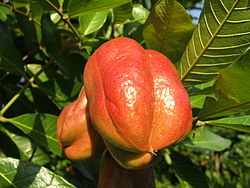 Ackee (Blighia sapida) fruit
 -
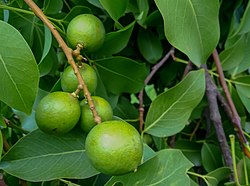 Guinep/ Mamoncillo (Melicoccus bijugatus) fruit
 -
 Lychee (Litchi chinensis) fruit
 -
 Alupag (Dimocarpus didyma) fruits
 -
 Guaraná (Paullinia cupana) fruit
 -
 Maple syrup (from Acer saccharum)

.jpg)


References
[edit]- ^ "Sapindaceae Juss., nom. cons". Germplasm Resources Information Network. United States Department of Agriculture. 2003-01-17. Archived from the original on 2009-05-06. Retrieved 2009-04-11.
- ^ "The Plant List:Sapindaceae". Royal Botanic Gardens Kew and Missouri Botanic Garden. Retrieved 5 April 2017.
- ^ Buerki, Sven; Callmander, Martin W.; Acevedo-Rodriguez, Pedro; LowryII, Porter P.; Munzinger, Jérôme; Bailey, Paul; Maurin, Olivier; Brewer, Grace E.; Epitawalage, Niroshini; Baker, William J.; Forest, Félix. "An Updated Infra-Familial Classification of Sapindaceae Based on Targeted Enrichment Data (2021)". American Journal of Botany. 108. Retrieved 5 June 2023.
- ^ a b c d e f Singh, Gurjaran (2004). Plant Systematics: An Integrated Approach. Enfield, New Hampshire: Science Publishers. pp. 438–440. ISBN 1-57808-342-7.
- ^ a b Harrington, Mark G.; Karen J. Edwards; Sheila A. Johnson; Mark W. Chase; Paul A. Gadek (2005). "Phylogenetic inference in Sapindaceae sensu lato using plastid matK and rbcL DNA sequences". Syst Bot. 30 (2): 366–382. Bibcode:2005SysBo..30..366H. doi:10.1600/0363644054223549. S2CID 85868684.
- ^ Watson, L. & Dallwitz, M.J. (2007). "Sapindaceae Juss". The families of flowering plants: descriptions, illustrations, identification, and information retrieval. Retrieved 2007-08-27.
- ^ V.H. Heywood; R.K. Brummit; A. Culham; O. Seberg (2007). Flowering plant families of the world. Firefly Books Ltd. ISBN 978-1-55407-206-4.
- ^ Stevens, P.F. (2015) [1st. Pub. 2001], Angiosperm Phylogeny Website, retrieved 28 January 2021
- ^ Stoffels, Karin (September 2008). "Soap Nut Saponins Create Powerful Natural Surfactant". Personal Care Magazine. Jeen International Corporation. Archived from the original on 2011-06-15.
External links
[edit]- Sapindaceae in BoDD – Botanical Dermatology Database
- USDA Agricultural Research Service: Fruits and seeds of Sapindaceae. Archived 2018-07-15 at the Wayback Machine

| International | |
|---|---|
| National | |
| Other | |

Sapindaceae
View on GrokipediaTaxonomy
Etymology and History
The name Sapindaceae is derived from its type genus Sapindus, which combines the Latin words sapo (soap) and Indus (Indian), referring to the soap-like saponin-rich fruits of Sapindus species traditionally used for cleaning in India and other regions.[4][5] The family was first formally described by Antoine Laurent de Jussieu in 1789 in his Genera Plantarum, where he recognized Sapindaceae as a distinct group based on floral and fruit characteristics, separating it from the related Aceraceae (which encompassed maples and horse chestnuts) that had been treated together in earlier systems.[3] Throughout the 19th century, classifications evolved with increasing recognition of morphological affinities, including early proposals to include maples (Acer) and horse chestnuts (Aesculus) within a broader Sapindaceae, though they were often maintained as separate families.[6] Ludwig Radlkofer significantly expanded and refined the family's circumscription in the late 19th and early 20th centuries through his monographic work, culminating in a detailed classification published between 1931 and 1934 that divided Sapindaceae into 14 tribes primarily based on ovule number, fruit morphology, and inflorescence structure, establishing a foundational framework for subsequent studies.[7][8] A major milestone occurred in the 21st century with the advent of molecular phylogenetics, which demonstrated close relationships among Sapindaceae, Aceraceae, and Hippocastanaceae, leading to their merger into an expanded Sapindaceae in the Angiosperm Phylogeny Group III (APG III) system of 2009; this reclassification, supported by DNA sequence data from multiple genes, resolved long-standing debates on family boundaries and emphasized the role of molecular evidence in modern taxonomy.[9]Phylogenetic Classification
Sapindaceae belongs to the order Sapindales within the rosids clade of the eurosids I group in the APG IV system. Phylogenetic reconstructions based on extensive molecular data place Sapindaceae as sister to Rutaceae or to a broader clade including Rutaceae, Heisteriaceae, and Kirkiaceae, though the exact relationships remain somewhat unresolved across studies. The family encompasses 144 genera and approximately 1,900 species, predominantly woody plants distributed across tropical and temperate regions.[10] Molecular phylogenies, particularly those employing targeted enrichment of nuclear loci such as the Angiosperms353 dataset, robustly confirm the monophyly of Sapindaceae. These analyses, integrating coalescence-based and concatenated methods, resolve the family as a cohesive lineage with strong support, distinguishing it from other Sapindales families. Key synapomorphies supporting this monophyly include the production of saponins—triterpenoid compounds responsible for the family's characteristic soapy properties—and the prevalence of compound leaves, typically alternate and pinnate or palmate in structure.[10] A comprehensive infra-familial classification was updated in 2021 using these targeted enrichment data, recognizing four subfamilies—Xanthoceratoideae, Hippocastanoideae, Dodonaeoideae, and Sapindoideae—and 20 tribes, with six newly described tribes to better reflect evolutionary relationships. This framework builds on prior morphological and molecular work, providing a stable backbone for understanding diversification within the family. In 2024, further refinements occurred with the revision of Sapindus section Sapindus, which added three new species—S. marikuru, S. motu-koita, and S. standleyi—primarily from the Americas and Pacific islands, enhancing resolution in this economically important genus.[10] Sapindaceae displays considerable generic diversity, with the largest genera contributing significantly to the family's species richness. Notable examples include Allophylus (approximately 250 species, pantropical shrubs and trees), Serjania (ca. 230 species, mostly neotropical lianas), Paullinia (ca. 200 species, diverse climbers and shrubs in the Americas), and Acer (111 species, temperate trees known as maples). These genera highlight the family's ecological versatility, from temperate forests to tropical understories.[10]Subfamilies and Tribes
The Sapindaceae family is classified into four subfamilies: Xanthoceratoideae, Hippocastanoideae, Dodonaeoideae, and Sapindoideae, based on phylogenetic analyses of molecular data such as targeted enrichment of low-copy nuclear genes.[1] This classification recognizes 20 tribes across the latter three subfamilies, with Xanthoceratoideae lacking formal tribes due to its monotypic nature.[1] The subfamilies are distinguished primarily by leaf arrangement, ovule number per locule, petal morphology, and fruit types, reflecting evolutionary adaptations from temperate to tropical environments.[11] Subfamily Xanthoceratoideae comprises a single genus, Xanthoceras (one species, X. sorbifolium), consisting of arid-adapted shrubs native to northern China.[11] Diagnostic features include alternate, imparipinnate leaves, large white flowers with 7–8 ovules per locule, and capsular fruits containing winged seeds.[1] These traits support its basal position in the family phylogeny.[12] Subfamily Hippocastanoideae includes two tribes and five genera, primarily temperate trees characterized by opposite leaves, two ovules per locule, and winged or capsular fruits.[1]- Tribe Acereae (two genera: Acer and Dipteronia) features actinomorphic flowers with an annular nectar disk and samara fruits with winged seeds, as seen in maples (Acer spp.).[1]
- Tribe Hippocastaneae (three genera: Aesculus, Billia, and Handeliodendron) has zygomorphic flowers with a unilateral nectar disk and dehiscent capsules, exemplified by horse chestnuts (Aesculus hippocastanum) with large, poisonous seeds.[1]
- Tribe Doratoxyleae (seven genera, e.g., Doratoxylon) includes shrubs and trees with diverse distributions in the Old World tropics.[1]
- Tribe Dodonaeeae (17 genera, including Dodonaea) features paleotropical shrubs with winged capsules, such as the hopbush (Dodonaea viscosa), valued for its resinous properties.[1]
- Paullinieae (seven genera, e.g., Paullinia and Serjania), comprising lianas with tendrils and explosive dehiscent capsules.[1]
- Sapindeae (12 genera, e.g., Sapindus), tropical trees with single-seeded drupes rich in saponins, used traditionally as soap; recent revisions in 2024 recognized three new species in Sapindus sect. Sapindus, refining its Neotropical and Paleotropical circumscription based on morphological and molecular evidence.[14][14]
- Nephelieae (16 genera, e.g., Litchi and Dimocarpus), featuring economically important fruit trees with arillate seeds, such as the lychee (Litchi chinensis) with its edible, sweet aril.[15][1] Other tribes, like Cupanieae (34 genera, pantropical with arillate seeds) and Koelreuterieae (three genera with three-locular capsules), highlight the subfamily's morphological diversity.[1] Six new tribes (e.g., Ungnadieae, Tristiropsideae) were established in the 2021 classification to better reflect phylogenetic relationships.[1]