


Community hub
Recent from talks
Contribute something
Nothing was collected or created yet.
Sarson ka saag
View on Wikipedia
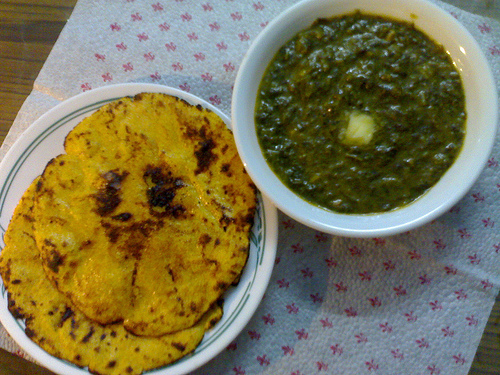
 Makki ki roti with sarson ka saag | |
| Alternative names | Sarsan da saag; sareyan da saag (Punjabi) |
|---|---|
| Course | Main course |
| Place of origin | Punjab |
| Region or state | Punjab, Jammu, Himachal Pradesh, Gujarat, Mithila |
| Associated cuisine | India, Pakistan[1] |
| Main ingredients | Mustard leaves |

Sarson ka saag, also known as sarsa da saag and saron da saag, is a dish of mustard greens cooked with spices. It originated in the Indian subcontinent and is well known throughout the region.[2][3][4][5][6]
Name
[edit]The dish is known as sarson ka saag in Hindi and Urdu, saron da saag (or sareyan da saag) in Punjabi,[7][4][8] sarsav nu shaak in Gujarati,[9] and sariso saag in Maithili.[10]
Sarson, sarhon, sareyan, and other names are derived from the Sanskrit word sarṣapa, 'mustard'.[11] Saag and shaak are derived from the Sanskrit word śāka, 'greens; vegetable leaves'.[12]
Ingredients and preparation
[edit]Mustard is widely grown in the region for the plant's leaves, seeds and seed oil. It is harvested in winter and spring, making sarson ka saag a frequently served warming dish in the cooler months.[13][14][15]
There are many recipes for the dish, usually calling for the leaves to be cooked in oil or clarified butter (ghee)[16] with spices such as garlic, ginger and chilli. Other spices may be used, varying according to region and taste.
Accompaniments
[edit]The dish is often served with bread such as makki ki roti or bajra ki roti.[17]
See also
[edit]References
[edit]- ^ Rai Gupta, Kulwant (2006). Studies in World Affairs. Vol. 2. Atlantic Publishers & Distributors. p. 289. ISBN 9788126904969.
- ^ Dọgarī loka-gīta (in Hindi). Kalacarala Akādamī. 1964.
- ^ Excelsior, Daily (29 September 2018). "Promotion of Dogra culture". Jammu Kashmir Latest News | Tourism | Breaking News J&K. Retrieved 16 June 2022.
..Dogra cuisine such as Pathores, Makki ki Roti and Sarson ka Saag, Keurs...
- ^ a b Hamārā sāhitya (in Hindi). Lalitakalā, Saṃskṛti, va Sāhitya Akādamī, Jammū-Kaśmīra. 1995.
- ^ Agrawal, Chandresh; books, nandini (1 June 2022). HPPSC-Himachal Pradesh Drug Inspector Exam Ebook-PDF: All Sections Covered. Chandresh Agrawal.
Himachali specialities include Siddu....Makki ki Roti & Sarson Ka Saag
- ^ "History - Government of Himachal Pradesh, India". himachal.nic.in. Retrieved 19 June 2022.
- ^ Misra, Anoop (2012). Dietary Considerations in Diabetes - ECAB. Elsevier Health Sciences. p. 79. ISBN 9788131232095.
- ^ Bhandari, Laveesh (2009). Indian States At A Glance 2008-09: Performance, Facts And Figures - Punjab. New York: Pearson Education. p. 29. ISBN 9788131723456.
- ^ Gujarati, Team Recipe in (21 December 2022). "ઢાબા જેવુજ ટેસ્ટી સરસવ નું શાક - સરસો દા સાગ બનાવવાની રીત". Recipe in Gujarati. Retrieved 4 April 2023.
- ^ "Biriya Curry: A Maithil Delicacy Made with Chickpea Greens". GOYA. 19 August 2021. Retrieved 11 April 2023.
No meal within the Maithil community is considered complete without the inclusion of leafy dishes known as saag. Our cuisine is an ode to saag: bathua, laal saag, patua saag, genhari, karmi, sariso saag.
- ^ McGregor, R. S. (Ronald Stuart) (1993). "The Oxford Hindi-English dictionary". dsal.uchicago.edu. Retrieved 16 June 2022.
- ^ Platts, John T. (John Thompson) (1884). "A Dictionary of Urdu, Classical Hindi, and English". dsal.uchicago.edu. Retrieved 16 June 2022.
- ^ "Sarson ka saag / Makki ki roti". dawn.com. 19 February 2014. Retrieved 27 February 2017.
- ^ "Growing more mustard can make India self sufficient in edible oils". Gaonconnection | Your Connection with Rural India. 22 December 2021. Retrieved 16 June 2022.
Mustard is cultivated extensively in north India.
- ^ O'Brien, Charmaine (2013). The Penguin Food Guide to India. Penguin Books Limited. p. 38. ISBN 9789351185758.
In the winter months in Punjab, a richly spiced puree of mustard greens is eaten, accompanied with roti made of ground maize and a knob of fresh, soft, crumbly gur. The classic combination is called sarson ka saag and makki ki roti. Mustard has been grown in Punjab for millennia and its oil-rich seed is an important commercial crop.
- ^ Jiggs Kalra, Pushpesh Pant, "Classic Cooking Of Punjab", tumhari aisi kitasi Allied Publishers, 2004, ISBN 81-7764-566-8, page 42.
- ^ Laveesh Bhandari, Sumita Kale, "Indian states at a glance, 2008-09: Punjab : performance, facts and figures", Pearson Education India, 2009, ISBN 81-317-2345-3, section 4.7.2

| Balochi |  | ||||
|---|---|---|---|---|---|
| Kashmiri | |||||
| Muhajir |
| ||||
| Pashtun | |||||
| Punjabi |
| ||||
| Saraiki | |||||
| Sindhi | |||||
| Common dishes |
| ||||
| Pakistani diaspora | |||||


 | This Indian cuisine–related article is a stub. You can help Wikipedia by adding missing information. |
| This Pakistani cuisine–related article is a stub. You can help Wikipedia by adding missing information. |
Sarson ka saag
View on GrokipediaEtymology and Naming
Origin of the Name
The term "sarson" in "Sarson ka saag" derives from the Sanskrit word sarṣapa, which specifically refers to the mustard plant (Brassica species). This ancient root evolved linguistically through Middle Indo-Aryan languages such as Prakrit, where it appeared as sarisava, before entering modern North Indian languages like Hindi and Punjabi as sarson or sarson, retaining its meaning as mustard or its greens. The word "saag" (also spelled shaak in some dialects) originates from the Sanskrit śāka, denoting leafy green vegetables or edible greens in general.[5] This term has persisted across Indo-Aryan languages, evolving into saag in Punjabi and Hindi to describe cooked preparations of greens, emphasizing their vegetative nature.[6] Collectively, "Sarson ka saag" literally translates to "mustard greens," directly reflecting the dish's primary ingredient of mustard leaves, which form the foundational element of this traditional preparation.[5]Regional Linguistic Variations
Sarson ka saag exhibits notable linguistic variations across northern and western India, reflecting regional phonetic adaptations and cultural influences on nomenclature. In Punjabi, the dish is commonly referred to as "saron da saag" or "sarson da saag," where "saron" or "sarson" denotes mustard greens, and "da saag" indicates "of the greens," aligning with the Gurmukhi script's pronunciation that softens the 's' sound in everyday speech.[7] A variant, "sareyan da saag," emerges in Dogri dialects spoken in Jammu and parts of Himachal Pradesh, where the term "sareyan" phonetically shifts to emphasize a more nasal tone, influenced by the local Pahari and Dogri scripts that adapt Sanskrit-derived words to mountainous terrains' oral traditions.[8] In Gujarati, the equivalent is "sarsav nu shaak," substituting "shaak" for "saag" to signify vegetable curry, with "sarsav" retaining the mustard essence but pronounced with a rounded vowel typical of the Gujarati script's phonetic system.[8] Similarly, in Maithili, spoken in the Mithila region of Bihar and Nepal, it is known as "sariso saag," where "sariso" adapts the mustard term through the Mithilakshar script's intricate consonants, preserving the greens' focus while incorporating local intonations that elongate the 'o' sound for rhythmic dialect flow.[9] These naming conventions stem from the core Sanskrit root "sarṣapa" for mustard, but regional scripts and pronunciations—such as Gurmukhi's fluid cursives in Punjab or Devanagari's angular forms in Maithili—further diversify the terms, embedding cultural identities into the dish's linguistic identity without altering its fundamental preparation.[10]History and Origins
Agricultural Roots
The cultivation of mustard plants, particularly Brassica juncea (Indian mustard), represents a cornerstone of agricultural practices in the Indian subcontinent, with evidence of its domestication and use dating back millennia in northern regions. This species, native to the Himalayan foothills and central Asia, was among the earliest oilseed crops domesticated in India, with archaeological records indicating its presence around 2300 BCE in sites across the Indus Valley and Gangetic plains. Primarily valued for its versatile applications, B. juncea was grown for its nutrient-rich leaves used as greens, its seeds for condiments and spice production, and its oil extracted for cooking and medicinal purposes, integrating it deeply into the agrarian economy of ancient northern India.[11] In Punjab and surrounding areas of northern India, such as Haryana and Uttar Pradesh, Brassica juncea has been traditionally cultivated as a winter (rabi) crop, sown in October-November during the cooler post-monsoon season and harvested in March-April, aligning with the region's temperate climate and soil fertility. This seasonal rhythm not only optimized yield through frost-tolerant growth but also tied directly to harvest-based culinary traditions, where the tender leaves of young plants formed the basis for dishes like sarson ka saag during the peak winter abundance. Historical agronomic texts and modern analyses confirm that this practice enhanced soil health via crop rotation with staples like wheat, sustaining productivity in the Indo-Gangetic alluvial soils for centuries.[12]Development in Regional Cuisines
Preparations of mustard greens have ancient roots, with the earliest documented reference appearing in the Jain text Acharanga Sutra from the 3rd century BCE.[2] Sarson ka saag further evolved as a staple in Punjabi cuisine during the Mughal era (16th-19th centuries), when Central Asian influences blended with local agrarian practices in the Punjab region, historically tied to the fertile Indus Valley. The dish, centered on mustard greens prepared as a spiced puree known as "sag," was documented in 18th-century Mughal cookbooks such as Khulasat-i Makulat u Mashrubat, reflecting its roots in rural farming communities where abundant winter greens provided nourishment for laborers.[13] This hearty preparation suited the hardworking lifestyles of Punjab's agrarian population, evolving from simple boiled greens into a flavorful curry enriched with spices like ginger and garlic.[4] By the 19th and 20th centuries, sarson ka saag spread beyond Punjab to neighboring regions like Jammu and Himachal Pradesh, where it integrated into local cuisines through shared North Indian culinary traditions and proximity to mustard-growing areas. In these hilly and valley terrains, the dish adapted slightly with regional greens but retained its core mustard base, becoming a winter favorite alongside corn flatbreads. Further dissemination occurred to Gujarat and the Mithila region of Bihar via broader cultural exchanges and trade networks across northern and western India, with local variations appearing in Gujarati "sarso nu shaak" and Bihari-style preparations that emphasize mustard's pungent flavor.[14][15] The dish's documentation in early 20th-century sources solidified its place in printed culinary literature, often featured in regional Indian recipe collections as a symbol of Punjabi heritage. Its association with the post-Partition Punjabi diaspora intensified in the mid-20th century, as refugees fleeing to cities like Delhi introduced sarson ka saag to urban eateries, blending it into mainstream North Indian menus and popularizing it nationwide through migration-driven food transformations.[16][17]Cultural and Seasonal Significance
Role in Punjabi Traditions
Sarson ka saag holds a central place in Punjabi traditions, particularly during the Lohri festival in January, which marks the celebration of the winter harvest through communal bonfires, songs, and shared meals. As a staple of these gatherings, the dish is prepared in large quantities to symbolize abundance and gratitude for the earth's bounty, often paired with makki di roti to foster community bonding among families and neighbors.[18][19] In the harsh Punjabi winters, sarson ka saag embodies warmth and nourishment, its hearty, spiced greens providing sustenance against the cold while evoking the golden mustard fields that blanket the landscape. This seasonal dish is traditionally cooked over wood fires in large earthen pots for extended family feasts, reinforcing social ties and the cultural value of hospitality during the chilly months.[19][20] The dish also permeates Punjabi folklore and literature, appearing in folk songs that depict harvest feasts and rural life. For instance, the traditional Lohri song "Tode Uper Toda" references bundles of saag alongside imagery of fresh greens, capturing the joy of seasonal abundance in oral traditions passed down through generations.[21][22]Importance in Festivals and Daily Life
Beyond its Punjabi roots, sarson ka saag holds significance in other regional festivals across the Indian subcontinent, particularly as a seasonal offering during Maithili Chhath Puja. In the Mithila region of Bihar and parts of eastern India, the dish is traditionally consumed on the first day of the festival, known as Nahay Khay, to mark the beginning of the four-day fast dedicated to the sun god. Prepared with mustard greens for its pure, sattvic qualities as per Hindu scriptures, it provides warmth to the body—essential for devotees who stand in cold water during rituals—and pairs with pumpkin to aid digestion and prevent seasonal ailments.[23] In daily life, sarson ka saag serves as an affordable winter staple in rural households across northern India, especially Punjab, where mustard greens are abundantly cultivated during the cooler months. Its preparation relies on locally grown, organic ingredients like fresh greens and minimal spices, making it cost-effective for farming families who consume it regularly for sustenance and nutrition amid harsh winters. The dish's availability from nearby fields ensures it becomes a routine meal, often slow-cooked over traditional hearths to feed hardworking rural communities.[4] Among global Punjabi diaspora communities, sarson ka saag maintains cultural ties through adaptations in community events, such as Lohri and Vaisakhi celebrations. In places like New Zealand, it is prepared alongside makki ki roti during Lohri gatherings to evoke heritage and foster bonds among expatriates, while UK-based establishments like Dishoom feature it as a Vaisakhi special to honor harvest traditions and unite participants in shared rituals. These events highlight the dish's role in preserving identity, with modern twists like delivery options ensuring accessibility far from its origins.[24][25]Ingredients
Primary Greens and Base
Sarson ka saag centers on mustard greens (Brassica juncea), known as sarson in Hindi, which form the primary ingredient and contribute the dish's signature bitter and pungent flavor profile. These greens typically comprise 70-80% of the vegetable mix, providing a robust, earthy base that defines the saag's character.[1] To balance the intensity of the mustard greens, common additions include spinach (palak, Spinacia oleracea), bathua (Chenopodium album), and fenugreek leaves (methi, Trigonella foenum-graecum), which together account for about 20-30% of the mix and introduce milder, slightly sweet notes for a more harmonious texture and taste.[26][14] These greens are traditionally sourced from winter fields in northern India, particularly in Punjab and surrounding regions, where mustard is cultivated during the cooler months from October to March, allowing for the harvest of fresh, young leaves that ensure tenderness and optimal flavor retention. Radish or turnip roots are often included in the base, chopped and simmered with the greens to reduce bitterness and add subtle sweetness.[27][2][14]Spices and Seasonings
The core spices and seasonings in sarson ka saag form the base tempering, known as tadka, which infuses the dish with pungent and spicy notes to complement the bitter mustard greens. Ginger, garlic, and green chilies are essential aromatics that provide a sharp, warming foundation during the initial cooking stage.[14][28] Asafoetida (hing), added in a small pinch, contributes a subtle onion-like umami that aids digestion and balances the greens' earthiness in traditional Punjabi preparations.[14][26] For added depth, optional spices such as turmeric, coriander powder, and fenugreek seeds are incorporated to enhance color, mild earthiness, and a slight bitterness that harmonizes with the primary greens. Turmeric offers a vibrant yellow hue and anti-inflammatory properties, while coriander powder imparts a citrusy undertone.[29][30] Fenugreek seeds, used sparingly in some variations, release a maple-like aroma when toasted, enriching the overall flavor profile without overpowering the dish.[31][32] Ghee or mustard oil serves as the primary cooking fat, lending a rich, nutty essence that is integral to the dish's indulgent texture and authentic taste in Punjabi cuisine. Ghee, clarified butter, is preferred for its ability to carry spices effectively at high temperatures, while mustard oil adds a bold, pungent bite reflective of regional agricultural staples.[14][26][28]Preparation Methods
Traditional Cooking Process
The traditional cooking process of sarson ka saag begins with the careful preparation of the greens, primarily mustard leaves (sarson) supplemented by spinach, bathua, and sometimes fenugreek or radish greens. The leaves are thoroughly washed multiple times in cold water to remove dirt and grit. After draining, the greens are roughly chopped, including tender stems, to ensure even cooking and flavor integration. This initial step preserves the nutritional integrity while preparing the mixture for extended simmering.[33] The chopped greens are then transferred to a heavy-bottomed pot, such as a traditional degchi or patila, along with minimal water, ginger, garlic, green chilies, and a touch of salt. The mixture is slow-simmered over low heat for 2-3 hours, stirring occasionally to prevent sticking and allow the flavors to meld deeply; this prolonged cooking breaks down the fibrous greens into a creamy, earthy puree characteristic of authentic Punjabi saag. During this phase, a small amount of maize flour may be added midway to thicken and enhance texture without overpowering the natural taste. To achieve the desired consistency, the softened saag is mashed using a wooden stirrer known as a madhani, which incorporates air and develops a light, velvety texture through the traditional ghotna process.[14][34][3] Finally, the saag is finished with a tadka, or tempering, prepared by heating ghee or mustard oil in a separate pan until smoking, then adding cumin seeds, whole dried red chilies, and finely chopped or sliced garlic cloves, which are browned until fragrant and golden. This aromatic mixture is poured over the saag, infusing it with a pungent, smoky depth that balances the greens' mild bitterness. While modern adaptations often employ pressure cookers to shorten the simmering to under an hour, the traditional method emphasizes this patient, low-heat approach for optimal flavor development.[33][34]Modern and Regional Adaptations
In contemporary urban Indian households, the adoption of pressure cookers has transformed the preparation of sarson ka saag by drastically reducing cooking time to 30-45 minutes, compared to the traditional multi-hour slow simmering. This innovation became widespread in the 1980s as pressure cookers emerged as essential kitchen tools, enabling faster cooking of greens while preserving flavors through methods like pressure cooking the leaves for 15-20 minutes followed by a brief stovetop simmer after blending.[35][27] Regional adaptations highlight diverse influences across India. In Gujarati cuisine, the dish is known as sarsav nu shaak and is often paired with jaggery to introduce a subtle sweetness that tempers the mustard greens' inherent bitterness, aligning with the region's preference for balanced sweet-sour profiles in vegetable preparations. In Maithili cuisine from Bihar, sariso saag incorporates boiled chickpeas, adding a nutty texture and boosting protein content to make the dish more substantial as a standalone meal.[36] Global influences have spurred vegan adaptations, particularly among Indian diaspora communities, where ghee is substituted with neutral oils like avocado or mustard oil to maintain the dish's richness without dairy. Additionally, frozen mustard and spinach greens enable year-round preparation outside seasonal availability, simplifying the process for expatriates in regions like North America and Europe while retaining the creamy consistency through blending.[29][37]Serving and Accompaniments
Classic Pairings
Sarson ka saag is traditionally paired with makki di roti, a flatbread made from cornmeal, which provides a contrasting texture and mild sweetness that complements the earthy, slightly bitter flavors of the mustard greens.[38] This combination is a staple in Punjabi cuisine, enhancing the dish's richness through the roti's subtle corn taste and soft, pliable consistency.[14] In non-Punjabi regions, such as parts of Haryana or urban Indian settings, alternatives like bajra ki roti—made from pearl millet—or naan are commonly used to accompany sarson ka saag, adapting the dish to local grain availability and preferences while maintaining its hearty profile.[39][40] To balance the saag's robust savoriness, accompaniments such as white butter (makhan) are often dolloped on top for creaminess, jaggery adds a touch of natural sweetness to offset bitterness, and pickles provide tangy contrast.[38] These elements create a harmonious meal, with the butter melting into the warm saag and the jaggery or pickle served on the side for personalized flavor adjustment.[14]Presentation and Consumption Practices
Sarson ka saag is traditionally presented and served hot to preserve its comforting warmth and robust flavors, often in simple earthenware bowls or metal katoris that evoke the rustic Punjabi countryside. A hallmark of its presentation is the addition of a generous dollop or pat of fresh, churned butter (makhan) placed atop the creamy green stew just before serving, which melts into the dish and adds a rich, glossy finish while balancing its earthy bitterness.[1][41] This topping not only enhances the visual appeal but also underscores the dish's indulgent yet nourishing character in Punjabi culinary tradition. Consumption practices emphasize a hands-on, communal approach reflective of Punjabi family gatherings, where diners tear off small portions of accompanying makki di roti—a soft, unleavened cornmeal flatbread—and use them to scoop and dip into the saag directly from shared bowls. This method allows for an intimate interaction with the dish's thick, velvety consistency, promoting a sensory experience that combines the roti's subtle sweetness with the saag's spiced, greens-forward depth. Etiquette in these settings encourages sharing from a central serving, fostering social bonds during meals, particularly in rural or home environments.[41][1] In winter rituals, sarson ka saag holds a special place as a seasonal staple, ideally consumed immediately after preparation to retain its inherent heat and maximize nutrient retention from the fresh mustard greens. This practice aligns with Punjabi customs of enjoying hearty, warming foods during the cold months, often as part of weekend family meals or festive occasions, where the immediacy of serving ensures the dish's therapeutic warmth combats the chill.[1][41]Nutritional Profile
Key Nutrients
Sarson ka saag, primarily composed of cooked mustard greens, is notably rich in vitamins A, C, and K, which support vision, immune function, and blood clotting, respectively.[42] These greens also provide significant amounts of calcium, iron and folate, essential for bone health, red blood cell production and overall blood health.[42][43] A standard 100g serving of the dish, prepared without added fats, offers approximately 26 calories, 2.6g of protein, 4.5g of carbohydrates, and 0.5g of fat.[42] When ghee or oil is incorporated during cooking, the calorie count can rise to 50-60, with fat content increasing accordingly.[44] The dish delivers about 3.2g of dietary fiber per 100g, promoting digestive health through its soluble and insoluble components from the leafy greens.[42] If mustard seeds are used in the preparation, they contribute omega-3 fatty acids, such as alpha-linolenic acid, enhancing the anti-inflammatory profile.[45]| Nutrient (per 100g, cooked without added fat) | Amount | % Daily Value* |
|---|---|---|
| Calories | 26 kcal | 1% |
| Protein | 2.6 g | 5% |
| Carbohydrates | 4.5 g | 2% |
| Dietary Fiber | 3.2 g | 11% |
| Fat | 0.5 g | 1% |
| Vitamin A | 618 mcg RAE | 69% |
| Vitamin C | 25 mg | 28% |
| Vitamin K | 347 mcg | 289% |
| Calcium | 118 mg | 9% |
| Iron | 0.9 mg | 5% |
| Folate | 9 mcg | 2% |