



Community hub
Recent from talks
Contribute something
Nothing was collected or created yet.
Separation of variables
View on Wikipedia| Differential equations |
|---|
| Scope |
| Classification |
| Solution |
| People |
In mathematics, separation of variables (also known as the Fourier method) is any of several methods for solving ordinary and partial differential equations, in which algebra allows one to rewrite an equation so that each of two variables occurs on a different side of the equation.
Ordinary differential equations (ODE)
[edit]A differential equation for the unknown is separable if it can be written in the form

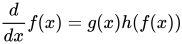
where and are given functions. This is perhaps more transparent when written using as:


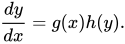
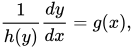
So now as long as h(y) ≠ 0, we can rearrange terms to obtain:

where the two variables x and y have been separated. Note dx (and dy) can be viewed, at a simple level, as just a convenient notation, which provides a handy mnemonic aid for assisting with manipulations. A formal definition of dx as a differential (infinitesimal) is somewhat advanced.
Alternative notation
[edit]Those who dislike Leibniz's notation may prefer to write this as
but that fails to make it quite as obvious why this is called "separation of variables". Integrating both sides of the equation with respect to , we have

| A1 |
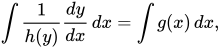
or equivalently,
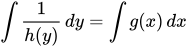
because of the substitution rule for integrals.
If one can evaluate the two integrals, one can find a solution to the differential equation. Observe that this process effectively allows us to treat the derivative as a fraction which can be separated. This allows us to solve separable differential equations more conveniently, as demonstrated in the example below.

(Note that we do not need to use two constants of integration, in equation (A1) as in

because a single constant is equivalent.)

Example
[edit]Population growth is often modeled by the "logistic" differential equation

where is the population with respect to time , is the rate of growth, and is the carrying capacity of the environment. Separation of variables now leads to


which is readily integrated using partial fractions on the left side yielding
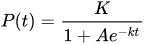
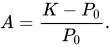
where A is the constant of integration. We can find in terms of at t=0. Noting we get


Generalization of separable ODEs to the nth order
[edit]Much like one can speak of a separable first-order ODE, one can speak of a separable second-order, third-order or nth-order ODE. Consider the separable first-order ODE:
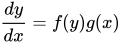
The derivative can alternatively be written the following way to underscore that it is an operator working on the unknown function, y:
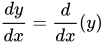
Thus, when one separates variables for first-order equations, one in fact moves the dx denominator of the operator to the side with the x variable, and the d(y) is left on the side with the y variable. The second-derivative operator, by analogy, breaks down as follows:

The third-, fourth- and nth-derivative operators break down in the same way. Thus, much like a first-order separable ODE is reducible to the form
a separable second-order ODE is reducible to the form
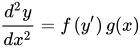
and an nth-order separable ODE is reducible to
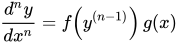
Example
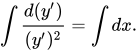
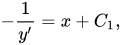
[edit]Consider the simple nonlinear second-order differential equation:This equation is an equation only of y'' and y', meaning it is reducible to the general form described above and is, therefore, separable. Since it is a second-order separable equation, collect all x variables on one side and all y' variables on the other to get:Now, integrate the right side with respect to x and the left with respect to y':This giveswhich simplifies to:This is now a simple integral problem that gives the final answer:




Partial differential equations
[edit]The method of separation of variables is also used to solve a wide range of linear partial differential equations with boundary and initial conditions, such as the heat equation, wave equation, Laplace equation, Helmholtz equation and biharmonic equation.
The analytical method of separation of variables for solving partial differential equations has also been generalized into a computational method of decomposition in invariant structures that can be used to solve systems of partial differential equations.[1]
Example: homogeneous case
[edit]Consider the one-dimensional heat equation. The equation is
| 1 |

The variable u denotes temperature. The boundary condition is homogeneous, that is
| 2 |

Let us attempt to find a nontrivial solution satisfying the boundary conditions but with the following property: u is a product in which the dependence of u on x, t is separated, that is:
| 3 |

Substituting u back into equation (1) and using the product rule,
| 4 |

where λ must be constant since the right hand side depends only on x and the left hand side only on t. Thus:
| 5 |

and
| 6 |

−λ here is the eigenvalue for both differential operators, and T(t) and X(x) are corresponding eigenfunctions.
We will now show that solutions for X(x) for values of λ ≤ 0 cannot occur:
Suppose that λ < 0. Then there exist real numbers B, C such that

From (2) we get
| 7 |

and therefore B = 0 = C which implies u is identically 0.
Suppose that λ = 0. Then there exist real numbers B, C such that

From (7) we conclude in the same manner as in 1 that u is identically 0.
Therefore, it must be the case that λ > 0. Then there exist real numbers A, B, C such that
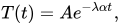
and

From (7) we get C = 0 and that for some positive integer n,

This solves the heat equation in the special case that the dependence of u has the special form of (3).
In general, the sum of solutions to (1) which satisfy the boundary conditions (2) also satisfies (1) and (3). Hence a complete solution can be given as

where Dn are coefficients determined by initial condition.
Given the initial condition
| 8 |
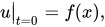
we can get
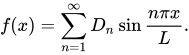
This is the Fourier sine series expansion of f(x) which is amenable to Fourier analysis. Multiplying both sides with and integrating over [0, L] results in

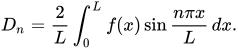
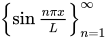
This method requires that the eigenfunctions X, here , are orthogonal and complete. In general this is guaranteed by Sturm–Liouville theory.
Example: nonhomogeneous case
[edit]Suppose the equation is nonhomogeneous,
| 8 |
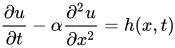
with the boundary condition the same as (2) and initial condition same as (8).
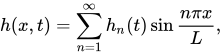
Expand h(x,t), u(x,t) and f(x) into
| 9 |
| 10 |
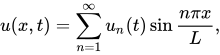
| 11 |
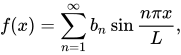
where hn(t) and bn can be calculated by integration, while un(t) is to be determined.
Substitute (9) and (10) back to (8) and considering the orthogonality of sine functions we get
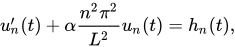
which are a sequence of linear differential equations that can be readily solved with, for instance, Laplace transform, or Integrating factor. Finally, we can get

If the boundary condition is nonhomogeneous, then the expansion of (9) and (10) is no longer valid. One has to find a function v that satisfies the boundary condition only, and subtract it from u. The function u-v then satisfies homogeneous boundary condition, and can be solved with the above method.
Example: mixed derivatives
[edit]For some equations involving mixed derivatives, the equation does not separate as easily as the heat equation did in the first example above, but nonetheless separation of variables may still be applied. Consider the two-dimensional biharmonic equation
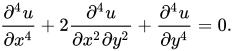
Proceeding in the usual manner, we look for solutions of the form

and we obtain the equation

Writing this equation in the form

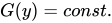
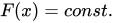
Taking the derivative of this expression with respect to gives which means or and likewise, taking derivative with respect to leads to and thus or , hence either F(x) or G(y) must be a constant, say −λ. This further implies that either or are constant. Returning to the equation for X and Y, we have two cases







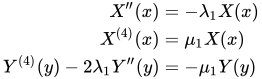
and

which can each be solved by considering the separate cases for and noting that .


Curvilinear coordinates
[edit]In orthogonal curvilinear coordinates, separation of variables can still be used, but in some details different from that in Cartesian coordinates. For instance, regularity or periodic condition may determine the eigenvalues in place of boundary conditions. See spherical harmonics for example.
Applicability
[edit]Partial differential equations
[edit]For many PDEs, such as the wave equation, Helmholtz equation and Schrödinger equation, the applicability of separation of variables is a result of the spectral theorem. In some cases, separation of variables may not be possible. Separation of variables may be possible in some coordinate systems but not others,[2] and which coordinate systems allow for separation depends on the symmetry properties of the equation.[3] Below is an outline of an argument demonstrating the applicability of the method to certain linear equations, although the precise method may differ in individual cases (for instance in the biharmonic equation above).
Consider an initial boundary value problem for a function on in two variables:

![{\displaystyle D=\{(x,t):x\in [0,l],t\geq 0\}}](https://wikimedia.org/api/rest_v1/media/math/render/svg/ff6111350a4abb6ac930ff8071104221154cca23)

where is a differential operator with respect to and is a differential operator with respect to with boundary data:


- for
- for




where is a known function.
We look for solutions of the form . Dividing the PDE through by gives



The right hand side depends only on and the left hand side only on so both must be equal to a constant , which gives two ordinary differential equations

which we can recognize as eigenvalue problems for the operators for and . If is a compact, self-adjoint operator on the space along with the relevant boundary conditions, then by the Spectral theorem there exists a basis for consisting of eigenfunctions for . Let the spectrum of be and let be an eigenfunction with eigenvalue . Then for any function which at each time is square-integrable with respect to , we can write this function as a linear combination of the . In particular, we know the solution can be written as
![{\displaystyle L^{2}[0,l]}](https://wikimedia.org/api/rest_v1/media/math/render/svg/478f87f6a42c55e7ad836633175232f94c53420f)


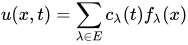
For some functions . In the separation of variables, these functions are given by solutions to


Hence, the spectral theorem ensures that the separation of variables will (when it is possible) find all the solutions.
For many differential operators, such as , we can show that they are self-adjoint by integration by parts. While these operators may not be compact, their inverses (when they exist) may be, as in the case of the wave equation, and these inverses have the same eigenfunctions and eigenvalues as the original operator (with the possible exception of zero).[4]

Matrices
[edit]The matrix form of the separation of variables is the Kronecker sum.
As an example we consider the 2D discrete Laplacian on a regular grid:

where and are 1D discrete Laplacians in the x- and y-directions, correspondingly, and are the identities of appropriate sizes. See the main article Kronecker sum of discrete Laplacians for details.


Software
[edit]See also
[edit]Notes
[edit]- ^ Miroshnikov, Victor A. (15 December 2017). Harmonic Wave Systems: Partial Differential Equations of the Helmholtz Decomposition. Scientific Research Publishing, Inc. USA. ISBN 9781618964069.
- ^ John Renze, Eric W. Weisstein, Separation of variables
- ^ Willard Miller(1984) Symmetry and Separation of Variables, Cambridge University Press
- ^ David Benson (2007) Music: A Mathematical Offering, Cambridge University Press, Appendix W
- ^ "Symbolic algebra and Mathematics with Xcas" (PDF).
References
[edit]- Polyanin, Andrei D. (2001-11-28). Handbook of Linear Partial Differential Equations for Engineers and Scientists. Boca Raton, FL: Chapman & Hall/CRC. ISBN 1-58488-299-9.
- Myint-U, Tyn; Debnath, Lokenath (2007). Linear Partial Differential Equations for Scientists and Engineers. Boston, MA: Birkhäuser Boston. doi:10.1007/978-0-8176-4560-1. ISBN 978-0-8176-4393-5.
- Teschl, Gerald (2012). Ordinary Differential Equations and Dynamical Systems. Graduate Studies in Mathematics. Vol. 140. Providence, RI: American Mathematical Society. ISBN 978-0-8218-8328-0.
External links
[edit]- "Fourier method", Encyclopedia of Mathematics, EMS Press, 2001 [1994]
- John Renze, Eric W. Weisstein, "Separation of variables" ("Differential Equation") at MathWorld.
- Methods of Generalized and Functional Separation of Variables at EqWorld: The World of Mathematical Equations
- Examples of separating variables to solve PDEs
- "A Short Justification of Separation of Variables"
Separation of variables
View on GrokipediaFundamentals
Definition and Basic Principle
The method of separation of variables is a analytical technique for solving certain classes of differential equations, particularly linear homogeneous ones, by assuming that the solution can be expressed as a product of functions, each depending on only one independent variable. This approach exploits the additive separability of the equation, where the partial derivatives or terms involving distinct variables can be rearranged and isolated on separate sides, enabling the equation to be decoupled into simpler components.[4] The technique is applicable when the equation's structure allows such isolation without loss of generality, transforming a coupled multivariable problem into independent ordinary differential equations (ODEs).[5] For ordinary differential equations (ODEs), the method applies to separable equations of the general form , where depends solely on the independent variable and on the dependent variable . Rearranging yields , which integrates directly to , producing an implicit solution that can often be solved explicitly for .[3] This separation leverages the chain rule in reverse, reducing the first-order ODE to algebraic integration over single variables. In the case of partial differential equations (PDEs), such as those governing physical phenomena like heat conduction or wave propagation, the method posits a solution . Substituting into a linear PDE, for instance, the one-dimensional heat equation , gives , where is the separation constant introduced to equate the spatial and temporal dependencies.[4] The boundary and initial conditions of the problem then determine the eigenvalues and corresponding eigenfunctions, often through Sturm-Liouville theory, ensuring the separated ODEs and yield valid solutions that satisfy the original PDE.[5] This process reduces the multivariable PDE to a pair of single-variable ODEs, solvable via standard techniques like characteristic equations or power series.Historical Development
The method of separation of variables emerged in the context of solving ordinary differential equations (ODEs) in the late 17th century. Gottfried Wilhelm Leibniz used it implicitly in 1691 to solve certain inverse tangent problems, while Jacob Bernoulli applied it in 1690 to the isochrone problem. Johann Bernoulli coined the phrase “separation of variables” in a 1694 letter to Leibniz and used it systematically in his lectures on calculus from 1691–92.[6][7] Its application to partial differential equations (PDEs) began in the mid-18th century, pioneered by Jean le Rond d'Alembert in 1747 for the wave equation and extended by Leonhard Euler in 1748, who applied separation of variables to derive solutions for wave propagation problems.[8] In the late 18th century, Joseph-Louis Lagrange contributed to the analysis of PDEs in celestial mechanics, employing variable separation in variational problems and minimal surface equations to model gravitational potentials. Similarly, Pierre-Simon Laplace advanced the technique around 1782 for solving Laplace's equation in potential theory, using separation in spherical coordinates to study celestial mechanics and early heat conduction models, including spherical harmonics for gravitational fields.[8] The method gained formal prominence in the 19th century through Joseph Fourier's 1822 treatise Théorie Analytique de la Chaleur, where he systematically applied separation of variables to the heat equation, combining it with infinite series expansions to solve boundary value problems in conduction.[9] This work expanded the technique beyond simple product solutions, integrating it with trigonometric series for arbitrary initial conditions, and marked a shift toward broader applicability in physical modeling.[10] In the 20th century, the method found pivotal use in quantum mechanics, notably in Erwin Schrödinger's 1926 formulation of the wave equation, where separation of variables in spherical coordinates yielded exact solutions for the hydrogen atom, enabling energy level quantization.[11] These developments have profoundly influenced modern engineering and physics, serving as a cornerstone for analytical solutions in heat transfer, fluid dynamics, electromagnetism, and structural analysis, where it reduces complex PDEs to solvable ODEs under linear, homogeneous conditions.[12]Ordinary Differential Equations
First-Order Separable Equations
A first-order ordinary differential equation (ODE) is separable if it can be expressed in the form , where depends only on the independent variable and depends only on the dependent variable .[13] This criterion allows the equation to be rewritten as , isolating terms involving each variable on opposite sides.[14] The solution process begins by integrating both sides of the separated equation: , where is the constant of integration.[13] The resulting implicit solution is then solved explicitly for if possible, or left in implicit form. Initial conditions, such as , are applied to determine the specific value of .[14] Constant solutions where must be checked separately, as they may not appear in the general solution from integration.[13] In the general solution form, is obtained as the inverse function of the integral involving , equated to the integral of plus : .[14] Solutions involving logarithms or other functions may require handling absolute values, such as replacing with and exponentiating to yield , which simplifies to and absorbs the sign into the arbitrary constant.[13] Domains must be restricted to intervals where the solution is defined, excluding points that cause division by zero, negative arguments in logarithms, or other singularities.[14] Separable equations represent a special case of exact first-order ODEs, where the equation satisfies with and .[15] When separability fails but the equation is nearly exact, integrating factors—functions or that multiply the equation to make it exact—provide an alternative method, often derived via separation of variables on an auxiliary equation.[15]Example: First-Order Population Model
A classic application of separation of variables arises in modeling population growth using the Malthusian equation, which assumes that the rate of change of the population is proportional to its current size, leading to the first-order ordinary differential equation where is the intrinsic growth rate constant.[16] To solve this separable equation, divide both sides by (assuming ) and multiply by , yielding Integrating both sides gives which integrates to , where is the constant of integration. Exponentiating both sides produces the general solution , with . For an initial value problem with , the constant is determined as , resulting in the explicit solution [16] This solution describes exponential growth, where the population doubles every time units, reflecting rapid increases observed in unconstrained environments like bacterial cultures. However, the model predicts unbounded growth as , which is unrealistic for real populations limited by resources such as food or space.[16] A more realistic variation is the logistic growth model, which incorporates a carrying capacity to account for environmental limits, given by the equation This is also separable: rewrite as Using partial fraction decomposition, , the left side integrates to . Solving yields the general solution where is determined from the initial condition . The solution curve forms an S-shape, starting slowly, accelerating to a maximum growth rate at , and asymptotically approaching the carrying capacity as , better capturing bounded population dynamics in ecosystems.[17][18]Higher-Order Separable Equations
The separation of variables method extends to higher-order ordinary differential equations (ODEs) primarily through reduction of order techniques, which reduce the equation to a series of lower-order separable equations. For second-order ODEs of the form , separability occurs if the terms involving can be isolated from those involving and , though the method is most straightforward for autonomous cases where the independent variable is absent, such as . In these autonomous equations, the absence of explicit -dependence allows the equation to be treated as a first-order equation in terms of as a function of .[19] To solve , introduce the substitution , so by the chain rule. This yields the separable first-order equation , or . Integrating both sides gives , where is the constant of integration. Solving for , we obtain , and since , this results in the separable equation , or . Integrating again yields , providing the implicit solution. An equivalent approach is to multiply the original equation by , leading to , where the left side is and the right side integrates to , confirming the same first integral.[20] For general nth-order autonomous ODEs where the highest derivative can be isolated as , successive reductions apply if the structure permits separation after substitutions. Each step treats the equation as first-order in the highest derivative with respect to the previous one, reducing the order by one until reaching a separable first-order equation, followed by successive integrations to recover the solution. This process introduces multiple constants of integration, corresponding to the order of the original equation. In linear higher-order cases with boundary conditions, such reductions can lead to eigenvalue problems where separation constants arise from assuming exponential forms or other trial functions, determining the eigenvalues that satisfy the boundaries.[21] However, not all higher-order ODEs are separable without additional substitutions; the method requires the equation to lack explicit dependence on the independent variable or to allow clear isolation of derivatives after reduction, limiting its applicability to specific autonomous or quasi-autonomous forms.[19]Example: Second-Order Harmonic Oscillator
The second-order ordinary differential equation governing simple harmonic motion is given by where represents the displacement from equilibrium at time , and is a constant related to the system's parameters, such as the angular frequency.\] This equation arises in [classical mechanics](/page/Classical_mechanics) for systems like a mass-spring setup, where the restoring [force](/page/Force) is proportional to displacement, leading to oscillatory behavior without [damping](/page/Damping).\[ To solve this using a separation-of-variables approach, multiply both sides of the equation by the velocity : The first term simplifies to , and the second to , yielding Integrating with respect to time gives the conservation of mechanical energy: where is a constant determined by initial conditions.$$] Rearranging yields the separable first-order equation [ \frac{dx}{dt} = \pm \sqrt{2E - \omega^2 x^2}, \int \frac{dx}{\sqrt{2E - \omega^2 x^2}} = \pm \int dt. Assuming $ 2E = \omega^2 A^2 $ for amplitude $ A $, the left integral evaluates to $ \frac{1}{\omega} \arcsin\left( \frac{\omega x}{A} \right) $, leading to the general solution x(t) = A \cos(\omega t + \phi), where $ \phi $ is the phase angle.$$\] An equivalent form is the linear combination \[ x(t) = C \cos(\omega t) + D \sin(\omega t), obtained via trigonometric identities.$$] The constants and (or and ) are determined by initial boundary conditions, typically the initial displacement and initial velocity . For instance, substituting into the cosine-sine form gives and , while the amplitude is and .[$$ Physically, this solution describes periodic motion with angular frequency , period , and frequency , where the system returns to the initial position after each cycle.\] The motion is bounded between $ -A $ and $ A $, reflecting energy conservation. Extensions to damped harmonic oscillators, such as $ \frac{d^2 x}{dt^2} + 2\gamma \frac{dx}{dt} + \omega^2 x = 0 $ with damping coefficient $ \gamma > 0 $, introduce exponential decay but require additional techniques like the characteristic equation for separation, as direct multiplication no longer yields a simple conserved quantity.\[Partial Differential Equations
Separation Technique for Linear PDEs
The separation of variables technique is a standard analytical method for solving linear homogeneous partial differential equations (PDEs), particularly those arising in physics such as the heat and wave equations. It relies on the assumption that the solution can be expressed as a product of functions, each depending on a single independent variable. For a PDE involving spatial variables and possibly time , the assumed form is .[22][23] To apply the technique, the product form is substituted directly into the PDE. Due to the homogeneity and linearity of the equation, division by the product (assuming it is nonzero) separates the variables, resulting in an equation where each term depends only on one variable and equals a constant. This introduces separation constants, such as , leading to a system of ordinary differential equations (ODEs), one for each function and . The method extends the separation approach used in ODEs by adapting it to the multivariable context of PDEs.[2][22] In the case of the heat or wave equation, the spatial ODEs typically form Sturm-Liouville eigenvalue problems, where the separation constant serves as the eigenvalue, and the corresponding eigenfunctions provide the basis for the solution. These problems ensure the existence of a complete set of orthogonal solutions under appropriate boundary conditions.[23][2] The linearity of the PDE allows the general solution to be constructed via superposition, expressing as an infinite sum (or series) of the separated product solutions, with coefficients determined by initial or boundary conditions. This step leverages the completeness of the eigenfunctions to represent arbitrary functions in the domain.[22][23] For PDEs with multiple spatial variables, separation proceeds successively, isolating one variable at a time by introducing multiple separation constants, yielding a chain of ODEs that can be solved independently. This iterative process is essential for higher-dimensional problems, maintaining the method's applicability while preserving the product structure.[2][22]Homogeneous Boundary Value Problems
Homogeneous boundary value problems arise when solving linear partial differential equations (PDEs) subject to boundary conditions that are identically zero on the domain boundaries, enabling the separation of variables to reduce the problem to an eigenvalue problem for the spatial operator.[24] This setup is particularly common in diffusion and wave phenomena where the boundaries are maintained at a reference state, such as zero temperature. The resulting eigenfunctions form an orthogonal basis, facilitating the expansion of the solution in terms of these modes.[25] A canonical example is the one-dimensional heat equation, which models heat diffusion in a thin rod: where represents the temperature at position and time , and is the thermal diffusivity.[24] The homogeneous Dirichlet boundary conditions are and for , with an initial condition for .[25] Applying separation of variables, assume a product solution . Substituting into the PDE yields where is the separation constant. This separates into two ordinary differential equations (ODEs): the spatial eigenvalue problem and the temporal equation .[24] The boundary conditions and imply and . Solving the spatial Sturm-Liouville problem gives eigenvalues for , with corresponding eigenfunctions .[25] For each , the temporal ODE has solution , up to a constant. The general solution is then a superposition: The coefficients are determined from the initial condition via the Fourier sine series: [24] The eigenfunctions are orthogonal on with respect to the inner product , as for and .[25] This orthogonality justifies the Fourier expansion and ensures the coefficients are uniquely determined. The series solution converges to the initial condition in the sense for square-integrable , and pointwise under additional regularity assumptions like piecewise smoothness.[24]Nonhomogeneous Boundary Value Problems
In nonhomogeneous boundary value problems (BVPs) for partial differential equations (PDEs), the presence of forcing terms or inhomogeneous boundary conditions prevents direct application of separation of variables, as the method requires linearity and homogeneity in the boundary conditions. To address this, the solution is decomposed as , where is a steady-state particular solution satisfying the nonhomogeneous boundary conditions and the time-independent part of the PDE, while solves a homogeneous BVP with adjusted initial conditions using separation of variables. This decomposition transforms the original problem into one amenable to eigenfunction expansions derived from the associated homogeneous problem.[26] For PDEs with a time-dependent forcing term, such as the nonhomogeneous wave equation on with homogeneous Dirichlet boundary conditions , separation of variables is first applied to the homogeneous version to obtain eigenfunctions and eigenvalues , . The solution is then expressed as , where the coefficients satisfy the second-order ODE , with . Duhamel's principle provides the solution , where , and , are determined from initial conditions via Fourier coefficients. This yields the full nonhomogeneous solution as the superposition.[27][28] When boundary conditions are nonhomogeneous, such as and , the steady-state function is chosen to satisfy these conditions, often by solving an auxiliary ODE like for the heat equation, giving if time-independent. For time-dependent cases, may require expansion in the eigenfunctions of the homogeneous spatial operator: , where coefficients are determined by projecting the boundary data onto the eigenbasis, ensuring inherits homogeneous boundaries. The complete solution takes the form of a particular solution plus the homogeneous series , with and coefficients fitted to initial conditions.[29][26] This approach leverages the eigenfunctions from the homogeneous BVP to handle inhomogeneities efficiently, maintaining the utility of separation of variables for linear PDEs while extending it to practical scenarios like forced vibrations or heat conduction with external sources.[27]Equations with Mixed Derivatives
Equations involving derivatives with respect to multiple variables, such as those appearing in advection or transport equations, present challenges for direct application of separation of variables due to the coupling of derivatives across multiple spatial directions. Consider the two-dimensional linear advection equation where and are constant velocities, defined on an infinite or periodic domain with initial condition . This hyperbolic PDE models the passive transport of a quantity by a uniform flow in the direction.[30] Assuming a separable product form and substituting into the equation yields For separation to hold, each term must be constant: , , and , where and are separation constants. This results in plane wave solutions of the form with dispersion relation . These solutions satisfy the PDE and represent propagating waves without dispersion.[31][30] However, direct separation often requires prior transformation to characteristic coordinates to decouple the mixed terms. The characteristics are straight lines parameterized by , , along which remains constant. In these coordinates, the PDE reduces to along each characteristic, yielding the general solution , where is determined by the initial data . This transformation effectively renders the problem separable, as the solution depends independently on the shifted spatial variables.[22][30] For boundary conditions in periodic or infinite domains, the general solution is obtained via superposition of plane waves using a two-dimensional Fourier transform: which aligns with the characteristic solution and confirms the link between separation and the method of characteristics. Such conditions ensure well-posedness without reflections, allowing plane wave expansions to converge.[31][30]Application to Curvilinear Coordinates
In curvilinear coordinate systems, such as polar and spherical coordinates, the separation of variables method is particularly effective for solving partial differential equations (PDEs) like Laplace's equation, where the geometry of the domain aligns with the coordinate system's natural boundaries.[32] These systems transform the PDE into a form that separates into ordinary differential equations (ODEs) along each coordinate direction, simplifying the analysis of problems with rotational or spherical symmetry.[33] Consider Laplace's equation in two-dimensional polar coordinates , given by Assuming a product solution , substitution yields the separated equations for the angular part and for the radial part, where is the separation constant.[34] The angular equation admits periodic solutions for integer to ensure single-valuedness.[35] The radial equation is an Euler-Cauchy equation with solutions for , while for , the solutions are .[32] The general solution in polar coordinates is thus a Fourier series in the angular variable combined with the corresponding radial functions: .[36] Boundary conditions tailored to the geometry determine the coefficients; for instance, in a disk of radius with prescribed boundary values , the interior solution sets to ensure boundedness at , yielding , where the and are Fourier coefficients of .[37] This approach extends naturally to three-dimensional spherical coordinates , where Laplace's equation separates into radial, polar angular, and azimuthal parts.[38] The azimuthal equation is with solutions , while the polar equation becomes the associated Legendre equation , where and is an integer separation constant.[39] The solutions are associated Legendre functions , which reduce to Legendre polynomials for . The radial solutions are .[40] For spherical boundary value problems, such as potential on a sphere of radius with , the solution expands in spherical harmonics multiplied by radial terms, with coefficients chosen to match the boundary data via orthogonality of the harmonics.[41] Boundedness at the origin typically selects the terms for interior problems, analogous to the disk case in polar coordinates.[42]Extensions and Applications
Formulation in Matrix Form
In the context of linear systems of ordinary differential equations (ODEs), the separation of variables technique manifests through the eigenvalue decomposition of the coefficient matrix. Consider the system , where is an constant matrix and . Assuming has linearly independent eigenvectors corresponding to eigenvalues , satisfying for , the general solution separates into a linear combination of independent modal solutions: , with constants determined by initial conditions.[43] This form decouples the system into scalar equations along each eigenvector direction, mirroring the variable separation in single ODEs. If is diagonalizable, it admits a decomposition , where collects the eigenvectors as columns and . The solution then takes the matrix exponential form , where .[44] This product structure separates the temporal evolution (via the diagonal exponential) from the spatial transformation (via and ), enabling efficient computation and analysis of the decoupled dynamics.[45] For partial differential equations (PDEs), a matrix formulation arises upon discretization, such as via finite differences, transforming the continuous separation into discrete eigenvalue problems. The separated spatial operator, often a Sturm-Liouville problem, discretizes to a matrix eigenvalue equation whose spectrum and eigenmodes approximate the continuous separation constants and functions; for instance, in the heat equation, the discrete Laplacian yields eigenvalues that determine the decay rates of separated modes, paralleling the analytical process.[46] This analogy preserves the separability, with the matrix eigenvalues governing the temporal behavior in the numerical solution.[47] Nonhomogeneous extensions involve matrix equations like the Sylvester equation , which appears in steady-state analysis or control design. A unique solution exists if and share no eigenvalues.[48] If and commute (i.e., ) and are diagonalizable, they admit simultaneous diagonalization , with diagonal .[49] This reduces the equation to entrywise scalar separations , solvable independently as when the denominator is nonzero.[48] The Lyapunov equation, a special case with , similarly separates under these conditions for quadratic stability analysis.[50] In control theory, this matrix separability facilitates stability analysis for linear time-invariant systems , where diagonalizability of decouples the modes, allowing eigenvalue-based checks for asymptotic stability (all ) and independent controller design per mode.[51] Such formulations underpin modal control and observer design, ensuring robust performance through separated dynamics.Implementation in Software
Symbolic mathematical software packages implement separation of variables to obtain analytical solutions for separable ordinary differential equations (ODEs) and certain partial differential equations (PDEs). In Wolfram Mathematica, theDSolve function automatically applies separation of variables for first-order separable ODEs, such as those of the form , by isolating terms and integrating both sides to yield the implicit or explicit solution.[52] For linear PDEs, DSolve internally employs separation alongside symmetry reductions to derive solutions.[53]
Similarly, MATLAB's Symbolic Math Toolbox uses the dsolve function to handle separable ODEs by recognizing the form and performing the separation and integration steps. For instance, solving with initial condition yields .[54] For PDEs like the one-dimensional heat equation , dsolve supports separation of variables by assuming , reducing it to ODEs, and assembling the general solution involving Fourier series.[55] In Python, the SymPy library's dsolve function includes a dedicated 'separable' hint for first-order ODEs, rewriting the equation as and integrating accordingly.[56] For PDEs, SymPy provides pde_separate to explicitly separate variables using multiplicative or additive strategies, as in the wave equation , yielding .[57]
Once variables are separated, the resulting ODEs or eigenvalue problems are often solved numerically in software tailored for PDEs. MATLAB's Partial Differential Equation Toolbox computes eigenmodes for problems like the Helmholtz equation , which arise from spatial separation in time-dependent PDEs, using finite element methods to approximate eigenvalues and modes without requiring manual separation.[58] In Python's SciPy library, numerical solutions to the separated ODEs can be obtained via scipy.integrate.solve_ivp for time-dependent terms, such as exponential decays in heat equation solutions.[59]
Practical implementations often combine symbolic separation with numerical evaluation of coefficients. For the one-dimensional heat equation on with homogeneous Dirichlet boundaries, separation yields , where Fourier coefficients are computed numerically.
Here is a SymPy example to separate and solve the heat equation symbolically:
from sympy import Function, dsolve, Derivative, symbols, Eq, sin, pi, exp, Sum
x, t, L, k, n = symbols('x t L k n')
u = Function('u')
pde = Eq(Derivative(u(x,t), t), k * Derivative(u(x,t), x, 2))
# Assume u(x,t) = X(x) * T(t); separation leads to ODEs
# Spatial: X'' + λ X = 0, with X(0)=X(L)=0 → X_n = sin(n π x / L), λ_n = (n π / L)^2
# Temporal: T' + k λ T = 0 → T_n = exp(-k λ_n t)
# General solution
sol = Sum((symbols('b_n') * sin(n * pi * x / L) * exp(-k * (n * pi / L)**2 * t)), (n, 1, oo))
print(sol)
from sympy import Function, dsolve, Derivative, symbols, Eq, sin, pi, exp, Sum
x, t, L, k, n = symbols('x t L k n')
u = Function('u')
pde = Eq(Derivative(u(x,t), t), k * Derivative(u(x,t), x, 2))
# Assume u(x,t) = X(x) * T(t); separation leads to ODEs
# Spatial: X'' + λ X = 0, with X(0)=X(L)=0 → X_n = sin(n π x / L), λ_n = (n π / L)^2
# Temporal: T' + k λ T = 0 → T_n = exp(-k λ_n t)
# General solution
sol = Sum((symbols('b_n') * sin(n * pi * x / L) * exp(-k * (n * pi / L)**2 * t)), (n, 1, oo))
print(sol)
scipy.integrate.quad for initial conditions .[57]
In MATLAB, a similar workflow for Fourier coefficient computation follows separation:
syms x t L k n bn
u(x,t) = sum(bn * sin(n*pi*x/L) * exp(-k*(n*pi/L)^2 * t), n, 1, Inf);
% Compute bn for initial condition u(x,0) = f(x)
% bn = (2/L) * int(f(x)*sin(n*pi*x/L), x, 0, L)
f = x*(L-x);  % Example initial [condition](/page/Initial_condition)
bn_expr = (2/L) * int(f * sin(n*pi*x/L), x, 0, L);
bn_n = subs(bn_expr, n, n);  % Evaluate for integer n
syms x t L k n bn
u(x,t) = sum(bn * sin(n*pi*x/L) * exp(-k*(n*pi/L)^2 * t), n, 1, Inf);
% Compute bn for initial condition u(x,0) = f(x)
% bn = (2/L) * int(f(x)*sin(n*pi*x/L), x, 0, L)
f = x*(L-x);  % Example initial [condition](/page/Initial_condition)
bn_expr = (2/L) * int(f * sin(n*pi*x/L), x, 0, L);
bn_n = subs(bn_expr, n, n);  % Evaluate for integer n
ezplot or array evaluation for finite terms.[60]
Software implementations assume the underlying equations are linear and homogeneous to enable clean separation, often requiring users to preprocess non-separable forms or verify applicability manually; nonlinear or coupled terms may necessitate alternative numerical methods like finite differences without separation.