Hubbry Logo
ShaleShaleMain
Open search
Shale
Community hub
Shale
logo
8 pages, 0 posts
0 subscribers
Be the first to start a discussion here.
Shale
Shale
from Wikipedia

Shale
Sedimentary rock
Shale
Composition
Clay minerals and quartz

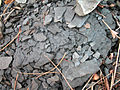
Shale is a fine-grained, clastic sedimentary rock formed from mud that is a mix of flakes of clay minerals (hydrous aluminium phyllosilicates, e.g., kaolin, Al2Si2O5(OH)4) and tiny fragments (silt-sized particles) of other minerals, especially quartz and calcite.[1] Shale is characterized by its tendency to split into thin layers (laminae) less than one centimeter in thickness. This property is called fissility.[1] Shale is the most common sedimentary rock.[2]

The term shale is sometimes applied more broadly, as essentially a synonym for mudrock, rather than in the narrower sense of clay-rich fissile mudrock.[3]

Texture

[edit]

Shale typically exhibits varying degrees of fissility. Because of the parallel orientation of clay mineral flakes in shale, it breaks into thin layers, often splintery and usually parallel to the otherwise indistinguishable bedding planes.[4] Non-fissile rocks of similar composition and particle size (less than 0.0625 mm) are described as mudstones (1/3 to 2/3 silt particles) or claystones (less than 1/3 silt). Rocks with similar particle sizes but with less clay (greater than 2/3 silt) and therefore grittier are siltstones.[4][5]

Sample of drill cuttings of shale while drilling an oil well in Louisiana, United States. Sand grain = 2 mm in diameter

Composition and color

[edit]
Color chart for shale based on oxidation state and organic carbon content

Shales are typically gray in color and are composed of clay minerals and quartz grains. The addition of variable amounts of minor constituents alters the color of the rock. Red, brown and green colors are indicative of ferric oxide (hematite – reds), iron hydroxide (goethite – browns and limonite – yellow), or micaceous minerals (chlorite, biotite and illite – greens).[4] The color shifts from reddish to greenish as iron in the oxidized (ferric) state is converted to iron in the reduced (ferrous) state.[6] Black shale results from the presence of greater than one percent carbonaceous material and indicates a reducing environment.[4] Pale blue to blue-green shales typically are rich in carbonate minerals.[7]

Clays are the major constituent of shales and other mudrocks. The clay minerals represented are largely kaolinite, montmorillonite and illite. Clay minerals of Late Tertiary mudstones are expandable smectites, whereas in older rocks (especially in mid-to early Paleozoic shales) illites predominate. The transformation of smectite to illite produces silica, sodium, calcium, magnesium, iron and water. These released elements form authigenic quartz, chert, calcite, dolomite, ankerite, hematite and albite, all trace to minor (except quartz) minerals found in shales and other mudrocks.[4] A typical shale is composed of about 58% clay minerals, 28% quartz, 6% feldspar, 5% carbonate minerals, and 2% iron oxides.[8] Most of the quartz is detrital (part of the original sediments that formed the shale) rather than authigenic (crystallized within the shale after deposition).[9]

Shales and other mudrocks contain roughly 95 percent of the organic matter in all sedimentary rocks. However, this amounts to less than one percent by mass in an average shale. Black shales, which form in anoxic conditions, contain reduced free carbon along with ferrous iron (Fe2+) and sulfur (S2−). Amorphous iron sulfide, along with carbon, produce the black coloration.[4] Because amorphous iron sulfide gradually converts to pyrite, which is not an important pigment, young shales may be quite dark from their iron sulfide content, in spite of a modest carbon content (less than 1%), while a black color in an ancient shale indicates a high carbon content.[7]

Most shales are marine in origin,[10] and the groundwater in shale formations is often highly saline. There is evidence that shale acts as a semipermeable medium, allowing water to pass through while retaining dissolved salts.[11][12]

Formation

[edit]

The fine particles that compose shale can remain suspended in water long after the larger particles of sand have been deposited. As a result, shales are typically deposited in very slow moving water and are often found in lakes and lagoonal deposits, in river deltas, on floodplains and offshore below the wave base.[13] Thick deposits of shale are found near ancient continental margins[13] and foreland basins.[14] Some of the most widespread shale formations were deposited by epicontinental seas. Black shales[8] are common in Cretaceous strata on the margins of the Atlantic Ocean, where they were deposited in fault-bounded silled basins associated with the opening of the Atlantic during the breakup of Pangaea. These basins were anoxic, in part because of restricted circulation in the narrow Atlantic, and in part because the very warm Cretaceous seas lacked the circulation of cold bottom water that oxygenates the deep oceans today.[15]

Most clay must be deposited as aggregates and floccules, since the settling rate of individual clay particles is extremely slow.[16] Flocculation is very rapid once the clay encounters highly saline sea water.[17] Whereas individual clay particles are less than 4 microns in size, the clumps of clay particles produced by flocculation vary in size from a few tens of microns to over 700 microns in diameter. The floccules start out water-rich, but much of the water is expelled from the floccules as the clay minerals bind more tightly together over time (a process called syneresis).[18] Clay pelletization by organisms that filter feed is important where flocculation is inhibited. Filter feeders produce an estimated 12 metric tons of clay pellets per square kilometer per year along the U.S. Gulf Coast.[19]

As sediments continue to accumulate, the older, more deeply buried sediments begin to undergo diagenesis. This mostly consists of compaction and lithification of the clay and silt particles.[20][21] Early stages of diagenesis, described as eogenesis, take place at shallow depths (a few tens of meters) and are characterized by bioturbation and mineralogical changes in the sediments, with only slight compaction.[22] Pyrite may be formed in anoxic mud at this stage of diagenesis.[8][23]

Deeper burial is accompanied by mesogenesis, during which most of the compaction and lithification takes place. As the sediments come under increasing pressure from overlying sediments, sediment grains move into more compact arrangements, ductile grains (such as clay mineral grains) are deformed, and pore space is reduced.[24] In addition to this physical compaction, chemical compaction may take place via pressure solution. Points of contact between grains are under the greatest strain, and the strained mineral is more soluble than the rest of the grain. As a result, the contact points are dissolved away, allowing the grains to come into closer contact.[21]

It is during compaction that shale develops its fissility, likely through mechanical compaction of the original open framework of clay particles. The particles become strongly oriented into parallel layers that give the shale its distinctive fabric.[25] Fissility likely develops early in the compaction process, at relatively shallow depth, since fissility does not seem to vary with depth in thick formations.[26] Kaolinite flakes have less tendency to align in parallel layers than other clays, so kaolinite-rich clay is more likely to form nonfissile mudstone than shale. On the other hand, black shales often have very pronounced fissility (paper shales) due to binding of hydrocarbon molecules to the faces of the clay particles, which weakens the binding between particles.[27]

Lithification follows closely on compaction, as increased temperatures at depth hasten deposition of cement that binds the grains together. Pressure solution contributes to cementing, as the mineral dissolved from strained contact points is redeposited in the unstrained pore spaces. The clay minerals may be altered as well. For example, smectite is altered to illite at temperatures of about 55 to 200 °C (130 to 390 °F), releasing water in the process.[8] Other alteration reactions include the alteration of smectite to chlorite and of kaolinite to illite at temperatures between 120 and 150 °C (250 and 300 °F).[8] Because of these reactions, illite composes 80% of Precambrian shales, versus about 25% of young shales.[28]

Unroofing of buried shale is accompanied by telogenesis, the third and final stage of diagenesis.[22] As erosion reduces the depth of burial, renewed exposure to meteoric water produces additional changes to the shale, such as dissolution of some of the cement to produce secondary porosity. Pyrite may be oxidized to produce gypsum.[21]

Black shales are dark, as a result of being especially rich in unoxidized carbon. Common in some Paleozoic and Mesozoic strata, black shales were deposited in anoxic, reducing environments, such as in stagnant water columns.[8] Some black shales contain abundant heavy metals such as molybdenum, uranium, vanadium, and zinc.[8][29][30][31] The enriched values are of controversial origin, having been alternatively attributed to input from hydrothermal fluids during or after sedimentation or to slow accumulation from sea water over long periods of sedimentation.[30][32][33]

Fossils, animal tracks or burrows and even raindrop impressions are sometimes preserved on shale bedding surfaces. Shales may also contain concretions consisting of pyrite, apatite, or various carbonate minerals.[34]

Shales that are subject to heat and pressure of metamorphism alter into a hard, fissile, metamorphic rock known as slate. With continued increase in metamorphic grade the sequence is phyllite, then schist and finally gneiss.[35]

As hydrocarbon source rock

[edit]

Shale is the most common source rock for hydrocarbons (natural gas and petroleum).[8] The lack of coarse sediments in most shale beds reflects the absence of strong currents in the waters of the depositional basin. These might have oxygenated the waters and destroyed organic matter before it could accumulate. The absence of carbonate rock in shale beds reflects the absence of organisms that might have secreted carbonate skeletons, also likely due to an anoxic environment. As a result, about 95% of organic matter in sedimentary rocks is found in shales and other mudrocks. Individual shale beds typically have an organic matter content of about 1%, but the richest source rocks may contain as much as 40% organic matter.[36]

The organic matter in shale is converted over time from the original proteins, polysaccharides, lipids, and other organic molecules to kerogen, which at the higher temperatures found at greater depths of burial is further converted to graphite and petroleum.[37]

Historical mining terminology

[edit]

Before the mid-19th century, the terms slate, shale and schist were not sharply distinguished.[38] In the context of underground coal mining, shale was frequently referred to as slate well into the 20th century.[39] Black shale associated with coal seams is called black metal.[40]

See also

[edit]
  • Bakken Formation – Geological formation in North America
  • Barnett Shale – Geological formation in Texas, United States
  • Bearpaw Formation – Geologic formation in North America
  • Burgess Shale – Fossil-bearing rock formation in the Canadian Rockies
  • Emu Bay Shale – Geological formation in South Australia
  • Marcellus Formation – Middle Devonian age unit of sedimentary rock
  • Mazon Creek fossil beds – Conservation lagerstätte in Illinois on the National Register of Historic Places
  • Oil shale – Organic-rich fine-grained sedimentary rock containing kerogen
  • Shale gas – Natural gas trapped in shale formations
  • Wheeler Shale – Geologic formation in Utah notable for trilobite fossils
  • Bringelly Shale – Triassic age unit of sedimentary rock in Australia

References

[edit]
[edit]
Revisions and contributorsEdit on WikipediaRead on Wikipedia
from Grokipedia
Shale is a fine-grained, clastic formed by the consolidation and compaction of clay, , or deposits, typically exhibiting fissility—the tendency to split into thin, parallel layers along planes. It constitutes the most abundant type of , comprising approximately 70 percent of all . Shale primarily consists of clay minerals such as , , and , along with variable amounts of , , and (see Composition). These rocks form in low-energy depositional environments, such as deep marine basins, lakes, or floodplains (see Formation and Occurrence). Physical properties of shale include low permeability and high plasticity when wet (see Definition and Characteristics). Geologically, shale plays a critical role as a cap rock in systems, trapping hydrocarbons in underlying reservoirs due to its sealing properties, and as a source rock when enriched with organic content. Notable types include black shale, which is organic-rich and often contains , giving it a dark color and potential for preservation; and , a variant laden with that can yield and combustible gas upon heating (pyrolysis). is defined as a fine-grained containing sufficient to produce substantial amounts of and combustible gas when retorted. Note that "shale oil" can also refer to liquid extracted from tight shale formations via hydraulic fracturing, distinct from oil produced by heating . As of 2025, economically, shale has transformed global energy markets through hydraulic fracturing and horizontal drilling techniques, enabling the extraction of vast reserves of (tight oil) and —collectively known as unconventional resources—from low-permeability formations. In the United States, these resources have driven , boosted employment, and reduced reliance on imported oil, with production from formations like the Bakken and Marcellus shales contributing significantly to domestic output (averaging over 13 million barrels per day for crude oil and 106 billion cubic feet per day for in early 2025). Beyond energy, shale serves industrial purposes, including the manufacture of bricks, tiles, , and ceramics, due to its abundance and moldability when fired (see Economic and Industrial Uses).

Definition and Characteristics

Definition

Shale is a fine-grained, clastic composed primarily of consolidated clay and minerals, with particle sizes generally less than 0.0625 mm. This composition arises from the of , a mixture of clay flakes and silt-sized particles derived from weathered source materials. As one of the most abundant s, shale forms through the compaction and cementation of these fine sediments in quiet depositional settings. The defining characteristic of shale is its fissility, the property that allows it to split easily into thin, parallel layers along planes. This fissility develops due to the preferred orientation of platy clay minerals, such as or , which align during deposition under calm water conditions and become accentuated through diagenetic processes like pressure solution and . Without this aligned microstructure, similar fine-grained rocks lack the ability to cleave in such a manner. Shale differs from mudstone, its non-fissile counterpart, which breaks into irregular, blocky fragments rather than thin slabs due to a more massive or weakly laminated texture. Claystone, on the other hand, represents an even finer-grained end-member, consisting predominantly of clay-sized particles (less than 0.004 mm) with minimal and exhibiting blocky fracturing without pronounced fissility. These distinctions are based on distribution and structural fabric rather than chemical differences. Within the broader classification of sedimentary rocks, shale belongs to the detrital or clastic category, originating from the mechanical breakdown and transport of pre-existing rocks from . Its particles are transported by water or wind and settle in low-energy environments, such as deep marine basins or floodplains, where sorting produces the uniform fine texture.

Physical Properties

Shale is characterized by a fine-grained, laminated or fissile texture that enables it to cleave into thin sheets parallel to the planes, distinguishing it from more massive fine-grained rocks. This structure imparts low permeability, typically on the order of 1 to 1000 nanodarcies, severely limiting fluid migration through . Additionally, shale often displays brittleness, which affects its deformability under applied stress and is evident in its tendency to rather than ductily deform. The of shale ranges from 2.4 to 2.8 g/cm³, influenced by compaction levels and the packing of its constituent particles, with higher values indicating greater induration. in shale is generally low, between 1% and 10%, dominated by micropores and nanopores that contribute to its overall impermeability despite the presence of void space. In organic-rich varieties suitable as source rocks, a portion of this —up to several percent—arises from , enhancing storage capacity for hydrocarbons within the matrix. Shale's mechanical properties reflect its anisotropic nature due to layering, with significant differences in parallel and perpendicular to the . Tensile strength is low, typically 2–10 MPa, rendering the rock susceptible to tensile failure and hydraulic fracturing. In contrast, compressive is higher, ranging from 50 to 200 MPa, providing resistance to pressures while the fissile structure promotes directional weakness. Shale occurs in a variety of colors, most commonly gray, , or , which serve as visual identifiers in field and hand-sample examinations.

Composition

Mineral Composition

Shale primarily consists of clay minerals, which form the dominant component and typically account for 60-80% of its mineralogical makeup. These clay minerals include , , , and , with often being the most prevalent in many shales, comprising up to 55% of the clay fraction, followed by illite-smectite mixed-layer clays at around 30%, at 10%, and at 5%. The high proportion of these platy clay minerals contributes to shale's characteristic fissility by allowing cleavage along parallel planes. Quartz is the next most abundant in shale, generally ranging from 10-30% and occurring as detrital silt-sized grains derived from weathered source rocks. , primarily , constitutes 5-15% and serves as another detrital component, while accessory minerals such as , , and make up smaller fractions, often less than 5% each, adding trace elements and influencing local reactivity. These proportions reflect the fine-grained clastic nature of shale, with overall varying based on source material and transport processes. The mineral composition of shale exhibits notable variations depending on the . In terrestrial or fluvial settings, shales tend to have higher content due to intense chemical in source areas, promoting the formation of this 1:1 . In contrast, marine shales are enriched in and , reflecting lower intensity and contributions from physical erosion of crystalline rocks. Such environmental influences can shift assemblages significantly, with more common in volcanic-influenced or alkaline settings. Shale's grain size distribution underscores its mudrock classification, with 40-90% of particles being clay-sized (<2 μm) and 10-50% silt-sized (2-62.5 μm), resulting in a dominantly fine matrix that imparts low permeability. Post-depositional processes lead to the formation of authigenic minerals, such as overgrowths on detrital or precipitation of carbonates like , which can comprise up to several percent and alter the rock's and mechanical properties during .

Organic and Chemical Components

Shale contains varying amounts of , primarily in the form of , which serves as the precursor to . In source rocks, the (TOC) content typically ranges from 0.5% to 20% by weight, with higher values indicating greater potential for hydrocarbon generation. is categorized into three main types—I, II, and III—based on its biological origin and : type I derives from lipid-rich algal material and is highly oil-prone; type II originates from mixed marine and liptodetrinite, yielding both oil and gas; and type III consists of terrestrial humic plant debris, predominantly gas-prone. These types are dispersed within the mineral matrix, influencing the rock's reactivity and diagenetic behavior. The chemical makeup of shale reflects its clay-rich nature, with major oxides comprising the bulk of its composition. Silica (SiO₂) averages 50–60%, forming the framework from and silicates, while alumina (Al₂O₃) ranges from 15–25%, primarily from clay minerals like and . Minor oxides include ferric oxide (Fe₂O₃, typically 4–7%), magnesia (MgO, 2–3%), and (K₂O, 3–4%), which contribute to the rock's geochemical signature and stability. These oxides, expressed as SiO₂, Al₂O₃, Fe₂O₃, MgO, and K₂O, vary slightly by but underscore shale's dominance. Certain shales, especially varieties, show enrichment in trace elements such as (U), (V), and (Mo), often at concentrations orders of magnitude above crustal averages. This enrichment occurs under anoxic bottom-water conditions during deposition, where reducing environments promote the adsorption and fixation of these redox-sensitive metals onto and sulfides from . The coloration of shale arises directly from its organic and chemical constituents. Abundant imparts dark gray to hues by absorbing light, whereas the oxidation of iron to Fe₂O₃ produces or tones in oxygenated settings with minimal organics.

Formation and Occurrence

Sedimentary Formation Processes

Shale originates from fine-grained clastic sediments primarily composed of clay and particles generated through the physical and chemical of source rocks, such as feldspar-rich granites and volcanic materials, which break down into platy minerals like and . These particles are subsequently eroded and transported by fluvial, eolian, or glacial processes to sedimentary basins, where they settle out of suspension due to decreasing in the transport medium. Deposition occurs predominantly in low-energy aquatic environments that favor the accumulation of without significant reworking, including deep marine settings below the wave base, lacustrine basins with calm waters, and distal deltaic zones where currents are minimal. In these settings, the fine particles form thin, layered deposits of , often interbedded with minor or , creating the initial laminated fabric that persists through later stages. As burial progresses, mechanical compaction driven by the load expels interstitial water and reduces pore volume, resulting in a 70-90% decrease in the original volume and the parallel alignment of clay flakes, which confers shale's distinctive fissility and low permeability. This dewatering phase transitions into , where early cementation by authigenic minerals like or stabilizes the framework at shallow depths and low temperatures. Further diagenetic alteration involves chemical transformations, notably the illitization of expandable clays into non-expandable at burial temperatures of 70-150°C, facilitated by potassium-rich fluids and increasing thermal gradients, which enhances structural integrity while maintaining the rock below metamorphic thresholds. This progressive illitization, often occurring in mixed-layer illite- phases, reduces further and influences the rock's mechanical properties without introducing significant recrystallization.

Geological Distribution and Settings

Shale deposits occur worldwide, forming a substantial component of the record and reflecting diverse depositional environments shaped by tectonic processes. These rocks are the most prevalent clastic sedimentary type, constituting approximately 80% of the volume preserved in the . Their global distribution spans continental interiors to marine margins, with key accumulations in regions like , , , , and . Shales are documented across a broad stratigraphic range, from black shales dating back approximately 3.5 billion years ago to examples, though they predominate in and successions due to widespread marine transgressions and basin development during those eras. Early notable occurrences include the in , , which preserves exceptional fossils from a Middle (about 508 million years old) submarine deposit. In the , prominent examples encompass the Middle Marcellus Shale in the Appalachian Basin of the and the Late to Early Mississippian in the of , (USA), and (), a vast organic-rich unit spanning multiple states. deposits are exemplified by the Late to Early Formation in Argentina's Basin, one of the largest unconventional resource plays globally. Tectonically, shales form in low-energy settings such as foreland basins adjacent to collisional orogens, passive continental margins with subsidence-driven accommodation, and intracratonic basins where stable cratonic interiors accumulate fine-grained sediments. shales often developed in flooded foreland basins along convergent margins, while and younger ones frequently occur in semi-restricted intracratonic or back-arc basins. Black shales, distinguished by high organic content, are particularly linked to episodic oceanic anoxic events (OAEs), such as the Cenomanian-Turonian OAE 2 in the , when global facilitated widespread organic carbon burial across epicontinental seas and deep basins. These events underscore shales' role in recording paleoceanographic perturbations, with distributions tied to eustatic sea-level rises and restricted circulation. Major resource concentrations highlight regional tectonic histories: in , shales like the Marcellus dominate the Appalachian foreland; in , shales such as the Longmaxi Formation fill intracratonic depocenters; and in the , equivalents occupy rift-related basins. This tectonic diversity ensures shales' ubiquity, covering vast areas and influencing global sedimentary architecture.

Economic and Industrial Uses

As Hydrocarbon Source Rock

Shale serves as a primary source rock due to its high organic content, primarily in the form of , which undergoes thermal maturation under increasing burial temperatures and pressures. During this process, experiences thermal cracking, transforming into liquid hydrocarbons in the oil window at temperatures of 60–120°C and gaseous hydrocarbons in the gas window at 100–150°C. Vitrinite reflectance (Ro), a key maturity indicator, typically ranges from 0.6% to 1.3% within the oil window, marking the peak generation of oil from type I and II . Beyond this, in the gas window, higher temperatures lead to further cracking of remaining oil and into , with Ro values exceeding 1.3%. This maturation is influenced by the organic matter's initial composition, as detailed in shale's chemical components. The quality of shale as a source rock is evaluated using parameters such as (TOC) content and hydrogen index (HI). Shales with TOC greater than 2% are considered good to excellent source rocks, providing sufficient organic material for significant hydrocarbon generation. Additionally, an HI exceeding 300 mg HC/g TOC indicates oil-prone (types I and II), reflecting high generative potential for liquid hydrocarbons, while lower HI values suggest gas-prone type III . These metrics, derived from Rock-Eval pyrolysis, help assess the richness and type of hydrocarbons a shale formation can yield, with mature shales often exhibiting TOC values in this range across major basins. In many cases, shale acts as both source and in unconventional systems, where low permeability—often less than 0.1 millidarcy—traps generated hydrocarbons as or . These self-sourced reservoirs require hydraulic fracturing to create conductive pathways for extraction, enabling commercial production from formations like the Bakken or Marcellus. The boom in the United States, accelerating since the early 2000s with advancements in horizontal and fracturing, exemplifies this; by 2023, accounted for approximately 78% of total U.S. dry production. This shift has transformed global energy markets, highlighting shale's role in unconventional resource development.

Non-Hydrocarbon Applications

Shale finds significant application in the ceramics industry, where its clay mineral content imparts plasticity when wet, allowing it to be molded into shapes that harden upon firing. This property enables the production of bricks, ceramic tiles, and pottery, with common clay and shale serving as primary raw materials for these durable, heat-resistant products. Ground shale, often mixed with other clays, is extruded, dried, and fired at temperatures exceeding 1,000°C to achieve structural integrity, making it a cost-effective alternative to pure clay in large-scale manufacturing. In cement production, ground shale serves as a key raw material in Portland cement clinker, providing essential silica and alumina to balance the mix with limestone, typically comprising 10-15% of the raw feed to ensure proper chemical composition during high-temperature sintering. Additionally, crushed shale acts as an aggregate in road base construction, valued for its availability and binding properties when compacted, though it requires proper drainage layers to mitigate potential breakdown under traffic loads. Certain high-alumina shales, rich in minerals, are utilized in the manufacture of furnace linings and other high-temperature components, where their stability withstands extreme without significant degradation. These shales, often processed into bricks or castables, offer resistance to and spalling in industrial kilns and boilers. Historically, has seen niche applications beyond energy, particularly in pre-21st-century contexts where retorted spent shale was incorporated into manufacturing to leverage its residues for clinker production, though modern adoption remains limited due to specialized processing needs. Early uses also included firing in furnaces and kilns as a supplementary source, reflecting its dual role in industrial materials before widespread focus shifted to hydrocarbon extraction.

Extraction and Environmental Considerations

Mining Techniques and History

The extraction of shale has evolved significantly since the , when became a primary method for obtaining the material primarily for production. In regions like and , shale deposits were accessed through surface excavations using manual shovels and basic tools, with some operations reaching depths exceeding 100 feet. By the late 1800s, these techniques supported booming industries in areas such as , where shale was quarried to meet demand for construction materials like paving bricks and heavy ware. A key aspect of shale extraction terminology distinguishes "" from "." Oil shale refers to a rich in , an that requires in-situ heating or and retorting to produce , a process historically pursued in the with early patents granted as far back as 1694 in . In contrast, shale oil denotes liquid hydrocarbons trapped within shale formations, extracted via modern drilling rather than processing the rock itself. Modern of shale for construction aggregates and bricks continues to rely on quarrying techniques involving , blasting, and excavation. Operations typically employ power equipment to create benches in open pits, where explosives fragment the rock, followed by mechanical loading and hauling to sites. This method suits shallower, accessible deposits and has remained standard since the adoption of mechanized tools in the early 20th century. Subsurface extraction methods emerged in the late 20th century to access deeper shale resources, driven by the rock's low permeability that limits natural hydrocarbon flow. Initial efforts used conventional vertical wells, but these proved inefficient for tight shale formations. The breakthrough came in the 1990s through innovations by Mitchell Energy in the Barnett Shale of Texas, where horizontal drilling was combined with multi-stage hydraulic fracturing—pumping high-pressure fluid mixtures to create fractures and release trapped gas and oil. Mitchell's first horizontal well in 1991 and refinement of slickwater fracking by 1997 marked pivotal milestones, transforming shale from a marginal resource to a major energy play.

Environmental Impacts

Shale gas extraction, particularly through hydraulic fracturing, poses significant risks to , primarily through the potential contamination of aquifers by fracking fluids and migration. Fracking fluids, which consist of , sand, and chemical additives, can introduce contaminants into if well integrity is compromised, leading to temporary or permanent changes in near production sites. The U.S. Agency's 2016 assessment found that while widespread systemic impacts on are not occurring, localized contamination incidents have been documented, often resulting from spills or faulty casing during well construction. migration to shallow aquifers has also been observed in areas of intensive , where from deeper formations escapes through natural or man-made pathways, elevating dissolved levels in private wells. A 2011 study in the Marcellus Shale region reported concentrations in 82% of water samples from homes within 1 km of sites, compared to 7% in distant samples, attributing this to proximity to active wells rather than direct fracking fluid intrusion. Induced seismicity represents another major environmental concern associated with shale development, largely stemming from the underground injection of generated during extraction. In , disposal into deep wells triggered a sharp increase in earthquakes starting in 2009, with the rate of magnitude 3.0 and larger events surpassing that of by 2013 and reaching levels comparable to highly active tectonic zones worldwide. The U.S. Geological Survey has linked this surge directly to injection volumes exceeding 1 billion barrels annually in the state, where pressurized fluids lubricate faults and induce slip. However, following regulatory restrictions on injection volumes implemented since 2015, earthquake rates have substantially decreased, with only around 20 events of magnitude 3.0 or greater recorded in 2023, though risks persist. Events as large as magnitude 5.8, such as the 2016 Pawnee earthquake, have caused structural damage and heightened public safety risks, prompting regulatory adjustments to injection practices. Air emissions from shale operations contribute to atmospheric through the release of volatile organic compounds (VOCs) and gases, often via venting and flaring of excess . Flaring, used to burn off unwanted gas at wellheads, emits , , and nitrogen oxides, while incomplete combustion produces VOCs like , which are precursors to formation. The EPA's Reporting Program indicates that the petroleum and systems sector, including shale plays, accounted for about 28% of U.S. in 2021, with venting and flaring contributing significantly during well completion and production phases. These emissions exacerbate and regional air quality issues, with studies showing elevated levels in the Permian Basin exceeding national ambient air quality standards. Land use changes from shale extraction disrupt habitats and pose challenges for remediation, as surface infrastructure fragments ecosystems and alters landscapes. Construction of well pads, roads, and pipelines in forested or areas leads to habitat loss and increased , reducing core wildlife habitats by up to 12-15% in affected regions like Pennsylvania's Marcellus Shale. In the Appalachian Basin, a USGS found that gas development converted over 50,000 acres of forest to non-forest land between 2004 and 2010, with long-term impacts on exceeding those from due to persistent infrastructure. Restoration efforts face obstacles, including , , and chemical residues that hinder revegetation, often requiring years of monitoring and soil amendments to achieve pre-disturbance conditions. Regulatory responses since the have aimed to mitigate these impacts through enhanced monitoring and standards. The U.S. EPA initiated comprehensive assessments of hydraulic fracturing's effects on in 2011, culminating in a 2016 report that informed stricter wastewater management rules. In 2012, the EPA issued New Source Performance Standards to reduce VOC and from new and modified and gas facilities, including shale operations, targeting a 95% reduction in well completion emissions. Seismic monitoring has been bolstered by USGS partnerships with states, leading to injection limits in high-risk areas like since 2015. In March 2024, the EPA finalized updated NSPS and emission guidelines requiring substantial cuts in and VOC emissions from new and existing and gas facilities, including shale operations, targeting an 80% reduction by 2030. These measures, while improving oversight, continue to evolve amid ongoing debates over enforcement and cumulative effects.

References

Add your contribution
Related Hubs
User Avatar
No comments yet.