Hubbry Logo
HandballHandballMain
Open search
Handball
Community hub
Handball
logo
8 pages, 0 posts
0 subscribers
Be the first to start a discussion here.
Handball
Handball
from Wikipedia

Handball game highlights video

Key Information

Handball (also known as team handball, European handball, Olympic handball,[3] or indoor handball) is a team sport in which two teams of seven players each (six outcourt players and a goalkeeper) pass a ball using their hands with the aim of throwing it into the goal of the opposing team. A standard match consists of two periods of 30 minutes, and the team that scores more goals wins.

Modern handball is played on a court of 40 by 20 metres (131 by 66 ft), with a goal in the middle of each end. The goals are surrounded by a 6-metre (20 ft) zone where only the defending goalkeeper is allowed; goals must be scored by throwing the ball from outside the zone or while "diving" into it. The sport is usually played indoors, but outdoor variants exist in the forms of field handball, Czech handball (which were more common in the past) and beach handball. The game is fast and high-scoring: professional teams now typically score between 20 and 35 goals each, though lower scores were not uncommon until a few decades ago. Body contact is permitted for the defenders trying to stop the attackers from approaching the goal. No protective equipment is mandated, but players may wear soft protective bands, pads and mouth guards.[4]

The modern set of rules was published in 1917 by Karl Schelenz, Max Heiser, and Erich Konigh,[5] on 29 October in Berlin, which is seen as the date of birth of the sport.[1][6] The rules have had several revisions since. The first official handball match was played in 1917 in Germany.[1] Karl Schelenz modified the rules in 1919.[5] The first international games were played (under these rules) with men in 1925 (between Germany and Belgium) and with women in 1930 (between Germany and Austria).[7]

Men's handball was first played at the Olympics in the 1936 Summer Olympics in Berlin outdoors, and the next time at the 1972 Summer Olympics in Munich indoors; handball has been an Olympic sport since then. Women's handball was added at the 1976 Summer Olympics.[8]

The International Handball Federation was formed in 1946 and, as of 2016, has 197 member federations.[9] The sport is most popular in Europe, and European countries have won all medals but one in the men's world championships since 1938. In the women's world championships, only two non-European countries have won the title: South Korea and Brazil. The game also enjoys popularity in East Asia, North Africa and parts of South America.

Origins and development

[edit]
A picture copied from an amphora shows youths playing a version of handball, c. 500 BC.

Games similar to handball were played in Ancient Greece and are represented on amphorae and stone carvings. Although detailed textual reference is rare, there are numerous descriptions of ball games being played where players throw the ball to one another; sometimes this is done in order to avoid interception by a player on the opposing team. Such games were played widely and served as both a form of exercise and a social event.[10]

There is evidence of ancient Roman women playing a version of handball called expulsim ludere.[11] There are records of handball-like games in medieval France, and among the Inuit in Greenland, in the Middle Ages. By the 19th century, there existed similar games of håndbold from Denmark, házená in the Czech Republic, handbol in Ukraine, and torball in Germany.[12]

The team handball game of today was codified at the end of the 19th century in northern Europe: primarily in Denmark, Germany, Norway, and Sweden. The first written set of team handball rules was published in 1906 by the Danish gym teacher, lieutenant and Olympic medalist Holger Nielsen from Ordrup grammar school, north of Copenhagen. The modern set of rules was published by Max Heiser, Karl Schelenz, and Erich Konigh in 1917[5] on 29 October in Berlin, Germany; this day is therefore seen as the "date of birth" of the sport.[1][6] The first official handball match was played on 2 December 1917 in Berlin.[1] In 1919 the rules were modified by Karl Schelenz.[5] The first international games were played under these rules, between Germany and Austria by men in 1925 and between Germany and Austria by women in 1930.[7]

In 1926, the Congress of World Athletics (then known as the International Amateur Athletic Federation) nominated a committee to draw up international rules for field handball. The International Amateur Handball Federation was formed in 1928 and later the International Handball Federation was formed in 1946.

Men's field handball was played at the 1936 Summer Olympics in Berlin. During the next several decades, indoor handball flourished and evolved in the Scandinavian countries. The sport re-emerged onto the world stage as men's team handball for the 1972 Summer Olympics in Munich. Women's team handball was added at the 1976 Summer Olympics in Montreal.[8][13] Due to its popularity in the region, the Eastern European countries that refined the event became the dominant force in the sport when it was reintroduced.

The International Handball Federation organised the men's world championship in 1938 and every four (sometimes three) years from World War II to 1995. Since the 1995 world championship in Iceland, the competition has been held every two years. The women's world championship has been held since 1957. The IHF also organizes women's and men's junior world championships. By July 2009, the IHF listed 166 member federations – approximately 795,000 teams and 19 million players.

Rules

[edit]

The rules are laid out in the IHF's set of rules, most recently published in 2024.[14]

Summary

[edit]

Two teams of seven players (six court players plus one goalkeeper) take the court and attempt to score points by putting the game ball into the opposing team's goal. In handling the ball, players are subject to the following restrictions:

  • After receiving the ball, players can pass, keep possession, or shoot the ball.
  • Players are not allowed to touch the ball with their feet. The goalkeeper is the only player allowed to use their feet, but only within the goal area.
  • If possessing the ball, players must dribble (comparable to a basketball dribble), or can take up to three steps for up to three seconds at a time without dribbling.
  • No attacking or defending players other than the defending goalkeeper are allowed to touch the floor of the goal area (within six metres of the goal). A shot or pass in the goal area is valid if completed before touching the floor. Goalkeepers are allowed outside the goal area, but are not allowed to cross the goal area boundary with the ball in their hands.
  • The ball may not be passed back to the goalkeeper when they are positioned in the goal area.

Notable scoring opportunities can occur when attacking players jump into the goal area. For example, an attacking player may catch a pass while launching toward the inside of the goal area, and then shoot or pass before touching the floor. Doubling occurs when a diving attacking player passes to another diving teammate.

Playing court

[edit]
Schematic diagram of a handball court
An outdoor handball court

Handball is played on a court 40 by 20 metres (131 ft 3 in × 65 ft 7 in), with a goal in the centre of each end. The goals are surrounded by a near-semicircular area, called the zone or the crease, defined by a line six metres from the goal. A dashed near-semicircular line nine metres from the goal marks the free-throw line. Each line on the court is part of the area it encompasses; the centre line belongs to both halves at the same time.

Goals

[edit]

The goals are two metres high and three metres wide. They must be securely bolted either to the floor or the wall behind.

The goal posts and the crossbar must be made out of the same material (e.g., wood or aluminium) and feature a quadratic cross section with sides of 8 cm (3 in). The three sides of the beams visible from the playing court must be painted alternatingly in two contrasting colors which both have to contrast against the background. The colors on both goals must be the same.

Each goal must feature a net. This must be fastened in such a way that a ball thrown into the goal does not leave or pass the goal under normal circumstances. If necessary, a second net may be clasped to the back of the net on the inside.

Crease

[edit]

The goals are surrounded by the crease, also called the zone. This area is delineated by two quarter circles with a radius of six metres around the far corners of each goal post and a connecting line parallel to the goal line. Only the defending goalkeeper is allowed inside this zone. Court players may catch and touch the ball in the air within it as long as the player starts their jump outside the zone and releases the ball before they land (landing inside the perimeter is allowed in this case as long as the ball has been released).

If a player without the ball contacts the ground inside the goal perimeter, or the line surrounding the perimeter, they must take the most direct path out of it. Should a player cross the zone in an attempt to gain an advantage (e.g., better position) their team cedes the ball. Similarly, violation of the zone by a defending player is penalized only if they do so in order to gain an advantage in defending.

Substitution area

[edit]

Outside of one long edge of the court to both sides of the middle line are the substitution areas for each team. Team officials, substitutes, and suspended players must wait within this area. A team's area is the same side as the goal the team is defending; during halftime, substitution areas are swapped. Any player entering or leaving the play must cross the substitution line which is part of the side line and extends 4.5 metres (15 ft) from the middle line to the team's side.

Duration

[edit]
Team timeout

A standard match has two 30-minute halves with a 10- or 15-minute (major Championships/Olympics) halftime intermission. At half-time, teams switch sides of the court as well as benches. For youths, the length of the halves is reduced—25 minutes at ages 12 to 15, and 20 minutes at ages 8 to 11; though national federations of some countries may differ in their implementation from the official guidelines.[14]

If a decision must be reached in a particular match (e.g., in a tournament) and it ends in a draw after regular time, there are at maximum two overtimes, each consisting of two straight 5-minute periods with a one-minute break in between. If these does not decide the game either, then the winning team is determined in a penalty shootout (best-of-five rounds; if still tied, extra rounds are added until one team wins).

The referees may call timeout according to their sole discretion; typical reasons are injuries, suspensions, or court cleaning. Penalty throws should trigger a timeout only for lengthy delays, such as a change of the goalkeeper.

Since 2012, teams can call 3 team timeouts per game (up to two per half), which last one minute each. This right may only be invoked by the team in possession of the ball. Team representatives must show a green card marked with a black T on the timekeeper's desk. The timekeeper then immediately interrupts the game by sounding the buzzer to stop the clock. Before 2012, teams were allowed only one timeout per half. For the purpose of calling timeouts, overtime and shootouts are extensions of the second half.

Referees

[edit]

A handball match is adjudicated by two equal referees. Some national bodies allow games with only a single referee in special cases like illness on short notice. Should the referees disagree on any occasion, a decision is made on mutual agreement during a short timeout; or, in case of punishments, the more severe of the two comes into effect. The referees are obliged to make their decisions "on the basis of their observations of facts".[15] Their judgements are final and can be appealed against only if not in compliance with the rules. Officials can look to TV replays, as needed.

The referees (blue shirts) keep both teams between them.

The referees position themselves in such a way that the team players are confined between them. They stand diagonally aligned so that each can observe one side line. Depending on their positions, one is called court referee and the other goal referee. These positions automatically switch on ball turnover. They physically exchange their positions approximately every 10 minutes (long exchange), and change sides every five minutes (short exchange).

The IHF defines 18 hand signals for quick visual communication with players and officials. The signal for warning is accompanied by a yellow card.[16] A disqualification for the game is indicated by a red card,[17] followed by a blue card if the disqualification will be accompanied by a report.[18] The referees also use whistle blows to indicate infractions or to restart the play.

The referees are supported by a scorekeeper and a timekeeper who attend to formal things such as keeping track of goals and suspensions, or starting and stopping the clock, respectively. They also keep an eye on the benches and notify the referees on substitution errors. Their desk is located between the two substitution areas.

Team players, substitutes, and officials

[edit]

Each team consists of seven players on court and seven substitute players on the bench. One player on the court must be the designated goalkeeper, differing in his clothing from the rest of the court players. Substitution of players can be done in any number and at any time during game play. An exchange takes place over the substitution line. A prior notification of the referees is not necessary.

Some national bodies, such as the Deutsche Handball Bund (DHB, "German Handball Federation"), allow substitution in junior teams only when in ball possession or during timeouts. This restriction is intended to prevent early specialization of players to offence or defence.

Court players

[edit]

Court players are allowed to touch the ball with any part of their bodies above and including the knee. As in several other team sports, a distinction is made between catching and dribbling. A player who is in possession of the ball may stand stationary for only three seconds, and may take only three steps. They must then either shoot, pass, or dribble the ball. Taking more than three steps at any time is considered travelling, and results in a turnover. A player may dribble as many times as they want (though, since passing is faster, it is the preferred method of attack), as long as during each dribble the hand contacts only the top of the ball. Therefore, carrying is completely prohibited, and results in a turnover. After the dribble is picked up, the player has the right to another three seconds or three steps. The ball must then be passed or shot, as further holding or dribbling will result in a double dribble turnover and a free throw for the other team. Other offensive infractions that result in a turnover include charging and setting an illegal screen. Carrying the ball into the six-metre zone results either in ball possession by the goalkeeper (by attacker) or turnover (by defender).

Goalkeeper

[edit]

Only the goalkeepers are allowed to move freely within the goal perimeter, although they may not cross the goal perimeter line while carrying or dribbling the ball. Within the zone, they are allowed to touch the ball with all parts of their bodies, including their feet, with a defensive aim (for other actions, they are subject to the same restrictions as the court players). The goalkeepers may participate in the normal play of their teammates. A regular court player may substitute for the goalkeeper if a team elects to use this scheme in order to outnumber the defending players. Prior to 2015, this court player became the designated goalkeeper on the court and had to wear some vest or bib the same color as the goalkeeper's shirt to be identified as such. A rule change meant to make the game more offensive now allows any player to substitute for the goalkeeper without becoming a designated goalkeeper. The new rule resembles the one used in ice hockey. This rule was first used in the women's world championship in December 2015 and has since been used by the men's European championship in January 2016 and by both genders in the Olympic tournament in 2016. This rule change has led to a drastic increase of empty net goals.[citation needed]

If either goalkeeper deflects the ball over the outer goal line, their team stays in possession of the ball, in contrast to other sports like football. The goalkeeper resumes the play with a throw from within the zone ("goalkeeper throw"). In a penalty shot or directly taken free throw, throwing the ball against the head of a goalkeeper who is not moving will lead to a direct disqualification ("red card"). Hitting a non-moving goalkeeper's head out of regular play will lead to a two-minute suspension as long as the player threw without obstruction.

Outside of own D-zone, the goalkeeper is treated as an ordinary court player, and has to follow court players' rules; holding or tackling an opponent player outside the area risks a direct disqualification.[clarification needed] The goalkeeper may not return to the area with the ball. Passing to one's own goalkeeper results in a turnover.

Team officials

[edit]

Each team is allowed to have a maximum of four team officials seated on the benches. An official is anybody who is neither player nor substitute. One official must be the designated representative who is usually the team manager. Since 2012, representatives can call up to 3 team timeouts (up to twice per half), and may address the scorekeeper, timekeeper, and referees (before that, it was once per half); overtime and shootouts are considered extensions of the second half. Other officials typically include physicians or managers. No official is allowed to enter the playing court without the permission of the referees.

Ball

[edit]
A size III handball

The ball is spherical and must be made either of leather or a synthetic material. It is not allowed to have a shiny or slippery surface. As the ball is intended to be operated by a single hand, its official sizes vary depending on age and gender of the participating teams.

Size Class Circumference
(cm)
Circumference
(in)
Weight
(g)
Weight
(oz)
III Men over 16 58–60 23–24 425–475 15.0–16.8
II Women over 14, men over 12 54–56 21–22 325–375 11.5–13.2
I Junior over 8 50–52 20–20 290–330 10–12

Awarded throws

[edit]

The referees may award a special throw to a team. This usually happens after certain events such as scored goals, off-court balls, turnovers and timeouts. All of these special throws require the thrower to obtain a certain position, and pose restrictions on the positions of all other players. Sometimes the execution must wait for a whistle blow by the referee.

Throw-off
A throw-off takes place from the center of the court. The thrower must touch the middle line with one foot, and all the other offensive players must stay in their half until the referee restarts the game. The defending players must keep a distance of at least three metres from the thrower until the ball leaves his hand. A throw-off occurs at the beginning of each period and after the opposing team scores a goal. It must be cleared by the referees.
Modern handball introduced the "fast throw-off" concept; i.e., the play will be immediately restarted by the referees as soon as the executing team fulfills its requirements. Many teams leverage this rule to score easy goals before the opposition has time to form a stable defense line.
Throw-in
The team which did not touch the ball last is awarded a throw-in when the ball fully crosses the side line or touches the ceiling. If the ball crosses the outer goal line, a throw-in is awarded only if the defending court players touched the ball last. Execution requires the thrower to place one foot on the nearest outer line to the cause. All defending players must keep a distance of three metres (9.8 ft). They are allowed to stand immediately outside their own goal area even when the distance is less than three metres.
Goalkeeper-throw
If the ball crosses the outer goal line without interference from the defending team or when deflected by the defending team's goalkeeper, or when the attacking team violates the D-zone as described above, a goalkeeper-throw is awarded to the defending team. This is the most common turnover. The goalkeeper resumes the play with a throw from anywhere within the goal area.
Free-throw
A free-throw restarts the play after an interruption by the referees. It takes places from the spot where the interruption was caused, as long as this spot is outside of the free-throw line of the opposing team. In the latter case, the throw is deferred to the nearest spot on the free-throw line. Free-throws are the equivalent to free-kicks in association football; conceding them is typically not seen as poor sportsmanship for the defending side, and in itself, they carry no major disadvantages. (In particular, being awarded a free throw while being on warning for passive play will not reset the warning, whereas a shot on goal will.) The thrower may take a direct attempt for a goal, which is rarely feasible if the defending team has organised a defense. If a free throw is awarded and the half or game ends, a direct throw at the goal is typically attempted, which occasionally goes in.
A seven-metre throw
Seven-metre throw
A seven-metre throw is awarded when a clear chance of scoring is illegally prevented anywhere on the court by an opposing team player, official, or spectator. It is awarded also when the referees have interrupted a legitimate scoring chance for any reason. The thrower steps with one foot behind the seven-metre line with only the defending goalkeeper between him and the goal. The goalkeeper must keep a distance of three metres away, which is marked by a short tick on the floor. All other players must remain behind the free-throw line until execution and the defending court players must keep a distance of three metres. The thrower must await the whistle blow of the referee. A seven-metre throw is the equivalent to a penalty kick in association football; it is far more common and typically occurs several times in a single game. It is thus tactically similar to free throw percentage in basketball and teams will try to have their best seven metre throwers execute those throws.

Penalties

[edit]
Yellow card shown in a handball match

Penalties are given to players, in progressive format, for fouls that require more punishment than just a free-throw. Actions directed mainly at the opponent and not the ball (such as reaching around, holding, pushing, tripping, and jumping into opponent) as well as contact from the side, from behind a player or impeding the opponent's counterattack are all considered illegal and are subject to penalty. Any infraction that prevents a clear scoring opportunity will result in a seven-metre penalty shot.

Typically the referee will give a warning yellow card for an illegal action; but, if the contact was particularly dangerous, like striking the opponent in the head, neck or throat, the referee can forego the warning for an immediate two-minute suspension. Players are warned once before given a yellow card; they risk being red-carded if they receive three two-minute suspensions.

A red card results in an ejection from the game and a two-minute penalty for the team. A player may receive a red card directly for particularly rough penalties. For instance, any contact from behind during a fast break is now being treated with a red card; as does any deliberate intent to injure opponents. A red-carded player has to leave the playing area completely. A player who is disqualified may be substituted with another player after the two-minute penalty is served. A coach or official can also be penalized progressively. Any coach or official who receives a two-minute suspension will have to pull out one of their players for two minutes. The player is not the one punished, and can be substituted in again, as the penalty consists of the team playing with one fewer player than the opposing team.

After referees award the ball to the opponents for whatever reason, the player currently in possession of the ball has to lay it down quickly, or risk a two-minute suspension. Also, gesticulating or verbally questioning the referee's order, as well as arguing with the officials' decisions, will normally risk a yellow card. If the suspended player protests further, does not walk straight off the court to the bench, or if the referee deems the tempo deliberately slow, that player risks a double yellow card. Illegal substitution (outside of the dedicated area, or if the replacement player enters too early) is prohibited; if they do, they risk a yellow card.

Gameplay

[edit]

Formations

[edit]
Positions of attacking (red) and defending players (blue), in a 5–1 defense formation
Positions of attacking (red) and defending players (blue), in a 6–0 defense formation

Players are typically referred to by the positions they are playing. The positions are always denoted from the view of the respective goalkeeper, so that a defender on the right opposes an attacker on the left. Not all of the following positions may be occupied depending on the formation or potential suspensions.

Offense

[edit]
  • Left and right wingman. These typically are fast players who excel at ball control and wide jumps from the outside of the goal perimeter in order to get into a better shooting angle at the goal. Teams usually try to occupy the left position with a right-handed player and vice versa.
  • Left and right backcourt. Goal attempts by these players are typically made by jumping high and shooting over the defenders. Thus, it is usually advantageous to have tall players with a powerful shot for these positions.
  • Centre backcourt. A player with experience is preferred on this position who acts as playmaker and the handball equivalent of a basketball point guard.
  • Pivot (left and right, if applicable), also commonly called "line player". This player tends to intermingle with the defence, setting picks and attempting to disrupt the defence's formation. This position requires the least jumping skills; but ball control and physical strength are advantages.

Sometimes, the offense uses formations with two pivot players. Formations with no pivots and 4 backs are rare, but not unheard of.

Defense

[edit]

There are many variations in defensive formations. Usually, they are described as n:m formations, where n is the number of players defending at the goal line and m the number of players defending more offensive. Exceptions are the 3:2:1 defense and n+m formation (e.g. 5+1), where m players defend some offensive player in man coverage (instead of the usual zone coverage).

  • Far left and far right. The opponents of the wingmen.
  • Half left and half right. The opponents of the left and right backcourts.
  • Back center (left and right). Opponent of the pivot.
  • Front center. Opponent of the center backcourt, may also be set against another specific backcourt player.

Late match defence

[edit]

Close to only seen in close matches with less than a minute left, where the defence is behind, the defence can go into a full field press, where the defensive line starts wherever the offence has the ball. This is a highly committal choice that often leads to an open chance for the offence.

Offensive play

[edit]

Attacks are played with all court players on the side of the defenders. Depending on the speed of the attack, one distinguishes between three attack waves with a decreasing chance of success:

Women's handball – a jump shot completes a fast-break.
Men's handball – a jump shot (Kiril Lazarov, world record-holder for the number of goals scored in one world championship)
First wave
First wave attacks are characterised by the absence of defending players around their goal perimeter. The chance of success is very high, as the throwing player is unhindered in his scoring attempt. Such attacks typically occur after an intercepted pass or a steal, and if the defending team can switch fast to offence. The far left or far right will usually try to run the attack, as they are not as tightly bound in the defence. On a turnover, they immediately sprint forward and receive the ball halfway to the other goal. Thus, these positions are commonly held by quick players.
Second wave
If the first wave is not successful and some defending players have gained their positions around the zone, the second wave comes into play: the remaining players advance with quick passes to locally outnumber the retreating defenders. If one player manages to step up to the perimeter or catches the ball at this spot, he becomes unstoppable by legal defensive means. From this position, the chance of success is naturally very high. Second wave attacks became much more important with the "fast throw-off" rule.
Third wave
The time during which the second wave may be successful is very short, as then the defenders closed the gaps around the zone. In the third wave, the attackers use standardised attack patterns usually involving crossing and passing between the back court players who either try to pass the ball through a gap to their pivot, take a jumping shot from the backcourt at the goal, or lure the defence away from a wingman.

The third wave evolves into the normal offensive play when all defenders not only reach the zone, but gain their accustomed positions. Some teams then substitute specialised offence players. This implies that these players must play in the defence should the opposing team be able to switch quickly to offence. The latter is another benefit for fast playing teams.

If the attacking team does not make sufficient progress (eventually releasing a shot on goal), the referees can call passive play (since 1995, the referee gives an advance warning by holding one hand high, signalling that the attacking team should release a shot soon), turning control over to the other team. A shot on goal or an infringement leading to a yellow card or two-minute penalty will mark the start of a new attack, causing the hand to be taken down; but a shot blocked by the defense or a normal free throw will not. This rule prevents an attacking team from stalling the game indefinitely, as it is difficult to intercept a pass without at the same time conceding dangerous openings towards the goal.

Defensive play

[edit]

The usual formations of the defense are 6–0, when all the defense players line up between the 6-metre (20 ft) and 9-metre (30 ft) lines to form a wall; the 5–1, when one of the players cruises outside the 9-metre (30 ft) perimeter, usually targeting the center forwards while the other 5 line up on the 6-metre (20 ft) line; and the less common 4–2 when there are two such defenders out front. Very fast teams will also try a 3–3 formation which is close to a switching man-to-man style. The formations vary greatly from country to country, and reflect each country's style of play. 6–0 is sometimes known as "flat defense", and all other formations are usually called "offensive defense".

Organization

[edit]

Handball teams are usually organised as clubs. On a national level, the clubs are associated in federations which organize matches in leagues and tournaments.

International body

[edit]

The International Handball Federation (IHF) is the administrative and controlling body for international handball. Handball is an Olympic sport played during the Summer Olympics.[19]

The IHF organizes world championships, held in odd-numbered years, with separate competitions for men and women.[20] The IHF World Men's Handball Championship 2025 title holders are Denmark.[21] The IHF World Women's Handball Championship 2023 title holder is France.[22]

The IHF is composed of five continental federations: Asian Handball Federation, African Handball Confederation, Pan-American Team Handball Federation, European Handball Federation and Oceania Handball Federation. These federations organize continental championships held every other second year. Handball is played during the Pan American Games,[23] All-Africa Games,[24] and Asian Games.[19] It is also played at the Mediterranean Games. In addition to continental competitions between national teams, the federations arrange international tournaments between club teams.[25]

International competitions

[edit]
  • Nor.Ca. Handball Championship (men, women)

National competitions

[edit]

Europe

[edit]

Other

[edit]

Attendance records

[edit]

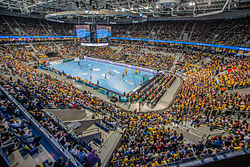
The worldwide attendance record for seven-a-side handball was set on 10 January 2024 in Düsseldorf, Germany, during the two opening matches of the 2024 European Men's Handball Championship. The two games (France versus North Macedonia and Germany against Switzerland) were played in front of 53,586 spectators.[26]

Commemorative coins

[edit]

Handball events have been selected as a main motif in numerous collectors' coins. One of the recent samples is the €10 Greek Handball commemorative coin, minted in 2003 to commemorate the 2004 Summer Olympics. On the coin, the modern athlete directs the ball in his hands towards his target, while in the background the ancient athlete is just about to throw a ball, in a game known as cheirosphaira, in a representation taken from a black-figure pottery vase of the Archaic period.[27]

The most recent commemorative coin featuring handball is the British 50 pence coin, part of the series of coins commemorating the London 2012 Olympic Games.[28]

See also

[edit]

References

[edit]
[edit]
Revisions and contributorsEdit on WikipediaRead on Wikipedia
from Grokipedia
Handball is a dynamic team sport played indoors between two teams of seven players each—six outfield players and one goalkeeper—who pass and throw a spherical ball using their hands to score goals by propelling it past the opposing goalkeeper into a netted goal measuring 3 meters wide and 2 meters high. The game takes place on a rectangular court 40 meters long and 20 meters wide, with a 6-meter goal area restricted to the goalkeeper, and matches consist of two 30-minute halves separated by a 10- to 15-minute halftime break. Players may hold the ball for up to 3 seconds and take up to 3 steps while in possession, with dribbling permitted but limited to avoid double dribbles, emphasizing speed, agility, and physical contact within strict rules against holding, pushing, or dangerous play. The sport's modern origins trace back to late 19th-century , with early forms resembling handball documented in and northern , but formalized rules first published in in 1906 and refined in in 1917 for an 11-player outdoor version known as . Indoor handball, the dominant format today, evolved in the 1910s in , , and , leading to the founding of the (IHF) in in 1946 to standardize and promote the game globally. debuted as an Olympic in 1936, while team handball (indoor) was introduced to the Summer Olympics in 1972 for men and 1976 for women, boosting its international profile. Handball encompasses several variants adapted for different environments and participants, including —played on sand with 4 players per team (3 outfield and 1 ) in two 10-minute halves, officially recognized by the IHF in 1994 and featured in multi- events since 2013—and wheelchair handball, a four-a-side inclusive version for athletes with disabilities that follows modified indoor rules to ensure accessibility and fairness. The IHF, now comprising 209 national federations, governs the worldwide, organizing events like the Men's and Women's Championships every two years and supporting regional bodies such as the (EHF), founded in 1991, which oversees premier competitions including the EHF EURO and Champions League. With approximately 27 million registered players across 209 national federations, handball thrives at professional, amateur, and recreational levels, renowned for its high-intensity action, strategic passing, and athletic demands that combine elements of , soccer, and rugby.

History

Origins

The origins of modern team handball can be traced to a variety of ancient and medieval ball games that emphasized throwing, team competition, and physical contact, laying the groundwork for its core elements of passing and goal-scoring. In ancient Rome, harpastum—a vigorous team sport played with a small, hard ball using hands and feet—served as an early precursor, where two teams vied to carry or throw the ball across a marked field while tackling opponents, mirroring handball's dynamic interplay. Similarly, Celtic traditions in Ireland featured hurling and related handball variants, where players used hands or sticks to propel a ball toward goals, fostering skills in aerial control and rapid transitions that influenced later European team sports. In medieval Scandinavia, games like the Icelandic knattleikr (a ball game involving sticks and hands) involved teams competing on open fields to strike or throw a ball into targets, highlighting the region's enduring affinity for collective, high-contact ball pursuits akin to handball's throwing mechanics. By the , these ancient influences evolved into informal folk games across , blending elements of football, , and into proto-handball variants. In , gymnastics instructor Konrad Koch developed raffball (snatch ball) around the 1890s, a schoolyard game played with 11 players per side on a large field, where teams threw a to advance and score by grounding it in an opponent's zone, marking some of the first recorded handball-like matches in German educational settings. Concurrently in , håndbold emerged as a similar folk pursuit in the late 1800s, combining soccer's team structure with hand-throwing techniques, often played outdoors by local clubs and schools to promote amid the era's gymnastic movement. Early 20th-century experiments in further refined these traditions, with Danish officer Holger Nielsen sketching initial rules for an 11-a-side indoor version of håndbold around 1906, emphasizing quick passes and defensive pressing to adapt the game for gymnasiums during harsh winters. These efforts, alongside Swedish adaptations by educators like G. Wallström in 1910, bridged folk practices toward structured play, setting the stage for handball's formal codification.

Development and Codification

The modern form of team handball emerged in the late 19th and early 20th centuries, primarily through the efforts of Danish teacher Holger Nielsen. In 1898, while teaching at Ordrup near , Nielsen developed an initial set of rules for a team ball game to provide indoor exercise during winter months, emphasizing passing without running or holding the ball for more than three seconds. These rules were first published in 1906, laying the groundwork for organized play in and influencing subsequent developments across . The sport's codification advanced significantly in Germany in 1917, when educators Max Heiser, Karl Schelenz, and Erich Konig published a comprehensive set of rules in Berlin on October 29, formally naming the game "handball" (Handball) and standardizing it as an 11-a-side outdoor variant played on a field similar to . Schelenz, a Berlin gymnastics teacher, refined these rules in 1919, introducing elements like with the ball and physical tackling while reducing team size in some formats to promote faster play; these changes also incorporated passing restrictions inspired by James Naismith's 1891 rules, which prohibited running with the ball to encourage strategic team movement. Early organization in began around this time, with the publication of rules fostering clubs and leagues that predated the post-World War II German Handball Federation founded in 1949. In , formal governance arrived with the establishment of the Danish Handball Federation (Dansk Håndbold Forbund) on June 2, 1935, which unified existing clubs and supported the sport's growth. Key milestones in handball's early expansion included the first international match on 13 September 1925 between Germany and Austria in Halle an der Saale, where Austria won 6-3 in an 11-a-side field format, signaling the sport's cross-border appeal. It achieved official status for men at the 1936 Berlin Olympics, where Germany claimed gold in field handball before seven teams. During the 1917–1930s, the sport transitioned from the larger 11-a-side outdoor field handball—suited to open spaces but weather-dependent—to the more dynamic 7-a-side indoor variant, which originated in Danish schools around 1917 and gained traction in Germany and Scandinavia for its suitability to gymnasiums and year-round play. This shift, formalized in international rules by the late 1930s, prioritized speed and skill over endurance on larger pitches.

Rules

Court and Equipment

The handball for indoor play is a rectangular area measuring 40 meters in length and 20 meters in width, with goal lines of 8 centimeters in width and all other lines 5 centimeters wide. A safety zone of at least 1 meter must surround the playing area along the side lines and at least 2 meters behind the goal lines to protect players and officials. The 's diagonals measure 44.72 meters across the full length and 28.28 meters for each half. The are positioned at the center of each goal line and consist of two vertical posts 2 meters high and 3 meters apart, connected by a horizontal crossbar at the top. Each goalpost has an 8-centimeter square cross-section with edges rounded to a radius of 4 millimeters plus or minus 1 millimeter, and the interior sides face the playing area. A net is attached to the back of the goal frame to retain the , with a depth ranging from 0.9 meters at the top to 1.1 meters at the bottom, plus or minus 0.1 meters, and meshes no larger than 10 by 10 centimeters. The area, often referred to as the crease, is a restricted zone protecting the and is marked by a 3-meter line parallel to and 6 meters from the line, positioned centrally in front of the goalposts, with quarter-circle of 6-meter centered at the inner rear corners of the goalposts connecting its ends to the line. This forms a D-shaped area with a central 3-meter by 6-meter rectangular portion extended by the , spanning a total of 15 meters in width along the line. A free-throw line is drawn parallel to the area line, 3 meters beyond it, at a of 9 meters from the line. Only the is permitted inside this area during play, except for specific throw-ins or penalties. The official is spherical, made of or synthetic material, and must meet and weight standards based on the competition level and gender. For men's senior and youth (16+) games, it has a of 58 to 60 centimeters and weighs 425 to 475 grams when using for grip. Women's senior and youth (14+) competitions use a with a 54- to 56-centimeter and 325- to 375-gram weight with , while smaller s apply to younger age groups, such as size 1 for players under 12 with adjusted dimensions of 50 to 52 centimeters and 290 to 330 grams. For senior s, weights without are reduced by 25 to 50 grams; for youth size 1, the maximum weight is reduced by up to 15 grams with a slightly smaller (49-51 cm). Players must wear identical uniforms consisting of , , and sports shoes suitable for indoor surfaces, with jersey numbers at least 20 centimeters high on the back and 10 centimeters on the front for visibility. Protective gear is limited: hand protection is optional but must not cover the fingers beyond the knuckles; and ankle supports require soft padding without metal parts; guards must be soft and non-rigid; and no face masks or helmets are allowed except in cases of medical necessity with prior approval. Dangerous items such as jewelry, watches, or unsecured glasses are prohibited to ensure safety. The substitution area is located outside the sideline on each side of the court, extending 4.5 meters from the center line along the side line and marked by a 15-centimeter-wide line both inside and outside the playing area. This zone allows for unlimited substitutions during the game, with players entering and exiting through designated areas adjacent to the team benches, and includes a coaching zone spanning 3.5 meters from the center line to 8 meters from the outer goal line. As of the 2025 IHF rules update (effective July 1, 2025), touching the ball while any body part is outside the boundary results in a awarded to the opponents (Rule 7:10).

Players and Officials

In team handball, each team consists of up to 16 players, with a maximum of 7 on the at any time, comprising 6 court players and 1 . A minimum of 5 players is required to commence the , and the remaining players serve as substitutes, with unlimited substitutions permitted during situations via a designated substitution line on the sideline. Court players occupy versatile positions that emphasize adaptability rather than rigid specialization, typically including left and right wings for speed along the sidelines, (left, center, and right) for shooting and playmaking from the rear, and a pivot (or line player) for positioning near the area to create and receive passes. These roles allow players to switch responsibilities fluidly during transitions, promoting dynamic team strategies without fixed positional constraints enforced by the rules. As of the 2025 IHF rules update (effective July 1, 2025), the steps rule has been broadened to allow a maximum of three steps after receiving or catching the , with landing on one or both feet simultaneously after no floor contact not counting as a step (Rule 7:3). The holds a unique role, primarily defending within the goal area but permitted to leave this zone and function as a player, provided they do not carry the out under control. must release the within 3 seconds after gaining control, whether stationary or after stopping movement, aligning with general player handling limits but adapted for defensive actions inside the goal area where they may use any body part to deflect shots. Only one may be on the at a time, and they can interchange positions with a player at any point during the game. Match officials include two referees who share equal authority in overseeing the game, one typically positioned along the sideline and the other behind the goal line for optimal visibility. They enforce rules through signals for starting and stopping play, along with standardized hand gestures to indicate decisions such as fouls, warnings (yellow card), or interruptions. Supporting them is a scorer and timekeeper, often combined in one role or separate, who manage the score sheet, track playing time, monitor suspensions, and record player participation. Each team may designate up to 5 team officials, including a head coach and a responsible team official who serves as the primary point of communication with referees, such as requesting time-outs via a signal. The coach directs strategy from a restricted bench area or coaching zone, limited to 3.5 meters from the center line extending 8 meters toward the goal line, while all team officials are prohibited from entering the during active play except in cases of assessment. A team delegate may also be appointed to oversee compliance with competition regulations but does not participate directly in proceedings.

Match Structure

A standard handball match consists of two halves of 30 minutes each, separated by a 10-minute halftime interval. If the score is tied at the end of regular time and a winner is required, overtime is played, comprising two 5-minute halves with a 1-minute break between them; a 5-minute interval precedes the overtime period. In cases of continued ties, particularly in final matches, the outcome is decided by a 7-meter shootout, where teams alternate penalty throws from 7 meters until a decisive goal difference emerges. The match begins with a toss to determine which team takes the initial throw-off or chooses the goal to defend first. The throw-off is executed from the center of the court by a player of the designated team, following the referee's , with all other players positioned behind the center line until the ball is released. The game concludes at the final signal from the timekeeper or public clock, though any ongoing throws or infractions may be resolved post-signal if they occurred before it. Each team is entitled to three 1-minute timeouts per match during regular playing time, excluding overtime, to be requested only when in possession of the ball or during a stoppage. Passive play, where the attacking team delays or avoids creating scoring opportunities, prompts a forewarning signal from the referees; following this, the team must attempt a shot on goal, typically within three to four additional passes, or face a free throw awarded to the defense. The clock runs continuously during active play but stops for interruptions such as timeouts, injuries, or substitutions. Substitutions occur unlimited times via a designated area on the sideline without halting the clock unless specified, while injuries necessitate an immediate stoppage, allowing two team personnel to assist the player, who must then leave the court temporarily. Since 2024, the has permitted video reviews for specific decisions, including goal validations and penalty assessments, to enhance accuracy in high-stakes matches.

Throws and Penalties

In handball, restarts after interruptions are managed through specific throws, each governed by precise rules to maintain fair play and game flow. The throw-off occurs immediately after a goal is scored or at the start of each half, initiated from the center of the court following a referee's whistle signal. The thrower must keep at least one foot in contact with the center line until the ball is released, and all opposing players must remain at least 3 meters away or outside the designated throw-off area. As of the 2025 amendments enforced by the International Handball Federation (IHF), throw-offs can alternatively be taken from a 4-meter marked area behind the center line in IHF-sanctioned events, with both the ball and thrower required to be fully inside the playing area before the whistle, promoting faster restarts. A is awarded when the ball crosses the outer line or sideline last touched by the attacking team, executed without a from the point where the ball went , with the thrower's foot on or behind the line. Opponents must maintain a 3-meter distance from the thrower, except when the throw-in is near the goal-area line. The free-throw, the most common restart, is given for minor fouls or violations outside the goal area, taken from the spot of the infraction (or the nearest point outside the goal area if inside) without a , within 3 seconds of readiness. It must not be performed inside the thrower's own area or beyond the opponent's 9-meter free-throw line, with all opponents positioned at least 3 meters away and teammates outside the opponent's free-throw line; violations of positioning can lead to a retake or escalation to a 7-meter throw. The goalkeeper throw restarts play after the goalkeeper gains possession within the goal area, such as following a defensive save or when the ball deflects into the area last touched by an attacker. It is taken from anywhere within the goal area and must be thrown over the goal-area line (9 meters from the goal line) without the ball touching the floor or being dribbled, with opponents required to stay outside the goal-area line until the ball crosses it. The 7-meter throw, a critical penalty mechanism, is awarded for serious fouls that deny an obvious scoring opportunity, such as illegal interference during a fast break; it is executed as a direct shot on goal from behind the 7-meter line (up to 1 meter behind), following a referee's whistle, within 3 seconds. The thrower and teammates must remain outside the 9-meter line until the ball is released, while opponents stand at least 3 meters from the 7-meter line and outside the 9-meter line, with the goalkeeper positioned behind the 4-meter line; the ball cannot be touched by teammates until it contacts an opponent or the goal. Recent 2025 IHF rules clarify that substitutions are frozen once the thrower signals readiness. Penalties in handball enforce through a progressive system, starting with warnings for minor infractions and escalating to severe sanctions. A warning, indicated by a yellow card, is issued for repeated minor fouls (progressive punishment under Rule 8:3) or initial (Rule 8:7), such as delaying the game or disrespectful behavior; a team may receive up to three warnings, but no more than one per player after a suspension. Common fouls triggering warnings include passive play—where the attacking team fails to attempt a shot after a referee's forewarning signal following about four passes without goal threat—resulting in a to the defense (Rule 7:11-12). Other violations like (touching the ball twice consecutively without it hitting the floor or another player, Rule 7:7) or charging (unnecessarily running or jumping into an opponent, Rule 8:2d) are penalized with a free throw and potential progressive warnings if repeated. Defenders must also maintain a 3-meter distance during free throws, throw-ins, and throw-offs (Rule 15:4), with encroachment leading to a retake or further sanction. Escalation from warnings leads to a 2-minute suspension, signaled by two fingers, for more severe offenses such as dangerous play without injury (Rule 8:4), faulty substitutions (Rule 4:5-6), or repeated unsportsmanlike conduct (Rule 8:8). The suspended player leaves the court, and the team plays short-handed until a goal is scored or the 2 minutes elapse, with up to three such suspensions allowed per player before disqualification; suspensions carry over halves or into overtime if active at period's end. A disqualification, marked by a red card, results from a third 2-minute suspension, highly dangerous fouls causing injury (Rule 8:5), or serious unsportsmanlike conduct like assault (Rule 8:9), permanently removing the player or official from the match and requiring a 2-minute (or sometimes 4-minute) short-handed period for the team. The 2025 IHF amendments introduced progressive card systems for repeated fouls, mandating escalation from yellow (warning) to 2-minute suspension to red (disqualification), and specify that headshots—intentionally striking an opponent's head (if the opponent is not moving their head to block the shot)—during 7-meter throws or free throws now result in a 2-minute suspension rather than an immediate red card, aiming to reduce overly harsh penalties while maintaining safety (Rules 8:8d and 8:8e). Additionally, goalkeeper headshots from 7-meter penalties trigger a suspension instead of disqualification. These changes, effective from July 1, 2025, emphasize graduated responses to promote fairer gameplay.

Gameplay

Offensive Play

Offensive play in handball emphasizes rapid ball movement and strategic positioning to create scoring opportunities against the opposing defense. The core principles revolve around fast breaks and set attacks. Fast breaks exploit quick transitions after regaining possession, typically unfolding in three phases: a simple first wave with immediate shots or passes, an extended second wave involving back-court players, and a complete third wave that integrates the full team for numerical advantages like 3v2 or 4v3 scenarios. Set attacks, in contrast, involve organized waves of play, where pivot players set screens near the area to block defenders, while back-court setups from wings and half-backs build pressure through layered passes and movements. These principles aim to maintain a high , stretching the defense and opening lanes to the . Key techniques in offensive play include jump shots, pivots, fakes, and passing chains. Jump shots, executed with an overarm motion while airborne, allow attackers to elevate over defenders for better angles and power, often used in fast breaks to capitalize on momentum. Pivots, or runners, operate close to the six-meter line, using body positioning to the ball and receive feeds from back-court players, thereby disrupting defensive alignments. Fakes—such as shot or pass deceptions—mislead opponents, creating space for follow-up actions like drives or redirects. Passing chains, consisting of quick, accurate interchanges (e.g., bounce or wrist passes), dismantle passive or man-to-man defenses by maintaining possession and probing for weaknesses, ideally keeping passes under three seconds to sustain rhythm. The 6-0 attack formation forms the foundational structure for most offensive strategies, positioning all six outfield players actively in attack: two wings on the flanks for width, two backs and a center back in the rear for shooting and distribution, and a pivot centrally for screens and rebounds. This setup counters man-to-man defense by emphasizing balance—maintaining approximately two-meter spacing to stretch opponents—while exploiting gaps through penetration or overloads on one side. Attackers adapt by using fakes and timing to unbalance defenders, passing to open teammates in numerical superiorities like 2v1. Defensive counters, such as aggressive pressing, can disrupt these flows but are briefly neutralized through quick pivots and redirects. Historically, offensive play has evolved toward a faster pace since the , driven by the shift to indoor formats and rule adjustments that reduced interruptions, such as quicker restarts after goals and passive play sanctions. This transition, solidified with men's Olympic inclusion in 1972, increased game dynamism, raising average goals from around 20 per team in the early 1970s to 25-30 in modern professional matches, reflecting enhanced speed and technical proficiency. In 2025, IHF youth rules further promote versatile attacking skills by restricting substitutions to possession phases and banning 7-vs-6 setups, encouraging players to develop well-rounded offense without over-specialization, using smaller resin-free balls for safer, more inclusive skill-building.

Defensive Play

Defensive play in handball focuses on preventing the opposing team from scoring by disrupting their offensive flow through coordinated positioning, pressure, and physical engagement. The primary tactics include man-to-man defense, where each defender is assigned to mark a specific opponent to limit their movement and passing options, and , which emphasizes covering designated areas of the to block lanes and turnovers. A common zone formation is the 6-0 defense, involving six players aligned across the to create a compact barrier, often applied as a to apply immediate pressure after regaining possession and intercept passes early in the transition. This setup allows for aggressive disruption but requires high coordination to avoid gaps that attackers can exploit. Blocking shots and interceptions form the core of effective defense, with players using their bodies to passively obstruct paths without . Defenders may position their trunk to impede movement into open space or use open hands to deflect passes legally, aiming to force errors or regain possession quickly. In active defense, teams pursue goals like slowing the attack's pace or provoking mistakes through legal on handlers, rewarding interceptions that lead to counterattacks. These actions emphasize anticipation and timing, as successful blocks often stem from reading offensive patterns rather than reactive scrambling. The plays a pivotal role in defensive integration, serving as the last line of protection while actively coordinating with field players. Through constant verbal communication, the organizes the defense by alerting teammates to potential threats, such as unmarked attackers or incoming passes, ensuring seamless coverage. also handle rebounding by directing loose balls away from danger zones after partial saves, preventing second-chance shots and maintaining defensive momentum. Key techniques include diving saves, where the extends fully to cover low or angled shots, using explosive leg drive and body rotation to maximize reach while landing safely to avoid injury. Defensive adjustments are essential to manage and adapt to game flow, such as shifting from a to a half-court setup when players tire, allowing recovery while still contesting shots near the . This transition preserves during prolonged matches, where physical demands can lead to decreased intensity after 20-30 minutes of high-pressure play. Handling fast breaks requires rapid retreat, with defenders prioritizing numerical balance by filling lanes quickly to counter outnumbered offenses, often starting from interceptions or rebounds. Recent trends reflect increased physicality in defense, influenced by 2025 International Handball Federation (IHF) rule changes (effective July 1, 2025) that introduce 2-minute suspensions instead of red cards for specific head contacts, such as unhindered shots hitting the goalkeeper's head in open play or free throws after the final signal hitting a defender's head. These amendments aim to balance player safety with the sport's dynamic nature, leading to fewer disruptions in defensive strategies.

Formations and Transitions

In handball, offensive formations are structured to maximize scoring opportunities by balancing player positions across the court while exploiting defensive weaknesses. The 6-0 formation, the most common setup, positions all six field players in a balanced arrangement, with three back-court players (left back, center back, right back) initiating plays from distance and three front players (left , pivot, right ) focusing on penetration and finishing near the area. This formation emphasizes width to stretch the defense and depth for passing options, allowing coordinated attacks that create spaces for shots or breakthroughs. The 5-1 formation introduces a specialist, typically a dedicated or defender transitioning to offense, where five players form the core attack while the sixth provides support from a deeper position, often used in controlled possession to draw defenders and open lanes for the specialist's involvement. Wing overloads adapt this by concentrating extra players on one flank, such as stacking two attackers on the left alongside the pivot, to overwhelm the opposing defender and force numerical superiority in that zone for crosses or lobs. Defensive formations in handball prioritize compactness and pressure to disrupt offensive flow and regain possession. The 6-0, or flat defense, aligns all six field players in a straight line parallel to the 6-meter line, divided into outside, middle, and center roles to block shots and passes without man-marking, effectively creating a "wall" that forces attackers into low-percentage attempts from afar. This setup is versatile for maintaining team shape during sustained pressure. The 5-1 formation shifts one defender forward as an advanced wing blocker, with the remaining five forming a shallower zone to intercept the ball carrier early, particularly effective against strong back-court shooters by denying clean receptions and provoking turnovers. For high-stakes scenarios, the 3-3 formation deploys three defenders aggressively upcourt in an open configuration to harass the offense at the 9-meter line, while the back three provide cover near the goal, aiming to create chaos and fast-break opportunities through steals. This system is often reserved for late matches when trailing, as it risks exposure but heightens disruption. Transitions between offense and defense are critical in handball's fast-paced nature, requiring rapid reorganization to capitalize on momentum shifts. After scoring a or forcing a turnover, teams execute quick switches via fast breaks, where players sprint in waves—first wave for immediate shots, second for support passes—to exploit disorganized defenses before they form a 6-0 setup. Numerical advantages arise during opponent suspensions (two-minute exclusions), allowing a 7-vs-6 attack that mirrors fast-break principles but in positional play, overwhelming the reduced defense with overloads on wings or pivots. Conversely, defensive transitions involve immediate retreats to reestablish a compact 6-0 or 5-1 line, preventing counterattacks by cutting passing lanes and applying pressure to halt the opponent's advance. Late-match adaptations enhance strategic depth, particularly under tied scores or when trailing. Teams often remove the in the final two minutes to form a 7-vs-6 offense, gaining an extra field player for aggressive pressing and shot volume, though it exposes the goal to counters—a tactic increasingly prevalent in competitions to force a decisive score. In tied scenarios, bonus rules permit this substitution without time restrictions in the closing stages, but passive play sanctions apply if the attack stalls, compelling teams to balance risk with purposeful movement. Defensive responses may shift to a 3-3 to counter the numerical edge, prioritizing interceptions over blocking to trigger immediate transitions.

Organization

International Bodies

The (IHF) serves as the global governing body for handball and , overseeing the sport's international development, standardization, and competitions. Founded during its inaugural congress from 10 to 13 July 1946 in , , attended by representatives from 14 national federations (8 in person and 6 by proxy), the IHF emerged to unify and promote the sport following its inclusion in the Olympics. As of 2025, the IHF comprises 211 member national federations, each required to affiliate with one of six continental confederations to ensure coordinated regional growth. The IHF's primary roles include establishing and amending the official rules of the game, organizing major international events such as the Men's and Women's World Championships, and fostering the sport's integrity through anti-doping measures. For instance, effective 1 July 2025, the IHF implemented key rule amendments, including changes to penalty enforcement for headshots—now resulting in suspensions rather than red cards—and clarifications to the steps rule to enhance fair play. These updates, developed through the IHF's rules commission, aim to balance competitiveness with player safety. The federation also coordinates World Championships biennially, drawing participation from top nations and serving as qualifiers for Olympic events. Organizationally, the IHF is structured around its —the supreme decision-making body comprising representatives from all member federations—which convenes biennially to elect leadership, approve rules, and set strategic directions. The , consisting of the president, first vice-president, treasurer, and two additional members, manages day-to-day operations and oversees specialized commissions, including those for rules, organizing competitions, and the Anti-Doping Unit (ADU), which enforces the World Anti-Doping Code through education, testing, and sanctions. Headquartered in , , at Peter Merian-Strasse 23, the IHF's central office supports these functions with a multilingual staff focused on administration, event logistics, and global outreach. Under President Dr. Hassan Moustafa, who has led the organization since his election in 2000, the IHF has emphasized inclusive growth through targeted initiatives. Youth development programs, such as the annual IHF Youth Coaches Education Week and Children's Handball Education Week launched in 2023, provide training for coaches and educators to build foundational skills among young players worldwide, with sessions covering tactical development and inclusive coaching methods. On gender equity, the IHF has intensified efforts post-2023 by integrating #EmbraceEquity campaigns into activities, promoting equal opportunities in leadership and participation, including quotas for female representation in commissions and support for women's events to address historical disparities in resources and visibility. These initiatives underscore the IHF's commitment to sustainable, equitable expansion of handball as a global sport.

Regional Federations

The regional federations of handball operate as continental confederations under the oversight of the (IHF), each responsible for promoting the sport within their geographic area through organization of championships, development initiatives, and funding programs. These bodies facilitate regional growth by tailoring strategies to local challenges, such as expanding participation in emerging markets and supporting youth and grassroots programs. The (EHF), founded on November 17, 1991, in , , serves as the governing body for handball in and currently comprises 50 full member federations along with two associated ones ( and ). Headquartered in , , the EHF organizes key events like the EHF EURO for men's and women's national teams, which have significantly boosted the sport's popularity and professionalization across the continent, drawing millions of viewers annually. It also invests in development funding, including coaching clinics and infrastructure support, to maintain 's dominance in global handball. The (AHF), established on August 26, 1974, in , , during the , oversees handball across 44 member nations and focuses on accelerating growth in non-traditional areas like South and . Based in , the AHF organizes continental championships such as the Asian Men's and Women's Handball Championships, which serve as qualifiers for world events and have helped increase participation rates in countries like and . Its development efforts emphasize talent identification and technical training to bridge gaps between established powerhouses like Qatar and emerging federations. In the Americas, the Pan-American Team Handball Federation (PATHF), originally founded in 1977, was restructured by the IHF in 2019 into two entities: the and Handball (NACHC) with 21 members and the South and Central America Handball (SCAHC) with 19 members, to better address regional disparities. These bodies collectively organize Pan-American Championships and provide funding for youth academies and equipment distribution, contributing to steady growth in nations like and the . The African Handball Confederation (CAHB), formed on January 15, 1973, in , , is the largest continental body with 53 member federations and plays a pivotal role in expanding handball across Africa's diverse landscapes. Headquartered in , , it hosts annual African Championships and has driven development through initiatives like referee training and facility upgrades, enhancing competitiveness in countries such as and . The Oceania Continent Handball Federation (OCHF), established in 1993 in , , governs 20 member federations and concentrates on building foundational structures in a region with limited resources. It organizes Oceania Championships and collaborates on IHF-funded programs for and youth clinics, fostering gradual increases in player numbers in , , and Pacific islands. Across these federations, common roles include hosting regional qualifiers for IHF events, allocating development budgets—such as the EHF's multimillion-euro annual investments—and partnering on initiatives like the 2025 IHF youth rule updates, which prohibit goalkeeper substitutions with players to promote balanced skill development. These efforts underscore their contributions to handball's global expansion while adapting to continental-specific needs.

Competitions

Olympic Games and World Championships

Handball made its Olympic debut at the 1936 Games as an outdoor field version played with 11 players per side, though it was not included in subsequent Olympics until the indoor seven-a-side format was introduced for men at the 1972 Munich Games, where claimed the inaugural gold. The women's indoor event followed at the 1976 Olympics, with the winning the first title. Since then, both men's and women's tournaments have been staples of the , featuring 12 teams each in a preliminary round of two groups of six, followed by stages leading to the gold medal match. At the 2024 Paris Olympics, secured the men's gold with a decisive 39-26 victory over in the final, marking their second title in the sport. Handball remains confirmed for the 2028 Games, with venues including facilities in Long Beach. holds the record for most men's Olympic golds with four (2008, 2012, 2020, 2024), while leads the women with three (2008, 2012, 2024). The , the premier non-Olympic international competition, began in 1938 in as the first indoor tournament, initially featuring just four European teams in a round-robin format, and has been held biennially since 1993. The women's edition debuted in 1957 in with nine teams, also on a biennial schedule since its . Both championships now expand to 32 teams for the men's event starting in 2025, divided into eight preliminary groups of four, where the top three from each advance to four main-round groups of six; the top two from those groups proceed to semifinals and the final, determining the world champion. The 2025 men's tournament, co-hosted by , , and from January 14 to February 2, saw defend their title with a 32-26 win over in the final at Unity Arena in , achieving a historic four-peat. holds the record for most men's world titles with four (1954, 1958, 1990, 1999), while leads the women with six. The 2025 women's World Championship is scheduled for November 26 to December 14, co-hosted by the and across venues in , 's-Hertogenbosch, , , and , featuring 32 teams in a similar group-to-knockout structure. These events underscore handball's global equity progress, including the International Handball Federation's efforts toward balanced opportunities for men's and women's competitions since the early .

Continental and Club Events

Continental handball championships represent the premier regional competitions for national teams, organized biennially by governing bodies such as the (EHF), (AHF), and African Handball Confederation (CAHB). The EHF EURO, Europe's flagship event, features top national teams in a group stage followed by knockout rounds, with the 2024 edition co-hosted by , , and drawing record crowds and viewership across 16 participating teams for both men's and women's tournaments. In the men's final, defeated to claim their fourth title, while secured a third consecutive women's crown with a decisive 31-23 victory over , highlighting the event's role in fostering intense rivalries and talent development. In , the Asian Handball Championship similarly employs a preliminary round-robin format leading to semifinals and a final, contested every two years among senior national teams. The men's tournament in marked the 21st edition, where emerged as champions after navigating a competitive field of 16 teams, while the women's event in , —the first hosted there—saw triumph for their second title. Africa's equivalent, the African Handball Nations Championship, follows a comparable structure with group stages and knockouts, as seen in the men's competition in , where the hosts dominated with a six-match winning streak to secure their ninth continental title and qualification spots for global events. These continental events often serve as key qualifiers for the , with winners and top finishers advancing to IHF Olympic Qualification Tournaments. On the club level, the stands as Europe's elite competition, involving 16 top men's and women's teams in a league phase of 14 matchdays followed by playoffs and a Final4 , with qualification drawn from leading national leagues. of clinched the 2024-25 men's title in an all-German final against Füchse Berlin, marking their fifth European crown and underscoring the league's high-stakes format that blends endurance and intensity. Parallel club competitions exist in other continents, such as the , an annual AHF-organized event featuring top Asian clubs in a round-robin and setup to crown regional supremacy. In , the African Handball Champions League mirrors this with biennial tournaments for leading clubs, emphasizing cross-border rivalries and player exchanges. Recent highlights include the 2025 in , which set a new attendance record of 22,150 spectators for the Spain-Egypt quarterfinal, reflecting surging global interest in handball's developmental tiers.

National Leagues

National handball leagues form the backbone of domestic competition worldwide, providing platforms for professional and semi-professional play while serving as talent pipelines for international events. In , these leagues are highly structured and commercially successful, often featuring large crowds and significant media coverage. The German Handball-Bundesliga stands as one of the world's premier domestic leagues, comprising 18 teams that compete in a double round-robin format, playing 34 regular-season matches each. The season culminates in for the top six teams to determine the champion, while the bottom two face relegation against teams from the second division; it draws exceptional attendance, with over 1.6 million spectators in the 2023/24 season and an average of 5,217 per game. The French Ligue Nationale de Handball (LNH) Division 1, known as the Starligue, features 16 teams in a 30-match regular season of home-and-away games, followed by for the top eight and relegation for the lowest-ranked sides. Denmark's Håndboldligaen, the top men's league, includes 14 teams contesting 26 regular-season matches, with for championship contention and a promotion/relegation system linking it to the 1st Division below. Beyond Europe, the Egyptian Handball Premier League is recognized as Africa's strongest domestic competition, involving 18 teams in a season that underscores Egypt's continental dominance through rigorous club development and high-level play. In , the Liga Nacional de Handebol adopts a tournament-style format with group stages and knockout rounds, gathering elite clubs for national supremacy amid efforts to sustain consistent competition. The emphasizes collegiate handball through club programs at universities, where teams participate in regional conferences leading to annual national championships organized by USA Team Handball, supporting grassroots growth with around 15 men's and several women's programs active. Typical league formats involve 26 to 34 regular-season matches per team, often in double round-robin setups, concluding with playoffs for titles and promotion/relegation battles to maintain dynamism across divisions; national champions from these leagues frequently qualify for continental club tournaments. In 2025, notable trends include the expansion of women's leagues in Asia, highlighted by India's launch of its first professional Women's Handball League with six teams and substantial investment, alongside North American progress fueled by USA Team Handball's strategic initiatives for Olympic preparation.

Variations

Beach Handball

Beach handball is a dynamic variant of handball played on , emphasizing speed, , and spectacular plays. Matches feature teams of up to 10 players, with 4 on the at a time—3 field players and 1 —on a rectangular measuring 27 meters long by 12 meters wide, with at least 40 cm deep. Games consist of two 10-minute periods separated by a 5-minute , using a "golden goal" or shoot-out to resolve ties. Substitutions are unlimited and can occur at any time without stopping play, allowing for flying changes to maintain the game's fast pace. Key rule differences from indoor handball promote creativity and flow on the sand surface. Players may hold the ball for a maximum of 3 seconds and take up to 3 steps while in possession, with no explicit pass time limit but passive play rules to prevent stalling. Goals scored with standard throws earn 1 point, while spectacular "in-flight" shots—such as dive shots, spin shots, or acrobatic jumps—award 2 points to encourage athleticism; jump shots are permitted for these higher-value goals. Fouls denying clear scoring chances result in a 6-meter throw, worth 2 points if successful, serving as a penalty mechanism without cards or suspensions in most cases. Unlike indoor handball's structured timeouts and team faults, beach handball allows one 1-minute timeout per period per team, fostering a more fluid, beach-oriented style. The sport's development accelerated under the (IHF), which officially recognized in May 1994 following its emergence in during the early 1990s. The first IHF Men's and Women's World Championships were held in 2004 in , , establishing a biennial event that has since grown to include 12 teams per gender by 2024. Youth versions debuted at the 2018 , and the IHF has pursued Olympic inclusion, submitting a formal application for the 2028 Games in a short-format to suit the venue. Beach handball's popularity has surged, particularly in and , where it thrives due to accessible coastal venues and vibrant club scenes. The IHF Beach Handball Global Tour, launched to boost international , featured three stages in 2025: Stage 1 in ; Stage 2 in ; and finals in João Pessoa, Brazil, attracting top teams like , , and for medal contention. In the 2025 finals, secured gold in both men's and women's categories, repeating their 2024 triumphs. This tour, alongside World Championships and regional events, has driven participation growth, with dominating titles since 2006 and European nations like and excelling in women's categories.

Other Forms

Field handball, the original outdoor variant of the sport, was played with 11 players per side on a grass field measuring 90 to 110 meters in length and 55 to 60 meters in width. This format, influenced by elements of soccer and rugby, featured teams passing and dribbling a ball toward goals similar in size to modern indoor handball but on a much larger pitch. It gained international recognition with its inclusion as a demonstration sport at the 1936 Olympics and the first men's World Championship in 1938, but declined in the due to the rise of indoor play and logistical challenges of outdoor conditions. The (IHF) discontinued official field handball championships for men in 1966 and for women in 1962, with the last attempted men's event canceled in 1969 for lack of participating teams. Czech handball emerged as a regional 7-a-side outdoor variant in during the early 20th century, characterized by smaller goals than those in field or indoor handball to suit more compact play. Popular from the to the 1950s, it emphasized faster transitions and was played on fields akin to half a soccer pitch, reflecting local adaptations before the dominance of standardized indoor rules. This form contributed to early debates on handball formats within European federations but faded as the 7-a-side indoor version became globally adopted. American handball is a distinct wall-based or doubles game, separate from team handball, where players strike a small against one, three, or four walls using gloved hands. Originating in the early from Irish and Basque influences, it evolved into popular formats like one-wall (played on urban courts) and four-wall (in enclosed facilities), with courts typically 20 feet wide, 40 feet long, and 20 feet high. The United States Handball Association (USHA), founded in , governs the sport, organizing national championships and promoting its growth in since the post-World War II era. Wheelchair handball adapts standard team handball rules for players in wheelchairs, using a 4-a-side format on a modified court to ensure accessibility and fair competition. Introduced internationally in the early 2000s through initiatives in Japan and Europe, it gained official IHF recognition in 2019, with the first World Championship held in 2022. The IHF has hosted annual events since, including the 2024 edition in Cairo, Egypt, where Egypt defeated the United States 2-0 in the final to claim the title.

Popularity and Impact

Global Reach and Growth

Handball enjoys widespread global participation, with an estimated 30 million players worldwide as of 2025. The sport is particularly dominant in Europe, where countries like and boast the strongest national teams and extensive domestic leagues, contributing to the continent's leadership in international competitions. Participation has seen notable growth in emerging regions such as and , driven by increased in youth development and regional tournaments, with the market experiencing robust expansion due to rising popularity. The inclusion of women's handball in the in 1976 marked a significant surge in female participation, expanding the sport's inclusivity and leading to steady growth in women's programs globally. The (IHF) has actively promoted gender equity through initiatives like the 2023 campaign emphasizing equal opportunities, supporting balanced development across genders. The global handball market reached approximately USD 1.31 billion in 2025, fueled primarily by equipment sales such as balls and apparel, alongside growing media rights and broadcasting revenues. Expansion efforts are evident in , where the has bolstered programs, with over 15 men's and several women's teams fostering growth and talent pipelines. Recent visibility gains include record television viewership for the 2025 IHF Men's World Championship, achieving more than 65-70% market share in host nation .

Records and Milestones

Handball has seen remarkable attendance figures in recent years, underscoring its growing appeal. The for a single match was set at the Men's EHF EURO 2024 opening day matches ( vs. and vs. ) in , drawing 53,586 spectators to the . This surpassed the previous mark of 44,189 from a 2014 German handball event in . In women's handball, a new benchmark was established at the Paris 2024 Olympic Games, with 26,664 fans attending the gold medal final between and at the Pierre Mauroy Stadium. Additionally, the 2025 in achieved a record 22,150 attendees for the quarter-final between and . Scoring records highlight the sport's fast-paced nature. The highest total goals in an international match occurred in 1981, when the USSR defeated 86-2 in a friendly tournament in , . In more competitive settings at World Championships, Iceland's 55-15 victory over in 2003 stands as the highest-scoring team performance. On the individual front, of holds the record for most goals in history with 1,299, while of leads international goals with 1,879. Key milestones mark handball's evolution. The first IHF Women's World Championship was held in 1957 in Yugoslavia, won by Czechoslovakia. The 2025 IHF Men's Youth World Championship in Egypt was hailed by the IHF as featuring one of the best finals ever in a global event, with Germany defeating Denmark in a thrilling decider. Cultural significance is evident in commemorative issuances and media reach. Greece minted a 10-euro silver proof coin in 2004 to honor handball at the Athens Olympics, depicting ancient and modern players. The United Kingdom issued a 50-pence coin in 2011 for the London 2012 Olympics, showcasing a player in action. The 2025 IHF Men's World Championship generated astonishing global TV viewership, with peaks exceeding 7 million in Germany for a quarter-final and over 2 million in Denmark for the final, reflecting handball's broad appeal.

References

Add your contribution
Related Hubs
User Avatar
No comments yet.