Hubbry Logo
Theodore TironTheodore TironMain
Open search
Theodore Tiron
Community hub
Theodore Tiron
logo
8 pages, 0 posts
0 subscribers
Be the first to start a discussion here.
Theodore Tiron
Theodore Tiron
from Wikipedia

For another Saint Theodore, see: Theodore Stratelates or Saint Theodore (disambiguation).

Saint Theodore (Άγιος Θεοδώρος), distinguished as Theodore of Amasea, Theodore the Recruit (Θεοδώρος ό Τήρων), and by other names, is a Christian saint and Great Martyr, particularly revered in the Eastern Orthodox Churches but also honored in Roman Catholicism and Oriental Orthodoxy. According to legend, he was a legionary in the Roman army who suffered martyrdom by immolation at Amasea in Galatian Pontus (modern Amasya, Turkey) during the Great Persecution under Diocletian in the early 4th century. Venerated by the late 4th century, he became a prominent warrior saint during the Middle Ages, attracted a great deal of additional legends including accounts of battle against dragons, and was often confused with (or was the original source of) the similar Theodore Stratelates of Heraclea.

Key Information

Names

[edit]

Theodore is the English form of the Latin masculine given name Theodorus from Ancient Greek Theódōros (Θεόδωρος) from Theós (Θεός, "God") + dō̂ron (δῶρον, "gift"). In Rome, he was also known to locals as St Toto.[1] He was eventually distinguished from other saints named Theodore as Theodore the Recruit,[3] Theodore the Tyro,[2] or Theodore the Soldier[4] (Latin: Theodorus Tyro or Tiro; Ancient Greek: Θεόδωρος Τήρων or ὁ Τήρων, Theódōros Tḗrōn or ho Tḗrōn).[a] The same name is variously anglicized as Theodore Tiron,[6] Tiro,[1][7] Tyron,[8] Tyro,[1][9] and Teron.[10] (Nilles argued that this epithet was a later mistake and that, rather than being a recruit, Theodore's name had originally referenced his service in the Cohors Tyronum.)[1][11] The saint is also distinguished as Theodore of Amasea,[1][12] Theodore of Euchaita,[1][13] and Theodore Martyr. The epithets are not generally needed, as Theodore Tiron is generally the intendend saint when the name "St Theodore" is used without other clarification.[6][14]

Legend

[edit]

Martyrdom

[edit]

Theodore was a Greek,[15] born in Amasea. The basic legend recounts that Theodore's cohort was sent to Pontus for winter quarters.[1] Christianity was still illegal and Galerius, prior to his 311 Edict of Toleration at Serdica, enforced his co-emperor Diocletian's Great Persecution. When the soldiers of Theodore's cohort were obliged to perform pagan sacrifice at Amasea in Galatian Pontus (modern Amasya, Turkey, about 30 miles or 48 kilometres south of the Black Coast at Sinop), he refused and recounted a confession of faith in the divinity of Jesus Christ.[1] Rather than immediately execute him, the judges—taking pity on his youth—delayed their sentence to allow him to change his mind.[1] Theodore then burned the city's temple of Magna Mater (Cybele), whereupon he was again arrested, tortured, and martyred by immolation.[1][16][17] The year of his martyrdom is cited as 287 in the legenda aurea, but later tradition including Butler has the year 306.[1][18] His relics were later carried to Euchaita, possibly his birthplace, by the Christian empress Eusebia[4] sometime before her death in 360.

Dragon slaying

[edit]
The Yılanlı Kilise fresco of saints Theodore and George slaying the dragon
Saints Theodore and George shown side by side as equestrian heroes. Theodore kills a dragon and George a human enemy. Saint Catherine's Monastery, Sinai, 9th or 10th century

Iconography of a horseman with a spear overcoming evil as personified as a dragon was widespread throughout the Christian period.[19] Iconographic representations of St Theodore as dragon-slayer are dated to as early as the 7th century, certainly by the early 10th century (the oldest certain depiction of Theodore killing a dragon is at Aghtamar, dated c. 920).[20] Theodore is reported as having destroyed a dragon near Euchaita in a legend not younger than the late 9th century. The earliest image of St Theodore as a horseman (named in Latin) is from Vinica, North Macedonia and, if genuine, dates to the 6th or 7th century. Here, Theodore is not slaying a dragon, but holding a draco standard.

The "Christianisation" of the Thracian horseman iconography can be traced to the Cappadocian cave churches of Göreme, where frescoes of the 10th century show military saints on horseback confronting serpents with one, two or three heads. One of the earliest examples is from the church known as Mavrucan 3 (Güzelöz, Yeşilhisar [tr]), generally dated to the 10th century,[21][22] which portrays two "sacred riders" confronting a two serpents twined around a tree, in a striking parallel to the Dioskuroi stela, except that the riders are now attacking the snake in the "tree of life" instead of a boar. In this example, at least, there appear to be two snakes with separate heads, but other examples of 10th-century Cappadocia show polycephalous snakes.[23] A poorly preserved wall-painting at the Yılanlı Kilise [tr] ("Snake Church") that depicts the two saints Theodore and George attacking a dragon has been tentatively dated to the 10th century,[24] or alternatively even to the mid-9th.[25] A similar example, but showing three equestrian saints, Demetrius, Theodore and George, is from the "Zoodochos Pigi" chapel in central Macedonia in Greece, in the prefecture of Kilkis, near the modern village of Kolchida, dated to the 9th or 10th century.[26]

A 12th-century depiction of Theodore as equestrian dragon-slayer is found in four muqarna panels in the nave of the Cappella Palatina in Palermo.[20]

The dragon motif was transferred to the George legend from that of his fellow soldier saint, Saint Theodore Tiro.[27] The transfer of the dragon iconography from Theodore, or Theodore and George as "Dioskuroi" to George on his own, first becomes tangible in the early 11th century. The oldest certain images of St. George combatting the serpent date are still found in Cappadocia, in particular the image in the church of Saint Barbara, Soganh (dated 1006 or 1021).[28]

The two Theodores

[edit]

The emergence of Theodore Stratelates as a separate saint is attested from the late 9th century. The two Theodores were frequently depicted alongside one another in the later Byzantine period. Theodore Stratelates had a shrine at Euchaneia, but was said to have originally been from Euchaita.[29] His "lives" are listed in Bibliotecha Hagiographica Graeca 1760–1773.[30]

Numerous conflicting legends grew up about the life and martyrdom of St Theodore so that, in order to bring some consistency into the stories, it seems to have been assumed that there must have been two different saints, St Theodore Tiron of Amasea and St Theodore Stratelates of Heraclea.[31][b]

There is much confusion between these two saints, and each of them is sometimes said to have had a shrine at Euchaita in Pontus. In fact the shrine existed before any distinction was made between these two saints. The separate shrine of Stratelates was at Euchaneia, a different place.[c] They were distinguished at least by the 9th century. However it is now generally accepted, at least in the west, that there was in fact only one St Theodore.[16][32][31] Delehaye wrote in 1909 that the existence of the second Theodore had not been historically established,[35] and Walter in 2003 wrote that "the Stratelates is surely a fiction".[14] Blackburn et al. treat the second figure as a promotion in rank of the former.[36]

There were several churches dedicated to both saints, Theodore Tiron and Theodore Stratelates. For instance at Dobarsko and at Serres, at the monastery of Kuprianou at Constantinople and at Pergamon.[37]

Veneration

[edit]

The veneration of St Theodore is attested by the late 4th century, when Gregory of Nyssa preached an encomium or homily[4] in his honor at his sanctuary[17][38][39] in the winter of 381.[4] It is uncertain if this sanctuary was located at Amasea or Euchaita, but a church at Euchaita related to pilgrimage in Theodore's honor is known to have existed from at least c. 400. His cult spread rapidly and he became highly popular. The patriarch Nectarius preached a sermon on Theodore at Constantinople before 397.[4] There was a church dedicated to him in Constantinople in 452,[40] a mosaic created of him at Rome's Church of SS Cosmas & Damian c. 530, and San Teodoro al Palatino, a separate circular church in his honor at the foot of the Palatine, was consecrated in the 6th or 7th century.

The initial center of veneration was in the district around Amasea. From at least the 9th century (and possibly much earlier), Euchaita housed the relics of the saint and became an important place of pilgrimage, to the point it was also known as Theodoropolis.[1] In a tradition recorded in the 10th or 11th century, a woman from Euchaita named Eusebia had transferred the saint's relics according to his wishes.[41][42] The same tradition also associates Theodore with the dragon slayer motif. In the late 11th century, the Amasea province was gradually overwhelmed by the Turkish invasion and Euchaita became depopulated.

St Theodore became especially important in the Eastern Orthodox Church, where his cult spread widely. Gregory of Nyssa said nothing about St Theodore's life beyond the basic legend as given above, but he told how he could influence the lives of his hearers and specifically mentioned that he could intervene in battles. This became a particularly important attribute of St Theodore.[17] Theodore was one of the important military saints of Byzantium and eventually had 15 churches in his honor in Constantinople. He was also widely venerated in Asia Minor, Syria, and Palestine[43] and there are churches dedicated to him in Jerusalem and Damascus.[1] The oldest Georgian Bir el Qutt inscriptions mention him twice. After the period of iconoclasm, from the 9th century, he was depicted as a soldier in military dress. A tradition origating in Cappadocia from the 9th or 10th century depicted him as dragon-slayer alongside Saints Demetrius and George. He was adopted as a military saint by the crusaders.

In Western Europe, Theodore was the patron saint of Venice during its period under Byzantine hegemony and the doge's chapel was dedicated to him until the 9th century, when Venice largely replaced him with St Mark as a sign of its growing independence. His cult spread during the Crusades. His body was said to have been transferred to Brindisi in the 12th century, after which he was honored as that city's patron.[1] Gaeta claimed to have taken his head.[1] Chartres Cathedral in France has a 13th-century stained glass window with 38 panels depicting Theodore's life,[1] but his cult did not become common beyond Italy.[44]

San Teodoro in Rome was made a collegiate church by Pope Felix IV[1] and was made available to the Orthodox by Pope John Paul II in 2000, with services beginning in 2004.

Iconography

[edit]

In mosaics and icons, he is most often shown in military dress from the 6th century,[citation needed] but sometimes in civilian or court dress. When on horseback, he is always in military dress, possibly spearing a dragon, and often accompanied by St George.[45] Both he and St Theodore Stratelates are shown with thick black hair and pointed beards, usually one point for Theodore Tiron and two points for Stratelates.[46]

His encounter with a dragon was increasingly transferred to the more-widely venerated Saint George beginning in the 13th century.[27]

Feast days

[edit]

In the Eastern church, St Theodore of Amasea is celebrated on 8 February in the Slavonic Byzantine calendar[47] or on 17 February[48] or on the 1st Saturday in Lent. In the western church, his date was 9 November but, since 1969 after the Second Vatican Council, he is no longer liturgically celebrated except in certain local calendars.[49]

A dish of kolyva, of the type blessed on Saint Theodore Saturday.

The Eastern Orthodox Church and those Eastern Catholic churches which follow the Byzantine Rite, celebrate a miracle attributed to St. Theodore Tyro on the First Saturday of Great Lent. At the end of the Presanctified Liturgy on Friday evening (since, liturgically, the day begins at sunset) a special canon to St. Theodore, composed by St. John of Damascus, is chanted. Then the priest blesses kolyva (boiled wheat with honey and raisins) which is distributed to the faithful in commemoration of the following miracle worked by St. Theodore on the First Saturday of Great Lent:

Fifty years after the death of St Theodore, the emperor Julian the Apostate (361-363) commanded the governor of Constantinople during the first week of Great Lent to sprinkle all the food provisions in the marketplace with the blood offered to pagan idols, knowing that the people would be hungry after the strict fasting of the first week. Thus he would force the Christians to unknowingly eat food "polluted" (from the Christian perspective) with the blood of idolatry. St Theodore appeared in a dream to the Archbishop of Constantinople, Eudoxius, ordering him to inform all the Christians that no one should buy anything at the market, but rather to boil the wheat they had at home and eat it sweetened with honey.

After the service, the kolyva is distributed to all who are present and, after Holy Communion and the antidoron, is the first food eaten after the strict fasting of the first week.

Venice

[edit]
Tomb in San Salvador, Venice
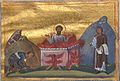
Theodore Tiron

St Theodore was the patron saint of Venice before the relics of Saint Mark were (according to tradition) brought to the city in 828. The original chapel of the Doge was dedicated to St Theodore, though, after the translation of the relics of St Mark, it was superseded by the church of St Mark.

There is some doubt whether this first patron of Venice was Theodore of Amasea or Theodore of Heraclea, although Demus opted emphatically for the latter in 1960[50] and was followed in this by Fenlon.[51] However, Demus later noted that none of the 12th-century mosaics which show St Theodore mentions more than his name and that he may have become the patron of the city before the two saints were distinguished.[52] In fact the Venetians never appear to have made any distinction between the different St Theodores. None of the mosaics in Venice's St Mark's Basilica show him in military dress.

There were 15 churches in Constantinople dedicated to St Theodore, who was a Greek saint, specially venerated by the Eastern church. Venice had originally been a subject city of the Eastern Roman Empire, and the Venetians saw St Theodore as a symbol of their subjection to Constantinople. The adoption of St Mark as their patron helped to establish their independence.

The new church of St Mark was built between the old chapel of St Theodore and the Ducal Palace. When this was enlarged and rebuilt in the late 11th century, the chapel of St Theodore disappeared in the rebuilding. There is today a small chapel dedicated to St Theodore, behind St Mark's church, but this was not built until 1486. (It was later occupied by the Inquisition in Venice).

Sculpture of St Theodore in Venice

The two Byzantine columns in the Piazzetta in Venice were set up soon after 1172. The eastern column bears a strange animal representing the winged lion of St Mark. A statue representing St Theodore was placed on the western column in 1372, but this was not the statue now to be seen there, which is a composite of several fragments, some antique, including a crocodile to represent a dragon, and was placed there in the second half of the 15th century.[53] The statue on the pillar is now a copy of the original, which is kept elsewhere for its preservation.

Reputed relics of St Theodore were taken from Mesembria by a Venetian admiral in 1257 and, after being first placed in a Venetian church in Constantinople, were brought to Venice in 1267. They were placed in the church of San Salvatore.[54]

[edit]

See also

[edit]

Notes

[edit]

References

[edit]
[edit]
Revisions and contributorsEdit on WikipediaRead on Wikipedia
from Grokipedia
Saint Theodore the Tyro (Greek: Θέοδωρος ὁ Τύρων, Theodoros ho Tyron; Latin: Theodorus Tiro; died c. 306 AD), also known as Theodore of Amasea or Theodore Tiron, was an early Christian martyr and Roman soldier from Euchaita in Pontus (modern northern Turkey). Conscripted into the Roman army during the Great Persecution under Emperors Diocletian and Maximian around 303 AD, he refused imperial orders to sacrifice to pagan deities, instead reportedly setting fire to a temple dedicated to the goddess Rhea (Cybele) and an idol within it. Arrested, tortured—including beatings, starvation, and threats—and steadfastly confessing his faith, Theodore was ultimately sentenced to death by burning alive in the city of Amasea. Venerated as a in the Eastern Orthodox, Oriental Orthodox, and , Theodore's relics were translated to Euchaita, where a major shrine developed, and his intercession is invoked against and for soldiers. His feast day is observed on March 17 in the liturgical calendar, with additional commemoration on the first Saturday of tied to a reported : appearing in a vision to Eudoxius of (c. 360–370 AD), he instructed the faithful to consume kollyva (boiled grains symbolizing ) after imperial forces had contaminated the city's grain stores with blood during , thus preserving Christian observance. Often depicted in Byzantine icons as a youthful warrior slaying a dragon—symbolizing triumph over evil or heresy—Theodore is one of the most prominent non-apostolic military saints, frequently paired with Saint (the General), though the two are distinct figures from different regions and martyrdoms. Accounts of his life derive primarily from hagiographic traditions preserved in synaxaria and menologia, with limited corroboration from contemporary Roman records of the , emphasizing his role as a model of fidelity amid coercion.

Identity and Nomenclature

Alternative Names and Etymology

Theodore Tiron is known by several alternative names in historical and liturgical traditions, including Theodore the Recruit (Greek: Θεόδωρος ὁ Τήρων, Theodōros ho Tērōn), Theodore , Theodore Tiro, and Theodore of Amasea. The "Tiron," "Tyro," or "Tiro" originates from the Latin tiro, denoting a newly enlisted or raw recruit in the Roman , which aligns with accounts of his brief service in the Legio Valeriorum stationed in Amasea, Pontus, around 303 AD. This designation distinguishes him from other martyrs bearing the name Theodore, such as ("the General"), and reflects early hagiographic emphasis on his novice status rather than seasoned command. The personal name Theodore derives from Theódōros (Θεόδωρος), a compound of theós (θεός, "god") and dôron (δῶρον, "gift"), literally translating to "gift of God." This etymology, common in early Christian naming conventions, underscores the theological motif of divine favor in martyrdom narratives, though no primary sources attribute a specific baptismal or secular alias to Tiron beyond identifiers. Regional variants, such as "Theodore the Oriental" or associations with Euchaita (his purported shrine site), appear in later Byzantine texts but lack attestation in the earliest from the fourth century.

Distinction from Theodore Stratelates

Theodore Tiron, also known as Theodore the Recruit or Theodore of Amasea, and , known as Theodore the General or Theodore of Heraclea, are recognized as two distinct saints in Eastern Orthodox tradition, despite sharing similar hagiographic elements as warrior martyrs under Roman . Theodore Tiron served as a low-ranking recruit (tiro) in the stationed in Amasea, Pontus, where he was martyred circa 306 AD by burning after refusing to offer sacrifices to pagan idols. In contrast, Theodore Stratelates held the rank of (general) and commanded troops in Euchaita or Heraclea, Pontus, suffering martyrdom around 319–320 AD under , involving scourging, torture, and eventual beheading. Early passiones and synaxaria initially blurred their identities, with some accounts merging elements due to regional shrine proximities in Pontus and shared military motifs, but by the Byzantine period, liturgical calendars and menologia treated them separately, assigning Theodore Tiron a primary feast on March 17 and on February 8. Iconographic conventions further delineate them: Theodore Tiron is typically depicted as youthful and beardless or with a single-pointed , emphasizing his recruit status, while appears mature, bearded with a forked , and armored as a commander, often shown together in paired compositions facing each other to highlight their complementary roles as protector saints. Scholarly analysis of primary sources, such as the , preserves distinct martyrdom scenes—Theodore Tiron immolated by fire and subjected to preliminary flagellation—affirming their separation despite hagiographic cross-pollination from oral traditions and relic veneration at sites like the original Euchaita shrine, initially linked to Tiron before Stratelates' cult developed. This distinction underscores the Orthodox emphasis on individualized saintly , with each Theodore invoked for specific military or protective needs, rather than as a singular .

Historical Background

Christian Persecution in the Early Fourth Century

The Great of , initiated by Emperor on February 23, 303, marked the most systematic and widespread imperial effort to eradicate in the . Prompted by consultations with pagan oracles and pressure from Caesar , the first edict ordered the demolition of church buildings, the burning of sacred scriptures, and the deprivation of civil rights for , including the release of Christian slaves by their masters. were imprisoned but not initially compelled to to Roman gods, reflecting an initial focus on institutional suppression rather than mass execution. Enforcement was uneven: in the western provinces under , compliance was minimal with little bloodshed, whereas in the East under and , officials aggressively razed structures and confiscated texts, as documented in provincial records from and . Subsequent edicts escalated the . A second in late 303 or early 304 mandated the arrest and forced sacrifice of all , while a third in 303-304 offered conditional pardon to those who complied, and the fourth in 304 universalized the sacrifice requirement under threat of death, torture, or enslavement for non-compliance. In the eastern provinces, including Asia Minor, governors like those in Pontus and implemented these measures harshly, targeting military personnel and urban Christians; soldiers faced discharge or execution for refusing participation, aligning with broader efforts to restore traditional Roman piety amid perceived threats to imperial stability. Estimates of martyrs vary, but contemporary accounts report thousands executed or tortured via methods such as burning, beheading, or exposure to wild beasts, though rates were high due to offers of reprieve. Regional variations persisted post-Diocletian's abdication in 305, with intensifying enforcement until his on April 30, 311, which partially rescinded penalties in response to empire-wide disruptions. This persecution's context in Asia Minor, where Theodore Tiron reportedly served, underscores its impact on the : edicts explicitly barred from legionary service unless they sacrificed, leading to purges in garrisons near the Persian frontier. Pontus Polemoniacus, encompassing Amasea, fell under intense scrutiny as a strategic , with local officials enforcing compliance amid Diocletian's tetrarchic reforms emphasizing loyalty oaths. The era's violence subsided variably after 311, culminating in the in 313 under Constantine and , but residual enforcement under Maximinus Daia prolonged suffering in the East until his defeat. Scholarly assessments, drawing from and , affirm the persecution's scale—destroying perhaps half of known church sites—yet note its ultimate failure to extirpate the , as Christian resilience and administrative inconsistencies undermined total enforcement.

Roman Military Service and Asia Minor Context

Theodore the Recruit (Tyro), traditionally depicted as a young Christian soldier, enlisted in the Roman army as a tiro—a newly recruited —stationed in Amaseia, the administrative center of Pontus province in northeastern Asia Minor. Pontus, bordering the , formed part of the Roman Empire's eastern frontier, where legions maintained garrisons to counter incursions from nomadic tribes such as the and to the north, as well as Persian threats from the southeast. Recruits like Theodore typically underwent basic training in cohortes tyronum (training cohorts) before integration into active units, often drawn from local provincial populations to bolster manpower amid ongoing reforms under , who expanded the army to approximately 500,000 men by dividing legions into smaller comitatenses and limitanei forces. In the early fourth century, Asia Minor's military landscape reflected the Tetrarchy's emphasis on border defense and internal stability, with Pontus integrated into the diocese of Pontus under eastern imperial authority. Amaseia, as a fortified city and regional hub, hosted detachments tasked with securing trade routes and suppressing unrest, including during the Great Persecution initiated by Diocletian's edicts of 303 AD, which mandated sacrifices to pagan gods and targeted military personnel for their visibility and loyalty oaths. Christian soldiers, comprising a growing minority in the ranks—estimated at up to 10-20% in some eastern units by the late third century—faced expulsion or execution for refusing compliance, as imperial rescripts explicitly purged "superstitious" elements to ensure unit cohesion and divine favor. Theodore's service coincided with this tension under Licinius, who governed the East from 308 AD and enforced anti-Christian measures in Pontus by 306-311 AD, despite later nominal tolerance via the 313 Edict of Milan. Hagiographic accounts, preserved in fifth-century passions, portray Theodore concealing his faith during enlistment but revealing it amid orders to venerate idols, aligning with documented cases of military martyrdoms in Asia Minor, such as the in neighboring around 320 AD. These narratives, while embellished, reflect empirical patterns of persecution in frontier provinces, where governors like Publius of Amaseia wielded authority to enforce loyalty tests on troops, exacerbating divisions in diverse, multi-ethnic legions. The region's Christian communities, evangelized since apostolic times, supplied recruits who navigated dual allegiances until imperial policy forced confrontation.

Account of Martyrdom

Enlistment and Initial Confrontation

Theodore, known as the tiro or recruit, enlisted in the during the early fourth century, likely around 306 AD amid the Great Persecution initiated by Emperors and . Assigned to a cohort or the legio Marmaritarum, he was stationed for winter quarters in Amaseia (modern ), a in the province of Pontus, Asia Minor, on the coast. Under the command of Praepositus Brincas (or Brincus), Theodore faced an imperial edict mandating to offer sacrifices to pagan deities, including idols associated with or Rhea. When ordered to comply, he refused, publicly confessing his Christian faith and declaring that he recognized Christ alone as his king, rejecting service to "evil images" or any demanding . Granted a brief period by his superiors to reconsider, Theodore instead escalated his defiance by entering a pagan temple in Amaseia and setting it ablaze, destroying the idol of Rhea within. This act of , interpreted in hagiographic accounts as a bold rejection of , prompted his immediate accusation by the military book-keeper Cronides and arrest, leading to his presentation before the local governor, Publius, for formal interrogation.

Trial, Torture, and Execution

Theodore was arrested in Amasea, Pontus, around 306 AD during the Great Persecution under co-emperor (or ), following his refusal to offer sacrifices to pagan idols as ordered for military recruits during . He was initially imprisoned and subjected to starvation, but upon being brought before the provincial governor Publius for interrogation, he boldly confessed his Christian faith, denounced the worship of "lifeless idols," and admitted to burning the temple of Rhea and destroying its idol. Publius, enraged by Theodore's defiance, ordered him subjected to physical torments, which the endured with remarkable fortitude, reciting and astonishing the executioners and onlookers with his lack of apparent suffering. To afford him a final opportunity to recant and save his life, the governor granted Theodore three days of respite, during which the fasted, prayed, and remained steadfast in his refusal to apostatize. Upon his unyielding response, Publius condemned Theodore to death by burning and handed him over to executioners for additional cruelties before leading him to the prepared pyre. The martyr made the sign of the cross, lay down upon the wood, blessed God for deeming him worthy of martyrdom, and entered the flames praising Christ; traditional accounts report that divine grace cooled the fire around him initially, allowing him to continue his prayers until his soul visibly ascended to heaven as witnesses looked on. His remains were later recovered by Christians and interred initially near Euchaita.

Variations in Early Passions

The earliest surviving passion narrative of Theodore Tiron, preserved in Greek manuscripts and dating to the fifth century, recounts his refusal to sacrifice as a new recruit (tiro) in the Roman legion at Amasea in Pontus, his arson of a temple dedicated to Cybele (Rhea) containing idols and sacrificial meat, subsequent arrest by the temple verger, interrogation before governor Publius, suspension and laceration with iron rakes, and execution by immolation in a fire-filled structure on February 17, circa 306 during the Great Persecution. This anonymous text, classified under BHG 1763 in the Bibliotheca Hagiographica Graeca, forms the basis for subsequent accounts but includes anachronistic placement under Emperor Maximian rather than Licinius, the actual regional persecutor after 306. Variations across early recensions, as analyzed by hagiographer Hippolyte Delehaye, primarily concern the locus of events, shifting from Amasea—supported by late-fourth-century testimonies like Gregory of Nyssa's —to Euchaita, the emerging cult center 50 kilometers inland, likely to localize relics and patronage. In Euchaita-oriented versions, the temple arson and trial occur there, prompting local uproar upon discovery, while retaining the core sequence of defiance, torture, and fiery martyrdom; these adaptations appear in fifth- and sixth-century manuscripts, reflecting cultic promotion rather than historical revision. Minor divergences include phrasing of Theodore's taunting compliance with orders to consume idol-offered meat—portrayed in some as feigned purchase of wheat mimicking (boiled grain) shared with comrades, emphasizing Lenten fasting—versus direct temple desecration in others, and details of his pre-execution amid flames, where his soul visibly ascends in select texts. The governor's name remains Publius across primitives, but rhetorical expansions in sixth-century Latin translations and Syriac fragments add Christological typology, portraying Theodore as an "alter Christus" without altering causal events. Delehaye's critical edition highlights these as interpolations for homiletic use, preserving the primitive narrative's empirical focus on military obedience clashing with demands.

Legendary Elements

Miracle of the Kolyva

In Orthodox hagiographic tradition, the Miracle of the Kolyva recounts a post-mortem intervention by Saint Theodore the Recruit approximately fifty years after his martyrdom in 306 AD, during the reign of Julian the Apostate (r. 361–363). Julian, seeking to undermine Christian observance of , ordered the pollution of market foods in with sacrificial offerings to pagan idols, compelling Christians to consume ritually unclean provisions or face starvation. The saint appeared in a vision to Eudoxius of (r. 360–370), alerting him to the emperor's scheme and instructing the faithful to abstain from tainted foods. When Eudoxius inquired about sustenance alternatives, Theodore recommended preparing kolyva—boiled wheat grains, a customary offering from his native Euchaita in Asia Minor—adorned with , nuts, and spices to symbolize and abundance. The duly distributed kolyva to the populace from , thwarting Julian's intent and preserving Lenten purity. This narrative, preserved in synaxaria and liturgical texts, established kolyva as a enduring symbol in Eastern Christian commemorations for the departed, evoking John 12:24 ("Unless a grain of wheat falls into the earth and dies, it remains alone; but if it dies, it bears much fruit"). Nectarius of (r. 381–397) formalized the feast on the first Saturday of to honor the event, integrating it into the with the distribution of blessed kolyva during services.

Dragon-Slaying and Heroic Exploits

In later hagiographic traditions, Saint Theodore the Tyro is credited with slaying a dragon that terrorized the inhabitants of Euchaita in Pontus. According to these accounts, while his military cohort was stationed near the town around 303 AD, Theodore learned of a monstrous serpent dwelling in a nearby swamp, which devoured humans and livestock, prompting the locals to offer sacrifices, including children, to appease it. Armed only with the sign of the cross and a spear or , Theodore confronted the beast, invoking Christ's aid before piercing and killing it in a , thereby liberating the region from its depredations. This exploit is narrated in the Greek passion BHG 1764, with the motif appearing in versions no earlier than the eighth or ninth century, reflecting a broader Byzantine hagiographic trend of ascribing dragon-slaying to warrior saints as symbolic victories over demonic forces. The narrative parallels the later dragon-slaying legend of Saint George, with Theodore initially bearing the motif before its transfer, as evidenced in early icons and seals depicting him as an equestrian warrior spearing a dragon. These heroic tales elevated Theodore's status as a protector against , influencing his as a patron of soldiers and those facing peril, though scholars view the story as a pious rather than historical fact, drawing from classical and biblical imagery of chaos monsters. Additional exploits in folk traditions, particularly Slavic byliny, portray Theodore as a engaging in epic battles against serpentine foes, expanding his role from to , but these derive from the core Euchaita dragon legend without primary early attestation.

Additional Miracles and Narrative Expansions

A collection of eight posthumous miracles attributed to Theodore the Recruit is preserved in an eleventh-century from Euchaita, his primary center, detailing interventions primarily protective in nature against invaders and personal afflictions. These accounts, likely composed between the seventh and eighth centuries based on references to Arab raids and imperial regnal years, expand the saint's role beyond his martyrdom to that of a vigilant guardian of the region. Scholars date specific miracles to events such as the Arab incursions of 663–664 CE under Emperor (or possibly ), where Theodore is depicted repelling attackers and reassuring fleeing inhabitants not to abandon the city. One early miracle involves the miraculously aiding an painter commissioned by Eusebia, a devotee who transported his relics to Euchaita; unable to accurately depict Theodore, the artist receives divine guidance, allowing the 's completion and establishing visual traditions of the . In another, Persian occupiers who desecrate the relics experience sudden recognition of their power, leading to healings that affirm Theodore's sanctity even among non-believers. Protective themes dominate, with Theodore appearing in visions to thwart sieges, deliver captives, and shield the faithful from enemy assaults, reinforcing his as a soldier- intervening in warfare. These narratives, while hagiographic, draw on local topography and historical threats, such as annual Arab winter raids, to legitimize the cult's continuity amid geopolitical instability. Narrative expansions in later Byzantine texts further embellish Theodore's exploits, portraying him as an active combatant in heavenly armies, a motif that blurred distinctions with Theodore Stratilates and facilitated with pagan archetypes like . By the eighth century, miracles invoked during iconoclastic debates positioned Theodore as a defender of orthodox imagery, with accounts alleging his relics' efficacy against imperial policies under (r. 741–775 CE). Such developments, preserved in Euchaitan miracle cycles, elevated the recruit's humble origins into a broader of divine , influencing liturgical texts and across the Orthodox world.

Historicity and Scholarship

Evidence for Historical Existence

The earliest attestation of Theodore the Recruit appears in a homily by Gregory of Nyssa, composed in the late fourth century, which describes him as a Christian soldier stationed in Amasea (modern , ) who refused orders to sacrifice to pagan idols during the Great Persecution under Emperor Maximinus Daia, circa 306 AD. Gregory, preaching at a sanctuary dedicated to Theodore, provides specific details including the involvement of a local governor named Publius, imprisonment, torture, and execution by burning, suggesting reliance on local tradition or records preserved in Pontus. This source, dated between 379 and 394 AD, emerges roughly 70–90 years after the alleged martyrdom, indicating an established cult but lacking eyewitness corroboration. A contemporary confirmation comes from a sermon by Nectarius of (died 397 AD), which similarly recounts Theodore's , defiance of imperial edicts against Christians, and fiery death in Amasea, reinforcing the narrative's circulation in ecclesiastical circles by the end of the fourth century. Notably absent are references in earlier chroniclers of the persecution, such as of Caesarea (died 339 AD), whose accounts of martyrs in Asia Minor and military contexts omit Theodore despite detailing similar cases of executions. This gap implies either limited documentation or that Theodore's story gained prominence post-persecution through oral or localized transmission rather than immediate imperial records. Subsequent passions (narrative acts of martyrdom) for Theodore Tiron, preserved in Greek manuscripts, date to the fifth or sixth century, with Hippolyte Delehaye identifying the oldest in his 1909 analysis of saints' legends as a composite text blending historical elements with expansions, such as dialogues and miracles. Delehaye, a Bollandist scholar specializing in critical , argues that while embellishments abound—typical of Greek passiones militum—the core of a Pontic soldier's refusal to apostatize aligns with verifiable patterns of Diocletianic enforcement in legions, where recruits (tirones) faced coerced sacrifices. No archaeological , such as inscriptions or early relics tied to Amasea, directly confirms Theodore's , though the cult's anchoring to that site (distinct from the separate of Euchaita) points to regional specificity unlikely for pure invention. Scholarly evaluations, including those in Byzantine hagiographic studies, generally posit a historical kernel: the timing fits documented edicts against Christian soldiers (e.g., Galerius's 303 rescripts), and the of the reluctant recruit-martyr recurs in credible persecutions without evident fabrication motives beyond veneration. However, the absence of Latin or Syriac parallels and reliance on fourth-century —potentially shaped by rhetorical needs—leaves room for , as causal chains from event to record involve unverifiable oral stages prone to idealization. Consensus holds the figure probable but unprovable absent new epigraphic finds, privileging the tradition's coherence over dismissal as .

Critical Evaluation of Hagiographic Sources

The hagiographic dossier of Theodore Tiron comprises multiple Greek Passions spanning the fifth to eleventh centuries, with the earliest, known as the Passio prima (BHG and ), critically edited by Hippolyte Delehaye and subjected to detailed scrutiny by Pio Franchi de' Cavalieri for its textual integrity and dependencies. These accounts uniformly follow the conventions of martyr literature, including stereotyped judicial interrogations, escalating tortures, and interventions, which betray literary fabrication over eyewitness testimony. Such formulaic elements, drawn from earlier passions like those of Roman soldiers under , indicate that the narratives prioritize moral and theological instruction—emphasizing steadfast confession and divine vindication—rather than empirical reconstruction of events purportedly occurring in 306 under Maximinus Daia. An attributed to , datable to the 380s, constitutes the cult's initial literary attestation but operates as oratory, extolling the saint's virtues through hyperbolic and typological linking him to figures, without providing verifiable chronological or biographical particulars. Delehaye's broader methodological framework for hagiographic criticism classifies such texts as prone to legendary expansion, where historical kernels, if present, become obscured by accretions serving communal devotion; for Theodore, this manifests in improbable details like the consumption of a pagan idol, absent from any contemporaneous secular of the Amasea persecution. The lack of corroboration in non-Christian sources, such as imperial edicts or local inscriptions from Pontus, underscores the unreliability of these elements, as no administrative documentation aligns with the specific recruit's defiance or execution by burning followed by bodily preservation. Scholarly consensus, as articulated in John Haldon's examination of the evolving dossier, views the sources as products of post-Constantinian cultic needs, adapting a possibly authentic of a fourth-century to resonate with Byzantine audiences amid ongoing frontier warfare; yet, the progressive elaboration—evident in later variants incorporating dragon-slaying motifs or expanded miracles—reveals causal priorities of and over factual fidelity. While archaeological traces of the Euchaita affirm early by circa 400, suggesting a non-fictitious origin for the figure, the hagiographies' anonymity, late composition relative to the claimed martyrdom, and internal anachronisms (e.g., judicial procedures mismatched to early fourth-century practice) preclude their use as straightforward , rendering them valuable primarily for insights into formation rather than biographical veracity.

Debates on Syncretism and the Two Theodores

Scholars have long debated the relationship between the two early Christian military martyrs known as Theodore the Recruit (Tiro or Tyron) of Amasea and (the General) of Heraclea, questioning whether they represent distinct historical figures or a single martyr whose legend was divided over time. Theodore the Recruit is commemorated for his martyrdom in 306 under Emperor Maximinus Daia, after burning a pagan temple in Amasea, while is recorded as executed in 319 under at Heraclea (possibly Euchaita). Early hagiographic sources, such as the passions attributed to both, exhibit similarities in motifs, including defiance of imperial orders and post-mortem miracles, leading some to argue for a common origin. Hippolyte Delehaye proposed that the Recruit and the General were likely the same individual, with later traditions splitting the figure to accommodate differing regional cults and narrative needs. Conversely, analyses of distinct passio texts and liturgical commemorations—Tyro on March 17 (or February 17 in some calendars) and Stratelates on February 8—support their separation as independent martyrs, though hagiographers may have borrowed elements between them. John Haldon's edition of their martyrdoms and miracles treats them as two saints, highlighting unique narrative developments while noting overlapping wonderworking traditions. The emergence of a separate Stratelates cult appears limited before the ninth century, suggesting possible later elaboration from the Amasean prototype. Syncretistic debates center on how these figures absorbed pagan archetypes, positioning Theodore as the prototype for Byzantine saints like George and . Dragon-slaying legends attributed to both Theodores echo Greco-Roman myths, such as Apollo's combat with Python or heroes bearing the draco standard, potentially overlaying Christian martyrdom onto indigenous Anatolian or Thracian cultic practices. Early icons depict Theodore with attributes akin to imperial standards, indicating adaptation of Roman cults into Christian , though direct pagan precedents remain conjectural without epigraphic evidence predating the fourth century. Such elements likely facilitated the saints' appeal in border regions, blending monotheistic fidelity with heroic ideals to counter perceptions of as pacifist.

Veneration and Legacy

Origins and Early Cult Centers

The cult of Theodore Tiron, a Roman soldier martyred in Amaseia (modern , ) circa 306 AD during the persecutions under Emperor , originated in the late of Helenopontus in northern Asia Minor. Tradition holds that his body was transported to the nearby town of Euchaita (modern Avkat, Province, ) for burial, establishing it as the primary locus of due to the perceived efficacy of his intercession against local pagan practices. By the late fourth century, Euchaita had developed into a dedicated and cultic center, with the saint's shrine attracting devotees and contributing to the town's elevation to episcopal status before 518 AD under Emperor Anastasius I. Archaeological surveys at Avkat confirm the site's prominence as the epicenter of Theodore's devotion from , marked by fortified structures possibly enclosing the sanctuary by the early sixth century. Literary evidence underscores the cult's rapid consolidation in this period. delivered a praising Theodore's destruction of a in Amaseia, likely around 379 AD, portraying the site as a hub where the saint's relics drew crowds and inspired conversions; this oration, preached near Euchaita, reflects an already organized local veneration emphasizing Theodore's role as a against . Similarly, Asterius, of Amaseia (died circa 410 AD), composed multiple homilies on Theodore's martyrdom, detailing his exploits and miracles, which served to propagate the cult regionally and affirm its doctrinal alignment with emerging orthodox . These texts, among the earliest hagiographic attestations, indicate that by circa 400 AD, Theodore's at Euchaita functioned as a focal point for commemorative feasts and relic-based healings. Early expansion beyond Euchaita included relic translations and secondary foundations. Parts of Theodore's relics were reportedly conveyed to Constantinople by the fifth century, fostering a metropolitan site with a dedicated church, possibly under imperial , that amplified his military-saint across the empire. Inscriptions from central , such as a late antique for a church of Theodore near Apamea (circa fourth to sixth centuries), evidence dissemination to eastern provinces, likely via military networks given his recruit-soldier identity. Distinctions from the contemporaneous of , centered at nearby Euchaina, emerged gradually, with Euchaita's focus on the "Tyro" (recruit) tradition predating clear separation until the century.

Iconographic Representations

Saint Theodore Tiron, known as Theodore the Recruit, is conventionally represented in Byzantine and Eastern Orthodox iconography as a military saint dressed in Roman armor, including a cuirass and greaves, and armed with a spear and round shield, emblematic of his role as a newly enlisted soldier in the imperial legion. These attributes underscore his martyrdom during the Diocletianic Persecution around 303 AD, when he was compelled to destroy a pagan temple as a test of faith. He is typically portrayed as a youthful figure with a dark, pointed beard and curly hair, setting him apart from beardless depictions of saints like George while aligning with the archetype of the armed confessor. In paired icons, Theodore Tiron appears alongside Theodore Stratelates, the two rendered in three-quarter view facing each other, a compositional type that emerged in early Byzantine art and proliferated through the post-Byzantine era, symbolizing their shared patronage over soldiers and their parallel martyrdoms. This dual representation, evident in frescoes from the 11th century onward, such as those in the Menologion of Basil II, emphasizes their distinction: Tiron as the junior recruit versus Stratelates as the commanding general, though visual differentiation relies primarily on inscriptions or subtle pose variations. Occasional narrative icons illustrate specific hagiographic episodes, including the of the kolyva, where Theodore appears instructing believers amid grains, or rare dragon-slaying motifs borrowed from Stratelates' , though these are less canonical for Tiron and reflect later syncretic influences in regional art like from the 17th century. Freestanding or equestrian poses, as in 12th-century frescoes at Church in , integrate him into cycles, often positioned near entrances as a protector against demonic forces. Such depictions persisted in Venetian and Bulgarian monasteries into the 16th–19th centuries, adapting Byzantine prototypes to local styles while retaining core martial symbolism.

Liturgical Commemorations

In the , the primary liturgical commemoration of Saint Theodore the Tyro occurs on , honoring his martyrdom and the subsequent veneration of his relics, with special emphasis on his role as a soldier-martyr who refused to worship pagan idols. This date features dedicated services, including the , troparia, and kontakia that recount his trial under Governor Publius and his burning at the stake in A.D. 306. A distinct observance falls on the first Saturday of , established by Patriarch Nektarios of (381–397) to commemorate Theodore's post-mortem appearance to Eusebius of Euchaita, warning Christians against consuming grain contaminated by imperial edicts mandating idol-meat offerings; this event prompted the tradition of blessing kolyva (boiled wheat mixed with honey and nuts) as a symbol of and abstinence. The service includes the Great Canon of Repentance by Saint , adapted for the occasion, and distribution of kolyva to the faithful, reinforcing themes of spiritual vigilance during the Lenten fast. In the Roman Catholic tradition, Theodore's feast is assigned to in historical martyrologies, reflecting his status as a confessing who endured for upholding Christian against emperor worship, though it receives limited observance in the post-Vatican II general calendar and is more prominent in local or traditionalist rites. Regional variations persist, such as in aligning with Orthodox dates or in folk customs like Bulgaria's Todorovden, where horse blessings and rituals echo Theodore's equestrian patronage on the Lenten .

Regional Devotions and Modern Observance

The veneration of Saint Theodore the Tyro, originating in the region of Pontus and centered at Euchaita in Asia Minor, spread across the and persists in Eastern Orthodox communities. Early cult sites included sanctuaries in Euchaita, where pilgrims sought from the warrior , and extended to areas like in , where churches were dedicated to him shortly after his martyrdom around 306 AD. In , relics attributed to Theodore were enshrined in the Novo Hopovo Monastery by the mid-16th century, fostering local devotion among monastic and lay faithful. Slavic regions incorporated his imagery into , portraying him as a heroic in Russian epic songs, reflecting with pre-Christian warrior archetypes. In modern Eastern Orthodox practice, Theodore's feast on commemorates his martyrdom, with liturgical services emphasizing his refusal to sacrifice to idols while serving in the at Amasea. The first Saturday of , known as Saint Theodore Saturday, honors the of the boiled , where Theodore appeared in a vision to a in 362 AD, instructing the faithful to abstain from grain defiled by Emperor Julian the Apostate and instead consume —a sweetened dish of boiled symbolizing . This observance, instituted by Patriarch Nektarios of (381–397), involves blessing and distributing in churches worldwide, a tradition maintained annually in Greek, Russian, Serbian, and other Orthodox communities to invoke Theodore's protection against famine and heresy. Devotion extends to iconographic and monastic traditions in and Georgia, where frescoes in sites like and Kremikovtsi Monasteries depict Theodore alongside other warrior saints, underscoring his role in defending . Contemporary practices include processions and prayers for military personnel, aligning with his patronal role over soldiers, though primary emphasis remains on Lenten commemorations amid global Orthodox diaspora.

References

Add your contribution
Related Hubs
User Avatar
No comments yet.